Teaching Writing skills
Tahreem Akhter
Writing skills
Have you ever wondered how chefs get to know about cooking?
They may have learned some cooking from their parents or by
watching TV or reading recipe books. Also, they have to practice a
lot in their kitchens. They gradually develop this skill of cooking.
Similarly, in the art of writing, there are some skills too. We use
these skills to make our write-ups interesting and organized. In this
section, we will learn some of the writing skills.
What you Require for Writing Skills?
oAdequate time
oEffective communicative skills in written form.
oRange of vocabulary
oA learner own style
oA goal
oA content
oAfter careful evaluation of the literature, it was found that numerous
researchers discovered the need for ESL students to be exposed to a variety
of genres, strategies, and methods in order to succeed in the writing of
English.
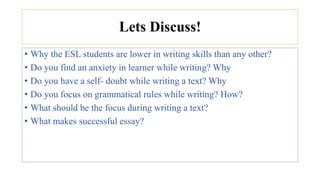
Lets Discuss!
• Why the ESL students are lower in writing skills than any other?
• Do you find an anxiety in learner while writing? Why
• Do you have a self- doubt while writing a text? Why
• Do you focus on grammatical rules while writing? How?
• What should be the focus during writing a text?
• What makes successful essay?
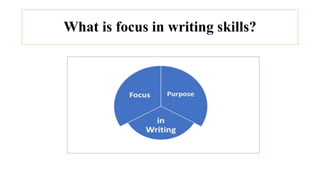
What is focus in writing skills?
Focused writing
• Focused writing is a skill that can
be learned and perfected with
practice. When you focus your
writing, you are able to command
your topic and communicate with
the principles of your message
more effectively. Your readers will
appreciate your clear and concise
writing, and you’ll find that
focused writing can help you save
time and energy in the long run.
How to stay Focused in Writing
• There are different approaches to
writing, but one of the most
important things to keep in mind
is the focus. It can be easy to get
caught up in the distractions of
the world around us. But if we
want to be effective writer, we
need to be able to focus on our
work.
• There are a few different ways
to stay focused while writing.
One way is to set aside a specific
time for writing each day and to
make sure that you don’t allow
yourself to be distracted during
that time. This can be difficult,
especially if you have a busy
lifestyle, but it’s important to try
to stick to your writing schedule
as much as possible.
Improving writing skills
• There are a few questions you can ask yourself to help you identify
your focus and purpose:
1. Who is your audience?
2. What are you writing about?
3. What do you want to achieve with your writing?
• Another way to maintain focus while writing is to set goals for each
writing session. Decide what you want to accomplish during that time,
and then work towards that goal. This can help to keep you from
getting sidetracked, and can also give you a sense of accomplishment
when you reach your goal.
Successful write up
• a study on various ways writers can
write good essays, Crossley, Roscoe,
and McNamara (2014) suggest that
“Successful writing cannot be defined
simply through a single set of
predefined features. Rather, successful
writing has multiple profiles” (p. 184).
Specifically, some successful writers
compose longer essays (Crossley,
Weston, McLain Sullivan, &
McNamara, 2011) with more
infrequent vocabulary (McNamara,
Crossley, & Roscoe, 2013), and fewer
grammatical, spelling, and punctuation
errors (Ferrari, Bouffard, & Rainsville,
1998).
Teaching writing skills
• Teaching writing skills can be a challenging task, but with the right
approach and techniques, it can be a rewarding experience for both
you and your students. Here are some steps you can take to help your
students improve their writing skills:
1. each the writing process
2. Focus on the basics
3. Provide models
4. Encourage creativity
5. Provide feedback
Teach the writing Process
• The writing process involves several stages, including
prewriting,
drafting,
revising,
and publishing.
Teach your students how to go through each of these stages, and
emphasize the importance of planning and revising their work.
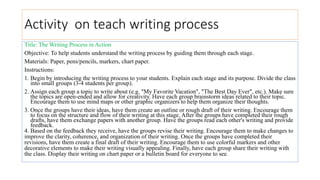
Activity on teach writing process
Title: The Writing Process in Action
Objective: To help students understand the writing process by guiding them through each stage.
Materials: Paper, pens/pencils, markers, chart paper.
Instructions:
1. Begin by introducing the writing process to your students. Explain each stage and its purpose. Divide the class
into small groups (3-4 students per group).
2. Assign each group a topic to write about (e.g. "My Favorite Vacation", "The Best Day Ever", etc.). Make sure
the topics are open-ended and allow for creativity. Have each group brainstorm ideas related to their topic.
Encourage them to use mind maps or other graphic organizers to help them organize their thoughts.
3. Once the groups have their ideas, have them create an outline or rough draft of their writing. Encourage them
to focus on the structure and flow of their writing at this stage. After the groups have completed their rough
drafts, have them exchange papers with another group. Have the groups read each other's writing and provide
feedback.
4. Based on the feedback they receive, have the groups revise their writing. Encourage them to make changes to
improve the clarity, coherence, and organization of their writing. Once the groups have completed their
revisions, have them create a final draft of their writing. Encourage them to use colorful markers and other
decorative elements to make their writing visually appealing. Finally, have each group share their writing with
the class. Display their writing on chart paper or a bulletin board for everyone to see.
Focus on Basics
Make sure your students understand the basics of grammar,
punctuation, and sentence structure. Teach them how to write clear,
concise sentences and how to use proper punctuation and capitalization.
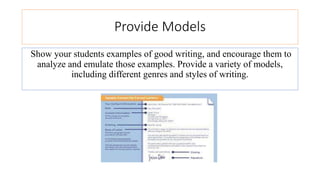
Provide Models
Show your students examples of good writing, and encourage them to
analyze and emulate those examples. Provide a variety of models,
including different genres and styles of writing.
Encourage creativity
• Writing is a form of self-expression, so encourage your students to be
creative in their writing. Allow them to choose their own topics and
give them the freedom to express their ideas in their own unique way.
Provide feedback
Provide feedback on your students' writing, and help them identify
areas where they can improve. Encourage them to revise their work
based on your feedback and provide additional support if needed.

teaching writing skills.pptx

  • 1.
  • 2.
    Writing skills Have youever wondered how chefs get to know about cooking? They may have learned some cooking from their parents or by watching TV or reading recipe books. Also, they have to practice a lot in their kitchens. They gradually develop this skill of cooking. Similarly, in the art of writing, there are some skills too. We use these skills to make our write-ups interesting and organized. In this section, we will learn some of the writing skills.
  • 3.
    What you Requirefor Writing Skills? oAdequate time oEffective communicative skills in written form. oRange of vocabulary oA learner own style oA goal oA content oAfter careful evaluation of the literature, it was found that numerous researchers discovered the need for ESL students to be exposed to a variety of genres, strategies, and methods in order to succeed in the writing of English.
  • 4.
    Lets Discuss! • Whythe ESL students are lower in writing skills than any other? • Do you find an anxiety in learner while writing? Why • Do you have a self- doubt while writing a text? Why • Do you focus on grammatical rules while writing? How? • What should be the focus during writing a text? • What makes successful essay?
  • 5.
    What is focusin writing skills?
  • 6.
    Focused writing • Focusedwriting is a skill that can be learned and perfected with practice. When you focus your writing, you are able to command your topic and communicate with the principles of your message more effectively. Your readers will appreciate your clear and concise writing, and you’ll find that focused writing can help you save time and energy in the long run.
  • 7.
    How to stayFocused in Writing • There are different approaches to writing, but one of the most important things to keep in mind is the focus. It can be easy to get caught up in the distractions of the world around us. But if we want to be effective writer, we need to be able to focus on our work. • There are a few different ways to stay focused while writing. One way is to set aside a specific time for writing each day and to make sure that you don’t allow yourself to be distracted during that time. This can be difficult, especially if you have a busy lifestyle, but it’s important to try to stick to your writing schedule as much as possible.
  • 8.
    Improving writing skills •There are a few questions you can ask yourself to help you identify your focus and purpose: 1. Who is your audience? 2. What are you writing about? 3. What do you want to achieve with your writing? • Another way to maintain focus while writing is to set goals for each writing session. Decide what you want to accomplish during that time, and then work towards that goal. This can help to keep you from getting sidetracked, and can also give you a sense of accomplishment when you reach your goal.
  • 9.
    Successful write up •a study on various ways writers can write good essays, Crossley, Roscoe, and McNamara (2014) suggest that “Successful writing cannot be defined simply through a single set of predefined features. Rather, successful writing has multiple profiles” (p. 184). Specifically, some successful writers compose longer essays (Crossley, Weston, McLain Sullivan, & McNamara, 2011) with more infrequent vocabulary (McNamara, Crossley, & Roscoe, 2013), and fewer grammatical, spelling, and punctuation errors (Ferrari, Bouffard, & Rainsville, 1998).
  • 10.
    Teaching writing skills •Teaching writing skills can be a challenging task, but with the right approach and techniques, it can be a rewarding experience for both you and your students. Here are some steps you can take to help your students improve their writing skills: 1. each the writing process 2. Focus on the basics 3. Provide models 4. Encourage creativity 5. Provide feedback
  • 11.
    Teach the writingProcess • The writing process involves several stages, including prewriting, drafting, revising, and publishing. Teach your students how to go through each of these stages, and emphasize the importance of planning and revising their work.
  • 12.
    Activity on teachwriting process Title: The Writing Process in Action Objective: To help students understand the writing process by guiding them through each stage. Materials: Paper, pens/pencils, markers, chart paper. Instructions: 1. Begin by introducing the writing process to your students. Explain each stage and its purpose. Divide the class into small groups (3-4 students per group). 2. Assign each group a topic to write about (e.g. "My Favorite Vacation", "The Best Day Ever", etc.). Make sure the topics are open-ended and allow for creativity. Have each group brainstorm ideas related to their topic. Encourage them to use mind maps or other graphic organizers to help them organize their thoughts. 3. Once the groups have their ideas, have them create an outline or rough draft of their writing. Encourage them to focus on the structure and flow of their writing at this stage. After the groups have completed their rough drafts, have them exchange papers with another group. Have the groups read each other's writing and provide feedback. 4. Based on the feedback they receive, have the groups revise their writing. Encourage them to make changes to improve the clarity, coherence, and organization of their writing. Once the groups have completed their revisions, have them create a final draft of their writing. Encourage them to use colorful markers and other decorative elements to make their writing visually appealing. Finally, have each group share their writing with the class. Display their writing on chart paper or a bulletin board for everyone to see.
  • 13.
    Focus on Basics Makesure your students understand the basics of grammar, punctuation, and sentence structure. Teach them how to write clear, concise sentences and how to use proper punctuation and capitalization.
  • 14.
    Provide Models Show yourstudents examples of good writing, and encourage them to analyze and emulate those examples. Provide a variety of models, including different genres and styles of writing.
  • 15.
    Encourage creativity • Writingis a form of self-expression, so encourage your students to be creative in their writing. Allow them to choose their own topics and give them the freedom to express their ideas in their own unique way.
  • 16.
    Provide feedback Provide feedbackon your students' writing, and help them identify areas where they can improve. Encourage them to revise their work based on your feedback and provide additional support if needed.