ENZYMES &
BIO-CATALYSIS
Enzymes
◦ Enzymes are biological catalysts, which increase the rate of the reactions taking place within living cells
without themselves undergoing any overall change.
◦ Any biomolecule, either protein or RNA that catalyses a specific chemical reaction, enhances the rate
by providing a reaction path with a lower activation energy can be called an ‘Enzyme’. Enzyme
mediated reactions are the basis of all living organisms.
◦ Many enzyme proteins lack catalytic activity without the presence of a non protein component called a
co-factor. In such a case, the inactive protein component is called ’apoenzyme’. Apoenzyme along with
co factor is called ‘holoenzyme’.
◦ The co factor may be an organic molecule, then it is called a co enzyme, or it may be a metal ion.
◦ When the cofactor is bound tightly to the enzyme so that removing it without damaging the enzyme is
not possible, it is known as ‘prosthetic group’
◦ The SI unit of enzyme activity is defined as the amount of enzyme that will convert I mole of substrate to
product in one second. It has units Katal.
◦ More than 75000 enzymes are known. They are named by adding the suffix “ase” to the substrate they
catalyse. Eg: lipase, urease, protease etc. The only exceptions to this are the proteolytic enzymes, whose
names end with “in”. Eg: trypsin
Concept of Activation energy
◦ A chemical reaction of substrate ‘S’ to form the product ‘P’ goes through a transition
state that has higher free energy.
◦ Enzymes accelerate the reaction by decreasing this free energy, the activation energy.
The combination of enzyme and substrate creates a new reaction pathway whose
transition state energy(activation energy) is lower than before.
◦ Lower activation energy means more number of molecules have the required energy
to reach the transition state and thus get converted to products. Thus reaction rate is
increased.
CLASSIFICATION AND NOMENCLATURE OF
ENZYMES
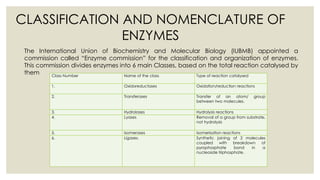
Class Number Name of the class Type of reaction catalysed
1. Oxidoreductases Oxidation/reduction reactions
2. Transferases Transfer of an atom/ group
between two molecules.
3. Hydrolases Hydrolysis reactions
4. Lyases Removal of a group from substrate,
not hydrolysis
5. Isomerases Isomerisation reactions
6. Ligases. Synthetic joining of 2 molecules
coupled with breakdown of
pyrophosphate bond in a
nucleoside triphosphate.
The International Union of Biochemistry and Molecular Biology (IUBMB) appointed a
commission called “Enzyme commission” for the classification and organization of enzymes.
This commission divides enzymes into 6 main Classes, based on the total reaction catalysed by
them
ENZYME NOMENCLATURE
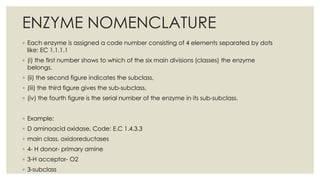
◦ Each enzyme is assigned a code number consisting of 4 elements separated by dots
like: EC 1.1.1.1
◦ (i) the first number shows to which of the six main divisions (classes) the enzyme
belongs,
◦ (ii) the second figure indicates the subclass,
◦ (iii) the third figure gives the sub-subclass,
◦ (iv) the fourth figure is the serial number of the enzyme in its sub-subclass.
◦ Example:
◦ D aminoacid oxidase, Code: E.C 1.4.3.3
◦ main class, oxidoreductases
◦ 4- H donor- primary amine
◦ 3-H acceptor- O2
◦ 3-subclass
Lock & Key Model
◦ This model was proposed by Emil Fischer in 1890, to explain
enzyme-substrate interactions.
◦ According to Fischer, enzyme specificity implied the presence of
complementary structural features between enzyme and
substrate.
◦ A substrate fits into its complementary site on the enzyme just like
a key fits into a lock.
◦ All the structures remain rigid (fixed) throughout the binding
process.
◦ Limitation: Does not account for the flexibility of the proteins. (X
ray diffraction studies, NMR and several other studies have
revealed differences between structures of free and bound
enzymes).
Induced fit Hypothesis
◦ It was proposed by Daniel Koshland in 1958.
◦ The hypothesis suggests that the structure of the substrate may
be complementary to that of active site in enzyme-substrate (ES)
complex, but not in the free enzyme.
◦ A conformation change takes place in the enzyme during the
binding of substrate, which results in formation of required
complementary structures of the active site, to fit the substrate.
◦ According to this hypothesis, the active site of enzyme is floppy
and substrate is rigid, allowing the enzyme to wrap itself around
the substrate ,and in this way bringing together the
corresponding catalytic sites and reacting groups.
◦ It is better than Lock and Key model since it accounts for the
flexibility and also, provides high degree of specificity for the
enzyme.
Factors affecting Enzyme activity
◦ Salt Concentration:
Most enzymes cannot tolerate extremely high salt concentrations. The ions interfere
with the weak ionic bonds of proteins. Typical enzymes are active in salt concentrations
of 1-500 mM. As usual there are exceptions such as the halophilic (salt loving) algae
and bacteria.
◦ Effects of Temperature:
All enzymes work within a range of temperature specific to the organism. Increases in
temperature generally lead to increases in reaction rates. There is a limit to the increase
because higher temperatures lead to a sharp decrease in reaction rates. This is due to
the denaturing (alteration) of protein structure resulting from the breakdown of the
weak ionic and hydrogen bonding that stabilize the three dimensional structure of the
enzyme. The "optimum" temperature for human enzymes is usually between 35 and
40 °C. Enzymes from thermophilic archaea found in the hot springs are stable up to
100 °C.
Factors affecting Enzyme activity
◦ Effects of pH:
Most enzymes are sensitive to pH and have specific ranges of activity. All have an
optimum pH. The pH can stop enzyme activity by denaturing (altering) the three
dimensional shape of the enzyme by breaking ionic, and hydrogen bonds. Most
enzymes function between a pH of 6 and 8; however pepsin in the stomach works best
at a pH of 2 and trypsin at a pH of 8.
◦ Substrate Saturation:
Increasing the substrate concentration increases the rate of reaction (enzyme activity).
However, enzyme saturation limits reaction rates. An enzyme is saturated when the
active sites of all the molecules are occupied most of the time. At the saturation point,
the reaction will not speed up, no matter how much additional substrate is added.
Enzyme Inhibition
◦ Inhibitors are substances which tend to decrease the rate of an enzyme catalyzed reaction.
◦ Reversible Inhibition:
Reversible inhibition bind to an enzyme in a reversible fashion and can be removed by dialysis or simple
dilution to remove to restore full enzymatic activity whereas irreversible inhibitors cannot be removed from
an enzyme by dialysis.
1. Competitive Inhibition:
Competitive inhibitors closely resemble the substrates they inhibit and compete for the same binding site on the
enzyme.
2. Uncompetitive Inhibition:
Uncompetitive inhibitors bind only to the enzyme-substrate complex and not to the enzyme. Hence, increasing the
substrate conc does not overcome inhibition.
3. Non-competitive Inhibition:
A non-competitive inhibitor binds at a different site from the substrate. Consider the case only where the inhibitor
destroys catalytic activity of enzyme either by binding to the catalytic site or as a result of a conformational
change affecting the catalytic site but does not affect substrate binding thereby producing a dead end complex.
◦ Irreversible Inhibition:
An irreversible inhibitor binds to the active site of the enzyme by an irreversible reaction and cannot
subsequently dissociate from it. A covalent bond is usually formed between inhibitor and enzyme.
E + I EI
Feedback inhibition
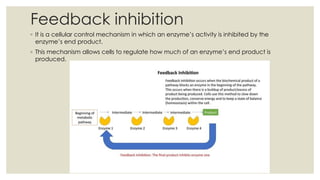
◦ It is a cellular control mechanism in which an enzyme’s activity is inhibited by the
enzyme’s end product.
◦ This mechanism allows cells to regulate how much of an enzyme’s end product is
produced.

Enzymes&biocatalysis

  • 1.
  • 2.
    Enzymes ◦ Enzymes arebiological catalysts, which increase the rate of the reactions taking place within living cells without themselves undergoing any overall change. ◦ Any biomolecule, either protein or RNA that catalyses a specific chemical reaction, enhances the rate by providing a reaction path with a lower activation energy can be called an ‘Enzyme’. Enzyme mediated reactions are the basis of all living organisms. ◦ Many enzyme proteins lack catalytic activity without the presence of a non protein component called a co-factor. In such a case, the inactive protein component is called ’apoenzyme’. Apoenzyme along with co factor is called ‘holoenzyme’. ◦ The co factor may be an organic molecule, then it is called a co enzyme, or it may be a metal ion. ◦ When the cofactor is bound tightly to the enzyme so that removing it without damaging the enzyme is not possible, it is known as ‘prosthetic group’ ◦ The SI unit of enzyme activity is defined as the amount of enzyme that will convert I mole of substrate to product in one second. It has units Katal. ◦ More than 75000 enzymes are known. They are named by adding the suffix “ase” to the substrate they catalyse. Eg: lipase, urease, protease etc. The only exceptions to this are the proteolytic enzymes, whose names end with “in”. Eg: trypsin
  • 3.
    Concept of Activationenergy ◦ A chemical reaction of substrate ‘S’ to form the product ‘P’ goes through a transition state that has higher free energy. ◦ Enzymes accelerate the reaction by decreasing this free energy, the activation energy. The combination of enzyme and substrate creates a new reaction pathway whose transition state energy(activation energy) is lower than before. ◦ Lower activation energy means more number of molecules have the required energy to reach the transition state and thus get converted to products. Thus reaction rate is increased.
  • 4.
    CLASSIFICATION AND NOMENCLATUREOF ENZYMES Class Number Name of the class Type of reaction catalysed 1. Oxidoreductases Oxidation/reduction reactions 2. Transferases Transfer of an atom/ group between two molecules. 3. Hydrolases Hydrolysis reactions 4. Lyases Removal of a group from substrate, not hydrolysis 5. Isomerases Isomerisation reactions 6. Ligases. Synthetic joining of 2 molecules coupled with breakdown of pyrophosphate bond in a nucleoside triphosphate. The International Union of Biochemistry and Molecular Biology (IUBMB) appointed a commission called “Enzyme commission” for the classification and organization of enzymes. This commission divides enzymes into 6 main Classes, based on the total reaction catalysed by them
  • 5.
    ENZYME NOMENCLATURE ◦ Eachenzyme is assigned a code number consisting of 4 elements separated by dots like: EC 1.1.1.1 ◦ (i) the first number shows to which of the six main divisions (classes) the enzyme belongs, ◦ (ii) the second figure indicates the subclass, ◦ (iii) the third figure gives the sub-subclass, ◦ (iv) the fourth figure is the serial number of the enzyme in its sub-subclass. ◦ Example: ◦ D aminoacid oxidase, Code: E.C 1.4.3.3 ◦ main class, oxidoreductases ◦ 4- H donor- primary amine ◦ 3-H acceptor- O2 ◦ 3-subclass
  • 6.
    Lock & KeyModel ◦ This model was proposed by Emil Fischer in 1890, to explain enzyme-substrate interactions. ◦ According to Fischer, enzyme specificity implied the presence of complementary structural features between enzyme and substrate. ◦ A substrate fits into its complementary site on the enzyme just like a key fits into a lock. ◦ All the structures remain rigid (fixed) throughout the binding process. ◦ Limitation: Does not account for the flexibility of the proteins. (X ray diffraction studies, NMR and several other studies have revealed differences between structures of free and bound enzymes).
  • 7.
    Induced fit Hypothesis ◦It was proposed by Daniel Koshland in 1958. ◦ The hypothesis suggests that the structure of the substrate may be complementary to that of active site in enzyme-substrate (ES) complex, but not in the free enzyme. ◦ A conformation change takes place in the enzyme during the binding of substrate, which results in formation of required complementary structures of the active site, to fit the substrate. ◦ According to this hypothesis, the active site of enzyme is floppy and substrate is rigid, allowing the enzyme to wrap itself around the substrate ,and in this way bringing together the corresponding catalytic sites and reacting groups. ◦ It is better than Lock and Key model since it accounts for the flexibility and also, provides high degree of specificity for the enzyme.
  • 8.
    Factors affecting Enzymeactivity ◦ Salt Concentration: Most enzymes cannot tolerate extremely high salt concentrations. The ions interfere with the weak ionic bonds of proteins. Typical enzymes are active in salt concentrations of 1-500 mM. As usual there are exceptions such as the halophilic (salt loving) algae and bacteria. ◦ Effects of Temperature: All enzymes work within a range of temperature specific to the organism. Increases in temperature generally lead to increases in reaction rates. There is a limit to the increase because higher temperatures lead to a sharp decrease in reaction rates. This is due to the denaturing (alteration) of protein structure resulting from the breakdown of the weak ionic and hydrogen bonding that stabilize the three dimensional structure of the enzyme. The "optimum" temperature for human enzymes is usually between 35 and 40 °C. Enzymes from thermophilic archaea found in the hot springs are stable up to 100 °C.
  • 9.
    Factors affecting Enzymeactivity ◦ Effects of pH: Most enzymes are sensitive to pH and have specific ranges of activity. All have an optimum pH. The pH can stop enzyme activity by denaturing (altering) the three dimensional shape of the enzyme by breaking ionic, and hydrogen bonds. Most enzymes function between a pH of 6 and 8; however pepsin in the stomach works best at a pH of 2 and trypsin at a pH of 8. ◦ Substrate Saturation: Increasing the substrate concentration increases the rate of reaction (enzyme activity). However, enzyme saturation limits reaction rates. An enzyme is saturated when the active sites of all the molecules are occupied most of the time. At the saturation point, the reaction will not speed up, no matter how much additional substrate is added.
  • 10.
    Enzyme Inhibition ◦ Inhibitorsare substances which tend to decrease the rate of an enzyme catalyzed reaction. ◦ Reversible Inhibition: Reversible inhibition bind to an enzyme in a reversible fashion and can be removed by dialysis or simple dilution to remove to restore full enzymatic activity whereas irreversible inhibitors cannot be removed from an enzyme by dialysis. 1. Competitive Inhibition: Competitive inhibitors closely resemble the substrates they inhibit and compete for the same binding site on the enzyme. 2. Uncompetitive Inhibition: Uncompetitive inhibitors bind only to the enzyme-substrate complex and not to the enzyme. Hence, increasing the substrate conc does not overcome inhibition. 3. Non-competitive Inhibition: A non-competitive inhibitor binds at a different site from the substrate. Consider the case only where the inhibitor destroys catalytic activity of enzyme either by binding to the catalytic site or as a result of a conformational change affecting the catalytic site but does not affect substrate binding thereby producing a dead end complex. ◦ Irreversible Inhibition: An irreversible inhibitor binds to the active site of the enzyme by an irreversible reaction and cannot subsequently dissociate from it. A covalent bond is usually formed between inhibitor and enzyme. E + I EI
  • 11.
    Feedback inhibition ◦ Itis a cellular control mechanism in which an enzyme’s activity is inhibited by the enzyme’s end product. ◦ This mechanism allows cells to regulate how much of an enzyme’s end product is produced.