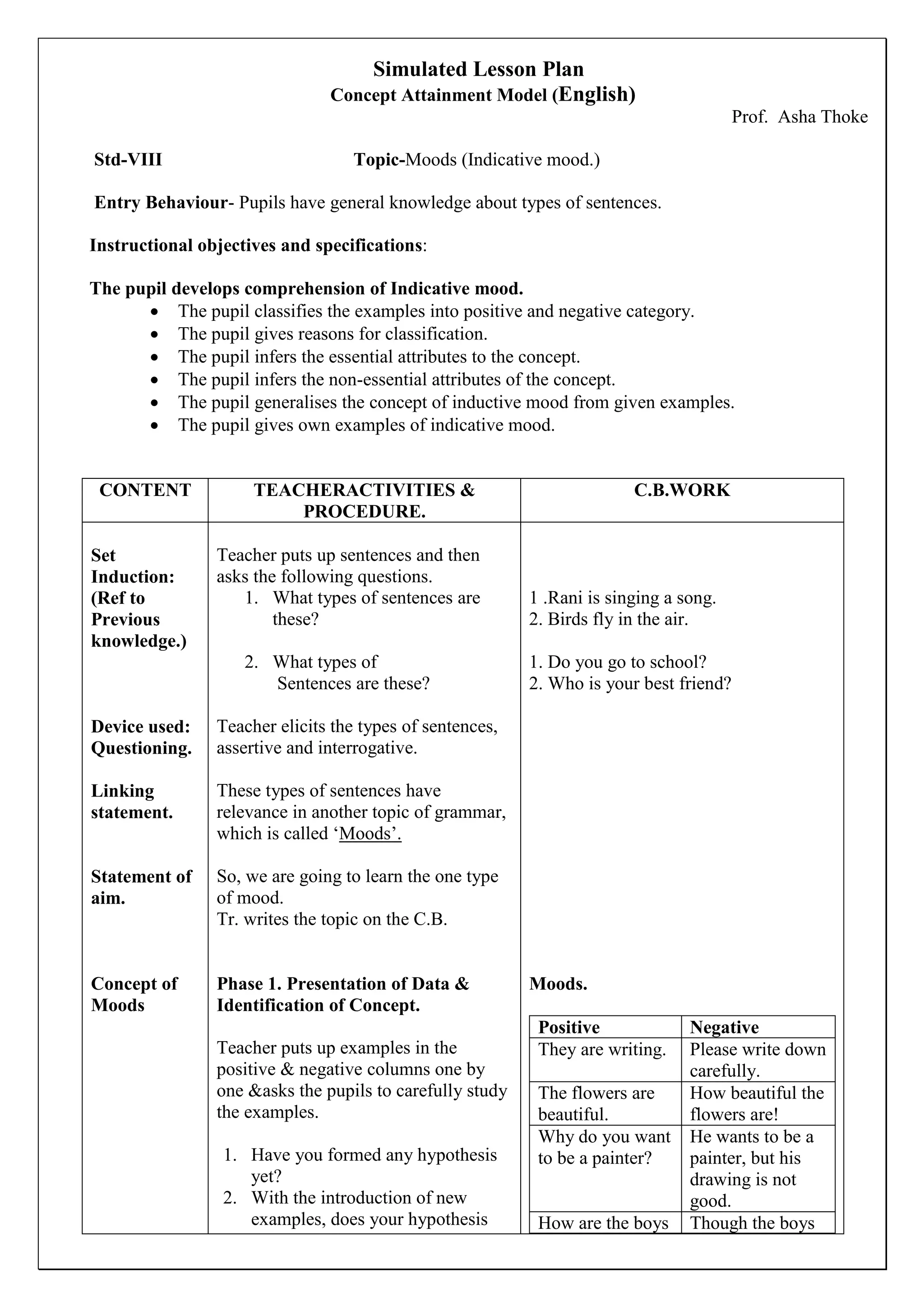
Simulated Lesson Plan
Concept Attainment Model (English)
Prof. Asha Thoke
Std-VIII Topic-Moods (Indicative mood.)
Entry Behaviour- Pupils have general knowledge about types of sentences.
Instructional objectives and specifications:
The pupil develops comprehension of Indicative mood.
 The pupil classifies the examples into positive and negative category.
 The pupil gives reasons for classification.
 The pupil infers the essential attributes to the concept.
 The pupil infers the non-essential attributes of the concept.
 The pupil generalises the concept of inductive mood from given examples.
 The pupil gives own examples of indicative mood.
CONTENT TEACHERACTIVITIES &
PROCEDURE.
C.B.WORK
Set
Induction:
(Ref to
Previous
knowledge.)
Device used:
Questioning.
Linking
statement.
Statement of
aim.
Concept of
Moods
Teacher puts up sentences and then
asks the following questions.
1. What types of sentences are
these?
2. What types of
Sentences are these?
Teacher elicits the types of sentences,
assertive and interrogative.
These types of sentences have
relevance in another topic of grammar,
which is called ‘Moods’.
So, we are going to learn the one type
of mood.
Tr. writes the topic on the C.B.
Phase 1. Presentation of Data &
Identification of Concept.
Teacher puts up examples in the
positive & negative columns one by
one &asks the pupils to carefully study
the examples.
1. Have you formed any hypothesis
yet?
2. With the introduction of new
examples, does your hypothesis
1 .Rani is singing a song.
2. Birds fly in the air.
1. Do you go to school?
2. Who is your best friend?
Moods.
Positive Negative
They are writing. Please write down
carefully.
The flowers are
beautiful.
How beautiful the
flowers are!
Why do you want
to be a painter?
He wants to be a
painter, but his
drawing is not
good.
How are the boys Though the boys
Phase 2
Phase 3
still hold true?
3. Do you want to change it?
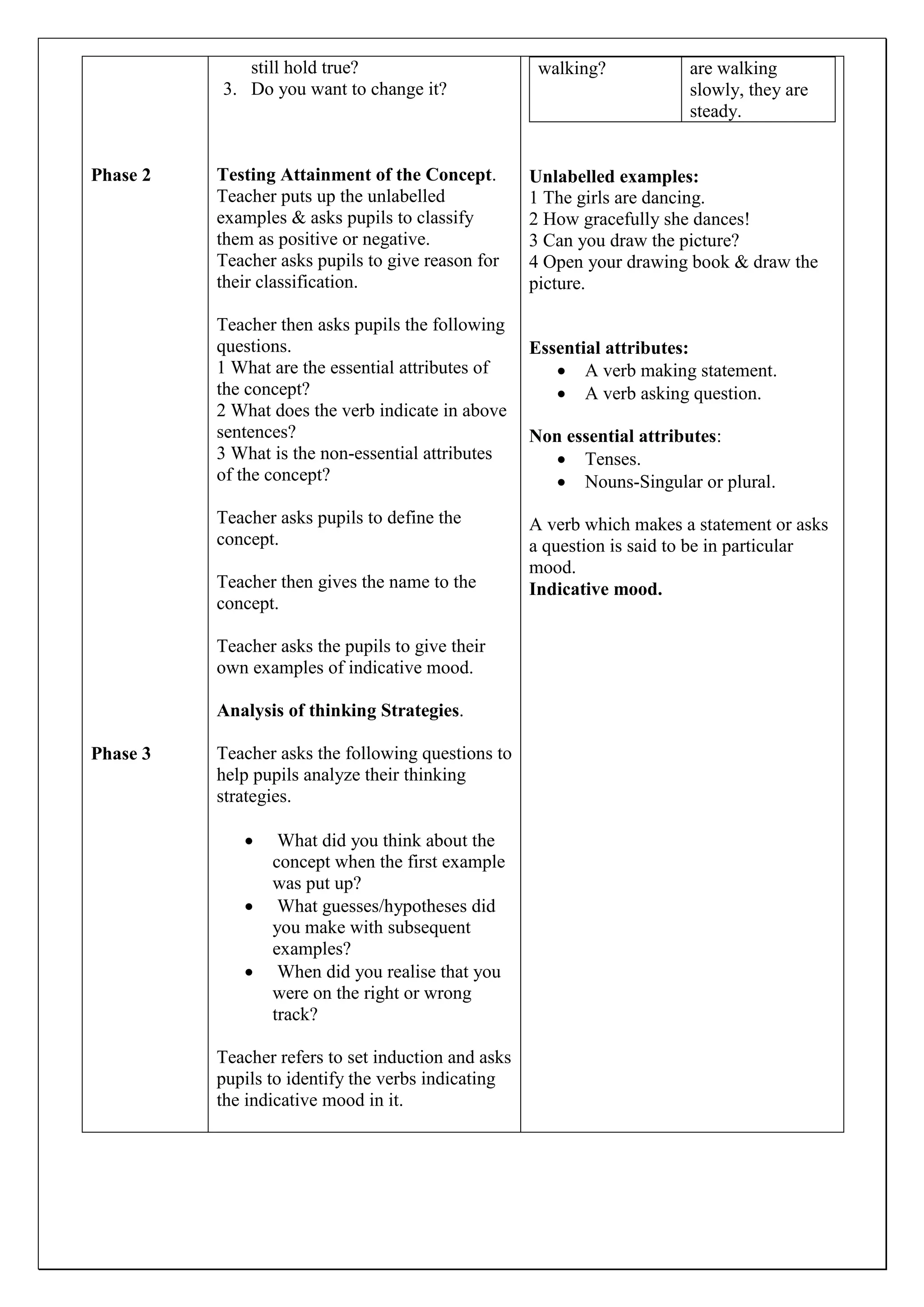
Testing Attainment of the Concept.
Teacher puts up the unlabelled
examples & asks pupils to classify
them as positive or negative.
Teacher asks pupils to give reason for
their classification.
Teacher then asks pupils the following
questions.
1 What are the essential attributes of
the concept?
2 What does the verb indicate in above
sentences?
3 What is the non-essential attributes
of the concept?
Teacher asks pupils to define the
concept.
Teacher then gives the name to the
concept.
Teacher asks the pupils to give their
own examples of indicative mood.
Analysis of thinking Strategies.
Teacher asks the following questions to
help pupils analyze their thinking
strategies.
 What did you think about the
concept when the first example
was put up?
 What guesses/hypotheses did
you make with subsequent
examples?
 When did you realise that you
were on the right or wrong
track?
Teacher refers to set induction and asks
pupils to identify the verbs indicating
the indicative mood in it.
walking? are walking
slowly, they are
steady.
Unlabelled examples:
1 The girls are dancing.
2 How gracefully she dances!
3 Can you draw the picture?
4 Open your drawing book & draw the
picture.
Essential attributes:
 A verb making statement.
 A verb asking question.
Non essential attributes:
 Tenses.
 Nouns-Singular or plural.
A verb which makes a statement or asks
a question is said to be in particular
mood.
Indicative mood.

3 Concept Attainment Model Lesson Plan English.doc

  • 1.
    Simulated Lesson Plan ConceptAttainment Model (English) Prof. Asha Thoke Std-VIII Topic-Moods (Indicative mood.) Entry Behaviour- Pupils have general knowledge about types of sentences. Instructional objectives and specifications: The pupil develops comprehension of Indicative mood.  The pupil classifies the examples into positive and negative category.  The pupil gives reasons for classification.  The pupil infers the essential attributes to the concept.  The pupil infers the non-essential attributes of the concept.  The pupil generalises the concept of inductive mood from given examples.  The pupil gives own examples of indicative mood. CONTENT TEACHERACTIVITIES & PROCEDURE. C.B.WORK Set Induction: (Ref to Previous knowledge.) Device used: Questioning. Linking statement. Statement of aim. Concept of Moods Teacher puts up sentences and then asks the following questions. 1. What types of sentences are these? 2. What types of Sentences are these? Teacher elicits the types of sentences, assertive and interrogative. These types of sentences have relevance in another topic of grammar, which is called ‘Moods’. So, we are going to learn the one type of mood. Tr. writes the topic on the C.B. Phase 1. Presentation of Data & Identification of Concept. Teacher puts up examples in the positive & negative columns one by one &asks the pupils to carefully study the examples. 1. Have you formed any hypothesis yet? 2. With the introduction of new examples, does your hypothesis 1 .Rani is singing a song. 2. Birds fly in the air. 1. Do you go to school? 2. Who is your best friend? Moods. Positive Negative They are writing. Please write down carefully. The flowers are beautiful. How beautiful the flowers are! Why do you want to be a painter? He wants to be a painter, but his drawing is not good. How are the boys Though the boys
  • 2.
    Phase 2 Phase 3 stillhold true? 3. Do you want to change it? Testing Attainment of the Concept. Teacher puts up the unlabelled examples & asks pupils to classify them as positive or negative. Teacher asks pupils to give reason for their classification. Teacher then asks pupils the following questions. 1 What are the essential attributes of the concept? 2 What does the verb indicate in above sentences? 3 What is the non-essential attributes of the concept? Teacher asks pupils to define the concept. Teacher then gives the name to the concept. Teacher asks the pupils to give their own examples of indicative mood. Analysis of thinking Strategies. Teacher asks the following questions to help pupils analyze their thinking strategies.  What did you think about the concept when the first example was put up?  What guesses/hypotheses did you make with subsequent examples?  When did you realise that you were on the right or wrong track? Teacher refers to set induction and asks pupils to identify the verbs indicating the indicative mood in it. walking? are walking slowly, they are steady. Unlabelled examples: 1 The girls are dancing. 2 How gracefully she dances! 3 Can you draw the picture? 4 Open your drawing book & draw the picture. Essential attributes:  A verb making statement.  A verb asking question. Non essential attributes:  Tenses.  Nouns-Singular or plural. A verb which makes a statement or asks a question is said to be in particular mood. Indicative mood.