ASSESSME
NT IN THE
AFFECTIVE
DOMAIN
Prepared by
LICTAO, SHARON
At the end of the chapter, the learners should be able to
do the following:
1. Explain the taxonomy in the affective domain and relate
it to assessment
2. Write a specific objective showing the elevation
of the levels for affective domain
3. Design instruments for assessing affective
learning
Objectives
CHAPTER Outline
The Taxonomy in the Affective Domain
Affective Learning Competencies
Development of Assessment Tools in
the Affective Domain
Affective Domain:
emotional response concerning
one’s attitudes, values and
appreciation for motivation in
learning
“Some are
schooled, but not
educated”
PONDER
-Thomas Moore
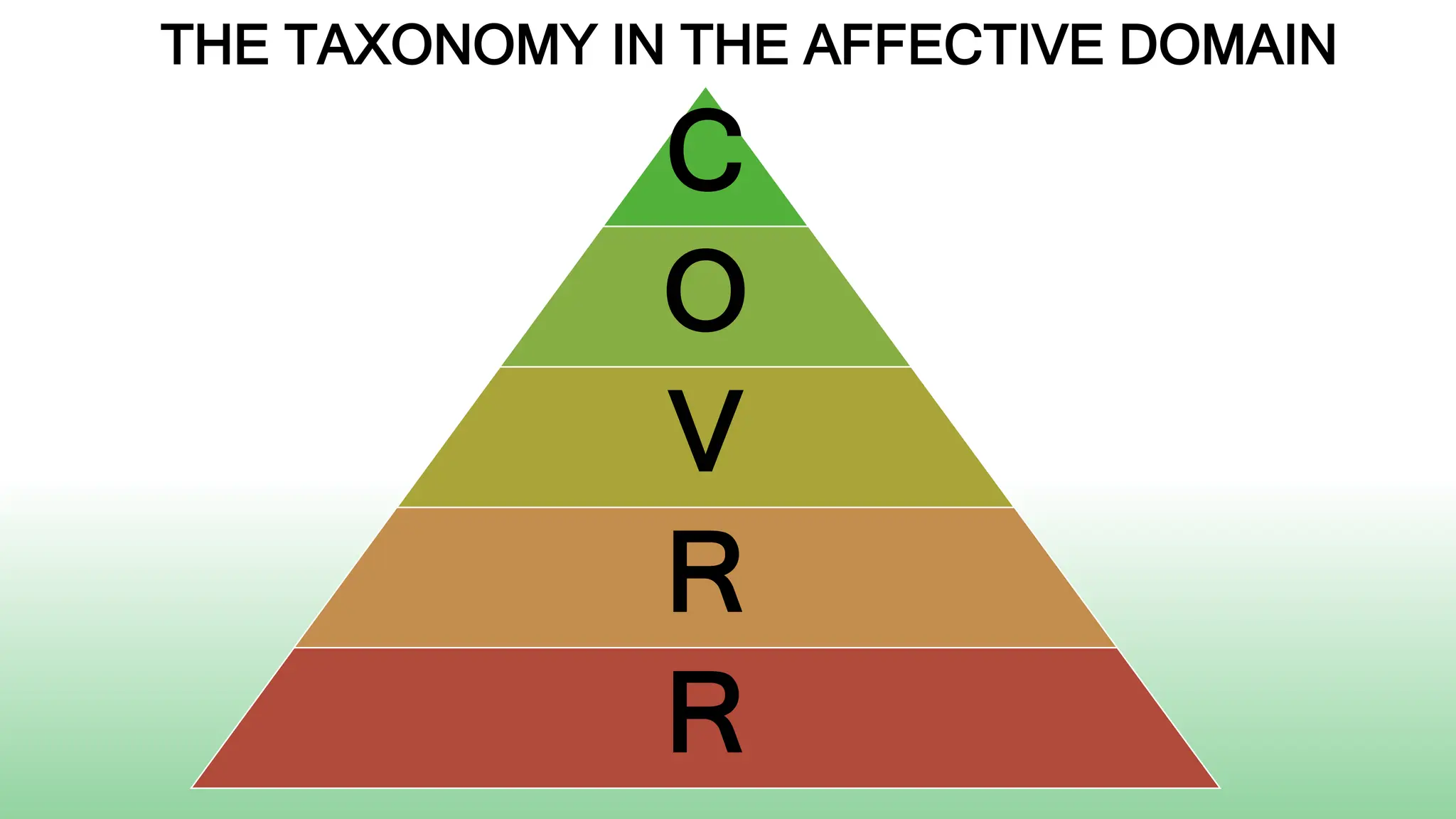
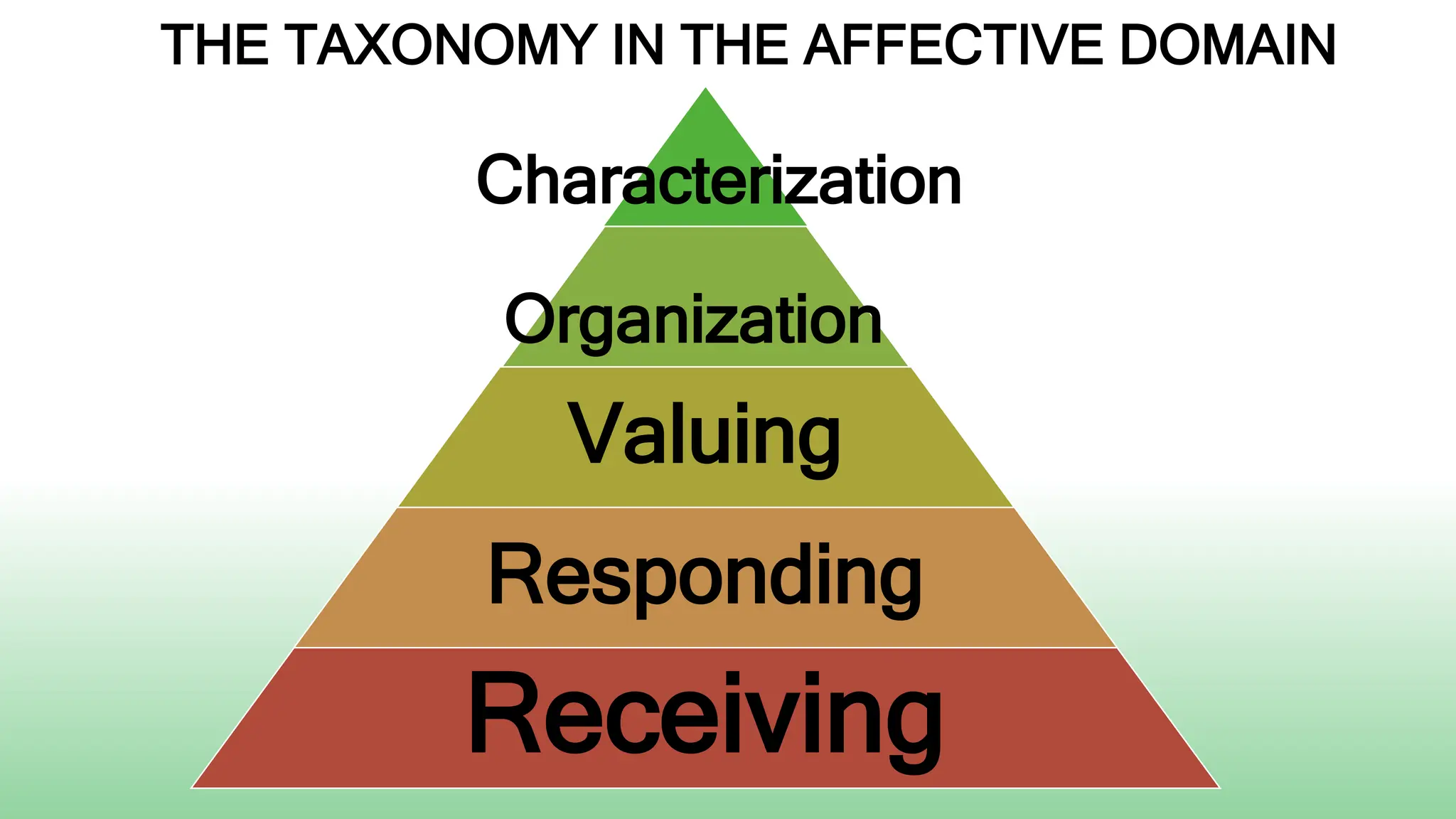
THE TAXONOMY IN THE AFFECTIVE DOMAIN
C
O
V
R
R
THE TAXONOMY IN THE AFFECTIVE DOMAIN
Valuing
Responding
Receiving
Organization
Characterization
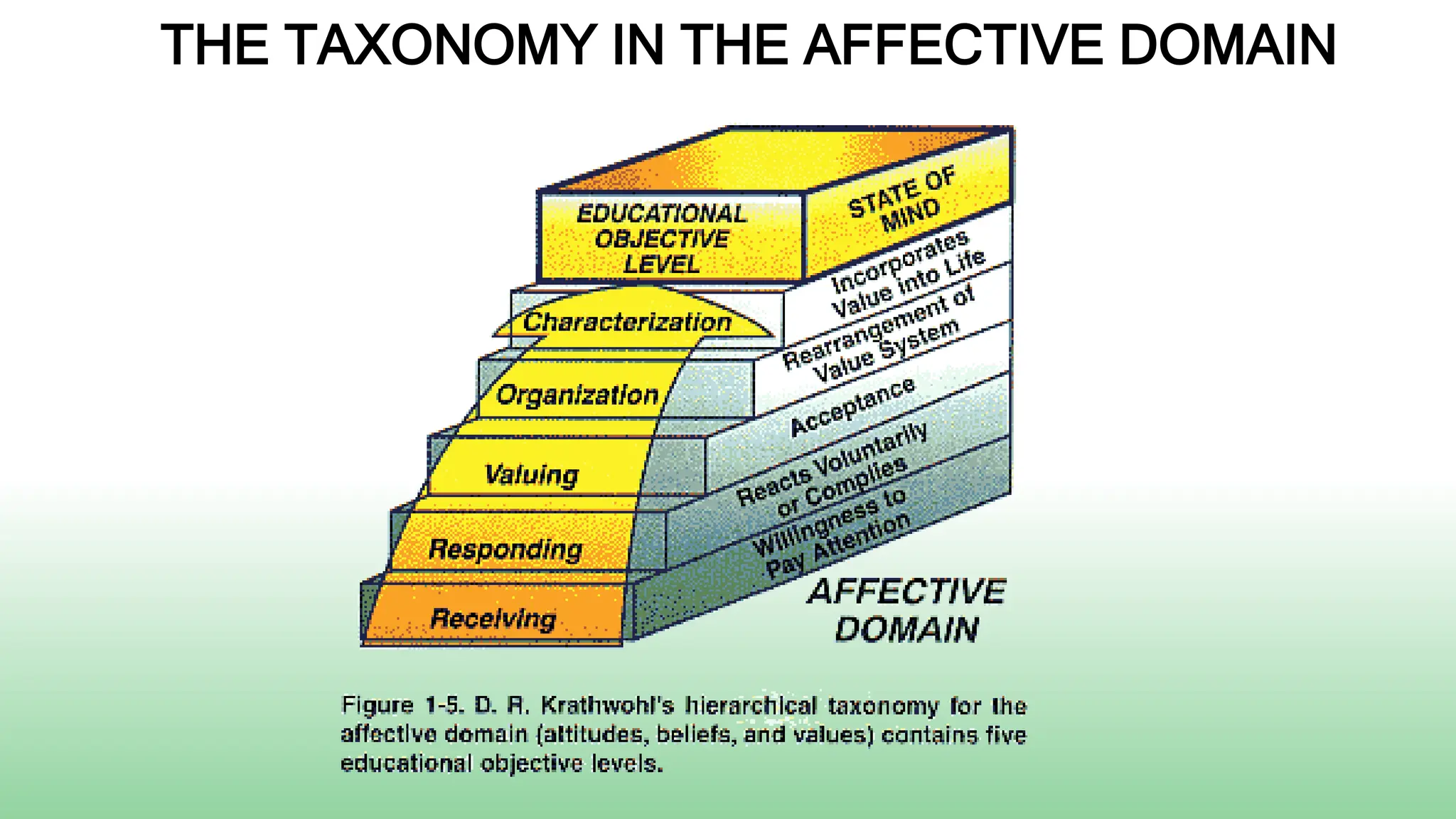
THE TAXONOMY IN THE AFFECTIVE DOMAIN
CHAPTER Outline
The Taxonomy in the Affective Domain
Affective Learning Competencies
Development of Assessment Tools in
the Affective Domain
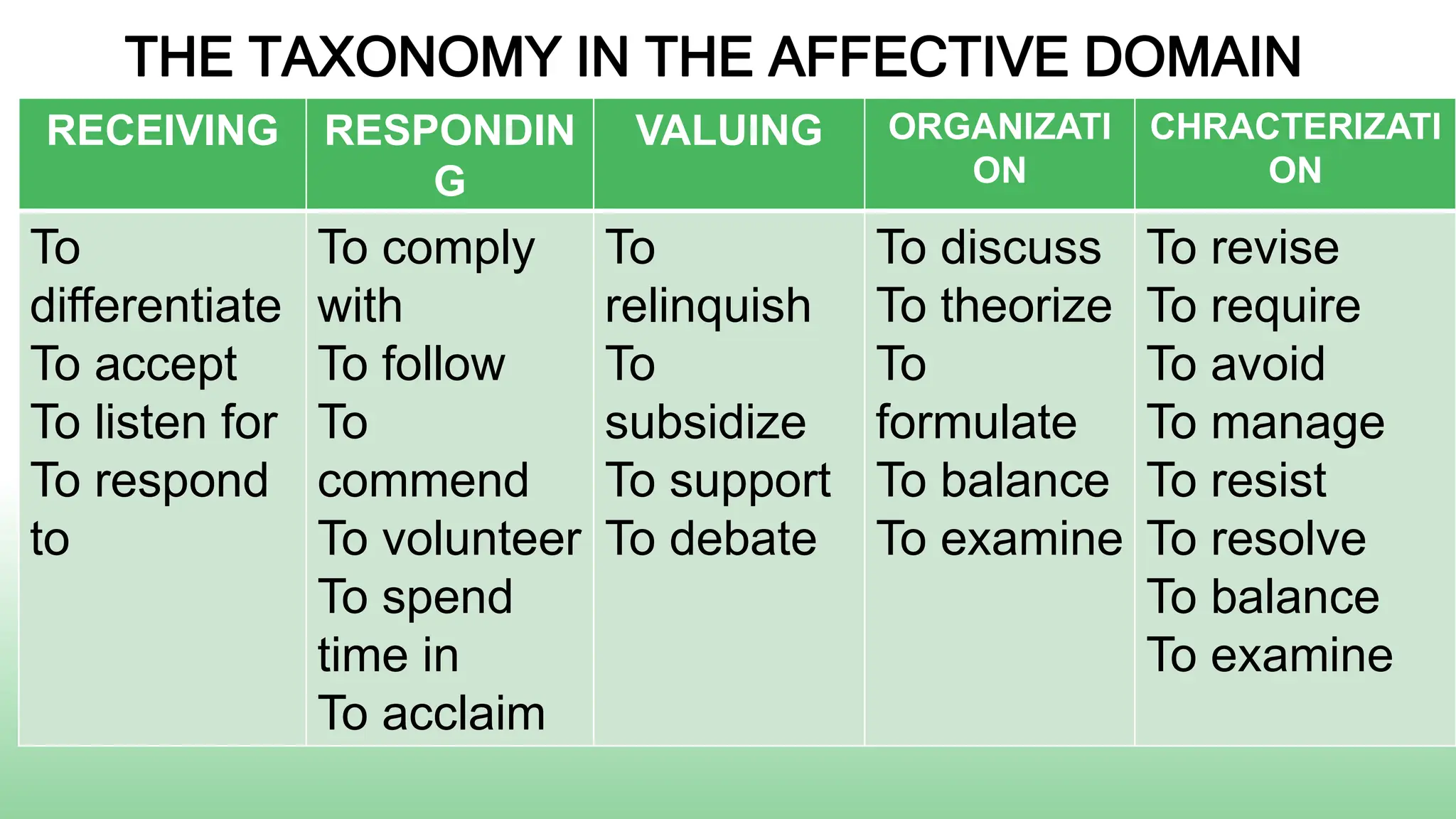
RECEIVING RESPONDIN
G
VALUING ORGANIZATI
ON
CHRACTERIZATI
ON
To
differentiate
To accept
To listen for
To respond
to
To comply
with
To follow
To
commend
To volunteer
To spend
time in
To acclaim
To
relinquish
To
subsidize
To support
To debate
To discuss
To theorize
To
formulate
To balance
To examine
To revise
To require
To avoid
To manage
To resist
To resolve
To balance
To examine
THE TAXONOMY IN THE AFFECTIVE DOMAIN
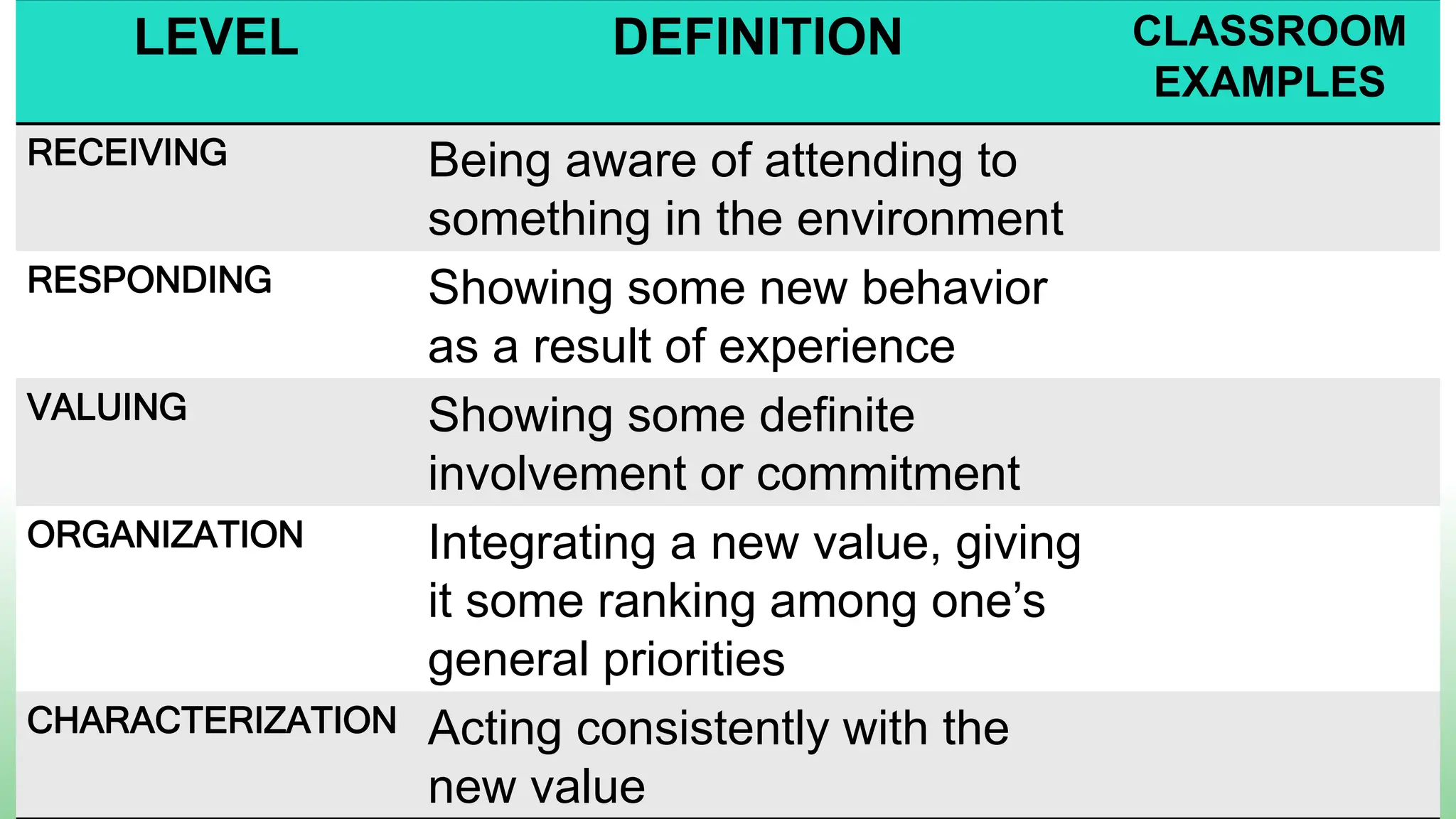
LEVEL DEFINITION CLASSROOM
EXAMPLES
RECEIVING Being aware of attending to
something in the environment
RESPONDING Showing some new behavior
as a result of experience
VALUING Showing some definite
involvement or commitment
ORGANIZATION Integrating a new value, giving
it some ranking among one’s
general priorities
CHARACTERIZATION Acting consistently with the
new value
PICK AND IDENTIFY
Identify the level of
learning within the
affective domain
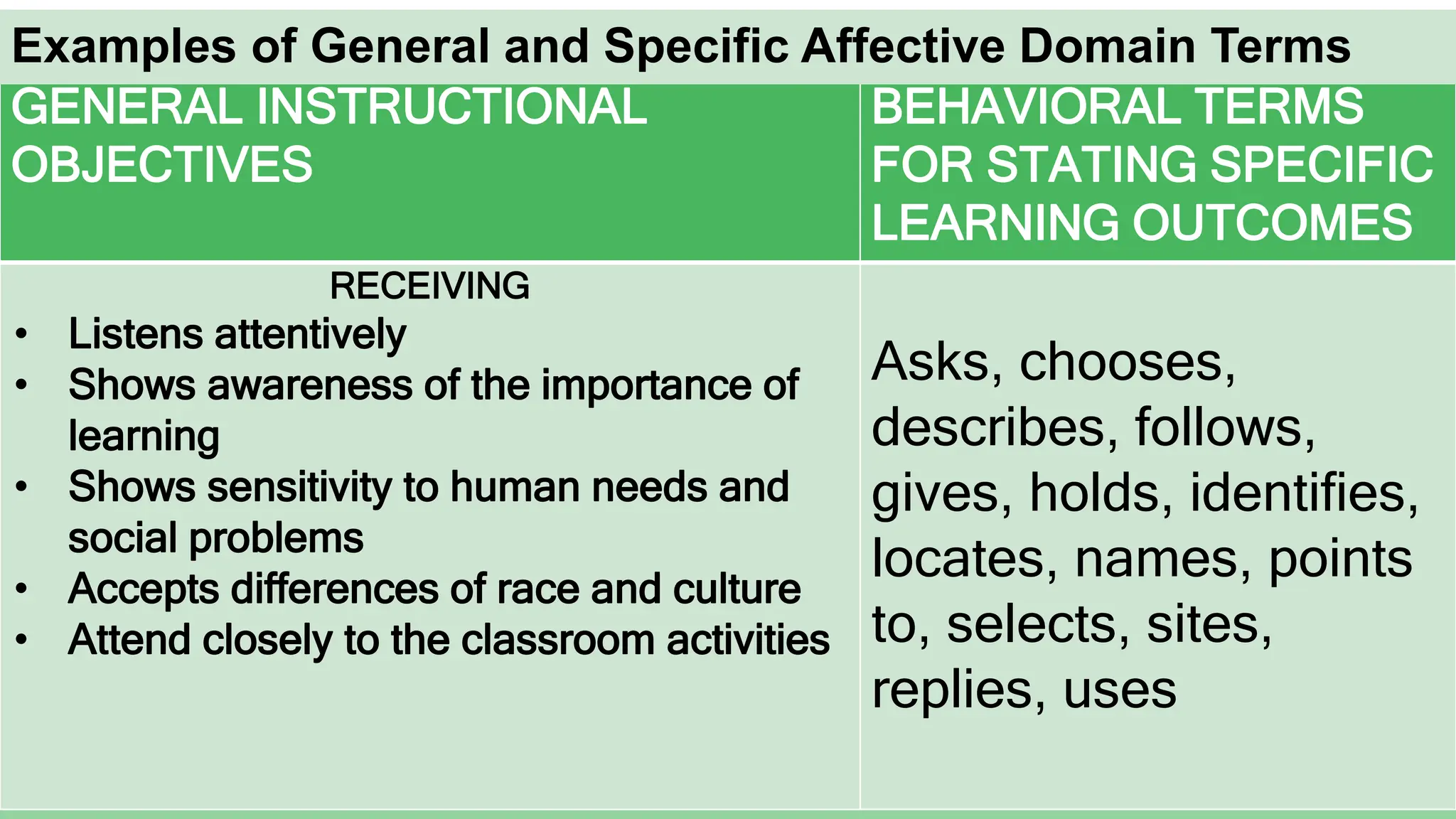
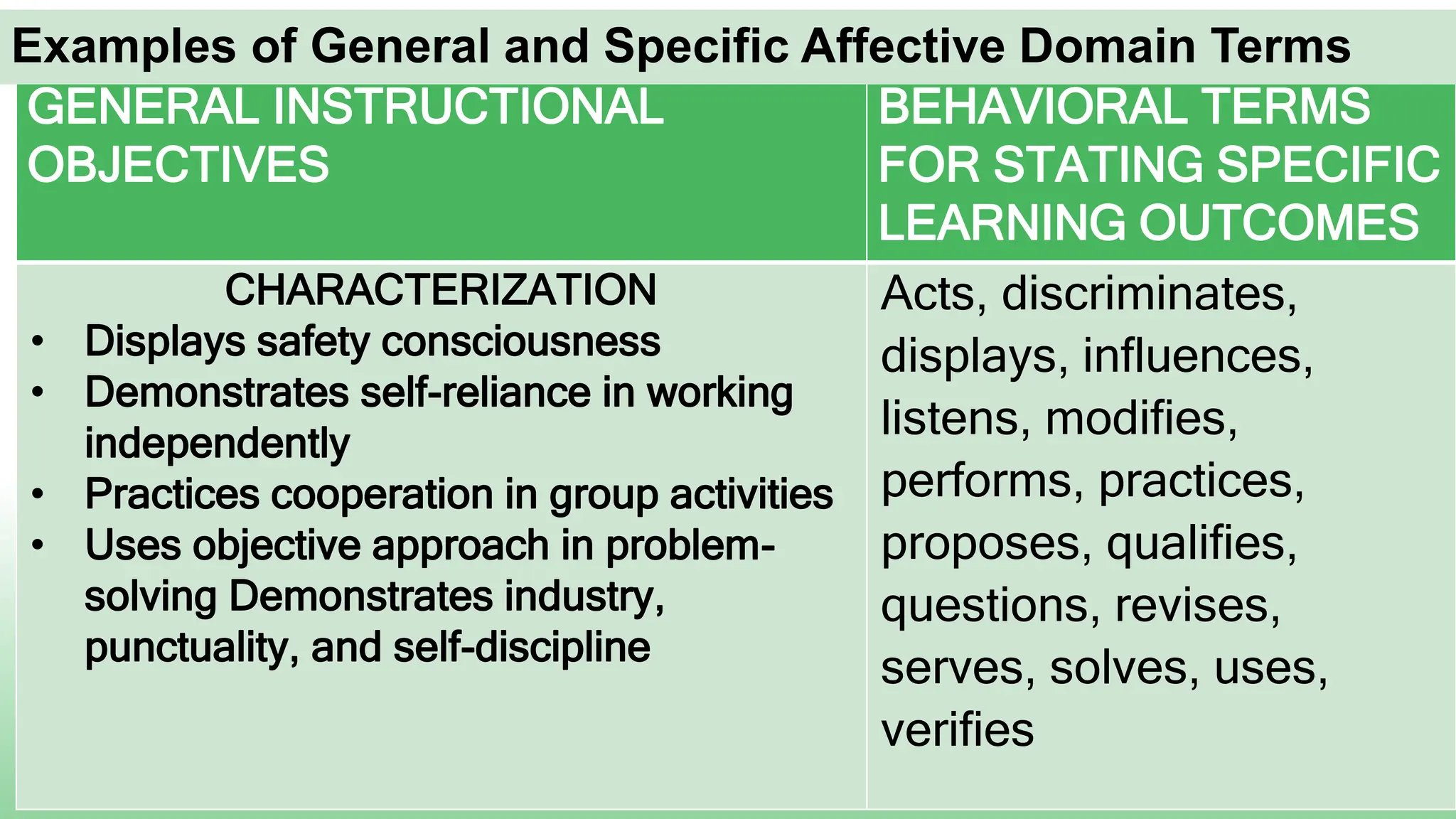
Examples of General and Specific Affective Domain Terms
GENERAL INSTRUCTIONAL
OBJECTIVES
BEHAVIORAL TERMS
FOR STATING SPECIFIC
LEARNING OUTCOMES
RECEIVING
• Listens attentively
• Shows awareness of the importance of
learning
• Shows sensitivity to human needs and
social problems
• Accepts differences of race and culture
• Attend closely to the classroom activities
Asks, chooses,
describes, follows,
gives, holds, identifies,
locates, names, points
to, selects, sites,
replies, uses
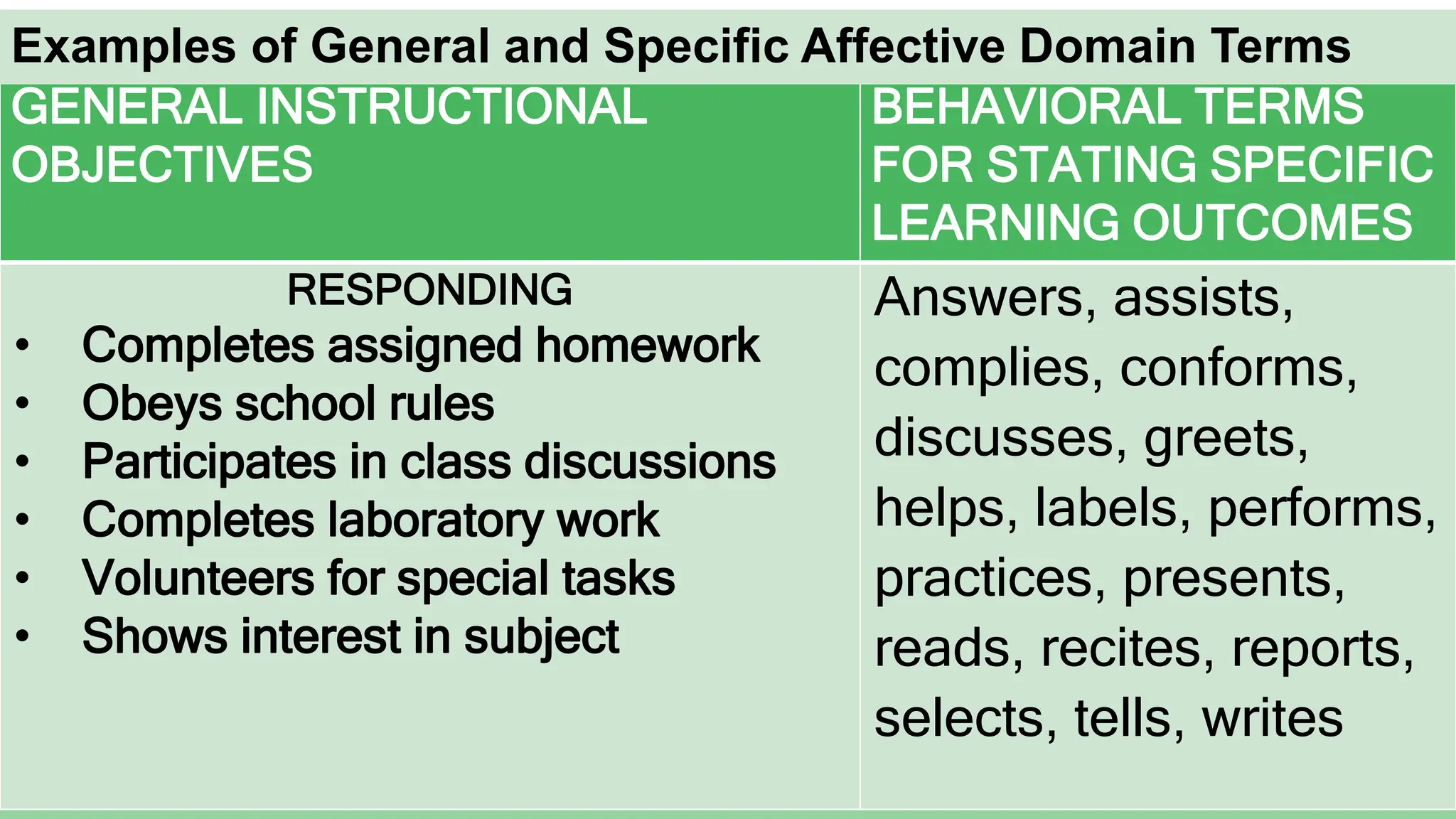
Examples of General and Specific Affective Domain Terms
GENERAL INSTRUCTIONAL
OBJECTIVES
BEHAVIORAL TERMS
FOR STATING SPECIFIC
LEARNING OUTCOMES
RESPONDING
• Completes assigned homework
• Obeys school rules
• Participates in class discussions
• Completes laboratory work
• Volunteers for special tasks
• Shows interest in subject
Answers, assists,
complies, conforms,
discusses, greets,
helps, labels, performs,
practices, presents,
reads, recites, reports,
selects, tells, writes
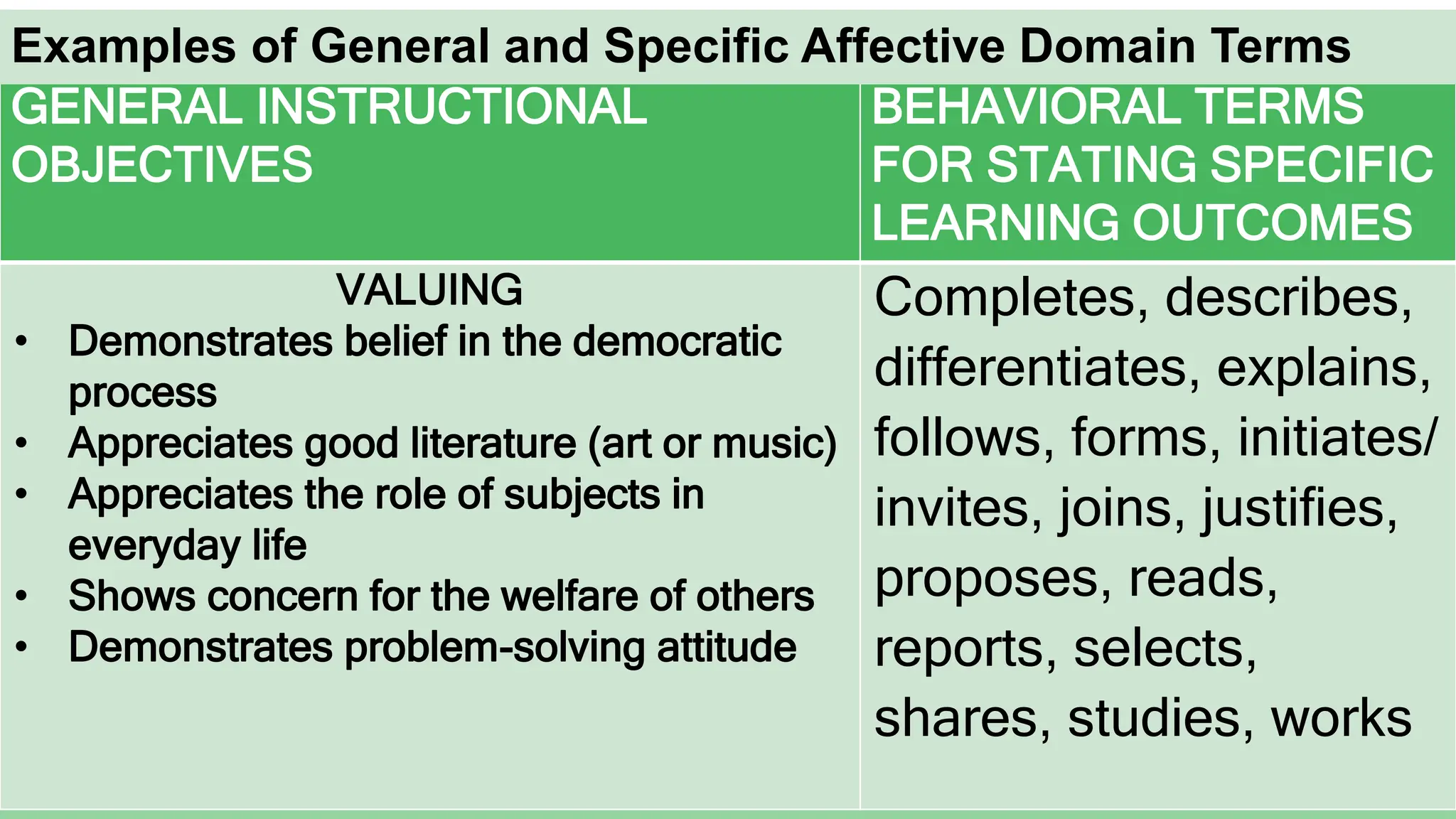
Examples of General and Specific Affective Domain Terms
GENERAL INSTRUCTIONAL
OBJECTIVES
BEHAVIORAL TERMS
FOR STATING SPECIFIC
LEARNING OUTCOMES
VALUING
• Demonstrates belief in the democratic
process
• Appreciates good literature (art or music)
• Appreciates the role of subjects in
everyday life
• Shows concern for the welfare of others
• Demonstrates problem-solving attitude
Completes, describes,
differentiates, explains,
follows, forms, initiates/
invites, joins, justifies,
proposes, reads,
reports, selects,
shares, studies, works
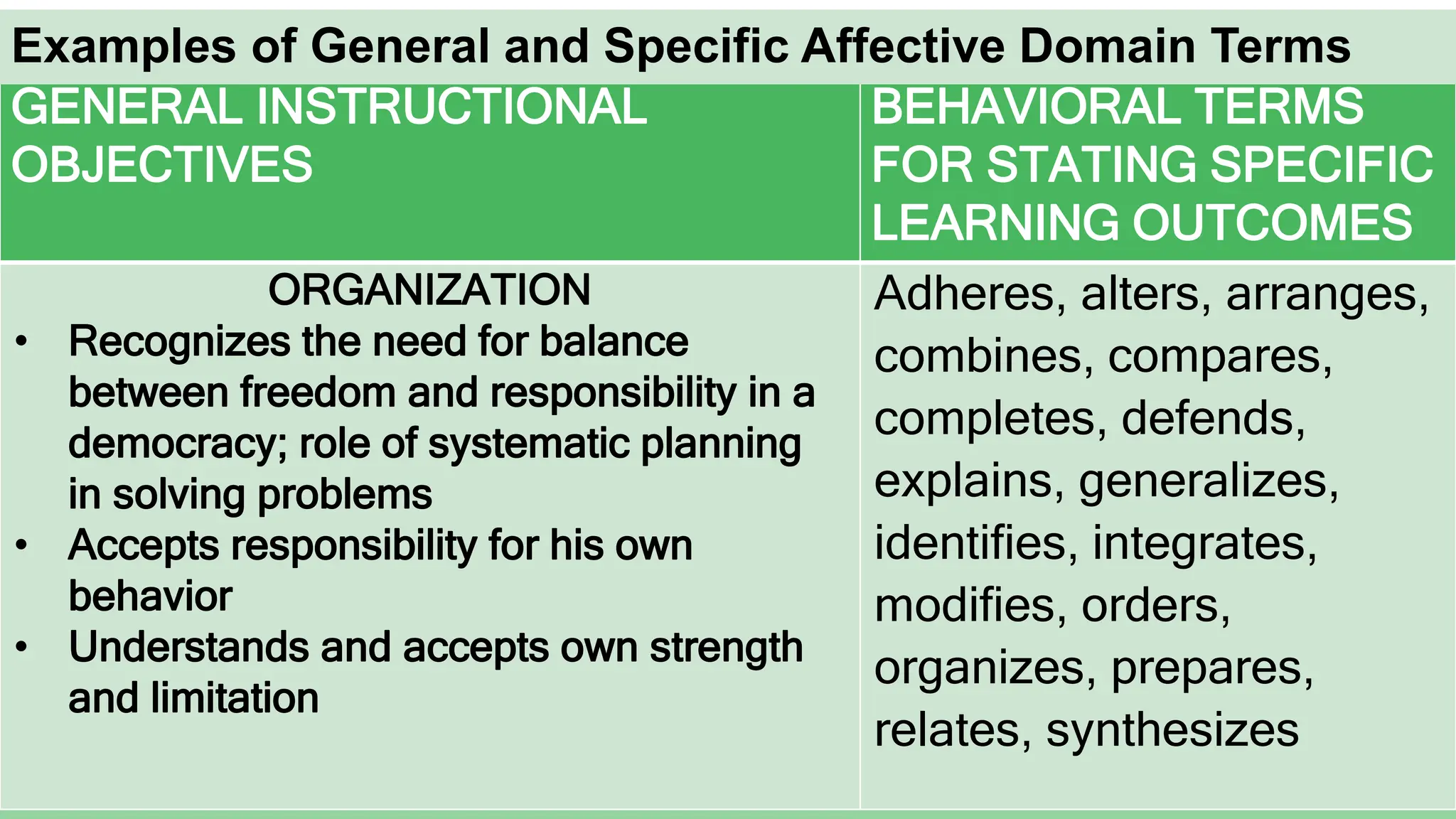
Examples of General and Specific Affective Domain Terms
GENERAL INSTRUCTIONAL
OBJECTIVES
BEHAVIORAL TERMS
FOR STATING SPECIFIC
LEARNING OUTCOMES
ORGANIZATION
• Recognizes the need for balance
between freedom and responsibility in a
democracy; role of systematic planning
in solving problems
• Accepts responsibility for his own
behavior
• Understands and accepts own strength
and limitation
Adheres, alters, arranges,
combines, compares,
completes, defends,
explains, generalizes,
identifies, integrates,
modifies, orders,
organizes, prepares,
relates, synthesizes
Examples of General and Specific Affective Domain Terms
GENERAL INSTRUCTIONAL
OBJECTIVES
BEHAVIORAL TERMS
FOR STATING SPECIFIC
LEARNING OUTCOMES
CHARACTERIZATION
• Displays safety consciousness
• Demonstrates self-reliance in working
independently
• Practices cooperation in group activities
• Uses objective approach in problem-
solving Demonstrates industry,
punctuality, and self-discipline
Acts, discriminates,
displays, influences,
listens, modifies,
performs, practices,
proposes, qualifies,
questions, revises,
serves, solves, uses,
verifies
Examples of General and Specific Affective Domain Terms
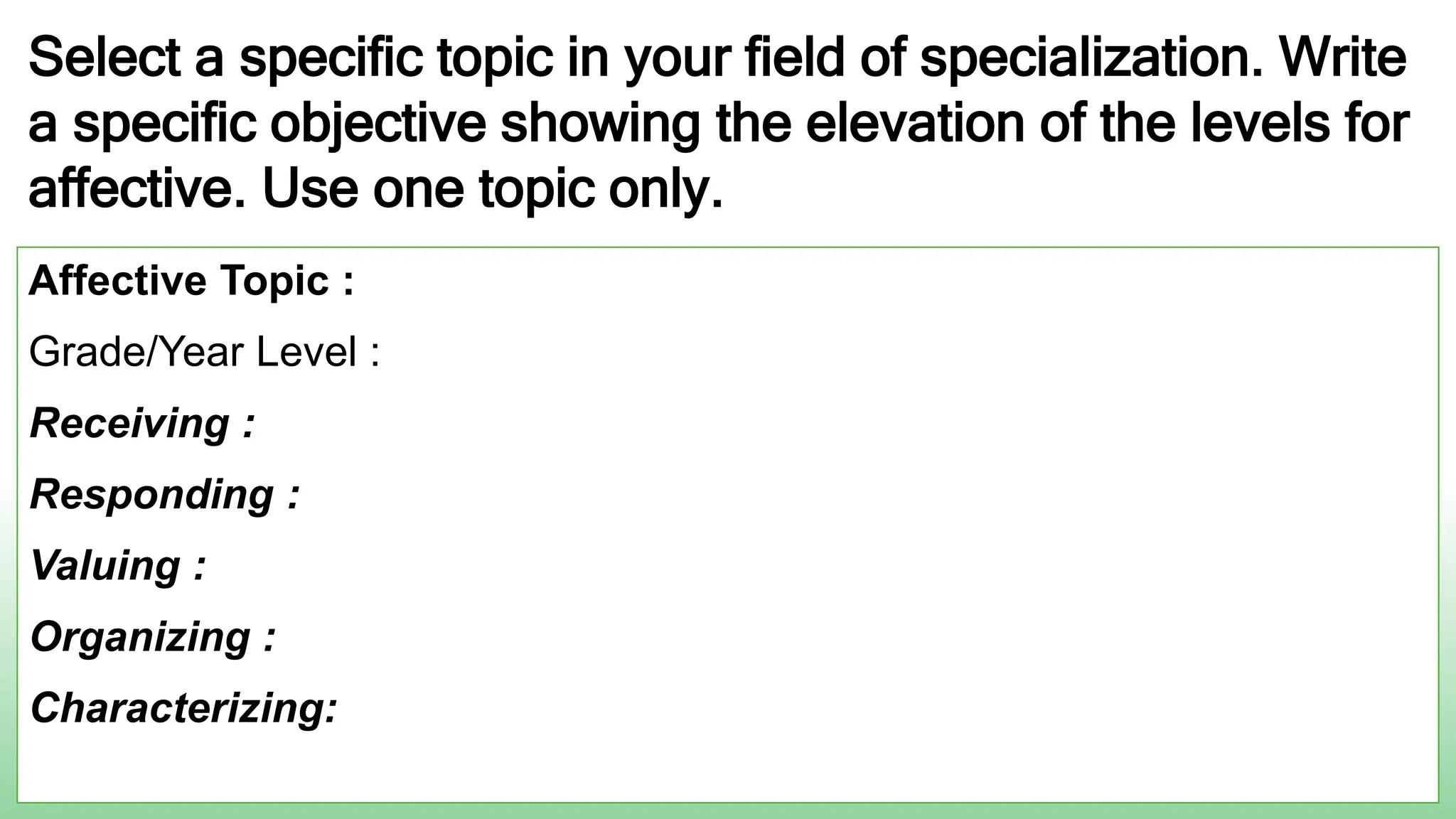
Select a specific topic in your field of specialization. Write
a specific objective showing the elevation of the levels for
affective. Use one topic only.
Affective Topic :
Grade/Year Level :
Receiving :
Responding :
Valuing :
Organizing :
Characterizing:
Affective Learning Competencies Educ 7 Assesssment

Affective Learning Competencies Educ 7 Assesssment

  • 1.
  • 2.
    At the endof the chapter, the learners should be able to do the following: 1. Explain the taxonomy in the affective domain and relate it to assessment 2. Write a specific objective showing the elevation of the levels for affective domain 3. Design instruments for assessing affective learning Objectives
  • 3.
    CHAPTER Outline The Taxonomyin the Affective Domain Affective Learning Competencies Development of Assessment Tools in the Affective Domain
  • 4.
    Affective Domain: emotional responseconcerning one’s attitudes, values and appreciation for motivation in learning
  • 5.
    “Some are schooled, butnot educated” PONDER -Thomas Moore
  • 6.
    THE TAXONOMY INTHE AFFECTIVE DOMAIN C O V R R
  • 7.
    THE TAXONOMY INTHE AFFECTIVE DOMAIN Valuing Responding Receiving Organization Characterization
  • 8.
    THE TAXONOMY INTHE AFFECTIVE DOMAIN
  • 9.
    CHAPTER Outline The Taxonomyin the Affective Domain Affective Learning Competencies Development of Assessment Tools in the Affective Domain
  • 10.
    RECEIVING RESPONDIN G VALUING ORGANIZATI ON CHRACTERIZATI ON To differentiate Toaccept To listen for To respond to To comply with To follow To commend To volunteer To spend time in To acclaim To relinquish To subsidize To support To debate To discuss To theorize To formulate To balance To examine To revise To require To avoid To manage To resist To resolve To balance To examine THE TAXONOMY IN THE AFFECTIVE DOMAIN
  • 11.
    LEVEL DEFINITION CLASSROOM EXAMPLES RECEIVINGBeing aware of attending to something in the environment RESPONDING Showing some new behavior as a result of experience VALUING Showing some definite involvement or commitment ORGANIZATION Integrating a new value, giving it some ranking among one’s general priorities CHARACTERIZATION Acting consistently with the new value
  • 12.
    PICK AND IDENTIFY Identifythe level of learning within the affective domain
  • 13.
    Examples of Generaland Specific Affective Domain Terms GENERAL INSTRUCTIONAL OBJECTIVES BEHAVIORAL TERMS FOR STATING SPECIFIC LEARNING OUTCOMES RECEIVING • Listens attentively • Shows awareness of the importance of learning • Shows sensitivity to human needs and social problems • Accepts differences of race and culture • Attend closely to the classroom activities Asks, chooses, describes, follows, gives, holds, identifies, locates, names, points to, selects, sites, replies, uses Examples of General and Specific Affective Domain Terms
  • 14.
    Examples of Generaland Specific Affective Domain Terms GENERAL INSTRUCTIONAL OBJECTIVES BEHAVIORAL TERMS FOR STATING SPECIFIC LEARNING OUTCOMES RESPONDING • Completes assigned homework • Obeys school rules • Participates in class discussions • Completes laboratory work • Volunteers for special tasks • Shows interest in subject Answers, assists, complies, conforms, discusses, greets, helps, labels, performs, practices, presents, reads, recites, reports, selects, tells, writes Examples of General and Specific Affective Domain Terms
  • 15.
    Examples of Generaland Specific Affective Domain Terms GENERAL INSTRUCTIONAL OBJECTIVES BEHAVIORAL TERMS FOR STATING SPECIFIC LEARNING OUTCOMES VALUING • Demonstrates belief in the democratic process • Appreciates good literature (art or music) • Appreciates the role of subjects in everyday life • Shows concern for the welfare of others • Demonstrates problem-solving attitude Completes, describes, differentiates, explains, follows, forms, initiates/ invites, joins, justifies, proposes, reads, reports, selects, shares, studies, works Examples of General and Specific Affective Domain Terms
  • 16.
    Examples of Generaland Specific Affective Domain Terms GENERAL INSTRUCTIONAL OBJECTIVES BEHAVIORAL TERMS FOR STATING SPECIFIC LEARNING OUTCOMES ORGANIZATION • Recognizes the need for balance between freedom and responsibility in a democracy; role of systematic planning in solving problems • Accepts responsibility for his own behavior • Understands and accepts own strength and limitation Adheres, alters, arranges, combines, compares, completes, defends, explains, generalizes, identifies, integrates, modifies, orders, organizes, prepares, relates, synthesizes Examples of General and Specific Affective Domain Terms
  • 17.
    Examples of Generaland Specific Affective Domain Terms GENERAL INSTRUCTIONAL OBJECTIVES BEHAVIORAL TERMS FOR STATING SPECIFIC LEARNING OUTCOMES CHARACTERIZATION • Displays safety consciousness • Demonstrates self-reliance in working independently • Practices cooperation in group activities • Uses objective approach in problem- solving Demonstrates industry, punctuality, and self-discipline Acts, discriminates, displays, influences, listens, modifies, performs, practices, proposes, qualifies, questions, revises, serves, solves, uses, verifies Examples of General and Specific Affective Domain Terms
  • 18.
    Select a specifictopic in your field of specialization. Write a specific objective showing the elevation of the levels for affective. Use one topic only. Affective Topic : Grade/Year Level : Receiving : Responding : Valuing : Organizing : Characterizing:

Editor's Notes

  • #2 Learning domains play an important role in assessing or evaluating the student’s knowledge and skills.  If we leave the formation of our students to chance we may not get what we want and what the public needs.
  • #5 The affective domain involves our feelings, emotions, and attitudes, and includes the manner in which we deal with things emotionally (feelings, values, appreciation, enthusiasm, motivations, and attitudes). 
  • #6 Some people may excel academically but they lack essential life skills, empathy or understanding the real world complexities that education should provide.
  • #8 Affective learning is demonstrated by behaviors indicating attitudes of awareness, interest, attention, concern, and responsibility, ability to listen and respond in interactions with others, and ability to demonstrate those attitudinal characteristics or values which are appropriate to the test situation and the field of study
  • #9 Krathwohl’s affective domain taxonomy is perhaps the best known of any of the affective taxonomies. “The taxonomy is ordered according to the principle of internalization. Internalization refers to the process whereby a person’s affect toward an object passes from a general awareness level to a point where the affect is ‘internalized’ and consistently guides or controls the person’s behavior (Seels & Glasgow, 1990, p. 28).”