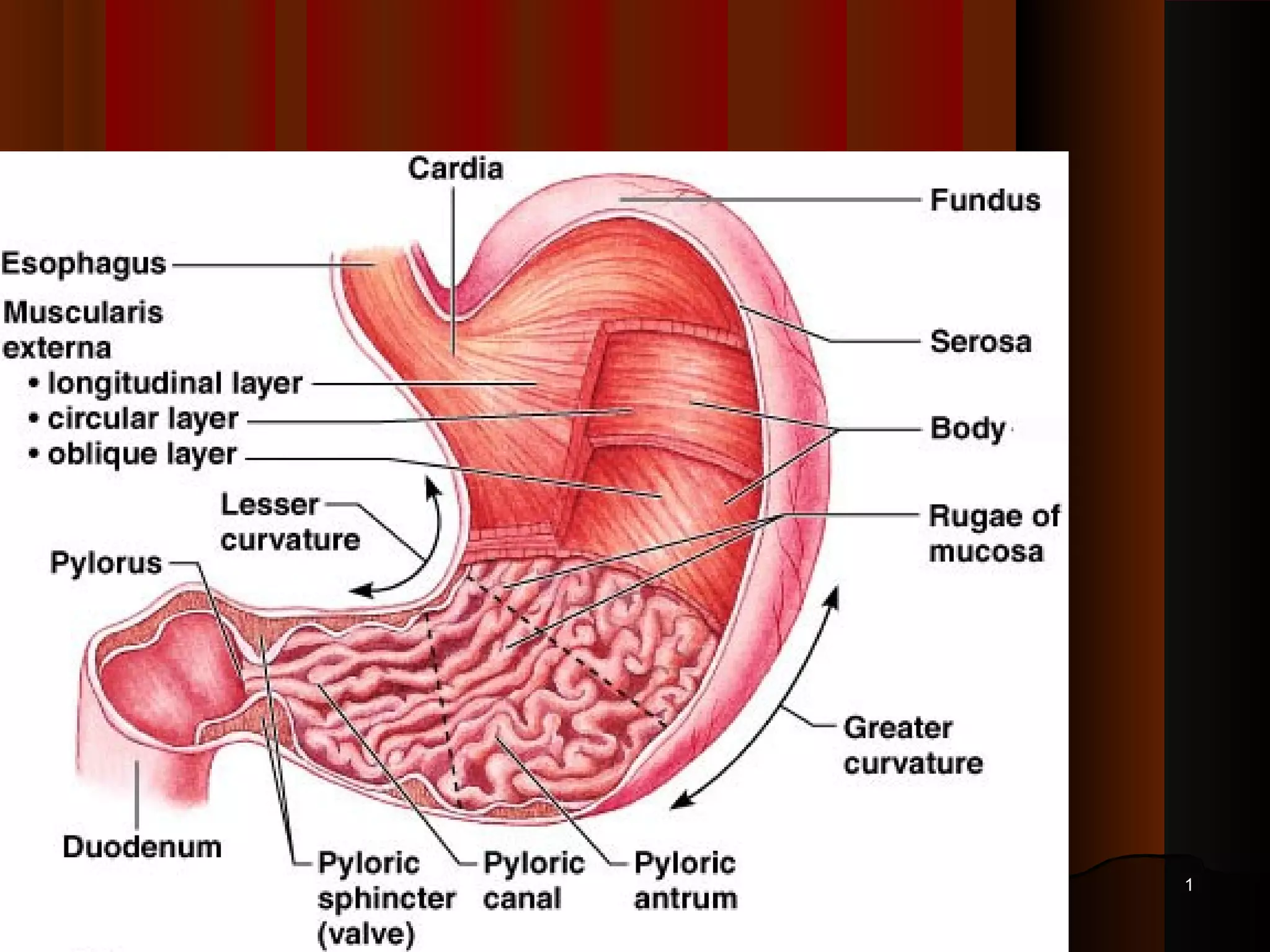
11
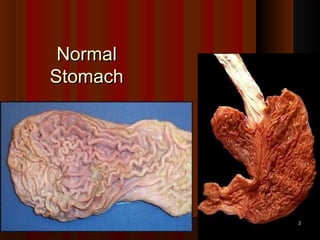
NormalNormal
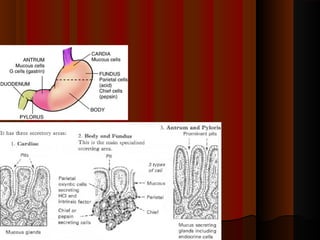
StomachStomach
22
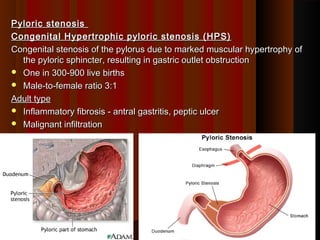
Pyloric stenosisPyloric stenosis
Congenital Hypertrophic pyloric stenosis (HPS)Congenital Hypertrophic pyloric stenosis (HPS)
Congenital stenosis of the pylorus due to marked muscular hypertrophy ofCongenital stenosis of the pylorus due to marked muscular hypertrophy of
the pyloric sphincter, resulting in gastric outlet obstructionthe pyloric sphincter, resulting in gastric outlet obstruction
 One in 300-900 live birthsOne in 300-900 live births
 Male-to-female ratio 3:1Male-to-female ratio 3:1
Adult typeAdult type
 Inflammatory fibrosis - antral gastritis, peptic ulcerInflammatory fibrosis - antral gastritis, peptic ulcer
 Malignant infiltrationMalignant infiltration
33
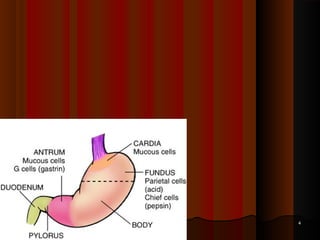
44
  
GastritisGastritis
It is an inflammatory condition of gastric mucosaIt is an inflammatory condition of gastric mucosa
1.1. Acute gastritisAcute gastritis
 Acute mucosal inflammatory process, comes onAcute mucosal inflammatory process, comes on
suddenly and lasts brieflysuddenly and lasts briefly
2.2. Chronic gastritisChronic gastritis
 It is a chronic inflammation of gastric mucosa leading toIt is a chronic inflammation of gastric mucosa leading to
atrophy of gastric mucosaatrophy of gastric mucosa
 either long lasting or recurrenteither long lasting or recurrent
66
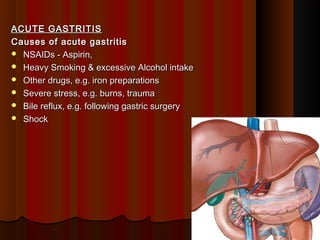
ACUTE GASTRITISACUTE GASTRITIS
Causes of acute gastritisCauses of acute gastritis
 NSAIDs - Aspirin,NSAIDs - Aspirin,
 Heavy Smoking & excessive Alcohol intakeHeavy Smoking & excessive Alcohol intake
 Other drugs, e.g. iron preparationsOther drugs, e.g. iron preparations
 Severe stress, e.g. burns, traumaSevere stress, e.g. burns, trauma
 Bile reflux, e.g. following gastric surgeryBile reflux, e.g. following gastric surgery
 ShockShock
77
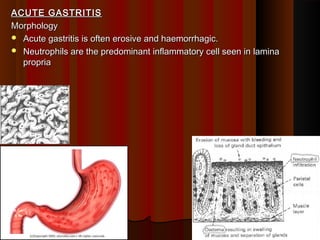
ACUTE GASTRITISACUTE GASTRITIS
MorphologyMorphology
 Acute gastritis is often erosive and haemorrhagic.Acute gastritis is often erosive and haemorrhagic.
 Neutrophils are the predominant inflammatory cell seen in laminaNeutrophils are the predominant inflammatory cell seen in lamina
propriapropria
88
Clinical effectsClinical effects
 Acute gastritis often produces no symptoms but may causeAcute gastritis often produces no symptoms but may cause
dyspepsia, anorexia, nausea or vomiting, and haematemesis ordyspepsia, anorexia, nausea or vomiting, and haematemesis or
melaena.melaena.
TreatmentTreatment
 Should be directed to the underlying cause. Short-term symptomaticShould be directed to the underlying cause. Short-term symptomatic
therapy with antacids, and acid suppression using proton pumptherapy with antacids, and acid suppression using proton pump
inhibitors or antiemetics (e.g. metoclopramide) may be necessary.inhibitors or antiemetics (e.g. metoclopramide) may be necessary.
99
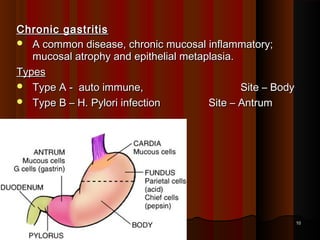
Chronic gastritisChronic gastritis
 A common disease, chronic mucosal inflammatory;A common disease, chronic mucosal inflammatory;
mucosal atrophy and epithelial metaplasia.mucosal atrophy and epithelial metaplasia.
TypesTypes
 Type A - auto immune,Type A - auto immune, Site – BodySite – Body
 Type B – H. Pylori infectionType B – H. Pylori infection Site – AntrumSite – Antrum
  
1010
AetiopathogenesisAetiopathogenesis
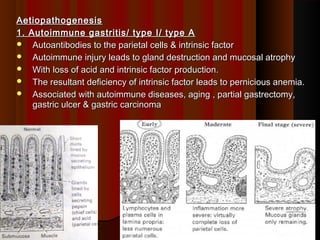
1. Autoimmune gastritis/ type I/ type A1. Autoimmune gastritis/ type I/ type A
 Autoantibodies to the parietal cells & intrinsic factorAutoantibodies to the parietal cells & intrinsic factor
 Autoimmune injury leads to gland destruction and mucosal atrophyAutoimmune injury leads to gland destruction and mucosal atrophy
 With loss of acid and intrinsic factor production.With loss of acid and intrinsic factor production.
 The resultant deficiency of intrinsic factor leads to pernicious anemia.The resultant deficiency of intrinsic factor leads to pernicious anemia.
 Associated with autoimmune diseases, aging , partial gastrectomy,Associated with autoimmune diseases, aging , partial gastrectomy,
gastric ulcer & gastric carcinomagastric ulcer & gastric carcinoma
1111
AetiopathogenesisAetiopathogenesis
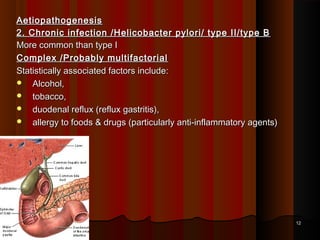
2. Chronic infection /Helicobacter pylori/ type II/type B2. Chronic infection /Helicobacter pylori/ type II/type B
More common than type IMore common than type I
Complex /Probably multifactorialComplex /Probably multifactorial
Statistically associated factors include:Statistically associated factors include:
 Alcohol,Alcohol,
 tobacco,tobacco,
 duodenal reflux (reflux gastritis),duodenal reflux (reflux gastritis),
 allergy to foods & drugs (particularly anti-inflammatory agents)allergy to foods & drugs (particularly anti-inflammatory agents)
1212
AetiopathogenesisAetiopathogenesis
2. Chronic infection /Helicobacter pylori/ type II/type B2. Chronic infection /Helicobacter pylori/ type II/type B
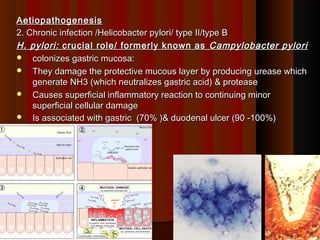
H. pylori:H. pylori: crucial role/ formerly known ascrucial role/ formerly known as Campylobacter pyloriCampylobacter pylori
 colonizes gastric mucosa:colonizes gastric mucosa:
 They damage the protective mucous layer by producing urease whichThey damage the protective mucous layer by producing urease which
generate NH3 (which neutralizes gastric acid) & proteasegenerate NH3 (which neutralizes gastric acid) & protease
 Causes superficial inflammatory reaction to continuing minorCauses superficial inflammatory reaction to continuing minor
superficial cellular damagesuperficial cellular damage
 Is associated with gastric (70% )& duodenal ulcer (90 -100%)Is associated with gastric (70% )& duodenal ulcer (90 -100%)
1313
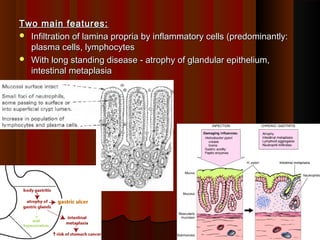
Two main features:Two main features:
 Infiltration of lamina propria by inflammatory cells (predominantly:Infiltration of lamina propria by inflammatory cells (predominantly:
plasma cells, lymphocytesplasma cells, lymphocytes
 With long standing disease - atrophy of glandular epithelium,With long standing disease - atrophy of glandular epithelium,
intestinal metaplasiaintestinal metaplasia
1414
1515
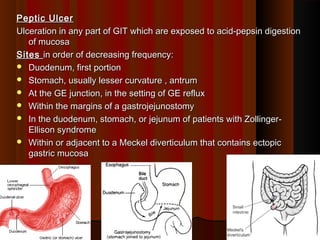
Peptic UlcerPeptic Ulcer
Ulceration in any part of GIT which are exposed to acid-pepsin digestionUlceration in any part of GIT which are exposed to acid-pepsin digestion
of mucosaof mucosa
SitesSites in order of decreasing frequency:in order of decreasing frequency:
 Duodenum, first portionDuodenum, first portion
 Stomach, usually lesser curvature , antrumStomach, usually lesser curvature , antrum
 At the GE junction, in the setting of GE refluxAt the GE junction, in the setting of GE reflux
 Within the margins of a gastrojejunostomyWithin the margins of a gastrojejunostomy
 In the duodenum, stomach, or jejunum of patients with Zollinger-In the duodenum, stomach, or jejunum of patients with Zollinger-
Ellison syndromeEllison syndrome
 Within or adjacent to a Meckel diverticulum that contains ectopicWithin or adjacent to a Meckel diverticulum that contains ectopic
gastric mucosagastric mucosa
1616
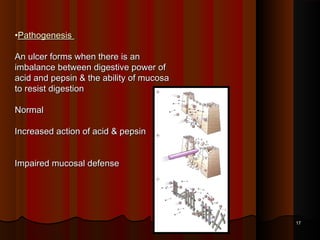
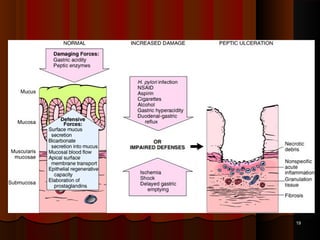
•PathogenesisPathogenesis
An ulcer forms when there is anAn ulcer forms when there is an
imbalance between digestive power ofimbalance between digestive power of
acid and pepsin & the ability of mucosaacid and pepsin & the ability of mucosa
to resist digestionto resist digestion
  
NormalNormal
Increased action of acid & pepsinIncreased action of acid & pepsin
Impaired mucosal defenseImpaired mucosal defense
1717
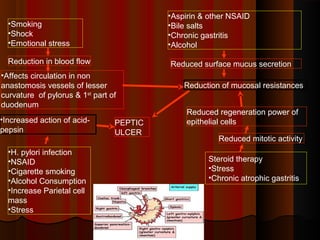
•Smoking
•Shock
•Emotional stress
Reduction in blood flow
Reduction of mucosal resistances
PEPTIC
ULCER
•Increased action of acid-
pepsin
•Aspirin & other NSAID
•Bile salts
•Chronic gastritis
•Alcohol
•H. pylori infection
•NSAID
•Cigarette smoking
•Alcohol Consumption
•Increase Parietal cell
mass
•Stress
Reduced regeneration power of
epithelial cells
Reduced surface mucus secretion
Reduced mitotic activity
Steroid therapy
•Stress
•Chronic atrophic gastritis
•Affects circulation in non
anastomosis vessels of lesser
curvature of pylorus & 1st
part of
duodenum
1919
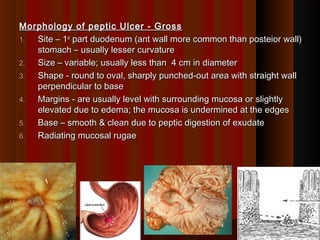
Morphology of peptic Ulcer - GrossMorphology of peptic Ulcer - Gross
1.1. Site – 1Site – 1stst
part duodenum (ant wall more common than posteior wall)part duodenum (ant wall more common than posteior wall)
stomach – usually lesser curvaturestomach – usually lesser curvature
2.2. Size – variable; usually less than 4 cm in diameterSize – variable; usually less than 4 cm in diameter
3.3. Shape - round to oval, sharply punched-out area with straight wallShape - round to oval, sharply punched-out area with straight wall
perpendicular to baseperpendicular to base
4.4. Margins - are usually level with surrounding mucosa or slightlyMargins - are usually level with surrounding mucosa or slightly
elevated due to edema; the mucosa is undermined at the edgeselevated due to edema; the mucosa is undermined at the edges
5.5. Base – smooth & clean due to peptic digestion of exudateBase – smooth & clean due to peptic digestion of exudate
6.6. Radiating mucosal rugaeRadiating mucosal rugae
2020
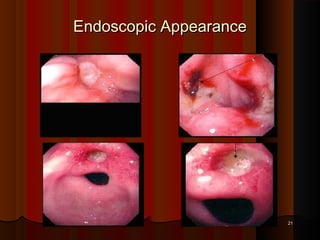
Endoscopic AppearanceEndoscopic Appearance
2121
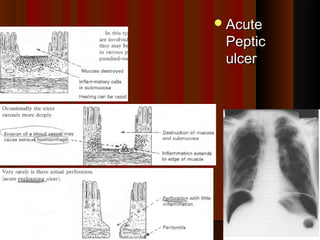
AcuteAcute
PepticPeptic
ulcerulcer
2222
Acute typeAcute type
 Less frequent than chronic typeLess frequent than chronic type
FateFate
 Severe bleedingSevere bleeding
 Heal with no scarHeal with no scar
 Chronic peptic ulcerChronic peptic ulcer
2323
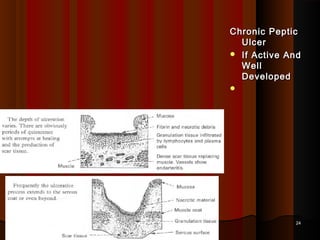
Chronic PepticChronic Peptic
UlcerUlcer
 If Active AndIf Active And
WellWell
DevelopedDeveloped

2424
Chronic formChronic form
 More common formMore common form
 Complete healing results in replacement of muscles withComplete healing results in replacement of muscles with
fibrous tissue & scarfibrous tissue & scar
2525
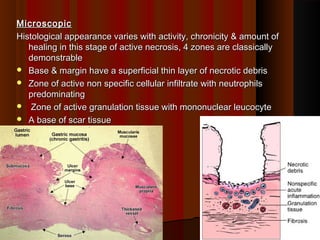
MicroscopicMicroscopic
Histological appearance varies with activity, chronicity & amount ofHistological appearance varies with activity, chronicity & amount of
healing in this stage of active necrosis, 4 zones are classicallyhealing in this stage of active necrosis, 4 zones are classically
demonstrabledemonstrable
 Base & margin have a superficial thin layer of necrotic debrisBase & margin have a superficial thin layer of necrotic debris
 Zone of active non specific cellular infiltrate with neutrophilsZone of active non specific cellular infiltrate with neutrophils
predominatingpredominating
 Zone of active granulation tissue with mononuclear leucocyteZone of active granulation tissue with mononuclear leucocyte
 A base of scar tissueA base of scar tissue
2626
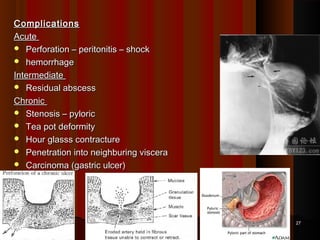
ComplicationsComplications
AcuteAcute
 Perforation – peritonitis – shockPerforation – peritonitis – shock
 hemorrhagehemorrhage
IntermediateIntermediate
 Residual abscessResidual abscess
ChronicChronic
 Stenosis – pyloricStenosis – pyloric
 Tea pot deformityTea pot deformity
 Hour glasss contractureHour glasss contracture
 Penetration into neighburing visceraPenetration into neighburing viscera
 Carcinoma (gastric ulcer)Carcinoma (gastric ulcer)
  
2727
Causes of ulcer in GITCauses of ulcer in GIT
Stomach –Stomach –
 Benign – Mostly peptic ulcerBenign – Mostly peptic ulcer
 Malignant - Ulcerative or excavated carcinomaMalignant - Ulcerative or excavated carcinoma
Small intestineSmall intestine
CommonCommon
 Duodenal - Peptic ulcer (Duodenal)Duodenal - Peptic ulcer (Duodenal)
 Typhoid ulcerTyphoid ulcer
 Tuberculous ulcerTuberculous ulcer
UncommonUncommon
 Bacillary dysentryBacillary dysentry
 Amoebic dysentryAmoebic dysentry
 Ulcerative colitisUlcerative colitis
 Crohn’s diseaseCrohn’s disease
 Malignant ulcerMalignant ulcer
 Peptic ulcer ( mackel’s diverticulum)Peptic ulcer ( mackel’s diverticulum)
2828
Large intestineLarge intestine
 Bacillary dysentryBacillary dysentry
 Amoebic dysentryAmoebic dysentry
 Tuberculous UlcerTuberculous Ulcer
 Ulcerative colitisUlcerative colitis
 Crohn’s diseaseCrohn’s disease
 Malignant ulcerMalignant ulcer
2929
3030
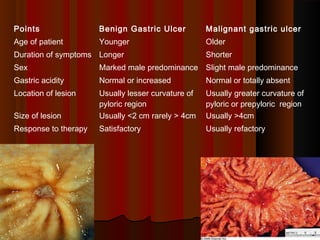
Points Benign Gastric Ulcer Malignant gastric ulcer
Age of patient Younger Older
Duration of symptoms Longer Shorter
Sex Marked male predominance Slight male predominance
Gastric acidity Normal or increased Normal or totally absent
Location of lesion Usually lesser curvature of
pyloric region
Usually greater curvature of
pyloric or prepyloric region
Size of lesion Usually <2 cm rarely > 4cm Usually >4cm
Response to therapy Satisfactory Usually refactory
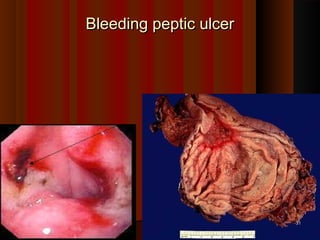
Bleeding peptic ulcerBleeding peptic ulcer
3131
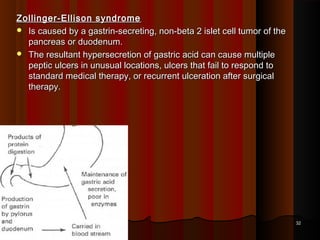
Zollinger-Ellison syndromeZollinger-Ellison syndrome
 Is caused by a gastrin-secreting, non-beta 2 islet cell tumor of theIs caused by a gastrin-secreting, non-beta 2 islet cell tumor of the
pancreas or duodenum.pancreas or duodenum.
 The resultant hypersecretion of gastric acid can cause multipleThe resultant hypersecretion of gastric acid can cause multiple
peptic ulcers in unusual locations, ulcers that fail to respond topeptic ulcers in unusual locations, ulcers that fail to respond to
standard medical therapy, or recurrent ulceration after surgicalstandard medical therapy, or recurrent ulceration after surgical
therapy.therapy.
3232
Tumours of StomachTumours of Stomach
 1. Primary1. Primary
BenignBenign
Epithelial tumourEpithelial tumour
 Gastric polypGastric polyp
 Hyperplastic polypHyperplastic polyp
 Adenomatous polypAdenomatous polyp
Mesenchymal tumourMesenchymal tumour
 FibromaFibroma
 LeiomyomaLeiomyoma
 LipomaLipoma
 HemangiomaHemangioma
 NeurofibromaNeurofibroma
3333
MalignantMalignant
 Epithelial tumourEpithelial tumour
 AdenocarcinomaAdenocarcinoma
 MesenchymalMesenchymal
 LymphomaLymphoma
 LeiomyosarcomaLeiomyosarcoma
 FibeosarcomaFibeosarcoma
Carcinoid tumour of endocrine glandCarcinoid tumour of endocrine gland
2. Secondary2. Secondary
3434
Risk factorsRisk factors
 Dietary factorsDietary factors
- Smoked fish and meats- Smoked fish and meats
- Pickled vegetables- Pickled vegetables
- Nitrosamines- Nitrosamines
- Benzpyrene- Benzpyrene
- Decreased intake of fruits and vegetables .- Decreased intake of fruits and vegetables .
 H. pylori infection .H. pylori infection .
 Chronic atrophic gastritis .Chronic atrophic gastritis .
 Blood type ABlood type A
 Bacterial overgrowth in the stomach .Bacterial overgrowth in the stomach .
 Partial gastrectomy .Partial gastrectomy .
 Male SexMale Sex
 Age – >50 yearsAge – >50 years

3535
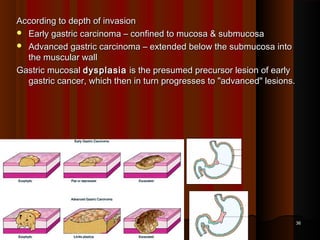
According to depth of invasionAccording to depth of invasion
 Early gastric carcinoma – confined to mucosa & submucosaEarly gastric carcinoma – confined to mucosa & submucosa
 Advanced gastric carcinoma – extended below the submucosa intoAdvanced gastric carcinoma – extended below the submucosa into
the muscular wallthe muscular wall
Gastric mucosalGastric mucosal dysplasiadysplasia is the presumed precursor lesion of earlyis the presumed precursor lesion of early
gastric cancer, which then in turn progresses to "advanced" lesions.gastric cancer, which then in turn progresses to "advanced" lesions.
3636
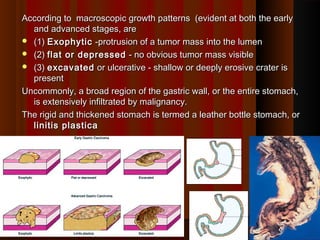
According to macroscopic growth patterns (evident at both the earlyAccording to macroscopic growth patterns (evident at both the early
and advanced stages, areand advanced stages, are
 (1)(1) ExophyticExophytic -protrusion of a tumor mass into the lumen-protrusion of a tumor mass into the lumen
 (2)(2) flat or depressedflat or depressed - no obvious tumor mass visible- no obvious tumor mass visible
 (3)(3) excavatedexcavated or ulcerative - shallow or deeply erosive crater isor ulcerative - shallow or deeply erosive crater is
presentpresent
Uncommonly, a broad region of the gastric wall, or the entire stomach,Uncommonly, a broad region of the gastric wall, or the entire stomach,
is extensively infiltrated by malignancy.is extensively infiltrated by malignancy.
The rigid and thickened stomach is termed a leather bottle stomach, orThe rigid and thickened stomach is termed a leather bottle stomach, or
linitis plasticalinitis plastica
3737
Histological subtypeHistological subtype
 Intestinal variantIntestinal variant
 Gastric variantGastric variant
The intestinal typeThe intestinal type
 Is thought to arise from gastric mucous cells that have undergoneIs thought to arise from gastric mucous cells that have undergone
intestinal metaplasia in the setting of chronic gastritis.intestinal metaplasia in the setting of chronic gastritis.
 This pattern of cancer tends to be better differentiated and is theThis pattern of cancer tends to be better differentiated and is the
more common type in high-risk populations.more common type in high-risk populations.
 The intestinal-type carcinoma occurs primarily after age 50 yearsThe intestinal-type carcinoma occurs primarily after age 50 years
with a 2 : 1 male predominancewith a 2 : 1 male predominance
3838
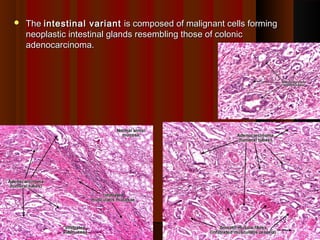
 TheThe intestinal variantintestinal variant is composed of malignant cells formingis composed of malignant cells forming
neoplastic intestinal glands resembling those of colonicneoplastic intestinal glands resembling those of colonic
adenocarcinoma.adenocarcinoma.
3939
The diffuse variantThe diffuse variant
 Is thought to arise de novo from native gastric mucous cells,Is thought to arise de novo from native gastric mucous cells,
 It is not associated with chronic gastritis, and tends to be poorlyIt is not associated with chronic gastritis, and tends to be poorly
differentiated.differentiated.
 The diffuse carcinoma occurs at an earlier age with femaleThe diffuse carcinoma occurs at an earlier age with female
predominance.predominance.
4040
 TheThe diffuse variantdiffuse variant is composed of gastric-type mucous cells thatis composed of gastric-type mucous cells that
 generally do not form glandsgenerally do not form glands
 but rather permeate the mucosa and wall as scattered individualbut rather permeate the mucosa and wall as scattered individual
"signet-ring" cells"signet-ring" cells or small clusters in an "infiltrative" growthor small clusters in an "infiltrative" growth
pattern.pattern.
4141
PresentationPresentation
 Often (90%) asymptomatic until late in the course .Often (90%) asymptomatic until late in the course .
 Weight loss and anorexiaWeight loss and anorexia
 Epigastric abdominal pain mimicking a peptic ulcer .Epigastric abdominal pain mimicking a peptic ulcer .
 Early satietyEarly satiety
 Occult bleeding and iron deficiency anemiaOccult bleeding and iron deficiency anemia
4242
MorphologyMorphology
The location of gastric carcinomas within the stomach is as follows:The location of gastric carcinomas within the stomach is as follows:
- pylorus and antrum, 50% to 60%;- pylorus and antrum, 50% to 60%;
- cardia, 25%;- cardia, 25%;
- and the remainder in the body and fundus.- and the remainder in the body and fundus.
The lesser curvature is involved in about 40% and the greaterThe lesser curvature is involved in about 40% and the greater
curvature in 12%.curvature in 12%.
Thus, a favored location is the lesser curvature of theThus, a favored location is the lesser curvature of the
antropyloric region.antropyloric region.
4343
Mode of spreadMode of spread
Direct spreadDirect spread
 Through wall to adjaecent structures - Pancreas, liver, esophagus,Through wall to adjaecent structures - Pancreas, liver, esophagus,
transverse colon , mesocolontransverse colon , mesocolon
Lymphatic spreadLymphatic spread
 Main nodes – nodes of lesser & greater curvatureMain nodes – nodes of lesser & greater curvature
 Virchow’s node - lt supraclavicular nodeVirchow’s node - lt supraclavicular node
Haemaogenous nodeHaemaogenous node
 Liver & lungLiver & lung
Transcelomic spreadTranscelomic spread
 Through Peritoneum – ascitisThrough Peritoneum – ascitis
 Ovary ( krukenberg’s tumour)Ovary ( krukenberg’s tumour)
4444
 Meckel diverticulum (also referred to as Meckel's Diverticulum) isMeckel diverticulum (also referred to as Meckel's Diverticulum) is
the most common congenital abnormality of the small intestine; it isthe most common congenital abnormality of the small intestine; it is
caused by an incomplete obliteration of the vitelline duct (ie,caused by an incomplete obliteration of the vitelline duct (ie,
omphalomesenteric duct). It is named after Johann Friedrichomphalomesenteric duct). It is named after Johann Friedrich
Meckel, who established its embryonic origin in 1809.Meckel, who established its embryonic origin in 1809.
 Despite the availability of modern imaging techniques, diagnosis isDespite the availability of modern imaging techniques, diagnosis is
challenging. Although Meckel diverticulum is usually of no medicalchallenging. Although Meckel diverticulum is usually of no medical
significance, two types of complications can require clinicalsignificance, two types of complications can require clinical
attention. One type involves ectopic mucosal tissue and most oftenattention. One type involves ectopic mucosal tissue and most often
leading to GI bleeding in younger children. In the secondleading to GI bleeding in younger children. In the second
type, the sequelae of the diverticulum involve an aberranttype, the sequelae of the diverticulum involve an aberrant
intraabdominal structure.intraabdominal structure.
4545
Complications include the following:Complications include the following:
 BleedingBleeding
 ObstructionObstruction
 DiverticulitisDiverticulitis
 TumorsTumors
4646

2.stomach

  • 1.
  • 2.
  • 3.
    Pyloric stenosisPyloric stenosis CongenitalHypertrophic pyloric stenosis (HPS)Congenital Hypertrophic pyloric stenosis (HPS) Congenital stenosis of the pylorus due to marked muscular hypertrophy ofCongenital stenosis of the pylorus due to marked muscular hypertrophy of the pyloric sphincter, resulting in gastric outlet obstructionthe pyloric sphincter, resulting in gastric outlet obstruction  One in 300-900 live birthsOne in 300-900 live births  Male-to-female ratio 3:1Male-to-female ratio 3:1 Adult typeAdult type  Inflammatory fibrosis - antral gastritis, peptic ulcerInflammatory fibrosis - antral gastritis, peptic ulcer  Malignant infiltrationMalignant infiltration 33
  • 4.
  • 5.
  • 6.
    GastritisGastritis It is aninflammatory condition of gastric mucosaIt is an inflammatory condition of gastric mucosa 1.1. Acute gastritisAcute gastritis  Acute mucosal inflammatory process, comes onAcute mucosal inflammatory process, comes on suddenly and lasts brieflysuddenly and lasts briefly 2.2. Chronic gastritisChronic gastritis  It is a chronic inflammation of gastric mucosa leading toIt is a chronic inflammation of gastric mucosa leading to atrophy of gastric mucosaatrophy of gastric mucosa  either long lasting or recurrenteither long lasting or recurrent 66
  • 7.
    ACUTE GASTRITISACUTE GASTRITIS Causesof acute gastritisCauses of acute gastritis  NSAIDs - Aspirin,NSAIDs - Aspirin,  Heavy Smoking & excessive Alcohol intakeHeavy Smoking & excessive Alcohol intake  Other drugs, e.g. iron preparationsOther drugs, e.g. iron preparations  Severe stress, e.g. burns, traumaSevere stress, e.g. burns, trauma  Bile reflux, e.g. following gastric surgeryBile reflux, e.g. following gastric surgery  ShockShock 77
  • 8.
    ACUTE GASTRITISACUTE GASTRITIS MorphologyMorphology Acute gastritis is often erosive and haemorrhagic.Acute gastritis is often erosive and haemorrhagic.  Neutrophils are the predominant inflammatory cell seen in laminaNeutrophils are the predominant inflammatory cell seen in lamina propriapropria 88
  • 9.
    Clinical effectsClinical effects Acute gastritis often produces no symptoms but may causeAcute gastritis often produces no symptoms but may cause dyspepsia, anorexia, nausea or vomiting, and haematemesis ordyspepsia, anorexia, nausea or vomiting, and haematemesis or melaena.melaena. TreatmentTreatment  Should be directed to the underlying cause. Short-term symptomaticShould be directed to the underlying cause. Short-term symptomatic therapy with antacids, and acid suppression using proton pumptherapy with antacids, and acid suppression using proton pump inhibitors or antiemetics (e.g. metoclopramide) may be necessary.inhibitors or antiemetics (e.g. metoclopramide) may be necessary. 99
  • 10.
    Chronic gastritisChronic gastritis A common disease, chronic mucosal inflammatory;A common disease, chronic mucosal inflammatory; mucosal atrophy and epithelial metaplasia.mucosal atrophy and epithelial metaplasia. TypesTypes  Type A - auto immune,Type A - auto immune, Site – BodySite – Body  Type B – H. Pylori infectionType B – H. Pylori infection Site – AntrumSite – Antrum    1010
  • 11.
    AetiopathogenesisAetiopathogenesis 1. Autoimmune gastritis/type I/ type A1. Autoimmune gastritis/ type I/ type A  Autoantibodies to the parietal cells & intrinsic factorAutoantibodies to the parietal cells & intrinsic factor  Autoimmune injury leads to gland destruction and mucosal atrophyAutoimmune injury leads to gland destruction and mucosal atrophy  With loss of acid and intrinsic factor production.With loss of acid and intrinsic factor production.  The resultant deficiency of intrinsic factor leads to pernicious anemia.The resultant deficiency of intrinsic factor leads to pernicious anemia.  Associated with autoimmune diseases, aging , partial gastrectomy,Associated with autoimmune diseases, aging , partial gastrectomy, gastric ulcer & gastric carcinomagastric ulcer & gastric carcinoma 1111
  • 12.
    AetiopathogenesisAetiopathogenesis 2. Chronic infection/Helicobacter pylori/ type II/type B2. Chronic infection /Helicobacter pylori/ type II/type B More common than type IMore common than type I Complex /Probably multifactorialComplex /Probably multifactorial Statistically associated factors include:Statistically associated factors include:  Alcohol,Alcohol,  tobacco,tobacco,  duodenal reflux (reflux gastritis),duodenal reflux (reflux gastritis),  allergy to foods & drugs (particularly anti-inflammatory agents)allergy to foods & drugs (particularly anti-inflammatory agents) 1212
  • 13.
    AetiopathogenesisAetiopathogenesis 2. Chronic infection/Helicobacter pylori/ type II/type B2. Chronic infection /Helicobacter pylori/ type II/type B H. pylori:H. pylori: crucial role/ formerly known ascrucial role/ formerly known as Campylobacter pyloriCampylobacter pylori  colonizes gastric mucosa:colonizes gastric mucosa:  They damage the protective mucous layer by producing urease whichThey damage the protective mucous layer by producing urease which generate NH3 (which neutralizes gastric acid) & proteasegenerate NH3 (which neutralizes gastric acid) & protease  Causes superficial inflammatory reaction to continuing minorCauses superficial inflammatory reaction to continuing minor superficial cellular damagesuperficial cellular damage  Is associated with gastric (70% )& duodenal ulcer (90 -100%)Is associated with gastric (70% )& duodenal ulcer (90 -100%) 1313
  • 14.
    Two main features:Twomain features:  Infiltration of lamina propria by inflammatory cells (predominantly:Infiltration of lamina propria by inflammatory cells (predominantly: plasma cells, lymphocytesplasma cells, lymphocytes  With long standing disease - atrophy of glandular epithelium,With long standing disease - atrophy of glandular epithelium, intestinal metaplasiaintestinal metaplasia 1414
  • 15.
  • 16.
    Peptic UlcerPeptic Ulcer Ulcerationin any part of GIT which are exposed to acid-pepsin digestionUlceration in any part of GIT which are exposed to acid-pepsin digestion of mucosaof mucosa SitesSites in order of decreasing frequency:in order of decreasing frequency:  Duodenum, first portionDuodenum, first portion  Stomach, usually lesser curvature , antrumStomach, usually lesser curvature , antrum  At the GE junction, in the setting of GE refluxAt the GE junction, in the setting of GE reflux  Within the margins of a gastrojejunostomyWithin the margins of a gastrojejunostomy  In the duodenum, stomach, or jejunum of patients with Zollinger-In the duodenum, stomach, or jejunum of patients with Zollinger- Ellison syndromeEllison syndrome  Within or adjacent to a Meckel diverticulum that contains ectopicWithin or adjacent to a Meckel diverticulum that contains ectopic gastric mucosagastric mucosa 1616
  • 17.
    •PathogenesisPathogenesis An ulcer formswhen there is anAn ulcer forms when there is an imbalance between digestive power ofimbalance between digestive power of acid and pepsin & the ability of mucosaacid and pepsin & the ability of mucosa to resist digestionto resist digestion    NormalNormal Increased action of acid & pepsinIncreased action of acid & pepsin Impaired mucosal defenseImpaired mucosal defense 1717
  • 18.
    •Smoking •Shock •Emotional stress Reduction inblood flow Reduction of mucosal resistances PEPTIC ULCER •Increased action of acid- pepsin •Aspirin & other NSAID •Bile salts •Chronic gastritis •Alcohol •H. pylori infection •NSAID •Cigarette smoking •Alcohol Consumption •Increase Parietal cell mass •Stress Reduced regeneration power of epithelial cells Reduced surface mucus secretion Reduced mitotic activity Steroid therapy •Stress •Chronic atrophic gastritis •Affects circulation in non anastomosis vessels of lesser curvature of pylorus & 1st part of duodenum
  • 19.
  • 20.
    Morphology of pepticUlcer - GrossMorphology of peptic Ulcer - Gross 1.1. Site – 1Site – 1stst part duodenum (ant wall more common than posteior wall)part duodenum (ant wall more common than posteior wall) stomach – usually lesser curvaturestomach – usually lesser curvature 2.2. Size – variable; usually less than 4 cm in diameterSize – variable; usually less than 4 cm in diameter 3.3. Shape - round to oval, sharply punched-out area with straight wallShape - round to oval, sharply punched-out area with straight wall perpendicular to baseperpendicular to base 4.4. Margins - are usually level with surrounding mucosa or slightlyMargins - are usually level with surrounding mucosa or slightly elevated due to edema; the mucosa is undermined at the edgeselevated due to edema; the mucosa is undermined at the edges 5.5. Base – smooth & clean due to peptic digestion of exudateBase – smooth & clean due to peptic digestion of exudate 6.6. Radiating mucosal rugaeRadiating mucosal rugae 2020
  • 21.
  • 22.
  • 23.
    Acute typeAcute type Less frequent than chronic typeLess frequent than chronic type FateFate  Severe bleedingSevere bleeding  Heal with no scarHeal with no scar  Chronic peptic ulcerChronic peptic ulcer 2323
  • 24.
    Chronic PepticChronic Peptic UlcerUlcer If Active AndIf Active And WellWell DevelopedDeveloped  2424
  • 25.
    Chronic formChronic form More common formMore common form  Complete healing results in replacement of muscles withComplete healing results in replacement of muscles with fibrous tissue & scarfibrous tissue & scar 2525
  • 26.
    MicroscopicMicroscopic Histological appearance varieswith activity, chronicity & amount ofHistological appearance varies with activity, chronicity & amount of healing in this stage of active necrosis, 4 zones are classicallyhealing in this stage of active necrosis, 4 zones are classically demonstrabledemonstrable  Base & margin have a superficial thin layer of necrotic debrisBase & margin have a superficial thin layer of necrotic debris  Zone of active non specific cellular infiltrate with neutrophilsZone of active non specific cellular infiltrate with neutrophils predominatingpredominating  Zone of active granulation tissue with mononuclear leucocyteZone of active granulation tissue with mononuclear leucocyte  A base of scar tissueA base of scar tissue 2626
  • 27.
    ComplicationsComplications AcuteAcute  Perforation –peritonitis – shockPerforation – peritonitis – shock  hemorrhagehemorrhage IntermediateIntermediate  Residual abscessResidual abscess ChronicChronic  Stenosis – pyloricStenosis – pyloric  Tea pot deformityTea pot deformity  Hour glasss contractureHour glasss contracture  Penetration into neighburing visceraPenetration into neighburing viscera  Carcinoma (gastric ulcer)Carcinoma (gastric ulcer)    2727
  • 28.
    Causes of ulcerin GITCauses of ulcer in GIT Stomach –Stomach –  Benign – Mostly peptic ulcerBenign – Mostly peptic ulcer  Malignant - Ulcerative or excavated carcinomaMalignant - Ulcerative or excavated carcinoma Small intestineSmall intestine CommonCommon  Duodenal - Peptic ulcer (Duodenal)Duodenal - Peptic ulcer (Duodenal)  Typhoid ulcerTyphoid ulcer  Tuberculous ulcerTuberculous ulcer UncommonUncommon  Bacillary dysentryBacillary dysentry  Amoebic dysentryAmoebic dysentry  Ulcerative colitisUlcerative colitis  Crohn’s diseaseCrohn’s disease  Malignant ulcerMalignant ulcer  Peptic ulcer ( mackel’s diverticulum)Peptic ulcer ( mackel’s diverticulum) 2828
  • 29.
    Large intestineLarge intestine Bacillary dysentryBacillary dysentry  Amoebic dysentryAmoebic dysentry  Tuberculous UlcerTuberculous Ulcer  Ulcerative colitisUlcerative colitis  Crohn’s diseaseCrohn’s disease  Malignant ulcerMalignant ulcer 2929
  • 30.
    3030 Points Benign GastricUlcer Malignant gastric ulcer Age of patient Younger Older Duration of symptoms Longer Shorter Sex Marked male predominance Slight male predominance Gastric acidity Normal or increased Normal or totally absent Location of lesion Usually lesser curvature of pyloric region Usually greater curvature of pyloric or prepyloric region Size of lesion Usually <2 cm rarely > 4cm Usually >4cm Response to therapy Satisfactory Usually refactory
  • 31.
  • 32.
    Zollinger-Ellison syndromeZollinger-Ellison syndrome Is caused by a gastrin-secreting, non-beta 2 islet cell tumor of theIs caused by a gastrin-secreting, non-beta 2 islet cell tumor of the pancreas or duodenum.pancreas or duodenum.  The resultant hypersecretion of gastric acid can cause multipleThe resultant hypersecretion of gastric acid can cause multiple peptic ulcers in unusual locations, ulcers that fail to respond topeptic ulcers in unusual locations, ulcers that fail to respond to standard medical therapy, or recurrent ulceration after surgicalstandard medical therapy, or recurrent ulceration after surgical therapy.therapy. 3232
  • 33.
    Tumours of StomachTumoursof Stomach  1. Primary1. Primary BenignBenign Epithelial tumourEpithelial tumour  Gastric polypGastric polyp  Hyperplastic polypHyperplastic polyp  Adenomatous polypAdenomatous polyp Mesenchymal tumourMesenchymal tumour  FibromaFibroma  LeiomyomaLeiomyoma  LipomaLipoma  HemangiomaHemangioma  NeurofibromaNeurofibroma 3333
  • 34.
    MalignantMalignant  Epithelial tumourEpithelialtumour  AdenocarcinomaAdenocarcinoma  MesenchymalMesenchymal  LymphomaLymphoma  LeiomyosarcomaLeiomyosarcoma  FibeosarcomaFibeosarcoma Carcinoid tumour of endocrine glandCarcinoid tumour of endocrine gland 2. Secondary2. Secondary 3434
  • 35.
    Risk factorsRisk factors Dietary factorsDietary factors - Smoked fish and meats- Smoked fish and meats - Pickled vegetables- Pickled vegetables - Nitrosamines- Nitrosamines - Benzpyrene- Benzpyrene - Decreased intake of fruits and vegetables .- Decreased intake of fruits and vegetables .  H. pylori infection .H. pylori infection .  Chronic atrophic gastritis .Chronic atrophic gastritis .  Blood type ABlood type A  Bacterial overgrowth in the stomach .Bacterial overgrowth in the stomach .  Partial gastrectomy .Partial gastrectomy .  Male SexMale Sex  Age – >50 yearsAge – >50 years  3535
  • 36.
    According to depthof invasionAccording to depth of invasion  Early gastric carcinoma – confined to mucosa & submucosaEarly gastric carcinoma – confined to mucosa & submucosa  Advanced gastric carcinoma – extended below the submucosa intoAdvanced gastric carcinoma – extended below the submucosa into the muscular wallthe muscular wall Gastric mucosalGastric mucosal dysplasiadysplasia is the presumed precursor lesion of earlyis the presumed precursor lesion of early gastric cancer, which then in turn progresses to "advanced" lesions.gastric cancer, which then in turn progresses to "advanced" lesions. 3636
  • 37.
    According to macroscopicgrowth patterns (evident at both the earlyAccording to macroscopic growth patterns (evident at both the early and advanced stages, areand advanced stages, are  (1)(1) ExophyticExophytic -protrusion of a tumor mass into the lumen-protrusion of a tumor mass into the lumen  (2)(2) flat or depressedflat or depressed - no obvious tumor mass visible- no obvious tumor mass visible  (3)(3) excavatedexcavated or ulcerative - shallow or deeply erosive crater isor ulcerative - shallow or deeply erosive crater is presentpresent Uncommonly, a broad region of the gastric wall, or the entire stomach,Uncommonly, a broad region of the gastric wall, or the entire stomach, is extensively infiltrated by malignancy.is extensively infiltrated by malignancy. The rigid and thickened stomach is termed a leather bottle stomach, orThe rigid and thickened stomach is termed a leather bottle stomach, or linitis plasticalinitis plastica 3737
  • 38.
    Histological subtypeHistological subtype Intestinal variantIntestinal variant  Gastric variantGastric variant The intestinal typeThe intestinal type  Is thought to arise from gastric mucous cells that have undergoneIs thought to arise from gastric mucous cells that have undergone intestinal metaplasia in the setting of chronic gastritis.intestinal metaplasia in the setting of chronic gastritis.  This pattern of cancer tends to be better differentiated and is theThis pattern of cancer tends to be better differentiated and is the more common type in high-risk populations.more common type in high-risk populations.  The intestinal-type carcinoma occurs primarily after age 50 yearsThe intestinal-type carcinoma occurs primarily after age 50 years with a 2 : 1 male predominancewith a 2 : 1 male predominance 3838
  • 39.
     TheThe intestinalvariantintestinal variant is composed of malignant cells formingis composed of malignant cells forming neoplastic intestinal glands resembling those of colonicneoplastic intestinal glands resembling those of colonic adenocarcinoma.adenocarcinoma. 3939
  • 40.
    The diffuse variantThediffuse variant  Is thought to arise de novo from native gastric mucous cells,Is thought to arise de novo from native gastric mucous cells,  It is not associated with chronic gastritis, and tends to be poorlyIt is not associated with chronic gastritis, and tends to be poorly differentiated.differentiated.  The diffuse carcinoma occurs at an earlier age with femaleThe diffuse carcinoma occurs at an earlier age with female predominance.predominance. 4040
  • 41.
     TheThe diffusevariantdiffuse variant is composed of gastric-type mucous cells thatis composed of gastric-type mucous cells that  generally do not form glandsgenerally do not form glands  but rather permeate the mucosa and wall as scattered individualbut rather permeate the mucosa and wall as scattered individual "signet-ring" cells"signet-ring" cells or small clusters in an "infiltrative" growthor small clusters in an "infiltrative" growth pattern.pattern. 4141
  • 42.
    PresentationPresentation  Often (90%)asymptomatic until late in the course .Often (90%) asymptomatic until late in the course .  Weight loss and anorexiaWeight loss and anorexia  Epigastric abdominal pain mimicking a peptic ulcer .Epigastric abdominal pain mimicking a peptic ulcer .  Early satietyEarly satiety  Occult bleeding and iron deficiency anemiaOccult bleeding and iron deficiency anemia 4242
  • 43.
    MorphologyMorphology The location ofgastric carcinomas within the stomach is as follows:The location of gastric carcinomas within the stomach is as follows: - pylorus and antrum, 50% to 60%;- pylorus and antrum, 50% to 60%; - cardia, 25%;- cardia, 25%; - and the remainder in the body and fundus.- and the remainder in the body and fundus. The lesser curvature is involved in about 40% and the greaterThe lesser curvature is involved in about 40% and the greater curvature in 12%.curvature in 12%. Thus, a favored location is the lesser curvature of theThus, a favored location is the lesser curvature of the antropyloric region.antropyloric region. 4343
  • 44.
    Mode of spreadModeof spread Direct spreadDirect spread  Through wall to adjaecent structures - Pancreas, liver, esophagus,Through wall to adjaecent structures - Pancreas, liver, esophagus, transverse colon , mesocolontransverse colon , mesocolon Lymphatic spreadLymphatic spread  Main nodes – nodes of lesser & greater curvatureMain nodes – nodes of lesser & greater curvature  Virchow’s node - lt supraclavicular nodeVirchow’s node - lt supraclavicular node Haemaogenous nodeHaemaogenous node  Liver & lungLiver & lung Transcelomic spreadTranscelomic spread  Through Peritoneum – ascitisThrough Peritoneum – ascitis  Ovary ( krukenberg’s tumour)Ovary ( krukenberg’s tumour) 4444
  • 45.
     Meckel diverticulum(also referred to as Meckel's Diverticulum) isMeckel diverticulum (also referred to as Meckel's Diverticulum) is the most common congenital abnormality of the small intestine; it isthe most common congenital abnormality of the small intestine; it is caused by an incomplete obliteration of the vitelline duct (ie,caused by an incomplete obliteration of the vitelline duct (ie, omphalomesenteric duct). It is named after Johann Friedrichomphalomesenteric duct). It is named after Johann Friedrich Meckel, who established its embryonic origin in 1809.Meckel, who established its embryonic origin in 1809.  Despite the availability of modern imaging techniques, diagnosis isDespite the availability of modern imaging techniques, diagnosis is challenging. Although Meckel diverticulum is usually of no medicalchallenging. Although Meckel diverticulum is usually of no medical significance, two types of complications can require clinicalsignificance, two types of complications can require clinical attention. One type involves ectopic mucosal tissue and most oftenattention. One type involves ectopic mucosal tissue and most often leading to GI bleeding in younger children. In the secondleading to GI bleeding in younger children. In the second type, the sequelae of the diverticulum involve an aberranttype, the sequelae of the diverticulum involve an aberrant intraabdominal structure.intraabdominal structure. 4545
  • 46.
    Complications include thefollowing:Complications include the following:  BleedingBleeding  ObstructionObstruction  DiverticulitisDiverticulitis  TumorsTumors 4646