• Hydrocephalus is the term used for increasedHydrocephalus is the term used for increased
volume of CSF within the skull, accompanied byvolume of CSF within the skull, accompanied by
dilation of the ventricles. There is increaseddilation of the ventricles. There is increased
intracranial pressure. This type ofintracranial pressure. This type of
hydrocephalus involving ventricular dilatation ishydrocephalus involving ventricular dilatation is
known as internal hydrocephalus. A localizeknown as internal hydrocephalus. A localize
collection of CSF in subarachnoid space iscollection of CSF in subarachnoid space is
called external hydrocephalus.called external hydrocephalus.
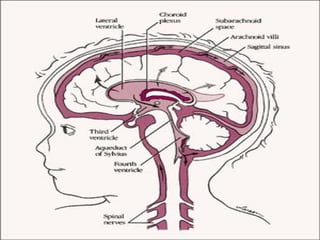
• CSF mainly produced by choroid plexus in the lateralCSF mainly produced by choroid plexus in the lateral
3rd & 4th ventricle & small part found on the surface of3rd & 4th ventricle & small part found on the surface of
brain & spinal chord. Total volume of CSF is 120-150brain & spinal chord. Total volume of CSF is 120-150
ml. CSF is formed in the lateral ventricle flow throw theml. CSF is formed in the lateral ventricle flow throw the
foramen of Munroe to the third ventricle & from thereforamen of Munroe to the third ventricle & from there
by aqueduct of the sylvius to the fourth ventricle. Theby aqueduct of the sylvius to the fourth ventricle. The
fluid then passes through the foramen of magendie &fluid then passes through the foramen of magendie &
Lusaka of the 4th ventricle to reach the sub arachnoidLusaka of the 4th ventricle to reach the sub arachnoid
space of the brain then spreads through the subspace of the brain then spreads through the sub
arachnoid space of the surface of the spinal cord . it isarachnoid space of the surface of the spinal cord . it is
absorbed into the blood by the arachnid villi alongabsorbed into the blood by the arachnid villi along
Dural venous sinus.Dural venous sinus.
• Hydrocephalus is classified into primary & secondaryHydrocephalus is classified into primary & secondary
hydrocephalus.hydrocephalus.
• Primary hydrocephalus:Primary hydrocephalus:
• Increase in the volume of CSF with in the skull along withIncrease in the volume of CSF with in the skull along with
increase intra cranial pressure. There are 3 possibleincrease intra cranial pressure. There are 3 possible
method of primary hydrocephalusmethod of primary hydrocephalus
1.1.Obstruction to the flow of CSFObstruction to the flow of CSF
2.2.Over production of CSFOver production of CSF
3.3.Deficient reabsorption of CSFDeficient reabsorption of CSF
• Obstruction to the flow of CSF is commonest cause isObstruction to the flow of CSF is commonest cause is
called obstructive hydrocephalus.called obstructive hydrocephalus.
• Non communicating hydrocephalus:Non communicating hydrocephalus:
Obstruction to the flow of CSF within the ventricular systemObstruction to the flow of CSF within the ventricular system
then a portion of ventricles become enlarged & CSF can notthen a portion of ventricles become enlarged & CSF can not
pass into sub arachnoid space this is called nonpass into sub arachnoid space this is called non
communicating hydrocephalus.communicating hydrocephalus.
• Communicating hydrocephalus:Communicating hydrocephalus:
All the ventricular system is enlarged due to reduce resorptionAll the ventricular system is enlarged due to reduce resorption
is called as communicating hydrocephalus.is called as communicating hydrocephalus.
• Secondary hydrocephalus:Secondary hydrocephalus:
Compensatory increase of CSF due to loss of neural tissueCompensatory increase of CSF due to loss of neural tissue
without rise in intra cranial pressure for example cerebralwithout rise in intra cranial pressure for example cerebral
atrophy & infraction.atrophy & infraction.
Cont…..Cont…..
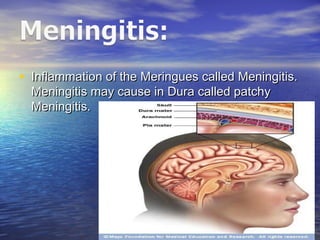
• Inflammation of the Meringues called Meningitis.Inflammation of the Meringues called Meningitis.
Meningitis may cause in Dura called patchyMeningitis may cause in Dura called patchy
Meningitis.Meningitis.
Infectious Meningitis is classified into 3 types.Infectious Meningitis is classified into 3 types.
1.1.Acute pyogenic MeningitisAcute pyogenic Meningitis
2.2.Acute pyogenic aseptic MeningitisAcute pyogenic aseptic Meningitis
3.3.Chronic MeningitisChronic Meningitis
a)a) BacterialBacterial
b)b) FungulFungul
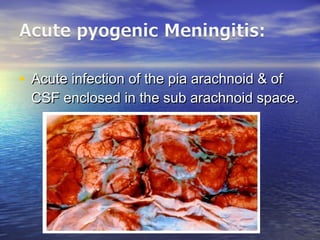
• Acute infection of the pia arachnoid & ofAcute infection of the pia arachnoid & of
CSF enclosed in the sub arachnoid space.CSF enclosed in the sub arachnoid space.
• Causative agent very with the age of theCausative agent very with the age of the
patientpatient
• In neonates common organism are E.In neonates common organism are E.
Coli, StreptococcusColi, Streptococcus
• In older age streptococcus pneumonia,In older age streptococcus pneumonia,
listeria monocytogines are more commonlisteria monocytogines are more common
• In adolescent & young adults NeiseriaIn adolescent & young adults Neiseria
Meningitis.Meningitis.
• Blood stream introduction micro organism atBlood stream introduction micro organism at
operation or during lumber punctureoperation or during lumber puncture
• morphological changes:morphological changes:
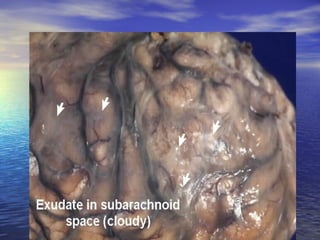
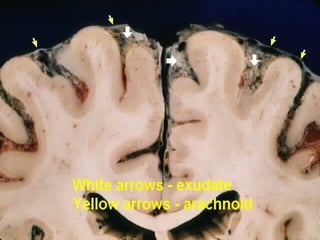
• GROSSGROSS puss present in the sub arachonoidpuss present in the sub arachonoid
space so CSF become stubid or porulant.space so CSF become stubid or porulant.
sturbid fluid is seen in sulcui & at the base of thesturbid fluid is seen in sulcui & at the base of the
brain.brain.
• In fluminant case some digree of ventriculaitis isIn fluminant case some digree of ventriculaitis is
also present contaning a fibrinous coting onalso present contaning a fibrinous coting on
• Numerous polymorph nuclear nutrophilesNumerous polymorph nuclear nutrophiles
in the subarachnoid space as well asin the subarachnoid space as well as
Meningies & particularly around the bloodMeningies & particularly around the blood
vessel.vessel.
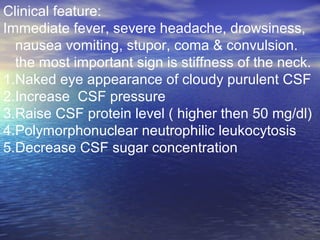
Clinical feature:
Immediate fever, severe headache, drowsiness,
nausea vomiting, stupor, coma & convulsion.
the most important sign is stiffness of the neck.
1.Naked eye appearance of cloudy purulent CSF
2.Increase CSF pressure
3.Raise CSF protein level ( higher then 50 mg/dl)
4.Polymorphonuclear neutrophilic leukocytosis
5.Decrease CSF sugar concentration
• Is common in young adultIs common in young adult
• Etiology:Etiology:
• introvirus, mums, Cox sackie virus &introvirus, mums, Cox sackie virus &
abstenbar virus, HSV-2abstenbar virus, HSV-2
• Morphology:Morphology:
• Gross: swealing of the brain .Gross: swealing of the brain .
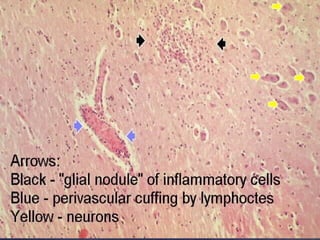
• Microscopic: lymphocyte infiltrationMicroscopic: lymphocyte infiltration
in lap Meningitis.in lap Meningitis.
• the clinical manifastation for viral Meningitis arethe clinical manifastation for viral Meningitis are
same in bactarial Meningitis with the feature ofsame in bactarial Meningitis with the feature of
the acute onset Meningial symptoms & fever.the acute onset Meningial symptoms & fever.
Clinical course is less fluminant in pyogenicClinical course is less fluminant in pyogenic
Meningitis.Meningitis.
• aseptic Meningitis is self limiting & often treatedaseptic Meningitis is self limiting & often treated
symptomatically.symptomatically.
• CSF finding in viral Meningitis areCSF finding in viral Meningitis are
1.1.Naked eye appearance of clear turbid CSFNaked eye appearance of clear turbid CSF
2.2.CSF pressure increase above 250mm waterCSF pressure increase above 250mm water
3.3.Lympho cytosis in CSFLympho cytosis in CSF
4.4.10-100 cells per micro liter.10-100 cells per micro liter.
• There are 2 types of chronic MeningitisThere are 2 types of chronic Meningitis
1.1.Tubercular &Tubercular &
2.2.Crepto coccalCrepto coccal
• Tubercular Meningitis:Tubercular Meningitis: occurs in children & adultsoccurs in children & adults
through hematogenis spread of infection fromthrough hematogenis spread of infection from
tuberculosis in the bodytuberculosis in the body
• Creptococcal Meningitis:Creptococcal Meningitis: particularly in immunoparticularly in immuno
compromised person as a result of hematogeniccompromised person as a result of hematogenic
dissemination from a pulmonary lesiondissemination from a pulmonary lesion
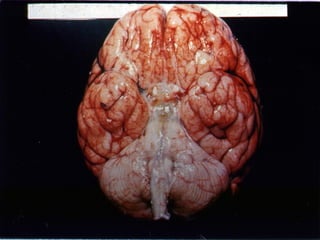
Gross: in tubercular MeningitisGross: in tubercular Meningitis
arachnoids space contain thickarachnoids space contain thick
exudates particularly abundant in theexudates particularly abundant in the
sulci and the base of the brainsulci and the base of the brain
Tubercle 1-2 mm in diameter may beTubercle 1-2 mm in diameter may be
visiblevisible
The exudates in the CryptococcusThe exudates in the Cryptococcus
meningitis is scanti translucent andmeningitis is scanti translucent and
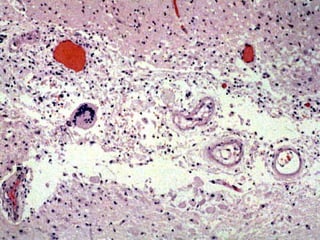
MICROSCOPICMICROSCOPIC
• Tubercleus meningitis showsTubercleus meningitis shows
exudates of acute and chronicexudates of acute and chronic
inflammatory cell and granulomasinflammatory cell and granulomas
with or with out caseation necrosiswith or with out caseation necrosis
and giant celland giant cell
• Cryptococcal meningitis isCryptococcal meningitis is
characterized by lymphocytes,characterized by lymphocytes,
plasma cell and granulomaplasma cell and granuloma
CLINICAL FEATURES ANDCLINICAL FEATURES AND
DIAGNOSISDIAGNOSIS
• Common clinical feature of tubercles meningitisCommon clinical feature of tubercles meningitis
are headache, confusion, malaise and vomitingare headache, confusion, malaise and vomiting
• clinical course in cryptococcal meningitis may beclinical course in cryptococcal meningitis may be
fulminate and fatal in a few weeksfulminate and fatal in a few weeks
• CSF finding in chronic manangitis areCSF finding in chronic manangitis are
1.1. Naked eye appearance of clear or slightly terbidNaked eye appearance of clear or slightly terbid
CSFCSF
2.2. Raise CSF pressure above 300 mm waterRaise CSF pressure above 300 mm water
3.3. Mono nuclearleucocytosisMono nuclearleucocytosis
4.4. Raised protein contentRaised protein content
5.5. Lowered glucose concentration.Lowered glucose concentration.
It is a localized area of tissue necrosisIt is a localized area of tissue necrosis
caused by local vascular occlusion ofcaused by local vascular occlusion of
arteries & veins. It is also called as stroke.arteries & veins. It is also called as stroke.
Arterial occlusion: occlusions of the cerebralArterial occlusion: occlusions of the cerebral
arteries by either by thrombi or emboli.arteries by either by thrombi or emboli.
Thrombotic occlusions of the cerebralThrombotic occlusions of the cerebral
arteries is the most common & frequentlyarteries is the most common & frequently
the result of the atherosclerosis.the result of the atherosclerosis.
Emboli arterial occlusion is commenly derivedEmboli arterial occlusion is commenly derived
from the heart ,most from the muralfrom the heart ,most from the mural
thrombosis complicating MI ,arterial fibrilationthrombosis complicating MI ,arterial fibrilation
and endocarditis.The size and shape of anand endocarditis.The size and shape of an
infarct are determined by the extent of aninfarct are determined by the extent of an
anastomosis with adjacent arteries .anastomosis with adjacent arteries .
• The middle anterior cerebral arteries haveThe middle anterior cerebral arteries have
partial anastomosis of thuer distalpartial anastomosis of thuer distal
branches.Their complete occlusion maybranches.Their complete occlusion may
cause infarct.cause infarct.
Venous infarction in the brain is infrequentVenous infarction in the brain is infrequent
phenomenon due to good communication ofphenomenon due to good communication of
the cerebral venous drainage.the cerebral venous drainage.
NON OCCLUSIVE CAUSESNON OCCLUSIVE CAUSES
Compression of theCompression of the
cerebral arteries from outside such as duringcerebral arteries from outside such as during
herniation may cause cerebral infarction.herniation may cause cerebral infarction.
May be anaemic or haemorraghicMay be anaemic or haemorraghic
GROSSLYGROSSLY
An anaemic infarct becomes evidentAn anaemic infarct becomes evident
6-12hours after its occurance.6-12hours after its occurance.
The affected area is soft swollen there is blurringThe affected area is soft swollen there is blurring
of the junction between the grey and whiteof the junction between the grey and white
matter.Within2-3 days the infarct undergoesmatter.Within2-3 days the infarct undergoes
sotening and disintegration.sotening and disintegration.
Is due to the frgmentation of the occlusiveIs due to the frgmentation of the occlusive
arterial emboli or venous thrombosis.arterial emboli or venous thrombosis.
HISTOLOGICALLYHISTOLOGICALLY
1.1. Initially eosinophilic neuronal necrosis lipidInitially eosinophilic neuronal necrosis lipid
vacuolisation produced by breakedown ofvacuolisation produced by breakedown of
the myelin Simultaniously the area isthe myelin Simultaniously the area is
infiltrated by neutrphilsinfiltrated by neutrphils
2.2. After 2-3 days ther is progressive invasionAfter 2-3 days ther is progressive invasion
by macrophages and ther is astrcytic andby macrophages and ther is astrcytic and
3.Wks to months macrophages clear away3.Wks to months macrophages clear away
the necrotic debris by phagocytosisthe necrotic debris by phagocytosis
followed by astrocytic with fibrosisfollowed by astrocytic with fibrosis
4.After 3-4 months old cystic infarct is4.After 3-4 months old cystic infarct is
formed.formed.

Central nervous system

  • 2.
    • Hydrocephalus isthe term used for increasedHydrocephalus is the term used for increased volume of CSF within the skull, accompanied byvolume of CSF within the skull, accompanied by dilation of the ventricles. There is increaseddilation of the ventricles. There is increased intracranial pressure. This type ofintracranial pressure. This type of hydrocephalus involving ventricular dilatation ishydrocephalus involving ventricular dilatation is known as internal hydrocephalus. A localizeknown as internal hydrocephalus. A localize collection of CSF in subarachnoid space iscollection of CSF in subarachnoid space is called external hydrocephalus.called external hydrocephalus.
  • 3.
    • CSF mainlyproduced by choroid plexus in the lateralCSF mainly produced by choroid plexus in the lateral 3rd & 4th ventricle & small part found on the surface of3rd & 4th ventricle & small part found on the surface of brain & spinal chord. Total volume of CSF is 120-150brain & spinal chord. Total volume of CSF is 120-150 ml. CSF is formed in the lateral ventricle flow throw theml. CSF is formed in the lateral ventricle flow throw the foramen of Munroe to the third ventricle & from thereforamen of Munroe to the third ventricle & from there by aqueduct of the sylvius to the fourth ventricle. Theby aqueduct of the sylvius to the fourth ventricle. The fluid then passes through the foramen of magendie &fluid then passes through the foramen of magendie & Lusaka of the 4th ventricle to reach the sub arachnoidLusaka of the 4th ventricle to reach the sub arachnoid space of the brain then spreads through the subspace of the brain then spreads through the sub arachnoid space of the surface of the spinal cord . it isarachnoid space of the surface of the spinal cord . it is absorbed into the blood by the arachnid villi alongabsorbed into the blood by the arachnid villi along Dural venous sinus.Dural venous sinus.
  • 5.
    • Hydrocephalus isclassified into primary & secondaryHydrocephalus is classified into primary & secondary hydrocephalus.hydrocephalus. • Primary hydrocephalus:Primary hydrocephalus: • Increase in the volume of CSF with in the skull along withIncrease in the volume of CSF with in the skull along with increase intra cranial pressure. There are 3 possibleincrease intra cranial pressure. There are 3 possible method of primary hydrocephalusmethod of primary hydrocephalus 1.1.Obstruction to the flow of CSFObstruction to the flow of CSF 2.2.Over production of CSFOver production of CSF 3.3.Deficient reabsorption of CSFDeficient reabsorption of CSF • Obstruction to the flow of CSF is commonest cause isObstruction to the flow of CSF is commonest cause is called obstructive hydrocephalus.called obstructive hydrocephalus.
  • 6.
    • Non communicatinghydrocephalus:Non communicating hydrocephalus: Obstruction to the flow of CSF within the ventricular systemObstruction to the flow of CSF within the ventricular system then a portion of ventricles become enlarged & CSF can notthen a portion of ventricles become enlarged & CSF can not pass into sub arachnoid space this is called nonpass into sub arachnoid space this is called non communicating hydrocephalus.communicating hydrocephalus. • Communicating hydrocephalus:Communicating hydrocephalus: All the ventricular system is enlarged due to reduce resorptionAll the ventricular system is enlarged due to reduce resorption is called as communicating hydrocephalus.is called as communicating hydrocephalus. • Secondary hydrocephalus:Secondary hydrocephalus: Compensatory increase of CSF due to loss of neural tissueCompensatory increase of CSF due to loss of neural tissue without rise in intra cranial pressure for example cerebralwithout rise in intra cranial pressure for example cerebral atrophy & infraction.atrophy & infraction. Cont…..Cont…..
  • 7.
    • Inflammation ofthe Meringues called Meningitis.Inflammation of the Meringues called Meningitis. Meningitis may cause in Dura called patchyMeningitis may cause in Dura called patchy Meningitis.Meningitis.
  • 8.
    Infectious Meningitis isclassified into 3 types.Infectious Meningitis is classified into 3 types. 1.1.Acute pyogenic MeningitisAcute pyogenic Meningitis 2.2.Acute pyogenic aseptic MeningitisAcute pyogenic aseptic Meningitis 3.3.Chronic MeningitisChronic Meningitis a)a) BacterialBacterial b)b) FungulFungul
  • 9.
    • Acute infectionof the pia arachnoid & ofAcute infection of the pia arachnoid & of CSF enclosed in the sub arachnoid space.CSF enclosed in the sub arachnoid space.
  • 10.
    • Causative agentvery with the age of theCausative agent very with the age of the patientpatient • In neonates common organism are E.In neonates common organism are E. Coli, StreptococcusColi, Streptococcus • In older age streptococcus pneumonia,In older age streptococcus pneumonia, listeria monocytogines are more commonlisteria monocytogines are more common • In adolescent & young adults NeiseriaIn adolescent & young adults Neiseria Meningitis.Meningitis.
  • 11.
    • Blood streamintroduction micro organism atBlood stream introduction micro organism at operation or during lumber punctureoperation or during lumber puncture • morphological changes:morphological changes: • GROSSGROSS puss present in the sub arachonoidpuss present in the sub arachonoid space so CSF become stubid or porulant.space so CSF become stubid or porulant. sturbid fluid is seen in sulcui & at the base of thesturbid fluid is seen in sulcui & at the base of the brain.brain. • In fluminant case some digree of ventriculaitis isIn fluminant case some digree of ventriculaitis is also present contaning a fibrinous coting onalso present contaning a fibrinous coting on
  • 14.
    • Numerous polymorphnuclear nutrophilesNumerous polymorph nuclear nutrophiles in the subarachnoid space as well asin the subarachnoid space as well as Meningies & particularly around the bloodMeningies & particularly around the blood vessel.vessel.
  • 15.
    Clinical feature: Immediate fever,severe headache, drowsiness, nausea vomiting, stupor, coma & convulsion. the most important sign is stiffness of the neck. 1.Naked eye appearance of cloudy purulent CSF 2.Increase CSF pressure 3.Raise CSF protein level ( higher then 50 mg/dl) 4.Polymorphonuclear neutrophilic leukocytosis 5.Decrease CSF sugar concentration
  • 16.
    • Is commonin young adultIs common in young adult • Etiology:Etiology: • introvirus, mums, Cox sackie virus &introvirus, mums, Cox sackie virus & abstenbar virus, HSV-2abstenbar virus, HSV-2 • Morphology:Morphology: • Gross: swealing of the brain .Gross: swealing of the brain . • Microscopic: lymphocyte infiltrationMicroscopic: lymphocyte infiltration in lap Meningitis.in lap Meningitis.
  • 18.
    • the clinicalmanifastation for viral Meningitis arethe clinical manifastation for viral Meningitis are same in bactarial Meningitis with the feature ofsame in bactarial Meningitis with the feature of the acute onset Meningial symptoms & fever.the acute onset Meningial symptoms & fever. Clinical course is less fluminant in pyogenicClinical course is less fluminant in pyogenic Meningitis.Meningitis. • aseptic Meningitis is self limiting & often treatedaseptic Meningitis is self limiting & often treated symptomatically.symptomatically.
  • 19.
    • CSF findingin viral Meningitis areCSF finding in viral Meningitis are 1.1.Naked eye appearance of clear turbid CSFNaked eye appearance of clear turbid CSF 2.2.CSF pressure increase above 250mm waterCSF pressure increase above 250mm water 3.3.Lympho cytosis in CSFLympho cytosis in CSF 4.4.10-100 cells per micro liter.10-100 cells per micro liter.
  • 20.
    • There are2 types of chronic MeningitisThere are 2 types of chronic Meningitis 1.1.Tubercular &Tubercular & 2.2.Crepto coccalCrepto coccal • Tubercular Meningitis:Tubercular Meningitis: occurs in children & adultsoccurs in children & adults through hematogenis spread of infection fromthrough hematogenis spread of infection from tuberculosis in the bodytuberculosis in the body • Creptococcal Meningitis:Creptococcal Meningitis: particularly in immunoparticularly in immuno compromised person as a result of hematogeniccompromised person as a result of hematogenic dissemination from a pulmonary lesiondissemination from a pulmonary lesion
  • 21.
    Gross: in tubercularMeningitisGross: in tubercular Meningitis arachnoids space contain thickarachnoids space contain thick exudates particularly abundant in theexudates particularly abundant in the sulci and the base of the brainsulci and the base of the brain Tubercle 1-2 mm in diameter may beTubercle 1-2 mm in diameter may be visiblevisible The exudates in the CryptococcusThe exudates in the Cryptococcus meningitis is scanti translucent andmeningitis is scanti translucent and
  • 23.
    MICROSCOPICMICROSCOPIC • Tubercleus meningitisshowsTubercleus meningitis shows exudates of acute and chronicexudates of acute and chronic inflammatory cell and granulomasinflammatory cell and granulomas with or with out caseation necrosiswith or with out caseation necrosis and giant celland giant cell • Cryptococcal meningitis isCryptococcal meningitis is characterized by lymphocytes,characterized by lymphocytes, plasma cell and granulomaplasma cell and granuloma
  • 25.
    CLINICAL FEATURES ANDCLINICALFEATURES AND DIAGNOSISDIAGNOSIS • Common clinical feature of tubercles meningitisCommon clinical feature of tubercles meningitis are headache, confusion, malaise and vomitingare headache, confusion, malaise and vomiting • clinical course in cryptococcal meningitis may beclinical course in cryptococcal meningitis may be fulminate and fatal in a few weeksfulminate and fatal in a few weeks • CSF finding in chronic manangitis areCSF finding in chronic manangitis are 1.1. Naked eye appearance of clear or slightly terbidNaked eye appearance of clear or slightly terbid CSFCSF 2.2. Raise CSF pressure above 300 mm waterRaise CSF pressure above 300 mm water 3.3. Mono nuclearleucocytosisMono nuclearleucocytosis 4.4. Raised protein contentRaised protein content 5.5. Lowered glucose concentration.Lowered glucose concentration.
  • 26.
    It is alocalized area of tissue necrosisIt is a localized area of tissue necrosis caused by local vascular occlusion ofcaused by local vascular occlusion of arteries & veins. It is also called as stroke.arteries & veins. It is also called as stroke. Arterial occlusion: occlusions of the cerebralArterial occlusion: occlusions of the cerebral arteries by either by thrombi or emboli.arteries by either by thrombi or emboli. Thrombotic occlusions of the cerebralThrombotic occlusions of the cerebral arteries is the most common & frequentlyarteries is the most common & frequently the result of the atherosclerosis.the result of the atherosclerosis.
  • 27.
    Emboli arterial occlusionis commenly derivedEmboli arterial occlusion is commenly derived from the heart ,most from the muralfrom the heart ,most from the mural thrombosis complicating MI ,arterial fibrilationthrombosis complicating MI ,arterial fibrilation and endocarditis.The size and shape of anand endocarditis.The size and shape of an infarct are determined by the extent of aninfarct are determined by the extent of an anastomosis with adjacent arteries .anastomosis with adjacent arteries . • The middle anterior cerebral arteries haveThe middle anterior cerebral arteries have partial anastomosis of thuer distalpartial anastomosis of thuer distal branches.Their complete occlusion maybranches.Their complete occlusion may cause infarct.cause infarct.
  • 28.
    Venous infarction inthe brain is infrequentVenous infarction in the brain is infrequent phenomenon due to good communication ofphenomenon due to good communication of the cerebral venous drainage.the cerebral venous drainage. NON OCCLUSIVE CAUSESNON OCCLUSIVE CAUSES Compression of theCompression of the cerebral arteries from outside such as duringcerebral arteries from outside such as during herniation may cause cerebral infarction.herniation may cause cerebral infarction.
  • 29.
    May be anaemicor haemorraghicMay be anaemic or haemorraghic GROSSLYGROSSLY An anaemic infarct becomes evidentAn anaemic infarct becomes evident 6-12hours after its occurance.6-12hours after its occurance. The affected area is soft swollen there is blurringThe affected area is soft swollen there is blurring of the junction between the grey and whiteof the junction between the grey and white matter.Within2-3 days the infarct undergoesmatter.Within2-3 days the infarct undergoes sotening and disintegration.sotening and disintegration.
  • 30.
    Is due tothe frgmentation of the occlusiveIs due to the frgmentation of the occlusive arterial emboli or venous thrombosis.arterial emboli or venous thrombosis. HISTOLOGICALLYHISTOLOGICALLY 1.1. Initially eosinophilic neuronal necrosis lipidInitially eosinophilic neuronal necrosis lipid vacuolisation produced by breakedown ofvacuolisation produced by breakedown of the myelin Simultaniously the area isthe myelin Simultaniously the area is infiltrated by neutrphilsinfiltrated by neutrphils 2.2. After 2-3 days ther is progressive invasionAfter 2-3 days ther is progressive invasion by macrophages and ther is astrcytic andby macrophages and ther is astrcytic and
  • 31.
    3.Wks to monthsmacrophages clear away3.Wks to months macrophages clear away the necrotic debris by phagocytosisthe necrotic debris by phagocytosis followed by astrocytic with fibrosisfollowed by astrocytic with fibrosis 4.After 3-4 months old cystic infarct is4.After 3-4 months old cystic infarct is formed.formed.