Sarang Suresh
Hotchandani
It is a medical condition characterized by Ulcers
in;
Lower esophagus
Stomach
Duodenum
Jejunum
Ileum (adjacent to Meckel's Diverticulum)
INTRODUCTION
SARANG SURESH HOTCHANDANI
Ulcer is breach in
mucosal lining.
WHAT IS ULCER???
SARANG SURESH HOTCHANDANI
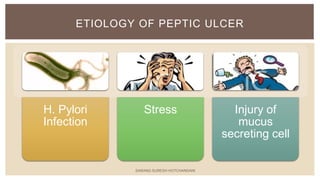
H. Pylori
Infection
Stress Injury of
mucus
secreting cell
ETIOLOGY OF PEPTIC ULCER
SARANG SURESH HOTCHANDANI
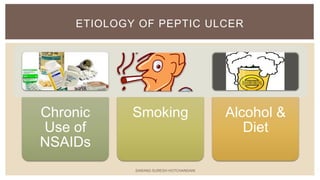
Chronic
Use of
NSAIDs
Smoking Alcohol &
Diet
ETIOLOGY OF PEPTIC ULCER
SARANG SURESH HOTCHANDANI
 Gastric Ulcer
 Chronic gastric ulcer is usually single.
 Approx. 90% are situated in lesser curvature with the antrum or junction between
body and antral mucosa.
 Duodenal Ulcer
 Chronic duodenal ulcers occurs in 1st part of duodenum.
 Approx. 50% are on anterior wall.
 Gastric & duodenal ulcers co – exists in approx. 10% of patients.
 Multiple peptic ulcers are found in approx. 10 – 15 % of patients.
EPIDEMIOLOGY
SARANG SURESH HOTCHANDANI
Approx. 90% of cases of duodenal ulcers patients & approx.
70% of gastric ulcer patients are infected with H. Pylori.
Others are by NSAIDs.
Infection is acquired in childhood from person to person
contact.
Majority of people infected with H. Pylori are asymptomatic &
healthy.
Only small number of people develop symptoms.
PATHOPHYSIOLOGY
SARANG SURESH HOTCHANDANI
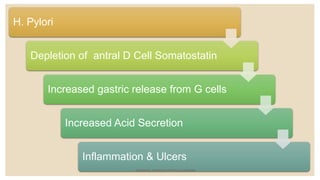
H. Pylori
Depletion of antral D Cell Somatostatin
Increased gastric release from G cells
Increased Acid Secretion
Inflammation & Ulcers
SARANG SURESH HOTCHANDANI
 H. Pylori only grow on gastric
type of mucosa.
 Virulence Factors of H. Pylori;
 Vacoulating cytotoxin A )Vac A)
 Cytotoxin associated gene (Cag A)
 Adhesion (BabA)
 OiPA (Outer inflammatory protein A)
 It is gram –ve, motile & spiral
bacteria
 Uses adhesion molecule (BabA)
to bind Lewis B antigen on
epithelial cells.
 Prevent its damage from acid
by producing urease which
convert ammonia into urea with
protects H. Pylori.
PROPERTIES OF H. PYLORI
SARANG SURESH HOTCHANDANI
Increase acid release from
stomach cause metaplasia of
duodenal mucosa which provide
environment for growth of H.
Pylori resulting duodenal ulcer.
H. PYLORI ONLY GROWS ON GASTRIC MUCOSA!
THEN HOW IT GROW IN DUODENUM RESULTING
DUODENAL ULCER
SARANG SURESH HOTCHANDANI
 It is a chronic condition with spontaneous relapse & remissions.
 The diagnostic value of individual symptoms for peptic ulcer is poor.
 Most Common Presentation
 Recurrent abdominal pain
 Pain is epigastrium
 relationship to food
 Episodic occurrence
 Vomiting in approx. 40% of patients.
CLINICAL FEATURES OF PEPTIC ULCERS
SARANG SURESH HOTCHANDANI
Anorexia & nausea.
Gastric ulcer pain increases with food.
Duodenal ulcer pain is relieved with
food.
CLINICAL FEATURES OF PEPTIC ULCERS
SARANG SURESH HOTCHANDANI
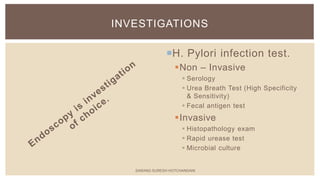
H. Pylori infection test.
Non – Invasive
 Serology
 Urea Breath Test (High Specificity
& Sensitivity)
 Fecal antigen test
Invasive
 Histopathology exam
 Rapid urease test
 Microbial culture
INVESTIGATIONS
SARANG SURESH HOTCHANDANI
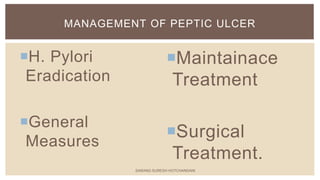
Maintainace
Treatment
Surgical
Treatment.
H. Pylori
Eradication
General
Measures
MANAGEMENT OF PEPTIC ULCER
SARANG SURESH HOTCHANDANI
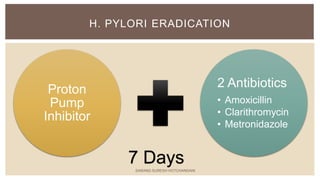
Proton
Pump
Inhibitor
2 Antibiotics
• Amoxicillin
• Clarithromycin
• Metronidazole
H. PYLORI ERADICATION
7 DaysSARANG SURESH HOTCHANDANI
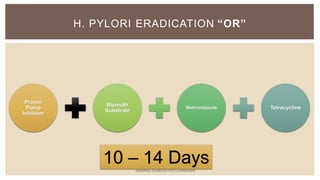
Proton
Pump
Inhibitor
Bismuth
Substrate
Metronidazole Tetracycline
H. PYLORI ERADICATION “OR”
10 – 14 DaysSARANG SURESH HOTCHANDANI
Diarrhea; approx. 30 – 50% of patients.
Flushing & vomiting when taken with alcohol.
Nausea & vomiting.
Cramps, headache, rashes.
SIDE EFFECTS OF H. PYLORI ERADIATION
THERAPY
SARANG SURESH HOTCHANDANI
Chronic proton pump
inhibitor user.
Idiopathic Thrombocyte
Purpura
Iron deficiency anemia
Peptic ulcer
Family history of Gastric
ulcer.
Previous resection of
gastric cancer.
H. Pylori Positive
INDICATIONS OF H. PYLORI ERADICATION
THERAPY
SARANG SURESH HOTCHANDANI
Gastro Esophageal Reflux
Disease
Asymptomatic Persons
CONTRAINDICATION OF H. PYLORI ERADICATION
THERAPY
SARANG SURESH HOTCHANDANI
AVOID
Smoking
Chronic NSAIDs
Alcohol
GENERAL MEASURES
SARANG SURESH HOTCHANDANI
Low dose of Proton
Pump Inhibitors
MAINTAINACE THERAPY
SARANG SURESH HOTCHANDANI
Operation of choice for
chronic non – healing
gastric ulcers is
Partial Gastrectomy.
SURGICAL TREATMENT
SARANG SURESH HOTCHANDANI
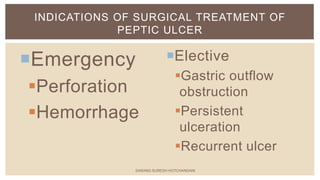
Elective
Gastric outflow
obstruction
Persistent
ulceration
Recurrent ulcer
Emergency
Perforation
Hemorrhage
INDICATIONS OF SURGICAL TREATMENT OF
PEPTIC ULCER
SARANG SURESH HOTCHANDANI
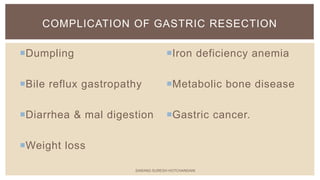
Iron deficiency anemia
Metabolic bone disease
Gastric cancer.
Dumpling
Bile reflux gastropathy
Diarrhea & mal digestion
Weight loss
COMPLICATION OF GASTRIC RESECTION
SARANG SURESH HOTCHANDANI
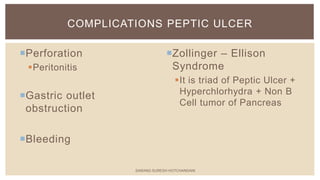
Zollinger – Ellison
Syndrome
It is triad of Peptic Ulcer +
Hyperchlorhydra + Non B
Cell tumor of Pancreas
Perforation
Peritonitis
Gastric outlet
obstruction
Bleeding
COMPLICATIONS PEPTIC ULCER
SARANG SURESH HOTCHANDANI
Sarang
Suresh
Hotchandani
Final Year
Dentistry
Student
Bibi Aseefa
Dental
College,
SMBBMU,
Larkana,
Sindh,
P A K I S T A N
THE END
SARANG SURESH HOTCHANDANI

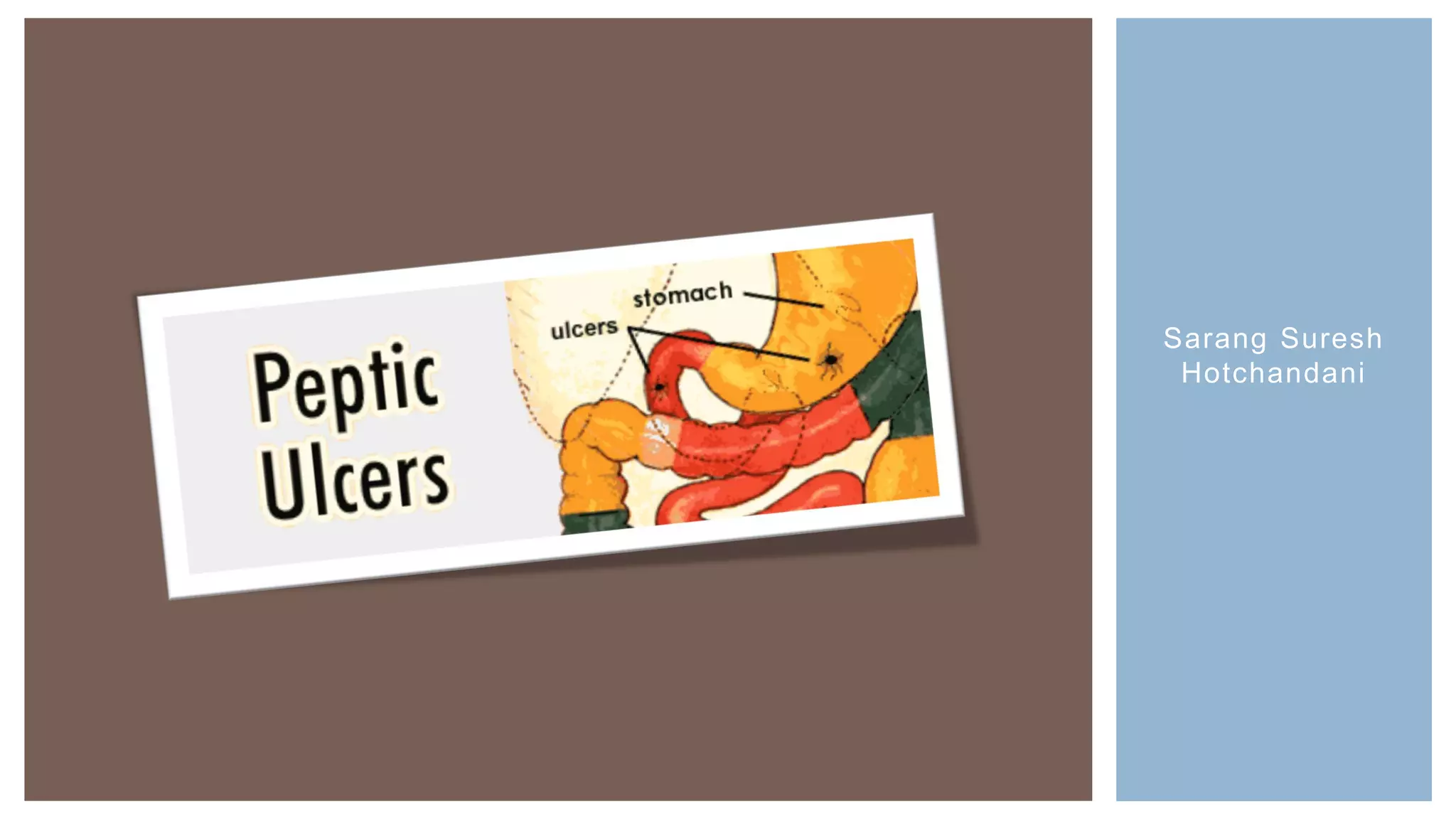
Peptic Ulcer

  • 1.
  • 2.
    It is amedical condition characterized by Ulcers in; Lower esophagus Stomach Duodenum Jejunum Ileum (adjacent to Meckel's Diverticulum) INTRODUCTION SARANG SURESH HOTCHANDANI
  • 3.
    Ulcer is breachin mucosal lining. WHAT IS ULCER??? SARANG SURESH HOTCHANDANI
  • 4.
    H. Pylori Infection Stress Injuryof mucus secreting cell ETIOLOGY OF PEPTIC ULCER SARANG SURESH HOTCHANDANI
  • 5.
    Chronic Use of NSAIDs Smoking Alcohol& Diet ETIOLOGY OF PEPTIC ULCER SARANG SURESH HOTCHANDANI
  • 6.
     Gastric Ulcer Chronic gastric ulcer is usually single.  Approx. 90% are situated in lesser curvature with the antrum or junction between body and antral mucosa.  Duodenal Ulcer  Chronic duodenal ulcers occurs in 1st part of duodenum.  Approx. 50% are on anterior wall.  Gastric & duodenal ulcers co – exists in approx. 10% of patients.  Multiple peptic ulcers are found in approx. 10 – 15 % of patients. EPIDEMIOLOGY SARANG SURESH HOTCHANDANI
  • 7.
    Approx. 90% ofcases of duodenal ulcers patients & approx. 70% of gastric ulcer patients are infected with H. Pylori. Others are by NSAIDs. Infection is acquired in childhood from person to person contact. Majority of people infected with H. Pylori are asymptomatic & healthy. Only small number of people develop symptoms. PATHOPHYSIOLOGY SARANG SURESH HOTCHANDANI
  • 8.
    H. Pylori Depletion ofantral D Cell Somatostatin Increased gastric release from G cells Increased Acid Secretion Inflammation & Ulcers SARANG SURESH HOTCHANDANI
  • 9.
     H. Pylorionly grow on gastric type of mucosa.  Virulence Factors of H. Pylori;  Vacoulating cytotoxin A )Vac A)  Cytotoxin associated gene (Cag A)  Adhesion (BabA)  OiPA (Outer inflammatory protein A)  It is gram –ve, motile & spiral bacteria  Uses adhesion molecule (BabA) to bind Lewis B antigen on epithelial cells.  Prevent its damage from acid by producing urease which convert ammonia into urea with protects H. Pylori. PROPERTIES OF H. PYLORI SARANG SURESH HOTCHANDANI
  • 10.
    Increase acid releasefrom stomach cause metaplasia of duodenal mucosa which provide environment for growth of H. Pylori resulting duodenal ulcer. H. PYLORI ONLY GROWS ON GASTRIC MUCOSA! THEN HOW IT GROW IN DUODENUM RESULTING DUODENAL ULCER SARANG SURESH HOTCHANDANI
  • 11.
     It isa chronic condition with spontaneous relapse & remissions.  The diagnostic value of individual symptoms for peptic ulcer is poor.  Most Common Presentation  Recurrent abdominal pain  Pain is epigastrium  relationship to food  Episodic occurrence  Vomiting in approx. 40% of patients. CLINICAL FEATURES OF PEPTIC ULCERS SARANG SURESH HOTCHANDANI
  • 12.
    Anorexia & nausea. Gastriculcer pain increases with food. Duodenal ulcer pain is relieved with food. CLINICAL FEATURES OF PEPTIC ULCERS SARANG SURESH HOTCHANDANI
  • 13.
    H. Pylori infectiontest. Non – Invasive  Serology  Urea Breath Test (High Specificity & Sensitivity)  Fecal antigen test Invasive  Histopathology exam  Rapid urease test  Microbial culture INVESTIGATIONS SARANG SURESH HOTCHANDANI
  • 14.
  • 15.
    Proton Pump Inhibitor 2 Antibiotics • Amoxicillin •Clarithromycin • Metronidazole H. PYLORI ERADICATION 7 DaysSARANG SURESH HOTCHANDANI
  • 16.
    Proton Pump Inhibitor Bismuth Substrate Metronidazole Tetracycline H. PYLORIERADICATION “OR” 10 – 14 DaysSARANG SURESH HOTCHANDANI
  • 17.
    Diarrhea; approx. 30– 50% of patients. Flushing & vomiting when taken with alcohol. Nausea & vomiting. Cramps, headache, rashes. SIDE EFFECTS OF H. PYLORI ERADIATION THERAPY SARANG SURESH HOTCHANDANI
  • 18.
    Chronic proton pump inhibitoruser. Idiopathic Thrombocyte Purpura Iron deficiency anemia Peptic ulcer Family history of Gastric ulcer. Previous resection of gastric cancer. H. Pylori Positive INDICATIONS OF H. PYLORI ERADICATION THERAPY SARANG SURESH HOTCHANDANI
  • 19.
    Gastro Esophageal Reflux Disease AsymptomaticPersons CONTRAINDICATION OF H. PYLORI ERADICATION THERAPY SARANG SURESH HOTCHANDANI
  • 20.
  • 21.
    Low dose ofProton Pump Inhibitors MAINTAINACE THERAPY SARANG SURESH HOTCHANDANI
  • 22.
    Operation of choicefor chronic non – healing gastric ulcers is Partial Gastrectomy. SURGICAL TREATMENT SARANG SURESH HOTCHANDANI
  • 23.
  • 24.
    Iron deficiency anemia Metabolicbone disease Gastric cancer. Dumpling Bile reflux gastropathy Diarrhea & mal digestion Weight loss COMPLICATION OF GASTRIC RESECTION SARANG SURESH HOTCHANDANI
  • 25.
    Zollinger – Ellison Syndrome Itis triad of Peptic Ulcer + Hyperchlorhydra + Non B Cell tumor of Pancreas Perforation Peritonitis Gastric outlet obstruction Bleeding COMPLICATIONS PEPTIC ULCER SARANG SURESH HOTCHANDANI
  • 26.