11
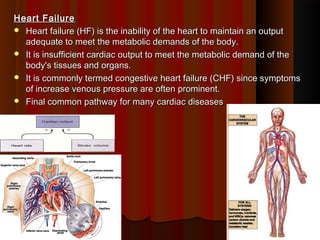
Heart FailureHeart Failure
 Heart failure (HF) is the inability of the heart to maintain an outputHeart failure (HF) is the inability of the heart to maintain an output
adequate to meet the metabolic demands of the body.adequate to meet the metabolic demands of the body.
 It is insufficient cardiac output to meet the metabolic demand of theIt is insufficient cardiac output to meet the metabolic demand of the
body's tissues and organs.body's tissues and organs.
 It is commonly termed congestive heart failure (CHF) since symptomsIt is commonly termed congestive heart failure (CHF) since symptoms
of increase venous pressure are often prominent.of increase venous pressure are often prominent.
 Final common pathway for many cardiac diseasesFinal common pathway for many cardiac diseases
22
Compensatory MechanismCompensatory Mechanism
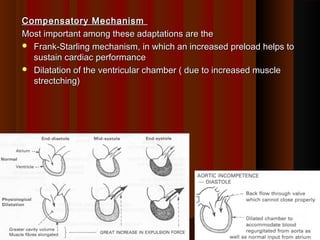
Most important among these adaptations are theMost important among these adaptations are the
 Frank-Starling mechanism, in which an increased preload helps toFrank-Starling mechanism, in which an increased preload helps to
sustain cardiac performancesustain cardiac performance
 Dilatation of the ventricular chamber ( due to increased muscleDilatation of the ventricular chamber ( due to increased muscle
strectching)strectching)
33
Compensatory Mechanism ..cont..Compensatory Mechanism ..cont..
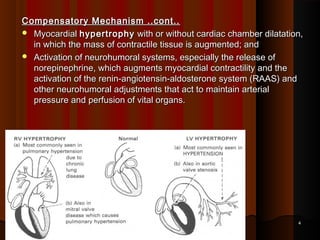
 MyocardialMyocardial hypertrophyhypertrophy with or without cardiac chamber dilatation,with or without cardiac chamber dilatation,
in which the mass of contractile tissue is augmented; andin which the mass of contractile tissue is augmented; and
 Activation of neurohumoral systems, especially the release ofActivation of neurohumoral systems, especially the release of
norepinephrine, which augments myocardial contractility and thenorepinephrine, which augments myocardial contractility and the
activation of the renin-angiotensin-aldosterone system (RAAS) andactivation of the renin-angiotensin-aldosterone system (RAAS) and
other neurohumoral adjustments that act to maintain arterialother neurohumoral adjustments that act to maintain arterial
pressure and perfusion of vital organs.pressure and perfusion of vital organs.
44
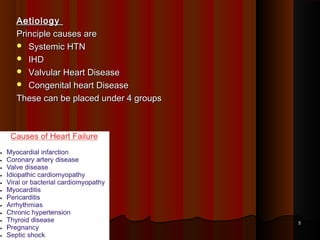
AetiologyAetiology
Principle causes arePrinciple causes are
 Systemic HTNSystemic HTN
 IHDIHD
 Valvular Heart DiseaseValvular Heart Disease
 Congenital heart DiseaseCongenital heart Disease
These can be placed under 4 groupsThese can be placed under 4 groups
55
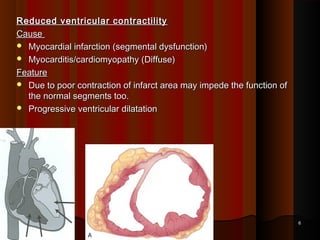
Reduced ventricular contractilityReduced ventricular contractility
CauseCause
 Myocardial infarction (segmental dysfunction)Myocardial infarction (segmental dysfunction)
 Myocarditis/cardiomyopathy (Diffuse)Myocarditis/cardiomyopathy (Diffuse)
FeatureFeature
 Due to poor contraction of infarct area may impede the function ofDue to poor contraction of infarct area may impede the function of
the normal segments too.the normal segments too.
 Progressive ventricular dilatationProgressive ventricular dilatation
66
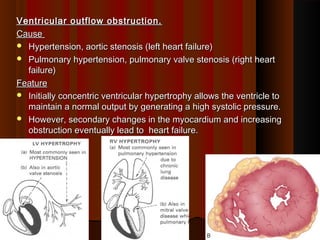
Ventricular outflow obstruction.Ventricular outflow obstruction.
CauseCause
 Hypertension, aortic stenosis (left heart failure)Hypertension, aortic stenosis (left heart failure)
 Pulmonary hypertension, pulmonary valve stenosis (right heartPulmonary hypertension, pulmonary valve stenosis (right heart
failure)failure)
FeatureFeature
 Initially concentric ventricular hypertrophy allows the ventricle toInitially concentric ventricular hypertrophy allows the ventricle to
maintain a normal output by generating a high systolic pressure.maintain a normal output by generating a high systolic pressure.
 However, secondary changes in the myocardium and increasingHowever, secondary changes in the myocardium and increasing
obstruction eventually lead to heart failure.obstruction eventually lead to heart failure.
77
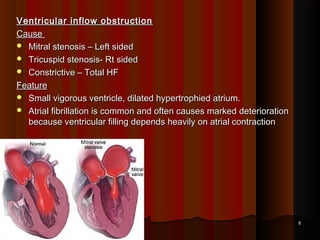
Ventricular inflow obstructionVentricular inflow obstruction
CauseCause
 Mitral stenosis – Left sidedMitral stenosis – Left sided
 Tricuspid stenosis- Rt sidedTricuspid stenosis- Rt sided
 Constrictive – Total HFConstrictive – Total HF
FeatureFeature
 Small vigorous ventricle, dilated hypertrophied atrium.Small vigorous ventricle, dilated hypertrophied atrium.
 Atrial fibrillation is common and often causes marked deteriorationAtrial fibrillation is common and often causes marked deterioration
because ventricular filling depends heavily on atrial contractionbecause ventricular filling depends heavily on atrial contraction
88
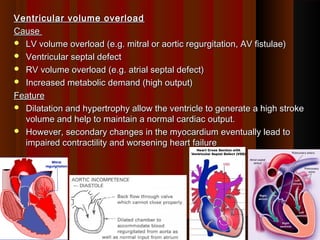
Ventricular volume overloadVentricular volume overload
CauseCause
 LV volume overload (e.g. mitral or aortic regurgitation, AV fistulae)LV volume overload (e.g. mitral or aortic regurgitation, AV fistulae)
 Ventricular septal defectVentricular septal defect
 RV volume overload (e.g. atrial septal defect)RV volume overload (e.g. atrial septal defect)
 Increased metabolic demand (high output)Increased metabolic demand (high output)
FeatureFeature
 Dilatation and hypertrophy allow the ventricle to generate a high strokeDilatation and hypertrophy allow the ventricle to generate a high stroke
volume and help to maintain a normal cardiac output.volume and help to maintain a normal cardiac output.
 However, secondary changes in the myocardium eventually lead toHowever, secondary changes in the myocardium eventually lead to
impaired contractility and worsening heart failureimpaired contractility and worsening heart failure
99
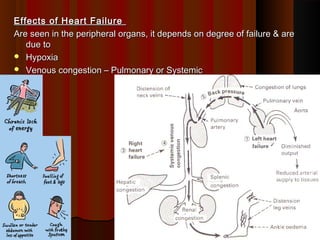
Effects of Heart FailureEffects of Heart Failure
Are seen in the peripheral organs, it depends on degree of failure & areAre seen in the peripheral organs, it depends on degree of failure & are
due todue to
 HypoxiaHypoxia
 Venous congestion – Pulmonary or SystemicVenous congestion – Pulmonary or Systemic
1010
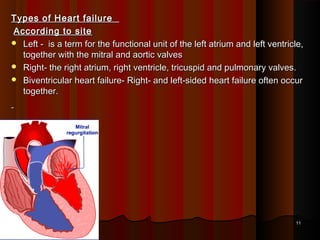
Types of Heart failure  Types of Heart failure  
According to siteAccording to site
 Left - is a term for the functional unit of the left atrium and left ventricle,Left - is a term for the functional unit of the left atrium and left ventricle,
together with the mitral and aortic valvestogether with the mitral and aortic valves
 Right- the right atrium, right ventricle, tricuspid and pulmonary valves.Right- the right atrium, right ventricle, tricuspid and pulmonary valves.
 Biventricular heart failure- Right- and left-sided heart failure often occurBiventricular heart failure- Right- and left-sided heart failure often occur
together.together.
1111
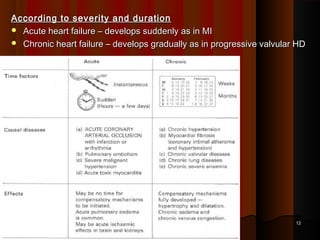
According to severity and durationAccording to severity and duration
 Acute heart failure – develops suddenly as in MIAcute heart failure – develops suddenly as in MI
 Chronic heart failure – develops gradually as in progressive valvular HDChronic heart failure – develops gradually as in progressive valvular HD
1212
OthersOthers
Compensation & decompensated heart failureCompensation & decompensated heart failure
 'compensated heart failure‘ - Impaired cardiac function is impaired'compensated heart failure‘ - Impaired cardiac function is impaired
but overt heart failure has not developed due to adaptive changesbut overt heart failure has not developed due to adaptive changes
 Decompensated heart failure – indicates overt heart failureDecompensated heart failure – indicates overt heart failure
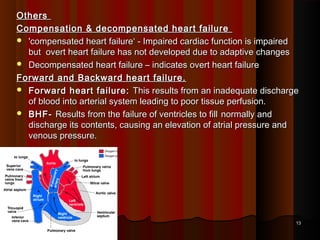
Forward and Backward heart failure.Forward and Backward heart failure.
 Forward heart failure:Forward heart failure: This results from an inadequate dischargeThis results from an inadequate discharge
of blood into arterial system leading to poor tissue perfusion.of blood into arterial system leading to poor tissue perfusion.  
 BHF-BHF- Results from the failure of ventricles to fillResults from the failure of ventricles to fill normally andnormally and
discharge its contents, causing an elevation of atrial pressure anddischarge its contents, causing an elevation of atrial pressure and
venous pressure.venous pressure.
1313
OthersOthers
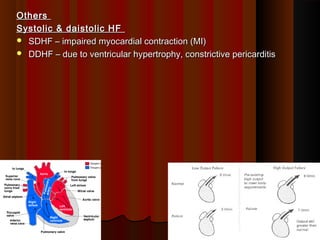
Systolic & daistolic HFSystolic & daistolic HF
 SDHF – impaired myocardial contraction (MI)SDHF – impaired myocardial contraction (MI)
 DDHF – due to ventricular hypertrophy, constrictive pericarditisDDHF – due to ventricular hypertrophy, constrictive pericarditis
1414
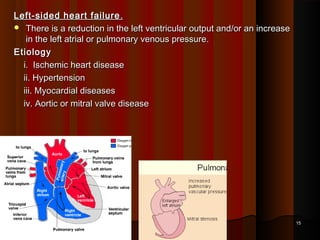
Left-sided heart failureLeft-sided heart failure ..
 There is a reduction in the left ventricular output and/or an increaseThere is a reduction in the left ventricular output and/or an increase
in the left atrial or pulmonary venous pressure.in the left atrial or pulmonary venous pressure.
EtiologyEtiology
i. Ischemic heart diseasei. Ischemic heart disease
ii. Hypertensionii. Hypertension
iii. Myocardial diseasesiii. Myocardial diseases
iv. Aortic or mitral valve diseaseiv. Aortic or mitral valve disease
1515
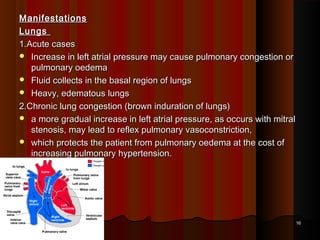
ManifestationsManifestations
LungsLungs
1.Acute cases1.Acute cases
 Increase in left atrial pressure may cause pulmonary congestion orIncrease in left atrial pressure may cause pulmonary congestion or
pulmonary oedemapulmonary oedema
 Fluid collects in the basal region of lungsFluid collects in the basal region of lungs
 Heavy, edematous lungsHeavy, edematous lungs
2.Chronic lung congestion (brown induration of lungs)2.Chronic lung congestion (brown induration of lungs)
 a more gradual increase in left atrial pressure, as occurs with mitrala more gradual increase in left atrial pressure, as occurs with mitral
stenosis, may lead to reflex pulmonary vasoconstriction,stenosis, may lead to reflex pulmonary vasoconstriction,
 which protects the patient from pulmonary oedema at the cost ofwhich protects the patient from pulmonary oedema at the cost of
increasing pulmonary hypertension.increasing pulmonary hypertension.
1616
KidneysKidneys
Reduced CO leads to reduced renal perfusion & thereby salt & waterReduced CO leads to reduced renal perfusion & thereby salt & water
retention via renin-angiotensin – aldosterone systemretention via renin-angiotensin – aldosterone system
BrainBrain
Hypoxic encephalopathy in advanced casesHypoxic encephalopathy in advanced cases
ComplicationsComplications
 Passive pulmonary congestion and edemaPassive pulmonary congestion and edema
 Activation of renin-angiotensin-aldosterone system leading to 2°Activation of renin-angiotensin-aldosterone system leading to 2°
hyperaldosteronismhyperaldosteronism
 Cardiogenic shockCardiogenic shock
1717
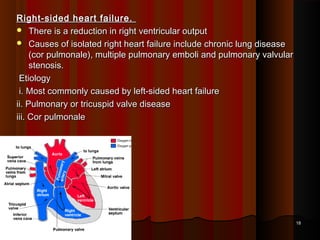
Right-sided heart failure.Right-sided heart failure.
 There is a reduction in right ventricular outputThere is a reduction in right ventricular output
 Causes of isolated right heart failure include chronic lung diseaseCauses of isolated right heart failure include chronic lung disease
(cor pulmonale), multiple pulmonary emboli and pulmonary valvular(cor pulmonale), multiple pulmonary emboli and pulmonary valvular
stenosis.stenosis.
EtiologyEtiology
i. Most commonly caused by left-sided heart failurei. Most commonly caused by left-sided heart failure
ii. Pulmonary or tricuspid valve diseaseii. Pulmonary or tricuspid valve disease
iii. Cor pulmonaleiii. Cor pulmonale
1818
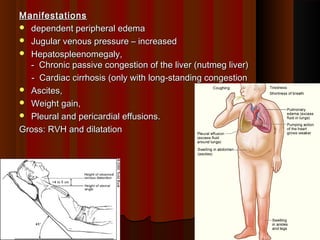
ManifestationsManifestations
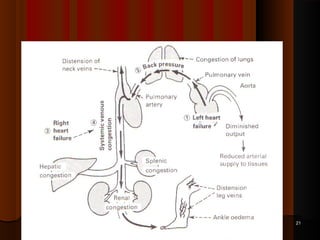
 dependent peripheral edemadependent peripheral edema
 Jugular venous pressure – increasedJugular venous pressure – increased
 Hepatospleenomegaly,Hepatospleenomegaly,
- Chronic passive congestion of the liver (nutmeg liver)- Chronic passive congestion of the liver (nutmeg liver)
- Cardiac cirrhosis (only with long-standing congestion- Cardiac cirrhosis (only with long-standing congestion
 Ascites,Ascites,
 Weight gain,Weight gain,
 Pleural and pericardial effusions.Pleural and pericardial effusions.
Gross: RVH and dilatationGross: RVH and dilatation
1919
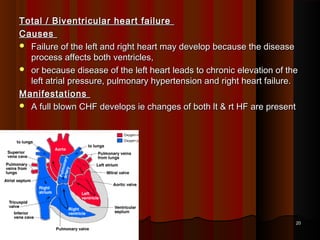
Total / Biventricular heart failureTotal / Biventricular heart failure
CausesCauses
 Failure of the left and right heart may develop because the diseaseFailure of the left and right heart may develop because the disease
process affects both ventricles,process affects both ventricles,
 or because disease of the left heart leads to chronic elevation of theor because disease of the left heart leads to chronic elevation of the
left atrial pressure, pulmonary hypertension and right heart failure.left atrial pressure, pulmonary hypertension and right heart failure.
ManifestationsManifestations
 A full blown CHF develops ie changes of both lt & rt HF are presentA full blown CHF develops ie changes of both lt & rt HF are present
2020
2121
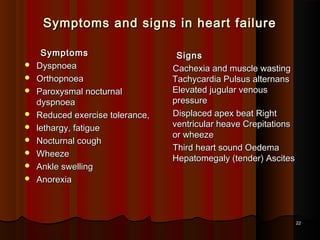
Symptoms and signs in heart failureSymptoms and signs in heart failure
SymptomsSymptoms
 DyspnoeaDyspnoea
 OrthopnoeaOrthopnoea
 Paroxysmal nocturnalParoxysmal nocturnal
dyspnoeadyspnoea
 Reduced exercise tolerance,Reduced exercise tolerance,
 lethargy, fatiguelethargy, fatigue
 Nocturnal coughNocturnal cough
 WheezeWheeze
 Ankle swellingAnkle swelling
 AnorexiaAnorexia
SignsSigns
Cachexia and muscle wastingCachexia and muscle wasting
Tachycardia Pulsus alternansTachycardia Pulsus alternans
Elevated jugular venousElevated jugular venous
pressurepressure
Displaced apex beat RightDisplaced apex beat Right
ventricular heave Crepitationsventricular heave Crepitations
or wheezeor wheeze
Third heart sound OedemaThird heart sound Oedema
Hepatomegaly (tender) AscitesHepatomegaly (tender) Ascites
2222

4heart failure pathology

  • 1.
  • 2.
    Heart FailureHeart Failure Heart failure (HF) is the inability of the heart to maintain an outputHeart failure (HF) is the inability of the heart to maintain an output adequate to meet the metabolic demands of the body.adequate to meet the metabolic demands of the body.  It is insufficient cardiac output to meet the metabolic demand of theIt is insufficient cardiac output to meet the metabolic demand of the body's tissues and organs.body's tissues and organs.  It is commonly termed congestive heart failure (CHF) since symptomsIt is commonly termed congestive heart failure (CHF) since symptoms of increase venous pressure are often prominent.of increase venous pressure are often prominent.  Final common pathway for many cardiac diseasesFinal common pathway for many cardiac diseases 22
  • 3.
    Compensatory MechanismCompensatory Mechanism Mostimportant among these adaptations are theMost important among these adaptations are the  Frank-Starling mechanism, in which an increased preload helps toFrank-Starling mechanism, in which an increased preload helps to sustain cardiac performancesustain cardiac performance  Dilatation of the ventricular chamber ( due to increased muscleDilatation of the ventricular chamber ( due to increased muscle strectching)strectching) 33
  • 4.
    Compensatory Mechanism ..cont..CompensatoryMechanism ..cont..  MyocardialMyocardial hypertrophyhypertrophy with or without cardiac chamber dilatation,with or without cardiac chamber dilatation, in which the mass of contractile tissue is augmented; andin which the mass of contractile tissue is augmented; and  Activation of neurohumoral systems, especially the release ofActivation of neurohumoral systems, especially the release of norepinephrine, which augments myocardial contractility and thenorepinephrine, which augments myocardial contractility and the activation of the renin-angiotensin-aldosterone system (RAAS) andactivation of the renin-angiotensin-aldosterone system (RAAS) and other neurohumoral adjustments that act to maintain arterialother neurohumoral adjustments that act to maintain arterial pressure and perfusion of vital organs.pressure and perfusion of vital organs. 44
  • 5.
    AetiologyAetiology Principle causes arePrinciplecauses are  Systemic HTNSystemic HTN  IHDIHD  Valvular Heart DiseaseValvular Heart Disease  Congenital heart DiseaseCongenital heart Disease These can be placed under 4 groupsThese can be placed under 4 groups 55
  • 6.
    Reduced ventricular contractilityReducedventricular contractility CauseCause  Myocardial infarction (segmental dysfunction)Myocardial infarction (segmental dysfunction)  Myocarditis/cardiomyopathy (Diffuse)Myocarditis/cardiomyopathy (Diffuse) FeatureFeature  Due to poor contraction of infarct area may impede the function ofDue to poor contraction of infarct area may impede the function of the normal segments too.the normal segments too.  Progressive ventricular dilatationProgressive ventricular dilatation 66
  • 7.
    Ventricular outflow obstruction.Ventricularoutflow obstruction. CauseCause  Hypertension, aortic stenosis (left heart failure)Hypertension, aortic stenosis (left heart failure)  Pulmonary hypertension, pulmonary valve stenosis (right heartPulmonary hypertension, pulmonary valve stenosis (right heart failure)failure) FeatureFeature  Initially concentric ventricular hypertrophy allows the ventricle toInitially concentric ventricular hypertrophy allows the ventricle to maintain a normal output by generating a high systolic pressure.maintain a normal output by generating a high systolic pressure.  However, secondary changes in the myocardium and increasingHowever, secondary changes in the myocardium and increasing obstruction eventually lead to heart failure.obstruction eventually lead to heart failure. 77
  • 8.
    Ventricular inflow obstructionVentricularinflow obstruction CauseCause  Mitral stenosis – Left sidedMitral stenosis – Left sided  Tricuspid stenosis- Rt sidedTricuspid stenosis- Rt sided  Constrictive – Total HFConstrictive – Total HF FeatureFeature  Small vigorous ventricle, dilated hypertrophied atrium.Small vigorous ventricle, dilated hypertrophied atrium.  Atrial fibrillation is common and often causes marked deteriorationAtrial fibrillation is common and often causes marked deterioration because ventricular filling depends heavily on atrial contractionbecause ventricular filling depends heavily on atrial contraction 88
  • 9.
    Ventricular volume overloadVentricularvolume overload CauseCause  LV volume overload (e.g. mitral or aortic regurgitation, AV fistulae)LV volume overload (e.g. mitral or aortic regurgitation, AV fistulae)  Ventricular septal defectVentricular septal defect  RV volume overload (e.g. atrial septal defect)RV volume overload (e.g. atrial septal defect)  Increased metabolic demand (high output)Increased metabolic demand (high output) FeatureFeature  Dilatation and hypertrophy allow the ventricle to generate a high strokeDilatation and hypertrophy allow the ventricle to generate a high stroke volume and help to maintain a normal cardiac output.volume and help to maintain a normal cardiac output.  However, secondary changes in the myocardium eventually lead toHowever, secondary changes in the myocardium eventually lead to impaired contractility and worsening heart failureimpaired contractility and worsening heart failure 99
  • 10.
    Effects of HeartFailureEffects of Heart Failure Are seen in the peripheral organs, it depends on degree of failure & areAre seen in the peripheral organs, it depends on degree of failure & are due todue to  HypoxiaHypoxia  Venous congestion – Pulmonary or SystemicVenous congestion – Pulmonary or Systemic 1010
  • 11.
    Types of Heartfailure  Types of Heart failure   According to siteAccording to site  Left - is a term for the functional unit of the left atrium and left ventricle,Left - is a term for the functional unit of the left atrium and left ventricle, together with the mitral and aortic valvestogether with the mitral and aortic valves  Right- the right atrium, right ventricle, tricuspid and pulmonary valves.Right- the right atrium, right ventricle, tricuspid and pulmonary valves.  Biventricular heart failure- Right- and left-sided heart failure often occurBiventricular heart failure- Right- and left-sided heart failure often occur together.together. 1111
  • 12.
    According to severityand durationAccording to severity and duration  Acute heart failure – develops suddenly as in MIAcute heart failure – develops suddenly as in MI  Chronic heart failure – develops gradually as in progressive valvular HDChronic heart failure – develops gradually as in progressive valvular HD 1212
  • 13.
    OthersOthers Compensation & decompensatedheart failureCompensation & decompensated heart failure  'compensated heart failure‘ - Impaired cardiac function is impaired'compensated heart failure‘ - Impaired cardiac function is impaired but overt heart failure has not developed due to adaptive changesbut overt heart failure has not developed due to adaptive changes  Decompensated heart failure – indicates overt heart failureDecompensated heart failure – indicates overt heart failure Forward and Backward heart failure.Forward and Backward heart failure.  Forward heart failure:Forward heart failure: This results from an inadequate dischargeThis results from an inadequate discharge of blood into arterial system leading to poor tissue perfusion.of blood into arterial system leading to poor tissue perfusion.    BHF-BHF- Results from the failure of ventricles to fillResults from the failure of ventricles to fill normally andnormally and discharge its contents, causing an elevation of atrial pressure anddischarge its contents, causing an elevation of atrial pressure and venous pressure.venous pressure. 1313
  • 14.
    OthersOthers Systolic & daistolicHFSystolic & daistolic HF  SDHF – impaired myocardial contraction (MI)SDHF – impaired myocardial contraction (MI)  DDHF – due to ventricular hypertrophy, constrictive pericarditisDDHF – due to ventricular hypertrophy, constrictive pericarditis 1414
  • 15.
    Left-sided heart failureLeft-sidedheart failure ..  There is a reduction in the left ventricular output and/or an increaseThere is a reduction in the left ventricular output and/or an increase in the left atrial or pulmonary venous pressure.in the left atrial or pulmonary venous pressure. EtiologyEtiology i. Ischemic heart diseasei. Ischemic heart disease ii. Hypertensionii. Hypertension iii. Myocardial diseasesiii. Myocardial diseases iv. Aortic or mitral valve diseaseiv. Aortic or mitral valve disease 1515
  • 16.
    ManifestationsManifestations LungsLungs 1.Acute cases1.Acute cases Increase in left atrial pressure may cause pulmonary congestion orIncrease in left atrial pressure may cause pulmonary congestion or pulmonary oedemapulmonary oedema  Fluid collects in the basal region of lungsFluid collects in the basal region of lungs  Heavy, edematous lungsHeavy, edematous lungs 2.Chronic lung congestion (brown induration of lungs)2.Chronic lung congestion (brown induration of lungs)  a more gradual increase in left atrial pressure, as occurs with mitrala more gradual increase in left atrial pressure, as occurs with mitral stenosis, may lead to reflex pulmonary vasoconstriction,stenosis, may lead to reflex pulmonary vasoconstriction,  which protects the patient from pulmonary oedema at the cost ofwhich protects the patient from pulmonary oedema at the cost of increasing pulmonary hypertension.increasing pulmonary hypertension. 1616
  • 17.
    KidneysKidneys Reduced CO leadsto reduced renal perfusion & thereby salt & waterReduced CO leads to reduced renal perfusion & thereby salt & water retention via renin-angiotensin – aldosterone systemretention via renin-angiotensin – aldosterone system BrainBrain Hypoxic encephalopathy in advanced casesHypoxic encephalopathy in advanced cases ComplicationsComplications  Passive pulmonary congestion and edemaPassive pulmonary congestion and edema  Activation of renin-angiotensin-aldosterone system leading to 2°Activation of renin-angiotensin-aldosterone system leading to 2° hyperaldosteronismhyperaldosteronism  Cardiogenic shockCardiogenic shock 1717
  • 18.
    Right-sided heart failure.Right-sidedheart failure.  There is a reduction in right ventricular outputThere is a reduction in right ventricular output  Causes of isolated right heart failure include chronic lung diseaseCauses of isolated right heart failure include chronic lung disease (cor pulmonale), multiple pulmonary emboli and pulmonary valvular(cor pulmonale), multiple pulmonary emboli and pulmonary valvular stenosis.stenosis. EtiologyEtiology i. Most commonly caused by left-sided heart failurei. Most commonly caused by left-sided heart failure ii. Pulmonary or tricuspid valve diseaseii. Pulmonary or tricuspid valve disease iii. Cor pulmonaleiii. Cor pulmonale 1818
  • 19.
    ManifestationsManifestations  dependent peripheraledemadependent peripheral edema  Jugular venous pressure – increasedJugular venous pressure – increased  Hepatospleenomegaly,Hepatospleenomegaly, - Chronic passive congestion of the liver (nutmeg liver)- Chronic passive congestion of the liver (nutmeg liver) - Cardiac cirrhosis (only with long-standing congestion- Cardiac cirrhosis (only with long-standing congestion  Ascites,Ascites,  Weight gain,Weight gain,  Pleural and pericardial effusions.Pleural and pericardial effusions. Gross: RVH and dilatationGross: RVH and dilatation 1919
  • 20.
    Total / Biventricularheart failureTotal / Biventricular heart failure CausesCauses  Failure of the left and right heart may develop because the diseaseFailure of the left and right heart may develop because the disease process affects both ventricles,process affects both ventricles,  or because disease of the left heart leads to chronic elevation of theor because disease of the left heart leads to chronic elevation of the left atrial pressure, pulmonary hypertension and right heart failure.left atrial pressure, pulmonary hypertension and right heart failure. ManifestationsManifestations  A full blown CHF develops ie changes of both lt & rt HF are presentA full blown CHF develops ie changes of both lt & rt HF are present 2020
  • 21.
  • 22.
    Symptoms and signsin heart failureSymptoms and signs in heart failure SymptomsSymptoms  DyspnoeaDyspnoea  OrthopnoeaOrthopnoea  Paroxysmal nocturnalParoxysmal nocturnal dyspnoeadyspnoea  Reduced exercise tolerance,Reduced exercise tolerance,  lethargy, fatiguelethargy, fatigue  Nocturnal coughNocturnal cough  WheezeWheeze  Ankle swellingAnkle swelling  AnorexiaAnorexia SignsSigns Cachexia and muscle wastingCachexia and muscle wasting Tachycardia Pulsus alternansTachycardia Pulsus alternans Elevated jugular venousElevated jugular venous pressurepressure Displaced apex beat RightDisplaced apex beat Right ventricular heave Crepitationsventricular heave Crepitations or wheezeor wheeze Third heart sound OedemaThird heart sound Oedema Hepatomegaly (tender) AscitesHepatomegaly (tender) Ascites 2222