VasculitisVasculitis
 Inflammatory disease often with necrosis of blood vessels – arteries,Inflammatory disease often with necrosis of blood vessels – arteries,
veins & capillariesveins & capillaries
AteritisAteritis
 Inflammatory disease of arteriesInflammatory disease of arteries
11
THROMBOANGIITIS OBLITERANS (BUERGER DISEASE)THROMBOANGIITIS OBLITERANS (BUERGER DISEASE)
Recurrent acute and chronic inflammation & thrombosis of medium-Recurrent acute and chronic inflammation & thrombosis of medium-
sized and small arteriessized and small arteries
Commonly affectedCommonly affected
 Anterior & Posterior tibial, popliteal & femoral arteriesAnterior & Posterior tibial, popliteal & femoral arteries
 Arms may be involved extremities.Arms may be involved extremities.
 Adjacent veins & nerves may be involvedAdjacent veins & nerves may be involved
 Mainly occurs in male between 20 – 35 yearsMainly occurs in male between 20 – 35 years
22
Aetiology & pathogenesisAetiology & pathogenesis
Aetiology of Buerger disease is unknownAetiology of Buerger disease is unknown
Seen in male with history of heavy smoking.Seen in male with history of heavy smoking.
 Toxic to endotheliumToxic to endothelium
 Hypersensitivity to some tobacco productHypersensitivity to some tobacco product
 Disturbances in catecholamine metabolism leading to vasoconstrictionDisturbances in catecholamine metabolism leading to vasoconstriction
 Hypercoagulability leading to thrombosisHypercoagulability leading to thrombosis
33
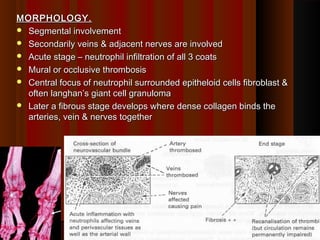
MORPHOLOGY.MORPHOLOGY.
 Segmental involvementSegmental involvement
 Secondarily veins & adjacent nerves are involvedSecondarily veins & adjacent nerves are involved
 Acute stage – neutrophil infiltration of all 3 coatsAcute stage – neutrophil infiltration of all 3 coats
 Mural or occlusive thrombosisMural or occlusive thrombosis
 Central focus of neutrophil surrounded epitheloid cells fibroblast &Central focus of neutrophil surrounded epitheloid cells fibroblast &
often langhan’s giant cell granulomaoften langhan’s giant cell granuloma
 Later a fibrous stage develops where dense collagen binds theLater a fibrous stage develops where dense collagen binds the
arteries, vein & nerves togetherarteries, vein & nerves together
44
ComplicationsComplications
 UlcerationsUlcerations
 GangreneGangrene
 InfectionInfection
 Need for amputationNeed for amputation
 Rare occlusion of coronary, renal, splenic, or mesenteric arteriesRare occlusion of coronary, renal, splenic, or mesenteric arteries
55
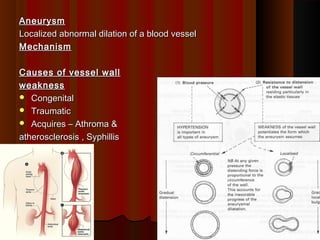
AneurysmAneurysm
Localized abnormal dilation of a blood vesselLocalized abnormal dilation of a blood vessel
MechanismMechanism
Causes of vessel wallCauses of vessel wall
weaknessweakness
 CongenitalCongenital
 TraumaticTraumatic
 Acquires – Athroma &Acquires – Athroma &
atherosclerosis , Syphillisatherosclerosis , Syphillis
66
Types of aneurism /Morphologically-Types of aneurism /Morphologically- 2 main types:2 main types:
Saccular aneurysmsSaccular aneurysms
 Essentially spherical (involving only a portion of the vessel wall) andEssentially spherical (involving only a portion of the vessel wall) and
vary in size 5 up to 20 cm in diametervary in size 5 up to 20 cm in diameter
 Common in arota & usually due to atheromaCommon in arota & usually due to atheroma
Fusiform aneurysmFusiform aneurysm
 Spindle shaped, gradual, progressive dilation of the completeSpindle shaped, gradual, progressive dilation of the complete
circumference of the vessel. Diameter upto 20 cmcircumference of the vessel. Diameter upto 20 cm
 Common in aortic arch & usually syphiliticCommon in aortic arch & usually syphilitic
77
Other varieties of AneurysmOther varieties of Aneurysm
Berry aneurysmBerry aneurysm
 Small spherical dilatationSmall spherical dilatation
 Occurs in medium sized vessels at the base of the skull e.g. theOccurs in medium sized vessels at the base of the skull e.g. the
circle of Williscircle of Willis
 Associated with congenital deficiency of arterial mediaAssociated with congenital deficiency of arterial media
MicroaneurysmsMicroaneurysms
Small aneurysms commonly seen in HTN and diabetesSmall aneurysms commonly seen in HTN and diabetes
Commonly affecting smaller arteries & arterioles esp. in brainCommonly affecting smaller arteries & arterioles esp. in brain
88
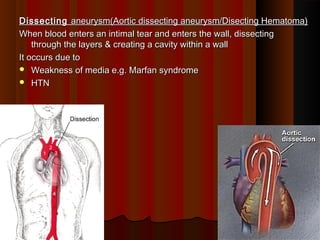
DissectingDissecting aneurysm(Aortic dissecting aneurysm/Disecting Hematoma)aneurysm(Aortic dissecting aneurysm/Disecting Hematoma)
When blood enters an intimal tear and enters the wall, dissectingWhen blood enters an intimal tear and enters the wall, dissecting
through the layers & creating a cavity within a wallthrough the layers & creating a cavity within a wall
It occurs due toIt occurs due to
 Weakness of media e.g. Marfan syndromeWeakness of media e.g. Marfan syndrome
 HTNHTN
99
FateFate
 Immediate burst – massive haemorrahegeImmediate burst – massive haemorrahege
 Localised with thrombosis. Organisation & healingLocalised with thrombosis. Organisation & healing
 Track proximally & distally within the mediaTrack proximally & distally within the media
 Rupture into the pericardium with cardiac tamponade & deathRupture into the pericardium with cardiac tamponade & death
 Compress or track along branches e.g MICompress or track along branches e.g MI
 Double barrel aortaDouble barrel aorta
1010
1111
True aneurysmTrue aneurysm
 Is bounded by generally complete but often attenuated arterial wallIs bounded by generally complete but often attenuated arterial wall
components.components.
 The blood within a true aneurysm remains within the confines of theThe blood within a true aneurysm remains within the confines of the
circulatory system.circulatory system.
False aneurysmFalse aneurysm (also called(also called pseudoaneurysm)pseudoaneurysm)
 Is an extravascular hematoma that communicates with theIs an extravascular hematoma that communicates with the
intravascular space (thus a pulsating hematoma).intravascular space (thus a pulsating hematoma).
1212
POLYARTERITIS NODOSA (CLASSIC)POLYARTERITIS NODOSA (CLASSIC)
 Systemic vasculitis manifested by transmural necrotizingSystemic vasculitis manifested by transmural necrotizing
inflammation of small or medium-sized muscular arteriesinflammation of small or medium-sized muscular arteries
 Typically involving renal and visceral vessels and sparing theTypically involving renal and visceral vessels and sparing the
pulmonary circulationpulmonary circulation
 Disease of young adultsDisease of young adults
AetiologyAetiology
 Probably type III hypersensitivity reactionProbably type III hypersensitivity reaction
 Many cases HBV antigen has been foundMany cases HBV antigen has been found
1313
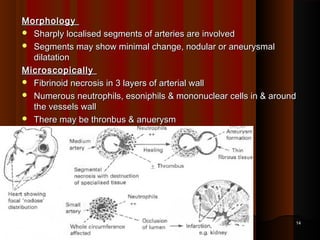
MorphologyMorphology
 Sharply localised segments of arteries are involvedSharply localised segments of arteries are involved
 Segments may show minimal change, nodular or aneurysmalSegments may show minimal change, nodular or aneurysmal
dilatationdilatation
MicroscopicallyMicroscopically
 Fibrinoid necrosis in 3 layers of arterial wallFibrinoid necrosis in 3 layers of arterial wall
 Numerous neutrophils, esoniphils & mononuclear cells in & aroundNumerous neutrophils, esoniphils & mononuclear cells in & around
the vessels wallthe vessels wall
 There may be thronbus & anuerysmThere may be thronbus & anuerysm
1414
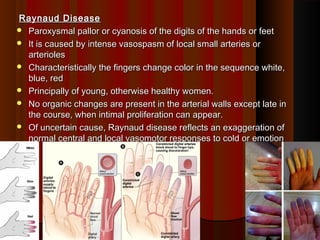
Raynaud DiseaseRaynaud Disease
 Paroxysmal pallor or cyanosis of the digits of the hands or feetParoxysmal pallor or cyanosis of the digits of the hands or feet
 It is caused by intense vasospasm of local small arteries orIt is caused by intense vasospasm of local small arteries or
arteriolesarterioles
 Characteristically the fingers change color in the sequence white,Characteristically the fingers change color in the sequence white,
blue, redblue, red
 Principally of young, otherwise healthy women.Principally of young, otherwise healthy women.
 No organic changes are present in the arterial walls except late inNo organic changes are present in the arterial walls except late in
the course, when intimal proliferation can appear.the course, when intimal proliferation can appear.
 Of uncertain cause, Raynaud disease reflects an exaggeration ofOf uncertain cause, Raynaud disease reflects an exaggeration of
normal central and local vasomotor responses to cold or emotionnormal central and local vasomotor responses to cold or emotion
Raynaud phenomenonRaynaud phenomenon
 Refers to arterial insufficiency of the extremitiesRefers to arterial insufficiency of the extremities secondarysecondary to theto the
arterial narrowing induced by various conditionsarterial narrowing induced by various conditions
 Including SLE, atherosclerosis, or Buerger disease (see earlier).Including SLE, atherosclerosis, or Buerger disease (see earlier).
 Raynaud phenomenon may be the first manifestation of any ofRaynaud phenomenon may be the first manifestation of any of
these conditions.these conditions.
GIANT CELL (TEMPORAL) ARTERITISGIANT CELL (TEMPORAL) ARTERITIS
 Is an inflammation of large & medium-sized arteries of unknownIs an inflammation of large & medium-sized arteries of unknown
aetiologyaetiology
 It affects principally the arteries in the head-- especially the temporalIt affects principally the arteries in the head-- especially the temporal
arteriesarteries
 The name (giant cell arteritis) reflects the type of inflammatory cellThe name (giant cell arteritis) reflects the type of inflammatory cell
that is involvedthat is involved[[
 It occurs older individuals and rare before the age of 50.It occurs older individuals and rare before the age of 50.
1717
TAKAYASU ARTERITISTAKAYASU ARTERITIS
 Takayasu arteritis is a is a rare type of vasculitisTakayasu arteritis is a is a rare type of vasculitis
 Related to fibrous thickening of the aortic arch with narrowing orRelated to fibrous thickening of the aortic arch with narrowing or
virtual obliteration of the origins or more distal portions of the greatvirtual obliteration of the origins or more distal portions of the great
vessels arising in the arch.vessels arising in the arch.
 Ischemia of brain, eyes, arms (pulseless disease) heart inIschemia of brain, eyes, arms (pulseless disease) heart in
combinationcombination
 Death often follows these serious effectsDeath often follows these serious effects
1818
Disease of the veinDisease of the vein
 THROMBOPHLEBITIS AND PHLEBOTHROMBOSIS –THROMBOPHLEBITIS AND PHLEBOTHROMBOSIS –
33rdrd
semsem
 Varicose veins – study yourselfVaricose veins – study yourself
1919

11.Vascular pathology

  • 1.
    VasculitisVasculitis  Inflammatory diseaseoften with necrosis of blood vessels – arteries,Inflammatory disease often with necrosis of blood vessels – arteries, veins & capillariesveins & capillaries AteritisAteritis  Inflammatory disease of arteriesInflammatory disease of arteries 11
  • 2.
    THROMBOANGIITIS OBLITERANS (BUERGERDISEASE)THROMBOANGIITIS OBLITERANS (BUERGER DISEASE) Recurrent acute and chronic inflammation & thrombosis of medium-Recurrent acute and chronic inflammation & thrombosis of medium- sized and small arteriessized and small arteries Commonly affectedCommonly affected  Anterior & Posterior tibial, popliteal & femoral arteriesAnterior & Posterior tibial, popliteal & femoral arteries  Arms may be involved extremities.Arms may be involved extremities.  Adjacent veins & nerves may be involvedAdjacent veins & nerves may be involved  Mainly occurs in male between 20 – 35 yearsMainly occurs in male between 20 – 35 years 22
  • 3.
    Aetiology & pathogenesisAetiology& pathogenesis Aetiology of Buerger disease is unknownAetiology of Buerger disease is unknown Seen in male with history of heavy smoking.Seen in male with history of heavy smoking.  Toxic to endotheliumToxic to endothelium  Hypersensitivity to some tobacco productHypersensitivity to some tobacco product  Disturbances in catecholamine metabolism leading to vasoconstrictionDisturbances in catecholamine metabolism leading to vasoconstriction  Hypercoagulability leading to thrombosisHypercoagulability leading to thrombosis 33
  • 4.
    MORPHOLOGY.MORPHOLOGY.  Segmental involvementSegmentalinvolvement  Secondarily veins & adjacent nerves are involvedSecondarily veins & adjacent nerves are involved  Acute stage – neutrophil infiltration of all 3 coatsAcute stage – neutrophil infiltration of all 3 coats  Mural or occlusive thrombosisMural or occlusive thrombosis  Central focus of neutrophil surrounded epitheloid cells fibroblast &Central focus of neutrophil surrounded epitheloid cells fibroblast & often langhan’s giant cell granulomaoften langhan’s giant cell granuloma  Later a fibrous stage develops where dense collagen binds theLater a fibrous stage develops where dense collagen binds the arteries, vein & nerves togetherarteries, vein & nerves together 44
  • 5.
    ComplicationsComplications  UlcerationsUlcerations  GangreneGangrene InfectionInfection  Need for amputationNeed for amputation  Rare occlusion of coronary, renal, splenic, or mesenteric arteriesRare occlusion of coronary, renal, splenic, or mesenteric arteries 55
  • 6.
    AneurysmAneurysm Localized abnormal dilationof a blood vesselLocalized abnormal dilation of a blood vessel MechanismMechanism Causes of vessel wallCauses of vessel wall weaknessweakness  CongenitalCongenital  TraumaticTraumatic  Acquires – Athroma &Acquires – Athroma & atherosclerosis , Syphillisatherosclerosis , Syphillis 66
  • 7.
    Types of aneurism/Morphologically-Types of aneurism /Morphologically- 2 main types:2 main types: Saccular aneurysmsSaccular aneurysms  Essentially spherical (involving only a portion of the vessel wall) andEssentially spherical (involving only a portion of the vessel wall) and vary in size 5 up to 20 cm in diametervary in size 5 up to 20 cm in diameter  Common in arota & usually due to atheromaCommon in arota & usually due to atheroma Fusiform aneurysmFusiform aneurysm  Spindle shaped, gradual, progressive dilation of the completeSpindle shaped, gradual, progressive dilation of the complete circumference of the vessel. Diameter upto 20 cmcircumference of the vessel. Diameter upto 20 cm  Common in aortic arch & usually syphiliticCommon in aortic arch & usually syphilitic 77
  • 8.
    Other varieties ofAneurysmOther varieties of Aneurysm Berry aneurysmBerry aneurysm  Small spherical dilatationSmall spherical dilatation  Occurs in medium sized vessels at the base of the skull e.g. theOccurs in medium sized vessels at the base of the skull e.g. the circle of Williscircle of Willis  Associated with congenital deficiency of arterial mediaAssociated with congenital deficiency of arterial media MicroaneurysmsMicroaneurysms Small aneurysms commonly seen in HTN and diabetesSmall aneurysms commonly seen in HTN and diabetes Commonly affecting smaller arteries & arterioles esp. in brainCommonly affecting smaller arteries & arterioles esp. in brain 88
  • 9.
    DissectingDissecting aneurysm(Aortic dissectinganeurysm/Disecting Hematoma)aneurysm(Aortic dissecting aneurysm/Disecting Hematoma) When blood enters an intimal tear and enters the wall, dissectingWhen blood enters an intimal tear and enters the wall, dissecting through the layers & creating a cavity within a wallthrough the layers & creating a cavity within a wall It occurs due toIt occurs due to  Weakness of media e.g. Marfan syndromeWeakness of media e.g. Marfan syndrome  HTNHTN 99
  • 10.
    FateFate  Immediate burst– massive haemorrahegeImmediate burst – massive haemorrahege  Localised with thrombosis. Organisation & healingLocalised with thrombosis. Organisation & healing  Track proximally & distally within the mediaTrack proximally & distally within the media  Rupture into the pericardium with cardiac tamponade & deathRupture into the pericardium with cardiac tamponade & death  Compress or track along branches e.g MICompress or track along branches e.g MI  Double barrel aortaDouble barrel aorta 1010
  • 11.
  • 12.
    True aneurysmTrue aneurysm Is bounded by generally complete but often attenuated arterial wallIs bounded by generally complete but often attenuated arterial wall components.components.  The blood within a true aneurysm remains within the confines of theThe blood within a true aneurysm remains within the confines of the circulatory system.circulatory system. False aneurysmFalse aneurysm (also called(also called pseudoaneurysm)pseudoaneurysm)  Is an extravascular hematoma that communicates with theIs an extravascular hematoma that communicates with the intravascular space (thus a pulsating hematoma).intravascular space (thus a pulsating hematoma). 1212
  • 13.
    POLYARTERITIS NODOSA (CLASSIC)POLYARTERITISNODOSA (CLASSIC)  Systemic vasculitis manifested by transmural necrotizingSystemic vasculitis manifested by transmural necrotizing inflammation of small or medium-sized muscular arteriesinflammation of small or medium-sized muscular arteries  Typically involving renal and visceral vessels and sparing theTypically involving renal and visceral vessels and sparing the pulmonary circulationpulmonary circulation  Disease of young adultsDisease of young adults AetiologyAetiology  Probably type III hypersensitivity reactionProbably type III hypersensitivity reaction  Many cases HBV antigen has been foundMany cases HBV antigen has been found 1313
  • 14.
    MorphologyMorphology  Sharply localisedsegments of arteries are involvedSharply localised segments of arteries are involved  Segments may show minimal change, nodular or aneurysmalSegments may show minimal change, nodular or aneurysmal dilatationdilatation MicroscopicallyMicroscopically  Fibrinoid necrosis in 3 layers of arterial wallFibrinoid necrosis in 3 layers of arterial wall  Numerous neutrophils, esoniphils & mononuclear cells in & aroundNumerous neutrophils, esoniphils & mononuclear cells in & around the vessels wallthe vessels wall  There may be thronbus & anuerysmThere may be thronbus & anuerysm 1414
  • 15.
    Raynaud DiseaseRaynaud Disease Paroxysmal pallor or cyanosis of the digits of the hands or feetParoxysmal pallor or cyanosis of the digits of the hands or feet  It is caused by intense vasospasm of local small arteries orIt is caused by intense vasospasm of local small arteries or arteriolesarterioles  Characteristically the fingers change color in the sequence white,Characteristically the fingers change color in the sequence white, blue, redblue, red  Principally of young, otherwise healthy women.Principally of young, otherwise healthy women.  No organic changes are present in the arterial walls except late inNo organic changes are present in the arterial walls except late in the course, when intimal proliferation can appear.the course, when intimal proliferation can appear.  Of uncertain cause, Raynaud disease reflects an exaggeration ofOf uncertain cause, Raynaud disease reflects an exaggeration of normal central and local vasomotor responses to cold or emotionnormal central and local vasomotor responses to cold or emotion
  • 16.
    Raynaud phenomenonRaynaud phenomenon Refers to arterial insufficiency of the extremitiesRefers to arterial insufficiency of the extremities secondarysecondary to theto the arterial narrowing induced by various conditionsarterial narrowing induced by various conditions  Including SLE, atherosclerosis, or Buerger disease (see earlier).Including SLE, atherosclerosis, or Buerger disease (see earlier).  Raynaud phenomenon may be the first manifestation of any ofRaynaud phenomenon may be the first manifestation of any of these conditions.these conditions.
  • 17.
    GIANT CELL (TEMPORAL)ARTERITISGIANT CELL (TEMPORAL) ARTERITIS  Is an inflammation of large & medium-sized arteries of unknownIs an inflammation of large & medium-sized arteries of unknown aetiologyaetiology  It affects principally the arteries in the head-- especially the temporalIt affects principally the arteries in the head-- especially the temporal arteriesarteries  The name (giant cell arteritis) reflects the type of inflammatory cellThe name (giant cell arteritis) reflects the type of inflammatory cell that is involvedthat is involved[[  It occurs older individuals and rare before the age of 50.It occurs older individuals and rare before the age of 50. 1717
  • 18.
    TAKAYASU ARTERITISTAKAYASU ARTERITIS Takayasu arteritis is a is a rare type of vasculitisTakayasu arteritis is a is a rare type of vasculitis  Related to fibrous thickening of the aortic arch with narrowing orRelated to fibrous thickening of the aortic arch with narrowing or virtual obliteration of the origins or more distal portions of the greatvirtual obliteration of the origins or more distal portions of the great vessels arising in the arch.vessels arising in the arch.  Ischemia of brain, eyes, arms (pulseless disease) heart inIschemia of brain, eyes, arms (pulseless disease) heart in combinationcombination  Death often follows these serious effectsDeath often follows these serious effects 1818
  • 19.
    Disease of theveinDisease of the vein  THROMBOPHLEBITIS AND PHLEBOTHROMBOSIS –THROMBOPHLEBITIS AND PHLEBOTHROMBOSIS – 33rdrd semsem  Varicose veins – study yourselfVaricose veins – study yourself 1919