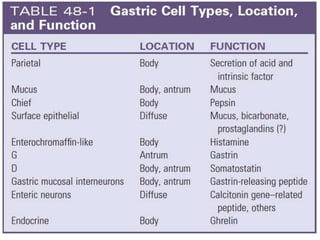
Peptic ulcer disease
Nomin-Erdene. D
SOM-531
Learning objectives
๏‚ข Stomach gross anatomy
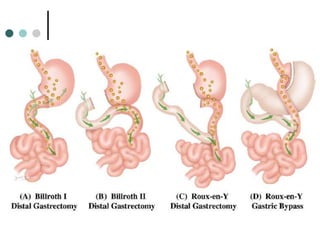
๏‚ข PUD
๏ฌ Epidemiology
๏ฌ Pathogenesis
๏ฌ Clinical manifestation
๏ฌ Diagnosing
๏ฌ Treatment
๏ฌ Complicated ulcer disease
๏ฌ Surgical procedures
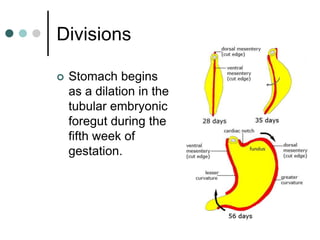
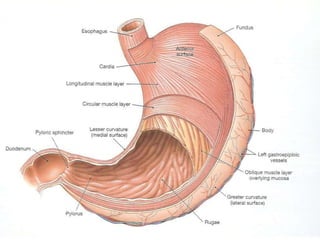
Divisions
๏‚ข Stomach begins
as a dilation in the
tubular embryonic
foregut during the
fifth week of
gestation.
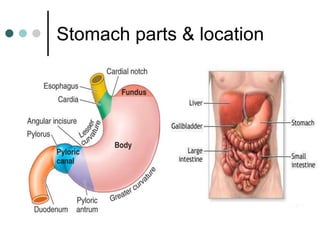
Stomach parts & location
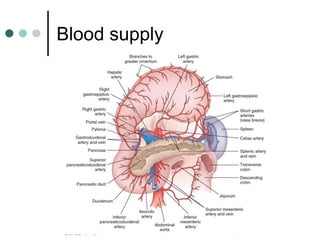
Blood supply
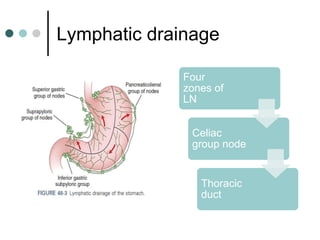
Lymphatic drainage
Four
zones of
LN
Celiac
group node
Thoracic
duct
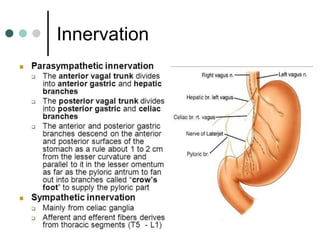
Innervation
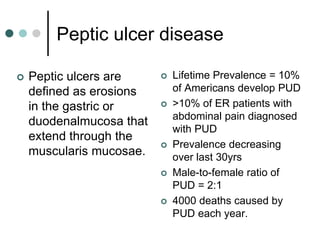
Peptic ulcer disease
๏‚ข Peptic ulcers are
defined as erosions
in the gastric or
duodenalmucosa that
extend through the
muscularis mucosae.
๏‚ข Lifetime Prevalence = 10%
of Americans develop PUD
๏‚ข >10% of ER patients with
abdominal pain diagnosed
with PUD
๏‚ข Prevalence decreasing
over last 30yrs
๏‚ข Male-to-female ratio of
PUD = 2:1
๏‚ข 4000 deaths caused by
PUD each year.
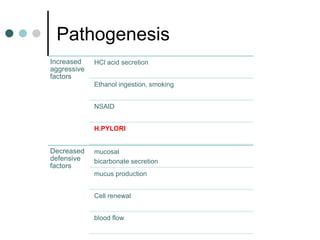
Pathogenesis
Increased
aggressive
factors
HCl acid secretion
Ethanol ingestion, smoking
NSAID
H.PYLORI
Decreased
defensive
factors
mucosal
bicarbonate secretion
mucus production
Cell renewal
blood flow
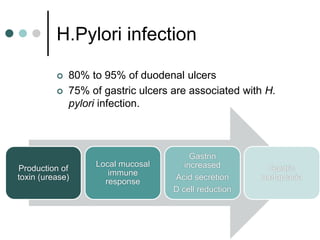
H.Pylori infection
๏‚ข 80% to 95% of duodenal ulcers
๏‚ข 75% of gastric ulcers are associated with H.
pylori infection.
Production of
toxin (urease)
Local mucosal
immune
response
Gastrin
increased
Acid secretion
D cell reduction
Gastric
metaplasia
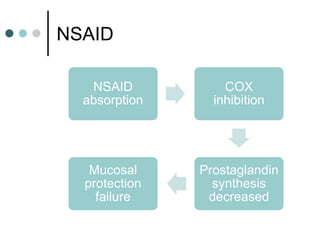
NSAID
NSAID
absorption
COX
inhibition
Prostaglandin
synthesis
decreased
Mucosal
protection
failure
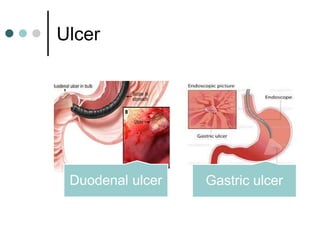
Ulcer
Duodenal ulcer Gastric ulcer
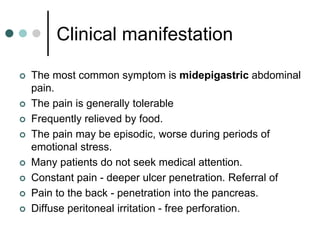
Clinical manifestation
๏‚ข The most common symptom is midepigastric abdominal
pain.
๏‚ข The pain is generally tolerable
๏‚ข Frequently relieved by food.
๏‚ข The pain may be episodic, worse during periods of
emotional stress.
๏‚ข Many patients do not seek medical attention.
๏‚ข Constant pain - deeper ulcer penetration. Referral of
๏‚ข Pain to the back - penetration into the pancreas.
๏‚ข Diffuse peritoneal irritation - free perforation.
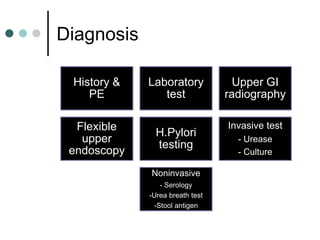
Diagnosis
History &
PE
Laboratory
test
Upper GI
radiography
Flexible
upper
endoscopy
H.Pylori
testing
Invasive test
- Urease
- Culture
Noninvasive
- Serology
-Urea breath test
-Stool antigen
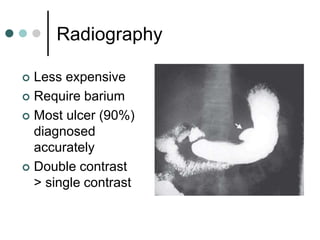
Radiography
๏‚ข Less expensive
๏‚ข Require barium
๏‚ข Most ulcer (90%)
diagnosed
accurately
๏‚ข Double contrast
> single contrast
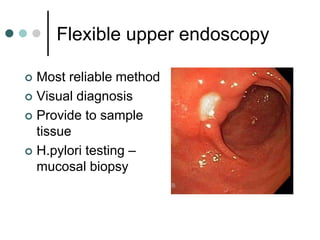
Flexible upper endoscopy
๏‚ข Most reliable method
๏‚ข Visual diagnosis
๏‚ข Provide to sample
tissue
๏‚ข H.pylori testing โ€“
mucosal biopsy
Urease assay
๏‚ข With endoscopy
๏‚ข From the gastric body and the antrum
๏‚ข Sensitivity in diagnosing infection is
greater than 90%, and specificity is
95% to 100%
๏‚ข Sensitivity of the test is lowered in
patients who are taking PPIs, H2
antagonists, or antibiotics.
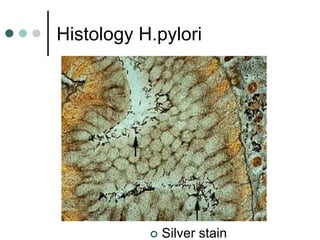
Histology H.pylori
๏‚ข Silver stain
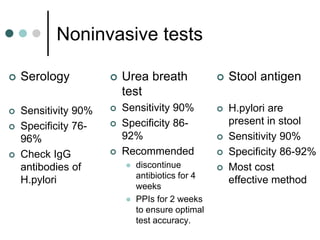
Noninvasive tests
๏‚ข Serology
๏‚ข Sensitivity 90%
๏‚ข Specificity 76-
96%
๏‚ข Check IgG
antibodies of
H.pylori
๏‚ข Urea breath
test
๏‚ข Sensitivity 90%
๏‚ข Specificity 86-
92%
๏‚ข Recommended
๏ฌ discontinue
antibiotics for 4
weeks
๏ฌ PPIs for 2 weeks
to ensure optimal
test accuracy.
๏‚ข Stool antigen
๏‚ข H.pylori are
present in stool
๏‚ข Sensitivity 90%
๏‚ข Specificity 86-92%
๏‚ข Most cost
effective method
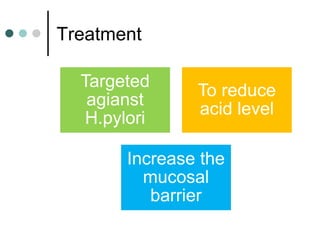
Treatment
Targeted
agianst
H.pylori
To reduce
acid level
Increase the
mucosal
barrier
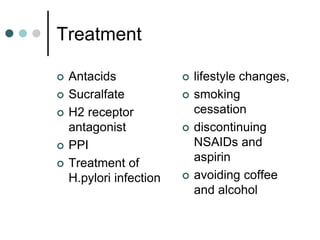
Treatment
๏‚ข Antacids
๏‚ข Sucralfate
๏‚ข H2 receptor
antagonist
๏‚ข PPI
๏‚ข Treatment of
H.pylori infection
๏‚ข lifestyle changes,
๏‚ข smoking
cessation
๏‚ข discontinuing
NSAIDs and
aspirin
๏‚ข avoiding coffee
and alcohol
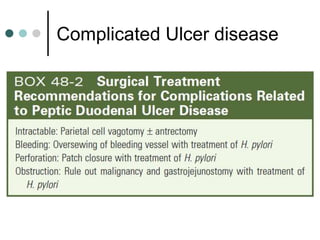
Complicated Ulcer disease
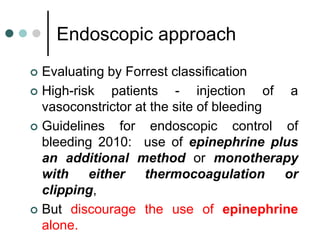
Endoscopic approach
๏‚ข Evaluating by Forrest classification
๏‚ข High-risk patients - injection of a
vasoconstrictor at the site of bleeding
๏‚ข Guidelines for endoscopic control of
bleeding 2010: use of epinephrine plus
an additional method or monotherapy
with either thermocoagulation or
clipping,
๏‚ข But discourage the use of epinephrine
alone.
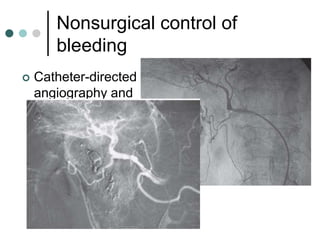
Nonsurgical control of
bleeding
๏‚ข Catheter-directed
angiography and
endovascular
embolization
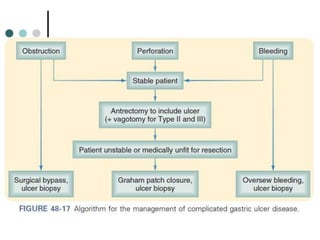
Perforation
๏‚ข Typically complain of sudden-onset,
frequently severe epigastric pain
๏‚ข Highest mortality rate of any
complication of ulcer disease
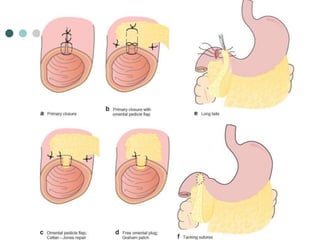
๏‚ข Graham patch repair is performed
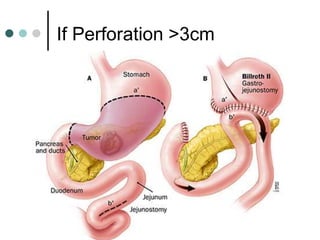
If Perforation >3cm
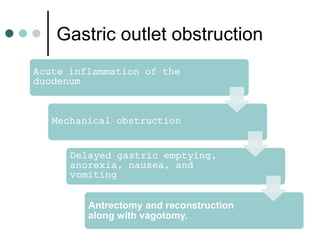
Gastric outlet obstruction
Acute inflammation of the
duodenum
Mechanical obstruction
Delayed gastric emptying,
anorexia, nausea, and
vomiting
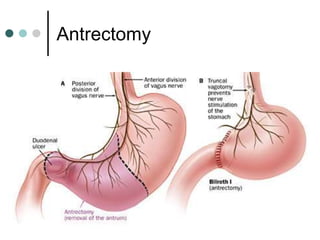
Antrectomy and reconstruction
along with vagotomy.
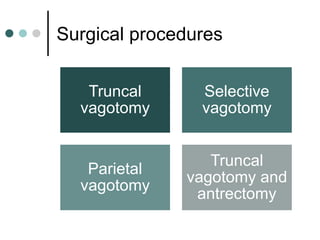
Surgical procedures
Truncal
vagotomy
Selective
vagotomy
Parietal
vagotomy
Truncal
vagotomy and
antrectomy
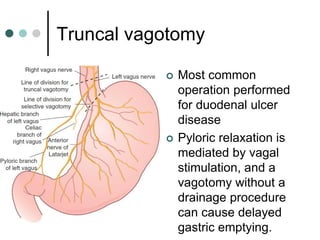
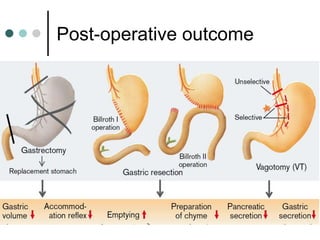
Truncal vagotomy
๏‚ข Most common
operation performed
for duodenal ulcer
disease
๏‚ข Pyloric relaxation is
mediated by vagal
stimulation, and a
vagotomy without a
drainage procedure
can cause delayed
gastric emptying.
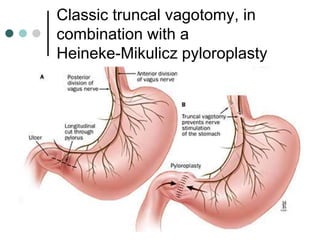
Classic truncal vagotomy, in
combination with a
Heineke-Mikulicz pyloroplasty
Antrectomy
Post-operative outcome
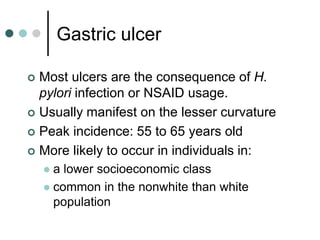
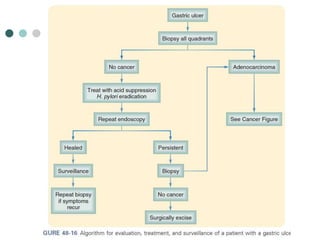
Gastric ulcer
๏‚ข Most ulcers are the consequence of H.
pylori infection or NSAID usage.
๏‚ข Usually manifest on the lesser curvature
๏‚ข Peak incidence: 55 to 65 years old
๏‚ข More likely to occur in individuals in:
๏ฌ a lower socioeconomic class
๏ฌ common in the nonwhite than white
population
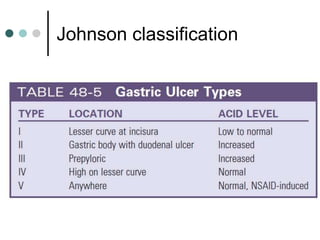
Johnson classification
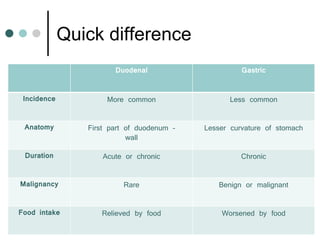
Quick difference
Duodenal Gastric
Incidence More common Less common
Anatomy First part of duodenum โ€“
wall
Lesser curvature of stomach
Duration Acute or chronic Chronic
Malignancy Rare Benign or malignant
Food intake Relieved by food Worsened by food
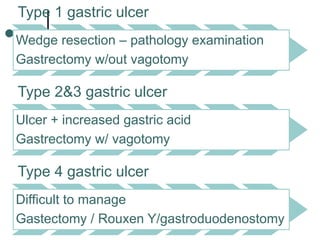
Type 1 gastric ulcer
Wedge resection โ€“ pathology examination
Gastrectomy w/out vagotomy
Type 2&3 gastric ulcer
Ulcer + increased gastric acid
Gastrectomy w/ vagotomy
Type 4 gastric ulcer
Difficult to manage
Gastectomy / Rouxen Y/gastroduodenostomy
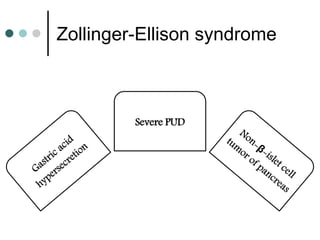
Zollinger-Ellison syndrome
Severe PUD
Diagnosing ZES
๏‚ข Secretin-stimulated gastrin level
๏ฌ Serum gastrin samples are measured
before and after IV secretin (2 U/kg)
administration at 5-minute intervals for
30 minutes.
๏ฌ An increase in the serum gastrin level
of greater than 200 pg/mL is specific
for gastrinoma.
Diagnosing
๏‚ข Localize the gastrinoma is either CT or MRI of
the abdomen.
๏‚ข However, these imaging modalities have a
relatively low sensitivity in detecting tumors
that are less than 1 cm in diameter as well as
small liver metastases.
๏‚ข Somatostatin receptor scintigraphy uses
radionucleotide labeled octreotide, which binds
to the ZES tumor cells and can detect hepatic
metastases in 85% to 95% of patients
Treatment
๏‚ข Resection of tumor
๏‚ข Patients with tumor recurrence or
metastatic disease are treated with
chemotherapy (streptozotocin with 5-
fluorouracil or doxorubicin or both).
THANK YOU
Because I already told you what
I know only if you had listened
to me ๏Š
REVIEW
QUESTIONS
Question #1
๏‚ข The consistently largest artery to the
stomach is the
๏‚ข A. Right gastric
๏‚ข B. Left gastric
๏‚ข C. Right gastroepiploic
๏‚ข D. Left gastroepiploic
Answer
๏‚ข Answer: B
๏‚ข The consistently largest artery to the
stomach is the left gastric artery,
which usually arises directly rom the
celiac trunk and divides into an
ascending and descending branch
along the lesser gastric curvature
Question #2
๏‚ข Which of the following inhibits gastrin
secretion?
๏‚ข A. Histamine
๏‚ข B. Acetylcholine
๏‚ข C. Amino acids
๏‚ข D. Acid
๏‚ข Answer: D
๏‚ข Luminal peptides and amino acids are
the most potent stimulants o gastrin
release, and luminal acid is the most
potent inhibitor of gastrin secretion.
Question #3
๏‚ข Helicobacter pylori infection primarily
mediates duodenal ulcer pathogenesis via
๏‚ข A. Antral alkalinization leading to inhibition of
somatostatin release
๏‚ข B. Direct stimulation of gastrin release
๏‚ข C. Local infammation with autoimmune
response
๏‚ข D. Upregulation of parietal cell acid production
๏‚ข Answer: A
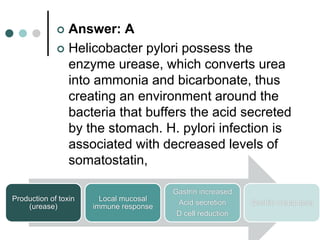
๏‚ข Helicobacter pylori possess the
enzyme urease, which converts urea
into ammonia and bicarbonate, thus
creating an environment around the
bacteria that buffers the acid secreted
by the stomach. H. pylori infection is
associated with decreased levels of
somatostatin,
Production of toxin
(urease)
Local mucosal
immune response
Gastrin increased
Acid secretion
D cell reduction
Gastric metaplasia
Question #4
Which of the following is the preoperative
imaging study of choice for gastrinoma?
๏‚ข A. CT scan
๏‚ข B. Magnetic resonance imaging (MRI)
๏‚ข C. Endoscopic ultrasound (EUS)
๏‚ข D. Angiographic localization
๏‚ข E. Somatostatin receptor scintigraphy
๏‚ข Answer: E
๏‚ข Currently, the preoperative imaging
study of choice for gastrinoma is
somatostatin-receptor scintigraphy
(the octreotide scan). When the
pretest probability of gastrinoma is
high, the sensitivity and specificity o
this modality approach 100%

Peptic ulcer disease

  • 1.
  • 2.
    Learning objectives ๏‚ข Stomachgross anatomy ๏‚ข PUD ๏ฌ Epidemiology ๏ฌ Pathogenesis ๏ฌ Clinical manifestation ๏ฌ Diagnosing ๏ฌ Treatment ๏ฌ Complicated ulcer disease ๏ฌ Surgical procedures
  • 3.
    Divisions ๏‚ข Stomach begins asa dilation in the tubular embryonic foregut during the fifth week of gestation.
  • 4.
  • 6.
  • 7.
  • 8.
  • 10.
    Peptic ulcer disease ๏‚ขPeptic ulcers are defined as erosions in the gastric or duodenalmucosa that extend through the muscularis mucosae. ๏‚ข Lifetime Prevalence = 10% of Americans develop PUD ๏‚ข >10% of ER patients with abdominal pain diagnosed with PUD ๏‚ข Prevalence decreasing over last 30yrs ๏‚ข Male-to-female ratio of PUD = 2:1 ๏‚ข 4000 deaths caused by PUD each year.
  • 11.
    Pathogenesis Increased aggressive factors HCl acid secretion Ethanolingestion, smoking NSAID H.PYLORI Decreased defensive factors mucosal bicarbonate secretion mucus production Cell renewal blood flow
  • 12.
    H.Pylori infection ๏‚ข 80%to 95% of duodenal ulcers ๏‚ข 75% of gastric ulcers are associated with H. pylori infection. Production of toxin (urease) Local mucosal immune response Gastrin increased Acid secretion D cell reduction Gastric metaplasia
  • 13.
  • 14.
  • 15.
    Clinical manifestation ๏‚ข Themost common symptom is midepigastric abdominal pain. ๏‚ข The pain is generally tolerable ๏‚ข Frequently relieved by food. ๏‚ข The pain may be episodic, worse during periods of emotional stress. ๏‚ข Many patients do not seek medical attention. ๏‚ข Constant pain - deeper ulcer penetration. Referral of ๏‚ข Pain to the back - penetration into the pancreas. ๏‚ข Diffuse peritoneal irritation - free perforation.
  • 16.
    Diagnosis History & PE Laboratory test Upper GI radiography Flexible upper endoscopy H.Pylori testing Invasivetest - Urease - Culture Noninvasive - Serology -Urea breath test -Stool antigen
  • 17.
    Radiography ๏‚ข Less expensive ๏‚ขRequire barium ๏‚ข Most ulcer (90%) diagnosed accurately ๏‚ข Double contrast > single contrast
  • 18.
    Flexible upper endoscopy ๏‚ขMost reliable method ๏‚ข Visual diagnosis ๏‚ข Provide to sample tissue ๏‚ข H.pylori testing โ€“ mucosal biopsy
  • 19.
    Urease assay ๏‚ข Withendoscopy ๏‚ข From the gastric body and the antrum ๏‚ข Sensitivity in diagnosing infection is greater than 90%, and specificity is 95% to 100% ๏‚ข Sensitivity of the test is lowered in patients who are taking PPIs, H2 antagonists, or antibiotics.
  • 20.
  • 21.
    Noninvasive tests ๏‚ข Serology ๏‚ขSensitivity 90% ๏‚ข Specificity 76- 96% ๏‚ข Check IgG antibodies of H.pylori ๏‚ข Urea breath test ๏‚ข Sensitivity 90% ๏‚ข Specificity 86- 92% ๏‚ข Recommended ๏ฌ discontinue antibiotics for 4 weeks ๏ฌ PPIs for 2 weeks to ensure optimal test accuracy. ๏‚ข Stool antigen ๏‚ข H.pylori are present in stool ๏‚ข Sensitivity 90% ๏‚ข Specificity 86-92% ๏‚ข Most cost effective method
  • 22.
  • 23.
    Treatment ๏‚ข Antacids ๏‚ข Sucralfate ๏‚ขH2 receptor antagonist ๏‚ข PPI ๏‚ข Treatment of H.pylori infection ๏‚ข lifestyle changes, ๏‚ข smoking cessation ๏‚ข discontinuing NSAIDs and aspirin ๏‚ข avoiding coffee and alcohol
  • 25.
  • 27.
    Endoscopic approach ๏‚ข Evaluatingby Forrest classification ๏‚ข High-risk patients - injection of a vasoconstrictor at the site of bleeding ๏‚ข Guidelines for endoscopic control of bleeding 2010: use of epinephrine plus an additional method or monotherapy with either thermocoagulation or clipping, ๏‚ข But discourage the use of epinephrine alone.
  • 28.
    Nonsurgical control of bleeding ๏‚ขCatheter-directed angiography and endovascular embolization
  • 29.
    Perforation ๏‚ข Typically complainof sudden-onset, frequently severe epigastric pain ๏‚ข Highest mortality rate of any complication of ulcer disease ๏‚ข Graham patch repair is performed
  • 31.
  • 32.
    Gastric outlet obstruction Acuteinflammation of the duodenum Mechanical obstruction Delayed gastric emptying, anorexia, nausea, and vomiting Antrectomy and reconstruction along with vagotomy.
  • 33.
  • 34.
    Truncal vagotomy ๏‚ข Mostcommon operation performed for duodenal ulcer disease ๏‚ข Pyloric relaxation is mediated by vagal stimulation, and a vagotomy without a drainage procedure can cause delayed gastric emptying.
  • 35.
    Classic truncal vagotomy,in combination with a Heineke-Mikulicz pyloroplasty
  • 37.
  • 39.
  • 40.
    Gastric ulcer ๏‚ข Mostulcers are the consequence of H. pylori infection or NSAID usage. ๏‚ข Usually manifest on the lesser curvature ๏‚ข Peak incidence: 55 to 65 years old ๏‚ข More likely to occur in individuals in: ๏ฌ a lower socioeconomic class ๏ฌ common in the nonwhite than white population
  • 41.
  • 42.
    Quick difference Duodenal Gastric IncidenceMore common Less common Anatomy First part of duodenum โ€“ wall Lesser curvature of stomach Duration Acute or chronic Chronic Malignancy Rare Benign or malignant Food intake Relieved by food Worsened by food
  • 45.
    Type 1 gastriculcer Wedge resection โ€“ pathology examination Gastrectomy w/out vagotomy Type 2&3 gastric ulcer Ulcer + increased gastric acid Gastrectomy w/ vagotomy Type 4 gastric ulcer Difficult to manage Gastectomy / Rouxen Y/gastroduodenostomy
  • 46.
  • 47.
    Diagnosing ZES ๏‚ข Secretin-stimulatedgastrin level ๏ฌ Serum gastrin samples are measured before and after IV secretin (2 U/kg) administration at 5-minute intervals for 30 minutes. ๏ฌ An increase in the serum gastrin level of greater than 200 pg/mL is specific for gastrinoma.
  • 48.
    Diagnosing ๏‚ข Localize thegastrinoma is either CT or MRI of the abdomen. ๏‚ข However, these imaging modalities have a relatively low sensitivity in detecting tumors that are less than 1 cm in diameter as well as small liver metastases. ๏‚ข Somatostatin receptor scintigraphy uses radionucleotide labeled octreotide, which binds to the ZES tumor cells and can detect hepatic metastases in 85% to 95% of patients
  • 49.
    Treatment ๏‚ข Resection oftumor ๏‚ข Patients with tumor recurrence or metastatic disease are treated with chemotherapy (streptozotocin with 5- fluorouracil or doxorubicin or both).
  • 50.
    THANK YOU Because Ialready told you what I know only if you had listened to me ๏Š
  • 51.
  • 52.
    Question #1 ๏‚ข Theconsistently largest artery to the stomach is the ๏‚ข A. Right gastric ๏‚ข B. Left gastric ๏‚ข C. Right gastroepiploic ๏‚ข D. Left gastroepiploic
  • 53.
    Answer ๏‚ข Answer: B ๏‚ขThe consistently largest artery to the stomach is the left gastric artery, which usually arises directly rom the celiac trunk and divides into an ascending and descending branch along the lesser gastric curvature
  • 54.
    Question #2 ๏‚ข Whichof the following inhibits gastrin secretion? ๏‚ข A. Histamine ๏‚ข B. Acetylcholine ๏‚ข C. Amino acids ๏‚ข D. Acid
  • 55.
    ๏‚ข Answer: D ๏‚ขLuminal peptides and amino acids are the most potent stimulants o gastrin release, and luminal acid is the most potent inhibitor of gastrin secretion.
  • 56.
    Question #3 ๏‚ข Helicobacterpylori infection primarily mediates duodenal ulcer pathogenesis via ๏‚ข A. Antral alkalinization leading to inhibition of somatostatin release ๏‚ข B. Direct stimulation of gastrin release ๏‚ข C. Local infammation with autoimmune response ๏‚ข D. Upregulation of parietal cell acid production
  • 57.
    ๏‚ข Answer: A ๏‚ขHelicobacter pylori possess the enzyme urease, which converts urea into ammonia and bicarbonate, thus creating an environment around the bacteria that buffers the acid secreted by the stomach. H. pylori infection is associated with decreased levels of somatostatin, Production of toxin (urease) Local mucosal immune response Gastrin increased Acid secretion D cell reduction Gastric metaplasia
  • 58.
    Question #4 Which ofthe following is the preoperative imaging study of choice for gastrinoma? ๏‚ข A. CT scan ๏‚ข B. Magnetic resonance imaging (MRI) ๏‚ข C. Endoscopic ultrasound (EUS) ๏‚ข D. Angiographic localization ๏‚ข E. Somatostatin receptor scintigraphy
  • 59.
    ๏‚ข Answer: E ๏‚ขCurrently, the preoperative imaging study of choice for gastrinoma is somatostatin-receptor scintigraphy (the octreotide scan). When the pretest probability of gastrinoma is high, the sensitivity and specificity o this modality approach 100%

Editor's Notes

  • #5ย The stomach is bounded superiorly by the diaphragm and laterally by the spleen. The body also contains most of the parietal cells and is bounded on the right by the relatively straight lesser curvature and on the left by the longer greater curvature. At the angularis incisura, the lesser curvature abruptly angles to the right. The body of the stomach ends here and the antrum begins. Another important anatomic angle (angle of His) is the angle formed by the fundus with the left margin of the Esophagus. The gastrosplenic ligament attaches the proximal greater curvature to the spleen.
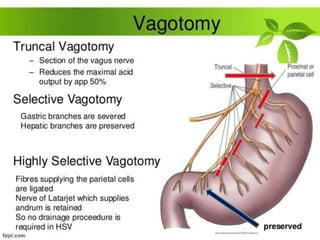
  • #9ย The left vagus gives off the hepatic branch to the liver and continues along the lesser curvature as the anterior nerve of Latarjet. Although not shown, the so-called criminal nerve of Grassi is the first branch of the right or posterior vagus nerve; it is recognized as a potential cause of recurrent ulcers when left undivided. The right nerve gives a branch off to the celiac plexus and continues posteriorly along the lesser curvature. A truncal vagotomy is performed above the celiac and hepatic branches of the vagi, whereas a selective vagotomy is performed below.
  • #14ย Prostaglandins promote gastric and duodenal mucosal protection via numerous mechanisms, including increasing mucin and bicarbonate secretion and increasing blood flow to the mucosal endothelium. The presence of NSAIDs disrupts these naturally protective mechanisms, increasing the risk of peptic ulcer formation in the stomach and the duodenum.
  • #24ย Antacid โ€“ oldest form of therapy โ€“ reduce gastric acdity More effective when ingested 1 hour after a meal Sucralfate โ€“ structurally related to heparin /no anticoagulant effect/ Exact mechanism is not fully understood Provide protective coating not initial treatment H2RI โ€“ Famotidine is the most potent
  • #30ย Perforations smaller than 1 cm can generally be closed primarily and buttressed with a wellvascularized omentum. For larger perforations or ulcers with fibrotic edges that cannot be brought together without tension, a Graham patch repair with a tongue of healthy omentum is performed. Multiple stay sutures are placed that incorporate a bite of healthy tissue on the proximal and the distal side of the ulcer. The omentum is placed underneath these sutures, and they are tied to secure it in place and seal the perforation (Fig. 48-11). For very large perforations (>3 cm), control of the duodenal defect can be difficult. The defect should be closed by the application of healthy tissue, such as omentum or jejunal serosa from a Rouxen- Y type limb. In such cases, a pyloric exclusion is typically performed by oversewing the pylorus using absorbable suture or stapling across it using a noncutting linear stapler. A gastrojejunostomy is created to bypass the duodenum in a Billroth II or Roux-en-Y fashion.
  • #31ย Graham patch repair of a perforated duodenal ulcer. A โ€œtongueโ€ of omentum is brought up to cover the ulcer defect and secured in position with a series of interrupted sutures. I
  • #36ย Classic truncal vagotomy, in combination with a Heineke-Mikulicz pyloroplasty, is shown in Figure 48-12. When the duodenal bulb is scarred, a Finney pyloroplasty or Jaboulay gastroduodenostomy may be a useful alternative. In general, there is little difference in the side effects associated with the type of drainage procedure performed, although bile reflux may be more common after gastroenterostomy, and diarrhea is more common after pyloroplasty.
  • #38ย Usually in gastric ulcer Vagotomy โ€“ eliminates cephalic phase Antrectomy โ€“ eliminates gastric phase
  • #53ย Answer: B he consistently largest artery to the stomach is the le t gastric artery, which usually arises directly rom the celiac trunk and divides into an ascending and descending branch along the lesser gastric curvature. Approximately 20% o the time, the le t gastric artery supplies an aberrant vessel that travels in the gastrohepatic ligament (lesser omentum) to the le t side o the liver. Rarely, this is the only arterial blood supply to this part o the liver, and inadvertent ligation may lead to clinically signi icant hepatic ischemia in this unusual circumstance. (See Schwartz 10th ed., p. 1037.)