Team Members:
Abu Sufian
Asif Ibtehaz
Samrin Sultana Tithi
Syeda NoorJaha Azim
 A Mutation is a change in nucleotide
sequence of DNA.
 May occur in somatic cells (aren’t passed
to offspring)
 May occur in gametes (eggs & sperm) and
be passed to offspring.
 Mutations are important because they
increase genetic variation.
 Spontaneous mutation
- A mutation that arises naturally and not as a
result of exposure to mutagens
 Error prone replication by-pass
- Increasing evidence that the majority of
spontaneously arising mutations are due to error
prone replication
 Errors introduced during DNA repair
- Double-strand breaks occur at a relatively low
frequency in DNA
 Induced mutation
- A mutation is any change in a DNA sequence
that can be passed from parent to offspring
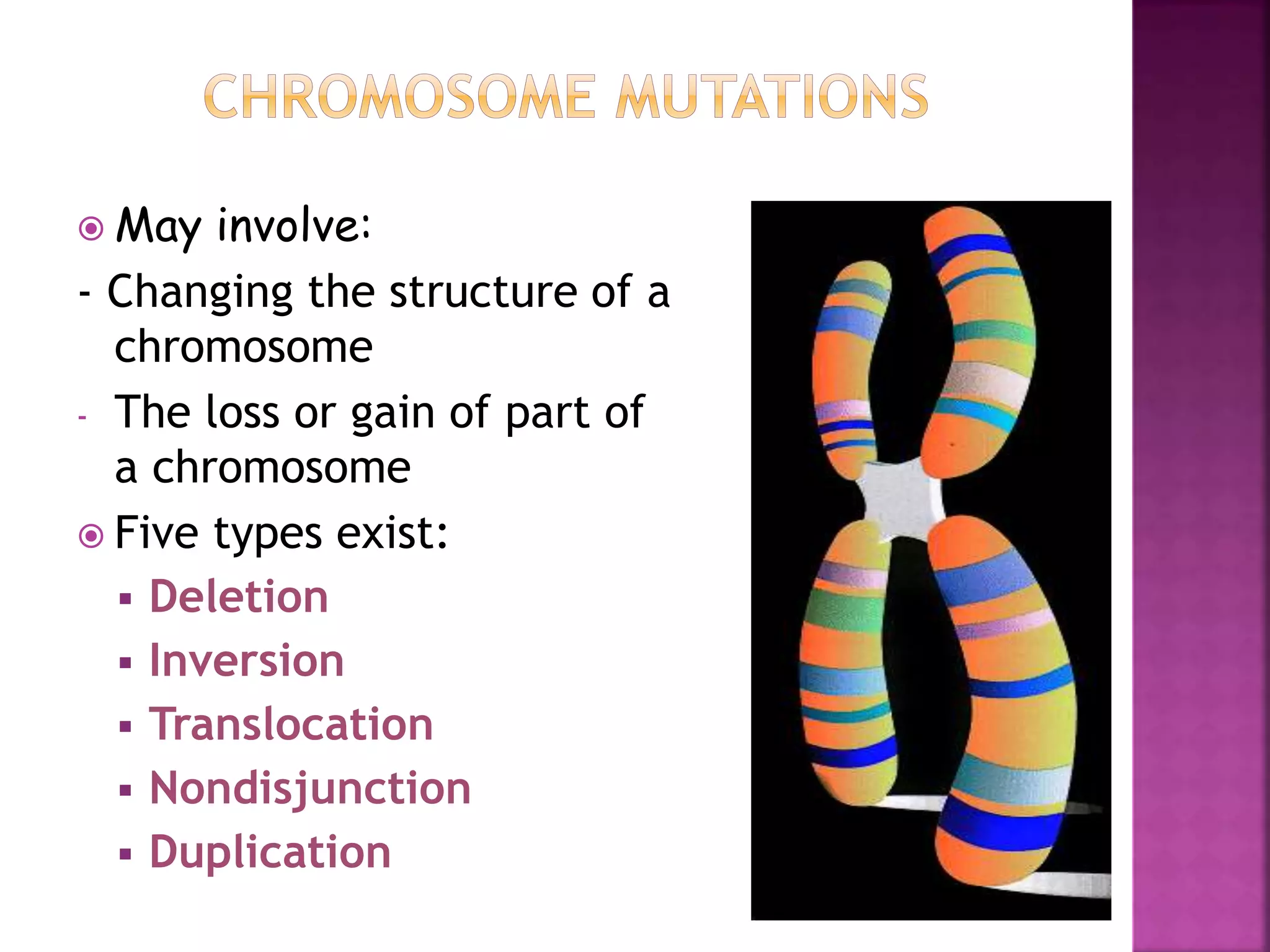
 May involve:
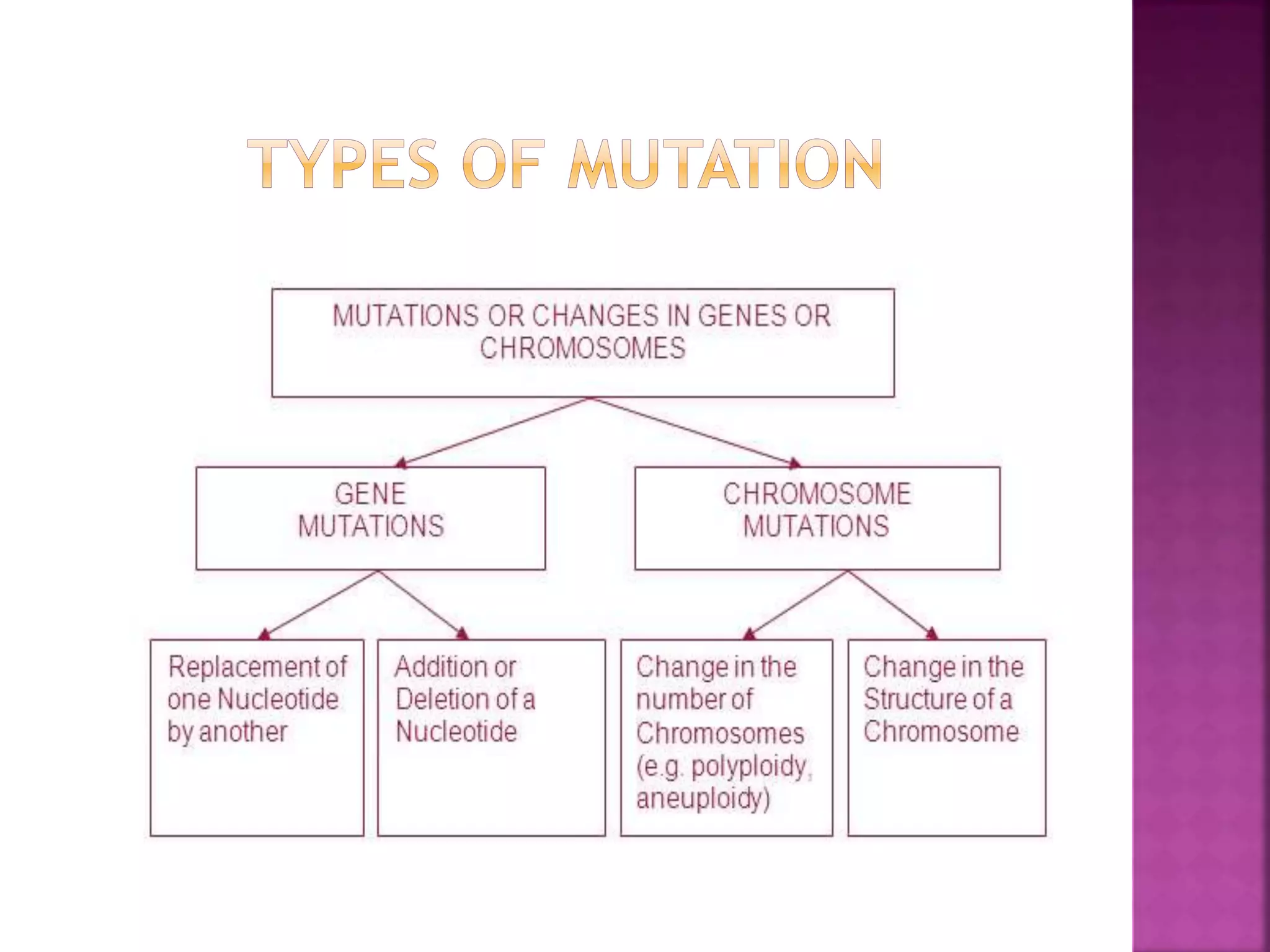
- Changing the structure of a
chromosome
- The loss or gain of part of
a chromosome
 Five types exist:
 Deletion
 Inversion
 Translocation
 Nondisjunction
 Duplication
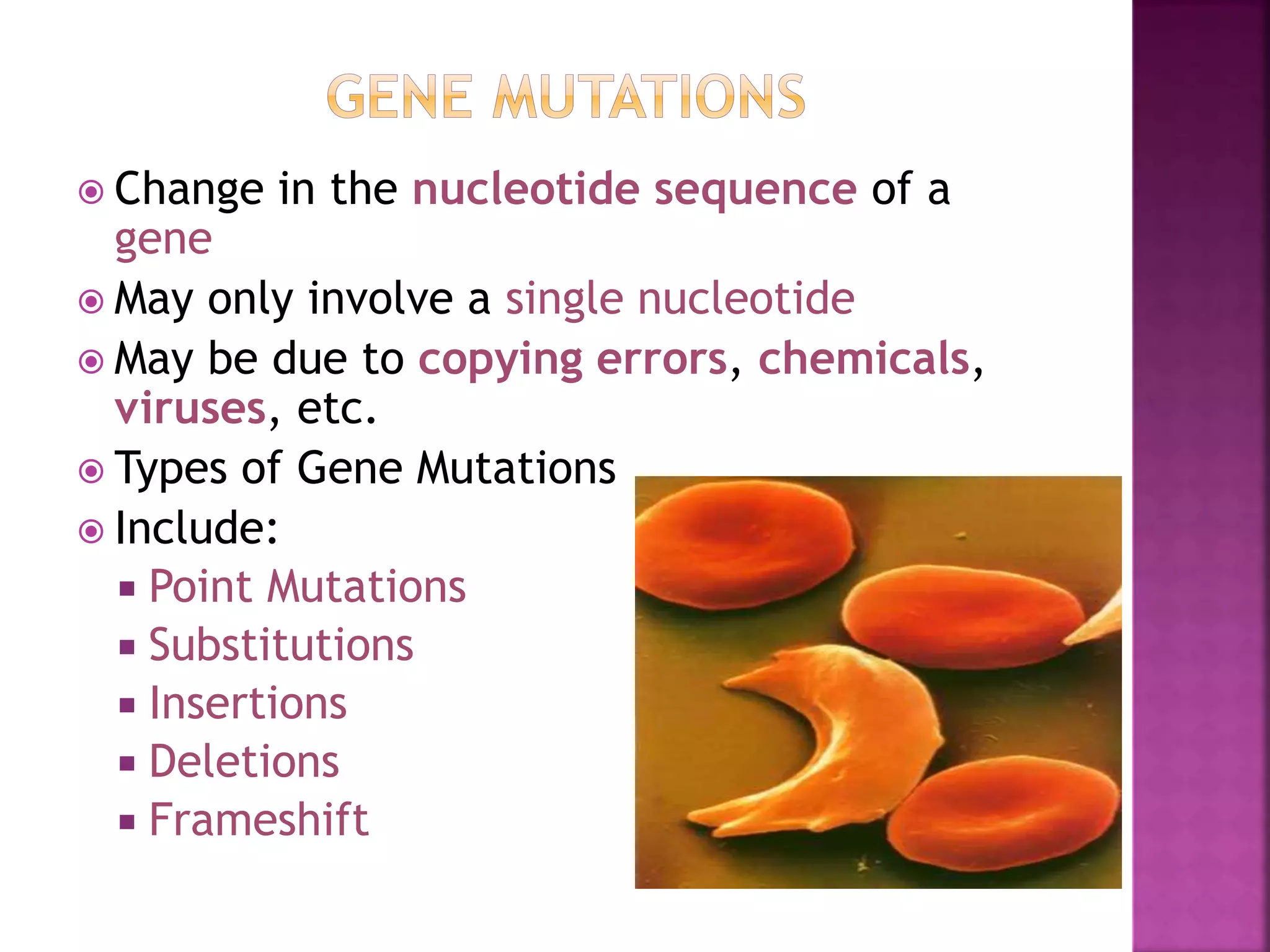
 Change in the nucleotide sequence of a
gene
 May only involve a single nucleotide
 May be due to copying errors, chemicals,
viruses, etc.
 Types of Gene Mutations
 Include:
 Point Mutations
 Substitutions
 Insertions
 Deletions
 Frameshift
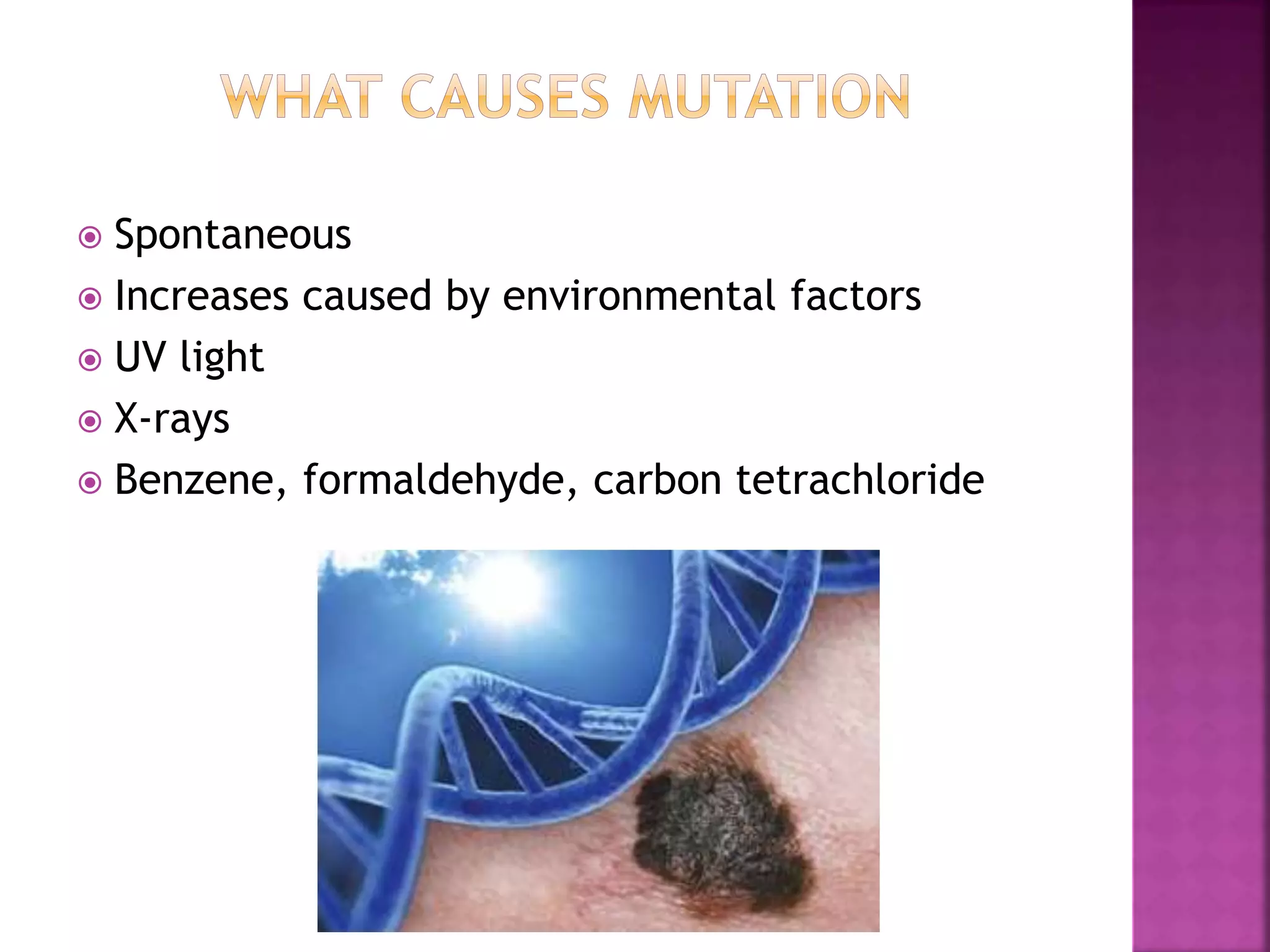
 Spontaneous
 Increases caused by environmental factors
 UV light
 X-rays
 Benzene, formaldehyde, carbon tetrachloride
Not all are harmful
Survival advantage
Most common among bacteria and
viruses but also seen in insects
If no selective pressure may remain
in population
 Cystic fibrosis and sickle cell anaemia
 Disfunctional proteins
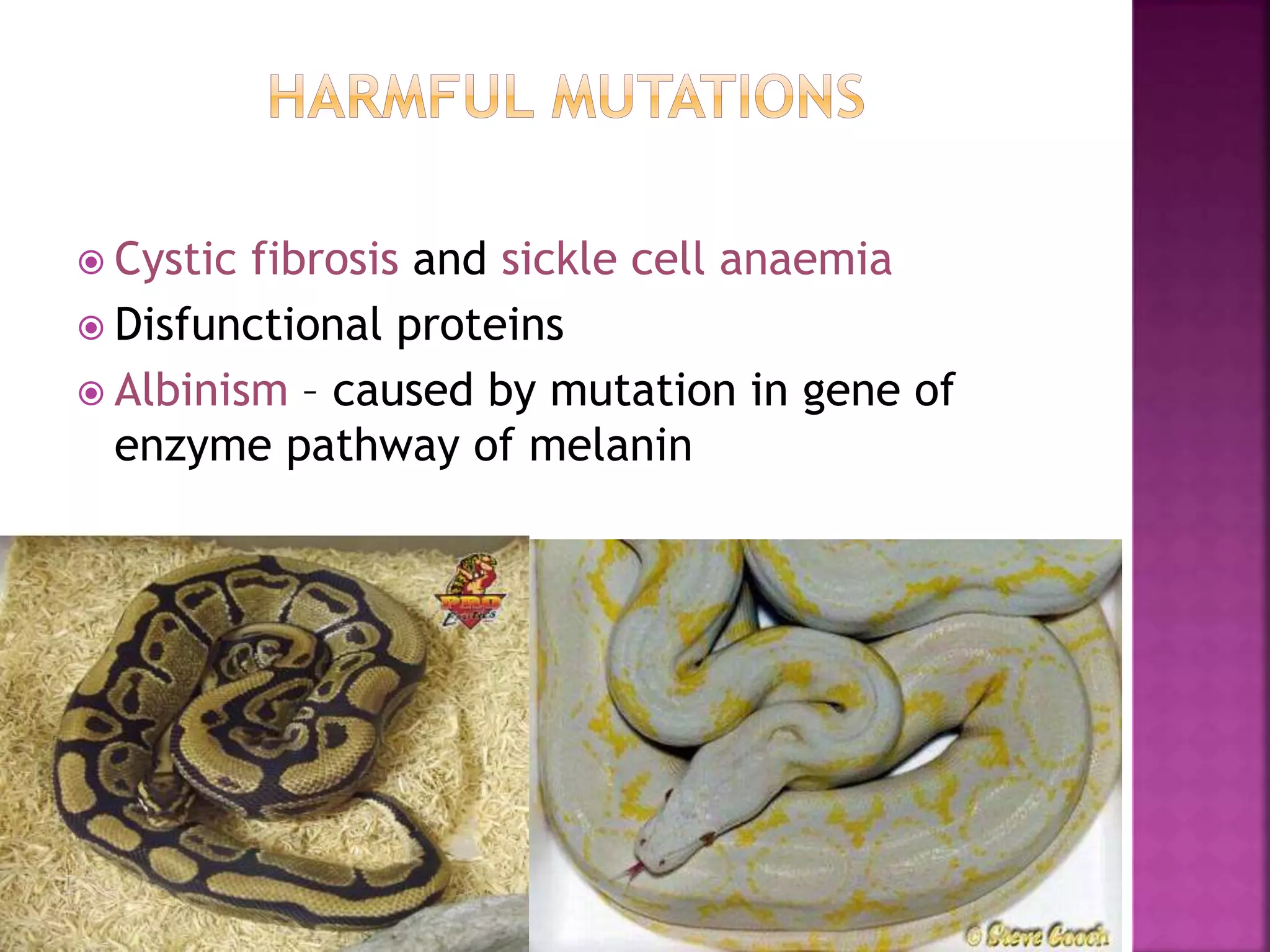
 Albinism – caused by mutation in gene of
enzyme pathway of melanin
 Bacteria – antibiotic
resistance through
mutation, transfer
between bacterial species
 Superbugs such as MRSA
have arisen this way
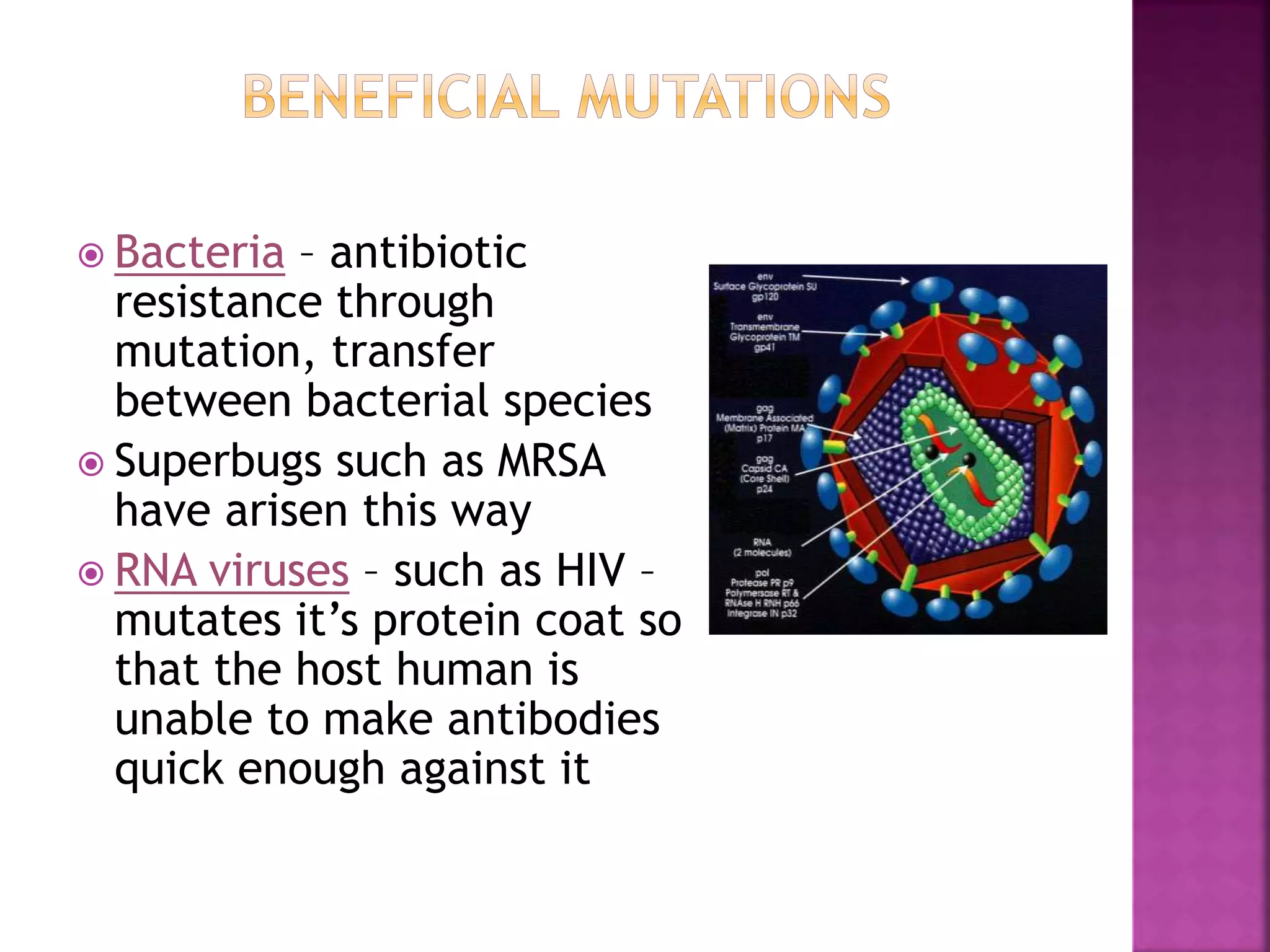
 RNA viruses – such as HIV –
mutates it’s protein coat so
that the host human is
unable to make antibodies
quick enough against it
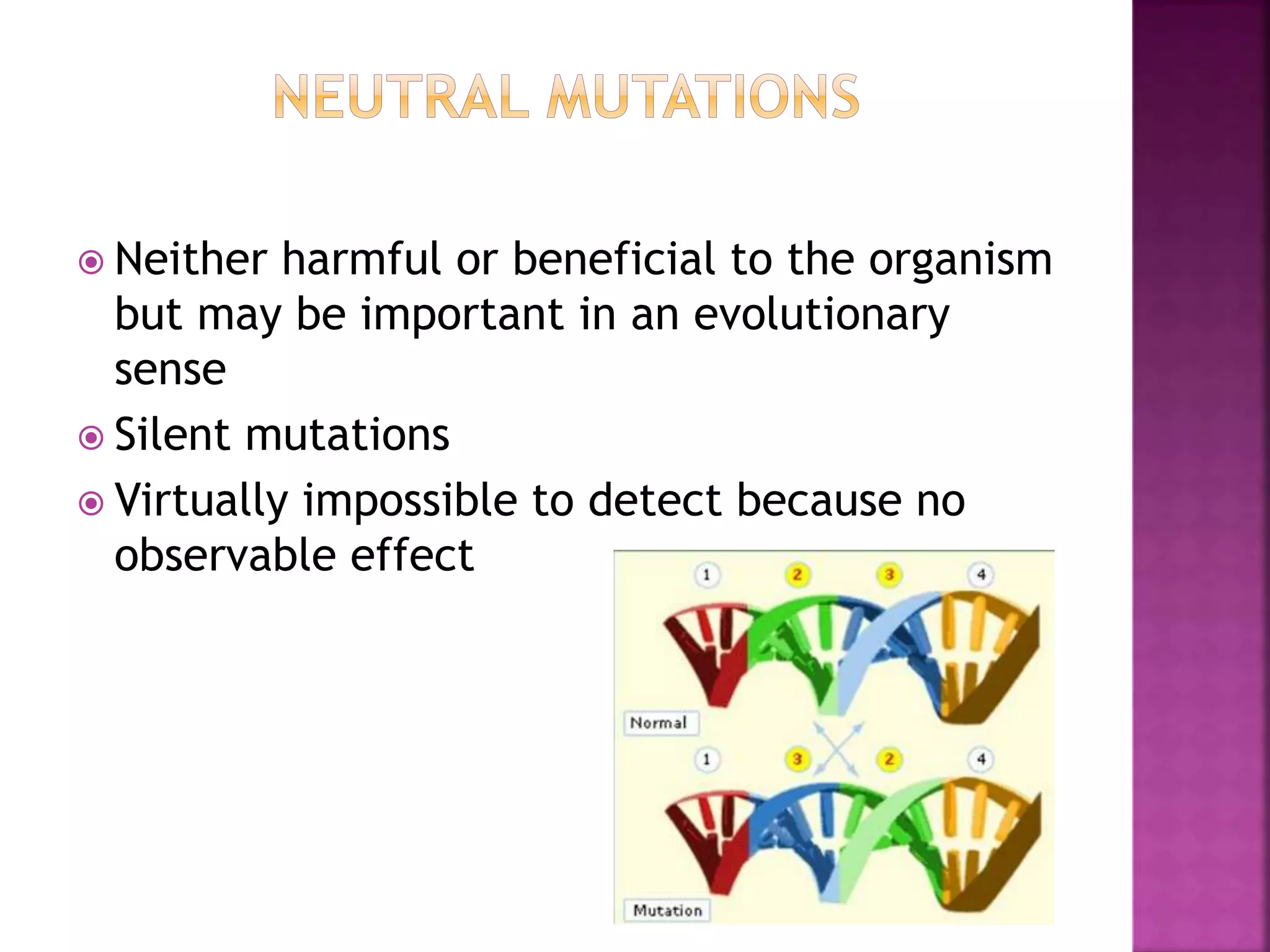
 Neither harmful or beneficial to the organism
but may be important in an evolutionary
sense
 Silent mutations
 Virtually impossible to detect because no
observable effect
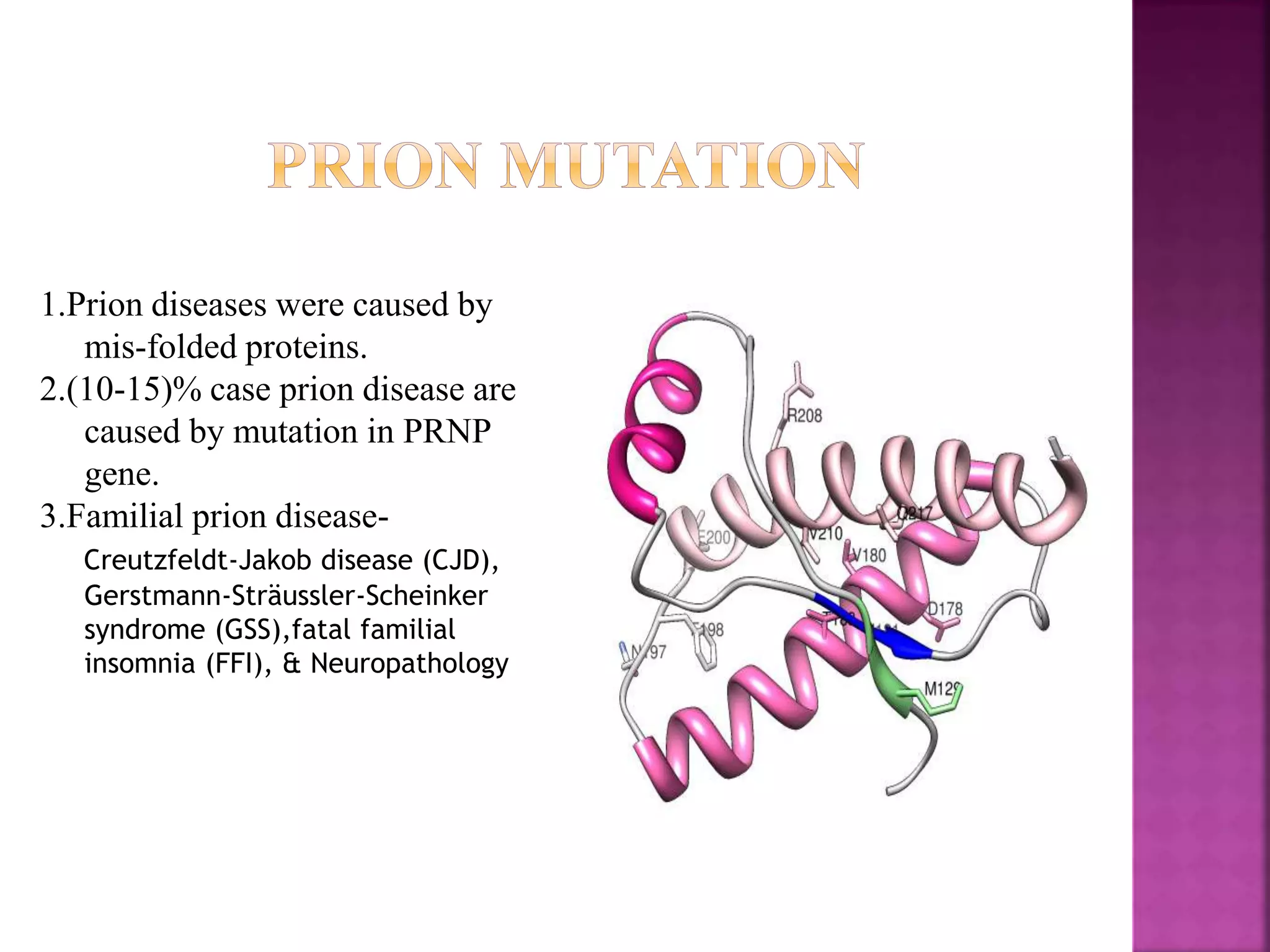
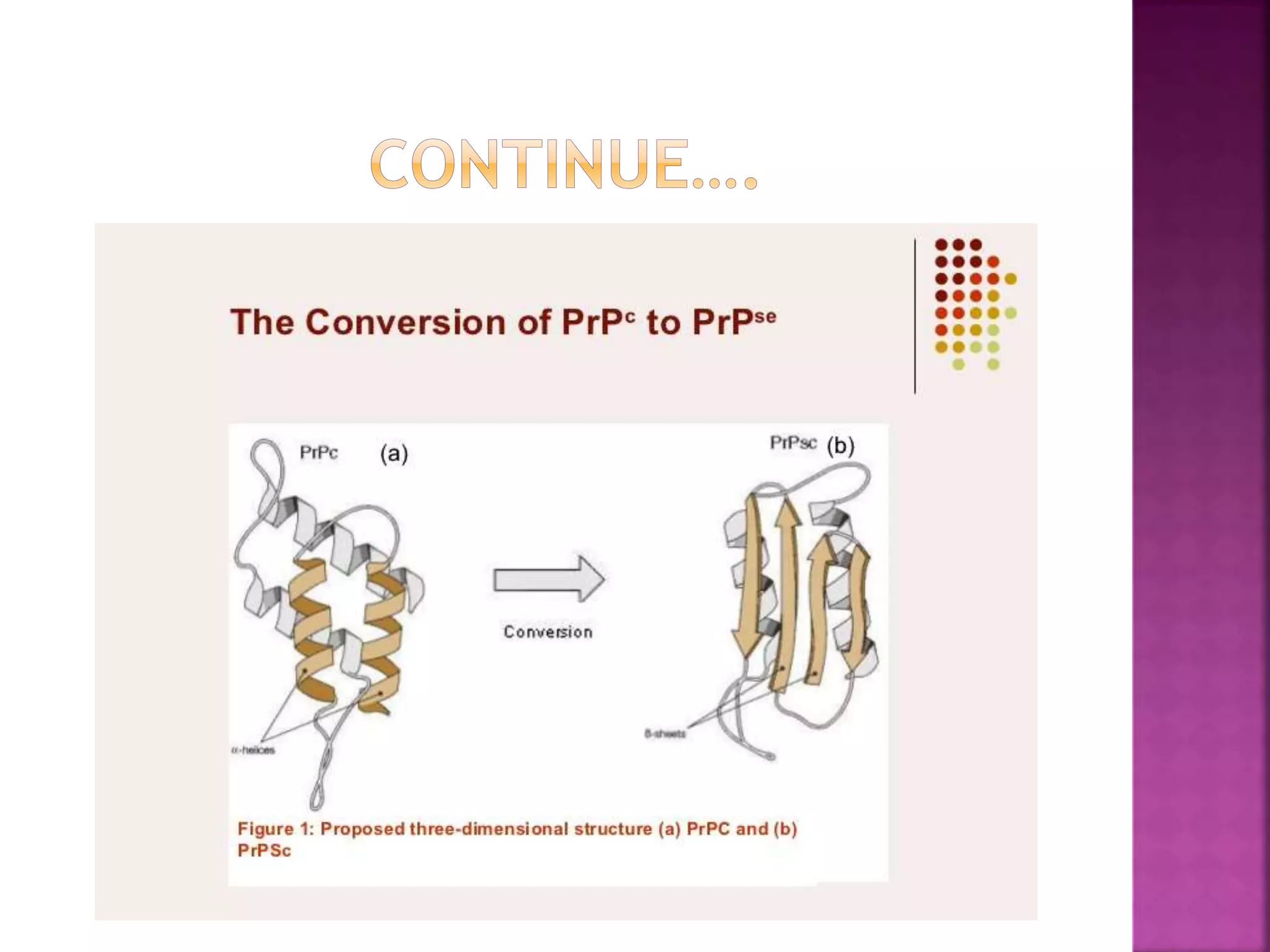
1.Prion diseases were caused by
mis-folded proteins.
2.(10-15)% case prion disease are
caused by mutation in PRNP
gene.
3.Familial prion disease-
Creutzfeldt-Jakob disease (CJD),
Gerstmann-Sträussler-Scheinker
syndrome (GSS),fatal familial
insomnia (FFI), & Neuropathology
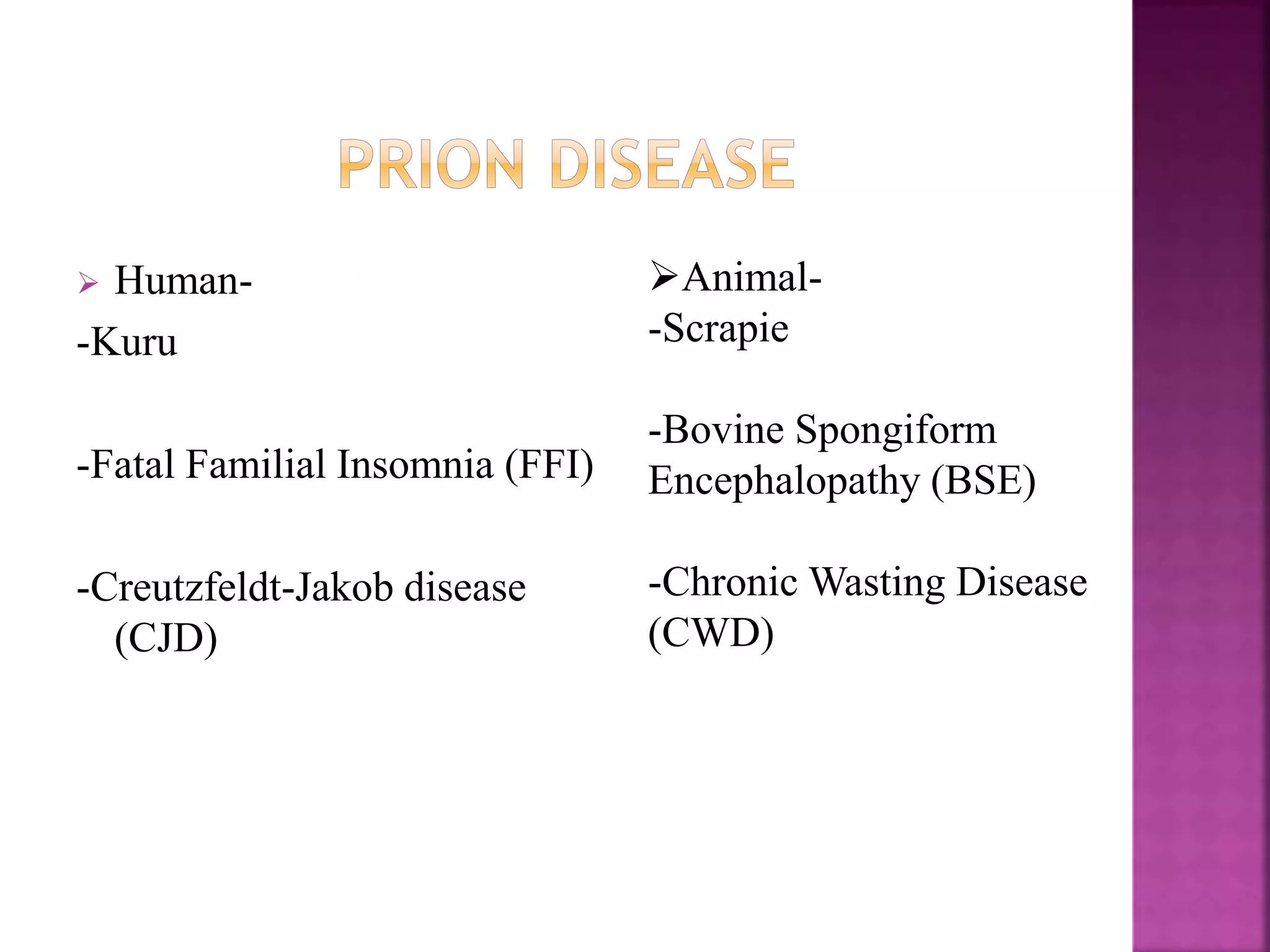
 Human-
-Kuru
-Fatal Familial Insomnia (FFI)
-Creutzfeldt-Jakob disease
(CJD)
Animal-
-Scrapie
-Bovine Spongiform
Encephalopathy (BSE)
-Chronic Wasting Disease
(CWD)
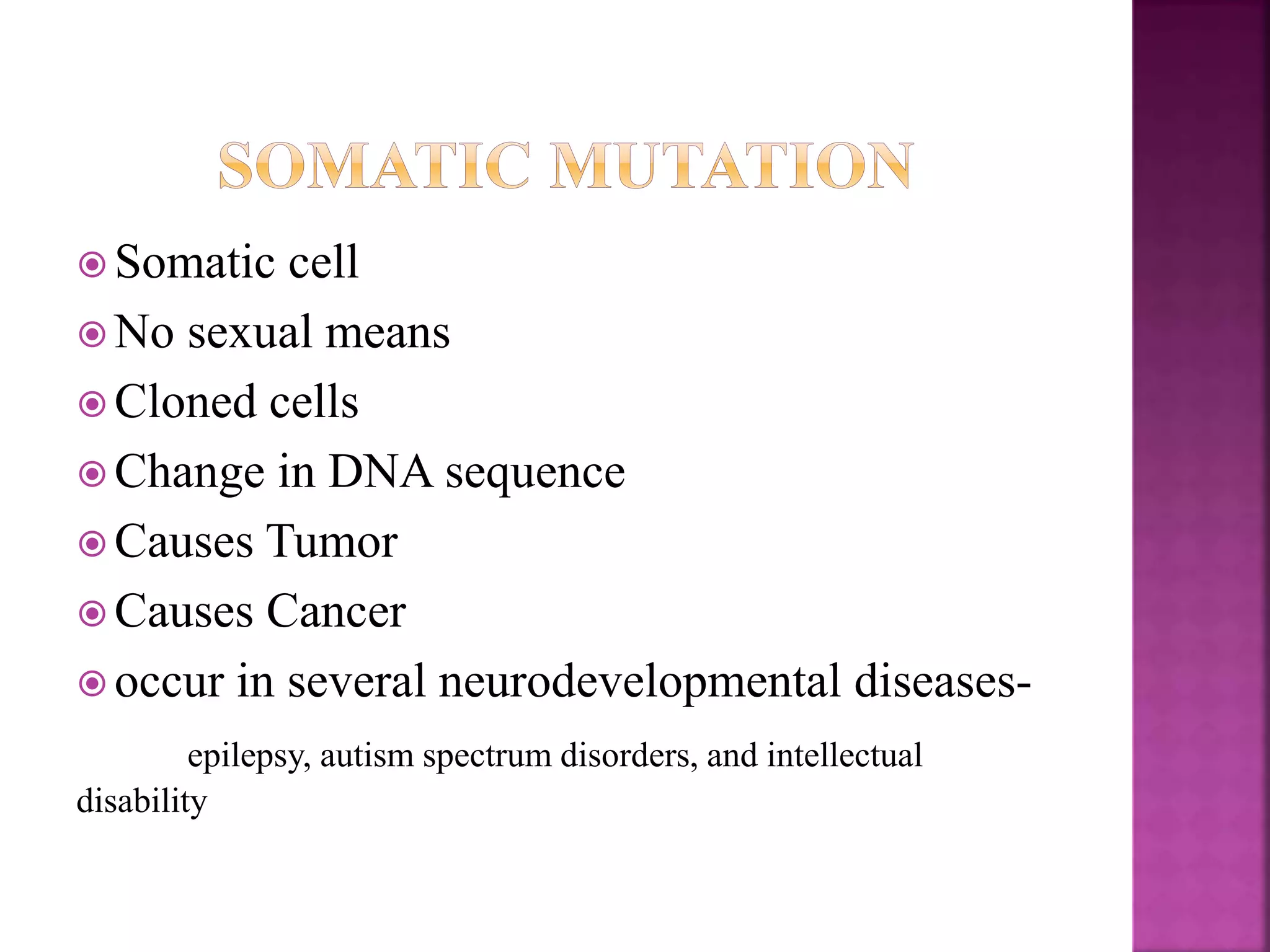
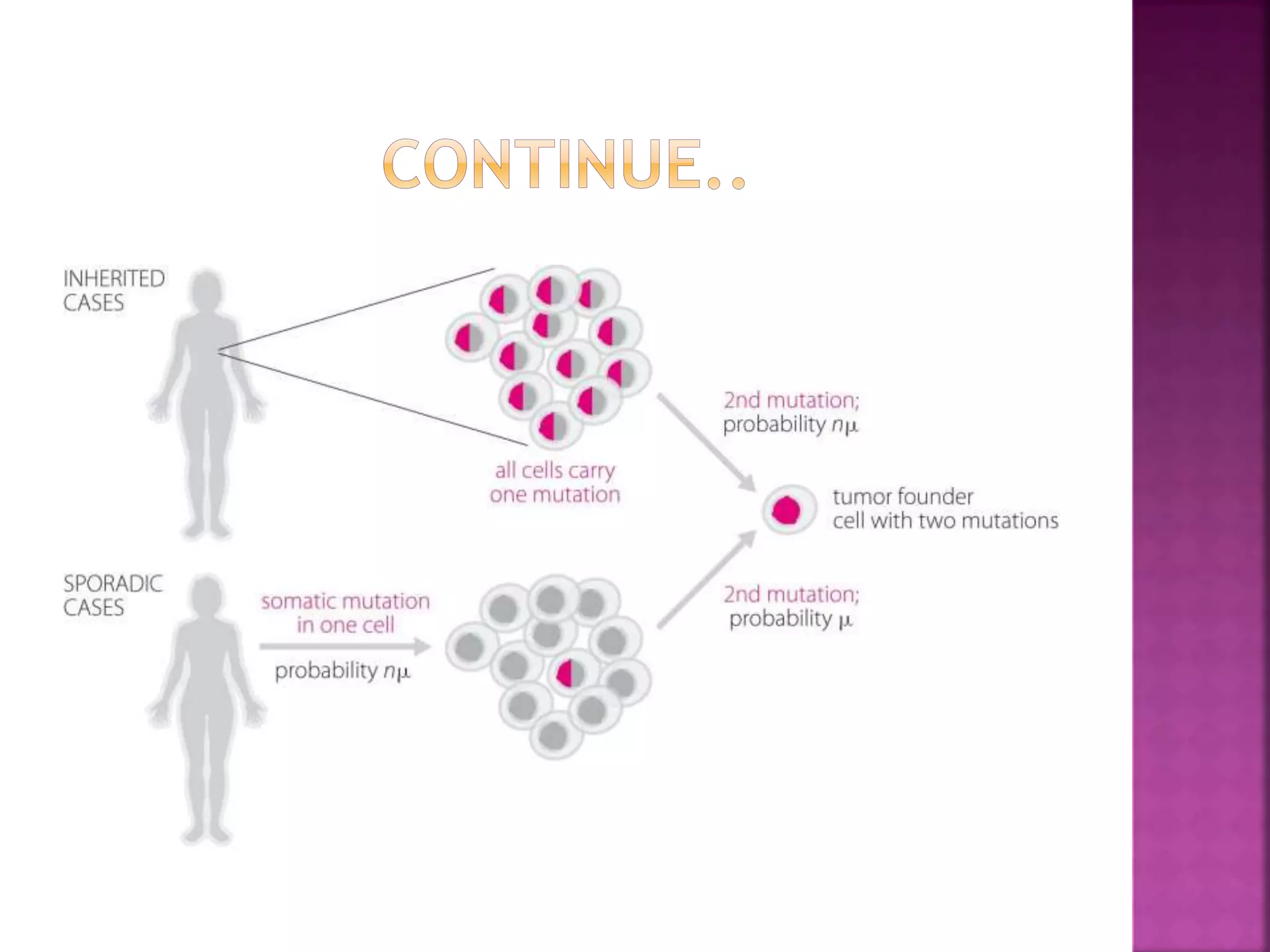
 Somatic cell
 No sexual means
 Cloned cells
 Change in DNA sequence
 Causes Tumor
 Causes Cancer
 occur in several neurodevelopmental diseases-
epilepsy, autism spectrum disorders, and intellectual
disability
 Lung cancer after 50 pack-years (7,300
cigarettes/year, pack a day)
 Mutation spectra here similar to primary lung
cancers
 Clone of cells that gives rise to cancer
accumulates 1 mutation per 15 cigarettes
 Substantial mutation over the bronchial tree
(cells not cancerous)
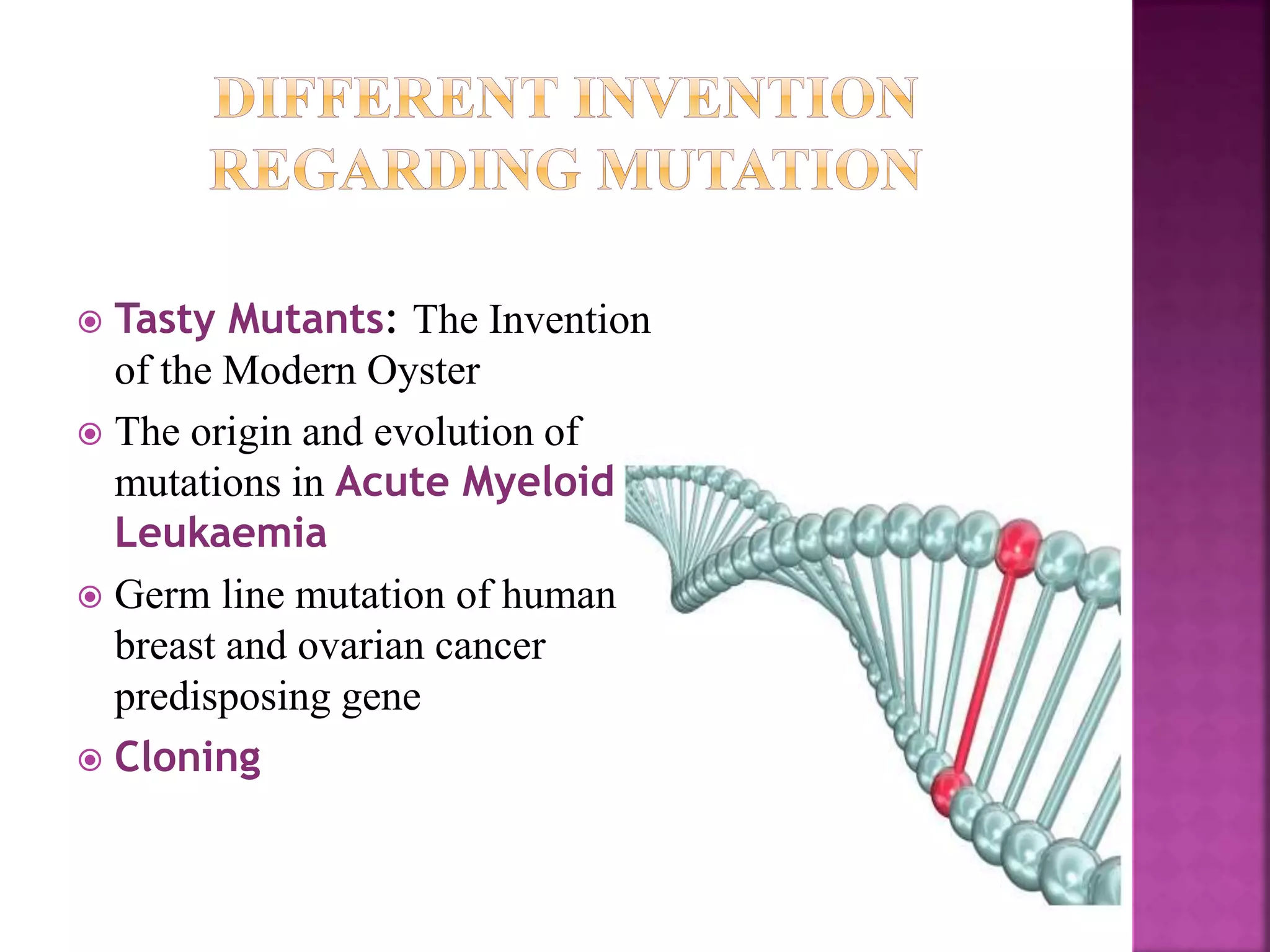
 Tasty Mutants: The Invention
of the Modern Oyster
 The origin and evolution of
mutations in Acute Myeloid
Leukaemia
 Germ line mutation of human
breast and ovarian cancer
predisposing gene
 Cloning
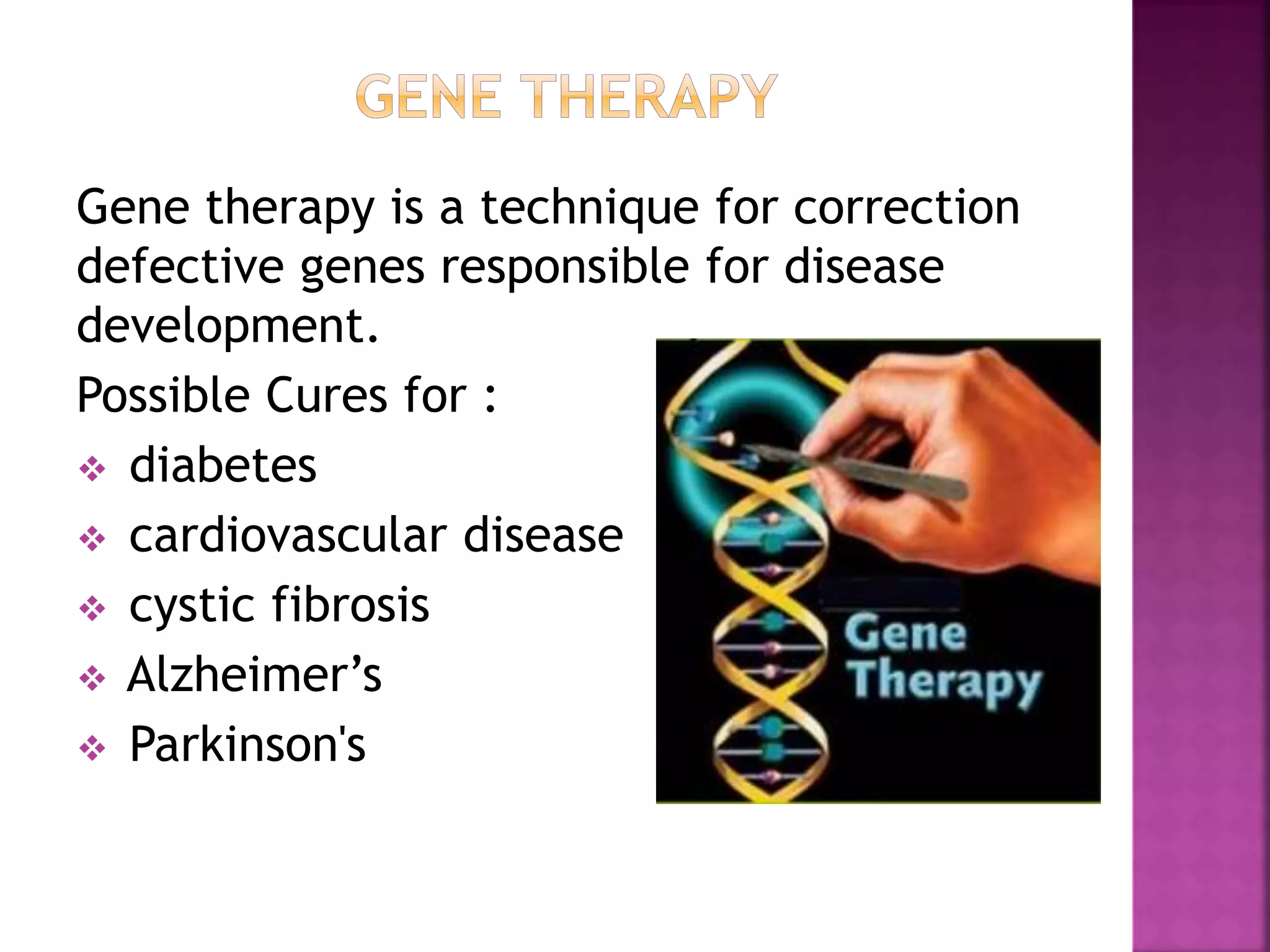
Gene therapy is a technique for correction
defective genes responsible for disease
development.
Possible Cures for :
 diabetes
 cardiovascular disease
 cystic fibrosis
 Alzheimer’s
 Parkinson's
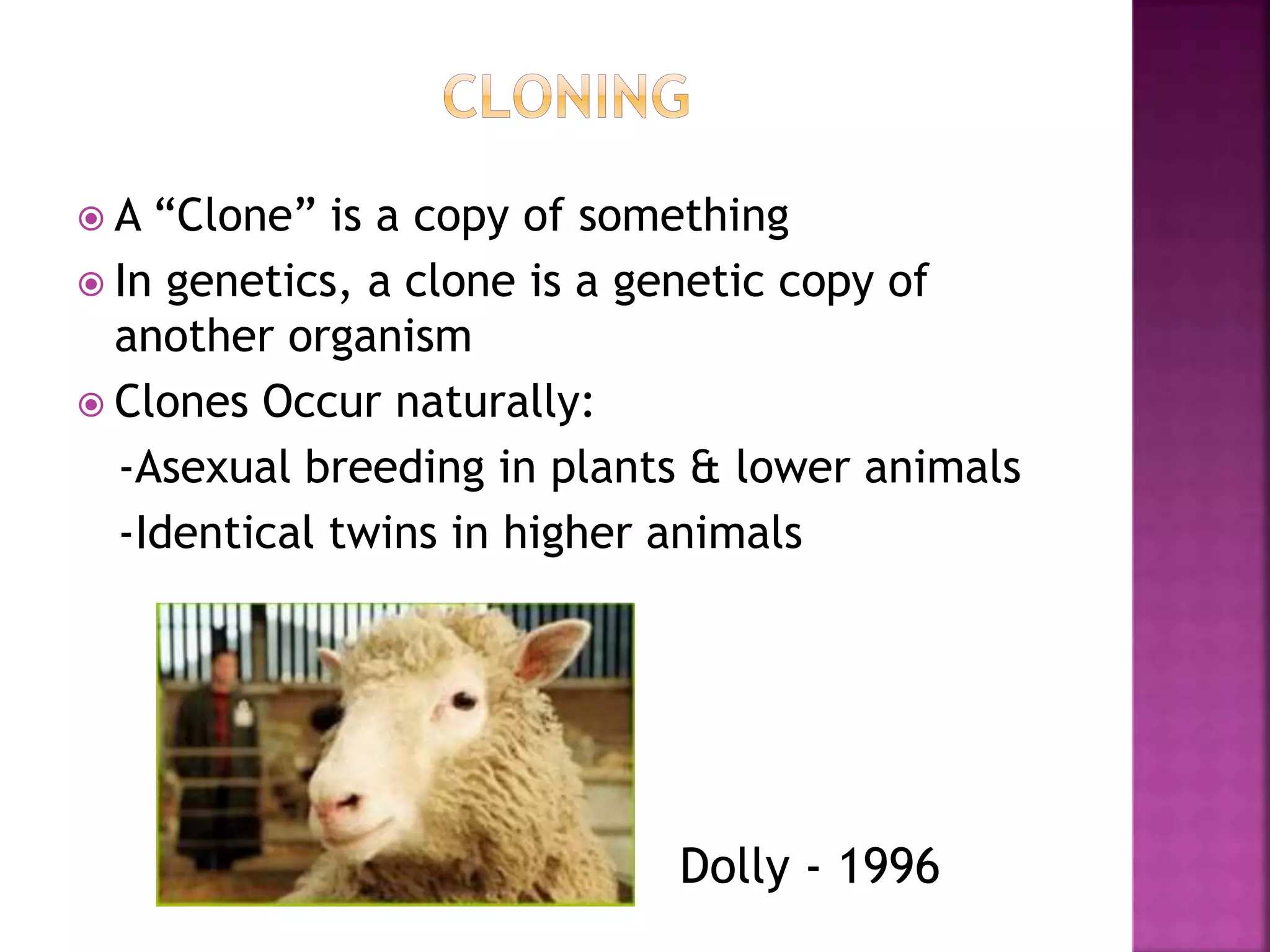
 A “Clone” is a copy of something
 In genetics, a clone is a genetic copy of
another organism
 Clones Occur naturally:
-Asexual breeding in plants & lower animals
-Identical twins in higher animals
Dolly - 1996
 http://pandawhale.com/post/51287/tasty-
mutants-the-invention-the-modern-oyster-
atlantic-mobile
 http://en.wikipedia.org/wiki/Mutation
 http://learn.genetics.utah.edu/content/variatio
n/mutation/
 http://ghr.nlm.nih.gov/condition/prion-disease
 http://www.federationofscientists.org/pmpanels
/tse/priprogene.asp
 http://global.britannica.com/EBchecked/topic/
553940/somatic-mutation
Mutation

Mutation

  • 1.
    Team Members: Abu Sufian AsifIbtehaz Samrin Sultana Tithi Syeda NoorJaha Azim
  • 2.
     A Mutationis a change in nucleotide sequence of DNA.  May occur in somatic cells (aren’t passed to offspring)  May occur in gametes (eggs & sperm) and be passed to offspring.  Mutations are important because they increase genetic variation.
  • 3.
     Spontaneous mutation -A mutation that arises naturally and not as a result of exposure to mutagens  Error prone replication by-pass - Increasing evidence that the majority of spontaneously arising mutations are due to error prone replication  Errors introduced during DNA repair - Double-strand breaks occur at a relatively low frequency in DNA  Induced mutation - A mutation is any change in a DNA sequence that can be passed from parent to offspring
  • 5.
     May involve: -Changing the structure of a chromosome - The loss or gain of part of a chromosome  Five types exist:  Deletion  Inversion  Translocation  Nondisjunction  Duplication
  • 6.
     Change inthe nucleotide sequence of a gene  May only involve a single nucleotide  May be due to copying errors, chemicals, viruses, etc.  Types of Gene Mutations  Include:  Point Mutations  Substitutions  Insertions  Deletions  Frameshift
  • 7.
     Spontaneous  Increasescaused by environmental factors  UV light  X-rays  Benzene, formaldehyde, carbon tetrachloride
  • 8.
    Not all areharmful Survival advantage Most common among bacteria and viruses but also seen in insects If no selective pressure may remain in population
  • 9.
     Cystic fibrosisand sickle cell anaemia  Disfunctional proteins  Albinism – caused by mutation in gene of enzyme pathway of melanin
  • 10.
     Bacteria –antibiotic resistance through mutation, transfer between bacterial species  Superbugs such as MRSA have arisen this way  RNA viruses – such as HIV – mutates it’s protein coat so that the host human is unable to make antibodies quick enough against it
  • 11.
     Neither harmfulor beneficial to the organism but may be important in an evolutionary sense  Silent mutations  Virtually impossible to detect because no observable effect
  • 12.
    1.Prion diseases werecaused by mis-folded proteins. 2.(10-15)% case prion disease are caused by mutation in PRNP gene. 3.Familial prion disease- Creutzfeldt-Jakob disease (CJD), Gerstmann-Sträussler-Scheinker syndrome (GSS),fatal familial insomnia (FFI), & Neuropathology
  • 13.
     Human- -Kuru -Fatal FamilialInsomnia (FFI) -Creutzfeldt-Jakob disease (CJD) Animal- -Scrapie -Bovine Spongiform Encephalopathy (BSE) -Chronic Wasting Disease (CWD)
  • 15.
     Somatic cell No sexual means  Cloned cells  Change in DNA sequence  Causes Tumor  Causes Cancer  occur in several neurodevelopmental diseases- epilepsy, autism spectrum disorders, and intellectual disability
  • 17.
     Lung cancerafter 50 pack-years (7,300 cigarettes/year, pack a day)  Mutation spectra here similar to primary lung cancers  Clone of cells that gives rise to cancer accumulates 1 mutation per 15 cigarettes  Substantial mutation over the bronchial tree (cells not cancerous)
  • 18.
     Tasty Mutants:The Invention of the Modern Oyster  The origin and evolution of mutations in Acute Myeloid Leukaemia  Germ line mutation of human breast and ovarian cancer predisposing gene  Cloning
  • 19.
    Gene therapy isa technique for correction defective genes responsible for disease development. Possible Cures for :  diabetes  cardiovascular disease  cystic fibrosis  Alzheimer’s  Parkinson's
  • 20.
     A “Clone”is a copy of something  In genetics, a clone is a genetic copy of another organism  Clones Occur naturally: -Asexual breeding in plants & lower animals -Identical twins in higher animals Dolly - 1996
  • 21.
     http://pandawhale.com/post/51287/tasty- mutants-the-invention-the-modern-oyster- atlantic-mobile  http://en.wikipedia.org/wiki/Mutation http://learn.genetics.utah.edu/content/variatio n/mutation/  http://ghr.nlm.nih.gov/condition/prion-disease  http://www.federationofscientists.org/pmpanels /tse/priprogene.asp  http://global.britannica.com/EBchecked/topic/ 553940/somatic-mutation