PowerPoint® Lectures for
University Physics, 14th Edition
– Hugh D. Young and Roger A. Freedman Lectures by Jason Harlow
Motion Along a Straight Line
Chapter 2
© 2016 Pearson Education Inc.
Learning Goals for Chapter 2
Looking forward at …
• how the ideas of displacement and average velocity help us
describe straight-line motion.
• the meaning of instantaneous velocity; the difference between
velocity and speed.
• how to use average acceleration and instantaneous
acceleration to describe changes in velocity.
• how to solve problems in which an object is falling freely
under the influence of gravity alone.
• how to analyze straight-line motion when the acceleration is
not constant.
© 2016 Pearson Education Inc.
Introduction
• Kinematics is the study of motion.
• Velocity and acceleration are important physical quantities.
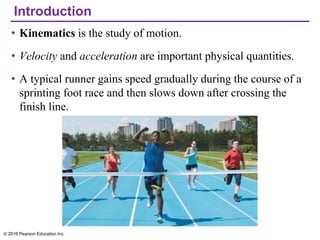
• A typical runner gains speed gradually during the course of a
sprinting foot race and then slows down after crossing the
finish line.
© 2016 Pearson Education Inc.
Displacement, time, and average velocity
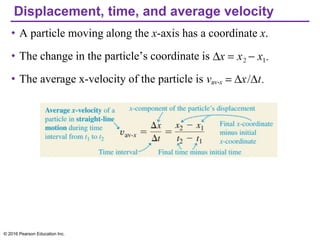
• A particle moving along the x-axis has a coordinate x.
• The change in the particle’s coordinate is
• The average x-velocity of the particle is
© 2016 Pearson Education Inc.
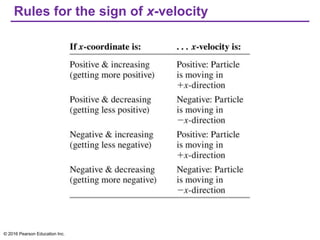
Rules for the sign of x-velocity
© 2016 Pearson Education Inc.
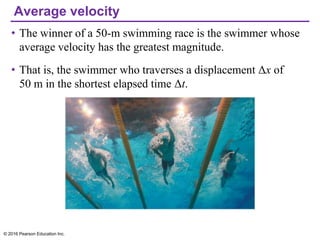
Average velocity
• The winner of a 50-m swimming race is the swimmer whose
average velocity has the greatest magnitude.
• That is, the swimmer who traverses a displacement Δx of
50 m in the shortest elapsed time Δt.
© 2016 Pearson Education Inc.
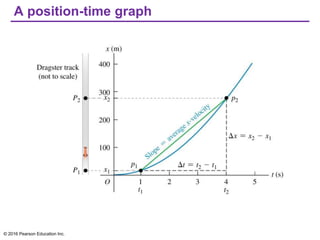
A position-time graph
© 2016 Pearson Education Inc.
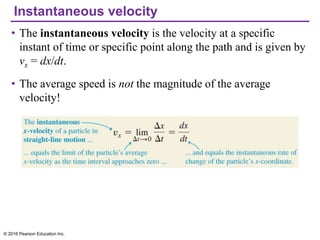
Instantaneous velocity
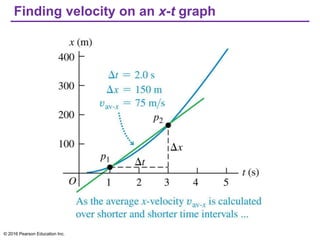
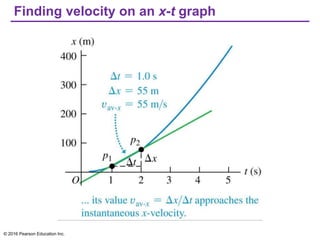
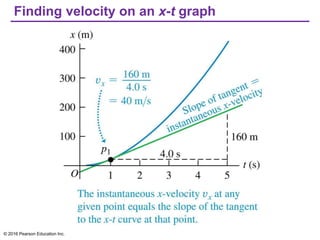
• The instantaneous velocity is the velocity at a specific
instant of time or specific point along the path and is given by
vx = dx/dt.
• The average speed is not the magnitude of the average
velocity!
© 2016 Pearson Education Inc.
Finding velocity on an x-t graph
© 2016 Pearson Education Inc.
Finding velocity on an x-t graph
© 2016 Pearson Education Inc.
Finding velocity on an x-t graph
© 2016 Pearson Education Inc.
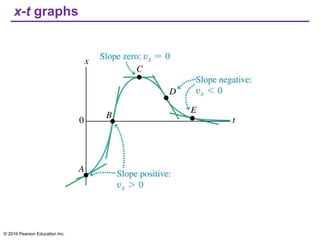
x-t graphs
© 2016 Pearson Education Inc.
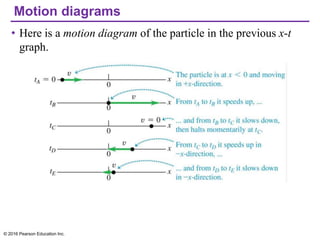
Motion diagrams
• Here is a motion diagram of the particle in the previous x-t
graph.
© 2016 Pearson Education Inc.
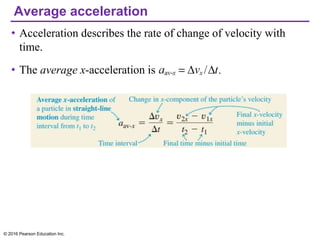
Average acceleration
• Acceleration describes the rate of change of velocity with
time.
• The average x-acceleration is
© 2016 Pearson Education Inc.
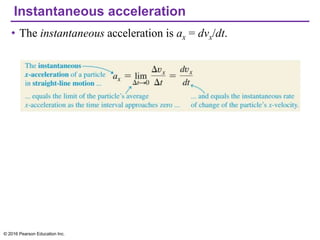
Instantaneous acceleration
• The instantaneous acceleration is ax = dvx/dt.
© 2016 Pearson Education Inc.
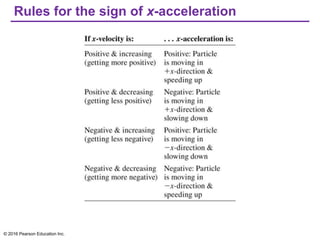
Rules for the sign of x-acceleration
© 2016 Pearson Education Inc.
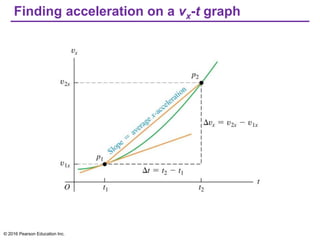
Finding acceleration on a vx-t graph
© 2016 Pearson Education Inc.
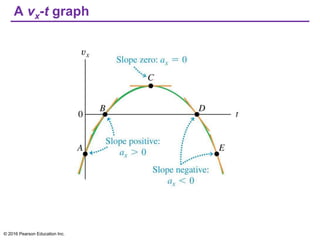
A vx-t graph
© 2016 Pearson Education Inc.
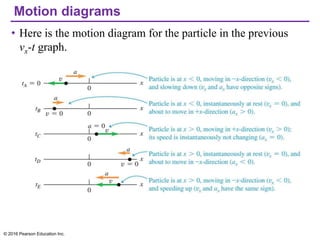
Motion diagrams
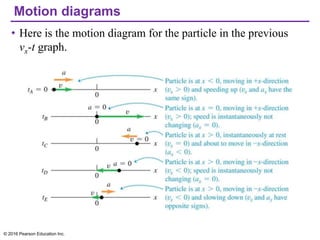
• Here is the motion diagram for the particle in the previous
vx-t graph.
© 2016 Pearson Education Inc.
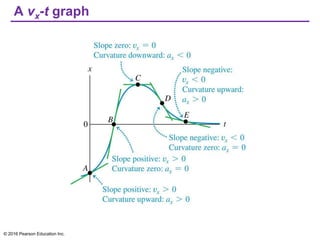
A vx-t graph
© 2016 Pearson Education Inc.
Motion diagrams
• Here is the motion diagram for the particle in the previous
vx-t graph.
© 2016 Pearson Education Inc.
Motion with constant acceleration
© 2016 Pearson Education Inc.
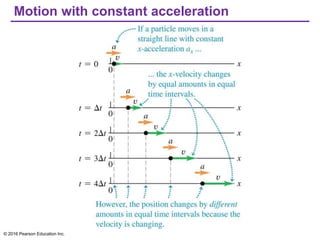
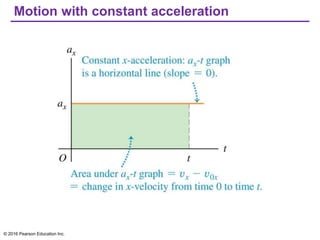
Motion with constant acceleration
© 2016 Pearson Education Inc.
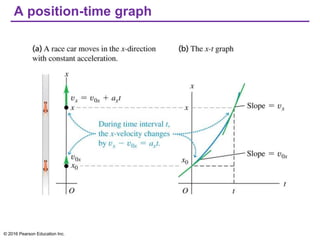
A position-time graph
© 2016 Pearson Education Inc.
The equations of motion with constant
acceleration
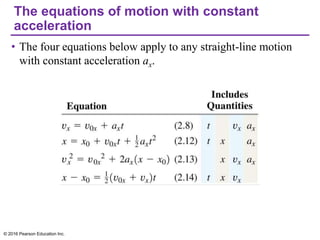
• The four equations below apply to any straight-line motion
with constant acceleration ax.
© 2016 Pearson Education Inc.
Freely falling bodies
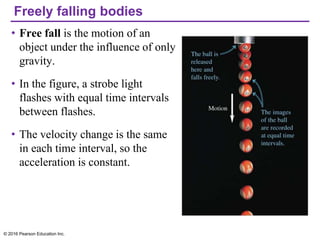
• Free fall is the motion of an
object under the influence of only
gravity.
• In the figure, a strobe light
flashes with equal time intervals
between flashes.
• The velocity change is the same
in each time interval, so the
acceleration is constant.
© 2016 Pearson Education Inc.
A freely falling coin
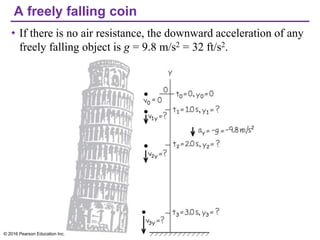
• If there is no air resistance, the downward acceleration of any
freely falling object is g = 9.8 m/s2 = 32 ft/s2.
© 2016 Pearson Education Inc.
Up-and-down motion in free fall
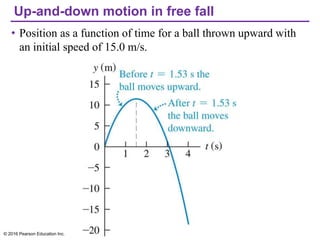
• Position as a function of time for a ball thrown upward with
an initial speed of 15.0 m/s.
© 2016 Pearson Education Inc.
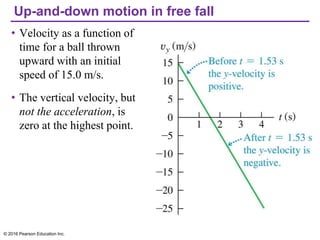
Up-and-down motion in free fall
• Velocity as a function of
time for a ball thrown
upward with an initial
speed of 15.0 m/s.
• The vertical velocity, but
not the acceleration, is
zero at the highest point.
© 2016 Pearson Education Inc.
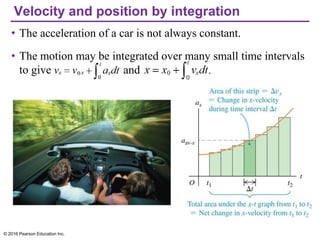
Velocity and position by integration
• The acceleration of a car is not always constant.
• The motion may be integrated over many small time intervals
to give and
© 2016 Pearson Education Inc.

2-Motion Along a Straight Line.pptx

  • 1.
    PowerPoint® Lectures for UniversityPhysics, 14th Edition – Hugh D. Young and Roger A. Freedman Lectures by Jason Harlow Motion Along a Straight Line Chapter 2 © 2016 Pearson Education Inc.
  • 2.
    Learning Goals forChapter 2 Looking forward at … • how the ideas of displacement and average velocity help us describe straight-line motion. • the meaning of instantaneous velocity; the difference between velocity and speed. • how to use average acceleration and instantaneous acceleration to describe changes in velocity. • how to solve problems in which an object is falling freely under the influence of gravity alone. • how to analyze straight-line motion when the acceleration is not constant. © 2016 Pearson Education Inc.
  • 3.
    Introduction • Kinematics isthe study of motion. • Velocity and acceleration are important physical quantities. • A typical runner gains speed gradually during the course of a sprinting foot race and then slows down after crossing the finish line. © 2016 Pearson Education Inc.
  • 4.
    Displacement, time, andaverage velocity • A particle moving along the x-axis has a coordinate x. • The change in the particle’s coordinate is • The average x-velocity of the particle is © 2016 Pearson Education Inc.
  • 5.
    Rules for thesign of x-velocity © 2016 Pearson Education Inc.
  • 6.
    Average velocity • Thewinner of a 50-m swimming race is the swimmer whose average velocity has the greatest magnitude. • That is, the swimmer who traverses a displacement Δx of 50 m in the shortest elapsed time Δt. © 2016 Pearson Education Inc.
  • 7.
    A position-time graph ©2016 Pearson Education Inc.
  • 8.
    Instantaneous velocity • Theinstantaneous velocity is the velocity at a specific instant of time or specific point along the path and is given by vx = dx/dt. • The average speed is not the magnitude of the average velocity! © 2016 Pearson Education Inc.
  • 9.
    Finding velocity onan x-t graph © 2016 Pearson Education Inc.
  • 10.
    Finding velocity onan x-t graph © 2016 Pearson Education Inc.
  • 11.
    Finding velocity onan x-t graph © 2016 Pearson Education Inc.
  • 12.
    x-t graphs © 2016Pearson Education Inc.
  • 13.
    Motion diagrams • Hereis a motion diagram of the particle in the previous x-t graph. © 2016 Pearson Education Inc.
  • 14.
    Average acceleration • Accelerationdescribes the rate of change of velocity with time. • The average x-acceleration is © 2016 Pearson Education Inc.
  • 15.
    Instantaneous acceleration • Theinstantaneous acceleration is ax = dvx/dt. © 2016 Pearson Education Inc.
  • 16.
    Rules for thesign of x-acceleration © 2016 Pearson Education Inc.
  • 17.
    Finding acceleration ona vx-t graph © 2016 Pearson Education Inc.
  • 18.
    A vx-t graph ©2016 Pearson Education Inc.
  • 19.
    Motion diagrams • Hereis the motion diagram for the particle in the previous vx-t graph. © 2016 Pearson Education Inc.
  • 20.
    A vx-t graph ©2016 Pearson Education Inc.
  • 21.
    Motion diagrams • Hereis the motion diagram for the particle in the previous vx-t graph. © 2016 Pearson Education Inc.
  • 22.
    Motion with constantacceleration © 2016 Pearson Education Inc.
  • 23.
    Motion with constantacceleration © 2016 Pearson Education Inc.
  • 24.
    A position-time graph ©2016 Pearson Education Inc.
  • 25.
    The equations ofmotion with constant acceleration • The four equations below apply to any straight-line motion with constant acceleration ax. © 2016 Pearson Education Inc.
  • 26.
    Freely falling bodies •Free fall is the motion of an object under the influence of only gravity. • In the figure, a strobe light flashes with equal time intervals between flashes. • The velocity change is the same in each time interval, so the acceleration is constant. © 2016 Pearson Education Inc.
  • 27.
    A freely fallingcoin • If there is no air resistance, the downward acceleration of any freely falling object is g = 9.8 m/s2 = 32 ft/s2. © 2016 Pearson Education Inc.
  • 28.
    Up-and-down motion infree fall • Position as a function of time for a ball thrown upward with an initial speed of 15.0 m/s. © 2016 Pearson Education Inc.
  • 29.
    Up-and-down motion infree fall • Velocity as a function of time for a ball thrown upward with an initial speed of 15.0 m/s. • The vertical velocity, but not the acceleration, is zero at the highest point. © 2016 Pearson Education Inc.
  • 30.
    Velocity and positionby integration • The acceleration of a car is not always constant. • The motion may be integrated over many small time intervals to give and © 2016 Pearson Education Inc.