1
Kinematics:
, , , and .
Ans.
Ans.t = 26.7 s
15 = 0 + 0.5625t
A :+ B v = v0 + act
ac = 0.5625 m>s2
152
= 02
+ 2ac(200 - 0)
A :+ B v2
= v0
2
+ 2ac(s - s0)
s = 200 ms0 = 0v = 15 m>sv0 = 0
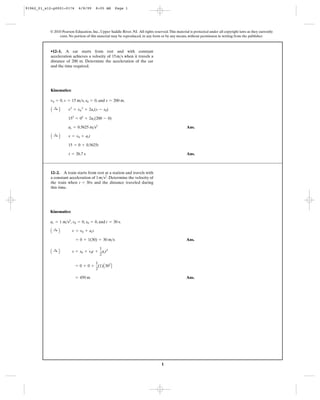
•12–1. A car starts from rest and with constant
acceleration achieves a velocity of when it travels a
distance of 200 m. Determine the acceleration of the car
and the time required.
15m>s
© 2010 Pearson Education, Inc., Upper Saddle River, NJ. All rights reserved.This material is protected under all copyright laws as they currently
exist. No portion of this material may be reproduced, in any form or by any means, without permission in writing from the publisher.
Kinematics:
, , , and .
Ans.
Ans.= 450 m
= 0 + 0 +
1
2
(1)A302
B
A :+ B s = s0 + v0t +
1
2
act2
= 0 + 1(30) = 30 m>s
A :+ B v = v0 + act
t = 30 ss0 = 0v0 = 0ac = 1 m>s2
12–2. A train starts from rest at a station and travels with
a constant acceleration of . Determine the velocity of
the train when and the distance traveled during
this time.
t = 30s
1m>s2
91962_01_s12-p0001-0176 6/8/09 8:05 AM Page 1
2
Kinematics:
, , , and .
Ans.
Ans.s = 22.5 ft
152
= 02
+ 2(5)(s - 0)
A + T B v2
= v0
2
+ 2ac(s - s0)
t = 3s
15 = 0 + 5t
A + T B v = v0 + act
s0 = 0v = 15 ft>sv0 = 0ac = 5 ft>s2
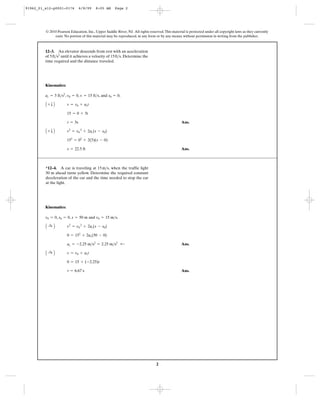
12–3. An elevator descends from rest with an acceleration
of until it achieves a velocity of . Determine the
time required and the distance traveled.
15ft>s5ft>s2
© 2010 Pearson Education, Inc., Upper Saddle River, NJ. All rights reserved.This material is protected under all copyright laws as they currently
exist. No portion of this material may be reproduced, in any form or by any means, without permission in writing from the publisher.
Kinematics:
, , and .
Ans.
Ans.t = 6.67 s
0 = 15 + (-2.25)t
A :+ B v = v0 + act
ac = -2.25 m>s2
= 2.25 m>s2
;
0 = 152
+ 2ac(50 - 0)
A :+ B v2
= v0
2
+ 2ac(s - s0)
v0 = 15 m>ss = 50 ms0 = 0v0 = 0
*12–4. A car is traveling at , when the traffic light
50 m ahead turns yellow. Determine the required constant
deceleration of the car and the time needed to stop the car
at the light.
15m>s
91962_01_s12-p0001-0176 6/8/09 8:05 AM Page 2
3
Velocity:
Ans.
Position: Using this result and the initial condition at ,
Ans.s = a2t3
-
4
5
t5>2
+ 15bft
sΗ
s
15 ft
= a2t3
-
4
5
t5>2
b 2
t
0
L
s
15 ft
ds =
L
t
0
A6t2
- 2t3>2
Bdt
A :+ B ds = v dt
t = 0 ss = 15 ft
v = A6t2
- 2t3>2
Bft>s
vΗ
v
0
= A6t2
- 2t3>2
B 2
t
0
L
v
0
dv =
L
t
0
A12t - 3t1>2
Bdt
A :+ B dv = a dt
•12–5. A particle is moving along a straight line with the
acceleration , where t is in seconds.
Determine the velocity and the position of the particle as a
function of time.When , and .s = 15ftv = 0t = 0
a = (12t – 3t1/2
)ft>s2
© 2010 Pearson Education, Inc., Upper Saddle River, NJ. All rights reserved.This material is protected under all copyright laws as they currently
exist. No portion of this material may be reproduced, in any form or by any means, without permission in writing from the publisher.
Kinematics: When the ball is released, its velocity will be the same as the elevator at
the instant of release. Thus, . Also, , , , and
.
Ans.
Ans.= -90.6 ft>s = 90.6 ft>s T
v = 6 + (-32.2)(3)
A + c B v = v0 + act
h = 127 ft
-h = 0 + 6(3) +
1
2
(-32.2)A32
B
A + c B s = s0 + v0t +
1
2
ac t2
ac = -32.2 ft>s2
s = -hs0 = 0t = 3 sv0 = 6 ft>s
12–6. A ball is released from the bottom of an elevator
which is traveling upward with a velocity of . If the ball
strikes the bottom of the elevator shaft in 3 s, determine the
height of the elevator from the bottom of the shaft at the
instant the ball is released.Also, find the velocity of the ball
when it strikes the bottom of the shaft.
6ft>s
91962_01_s12-p0001-0176 6/8/09 8:05 AM Page 3
4
Ans.
Ans.
Ans.t = 8.33 s
0 = 25 + (-3)(t)
v = v0 + ac t
¢s = s - 0 = 25(4) +
1
2
(-3)(4)2
= 76 m
¢s = s - s0 = v0 t +
1
2
ac t2
v = 25 + (-3)(4) = 13 m>s
v = v0 + act
12–7. A car has an initial speed of and a constant
deceleration of . Determine the velocity of the car
when .What is the displacement of the car during the
4-s time interval? How much time is needed to stop the car?
t = 4 s
3 m>s2
25 m>s
© 2010 Pearson Education, Inc., Upper Saddle River, NJ. All rights reserved.This material is protected under all copyright laws as they currently
exist. No portion of this material may be reproduced, in any form or by any means, without permission in writing from the publisher.
Ans.= 20 ft
= 0 + 12(10) +
1
2
(-2)(10)2
A :+ B s = s0 + v0 t +
1
2
ac t2
*12–8. If a particle has an initial velocity of to
the right, at , determine its position when , if
to the left.a = 2 ft>s2
t = 10 ss0 = 0
v0 = 12 ft>s
Velocity:
Ans.v = 22kt + v0
2
t =
1
2k
Av2
- v0
2
B
t 2
t
0
=
1
2k
v2 2
v
v0
L
t
0
dt =
L
v
v0
1
k
vdv
L
t
0
dt =
L
v
v0
dv
k>v
A :+ B dt =
dv
a
•12–9. The acceleration of a particle traveling along a
straight line is , where k is a constant. If ,
when , determine the velocity of the particle as
a function of time t.
t = 0v = v0
s = 0a = k>v
91962_01_s12-p0001-0176 6/8/09 8:05 AM Page 4
5
Distance Traveled: Time for car A to achives can be obtained by
applying Eq. 12–4.
The distance car A travels for this part of motion can be determined by applying
Eq. 12–6.
For the second part of motion, car A travels with a constant velocity of
and the distance traveled in ( is the total time) is
Car B travels in the opposite direction with a constant velocity of and
the distance traveled in is
It is required that
The distance traveled by car A is
Ans.sA = s1 + s2 = 533.33 + 80(46.67 - 13.33) = 3200 ft
t1 = 46.67 s
533.33 + 80(t1 - 13.33) + 60t1 = 6000
s1 + s2 + s3 = 6000
A :+ B s3 = yt1 = 60t1
t1
y = 60 ft>s
A :+ B s2 = yt¿ = 80(t1 - 13.33)
t1t¿ = (t1 - 13.33) s
y = 80 ft>s
s1 = 533.33 ft
802
= 0 + 2(6)(s1 - 0)
A :+ B y2
= y0
2
+ 2ac (s - s0)
t = 13.33 s
80 = 0 + 6t
A :+ B y = y0 + ac t
y = 80 ft>s
12–10. Car A starts from rest at and travels along a
straight road with a constant acceleration of until it
reaches a speed of . Afterwards it maintains this
speed. Also, when , car B located 6000 ft down the
road is traveling towards A at a constant speed of .
Determine the distance traveled by car A when they pass
each other.
60 ft>s
t = 0
80 ft>s
6 ft>s2
t = 0
© 2010 Pearson Education, Inc., Upper Saddle River, NJ. All rights reserved.This material is protected under all copyright laws as they currently
exist. No portion of this material may be reproduced, in any form or by any means, without permission in writing from the publisher.
A B
6000 ft
60 ft/s
91962_01_s12-p0001-0176 6/8/09 8:05 AM Page 5
6
(1)
Ans.
Ans.
From Eq. (1):
when
Ans.sT = (21 - 5) + (901 - 5) = 912 m
s|t=2 = 12(2) - (2)3
- 21 = -5
t = 2sv = 0
¢s = -901 - (-21) = -880 m
s|t=10 = -901
s|t=0 = -21
s = 12t - t3
- 21
s + 10 = 12t - t3
- 11
L
s
-10
ds =
L
t
1
v dt =
L
t
1
A12 - 3t2
Bdt
a =
dv
dt
= -6t 2
t=4
= -24 m>s2
v = 12 - 3t2
12–11. A particle travels along a straight line with a
velocity , where t is in seconds. When
, the particle is located 10 m to the left of the origin.
Determine the acceleration when , the displacement
from to , and the distance the particle travels
during this time period.
t = 10 st = 0
t = 4 s
t = 1 s
v = (12 - 3t2
) m>s
© 2010 Pearson Education, Inc., Upper Saddle River, NJ. All rights reserved.This material is protected under all copyright laws as they currently
exist. No portion of this material may be reproduced, in any form or by any means, without permission in writing from the publisher.
91962_01_s12-p0001-0176 6/8/09 8:05 AM Page 6
7
Velocity: at .Applying Eq. 12–2, we have
[1]
At , from Eq.[1]
Distance Traveled: at . Using the result and applying
Eq. 12–1, we have
[2]
At , from Eq. [2]
Ans.s = 27(3.00) - 3.003
= 54.0 m
t = 3.00 s
s = A27t - t3
B m
L
s
0
ds =
L
t
0
A27 - 3t2
B dt
A + T B ds = ydt
y = 27 - 3t2
t0 = 0 ss0 = 0 m
0 = 27 - 3t2
t = 3.00 s
y = 0
y = A27 - 3t2
B m>s
L
y
27
dy =
L
t
0
-6tdt
A + T B dy = adt
t0 = 0 sy0 = 27 m>s
*12–12. A sphere is fired downwards into a medium with
an initial speed of . If it experiences a deceleration of
where t is in seconds, determine the
distance traveled before it stops.
a = (-6t) m>s2
,
27 m>s
© 2010 Pearson Education, Inc., Upper Saddle River, NJ. All rights reserved.This material is protected under all copyright laws as they currently
exist. No portion of this material may be reproduced, in any form or by any means, without permission in writing from the publisher.
Ans.
Ans.(vsp)avg =
sT
t
=
6
6
= 1 m>s
vavg =
¢s
t
=
2
6
= 0.333 m>s
t = (2 + 4) = 6 s
sT = (0.5 + 1.5 + 1.5 + 2.5) = 6 m
¢s = (sC - sA) = 2 m
•12–13. A particle travels along a straight line such that in
2 s it moves from an initial position to a
position . Then in another 4 s it moves from
to . Determine the particle’s average velocity
and average speed during the 6-s time interval.
sC = +2.5 m
sBsB = -1.5 m
sA = +0.5 m
91962_01_s12-p0001-0176 6/8/09 8:05 AM Page 7
8
Average Velocity: The displacement from A to C is
.
Ans.
Average Speed: The distances traveled from A to B and B to C are
and , respectively. Then, the
total distance traveled is .
Ans.AyspBavg =
sTot
¢t
=
20.0
4 + 5
= 2.22 m>s
sTot = sA : B + sB : C = 11.0 - 9.00 = 20.0 m
sB : C = 3 + 6 = 9.00 msA : B = 8 + 3 = 11.0 m
yavg =
¢s
¢t
=
2
4 + 5
= 0.222 m>s
= 2 m
¢s = sC - SA = -6 - (-8)
12–14. A particle travels along a straight-line path such
that in 4 s it moves from an initial position to a
position .Then in another 5 s it moves from to
. Determine the particle’s average velocity and
average speed during the 9-s time interval.
sC = -6 m
sBsB = +3 m
sA = -8 m
© 2010 Pearson Education, Inc., Upper Saddle River, NJ. All rights reserved.This material is protected under all copyright laws as they currently
exist. No portion of this material may be reproduced, in any form or by any means, without permission in writing from the publisher.
Stopping Distance: For normal driver, the car moves a distance of
before he or she reacts and decelerates the car. The
stopping distance can be obtained using Eq. 12–6 with and .
Ans.
For a drunk driver, the car moves a distance of before he
or she reacts and decelerates the car. The stopping distance can be obtained using
Eq. 12–6 with and .
Ans.d = 616 ft
02
= 442
+ 2(-2)(d - 132)
A :+ B y2
= y2
0 + 2ac (s - s0)
y = 0s0 = d¿ = 132 ft
d¿ = yt = 44(3) = 132 ft
d = 517 ft
02
= 442
+ 2(-2)(d - 33.0)
A :+ B y2
= y2
0 + 2ac (s - s0)
y = 0s0 = d¿ = 33.0 ft
d¿ = yt = 44(0.75) = 33.0 ft
12–15. Tests reveal that a normal driver takes about
before he or she can react to a situation to avoid a collision.
It takes about 3 s for a driver having 0.1% alcohol in his
system to do the same. If such drivers are traveling on a
straight road at 30 mph (44 ) and their cars can
decelerate at , determine the shortest stopping
distance d for each from the moment they see the
pedestrians. Moral: If you must drink, please don’t drive!
2 ft>s2
ft>s
0.75 s
d
v1 ϭ 44 ft/s
91962_01_s12-p0001-0176 6/8/09 8:05 AM Page 8
9
Kinematics: For the first kilometer of the journey, , , ,
and .Thus,
For the second kilometer, , , , and
.Thus,
Ans.
For the whole journey, , , and .Thus,
Ans.t = 250 s
14 = 2 + 0.048t
A :+ B v = v0 + act
0.048 m>s2
v = 14 m>sv0 = 2 m>s
v = 14 m>s
v2
= 102
+ 2(0.048)(2000 - 1000)
A :+ B v2
= v0
2
+ 2ac (s - s0)
0.048 m>s2
s = 2000 ms0 = 1000 mv0 = 10 m>s
ac = 0.048 m>s2
102
= 22
+ 2ac (1000 - 0)
A :+ B v2
= v0
2
+ 2ac (s - s0)
s = 1000 m
s0 = 0v = 10 m>sv0 = 2 m>s
*12–16. As a train accelerates uniformly it passes
successive kilometer marks while traveling at velocities of
and then . Determine the train’s velocity when
it passes the next kilometer mark and the time it takes to
travel the 2-km distance.
10 m>s2 m>s
© 2010 Pearson Education, Inc., Upper Saddle River, NJ. All rights reserved.This material is protected under all copyright laws as they currently
exist. No portion of this material may be reproduced, in any form or by any means, without permission in writing from the publisher.
•12–17. A ball is thrown with an upward velocity of
from the top of a 10-m high building. One second later
another ball is thrown vertically from the ground with a
velocity of . Determine the height from the ground
where the two balls pass each other.
10 m>s
5 m>s
Kinematics: First, we will consider the motion of ball A with ,
, , , and .Thus,
(1)
Motion of ball B is with , , , and
.Thus,
(2)
Solving Eqs. (1) and (2) yields
Ans.
t¿ = 1.68 m
h = 4.54 m
h = 19.81t¿ - 4.905(t¿)2
- 14.905
h = 0 + 10(t¿ - 1) +
1
2
(-9.81)(t¿ - 1)2
A + c B sB = (sB)0 + (vB)0 tB +
1
2
ac tB
2
ac = -9.81 m>s2
tB = t¿ - 1sB = h(sB)0 = 0(vB)0 = 10 m>s
h = 5t¿ - 4.905(t¿)2
+ 10
h - 10 = 0 + 5t¿ +
1
2
(-9.81)(t¿)2
A + c B sA = (sA)0 + (vA)0 tA +
1
2
actA
2
ac = -9.81 m>s2
tA = t¿sA = (h - 10) m(sA)0 = 0
(vA)0 = 5 m>s
91962_01_s12-p0001-0176 6/8/09 8:05 AM Page 9
10
© 2010 Pearson Education, Inc., Upper Saddle River, NJ. All rights reserved.This material is protected under all copyright laws as they currently
exist. No portion of this material may be reproduced, in any form or by any means, without permission in writing from the publisher.
Kinematics: For stage (1) of the motion, , , , and
.
For stage (2) of the motion, , , , and .Thus,
Ans.
The average speed of the car is then
Ans.vavg =
s
t1 + t2
=
1708.33
16.67 + 60
= 22.3 m>s
= 1708.33ft = 1708 m
s = 208.33 + 25(60) + 0
A :+ B s = s0 + v0t +
1
2
ac t2
ac = 0t = 60 sv0 = 25 ft>ss0 = 108.22 ft
s1 = 208.33 m
252
= 0 + 2(1.5)(s1 - 0)
A :+ B v2
= v0
2
+ 2ac(s - s0)
t1 = 16.67 s
25 = 0 + 1.5t1
A :+ B v = v0 + act
ac = 1.5 m>s2
v = 25 m>ss0 = 0v0 = 0
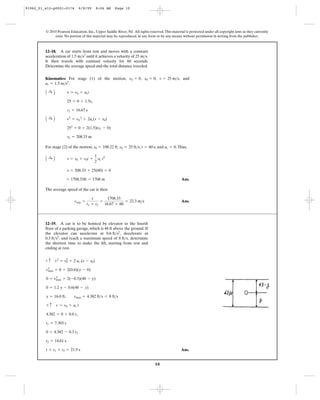
12–18. A car starts from rest and moves with a constant
acceleration of until it achieves a velocity of .
It then travels with constant velocity for 60 seconds.
Determine the average speed and the total distance traveled.
25 m>s1.5 m>s2
Ans.t = t1 + t2 = 21.9 s
t2 = 14.61 s
0 = 4.382 - 0.3 t2
t1 = 7.303 s
4.382 = 0 + 0.6 t1
+ c v = v0 + ac t
y = 16.0 ft, vmax = 4.382 ft>s 6 8 ft>s
0 = 1.2 y - 0.6(48 - y)
0 = v2
max + 2(-0.3)(48 - y)
v2
max = 0 + 2(0.6)(y - 0)
+ c v2
= v0
2
+ 2 ac (s - s0)
12–19. A car is to be hoisted by elevator to the fourth
floor of a parking garage, which is 48 ft above the ground. If
the elevator can accelerate at decelerate at
and reach a maximum speed of determine
the shortest time to make the lift, starting from rest and
ending at rest.
8 ft>s,0.3 ft>s2
,
0.6 ft>s2
,
91962_01_s12-p0001-0176 6/8/09 8:06 AM Page 10
11
© 2010 Pearson Education, Inc., Upper Saddle River, NJ. All rights reserved.This material is protected under all copyright laws as they currently
exist. No portion of this material may be reproduced, in any form or by any means, without permission in writing from the publisher.
Ans.
Ans.a =
dv
dt
=
16(2)(8t + 1)(8)
(8t + 1)4
= a
256
(8t + 1)3
b m>s2
v = -4a
2
8t + 1
b
2
= a -
16
(8t + 1)2
b m>s
s =
2
8t + 1
t =
1
4
(s-1
- 0.5)
-s-1
|s
2 = -4t|0
t
L
s
2
s-2
ds =
L
t
0
-4 dt
ds
dt
= -4s2
v = -4s2
*12–20. A particle is moving along a straight line such that
its speed is defined as , where s is in meters.
If when , determine the velocity and
acceleration as functions of time.
t = 0s = 2 m
v = (-4s2
) m>s
91962_01_s12-p0001-0176 6/8/09 8:06 AM Page 11
12
© 2010 Pearson Education, Inc., Upper Saddle River, NJ. All rights reserved.This material is protected under all copyright laws as they currently
exist. No portion of this material may be reproduced, in any form or by any means, without permission in writing from the publisher.
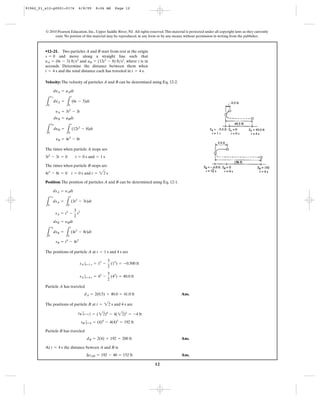
Velocity: The velocity of particles A and B can be determined using Eq. 12-2.
The times when particle A stops are
The times when particle B stops are
and
Position: The position of particles A and B can be determined using Eq. 12-1.
The positions of particle A at and 4 s are
Particle A has traveled
Ans.
The positions of particle B at and 4 s are
Particle B has traveled
Ans.
At the distance beween A and B is
Ans.¢sAB = 192 - 40 = 152 ft
t = 4 s
dB = 2(4) + 192 = 200 ft
sB |t=4 = (4)4
- 4(4)2
= 192 ft
sB |t= 12 = (22)4
- 4(22)2
= -4 ft
t = 22 s
dA = 2(0.5) + 40.0 = 41.0 ft
sA |t=4 s = 43
-
3
2
(42
) = 40.0 ft
sA |t=1 s = 13
-
3
2
(12
) = -0.500 ft
t = 1 s
sB = t4
- 4t2
L
sB
0
dsB =
L
t
0
(4t3
- 8t)dt
dsB = yBdt
sA = t3
-
3
2
t2
L
sA
0
dsA =
L
t
0
(3t2
- 3t)dt
dsA = yAdt
t = 22 s4t3
- 8t = 0 t = 0 s
3t2
- 3t = 0 t = 0 s and = 1 s
yB = 4t3
- 8t
L
yB
0
dyB =
L
t
0
(12t2
- 8)dt
dyB = aBdt
yA = 3t2
- 3t
L
yA
0
dyA =
L
t
0
(6t - 3)dt
dyA = aAdt
•12–21. Two particles A and B start from rest at the origin
and move along a straight line such that
and , where t is in
seconds. Determine the distance between them when
and the total distance each has traveled in .t = 4 st = 4 s
aB = (12t2
- 8) ft>s2
aA = (6t - 3) ft>s2
s = 0
91962_01_s12-p0001-0176 6/8/09 8:06 AM Page 12
13
© 2010 Pearson Education, Inc., Upper Saddle River, NJ. All rights reserved.This material is protected under all copyright laws as they currently
exist. No portion of this material may be reproduced, in any form or by any means, without permission in writing from the publisher.
Velocity: The velocity of the particle can be related to its position by applying
Eq. 12–3.
[1]
Position: The position of the particle can be related to the time by applying Eq. 12–1.
When ,
Choose the root greater than Ans.
Substitute into Eq. [1] yields
Ans.y =
8
16(11.94) - 159
= 0.250 m>s
s = 11.94 m
10 m s = 11.94 m = 11.9 m
8s2
- 159s + 758 = 0
8(4) = 8s2
- 159s + 790
t = 4 s
8t = 8s2
- 159s + 790
L
t
0
dt =
L
s
10m
1
8
(16s - 159) ds
dt =
ds
y
y =
8
16s - 159
s - 10 =
1
2y
-
1
16
L
s
10m
ds =
L
y
8m>s
-
dy
2y2
ds =
ydy
a
12–22. A particle moving along a straight line is subjected
to a deceleration , where is in . If it
has a velocity and a position when
, determine its velocity and position when .t = 4 st = 0
s = 10 mv = 8 m>s
m>sva = (-2v3
) m>s2
91962_01_s12-p0001-0176 6/8/09 8:06 AM Page 13
14
© 2010 Pearson Education, Inc., Upper Saddle River, NJ. All rights reserved.This material is protected under all copyright laws as they currently
exist. No portion of this material may be reproduced, in any form or by any means, without permission in writing from the publisher.
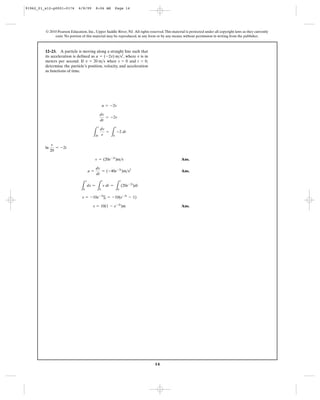
ln
Ans.
Ans.
Ans.s = 10(1 - e-2t
)m
s = -10e-2t
|t
0 = -10(e-2t
- 1)
L
s
0
ds =
L
t
0
v dt =
L
t
0
(20e-2t
)dt
a =
dv
dt
= (-40e-2t
)m>s2
v = (20e-2t
)m>s
v
20
= -2t
L
v
20
dv
v
=
L
t
0
-2 dt
dv
dt
= -2v
a = -2v
12–23. A particle is moving along a straight line such that
its acceleration is defined as , where is in
meters per second. If when and ,
determine the particle’s position, velocity, and acceleration
as functions of time.
t = 0s = 0v = 20 m>s
va = (-2v) m>s2
91962_01_s12-p0001-0176 6/8/09 8:06 AM Page 14
15
© 2010 Pearson Education, Inc., Upper Saddle River, NJ. All rights reserved.This material is protected under all copyright laws as they currently
exist. No portion of this material may be reproduced, in any form or by any means, without permission in writing from the publisher.
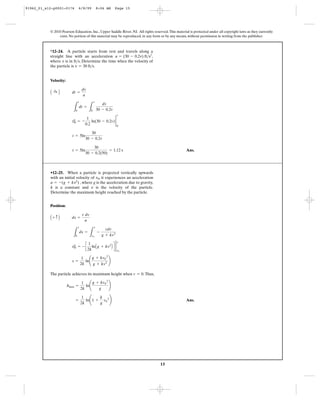
Velocity:
Ans.t = 5ln
30
30 - 0.2(50)
= 1.12 s
t = 5ln
30
30 - 0.2v
t|t
0 = -
1
0.2
ln(30 - 0.2v) 2
v
0
L
t
0
dt =
L
v
0
dv
30 - 0.2v
A :+ B dt =
dv
a
*12–24. A particle starts from rest and travels along a
straight line with an acceleration ,
where is in . Determine the time when the velocity of
the particle is .v = 30 ft>s
ft>sv
a = (30 - 0.2v) ft>s2
Position:
The particle achieves its maximum height when .Thus,
Ans.=
1
2k
ln¢1 +
k
g
v0
2
≤
hmax =
1
2k
ln¢
g + kv0
2
g
≤
v = 0
s =
1
2k
ln¢
g + kv0
2
g + kv2 ≤
s|s
0 = - c
1
2k
lnAg + kv2
B d 2
v
v0
L
s
0
ds =
L
v
v0
-
vdv
g + kv2
A + c B ds =
v dv
a
•12–25. When a particle is projected vertically upwards
with an initial velocity of , it experiences an acceleration
, where g is the acceleration due to gravity,
k is a constant and is the velocity of the particle.
Determine the maximum height reached by the particle.
v
a = -(g + kv2
)
v0
91962_01_s12-p0001-0176 6/8/09 8:06 AM Page 15
16
© 2010 Pearson Education, Inc., Upper Saddle River, NJ. All rights reserved.This material is protected under all copyright laws as they currently
exist. No portion of this material may be reproduced, in any form or by any means, without permission in writing from the publisher.
Velocity:
(1)
Position:
When ,
Solving the above equation by trial and error,
Thus, the velocity and acceleration when are
Ans.
Ans.
Ans.a = 0.02e5.329
= 4.13 m>s2
a = 0.02e5.329
= 4.13 m>s2
v = 0.02Ae5.329
- 1B = 4.11 m>s
s = 4 m (t = 5.329 s)
t = 5.329 s
et
- t - 201 = 0
4 = 0.02Aet
- t - 1B
s = 4 m
s = 0.02Aet
- t - 1B m
s|
s
0
= 0.02Aet
- tB 2
t
0
L
s
0
ds =
L
t
0
0.02Aet
- 1Bdt
A :+ B ds = v dt
v = C0.02Aet
- 1B D m>s
v|
v
0
= 0.02et 2
t
0
L
v
0
dv =
L
t
0
0.02et
dt
A :+ B dv = a dt
12–26. The acceleration of a particle traveling along a
straight line is , where t is in seconds. If
, when , determine the velocity and
acceleration of the particle at .s = 4 m
t = 0s = 0v = 0
a = (0.02et
) m>s2
Ans.v = 1.29 m>s
0.8351 =
1
2
v2
L
2
1
5 ds
A3s
1
3 + s
5
2
B
=
L
v
0
v dv
a ds = v dv
a =
5
A3s
1
3 + s
5
2
B
12–27. A particle moves along a straight line with an
acceleration of , where s is in
meters. Determine the particle’s velocity when , if it
starts from rest when . Use Simpson’s rule to
evaluate the integral.
s = 1 m
s = 2 m
a = 5>(3s1>3
+ s5>2
) m>s2
91962_01_s12-p0001-0176 6/8/09 8:06 AM Page 16
17
© 2010 Pearson Education, Inc., Upper Saddle River, NJ. All rights reserved.This material is protected under all copyright laws as they currently
exist. No portion of this material may be reproduced, in any form or by any means, without permission in writing from the publisher.
Velocity: The velocity of the particle can be related to the time by applying Eq. 12–2.
[1]
a) When , then, from Eq. [1]
Ans.
b) If , .Then, from Eq. [1]
Ans.ymax = 100 m>s
e0.1962t
- 1
e0.1962t
+ 1
: 1t : q
y =
100[e0.1962(5)
- 1]
e0.1962(5)
+ 1
= 45.5 m>s
t = 5 s
y =
100(e0.1962t
- 1)
e0.1962t
+ 1
9.81t = 50lna
1 + 0.01y
1 - 0.01y
b
t =
1
9.81
c
L
y
0
dy
2(1 + 0.01y)
+
L
y
0
dy
2(1 - 0.01y)
d
L
t
0
dt =
L
y
0
dy
9.81[1 - (0.01y)2
]
(+ T) dt =
dy
a
*12–28. If the effects of atmospheric resistance are
accounted for, a falling body has an acceleration defined by
the equation , where is in
and the positive direction is downward. If the body is
released from rest at a very high altitude, determine (a) the
velocity when , and (b) the body’s terminal or
maximum attainable velocity (as ).t : q
t = 5 s
m>sva = 9.81[1 - v2
(10-4
)] m>s2
91962_01_s12-p0001-0176 6/8/09 8:06 AM Page 17
18
© 2010 Pearson Education, Inc., Upper Saddle River, NJ. All rights reserved.This material is protected under all copyright laws as they currently
exist. No portion of this material may be reproduced, in any form or by any means, without permission in writing from the publisher.
Position: The position of the particle when is
Ans.
Total Distance Traveled: The velocity of the particle can be determined by applying
Eq. 12–1.
The times when the particle stops are
The position of the particle at , 1 s and 5 s are
From the particle’s path, the total distance is
Ans.stot = 10.5 + 48.0 + 10.5 = 69.0 ft
sΗt=5s = 1.5(53
) - 13.5(52
) + 22.5(5) = -37.5 ft
sΗt=1s = 1.5(13
) - 13.5(12
) + 22.5(1) = 10.5 ft
sΗt=0s = 1.5(03
) - 13.5(02
) + 22.5(0) = 0
t = 0 s
t = 1 s and t = 5 s
4.50t2
- 27.0t + 22.5 = 0
y =
ds
dt
= 4.50t2
- 27.0t + 22.5
s|t=6s = 1.5(63
) - 13.5(62
) + 22.5(6) = -27.0 ft
t = 6 s
•12–29. The position of a particle along a straight line is
given by , where t is in
seconds. Determine the position of the particle when
and the total distance it travels during the 6-s time
interval. Hint: Plot the path to determine the total distance
traveled.
t = 6 s
s = (1.5t3
- 13.5t2
+ 22.5t) ft
91962_01_s12-p0001-0176 6/8/09 8:06 AM Page 18
19
© 2010 Pearson Education, Inc., Upper Saddle River, NJ. All rights reserved.This material is protected under all copyright laws as they currently
exist. No portion of this material may be reproduced, in any form or by any means, without permission in writing from the publisher.
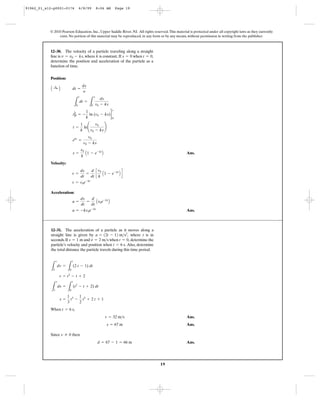
Position:
Ans.
Velocity:
Acceleration:
Ans.a = -kv0e-kt
a =
dv
dt
=
d
dt
Av0e-kt
B
v = v0e-kt
v =
ds
dt
=
d
dt
c
v0
k
A1 - e-kt
B d
s =
v0
k
A1 - e-kt
B
ekt
=
v0
v0 - ks
t =
1
k
ln¢
v0
v0 - ks
≤
tΗt
0 = -
1
k
ln (v0 - ks) 2
s
0
L
t
0
dt =
L
s
0
ds
v0 - ks
A :+ B dt =
ds
y
12–30. The velocity of a particle traveling along a straight
line is , where k is constant. If when ,
determine the position and acceleration of the particle as a
function of time.
t = 0s = 0v = v0 - ks
When ,
Ans.
Ans.
Since then
Ans.d = 67 - 1 = 66 m
v Z 0
s = 67 m
v = 32 m>s
t = 6 s
s =
1
3
t3
-
1
2
t2
+ 2 t + 1
L
s
1
ds =
L
t
0
(t2
- t + 2) dt
v = t2
- t + 2
L
v
2
dv =
L
t
0
(2 t - 1) dt
12–31. The acceleration of a particle as it moves along a
straight line is given by where t is in
seconds.If and when determine the
particle’s velocity and position when Also, determine
the total distance the particle travels during this time period.
t = 6 s.
t = 0,v = 2 m>ss = 1 m
a = 12t - 12 m>s2
,
91962_01_s12-p0001-0176 6/8/09 8:06 AM Page 19
20
© 2010 Pearson Education, Inc., Upper Saddle River, NJ. All rights reserved.This material is protected under all copyright laws as they currently
exist. No portion of this material may be reproduced, in any form or by any means, without permission in writing from the publisher.
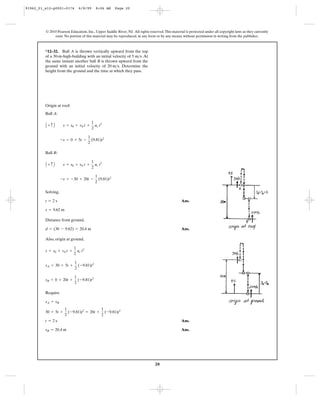
Origin at roof:
Ball A:
Ball B:
Solving,
Ans.
Distance from ground,
Ans.
Also, origin at ground,
Require
Ans.
Ans.sB = 20.4 m
t = 2 s
30 + 5t +
1
2
(-9.81)t2
= 20t +
1
2
(-9.81)t2
sA = sB
sB = 0 + 20t +
1
2
(-9.81)t2
sA = 30 + 5t +
1
2
(-9.81)t2
s = s0 + v0 t +
1
2
ac t2
d = (30 - 9.62) = 20.4 m
s = 9.62 m
t = 2 s
-s = -30 + 20t -
1
2
(9.81)t2
A + c B s = s0 + v0 t +
1
2
ac t2
-s = 0 + 5t -
1
2
(9.81)t2
A + c B s = s0 + v0 t +
1
2
ac t2
*12–32. Ball A is thrown vertically upward from the top
of a 30-m-high-building with an initial velocity of . At
the same instant another ball B is thrown upward from the
ground with an initial velocity of . Determine the
height from the ground and the time at which they pass.
20 m>s
5 m>s
91962_01_s12-p0001-0176 6/8/09 8:06 AM Page 20
21
© 2010 Pearson Education, Inc., Upper Saddle River, NJ. All rights reserved.This material is protected under all copyright laws as they currently
exist. No portion of this material may be reproduced, in any form or by any means, without permission in writing from the publisher.
Motorcycle:
In car travels
Distance between motorcycle and car:
When passing occurs for motorcycle,
For car:
Solving,
Thus, for the motorcycle,
Ans.
Ans.sm = 208.33 + 3463.54 = 3.67(10)3
ft
t = 69.27 + 8.33 = 77.6 s
t– = 69.27 s
x = 3463.54 ft
s = v0 t; 5541.67 - x = 30(t–)
s = v0 t; x = 50(t–)
6000 - 250 - 208.33 = 5541.67 ft
s– = v0 t¿ = 30(8.33) = 250 ft
t¿ = 8.33 s
s¿ = 208.33 ft
(50)2
= 0 + 2(6)(s¿ - 0)
v2
= v2
0 + 2ac (s - s0)
t¿ = 8.33 s
50 = 0 + 6t¿
A :+ B v = v0 + ac t¿
•12–33. A motorcycle starts from rest at and travels
along a straight road with a constant acceleration of
until it reaches a speed of . Afterwards it maintains
this speed.Also, when , a car located 6000 ft down the
road is traveling toward the motorcycle at a constant speed
of . Determine the time and the distance traveled by
the motorcycle when they pass each other.
30 ft>s
t = 0
50 ft>s
6 ft>s2
t = 0
91962_01_s12-p0001-0176 6/8/09 8:06 AM Page 21
22
© 2010 Pearson Education, Inc., Upper Saddle River, NJ. All rights reserved.This material is protected under all copyright laws as they currently
exist. No portion of this material may be reproduced, in any form or by any means, without permission in writing from the publisher.
Acceleration:
Thus,
When ,
Ans.
Position:
At ,
Ans.t =
1
200
ln
2000
500
= 6.93A10-3
B s = 6.93 ms
s = 2000 mm
t =
1
200
ln
s
500
t 2
t
0
=
1
200
lns 2
s
500 mm
L
t
0
dt =
L
s
500 mm
ds
200s
A :+ B dt =
ds
v
a = 40A103
B(2000) = 80A106
B mm>s2
= 80 km>s2
s = 2000 mm
a = v
dv
ds
= (200s)(200) = 40A103
Bs mm>s2
A :+ B
dv
ds
= 200s
12–34. A particle moves along a straight line with a
velocity , where s is in millimeters.
Determine the acceleration of the particle at .
How long does the particle take to reach this position if
when ?t = 0s = 500 mm
s = 2000 mm
v = (200s) mm>s
91962_01_s12-p0001-0176 6/8/09 8:07 AM Page 22
23
© 2010 Pearson Education, Inc., Upper Saddle River, NJ. All rights reserved.This material is protected under all copyright laws as they currently
exist. No portion of this material may be reproduced, in any form or by any means, without permission in writing from the publisher.
Velocity:
When ,
Ans.
Ans.v = 26.6 m>s
t = 0.372 s
s = 100 m
s = (27t - t3
) m>s
s 2
s
0
= A27t - t3
B 2
t
0
L
s
0
ds =
L
t
0
A27 - 3t2
Bdt
A :+ B ds = v dt
v = (27 - 3t2
) m>s
v 2
v
27
= A -3t2
B 2
t
0
L
t
27
dv =
L
t
0
(-6t)dt
A :+ B dv = a dt
½12–35. A particle has an initial speed of If it
experiences a deceleration of where t is in
seconds, determine its velocity, after it has traveled 10 m.
How much time does this take?
a = 1-6t2 m>s2
,
27 m>s.
*12–36. The acceleration of a particle traveling along a
straight line is , where s is in meters. If
at , determine the velocity of the particle at
, and the position of the particle when the velocity
is maximum.
s = 2 m
s = 0v = 0
a = (8 - 2s) m>s2
Velocity:
At ,
Ans.
When the velocity is maximum .Thus,
Ans.s = 4 m
16 - 4s = 0
dv
ds
=
16 - 4s
2216s - 2s2
= 0
dv
ds
= 0
vΗs=2 m = 216(2) - 2A22
B = ;4.90 m>s
s = 2 m
n = 216s - 2s2
m>s
v2
2
`
v
0
= A8s - s2
B 2
s
0
L
v
0
vdv =
L
s
0
(8 - 2s) ds
A :+ B v dv = a ds
91962_01_s12-p0001-0176 6/8/09 8:07 AM Page 23
24
© 2010 Pearson Education, Inc., Upper Saddle River, NJ. All rights reserved.This material is protected under all copyright laws as they currently
exist. No portion of this material may be reproduced, in any form or by any means, without permission in writing from the publisher.
Kinematics: First, we will consider the motion of ball A with , ,
, , and .
(1)
(2)
The motion of ball B requires , , , , and
.
(3)
(4)
Solving Eqs. (1) and (3),
Ans.
Substituting this result into Eqs. (2) and (4),
Ans.
Ans.=
1
2
gt c
vB = v0 - ga
2v0 + gt
2g
- tb
= -
1
2
gt =
1
2
gtT
vA = v0 - ga
2v0 + gt
2g
b
t¿ =
2v0 + gt
2g
v0t¿ -
g
2
t¿2
= v0(t¿ - t) -
g
2
(t¿ - t)2
vB = v0 - g(t¿ - t)
vB = v0 + (-g)(t¿ - t)
A + c B vB = (vB)0 + (ac)B tB
h = v0(t¿ - t) -
g
2
(t¿ - t)2
h = 0 + v0(t¿ - t) +
1
2
(-g)(t¿ - t)2
A + c B sB = (sB)0 + (vB)0tB +
1
2
(ac)BtB
2
(ac)B = -g
tB = t¿ - tsB = h(sB)0 = 0(vB)0 = v0
vA = v0 - gt¿
vA = v0 + (-g)(t¿)
A + c B vA = (vA)0 + (ac)A tA
h = v0t¿ -
g
2
t¿2
h = 0 + v0t¿ +
1
2
(-g)(t¿)2
A + c B sA = (sA)0 + (vA)0tA +
1
2
(ac)A tA
2
(ac)A = -gtA = t¿sA = h
(sA)0 = 0(vA)0 = v0
•12–37. Ball A is thrown vertically upwards with a
velocity of . Ball B is thrown upwards from the same point
with the same velocity t seconds later. Determine the
elapsed time from the instant ball A is thrown to
when the balls pass each other, and find the velocity of each
ball at this instant.
t 6 2v0>g
v0
91962_01_s12-p0001-0176 6/8/09 8:07 AM Page 24
25
© 2010 Pearson Education, Inc., Upper Saddle River, NJ. All rights reserved.This material is protected under all copyright laws as they currently
exist. No portion of this material may be reproduced, in any form or by any means, without permission in writing from the publisher.
Ans.= 11167 m>s = 11.2 km>s
= 22(9.81)(6356)(10)3
v = 22g0 R
v2
2
2
0
y
=
g0 R2
R + y
2
q
0
L
0
y
v dv = -g0R
2
L
q
0
dy
(R + y)
2
v dv = a dy
12–38. As a body is projected to a high altitude above the
earth’s surface,the variation of the acceleration of gravity with
respect to altitude y must be taken into account.Neglecting air
resistance, this acceleration is determined from the formula
, where is the constant gravitational
acceleration at sea level, R is the radius of the earth, and the
positive direction is measured upward. If and
,determine the minimum initial velocity (escape
velocity) at which a projectile should be shot vertically from
the earth’s surface so that it does not fall back to the earth.
Hint: This requires that as y : q.v = 0
R = 6356 km
g0 = 9.81 m>s2
g0a = -g0[R2
>(R + y)2
]
From Prob. 12–38,
Since
then
Thus
When , ,
Ans.v = -3016 m>s = 3.02 km>s T
v = -6356(103
)
A
2(9.81)(500)(103
)
6356(6356 + 500)(106
)
y = 0y0 = 500 km
v = -R
A
2g0 (y0 - y)
(R + y)(R + y0)
g0 R2
[
1
R + y
-
1
R + y0
] =
v2
2
g0 R2
c
1
R + y
d
y
y0
=
v2
2
-g0 R2
L
y
y0
dy
(R + y)2
=
L
v
0
v dv
a dy = v dv
(+ c) a = -g0
R2
(R + y)2
12–39. Accounting for the variation of gravitational
acceleration a with respect to altitude y (see Prob. 12–38),
derive an equation that relates the velocity of a freely falling
particle to its altitude.Assume that the particle is released from
rest at an altitude from the earth’s surface.With what velocity
does the particle strike the earth if it is released from rest at an
altitude ? Use the numerical data in Prob.12–38.y0 = 500 km
y0
91962_01_s12-p0001-0176 6/8/09 8:07 AM Page 25
26
© 2010 Pearson Education, Inc., Upper Saddle River, NJ. All rights reserved.This material is protected under all copyright laws as they currently
exist. No portion of this material may be reproduced, in any form or by any means, without permission in writing from the publisher.
Ans.t = 0.549a
vf
g
b
t =
vf
2g
ln ¢
vf + vf>2
vf - vf>2
≤
t =
vf
2g
ln ¢
vf + v
vf - v
≤
1
2vf
ln ¢
vf + v
vf - v
≤ `
y
0
=
g
v2
f
t
L
v
0
dy
v2
f - v2¿
=
g
v2
f L
t
0
dt
dv
dt
= a = ¢
g
v2
f
≤ Av2
f - v2
B
*12–40. When a particle falls through the air, its initial
acceleration diminishes until it is zero,and thereafter it
falls at a constant or terminal velocity . If this variation of
the acceleration can be expressed as
determine the time needed for the velocity to become
Initially the particle falls from rest.v = vf>2.
a = 1g>v2
f21v2
f - v2
2,
vf
a = g
91962_01_s12-p0001-0176 6/8/09 8:07 AM Page 26
27
© 2010 Pearson Education, Inc., Upper Saddle River, NJ. All rights reserved.This material is protected under all copyright laws as they currently
exist. No portion of this material may be reproduced, in any form or by any means, without permission in writing from the publisher.
Velocity:
The velocity of the particle changes direction at the instant when it is momentarily
brought to rest.Thus,
Position: The positions of the particle at , 1 s, 2 s, and 3 s are
Using the above results, the path of the particle is shown in Fig. a. From this figure,
the distance traveled by the particle during the time interval to is
Ans.
The average speed of the particle during the same time interval is
Ans.vavg =
sTot
¢t
=
30
3 - 1
= 15 m>s
sTot = (2 + 8) + (8 + 12) = 30 m
t = 3 st = 1 s
sΗt=3 s = 12 - 15A32
B + 5A33
B = 12 m
sΗt=2 s = 12 - 15A22
B + 5A23
B = -8 m
sΗt=1 s = 12 - 15A12
B + 5A13
B = 2 m
sΗt=0 s = 12 - 15A02
B + 5A03
B = 12 m
t = 0 s
t = 0 and 2 s
t(-30 + 15t) = 0
v = -30t + 15t2
= 0
v = -30t + 15t2
m>s
A :+ B v =
ds
dt
=
d
dt
A12 - 15t2
+ 5t3
B
•12–41. A particle is moving along a straight line such that
its position from a fixed point is ,
where t is in seconds. Determine the total distance traveled
by the particle from to .Also, find the average
speed of the particle during this time interval.
t = 3st = 1s
s = (12 - 15t2
+ 5t3
) m
91962_01_s12-p0001-0176 6/8/09 8:07 AM Page 27
28
© 2010 Pearson Education, Inc., Upper Saddle River, NJ. All rights reserved.This material is protected under all copyright laws as they currently
exist. No portion of this material may be reproduced, in any form or by any means, without permission in writing from the publisher.
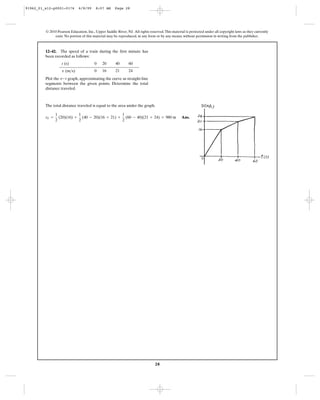
The total distance traveled is equal to the area under the graph.
Ans.sT =
1
2
(20)(16) +
1
2
(40 - 20)(16 + 21) +
1
2
(60 - 40)(21 + 24) = 980 m
12–42. The speed of a train during the first minute has
been recorded as follows:
Plot the graph, approximating the curve as straight-line
segments between the given points. Determine the total
distance traveled.
v-t
t (s) 0 20 40 60
( )m>sv 0 16 21 24
91962_01_s12-p0001-0176 6/8/09 8:07 AM Page 28
29
© 2010 Pearson Education, Inc., Upper Saddle River, NJ. All rights reserved.This material is protected under all copyright laws as they currently
exist. No portion of this material may be reproduced, in any form or by any means, without permission in writing from the publisher.
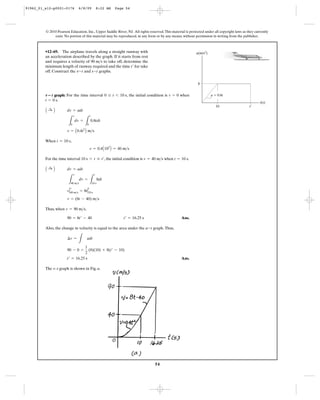
Since , the constant lines of the a–t graph become sloping lines for the v–t graph.
The numerical values for each point are calculated from the total area under the a–t graph to
the point.
At
At
Since , the sloping lines of the v–t graph become parabolic curves for the s–t graph.
The numerical values for each point are calculated from the total area under the v–t graph to
the point.
At
At
Also:
:
At :
:
When :
s = 3687.5 m = 3.69 km
v = 395 m>s
t = 20
s = s0 + v0 t +
1
2
ac t2
= 2025 + 270(t - 15) +
1
2
(25)(t - 15)2
v = v0 + ac t = 270 + 25(t - 15)
a = 25
15 … t … 20
s = 9(15)2
= 2025
v = 18(15) = 270
t = 15
s = s0 + v0 t +
1
2
ac t2
= 0 + 0 + 9t2
v = v0 + ac t = 0 + 18t
a = 18
0 … t … 15
t = 20 s, s = 2025 + 270(20 - 15) +
1
2
(395 - 270)(20 - 15) = 3687.5 m = 3.69 km
t = 15 s, s =
1
2
(15)(270) = 2025 m
s =
L
v dt
t = 20 s, v = 270 + (25)(20 - 15) = 395 m>s
t = 15 s, v = (18)(15) = 270 m>s
v =
L
a dt
12–43. A two-stage missile is fired vertically from rest
with the acceleration shown. In 15 s the first stage A burns
out and the second stage B ignites. Plot the and
graphs which describe the two-stage motion of the missile
for .0 … t … 20 s
s-tv-t a (m/s2
)
t (s)
15
18
25
20
A
B
91962_01_s12-p0001-0176 6/8/09 8:07 AM Page 29
30
© 2010 Pearson Education, Inc., Upper Saddle River, NJ. All rights reserved.This material is protected under all copyright laws as they currently
exist. No portion of this material may be reproduced, in any form or by any means, without permission in writing from the publisher.
Total Distance Traveled: The distance for part one of the motion can be related to
time by applying Eq. 12–5 with and .
The velocity at time t can be obtained by applying Eq. 12–4 with .
[1]
The time for the second stage of motion is and the train is traveling at
a constant velocity of (Eq. [1]).Thus, the distance for this part of motion is
If the total distance traveled is , then
Choose a root that is less than 160 s, then
Ans.
Graph: The equation for the velocity is given by Eq. [1]. When ,
.y = 0.5(27.34) = 13.7 ft>s
t = t¿ = 27.34 sY؊t
t¿ = 27.34 s = 27.3 s
0.25(t¿)2
- 80t¿ + 2000 = 0
2000 = 0.25(t¿)2
+ 80t¿ - 0.5(t¿)2
sTot = s1 + s2
sTot = 2000
A :+ B s2 = yt2 = 0.5t¿(160 - t¿) = 80t¿ - 0.5(t¿)2
y = 0.5t¿
t2 = 160 - t¿
A :+ B y = y0 + act = 0 + 0.5t = 0.5t
y0 = 0
s1 = 0 + 0 +
1
2
(0.5)(t¿)2
= 0.25(t¿)2
A :+ B s = s0 + y0 t +
1
2
ac t2
y0 = 0s0 = 0t = t¿
*12–44. A freight train starts from rest and travels with a
constant acceleration of .After a time it maintains a
constant speed so that when it has traveled 2000 ft.
Determine the time and draw the –t graph for the motion.vt¿
t = 160 s
t¿0.5 ft>s2
91962_01_s12-p0001-0176 6/8/09 8:08 AM Page 30
31
© 2010 Pearson Education, Inc., Upper Saddle River, NJ. All rights reserved.This material is protected under all copyright laws as they currently
exist. No portion of this material may be reproduced, in any form or by any means, without permission in writing from the publisher.
•12–45. If the position of a particle is defined by
, where t is in seconds, construct
the , , and graphs for .0 … t … 10 sa-tv-ts-t
s = [2 sin (p>5)t + 4] m
91962_01_s12-p0001-0176 6/8/09 8:08 AM Page 31
32
© 2010 Pearson Education, Inc., Upper Saddle River, NJ. All rights reserved.This material is protected under all copyright laws as they currently
exist. No portion of this material may be reproduced, in any form or by any means, without permission in writing from the publisher.
For stage (1) motion,
(1)
(2)
Eliminating from Eqs. (1) and (2), we have
(3)
For stage (2) motion, the train travels with the constant velocity of for
.Thus,
(4)
For stage (3) motion, the train travels for .Thus,
(5)
(6)
Eliminating from Eqs. (5) and (6) yields
(7)
Solving Eqs. (3), (4), and (7), we have
Ans.
Based on the above results the graph is shown in Fig. a.v-t
vmax = 16.7 m>s
t1 = 120 s t2 = 240 s
360 - t2 =
2000
vmax
(ac)3
(ac)3 =
vmax
2
2000
0 = vmax
2
+ 2C -(ac)3D(4000 - 3000)
A :+ B v3
2
= v2
2
+ 2(ac)3(s3 - s2)
vmax = (ac)3(360 - t2)
0 = vmax - (ac)3(360 - t2)
A :+ B v3 = v2 + (ac)3t
t = 360 - t2
t2 - t1 =
2000
vmax
1000 + 2000 = 1000 + vmax (t2 - t1) + 0
A :+ B s2 = s1 + v1t +
1
2
(ac)2 t2
t = (t2 - t1)
vmax
t1 =
2000
vmax
(ac)1
(ac)1 =
vmax
2
2000
vmax
2
= 0 + 2(ac)1(1000 - 0)
A :+ B v1
2
= v0
2
+ 2(ac)1(s1 - s0)
vmax = (ac)1t1
vmax = 0 + (ac)1 t1
A :+ B v1 = v0 + (ac)1 t
12–46. A train starts from station A and for the first
kilometer, it travels with a uniform acceleration. Then, for
the next two kilometers, it travels with a uniform speed.
Finally, the train decelerates uniformly for another
kilometer before coming to rest at station B. If the time for
the whole journey is six minutes, draw the graph and
determine the maximum speed of the train.
v–t
91962_01_s12-p0001-0176 6/8/09 8:08 AM Page 32
33
© 2010 Pearson Education, Inc., Upper Saddle River, NJ. All rights reserved.This material is protected under all copyright laws as they currently
exist. No portion of this material may be reproduced, in any form or by any means, without permission in writing from the publisher.
Graph: For ,
At and 3 m,
For ,
At and 6 m,
The graph is shown in Fig. a.a-s
a|s=6 m = 6 + 7 = 13 m>s2
a|s=3 m = 3 + 7 = 10 m>s2
s = 3 m
A :+ B a = v
dv
ds
= (s + 7)(1) = (s + 7) m>s2
3m 6 s … 6 m
a|s=3 m = 4(3) + 8 = 20 m>s2
a|s=0 m = 4(0) + 8 = 8 m>s2
s = 0 m
A :+ B a = v
dv
ds
= (2s + 4)(2) = (4s + 8) m>s2
0 … s 6 3 ma؊s
12–47. The particle travels along a straight line with the
velocity described by the graph. Construct the graph.a-s
s (m)
v (m/s)
3 6
4
10
13
v ϭ 2s ϩ 4
v ϭ s ϩ 7
91962_01_s12-p0001-0176 6/8/09 8:08 AM Page 33
34
© 2010 Pearson Education, Inc., Upper Saddle River, NJ. All rights reserved.This material is protected under all copyright laws as they currently
exist. No portion of this material may be reproduced, in any form or by any means, without permission in writing from the publisher.
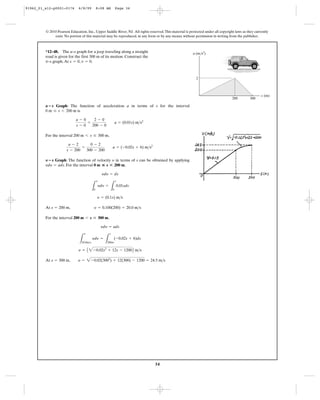
Graph: The function of acceleration a in terms of s for the interval
is
For the interval ,
Graph: The function of velocity in terms of s can be obtained by applying
. For the interval ,
At
For the interval ,
At s = 300 m, y = 2-0.02(3002
) + 12(300) - 1200 = 24.5 m>s
y = A 2-0.02s2
+ 12s - 1200B m>s
L
y
20.0m>s
ydy =
L
s
200m
(-0.02s + 6)ds
ydy = ads
200 m 6 s … 300 m
s = 200 m, y = 0.100(200) = 20.0 m>s
y = (0.1s) m>s
L
y
0
ydy =
L
s
0
0.01sds
ydy = ds
0 m ◊ s<200 mydy = ads
yY؊s
a - 2
s - 200
=
0 - 2
300 - 200
a = (-0.02s + 6) m>s2
200 m 6 s … 300 m
a - 0
s - 0
=
2 - 0
200 - 0
a = (0.01s) m>s2
0 m … s 6 200 m
a؊s
*12–48. The a–s graph for a jeep traveling along a straight
road is given for the first 300 m of its motion. Construct the
–s graph.At , .v = 0s = 0v
s (m)
a (m/s2
)
2
200 300
91962_01_s12-p0001-0176 6/8/09 8:08 AM Page 34
35
© 2010 Pearson Education, Inc., Upper Saddle River, NJ. All rights reserved.This material is protected under all copyright laws as they currently
exist. No portion of this material may be reproduced, in any form or by any means, without permission in writing from the publisher.
at
, and ,
s|t=0.4226 = 0.385 m
s|t=1.577 = -0.386 m
t = 0.4226 st = 1.577 s
0 = 3t2
- 6t + 2v = 0
a =
dv
dt
= 6t - 6
v =
ds
dt
= 3t2
- 6t + 2
s = t3
- 3t2
+ 2t
•12–49. A particle travels along a curve defined by the
equation where is in seconds. Draw
the and graphs for the particle for
.0 … t … 3 s
a - tv - t,s - t,
ts = (t3
- 3t2
+ 2t) m.
Graph: For ,
At ,
For ,
The graph is shown in Fig. a.a-s
A :+ B a = v
dv
ds
= 75(0) = 0
625 ft 6 s 6 1500ft
a|s=625 ft = 0.27A6251>2
B = 6.75ft>s2
s = 625ft
A :+ B a = v
dv
ds
= A0.6s3>4
B c
3
4
(0.6)s-1>4
d = A0.27s1>2
Bft >s2
0 … s 6 625 fta؊s
12–50. A truck is traveling along the straight line with a
velocity described by the graph. Construct the graph
for .0 … s … 1500 ft
a-s
s(ft)
v (ft/s)
625 1500
75
v ϭ 0.6 s3/4
91962_01_s12-p0001-0176 6/8/09 8:08 AM Page 35
36
© 2010 Pearson Education, Inc., Upper Saddle River, NJ. All rights reserved.This material is protected under all copyright laws as they currently
exist. No portion of this material may be reproduced, in any form or by any means, without permission in writing from the publisher.
Graph: For the time interval , the initial condition is when
.
When ,
For the time interval , the initial condition is when
.
When ,
Ans.
The graph shown is in Fig. a.
Graph: For the time interval ,
For the time interval ,
The graph is shown in Fig. b.
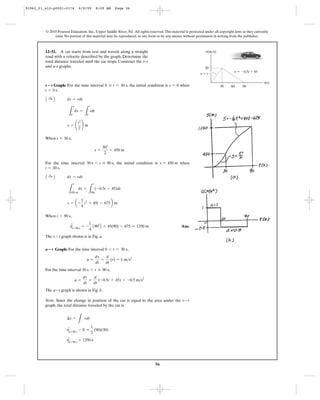
Note: Since the change in position of the car is equal to the area under the
graph, the total distance traveled by the car is
sΗt=90 s
= 1350 s
sΗt=90 s
- 0 =
1
2
(90)(30)
¢s =
L
vdt
v- t
a- t
a =
dv
dt
=
d
dt
(-0.5t + 45) = -0.5 m>s2
30 s 6 t … 90 s
a =
dv
dt
=
d
dt
(t) = 1 m>s2
0 6 t 6 30 sa؊t
s - t
sΗt=90 s
= -
1
4
A902
B + 45(90) - 675 = 1350 m
t = 90 s
s = a -
1
4
t2
+ 45t - 675b m
L
s
450 m
ds =
L
t
30s
(-0.5t + 45)dt
A :+ B ds = vdt
t = 30 s
s = 450 m30 s 6 t … 90 s
s =
302
2
= 450 m
t = 30 s
s = ¢
t2
2
≤ m
L
s
0
ds =
L
t
0
tdt
A :+ B ds = vdt
t = 0 s
s = 00 … t 6 30 ss؊t
12–51. A car starts from rest and travels along a straight
road with a velocity described by the graph. Determine the
total distance traveled until the car stops. Construct the
and graphs.a–t
s–t
t(s)
v(m/s)
30 90
30
v ϭ Ϫ0.5t ϩ 45
v ϭ t
60
91962_01_s12-p0001-0176 6/8/09 8:09 AM Page 36
37
© 2010 Pearson Education, Inc., Upper Saddle River, NJ. All rights reserved.This material is protected under all copyright laws as they currently
exist. No portion of this material may be reproduced, in any form or by any means, without permission in writing from the publisher.
Distance traveled is area under graph.
Ans.s = (10)(30) +
1
2
(10)(30) = 450 m
v- t
*12–52. A car travels up a hill with the speed shown.
Determine the total distance the car travels until it stops
( ). Plot the graph.a-tt = 60 s
30
t (s)
v (m/s)
10
60
Graph: The position function in terms of time t can be obtained by applying
. For time interval , .
At ,
For time interval ,
At
Graph: The acceleration function in terms of time t can be obtained by applying
. For time interval and ,
and , respectively.a =
dy
dt
= 0= 0.4 m>s2
a =
dy
dt
=
2
5
30 s<t ◊ 50 s0 s ◊ t<30 sa =
dy
dt
a؊t
t = 50 s, s = 12(50) - 180 = 420 m
s = (12t - 180) m
L
s
180 m
ds =
L
t
30 s
12dt
ds = ydt
30 s<t ◊ 50 s
s =
1
5
A302
B = 180 mt = 30 s
s = a
1
5
t2
b m
L
s
0
ds =
L
t
0
2
5
tdt
ds = ydt
y =
12
30
t = a
2
5
tb m>s0 s … t 6 30 sy =
ds
dt
s؊t
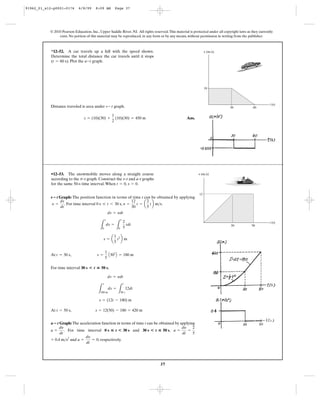
•12–53. The snowmobile moves along a straight course
according to the –t graph. Construct the s–t and a–t graphs
for the same 50-s time interval.When , .s = 0t = 0
v
t (s)
12
30 50
v (m/s)
91962_01_s12-p0001-0176 6/8/09 8:09 AM Page 37
38
© 2010 Pearson Education, Inc., Upper Saddle River, NJ. All rights reserved.This material is protected under all copyright laws as they currently
exist. No portion of this material may be reproduced, in any form or by any means, without permission in writing from the publisher.
Motorcycle:
Time to reach ,
Distance traveled,
In , truck travels
Further distance for motorcycle to travel:
Motorcycle:
Truck:
Thus
Ans.
Total distance motorcycle travels
sT = 302.08 + 85(5.717) = 788 ft
t = 4.167 + 5.717 = 9.88 s
t¿ = 5.717 s
s = 0 + 60t¿
(s + 142.92) = 0 + 85t¿
s = s0 + v0 t
= 142.92 ft
40 + 55 + 250 + 100 - 302.08
st = 60(4.167) = 250 ft
t = 4.167 s
sm = 302.08 ft
(85)2
= (60)2
+ 2(6)(sm - 0)
v2
= v2
0 + 2ac (s - s0)
t = 4.167 s
85 = 60 + 6t
v = v0 + ac t
85 ft>s
12–54. A motorcyclist at A is traveling at when he
wishes to pass the truck T which is traveling at a constant
speed of To do so the motorcyclist accelerates at
until reaching a maximum speed of If he then
maintains this speed, determine the time needed for him to
reach a point located 100 ft in front of the truck. Draw the
and graphs for the motorcycle during this time.s-tv-t
85 ft>s.6 ft>s2
60 ft>s.
60 ft>s
100 ft55 ft40 ft
A
T
(vm)1 ϭ 60 ft/s (vm)2 ϭ 85 ft/s
vt ϭ 60 ft/s
91962_01_s12-p0001-0176 6/8/09 8:09 AM Page 38
39
© 2010 Pearson Education, Inc., Upper Saddle River, NJ. All rights reserved.This material is protected under all copyright laws as they currently
exist. No portion of this material may be reproduced, in any form or by any means, without permission in writing from the publisher.
Graph: For the time interval , the initial condition is
when .
When ,
For the time interval , the initial condition is when .
When ,
Ans.
Also, the change in velocity is equal to the area under the a–t graph.Thus,
The v–t graph is shown in Fig. a.
t¿ = 8.75s¿
5 - 70 = - C5(10) + 4(t¿ - 5)D
¢v =
L
adt
5 = -4t¿ + 40 t¿ = 8.75 s
v = 5 m>s
v = (-4t + 40) m>s
L
v
20 m>s
dv =
L
t
5 s
-4dt
A :+ B dv = adt
t = 5 sv = 20 m>s5 s 6 t … t¿
v|t=5 s = -10(5) + 70 = 20 m>s
t = 5 s
v = (-10t + 70) m>s
L
v
70 m>s
dv =
L
t
0
-10dt
A :+ B dv = adt
t = 0 s
v = 70 m>s0 … t 6 5 sN؊t
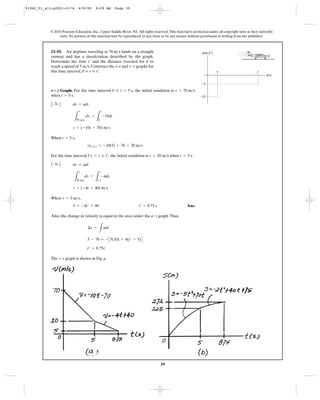
12–55. An airplane traveling at lands on a straight
runway and has a deceleration described by the graph.
Determine the time and the distance traveled for it to
reach a speed of . Construct the and graphs for
this time interval, .0 … t … t¿
s-tv–t5 m>s
t¿
70 m>s
t(s)
a(m/s2
)
5 t¿
Ϫ4
Ϫ10
91962_01_s12-p0001-0176 6/8/09 8:09 AM Page 39
40
© 2010 Pearson Education, Inc., Upper Saddle River, NJ. All rights reserved.This material is protected under all copyright laws as they currently
exist. No portion of this material may be reproduced, in any form or by any means, without permission in writing from the publisher.
Graph: For the time interval , the initial condition is when
.
When ,
For the time interval the initial condition is when
.
When ,
Ans.
Also, the change in position is equal to the area under the v–t graph. Referring to
Fig. a, we have
Ans.
The s–t graph is shown in Fig. b.
sΗt=8.75 s
- 0 =
1
2
(70 + 20)(5) +
1
2
(20 + 5)(3.75) = 271.875 m = 272 m
¢s =
L
vdt
sΗt=8.75 s
= -2A8.752
B + 40(8.75) + 75 = 271.875 m = 272 m
t = t¿ = 8.75 s
s = A -2t2
+ 40t + 75Bm
L
s
225 m
ds =
L
t
5
(-4t + 40)dt
A :+ B ds = vdt
t = 5 s
s = 225 m5 6 t … t¿ = 8.75 s
sΗt=5 s
= -5A52
B + 70(5) = 225 m
t = 5 s
s = A -5t2
+ 70tBm
L
s
0
ds =
L
t
0
(-10t + 70)dt
A :+ B ds = vdt
t = 0 s
s = 00 … t 6 5 ss؊t
12–57. Continued
91962_01_s12-p0001-0176 6/8/09 8:09 AM Page 40
41
© 2010 Pearson Education, Inc., Upper Saddle River, NJ. All rights reserved.This material is protected under all copyright laws as they currently
exist. No portion of this material may be reproduced, in any form or by any means, without permission in writing from the publisher.
Graph: For the time interval ,
When and 10 s,
For the time interval ,
When and 20 s,
The v–t graph is shown in Fig. a.
Graph: For the time interval ,
When and 10 s,
For the time interval ,
the a–t graph is shown in Fig. b.
A :+ B a =
dv
dt
=
d
dt
(-1.25t + 27.5) = -1.25 m>s2
10 s 6 t … 20 s
aΗt=0 s
= 0.3(0) = 0 aΗt=10 s
= 0.3(10) = 3 m>s2
t = 0 s
A :+ B a =
dv
dt
=
d
dt
A0.15t2
B = (0.3t) m>s2
0 … t 6 10 sa؊t
vΗt=20 s = -1.25(20) + 27.5 = 2.5 m>s
vΗt=10 s = -1.25(10) + 27.5 = 15 m>s
t = 10 s
A :+ B v =
ds
dt
=
d
dt
A -0.625t2
+ 27.5t - 162.5B = (-1.25t + 27.5) m>s
10 s 6 t … 20 s
vΗt=0
= 0.15A02
B = 0 vΗt=10 s
= 0.15A102
B = 15 m/s
t = 0 s
A :+ B v =
ds
dt
=
d
dt
A0.05t3
B = A0.15t2
B m>s
0 … t 6 10 sN؊t
*12–56. The position of a cyclist traveling along a straight
road is described by the graph. Construct the and
graphs.
a–tv–t
t (s)
s (m)
s ϭ Ϫ0.625 t2
ϩ 27.5t Ϫ 162.5
10 20
50
137.5
s ϭ 0.05 t3
91962_01_s12-p0001-0176 6/8/09 8:10 AM Page 41
42
© 2010 Pearson Education, Inc., Upper Saddle River, NJ. All rights reserved.This material is protected under all copyright laws as they currently
exist. No portion of this material may be reproduced, in any form or by any means, without permission in writing from the publisher.
Graph: For , the initial condition is at .
At ,
For , the initial condition is at .
When ,
Ans.
The v–s graph is shown in Fig. a.
0 = 2-30s¿ + 12000 s¿ = 400 m
v = 0
v = A 2-30s + 12000B m>s
v2
2
2
v
77.46 m>s
= -15sΗ
s
200 m
L
v
77.46 m>s
v dv =
L
s
200 m
-15ds
A :+ B vdv = ads
s = 200 mv = 77.46 m>s200 m 6 s … s¿
vΗs=200 m = 20.1A2002
B + 10(200) = 77.46 m>s = 77.5 m>s
s = 200 m
v = a 20.1s2
+ 10sb m>s
v2
2
2
v
0
= A0.05s2
+ 5sB 2
s
0
L
v
0
vdv =
L
s
0
(0.1s + 5)ds
A :+ B vdv = ads
s = 0v = 00 … s 6 200 mN؊s
•12–57. The dragster starts from rest and travels along a
straight track with an acceleration-deceleration described
by the graph. Construct the graph for and
determine the distance traveled before the dragster again
comes to rest.
s¿
0 … s … s¿,v-s
s(m)
a(m/s2
)
200
s¿
25
5
Ϫ15
a ϭ 0.1s ϩ 5
91962_01_s12-p0001-0176 6/8/09 8:10 AM Page 42
43
© 2010 Pearson Education, Inc., Upper Saddle River, NJ. All rights reserved.This material is protected under all copyright laws as they currently
exist. No portion of this material may be reproduced, in any form or by any means, without permission in writing from the publisher.
Graph: For , the initial condition is at .
When ,
For , the initial condition is at .
When ,
Ans.
The v–s graph is shown in Fig. a.
0 = 220 000 - 8s¿ s¿ = 2500 ft
v = 0
v = A 220 000 - 8sB ft>s
v2
2
2
v
109.54 ft>s
= -4sΗ
s
1000 ft
L
v
109.54 ft>s
vdv =
L
s
1000 ft
-4ds
A :+ B vdv = ads
s = 1000 ftv = 109.54 ft>s1000 ft 6 s … s¿
v = 212(1000)1>2
= 109.54 ft>s = 110 ft>s
s = 1000 ft
v = A 212s1>2
B ft>s
v2
2
= 6s
L
v
0
vdv =
L
s
0
6ds
A :+ B vdv = ads
s = 0v = 00 … s 6 1000 ftN؊s
12–58. A sports car travels along a straight road with an
acceleration-deceleration described by the graph. If the car
starts from rest, determine the distance the car travels
until it stops. Construct the graph for .0 … s … s¿v-s
s¿
s(ft)
a(ft/s2
)
s¿
Ϫ4
6
1000
91962_01_s12-p0001-0176 6/8/09 8:10 AM Page 43
44
© 2010 Pearson Education, Inc., Upper Saddle River, NJ. All rights reserved.This material is protected under all copyright laws as they currently
exist. No portion of this material may be reproduced, in any form or by any means, without permission in writing from the publisher.
For ,
When ,
For ,
When ,
Distance at :
Distance at :
Ans.s = 917 m
s - 125 =
1
3
t3
+ 10t2
- 50td
10
5
L
s
125
ds =
L
10
5
At2
+ 20t - 50Bdt
ds = v dv
t = 10 s
s = (5)3
= 125 m
L
s
0
ds =
L
5
0
3t2
dt
ds = v dt
t = 5 s
v = 250 m>s
t = 10 s
v = t2
+ 20t - 50
v - 75 = t2
+ 20t - 125
L
v
75
dv =
L
t
5
(2t + 20) dt
dv = a dt
a = 2t + 20
5 6 t 6 10 s
v = 75 m>s
t = 5 s
v = 3t2
L
v
0
dv =
L
t
0
6t dt
dv = a dt
a = 6t
t … 5 s
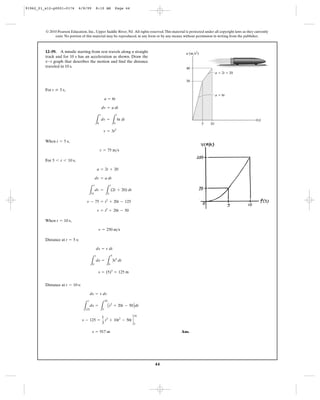
12–59. A missile starting from rest travels along a straight
track and for 10 s has an acceleration as shown. Draw the
graph that describes the motion and find the distance
traveled in 10 s.
v-t
30
5 10
40
t(s)
a (m/s2
)
a ϭ 2t ϩ 20
a ϭ 6t
91962_01_s12-p0001-0176 6/8/09 8:10 AM Page 44
45
© 2010 Pearson Education, Inc., Upper Saddle River, NJ. All rights reserved.This material is protected under all copyright laws as they currently
exist. No portion of this material may be reproduced, in any form or by any means, without permission in writing from the publisher.
For
When
For
When
Ans.s = 114 m
t = 10 s, v = 36 m>s
s = 3t2
- 24t + 54
L
s
18
ds =
L
t
6
(6t - 24) dt
ds = v dt
v = 6t - 24
L
v
12
dv =
L
t
6
6 dt
6 6 t … 10 dv = a dt
t = 6 s, v = 12 m>s s = 18 m
s =
1
72
t4
L
s
0
ds =
L
t
0
1
18
t
3
dt
ds = v dt
v =
1
18
t3
L
v
0
dv =
L
t
0
1
6
t2
dt
0 … t 6 6 dv = a dt
*12–60. A motorcyclist starting from rest travels along a
straight road and for 10 s has an acceleration as shown.
Draw the graph that describes the motion and find the
distance traveled in 10 s.
v-t
6 10
t (s)
6
1
—
6
a (m/s2
)
a ϭ t2
91962_01_s12-p0001-0176 6/8/09 8:10 AM Page 45
46
© 2010 Pearson Education, Inc., Upper Saddle River, NJ. All rights reserved.This material is protected under all copyright laws as they currently
exist. No portion of this material may be reproduced, in any form or by any means, without permission in writing from the publisher.
From the v–t graph at , , and ,
The equations defining the portions of the s–t graph are
0 … t … 5 s v = 4t; ds = v dt;
L
s
0
ds =
L
t
0
4t dt; s = 2t2
s3 = A1 + A2 + A3 = 350 +
1
2
(30 - 20)(20) = 450 m
s2 = A1 + A2 = 50 + 20(20 - 5) = 350 m
s1 = A1 =
1
2
(5)(20) = 50 m
t3 = 30 st2 = 20 st1 = 5 s
20 … t … 30 a =
¢v
¢t
=
0 - 20
30 - 20
= -2 m>s2
5 … t … 20 a =
¢v
¢t
=
20 - 20
20 - 5
= 0 m>s2
0 … t … 5 a =
¢v
¢t
=
20
5
= 4 m>s2
•12–61. The graph of a car while traveling along a
road is shown. Draw the and graphs for the motion.a-ts-t
v-t
20
20 305
t (s)
v (m/s)
20 … t … 30 s v = 2(30 - t); ds = v dt;
L
s
350
ds =
L
t
20
2(30 - t) dt; s = -t2
+ 60t - 450
5 … t … 20 s v = 20; ds = v dt;
L
s
50
ds =
L
t
5
20 dt; s = 20t - 50
91962_01_s12-p0001-0176 6/8/09 8:19 AM Page 46
47
© 2010 Pearson Education, Inc., Upper Saddle River, NJ. All rights reserved.This material is protected under all copyright laws as they currently
exist. No portion of this material may be reproduced, in any form or by any means, without permission in writing from the publisher.
Graph: For , the initial condition is at .
The maximum velocity of the boat occurs at , where its acceleration
changes sign.Thus,
Ans.
For , the initial condition is at .
Thus, when ,
Ans.
The v–s graph is shown in Fig. a.
0 = 2-8s¿ + 2550 s¿ = 318.7 m = 319 m
v = 0
v = 2-8s + 2550 m>s
v2
2
2
v
36.74 m>s
= -4s 2
s
150 m
L
v
36.74 m>s
vdv =
L
s
150 m
-4ds
A :+ B vdv = ads
s = 150 mv = 36.74 m>s150 m 6 s 6 s¿
vmax = vΗs=150 m = 2-0.02A1502
B + 12(150) = 36.74 m>s = 36.7 m>s
s = 150 m
v = a 2-0.02s2
+ 12sb m>s
v2
2
2
v
0
= A -0.01s2
+ 6sBΗ
s
0
L
v
0
vdv =
L
s
0
(-0.02s + 6)ds
A :+ B vdv = ads
s = 0v = 00 … s 6 150 mN؊s
12–62. The boat travels in a straight line with the
acceleration described by the graph. If it starts from rest,
construct the graph and determine the boat’s maximum
speed.What distance does it travel before it stops?s¿
v-s
a-s
s(m)
s¿
a(m/s2
)
3
150
Ϫ4
6
a ϭ Ϫ0.02s ϩ 6
91962_01_s12-p0001-0176 6/8/09 8:20 AM Page 47
48
© 2010 Pearson Education, Inc., Upper Saddle River, NJ. All rights reserved.This material is protected under all copyright laws as they currently
exist. No portion of this material may be reproduced, in any form or by any means, without permission in writing from the publisher.
Graph: For the time interval , the initial condition is at .
When ,
The initial condition is at .
When ,
The v–t graph is shown in Fig. a.
Graph: For the time interval , the initial condition is when
.
When ,
For the time interval , the initial condition is when
.
When ,
The s–t graph is shown in Fig. b.
sΗt=14 s =
2
3
A143
B - 9A142
B + 108(14) - 340.2 = 1237 m
t = 14 s
s = a
2
3
t3
- 9t2
+ 108t - 340.2b m
L
s
388.8 m
ds =
L
t
9 s
A2t2
- 18t + 108Bdt
A + c B ds = vdt
t = 9 s
s = 388.8 m9 s 6 t … 14 s
sΗt=9 s =
8
5
A95>2
B = 388.8 m
t = 9 s
s =
8
5
t5>2
L
s
0
ds =
L
t
0
4t3>2
dt
A + c B ds = vdt
t = 0
s = 00 … t 6 9 ss؊t
vΗt=14 s = 2A142
B - 18(14) + 108 = 248 m>s
t = 14 s
v = A2t2
- 18t + 108B m>s
L
v
108 m>s
dv =
L
t
9 s
(4t - 18)dt
A + c B dv = adt
t = 9 sv = 108 m>s
vΗt=9 s = 4A93>2
B = 108 m>s
t = 9 s
v = A4t3>2
Bm>s
L
v
0
dv =
L
t
0
6t1>2
dt
A + c B dv = adt
s = 0v = 00 … t 6 9 sN؊t
12–63. The rocket has an acceleration described by the
graph. If it starts from rest, construct the and
graphs for the motion for the time interval .0 … t … 14s
s-tv-t
t(s)
a(m/s2
)
38
18
9 14
a2
ϭ 36t
a ϭ 4t Ϫ 18
91962_01_s12-p0001-0176 6/8/09 8:20 AM Page 48
49
© 2010 Pearson Education, Inc., Upper Saddle River, NJ. All rights reserved.This material is protected under all copyright laws as they currently
exist. No portion of this material may be reproduced, in any form or by any means, without permission in writing from the publisher.
Graph: For ,
For ,
At and 525 m,
The a–s graph is shown in Fig. a.
aΗs=525 m = 0.04(525) - 24 = -3 m>s2
aΗs=225 m = 0.04(225) - 24 = -15 m>s2
s = 225 m
A :+ B a = v
dv
ds
= (-0.2s + 120)(-0.2) = (0.04s - 24) m>s2
225 m 6 s … 525 m
A :+ B a = v
dv
ds
= A5s1>2
B a
5
2
s-1>2
b = 12.5 m>s2
0 … s 6 225 ma ؊ s
*12–64. The jet bike is moving along a straight road
with the speed described by the graph. Construct the
graph.a-s
v-s
v(m/s)
v ϭ 5s1/2
75
15
225 525
v ϭ Ϫ0.2s ϩ 120
s(m)
91962_01_s12-p0001-0176 6/8/09 8:20 AM Page 49
50
© 2010 Pearson Education, Inc., Upper Saddle River, NJ. All rights reserved.This material is protected under all copyright laws as they currently
exist. No portion of this material may be reproduced, in any form or by any means, without permission in writing from the publisher.
Graph: For , the initial condition is at .
At ,
For , the initial condition is at .
At ,
The v–s graph is shown in Fig. a.
vΗs=500 ft = 220(500) - 1600 = 91.65 ft>s = 91.7 ft>s
s = 500 ft
v = 220s - 1600 ft>s
v2
2
2
v
48.99 ft>s
= 10sΗ
s
200 ft
L
v
48.99 ft>s
vdv =
L
s
200 ft
10ds
A :+ B vdv = ads
s = 200 ftv = 48.99 ft>s200 ft 6 s … 500 ft
vΗs=200 ft = 20.04A2002
B + 4(200) = 48.99 ft>s = 49.0 ft>s
s = 200 ft
v = 20.04s2
+ 4s ft>s
v2
2
2
v
0
= 0.02s2
+ 2sΗ
s
0
L
v
0
vdv =
L
s
0
(0.04s + 2)ds
A :+ B vdv = ads
s = 0v = 00 … s 6 200 ftN؊s
•12–65. The acceleration of the speed boat starting from
rest is described by the graph. Construct the graph.v-s
a(ft/s2
)
10
2
200 500
a ϭ 0.04s ϩ 2
s(ft)
91962_01_s12-p0001-0176 6/8/09 8:20 AM Page 50
51
© 2010 Pearson Education, Inc., Upper Saddle River, NJ. All rights reserved.This material is protected under all copyright laws as they currently
exist. No portion of this material may be reproduced, in any form or by any means, without permission in writing from the publisher.
Graph: For , the initial condition is when .
When ,
For , the initial condition is when .
When ,
Ans.
The s–t graph is shown in Fig. a.
Graph: For ,
For ,
When and 400 m,
The a–s graph is shown in Fig. b.
aΗs=400 m = 0.04(400) = 16 m>s2
aΗs=100 m = 0.04(100) = 4 m>s2
s = 100 m
a = v
dv
ds
= (0.2s)(0.2) = 0.04s
100 m 6 s … 400 m
a = v
dv
ds
= A2s1>2
B As-1>2
B = 2 m>s2
0 m … s 6 100 ma؊s
t = 16.93 s = 16.9 s
400 = 13.53et>5
s = 400 m
s = A13.53et>5
B m
et>5
e2
=
s
100
et>5-2
=
s
100
t
5
- 2 = ln
s
100
t - 10 = 5ln
s
100
L
t
10 s
dt =
L
s
100 m
ds
0.2s
A :+ B dt =
ds
v
t = 10 ss = 100 m100 6 s … 400 m
100 = t2
t = 10 s
s = 100 m
s = At2
B m
t = s1>2
L
t
0
dt =
L
s
0
ds
2s1>2
A :+ B dt =
ds
v
t = 0 ss = 00 … s 6 100 ms؊t
12–66. The boat travels along a straight line with the
speed described by the graph. Construct the and
graphs. Also, determine the time required for the boat to
travel a distance if .s = 0 when t = 0s = 400 m
a-ss-t
v(m/s)
100 400
20
80
s(m)
v2
ϭ 4s
v ϭ 0.2s
91962_01_s12-p0001-0176 6/8/09 8:21 AM Page 51
52
© 2010 Pearson Education, Inc., Upper Saddle River, NJ. All rights reserved.This material is protected under all copyright laws as they currently
exist. No portion of this material may be reproduced, in any form or by any means, without permission in writing from the publisher.
Graph: The velocity in terms of time t can be obtained by applying .
For time interval ,
When
For time interval ,
Graph: The acceleration in terms of time t can be obtained by applying .
For time interval and , and
, respectively.a =
dy
dt
= 0
a =
dy
dt
= 0.800 m>s2
30 s 6 t … 40 s0 s … t 6 30 s
a =
dy
dt
a؊t
y =
ds
dt
= 24.0 m>s
30 s 6 t … 40 s
t = 30 s, y = 0.8(30) = 24.0 m>s
y =
ds
dt
= 0.8t
0 s … t … 30 s
y =
ds
dt
Y؊t
12–67. The s–t graph for a train has been determined
experimentally. From the data, construct the and a–t
graphs for the motion.
v-t
t (s)
600
360
30 40
s (m)
s ϭ 24t Ϫ 360
s ϭ 0.4t2
91962_01_s12-p0001-0176 6/8/09 8:21 AM Page 52
53
© 2010 Pearson Education, Inc., Upper Saddle River, NJ. All rights reserved.This material is protected under all copyright laws as they currently
exist. No portion of this material may be reproduced, in any form or by any means, without permission in writing from the publisher.
Graph: For , the initial condition is at .
At ,
For , the initial condition is at .
When
Ans.
The v–s graph is shown in Fig. a.
s¿ = 2375 ft
25 = 236 250 - 15s
v = 25 ft>s
v = 236 250 - 15s
v2
2
2
v
100 ft>s
= (-7.5s)Η
s
1750 ft
L
v
100 ft>s
vdv =
L
s
1750 ft
-7.5ds
A :+ B vdv = ads
s = 1750 ftv = 100 ft>s1750 ft 6 s 6 s¿
vΗs=1750 ft = 262 500 - 30(1750) = 100 ft>s
s = 1750 ft
v = A 262 500 - 30sB ft>s
v2
2
2
v
250 ft>s
= -15sΗ
s
0
L
v
250 ft>s
vdv =
L
s
0
-15ds
A :+ B vdv = ads
s = 0 sv = 250 ft>s0 … s 6 1750 ftN؊s
*12–68. The airplane lands at on a straight
runway and has a deceleration described by the graph.
Determine the distance traveled before its speed is
decreased to . Draw the graph.s-t25 ft>s
s¿
250 ft>s a(ft/s2
)
1750
Ϫ7.5
Ϫ15
s¿
s(ft)
91962_01_s12-p0001-0176 6/8/09 8:21 AM Page 53
54
© 2010 Pearson Education, Inc., Upper Saddle River, NJ. All rights reserved.This material is protected under all copyright laws as they currently
exist. No portion of this material may be reproduced, in any form or by any means, without permission in writing from the publisher.
graph: For the time interval , the initial condition is when
.
When ,
For the time interval , the initial condition is when .
Thus, when ,
Ans.
Also, the change in velocity is equal to the area under the graph.Thus,
Ans.
The v–t graph is shown in Fig. a.
t¿ = 16.25 s
90 - 0 =
1
2
(8)(10) + 8(t¿ - 10)
¢v =
L
adt
a-t
90 = 8t¿ - 40 t¿ = 16.25 s
v = 90 m>s
v = (8t - 40) m>s
vΗ
v
40 m>s = 8tΗ
t
10 s
L
v
40 m>s
dv =
L
t
10 s
8dt
A :+ B dv = adt
t = 10 sv = 40 m>s10 s 6 t … t¿
v = 0.4A102
B = 40 m>s
t = 10 s
v = A0.4t2
B m>s
L
v
0
dv =
L
t
0
0.8tdt
A :+ B dv = adt
t = 0 s
v = 00 … t 6 10 sv؊t
•12–69. The airplane travels along a straight runway with
an acceleration described by the graph. If it starts from rest
and requires a velocity of to take off, determine the
minimum length of runway required and the time for take
off. Construct the and graphs.s-tv-t
t¿
90 m>s
t(s)
a(m/s2
)
t¿10
8
a ϭ 0.8t
91962_01_s12-p0001-0176 6/8/09 8:22 AM Page 54
55
© 2010 Pearson Education, Inc., Upper Saddle River, NJ. All rights reserved.This material is protected under all copyright laws as they currently
exist. No portion of this material may be reproduced, in any form or by any means, without permission in writing from the publisher.
Graph: For the time interval , the initial condition is when
.
When ,
For the time interval , the initial condition is
when .
When
Ans.
The s–t graph is shown in Fig. b.
sΗt=16.25 s = 4(16.25)2
- 40(16.25) + 133.33 = 539.58 m = 540 m
t = t¿ = 16.25 s
s = A4t2
- 40t + 133.33Bm
sΗ
s
133.33 m = A4t2
- 40tB 2
t
10 s
L
s
133.33 m
ds =
L
t
10s
(8t - 40)dt
A :+ B ds = vdt
t = 10 s
s = 133.33m10 s 6 t … t¿ = 16.25 s
sΗt=10 s = 0.1333A103
B = 133.33m
t = 10 s
s = A0.1333t3
B m
L
s
0
ds =
L
t
0
0.4t
2
dt
A :+ B ds = vdt
t = 0 s
s = 00 … t 6 10 ss؊t
91962_01_s12-p0001-0176 6/8/09 8:22 AM Page 55
56
© 2010 Pearson Education, Inc., Upper Saddle River, NJ. All rights reserved.This material is protected under all copyright laws as they currently
exist. No portion of this material may be reproduced, in any form or by any means, without permission in writing from the publisher.
Graph: For the time interval , the initial condition is when
.
When ,
For the time interval , the initial condition is at .
Thus, when ,
Choosing the root ,
Ans.
Also, the change in velocity is equal to the area under the a–t graph.Thus,
0 = -
1
30
t¿2
+ 5t¿ - 75
0 =
1
2
(3)(75) +
1
2
B ¢ -
1
15
t¿ + 5≤(t¿ - 75)R
¢v =
L
adt
t¿ = 133.09 s = 133 s
t¿ 7 75 s
0 = -
1
30
t¿2
+ 5t¿ - 75
v = 0
v = ¢ -
1
30
t2
+ 5t - 75≤ m>s
L
v
45 m>s
dv =
L
t
30 s
¢ -
1
15
t + 5≤dt
A :+ B dv = adt
t = 30 sv = 45 m>s30 s 6 t … t¿
vΗt=30 s = 0.05A302
B = 45 m>s
t = 30 s
v = A0.05t2
B m>s
L
v
0
dv =
L
t
0
0.1tdt
A :+ B dv = adt
t = 0 s
v = 00 … t 6 30 sN؊t
12–70. The graph of the bullet train is shown. If the
train starts from rest, determine the elapsed time before it
again comes to rest. What is the total distance traveled
during this time interval? Construct the and graphs.s–tv–t
t¿
a–t
t(s)
a(m/s2
)
3
30 75
a ϭ Ϫ( )t ϩ 5
1
15
a ϭ 0.1t
t¿
91962_01_s12-p0001-0176 6/8/09 8:22 AM Page 56
57
© 2010 Pearson Education, Inc., Upper Saddle River, NJ. All rights reserved.This material is protected under all copyright laws as they currently
exist. No portion of this material may be reproduced, in any form or by any means, without permission in writing from the publisher.
This equation is the same as the one obtained previously.
The slope of the v–t graph is zero when ,which is the instant .Thus,
The v–t graph is shown in Fig. a.
Graph: Using the result of v, the equation of the s–t graph can be obtained by
integrating the kinematic equation . For the time interval , the
initial condition at will be used as the integration limit.Thus,
When ,
For the time interval , the initial condition is
when .
When and ,
Ans.
The s–t graph is shown in Fig. b.
sΗt=133.09 s = -
1
90
A133.093
B +
5
2
A133.092
B - 75(133.09) + 750 = 8857 m
sΗt=75 s = -
1
90
A753
B +
5
2
A752
B - 75(75) + 750 = 4500 m
t¿ = 133.09 st = 75 s
s = a -
1
90
t3
+
5
2
t2
- 75t + 750b m
L
s
450 m
ds =
L
t
30 s
a -
1
30
t2
+ 5t - 75bdt
A :+ B ds = vdt
t = 30 s
s = 450 m30 s 6 t … t¿ = 133.09 s
sΗt=30 s =
1
60
A303
B = 450 m
t = 30 s
s = a
1
60
t3
b m
L
s
0
ds =
L
t
0
0.05t2
dt
A :+ B ds = vdt
t = 0 ss = 0
0 … t 6 30 sds = vdt
s؊t
vΗt=75 s = -
1
30
A752
B + 5(75) - 75 = 112.5 m>s
a =
dv
dt
= 0t = 75 s
91962_01_s12-p0001-0176 6/8/09 8:22 AM Page 57
58
© 2010 Pearson Education, Inc., Upper Saddle River, NJ. All rights reserved.This material is protected under all copyright laws as they currently
exist. No portion of this material may be reproduced, in any form or by any means, without permission in writing from the publisher.
Velocity:
When ,
Thus, the magnitude of the particle’s velocity is
Ans.
Acceleration:
When ,
Thus, the magnitude of the particle’s acceleration is
Ans.a = 2ax
2
+ ay
2
+ az
2
= 2362
+ 0.35362
+ 62
= 36.5 m>s2
a = C18(2)i + 2-3>2
j + 6kD m>s2
= [36i + 0.3536j + 6k] m>s2
t = 2 s
a =
dv
dt
=
d
dt
c A9t2
- 2Bi - A2t-1>2
+ 1Bj + (6t)kd m>s = C(18t)i + t-3>2
j + 6kD m>s2
v = 2vx
2
+ vy
2
+ vz
2
= 2342
+ (-2.414)2
+ 122
= 36.1 m>s
= [34i - 2.414j + 12k] m>s
v = B c9A22
B - 2di - c2A2-1>2
B + 1 dj + 6(2)kR m>s
t = 2 s
v =
dr
dt
=
d
dt
c A3t3
- 2tBi - A4t1>2
+ tBj + A3t2
- 2Bkd = c A9t2
- 2Bi - A2t-1>2
+ 1Bj + (6t)kd m>s
12–71. The position of a particle is
, where t is in seconds.
Determine the magnitude of the particle’s velocity and
acceleration when .t = 2 s
– (4t1/2
+ t)j + (3t2
- 2)k6m
r = 5(3t3
- 2t)i
Position: The position r of the particle can be determined by integrating the
kinematic equation using the initial condition at as the
integration limit.Thus,
When and 3 s,
Thus, the displacement of the particle is
Ans.= [6i + 4j] m
= (9i + 9j) - (3i + 5j)
¢r = rΗt=3 s - rΗt=1 s
rΗt=3 s = 3(3)i + C6(3) - 32
Dj = [9i + 9j] m>s
rΗt=1 s = 3(1)i + C6(1) - 12
Dj = [3i + 5j] m>s
t = 1 s
r = c3ti + A6t - t2
Bjdm
L
r
0
dr =
L
t
0
C3i + (6 - 2t)jDdt
dr = vdt
t = 0r = 0dr = vdt
*12–72. The velocity of a particle is ,
where t is in seconds. If , determine the
displacement of the particle during the time interval
.t = 1 s to t = 3 s
r = 0 when t = 0
v = 53i + (6 - 2t)j6m>s
91962_01_s12-p0001-0176 6/8/09 8:23 AM Page 58
59
© 2010 Pearson Education, Inc., Upper Saddle River, NJ. All rights reserved.This material is protected under all copyright laws as they currently
exist. No portion of this material may be reproduced, in any form or by any means, without permission in writing from the publisher.
Velocity:
Substituting the result of y into ,
Thus, the x component of the particle’s velocity can be determined by taking the
time derivative of x.
Acceleration:
Ans.
Ans.ay = v
#
y =
d
dt
Act2
B = 2ct
ax = v
#
x =
d
dt
¢
3
2A
c
3b
t1>2
≤ =
3
4A
c
3b
t-1>2
=
3
4A
c
3b
1
2t
vx = x
#
=
d
dt
B
A
c
3b
t3>2
R =
3
2A
c
3b
t1>2
x =
A
c
3b
t3>2
c
3
t3
= bx2
y = bx2
y =
c
3
t3
L
y
0
dy =
L
t
0
ct2
dt
dy = vy dt
•12–73. A particle travels along the parabolic path
. If its component of velocity along the y axis is
, determine the x and y components of the particle’s
acceleration. Here b and c are constants.
vy = ct2
y = bx2
91962_01_s12-p0001-0176 6/8/09 8:23 AM Page 59
60
© 2010 Pearson Education, Inc., Upper Saddle River, NJ. All rights reserved.This material is protected under all copyright laws as they currently
exist. No portion of this material may be reproduced, in any form or by any means, without permission in writing from the publisher.
Acceleration: The acceleration expressed in Cartesian vector form can be obtained
by applying Eq. 12–9.
When , .The magnitude
of the acceleration is
Ans.
Position: The position expressed in Cartesian vector form can be obtained by
applying Eq. 12–7.
When ,
Thus, the coordinate of the particle is
Ans.(42.7, 16.0, 14.0) m
r =
16
3
A23
Bi + A24
Bj + c
5
2
A22
B + 2(2)dk = {42.7i + 16.0j + 14.0k} m.
t = 2 s
r = c
16
3
t3
i + t4
j + a
5
2
t2
+ 2tbkd m
L
r
0
dr =
L
t
0
A16t
2
i + 4t
3
j + (5t + 2)kB dt
dr = v dt
a = 2a2
x + a2
y + a2
z = 2642
+ 482
+ 52
= 80.2 m>s2
a = 32(2)i + 12A22
Bj + 5k = {64i + 48j + 5k} m>s2
t = 2 s
a =
dv
dt
= {32ti + 12t2
j + 5k} m>s2
12–74. The velocity of a particle is given by
, where t is in seconds. If
the particle is at the origin when , determine the
magnitude of the particle’s acceleration when . Also,
what is the x, y, z coordinate position of the particle at this
instant?
t = 2 s
t = 0
v = 516t2
i + 4t3
j + (5t + 2)k6 m>s
91962_01_s12-p0001-0176 6/8/09 8:24 AM Page 60
61
© 2010 Pearson Education, Inc., Upper Saddle River, NJ. All rights reserved.This material is protected under all copyright laws as they currently
exist. No portion of this material may be reproduced, in any form or by any means, without permission in writing from the publisher.
Velocity:
Substituting this result into , we obtain
Thus,
Acceleration:
Ans.
Ans.ay = v
#
y =
d
dt
(2r cos 2t) = -4r sin 2t
ax = v
#
x =
d
dt
(<2r sin 2t) = <4r cos 2t
vx = x
#
=
d
dt
(<r cos 2t) = <2r sin 2t
x = <r cos 2t
x2
= r2
A1 - sin2
2tB
x2
+ r2
sin2
2t = r2
x2
+ y2
= r2
y = r sin 2t
L
y
0
dy =
L
t
0
2r cos 2tdt
dy = vy dt
12–75. A particle travels along the circular path
. If the y component of the particle’s velocity is
, determine the x and y components of its
acceleration at any instant.
vy = 2r cos 2t
x2
+ y2
= r2
91962_01_s12-p0001-0176 6/8/09 8:24 AM Page 61
62
© 2010 Pearson Education, Inc., Upper Saddle River, NJ. All rights reserved.This material is protected under all copyright laws as they currently
exist. No portion of this material may be reproduced, in any form or by any means, without permission in writing from the publisher.
Velocity: The x and y components of the box’s velocity can be related by taking the
first time derivative of the path’s equation using the chain rule.
or
At , .Thus,
Ans.
Acceleration: The x and y components of the box’s acceleration can be obtained by
taking the second time derivative of the path’s equation using the chain rule.
or
At , and .Thus,
Ans.ay = 0.1C(-3)2
+ 5(-1.5)D = 0.15 m>s2 c
ax = -1.5 m>s2
vx = -3 m>sx = 5 m
ay = 0.1Avx
2
+ xaxB
y = 0.1[x
#
x
#
+ xx] = 0.1Ax
# 2
+ xxB
vy = 0.1(5)(-3) = -1.5 m>s = 1.5 m>s T
vx = -3 m>sx = 5 m
vy = 0.1xvx
y
#
= 0.1xx
#
y = 0.05x2
*12–76. The box slides down the slope described by the
equation m, where is in meters. If the box has
x components of velocity and acceleration of
and at , determine the y components
of the velocity and the acceleration of the box at this instant.
x = 5max = –1.5 m>s2
vx = –3 m>s
xy = (0.05x2
)
y
x
y ϭ 0.05 x2
91962_01_s12-p0001-0176 6/8/09 8:24 AM Page 62
63
© 2010 Pearson Education, Inc., Upper Saddle River, NJ. All rights reserved.This material is protected under all copyright laws as they currently
exist. No portion of this material may be reproduced, in any form or by any means, without permission in writing from the publisher.
Velocity: The velocity expressed in Cartesian vector form can be obtained by
applying Eq. 12–7.
When , . Thus, the
magnitude of the velocity is
Ans.
Acceleration: The acceleration expressed in Cartesian vector from can be obtained
by applying Eq. 12–9.
When , .Thus, the
magnitude of the acceleration is
Ans.
Traveling Path: Here, and .Then,
[1]
[2]
Adding Eqs [1] and [2] yields
However, .Thus,
(Equation of an Ellipse) (Q.E.D.)
x2
25
+
y2
16
= 1
cos2
2t + sin2
2t = 1
x2
25
+
y2
16
= cos2
2t + sin2
2t
y2
16
= sin2
2t
x2
25
= cos2
2t
y = 4 sin 2tx = 5 cos 2t
a = 2a2
x + a2
y = 28.3232
+ (-14.549)2
= 16.8 m>s2
a = -20 cos 2(1)i - 16 sin 2(1)j = {8.323i - 14.549j} m>s2
t = 1 s
a =
dv
dt
= {-20 cos 2ti - 16 sin 2tj} m>s2
y = 2y2
x + y2
y = 2(-9.093)2
+ (-3.329)2
= 9.68 m>s
v = -10 sin 2(1)i + 8 cos 2(1)j = {-9.093i - 3.329j} m>st = 1 s
v =
dr
dt
= {-10 sin 2ti + 8 cos 2tj} m>s
•12–77. The position of a particle is defined by
, where t is in seconds and the
arguments for the sine and cosine are given in radians.
Determine the magnitudes of the velocity and acceleration
of the particle when .Also, prove that the path of the
particle is elliptical.
t = 1 s
r = 55 cos 2t i + 4 sin 2t j6 m
91962_01_s12-p0001-0176 6/8/09 8:24 AM Page 63
64
© 2010 Pearson Education, Inc., Upper Saddle River, NJ. All rights reserved.This material is protected under all copyright laws as they currently
exist. No portion of this material may be reproduced, in any form or by any means, without permission in writing from the publisher.
Velocity: The x and y components of the peg’s velocity can be related by taking the
first time derivative of the path’s equation.
or
(1)
At ,
Here, and . Substituting these values into Eq. (1),
Thus, the magnitude of the peg’s velocity is
Ans.
Acceleration: The x and y components of the peg’s acceleration can be related by
taking the second time derivative of the path’s equation.
or
(2)
Since is constant, . When , , , and
. Substituting these values into Eq. (2),
Thus, the magnitude of the peg’s acceleration is
Ans.a = 2ax
2
+ ay
2
= 202
+ (-38.49)2
= 38.5 m>s2
ay = -38.49 m>s2
= 38.49 m>s2
T
1
2
A102
+ 0B + 2c(-2.887)2
+
23
2
ay d = 0
vy = -2.887 m>s
vx = 10 m>sy =
23
2
mx = 1 max = 0nx
1
2
Avx
2
+ xaxB + 2Avy
2
+ yayB = 0
1
2
Ax
# 2
+ xxB + 2Ay
# 2
+ yyB = 0
1
2
(x
#
x
#
+ xx) + 2(y
#
y
#
+ yy) = 0
v = 2vx
2
+ vy
2
= 2102
+ 2.8872
= 10.4 m>s
1
2
(1)(10) + 2¢
23
2
≤vy = 0 vy = -2.887 m>s = 2.887 m>s T
x = 1vx = 10 m>s
(1)2
4
+ y2
= 1 y =
23
2
m
x = 1 m
1
2
xvx + 2yvy = 0
1
2
xx
#
+ 2yy
#
= 0
1
4
(2xx
#
) + 2yy
#
= 0
x2
4
+ y2
= 1
12–78. Pegs A and B are restricted to move in the elliptical
slots due to the motion of the slotted link. If the link moves
with a constant speed of , determine the magnitude of
the velocity and acceleration of peg A when .x = 1m
10 m/s
A
C D
B
y
x
v ϭ 10 m/s
x2
4
ϩ y2
ϭ 1
91962_01_s12-p0001-0176 6/8/09 8:25 AM Page 64
65
© 2010 Pearson Education, Inc., Upper Saddle River, NJ. All rights reserved.This material is protected under all copyright laws as they currently
exist. No portion of this material may be reproduced, in any form or by any means, without permission in writing from the publisher.
Velocity: The x and y components of the particle’s velocity can be related by taking
the first time derivative of the path’s equation using the chain rule.
or
(1)
At , .Thus Eq. (1) becomes
(2)
The magnitude of the particle’s velocity is
(3)
Substituting and Eq. (2) into Eq. (3),
Ans.
Substituting the result of into Eq. (2), we obtain
Ans.
Acceleration: The x and y components of the particle’s acceleration can be related
by taking the second time derivative of the path’s equation using the chain rule.
or
(4)
When , , and .Thus Eq. (4) becomes
(5)ay = 0.5ax - 0.8
1.7892
+ 4ay = 2ax
vy = 1.789 m>sy = 4 mx = 4 m
vy
2
+ yay = 2ax
y
# 2
+ yy = 2x
2(y
#
y
#
+ yy) = 4x
vy = 1.789 m>s = 1.79 m>s
nx
vx = 3.578 m>s = 3.58 m>s
4 =
Avx
2
+ a
1
2
vxb
2
v = 4 m>s
v = 2vx
2
+ vy
2
vy =
1
2
vx
y = 24(4) = 4 mx = 4 m
vy =
2
y
vx
y
#
=
2
y
x
#
2yy
#
= 4x
#
12–79. A particle travels along the path with a
constant speed of . Determine the x and y
components of the particle’s velocity and acceleration when
the particle is at .x = 4 m
v = 4 m>s
y2
= 4x
Since the particle travels with a constant speed along the path, its acceleration along
the tangent of the path is equal to zero. Here, the angle that the tangent makes with the
horizontal at is .
Thus, from the diagram shown in Fig. a,
(6)
Solving Eqs. (5) and (6) yields
Ans.ax = 0.32 m>s2
ay = -0.64 m>s2
= 0.64 m>s2
T
ax cos 26.57° + ay sin 26.57° = 0
u = tan-1
¢
dy
dx
≤ 2
x=4 m
= tan-1
¢
1
x1>2
≤ 2
x=4 m
= tan-1
(0.5) = 26.57°x = 4 m
91962_01_s12-p0001-0176 6/8/09 8:25 AM Page 65
66
© 2010 Pearson Education, Inc., Upper Saddle River, NJ. All rights reserved.This material is protected under all copyright laws as they currently
exist. No portion of this material may be reproduced, in any form or by any means, without permission in writing from the publisher.
Velocity: The x and y components of the van’s velocity can be related by taking the
first time derivative of the path’s equation using the chain rule.
or
When ,
(1)
The magnitude of the van’s velocity is
(2)
Substituting and Eq. (1) into Eq. (2),
Ans.
Substituting the result of into Eq. (1), we obtain
Ans.
Acceleration: The x and y components of the van’s acceleration can be related by
taking the second time derivative of the path’s equation using the chain rule.
or
When , .Thus,
(3)ay = -(16.504 + 0.15ax)
ay = -3A10-3
B c(-74.17)2
+ 50ax d
vx = -74.17 ft>sx = 50 ft
ay = -3A10-3
B Avx
2
+ xaxB
y
$
= -3A10-3
B(x
#
x
#
+ xx)
vy = -0.15(-74.17) = 11.12 ft>s = 11.1 ft>s c
nx
vx = 74.2 ft>s ;
75 = 2vx
2
+ (-0.15vx)2
v = 75 ft>s
v = 2vx
2
+ vy
2
vy = -3A10-3
B(50)vx = -0.15vx
x = 50 ft
vy = -3A10-3
Bxvx
y
#
= -3A10-3
Bxx
#
y = -1.5A10-3
Bx2
+ 15
*12–80. The van travels over the hill described by
. If it has a constant speed of
, determine the x and y components of the van’s
velocity and acceleration when .x = 50ft
75ft>s
y = (-1.5(10–3
) x2
+ 15)ft
x
y ϭ (Ϫ1.5 (10Ϫ3
) x2
ϩ 15) ft
y
100 ft
15 ft
Since the van travels with a constant speed along the path, its acceleration along the tangent
of the path is equal to zero. Here, the angle that the tangent makes with the horizontal at
is .
Thus, from the diagram shown in Fig. a,
(4)
Solving Eqs. (3) and (4) yields
Ans.
Ans.ay = -16.1 ft>s = 16.1 ft>s2
T
ax = -2.42 ft>s = 2.42 ft>s2
;
ax cos 8.531° - ay sin 8.531° = 0
u = tan-1
¢
dy
dx
≤ 2
x=50 ft
= tan-1
c -3A10-3
Bxd 2
x=50 ft
= tan-1
(-0.15) = -8.531°x = 50 ft
91962_01_s12-p0001-0176 6/8/09 8:26 AM Page 66
67
© 2010 Pearson Education, Inc., Upper Saddle River, NJ. All rights reserved.This material is protected under all copyright laws as they currently
exist. No portion of this material may be reproduced, in any form or by any means, without permission in writing from the publisher.
Position: The coordinates for points B and C are and
.Thus,
Average Velocity: The displacement from point B to C is
.
Ans.(vBC)avg =
¢rBC
¢t
=
7.765i + 13.45j
3 - 1
= {3.88i + 6.72j} m>s
= (28.98i - 7.765j) - (21.21i - 21.21j) = {7.765i + 13.45j} m
¢rBC = rC - rB
= {28.98i - 7.765j} m
rC = (30 sin 75° - 0)i + [(30 - 30 cos 75°) - 30]j
= {21.21i - 21.21j} m
rB = (30 sin 45° - 0)i + [(30 - 30 cos 45°) - 30]j
[30 sin 75°, 30 - 30 cos 75°]
[30 sin 45°, 30 - 30 cos 45°]
•12–81. A particle travels along the circular path from A
to B in 1 s. If it takes 3 s for it to go from A to C, determine
its average velocity when it goes from B to C.
45Њ
30Њ
30 m
x
y
A
B
C
Total Distance Traveled and Displacement: The total distance traveled is
Ans.
and the magnitude of the displacement is
Ans.
Average Velocity and Speed: The total time is .
The magnitude of average velocity is
Ans.
and the average speed is
Ans.AyspBavg =
s
¢t
=
9A103
B
1380
= 6.52 m>s
yavg =
¢r
¢t
=
6.708A103
B
1380
= 4.86 m>s
¢t = 5 + 8 + 10 = 23 min = 1380 s
¢r = 2(2 + 4)2
+ 32
= 6.708 km = 6.71 km
s = 2 + 3 + 4 = 9 km
12–82. A car travels east 2 km for 5 minutes, then north
3 km for 8 minutes, and then west 4 km for 10 minutes.
Determine the total distance traveled and the magnitude
of displacement of the car. Also, what is the magnitude of
the average velocity and the average speed?
91962_01_s12-p0001-0176 6/8/09 8:26 AM Page 67
68
© 2010 Pearson Education, Inc., Upper Saddle River, NJ. All rights reserved.This material is protected under all copyright laws as they currently
exist. No portion of this material may be reproduced, in any form or by any means, without permission in writing from the publisher.
Ans.
Ans.a = 2(-ck2
sin kt)2
+ (-ck2
cos kt)2
+ 0 = ck2
v = 2(ck cos kt)2
+ (-ck sin kt)2
+ (-b)2
= 2c2
k2
+ b2
z
$
= 0z
#
= -bz = h - bt
y
$
= -ck2
cos kty
#
= -ck sin kty = c cos kt
x
$
= -ck2
sin ktx
#
= ck cos ktx = c sin kt
12–83. The roller coaster car travels down the helical path at
constant speed such that the parametric equations that define
its position are , , , where
c, h, and b are constants. Determine the magnitudes of its
velocity and acceleration.
z = h - bty = c cos ktx = c sin kt
x
y
z
Ans.
Ans.ax =
c
2k
Ay + ct2
B
2(ct)2
+ 2yc = 4kax
ay = c
vy = ct
2v2
y + 2yay = 4kax
2yvy = 4kvx
y2
= 4kx
*12–84. The path of a particle is defined by , and
the component of velocity along the y axis is , where
both k and c are constants. Determine the x and y
components of acceleration when y = y0.
vy = ct
y2
= 4kx
91962_01_s12-p0001-0176 6/8/09 8:27 AM Page 68
69
© 2010 Pearson Education, Inc., Upper Saddle River, NJ. All rights reserved.This material is protected under all copyright laws as they currently
exist. No portion of this material may be reproduced, in any form or by any means, without permission in writing from the publisher.
Velocity: Taking the first derivative of the path , we have
[1]
However, and .Thus, Eq. [1] becomes
[2]
Here, at .Then, From Eq. [2]
Also,
Ans.
Acceleration: Taking the second derivative of the path , we have
[3]
However, and .Thus, Eq. [3] becomes
[4]
Since is constant, hence at .Then, From Eq. [4]
Also,
Ans.a = 2a2
x + a2
y = 202
+ (-0.020)2
= 0.0200 ft>s2
ay = 0 -
1
200
C22
+ 20(0)D = -0.020 ft>s2
x = 20 ftax = 0yx = 2 ft>s
ay = ax -
1
200
Ay2
x + xaxB
y
$
= ayx
$
= ax
y
$
= x
$
-
1
200
Ax
# 2
+ xx
$
B
y = x -
x2
400
y = 2y2
x + y2
y = 222
+ 1.802
= 2.69 ft>s
yy = 2 -
20
200
(2) = 1.80 ft>s
x = 20 ftyx = 2 ft>s
yy = yx -
x
200
yx
y
#
= yyx
#
= yx
y
#
= x
#
-
x
200
x
#
y
#
= x
#
-
1
400
(2xx
#
)
y = x -
x2
400
•12–85. A particle moves along the curve ,
where x and y are in ft. If the velocity component in the x
direction is and remains constant, determine the
magnitudes of the velocity and acceleration when .x = 20 ft
vx = 2 ft>s
y = x - (x2
>400)
91962_01_s12-p0001-0176 6/8/09 8:27 AM Page 69
70
© 2010 Pearson Education, Inc., Upper Saddle River, NJ. All rights reserved.This material is protected under all copyright laws as they currently
exist. No portion of this material may be reproduced, in any form or by any means, without permission in writing from the publisher.
Ans.
Ans.vy =
v0 pc
L
acos
p
L
xb B1 + a
p
L
cb
2
cos2
a
p
L
xb R
-1
2
vx = v0 B1 + a
p
L
cb
2
cos2
a
p
L
xb R
-1
2
v2
0 = v2
x B1 + a
p
L
cb
2
cos2
a
p
L
xb R
v2
0 = v2
y + v2
x
vy =
p
L
c vx acos
p
L
xb
y =
p
L
cacos
p
L
xbx
#
y = c sin a
p
L
xb
12–86. The motorcycle travels with constant speed
along the path that, for a short distance, takes the form of a
sine curve. Determine the x and y components of its
velocity at any instant on the curve.
v0
L L
c
c
x
y
v0
y ϭ c sin ( x)––
L
π
Coordinate System: The x–y coordinate system will be set so that its origin coincides
with point A.
x-Motion: Here, , and .Thus,
(1)
y-Motion: Here, , , and .Thus,
(2)
Solving Eqs. (1) and (2) yields
Ans.vA = 6.49 m>s t = 0.890 s
4.905t2
- vA sin 30° t - 1 = 0
-1 = 0 + vA sin 30° t +
1
2
(-9.81)t2
A + c B yB = yA + (vA)y t +
1
2
ay t2
yB = -1 may = -g = -9.81 m>s2
(vA)y = vA sin 30°
t =
5
vA cos 30°
5 = 0 + vA cos 30° t
A :+ B xB = xA + (vA)xt
xB = 5 mxA = 0(vA)x = vA cos 30°
12–87. The skateboard rider leaves the ramp at A with an
initial velocity . If he strikes the ground at
B, determine and the time of flight.vA
vA at a 30° angle
vA
5 m
1 m
A
B
30Њ
91962_01_s12-p0001-0176 6/8/09 8:28 AM Page 70
71
© 2010 Pearson Education, Inc., Upper Saddle River, NJ. All rights reserved.This material is protected under all copyright laws as they currently
exist. No portion of this material may be reproduced, in any form or by any means, without permission in writing from the publisher.
Ans.
Ans.h = 5 + 0 +
1
2
(-32.2)(0.4286)2
= 2.04 ft
A + c B s = s0 + v0 t +
1
2
ac t2
t = 0.4286 = 0.429 s
A ;+ B s = vt; 60 = 140t
*12–88. The pitcher throws the baseball horizontally with
a speed of 140 from a height of 5 ft. If the batter is 60 ft
away, determine the time for the ball to arrive at the batter
and the height h at which it passes the batter.
ft>s
h 5 ft
60 ft
Coordinate System: The x–y coordinate system will be set so that its origin coincides
with point A.
x-Motion: Here, , , and , and .Thus,
(1)
y-Motion: Here, , , , and ,
and .Thus,
(2)
Solving Eqs. (1) and (2) yields
Ans.
Using the result of and , we obtain
Thus,
Thus, the magnitude of the ball’s velocity when it strikes the ground is
Ans.vB = 2202
+ 73.32
= 76.0 ft>s
(vB)y = 23.3 + (-32.2)(3) = -73.3 ft>s = 73.3 ft>s T
A + c B (vB)y = (vA)y + ayt
(vA)x = 30.71 cos 49.36° = 20 ft>s (vA)y = 30.71 sin 49.36° = 23.3 ft>s
nAu
u = 49.36° = 49.4° vA = 30.71 ft>s = 30.7 ft>s
vA sin u = 23.3
-75 = 0 + vA sin u(3) +
1
2
(-32.2)A32
B
A + c B yB = yA + (vA)yt +
1
2
ayt2
t = 3 s
yB = -75 ftyA = 0ay = -g = -32.2 ft>s2
(vA)y = vA sin u
vA cos u = 20
60 = 0 + vA cos u(3)
A :+ B xB = xA + (vA)xt
t = 3 sxB = 60 ftxA = 0(vA)x = vA cos u
•12–89. The ball is thrown off the top of the building. If it
strikes the ground at B in 3 s,determine the initial velocity
and the inclination angle at which it was thrown.Also, find
the magnitude of the ball’s velocity when it strikes the ground.
uA
vA
75 ft
60 ft
vA
B
A
uA
91962_01_s12-p0001-0176 6/8/09 8:28 AM Page 71
72
© 2010 Pearson Education, Inc., Upper Saddle River, NJ. All rights reserved.This material is protected under all copyright laws as they currently
exist. No portion of this material may be reproduced, in any form or by any means, without permission in writing from the publisher.
x-Motion: For the motion of the first projectile, , ,
and .Thus,
(1)
For the motion of the second projectile, , , and .
Thus,
(2)
y-Motion: For the motion of the first projectile, , ,
and .Thus,
(3)
For the motion of the second projectile, , , and
.Thus,
(4)
Equating Eqs. (1) and (2),
(5)
Equating Eqs. (3) and (4),
(6)t1 =
30 sin u + 1.22625
60 sin u - 47.06
(60 sin u - 47.06)t1 = 30 sin u + 1.22625
51.96t1 - 4.905t1
2
= (60 sin u)t1 - 30 sin u - 4.905t1
2
+ 4.905t1 - 1.22625
t1 =
cos u
2 cos u - 1
30t1 = 60 cos u(t1 - 0.5)
y = (60 sin u)t1 - 30 sin u - 4.905 t1
2
+ 4.905t1 - 1.22625
y = 0 + 60 sin u(t1 - 0.5) +
1
2
(-9.81)(t1 - 0.5)2
A + c B y = y0 + vyt +
1
2
ayt2
ay = -g = -9.81 m>s2
y0 = 0vy = 60 sin u
y = 51.96t1 - 4.905t1
2
y = 0 + 51.96t1 +
1
2
(-9.81)t1
2
A + c B y = y0 + vyt +
1
2
ayt2
ay = -g = -9.81 m>s2
y0 = 0vy = 60 sin 60° = 51.96 m>s
x = 0 + 60 cos u(t1 - 0.5)
A :+ B x = x0 + vxt
t = t1 - 0.5x0 = 0vx = 60 cos u
x = 0 + 30t1
A :+ B x = x0 + vxt
t = t1
x0 = 0vx = 60 cos 60° = 30 m>s
12–90. A projectile is fired with a speed of at
an angle of . A second projectile is then fired with the
same speed 0.5 s later. Determine the angle of the second
projectile so that the two projectiles collide. At what
position (x, y) will this happen?
u
60°
v = 60 m>s
y
y
x
x
v ϭ 60 m/s
v ϭ 60 m/s60Њ
u
91962_01_s12-p0001-0176 6/8/09 8:29 AM Page 72
73
© 2010 Pearson Education, Inc., Upper Saddle River, NJ. All rights reserved.This material is protected under all copyright laws as they currently
exist. No portion of this material may be reproduced, in any form or by any means, without permission in writing from the publisher.
Equating Eqs. (5) and (6) yields
Solving by trial and error,
Ans.
Substituting this result into Eq. (5) (or Eq. (6)),
Substituting this result into Eqs. (1) and (3),
Ans.
Ans.y = 51.96(7.3998) - 4.905A7.39982
B = 116 m
x = 30(7.3998) = 222 m
t1 =
cos 57.57°
2 cos 57.57° - 1
= 7.3998 s
u = 57.57° = 57.6°
49.51 cos u - 30 sin u = 1.22625
cos u
2 cos u - 1
=
30 sin u + 1.22625
60 sin u - 47.06
91962_01_s12-p0001-0176 6/8/09 8:29 AM Page 73
74
© 2010 Pearson Education, Inc., Upper Saddle River, NJ. All rights reserved.This material is protected under all copyright laws as they currently
exist. No portion of this material may be reproduced, in any form or by any means, without permission in writing from the publisher.
Coordinate System: The x–y coordinate system will be set so that its origin coincides
with point A.
x-Motion: Here, , , and .Thus,
(1)
y-Motion: Here, , , ,
and .Thus,
Substituting these results into Eq. (1), the two possible distances are
Ans.
Ans.s = 34.64(0.9917) = 34.4 ft
s = 34.64(0.2505) = 8.68 ft
t = 0.2505 s and 0.9917 s
16.1t2
- 20t + 4 = 0
4 = 0 + 20t +
1
2
(-32.2)t2
A + c B yB = yA + (vA)y t +
1
2
ay t2
yB = 8 - 4 = 4 ft
yA = 0ay = -g = -32.2 ft>s2
(vA)y = 40 sin 30° ft>s = 20 ft>s
s = 34.64t
s = 0 + 34.64t
A :+ B xB = xA + (vA)xt
xB = sxA = 0(vA)x = 40 cos 30° ft>s = 34.64 ft>s
12–91. The fireman holds the hose at an angle
with horizontal, and the water is discharged from the hose
at A with a speed of . If the water stream strikes
the building at B, determine his two possible distances s
from the building.
vA = 40ft>s
u = 30°
B
4 ft
A
s
8 ft
vA ϭ 40 ft/s
u
91962_01_s12-p0001-0176 6/8/09 8:30 AM Page 74
75
© 2010 Pearson Education, Inc., Upper Saddle River, NJ. All rights reserved.This material is protected under all copyright laws as they currently
exist. No portion of this material may be reproduced, in any form or by any means, without permission in writing from the publisher.
Coordinate System: The x–y coordinate system will be set so that its origin coincides
with point A.
x-Motion: Here, , , and .Thus,
(1)
y-Motion: Here, , , , and
.Thus,
(2)
Substituting Eq. (1) into Eq. (2) yields
Solving by trial and error,
Ans.u = 23.8° and 77.5°
5 sin 2u - cos 2u = 3.0125
5 sin 2u - A2 cos2
u - 1B - 1 = 2.0125
10 sin u cos u - 2 cos2
u = 2.0125
20 sin u cos u - 4 cos2
u = 4.025
16.1¢
1
2 cos u
≤
2
- 40 sin u¢
1
2 cos u
≤ + 4 = 0
16.1t2
- 40 sin ut + 4 = 0
4 = 0 + 40 sin ut +
1
2
(-32.2)t2
A + c B yB = yA + (vA)yt +
1
2
ayt2
= 4 ft
yB = 8 - 4yA = 0ay = -g = -32.2 ft>s2
(vA)y = 40 sin u
t =
1
2 cos u
20 = 0 + 40 cos ut
A :+ B xB = xA + (vA)xt
xB = 20 ft>sxA = 0(vA)x = 40 cos u
*12–92. Water is discharged from the hose with a speed of
. Determine the two possible angles the fireman can
hold the hose so that the water strikes the building at B.
Take .s = 20 ft
u40ft>s
B
4 ft
A
s
8 ft
vA ϭ 40 ft/s
u
91962_01_s12-p0001-0176 6/8/09 8:30 AM Page 75
76
© 2010 Pearson Education, Inc., Upper Saddle River, NJ. All rights reserved.This material is protected under all copyright laws as they currently
exist. No portion of this material may be reproduced, in any form or by any means, without permission in writing from the publisher.
Coordinate System: The x–y coordinate system will be set so that its origin coincides
with point A.
x-Motion: Here, , and .Thus,
(1)
y-Motion: Here, , , and .Thus,
(2)
Substituting Eq. (1) into Eq. (2) yields
Solving by trial and error,
Ans.uA = 7.19° and 80.5°
1.2 cos2
uA + 30 sin uA cos uA - 4.905 = 0
4.905¢
1
cos uA
≤
2
- 30 sin uA¢
1
cos uA
≤ - 1.2 = 0
4.905t2
- 30 sin uA t - 1.2 = 0
-1.2 = 0 + 30 sin uAt +
1
2
(-9.81)t2
A + c B yB = yA + (vA)yt +
1
2
ayt2
yB = -1.2 may = -g = -9.81 m>s2
(vA)y = 30 sin uA
t =
1
cos uA
30 = 0 + 30 cos uAt
A :+ B xB = xA + (vA)xt
xB = 30 mxA = 0(vA)x = 30 cos uA
•12–93. The pitching machine is adjusted so that the
baseball is launched with a speed of . If the ball
strikes the ground at B,determine the two possible angles
at which it was launched.
uA
vA = 30m>s
30 m
B
A
1.2 m
vA ϭ 30 m/s
uA
91962_01_s12-p0001-0176 6/8/09 8:31 AM Page 76
77
© 2010 Pearson Education, Inc., Upper Saddle River, NJ. All rights reserved.This material is protected under all copyright laws as they currently
exist. No portion of this material may be reproduced, in any form or by any means, without permission in writing from the publisher.
Coordinate System: The x–y coordinate system will be set so that its origin coincides
with point A.
x-Motion: Here, , , , and .Thus,
(1)
y-Motion: Here, , , , and
.Thus,
(2)
Solving Eqs. (1) and (2) yields
Ans.uA = 30.5° vA = 23.2 m>s
vA sin uA = 11.7825
-1.2 = 0 + vA sin uA (2.5) +
1
2
(-9.81)A2.52
B
A + c B yB = yA + (vA)yt +
1
2
ayt2
= -9.81 m>s2
ay = -gyB = -1.2 myA = 0(vA)y = vA sin uA
vA cos uA = 20
50 = 0 + vA cos uA(2.5)
A :+ B xB = xA + (vA)xt
t = 2.5 sxB = 50 mxA = 0(vA)x = vA cos uA
12–94. It is observed that the time for the ball to strike the
ground at B is 2.5 s. Determine the speed and angle at
which the ball was thrown.
uAvA
vA
A
B
1.2 m
50 m
uA
350 ft
30 ft
110 ft/s
A B
h
30Њ
Coordinate System: The x–y coordinate system will be set so that its origin coincides
with the take off point of the motorcycle at ramp A.
x-Motion: Here, , , and .Thus,
y-Motion: Here, , , , and
.Thus, using the result of t, we have
Ans.h = 14.7 ft
h - 30 = 0 + 55(3.674) +
1
2
(-32.2)A3.6742
B
A + c B yB = yA + (vA)yt +
1
2
ayt2
= -32.2 ft>s2
ay = -g(vA)y = 110 sin 30° = 55 ft>syB = h - 30yA = 0
t = 3.674 s
350 = 0 + 95.26t
A :+ B xB = xA + (vA)xt
(vA)x = 110 cos 30° = 95.26 ft>sxB = 350 ftxA = 0
12–95. If the motorcycle leaves the ramp traveling at
, determine the height h ramp B must have so that
the motorcycle lands safely.
110 ft>s
91962_01_s12-p0001-0176 6/8/09 8:31 AM Page 77
78
© 2010 Pearson Education, Inc., Upper Saddle River, NJ. All rights reserved.This material is protected under all copyright laws as they currently
exist. No portion of this material may be reproduced, in any form or by any means, without permission in writing from the publisher.
Vertical Motion: The vertical component of initial velocity for the football is
. The initial and final vertical positions are
and , respectively.
Horizontal Motion: The horizontal component of velocity for the baseball is
. The initial and final horizontal positions are
and , respectively.
The distance for which player B must travel in order to catch the baseball is
Ans.
Player B is required to run at a same speed as the horizontal component of velocity
of the baseball in order to catch it.
Ans.yB = 40 cos 60° = 20.0 ft>s
d = R - 15 = 43.03 - 15 = 28.0 ft
R = 0 + 20.0(2.152) = 43.03 ft
A :+ B sx = (s0)x + (y0)x t
sx = R(s0)x = 0
(y0)x = 40 cos 60° = 20.0 ft>s
t = 2.152 s
0 = 0 + 34.64t +
1
2
(-32.2)t2
(+ c) sy = (s0)y + (y0)y t +
1
2
(ac)y t2
sy = 0
(s0)y = 0(y0)y = 40 sin 60° = 34.64 ft>s
*12–96. The baseball player A hits the baseball with
and . When the ball is directly above
of player B he begins to run under it. Determine the
constant speed and the distance d at which B must run in
order to make the catch at the same elevation at which the
ball was hit.
vB
uA = 60°vA = 40 ft>s
vA ϭ 40 ft/s
A
vB
A
u
B C
15 ft d
91962_01_s12-p0001-0176 6/8/09 8:32 AM Page 78
79
© 2010 Pearson Education, Inc., Upper Saddle River, NJ. All rights reserved.This material is protected under all copyright laws as they currently
exist. No portion of this material may be reproduced, in any form or by any means, without permission in writing from the publisher.
Vertical Motion: For the first ball, the vertical component of initial velocity is
and the initial and final vertical positions are and ,
respectively.
[1]
For the second ball, the vertical component of initial velocity is and
the initial and final vertical positions are and , respectively.
[2]
Horizontal Motion: For the first ball, the horizontal component of initial velocity is
and the initial and final horizontal positions are and
, respectively.
[3]
For the second ball, the horizontal component of initial velocity is
and the initial and final horizontal positions are and , respectively.
[4]
Equating Eqs. [3] and [4], we have
[5]
Equating Eqs. [1] and [2], we have
[6]
Solving Eq. [5] into [6] yields
Thus, the time between the throws is
Ans.=
2y0 sin (u1 - u2)
g(cos u2 + cos u1)
¢t = t1 - t2 =
2y0 sin(u1 - u2)(cos u2 - cos u1)
g(cos2
u2 - cos2
u1)
t2 =
2y0 cos u1 sin(u1 - u2)
g(cos2
u2 - cos2
u1)
t1 =
2y0 cos u2 sin(u1 - u2)
g(cos2
u2 - cos2
u1)
y0 t1 sin u1 - y0 t2 sin u2 =
1
2
gAt2
1 - t2
2B
t2 =
cos u1
cos u2
t1
x = 0 + y0 cos u2 t2
A :+ B sx = (s0)x + (y0)x t
sx = x(s0)x = 0
(y0)x = y0 cos u2
x = 0 + y0 cos u1 t1
A :+ B sx = (s0)x + (y0)x t
sx = x
(s0)x = 0(y0)x = y0 cos u1
y = 0 + y0 sin u2t2 +
1
2
(-g)t2
2
(+ c) sy = (s0)y + (y0)y t +
1
2
(ac)y t2
sy = y(s0)y = 0
(y0)y = y0 sin u2
y = 0 + y0 sin u1t1 +
1
2
(-g)t2
1
(+ c) sy = (s0)y + (y0)y t +
1
2
(ac)y t2
sy = y(s0)y = 0(y0)y = y0 sin u1
•12–97. A boy throws a ball at O in the air with a speed
at an angle . If he then throws another ball with the same
speed at an angle , determine the time between
the throws so that the balls collide in mid air at B.
u2 6 u1v0
u1
v0
B
y
x
O
u
u1
2
91962_01_s12-p0001-0176 6/8/09 8:32 AM Page 79
80
© 2010 Pearson Education, Inc., Upper Saddle River, NJ. All rights reserved.This material is protected under all copyright laws as they currently
exist. No portion of this material may be reproduced, in any form or by any means, without permission in writing from the publisher.
Coordinate System: The x–y coordinate system will be set so that its origin coincides
with point A.
x-Motion: Here, , , and
.Thus,
(1)
y-Motion: Here, , ,
, and .
Thus,
(2)
Substituting Eq. (1) into Eq. (2) yields
Since , then
Ans.d = 94.1 m
3.9303A10-3
Bd = 0.37002 = 0
d Z 0
dC3.9303A10-3
Bd - 0.37002D = 0
3.9303A10-3
Bd2
- 0.37002d = 0
4.905(0.02831d)2
- 20(0.02831d) + 0.1961d = 0
4.905t2
- 20t + 0.1961d = 0
0.1961d = 0 + 20t +
1
2
(-9.81)t2
A + c B yB = yA + (vA)yt +
1
2
ayt2
ay = -g = -9.81 m>s2
= 0.1961d
yB = d¢
A
1
252
+ 1
≤yA = 0(vA)y = 40 sin 30° = 20 m>s
t = 0.02831d
0.9806d = 0 + 34.64t
A :+ B xB = xA + (vA)xt
= 0.9806d
xB = d¢
5
252
+ 1
≤xA = 0(vA)x = 40 cos 30° = 34.64 m>s
12–98. The golf ball is hit at A with a speed of
and directed at an angle of with the
horizontal as shown. Determine the distance d where the
ball strikes the slope at B.
30°vA = 40m>s
A
B
vA ϭ 40 m/s
1
5
d
30Њ
91962_01_s12-p0001-0176 6/8/09 8:33 AM Page 80
81
© 2010 Pearson Education, Inc., Upper Saddle River, NJ. All rights reserved.This material is protected under all copyright laws as they currently
exist. No portion of this material may be reproduced, in any form or by any means, without permission in writing from the publisher.
Coordinate System: The x–y coordinate system will be set so that its origin coincides
with point A.
x-Motion: For the motion from A to C, , and , ,
and .Thus,
(1)
For the motion from A to B, , and , , and
.Thus,
(2)
y-Motion: For the motion from A to C, , and , ,
and .Thus,
(3)
For the motion from A to B, .Thus,
Since , then
(4)
Substituting Eq. (1) into Eq. (3) yields
Ans.
Substituting this result into Eq. (4),
Substituting the result of and into Eq. (2),
Ans.= 22.9 ft
s = 76.73 cos 45°(3.370) - 160
yAtAB
tAB = 3.370 s
16.1tAB - 76.73 sin 45° = 0
vA = 76.73 ft>s = 76.7 ft>s
16.1¢
160
vA cos 45°
≤
2
- vA sin 45°¢
160
vA cos 45°
≤ + 20 = 0
16.1tAB - vA sin 45° = 0
tAB Z 0
tAB (16.1tAB - vA sin 45°) = 0
0 = 0 + vA sin 45°(tAB) +
1
2
(-32.2)tAB
2
A + c B yB = yA + (vA)yt +
1
2
ayt2
yA = yB = 0
16.1tAC
2
- vA sin 45° tAC + 20 = 0
20 = 0 + vA sin 45° tAC +
1
2
(-32.2)tAC
2
A + c B yC = yA + (vA)yt +
1
2
ayt2
ay = -g = -32.2 ft>s2
(vA)y = vA sin 45°yC = 20ftyA = 0
s = vA cos 45°(tAB) - 160
160 + s = 0 + vA cos 45° tAB
A :+ B xB = xA + (vA)xt
t = tAB
(vA)x = vA cos 45°xB = 160 + sxA = 0
tAC =
160
vA cos 45°
160 = 0 + vA cos 45° tAC
A :+ B xC = xA + (vA)xt
t = tAC
(vA)x = vA cos 45°xC = 160 ftxA = 0
12–99. If the football is kicked at the , determine
its minimum initial speed so that it passes over the goal
post at C. At what distance s from the goal post will the
football strike the ground at B?
vA
45°angle
vA
A
C
Bs160 ft
20 ft45Њ
91962_01_s12-p0001-0176 6/8/09 8:34 AM Page 81
82
© 2010 Pearson Education, Inc., Upper Saddle River, NJ. All rights reserved.This material is protected under all copyright laws as they currently
exist. No portion of this material may be reproduced, in any form or by any means, without permission in writing from the publisher.
Coordinate System: The x–y coordinate system will be set so that its origin coincides
with point A.The speed of the water that the jet discharges from A is
x-Motion: Here, , , , and .Thus,
(1)
y-Motion: Here, , , , , and
.Thus,
Thus,
Ans.x = 0 + 6.264(0.553) = 3.46 m
tA = 0.553 s
-1.5 = 0 + 0 +
1
2
(-9.81)tA
2
A + c B yB = yA + (vA)yt +
1
2
ayt2
t = tA
yB = -1.5 myA = 0 may = -g = -9.81 m>s2
(vA)y = 0
x = 0 + 6.264tA
A :+ B xB = xA + (vA)xt
t = tAxB = xxA = 0(vA)x = vA = 6.264 m>s
vA = 22(9.81)(2) = 6.264 m>s
*12–100. The velocity of the water jet discharging from the
orifice can be obtained from , where is
the depth of the orifice from the free water surface.Determine
the time for a particle of water leaving the orifice to reach
point B and the horizontal distance x where it hits the surface.
h = 2mv = 22gh
1.5 m
2 m
A
x
B
vA
10 m
20 m
1.8 m
B
A
vA
30Њ
C
Coordinate System: The x–y coordinate system will be set so that its origin coincides
with point A.
x-Motion: Here, and .Thus,
(1)
y-Motion: Here, , , and .Thus,
Thus,
So that
Ans.vA =
20
cos 30°(0.8261)
= 28.0 m>s
t = 0.8261 s
10 - 1.8 = ¢
20sin 30°
cos 30°(t)
≤(t) - 4.905(t)2
10 = 1.8 + vA sin 30°(t) +
1
2
(-9.81)(t)2
A + c B yC = yA + (vA)yt +
1
2
ayt2
ay = -g = -9.81 m>s2
(vA)y = vA sin 30°yA = 1.8
20 = 0 + vA cos 30° t
A :+ B xC = xA + (vA)xt
xC = 20 mxA = 0
•12–101. A projectile is fired from the platform at B. The
shooter fires his gun from point A at an angle of .
Determine the muzzle speed of the bullet if it hits the
projectile at C.
30°
91962_01_s12-p0001-0176 6/8/09 8:34 AM Page 82
83
© 2010 Pearson Education, Inc., Upper Saddle River, NJ. All rights reserved.This material is protected under all copyright laws as they currently
exist. No portion of this material may be reproduced, in any form or by any means, without permission in writing from the publisher.
Horizontal Motion: The horizontal component of velocity is
.The initial and final horizontal positions are and ,
respectively.
[1]
Vertical Motion: The vertical component of initial velocity is
. The initial and final vertical positions are and ,
respectively.
[2]
Solving Eqs. [1] and [2] yields
Ans.
t = 3.568 s
d = 166 ft
d sin 10° = 0 + 65.53t +
1
2
(-32.2)t2
(+ c) sy = (s0)y + (y0)y t +
1
2
(ac)y t2
sy = d sin 10°(s0)y = 0= 65.53 ft>s
(y0)y = 80 sin 55°
d cos 10° = 0 + 45.89t
A :+ B sx = (s0)x + (y0)x t
sx = d cos 10°(s0)x = 0= 45.89 ft>s
(y0)x = 80 cos 55°
12–102. A golf ball is struck with a velocity of 80 as
shown. Determine the distance d to where it will land.
ft>s
d
B
A 10Њ
45Њ
vA ϭ 80 ft/s
Horizontal Motion: The horizontal component of velocity is
. The initial and final horizontal positions are and ,
respectively.
Vertical Motion: The vertical component of initial velocity is
. The initial and final vertical positions are and ,
respectively.
Since , the football is kicked over the goalpost. Ans.
Ans.h = H - 15 = 37.01 - 15 = 22.0 ft
H 7 15 ft
H = 37.01 ft
H = 0 + 69.28(0.625) +
1
2
(-32.2)A0.6252
B
A + c B sy = (s0)y + (y0)y t +
1
2
(ac)y t2
sy = H(s0)y = 0= 69.28 ft>s
(y0)y = 80 sin 60°
t = 0.625 s
25 = 0 + 40.0t
A :+ B sx = (s0)x + (y0)x t
sx = 25 ft(s0)x = 0= 40.0 ft>s
(y0)x = 80 cos 60°
12–103. The football is to be kicked over the goalpost,
which is 15 ft high. If its initial speed is ,
determine if it makes it over the goalpost, and if so, by how
much, h.
vA = 80 ft>s
25 ft 30 ft
15 ft
y
45Њ
h
60Њ
vA ϭ 80 ft/s
x
B
91962_01_s12-p0001-0176 6/8/09 8:35 AM Page 83
84
© 2010 Pearson Education, Inc., Upper Saddle River, NJ. All rights reserved.This material is protected under all copyright laws as they currently
exist. No portion of this material may be reproduced, in any form or by any means, without permission in writing from the publisher.
Horizontal Motion: The horizontal component of velocity is
.The initial and final horzontal positions are and ,
respectively.
[1]
Vertical Motion: The vertical component of initial velocity is
. The initial and final vertical positions are and
, respectively.
[2]
Solving Eqs. [1] and [2] yields
Ans.y = x = 63.8 ft
t = 2.969 s
x = 0 + 69.28t +
1
2
(-32.2)t2
A + c B sy = (s0)y + (y0)y t +
1
2
(ac)y t2
sy = y = x tan 45° = x
(s0)y = 0= 69.28 ft>s
(y0)y = 80 sin 60°
55 + x = 0 + 40.0t
A :+ B sx = (s0)x + (y0)x t
sx = (55 + x)(s0)x = 0= 40.0 ft>s
(y0)x = 80 cos 60°
*12–104. The football is kicked over the goalpost with an
initial velocity of as shown. Determine the
point B (x, y) where it strikes the bleachers.
vA = 80 ft>s
25 ft 30 ft
15 ft
y
45Њ
h
60Њ
vA ϭ 80 ft/s
x
B
8 m
4 m
1 m
AA
d
vA
C
u
Vertical Motion: The vertical component, of initial and final velocity are
and , respectively. The initial vertical position is
.
[1]
[2]
Solving Eqs. [1] and [2] yields
Ans.
Horizontal Motion: The horizontal component of velocity is
. The initial and final horizontal positions are
and , respectively.
Ans.d = 7.18 m
d + 4 = 0 + 9.363(1.195)
A :+ B sx = (s0)x + (y0)x t
sx = (d + 4) m
(s0)x = 0= 15 cos 51.38° = 9.363 m>s
(y0)x = yA cos uA
t = 1.195 s
uA = 51.38° = 51.4°
8 = 1 + 15 sin uAt +
1
2
(-9.81)t2
A + c B sy = (s0)y + (y0)y t +
1
2
(ac)y t2
0 = 15 sin uA + (-9.81)t
A + c B yy = (y0) + ac t
(s0)y = 1 m
yy = 0(y0)y = (15 sin uA) m>s
•12–105. The boy at A attempts to throw a ball over the
roof of a barn with an initial speed of .
Determine the angle at which the ball must be thrown so
that it reaches its maximum height at C. Also, find the
distance d where the boy should stand to make the throw.
uA
vA = 15 m>s
91962_01_s12-p0001-0176 6/8/09 8:36 AM Page 84
85
© 2010 Pearson Education, Inc., Upper Saddle River, NJ. All rights reserved.This material is protected under all copyright laws as they currently
exist. No portion of this material may be reproduced, in any form or by any means, without permission in writing from the publisher.
Vertical Motion: The vertical components of initial and final velocity are
and , respectively. The initial vertical position is
.
[1]
[2]
Solving Eqs. [1] and [2] yields
Ans.
Horizontal Motion: The horizontal component of velocity is
. The initial and final horizontal positions are
and , respectively.
Ans.d = 12.7 m
d + 4 = 0 + 13.97(1.195)
A :+ B sx = (s0)x + (y0)x t
sx = (d + 4) m
(s0)x = 0= 18.23 cos 40° = 13.97 m>s
(y0)x = yA cos uA
t = 1.195 s
yA = 18.23 m>s = 18.2 m>s
8 = 1 + yA sin 40°t +
1
2
(-9.81) t2
A + c B sy = (s0)y + (y0)y t +
1
2
(ac)y t2
0 = yA sin 40° + (-9.81) t
A + c B yy = (y0) + ac t
(s0)y = 1 m
yy = 0(y0)y = (yA sin 40°) m>s
12–106. The boy at A attempts to throw a ball over the
roof of a barn such that it is launched at an angle .
Determine the minimum speed at which he must throw
the ball so that it reaches its maximum height at C. Also,
find the distance d where the boy must stand so that he can
make the throw.
vA
uA = 40°
8 m
4 m
1 m
AA
d
vA
C
u
Thus,
Solving,
Ans.
Ans.u2 = 85.2° (above the horizontal)
u1 = 25.0° (below the horizontal)
20 cos2
u = 17.5 sin 2u + 3.0816
20 = 80 sin u
0.4375
cos u
t + 16.1¢
0.1914
cos2
u
≤
-20 = 0 - 80 sin u t +
1
2
(-32.2)t2
A + c B s = s0 + v0 t +
1
2
act2
35 = 0 + (80) cos u
A :+ B s = s0 + v0 t
12–107. The fireman wishes to direct the flow of water
from his hose to the fire at B. Determine two possible
angles and at which this can be done.Water flows from
the hose at .vA = 80 ft>s
u2u1
35 ft
20 ft
A
u
B
vA
91962_01_s12-p0001-0176 6/8/09 8:37 AM Page 85
86
© 2010 Pearson Education, Inc., Upper Saddle River, NJ. All rights reserved.This material is protected under all copyright laws as they currently
exist. No portion of this material may be reproduced, in any form or by any means, without permission in writing from the publisher.
Vertical Motion: The vertical component of initial velocity is
. The initial and final vertical positions are and ,
respectively.
Choose the positive root
Horizontal Motion: The horizontal component of velocity is
and the initial horizontal position is . If , then
Ans.
If , then
Ans.R = 0.189 m
R + 1 = 0 + 1.732(0.6867)
A :+ B sx = (s0)x + (y0)x t
sx = R + 1
R = 0 + 1.732(0.6867) = 1.19 m
A :+ B sx = (s0)x + (y0)x t
sx = R(s0)x = 0= 1.732 m>s
(y0)x = 2 cos 30°
t = 0.6867 s
3 = 0 + 1.00(t) +
1
2
(9.81)At2
B
A + T B sy = (s0)y + (y0)y t +
1
2
(ac)y t2
sy = 3 m(s0)y = 0= 1.00 m>s
(y0)y = 2 sin 30°
*12–108. Small packages traveling on the conveyor belt
fall off into a l-m-long loading car. If the conveyor is running
at a constant speed of , determine the smallest
and largest distance R at which the end A of the car may be
placed from the conveyor so that the packages enter the car.
vC = 2 m>s
vc ϭ 2 m/s
30Њ
3 m
1 m
A B
R
91962_01_s12-p0001-0176 6/8/09 8:37 AM Page 86
87
© 2010 Pearson Education, Inc., Upper Saddle River, NJ. All rights reserved.This material is protected under all copyright laws as they currently
exist. No portion of this material may be reproduced, in any form or by any means, without permission in writing from the publisher.
Vertical Motion: The vertical component of initial velocity is . For the ball
to travel from A to B, the initial and final vertical positions are and
, respectively.
For the ball to travel from A to C, the initial and final vertical positions are
and , respectively.
Horizontal Motion: The horizontal component of velocity is . For the ball
to travel from A to B, the initial and final horizontal positions are and
, respectively.The time is .
Ans.
For the ball to travel from A to C, the initial and final horizontal positions are
and , respectively.The time is .
Ans.s = 6.11 ft
21 + s = 0 + 39.72(0.6825)
A ;+ B sx = (s0)x + (y0)x t
t = t2 = 0.6825 ssx = (21 + s) ft(s0)x = 0
yA = 39.72 ft>s = 39.7 ft>s
21 = 0 + yA (0.5287)
A ;+ B sx = (s0)x + (y0)x t
t = t1 = 0.5287 ssx = 21 ft
(s0)x = 0
(y0)x = yA
t2 = 0.6825 s
0 = 7.5 + 0 +
1
2
(-32.2)t2
2
A + c B sy = (s0)y + (y0)y t +
1
2
(ac)y t2
sy = 0(s0)y = 7.5 ft
t1 = 0.5287 s
3 = 7.5 + 0 +
1
2
(-32.2)t2
1
A + c B sy = (s0)y + (y0)y t +
1
2
(ac)y t2
sy = 3 ft
(s0)y = 7.5 ft
(y0)y = 0
•12–109. Determine the horizontal velocity of a tennis
ball at A so that it just clears the net at B. Also, find the
distance s where the ball strikes the ground.
vA
21 fts
7.5 ft
3 ft
vA
C
A
B
91962_01_s12-p0001-0176 6/8/09 8:38 AM Page 87
88
© 2010 Pearson Education, Inc., Upper Saddle River, NJ. All rights reserved.This material is protected under all copyright laws as they currently
exist. No portion of this material may be reproduced, in any form or by any means, without permission in writing from the publisher.
Solving,
Ans.
Ans.tAB = 4.54 s
vA = 19.4 m>s
-4 - 100a
3
5
b = 0 + vA sin 25°tAB +
1
2
(-9.81)t2
AB
A + c B s = s0 + v0 t +
1
2
ac t2
100a
4
5
b = vA cos 25°tAB
A :+ B s = v0 t
12–110. It is observed that the skier leaves the ramp A at an
angle with the horizontal. If he strikes the ground
at B, determine his initial speed and the time of flight .tABvA
uA = 25°
4 m
vA
A
100 m
B
A
u
3
4
5
Acceleration: Since the car is traveling with a constant speed, its tangential
component of acceleration is zero, i.e., .Thus,
Ans.r = 208 m
3 =
252
r
a = an =
v2
r
at = 0
12–111. When designing a highway curve it is required
that cars traveling at a constant speed of must not
have an acceleration that exceeds . Determine the
minimum radius of curvature of the curve.
3 m>s2
25 m>s
Acceleration: Here, the car’s tangential component of acceleration of
.Thus,
Ans.r = 100 m
4 =
202
r
an =
v2
r
an = 4 m>s2
5 = 4A -3B2
+ an
2
a = 2at
2
+ an
2
at = -3 m>s2
*12–112. At a given instant, a car travels along a circular
curved road with a speed of while decreasing its speed
at the rate of .If the magnitude of the car’s acceleration
is , determine the radius of curvature of the road.5 m>s2
3 m>s2
20 m>s
91962_01_s12-p0001-0176 6/8/09 8:38 AM Page 88
89
© 2010 Pearson Education, Inc., Upper Saddle River, NJ. All rights reserved.This material is protected under all copyright laws as they currently
exist. No portion of this material may be reproduced, in any form or by any means, without permission in writing from the publisher.
Acceleration: Since the speed of the race car is constant, its tangential component of
acceleration is zero, i.e., .Thus,
Ans.n = 38.7 m>s
7.5 =
v2
200
a = an =
v2
r
at = 0
•12–113. Determine the maximum constant speed a
race car can have if the acceleration of the car cannot
exceed while rounding a track having a radius of
curvature of 200 m.
7.5 m>s2
Acceleration: Since the automobile is traveling at a constant speed, .
Thus, .Applying Eq. 12–20, , we have
Ans.y = 2ran = 2800(5) = 63.2 ft>s
an =
y2
r
an = a = 5 ft>s2
at = 0
12–114. An automobile is traveling on a horizontal
circular curve having a radius of 800 ft. If the acceleration of
the automobile is , determine the constant speed at
which the automobile is traveling.
5 ft>s2
Ans.a = 2a2
t + a2
n = 20.15432
+ 0.46302
= 0.488 m>s2
an =
y2
r
=
16.672
600
= 0.4630 m>s2
y = a
60 km
h
b a
1000 m
1 km
b a
1h
3600 s
b = 16.67 m>s
at = ¢
2000 km
h2
b a
1000 m
1 km
b a
1h
3600 s
b
2
= 0.1543 m>s2
12–115. A car travels along a horizontal circular curved
road that has a radius of 600 m. If the speed is uniformly
increased at a rate of , determine the magnitude
of the acceleration at the instant the speed of the car is
.60 km>h
2000 km>h2
91962_01_s12-p0001-0176 6/8/09 8:39 AM Page 89
90
© 2010 Pearson Education, Inc., Upper Saddle River, NJ. All rights reserved.This material is protected under all copyright laws as they currently
exist. No portion of this material may be reproduced, in any form or by any means, without permission in writing from the publisher.
Acceleration: The tangential acceleration is
Ans.
and the normal acceleration is . Applying
Eq. 12–20, , we have
Ans.r =
y2
an
=
802
5.00
= 1280 ft
an =
y2
r
an = a sin 30° = 10 sin 30° = 5.00 ft>s2
at = a cos 30° = 10 cos 30° = 8.66 ft>s2
*12–116. The automobile has a speed of at point A
and an acceleration a having a magnitude of , acting
in the direction shown. Determine the radius of curvature
of the path at point A and the tangential component of
acceleration.
10 ft>s2
80 ft>s
ϭ 30Њ
n
t
a
u
A
Velocity: The time for which the boat to travel 20 m must be determined first.
The magnitude of the boat’s velocity is
Ans.
Acceleration: The tangential accelerations is
To determine the normal acceleration, apply Eq. 12–20.
Thus, the magnitude of acceleration is
Ans.a = 2a2
t + a2
n = 20.82
+ 0.6402
= 1.02 m>s2
an =
y2
r
=
5.6572
50
= 0.640 m>s2
at = y
#
= 0.8 m>s2
y = 0.8 (7.071) = 5.657 m>s = 5.66 m>s
t = 7.071 s
L
20 m
0
ds =
L
t
0
0.8tdt
ds = ydt
•12–117. Starting from rest the motorboat travels around
the circular path, , at a speed ,
where t is in seconds. Determine the magnitudes of the
boat’s velocity and acceleration when it has traveled 20 m.
v = (0.8t) m>sr = 50 m r ϭ 50 m
v
91962_01_s12-p0001-0176 6/8/09 8:39 AM Page 90
91
© 2010 Pearson Education, Inc., Upper Saddle River, NJ. All rights reserved.This material is protected under all copyright laws as they currently
exist. No portion of this material may be reproduced, in any form or by any means, without permission in writing from the publisher.
Velocity: When , the boat travels at a speed of
Ans.
Acceleration: The tangential acceleration is .When ,
To determine the normal acceleration, apply Eq. 12–20.
Thus, the magnitude of acceleration is
Ans.a = 2a2
t + a2
n = 21.202
+ 0.06482
= 1.20 m>s2
an =
y2
r
=
1.802
50
= 0.0648 m>s2
at = 0.4 (3) = 1.20 m>s2
t = 3 sat = y
#
= (0.4t) m>s2
y = 0.2 A32
B = 1.80 m>s
t = 3 s
12–118. Starting from rest, the motorboat travels around
the circular path, , at a speed ,
where t is in seconds. Determine the magnitudes of the
boat’s velocity and acceleration at the instant .t = 3 s
v = (0.2t2
) m>sr = 50 m r ϭ 50 m
v
When ,
Ans.
Ans.¢s = 14 ft
¢s =
3
2
t2
+ t3
d
2
0
L
ds =
L
2
0
3At + t2
B dt
ds = v dt
a = 2(15)2
+ (1.296)2
= 15.1 ft>s2
an =
v2
r
=
C3(2 + 22
)D2
250
= 1.296 ft>s2
at = 3 + 6(2) = 15 ft>s2
t = 2 s
at =
dv
dt
= 3 + 6t
v = 3At + t2
B
12–119. A car moves along a circular track of radius 250 ft,
and its speed for a short period of time is
, where t is in seconds. Determine the
magnitude of the car’s acceleration when . How far
has it traveled in ?t = 2 s
t = 2 s
v = 3(t + t2
) ft>s
0 … t … 2 s
91962_01_s12-p0001-0176 6/8/09 8:40 AM Page 91
92
© 2010 Pearson Education, Inc., Upper Saddle River, NJ. All rights reserved.This material is protected under all copyright laws as they currently
exist. No portion of this material may be reproduced, in any form or by any means, without permission in writing from the publisher.
Solving,
Ans.
Ans.a = 2a2
t + a2
n = 220.352
+ 13.142
= 24.2 m>s2
an =
y2
r
=
19.852
30
= 13.14 m>s2
at = y
#
= 0.5et
ƒt=3.7064 s = 20.35 m>s2
y = 0.5(e3.7064
- 1) = 19.85 m>s = 19.9 m>s
t = 3.7064 s
18 = 0.5(et
- t - 1)
L
18
0
ds = 0.5
L
t
0
(et
- 1)dt
y = 0.5(et
- 1)
L
y
0
dy =
L
t
0
0.5et
dt
*12–120. The car travels along the circular path such that
its speed is increased by , where t is in
seconds. Determine the magnitudes of its velocity and
acceleration after the car has traveled starting
from rest. Neglect the size of the car.
s = 18 m
at = (0.5et
) m>s2
s ϭ 18 m
ϭ 30 mρ
Radius of Curvature:
Acceleration:
The magnitude of the train’s acceleration at B is
Ans.a = 2at
2
+ an
2
= 2A -0.5B2
+ 0.10502 = 0.511 m>s2
an =
v2
r
=
202
3808.96
= 0.1050 m>s2
at = v
#
= -0.5 m>s2
r =
c1 + a
dy
dx
b
2
d
3>2
2
d2
y
dx2
2
=
C1 + ¢0.2 e
x
1000 ≤
2
S
3>2
` 0.2A10-3
Be
x
1000 `
6
x=400 m
= 3808.96 m
d2
y
dx2
= 0.2a
1
1000
be
x
1000 = 0.2A10-3
Be
x
1000
.
dy
dx
= 200a
1
1000
be
x
1000 = 0.2e
x
1000
y = 200e
x
1000
•12–121. The train passes point B with a speed of
which is decreasing at . Determine the
magnitude of acceleration of the train at this point.
at = –0.5 m>s2
20 m>s y
x
400 m
y ϭ 200 e
x
1000
B
A
91962_01_s12-p0001-0176 6/8/09 8:41 AM Page 92
93
© 2010 Pearson Education, Inc., Upper Saddle River, NJ. All rights reserved.This material is protected under all copyright laws as they currently
exist. No portion of this material may be reproduced, in any form or by any means, without permission in writing from the publisher.
Velocity: The speed of the train at B can be determined from
Radius of Curvature:
Acceleration:
The magnitude of the train’s acceleration at B is
Ans.a = 2at
2
+ an
2
= 2A -0.5B2
+ 0.18222 = 0.309 m>s2
a n =
v2
r
=
26.342
3808.96
= 0.1822 m>s2
at = v
#
= -0.25 m>s2
r =
B1+ a
dy
dx
b
2
R
3>2
2
d2
y
dx2
2
=
C1 + £0.2e
x
1000 ≥
2
S
3>2
2 0.2A10-3
Be
x
1000 2
6
x=400 m
= 3808.96 m
d2
y
dx2
= 0.2A10-3
Be
x
1000
dy
dx
= 0.2e
x
1000
y = 200e
x
1000
vB = 26.34 m>s
vB
2
= 302
+ 2(-0.25)(412 - 0)
vB
2
= vA
2
+ 2a t (sB - sA)
12–122. The train passes point A with a speed of
and begins to decrease its speed at a constant rate of
. Determine the magnitude of the
acceleration of the train when it reaches point B, where
.sAB = 412 m
at = –0.25 m>s2
30 m>s y
x
400 m
y ϭ 200 e
x
1000
B
A
91962_01_s12-p0001-0176 6/8/09 8:41 AM Page 93
94
© 2010 Pearson Education, Inc., Upper Saddle River, NJ. All rights reserved.This material is protected under all copyright laws as they currently
exist. No portion of this material may be reproduced, in any form or by any means, without permission in writing from the publisher.
Velocity: The speed of the car at B is
Radius of Curvature:
Acceleration:
When the car is at
Thus, the magnitude of the car’s acceleration at B is
Ans.a = 2at
2
+ an
2
= 2(-2.591)2
+ 0.91942
= 2.75 m>s2
a t = C0.225A51.5B - 3.75D = -2.591 m>s2
B As = 51.5 mB
a t = v
dv
ds
= A25 - 0.15sB A -0.15B = A0.225s - 3.75B m>s2
an =
vB
2
r
=
17.282
324.58
= 0.9194 m>s2
r =
B1 + a
dy
dx
b
2
B
3>2
2
d2
y
dx2
2
=
c1 + a -3.2A10-3
Bxb
2
d
3>2
2 -3.2A10-3
B 2
4
x=50 m
= 324.58 m
d2
y
dx2
= -3.2A10-3
B
dy
dx
= -3.2A10-3
Bx
y = 16 -
1
625
x2
vB = C25 - 0.15A51.5B D = 17.28 m>s
12–123. The car passes point A with a speed of
after which its speed is defined by .
Determine the magnitude of the car’s acceleration when it
reaches point B, where .s = 51.5 m
v = (25 - 0.15s) m>s
25 m>s
y ϭ 16 Ϫ x21
625
y
s
x
16 m
B
A
91962_01_s12-p0001-0176 6/8/09 8:42 AM Page 94
95
© 2010 Pearson Education, Inc., Upper Saddle River, NJ. All rights reserved.This material is protected under all copyright laws as they currently
exist. No portion of this material may be reproduced, in any form or by any means, without permission in writing from the publisher.
Velocity: The speed of the car at C is
Radius of Curvature:
Acceleration:
The magnitude of the car’s acceleration at C is
Ans.a = 2at
2
+ an
2
= 20.52
+ 1.602
= 1.68 m>s2
an =
vC
2
r
=
22.3612
312.5
= 1.60 m>s2
a t = v
#
= 0.5 m>s
r =
B1 + a
dy
dx
b
2
R
3>2
2
d2
y
dx2
2
=
c1 + a -3.2A10-3
Bxb
2
d
3>2
Η-3.2A10-3
BΗ
4
x=0
= 312.5 m
d2
y
dx2
= -3.2A10-3
B
dy
dx
= -3.2A10-3
Bx
y = 16 -
1
625
x2
vC = 22.361 m>s
vC
2
= 202
+ 2(0.5)(100 - 0)
vC
2
= vA
2
+ 2a t (sC - sA)
*12–124. If the car passes point A with a speed of
and begins to increase its speed at a constant rate of
, determine the magnitude of the car’s
acceleration when .s = 100 m
at = 0.5 m>s2
20 m>s
y ϭ 16 Ϫ x21
625
y
s
x
16 m
B
A
91962_01_s12-p0001-0176 6/8/09 8:42 AM Page 95
96
© 2010 Pearson Education, Inc., Upper Saddle River, NJ. All rights reserved.This material is protected under all copyright laws as they currently
exist. No portion of this material may be reproduced, in any form or by any means, without permission in writing from the publisher.
Velocity: Using the initial condition at ,
(1)
Position: Using the initial conditions when ,
Acceleration: When the car reaches C, .Thus,
Solving by trial and error,
Thus, using Eq. (1).
The magnitude of the car’s acceleration at C is
Ans.a = 4AatBC
2
+ AanBC
2
= 4(-0.9982)2
+ 0.82842
= 1.30 m>s2
AanBC =
vC
2
r
=
14.3912
250
= 0.8284 m>s2
(at)C = v
#
= -
1
4
A15.9421>2
B = -0.9982 m>s2
vC = 25 -
1
6
(15.942)3>2
= 14.391 m>s
t = 15.942 s
330.90 = 25t -
1
15
t5>2
sC = 200 + 250a
p
6
b = 330.90 m
s = a25t -
1
15
t 5>2
b m
L
s
0
ds =
L
t
0
a25-
1
6
t 3>2
bdt
L
ds =
L
vdt
t = 0 ss = 0
v = a25 -
1
6
t3>2
b m>s
L
v
25 m>s
dv =
L
t
0
-
1
4
t1>2
dt
dv = at dt
t = 0 sv = 25 m>s
•12–125. When the car reaches point A it has a speed of
. If the brakes are applied, its speed is reduced by
. Determine the magnitude of acceleration
of the car just before it reaches point C.
at = (-1
4 t
1>2
) m>s2
25 m>s
B
C
A
200 m30Њ
r ϭ 250 m
91962_01_s12-p0001-0176 6/8/09 8:43 AM Page 96
97
© 2010 Pearson Education, Inc., Upper Saddle River, NJ. All rights reserved.This material is protected under all copyright laws as they currently
exist. No portion of this material may be reproduced, in any form or by any means, without permission in writing from the publisher.
Velocity: Using the initial condition at ,
Acceleration: When the car is at point C, .Thus,
the speed of the car at C is
The magnitude of the car’s acceleration at C is
Ans.a = 2(at)C
2
+ (an)C
2
= 2(-0.6691)2
+ 0.29082
= 0.730 m>s2
(an)C =
vC
2
r
=
8.5262
250
= 0.2908 m>s2
(at)C = v
#
= [0.001(330.90) - 1] = -0.6691 m>s2
vC = 40.001A330.902
B - 2(330.90) + 625 = 8.526 m>s2
sC = 200 + 250a
p
6
b = 330.90 m
v = 20.001s2
- 2s + 625
L
v
25 m>s
vdv =
L
s
0
(0.001s - 1)ds
dv = ads
t = 0 sv = 25 m>s
12–126. When the car reaches point A, it has a speed of
. If the brakes are applied, its speed is reduced by
. Determine the magnitude of
acceleration of the car just before it reaches point C.
at = (0.001s - 1) m>s2
25 m>s
B
C
A
200 m30Њ
r ϭ 250 m
Acceleration: From the geometry in Fig. a, or . Thus,
or .
Thus,
Since the airplane travels along the circular path with a constant speed, .Thus,
the magnitude of the airplane’s acceleration is
Ans.a = 2at
2
+ an
2
= 202
+ 7.8542
= 7.85 ft>s2
at = 0
an =
v2
r
=
3002
36 000>p
= 7.854 ft>s2
r =
sAB
u
=
12 000
p>3
=
36 000
p
ft
sAB = vt = 300A40B = 12 000 ft
u = 60° =
p
3
rad
u
2
= 90° - 60°
f = 60°2f + 60° = 180°
12–127. Determine the magnitude of acceleration of the
airplane during the turn. It flies along the horizontal
circular path AB in , while maintaining a constant speed
of .300 ft>s
40 s
A
B
60Њ
91962_01_s12-p0001-0176 6/8/09 8:48 AM Page 97
98
© 2010 Pearson Education, Inc., Upper Saddle River, NJ. All rights reserved.This material is protected under all copyright laws as they currently
exist. No portion of this material may be reproduced, in any form or by any means, without permission in writing from the publisher.
Velocity: Using the initial condition when ,
Position: Using the initial condition when ,
Acceleration: From the geometry, or .Thus,
or .
The magnitude of the airplane’s acceleration is
Ans.a = 2at
2
+ an
2
= 2(-6)2
+ 2.4852
= 6.49 ft>s2
AatBB = v
#
= -0.1(60) = -6ft>s2
AanBB =
vB
2
r
=
2202
61 200>p
= 2.485 ft>s2
vB = 400 - 0.05A602
B = 220 ft>s
r =
sAB
u
=
20 400
p>3
=
61200
p
ft
sAB = 400A60B - 0.01667A603
B = 20 400 ft
u = 60° =
p
3
rad
u
2
= 90° - 60°f = 60°2f + 60° = 180°
s = A400t - 0.01667t3
B ft
L
s
0
ds =
L
t
0
A400 - 0.05t2
B dt
L
ds =
L
vdt
t = 0 ss = 0
v = A400 - 0.05t2
B ft>s
L
v
400 ft>s
dv =
L
t
0
-0.1tdt
dv = at dt
t = 0 sv = 400 ft>s
*12–128. The airplane flies along the horizontal circular path
AB in 60 s.If its speed at point A is ,which decreases at
a rate of , determine the magnitude of the
plane’s acceleration when it reaches point B.
at = (–0.1t) ft>s2
400 ft>s
A
B
60Њ
91962_01_s12-p0001-0176 6/8/09 8:48 AM Page 98
99
© 2010 Pearson Education, Inc., Upper Saddle River, NJ. All rights reserved.This material is protected under all copyright laws as they currently
exist. No portion of this material may be reproduced, in any form or by any means, without permission in writing from the publisher.
Radius of Curvature:
Acceleration:
The magnitude of the roller coaster’s acceleration is
Ans.a = 2at
2
+ an
2
= 232
+ 7.8812
= 8.43 m>s2
an =
vB
2
r
=
252
79.30
= 7.881 m>s2
at = v
#
= 3 m>s2
r =
B1 + a
dy
dx
b
2
R
3>2
2
d2
y
dx2
2
=
B1 + a
1
50
xb
2
R
3>2
2 1
50
2
5
x=30 m
= 79.30 m
d2
y
dx2
=
1
50
dy
dx
=
1
50
x
y =
1
100
x2
•12–129. When the roller coaster is at B, it has a speed of
, which is increasing at . Determine the
magnitude of the acceleration of the roller coaster at this
instant and the direction angle it makes with the x axis.
at = 3 m>s2
25 m>s
y
s
A
x
30 m
y ϭ x21
100
B
The angle that the tangent at B makes with the x axis is .
As shown in Fig. a, is always directed towards the center of curvature of the path. Here,
.Thus, the angle that the roller coaster’s acceleration makes
with the x axis is
Ans.u = a - f = 38.2°
ua = tan-1
a
an
at
b = tan-1
a
7.881
3
b = 69.16°
an
f = tan-1
¢
dy
dx
2
x=30 m
≤ = tan-1
c
1
50
A30B d = 30.96°
91962_01_s12-p0001-0176 6/8/09 8:48 AM Page 99
100
© 2010 Pearson Education, Inc., Upper Saddle River, NJ. All rights reserved.This material is protected under all copyright laws as they currently
exist. No portion of this material may be reproduced, in any form or by any means, without permission in writing from the publisher.
Velocity: Using the initial condition at ,
(1)
Thus,
Radius of Curvature:
Acceleration:
The magnitude of the roller coaster’s acceleration at B is
Ans.a = 2at
2
+ an
2
= 23.6002
+ 4.8422
= 6.03 m>s2
an =
v2
r
=
19.602
79.30
= 4.842 m>s2
at = v
#
= 6 - 0.06(40) = 3.600 m>s2
r =
B1 + a
dy
dx
b
2
R
3>2
2
d2
y
dx2
2
=
B1 + a
1
50
xb
2
R
3>2
2 1
50
2
5
x=30 m
= 79.30 m
d2
y
dx2
=
1
50
dy
dx
=
1
50
x
y =
1
100
x2
vB = 412A40B - 0.06A40B2
= 19.60 m>s
v = a 212s - 0.06s2
b m>s
L
v
0
vdv =
L
s
0
A6 - 0.06sBds
dv = at dt
s = 0v = 0
12–130. If the roller coaster starts from rest at A and its
speed increases at , determine the
magnitude of its acceleration when it reaches B where
.sB = 40 m
at = (6 - 0.06s) m>s2
y
s
A
x
30 m
y ϭ x21
100
B
91962_01_s12-p0001-0176 6/8/09 8:48 AM Page 100
101
© 2010 Pearson Education, Inc., Upper Saddle River, NJ. All rights reserved.This material is protected under all copyright laws as they currently
exist. No portion of this material may be reproduced, in any form or by any means, without permission in writing from the publisher.
Velocity: Using the initial condition when ,
(1)
Position: Using the initial condition when ,
(2)
Acceleration:
The magnitude of the car’s acceleration at point C is
Ans.a = 2(at)C
2
+ (an)C
2
= 2(-0.7229)2
+ 0.39572
= 0.824 m>s2
AatBC = v
#
= -0.08(9.036) = -0.7229 m>s2
AanBC =
vC
2
r
=
9.0362
206.33
= 0.3957 m>s2
vC = 30e -0.08(15)
= 9.036 m>s
r =
sBC
u
=
162.05
p>4
= 206.33 m
sBC = sC - sB = 262.05 - 100 = 162.05 m
sC = 375A1 - e -0.08(15)
B = 262.05 m
s = C375A1 - e-0.08t
B D m
L
s
0
ds =
L
t
0
30e-0.08t
dt
ds = vdt
t = 0 ss = 0
v = A30e-0.08t
B m>s
t = 12.5 In
30
v
L
t
0
dt =
L
v
30 m>s
-
dv
0.08v
dt =
dv
a
t = 0 sv = 30 m>s
12–131. The car is traveling at a constant speed of .
The driver then applies the brakes at A and thereby reduces
the car’s speed at the rate of , where is
in . Determine the acceleration of the car just before it
reaches point C on the circular curve. It takes 15 s for the
car to travel from A to C.
m>s
vat = (-0.08v) m>s2
30 m>s
C
B
s
A
100 m
45Њ
91962_01_s12-p0001-0176 6/8/09 8:48 AM Page 101
102
© 2010 Pearson Education, Inc., Upper Saddle River, NJ. All rights reserved.This material is protected under all copyright laws as they currently
exist. No portion of this material may be reproduced, in any form or by any means, without permission in writing from the publisher.
Velocity: Using the initial condition when ,
Position: Using the initial condition when ,
Acceleration:
The magnitude of the car’s acceleration at point C is
Ans.a = 4AatBC
2
+ AanBC
2
= 4A -1.875B2
+ 0.71332
= 2.01 m>s2
AanBC =
yC
2
r
=
15.93752
356.11
= 0.7133 m>s2
AatBC = v
#
= -
1
8
(15) = -1.875 m>s2
vC = 30 -
1
16
A152
B = 15.9375 m>s
r =
sBC
u
=
279.6875
p>4
= 356.11 m
sBC = sC - sB = 379.6875 - 100 = 279.6875 m
sC = 30(15) -
1
48
A153
B = 379.6875 m
s = a30t -
1
48
t3
bm
L
s
0
ds =
L
t
0
a30 -
1
16
t2
bdt
ds = vdt
t = 0 ss = 0
v = a30 -
1
16
t2
b m>s
L
v
30 m>s
dv =
L
t
0
-
1
8
tdt
dv = at dt
t = 0 sv = 30 m>s
*12–132. The car is traveling at a speed of . The
driver applies the brakes at A and thereby reduces the
speed at the rate of , where t is in seconds.
Determine the acceleration of the car just before it reaches
point C on the circular curve. It takes 15 s for the car to
travel from A to C.
at = A -1
8tB m>s2
30 m>s
C
B
s
A
100 m
45Њ
91962_01_s12-p0001-0176 6/8/09 8:48 AM Page 102
103
© 2010 Pearson Education, Inc., Upper Saddle River, NJ. All rights reserved.This material is protected under all copyright laws as they currently
exist. No portion of this material may be reproduced, in any form or by any means, without permission in writing from the publisher.
Velocity: Using the initial condition at .
Position: Using the initial condition when .
When ,
Acceleration:
The magnitude of the particle’s acceleration is
Ans.a = 4a2
t + a2
n = 4A -8.415B2
+ 5.83852
= 10.2 m>s2
an =
v2
r
=
10.812
20
= 5.8385 m>s2
v = 4400 - 0.25A33.6592
B = 10.81 m>s
at = v
#
= -0.25(33.659) = -8.415 m>s2
s = 40 sin (2>2) = 33.659 m
t = 2 s
s = A40 sin (t>2)B m
t = 2 sin-3
a
s
40
b
L
t
0
dt =
L
s
0
ds
2400 - 0.25s2
= 2
L
s
0
ds
21600 - s2
dt =
ds
v
t = 0 ss = 0
v = a 4400 - 0.25s2
b m>s
L
v
20 m>s
vdv =
L
s
0
-0.25 sds
vdv = ads
s = 0v = 20 m>s
•12–133. A particle is traveling along a circular curve
having a radius of 20 m. If it has an initial speed of
and then begins to decrease its speed at the rate of
, determine the magnitude of the
acceleration of the particle two seconds later.
at = (-0.25s)m>s2
20m>s
91962_01_s12-p0001-0176 6/8/09 8:48 AM Page 103
104
© 2010 Pearson Education, Inc., Upper Saddle River, NJ. All rights reserved.This material is protected under all copyright laws as they currently
exist. No portion of this material may be reproduced, in any form or by any means, without permission in writing from the publisher.
Radius of Curvature:
(1)
(2)
Differentiating Eq. (1),
(3)
Substituting Eq. (2) into Eq. (3) yields
Thus,
Acceleration: Since the race car travels with a constant speed along the track, .
At and ,
The speed of the race car is
Thus,
Ans.aA =
v2
rA
=
66.672
1000
= 4.44 m>s2
v = a240
km
h
b a
1000 m
1 km
b a
1h
3600 s
b = 66.67 m>s
rA =
A16y2
+ x2
B3>2
4A4y2
+ x2
B
3
x=4 km
y=0
=
A0 + 42
B3>2
4A0 + 42
B
= 1 km = 1000 m
y = 0x = 4 km
at = 0
r =
B1 + a
dy
dx
b
2
R
3>2
2
d2
y
dx2
2
=
B1 + a-
x
4y
b
2
R
3>2
2
4y2
+ x2
16y3
2
=
¢1 +
x2
16y2 ≤
3>2
¢
4y2
+ x2
16y3 ≤
=
A16y2
+ x2
B3>2
4A4y2
+ x2
B
d2
y
dx2
= - B
4y2
+ x2
16y3 R
d2
y
dx2
= - D
1 + 4a
dy
dx
b
2
4y
T
d2
y
dx2
=
-
1
2
- 2a
dy
dx
b
2
2y
2a
dy
dx
b a
dy
dx
b + 2y
d2
y
dx2
= -
1
2
dy
dx
= -
x
4y
2y
dy
dx
= -
x
2
y2
= 4a1 -
x2
16
b
12–134. A racing car travels with a constant speed of
around the elliptical race track. Determine the
acceleration experienced by the driver at A.
240 km>h
x2
––
16
y2
––
4
y
x
2 km
4 km
ϩ ϭ 1
A
B
91962_01_s12-p0001-0176 6/8/09 8:48 AM Page 104
105
© 2010 Pearson Education, Inc., Upper Saddle River, NJ. All rights reserved.This material is protected under all copyright laws as they currently
exist. No portion of this material may be reproduced, in any form or by any means, without permission in writing from the publisher.
Radius of Curvature:
(1)
(2)
Differentiating Eq. (1),
(3)
Substituting Eq. (2) into Eq. (3) yields
Thus,
Acceleration: Since the race car travels with a constant speed along the track, .
At and
The speed of the car is
Thus,
Ans.aB =
v2
rB
=
66.672
8000
= 0.556 m>s2
v = a240
km
h
b a
1000 m
1 km
b a
1 h
3600 s
b = 66.67 m>s
rB =
A16y2
+ x2
B3>2
4A4y2
+ x2
B
3
x=0
y=2 km
=
C16A22
B + 0D3>2
4C4A22
B + 0D
= 8 km = 8000 m
y = 2 kmx = 0
at = 0
r =
B1+ a
dy
dx
b
2
R
3>2
2
d2
y
dx2
2
=
B1+ a -
x
4y
b
2
R
3>2
2
4y2
+ x2
16y3
2
=
¢1 +
x2
16y2 ≤
3>2
¢
4y2
+ x2
16y3 ≤
=
A16y2
+ x2
B3>2
4A4y2
+ x2
B
d2
y
dx2
= - B
4y2
+ x2
16 y3 R
d2
y
dx2
= - D
1 + 4a
dy
dx
b
2
4y
T
d2
y
dx2
=
-
1
2
- 2a
dy
dx
b
2
2y
2a
dy
dx
b a
dy
dx
b + 2y
d2
y
dx2
= -
1
2
dy
dx
= -
x
4y
2y
dy
dx
= -
x
2
y2
= 4a1 -
x2
16
b
12–135. The racing car travels with a constant speed of
around the elliptical race track. Determine the
acceleration experienced by the driver at B.
240 km>h
x2
––
16
y2
––
4
y
x
2 km
4 km
ϩ ϭ 1
A
B
91962_01_s12-p0001-0176 6/8/09 8:49 AM Page 105
106
© 2010 Pearson Education, Inc., Upper Saddle River, NJ. All rights reserved.This material is protected under all copyright laws as they currently
exist. No portion of this material may be reproduced, in any form or by any means, without permission in writing from the publisher.
Velocity:
The magnitude of the velocity is
Ans.
Acceleration:
Thus, the magnitude of the particle’s acceleration is
Ans.a = 2ax
2
+ ay
2
+ az
2
=
B
¢ -
p2
8
sin
p
4
t≤
2
+ ¢ -
p2
8
cos
p
4
t≤
2
=
p2
8
m>s2
= 1.23 m>s2
a =
dv
dt
= c -
p2
8
sin a
p
4
tbi -
p2
8
cos a
p
4
tbjd m>s2
=
A
p2
4
+ 9 = 3.39 m>s
v = 2vx
2
+ vy
2
+ vz
2
=
A a
p
2
cos
p
4
tb
2
+ a-
p
2
sin
p
4
tb
2
+ 32
v =
dr
dt
= c
p
2
cos a
p
4
tbi -
p
2
sin a
p
4
tbj + 3kd m>s
r = c2 sin a
p
4
tbi + 2 cos a
p
4
tbj + 3tkd m
*12–136. The position of a particle is defined by
, where t is in
seconds. Determine the magnitudes of the velocity and
acceleration at any instant.
r = 52 sin(p
4)ti + 2 cos(p
4)tj + 3tk6 m
91962_01_s12-p0001-0176 6/8/09 8:49 AM Page 106
107
© 2010 Pearson Education, Inc., Upper Saddle River, NJ. All rights reserved.This material is protected under all copyright laws as they currently
exist. No portion of this material may be reproduced, in any form or by any means, without permission in writing from the publisher.
Velocity:
When ,
The magnitude of the velocity is
Ans.
Acceleration:
When ,
Thus, the magnitude of the particle’s acceleration is
Ans.
Since is parallel to v, its magnitude can be obtained by the vector dot product
, where .Thus,
Thus,
Ans.r = 51.1 m
6.889 =
18.762
r
an =
v2
r
an = 6.889 m>s2
13.42 = 211.512
+ an
2
a = 2at
2
+ an
2
at = A12i + 6jB # A0.6396i + 0.6396j + 0.4264kB = 11.51 m>s2
uv =
v
v
= 0.6396i + 0.6396j + 0.4264kat = a # uv
at
a = 2ax
2
+ ay
2
+ az
2
= 2122
+ 62
+ 02
= 13.42 = 13.4 m>s2
a = C6A2Bi + 6jD = [12i + 6j] m>s2
t = 2 s
a =
dv
dt
= [6ti + 6j] m>s2
v = 2vx
2
+ vy
2
+ vz
2
= 2122
+ 122
+ 82
= 18.76 = 18.8 m>s
v = c3A22
Bi + 6A2Bj + 8kd = [12i + 12j + 8k] m>s
t = 2 s
v =
dr
dt
= C3t2
i + 6tj + 8kD m>s
r = Ct3
i + 3t2
j + 8tkD m
•12–137. The position of a particle is defined by
, where t is in seconds. Determine
the magnitude of the velocity and acceleration and the
radius of curvature of the path when .t = 2 s
r = 5t3
i + 3t2
j + 8tk6 m
91962_01_s12-p0001-0176 6/8/09 8:49 AM Page 107
108
© 2010 Pearson Education, Inc., Upper Saddle River, NJ. All rights reserved.This material is protected under all copyright laws as they currently
exist. No portion of this material may be reproduced, in any form or by any means, without permission in writing from the publisher.
Velocity: The speed in terms of time t can be obtained by applying .
[1]
When , the car has traveled a distance of .
The time required for the car to travel this distance can be obtained by applying
.
Solving by trial and error
Substituting into Eq. [1] yields
Ans.
Acceleration: The tangential acceleration for the car at is
.To determine the normal acceleration, apply Eq. 12–20.
The magnitude of the acceleration is
Ans.a = 2a2
t + a2
n = 24.1802
+ 2.7082
= 4.98 m>s2
an =
y2
r
=
3.6802
5
= 2.708 m>s2
at = 0.5e2.1234
= 4.180 m>s2
t = 2.1234 s
y = 0.5 Ae2.1234
- 1B = 3.680 m>s = 3.68 m>s
t = 2.1234 s
t = 2.1234 s
2.618 = 0.5 Aet
- t - 1B
L
2.618 m
0
ds =
L
t
0
0.5Ae
t
- 1B dt
ds = ydt
y =
ds
dt
s = ru = 5a
30°
180°
pb = 2.618 mu = 30°
y = 0.5Aet
- 1B
L
y
0
dy =
L
t
0
0.5et
dt
dy = adt
a =
dy
dt
y
12–138. Car B turns such that its speed is increased by
, where t is in seconds. If the car starts
from rest when , determine the magnitudes of its
velocity and acceleration when the arm AB rotates .
Neglect the size of the car.
u = 30°
u = 0°
(at)B = (0.5et
) m>s2 B
A u
5 m
91962_01_s12-p0001-0176 6/8/09 8:49 AM Page 108
109
© 2010 Pearson Education, Inc., Upper Saddle River, NJ. All rights reserved.This material is protected under all copyright laws as they currently
exist. No portion of this material may be reproduced, in any form or by any means, without permission in writing from the publisher.
Velocity: The speed in terms of time t can be obtained by applying .
When Ans.
Acceleration: The tangential acceleration of the car at is
.To determine the normal acceleration, apply Eq. 12–20.
The magnitude of the acceleration is
Ans.a = 2a2
t + a2
n = 23.6952
+ 2.0412
= 4.22 m>s2
an =
y2
r
=
3.1952
5
= 2.041 m>s2
at = 0.5e2
= 3.695 m>s2
t = 2 s
t = 2 s, y = 0.5Ae2
- 1B = 3.195 m>s = 3.19 m>s
y = 0.5Aet
- 1B
L
v
0
dy =
L
t
0
0.5e
t
dt
dy = adt
a =
dy
dt
y
12–139. Car B turns such that its speed is increased by
, where t is in seconds. If the car starts
from rest when , determine the magnitudes of its
velocity and acceleration when . Neglect the size of
the car.
t = 2 s
u = 0°
(at)B = (0.5et
) m>s2 B
A u
5 m
Velocity: The speed in terms of position s can be obtained by applying .
At Ans.
Acceleration: The tangential acceleration of the truck at is
.To determine the normal acceleration, apply Eq. 12–20.
The magnitude of the acceleration is
Ans.a = 2a2
t + a2
n = 20.5002
+ 0.4202
= 0.653 m>s2
an =
y2
r
=
4.5832
50
= 0.420 m>s2
at = 0.05 (10) = 0.500 m>s2
s = 10 m
s = 10 m, y = 20.05(102
) + 16 = 4.583 m>s = 4.58 m>s
y = A 20.05s2
+ 16 B m>s
L
y
4 m>s
ydy =
L
s
0
0.05sds
ydy = ads
ydy = adsy
*12–140. The truck travels at a speed of along a
circular road that has a radius of 50 m. For a short distance
from , its speed is then increased by ,
where s is in meters. Determine its speed and the magnitude
of its acceleration when it has moved .s = 10 m
at = (0.05s) m>s2
s = 0
4 m>s
50 m
91962_01_s12-p0001-0176 6/8/09 8:49 AM Page 109
110
© 2010 Pearson Education, Inc., Upper Saddle River, NJ. All rights reserved.This material is protected under all copyright laws as they currently
exist. No portion of this material may be reproduced, in any form or by any means, without permission in writing from the publisher.
Velocity: The speed in terms of time t can be obtained by applying .
When Ans.
Acceleration: The tangential acceleration of the truck when is
.To determine the normal acceleration, apply Eq. 12–20.
The magnitude of the acceleration is
Ans.a = 2a2
t + a2
n = 21.602
+ 1.0372
= 1.91 m>s2
an =
y2
r
=
7.202
50
= 1.037 m>s2
at = 0.4(4) = 1.60 m>s2
t = 4 s
t = 4 s, y = 0.2A42
B + 4 = 7.20 m>s
y = A0.2t2
+ 4B m>s
L
y
4 m>s
dy =
L
t
0
0.4tdt
dy = adt
a =
dy
dt
y
•12–141. The truck travels along a circular road that has a
radius of 50 m at a speed of 4 . For a short distance when
, its speed is then increased by , where
t is in seconds. Determine the speed and the magnitude of
the truck’s acceleration when .t = 4 s
at = (0.4t) m>s2
t = 0
m>s
50 m
91962_01_s12-p0001-0176 6/8/09 8:49 AM Page 110
111
© 2010 Pearson Education, Inc., Upper Saddle River, NJ. All rights reserved.This material is protected under all copyright laws as they currently
exist. No portion of this material may be reproduced, in any form or by any means, without permission in writing from the publisher.
Distance Traveled: Initially, the distance between the cyclists is
. When , cyclist B travels a distance of
.The distance traveled by cyclist A can be obtained as follows
[1]
Thus, the distance between the two cyclists after is
Ans.
Acceleration: The tangential acceleration for cyclist A and B at is
and (cyclist B travels at constant speed),
respectively. At , from Eq. [1], . To
determine normal acceleration, apply Eq. 12–20.
The magnitude of the acceleration for cyclist A and B are
Ans.
Ans.aB = 2(at)2
B + (an)2
B = 202
+ 1.282
= 1.28 ft>s2
aA = 2(at)2
A + (an)2
A = 29.4022
+ 3.0482
= 9.88 ft>s2
(an)B =
y2
B
r
=
82
50
= 1.28 ft>s2
(an)A =
y2
A
r
=
12.342
50
= 3.048 ft>s2
yA = 29.4022
+ 64 = 12.34 ft>st = 1 s
(at)B = 0(at)A = sA = 9.402 ft>s2
t = 1 s
d = d0 + sA - sB = 104.72 + 9.402 - 8 = 106 ft
t = 1 s
sA = 9.402 ft
1 = sinh-1
a
sA
8
b
L
1s
0
dt =
L
sA
0
dsA
2s2
A + 64
dt =
dsA
yA
yA = 2s2
A + 64
L
yA
8 ft>s
yA dyA =
L
sA
0
sA dsA
yAdyA = aA dsA
= 8 ft
sB = 8(1)t = 1 s= 50a
120°
180°
pb = 104.72 ft
d0 = ru
12–142. Two cyclists, A and B, are traveling
counterclockwise around a circular track at a constant speed
of at the instant shown. If the speed of A is increased
at , where is in feet, determine the
distance measured counterclockwise along the track from B
to A between the cyclists when . What is the
magnitude of the acceleration of each cyclist at this instant?
t = 1 s
sA(at)A = (sA) ft>s2
8 ft>s
r ϭ 50 ft
ϭ 120Њ sB
sA
B
A
u
91962_01_s12-p0001-0176 6/8/09 8:49 AM Page 111
112
© 2010 Pearson Education, Inc., Upper Saddle River, NJ. All rights reserved.This material is protected under all copyright laws as they currently
exist. No portion of this material may be reproduced, in any form or by any means, without permission in writing from the publisher.
Acceleration: The radius of curvature of the path at point A must be determined
first. Here, and , then
To determine the normal acceleration, apply Eq. 12–20.
Here, .Thus, the magnitude of accleration is
Ans.a = 2a2
t + a2
n = 232
+ 0.52472
= 3.05 m>s2
at = y
#
A = 3 m>s
an =
y2
r
=
102
190.57
= 0.5247 m>s2
r =
[1 + (dy>dx)2
]3>2
|d2
y>dx2
|
=
[1 + (0.02x)2
]3>2
|0.02|
2
x=60 m
= 190.57 m
d2
y
dx2
= 0.02
dy
dx
= 0.02x
12–143. A toboggan is traveling down along a curve which
can be approximated by the parabola .
Determine the magnitude of its acceleration when it
reaches point A, where its speed is , and it is
increasing at the rate of .(at)A = 3 m>s2
vA = 10 m>s
y = 0.01x2
60 m
36 m
y ϭ 0.01x2
y
x
A
Ans.
Since
Ans.u = 10.6°
dy
dx
= tan u = 0.1875
a = 2(-40)2
+ (32.04)2
= 51.3 m>s2
at = -40 m>s2
an =
v2
r
=
(120)2
449.4
= 32.04 m>s2
=
[1 + (0.1875)2
]3>2
|-0.002344|
= 449.4 m
r 4
x=80 m
=
C1 + (dy
dx)2
D3>2
`
d2
y
dx
2 `
4
x = 80 m
d2
y
dx2
= -
15
x2
2
x=80 m
= -0.002344
dy
dx
=
15
x
2
x=80 m
= 0.1875
y = 15 lna
x
80
b
*12–144. The jet plane is traveling with a speed of 120
which is decreasing at when it reaches point A.
Determine the magnitude of its acceleration when it is at this
point.Also, specify the direction of flight, measured from the
x axis.
40 m>s2
m>s y
x
y ϭ 15 ln ( )
A
80 m
x––
80
91962_01_s12-p0001-0176 6/8/09 8:49 AM Page 112
113
© 2010 Pearson Education, Inc., Upper Saddle River, NJ. All rights reserved.This material is protected under all copyright laws as they currently
exist. No portion of this material may be reproduced, in any form or by any means, without permission in writing from the publisher.
Since the plane travels with a constant speed, . Hence
Ans.a = an = 26.9 m>s2
at = 0
an =
y2
r
=
(110)2
449.4
= 26.9 m>s2
=
C1 + (0.1875)2
D3>2
|-0.002344|
= 449.4 m
r 4
x=80 m
=
C1 + (dy
dx)2
D3>2
`
d2
y
dx
2 `
4
x=80 m
d2
y
dx2
= -
15
x2
2
x=80 m
= -0.002344
dy
dx
=
15
x
2
x=80 m
= 0.1875
y = 15 lna
x
80
b
•12–145. The jet plane is traveling with a constant speed
of 110 along the curved path. Determine the magnitude
of the acceleration of the plane at the instant it reaches
point A ( ).y = 0
m>s
y
x
y ϭ 15 ln ( )
A
80 m
x––
80
Since the motorcyclist travels with a constant speed, . Hence
Ans.a = an = 0.897 ft>s2
at = 0
an =
y2
r
=
302
1003.8
= 0.897 ft>s2
=
[1 + (-0.05)2
]3>2
|0.001|
= 1003.8 ft
r 4
x=100 ft
=
[1 + (dy
dx)2
]3>2
`
d2
y
dx
2 `
4
x=100 ft
d2
y
dx2
=
1000
x3
2
x=100 ft
= 0.001
dy
dx
= -
500
x2
2
x=100 ft
= -0.05
12–146. The motorcyclist travels along the curve at a
constant speed of 30 . Determine his acceleration when
he is located at point A. Neglect the size of the motorcycle
and rider for the calculation.
ft>s
100 ft
x
y
y ϭ
500
–—
x
v ϭ 30 ft/s
A
91962_01_s12-p0001-0176 6/8/09 8:49 AM Page 113
114
© 2010 Pearson Education, Inc., Upper Saddle River, NJ. All rights reserved.This material is protected under all copyright laws as they currently
exist. No portion of this material may be reproduced, in any form or by any means, without permission in writing from the publisher.
Ans.a = 2a2
t + a2
n = 2(4)2
+ (7.622)2
= 8.61 m>s2
an =
yB
2
r
=
82
8.396
= 7.622 m>s2
r =
C1 + (dy
dx)2
D3>2
`
d2
y
dx
2 `
4
x=2 m
=
C1 + (1.6)2
D3>2
|0.8|
= 8.396 m
d2
y
dx2
2
x=2 m
= 0.8
dy
dx
2
x=2 m
= 0.8x 2
x=2 m
= 1.6
y = 0.4 x2
12–147. The box of negligible size is sliding down along a
curved path defined by the parabola .When it is at
A ( , ), the speed is and the
increase in speed is . Determine the
magnitude of the acceleration of the box at this instant.
dvB>dt = 4 m>s2
vB = 8 m>syA = 1.6 mxA = 2 m
y = 0.4x2
y
x
2 m
y ϭ 0.4x2
A
Ans.a = 2a2
t + a2
n = 20 + (1.81)2
= 1.81 ft>s2
an =
y2
r
=
402
885.7
= 1.81 ft>s2
r 4
x=600 ft
=
[1 + (dy
dx)2
D3>2
`
d2
y
dx
2 `
4
x=600 ft
=
[1 + (1.08)2
]3>2
|3.6(10)-3
|
= 885.7 ft
d2
y
dx2
2
x=600 ft
= 6(10)-6
x 2
x=600 ft
= 3.6(10)-3
dy
dx
2
x=600 ft
= 3(10)-6
x2 2
x=600 ft
= 1.08
y = (10)-6
x3
*12–148. A spiral transition curve is used on railroads to
connect a straight portion of the track with a curved
portion. If the spiral is defined by the equation
, where x and y are in feet, determine the
magnitude of the acceleration of a train engine moving with
a constant speed of 40 when it is at point .x = 600 ftft>s
y = (10-6
)x3
600 ft
v ϭ 40 ft/s
x
y
y ϭ (10Ϫ6
)x3
91962_01_s12-p0001-0176 6/8/09 8:50 AM Page 114
115
© 2010 Pearson Education, Inc., Upper Saddle River, NJ. All rights reserved.This material is protected under all copyright laws as they currently
exist. No portion of this material may be reproduced, in any form or by any means, without permission in writing from the publisher.
Distance Traveled: Initially the distance between the particles is
When , B travels a distance of
The distance traveled by particle A is determined as follows:
(1)
Thus the distance between the two cyclists after is
Ans.
Acceleration:
For A, when ,
The magnitude of the A’s acceleration is
Ans.
For B, when ,
The magnitude of the B’s acceleration is
Ans.aB = 202
+ 12.802
= 12.8 m>s2
(an)B =
v2
B
r
=
82
5
= 12.80 m>s2
AatBB = v
#
A = 0
t = 1 s
aA = 23.41762
+ 18.642
= 19.0 m>s2
(an)A =
v2
A
r
=
9.6552
5
= 18.64 m>s2
vA = 0.632528.5442
+ 160 = 9.655 m>s
AatBA = v
#
A = 0.4A8.544B = 3.4176 m>s2
t = 1 s
d = 10.47 + 8.544 - 8 = 11.0 m
t = 1 s
s = 8.544 m
1 =
1
0.6325
£InC
2s2
+ 160 + s
2160
S ≥
L
t
0
dt =
L
s
0
ds
0.63252s2
+ 160
dt =
ds
v
v = 0.63252s2
+ 160
L
v
8 m>s
vdv =
L
s
0
0.4 sds
vdv = ads
dB = 8(1) = 8 m
t = 1 s
d0 = rdu = 5a
120°
180°
bp = 10.47 m
•12–149. Particles A and B are traveling counter-
clockwise around a circular track at a constant speed of
. If at the instant shown the speed of A begins to
increase by where is in meters,
determine the distance measured counterclockwise along
the track from B to A when .What is the magnitude
of the acceleration of each particle at this instant?
t = 1 s
sA(at)A =(0.4sA) m>s2
,
8 m>s
r ϭ 5 m
ϭ 120Њ
sB
sA
A
B
u
91962_01_s12-p0001-0176 6/8/09 8:50 AM Page 115
116
© 2010 Pearson Education, Inc., Upper Saddle River, NJ. All rights reserved.This material is protected under all copyright laws as they currently
exist. No portion of this material may be reproduced, in any form or by any means, without permission in writing from the publisher.
Distance Traveled: Initially the distance between the two particles is
. Since particle B travels with a constant acceleration,
distance can be obtained by applying equation
[1]
The distance traveled by particle A can be obtained as follows.
[2]
In order for the collision to occur
Solving by trial and error Ans.
Note: If particle A strikes B then, .This equation will result in
.
Acceleration: The tangential acceleration for particle A and B when are
and , respectively. When
,from Eq.[1], and
.To determine the normal acceleration,apply Eq.12–20.
The magnitude of the acceleration for particles A and B just before collision are
Ans.
Ans.aB = 2(at)2
B + (an)2
B = 242
+ 65.012
= 65.1 m>s2
aA = 2(at)2
A + (an)2
A = 22.0062
+ 22.112
= 22.2 m>s2
(an)B =
y2
B
r
=
18.032
5
= 65.01 m>s2
(an)A =
y2
A
r
=
10.512
5
= 22.11 m>s2
= 8 + 4(2.5074) = 18.03 m>s
yB = (y0)B + ac tyA = 0.4 A2.50742
B + 8 = 10.51 m>st = 2.5074 s
(at)B = 4 m>s2
(at)A = 0.8t = 0.8 (2.5074) = 2.006 m>s2
t = 2.5074
t = 14.6 s 7 2.51 s
sA = 5a
240°
180°
pb + sB
t = 2.5074 s = 2.51 s
0.1333t3
+ 8t + 10.47 = 8t + 2t2
sA + d0 = sB
sA = 0.1333t3
+ 8t
L
sA
0
dsA =
L
t
0
A0.4t2
+ 8B dt
dsA = yA dt
yA = A0.4t2
+ 8B m>s
L
yA
8 m>s
dyA =
L
t
0
0.8 tdt
dyA = aA dt
sB = 0 + 8t +
1
2
(4) t2
= A8t + 2t2
B m
sB = (s0)B + (y0)B t +
1
2
ac t2
= 5a
120°
180°
pb = 10.47 m
d0 = ru
12–150. Particles A and B are traveling around a circular
track at a speed of at the instant shown.If the speed of B
is increasing by , and at the same instant A has
an increase in speed of ,determine how long
it takes for a collision to occur. What is the magnitude of the
acceleration of each particle just before the collision occurs?
(at)A = 0.8t m>s2
(at)B = 4 m>s2
8 m>s
r ϭ 5 m
ϭ 120Њ
sB
sA
A
B
u
91962_01_s12-p0001-0176 6/8/09 8:50 AM Page 116
117
© 2010 Pearson Education, Inc., Upper Saddle River, NJ. All rights reserved.This material is protected under all copyright laws as they currently
exist. No portion of this material may be reproduced, in any form or by any means, without permission in writing from the publisher.
Ans.
Ans.
Ans.a = 2(3.501)2
+ (11.305)2
= 11.8 m>s2
an =
v2
r
=
(47.551)2
200
= 11.305 m>s2
at =
4
3
(47.551)
1
4 = 3.501 m>s2
v = (10.108 + 8)
4
3 = 47.551 = 47.6 m>s
t = 10.108 s = 10.1 s
For s =
p
2
(200) = 100p =
3
7
(t + 8)
7
3 - 54.86
s =
3
7
(t + 8)
2
3 - 54.86
s =
3
7
(t + 8)
2
3 2
t
0
L
s
0
ds =
L
t
0
(t + 8)
4
3 dt
ds = v dt
v = (t + 8)
4
3
v
3
4 - 8 = t
v
1
4
Η16
v
= t
L
v
16
0.75
dv
v
1
4
=
L
t
0
dt
dv =
4
3
v
1
4 dt
dv = at dt
at =
4
3
v
1
4
12–151. The race car travels around the circular track with
a speed of 16 . When it reaches point A it increases its
speed at , where is in . Determine the
magnitudes of the velocity and acceleration of the car when
it reaches point B. Also, how much time is required for it to
travel from A to B?
m>svat = (4
3 v1>4
) m>s2
m>s
200 m
A
y
x
B
91962_01_s12-p0001-0176 6/8/09 8:50 AM Page 117
118
© 2010 Pearson Education, Inc., Upper Saddle River, NJ. All rights reserved.This material is protected under all copyright laws as they currently
exist. No portion of this material may be reproduced, in any form or by any means, without permission in writing from the publisher.
When
Ans.
Ans.
At
Ans.an =
2 c v2
0
(1 + b2
)3>2
x = 0, r =
(1 + b2
)3>2
2 c
d2
y
dx2
= 2 c
dy
dx
= b + 2c x
r =
C1 + Ady
dx B2
D
3
2
`
d2
y
dx
2 `
an =
v2
0
r
vy =
v0 b
21 + b2
vx = x
#
=
v0
21 + b2
v2
0 + x
# 2
+ b2
x
# 2
x = 0, y
#
= b x
#
y
$
= bx
$
+ 2c (x
#
)2
+ 2cxx
$
y
#
= bx
#
+ 2 c x x
#
y = a + bx + cx2
*12–152. A particle travels along the path
, where a, b, c are constants. If the speed of the particle
is constant, , determine the x and y components
of velocity and the normal component of acceleration
when .x = 0
v = v0
+ cx2
y = a + bx
91962_01_s12-p0001-0176 6/8/09 8:53 AM Page 118
119
© 2010 Pearson Education, Inc., Upper Saddle River, NJ. All rights reserved.This material is protected under all copyright laws as they currently
exist. No portion of this material may be reproduced, in any form or by any means, without permission in writing from the publisher.
Horizontal Motion: The horizontal component of velocity is
and the initial horizontal and final positions are and ,
respectively.
[1]
Vertical Motion: The vertical component of initial velocity is
. The initial and final vertical positions are and ,
respectively.
[2]
Eliminate t from Eqs [1] and [2], we have
Ans.
The tangent of the path makes an angle with the x axis.
Acceleration: When , from Eq. [1], . Here,
. At ,
and the tangent of the path makes an angle with the x axis.
The magnitude of the acceleration is and is directed downward. From
the figure, .Therefore,
Ans.
Ans.an = a cos a = 9.81 cos 23.70° = 8.98 m>s2
at = a sin a = 9.81 sin 23.70° = 3.94 m>s2
a = 23.70°
a = 9.81 m>s2
u = tan-1
0.4389 = 23.70°
dy
dx
= 0.8391 - 0.2612(1.532) = 0.4389x = 1.532 m
dy
dx
= 0.8391 - 0.2612x
x = 0 + 6.128(0.25) = 1.532 mt = 0.25 s
u = tan-1 3.644
4
= 42.33°
y = {0.8391x - 0.1306x2
} m = {0.839x - 0.131x2
} m
y = 0 + 5.143t +
1
2
(-9.81) At2
B
A + c B sy = (s0)y + (y0)y t +
1
2
(ac)y t2
sy = y(s0)y = 0= 5.143 m>s
(y0)y = 8 sin 40°
x = 0 + 6.128t
A :+ B sx = (s0)x + (y0)x t
sx = x(s0)x = 0= 6.128 m>s
(v0)x = 8 cos 40°
•12–153. The ball is kicked with an initial speed
at an angle with the horizontal. Find
the equation of the path, , and then determine the
normal and tangential components of its acceleration when
.t = 0.25 s
y = f(x)
uA = 40°vA = 8 m>s
x
y
y
xA
uA ϭ 40Њ
vA = 8 m/s
91962_01_s12-p0001-0176 6/8/09 8:54 AM Page 119
120
© 2010 Pearson Education, Inc., Upper Saddle River, NJ. All rights reserved.This material is protected under all copyright laws as they currently
exist. No portion of this material may be reproduced, in any form or by any means, without permission in writing from the publisher.
Velocity: Here, .To determine the velocity v,apply Eq.12–7.
When , . Then
. Since the velocity is always directed tangent to the path,
Ans.
The velocity v makes an angle with the x axis.
Acceleration: To determine the acceleration a, apply Eq. 12–9.
Then
The acceleration a makes an angle with the x axis. From the
figure, .Therefore,
Ans.
Ans.at = a cos a = 2.828 cos 11.31° = 2.77 m>s2
an = a sin a = 2.828 sin 11.31° = 0.555 m>s2
a = 45° - 33.69 = 11.31°
f = tan-1 2
2
= 45.0°
a = 222
+ 22
= 2.828 m>s2
a =
dv
dt
= {2i + 2j} m>s2
u = tan-1 4
6
= 33.69°
yn = 0 and yt = 7.21 m>s
= 7.21 m>s
y = 262
+ 42
v = [2 + 2(2)]i + 2(2)j = {6i + 4j} m>st = 2 s
v =
dr
dt
= {(2 + 2t) i + 2tj } m>s
r = E A2t + t2
B i + t2
jF m
12–154. The motion of a particle is defined by the
equations and , where t is in
seconds. Determine the normal and tangential components
of the particle’s velocity and acceleration when .t = 2 s
y = (t2
) mx = (2t + t2
) m
91962_01_s12-p0001-0176 6/8/09 8:54 AM Page 120
121
© 2010 Pearson Education, Inc., Upper Saddle River, NJ. All rights reserved.This material is protected under all copyright laws as they currently
exist. No portion of this material may be reproduced, in any form or by any means, without permission in writing from the publisher.
Acceleration: Differentiating twice the expression , we have
The radius of curvature of the path is
[1]
To have the maximum normal acceleration, the radius of curvature of the path must be
a minimum. By observation, this happens when and . When ,
.Then, .
Substituting this value into Eq. [1] yields .At ,
To determine the normal acceleration, apply Eq. 12–20.
Since the motorcycle is traveling at a constant speed, .Thus,
Ans.amax = (an)max =
a
b2
y2
at = 0
(an)max =
y2
r
=
y2
b2
>a
=
a
b2
y2
r =
b2
a4 Aa3
B =
b2
a
x = ar =
b2
a4
x3
c1 +
b2
x2
a2
(a2
- x2
)
d
3>2
: c
b2
x2
a2
(a2
- x2
)
d
3>2
=
b3
x3
a3
(a2
- x2
)3>2
b2
x2
a2
(a2
- x2
)
7 7 7 1
x : ax = ay = 0
r =
c1 + a
dy
dx
b
2
d
3>2
2
d2
y
dx2
2
=
B1 + ¢ -
bx
a2a2
- x2
≤
2
R
3>2
2 -
ab
(a2
- x2
)3>2
2
=
c1 +
b2
x2
a2
(a2
- x2
)
d
3>2
ab
(a2
- x2
)3>2
d2
y
dx2
= -
ab
(a2
- x2
)3>2
dy
dx
= -
bx
a2a2
- x2
y =
b
a
2a2
- x2
12–155. The motorcycle travels along the elliptical track
at a constant speed . Determine the greatest magnitude of
the acceleration if .a 7 b
v b
a
y
x
ϩ ϭ 1
x2
a
2
y2
b
2
91962_01_s12-p0001-0176 6/8/09 8:54 AM Page 121
122
© 2010 Pearson Education, Inc., Upper Saddle River, NJ. All rights reserved.This material is protected under all copyright laws as they currently
exist. No portion of this material may be reproduced, in any form or by any means, without permission in writing from the publisher.
Time Derivatives:
Velocity: The radial and transverse components of the particle’s velocity are
Thus, the magnitude of the particle’s velocity is
Ans.
Acceleration:
Thus, the magnitude of the particle’s acceleration is
Ans.a = 2ar
2
+ au
2
= 2(-19.2)2
+ 2.42
= 19.3 m>s2
au = ru
$
+ 2r
#
u
#
= 0.3(8) + 0 = 2.4 m>s2
ar = r
$
- ru
# 2
= 0 - 0.3A82
B = -19.2 m>s2
v = 2vr
2
+ vu
2
= 202
+ 2.42
= 2.4 m>s
vr = r
#
= 0 vu = ru
#
= 0.3(8) = 2.4 m>s
u
#
= 2t2
Ηt=2 s = 8 rad>s u
$
= 4tΗt=2 s = 8 rad>s2
r
#
= r
$
= 0
*12–156. A particle moves along a circular path of radius
300 mm. If its angular velocity is , where t is
in seconds, determine the magnitude of the particle’s
acceleration when .t = 2 s
= (2t2
) rad>su
#
91962_01_s12-p0001-0176 6/8/09 8:54 AM Page 122
123
© 2010 Pearson Education, Inc., Upper Saddle River, NJ. All rights reserved.This material is protected under all copyright laws as they currently
exist. No portion of this material may be reproduced, in any form or by any means, without permission in writing from the publisher.
Time Derivatives: Using the initial condition when ,
At ,
Velocity:
Thus, the magnitude of the particle’s velocity is
Ans.
Acceleration:
Thus, the magnitude of the particle’s acceleration is
Ans.a = 2ar
2
+ au
2
= 2(-1.957)2
+ 1.6612
= 2.57 m>s2
au = ru
$
+ 2r
#
u
#
= 0.3(5.536) + 0 = 1.661 m>s2
ar = r
$
- ru
# 2
= 0 - 0.3A2.5542
B = -1.957 m>s2
v = 2vr
2
+ vu
2
= 202
+ 0.76612
= 0.766 m>s
vr = r
#
= 0 vu = ru
#
= 0.3(2.554) = 0.7661 m>s
u
#
= 3t2
Ηt=0.9226 s = 2.554 rad>s u
$
= 6tΗt=0.9226 s = 5.536 rad>s2
r
#
= r
$
= 0
p
4
= t3
t = 0.9226 s
u = 45° =
p
4
rad
u = At3
B rad
L
u
0
du =
L
t
0
3t2
dt
du = 3t2
dt
t = 0 su = 0°
•12–157. A particle moves along a circular path of radius
300 mm. If its angular velocity is , where t is
in seconds, determine the magnitudes of the particle’s
velocity and acceleration when . The particle starts
from rest when .u = 0°
u = 45°
u
#
= (3t2
) rad>s
91962_01_s12-p0001-0176 6/8/09 8:54 AM Page 123
124
© 2010 Pearson Education, Inc., Upper Saddle River, NJ. All rights reserved.This material is protected under all copyright laws as they currently
exist. No portion of this material may be reproduced, in any form or by any means, without permission in writing from the publisher.
Time Derivative: At ,
Using the result of t, the value of the first and second time derivative of r and are
Acceleration:
Thus, the magnitude of the particle’s acceleration is
Ans.a = 2ar
2
+ au
2
= 2(-3.084)2
+ 1.9632
= 3.66 ft>s2
au = ru
$
+ 2r
#
u
#
= 5(0.3927) + 0 = 1.963 ft>s2
ar = r
$
- ru
# 2
= 0 - 5A0.78542
B = -3.084 ft>s2
u
$
= 0.25e0.5t
Ηt=0.9032 s = 0.3927 rad>s2
u
#
= 0.5e0.5t
Ηt=0.9032 s = 0.7854 rad>s
r
#
= r
$
= 0
u
p
2
= e0.5t
t = 0.9032 s
u = 90° =
p
2
rad
12–158. A particle moves along a circular path of radius
5 ft. If its position is , where t is in seconds,
determine the magnitude of the particle’s acceleration
when .u = 90°
u = (e0.5t
)rad
91962_01_s12-p0001-0176 6/8/09 8:54 AM Page 124
125
© 2010 Pearson Education, Inc., Upper Saddle River, NJ. All rights reserved.This material is protected under all copyright laws as they currently
exist. No portion of this material may be reproduced, in any form or by any means, without permission in writing from the publisher.
Time Derivatives: The first and second time derivative of r and when are
Velocity:
Thus, the magnitude of the particle’s velocity is
Ans.
Acceleration:
Thus, the magnitude of the particle’s acceleration is
Ans.a = 2ar
2
+ au
2
= 2(-42.0)2
+ 74.252
= 85.3 m>s2
au = ru
$
+ 2r
#
u
#
= 12(0.5303) + 2(16)(2.121) = 74.25 m>s2
ar = r
$
- ru
# 2
= 12 - 12A2.1212
B = -42.0 m>s2
v = 2vr
2
+ vu
2
= 2162
+ 25.462
= 30.1 m>s
vr = r
#
= 16 m>s vu = ru
#
= 12(2.121) = 25.46 m>s
u
$
=
3
4
t-1>2 2
t=2 s
= 0.5303 rad>s2
r
$
= 6tΗt=2 s = 12 m>s2
u
#
=
3
2
t1>2 2
t=2 s
= 2.121 rad>sr
#
= 3t2
+ 4Ηt=2 s = 16 m>s
u = t3>2
r = t3
+ 4t - 4Ηt=2 s = 12 m
t = 2 su
12–159. The position of a particle is described by
and , where t is in
seconds. Determine the magnitudes of the particle’s
velocity and acceleration at the instant .t = 2 s
u = (t3>2
)radr = (t3
+ 4t - 4)mm
91962_01_s12-p0001-0176 6/8/09 8:55 AM Page 125
126
© 2010 Pearson Education, Inc., Upper Saddle River, NJ. All rights reserved.This material is protected under all copyright laws as they currently
exist. No portion of this material may be reproduced, in any form or by any means, without permission in writing from the publisher.
Time Derivatives: The first and second time derivative of r and when are
Velocity:
Thus, the magnitude of the particle’s velocity is
Ans.
Acceleration:
Thus, the magnitude of the particle’s acceleration is
Ans.a = 2ar
2
+ au
2
= 2(-79.36)2
+ (-42.51)2
= 90.0 mm>s2
au = ru
$
+ 2r
#
u
#
= 141.71(0.6) + 2(-70.85)(0.9) = -42.51 mm>s2
ar = r
$
- ru
# 2
= 35.43 - 141.71A0.92
B = -79.36 mm>s2
v = 2vr
2
+ vu
2
= 2(-70.85)2
+ 127.542
= 146 mm>s
vr = r
#
= -70.85 mm>s vu = ru
#
= 141.71(0.9) = 127.54 mm>s
u
$
= 0.6 rad>s2
r
$
= 75e-0.5t
Ηt-1.5 s = 35.43 mm>s2
u
#
= 0.6tΗt-1.5 s = 0.9 rad>sr
#
= -150e-0.5t
Ηt-1.5 s = -70.85 mm>s
u = 0.3t2
radr = 300e-0.5t
Ηt-1.5 s = 141.77 mm
t = 1.5 su
*12–160. The position of a particle is described by
and , where t is in seconds.
Determine the magnitudes of the particle’s velocity and
acceleration at the instant .t = 1.5s
u = (0.3t2
)radr = (300e–0.5t
)mm
Ans.
Ans.a = 2a2
Pl + a2
Pr = 2(0.001 22)2
+ (43 200)2
= 43.2(103
) ft>s2
aPr =
y2
Pr
r
=
(360)2
3
= 43 200 ft>s2
y = 2y2
Pl + y2
Pr = 2(293.3)2
+ (360)2
= 464 ft>s
yPr = 120(3) = 360 ft>s
aPl = ¢
3 mi
h2 ≤ ¢
5280 ft
1 mi
≤ ¢
1 h
3600 s
≤
2
= 0.001 22 ft>s2
yPl = ¢
200 mi
h
≤ ¢
5280 ft
1 mi
≤ ¢
1 h
3600 s
≤ = 293.3 ft>s
•12–161. An airplane is flying in a straight line with a
velocity of 200 and an acceleration of . If the
propeller has a diameter of 6 ft and is rotating at an
angular rate of 120 , determine the magnitudes of
velocity and acceleration of a particle located on the tip
of the propeller.
rad>s
3 mi>h2
mi>h
91962_01_s12-p0001-0176 6/8/09 8:55 AM Page 126
127
© 2010 Pearson Education, Inc., Upper Saddle River, NJ. All rights reserved.This material is protected under all copyright laws as they currently
exist. No portion of this material may be reproduced, in any form or by any means, without permission in writing from the publisher.
When
Ans.a = 2a2
r + a2
u = 2(-11.6135)2
+ (-8.3776)2
= 14.3 in.>s2
au = ru
$
+ 2r
#
u
#
= 4(-2.0944) + 0 = -8.3776 in.>s2
ar = r
$
- ru
# 2
= 0 - 4(-1.7039)2
= -11.6135 in.>s2
r = 4 r
#
= 0 r
$
= 0
u
$
=
d2
u
dt2
= -4 cos 2t 2
t=0.5099 s
= -2.0944 rad>s2
u
#
=
du
dt
= -2 sin 2t 2
t=0.5099 s
= -1.7039 rad>s
u = p
6 rad, p
6 = cos 2t t = 0.5099 s
12–162. A particle moves along a circular path having a
radius of 4 in. such that its position as a function of time is
given by where t is in seconds. Determine
the magnitude of the acceleration of the particle when
.u = 30°
u = (cos 2t) rad,
Ans.
Ans.
Ans.
Ans.= (b - a cos u)u
$
+ 2au
# 2
sin u
au = ru
$
+ 2r
#
u
#
= (b - a cos u)u
$
+ 2aa sin uu
#
bu
#
= (2a cos u - b) u
# 2
+ a sin uu
$
ar = r
$
- ru
#2
= a cos uu
#2
+ a sin uu
$
- (b - a cos u)u
# 2
vu = ru = (b - a cos u)u
#
vr = r
#
= a sin uu
#
r
#
= a cos uu
# 2
+ a sin uu
$
r
#
= a sin uu
#
r = b - a cos u
12–163. A particle travels around a limaçon, defined by
the equation , where a and b are constants.
Determine the particle’s radial and transverse components
of velocity and acceleration as a function of and its time
derivatives.
u
r = b - a cos u
91962_01_s12-p0001-0176 6/8/09 8:55 AM Page 127
128
© 2010 Pearson Education, Inc., Upper Saddle River, NJ. All rights reserved.This material is protected under all copyright laws as they currently
exist. No portion of this material may be reproduced, in any form or by any means, without permission in writing from the publisher.
.
Ans.
Ans.
Ans.
Ans.au = ru
$
+ 2ru
#
= au- 1
2u
$
+ 2(a)a -
1
2
bu- 3
2u
#
au
#
b = aBu
$
-
u
# 2
u
Ru- 1
2
= ac a
3
4
u-2
- 1bu- 1
2 u
# 2
-
1
2
u- 3
2 u
$
d
ar = r
$
- ru
# 2
= -
1
2
aa -
3
2
u-3
2 u
# 2
+ u- 3
2 u
$
b - au- 1
2 u
# 2
vu = ru
#
= au- 1
2 u
#
vr = r
#
= -
1
2
au- 3
2 u
#
r
$
= -
1
2
aa -
3
2
u- 3
2 u
#2
+ u- 3
2 u
$
b
r = aa -
1
2
bu- 3
2u
#
r = au- 1
2
r2
u = a2
*12–164. A particle travels around a lituus, defined by the
equation , where a is a constant. Determine the
particle’s radial and transverse components of velocity and
acceleration as a function of and its time derivatives.u
r2
u = a2
Velocity: Applying Eq. 12–25, we have
Thus, the magnitude of the velocity of the car is
Ans.
Acceleration: Applying Eq. 12–29, we have
Thus, the magnitude of the acceleration of the car is
Ans.a = 2a2
r + a2
u = 2(-48.0)2
+ 60.02
= 76.8 ft>s2
au = ru
$
+ 2r
#
u
#
= 300(0.2) + 2(0)(0.4) = 60.0 ft>s2
ar = r
$
- ru
# 2
= 0 - 300A0.42
B = -48.0 ft>s2
y = 2y2
r + y2
u = 202
+ 1202
= 120 ft>s
yr = r
#
= 0 yu = ru
#
= 300(0.4) = 120 ft>s
•12–165. A car travels along the circular curve of radius
.At the instant shown, its angular rate of rotation
is , which is increasing at the rate of
. Determine the magnitudes of the car’s
velocity and acceleration at this instant.
u
$
= 0.2 rad>s2
u
#
= 0.4 rad>s
r = 300 ft
r ϭ 300 ft
A
u
u
u
ϭ 0.2 rad/s2
..
ϭ 0.4 rad/s
.
91962_01_s12-p0001-0176 6/8/09 8:56 AM Page 128
129
© 2010 Pearson Education, Inc., Upper Saddle River, NJ. All rights reserved.This material is protected under all copyright laws as they currently
exist. No portion of this material may be reproduced, in any form or by any means, without permission in writing from the publisher.
Time Derivatives:
Since is constant, .Thus,
Velocity:
Thus, the magnitude of the pin’s velocity is
Ans.
Acceleration:
Thus, the magnitude of the pin’s acceleration is
Ans.= 416a2
u
# 4
Acos2
u + sin 2
uB = 4au
# 2
a = 2ar
2
+ au
2
= 4A -4a cos uu
# 2
B2
+ A -4a sin uu
# 2
B2
au = ru
$
+ 2r
#
u
#
= 0 + 2A -2asin uu
#
Bu
#
= -4a sin uu
# 2
ar = r
$
- ru
# 2
= -2a cos uu
# 2
- 2a cos uu
# 2
= -4a cos uu
# 2
= 44a2
u
# 2
Asin2
u + cos2
uB = 2au
#
v = 4vr
2
+ vu
2
= 4A -2a sin uu
#
B2
+ A2a cos uu
#
B2
vr = r
#
= -2a sin uu
#
vu = ru
#
= 2a cos uu
#
r
$
= -2a cos uu
# 2
u
$
= 0u
#
r
$
= -2aCcos uu
#
u
#
+ sin uu
$
D = -2aCcos uu
# 2
+ sin uu
$
D
r
#
= -2a sin uu
#
r = 2a cos u
12–166. The slotted arm OA rotates counterclockwise
about O with a constant angular velocity of .The motion of
pin B is constrained such that it moves on the fixed circular
surface and along the slot in OA. Determine the magnitudes
of the velocity and acceleration of pin B as a function of .u
u
#
O
B
A
a
u
r ϭ 2 a cos u
91962_01_s12-p0001-0176 6/8/09 8:56 AM Page 129
130
© 2010 Pearson Education, Inc., Upper Saddle River, NJ. All rights reserved.This material is protected under all copyright laws as they currently
exist. No portion of this material may be reproduced, in any form or by any means, without permission in writing from the publisher.
Time Derivatives:
When ,
Velocity:
Thus, the magnitude of the pin’s velocity is
Ans.
Acceleration:
Thus, the magnitude of the pin’s acceleration is
Ans.= 2a44u
#
4 + u
$
2
a = 2ar
2
+ au
2
= 4C - 22aA2u
# 2
+ u
$
B D2
+ C 22aAu
$
- 2u
# 2
B D2
au = ru
$
+ 2r
#
u
#
= 22au
$
+ 2A - 22au
#
B Au
#
B = 22aAu
$
- 2u
# 2
B
ar = r
$
- ru
# 2
= - 22aAu
# 2
+ u
$
B - 22au
# 2
= - 22aA2u
# 2
+ u
$
B
v = 2vr
2
+ vu
2
= 4A - 22au
#
B2
+ A 22au
#
B2
= 2au
#
vr = r
#
= - 22au
#
vu = ru
#
= 22au
#
r
$
Ηu = p
4 = -2a¢
1
22
u
# 2
+
1
22
u
$
≤ = - 22aAu
# 2
+ u
$
B
r
#
Ηu = p
4 = -2a¢
1
22
≤u
#
= - 22au
#
rΗu = p
4 = 2a¢
1
22
≤ = 22a
u =
p
4
rad
r
$
= -2aCcos uu
#
u
#
+ sin uu
#
D = -2aCcos uu
# 2
+ sin uu
#
D
r
#
= -2a sin uu
#
r = 2a cos u
12–167. The slotted arm OA rotates counterclockwise
about O such that when , arm OA is rotating with
an angular velocity of and an angular acceleration of .
Determine the magnitudes of the velocity and acceleration
of pin B at this instant. The motion of pin B is constrained
such that it moves on the fixed circular surface and along
the slot in OA.
u
$
u
# u = p>4
O
B
A
a
u
r ϭ 2 a cos u
91962_01_s12-p0001-0176 6/8/09 8:56 AM Page 130
131
© 2010 Pearson Education, Inc., Upper Saddle River, NJ. All rights reserved.This material is protected under all copyright laws as they currently
exist. No portion of this material may be reproduced, in any form or by any means, without permission in writing from the publisher.
Ans.
Ans.
Ans.
Ans.au = r u + 2ru = 400(-0.008) + 0 = -3.20 ft>s2
ar = r - ru
# 2
= 0 - 400(0.025)2
= -0.25 ft>s2
vu = ru
#
= 400(0.025) = 10 ft>s
vr = r
#
= 0
u
#
= 0.025 u = -0.008
r = 400 r
#
= 0 r
$
= 0
*12–168. The car travels along the circular curve having a
radius . At the instant shown, its angular rate of
rotation is , which is decreasing at the rate
. Determine the radial and transverse
components of the car’s velocity and acceleration at this
instant and sketch these components on the curve.
u
$
= -0.008 rad>s2
u
#
= 0.025 rad>s
r = 400 ft
r ϭ 400 ft
u
.
Ans.
Ans.a = 2(-2.25)2
+ (0)2
= 2.25 ft>s2
au = ru + 2r
#
u = 400(0) + 2(0)(0.075) = 0
ar = r
$
- ru
# 2
= 0 - 400(0.075)2
= -2.25 ft>s2
u
$
= 0
u = 0.075 rad>s
v = 6(0)2
+ a400 u
#
b
2
= 30
vr = r = 0 vu = ru = 400aub
r = 400 ft r
#
= 0 r
$
= 0
•12–169. The car travels along the circular curve of radius
with a constant speed of . Determine
the angular rate of rotation of the radial line r and the
magnitude of the car’s acceleration.
u
# v = 30 ft>sr = 400 ft
r ϭ 400 ft
u
.
91962_01_s12-p0001-0176 6/8/09 8:57 AM Page 131
132
© 2010 Pearson Education, Inc., Upper Saddle River, NJ. All rights reserved.This material is protected under all copyright laws as they currently
exist. No portion of this material may be reproduced, in any form or by any means, without permission in writing from the publisher.
Velocity: When , the position of the boy is given by
The boy’s radial component of velocity is given by
Ans.
The boy’s transverse component of velocity is given by
Ans.
Acceleration: When , , , , .
Applying Eq. 12–29, we have
Ans.
Ans.au = ru
$
+ 2ru
#
= 2.25(0) + 2(1.50)(0.2) = 0.600 m>s2
ar = r
$
- ru
# 2
= 0.5 - 2.25A0.22
B = 0.410 m>s2
u
$
= 0r
$
= 0.5 m>s2
r
#
= yr = 1.50 m>sr = 2.25 mt = 3 s
yu = ru
#
= 2.25(0.2) = 0.450 m>s
= 0 + 0.5(3) = 1.50 m>s
yr = (y0)r + (ac)r t
r = 0 + 0 +
1
2
(0.5)A32
B = 2.25 m
s = (s0)r + (y0)r t +
1
2
(ac)r t2
t = 3 s
12–170. Starting from rest, the boy runs outward in the
radial direction from the center of the platform with a
constant acceleration of . If the platform is rotating
at a constant rate , determine the radial and
transverse components of the velocity and acceleration of
the boy when . Neglect his size.t = 3 s
u
#
= 0.2 rad>s
0.5 m>s2
0.5 m/s2ϭ 0.2 rad/s
r
u
u
Thus, Ans.
Thus, Ans.a = {-5.81ur - 8.14uz} mm>s2
az = 10a
700
860.23
b = 8.14
au = 0
ar = 10a
500
860.23
b = 5.81
v = {-116ur - 163uz} mm>s
vz = (200)a
700
860.23
b = 163 mm>s
vu = 0
vr = (200)a
500
860.23
b = 116 mm>s
OB = 2(400)2
+ (300)2
= 500 mm
OA = 2(400)2
+ (300)2
+ (700)2
= 860.23 mm
12–171. The small washer slides down the cord OA.When it
is at the midpoint, its speed is 200 and its acceleration
is . Express the velocity and acceleration of the
washer at this point in terms of its cylindrical components.
10 mm>s2
mm>s
300 mm
700 mm
400 mm
r
O
z
z
y
x
u
A
v, a
91962_01_s12-p0001-0176 6/8/09 8:57 AM Page 132
133
© 2010 Pearson Education, Inc., Upper Saddle River, NJ. All rights reserved.This material is protected under all copyright laws as they currently
exist. No portion of this material may be reproduced, in any form or by any means, without permission in writing from the publisher.
Time Derivatives:
At ,
Velocity:
Thus, the magnitude of the peg’s velocity is
Ans.
Acceleration:
Thus, the magnitude of the peg’s acceleration is
Ans.a = 2ar
2
+ au
2
= 2(-24.82)2
+ 8.5972
= 26.3 m>s2
au = ru
$
+ 2r
#
u
#
= 0 + 2(2.149)(2) = 8.597 m>s2
ar = r
$
- ru
# 2
= -17.37 - 1.861A22
B = -24.82 m>s2
v = 2vr
2
+ vu
2
= 22.1492
+ 3.7222
= 4.30 m>s
vr = r
#
= 2.149 m>s vu = ru
#
= 1.861(2) = 3.722 m>s
r
$
Ηu=30° =
4C0 - 2 sin 60°A22
B D - (2.149)2
1.861
= -17.37 m>s2
r
#
Ηu=30° =
(4 cos 60°)(2)
1.861
= 2.149 m>s
rΗu=30° = 24 sin 60° = 1.861 m
u = 30°
r
$
= C
4Acos 2uu
$
- 2 sin 2uu
# 2
B - r
# 2
r
S m>s2
u
$
= 0
2Arr
$
+ r
# 2
B = 8A -2 sin 2uu
# 2
+ cos 2uu
$
B
r
#
= B
4 cos 2uu
#
r
R m>s u
#
= 2 rad>s
2rr
#
= 8 cos 2uu
#
r2
= 4 sin 2u
*12–172. If arm OA rotates counterclockwise with a
constant angular velocity of , determine the
magnitudes of the velocity and acceleration of peg P at
. The peg moves in the fixed groove defined by the
lemniscate, and along the slot in the arm.
u = 30°
= 2 rad>su
#
r
O
P
r2
ϭ (4 sin 2 u)m2
u
91962_01_s12-p0001-0176 6/8/09 8:57 AM Page 133
134
© 2010 Pearson Education, Inc., Upper Saddle River, NJ. All rights reserved.This material is protected under all copyright laws as they currently
exist. No portion of this material may be reproduced, in any form or by any means, without permission in writing from the publisher.
Time Derivatives:
At ,
Velocity:
Thus, the magnitude of the peg’s velocity is
Ans.
Acceleration:
Thus, the magnitude of the peg’s acceleration is
Ans.a = 2ar
2
+ au
2
= 2(-23.20)2
+ 11.392
= 25.8 m>s2
au = ru
$
+ 2r
#
u
#
= 1.861(1.5) + 2(2.149)(2) = 11.39 m>s2
ar = r
$
- ru
# 2
= -15.76 - 1.861A22
B = -23.20 m>s2
v = 2ar
2
+ au
2
= 22.1492
+ 3.7222
= 4.30 m>s
vr = r
#
= 2.149 m>s vu = ru
#
= 1.861(2) = 3.722 m>s
r
$
Ηu=30° =
4Ccos 60°(1.5) - 2 sin 60°A22
B D - (2.149)2
1.861
= -15.76 m>s2
r
#
Ηu=30° =
(4 cos 60°)(2)
1.861
= 2.149 m>s
rΗu=30° = 24 sin 60° = 1.861 m
u = 30°
u
$
= 1.5 rad>s2
r
$
= C
4Acos 2uu
$
- 2 sin 2uu
# 2
B - r
# 2
r
S m>s2
2arr
$
+ r
# 2
b = 8a -2 sin 2uu
$
+ cos 2uu
# 2
b
u
#
= 2 rad>sr
#
= ¢
4 cos 2uu
#
r
≤ m>s
2rr
#
= 8 cos 2uu
#
•12–173. The peg moves in the curved slot defined by the
lemniscate, and through the slot in the arm. At , the
angular velocity is , and the angular acceleration
is . Determine the magnitudes of the velocity
and acceleration of peg P at this instant.
u
$
= 1.5 rad>s2
u
#
= 2 rad>s
u = 30°
r
O
P
r2
ϭ (4 sin 2 u)m2
u
91962_01_s12-p0001-0176 6/8/09 8:58 AM Page 134
135
© 2010 Pearson Education, Inc., Upper Saddle River, NJ. All rights reserved.This material is protected under all copyright laws as they currently
exist. No portion of this material may be reproduced, in any form or by any means, without permission in writing from the publisher.
Ans.
Ans.
Ans.
Ans.
Ans.
Ans.az = z
$
= -0.00725 m>s2
au = ru
$
+ 2r
#
u
#
= 4(0) + 2(0)(0.2) = 0
ar = r
$
- ru
# 2
= 0 - 4(0.2)2
= -0.16 m>s2
yz = z
#
= -0.0932 m>s
yu = ru
#
= 4(0.2) = 0.8 m>s
yr = r
#
= 0
z
$
= -0.5Ccos uu
# 2
+ sin uu
$
DΗu=1.2 rad = -0.007247 m>s2
z
#
= -0.5 sin uu
#
Ηu=1.2 rad = -0.0932 m>sz = 0.5 cos u
u
$
= 0r
$
= 0
u
#
= 0.2 rad>sr
#
= 0
u = 0.2tΗt=6 s = 1.2 radr = 4 m
12–174. The airplane on the amusement park ride moves
along a path defined by the equations ,
, and , where t is in seconds.
Determine the cylindrical components of the velocity and
acceleration of the airplane when .t = 6 s
z = (0.5 cos u) mu = (0.2t) rad
r = 4 m
r ϭ 4 m
z
u
91962_01_s12-p0001-0176 6/8/09 8:58 AM Page 135
136
© 2010 Pearson Education, Inc., Upper Saddle River, NJ. All rights reserved.This material is protected under all copyright laws as they currently
exist. No portion of this material may be reproduced, in any form or by any means, without permission in writing from the publisher.
Time Derivatives:
.Thus, when ,
Velocity:
Thus, the magnitude of the peg’s velocity is
Ans.
Acceleration:
Thus, the magnitude of the peg’s acceleration is
Ans.a = 2ar
2
+ au
2
= 2(-76.37)2
+ (-44.09)2
= 88.2 m>s2
au = ru
$
+ 2r
#
u
#
= 0 + 2(-7.348)(3) = -44.09 m>s2
ar = r
$
- ru
# 2
= -63.64 - 22(3)2
= -76.37 m>s2
v = 2vr
2
+ vu
2
= 27.3482
+ (-4.243)2
= 8.49 m>s
vu = ru
#
= 22(3) = 4.243 m>svr = r
#
= -7.348 m>s
r
$
Ηu=30° =
-4C0 + 2 cos 60°(3)2
D - (-7.348)2
22
= -63.64 m>s2
r
#
Ηu=30° =
-4 sin 60°(3)
22
= -7.348 m>s
rΗu=30° = 24 cos 60° = 22 m
u = 30°u
#
= 3 rad>s
u
$
= 0r
$
= C
-4Asin 2uu
$
+ 2 cos 2uu
# 2
B - r
# 2
r
S m>s2
2Arr
$
+ r
# 2
B = -8Asin 2uu
$
+ 2 cos 2u u
# 2
B
u
#
= 3 rad>sr
#
= ¢
-4 sin 2uu
#
r
≤ m>s
2rr
#
= -8 sin 2uu
#
r2
= 4 cos 2u
12–175. The motion of peg P is constrained by the
lemniscate curved slot in OB and by the slotted arm OA. If
OA rotates counterclockwise with a constant angular
velocity of , determine the magnitudes of the
velocity and acceleration of peg P at .u = 30°
= 3 rad>su
#
r
P A
O
B
r2
ϭ (4 cos 2 u)m2
u
91962_01_s12-p0001-0176 6/8/09 8:59 AM Page 136
137
© 2010 Pearson Education, Inc., Upper Saddle River, NJ. All rights reserved.This material is protected under all copyright laws as they currently
exist. No portion of this material may be reproduced, in any form or by any means, without permission in writing from the publisher.
Time Derivatives:
At ,
Thus,
r
$
Ηu=30° =
-4Csin 60°(3.812) + 2 cos 60°(1.824)2
D - (-4.468)2
22
= -32.86 m>s2
r
#
Ηu=30° =
-4 sin 60°(1.824)
22
= -4.468 m>s
rΗu=30° = 24 cos 60° = 22 m
u
$
=
9
2
t1>2 2
t=0.7177 s
= 3.812 rad>s2
u
#
= 3t3>2 2
t=0.7177 s
= 1.824 rad>s
p
6
=
6
5
t5>2
t = 0.7177 s
u = 30° =
p
6
rad
u = ¢
6
5
t5>2
≤ rad
L
u
0°
du =
L
t
0
3t3>2
dt
du
dt
= u
#
= 3t3>2
r
$
= C
-4Asin 2uu
$
+ 2 cos 2uu
#2
B - r
# 2
r
S m>s2
2Arr
$
+ r
# 2
B = -8Asin 2uu
$
+ 2 cos 2u u
# 2
B
r
#
= ¢
-4 sin 2uu
#
r
≤ m>s
2rr
#
= -8 sin 2uu
#
r2
= 4 cos 2u
*12–176. The motion of peg P is constrained by the
lemniscate curved slot in OB and by the slotted arm OA.
If OA rotates counterclockwise with an angular velocity of
, where t is in seconds, determine the
magnitudes of the velocity and acceleration of peg P at
.When , .u = 0°t = 0u = 30°
= (3t3/2
) rad>su
#
r
P A
O
B
r2
ϭ (4 cos 2 u)m2
u
91962_01_s12-p0001-0176 6/8/09 8:59 AM Page 137
138
© 2010 Pearson Education, Inc., Upper Saddle River, NJ. All rights reserved.This material is protected under all copyright laws as they currently
exist. No portion of this material may be reproduced, in any form or by any means, without permission in writing from the publisher.
Velocity:
Thus, the magnitude of the peg’s velocity is
Ans.
Acceleration:
Thus, the magnitude of the peg’s acceleration is
Ans.a = 2ar
2
+ au
2
= 2(-37.57)2
+ (-10.91)2
= 39.1 m>s2
au = ru
$
+ 2r
#
u
#
= 22(3.812) + 2(-4.468)(1.824) = -10.91 m>s2
ar = r
$
- ru
# 2
= -32.86 - 22(1.824)2
= -37.57 m>s2
v = 2vr
2
+ vu
2
= 2(-4.468)2
+ 2.5792
= 5.16 m>s
vr = r
#
= -4.468 m>s vu = ru
#
= 22(1.824) = 2.579 m>s
12–176. Continued
91962_01_s12-p0001-0176 6/8/09 8:59 AM Page 138
139
© 2010 Pearson Education, Inc., Upper Saddle River, NJ. All rights reserved.This material is protected under all copyright laws as they currently
exist. No portion of this material may be reproduced, in any form or by any means, without permission in writing from the publisher.
Time Derivatives:
At ,
Velocity: Referring to Fig. a, and .
(1)
and
(2)
Solving Eqs. (1) and (2) yields
Ans.u
#
= 0.3024 rad>s = 0.302 rad>s
f = 40.89°
40 sin f = 86.60u
#
vu = ru
#
-40 cos f = -100u
#
vr = r
#
vu = 40 sin fvr = -40 cos f
r
#
Ηu=15° = -200 sin 30°u
#
= -100u
#
m>s
rΗu=15° = 100 cos 30° = 86.60 m
u = 15°
r
#
= (-200 sin 2uu
#
) m>s
r = 100 cos 2u
•12–177. The driver of the car maintains a constant speed
of . Determine the angular velocity of the camera
tracking the car when .u = 15°
40 m>s
r ϭ (100 cos 2u) m
u
91962_01_s12-p0001-0176 6/8/09 8:59 AM Page 139
140
© 2010 Pearson Education, Inc., Upper Saddle River, NJ. All rights reserved.This material is protected under all copyright laws as they currently
exist. No portion of this material may be reproduced, in any form or by any means, without permission in writing from the publisher.
Time Derivatives:
At ,
Velocity: Referring to Fig. a, and .Thus,
(1)
and
(2)
Solving Eqs. (1) and (2) yields
Ans.u
#
= 0.378 rad>s
f = 40.89°
50 sin f = 86.60u
#
vu = ru
#
-50 cos f = -100u
#
vr = r
#
vu = 50 sin fvr = -50 cos f
r
#
Ηu=15° = -200Csin 30°u
$
+ 2 cos 30°u
# 2
D = A -100u
$
- 346.41u
# 2
B m>s2
r
#
Ηu=15° = -200 sin 30°u
#
= -100u
#
m>s
rΗu=15° = 100 cos 30° = 86.60 m
u = 15°
r
$
= -200Csin 2uu
$
+ 2 cos 2uu
# 2
D m>s2
r
#
= (-200 sin 2uu
#
) m>s
r = 100 cos 2u
12–178. When , the car has a speed of
which is increasing at . Determine the angular
velocity of the camera tracking the car at this instant.
6 m>s2
50 m>su = 15°
r ϭ (100 cos 2u) m
u
Time Derivatives:
When ,
Velocity: The radial component gives the rod’s velocity.
Ans.
Acceleration: The radial component gives the rod’s acceleration.
Ans.ar = r
$
- ru
# 2
= -2156.06 - 286.60(52
) = -9330 mm>s2
vr = r
#
= -250 mm>s
r
#
Ηu=30° = -100C0 + cos 30°A52
B D = -2165.06 mm>s2
r
#
Ηu=30° = -100 sin 30°(5) = -250 mm>s
rΗu=30° = 200 + 100 cos 30° = 286.60 mm
u = 30°
u
$
= 0r
$
= -100Csin uu
$
+ cos uu
# 2
D mm>s2
u
#
= 5 rad>sr
#
= (-100 sin uu
#
) mm>s
r = (200 + 100 cos u) mm
12–179. If the cam rotates clockwise with a constant
angular velocity of , determine the magnitudes
of the velocity and acceleration of the follower rod AB at
the instant . The surface of the cam has a shape of
limaçon defined by .r = (200 + 100 cos u) mm
u = 30°
= 5 rad>su
#
A B
r ϭ (200 ϩ 100 cos u) mm
u
91962_01_s12-p0001-0176 6/8/09 9:00 AM Page 140
141
© 2010 Pearson Education, Inc., Upper Saddle River, NJ. All rights reserved.This material is protected under all copyright laws as they currently
exist. No portion of this material may be reproduced, in any form or by any means, without permission in writing from the publisher.
Time Derivatives:
When ,
Velocity: The radial component gives the rod’s velocity.
Ans.
Acceleration: The radial component gives the rod’s acceleration.
Ans.ar = r
$
- ru
# 2
= -2465.06 - 286.60A52
B = -9630 mm>s2
vr = r
#
= -250 mm>s
r
$
Ηu=30° = -100Csin 30°(6) + cos 30°A52
B D = -2465.06 mm>s2
r
#
Ηu=30° = -100 sin 30°(5) = -250 mm>s
rΗu=30° = 200 + 100 cos 30° = 286.60 mm
u = 30°
r
#
= -100Csin uu
$
+ cos uu
$2
D mm>s2
r
#
= (-100 sin uu
#
) mm>s
r = (200 - 100 cos u) mm
*12–180. At the instant , the cam rotates with a
clockwise angular velocity of and and angular
acceleration of . Determine the magnitudes of
the velocity and acceleration of the follower rod AB at this
instant. The surface of the cam has a shape of a limaçon
defined by .r = (200 + 100 cos u) mm
= 6 rad>s2
u
$ = 5 rad>su
#u = 30°
A B
r ϭ (200 ϩ 100 cos u) mm
u
91962_01_s12-p0001-0176 6/8/09 9:00 AM Page 141
142
© 2010 Pearson Education, Inc., Upper Saddle River, NJ. All rights reserved.This material is protected under all copyright laws as they currently
exist. No portion of this material may be reproduced, in any form or by any means, without permission in writing from the publisher.
Since
Since
Ans.a = 2(-0.217)2
+ (0)2
+ (0)2
= 0.217 m>s2
az = z
$
= 0
au = r
#
u
$
+ 2ru = 10(0) + 2(0)(0.1473) = 0
ar = r - r
#
u2
= 0 - 10(0.1473)2
= -0.217
u = 0
vu = r u
#
= 1.473 u =
1.473
10
= 0.1473
r = 10 r
#
= 0 r = 0
vz = -1.5 sin 10.81° = -0.2814 m>s
vu = 1.5 cos 10.81° = 1.473 m>s
vr = 0
v = 1.5 m>s
f = tan-1
a
12
2p(10)
b = 10.81°
•12–181. The automobile travels from a parking deck
down along a cylindrical spiral ramp at a constant speed of
. If the ramp descends a distance of 12 m for
every full revolution, rad, determine the magnitude
of the car’s acceleration as it moves along the ramp,
. Hint: For part of the solution, note that the
tangent to the ramp at any point is at an angle of
from the horizontal. Use
this to determine the velocity components and , which
in turn are used to determine and .z
#
u
# vzvu
f = tan-1
(12>32p(10)4) = 10.81°
r = 10 m
u = 2p
v = 1.5 m>s
10 m
12 m
91962_01_s12-p0001-0176 6/8/09 9:01 AM Page 142
143
© 2010 Pearson Education, Inc., Upper Saddle River, NJ. All rights reserved.This material is protected under all copyright laws as they currently
exist. No portion of this material may be reproduced, in any form or by any means, without permission in writing from the publisher.
Velocity: The inclination angle of the ramp is .
Thus, from Fig. a, and .Thus,
Acceleration: Since is constant, .Also, is constant, then .
Using the above results,
Since is constant .Thus, the magnitude of the box’s acceleration is
Ans.a = 2ar
2
+ au
2
+ az
2
= 2(-7.264)2
+ 02
+ 02
= 7.26 m>s2
az = 0vz
au = ru
$
+ 2r
#
u
#
= 0.5(0) + 2(0)(3.812) = 0
ar = r
$
- ru
# 2
= 0 - 0.5(3.812)2
= -7.264 m>s2
u
$
= 0u
#
r
#
= r
$
= 0r = 0.5 m
u
#
= 3.812 rad>s
1.906 = 0.5u
#
vu = ru
#
vz = 2 sin 17.66° = 0.6066 m>svu = 2 cos 17.66° = 1.906 m>s
f = tan-1 L
2pr
= tan-1
B
1
2p(0.5)
R = 17.66°
12–182. The box slides down the helical ramp with a
constant speed of . Determine the magnitude of
its acceleration. The ramp descends a vertical distance of
for every full revolution.The mean radius of the ramp is
.r = 0.5 m
1m
v = 2 m>s
1 m
0.5 m
91962_01_s12-p0001-0176 6/8/09 9:01 AM Page 143
144
© 2010 Pearson Education, Inc., Upper Saddle River, NJ. All rights reserved.This material is protected under all copyright laws as they currently
exist. No portion of this material may be reproduced, in any form or by any means, without permission in writing from the publisher.
Time Derivatives:
When ,
Thus,
Velocity:
Thus, the magnitude of the box’s velocity is
Ans.
Acceleration:
Thus, the magnitude of the box’s acceleration is
Ans.a = 2ar
2
+ au
2
+ az
2
= 2(-32.867)2
+ 3.4872
+ (-0.4)2
= 33.1 m>s2
az = z
$
= -0.4 m>s2
au = ru
$
+ 2r
#
u
#
= 0.5(6.975) + 2(0)(8.108)2
= 3.487 m>s2
ar = r
$
- ru
# 2
= 0 - 0.5(8.108)2
= -32.867 m>s2
v = 2vr
2
+ vu
2
+ vz
2
= 202
+ 4.053852
+ (-0.92996)2
= 4.16 m>s
vz = z
#
= -0.92996 m>s
vu = ru
#
= 0.5(8.108) = 4.05385 m>s
vr = r
#
= 0
z
$
Ηt=2.325 s = -0.4 m>s2
z
#
Ηt=2.325 s = -0.4(2.325) = -0.92996 m>s
u
$
Ηt=2.325 s = 3(2.325) = 6.975 rad>s2
u
#
Ηt=2.325 s = 1.5(2.325)2
= 8.108 rad>s
t = 2.325 s2p = 0.5t3
u = 2p rad
z
$
= -0.4 m>s2
z
#
= (-0.4t) m>s
z = 2 - 0.2t2
u
$
= 3(3t) rad>s2
u
#
= A1.5t2
Brad>s
r
#
= r
$
= 0
r = 0.5 m
12–183. The box slides down the helical ramp which is
defined by , , and ,
where t is in seconds. Determine the magnitudes of the
velocity and acceleration of the box at the instant
.u = 2prad
z = (2 – 0.2t2
) mu = (0.5t3
)radr = 0.5 m
1 m
0.5 m
91962_01_s12-p0001-0176 6/8/09 9:01 AM Page 144
145
© 2010 Pearson Education, Inc., Upper Saddle River, NJ. All rights reserved.This material is protected under all copyright laws as they currently
exist. No portion of this material may be reproduced, in any form or by any means, without permission in writing from the publisher.
Time Derivatives: Using the initial condition when ,
Velocity:
Thus, the magnitude of the collar’s velocity is
Ans.
Acceleration:
Thus, the magnitude of the collar’s acceleration is
Ans.a = 2ar
2
+ au
2
= 2(-14.25)2
+ (-27)2
= 30.5 m>s2
au = ru
$
+ 2r
#
u
#
= 0.5625(0) + 2(2.25)(6) = 27 m>s2
ar = r
$
- ru
# 2
= 6 - 0.5625A62
B = -14.25 m>s2
v = 2vr
2
+ vu
2
= 22.252
+ 3.3752
= 4.06 m>s
vr = r
#
= 2.25 m>s vu = ru
#
= 0.5625(6) = 3.375 m>s
u
$
= 0r
$
= 8t 2
t=0.75 s
= 6 m>s2
u
#
= 6 rad>sr
#
= 4t2 2
t=0.75 s
= 2.25 m>s
r =
4
3
t3 2
t=0.75 s
= 0.5625 m
r = c
4
3
t3
d m
L
r
0
dr =
L
t
0
4t2
dt
dr
dt
= r
#
= 4t2
t = 0 sr = 0
*12–184. Rod OA rotates counterclockwise with a constant
angular velocity of . Through mechanical means
collar B moves along the rod with a speed of ,
where t is in seconds. If , determine the
magnitudes of velocity and acceleration of the collar when
.t = 0.75s
r = 0 when t = 0
= (4t2
)m>sr
#
= 6 rad>su
#
O
Br
A
u
91962_01_s12-p0001-0176 6/8/09 9:02 AM Page 145
146
© 2010 Pearson Education, Inc., Upper Saddle River, NJ. All rights reserved.This material is protected under all copyright laws as they currently
exist. No portion of this material may be reproduced, in any form or by any means, without permission in writing from the publisher.
Position: Using the initial condition when ,
At ,
Using the initial condition when ,
When ,
Time Derivatives:
Velocity:
Thus, the magnitude of the collar’s velocity is
Ans.
Acceleration:
Thus, the magnitude of the collar’s acceleration is
Ans.a = 2ar
2
+ au
2
= 2(-5.998)2
+ 38.952
= 39.4 m>s2
au = ru
$
+ 2r
#
u
#
= 2.094(4.650) + 2(5.405)(2.703) = 38.95 m>s2
ar = r
$
- ru
# 2
= 9.300 - 2.094A2.7032
B = -5.998 m>s2
v = 2vr
2
+ vu
2
= 25.4052
+ 5.6602
= 7.83 m>s
vr = r
#
= 5.405 m>s vu = ru
#
= 2.094(2.703) = 5.660 m>s
u
$
= 4t 2
t=1.162 s
= 4.650 rad>s2
r
$
= 8t 2
t=1.162 s
= 9.300 m>s2
u
#
= 2t2 2
t=1.162 s
= 2.703 rad>sr
#
= 4t2 2
t=1.162 s
= 5.405 m>s
r =
4
3
t3 2
t=1.162 s
= 2.094 m
t = 1.162 s au =
p
3
radb
r = c
4
3
t3
d m
L
r
0
dr =
L
t
0
4t2
dt
dr
dt
= r
#
= 4t2
t = 0 sr = 0
p
3
=
2
3
t3
t = 1.162 s
u = 60° =
p
3
rad
u = c
2
3
t3
d rad
L
u
0°
du =
L
t
0
2t2
dt
du
dt
= u
#
= 2t2
t = 0 su = 0
•12–185. Rod OA is rotating counterclockwise with an
angular velocity of .Through mechanical means
collar B moves along the rod with a speed of . If
and , determine the magnitudes of
velocity and acceleration of the collar at .u = 60°
r = 0 when t = 0u = 0
= (4t2
)m>sr
#
= (2t2
) rad>su
#
O
Br
A
u
91962_01_s12-p0001-0176 6/8/09 9:03 AM Page 146
147
© 2010 Pearson Education, Inc., Upper Saddle River, NJ. All rights reserved.This material is protected under all copyright laws as they currently
exist. No portion of this material may be reproduced, in any form or by any means, without permission in writing from the publisher.
Time Derivatives: Since is constant, then .
Velocity: Applying Eq. 12–25, we have
Ans.
Ans.
Acceleration: Applying Eq. 12–29, we have
Ans.
Ans.au = ru
$
+ 2r
#
u
#
= 0 + 2(au
#
)(u
#
) = 2au
# 2
ar = r
$
- ru
# 2
= 0 - auu
# 2
= -auu
#2
yu = ru
#
= auu
#
yr = r
#
= au
#
r = au r
#
= au
#
r
$
= au
$
= 0
u
$
= 0u
#
12–186. The slotted arm AB drives pin C through the spiral
groove described by the equation . If the angular
velocity is constant at , determine the radial and transverse
components of velocity and acceleration of the pin.
u
# r = au
r
A
u
B
C
Time Derivatives: Here, and .
Velocity: Integrate the angular rate, , we have .
Then, .At , ,
and .Applying Eq. 12–25, we have
Ans.
Ans.
Acceleration: Applying Eq. 12–29, we have
Ans.
Ans.au = ru
$
+ 2r
#
u
#
= 4.571(4) + 2(6) (4) = 66.3 ft>s2
ar = r
$
- ru
#2
= 6 - 4.571A42
B = -67.1 ft>s2
yu = ru
#
= 4.571 (4) = 18.3 ft>s
yr = r
#
= 6.00 ft>s
u
#
= 4(1) = 4 rad>s
r
#
= 6(1) = 6.00 ft>sr =
1
2
C6(12
) + pD = 4.571 ftt = 1 sr = b
1
2
(6t2
+ p)r ft
u =
1
3
(6t2
+ p) rad
L
u
p
3
du =
L
t
0
4tdt
r = 1.5u r
#
= 1.5u
#
= 1.5(4t) = 6t r
$
= 1.5u
$
= 1.5(4) = 6 ft>s2
u
$
= 4 rad>s2
u
#
= 4t
12–187. The slotted arm AB drives pin C through the
spiral groove described by the equation , where
is in radians. If the arm starts from rest when and
is driven at an angular velocity of , where t is
in seconds, determine the radial and transverse components
of velocity and acceleration of the pin C when .t = 1 s
u
#
= (4t) rad>s
u = 60°u
r = (1.5 u) ft
r
A
u
B
C
91962_01_s12-p0001-0176 6/8/09 9:03 AM Page 147
148
© 2010 Pearson Education, Inc., Upper Saddle River, NJ. All rights reserved.This material is protected under all copyright laws as they currently
exist. No portion of this material may be reproduced, in any form or by any means, without permission in writing from the publisher.
Ans.
Ans.a = 2(-655.33)2
+ (65.6976)2
= 659 mm>s2
au = ru
$
+ 2r
#
u
#
= 0 + 2(8.2122)(4) = 65.6976
ar = r
$
- ru
# 2
= 1.642 44 - 41.0610(4)2
= -655.33
v = 2(8.2122)2
+ (164.24)2
= 164 mm>s
vu = ru
#
= 41.0610(4) = 164.24
vr = r
#
= 8.2122
r
$
= 0.1e 0.05Ap
6 B (4)2
+ 0 = 1.64244
r
#
= 2e 0.05Ap
6 B (4) = 8.2122
r = 40e 0.05Ap
6 B = 41.0610
u
$
= 0
u
#
= 4
u =
p
6
r
$
= 0.1e0.0 5 u
au
#
b
2
+ 2e0.05 u
u
$
r
#
= 2e0.05u
u
#
r = 40e0.05 u
*12–188. The partial surface of the cam is that of a
logarithmic spiral , where is in radians. If
the cam rotates at a constant angular velocity of ,
determine the magnitudes of the velocity and acceleration of
the point on the cam that contacts the follower rod at the
instant .u = 30°
u
#
= 4 rad>s
ur = (40e0.05u
) mm
ϭ 4 rad/s
·
r ϭ 40e0.05
u
u
u
91962_01_s12-p0001-0176 6/8/09 9:03 AM Page 148
149
© 2010 Pearson Education, Inc., Upper Saddle River, NJ. All rights reserved.This material is protected under all copyright laws as they currently
exist. No portion of this material may be reproduced, in any form or by any means, without permission in writing from the publisher.
Ans.
Ans.a = 2(-651.2)2
+ (147.8197)2
= 668 mm>s2
au = ru
$
+ 2r
#
u
#
= 41.0610(2) + 2(8.2122)(4) = 147.8197
ar = r
$
- ru
# 2
= 5.749 - 41.0610(4)2
= -651.2
v = 2(8.2122)2
+ (164.24)2
= 164 mm>s
vu = ru
#
= 41.0610(4) = 164.24
vr = r = 8.2122
r
$
= 0.1e0.05Ap
6 B (4)2
+ 2e 0.05Ap
6 B (2) = 5.749
r = 2e 0.05 Ap
6 B (4) = 8.2122
r = 40e 0.05 Ap
6 B = 41.0610
u = 2
u = 4
u =
p
6
r = 0.1e0.05 u
aub
2
+ 2e0.05 u
u
#
r = 2e0.05 u
u
#
r = 40e0.05u
•12–189. Solve Prob. 12–188, if the cam has an angular
acceleration of when its angular velocity is
at .u = 30°u
#
= 4 rad>s
u
$
= 2 rad>s2
ϭ 4 rad/s
·
r ϭ 40e0.05
u
u
u
91962_01_s12-p0001-0176 6/8/09 9:04 AM Page 149
150
© 2010 Pearson Education, Inc., Upper Saddle River, NJ. All rights reserved.This material is protected under all copyright laws as they currently
exist. No portion of this material may be reproduced, in any form or by any means, without permission in writing from the publisher.
Time Derivatives: Here,
Velocity: Applying Eq. 12–25, we have
Ans.
Ans.
Acceleration: Applying Eq. 12–29, we have
Ans.
Ans.au = ru
$
+ 2r
#
u
#
= 4p(5) + 2(32.0)(4) = 319 ft>s2
ar = r
$
- ru
# 2
= 40 - 4pA42
B = -161 ft>s2
yu = ru
#
= 4p(4) = 50.3 ft>s
yr = r
#
= 32.0 ft>s
r
$
= 8u
$
= 8(5) = 40 ft>s2
r = 8u = 8a
p
2
b = 4p ft r
#
= 8u
#
= 8(4) = 32.0 ft>s
12–191. Solve Prob. 12–190 if the particle has an angular
acceleration when at rad.u = p>2u
#
= 4 rad>su
$
= 5 rad>s2
y
x
u
r ϭ (8 u) ft
r
Time Derivatives: Since is constant, .
Velocity: Applying Eq. 12–25, we have
Ans.
Ans.
Acceleration: Applying Eq. 12–29, we have
Ans.
Ans.au = ru
$
+ 2r
#
u
#
= 0 + 2(32.0)(4) = 256 ft>s2
ar = r
$
- ru
# 2
= 0 - 4pA42
B = -201 ft>s2
yu = ru
#
= 4p(4) = 50.3 ft>s
yr = r
#
= 32.0 ft>s
r = 8u = 8a
p
2
b = 4pft r
#
= 8u
#
= 8(4) = 32.0 ft>s r
$
= 8u
$
= 0
u
$
= 0u
#
12–190. A particle moves along an Archimedean spiral
, where is given in radians. If
(constant), determine the radial and transverse components
of the particle’s velocity and acceleration at the instant
. Sketch the curve and show the components on
the curve.
u = p>2 rad
u
#
= 4 rad>sur = (8u) ft
y
x
u
r ϭ (8 u) ft
r
91962_01_s12-p0001-0176 6/8/09 9:04 AM Page 150
151
© 2010 Pearson Education, Inc., Upper Saddle River, NJ. All rights reserved.This material is protected under all copyright laws as they currently
exist. No portion of this material may be reproduced, in any form or by any means, without permission in writing from the publisher.
Time Derivatives: Here, , and . When ,
and .
At , ,
and .
Velocity: Applying Eq. 12–25, we have
Ans.
Ans.
Acceleration: Applying Eq. 12–29, we have
Ans.
Ans.au = ru
$
+ 2r
#
u
#
= 83.47(0.8) + 2(-68.75)(0.8) = -43.2 ft>s2
ar = r
$
- ru
# 2
= -232.23 - 83.47A0.82
B = -286 ft>s2
yu = ru
#
= 83.47(0.8) = 66.8 ft>s
yr = r
#
= -68.8 ft>s
r
$
=
-10(103
)C2 cos 0.8(0.82
) + sin 0.8(0.8)D - (-68.75)2
83.47
= -232.23 ft>s2
r
#
= -
10(103
) sin 0.8
83.47
(0.8) = -68.75 ft>sr = 1002cos 0.8 = 83.47 ftu = 0.4 rad
r
$
=
-10(103
) A2 cos 2uu
# 2
+ sin 2uu
$
B - r
# 2
r
2rr
$
+ 2r
# 2
= -20A103
B A2 cos 2uu
# 2
+ sin 2uu
$
B
2rr
#
= -20A103
B sin 2uu
#
r
#
= -
10(102
) sin 2u
r
u
#
r2
= 10A103
B cos 2u r = 1002cos 2u
u
#
= 0.8 (1) = 0.8 rad>su = 0.4 A12
B = 0.4 rad
t = 1 su
$
= 0.8 rad>s2
u
#
= 0.8 tu = 0.4t2
*12–192. The boat moves along a path defined by
, where is in radians. If
where t is in seconds, determine the radial
and transverse components of the boat’s velocity and
acceleration at the instant .t = 1 s
(0.4t2
) rad,u =
ur2
= 310(103
) cos 2u4ft2
Ans.
Ans.yu =
600
p
(0.1325) = 25.3 ft>s
yr = -
1800
p2
(0.1325) = -24.2 ft>s
u = 0.1325 rad>s
352
= ¢ -
1800
p2
u
#
≤
2
+ ¢
600
p
u
#
≤
2
y2
= y2
r + y2
u
yr = r
#
= -
1800
p2
u
#
yu = ru
#
=
600
p
u
#
r
#
= -
200
u2
u
#
2
u=p>3 rad
= -
1800
p2
u
#
r =
200
u
2
u=p>3 rad
=
600
p
ft
•12–193. A car travels along a road,which for a short distance
is defined by , where is in radians. If it
maintains a constant speed of ,determine the radial
and transverse components of its velocity when rad.u = p>3
v = 35 ft>s
ur = (200>u) ft
r
u
91962_01_s12-p0001-0176 6/8/09 9:20 AM Page 151
152
© 2010 Pearson Education, Inc., Upper Saddle River, NJ. All rights reserved.This material is protected under all copyright laws as they currently
exist. No portion of this material may be reproduced, in any form or by any means, without permission in writing from the publisher.
Time Derivatives: Here, and .
At , ,
and .
Velocity: Applying Eq. 12–25, we have
Ans.
Ans.
Acceleration: Applying Eq. 12–29, we have
Ans.
Ans.= 0.06765 km>s2
= 67.7 m>s2
au = ru
$
+ 2r
#
u
#
= 35.36C2A10-3
B D + 2(-0.3062)C5A10-3
B D
= -0.1278 km>s2
= -128 m>s2
ar = r
$
- ru
# 2
= -0.1269 - 35.36C5A10-3
B D2
yu = ru
#
= 35.36C5A10-3
B D = 0.1768 km>s = 177 m>s
yr = r
#
= -0.3062 km>s = 306 m>s
r
$
=
-2500{2 cos 60°C5(10-3
)D2
+ sin 60°C2(10-3
)D} - (-0.3062)2
35.36
= -0.1269 km>s2
r
#
= -
2500 sin 60°
35.36
C5A10-3
B D = -0.3062 km>sr = 502cos 60° = 35.36 kmu = 30°
r
$
=
-2500(2 cos 2uu
#2
+ sin 2uu
$
B - r
# 2
r
2rr
$
+ 2r
# 2
= -5000A2 cos 2uu
# 2
+ sin 2uu
$
B
r
#
= -
2500 sin 2u
r
u
#
2rr
#
= -5000 sin 2uu
#
r = 502cos 2ur2
= 2500 cos 2u
u
$
= 2(10-3
) rad>s2
u
#
= 5(10-3
B rad>s
12–194. For a short time the jet plane moves along a path
in the shape of a lemniscate, . At the
instant , the radar tracking device is rotating at
with . Determine the
radial and transverse components of velocity and
acceleration of the plane at this instant.
u
$
= 2(10-3
) rad>s2
u
#
= 5(10-3
) rad>s
u = 30°
r2
= (2500 cos 2u) km2
r
u
ur2
ϭ 2500 cos 2
91962_01_s12-p0001-0176 6/8/09 9:20 AM Page 152
153
© 2010 Pearson Education, Inc., Upper Saddle River, NJ. All rights reserved.This material is protected under all copyright laws as they currently
exist. No portion of this material may be reproduced, in any form or by any means, without permission in writing from the publisher.
Thus,
Hence,
Ans.vP = 3(-2) = -6 m>s = 6 m>s Q
3vC - vP = 0
2sC + (sC - sP) = l
12–195. The mine car C is being pulled up the incline
using the motor M and the rope-and-pulley arrangement
shown. Determine the speed at which a point P on the
cable must be traveling toward the motor to move the car
up the plane with a constant speed of .v = 2 m>s
vP
v
C
P
M
Since , then
Ans.¢sB = -1.33 ft = 1.33 ft :
3¢sB = -4
¢sC = -4
3¢sB - ¢sC = 0
3sB - sC = l
2sB + (sB - sC) = l
*12–196. Determine the displacement of the log if the
truck at C pulls the cable 4 ft to the right.
C
B
Ans.vA = -4 ft>s = 4 ft>s ;
2(2) = -vA
2vH = -vA
2sH + sA = l
•12–197. If the hydraulic cylinder H draws in rod BC at
determine the speed of slider A.2 ft>s,
A
B C
H
91962_01_s12-p0001-0176 6/8/09 9:21 AM Page 153
154
© 2010 Pearson Education, Inc., Upper Saddle River, NJ. All rights reserved.This material is protected under all copyright laws as they currently
exist. No portion of this material may be reproduced, in any form or by any means, without permission in writing from the publisher.
Position Coordinates: By referring to Fig. a, the length of the two ropes written in
terms of the position coordinates , , and are
(1)
and
(2)
Eliminating from Eqs. (1) and (2) yields
Time Derivative: Taking the time derivative of the above equation,
Here, .Thus,
Ans.vB = -20 m>s = 20 m>s c
vB + 4(5) = 0
vA = 5 m>s
A + T B vB + 4vA = 0
sB + 4sA = l1 - 2a + 2l2
sC
2sA - sC = l2
sA + (sA - sC) = l2
sB + 2sC = l1 - 2a
sB + 2a + 2sC = l1
sCsBsA
12–198. If end A of the rope moves downward with a speed
of , determine the speed of cylinder B.5m>s
5 m/s
A
B
Position Coordinates: By referring to Fig. a, the length of the two cables written in
terms of the position coordinates are
(1)
and
(2)
Eliminating from Eqs. (1) and (2) yields
Time Derivative: Taking the time derivative of the above equation,
Here, .Thus,
Ans.vE = -2.14 m>s = 2.14 m>s c
7vE - C2A -5B D - A -5B = 0
vA = vB = -5 m>s
A + T B 7vE - 2vA - vB = 0
7sE - 2sA - sB = 2l1 + l2
sC
3sE - sB - 2sC = l2
(sE - sB) + 2(sE - sC) = l2
2sE - sA + sC = l1
sE + (sE - sA) + sC = l1
12–199. Determine the speed of the elevator if each
motor draws in the cable with a constant speed of .5m>s
B C
91962_01_s12-p0001-0176 6/8/09 9:21 AM Page 154
155
© 2010 Pearson Education, Inc., Upper Saddle River, NJ. All rights reserved.This material is protected under all copyright laws as they currently
exist. No portion of this material may be reproduced, in any form or by any means, without permission in writing from the publisher.
Position Coordinates: By referring to Fig. a, the length of the rope written in terms
of the position coordinates and is
Time Derivative: Taking the time derivative of the above equation,
Here, .Thus,
Ans.vA = -3.33 m>s = 3.33 m>s c
3vA + 10 = 0
vM = 10 m>s
A + T B 3vA + vM = 0
3sA + sM = l
sMsA
*12–200. Determine the speed of cylinder A, if the rope is
drawn towards the motor M at a constant rate of .10 m>s
M
A
h
Position Coordinates: By referring to Fig. a, the length of the rope written in terms
of the position coordinates and is
Time Derivative: Taking the time derivative of the above equation,
Here, .Thus,
Ans.vA = ¢ -
5
3
t3>2
≤ m>s = ¢
5
3
t3>2
≤ m>s 2
t=1 s
= 1.67 m>s c
3vA + 5t3>2
= 0
vM = A5t3>2
B m>s
A + T B 3vA + vM = 0
3sA + sM = l
sMsA
•12–201. If the rope is drawn towards the motor M at a
speed of , where t is in seconds, determine
the speed of cylinder A when .t = 1s
vM = (5t3>2
) m>s
M
A
h
91962_01_s12-p0001-0176 6/8/09 9:21 AM Page 155
156
© 2010 Pearson Education, Inc., Upper Saddle River, NJ. All rights reserved.This material is protected under all copyright laws as they currently
exist. No portion of this material may be reproduced, in any form or by any means, without permission in writing from the publisher.
Position-Coordinate Equation: Datum is established at fixed pulley D.The position
of point A, block B and pulley C with respect to datum are , and ,
respectively. Since the system consists of two cords, two position-coordinate
equations can be developed.
[1]
[2]
Eliminating from Eqs. [1] and [2] yields
Time Derivative: Taking the time derivative of the above equation yields
[3]
Since , from Eq. [3]
Ans.yB = -0.5 m>s = 0.5 m>s c
A + T B 2 + 4yB = 0
yA = 2 m>s
yA + 4yB = 0
sA + 4sB = l1 + 2l2
sC
sB + AsB - sCB = l2
2sC + sA = l1
sCsBsA
12–202. If the end of the cable at A is pulled down with a
speed of , determine the speed at which block B rises.2 m>s
C
2 m/s
A
D
B
Position Coordinates: By referring to Fig. a, the length of the two ropes written in
terms of the position coordinates , , and are
(1)
and
(2)
Eliminating from Eqs. (1) and (2),
(3)
Time Derivative: Taking the time derivative of Eq. (3),
Here, .Thus,
Ans.vB = -1 m>s = 1 m>s c
4vB + 4 = 0
vA = 4 m>s
A + T B 4vB + vA = 0
4sB + sA = 2l2 + l1
sC
sB + (sB - sC) = l2
sA + 2sC = l1
sCsBsA
12–203. Determine the speed of B if A is moving
downwards with a speed of at the instant shown.vA = 4 m>s
B
A vA ϭ 4 m/s
91962_01_s12-p0001-0176 6/8/09 9:22 AM Page 156
157
© 2010 Pearson Education, Inc., Upper Saddle River, NJ. All rights reserved.This material is protected under all copyright laws as they currently
exist. No portion of this material may be reproduced, in any form or by any means, without permission in writing from the publisher.
Position-Coordinate Equation: Datum is established as shown.The positon of point
A and B and load C with respect to datum are , and , respectively.
Time Derivative: Since h is a constant, taking the time derivative of the above
equation yields
[1]
Since and , from Eq. [1]
Ans.yC = -1.50 ft>s = 1.50 ft>s c
4yC + 2 + 4 = 0
yB = 4 ft>syA = 2 ft>s
4yC + yA + yB = 0
4sC + sA + sB + 2h = l
sCsBsA
*12–204. The crane is used to hoist the load. If the motors
at A and B are drawing in the cable at a speed of 2 and
4 , respectively, determine the speed of the load.ft>s
ft>s
A B
4 ft/s2 ft/s
Thus,
Ans.
Ans.aA = 0.5 ft>s = 0.5 ft>s2
T
2 = 4aA
vA = -1 ft>s = 1 ft>s c
-4 = 4vA
aB = 4aA
vB = 4vA
2vC = vB
sC + (sC - sB) = l
2vA = vC
2sA + (h - sC) = l
•12–205. The cable at B is pulled downwards at 4 , and
the speed is decreasing at . Determine the velocity
and acceleration of block A at this instant.
2 ft>s2
ft>s
C
D
B
4 ft/s
A
91962_01_s12-p0001-0176 6/8/09 9:22 AM Page 157
158
© 2010 Pearson Education, Inc., Upper Saddle River, NJ. All rights reserved.This material is protected under all copyright laws as they currently
exist. No portion of this material may be reproduced, in any form or by any means, without permission in writing from the publisher.
Ans.vB = -1 ft>s = 1 ft>s c
4 + 2vB - 2 = 0
vA + 2vB + vC = 0
sA + 2sB + sC = l
12–206. If block A is moving downward with a speed of 4
while C is moving up at 2 , determine the speed of block B.ft>s
ft>s
B
C
A
Ans.vB = -12 ft/s = 12 ft>s c
6 + 2vB + 18 = 0
vA = 2vB + vC = 0
sA = 2sB + sC = l
12–207. If block A is moving downward at 6 while block
C is moving down at 18 , determine the speed of block B.ft>s
ft>s
B
C
A
Position-Coordinate Equation: Datum is established at fixed pulley.The position of
point A, pulley B and C and block E with respect to datum are , , and ,
respectively. Since the system consists of three cords, three position-coordinate
equations can be developed.
[1]
[2]
[3]
Eliminating and from Eqs. [1], [2] and [3], we have
Time Derivative: Taking the time derivative of the above equation yields
[4]
Since , from Eq. [3]
Ans.yE = -0.250 m>s = 0.250 m>s c
A + T B 2 + 8yE = 0
yA = 2 m>s
yA + 8yE = 0
sA + 8sE = l1 + 2l2 + 4l3
sBsC
sE + (sE - sC) = l3
sC + (sC - sB) = l2
2sB + sA = l1
sEsCsBsA
*12–208. If the end of the cable at A is pulled down with a
speed of 2 , determine the speed at which block E rises.m>s
B
C
D
E
2 m/s
A
91962_01_s12-p0001-0176 6/8/09 9:22 AM Page 158
159
© 2010 Pearson Education, Inc., Upper Saddle River, NJ. All rights reserved.This material is protected under all copyright laws as they currently
exist. No portion of this material may be reproduced, in any form or by any means, without permission in writing from the publisher.
If and , then,
Thus,
(1)
(2)
Ans.
Thus, from Eqs. (1) and (2):
Ans.vC = -2.21 m>s = 2.21 m>s c
2vC - (-1.474) + 2.947 = 0
vD = -1.474
2.947 = -2vD
vA = vB = 2.947 m>s
v = 0.1(5.428)2
= 2.947 m>s
t = 5.428 s = 5.43 s
s =
0.1
3
t3
= 5.33
L
s
0
ds =
L
t
0
0.1t2
dt
ds = v dt
v = 0.1t2
L
v
0
dv =
L
t
0
0.2t dt
dv = a dt
a = 0.2t
2vC - vD + vB = 0
vA = -2vD
¢sD = -2.67 m ¢sA = ¢sB = 5.33 m
¢sA = -2¢sD 2(-4) - ¢sD + ¢sA = 0
¢sA = ¢sB¢sC = -4
¢sA = -2¢sD 2¢sC - ¢sD + ¢sB = 0
(sC - sD) + sC + sB = l¿
sA + 2sD = l
•12–209. If motors at A and B draw in their attached
cables with an acceleration of , where t is in
seconds, determine the speed of the block when it reaches a
height of , starting from rest at . Also, how
much time does it take to reach this height?
h = 0h = 4 m
a = (0.2t) m>s2
h
A
C
D
B
91962_01_s12-p0001-0176 6/8/09 9:23 AM Page 159
160
© 2010 Pearson Education, Inc., Upper Saddle River, NJ. All rights reserved.This material is protected under all copyright laws as they currently
exist. No portion of this material may be reproduced, in any form or by any means, without permission in writing from the publisher.
For A:
For B:
Require
Set
The positive root is .Thus,
Ans.
Ans.
Ans.vB = 5(1.0656) = 5.33 m>s
vA = .0.5(1.0656)2
= 0.605 m>s
t = 1.0656 = 1.07 s
u = 1.1355
u = t2
0.125u2
+ 2.5u = 3
0.125t4
+ 2.5t2
= 3
sA + sB = d
sB = 2.5t2
;
vB = 5t ;
aB = 5 m>s2
;
sA = 0.125t4
:
vA = 0.5t3
:
aA = -1.5t2
= 1.5t2
:
2aA = aC = -3t2
2vA = vC
sA + (sA - sC) = l
12–210. The motor at C pulls in the cable with an
acceleration , where t is in seconds. The
motor at D draws in its cable at . If both motors
start at the same instant from rest when , determine
(a) the time needed for , and (b) the velocities of
blocks A and B when this occurs.
d = 0
d = 3 m
aD = 5 m>s2
aC = (3t2
) m>s2
d ϭ 3 m
A
D
C
B
91962_01_s12-p0001-0176 6/8/09 9:23 AM Page 160
161
© 2010 Pearson Education, Inc., Upper Saddle River, NJ. All rights reserved.This material is protected under all copyright laws as they currently
exist. No portion of this material may be reproduced, in any form or by any means, without permission in writing from the publisher.
Evaluating these equations:
Ans.
Ans.sB =
((3)(-2))2
((3)2
+ 16)
3
2
-
(-2)2
+ 3(1)
((3)2
+ 16)
1
2
= -1.11 ft>s2
= 1.11 ft>s2 c
sB = -3(-2)A(3)2
+ 16B- 1
2 = 1.20 ft>s T
s
#
B =
AsAs
#
AB2
As2
A + 16B
3
2
-
AsAB2
+ sAs
$
A
As2
A + 16B
1
2
s
#
B = - B as
#
Ab
2
As2
A + 16B- 1
2 + sAs
$
AAs2
A + 16B- 1
2 + sAs
#
Aa-
1
2
b As2
A + 16B- 3
2 a2sAs
#
Ab R
s
#
B = -sAs
#
A As2
A + 16B- 1
2
1
2
As2
A + 16B- 1
2 (2sA)s
#
A + sB = 0
2s2
A + 42
+ sB = l
12–211. The motion of the collar at A is controlled by a
motor at B such that when the collar is at it is
moving upwards at 2 and decreasing at .
Determine the velocity and acceleration of a point on the
cable as it is drawn into the motor B at this instant.
1 ft>s2
ft>s
sA = 3 ft
B
4 ft
A
sA
Position-Coordinate Equation: Using the Pythagorean theorem to determine ,
we have .Thus,
[1]
Time Derivative: Taking the time derivative of Eq. [1] and realizing that
and , we have
[2]
At the instant , from Eq. [2]
Ans.
Note: The negative sign indicates that velocity is in the opposite direction to that
of positive .yB
yB
yB = -
4
242
+ 64
(1.5) = -0.671 m>s = 0.671 m>s c
xA = 4 m
yB = -
xA
2x2
A + 64
yA
yB =
dyB
dt
= -
xA
2x2
A + 64
dxA
dt
yB =
dyB
dt
yA =
dxA
dt
yB = 16 - 2x2
A + 64
16 = 2x2
A + 82
+ yB
l = lAC + yB
lAC = 2x2
A + 82
lAC
*12–212. The man pulls the boy up to the tree limb C by
walking backward at a constant speed of 1.5 .
Determine the speed at which the boy is being lifted at the
instant . Neglect the size of the limb. When
, , so that A and B are coincident, i.e., the
rope is 16 m long.
yB = 8 mxA = 0
xA = 4 m
m>s
8 m
yB
B
A
xA
C
91962_01_s12-p0001-0176 6/8/09 9:24 AM Page 161
162
© 2010 Pearson Education, Inc., Upper Saddle River, NJ. All rights reserved.This material is protected under all copyright laws as they currently
exist. No portion of this material may be reproduced, in any form or by any means, without permission in writing from the publisher.
Position-Coordinate Equation: Using the Pythagorean theorem to determine ,
we have .Thus,
[1]
Time Derivative: Taking the time derivative of Eq. [1] Where and
, we have
[2]
At the instant , from Eq. [1], , . The
velocity of the man at that instant can be obtained.
Substitute the above results into Eq. [2] yields
Ans.
Note: The negative sign indicates that velocity is in the opposite direction to that
of positive .yB
yB
yB = -
8.944
28.9442
+ 64
(1.891) = -1.41 m>s = 1.41 m>sc
yA = 1.891 m>s
y2
A = 0 + 2(0.2)(8.944 - 0)
y2
A = (y0)2
A + 2(ac)ACsA - (s0)AD
xA = 8.944 m4 = 16 - 2x2
A + 64yB = 4 m
yB = -
xA
2x2
A + 64
yA
yB =
dyB
dt
= -
xA
2x2
A + 64
dxA
dt
yB =
dyB
dt
yA =
dxA
dt
yB = 16 - 2x2
A + 64
16 = 2x2
A + 82
+ yB
l = lAC + yB
lAC = 2x2
A + 82
lAC
•12–213. The man pulls the boy up to the tree limb C by
walking backward. If he starts from rest when and
moves backward with a constant acceleration ,
determine the speed of the boy at the instant .
Neglect the size of the limb.When , ,so that A
and B are coincident, i.e., the rope is 16 m long.
yB = 8 mxA = 0
yB = 4 m
aA = 0.2 m>s2
xA = 0
8 m
yB
B
A
xA
C
91962_01_s12-p0001-0176 6/8/09 9:24 AM Page 162
163
© 2010 Pearson Education, Inc., Upper Saddle River, NJ. All rights reserved.This material is protected under all copyright laws as they currently
exist. No portion of this material may be reproduced, in any form or by any means, without permission in writing from the publisher.
Since , , and
Then,
Since ,
Ans.vC = -6 sec u = (6 sec u) ft>s :
a
ctn u
csc u
bvC = cos uvC = -6
1 + ctn2
u = csc2
u
(20 ctn u)vC
(400 + 400 ctn2
u)
1
2
= -6
xC = 20 ctn u
vC = x
#
Cx
#
T = vT = 6 ft>s
1
2
A(20)2
+ (xC)2
B- 1
2 a2xCx
#
Cb + x
#
T = 0
2(20)2
+ x2
C + xT = l = 100
12–214. If the truck travels at a constant speed of
, determine the speed of the crate for any angle
of the rope. The rope has a length of 100 ft and passes over
a pulley of negligible size at A. Hint: Relate the coordinates
and to the length of the rope and take the time
derivative. Then substitute the trigonometric relation
between and .uxC
xCxT
uvT = 6 ft>s
T vT
xTxC
C
20 ft
A
u
Velocity: Referring to Fig. a, the velocity of cars A and B expressed in Cartesian
vector form are
Applying the relative velocity equation,
Thus, the magnitude of is given by
Ans.
The direction angle of measured from the x axis, Fig. a is
Ans.uv = tan-1
a
8.618
7.162
b = 50.3°
vB/Auv
vB>A = 2(-7.162)2
+ 8.6182
= 11.2 m>s
vB/A
vB>A = [-7.162i + 8.618j] m>s
14.49i - 3.882j = 21.65i - 12.5j + vB>A
vB = vA + vB>A
vB = [15 cos 15° i - 15 sin 15° j] m>s = [14.49i - 3.882j] m>s
vA = [25 cos 30° i - 25 sin 30° j] m>s = [21.65i - 12.5j] m>s
12–215. At the instant shown, car A travels along the
straight portion of the road with a speed of . At this
same instant car B travels along the circular portion of the
road with a speed of . Determine the velocity of car B
relative to car A.
15m>s
25m>s
A
B
r ϭ 200 m
C
30Њ
15Њ
15Њ
91962_01_s12-p0001-0176 6/8/09 9:25 AM Page 163
164
© 2010 Pearson Education, Inc., Upper Saddle River, NJ. All rights reserved.This material is protected under all copyright laws as they currently
exist. No portion of this material may be reproduced, in any form or by any means, without permission in writing from the publisher.
Velocity: The velocity of cars A and B expressed in Cartesian vector form are
Applying the relative velocity equation, we have
Thus, the magnitude of is given by
Ans.
and the direction angle that makes with the x axis is
b Ans.
Acceleration:The acceleration of cars A and B expressed in Cartesian vector form are
Applying the relative acceleration equation,
Thus, the magnitude of is given by
Ans.
and the direction angle that makes with the x axis is
d Ans.ua = tan-1
a
4.061
1.061
b = 75.4°
aA/Cua
aA>C = 2(-1.061)2
+ (-4.061)2
= 4.20 m>s2
aA/C
aA>C = [-1.061i - 4.061j] m>s2
-1.061i - 1.061j = 3j + aA>C
aA = aC + aA>C
aC = [3j]m>s2
aA = [-1.5 cos 45°i - 1.5 sin 45°j] m>s2
= [-1.061i - 1.061j] m>s2
uv = tan-1
a
12.32
17.68
b = 34.9°
vA/Cuv
vA>C = 2(-17.68)2
+ 12.322
= 21.5 m>s
vA/C
vA>C = [-17.68i + 12.32j] m>s
-17.68i - 17.68j = -30j + vA>C
vA = vC + vA>C
vC = [-30j] m>s
vA = [-25 cos 45°i - 25 sin 45°j] m>s = [-17.68i - 17.68j] m>s
*12–216. Car A travels along a straight road at a speed of
while accelerating at . At this same instant
car C is traveling along the straight road with a speed of
while decelerating at . Determine the velocity
and acceleration of car A relative to car C.
3 m>s2
30 m>s
1.5 m>s2
25 m>s
r ϭ 100 m 3 m/s2
2 m/s2
30 m/s
15 m/s
B
C
A
1.5 m/s2
25 m/s
30Њ
45Њ
91962_01_s12-p0001-0176 6/8/09 9:25 AM Page 164
165
© 2010 Pearson Education, Inc., Upper Saddle River, NJ. All rights reserved.This material is protected under all copyright laws as they currently
exist. No portion of this material may be reproduced, in any form or by any means, without permission in writing from the publisher.
Velocity: The velocity of cars B and C expressed in Cartesian vector form are
Applying the relative velocity equation,
Thus, the magnitude of is given by
Ans.
and the direction angle that makes with the x axis is
Ans.
Acceleration: The normal component of car B’s acceleration is
. Thus, the tangential and normal components of car B’s
acceleration and the acceleration of car C expressed in Cartesian vector form are
Applying the relative acceleration equation,
Thus, the magnitude of is given by
Ans.
and the direction angle that makes with the x axis is
Ans.ua = tan-1
a
0.1429
0.9486
b = 8.57°
aB/Cua
aB>C = 20.94862
+ (-0.1429)2
= 0.959 m>s2
aB/C
aB>C = [0.9486i - 0.1429j] m>s2
(-1i + 1.732j) + (1.9486i + 1.125j) = 3j + aB>C
aB = aC + aB>C
aC = [3j] m>s2
(aB)n = [2.25 cos 30° i + 2.25 sin 30° j] = [1.9486i + 1.125j] m>s2
(aB)t = [-2 cos 60° i + 2 sin 60°j] = [-1i + 1.732j] m>s2
=
152
100
= 2.25 m>s2
(aB)n =
vB
2
r
uv = tan-1
a
17.01
7.5
b = 66.2°
vB/Cuv
vBC = 27.52
+ 17.012
= 18.6 m>s
vB/C
vB>C = [7.5i + 17.01j] m>s
7.5i - 12.99j = -30j + vB>C
vB = vC + vB>C
vC = [-30j] m>s
vB = [15 cos 60° i - 15 sin 60° j] m>s = [7.5i - 12.99j] m>s
•12–217. Car B is traveling along the curved road with a
speed of while decreasing its speed at .At this
same instant car C is traveling along the straight road with a
speed of while decelerating at . Determine the
velocity and acceleration of car B relative to car C.
3 m>s2
30 m>s
2 m>s2
15 m>s
r ϭ 100 m 3 m/s2
2 m/s2
30 m/s
15 m/s
B
C
A
1.5 m/s2
25 m/s
30Њ
45Њ
91962_01_s12-p0001-0176 6/8/09 9:26 AM Page 165
166
© 2010 Pearson Education, Inc., Upper Saddle River, NJ. All rights reserved.This material is protected under all copyright laws as they currently
exist. No portion of this material may be reproduced, in any form or by any means, without permission in writing from the publisher.
Solution I
Vector Analysis: The velocity of the smoke as observed from the ship is equal to the
velocity of the wind relative to the ship. Here, the velocity of the ship and wind
expressed in Cartesian vector form are
and .
Applying the relative velocity equation,
Thus, the magnitude of is given by
Ans.
and the direction angle that makes with the x axis is
Ans.
Solution II
Scalar Analysis: Applying the law of cosines by referring to the velocity diagram
shown in Fig. a,
Ans.
Using the result of and applying the law of sines,
Thus,
Ans.u = 45° + f = 74.0°
sin f
10
=
sin 75°
19.91
f = 29.02°
vw/s
= 19.91 m>s = 19.9 m>s
vw>s = 2202
+ 102
- 2(20)(10) cos 75°
u = tan-1
a
19.14
5.482
b = 74.0°
vw/su
vw = 2(-5.482)2
+ (-19.14)2
= 19.9m>s
vw/s
vw>s = [-5.482i - 19.14j] m>s
8.660i - 5j = 14.14i + 14.14j + vw>s
vw = vs + vw>s
= [8.660i - 5j] m>svw = [10 cos 30° i - 10 sin 30° j]= [14.14i + 14.14j] m>s
vs = [20 cos 45° i + 20 sin 45° j] m>s
12–218. The ship travels at a constant speed of
and the wind is blowing at a speed of , as shown.
Determine the magnitude and direction of the horizontal
component of velocity of the smoke coming from the smoke
stack as it appears to a passenger on the ship.
vw = 10 m>s
vs = 20 m>s
vs ϭ 20 m/s
vw ϭ 10 m/s
y
x
30Њ
45Њ
91962_01_s12-p0001-0176 6/8/09 9:27 AM Page 166
167
© 2010 Pearson Education, Inc., Upper Saddle River, NJ. All rights reserved.This material is protected under all copyright laws as they currently
exist. No portion of this material may be reproduced, in any form or by any means, without permission in writing from the publisher.
Solution I
Vector Analysis: The speed of the car is
.The velocity of the car and the rain expressed in Cartesian vector form
are and .
Applying the relative velocity equation, we have
Thus, the magnitude of is given by
Ans.
and the angle makes with the x axis is
Ans.
Solution II
Scalar Analysis: Referring to the velocity diagram shown in Fig. a and applying the
law of cosines,
Ans.
Using the result of and applying the law of sines,
Ans.u = 9.58°
sin u
6
=
sin 120°
31.21
vr/c
= 19.91 m>s = 19.9 m>s
vr>c = 227.782
+ 62
- 2(27.78)(6) cos 120°
u = tan-1
a
5.196
30.78
b = 9.58°
xr/c
vr>c = 230.782
+ (-5.196)2
= 31.2m>s
vr/c
vr>c = [30.78i - 5.196j] m>s
3i - 5.196j = -27.78i + vr>c
vr = vc + vr>c
vr = [6 sin 30°i - 6 cos 30°j] = [3i - 5.196j] m>svc = [-27.78i] m>s
= 27.78 m>s
vc = a100
km
h
b a
1000 m
1 km
b a
1 h
3600 s
b
12–219. The car is traveling at a constant speed of .
If the rain is falling at in the direction shown, determine
the velocity of the rain as seen by the driver.
6 m>s
100 km>h
vr
30Њ
vC ϭ 100 km/h
91962_01_s12-p0001-0176 6/8/09 9:27 AM Page 167
168
© 2010 Pearson Education, Inc., Upper Saddle River, NJ. All rights reserved.This material is protected under all copyright laws as they currently
exist. No portion of this material may be reproduced, in any form or by any means, without permission in writing from the publisher.
Solution I
Vector Analysis: Here, the velocity of the boat is directed from A to B. Thus,
. The magnitude of the boat’s velocity relative to the
flowing river is . Expressing , , and in Cartesian vector form,
we have , ,
and .Applying the relative velocity equation, we have
Equating the i and j components, we have
(1)
(2)
Solving Eqs. (1) and (2) yields
Ans.
Solution II
Scalar Analysis: Referring to the velocity diagram shown in Fig. a and applying the
law of cosines,
Choosing the positive root,
Ans.
Using the result of and applying the law of sines,
Ans.u = 84.4°
sin 180° - u
5.563
=
sin 63.43°
5
nb
nb = 5.563 m>s = 5.56 m>s
vb =
-(-1.789); 2(-1.789)2
- 4(1)(-21)
2(1)
vb
2
- 1.789vb - 21 = 0
52
= 22
+ vb
2
- 2(2)(vb) cos 63.43°
vb = 5.56 m>s u = 84.4°
0.8944vb = 5 sin u
0.4472vb = 2 + 5 cos u
0.4472vb i + 0.8944vb j = (2 + 5 cos u)i + 5 sin uj
0.4472vb i + 0.8944vb j = 2i + 5 cos ui + 5 sin uj
vb = vw + vb>w
vb>w = 5 cos ui + 5 sin uj
vw = [2i] m>svb = vb cos 63.43i + vb sin 63.43j = 0.4472vbi + 0.8944vb j
vb/wvwvbvb>w = 5 m>s
f = tan-1
a
50
25
b = 63.43°
vb
*12–220. The man can row the boat in still water with a
speed of . If the river is flowing at , determine
the speed of the boat and the angle he must direct the
boat so that it travels from A to B.
u
2 m>s5 m>s
B
A
50 m
25 m
5 m/s
vw ϭ 2 m/s
u
91962_01_s12-p0001-0176 6/8/09 9:28 AM Page 168
169
© 2010 Pearson Education, Inc., Upper Saddle River, NJ. All rights reserved.This material is protected under all copyright laws as they currently
exist. No portion of this material may be reproduced, in any form or by any means, without permission in writing from the publisher.
20
h
Solving
Ans.
Ans.
1200
h
Solving
Ans.
Ans.u = tan-1
(
1705.9
554.7
) = 72.0° au
aB>A = 2(554.7)2
+ 1705.9)2
= 1.79(103
) mi>h2
(aB>A)x = 554.7 : ; (aB>A)y = 1705.9 c
A + c B 1200 cos 30° + 1333.3 sin 30° = (aB>A)y
A :+ B -1200 sin 30° + 1333.3 cos 30° = (aB>A)x
+ au
1333.3
30°
= 0 + (aB>A
:
)x + (aB>A
c
)y
30°
aB = aA + aB>A
(aB)n =
(20)2
0.3
= 1333.3
u = tan-1
(
17.32
20
) = 40.9° au
vB>A = 2(20)2
+ (17.32)2
= 26.5 mi>h
(vB>A)y = 17.32 c
(vB>A)x = 20 :
A + c B 20 cos 30° = (vB>A)y
A :+ B -20 sin 30° = -30 + (vB>A)x
= 30
;
+ (vB/A
:
)x + (vB/A
c
)y
30°
vB = vA + vB>A
•12–221. At the instant shown, cars A and B travel at speeds
of and respectively. If B is increasing its
speed by while A maintains a constant speed,
determine the velocity and acceleration of B with respect to A.
1200 mi>h2
,
20 mi>h,30 mi>h
A
B
0.3 mi
vB ϭ 20 mi/h
vA ϭ 30 mi/h
30Њ
91962_01_s12-p0001-0176 6/8/09 9:29 AM Page 169
170
© 2010 Pearson Education, Inc., Upper Saddle River, NJ. All rights reserved.This material is protected under all copyright laws as they currently
exist. No portion of this material may be reproduced, in any form or by any means, without permission in writing from the publisher.
20
h
Solving
Ans.
Ans.
Ans.
Ans.u = tan-1
(
26.154
1954.7
) = 0.767° cu
aB>A = 1955 mi>h2
(aB>A) = 2(1954.7)2
+ (26.154)2
(aB>A)y = -26.154 = 26.154 T
A + c B 1333.3 sin 30° - 800 cos 30° = (aB>A)y
(aB>A)x = 1954.7 :
A :+ B 1333.3 cos 30° + 800 sin 30° = -400 + (aB>A)x
[
202
0.3
= 1333.3
au
30°
] + [800
30° f
] = [400
;
] + [(aB>A)x
:
] + [(aB>A
c
)y]
aB + aA + aB>A
u = tan-1
(
17.32
20
) = 40.9° au
vB>A = 2(20)2
+ (17.32)2
= 26.5 mi>h
(vB>A)y = 17.32 c
(vB>A)x = 20 :
A + c B 20 cos 30° = (vB>A)y
A :+ B -20 sin 30° = -30 + (vB>A)x
= 30
;
+ (vB/A
:
)x + (vB/A
c
)y
30°
vB = vA + vB>A
12–222. At the instant shown, cars A and B travel at
speeds of respectively. If A is
increasing its speed at whereas the speed of B is
decreasing at determine the velocity and
acceleration of B with respect to A.
800 mi>h2
,
400 mi>h2
30 m>h and 20 mi>h,
A
B
0.3 mi
vB ϭ 20 mi/h
vA ϭ 30 mi/h
30Њ
91962_01_s12-p0001-0176 6/8/09 9:29 AM Page 170
171
© 2010 Pearson Education, Inc., Upper Saddle River, NJ. All rights reserved.This material is protected under all copyright laws as they currently
exist. No portion of this material may be reproduced, in any form or by any means, without permission in writing from the publisher.
vA
vB
A
O
B
30Њ
45Њ
Ans.
Ans.
Ans.
Also
Ans.t =
800
vA>B
=
800
21.68
= 36.9 s
t = 36.9 s
(800)2
= (20 t)2
+ (15 t)2
- 2(20 t)(15 t) cos 75°
u = tan-1
(
6.714
20.61
) = 18.0° b
vA>B = 2(-20.61)2
+ (+6.714)2
= 21.7 ft>s
vA>B = {-20.61i + 6.714j} ft>s
-20 sin 30°i + 20 cos 30°j = 15 cos 45°i + 15 sin 45°j + vA>B
vA = vB + vA>B
12–223. Two boats leave the shore at the same time and travel
in the directions shown. If and
determine the velocity of boat A with respect to boat B. How
long after leaving the shore will the boats be 800 ft apart?
vB = 15ft>s,vA = 20ft>s
Relative Velocity:
Thus, the magnitude of the relative velocity is
Ans.
The direction of the relative velocity is the same as the direction of that for relative
acceleration.Thus
Ans.
Relative Acceleration: Since car B is traveling along a curve, its normal
acceleration is .Applying Eq. 12–35 gives
Thus, the magnitude of the relative velocity is
Ans.
And its direction is
Ans.f = tan-1 833.09
3642.95
= 12.9° c
aB>A = 23642.952
+ (-833.09)2
= 3737 mi>h2
aB/A
aB>A = {3642.95i - 833.09j} mi>h2
(1100 sin 30° + 3571.43 cos 30°)i + (1100 cos 30° - 3571.43 sin 30°)j = 0 + aB>A
aB = aA + aB>A
(aB)n =
y2
B
r
=
502
0.7
= 3571.43 mi>h2
u = tan-1 26.70
25.0
= 46.9° c
yB>A = 225.02
+ (-26.70)2
= 36.6 mi>h
vB/A
vB>A = {25.0i - 26.70j} mi>h
50 sin 30°i + 50 cos 30°j = 70j + vB>A
vB = vA + vB>A
*12–224. At the instant shown, cars A and B travel at speeds
of 70 and 50 ,respectively.If B is increasing its speed
by , while A maintains a constant speed, determine
the velocity and acceleration of B with respect to A. Car B
moves along a curve having a radius of curvature of 0.7 mi.
1100 mi>h2
mi>hmi>h
vB ϭ 50 mi/h
vA ϭ 70 mi/h
B
A
30Њ
91962_01_s12-p0001-0176 6/8/09 9:30 AM Page 171
172
© 2010 Pearson Education, Inc., Upper Saddle River, NJ. All rights reserved.This material is protected under all copyright laws as they currently
exist. No portion of this material may be reproduced, in any form or by any means, without permission in writing from the publisher.
Relative Acceleration: Since car B is traveling along a curve, its normal acceleration
is .Applying Eq. 12–35 gives
Thus, the magnitude of the relative acc. is
Ans.
And its direction is
Ans.f = tan-1 3798.15
2392.95
= 57.8° c
aB>A = 22392.952
+ (-3798.15)2
= 4489 mi>h2
aB/A
aB>A = {2392.95i - 3798.15j} mi>h2
(3571.43 cos 30° - 1400 sin 30°)i + (-1400 cos 30° - 3571.43 sin 30°)j = 800j + aB>A
aB = aA + aB>A
(aB)n =
y2
B
r
=
502
0.7
= 3571.43 mi>h2
•12–225. At the instant shown, cars A and B travel at
speeds of 70 and 50 , respectively. If B is
decreasing its speed at while A is increasing its
speed at , determine the acceleration of B with
respect to A. Car B moves along a curve having a radius of
curvature of 0.7 mi.
800 mi>h2
1400 mi>h2
mi>hmi>h
vB ϭ 50 mi/h
vA ϭ 70 mi/h
B
A
30Њ
Ans.
Ans.u = tan-1
a
45.293
19.04
b = 67.2° d
vA>B = 2(-19.04)2
+ (-45.293)2
= 49.1 km>h
(vA>B)y = -45.293
(vA>B)x = -19.04
0 = 45.293 + (vA>B)y
200 = 219.04 + (vA>B)x
200i = 219.04i + 45.293j + (vA>B)xi + (vA>B)y j
vA = vB + vA>B
v B = 50i + 175 cos 15°i + 175 sin 15°j = 219.04i + 45.293j
vB = vC + vB>C
12–226. An aircraft carrier is traveling forward with a
velocity of At the instant shown, the plane at A
has just taken off and has attained a forward horizontal air
speed of measured from still water. If the plane
at B is traveling along the runway of the carrier at
in the direction shown, determine the velocity of
A with respect to B.
175 km>h
200 km>h,
50 km>h.
15Њ
50 km/h
B
A
91962_01_s12-p0001-0176 6/8/09 9:31 AM Page 172
173
© 2010 Pearson Education, Inc., Upper Saddle River, NJ. All rights reserved.This material is protected under all copyright laws as they currently
exist. No portion of this material may be reproduced, in any form or by any means, without permission in writing from the publisher.
Solution I
Vector Analysis: For the first case, the velocity of the car and the velocity of the wind
relative to the car expressed in Cartesian vector form are and
.Applying the relative velocity equation, we have
(1)
For the second case, and .
Applying the relative velocity equation, we have
(2)
Equating Eqs. (1) and (2) and then the i and j components,
(3)
(4)
Solving Eqs. (3) and (4) yields
Substituting the result of into Eq. (1),
Thus, the magnitude of is
Ans.
and the directional angle that makes with the x axis is
Ans.u = tan-1
a
50
30
b = 59.0° b
vWu
vw = 2(-30)2
+ 502
= 58.3 km>h
vW
vw = [-30i + 50j] km>h
(vw>c)1
(vw>c)1 = -30 km>h(vw>c)2 = -42.43 km>h
50 = 80 + (vw>c)2 sin 45°
(vw>c)1 = (vw>c)2 cos 45°
vw = (vw>c)2 cos 45° i + C80 + (vw>c)2 sin 45°Dj
vw = 80j + (vw>c)2 cos 45°i + (vw>c)2 sin 45° j
vw = vc + vw>c
vW>C = (vW>C)2 cos 45°i + (vW>C)2 sin 45° jvC = [80j] km>h
vw = (vw>c)1i + 50j
vw = 50j + (vw>c)1 i
vc = vw + vw>c
vW>C = (vW>C)1 i
vc = [50j] km>h
12–227. A car is traveling north along a straight road at
An instrument in the car indicates that the wind is
directed towards the east. If the car’s speed is the
instrument indicates that the wind is directed towards the
north-east. Determine the speed and direction of the wind.
80 km>h,
50 km>h.
91962_01_s12-p0001-0176 6/8/09 9:32 AM Page 173
174
© 2010 Pearson Education, Inc., Upper Saddle River, NJ. All rights reserved.This material is protected under all copyright laws as they currently
exist. No portion of this material may be reproduced, in any form or by any means, without permission in writing from the publisher.
Ans.
b Ans.
Ans.
Ans.f = tan-1
¢
1.1428
1.6206
≤ = 35.2° d
aB>A = 2(1.6206)2
+ (1.1428)2
= 1.98 m>s2
(aB>A)y = -1.1428 ft>s2
= 1.1428 m>s2
T
(aB>A)x = -1.6206 ft>s2
= 1.6206 m>s2
;
-0.8 sin 60° - 0.9 cos 60° = (aB>A)y
-0.8 cos 60° + 0.9 sin 60° = 2 + (aB>A)x
-0.8 cos 60°i - 0.8 sin 60°j + 0.9 sin 60°i - 0.9 cos 60°j = 2i + (aB>A)x i + (aB>A)y j
aB = aA + aB>A
(aB)n =
v2
r
=
152
250
= 0.9 m>s2
u = tan-1
a
12.99
22.5
b = 30°
vB>A = 2(22.5)2
+ (12.99)2
= 26.0 m>s
(vB>A)y = 12.99 m>s c
(vB>A)x = -22.5 = 22.5 m>s ;
15 sin 60° = 0 + (vB>A)y
15 cos 60° = 30 + (vB>A)x
15 cos 60°i + 15 sin 60°j = 30i + (vB>A)xi + (vB>A)y j
vB = vA + vB>A
*12–228. At the instant shown car A is traveling with a
velocity of and has an acceleration of along
the highway. At the same instant B is traveling on the
trumpet interchange curve with a speed of which is
decreasing at Determine the relative velocity and
relative acceleration of B with respect to A at this instant.
0.8 m>s2
.
15 m>s,
2 m>s2
30 m>s
60Њ
A
B r ϭ 250 m
91962_01_s12-p0001-0176 6/8/09 9:33 AM Page 174
175
© 2010 Pearson Education, Inc., Upper Saddle River, NJ. All rights reserved.This material is protected under all copyright laws as they currently
exist. No portion of this material may be reproduced, in any form or by any means, without permission in writing from the publisher.
Ans.= y22(1 - sin u)
= 22y2
- 2y2
sin u
yA>B = 2(y sin u - y)2
+ (y cos u)2
= (y sin u - y)i + y cos uj
= (y sin ui + y cos u j) - y i
vA>B = vA - vB
vA = y sin ui + y cos u j vB = y i
•12–229. Two cyclists A and B travel at the same constant
speed Determine the velocity of A with respect to B if A
travels along the circular track, while B travels along the
diameter of the circle.
v.
v
v
r
A
f
u
B
Relative Velocity: The velocity of the rain must be determined first. Applying
Eq. 12–34 gives
Thus, the relative velocity of the rain with respect to the man is
The magnitude of the relative velocity is given by
Ans.
And its direction is given by
Ans.u = tan-1 7
15
= 25.0° c
yr>m = 2152
+ (-7)2
= 16.6 km>h
vr/m
vr>m = {15i - 7j} km>h
20i - 7j = 5i + vr>m
vr = vm + vr>m
vr = vw + vr>w = 20i + (-7j) = {20i - 7j} km>h
12–230. A man walks at 5 in the direction of a
wind.If raindrops fall vertically at 7 in still air,
determine the direction in which the drops appear to fall with
respect to the man. Assume the horizontal speed of the
raindrops is equal to that of the wind.
km>h20-km>h
km>h
vw ϭ 20 km/h
vm ϭ 5 km/h
91962_01_s12-p0001-0176 6/8/09 9:33 AM Page 175
176
© 2010 Pearson Education, Inc., Upper Saddle River, NJ. All rights reserved.This material is protected under all copyright laws as they currently
exist. No portion of this material may be reproduced, in any form or by any means, without permission in writing from the publisher.
Relative Velocity:
Equating i and j component, we have
[1]
[2]
Solving Eqs. [1] and [2] yields
Ans.
Thus, the time t required by the boat to travel from point A to B is
Ans.t =
sAB
yb
=
2502
+ 502
6.210
= 11.4 s
yb = 6.210 m>s = 6.21 m>s
u = 28.57°
-yb cos 45° = -2 - 5 sin u
yb sin 45° = 5 cos u
yb sin 45°i - yb cos 45°j = -2j + 5 cos ui - 5 sin uj
vb = vr + vb>r
12–231. A man can row a boat at 5 in still water. He
wishes to cross a 50-m-wide river to point B, 50 m
downstream. If the river flows with a velocity of 2 ,
determine the speed of the boat and the time needed to
make the crossing.
m>s
m>s
50 m
B
u
A
50 m
2 m/s
91962_01_s12-p0001-0176 6/8/09 9:34 AM Page 176

solucionario del capitulo 12

  • 1.
    1 Kinematics: , , ,and . Ans. Ans.t = 26.7 s 15 = 0 + 0.5625t A :+ B v = v0 + act ac = 0.5625 m>s2 152 = 02 + 2ac(200 - 0) A :+ B v2 = v0 2 + 2ac(s - s0) s = 200 ms0 = 0v = 15 m>sv0 = 0 •12–1. A car starts from rest and with constant acceleration achieves a velocity of when it travels a distance of 200 m. Determine the acceleration of the car and the time required. 15m>s © 2010 Pearson Education, Inc., Upper Saddle River, NJ. All rights reserved.This material is protected under all copyright laws as they currently exist. No portion of this material may be reproduced, in any form or by any means, without permission in writing from the publisher. Kinematics: , , , and . Ans. Ans.= 450 m = 0 + 0 + 1 2 (1)A302 B A :+ B s = s0 + v0t + 1 2 act2 = 0 + 1(30) = 30 m>s A :+ B v = v0 + act t = 30 ss0 = 0v0 = 0ac = 1 m>s2 12–2. A train starts from rest at a station and travels with a constant acceleration of . Determine the velocity of the train when and the distance traveled during this time. t = 30s 1m>s2 91962_01_s12-p0001-0176 6/8/09 8:05 AM Page 1
  • 2.
    2 Kinematics: , , ,and . Ans. Ans.s = 22.5 ft 152 = 02 + 2(5)(s - 0) A + T B v2 = v0 2 + 2ac(s - s0) t = 3s 15 = 0 + 5t A + T B v = v0 + act s0 = 0v = 15 ft>sv0 = 0ac = 5 ft>s2 12–3. An elevator descends from rest with an acceleration of until it achieves a velocity of . Determine the time required and the distance traveled. 15ft>s5ft>s2 © 2010 Pearson Education, Inc., Upper Saddle River, NJ. All rights reserved.This material is protected under all copyright laws as they currently exist. No portion of this material may be reproduced, in any form or by any means, without permission in writing from the publisher. Kinematics: , , and . Ans. Ans.t = 6.67 s 0 = 15 + (-2.25)t A :+ B v = v0 + act ac = -2.25 m>s2 = 2.25 m>s2 ; 0 = 152 + 2ac(50 - 0) A :+ B v2 = v0 2 + 2ac(s - s0) v0 = 15 m>ss = 50 ms0 = 0v0 = 0 *12–4. A car is traveling at , when the traffic light 50 m ahead turns yellow. Determine the required constant deceleration of the car and the time needed to stop the car at the light. 15m>s 91962_01_s12-p0001-0176 6/8/09 8:05 AM Page 2
  • 3.
    3 Velocity: Ans. Position: Using thisresult and the initial condition at , Ans.s = a2t3 - 4 5 t5>2 + 15bft sΗ s 15 ft = a2t3 - 4 5 t5>2 b 2 t 0 L s 15 ft ds = L t 0 A6t2 - 2t3>2 Bdt A :+ B ds = v dt t = 0 ss = 15 ft v = A6t2 - 2t3>2 Bft>s vΗ v 0 = A6t2 - 2t3>2 B 2 t 0 L v 0 dv = L t 0 A12t - 3t1>2 Bdt A :+ B dv = a dt •12–5. A particle is moving along a straight line with the acceleration , where t is in seconds. Determine the velocity and the position of the particle as a function of time.When , and .s = 15ftv = 0t = 0 a = (12t – 3t1/2 )ft>s2 © 2010 Pearson Education, Inc., Upper Saddle River, NJ. All rights reserved.This material is protected under all copyright laws as they currently exist. No portion of this material may be reproduced, in any form or by any means, without permission in writing from the publisher. Kinematics: When the ball is released, its velocity will be the same as the elevator at the instant of release. Thus, . Also, , , , and . Ans. Ans.= -90.6 ft>s = 90.6 ft>s T v = 6 + (-32.2)(3) A + c B v = v0 + act h = 127 ft -h = 0 + 6(3) + 1 2 (-32.2)A32 B A + c B s = s0 + v0t + 1 2 ac t2 ac = -32.2 ft>s2 s = -hs0 = 0t = 3 sv0 = 6 ft>s 12–6. A ball is released from the bottom of an elevator which is traveling upward with a velocity of . If the ball strikes the bottom of the elevator shaft in 3 s, determine the height of the elevator from the bottom of the shaft at the instant the ball is released.Also, find the velocity of the ball when it strikes the bottom of the shaft. 6ft>s 91962_01_s12-p0001-0176 6/8/09 8:05 AM Page 3
  • 4.
    4 Ans. Ans. Ans.t = 8.33s 0 = 25 + (-3)(t) v = v0 + ac t ¢s = s - 0 = 25(4) + 1 2 (-3)(4)2 = 76 m ¢s = s - s0 = v0 t + 1 2 ac t2 v = 25 + (-3)(4) = 13 m>s v = v0 + act 12–7. A car has an initial speed of and a constant deceleration of . Determine the velocity of the car when .What is the displacement of the car during the 4-s time interval? How much time is needed to stop the car? t = 4 s 3 m>s2 25 m>s © 2010 Pearson Education, Inc., Upper Saddle River, NJ. All rights reserved.This material is protected under all copyright laws as they currently exist. No portion of this material may be reproduced, in any form or by any means, without permission in writing from the publisher. Ans.= 20 ft = 0 + 12(10) + 1 2 (-2)(10)2 A :+ B s = s0 + v0 t + 1 2 ac t2 *12–8. If a particle has an initial velocity of to the right, at , determine its position when , if to the left.a = 2 ft>s2 t = 10 ss0 = 0 v0 = 12 ft>s Velocity: Ans.v = 22kt + v0 2 t = 1 2k Av2 - v0 2 B t 2 t 0 = 1 2k v2 2 v v0 L t 0 dt = L v v0 1 k vdv L t 0 dt = L v v0 dv k>v A :+ B dt = dv a •12–9. The acceleration of a particle traveling along a straight line is , where k is a constant. If , when , determine the velocity of the particle as a function of time t. t = 0v = v0 s = 0a = k>v 91962_01_s12-p0001-0176 6/8/09 8:05 AM Page 4
  • 5.
    5 Distance Traveled: Timefor car A to achives can be obtained by applying Eq. 12–4. The distance car A travels for this part of motion can be determined by applying Eq. 12–6. For the second part of motion, car A travels with a constant velocity of and the distance traveled in ( is the total time) is Car B travels in the opposite direction with a constant velocity of and the distance traveled in is It is required that The distance traveled by car A is Ans.sA = s1 + s2 = 533.33 + 80(46.67 - 13.33) = 3200 ft t1 = 46.67 s 533.33 + 80(t1 - 13.33) + 60t1 = 6000 s1 + s2 + s3 = 6000 A :+ B s3 = yt1 = 60t1 t1 y = 60 ft>s A :+ B s2 = yt¿ = 80(t1 - 13.33) t1t¿ = (t1 - 13.33) s y = 80 ft>s s1 = 533.33 ft 802 = 0 + 2(6)(s1 - 0) A :+ B y2 = y0 2 + 2ac (s - s0) t = 13.33 s 80 = 0 + 6t A :+ B y = y0 + ac t y = 80 ft>s 12–10. Car A starts from rest at and travels along a straight road with a constant acceleration of until it reaches a speed of . Afterwards it maintains this speed. Also, when , car B located 6000 ft down the road is traveling towards A at a constant speed of . Determine the distance traveled by car A when they pass each other. 60 ft>s t = 0 80 ft>s 6 ft>s2 t = 0 © 2010 Pearson Education, Inc., Upper Saddle River, NJ. All rights reserved.This material is protected under all copyright laws as they currently exist. No portion of this material may be reproduced, in any form or by any means, without permission in writing from the publisher. A B 6000 ft 60 ft/s 91962_01_s12-p0001-0176 6/8/09 8:05 AM Page 5
  • 6.
    6 (1) Ans. Ans. From Eq. (1): when Ans.sT= (21 - 5) + (901 - 5) = 912 m s|t=2 = 12(2) - (2)3 - 21 = -5 t = 2sv = 0 ¢s = -901 - (-21) = -880 m s|t=10 = -901 s|t=0 = -21 s = 12t - t3 - 21 s + 10 = 12t - t3 - 11 L s -10 ds = L t 1 v dt = L t 1 A12 - 3t2 Bdt a = dv dt = -6t 2 t=4 = -24 m>s2 v = 12 - 3t2 12–11. A particle travels along a straight line with a velocity , where t is in seconds. When , the particle is located 10 m to the left of the origin. Determine the acceleration when , the displacement from to , and the distance the particle travels during this time period. t = 10 st = 0 t = 4 s t = 1 s v = (12 - 3t2 ) m>s © 2010 Pearson Education, Inc., Upper Saddle River, NJ. All rights reserved.This material is protected under all copyright laws as they currently exist. No portion of this material may be reproduced, in any form or by any means, without permission in writing from the publisher. 91962_01_s12-p0001-0176 6/8/09 8:05 AM Page 6
  • 7.
    7 Velocity: at .ApplyingEq. 12–2, we have [1] At , from Eq.[1] Distance Traveled: at . Using the result and applying Eq. 12–1, we have [2] At , from Eq. [2] Ans.s = 27(3.00) - 3.003 = 54.0 m t = 3.00 s s = A27t - t3 B m L s 0 ds = L t 0 A27 - 3t2 B dt A + T B ds = ydt y = 27 - 3t2 t0 = 0 ss0 = 0 m 0 = 27 - 3t2 t = 3.00 s y = 0 y = A27 - 3t2 B m>s L y 27 dy = L t 0 -6tdt A + T B dy = adt t0 = 0 sy0 = 27 m>s *12–12. A sphere is fired downwards into a medium with an initial speed of . If it experiences a deceleration of where t is in seconds, determine the distance traveled before it stops. a = (-6t) m>s2 , 27 m>s © 2010 Pearson Education, Inc., Upper Saddle River, NJ. All rights reserved.This material is protected under all copyright laws as they currently exist. No portion of this material may be reproduced, in any form or by any means, without permission in writing from the publisher. Ans. Ans.(vsp)avg = sT t = 6 6 = 1 m>s vavg = ¢s t = 2 6 = 0.333 m>s t = (2 + 4) = 6 s sT = (0.5 + 1.5 + 1.5 + 2.5) = 6 m ¢s = (sC - sA) = 2 m •12–13. A particle travels along a straight line such that in 2 s it moves from an initial position to a position . Then in another 4 s it moves from to . Determine the particle’s average velocity and average speed during the 6-s time interval. sC = +2.5 m sBsB = -1.5 m sA = +0.5 m 91962_01_s12-p0001-0176 6/8/09 8:05 AM Page 7
  • 8.
    8 Average Velocity: Thedisplacement from A to C is . Ans. Average Speed: The distances traveled from A to B and B to C are and , respectively. Then, the total distance traveled is . Ans.AyspBavg = sTot ¢t = 20.0 4 + 5 = 2.22 m>s sTot = sA : B + sB : C = 11.0 - 9.00 = 20.0 m sB : C = 3 + 6 = 9.00 msA : B = 8 + 3 = 11.0 m yavg = ¢s ¢t = 2 4 + 5 = 0.222 m>s = 2 m ¢s = sC - SA = -6 - (-8) 12–14. A particle travels along a straight-line path such that in 4 s it moves from an initial position to a position .Then in another 5 s it moves from to . Determine the particle’s average velocity and average speed during the 9-s time interval. sC = -6 m sBsB = +3 m sA = -8 m © 2010 Pearson Education, Inc., Upper Saddle River, NJ. All rights reserved.This material is protected under all copyright laws as they currently exist. No portion of this material may be reproduced, in any form or by any means, without permission in writing from the publisher. Stopping Distance: For normal driver, the car moves a distance of before he or she reacts and decelerates the car. The stopping distance can be obtained using Eq. 12–6 with and . Ans. For a drunk driver, the car moves a distance of before he or she reacts and decelerates the car. The stopping distance can be obtained using Eq. 12–6 with and . Ans.d = 616 ft 02 = 442 + 2(-2)(d - 132) A :+ B y2 = y2 0 + 2ac (s - s0) y = 0s0 = d¿ = 132 ft d¿ = yt = 44(3) = 132 ft d = 517 ft 02 = 442 + 2(-2)(d - 33.0) A :+ B y2 = y2 0 + 2ac (s - s0) y = 0s0 = d¿ = 33.0 ft d¿ = yt = 44(0.75) = 33.0 ft 12–15. Tests reveal that a normal driver takes about before he or she can react to a situation to avoid a collision. It takes about 3 s for a driver having 0.1% alcohol in his system to do the same. If such drivers are traveling on a straight road at 30 mph (44 ) and their cars can decelerate at , determine the shortest stopping distance d for each from the moment they see the pedestrians. Moral: If you must drink, please don’t drive! 2 ft>s2 ft>s 0.75 s d v1 ϭ 44 ft/s 91962_01_s12-p0001-0176 6/8/09 8:05 AM Page 8
  • 9.
    9 Kinematics: For thefirst kilometer of the journey, , , , and .Thus, For the second kilometer, , , , and .Thus, Ans. For the whole journey, , , and .Thus, Ans.t = 250 s 14 = 2 + 0.048t A :+ B v = v0 + act 0.048 m>s2 v = 14 m>sv0 = 2 m>s v = 14 m>s v2 = 102 + 2(0.048)(2000 - 1000) A :+ B v2 = v0 2 + 2ac (s - s0) 0.048 m>s2 s = 2000 ms0 = 1000 mv0 = 10 m>s ac = 0.048 m>s2 102 = 22 + 2ac (1000 - 0) A :+ B v2 = v0 2 + 2ac (s - s0) s = 1000 m s0 = 0v = 10 m>sv0 = 2 m>s *12–16. As a train accelerates uniformly it passes successive kilometer marks while traveling at velocities of and then . Determine the train’s velocity when it passes the next kilometer mark and the time it takes to travel the 2-km distance. 10 m>s2 m>s © 2010 Pearson Education, Inc., Upper Saddle River, NJ. All rights reserved.This material is protected under all copyright laws as they currently exist. No portion of this material may be reproduced, in any form or by any means, without permission in writing from the publisher. •12–17. A ball is thrown with an upward velocity of from the top of a 10-m high building. One second later another ball is thrown vertically from the ground with a velocity of . Determine the height from the ground where the two balls pass each other. 10 m>s 5 m>s Kinematics: First, we will consider the motion of ball A with , , , , and .Thus, (1) Motion of ball B is with , , , and .Thus, (2) Solving Eqs. (1) and (2) yields Ans. t¿ = 1.68 m h = 4.54 m h = 19.81t¿ - 4.905(t¿)2 - 14.905 h = 0 + 10(t¿ - 1) + 1 2 (-9.81)(t¿ - 1)2 A + c B sB = (sB)0 + (vB)0 tB + 1 2 ac tB 2 ac = -9.81 m>s2 tB = t¿ - 1sB = h(sB)0 = 0(vB)0 = 10 m>s h = 5t¿ - 4.905(t¿)2 + 10 h - 10 = 0 + 5t¿ + 1 2 (-9.81)(t¿)2 A + c B sA = (sA)0 + (vA)0 tA + 1 2 actA 2 ac = -9.81 m>s2 tA = t¿sA = (h - 10) m(sA)0 = 0 (vA)0 = 5 m>s 91962_01_s12-p0001-0176 6/8/09 8:05 AM Page 9
  • 10.
    10 © 2010 PearsonEducation, Inc., Upper Saddle River, NJ. All rights reserved.This material is protected under all copyright laws as they currently exist. No portion of this material may be reproduced, in any form or by any means, without permission in writing from the publisher. Kinematics: For stage (1) of the motion, , , , and . For stage (2) of the motion, , , , and .Thus, Ans. The average speed of the car is then Ans.vavg = s t1 + t2 = 1708.33 16.67 + 60 = 22.3 m>s = 1708.33ft = 1708 m s = 208.33 + 25(60) + 0 A :+ B s = s0 + v0t + 1 2 ac t2 ac = 0t = 60 sv0 = 25 ft>ss0 = 108.22 ft s1 = 208.33 m 252 = 0 + 2(1.5)(s1 - 0) A :+ B v2 = v0 2 + 2ac(s - s0) t1 = 16.67 s 25 = 0 + 1.5t1 A :+ B v = v0 + act ac = 1.5 m>s2 v = 25 m>ss0 = 0v0 = 0 12–18. A car starts from rest and moves with a constant acceleration of until it achieves a velocity of . It then travels with constant velocity for 60 seconds. Determine the average speed and the total distance traveled. 25 m>s1.5 m>s2 Ans.t = t1 + t2 = 21.9 s t2 = 14.61 s 0 = 4.382 - 0.3 t2 t1 = 7.303 s 4.382 = 0 + 0.6 t1 + c v = v0 + ac t y = 16.0 ft, vmax = 4.382 ft>s 6 8 ft>s 0 = 1.2 y - 0.6(48 - y) 0 = v2 max + 2(-0.3)(48 - y) v2 max = 0 + 2(0.6)(y - 0) + c v2 = v0 2 + 2 ac (s - s0) 12–19. A car is to be hoisted by elevator to the fourth floor of a parking garage, which is 48 ft above the ground. If the elevator can accelerate at decelerate at and reach a maximum speed of determine the shortest time to make the lift, starting from rest and ending at rest. 8 ft>s,0.3 ft>s2 , 0.6 ft>s2 , 91962_01_s12-p0001-0176 6/8/09 8:06 AM Page 10
  • 11.
    11 © 2010 PearsonEducation, Inc., Upper Saddle River, NJ. All rights reserved.This material is protected under all copyright laws as they currently exist. No portion of this material may be reproduced, in any form or by any means, without permission in writing from the publisher. Ans. Ans.a = dv dt = 16(2)(8t + 1)(8) (8t + 1)4 = a 256 (8t + 1)3 b m>s2 v = -4a 2 8t + 1 b 2 = a - 16 (8t + 1)2 b m>s s = 2 8t + 1 t = 1 4 (s-1 - 0.5) -s-1 |s 2 = -4t|0 t L s 2 s-2 ds = L t 0 -4 dt ds dt = -4s2 v = -4s2 *12–20. A particle is moving along a straight line such that its speed is defined as , where s is in meters. If when , determine the velocity and acceleration as functions of time. t = 0s = 2 m v = (-4s2 ) m>s 91962_01_s12-p0001-0176 6/8/09 8:06 AM Page 11
  • 12.
    12 © 2010 PearsonEducation, Inc., Upper Saddle River, NJ. All rights reserved.This material is protected under all copyright laws as they currently exist. No portion of this material may be reproduced, in any form or by any means, without permission in writing from the publisher. Velocity: The velocity of particles A and B can be determined using Eq. 12-2. The times when particle A stops are The times when particle B stops are and Position: The position of particles A and B can be determined using Eq. 12-1. The positions of particle A at and 4 s are Particle A has traveled Ans. The positions of particle B at and 4 s are Particle B has traveled Ans. At the distance beween A and B is Ans.¢sAB = 192 - 40 = 152 ft t = 4 s dB = 2(4) + 192 = 200 ft sB |t=4 = (4)4 - 4(4)2 = 192 ft sB |t= 12 = (22)4 - 4(22)2 = -4 ft t = 22 s dA = 2(0.5) + 40.0 = 41.0 ft sA |t=4 s = 43 - 3 2 (42 ) = 40.0 ft sA |t=1 s = 13 - 3 2 (12 ) = -0.500 ft t = 1 s sB = t4 - 4t2 L sB 0 dsB = L t 0 (4t3 - 8t)dt dsB = yBdt sA = t3 - 3 2 t2 L sA 0 dsA = L t 0 (3t2 - 3t)dt dsA = yAdt t = 22 s4t3 - 8t = 0 t = 0 s 3t2 - 3t = 0 t = 0 s and = 1 s yB = 4t3 - 8t L yB 0 dyB = L t 0 (12t2 - 8)dt dyB = aBdt yA = 3t2 - 3t L yA 0 dyA = L t 0 (6t - 3)dt dyA = aAdt •12–21. Two particles A and B start from rest at the origin and move along a straight line such that and , where t is in seconds. Determine the distance between them when and the total distance each has traveled in .t = 4 st = 4 s aB = (12t2 - 8) ft>s2 aA = (6t - 3) ft>s2 s = 0 91962_01_s12-p0001-0176 6/8/09 8:06 AM Page 12
  • 13.
    13 © 2010 PearsonEducation, Inc., Upper Saddle River, NJ. All rights reserved.This material is protected under all copyright laws as they currently exist. No portion of this material may be reproduced, in any form or by any means, without permission in writing from the publisher. Velocity: The velocity of the particle can be related to its position by applying Eq. 12–3. [1] Position: The position of the particle can be related to the time by applying Eq. 12–1. When , Choose the root greater than Ans. Substitute into Eq. [1] yields Ans.y = 8 16(11.94) - 159 = 0.250 m>s s = 11.94 m 10 m s = 11.94 m = 11.9 m 8s2 - 159s + 758 = 0 8(4) = 8s2 - 159s + 790 t = 4 s 8t = 8s2 - 159s + 790 L t 0 dt = L s 10m 1 8 (16s - 159) ds dt = ds y y = 8 16s - 159 s - 10 = 1 2y - 1 16 L s 10m ds = L y 8m>s - dy 2y2 ds = ydy a 12–22. A particle moving along a straight line is subjected to a deceleration , where is in . If it has a velocity and a position when , determine its velocity and position when .t = 4 st = 0 s = 10 mv = 8 m>s m>sva = (-2v3 ) m>s2 91962_01_s12-p0001-0176 6/8/09 8:06 AM Page 13
  • 14.
    14 © 2010 PearsonEducation, Inc., Upper Saddle River, NJ. All rights reserved.This material is protected under all copyright laws as they currently exist. No portion of this material may be reproduced, in any form or by any means, without permission in writing from the publisher. ln Ans. Ans. Ans.s = 10(1 - e-2t )m s = -10e-2t |t 0 = -10(e-2t - 1) L s 0 ds = L t 0 v dt = L t 0 (20e-2t )dt a = dv dt = (-40e-2t )m>s2 v = (20e-2t )m>s v 20 = -2t L v 20 dv v = L t 0 -2 dt dv dt = -2v a = -2v 12–23. A particle is moving along a straight line such that its acceleration is defined as , where is in meters per second. If when and , determine the particle’s position, velocity, and acceleration as functions of time. t = 0s = 0v = 20 m>s va = (-2v) m>s2 91962_01_s12-p0001-0176 6/8/09 8:06 AM Page 14
  • 15.
    15 © 2010 PearsonEducation, Inc., Upper Saddle River, NJ. All rights reserved.This material is protected under all copyright laws as they currently exist. No portion of this material may be reproduced, in any form or by any means, without permission in writing from the publisher. Velocity: Ans.t = 5ln 30 30 - 0.2(50) = 1.12 s t = 5ln 30 30 - 0.2v t|t 0 = - 1 0.2 ln(30 - 0.2v) 2 v 0 L t 0 dt = L v 0 dv 30 - 0.2v A :+ B dt = dv a *12–24. A particle starts from rest and travels along a straight line with an acceleration , where is in . Determine the time when the velocity of the particle is .v = 30 ft>s ft>sv a = (30 - 0.2v) ft>s2 Position: The particle achieves its maximum height when .Thus, Ans.= 1 2k ln¢1 + k g v0 2 ≤ hmax = 1 2k ln¢ g + kv0 2 g ≤ v = 0 s = 1 2k ln¢ g + kv0 2 g + kv2 ≤ s|s 0 = - c 1 2k lnAg + kv2 B d 2 v v0 L s 0 ds = L v v0 - vdv g + kv2 A + c B ds = v dv a •12–25. When a particle is projected vertically upwards with an initial velocity of , it experiences an acceleration , where g is the acceleration due to gravity, k is a constant and is the velocity of the particle. Determine the maximum height reached by the particle. v a = -(g + kv2 ) v0 91962_01_s12-p0001-0176 6/8/09 8:06 AM Page 15
  • 16.
    16 © 2010 PearsonEducation, Inc., Upper Saddle River, NJ. All rights reserved.This material is protected under all copyright laws as they currently exist. No portion of this material may be reproduced, in any form or by any means, without permission in writing from the publisher. Velocity: (1) Position: When , Solving the above equation by trial and error, Thus, the velocity and acceleration when are Ans. Ans. Ans.a = 0.02e5.329 = 4.13 m>s2 a = 0.02e5.329 = 4.13 m>s2 v = 0.02Ae5.329 - 1B = 4.11 m>s s = 4 m (t = 5.329 s) t = 5.329 s et - t - 201 = 0 4 = 0.02Aet - t - 1B s = 4 m s = 0.02Aet - t - 1B m s| s 0 = 0.02Aet - tB 2 t 0 L s 0 ds = L t 0 0.02Aet - 1Bdt A :+ B ds = v dt v = C0.02Aet - 1B D m>s v| v 0 = 0.02et 2 t 0 L v 0 dv = L t 0 0.02et dt A :+ B dv = a dt 12–26. The acceleration of a particle traveling along a straight line is , where t is in seconds. If , when , determine the velocity and acceleration of the particle at .s = 4 m t = 0s = 0v = 0 a = (0.02et ) m>s2 Ans.v = 1.29 m>s 0.8351 = 1 2 v2 L 2 1 5 ds A3s 1 3 + s 5 2 B = L v 0 v dv a ds = v dv a = 5 A3s 1 3 + s 5 2 B 12–27. A particle moves along a straight line with an acceleration of , where s is in meters. Determine the particle’s velocity when , if it starts from rest when . Use Simpson’s rule to evaluate the integral. s = 1 m s = 2 m a = 5>(3s1>3 + s5>2 ) m>s2 91962_01_s12-p0001-0176 6/8/09 8:06 AM Page 16
  • 17.
    17 © 2010 PearsonEducation, Inc., Upper Saddle River, NJ. All rights reserved.This material is protected under all copyright laws as they currently exist. No portion of this material may be reproduced, in any form or by any means, without permission in writing from the publisher. Velocity: The velocity of the particle can be related to the time by applying Eq. 12–2. [1] a) When , then, from Eq. [1] Ans. b) If , .Then, from Eq. [1] Ans.ymax = 100 m>s e0.1962t - 1 e0.1962t + 1 : 1t : q y = 100[e0.1962(5) - 1] e0.1962(5) + 1 = 45.5 m>s t = 5 s y = 100(e0.1962t - 1) e0.1962t + 1 9.81t = 50lna 1 + 0.01y 1 - 0.01y b t = 1 9.81 c L y 0 dy 2(1 + 0.01y) + L y 0 dy 2(1 - 0.01y) d L t 0 dt = L y 0 dy 9.81[1 - (0.01y)2 ] (+ T) dt = dy a *12–28. If the effects of atmospheric resistance are accounted for, a falling body has an acceleration defined by the equation , where is in and the positive direction is downward. If the body is released from rest at a very high altitude, determine (a) the velocity when , and (b) the body’s terminal or maximum attainable velocity (as ).t : q t = 5 s m>sva = 9.81[1 - v2 (10-4 )] m>s2 91962_01_s12-p0001-0176 6/8/09 8:06 AM Page 17
  • 18.
    18 © 2010 PearsonEducation, Inc., Upper Saddle River, NJ. All rights reserved.This material is protected under all copyright laws as they currently exist. No portion of this material may be reproduced, in any form or by any means, without permission in writing from the publisher. Position: The position of the particle when is Ans. Total Distance Traveled: The velocity of the particle can be determined by applying Eq. 12–1. The times when the particle stops are The position of the particle at , 1 s and 5 s are From the particle’s path, the total distance is Ans.stot = 10.5 + 48.0 + 10.5 = 69.0 ft sΗt=5s = 1.5(53 ) - 13.5(52 ) + 22.5(5) = -37.5 ft sΗt=1s = 1.5(13 ) - 13.5(12 ) + 22.5(1) = 10.5 ft sΗt=0s = 1.5(03 ) - 13.5(02 ) + 22.5(0) = 0 t = 0 s t = 1 s and t = 5 s 4.50t2 - 27.0t + 22.5 = 0 y = ds dt = 4.50t2 - 27.0t + 22.5 s|t=6s = 1.5(63 ) - 13.5(62 ) + 22.5(6) = -27.0 ft t = 6 s •12–29. The position of a particle along a straight line is given by , where t is in seconds. Determine the position of the particle when and the total distance it travels during the 6-s time interval. Hint: Plot the path to determine the total distance traveled. t = 6 s s = (1.5t3 - 13.5t2 + 22.5t) ft 91962_01_s12-p0001-0176 6/8/09 8:06 AM Page 18
  • 19.
    19 © 2010 PearsonEducation, Inc., Upper Saddle River, NJ. All rights reserved.This material is protected under all copyright laws as they currently exist. No portion of this material may be reproduced, in any form or by any means, without permission in writing from the publisher. Position: Ans. Velocity: Acceleration: Ans.a = -kv0e-kt a = dv dt = d dt Av0e-kt B v = v0e-kt v = ds dt = d dt c v0 k A1 - e-kt B d s = v0 k A1 - e-kt B ekt = v0 v0 - ks t = 1 k ln¢ v0 v0 - ks ≤ tΗt 0 = - 1 k ln (v0 - ks) 2 s 0 L t 0 dt = L s 0 ds v0 - ks A :+ B dt = ds y 12–30. The velocity of a particle traveling along a straight line is , where k is constant. If when , determine the position and acceleration of the particle as a function of time. t = 0s = 0v = v0 - ks When , Ans. Ans. Since then Ans.d = 67 - 1 = 66 m v Z 0 s = 67 m v = 32 m>s t = 6 s s = 1 3 t3 - 1 2 t2 + 2 t + 1 L s 1 ds = L t 0 (t2 - t + 2) dt v = t2 - t + 2 L v 2 dv = L t 0 (2 t - 1) dt 12–31. The acceleration of a particle as it moves along a straight line is given by where t is in seconds.If and when determine the particle’s velocity and position when Also, determine the total distance the particle travels during this time period. t = 6 s. t = 0,v = 2 m>ss = 1 m a = 12t - 12 m>s2 , 91962_01_s12-p0001-0176 6/8/09 8:06 AM Page 19
  • 20.
    20 © 2010 PearsonEducation, Inc., Upper Saddle River, NJ. All rights reserved.This material is protected under all copyright laws as they currently exist. No portion of this material may be reproduced, in any form or by any means, without permission in writing from the publisher. Origin at roof: Ball A: Ball B: Solving, Ans. Distance from ground, Ans. Also, origin at ground, Require Ans. Ans.sB = 20.4 m t = 2 s 30 + 5t + 1 2 (-9.81)t2 = 20t + 1 2 (-9.81)t2 sA = sB sB = 0 + 20t + 1 2 (-9.81)t2 sA = 30 + 5t + 1 2 (-9.81)t2 s = s0 + v0 t + 1 2 ac t2 d = (30 - 9.62) = 20.4 m s = 9.62 m t = 2 s -s = -30 + 20t - 1 2 (9.81)t2 A + c B s = s0 + v0 t + 1 2 ac t2 -s = 0 + 5t - 1 2 (9.81)t2 A + c B s = s0 + v0 t + 1 2 ac t2 *12–32. Ball A is thrown vertically upward from the top of a 30-m-high-building with an initial velocity of . At the same instant another ball B is thrown upward from the ground with an initial velocity of . Determine the height from the ground and the time at which they pass. 20 m>s 5 m>s 91962_01_s12-p0001-0176 6/8/09 8:06 AM Page 20
  • 21.
    21 © 2010 PearsonEducation, Inc., Upper Saddle River, NJ. All rights reserved.This material is protected under all copyright laws as they currently exist. No portion of this material may be reproduced, in any form or by any means, without permission in writing from the publisher. Motorcycle: In car travels Distance between motorcycle and car: When passing occurs for motorcycle, For car: Solving, Thus, for the motorcycle, Ans. Ans.sm = 208.33 + 3463.54 = 3.67(10)3 ft t = 69.27 + 8.33 = 77.6 s t– = 69.27 s x = 3463.54 ft s = v0 t; 5541.67 - x = 30(t–) s = v0 t; x = 50(t–) 6000 - 250 - 208.33 = 5541.67 ft s– = v0 t¿ = 30(8.33) = 250 ft t¿ = 8.33 s s¿ = 208.33 ft (50)2 = 0 + 2(6)(s¿ - 0) v2 = v2 0 + 2ac (s - s0) t¿ = 8.33 s 50 = 0 + 6t¿ A :+ B v = v0 + ac t¿ •12–33. A motorcycle starts from rest at and travels along a straight road with a constant acceleration of until it reaches a speed of . Afterwards it maintains this speed.Also, when , a car located 6000 ft down the road is traveling toward the motorcycle at a constant speed of . Determine the time and the distance traveled by the motorcycle when they pass each other. 30 ft>s t = 0 50 ft>s 6 ft>s2 t = 0 91962_01_s12-p0001-0176 6/8/09 8:06 AM Page 21
  • 22.
    22 © 2010 PearsonEducation, Inc., Upper Saddle River, NJ. All rights reserved.This material is protected under all copyright laws as they currently exist. No portion of this material may be reproduced, in any form or by any means, without permission in writing from the publisher. Acceleration: Thus, When , Ans. Position: At , Ans.t = 1 200 ln 2000 500 = 6.93A10-3 B s = 6.93 ms s = 2000 mm t = 1 200 ln s 500 t 2 t 0 = 1 200 lns 2 s 500 mm L t 0 dt = L s 500 mm ds 200s A :+ B dt = ds v a = 40A103 B(2000) = 80A106 B mm>s2 = 80 km>s2 s = 2000 mm a = v dv ds = (200s)(200) = 40A103 Bs mm>s2 A :+ B dv ds = 200s 12–34. A particle moves along a straight line with a velocity , where s is in millimeters. Determine the acceleration of the particle at . How long does the particle take to reach this position if when ?t = 0s = 500 mm s = 2000 mm v = (200s) mm>s 91962_01_s12-p0001-0176 6/8/09 8:07 AM Page 22
  • 23.
    23 © 2010 PearsonEducation, Inc., Upper Saddle River, NJ. All rights reserved.This material is protected under all copyright laws as they currently exist. No portion of this material may be reproduced, in any form or by any means, without permission in writing from the publisher. Velocity: When , Ans. Ans.v = 26.6 m>s t = 0.372 s s = 100 m s = (27t - t3 ) m>s s 2 s 0 = A27t - t3 B 2 t 0 L s 0 ds = L t 0 A27 - 3t2 Bdt A :+ B ds = v dt v = (27 - 3t2 ) m>s v 2 v 27 = A -3t2 B 2 t 0 L t 27 dv = L t 0 (-6t)dt A :+ B dv = a dt ½12–35. A particle has an initial speed of If it experiences a deceleration of where t is in seconds, determine its velocity, after it has traveled 10 m. How much time does this take? a = 1-6t2 m>s2 , 27 m>s. *12–36. The acceleration of a particle traveling along a straight line is , where s is in meters. If at , determine the velocity of the particle at , and the position of the particle when the velocity is maximum. s = 2 m s = 0v = 0 a = (8 - 2s) m>s2 Velocity: At , Ans. When the velocity is maximum .Thus, Ans.s = 4 m 16 - 4s = 0 dv ds = 16 - 4s 2216s - 2s2 = 0 dv ds = 0 vΗs=2 m = 216(2) - 2A22 B = ;4.90 m>s s = 2 m n = 216s - 2s2 m>s v2 2 ` v 0 = A8s - s2 B 2 s 0 L v 0 vdv = L s 0 (8 - 2s) ds A :+ B v dv = a ds 91962_01_s12-p0001-0176 6/8/09 8:07 AM Page 23
  • 24.
    24 © 2010 PearsonEducation, Inc., Upper Saddle River, NJ. All rights reserved.This material is protected under all copyright laws as they currently exist. No portion of this material may be reproduced, in any form or by any means, without permission in writing from the publisher. Kinematics: First, we will consider the motion of ball A with , , , , and . (1) (2) The motion of ball B requires , , , , and . (3) (4) Solving Eqs. (1) and (3), Ans. Substituting this result into Eqs. (2) and (4), Ans. Ans.= 1 2 gt c vB = v0 - ga 2v0 + gt 2g - tb = - 1 2 gt = 1 2 gtT vA = v0 - ga 2v0 + gt 2g b t¿ = 2v0 + gt 2g v0t¿ - g 2 t¿2 = v0(t¿ - t) - g 2 (t¿ - t)2 vB = v0 - g(t¿ - t) vB = v0 + (-g)(t¿ - t) A + c B vB = (vB)0 + (ac)B tB h = v0(t¿ - t) - g 2 (t¿ - t)2 h = 0 + v0(t¿ - t) + 1 2 (-g)(t¿ - t)2 A + c B sB = (sB)0 + (vB)0tB + 1 2 (ac)BtB 2 (ac)B = -g tB = t¿ - tsB = h(sB)0 = 0(vB)0 = v0 vA = v0 - gt¿ vA = v0 + (-g)(t¿) A + c B vA = (vA)0 + (ac)A tA h = v0t¿ - g 2 t¿2 h = 0 + v0t¿ + 1 2 (-g)(t¿)2 A + c B sA = (sA)0 + (vA)0tA + 1 2 (ac)A tA 2 (ac)A = -gtA = t¿sA = h (sA)0 = 0(vA)0 = v0 •12–37. Ball A is thrown vertically upwards with a velocity of . Ball B is thrown upwards from the same point with the same velocity t seconds later. Determine the elapsed time from the instant ball A is thrown to when the balls pass each other, and find the velocity of each ball at this instant. t 6 2v0>g v0 91962_01_s12-p0001-0176 6/8/09 8:07 AM Page 24
  • 25.
    25 © 2010 PearsonEducation, Inc., Upper Saddle River, NJ. All rights reserved.This material is protected under all copyright laws as they currently exist. No portion of this material may be reproduced, in any form or by any means, without permission in writing from the publisher. Ans.= 11167 m>s = 11.2 km>s = 22(9.81)(6356)(10)3 v = 22g0 R v2 2 2 0 y = g0 R2 R + y 2 q 0 L 0 y v dv = -g0R 2 L q 0 dy (R + y) 2 v dv = a dy 12–38. As a body is projected to a high altitude above the earth’s surface,the variation of the acceleration of gravity with respect to altitude y must be taken into account.Neglecting air resistance, this acceleration is determined from the formula , where is the constant gravitational acceleration at sea level, R is the radius of the earth, and the positive direction is measured upward. If and ,determine the minimum initial velocity (escape velocity) at which a projectile should be shot vertically from the earth’s surface so that it does not fall back to the earth. Hint: This requires that as y : q.v = 0 R = 6356 km g0 = 9.81 m>s2 g0a = -g0[R2 >(R + y)2 ] From Prob. 12–38, Since then Thus When , , Ans.v = -3016 m>s = 3.02 km>s T v = -6356(103 ) A 2(9.81)(500)(103 ) 6356(6356 + 500)(106 ) y = 0y0 = 500 km v = -R A 2g0 (y0 - y) (R + y)(R + y0) g0 R2 [ 1 R + y - 1 R + y0 ] = v2 2 g0 R2 c 1 R + y d y y0 = v2 2 -g0 R2 L y y0 dy (R + y)2 = L v 0 v dv a dy = v dv (+ c) a = -g0 R2 (R + y)2 12–39. Accounting for the variation of gravitational acceleration a with respect to altitude y (see Prob. 12–38), derive an equation that relates the velocity of a freely falling particle to its altitude.Assume that the particle is released from rest at an altitude from the earth’s surface.With what velocity does the particle strike the earth if it is released from rest at an altitude ? Use the numerical data in Prob.12–38.y0 = 500 km y0 91962_01_s12-p0001-0176 6/8/09 8:07 AM Page 25
  • 26.
    26 © 2010 PearsonEducation, Inc., Upper Saddle River, NJ. All rights reserved.This material is protected under all copyright laws as they currently exist. No portion of this material may be reproduced, in any form or by any means, without permission in writing from the publisher. Ans.t = 0.549a vf g b t = vf 2g ln ¢ vf + vf>2 vf - vf>2 ≤ t = vf 2g ln ¢ vf + v vf - v ≤ 1 2vf ln ¢ vf + v vf - v ≤ ` y 0 = g v2 f t L v 0 dy v2 f - v2¿ = g v2 f L t 0 dt dv dt = a = ¢ g v2 f ≤ Av2 f - v2 B *12–40. When a particle falls through the air, its initial acceleration diminishes until it is zero,and thereafter it falls at a constant or terminal velocity . If this variation of the acceleration can be expressed as determine the time needed for the velocity to become Initially the particle falls from rest.v = vf>2. a = 1g>v2 f21v2 f - v2 2, vf a = g 91962_01_s12-p0001-0176 6/8/09 8:07 AM Page 26
  • 27.
    27 © 2010 PearsonEducation, Inc., Upper Saddle River, NJ. All rights reserved.This material is protected under all copyright laws as they currently exist. No portion of this material may be reproduced, in any form or by any means, without permission in writing from the publisher. Velocity: The velocity of the particle changes direction at the instant when it is momentarily brought to rest.Thus, Position: The positions of the particle at , 1 s, 2 s, and 3 s are Using the above results, the path of the particle is shown in Fig. a. From this figure, the distance traveled by the particle during the time interval to is Ans. The average speed of the particle during the same time interval is Ans.vavg = sTot ¢t = 30 3 - 1 = 15 m>s sTot = (2 + 8) + (8 + 12) = 30 m t = 3 st = 1 s sΗt=3 s = 12 - 15A32 B + 5A33 B = 12 m sΗt=2 s = 12 - 15A22 B + 5A23 B = -8 m sΗt=1 s = 12 - 15A12 B + 5A13 B = 2 m sΗt=0 s = 12 - 15A02 B + 5A03 B = 12 m t = 0 s t = 0 and 2 s t(-30 + 15t) = 0 v = -30t + 15t2 = 0 v = -30t + 15t2 m>s A :+ B v = ds dt = d dt A12 - 15t2 + 5t3 B •12–41. A particle is moving along a straight line such that its position from a fixed point is , where t is in seconds. Determine the total distance traveled by the particle from to .Also, find the average speed of the particle during this time interval. t = 3st = 1s s = (12 - 15t2 + 5t3 ) m 91962_01_s12-p0001-0176 6/8/09 8:07 AM Page 27
  • 28.
    28 © 2010 PearsonEducation, Inc., Upper Saddle River, NJ. All rights reserved.This material is protected under all copyright laws as they currently exist. No portion of this material may be reproduced, in any form or by any means, without permission in writing from the publisher. The total distance traveled is equal to the area under the graph. Ans.sT = 1 2 (20)(16) + 1 2 (40 - 20)(16 + 21) + 1 2 (60 - 40)(21 + 24) = 980 m 12–42. The speed of a train during the first minute has been recorded as follows: Plot the graph, approximating the curve as straight-line segments between the given points. Determine the total distance traveled. v-t t (s) 0 20 40 60 ( )m>sv 0 16 21 24 91962_01_s12-p0001-0176 6/8/09 8:07 AM Page 28
  • 29.
    29 © 2010 PearsonEducation, Inc., Upper Saddle River, NJ. All rights reserved.This material is protected under all copyright laws as they currently exist. No portion of this material may be reproduced, in any form or by any means, without permission in writing from the publisher. Since , the constant lines of the a–t graph become sloping lines for the v–t graph. The numerical values for each point are calculated from the total area under the a–t graph to the point. At At Since , the sloping lines of the v–t graph become parabolic curves for the s–t graph. The numerical values for each point are calculated from the total area under the v–t graph to the point. At At Also: : At : : When : s = 3687.5 m = 3.69 km v = 395 m>s t = 20 s = s0 + v0 t + 1 2 ac t2 = 2025 + 270(t - 15) + 1 2 (25)(t - 15)2 v = v0 + ac t = 270 + 25(t - 15) a = 25 15 … t … 20 s = 9(15)2 = 2025 v = 18(15) = 270 t = 15 s = s0 + v0 t + 1 2 ac t2 = 0 + 0 + 9t2 v = v0 + ac t = 0 + 18t a = 18 0 … t … 15 t = 20 s, s = 2025 + 270(20 - 15) + 1 2 (395 - 270)(20 - 15) = 3687.5 m = 3.69 km t = 15 s, s = 1 2 (15)(270) = 2025 m s = L v dt t = 20 s, v = 270 + (25)(20 - 15) = 395 m>s t = 15 s, v = (18)(15) = 270 m>s v = L a dt 12–43. A two-stage missile is fired vertically from rest with the acceleration shown. In 15 s the first stage A burns out and the second stage B ignites. Plot the and graphs which describe the two-stage motion of the missile for .0 … t … 20 s s-tv-t a (m/s2 ) t (s) 15 18 25 20 A B 91962_01_s12-p0001-0176 6/8/09 8:07 AM Page 29
  • 30.
    30 © 2010 PearsonEducation, Inc., Upper Saddle River, NJ. All rights reserved.This material is protected under all copyright laws as they currently exist. No portion of this material may be reproduced, in any form or by any means, without permission in writing from the publisher. Total Distance Traveled: The distance for part one of the motion can be related to time by applying Eq. 12–5 with and . The velocity at time t can be obtained by applying Eq. 12–4 with . [1] The time for the second stage of motion is and the train is traveling at a constant velocity of (Eq. [1]).Thus, the distance for this part of motion is If the total distance traveled is , then Choose a root that is less than 160 s, then Ans. Graph: The equation for the velocity is given by Eq. [1]. When , .y = 0.5(27.34) = 13.7 ft>s t = t¿ = 27.34 sY؊t t¿ = 27.34 s = 27.3 s 0.25(t¿)2 - 80t¿ + 2000 = 0 2000 = 0.25(t¿)2 + 80t¿ - 0.5(t¿)2 sTot = s1 + s2 sTot = 2000 A :+ B s2 = yt2 = 0.5t¿(160 - t¿) = 80t¿ - 0.5(t¿)2 y = 0.5t¿ t2 = 160 - t¿ A :+ B y = y0 + act = 0 + 0.5t = 0.5t y0 = 0 s1 = 0 + 0 + 1 2 (0.5)(t¿)2 = 0.25(t¿)2 A :+ B s = s0 + y0 t + 1 2 ac t2 y0 = 0s0 = 0t = t¿ *12–44. A freight train starts from rest and travels with a constant acceleration of .After a time it maintains a constant speed so that when it has traveled 2000 ft. Determine the time and draw the –t graph for the motion.vt¿ t = 160 s t¿0.5 ft>s2 91962_01_s12-p0001-0176 6/8/09 8:08 AM Page 30
  • 31.
    31 © 2010 PearsonEducation, Inc., Upper Saddle River, NJ. All rights reserved.This material is protected under all copyright laws as they currently exist. No portion of this material may be reproduced, in any form or by any means, without permission in writing from the publisher. •12–45. If the position of a particle is defined by , where t is in seconds, construct the , , and graphs for .0 … t … 10 sa-tv-ts-t s = [2 sin (p>5)t + 4] m 91962_01_s12-p0001-0176 6/8/09 8:08 AM Page 31
  • 32.
    32 © 2010 PearsonEducation, Inc., Upper Saddle River, NJ. All rights reserved.This material is protected under all copyright laws as they currently exist. No portion of this material may be reproduced, in any form or by any means, without permission in writing from the publisher. For stage (1) motion, (1) (2) Eliminating from Eqs. (1) and (2), we have (3) For stage (2) motion, the train travels with the constant velocity of for .Thus, (4) For stage (3) motion, the train travels for .Thus, (5) (6) Eliminating from Eqs. (5) and (6) yields (7) Solving Eqs. (3), (4), and (7), we have Ans. Based on the above results the graph is shown in Fig. a.v-t vmax = 16.7 m>s t1 = 120 s t2 = 240 s 360 - t2 = 2000 vmax (ac)3 (ac)3 = vmax 2 2000 0 = vmax 2 + 2C -(ac)3D(4000 - 3000) A :+ B v3 2 = v2 2 + 2(ac)3(s3 - s2) vmax = (ac)3(360 - t2) 0 = vmax - (ac)3(360 - t2) A :+ B v3 = v2 + (ac)3t t = 360 - t2 t2 - t1 = 2000 vmax 1000 + 2000 = 1000 + vmax (t2 - t1) + 0 A :+ B s2 = s1 + v1t + 1 2 (ac)2 t2 t = (t2 - t1) vmax t1 = 2000 vmax (ac)1 (ac)1 = vmax 2 2000 vmax 2 = 0 + 2(ac)1(1000 - 0) A :+ B v1 2 = v0 2 + 2(ac)1(s1 - s0) vmax = (ac)1t1 vmax = 0 + (ac)1 t1 A :+ B v1 = v0 + (ac)1 t 12–46. A train starts from station A and for the first kilometer, it travels with a uniform acceleration. Then, for the next two kilometers, it travels with a uniform speed. Finally, the train decelerates uniformly for another kilometer before coming to rest at station B. If the time for the whole journey is six minutes, draw the graph and determine the maximum speed of the train. v–t 91962_01_s12-p0001-0176 6/8/09 8:08 AM Page 32
  • 33.
    33 © 2010 PearsonEducation, Inc., Upper Saddle River, NJ. All rights reserved.This material is protected under all copyright laws as they currently exist. No portion of this material may be reproduced, in any form or by any means, without permission in writing from the publisher. Graph: For , At and 3 m, For , At and 6 m, The graph is shown in Fig. a.a-s a|s=6 m = 6 + 7 = 13 m>s2 a|s=3 m = 3 + 7 = 10 m>s2 s = 3 m A :+ B a = v dv ds = (s + 7)(1) = (s + 7) m>s2 3m 6 s … 6 m a|s=3 m = 4(3) + 8 = 20 m>s2 a|s=0 m = 4(0) + 8 = 8 m>s2 s = 0 m A :+ B a = v dv ds = (2s + 4)(2) = (4s + 8) m>s2 0 … s 6 3 ma؊s 12–47. The particle travels along a straight line with the velocity described by the graph. Construct the graph.a-s s (m) v (m/s) 3 6 4 10 13 v ϭ 2s ϩ 4 v ϭ s ϩ 7 91962_01_s12-p0001-0176 6/8/09 8:08 AM Page 33
  • 34.
    34 © 2010 PearsonEducation, Inc., Upper Saddle River, NJ. All rights reserved.This material is protected under all copyright laws as they currently exist. No portion of this material may be reproduced, in any form or by any means, without permission in writing from the publisher. Graph: The function of acceleration a in terms of s for the interval is For the interval , Graph: The function of velocity in terms of s can be obtained by applying . For the interval , At For the interval , At s = 300 m, y = 2-0.02(3002 ) + 12(300) - 1200 = 24.5 m>s y = A 2-0.02s2 + 12s - 1200B m>s L y 20.0m>s ydy = L s 200m (-0.02s + 6)ds ydy = ads 200 m 6 s … 300 m s = 200 m, y = 0.100(200) = 20.0 m>s y = (0.1s) m>s L y 0 ydy = L s 0 0.01sds ydy = ds 0 m ◊ s<200 mydy = ads yY؊s a - 2 s - 200 = 0 - 2 300 - 200 a = (-0.02s + 6) m>s2 200 m 6 s … 300 m a - 0 s - 0 = 2 - 0 200 - 0 a = (0.01s) m>s2 0 m … s 6 200 m a؊s *12–48. The a–s graph for a jeep traveling along a straight road is given for the first 300 m of its motion. Construct the –s graph.At , .v = 0s = 0v s (m) a (m/s2 ) 2 200 300 91962_01_s12-p0001-0176 6/8/09 8:08 AM Page 34
  • 35.
    35 © 2010 PearsonEducation, Inc., Upper Saddle River, NJ. All rights reserved.This material is protected under all copyright laws as they currently exist. No portion of this material may be reproduced, in any form or by any means, without permission in writing from the publisher. at , and , s|t=0.4226 = 0.385 m s|t=1.577 = -0.386 m t = 0.4226 st = 1.577 s 0 = 3t2 - 6t + 2v = 0 a = dv dt = 6t - 6 v = ds dt = 3t2 - 6t + 2 s = t3 - 3t2 + 2t •12–49. A particle travels along a curve defined by the equation where is in seconds. Draw the and graphs for the particle for .0 … t … 3 s a - tv - t,s - t, ts = (t3 - 3t2 + 2t) m. Graph: For , At , For , The graph is shown in Fig. a.a-s A :+ B a = v dv ds = 75(0) = 0 625 ft 6 s 6 1500ft a|s=625 ft = 0.27A6251>2 B = 6.75ft>s2 s = 625ft A :+ B a = v dv ds = A0.6s3>4 B c 3 4 (0.6)s-1>4 d = A0.27s1>2 Bft >s2 0 … s 6 625 fta؊s 12–50. A truck is traveling along the straight line with a velocity described by the graph. Construct the graph for .0 … s … 1500 ft a-s s(ft) v (ft/s) 625 1500 75 v ϭ 0.6 s3/4 91962_01_s12-p0001-0176 6/8/09 8:08 AM Page 35
  • 36.
    36 © 2010 PearsonEducation, Inc., Upper Saddle River, NJ. All rights reserved.This material is protected under all copyright laws as they currently exist. No portion of this material may be reproduced, in any form or by any means, without permission in writing from the publisher. Graph: For the time interval , the initial condition is when . When , For the time interval , the initial condition is when . When , Ans. The graph shown is in Fig. a. Graph: For the time interval , For the time interval , The graph is shown in Fig. b. Note: Since the change in position of the car is equal to the area under the graph, the total distance traveled by the car is sΗt=90 s = 1350 s sΗt=90 s - 0 = 1 2 (90)(30) ¢s = L vdt v- t a- t a = dv dt = d dt (-0.5t + 45) = -0.5 m>s2 30 s 6 t … 90 s a = dv dt = d dt (t) = 1 m>s2 0 6 t 6 30 sa؊t s - t sΗt=90 s = - 1 4 A902 B + 45(90) - 675 = 1350 m t = 90 s s = a - 1 4 t2 + 45t - 675b m L s 450 m ds = L t 30s (-0.5t + 45)dt A :+ B ds = vdt t = 30 s s = 450 m30 s 6 t … 90 s s = 302 2 = 450 m t = 30 s s = ¢ t2 2 ≤ m L s 0 ds = L t 0 tdt A :+ B ds = vdt t = 0 s s = 00 … t 6 30 ss؊t 12–51. A car starts from rest and travels along a straight road with a velocity described by the graph. Determine the total distance traveled until the car stops. Construct the and graphs.a–t s–t t(s) v(m/s) 30 90 30 v ϭ Ϫ0.5t ϩ 45 v ϭ t 60 91962_01_s12-p0001-0176 6/8/09 8:09 AM Page 36
  • 37.
    37 © 2010 PearsonEducation, Inc., Upper Saddle River, NJ. All rights reserved.This material is protected under all copyright laws as they currently exist. No portion of this material may be reproduced, in any form or by any means, without permission in writing from the publisher. Distance traveled is area under graph. Ans.s = (10)(30) + 1 2 (10)(30) = 450 m v- t *12–52. A car travels up a hill with the speed shown. Determine the total distance the car travels until it stops ( ). Plot the graph.a-tt = 60 s 30 t (s) v (m/s) 10 60 Graph: The position function in terms of time t can be obtained by applying . For time interval , . At , For time interval , At Graph: The acceleration function in terms of time t can be obtained by applying . For time interval and , and , respectively.a = dy dt = 0= 0.4 m>s2 a = dy dt = 2 5 30 s<t ◊ 50 s0 s ◊ t<30 sa = dy dt a؊t t = 50 s, s = 12(50) - 180 = 420 m s = (12t - 180) m L s 180 m ds = L t 30 s 12dt ds = ydt 30 s<t ◊ 50 s s = 1 5 A302 B = 180 mt = 30 s s = a 1 5 t2 b m L s 0 ds = L t 0 2 5 tdt ds = ydt y = 12 30 t = a 2 5 tb m>s0 s … t 6 30 sy = ds dt s؊t •12–53. The snowmobile moves along a straight course according to the –t graph. Construct the s–t and a–t graphs for the same 50-s time interval.When , .s = 0t = 0 v t (s) 12 30 50 v (m/s) 91962_01_s12-p0001-0176 6/8/09 8:09 AM Page 37
  • 38.
    38 © 2010 PearsonEducation, Inc., Upper Saddle River, NJ. All rights reserved.This material is protected under all copyright laws as they currently exist. No portion of this material may be reproduced, in any form or by any means, without permission in writing from the publisher. Motorcycle: Time to reach , Distance traveled, In , truck travels Further distance for motorcycle to travel: Motorcycle: Truck: Thus Ans. Total distance motorcycle travels sT = 302.08 + 85(5.717) = 788 ft t = 4.167 + 5.717 = 9.88 s t¿ = 5.717 s s = 0 + 60t¿ (s + 142.92) = 0 + 85t¿ s = s0 + v0 t = 142.92 ft 40 + 55 + 250 + 100 - 302.08 st = 60(4.167) = 250 ft t = 4.167 s sm = 302.08 ft (85)2 = (60)2 + 2(6)(sm - 0) v2 = v2 0 + 2ac (s - s0) t = 4.167 s 85 = 60 + 6t v = v0 + ac t 85 ft>s 12–54. A motorcyclist at A is traveling at when he wishes to pass the truck T which is traveling at a constant speed of To do so the motorcyclist accelerates at until reaching a maximum speed of If he then maintains this speed, determine the time needed for him to reach a point located 100 ft in front of the truck. Draw the and graphs for the motorcycle during this time.s-tv-t 85 ft>s.6 ft>s2 60 ft>s. 60 ft>s 100 ft55 ft40 ft A T (vm)1 ϭ 60 ft/s (vm)2 ϭ 85 ft/s vt ϭ 60 ft/s 91962_01_s12-p0001-0176 6/8/09 8:09 AM Page 38
  • 39.
    39 © 2010 PearsonEducation, Inc., Upper Saddle River, NJ. All rights reserved.This material is protected under all copyright laws as they currently exist. No portion of this material may be reproduced, in any form or by any means, without permission in writing from the publisher. Graph: For the time interval , the initial condition is when . When , For the time interval , the initial condition is when . When , Ans. Also, the change in velocity is equal to the area under the a–t graph.Thus, The v–t graph is shown in Fig. a. t¿ = 8.75s¿ 5 - 70 = - C5(10) + 4(t¿ - 5)D ¢v = L adt 5 = -4t¿ + 40 t¿ = 8.75 s v = 5 m>s v = (-4t + 40) m>s L v 20 m>s dv = L t 5 s -4dt A :+ B dv = adt t = 5 sv = 20 m>s5 s 6 t … t¿ v|t=5 s = -10(5) + 70 = 20 m>s t = 5 s v = (-10t + 70) m>s L v 70 m>s dv = L t 0 -10dt A :+ B dv = adt t = 0 s v = 70 m>s0 … t 6 5 sN؊t 12–55. An airplane traveling at lands on a straight runway and has a deceleration described by the graph. Determine the time and the distance traveled for it to reach a speed of . Construct the and graphs for this time interval, .0 … t … t¿ s-tv–t5 m>s t¿ 70 m>s t(s) a(m/s2 ) 5 t¿ Ϫ4 Ϫ10 91962_01_s12-p0001-0176 6/8/09 8:09 AM Page 39
  • 40.
    40 © 2010 PearsonEducation, Inc., Upper Saddle River, NJ. All rights reserved.This material is protected under all copyright laws as they currently exist. No portion of this material may be reproduced, in any form or by any means, without permission in writing from the publisher. Graph: For the time interval , the initial condition is when . When , For the time interval the initial condition is when . When , Ans. Also, the change in position is equal to the area under the v–t graph. Referring to Fig. a, we have Ans. The s–t graph is shown in Fig. b. sΗt=8.75 s - 0 = 1 2 (70 + 20)(5) + 1 2 (20 + 5)(3.75) = 271.875 m = 272 m ¢s = L vdt sΗt=8.75 s = -2A8.752 B + 40(8.75) + 75 = 271.875 m = 272 m t = t¿ = 8.75 s s = A -2t2 + 40t + 75Bm L s 225 m ds = L t 5 (-4t + 40)dt A :+ B ds = vdt t = 5 s s = 225 m5 6 t … t¿ = 8.75 s sΗt=5 s = -5A52 B + 70(5) = 225 m t = 5 s s = A -5t2 + 70tBm L s 0 ds = L t 0 (-10t + 70)dt A :+ B ds = vdt t = 0 s s = 00 … t 6 5 ss؊t 12–57. Continued 91962_01_s12-p0001-0176 6/8/09 8:09 AM Page 40
  • 41.
    41 © 2010 PearsonEducation, Inc., Upper Saddle River, NJ. All rights reserved.This material is protected under all copyright laws as they currently exist. No portion of this material may be reproduced, in any form or by any means, without permission in writing from the publisher. Graph: For the time interval , When and 10 s, For the time interval , When and 20 s, The v–t graph is shown in Fig. a. Graph: For the time interval , When and 10 s, For the time interval , the a–t graph is shown in Fig. b. A :+ B a = dv dt = d dt (-1.25t + 27.5) = -1.25 m>s2 10 s 6 t … 20 s aΗt=0 s = 0.3(0) = 0 aΗt=10 s = 0.3(10) = 3 m>s2 t = 0 s A :+ B a = dv dt = d dt A0.15t2 B = (0.3t) m>s2 0 … t 6 10 sa؊t vΗt=20 s = -1.25(20) + 27.5 = 2.5 m>s vΗt=10 s = -1.25(10) + 27.5 = 15 m>s t = 10 s A :+ B v = ds dt = d dt A -0.625t2 + 27.5t - 162.5B = (-1.25t + 27.5) m>s 10 s 6 t … 20 s vΗt=0 = 0.15A02 B = 0 vΗt=10 s = 0.15A102 B = 15 m/s t = 0 s A :+ B v = ds dt = d dt A0.05t3 B = A0.15t2 B m>s 0 … t 6 10 sN؊t *12–56. The position of a cyclist traveling along a straight road is described by the graph. Construct the and graphs. a–tv–t t (s) s (m) s ϭ Ϫ0.625 t2 ϩ 27.5t Ϫ 162.5 10 20 50 137.5 s ϭ 0.05 t3 91962_01_s12-p0001-0176 6/8/09 8:10 AM Page 41
  • 42.
    42 © 2010 PearsonEducation, Inc., Upper Saddle River, NJ. All rights reserved.This material is protected under all copyright laws as they currently exist. No portion of this material may be reproduced, in any form or by any means, without permission in writing from the publisher. Graph: For , the initial condition is at . At , For , the initial condition is at . When , Ans. The v–s graph is shown in Fig. a. 0 = 2-30s¿ + 12000 s¿ = 400 m v = 0 v = A 2-30s + 12000B m>s v2 2 2 v 77.46 m>s = -15sΗ s 200 m L v 77.46 m>s v dv = L s 200 m -15ds A :+ B vdv = ads s = 200 mv = 77.46 m>s200 m 6 s … s¿ vΗs=200 m = 20.1A2002 B + 10(200) = 77.46 m>s = 77.5 m>s s = 200 m v = a 20.1s2 + 10sb m>s v2 2 2 v 0 = A0.05s2 + 5sB 2 s 0 L v 0 vdv = L s 0 (0.1s + 5)ds A :+ B vdv = ads s = 0v = 00 … s 6 200 mN؊s •12–57. The dragster starts from rest and travels along a straight track with an acceleration-deceleration described by the graph. Construct the graph for and determine the distance traveled before the dragster again comes to rest. s¿ 0 … s … s¿,v-s s(m) a(m/s2 ) 200 s¿ 25 5 Ϫ15 a ϭ 0.1s ϩ 5 91962_01_s12-p0001-0176 6/8/09 8:10 AM Page 42
  • 43.
    43 © 2010 PearsonEducation, Inc., Upper Saddle River, NJ. All rights reserved.This material is protected under all copyright laws as they currently exist. No portion of this material may be reproduced, in any form or by any means, without permission in writing from the publisher. Graph: For , the initial condition is at . When , For , the initial condition is at . When , Ans. The v–s graph is shown in Fig. a. 0 = 220 000 - 8s¿ s¿ = 2500 ft v = 0 v = A 220 000 - 8sB ft>s v2 2 2 v 109.54 ft>s = -4sΗ s 1000 ft L v 109.54 ft>s vdv = L s 1000 ft -4ds A :+ B vdv = ads s = 1000 ftv = 109.54 ft>s1000 ft 6 s … s¿ v = 212(1000)1>2 = 109.54 ft>s = 110 ft>s s = 1000 ft v = A 212s1>2 B ft>s v2 2 = 6s L v 0 vdv = L s 0 6ds A :+ B vdv = ads s = 0v = 00 … s 6 1000 ftN؊s 12–58. A sports car travels along a straight road with an acceleration-deceleration described by the graph. If the car starts from rest, determine the distance the car travels until it stops. Construct the graph for .0 … s … s¿v-s s¿ s(ft) a(ft/s2 ) s¿ Ϫ4 6 1000 91962_01_s12-p0001-0176 6/8/09 8:10 AM Page 43
  • 44.
    44 © 2010 PearsonEducation, Inc., Upper Saddle River, NJ. All rights reserved.This material is protected under all copyright laws as they currently exist. No portion of this material may be reproduced, in any form or by any means, without permission in writing from the publisher. For , When , For , When , Distance at : Distance at : Ans.s = 917 m s - 125 = 1 3 t3 + 10t2 - 50td 10 5 L s 125 ds = L 10 5 At2 + 20t - 50Bdt ds = v dv t = 10 s s = (5)3 = 125 m L s 0 ds = L 5 0 3t2 dt ds = v dt t = 5 s v = 250 m>s t = 10 s v = t2 + 20t - 50 v - 75 = t2 + 20t - 125 L v 75 dv = L t 5 (2t + 20) dt dv = a dt a = 2t + 20 5 6 t 6 10 s v = 75 m>s t = 5 s v = 3t2 L v 0 dv = L t 0 6t dt dv = a dt a = 6t t … 5 s 12–59. A missile starting from rest travels along a straight track and for 10 s has an acceleration as shown. Draw the graph that describes the motion and find the distance traveled in 10 s. v-t 30 5 10 40 t(s) a (m/s2 ) a ϭ 2t ϩ 20 a ϭ 6t 91962_01_s12-p0001-0176 6/8/09 8:10 AM Page 44
  • 45.
    45 © 2010 PearsonEducation, Inc., Upper Saddle River, NJ. All rights reserved.This material is protected under all copyright laws as they currently exist. No portion of this material may be reproduced, in any form or by any means, without permission in writing from the publisher. For When For When Ans.s = 114 m t = 10 s, v = 36 m>s s = 3t2 - 24t + 54 L s 18 ds = L t 6 (6t - 24) dt ds = v dt v = 6t - 24 L v 12 dv = L t 6 6 dt 6 6 t … 10 dv = a dt t = 6 s, v = 12 m>s s = 18 m s = 1 72 t4 L s 0 ds = L t 0 1 18 t 3 dt ds = v dt v = 1 18 t3 L v 0 dv = L t 0 1 6 t2 dt 0 … t 6 6 dv = a dt *12–60. A motorcyclist starting from rest travels along a straight road and for 10 s has an acceleration as shown. Draw the graph that describes the motion and find the distance traveled in 10 s. v-t 6 10 t (s) 6 1 — 6 a (m/s2 ) a ϭ t2 91962_01_s12-p0001-0176 6/8/09 8:10 AM Page 45
  • 46.
    46 © 2010 PearsonEducation, Inc., Upper Saddle River, NJ. All rights reserved.This material is protected under all copyright laws as they currently exist. No portion of this material may be reproduced, in any form or by any means, without permission in writing from the publisher. From the v–t graph at , , and , The equations defining the portions of the s–t graph are 0 … t … 5 s v = 4t; ds = v dt; L s 0 ds = L t 0 4t dt; s = 2t2 s3 = A1 + A2 + A3 = 350 + 1 2 (30 - 20)(20) = 450 m s2 = A1 + A2 = 50 + 20(20 - 5) = 350 m s1 = A1 = 1 2 (5)(20) = 50 m t3 = 30 st2 = 20 st1 = 5 s 20 … t … 30 a = ¢v ¢t = 0 - 20 30 - 20 = -2 m>s2 5 … t … 20 a = ¢v ¢t = 20 - 20 20 - 5 = 0 m>s2 0 … t … 5 a = ¢v ¢t = 20 5 = 4 m>s2 •12–61. The graph of a car while traveling along a road is shown. Draw the and graphs for the motion.a-ts-t v-t 20 20 305 t (s) v (m/s) 20 … t … 30 s v = 2(30 - t); ds = v dt; L s 350 ds = L t 20 2(30 - t) dt; s = -t2 + 60t - 450 5 … t … 20 s v = 20; ds = v dt; L s 50 ds = L t 5 20 dt; s = 20t - 50 91962_01_s12-p0001-0176 6/8/09 8:19 AM Page 46
  • 47.
    47 © 2010 PearsonEducation, Inc., Upper Saddle River, NJ. All rights reserved.This material is protected under all copyright laws as they currently exist. No portion of this material may be reproduced, in any form or by any means, without permission in writing from the publisher. Graph: For , the initial condition is at . The maximum velocity of the boat occurs at , where its acceleration changes sign.Thus, Ans. For , the initial condition is at . Thus, when , Ans. The v–s graph is shown in Fig. a. 0 = 2-8s¿ + 2550 s¿ = 318.7 m = 319 m v = 0 v = 2-8s + 2550 m>s v2 2 2 v 36.74 m>s = -4s 2 s 150 m L v 36.74 m>s vdv = L s 150 m -4ds A :+ B vdv = ads s = 150 mv = 36.74 m>s150 m 6 s 6 s¿ vmax = vΗs=150 m = 2-0.02A1502 B + 12(150) = 36.74 m>s = 36.7 m>s s = 150 m v = a 2-0.02s2 + 12sb m>s v2 2 2 v 0 = A -0.01s2 + 6sBΗ s 0 L v 0 vdv = L s 0 (-0.02s + 6)ds A :+ B vdv = ads s = 0v = 00 … s 6 150 mN؊s 12–62. The boat travels in a straight line with the acceleration described by the graph. If it starts from rest, construct the graph and determine the boat’s maximum speed.What distance does it travel before it stops?s¿ v-s a-s s(m) s¿ a(m/s2 ) 3 150 Ϫ4 6 a ϭ Ϫ0.02s ϩ 6 91962_01_s12-p0001-0176 6/8/09 8:20 AM Page 47
  • 48.
    48 © 2010 PearsonEducation, Inc., Upper Saddle River, NJ. All rights reserved.This material is protected under all copyright laws as they currently exist. No portion of this material may be reproduced, in any form or by any means, without permission in writing from the publisher. Graph: For the time interval , the initial condition is at . When , The initial condition is at . When , The v–t graph is shown in Fig. a. Graph: For the time interval , the initial condition is when . When , For the time interval , the initial condition is when . When , The s–t graph is shown in Fig. b. sΗt=14 s = 2 3 A143 B - 9A142 B + 108(14) - 340.2 = 1237 m t = 14 s s = a 2 3 t3 - 9t2 + 108t - 340.2b m L s 388.8 m ds = L t 9 s A2t2 - 18t + 108Bdt A + c B ds = vdt t = 9 s s = 388.8 m9 s 6 t … 14 s sΗt=9 s = 8 5 A95>2 B = 388.8 m t = 9 s s = 8 5 t5>2 L s 0 ds = L t 0 4t3>2 dt A + c B ds = vdt t = 0 s = 00 … t 6 9 ss؊t vΗt=14 s = 2A142 B - 18(14) + 108 = 248 m>s t = 14 s v = A2t2 - 18t + 108B m>s L v 108 m>s dv = L t 9 s (4t - 18)dt A + c B dv = adt t = 9 sv = 108 m>s vΗt=9 s = 4A93>2 B = 108 m>s t = 9 s v = A4t3>2 Bm>s L v 0 dv = L t 0 6t1>2 dt A + c B dv = adt s = 0v = 00 … t 6 9 sN؊t 12–63. The rocket has an acceleration described by the graph. If it starts from rest, construct the and graphs for the motion for the time interval .0 … t … 14s s-tv-t t(s) a(m/s2 ) 38 18 9 14 a2 ϭ 36t a ϭ 4t Ϫ 18 91962_01_s12-p0001-0176 6/8/09 8:20 AM Page 48
  • 49.
    49 © 2010 PearsonEducation, Inc., Upper Saddle River, NJ. All rights reserved.This material is protected under all copyright laws as they currently exist. No portion of this material may be reproduced, in any form or by any means, without permission in writing from the publisher. Graph: For , For , At and 525 m, The a–s graph is shown in Fig. a. aΗs=525 m = 0.04(525) - 24 = -3 m>s2 aΗs=225 m = 0.04(225) - 24 = -15 m>s2 s = 225 m A :+ B a = v dv ds = (-0.2s + 120)(-0.2) = (0.04s - 24) m>s2 225 m 6 s … 525 m A :+ B a = v dv ds = A5s1>2 B a 5 2 s-1>2 b = 12.5 m>s2 0 … s 6 225 ma ؊ s *12–64. The jet bike is moving along a straight road with the speed described by the graph. Construct the graph.a-s v-s v(m/s) v ϭ 5s1/2 75 15 225 525 v ϭ Ϫ0.2s ϩ 120 s(m) 91962_01_s12-p0001-0176 6/8/09 8:20 AM Page 49
  • 50.
    50 © 2010 PearsonEducation, Inc., Upper Saddle River, NJ. All rights reserved.This material is protected under all copyright laws as they currently exist. No portion of this material may be reproduced, in any form or by any means, without permission in writing from the publisher. Graph: For , the initial condition is at . At , For , the initial condition is at . At , The v–s graph is shown in Fig. a. vΗs=500 ft = 220(500) - 1600 = 91.65 ft>s = 91.7 ft>s s = 500 ft v = 220s - 1600 ft>s v2 2 2 v 48.99 ft>s = 10sΗ s 200 ft L v 48.99 ft>s vdv = L s 200 ft 10ds A :+ B vdv = ads s = 200 ftv = 48.99 ft>s200 ft 6 s … 500 ft vΗs=200 ft = 20.04A2002 B + 4(200) = 48.99 ft>s = 49.0 ft>s s = 200 ft v = 20.04s2 + 4s ft>s v2 2 2 v 0 = 0.02s2 + 2sΗ s 0 L v 0 vdv = L s 0 (0.04s + 2)ds A :+ B vdv = ads s = 0v = 00 … s 6 200 ftN؊s •12–65. The acceleration of the speed boat starting from rest is described by the graph. Construct the graph.v-s a(ft/s2 ) 10 2 200 500 a ϭ 0.04s ϩ 2 s(ft) 91962_01_s12-p0001-0176 6/8/09 8:20 AM Page 50
  • 51.
    51 © 2010 PearsonEducation, Inc., Upper Saddle River, NJ. All rights reserved.This material is protected under all copyright laws as they currently exist. No portion of this material may be reproduced, in any form or by any means, without permission in writing from the publisher. Graph: For , the initial condition is when . When , For , the initial condition is when . When , Ans. The s–t graph is shown in Fig. a. Graph: For , For , When and 400 m, The a–s graph is shown in Fig. b. aΗs=400 m = 0.04(400) = 16 m>s2 aΗs=100 m = 0.04(100) = 4 m>s2 s = 100 m a = v dv ds = (0.2s)(0.2) = 0.04s 100 m 6 s … 400 m a = v dv ds = A2s1>2 B As-1>2 B = 2 m>s2 0 m … s 6 100 ma؊s t = 16.93 s = 16.9 s 400 = 13.53et>5 s = 400 m s = A13.53et>5 B m et>5 e2 = s 100 et>5-2 = s 100 t 5 - 2 = ln s 100 t - 10 = 5ln s 100 L t 10 s dt = L s 100 m ds 0.2s A :+ B dt = ds v t = 10 ss = 100 m100 6 s … 400 m 100 = t2 t = 10 s s = 100 m s = At2 B m t = s1>2 L t 0 dt = L s 0 ds 2s1>2 A :+ B dt = ds v t = 0 ss = 00 … s 6 100 ms؊t 12–66. The boat travels along a straight line with the speed described by the graph. Construct the and graphs. Also, determine the time required for the boat to travel a distance if .s = 0 when t = 0s = 400 m a-ss-t v(m/s) 100 400 20 80 s(m) v2 ϭ 4s v ϭ 0.2s 91962_01_s12-p0001-0176 6/8/09 8:21 AM Page 51
  • 52.
    52 © 2010 PearsonEducation, Inc., Upper Saddle River, NJ. All rights reserved.This material is protected under all copyright laws as they currently exist. No portion of this material may be reproduced, in any form or by any means, without permission in writing from the publisher. Graph: The velocity in terms of time t can be obtained by applying . For time interval , When For time interval , Graph: The acceleration in terms of time t can be obtained by applying . For time interval and , and , respectively.a = dy dt = 0 a = dy dt = 0.800 m>s2 30 s 6 t … 40 s0 s … t 6 30 s a = dy dt a؊t y = ds dt = 24.0 m>s 30 s 6 t … 40 s t = 30 s, y = 0.8(30) = 24.0 m>s y = ds dt = 0.8t 0 s … t … 30 s y = ds dt Y؊t 12–67. The s–t graph for a train has been determined experimentally. From the data, construct the and a–t graphs for the motion. v-t t (s) 600 360 30 40 s (m) s ϭ 24t Ϫ 360 s ϭ 0.4t2 91962_01_s12-p0001-0176 6/8/09 8:21 AM Page 52
  • 53.
    53 © 2010 PearsonEducation, Inc., Upper Saddle River, NJ. All rights reserved.This material is protected under all copyright laws as they currently exist. No portion of this material may be reproduced, in any form or by any means, without permission in writing from the publisher. Graph: For , the initial condition is at . At , For , the initial condition is at . When Ans. The v–s graph is shown in Fig. a. s¿ = 2375 ft 25 = 236 250 - 15s v = 25 ft>s v = 236 250 - 15s v2 2 2 v 100 ft>s = (-7.5s)Η s 1750 ft L v 100 ft>s vdv = L s 1750 ft -7.5ds A :+ B vdv = ads s = 1750 ftv = 100 ft>s1750 ft 6 s 6 s¿ vΗs=1750 ft = 262 500 - 30(1750) = 100 ft>s s = 1750 ft v = A 262 500 - 30sB ft>s v2 2 2 v 250 ft>s = -15sΗ s 0 L v 250 ft>s vdv = L s 0 -15ds A :+ B vdv = ads s = 0 sv = 250 ft>s0 … s 6 1750 ftN؊s *12–68. The airplane lands at on a straight runway and has a deceleration described by the graph. Determine the distance traveled before its speed is decreased to . Draw the graph.s-t25 ft>s s¿ 250 ft>s a(ft/s2 ) 1750 Ϫ7.5 Ϫ15 s¿ s(ft) 91962_01_s12-p0001-0176 6/8/09 8:21 AM Page 53
  • 54.
    54 © 2010 PearsonEducation, Inc., Upper Saddle River, NJ. All rights reserved.This material is protected under all copyright laws as they currently exist. No portion of this material may be reproduced, in any form or by any means, without permission in writing from the publisher. graph: For the time interval , the initial condition is when . When , For the time interval , the initial condition is when . Thus, when , Ans. Also, the change in velocity is equal to the area under the graph.Thus, Ans. The v–t graph is shown in Fig. a. t¿ = 16.25 s 90 - 0 = 1 2 (8)(10) + 8(t¿ - 10) ¢v = L adt a-t 90 = 8t¿ - 40 t¿ = 16.25 s v = 90 m>s v = (8t - 40) m>s vΗ v 40 m>s = 8tΗ t 10 s L v 40 m>s dv = L t 10 s 8dt A :+ B dv = adt t = 10 sv = 40 m>s10 s 6 t … t¿ v = 0.4A102 B = 40 m>s t = 10 s v = A0.4t2 B m>s L v 0 dv = L t 0 0.8tdt A :+ B dv = adt t = 0 s v = 00 … t 6 10 sv؊t •12–69. The airplane travels along a straight runway with an acceleration described by the graph. If it starts from rest and requires a velocity of to take off, determine the minimum length of runway required and the time for take off. Construct the and graphs.s-tv-t t¿ 90 m>s t(s) a(m/s2 ) t¿10 8 a ϭ 0.8t 91962_01_s12-p0001-0176 6/8/09 8:22 AM Page 54
  • 55.
    55 © 2010 PearsonEducation, Inc., Upper Saddle River, NJ. All rights reserved.This material is protected under all copyright laws as they currently exist. No portion of this material may be reproduced, in any form or by any means, without permission in writing from the publisher. Graph: For the time interval , the initial condition is when . When , For the time interval , the initial condition is when . When Ans. The s–t graph is shown in Fig. b. sΗt=16.25 s = 4(16.25)2 - 40(16.25) + 133.33 = 539.58 m = 540 m t = t¿ = 16.25 s s = A4t2 - 40t + 133.33Bm sΗ s 133.33 m = A4t2 - 40tB 2 t 10 s L s 133.33 m ds = L t 10s (8t - 40)dt A :+ B ds = vdt t = 10 s s = 133.33m10 s 6 t … t¿ = 16.25 s sΗt=10 s = 0.1333A103 B = 133.33m t = 10 s s = A0.1333t3 B m L s 0 ds = L t 0 0.4t 2 dt A :+ B ds = vdt t = 0 s s = 00 … t 6 10 ss؊t 91962_01_s12-p0001-0176 6/8/09 8:22 AM Page 55
  • 56.
    56 © 2010 PearsonEducation, Inc., Upper Saddle River, NJ. All rights reserved.This material is protected under all copyright laws as they currently exist. No portion of this material may be reproduced, in any form or by any means, without permission in writing from the publisher. Graph: For the time interval , the initial condition is when . When , For the time interval , the initial condition is at . Thus, when , Choosing the root , Ans. Also, the change in velocity is equal to the area under the a–t graph.Thus, 0 = - 1 30 t¿2 + 5t¿ - 75 0 = 1 2 (3)(75) + 1 2 B ¢ - 1 15 t¿ + 5≤(t¿ - 75)R ¢v = L adt t¿ = 133.09 s = 133 s t¿ 7 75 s 0 = - 1 30 t¿2 + 5t¿ - 75 v = 0 v = ¢ - 1 30 t2 + 5t - 75≤ m>s L v 45 m>s dv = L t 30 s ¢ - 1 15 t + 5≤dt A :+ B dv = adt t = 30 sv = 45 m>s30 s 6 t … t¿ vΗt=30 s = 0.05A302 B = 45 m>s t = 30 s v = A0.05t2 B m>s L v 0 dv = L t 0 0.1tdt A :+ B dv = adt t = 0 s v = 00 … t 6 30 sN؊t 12–70. The graph of the bullet train is shown. If the train starts from rest, determine the elapsed time before it again comes to rest. What is the total distance traveled during this time interval? Construct the and graphs.s–tv–t t¿ a–t t(s) a(m/s2 ) 3 30 75 a ϭ Ϫ( )t ϩ 5 1 15 a ϭ 0.1t t¿ 91962_01_s12-p0001-0176 6/8/09 8:22 AM Page 56
  • 57.
    57 © 2010 PearsonEducation, Inc., Upper Saddle River, NJ. All rights reserved.This material is protected under all copyright laws as they currently exist. No portion of this material may be reproduced, in any form or by any means, without permission in writing from the publisher. This equation is the same as the one obtained previously. The slope of the v–t graph is zero when ,which is the instant .Thus, The v–t graph is shown in Fig. a. Graph: Using the result of v, the equation of the s–t graph can be obtained by integrating the kinematic equation . For the time interval , the initial condition at will be used as the integration limit.Thus, When , For the time interval , the initial condition is when . When and , Ans. The s–t graph is shown in Fig. b. sΗt=133.09 s = - 1 90 A133.093 B + 5 2 A133.092 B - 75(133.09) + 750 = 8857 m sΗt=75 s = - 1 90 A753 B + 5 2 A752 B - 75(75) + 750 = 4500 m t¿ = 133.09 st = 75 s s = a - 1 90 t3 + 5 2 t2 - 75t + 750b m L s 450 m ds = L t 30 s a - 1 30 t2 + 5t - 75bdt A :+ B ds = vdt t = 30 s s = 450 m30 s 6 t … t¿ = 133.09 s sΗt=30 s = 1 60 A303 B = 450 m t = 30 s s = a 1 60 t3 b m L s 0 ds = L t 0 0.05t2 dt A :+ B ds = vdt t = 0 ss = 0 0 … t 6 30 sds = vdt s؊t vΗt=75 s = - 1 30 A752 B + 5(75) - 75 = 112.5 m>s a = dv dt = 0t = 75 s 91962_01_s12-p0001-0176 6/8/09 8:22 AM Page 57
  • 58.
    58 © 2010 PearsonEducation, Inc., Upper Saddle River, NJ. All rights reserved.This material is protected under all copyright laws as they currently exist. No portion of this material may be reproduced, in any form or by any means, without permission in writing from the publisher. Velocity: When , Thus, the magnitude of the particle’s velocity is Ans. Acceleration: When , Thus, the magnitude of the particle’s acceleration is Ans.a = 2ax 2 + ay 2 + az 2 = 2362 + 0.35362 + 62 = 36.5 m>s2 a = C18(2)i + 2-3>2 j + 6kD m>s2 = [36i + 0.3536j + 6k] m>s2 t = 2 s a = dv dt = d dt c A9t2 - 2Bi - A2t-1>2 + 1Bj + (6t)kd m>s = C(18t)i + t-3>2 j + 6kD m>s2 v = 2vx 2 + vy 2 + vz 2 = 2342 + (-2.414)2 + 122 = 36.1 m>s = [34i - 2.414j + 12k] m>s v = B c9A22 B - 2di - c2A2-1>2 B + 1 dj + 6(2)kR m>s t = 2 s v = dr dt = d dt c A3t3 - 2tBi - A4t1>2 + tBj + A3t2 - 2Bkd = c A9t2 - 2Bi - A2t-1>2 + 1Bj + (6t)kd m>s 12–71. The position of a particle is , where t is in seconds. Determine the magnitude of the particle’s velocity and acceleration when .t = 2 s – (4t1/2 + t)j + (3t2 - 2)k6m r = 5(3t3 - 2t)i Position: The position r of the particle can be determined by integrating the kinematic equation using the initial condition at as the integration limit.Thus, When and 3 s, Thus, the displacement of the particle is Ans.= [6i + 4j] m = (9i + 9j) - (3i + 5j) ¢r = rΗt=3 s - rΗt=1 s rΗt=3 s = 3(3)i + C6(3) - 32 Dj = [9i + 9j] m>s rΗt=1 s = 3(1)i + C6(1) - 12 Dj = [3i + 5j] m>s t = 1 s r = c3ti + A6t - t2 Bjdm L r 0 dr = L t 0 C3i + (6 - 2t)jDdt dr = vdt t = 0r = 0dr = vdt *12–72. The velocity of a particle is , where t is in seconds. If , determine the displacement of the particle during the time interval .t = 1 s to t = 3 s r = 0 when t = 0 v = 53i + (6 - 2t)j6m>s 91962_01_s12-p0001-0176 6/8/09 8:23 AM Page 58
  • 59.
    59 © 2010 PearsonEducation, Inc., Upper Saddle River, NJ. All rights reserved.This material is protected under all copyright laws as they currently exist. No portion of this material may be reproduced, in any form or by any means, without permission in writing from the publisher. Velocity: Substituting the result of y into , Thus, the x component of the particle’s velocity can be determined by taking the time derivative of x. Acceleration: Ans. Ans.ay = v # y = d dt Act2 B = 2ct ax = v # x = d dt ¢ 3 2A c 3b t1>2 ≤ = 3 4A c 3b t-1>2 = 3 4A c 3b 1 2t vx = x # = d dt B A c 3b t3>2 R = 3 2A c 3b t1>2 x = A c 3b t3>2 c 3 t3 = bx2 y = bx2 y = c 3 t3 L y 0 dy = L t 0 ct2 dt dy = vy dt •12–73. A particle travels along the parabolic path . If its component of velocity along the y axis is , determine the x and y components of the particle’s acceleration. Here b and c are constants. vy = ct2 y = bx2 91962_01_s12-p0001-0176 6/8/09 8:23 AM Page 59
  • 60.
    60 © 2010 PearsonEducation, Inc., Upper Saddle River, NJ. All rights reserved.This material is protected under all copyright laws as they currently exist. No portion of this material may be reproduced, in any form or by any means, without permission in writing from the publisher. Acceleration: The acceleration expressed in Cartesian vector form can be obtained by applying Eq. 12–9. When , .The magnitude of the acceleration is Ans. Position: The position expressed in Cartesian vector form can be obtained by applying Eq. 12–7. When , Thus, the coordinate of the particle is Ans.(42.7, 16.0, 14.0) m r = 16 3 A23 Bi + A24 Bj + c 5 2 A22 B + 2(2)dk = {42.7i + 16.0j + 14.0k} m. t = 2 s r = c 16 3 t3 i + t4 j + a 5 2 t2 + 2tbkd m L r 0 dr = L t 0 A16t 2 i + 4t 3 j + (5t + 2)kB dt dr = v dt a = 2a2 x + a2 y + a2 z = 2642 + 482 + 52 = 80.2 m>s2 a = 32(2)i + 12A22 Bj + 5k = {64i + 48j + 5k} m>s2 t = 2 s a = dv dt = {32ti + 12t2 j + 5k} m>s2 12–74. The velocity of a particle is given by , where t is in seconds. If the particle is at the origin when , determine the magnitude of the particle’s acceleration when . Also, what is the x, y, z coordinate position of the particle at this instant? t = 2 s t = 0 v = 516t2 i + 4t3 j + (5t + 2)k6 m>s 91962_01_s12-p0001-0176 6/8/09 8:24 AM Page 60
  • 61.
    61 © 2010 PearsonEducation, Inc., Upper Saddle River, NJ. All rights reserved.This material is protected under all copyright laws as they currently exist. No portion of this material may be reproduced, in any form or by any means, without permission in writing from the publisher. Velocity: Substituting this result into , we obtain Thus, Acceleration: Ans. Ans.ay = v # y = d dt (2r cos 2t) = -4r sin 2t ax = v # x = d dt (<2r sin 2t) = <4r cos 2t vx = x # = d dt (<r cos 2t) = <2r sin 2t x = <r cos 2t x2 = r2 A1 - sin2 2tB x2 + r2 sin2 2t = r2 x2 + y2 = r2 y = r sin 2t L y 0 dy = L t 0 2r cos 2tdt dy = vy dt 12–75. A particle travels along the circular path . If the y component of the particle’s velocity is , determine the x and y components of its acceleration at any instant. vy = 2r cos 2t x2 + y2 = r2 91962_01_s12-p0001-0176 6/8/09 8:24 AM Page 61
  • 62.
    62 © 2010 PearsonEducation, Inc., Upper Saddle River, NJ. All rights reserved.This material is protected under all copyright laws as they currently exist. No portion of this material may be reproduced, in any form or by any means, without permission in writing from the publisher. Velocity: The x and y components of the box’s velocity can be related by taking the first time derivative of the path’s equation using the chain rule. or At , .Thus, Ans. Acceleration: The x and y components of the box’s acceleration can be obtained by taking the second time derivative of the path’s equation using the chain rule. or At , and .Thus, Ans.ay = 0.1C(-3)2 + 5(-1.5)D = 0.15 m>s2 c ax = -1.5 m>s2 vx = -3 m>sx = 5 m ay = 0.1Avx 2 + xaxB y = 0.1[x # x # + xx] = 0.1Ax # 2 + xxB vy = 0.1(5)(-3) = -1.5 m>s = 1.5 m>s T vx = -3 m>sx = 5 m vy = 0.1xvx y # = 0.1xx # y = 0.05x2 *12–76. The box slides down the slope described by the equation m, where is in meters. If the box has x components of velocity and acceleration of and at , determine the y components of the velocity and the acceleration of the box at this instant. x = 5max = –1.5 m>s2 vx = –3 m>s xy = (0.05x2 ) y x y ϭ 0.05 x2 91962_01_s12-p0001-0176 6/8/09 8:24 AM Page 62
  • 63.
    63 © 2010 PearsonEducation, Inc., Upper Saddle River, NJ. All rights reserved.This material is protected under all copyright laws as they currently exist. No portion of this material may be reproduced, in any form or by any means, without permission in writing from the publisher. Velocity: The velocity expressed in Cartesian vector form can be obtained by applying Eq. 12–7. When , . Thus, the magnitude of the velocity is Ans. Acceleration: The acceleration expressed in Cartesian vector from can be obtained by applying Eq. 12–9. When , .Thus, the magnitude of the acceleration is Ans. Traveling Path: Here, and .Then, [1] [2] Adding Eqs [1] and [2] yields However, .Thus, (Equation of an Ellipse) (Q.E.D.) x2 25 + y2 16 = 1 cos2 2t + sin2 2t = 1 x2 25 + y2 16 = cos2 2t + sin2 2t y2 16 = sin2 2t x2 25 = cos2 2t y = 4 sin 2tx = 5 cos 2t a = 2a2 x + a2 y = 28.3232 + (-14.549)2 = 16.8 m>s2 a = -20 cos 2(1)i - 16 sin 2(1)j = {8.323i - 14.549j} m>s2 t = 1 s a = dv dt = {-20 cos 2ti - 16 sin 2tj} m>s2 y = 2y2 x + y2 y = 2(-9.093)2 + (-3.329)2 = 9.68 m>s v = -10 sin 2(1)i + 8 cos 2(1)j = {-9.093i - 3.329j} m>st = 1 s v = dr dt = {-10 sin 2ti + 8 cos 2tj} m>s •12–77. The position of a particle is defined by , where t is in seconds and the arguments for the sine and cosine are given in radians. Determine the magnitudes of the velocity and acceleration of the particle when .Also, prove that the path of the particle is elliptical. t = 1 s r = 55 cos 2t i + 4 sin 2t j6 m 91962_01_s12-p0001-0176 6/8/09 8:24 AM Page 63
  • 64.
    64 © 2010 PearsonEducation, Inc., Upper Saddle River, NJ. All rights reserved.This material is protected under all copyright laws as they currently exist. No portion of this material may be reproduced, in any form or by any means, without permission in writing from the publisher. Velocity: The x and y components of the peg’s velocity can be related by taking the first time derivative of the path’s equation. or (1) At , Here, and . Substituting these values into Eq. (1), Thus, the magnitude of the peg’s velocity is Ans. Acceleration: The x and y components of the peg’s acceleration can be related by taking the second time derivative of the path’s equation. or (2) Since is constant, . When , , , and . Substituting these values into Eq. (2), Thus, the magnitude of the peg’s acceleration is Ans.a = 2ax 2 + ay 2 = 202 + (-38.49)2 = 38.5 m>s2 ay = -38.49 m>s2 = 38.49 m>s2 T 1 2 A102 + 0B + 2c(-2.887)2 + 23 2 ay d = 0 vy = -2.887 m>s vx = 10 m>sy = 23 2 mx = 1 max = 0nx 1 2 Avx 2 + xaxB + 2Avy 2 + yayB = 0 1 2 Ax # 2 + xxB + 2Ay # 2 + yyB = 0 1 2 (x # x # + xx) + 2(y # y # + yy) = 0 v = 2vx 2 + vy 2 = 2102 + 2.8872 = 10.4 m>s 1 2 (1)(10) + 2¢ 23 2 ≤vy = 0 vy = -2.887 m>s = 2.887 m>s T x = 1vx = 10 m>s (1)2 4 + y2 = 1 y = 23 2 m x = 1 m 1 2 xvx + 2yvy = 0 1 2 xx # + 2yy # = 0 1 4 (2xx # ) + 2yy # = 0 x2 4 + y2 = 1 12–78. Pegs A and B are restricted to move in the elliptical slots due to the motion of the slotted link. If the link moves with a constant speed of , determine the magnitude of the velocity and acceleration of peg A when .x = 1m 10 m/s A C D B y x v ϭ 10 m/s x2 4 ϩ y2 ϭ 1 91962_01_s12-p0001-0176 6/8/09 8:25 AM Page 64
  • 65.
    65 © 2010 PearsonEducation, Inc., Upper Saddle River, NJ. All rights reserved.This material is protected under all copyright laws as they currently exist. No portion of this material may be reproduced, in any form or by any means, without permission in writing from the publisher. Velocity: The x and y components of the particle’s velocity can be related by taking the first time derivative of the path’s equation using the chain rule. or (1) At , .Thus Eq. (1) becomes (2) The magnitude of the particle’s velocity is (3) Substituting and Eq. (2) into Eq. (3), Ans. Substituting the result of into Eq. (2), we obtain Ans. Acceleration: The x and y components of the particle’s acceleration can be related by taking the second time derivative of the path’s equation using the chain rule. or (4) When , , and .Thus Eq. (4) becomes (5)ay = 0.5ax - 0.8 1.7892 + 4ay = 2ax vy = 1.789 m>sy = 4 mx = 4 m vy 2 + yay = 2ax y # 2 + yy = 2x 2(y # y # + yy) = 4x vy = 1.789 m>s = 1.79 m>s nx vx = 3.578 m>s = 3.58 m>s 4 = Avx 2 + a 1 2 vxb 2 v = 4 m>s v = 2vx 2 + vy 2 vy = 1 2 vx y = 24(4) = 4 mx = 4 m vy = 2 y vx y # = 2 y x # 2yy # = 4x # 12–79. A particle travels along the path with a constant speed of . Determine the x and y components of the particle’s velocity and acceleration when the particle is at .x = 4 m v = 4 m>s y2 = 4x Since the particle travels with a constant speed along the path, its acceleration along the tangent of the path is equal to zero. Here, the angle that the tangent makes with the horizontal at is . Thus, from the diagram shown in Fig. a, (6) Solving Eqs. (5) and (6) yields Ans.ax = 0.32 m>s2 ay = -0.64 m>s2 = 0.64 m>s2 T ax cos 26.57° + ay sin 26.57° = 0 u = tan-1 ¢ dy dx ≤ 2 x=4 m = tan-1 ¢ 1 x1>2 ≤ 2 x=4 m = tan-1 (0.5) = 26.57°x = 4 m 91962_01_s12-p0001-0176 6/8/09 8:25 AM Page 65
  • 66.
    66 © 2010 PearsonEducation, Inc., Upper Saddle River, NJ. All rights reserved.This material is protected under all copyright laws as they currently exist. No portion of this material may be reproduced, in any form or by any means, without permission in writing from the publisher. Velocity: The x and y components of the van’s velocity can be related by taking the first time derivative of the path’s equation using the chain rule. or When , (1) The magnitude of the van’s velocity is (2) Substituting and Eq. (1) into Eq. (2), Ans. Substituting the result of into Eq. (1), we obtain Ans. Acceleration: The x and y components of the van’s acceleration can be related by taking the second time derivative of the path’s equation using the chain rule. or When , .Thus, (3)ay = -(16.504 + 0.15ax) ay = -3A10-3 B c(-74.17)2 + 50ax d vx = -74.17 ft>sx = 50 ft ay = -3A10-3 B Avx 2 + xaxB y $ = -3A10-3 B(x # x # + xx) vy = -0.15(-74.17) = 11.12 ft>s = 11.1 ft>s c nx vx = 74.2 ft>s ; 75 = 2vx 2 + (-0.15vx)2 v = 75 ft>s v = 2vx 2 + vy 2 vy = -3A10-3 B(50)vx = -0.15vx x = 50 ft vy = -3A10-3 Bxvx y # = -3A10-3 Bxx # y = -1.5A10-3 Bx2 + 15 *12–80. The van travels over the hill described by . If it has a constant speed of , determine the x and y components of the van’s velocity and acceleration when .x = 50ft 75ft>s y = (-1.5(10–3 ) x2 + 15)ft x y ϭ (Ϫ1.5 (10Ϫ3 ) x2 ϩ 15) ft y 100 ft 15 ft Since the van travels with a constant speed along the path, its acceleration along the tangent of the path is equal to zero. Here, the angle that the tangent makes with the horizontal at is . Thus, from the diagram shown in Fig. a, (4) Solving Eqs. (3) and (4) yields Ans. Ans.ay = -16.1 ft>s = 16.1 ft>s2 T ax = -2.42 ft>s = 2.42 ft>s2 ; ax cos 8.531° - ay sin 8.531° = 0 u = tan-1 ¢ dy dx ≤ 2 x=50 ft = tan-1 c -3A10-3 Bxd 2 x=50 ft = tan-1 (-0.15) = -8.531°x = 50 ft 91962_01_s12-p0001-0176 6/8/09 8:26 AM Page 66
  • 67.
    67 © 2010 PearsonEducation, Inc., Upper Saddle River, NJ. All rights reserved.This material is protected under all copyright laws as they currently exist. No portion of this material may be reproduced, in any form or by any means, without permission in writing from the publisher. Position: The coordinates for points B and C are and .Thus, Average Velocity: The displacement from point B to C is . Ans.(vBC)avg = ¢rBC ¢t = 7.765i + 13.45j 3 - 1 = {3.88i + 6.72j} m>s = (28.98i - 7.765j) - (21.21i - 21.21j) = {7.765i + 13.45j} m ¢rBC = rC - rB = {28.98i - 7.765j} m rC = (30 sin 75° - 0)i + [(30 - 30 cos 75°) - 30]j = {21.21i - 21.21j} m rB = (30 sin 45° - 0)i + [(30 - 30 cos 45°) - 30]j [30 sin 75°, 30 - 30 cos 75°] [30 sin 45°, 30 - 30 cos 45°] •12–81. A particle travels along the circular path from A to B in 1 s. If it takes 3 s for it to go from A to C, determine its average velocity when it goes from B to C. 45Њ 30Њ 30 m x y A B C Total Distance Traveled and Displacement: The total distance traveled is Ans. and the magnitude of the displacement is Ans. Average Velocity and Speed: The total time is . The magnitude of average velocity is Ans. and the average speed is Ans.AyspBavg = s ¢t = 9A103 B 1380 = 6.52 m>s yavg = ¢r ¢t = 6.708A103 B 1380 = 4.86 m>s ¢t = 5 + 8 + 10 = 23 min = 1380 s ¢r = 2(2 + 4)2 + 32 = 6.708 km = 6.71 km s = 2 + 3 + 4 = 9 km 12–82. A car travels east 2 km for 5 minutes, then north 3 km for 8 minutes, and then west 4 km for 10 minutes. Determine the total distance traveled and the magnitude of displacement of the car. Also, what is the magnitude of the average velocity and the average speed? 91962_01_s12-p0001-0176 6/8/09 8:26 AM Page 67
  • 68.
    68 © 2010 PearsonEducation, Inc., Upper Saddle River, NJ. All rights reserved.This material is protected under all copyright laws as they currently exist. No portion of this material may be reproduced, in any form or by any means, without permission in writing from the publisher. Ans. Ans.a = 2(-ck2 sin kt)2 + (-ck2 cos kt)2 + 0 = ck2 v = 2(ck cos kt)2 + (-ck sin kt)2 + (-b)2 = 2c2 k2 + b2 z $ = 0z # = -bz = h - bt y $ = -ck2 cos kty # = -ck sin kty = c cos kt x $ = -ck2 sin ktx # = ck cos ktx = c sin kt 12–83. The roller coaster car travels down the helical path at constant speed such that the parametric equations that define its position are , , , where c, h, and b are constants. Determine the magnitudes of its velocity and acceleration. z = h - bty = c cos ktx = c sin kt x y z Ans. Ans.ax = c 2k Ay + ct2 B 2(ct)2 + 2yc = 4kax ay = c vy = ct 2v2 y + 2yay = 4kax 2yvy = 4kvx y2 = 4kx *12–84. The path of a particle is defined by , and the component of velocity along the y axis is , where both k and c are constants. Determine the x and y components of acceleration when y = y0. vy = ct y2 = 4kx 91962_01_s12-p0001-0176 6/8/09 8:27 AM Page 68
  • 69.
    69 © 2010 PearsonEducation, Inc., Upper Saddle River, NJ. All rights reserved.This material is protected under all copyright laws as they currently exist. No portion of this material may be reproduced, in any form or by any means, without permission in writing from the publisher. Velocity: Taking the first derivative of the path , we have [1] However, and .Thus, Eq. [1] becomes [2] Here, at .Then, From Eq. [2] Also, Ans. Acceleration: Taking the second derivative of the path , we have [3] However, and .Thus, Eq. [3] becomes [4] Since is constant, hence at .Then, From Eq. [4] Also, Ans.a = 2a2 x + a2 y = 202 + (-0.020)2 = 0.0200 ft>s2 ay = 0 - 1 200 C22 + 20(0)D = -0.020 ft>s2 x = 20 ftax = 0yx = 2 ft>s ay = ax - 1 200 Ay2 x + xaxB y $ = ayx $ = ax y $ = x $ - 1 200 Ax # 2 + xx $ B y = x - x2 400 y = 2y2 x + y2 y = 222 + 1.802 = 2.69 ft>s yy = 2 - 20 200 (2) = 1.80 ft>s x = 20 ftyx = 2 ft>s yy = yx - x 200 yx y # = yyx # = yx y # = x # - x 200 x # y # = x # - 1 400 (2xx # ) y = x - x2 400 •12–85. A particle moves along the curve , where x and y are in ft. If the velocity component in the x direction is and remains constant, determine the magnitudes of the velocity and acceleration when .x = 20 ft vx = 2 ft>s y = x - (x2 >400) 91962_01_s12-p0001-0176 6/8/09 8:27 AM Page 69
  • 70.
    70 © 2010 PearsonEducation, Inc., Upper Saddle River, NJ. All rights reserved.This material is protected under all copyright laws as they currently exist. No portion of this material may be reproduced, in any form or by any means, without permission in writing from the publisher. Ans. Ans.vy = v0 pc L acos p L xb B1 + a p L cb 2 cos2 a p L xb R -1 2 vx = v0 B1 + a p L cb 2 cos2 a p L xb R -1 2 v2 0 = v2 x B1 + a p L cb 2 cos2 a p L xb R v2 0 = v2 y + v2 x vy = p L c vx acos p L xb y = p L cacos p L xbx # y = c sin a p L xb 12–86. The motorcycle travels with constant speed along the path that, for a short distance, takes the form of a sine curve. Determine the x and y components of its velocity at any instant on the curve. v0 L L c c x y v0 y ϭ c sin ( x)–– L π Coordinate System: The x–y coordinate system will be set so that its origin coincides with point A. x-Motion: Here, , and .Thus, (1) y-Motion: Here, , , and .Thus, (2) Solving Eqs. (1) and (2) yields Ans.vA = 6.49 m>s t = 0.890 s 4.905t2 - vA sin 30° t - 1 = 0 -1 = 0 + vA sin 30° t + 1 2 (-9.81)t2 A + c B yB = yA + (vA)y t + 1 2 ay t2 yB = -1 may = -g = -9.81 m>s2 (vA)y = vA sin 30° t = 5 vA cos 30° 5 = 0 + vA cos 30° t A :+ B xB = xA + (vA)xt xB = 5 mxA = 0(vA)x = vA cos 30° 12–87. The skateboard rider leaves the ramp at A with an initial velocity . If he strikes the ground at B, determine and the time of flight.vA vA at a 30° angle vA 5 m 1 m A B 30Њ 91962_01_s12-p0001-0176 6/8/09 8:28 AM Page 70
  • 71.
    71 © 2010 PearsonEducation, Inc., Upper Saddle River, NJ. All rights reserved.This material is protected under all copyright laws as they currently exist. No portion of this material may be reproduced, in any form or by any means, without permission in writing from the publisher. Ans. Ans.h = 5 + 0 + 1 2 (-32.2)(0.4286)2 = 2.04 ft A + c B s = s0 + v0 t + 1 2 ac t2 t = 0.4286 = 0.429 s A ;+ B s = vt; 60 = 140t *12–88. The pitcher throws the baseball horizontally with a speed of 140 from a height of 5 ft. If the batter is 60 ft away, determine the time for the ball to arrive at the batter and the height h at which it passes the batter. ft>s h 5 ft 60 ft Coordinate System: The x–y coordinate system will be set so that its origin coincides with point A. x-Motion: Here, , , and , and .Thus, (1) y-Motion: Here, , , , and , and .Thus, (2) Solving Eqs. (1) and (2) yields Ans. Using the result of and , we obtain Thus, Thus, the magnitude of the ball’s velocity when it strikes the ground is Ans.vB = 2202 + 73.32 = 76.0 ft>s (vB)y = 23.3 + (-32.2)(3) = -73.3 ft>s = 73.3 ft>s T A + c B (vB)y = (vA)y + ayt (vA)x = 30.71 cos 49.36° = 20 ft>s (vA)y = 30.71 sin 49.36° = 23.3 ft>s nAu u = 49.36° = 49.4° vA = 30.71 ft>s = 30.7 ft>s vA sin u = 23.3 -75 = 0 + vA sin u(3) + 1 2 (-32.2)A32 B A + c B yB = yA + (vA)yt + 1 2 ayt2 t = 3 s yB = -75 ftyA = 0ay = -g = -32.2 ft>s2 (vA)y = vA sin u vA cos u = 20 60 = 0 + vA cos u(3) A :+ B xB = xA + (vA)xt t = 3 sxB = 60 ftxA = 0(vA)x = vA cos u •12–89. The ball is thrown off the top of the building. If it strikes the ground at B in 3 s,determine the initial velocity and the inclination angle at which it was thrown.Also, find the magnitude of the ball’s velocity when it strikes the ground. uA vA 75 ft 60 ft vA B A uA 91962_01_s12-p0001-0176 6/8/09 8:28 AM Page 71
  • 72.
    72 © 2010 PearsonEducation, Inc., Upper Saddle River, NJ. All rights reserved.This material is protected under all copyright laws as they currently exist. No portion of this material may be reproduced, in any form or by any means, without permission in writing from the publisher. x-Motion: For the motion of the first projectile, , , and .Thus, (1) For the motion of the second projectile, , , and . Thus, (2) y-Motion: For the motion of the first projectile, , , and .Thus, (3) For the motion of the second projectile, , , and .Thus, (4) Equating Eqs. (1) and (2), (5) Equating Eqs. (3) and (4), (6)t1 = 30 sin u + 1.22625 60 sin u - 47.06 (60 sin u - 47.06)t1 = 30 sin u + 1.22625 51.96t1 - 4.905t1 2 = (60 sin u)t1 - 30 sin u - 4.905t1 2 + 4.905t1 - 1.22625 t1 = cos u 2 cos u - 1 30t1 = 60 cos u(t1 - 0.5) y = (60 sin u)t1 - 30 sin u - 4.905 t1 2 + 4.905t1 - 1.22625 y = 0 + 60 sin u(t1 - 0.5) + 1 2 (-9.81)(t1 - 0.5)2 A + c B y = y0 + vyt + 1 2 ayt2 ay = -g = -9.81 m>s2 y0 = 0vy = 60 sin u y = 51.96t1 - 4.905t1 2 y = 0 + 51.96t1 + 1 2 (-9.81)t1 2 A + c B y = y0 + vyt + 1 2 ayt2 ay = -g = -9.81 m>s2 y0 = 0vy = 60 sin 60° = 51.96 m>s x = 0 + 60 cos u(t1 - 0.5) A :+ B x = x0 + vxt t = t1 - 0.5x0 = 0vx = 60 cos u x = 0 + 30t1 A :+ B x = x0 + vxt t = t1 x0 = 0vx = 60 cos 60° = 30 m>s 12–90. A projectile is fired with a speed of at an angle of . A second projectile is then fired with the same speed 0.5 s later. Determine the angle of the second projectile so that the two projectiles collide. At what position (x, y) will this happen? u 60° v = 60 m>s y y x x v ϭ 60 m/s v ϭ 60 m/s60Њ u 91962_01_s12-p0001-0176 6/8/09 8:29 AM Page 72
  • 73.
    73 © 2010 PearsonEducation, Inc., Upper Saddle River, NJ. All rights reserved.This material is protected under all copyright laws as they currently exist. No portion of this material may be reproduced, in any form or by any means, without permission in writing from the publisher. Equating Eqs. (5) and (6) yields Solving by trial and error, Ans. Substituting this result into Eq. (5) (or Eq. (6)), Substituting this result into Eqs. (1) and (3), Ans. Ans.y = 51.96(7.3998) - 4.905A7.39982 B = 116 m x = 30(7.3998) = 222 m t1 = cos 57.57° 2 cos 57.57° - 1 = 7.3998 s u = 57.57° = 57.6° 49.51 cos u - 30 sin u = 1.22625 cos u 2 cos u - 1 = 30 sin u + 1.22625 60 sin u - 47.06 91962_01_s12-p0001-0176 6/8/09 8:29 AM Page 73
  • 74.
    74 © 2010 PearsonEducation, Inc., Upper Saddle River, NJ. All rights reserved.This material is protected under all copyright laws as they currently exist. No portion of this material may be reproduced, in any form or by any means, without permission in writing from the publisher. Coordinate System: The x–y coordinate system will be set so that its origin coincides with point A. x-Motion: Here, , , and .Thus, (1) y-Motion: Here, , , , and .Thus, Substituting these results into Eq. (1), the two possible distances are Ans. Ans.s = 34.64(0.9917) = 34.4 ft s = 34.64(0.2505) = 8.68 ft t = 0.2505 s and 0.9917 s 16.1t2 - 20t + 4 = 0 4 = 0 + 20t + 1 2 (-32.2)t2 A + c B yB = yA + (vA)y t + 1 2 ay t2 yB = 8 - 4 = 4 ft yA = 0ay = -g = -32.2 ft>s2 (vA)y = 40 sin 30° ft>s = 20 ft>s s = 34.64t s = 0 + 34.64t A :+ B xB = xA + (vA)xt xB = sxA = 0(vA)x = 40 cos 30° ft>s = 34.64 ft>s 12–91. The fireman holds the hose at an angle with horizontal, and the water is discharged from the hose at A with a speed of . If the water stream strikes the building at B, determine his two possible distances s from the building. vA = 40ft>s u = 30° B 4 ft A s 8 ft vA ϭ 40 ft/s u 91962_01_s12-p0001-0176 6/8/09 8:30 AM Page 74
  • 75.
    75 © 2010 PearsonEducation, Inc., Upper Saddle River, NJ. All rights reserved.This material is protected under all copyright laws as they currently exist. No portion of this material may be reproduced, in any form or by any means, without permission in writing from the publisher. Coordinate System: The x–y coordinate system will be set so that its origin coincides with point A. x-Motion: Here, , , and .Thus, (1) y-Motion: Here, , , , and .Thus, (2) Substituting Eq. (1) into Eq. (2) yields Solving by trial and error, Ans.u = 23.8° and 77.5° 5 sin 2u - cos 2u = 3.0125 5 sin 2u - A2 cos2 u - 1B - 1 = 2.0125 10 sin u cos u - 2 cos2 u = 2.0125 20 sin u cos u - 4 cos2 u = 4.025 16.1¢ 1 2 cos u ≤ 2 - 40 sin u¢ 1 2 cos u ≤ + 4 = 0 16.1t2 - 40 sin ut + 4 = 0 4 = 0 + 40 sin ut + 1 2 (-32.2)t2 A + c B yB = yA + (vA)yt + 1 2 ayt2 = 4 ft yB = 8 - 4yA = 0ay = -g = -32.2 ft>s2 (vA)y = 40 sin u t = 1 2 cos u 20 = 0 + 40 cos ut A :+ B xB = xA + (vA)xt xB = 20 ft>sxA = 0(vA)x = 40 cos u *12–92. Water is discharged from the hose with a speed of . Determine the two possible angles the fireman can hold the hose so that the water strikes the building at B. Take .s = 20 ft u40ft>s B 4 ft A s 8 ft vA ϭ 40 ft/s u 91962_01_s12-p0001-0176 6/8/09 8:30 AM Page 75
  • 76.
    76 © 2010 PearsonEducation, Inc., Upper Saddle River, NJ. All rights reserved.This material is protected under all copyright laws as they currently exist. No portion of this material may be reproduced, in any form or by any means, without permission in writing from the publisher. Coordinate System: The x–y coordinate system will be set so that its origin coincides with point A. x-Motion: Here, , and .Thus, (1) y-Motion: Here, , , and .Thus, (2) Substituting Eq. (1) into Eq. (2) yields Solving by trial and error, Ans.uA = 7.19° and 80.5° 1.2 cos2 uA + 30 sin uA cos uA - 4.905 = 0 4.905¢ 1 cos uA ≤ 2 - 30 sin uA¢ 1 cos uA ≤ - 1.2 = 0 4.905t2 - 30 sin uA t - 1.2 = 0 -1.2 = 0 + 30 sin uAt + 1 2 (-9.81)t2 A + c B yB = yA + (vA)yt + 1 2 ayt2 yB = -1.2 may = -g = -9.81 m>s2 (vA)y = 30 sin uA t = 1 cos uA 30 = 0 + 30 cos uAt A :+ B xB = xA + (vA)xt xB = 30 mxA = 0(vA)x = 30 cos uA •12–93. The pitching machine is adjusted so that the baseball is launched with a speed of . If the ball strikes the ground at B,determine the two possible angles at which it was launched. uA vA = 30m>s 30 m B A 1.2 m vA ϭ 30 m/s uA 91962_01_s12-p0001-0176 6/8/09 8:31 AM Page 76
  • 77.
    77 © 2010 PearsonEducation, Inc., Upper Saddle River, NJ. All rights reserved.This material is protected under all copyright laws as they currently exist. No portion of this material may be reproduced, in any form or by any means, without permission in writing from the publisher. Coordinate System: The x–y coordinate system will be set so that its origin coincides with point A. x-Motion: Here, , , , and .Thus, (1) y-Motion: Here, , , , and .Thus, (2) Solving Eqs. (1) and (2) yields Ans.uA = 30.5° vA = 23.2 m>s vA sin uA = 11.7825 -1.2 = 0 + vA sin uA (2.5) + 1 2 (-9.81)A2.52 B A + c B yB = yA + (vA)yt + 1 2 ayt2 = -9.81 m>s2 ay = -gyB = -1.2 myA = 0(vA)y = vA sin uA vA cos uA = 20 50 = 0 + vA cos uA(2.5) A :+ B xB = xA + (vA)xt t = 2.5 sxB = 50 mxA = 0(vA)x = vA cos uA 12–94. It is observed that the time for the ball to strike the ground at B is 2.5 s. Determine the speed and angle at which the ball was thrown. uAvA vA A B 1.2 m 50 m uA 350 ft 30 ft 110 ft/s A B h 30Њ Coordinate System: The x–y coordinate system will be set so that its origin coincides with the take off point of the motorcycle at ramp A. x-Motion: Here, , , and .Thus, y-Motion: Here, , , , and .Thus, using the result of t, we have Ans.h = 14.7 ft h - 30 = 0 + 55(3.674) + 1 2 (-32.2)A3.6742 B A + c B yB = yA + (vA)yt + 1 2 ayt2 = -32.2 ft>s2 ay = -g(vA)y = 110 sin 30° = 55 ft>syB = h - 30yA = 0 t = 3.674 s 350 = 0 + 95.26t A :+ B xB = xA + (vA)xt (vA)x = 110 cos 30° = 95.26 ft>sxB = 350 ftxA = 0 12–95. If the motorcycle leaves the ramp traveling at , determine the height h ramp B must have so that the motorcycle lands safely. 110 ft>s 91962_01_s12-p0001-0176 6/8/09 8:31 AM Page 77
  • 78.
    78 © 2010 PearsonEducation, Inc., Upper Saddle River, NJ. All rights reserved.This material is protected under all copyright laws as they currently exist. No portion of this material may be reproduced, in any form or by any means, without permission in writing from the publisher. Vertical Motion: The vertical component of initial velocity for the football is . The initial and final vertical positions are and , respectively. Horizontal Motion: The horizontal component of velocity for the baseball is . The initial and final horizontal positions are and , respectively. The distance for which player B must travel in order to catch the baseball is Ans. Player B is required to run at a same speed as the horizontal component of velocity of the baseball in order to catch it. Ans.yB = 40 cos 60° = 20.0 ft>s d = R - 15 = 43.03 - 15 = 28.0 ft R = 0 + 20.0(2.152) = 43.03 ft A :+ B sx = (s0)x + (y0)x t sx = R(s0)x = 0 (y0)x = 40 cos 60° = 20.0 ft>s t = 2.152 s 0 = 0 + 34.64t + 1 2 (-32.2)t2 (+ c) sy = (s0)y + (y0)y t + 1 2 (ac)y t2 sy = 0 (s0)y = 0(y0)y = 40 sin 60° = 34.64 ft>s *12–96. The baseball player A hits the baseball with and . When the ball is directly above of player B he begins to run under it. Determine the constant speed and the distance d at which B must run in order to make the catch at the same elevation at which the ball was hit. vB uA = 60°vA = 40 ft>s vA ϭ 40 ft/s A vB A u B C 15 ft d 91962_01_s12-p0001-0176 6/8/09 8:32 AM Page 78
  • 79.
    79 © 2010 PearsonEducation, Inc., Upper Saddle River, NJ. All rights reserved.This material is protected under all copyright laws as they currently exist. No portion of this material may be reproduced, in any form or by any means, without permission in writing from the publisher. Vertical Motion: For the first ball, the vertical component of initial velocity is and the initial and final vertical positions are and , respectively. [1] For the second ball, the vertical component of initial velocity is and the initial and final vertical positions are and , respectively. [2] Horizontal Motion: For the first ball, the horizontal component of initial velocity is and the initial and final horizontal positions are and , respectively. [3] For the second ball, the horizontal component of initial velocity is and the initial and final horizontal positions are and , respectively. [4] Equating Eqs. [3] and [4], we have [5] Equating Eqs. [1] and [2], we have [6] Solving Eq. [5] into [6] yields Thus, the time between the throws is Ans.= 2y0 sin (u1 - u2) g(cos u2 + cos u1) ¢t = t1 - t2 = 2y0 sin(u1 - u2)(cos u2 - cos u1) g(cos2 u2 - cos2 u1) t2 = 2y0 cos u1 sin(u1 - u2) g(cos2 u2 - cos2 u1) t1 = 2y0 cos u2 sin(u1 - u2) g(cos2 u2 - cos2 u1) y0 t1 sin u1 - y0 t2 sin u2 = 1 2 gAt2 1 - t2 2B t2 = cos u1 cos u2 t1 x = 0 + y0 cos u2 t2 A :+ B sx = (s0)x + (y0)x t sx = x(s0)x = 0 (y0)x = y0 cos u2 x = 0 + y0 cos u1 t1 A :+ B sx = (s0)x + (y0)x t sx = x (s0)x = 0(y0)x = y0 cos u1 y = 0 + y0 sin u2t2 + 1 2 (-g)t2 2 (+ c) sy = (s0)y + (y0)y t + 1 2 (ac)y t2 sy = y(s0)y = 0 (y0)y = y0 sin u2 y = 0 + y0 sin u1t1 + 1 2 (-g)t2 1 (+ c) sy = (s0)y + (y0)y t + 1 2 (ac)y t2 sy = y(s0)y = 0(y0)y = y0 sin u1 •12–97. A boy throws a ball at O in the air with a speed at an angle . If he then throws another ball with the same speed at an angle , determine the time between the throws so that the balls collide in mid air at B. u2 6 u1v0 u1 v0 B y x O u u1 2 91962_01_s12-p0001-0176 6/8/09 8:32 AM Page 79
  • 80.
    80 © 2010 PearsonEducation, Inc., Upper Saddle River, NJ. All rights reserved.This material is protected under all copyright laws as they currently exist. No portion of this material may be reproduced, in any form or by any means, without permission in writing from the publisher. Coordinate System: The x–y coordinate system will be set so that its origin coincides with point A. x-Motion: Here, , , and .Thus, (1) y-Motion: Here, , , , and . Thus, (2) Substituting Eq. (1) into Eq. (2) yields Since , then Ans.d = 94.1 m 3.9303A10-3 Bd = 0.37002 = 0 d Z 0 dC3.9303A10-3 Bd - 0.37002D = 0 3.9303A10-3 Bd2 - 0.37002d = 0 4.905(0.02831d)2 - 20(0.02831d) + 0.1961d = 0 4.905t2 - 20t + 0.1961d = 0 0.1961d = 0 + 20t + 1 2 (-9.81)t2 A + c B yB = yA + (vA)yt + 1 2 ayt2 ay = -g = -9.81 m>s2 = 0.1961d yB = d¢ A 1 252 + 1 ≤yA = 0(vA)y = 40 sin 30° = 20 m>s t = 0.02831d 0.9806d = 0 + 34.64t A :+ B xB = xA + (vA)xt = 0.9806d xB = d¢ 5 252 + 1 ≤xA = 0(vA)x = 40 cos 30° = 34.64 m>s 12–98. The golf ball is hit at A with a speed of and directed at an angle of with the horizontal as shown. Determine the distance d where the ball strikes the slope at B. 30°vA = 40m>s A B vA ϭ 40 m/s 1 5 d 30Њ 91962_01_s12-p0001-0176 6/8/09 8:33 AM Page 80
  • 81.
    81 © 2010 PearsonEducation, Inc., Upper Saddle River, NJ. All rights reserved.This material is protected under all copyright laws as they currently exist. No portion of this material may be reproduced, in any form or by any means, without permission in writing from the publisher. Coordinate System: The x–y coordinate system will be set so that its origin coincides with point A. x-Motion: For the motion from A to C, , and , , and .Thus, (1) For the motion from A to B, , and , , and .Thus, (2) y-Motion: For the motion from A to C, , and , , and .Thus, (3) For the motion from A to B, .Thus, Since , then (4) Substituting Eq. (1) into Eq. (3) yields Ans. Substituting this result into Eq. (4), Substituting the result of and into Eq. (2), Ans.= 22.9 ft s = 76.73 cos 45°(3.370) - 160 yAtAB tAB = 3.370 s 16.1tAB - 76.73 sin 45° = 0 vA = 76.73 ft>s = 76.7 ft>s 16.1¢ 160 vA cos 45° ≤ 2 - vA sin 45°¢ 160 vA cos 45° ≤ + 20 = 0 16.1tAB - vA sin 45° = 0 tAB Z 0 tAB (16.1tAB - vA sin 45°) = 0 0 = 0 + vA sin 45°(tAB) + 1 2 (-32.2)tAB 2 A + c B yB = yA + (vA)yt + 1 2 ayt2 yA = yB = 0 16.1tAC 2 - vA sin 45° tAC + 20 = 0 20 = 0 + vA sin 45° tAC + 1 2 (-32.2)tAC 2 A + c B yC = yA + (vA)yt + 1 2 ayt2 ay = -g = -32.2 ft>s2 (vA)y = vA sin 45°yC = 20ftyA = 0 s = vA cos 45°(tAB) - 160 160 + s = 0 + vA cos 45° tAB A :+ B xB = xA + (vA)xt t = tAB (vA)x = vA cos 45°xB = 160 + sxA = 0 tAC = 160 vA cos 45° 160 = 0 + vA cos 45° tAC A :+ B xC = xA + (vA)xt t = tAC (vA)x = vA cos 45°xC = 160 ftxA = 0 12–99. If the football is kicked at the , determine its minimum initial speed so that it passes over the goal post at C. At what distance s from the goal post will the football strike the ground at B? vA 45°angle vA A C Bs160 ft 20 ft45Њ 91962_01_s12-p0001-0176 6/8/09 8:34 AM Page 81
  • 82.
    82 © 2010 PearsonEducation, Inc., Upper Saddle River, NJ. All rights reserved.This material is protected under all copyright laws as they currently exist. No portion of this material may be reproduced, in any form or by any means, without permission in writing from the publisher. Coordinate System: The x–y coordinate system will be set so that its origin coincides with point A.The speed of the water that the jet discharges from A is x-Motion: Here, , , , and .Thus, (1) y-Motion: Here, , , , , and .Thus, Thus, Ans.x = 0 + 6.264(0.553) = 3.46 m tA = 0.553 s -1.5 = 0 + 0 + 1 2 (-9.81)tA 2 A + c B yB = yA + (vA)yt + 1 2 ayt2 t = tA yB = -1.5 myA = 0 may = -g = -9.81 m>s2 (vA)y = 0 x = 0 + 6.264tA A :+ B xB = xA + (vA)xt t = tAxB = xxA = 0(vA)x = vA = 6.264 m>s vA = 22(9.81)(2) = 6.264 m>s *12–100. The velocity of the water jet discharging from the orifice can be obtained from , where is the depth of the orifice from the free water surface.Determine the time for a particle of water leaving the orifice to reach point B and the horizontal distance x where it hits the surface. h = 2mv = 22gh 1.5 m 2 m A x B vA 10 m 20 m 1.8 m B A vA 30Њ C Coordinate System: The x–y coordinate system will be set so that its origin coincides with point A. x-Motion: Here, and .Thus, (1) y-Motion: Here, , , and .Thus, Thus, So that Ans.vA = 20 cos 30°(0.8261) = 28.0 m>s t = 0.8261 s 10 - 1.8 = ¢ 20sin 30° cos 30°(t) ≤(t) - 4.905(t)2 10 = 1.8 + vA sin 30°(t) + 1 2 (-9.81)(t)2 A + c B yC = yA + (vA)yt + 1 2 ayt2 ay = -g = -9.81 m>s2 (vA)y = vA sin 30°yA = 1.8 20 = 0 + vA cos 30° t A :+ B xC = xA + (vA)xt xC = 20 mxA = 0 •12–101. A projectile is fired from the platform at B. The shooter fires his gun from point A at an angle of . Determine the muzzle speed of the bullet if it hits the projectile at C. 30° 91962_01_s12-p0001-0176 6/8/09 8:34 AM Page 82
  • 83.
    83 © 2010 PearsonEducation, Inc., Upper Saddle River, NJ. All rights reserved.This material is protected under all copyright laws as they currently exist. No portion of this material may be reproduced, in any form or by any means, without permission in writing from the publisher. Horizontal Motion: The horizontal component of velocity is .The initial and final horizontal positions are and , respectively. [1] Vertical Motion: The vertical component of initial velocity is . The initial and final vertical positions are and , respectively. [2] Solving Eqs. [1] and [2] yields Ans. t = 3.568 s d = 166 ft d sin 10° = 0 + 65.53t + 1 2 (-32.2)t2 (+ c) sy = (s0)y + (y0)y t + 1 2 (ac)y t2 sy = d sin 10°(s0)y = 0= 65.53 ft>s (y0)y = 80 sin 55° d cos 10° = 0 + 45.89t A :+ B sx = (s0)x + (y0)x t sx = d cos 10°(s0)x = 0= 45.89 ft>s (y0)x = 80 cos 55° 12–102. A golf ball is struck with a velocity of 80 as shown. Determine the distance d to where it will land. ft>s d B A 10Њ 45Њ vA ϭ 80 ft/s Horizontal Motion: The horizontal component of velocity is . The initial and final horizontal positions are and , respectively. Vertical Motion: The vertical component of initial velocity is . The initial and final vertical positions are and , respectively. Since , the football is kicked over the goalpost. Ans. Ans.h = H - 15 = 37.01 - 15 = 22.0 ft H 7 15 ft H = 37.01 ft H = 0 + 69.28(0.625) + 1 2 (-32.2)A0.6252 B A + c B sy = (s0)y + (y0)y t + 1 2 (ac)y t2 sy = H(s0)y = 0= 69.28 ft>s (y0)y = 80 sin 60° t = 0.625 s 25 = 0 + 40.0t A :+ B sx = (s0)x + (y0)x t sx = 25 ft(s0)x = 0= 40.0 ft>s (y0)x = 80 cos 60° 12–103. The football is to be kicked over the goalpost, which is 15 ft high. If its initial speed is , determine if it makes it over the goalpost, and if so, by how much, h. vA = 80 ft>s 25 ft 30 ft 15 ft y 45Њ h 60Њ vA ϭ 80 ft/s x B 91962_01_s12-p0001-0176 6/8/09 8:35 AM Page 83
  • 84.
    84 © 2010 PearsonEducation, Inc., Upper Saddle River, NJ. All rights reserved.This material is protected under all copyright laws as they currently exist. No portion of this material may be reproduced, in any form or by any means, without permission in writing from the publisher. Horizontal Motion: The horizontal component of velocity is .The initial and final horzontal positions are and , respectively. [1] Vertical Motion: The vertical component of initial velocity is . The initial and final vertical positions are and , respectively. [2] Solving Eqs. [1] and [2] yields Ans.y = x = 63.8 ft t = 2.969 s x = 0 + 69.28t + 1 2 (-32.2)t2 A + c B sy = (s0)y + (y0)y t + 1 2 (ac)y t2 sy = y = x tan 45° = x (s0)y = 0= 69.28 ft>s (y0)y = 80 sin 60° 55 + x = 0 + 40.0t A :+ B sx = (s0)x + (y0)x t sx = (55 + x)(s0)x = 0= 40.0 ft>s (y0)x = 80 cos 60° *12–104. The football is kicked over the goalpost with an initial velocity of as shown. Determine the point B (x, y) where it strikes the bleachers. vA = 80 ft>s 25 ft 30 ft 15 ft y 45Њ h 60Њ vA ϭ 80 ft/s x B 8 m 4 m 1 m AA d vA C u Vertical Motion: The vertical component, of initial and final velocity are and , respectively. The initial vertical position is . [1] [2] Solving Eqs. [1] and [2] yields Ans. Horizontal Motion: The horizontal component of velocity is . The initial and final horizontal positions are and , respectively. Ans.d = 7.18 m d + 4 = 0 + 9.363(1.195) A :+ B sx = (s0)x + (y0)x t sx = (d + 4) m (s0)x = 0= 15 cos 51.38° = 9.363 m>s (y0)x = yA cos uA t = 1.195 s uA = 51.38° = 51.4° 8 = 1 + 15 sin uAt + 1 2 (-9.81)t2 A + c B sy = (s0)y + (y0)y t + 1 2 (ac)y t2 0 = 15 sin uA + (-9.81)t A + c B yy = (y0) + ac t (s0)y = 1 m yy = 0(y0)y = (15 sin uA) m>s •12–105. The boy at A attempts to throw a ball over the roof of a barn with an initial speed of . Determine the angle at which the ball must be thrown so that it reaches its maximum height at C. Also, find the distance d where the boy should stand to make the throw. uA vA = 15 m>s 91962_01_s12-p0001-0176 6/8/09 8:36 AM Page 84
  • 85.
    85 © 2010 PearsonEducation, Inc., Upper Saddle River, NJ. All rights reserved.This material is protected under all copyright laws as they currently exist. No portion of this material may be reproduced, in any form or by any means, without permission in writing from the publisher. Vertical Motion: The vertical components of initial and final velocity are and , respectively. The initial vertical position is . [1] [2] Solving Eqs. [1] and [2] yields Ans. Horizontal Motion: The horizontal component of velocity is . The initial and final horizontal positions are and , respectively. Ans.d = 12.7 m d + 4 = 0 + 13.97(1.195) A :+ B sx = (s0)x + (y0)x t sx = (d + 4) m (s0)x = 0= 18.23 cos 40° = 13.97 m>s (y0)x = yA cos uA t = 1.195 s yA = 18.23 m>s = 18.2 m>s 8 = 1 + yA sin 40°t + 1 2 (-9.81) t2 A + c B sy = (s0)y + (y0)y t + 1 2 (ac)y t2 0 = yA sin 40° + (-9.81) t A + c B yy = (y0) + ac t (s0)y = 1 m yy = 0(y0)y = (yA sin 40°) m>s 12–106. The boy at A attempts to throw a ball over the roof of a barn such that it is launched at an angle . Determine the minimum speed at which he must throw the ball so that it reaches its maximum height at C. Also, find the distance d where the boy must stand so that he can make the throw. vA uA = 40° 8 m 4 m 1 m AA d vA C u Thus, Solving, Ans. Ans.u2 = 85.2° (above the horizontal) u1 = 25.0° (below the horizontal) 20 cos2 u = 17.5 sin 2u + 3.0816 20 = 80 sin u 0.4375 cos u t + 16.1¢ 0.1914 cos2 u ≤ -20 = 0 - 80 sin u t + 1 2 (-32.2)t2 A + c B s = s0 + v0 t + 1 2 act2 35 = 0 + (80) cos u A :+ B s = s0 + v0 t 12–107. The fireman wishes to direct the flow of water from his hose to the fire at B. Determine two possible angles and at which this can be done.Water flows from the hose at .vA = 80 ft>s u2u1 35 ft 20 ft A u B vA 91962_01_s12-p0001-0176 6/8/09 8:37 AM Page 85
  • 86.
    86 © 2010 PearsonEducation, Inc., Upper Saddle River, NJ. All rights reserved.This material is protected under all copyright laws as they currently exist. No portion of this material may be reproduced, in any form or by any means, without permission in writing from the publisher. Vertical Motion: The vertical component of initial velocity is . The initial and final vertical positions are and , respectively. Choose the positive root Horizontal Motion: The horizontal component of velocity is and the initial horizontal position is . If , then Ans. If , then Ans.R = 0.189 m R + 1 = 0 + 1.732(0.6867) A :+ B sx = (s0)x + (y0)x t sx = R + 1 R = 0 + 1.732(0.6867) = 1.19 m A :+ B sx = (s0)x + (y0)x t sx = R(s0)x = 0= 1.732 m>s (y0)x = 2 cos 30° t = 0.6867 s 3 = 0 + 1.00(t) + 1 2 (9.81)At2 B A + T B sy = (s0)y + (y0)y t + 1 2 (ac)y t2 sy = 3 m(s0)y = 0= 1.00 m>s (y0)y = 2 sin 30° *12–108. Small packages traveling on the conveyor belt fall off into a l-m-long loading car. If the conveyor is running at a constant speed of , determine the smallest and largest distance R at which the end A of the car may be placed from the conveyor so that the packages enter the car. vC = 2 m>s vc ϭ 2 m/s 30Њ 3 m 1 m A B R 91962_01_s12-p0001-0176 6/8/09 8:37 AM Page 86
  • 87.
    87 © 2010 PearsonEducation, Inc., Upper Saddle River, NJ. All rights reserved.This material is protected under all copyright laws as they currently exist. No portion of this material may be reproduced, in any form or by any means, without permission in writing from the publisher. Vertical Motion: The vertical component of initial velocity is . For the ball to travel from A to B, the initial and final vertical positions are and , respectively. For the ball to travel from A to C, the initial and final vertical positions are and , respectively. Horizontal Motion: The horizontal component of velocity is . For the ball to travel from A to B, the initial and final horizontal positions are and , respectively.The time is . Ans. For the ball to travel from A to C, the initial and final horizontal positions are and , respectively.The time is . Ans.s = 6.11 ft 21 + s = 0 + 39.72(0.6825) A ;+ B sx = (s0)x + (y0)x t t = t2 = 0.6825 ssx = (21 + s) ft(s0)x = 0 yA = 39.72 ft>s = 39.7 ft>s 21 = 0 + yA (0.5287) A ;+ B sx = (s0)x + (y0)x t t = t1 = 0.5287 ssx = 21 ft (s0)x = 0 (y0)x = yA t2 = 0.6825 s 0 = 7.5 + 0 + 1 2 (-32.2)t2 2 A + c B sy = (s0)y + (y0)y t + 1 2 (ac)y t2 sy = 0(s0)y = 7.5 ft t1 = 0.5287 s 3 = 7.5 + 0 + 1 2 (-32.2)t2 1 A + c B sy = (s0)y + (y0)y t + 1 2 (ac)y t2 sy = 3 ft (s0)y = 7.5 ft (y0)y = 0 •12–109. Determine the horizontal velocity of a tennis ball at A so that it just clears the net at B. Also, find the distance s where the ball strikes the ground. vA 21 fts 7.5 ft 3 ft vA C A B 91962_01_s12-p0001-0176 6/8/09 8:38 AM Page 87
  • 88.
    88 © 2010 PearsonEducation, Inc., Upper Saddle River, NJ. All rights reserved.This material is protected under all copyright laws as they currently exist. No portion of this material may be reproduced, in any form or by any means, without permission in writing from the publisher. Solving, Ans. Ans.tAB = 4.54 s vA = 19.4 m>s -4 - 100a 3 5 b = 0 + vA sin 25°tAB + 1 2 (-9.81)t2 AB A + c B s = s0 + v0 t + 1 2 ac t2 100a 4 5 b = vA cos 25°tAB A :+ B s = v0 t 12–110. It is observed that the skier leaves the ramp A at an angle with the horizontal. If he strikes the ground at B, determine his initial speed and the time of flight .tABvA uA = 25° 4 m vA A 100 m B A u 3 4 5 Acceleration: Since the car is traveling with a constant speed, its tangential component of acceleration is zero, i.e., .Thus, Ans.r = 208 m 3 = 252 r a = an = v2 r at = 0 12–111. When designing a highway curve it is required that cars traveling at a constant speed of must not have an acceleration that exceeds . Determine the minimum radius of curvature of the curve. 3 m>s2 25 m>s Acceleration: Here, the car’s tangential component of acceleration of .Thus, Ans.r = 100 m 4 = 202 r an = v2 r an = 4 m>s2 5 = 4A -3B2 + an 2 a = 2at 2 + an 2 at = -3 m>s2 *12–112. At a given instant, a car travels along a circular curved road with a speed of while decreasing its speed at the rate of .If the magnitude of the car’s acceleration is , determine the radius of curvature of the road.5 m>s2 3 m>s2 20 m>s 91962_01_s12-p0001-0176 6/8/09 8:38 AM Page 88
  • 89.
    89 © 2010 PearsonEducation, Inc., Upper Saddle River, NJ. All rights reserved.This material is protected under all copyright laws as they currently exist. No portion of this material may be reproduced, in any form or by any means, without permission in writing from the publisher. Acceleration: Since the speed of the race car is constant, its tangential component of acceleration is zero, i.e., .Thus, Ans.n = 38.7 m>s 7.5 = v2 200 a = an = v2 r at = 0 •12–113. Determine the maximum constant speed a race car can have if the acceleration of the car cannot exceed while rounding a track having a radius of curvature of 200 m. 7.5 m>s2 Acceleration: Since the automobile is traveling at a constant speed, . Thus, .Applying Eq. 12–20, , we have Ans.y = 2ran = 2800(5) = 63.2 ft>s an = y2 r an = a = 5 ft>s2 at = 0 12–114. An automobile is traveling on a horizontal circular curve having a radius of 800 ft. If the acceleration of the automobile is , determine the constant speed at which the automobile is traveling. 5 ft>s2 Ans.a = 2a2 t + a2 n = 20.15432 + 0.46302 = 0.488 m>s2 an = y2 r = 16.672 600 = 0.4630 m>s2 y = a 60 km h b a 1000 m 1 km b a 1h 3600 s b = 16.67 m>s at = ¢ 2000 km h2 b a 1000 m 1 km b a 1h 3600 s b 2 = 0.1543 m>s2 12–115. A car travels along a horizontal circular curved road that has a radius of 600 m. If the speed is uniformly increased at a rate of , determine the magnitude of the acceleration at the instant the speed of the car is .60 km>h 2000 km>h2 91962_01_s12-p0001-0176 6/8/09 8:39 AM Page 89
  • 90.
    90 © 2010 PearsonEducation, Inc., Upper Saddle River, NJ. All rights reserved.This material is protected under all copyright laws as they currently exist. No portion of this material may be reproduced, in any form or by any means, without permission in writing from the publisher. Acceleration: The tangential acceleration is Ans. and the normal acceleration is . Applying Eq. 12–20, , we have Ans.r = y2 an = 802 5.00 = 1280 ft an = y2 r an = a sin 30° = 10 sin 30° = 5.00 ft>s2 at = a cos 30° = 10 cos 30° = 8.66 ft>s2 *12–116. The automobile has a speed of at point A and an acceleration a having a magnitude of , acting in the direction shown. Determine the radius of curvature of the path at point A and the tangential component of acceleration. 10 ft>s2 80 ft>s ϭ 30Њ n t a u A Velocity: The time for which the boat to travel 20 m must be determined first. The magnitude of the boat’s velocity is Ans. Acceleration: The tangential accelerations is To determine the normal acceleration, apply Eq. 12–20. Thus, the magnitude of acceleration is Ans.a = 2a2 t + a2 n = 20.82 + 0.6402 = 1.02 m>s2 an = y2 r = 5.6572 50 = 0.640 m>s2 at = y # = 0.8 m>s2 y = 0.8 (7.071) = 5.657 m>s = 5.66 m>s t = 7.071 s L 20 m 0 ds = L t 0 0.8tdt ds = ydt •12–117. Starting from rest the motorboat travels around the circular path, , at a speed , where t is in seconds. Determine the magnitudes of the boat’s velocity and acceleration when it has traveled 20 m. v = (0.8t) m>sr = 50 m r ϭ 50 m v 91962_01_s12-p0001-0176 6/8/09 8:39 AM Page 90
  • 91.
    91 © 2010 PearsonEducation, Inc., Upper Saddle River, NJ. All rights reserved.This material is protected under all copyright laws as they currently exist. No portion of this material may be reproduced, in any form or by any means, without permission in writing from the publisher. Velocity: When , the boat travels at a speed of Ans. Acceleration: The tangential acceleration is .When , To determine the normal acceleration, apply Eq. 12–20. Thus, the magnitude of acceleration is Ans.a = 2a2 t + a2 n = 21.202 + 0.06482 = 1.20 m>s2 an = y2 r = 1.802 50 = 0.0648 m>s2 at = 0.4 (3) = 1.20 m>s2 t = 3 sat = y # = (0.4t) m>s2 y = 0.2 A32 B = 1.80 m>s t = 3 s 12–118. Starting from rest, the motorboat travels around the circular path, , at a speed , where t is in seconds. Determine the magnitudes of the boat’s velocity and acceleration at the instant .t = 3 s v = (0.2t2 ) m>sr = 50 m r ϭ 50 m v When , Ans. Ans.¢s = 14 ft ¢s = 3 2 t2 + t3 d 2 0 L ds = L 2 0 3At + t2 B dt ds = v dt a = 2(15)2 + (1.296)2 = 15.1 ft>s2 an = v2 r = C3(2 + 22 )D2 250 = 1.296 ft>s2 at = 3 + 6(2) = 15 ft>s2 t = 2 s at = dv dt = 3 + 6t v = 3At + t2 B 12–119. A car moves along a circular track of radius 250 ft, and its speed for a short period of time is , where t is in seconds. Determine the magnitude of the car’s acceleration when . How far has it traveled in ?t = 2 s t = 2 s v = 3(t + t2 ) ft>s 0 … t … 2 s 91962_01_s12-p0001-0176 6/8/09 8:40 AM Page 91
  • 92.
    92 © 2010 PearsonEducation, Inc., Upper Saddle River, NJ. All rights reserved.This material is protected under all copyright laws as they currently exist. No portion of this material may be reproduced, in any form or by any means, without permission in writing from the publisher. Solving, Ans. Ans.a = 2a2 t + a2 n = 220.352 + 13.142 = 24.2 m>s2 an = y2 r = 19.852 30 = 13.14 m>s2 at = y # = 0.5et ƒt=3.7064 s = 20.35 m>s2 y = 0.5(e3.7064 - 1) = 19.85 m>s = 19.9 m>s t = 3.7064 s 18 = 0.5(et - t - 1) L 18 0 ds = 0.5 L t 0 (et - 1)dt y = 0.5(et - 1) L y 0 dy = L t 0 0.5et dt *12–120. The car travels along the circular path such that its speed is increased by , where t is in seconds. Determine the magnitudes of its velocity and acceleration after the car has traveled starting from rest. Neglect the size of the car. s = 18 m at = (0.5et ) m>s2 s ϭ 18 m ϭ 30 mρ Radius of Curvature: Acceleration: The magnitude of the train’s acceleration at B is Ans.a = 2at 2 + an 2 = 2A -0.5B2 + 0.10502 = 0.511 m>s2 an = v2 r = 202 3808.96 = 0.1050 m>s2 at = v # = -0.5 m>s2 r = c1 + a dy dx b 2 d 3>2 2 d2 y dx2 2 = C1 + ¢0.2 e x 1000 ≤ 2 S 3>2 ` 0.2A10-3 Be x 1000 ` 6 x=400 m = 3808.96 m d2 y dx2 = 0.2a 1 1000 be x 1000 = 0.2A10-3 Be x 1000 . dy dx = 200a 1 1000 be x 1000 = 0.2e x 1000 y = 200e x 1000 •12–121. The train passes point B with a speed of which is decreasing at . Determine the magnitude of acceleration of the train at this point. at = –0.5 m>s2 20 m>s y x 400 m y ϭ 200 e x 1000 B A 91962_01_s12-p0001-0176 6/8/09 8:41 AM Page 92
  • 93.
    93 © 2010 PearsonEducation, Inc., Upper Saddle River, NJ. All rights reserved.This material is protected under all copyright laws as they currently exist. No portion of this material may be reproduced, in any form or by any means, without permission in writing from the publisher. Velocity: The speed of the train at B can be determined from Radius of Curvature: Acceleration: The magnitude of the train’s acceleration at B is Ans.a = 2at 2 + an 2 = 2A -0.5B2 + 0.18222 = 0.309 m>s2 a n = v2 r = 26.342 3808.96 = 0.1822 m>s2 at = v # = -0.25 m>s2 r = B1+ a dy dx b 2 R 3>2 2 d2 y dx2 2 = C1 + £0.2e x 1000 ≥ 2 S 3>2 2 0.2A10-3 Be x 1000 2 6 x=400 m = 3808.96 m d2 y dx2 = 0.2A10-3 Be x 1000 dy dx = 0.2e x 1000 y = 200e x 1000 vB = 26.34 m>s vB 2 = 302 + 2(-0.25)(412 - 0) vB 2 = vA 2 + 2a t (sB - sA) 12–122. The train passes point A with a speed of and begins to decrease its speed at a constant rate of . Determine the magnitude of the acceleration of the train when it reaches point B, where .sAB = 412 m at = –0.25 m>s2 30 m>s y x 400 m y ϭ 200 e x 1000 B A 91962_01_s12-p0001-0176 6/8/09 8:41 AM Page 93
  • 94.
    94 © 2010 PearsonEducation, Inc., Upper Saddle River, NJ. All rights reserved.This material is protected under all copyright laws as they currently exist. No portion of this material may be reproduced, in any form or by any means, without permission in writing from the publisher. Velocity: The speed of the car at B is Radius of Curvature: Acceleration: When the car is at Thus, the magnitude of the car’s acceleration at B is Ans.a = 2at 2 + an 2 = 2(-2.591)2 + 0.91942 = 2.75 m>s2 a t = C0.225A51.5B - 3.75D = -2.591 m>s2 B As = 51.5 mB a t = v dv ds = A25 - 0.15sB A -0.15B = A0.225s - 3.75B m>s2 an = vB 2 r = 17.282 324.58 = 0.9194 m>s2 r = B1 + a dy dx b 2 B 3>2 2 d2 y dx2 2 = c1 + a -3.2A10-3 Bxb 2 d 3>2 2 -3.2A10-3 B 2 4 x=50 m = 324.58 m d2 y dx2 = -3.2A10-3 B dy dx = -3.2A10-3 Bx y = 16 - 1 625 x2 vB = C25 - 0.15A51.5B D = 17.28 m>s 12–123. The car passes point A with a speed of after which its speed is defined by . Determine the magnitude of the car’s acceleration when it reaches point B, where .s = 51.5 m v = (25 - 0.15s) m>s 25 m>s y ϭ 16 Ϫ x21 625 y s x 16 m B A 91962_01_s12-p0001-0176 6/8/09 8:42 AM Page 94
  • 95.
    95 © 2010 PearsonEducation, Inc., Upper Saddle River, NJ. All rights reserved.This material is protected under all copyright laws as they currently exist. No portion of this material may be reproduced, in any form or by any means, without permission in writing from the publisher. Velocity: The speed of the car at C is Radius of Curvature: Acceleration: The magnitude of the car’s acceleration at C is Ans.a = 2at 2 + an 2 = 20.52 + 1.602 = 1.68 m>s2 an = vC 2 r = 22.3612 312.5 = 1.60 m>s2 a t = v # = 0.5 m>s r = B1 + a dy dx b 2 R 3>2 2 d2 y dx2 2 = c1 + a -3.2A10-3 Bxb 2 d 3>2 Η-3.2A10-3 BΗ 4 x=0 = 312.5 m d2 y dx2 = -3.2A10-3 B dy dx = -3.2A10-3 Bx y = 16 - 1 625 x2 vC = 22.361 m>s vC 2 = 202 + 2(0.5)(100 - 0) vC 2 = vA 2 + 2a t (sC - sA) *12–124. If the car passes point A with a speed of and begins to increase its speed at a constant rate of , determine the magnitude of the car’s acceleration when .s = 100 m at = 0.5 m>s2 20 m>s y ϭ 16 Ϫ x21 625 y s x 16 m B A 91962_01_s12-p0001-0176 6/8/09 8:42 AM Page 95
  • 96.
    96 © 2010 PearsonEducation, Inc., Upper Saddle River, NJ. All rights reserved.This material is protected under all copyright laws as they currently exist. No portion of this material may be reproduced, in any form or by any means, without permission in writing from the publisher. Velocity: Using the initial condition at , (1) Position: Using the initial conditions when , Acceleration: When the car reaches C, .Thus, Solving by trial and error, Thus, using Eq. (1). The magnitude of the car’s acceleration at C is Ans.a = 4AatBC 2 + AanBC 2 = 4(-0.9982)2 + 0.82842 = 1.30 m>s2 AanBC = vC 2 r = 14.3912 250 = 0.8284 m>s2 (at)C = v # = - 1 4 A15.9421>2 B = -0.9982 m>s2 vC = 25 - 1 6 (15.942)3>2 = 14.391 m>s t = 15.942 s 330.90 = 25t - 1 15 t5>2 sC = 200 + 250a p 6 b = 330.90 m s = a25t - 1 15 t 5>2 b m L s 0 ds = L t 0 a25- 1 6 t 3>2 bdt L ds = L vdt t = 0 ss = 0 v = a25 - 1 6 t3>2 b m>s L v 25 m>s dv = L t 0 - 1 4 t1>2 dt dv = at dt t = 0 sv = 25 m>s •12–125. When the car reaches point A it has a speed of . If the brakes are applied, its speed is reduced by . Determine the magnitude of acceleration of the car just before it reaches point C. at = (-1 4 t 1>2 ) m>s2 25 m>s B C A 200 m30Њ r ϭ 250 m 91962_01_s12-p0001-0176 6/8/09 8:43 AM Page 96
  • 97.
    97 © 2010 PearsonEducation, Inc., Upper Saddle River, NJ. All rights reserved.This material is protected under all copyright laws as they currently exist. No portion of this material may be reproduced, in any form or by any means, without permission in writing from the publisher. Velocity: Using the initial condition at , Acceleration: When the car is at point C, .Thus, the speed of the car at C is The magnitude of the car’s acceleration at C is Ans.a = 2(at)C 2 + (an)C 2 = 2(-0.6691)2 + 0.29082 = 0.730 m>s2 (an)C = vC 2 r = 8.5262 250 = 0.2908 m>s2 (at)C = v # = [0.001(330.90) - 1] = -0.6691 m>s2 vC = 40.001A330.902 B - 2(330.90) + 625 = 8.526 m>s2 sC = 200 + 250a p 6 b = 330.90 m v = 20.001s2 - 2s + 625 L v 25 m>s vdv = L s 0 (0.001s - 1)ds dv = ads t = 0 sv = 25 m>s 12–126. When the car reaches point A, it has a speed of . If the brakes are applied, its speed is reduced by . Determine the magnitude of acceleration of the car just before it reaches point C. at = (0.001s - 1) m>s2 25 m>s B C A 200 m30Њ r ϭ 250 m Acceleration: From the geometry in Fig. a, or . Thus, or . Thus, Since the airplane travels along the circular path with a constant speed, .Thus, the magnitude of the airplane’s acceleration is Ans.a = 2at 2 + an 2 = 202 + 7.8542 = 7.85 ft>s2 at = 0 an = v2 r = 3002 36 000>p = 7.854 ft>s2 r = sAB u = 12 000 p>3 = 36 000 p ft sAB = vt = 300A40B = 12 000 ft u = 60° = p 3 rad u 2 = 90° - 60° f = 60°2f + 60° = 180° 12–127. Determine the magnitude of acceleration of the airplane during the turn. It flies along the horizontal circular path AB in , while maintaining a constant speed of .300 ft>s 40 s A B 60Њ 91962_01_s12-p0001-0176 6/8/09 8:48 AM Page 97
  • 98.
    98 © 2010 PearsonEducation, Inc., Upper Saddle River, NJ. All rights reserved.This material is protected under all copyright laws as they currently exist. No portion of this material may be reproduced, in any form or by any means, without permission in writing from the publisher. Velocity: Using the initial condition when , Position: Using the initial condition when , Acceleration: From the geometry, or .Thus, or . The magnitude of the airplane’s acceleration is Ans.a = 2at 2 + an 2 = 2(-6)2 + 2.4852 = 6.49 ft>s2 AatBB = v # = -0.1(60) = -6ft>s2 AanBB = vB 2 r = 2202 61 200>p = 2.485 ft>s2 vB = 400 - 0.05A602 B = 220 ft>s r = sAB u = 20 400 p>3 = 61200 p ft sAB = 400A60B - 0.01667A603 B = 20 400 ft u = 60° = p 3 rad u 2 = 90° - 60°f = 60°2f + 60° = 180° s = A400t - 0.01667t3 B ft L s 0 ds = L t 0 A400 - 0.05t2 B dt L ds = L vdt t = 0 ss = 0 v = A400 - 0.05t2 B ft>s L v 400 ft>s dv = L t 0 -0.1tdt dv = at dt t = 0 sv = 400 ft>s *12–128. The airplane flies along the horizontal circular path AB in 60 s.If its speed at point A is ,which decreases at a rate of , determine the magnitude of the plane’s acceleration when it reaches point B. at = (–0.1t) ft>s2 400 ft>s A B 60Њ 91962_01_s12-p0001-0176 6/8/09 8:48 AM Page 98
  • 99.
    99 © 2010 PearsonEducation, Inc., Upper Saddle River, NJ. All rights reserved.This material is protected under all copyright laws as they currently exist. No portion of this material may be reproduced, in any form or by any means, without permission in writing from the publisher. Radius of Curvature: Acceleration: The magnitude of the roller coaster’s acceleration is Ans.a = 2at 2 + an 2 = 232 + 7.8812 = 8.43 m>s2 an = vB 2 r = 252 79.30 = 7.881 m>s2 at = v # = 3 m>s2 r = B1 + a dy dx b 2 R 3>2 2 d2 y dx2 2 = B1 + a 1 50 xb 2 R 3>2 2 1 50 2 5 x=30 m = 79.30 m d2 y dx2 = 1 50 dy dx = 1 50 x y = 1 100 x2 •12–129. When the roller coaster is at B, it has a speed of , which is increasing at . Determine the magnitude of the acceleration of the roller coaster at this instant and the direction angle it makes with the x axis. at = 3 m>s2 25 m>s y s A x 30 m y ϭ x21 100 B The angle that the tangent at B makes with the x axis is . As shown in Fig. a, is always directed towards the center of curvature of the path. Here, .Thus, the angle that the roller coaster’s acceleration makes with the x axis is Ans.u = a - f = 38.2° ua = tan-1 a an at b = tan-1 a 7.881 3 b = 69.16° an f = tan-1 ¢ dy dx 2 x=30 m ≤ = tan-1 c 1 50 A30B d = 30.96° 91962_01_s12-p0001-0176 6/8/09 8:48 AM Page 99
  • 100.
    100 © 2010 PearsonEducation, Inc., Upper Saddle River, NJ. All rights reserved.This material is protected under all copyright laws as they currently exist. No portion of this material may be reproduced, in any form or by any means, without permission in writing from the publisher. Velocity: Using the initial condition at , (1) Thus, Radius of Curvature: Acceleration: The magnitude of the roller coaster’s acceleration at B is Ans.a = 2at 2 + an 2 = 23.6002 + 4.8422 = 6.03 m>s2 an = v2 r = 19.602 79.30 = 4.842 m>s2 at = v # = 6 - 0.06(40) = 3.600 m>s2 r = B1 + a dy dx b 2 R 3>2 2 d2 y dx2 2 = B1 + a 1 50 xb 2 R 3>2 2 1 50 2 5 x=30 m = 79.30 m d2 y dx2 = 1 50 dy dx = 1 50 x y = 1 100 x2 vB = 412A40B - 0.06A40B2 = 19.60 m>s v = a 212s - 0.06s2 b m>s L v 0 vdv = L s 0 A6 - 0.06sBds dv = at dt s = 0v = 0 12–130. If the roller coaster starts from rest at A and its speed increases at , determine the magnitude of its acceleration when it reaches B where .sB = 40 m at = (6 - 0.06s) m>s2 y s A x 30 m y ϭ x21 100 B 91962_01_s12-p0001-0176 6/8/09 8:48 AM Page 100
  • 101.
    101 © 2010 PearsonEducation, Inc., Upper Saddle River, NJ. All rights reserved.This material is protected under all copyright laws as they currently exist. No portion of this material may be reproduced, in any form or by any means, without permission in writing from the publisher. Velocity: Using the initial condition when , (1) Position: Using the initial condition when , (2) Acceleration: The magnitude of the car’s acceleration at point C is Ans.a = 2(at)C 2 + (an)C 2 = 2(-0.7229)2 + 0.39572 = 0.824 m>s2 AatBC = v # = -0.08(9.036) = -0.7229 m>s2 AanBC = vC 2 r = 9.0362 206.33 = 0.3957 m>s2 vC = 30e -0.08(15) = 9.036 m>s r = sBC u = 162.05 p>4 = 206.33 m sBC = sC - sB = 262.05 - 100 = 162.05 m sC = 375A1 - e -0.08(15) B = 262.05 m s = C375A1 - e-0.08t B D m L s 0 ds = L t 0 30e-0.08t dt ds = vdt t = 0 ss = 0 v = A30e-0.08t B m>s t = 12.5 In 30 v L t 0 dt = L v 30 m>s - dv 0.08v dt = dv a t = 0 sv = 30 m>s 12–131. The car is traveling at a constant speed of . The driver then applies the brakes at A and thereby reduces the car’s speed at the rate of , where is in . Determine the acceleration of the car just before it reaches point C on the circular curve. It takes 15 s for the car to travel from A to C. m>s vat = (-0.08v) m>s2 30 m>s C B s A 100 m 45Њ 91962_01_s12-p0001-0176 6/8/09 8:48 AM Page 101
  • 102.
    102 © 2010 PearsonEducation, Inc., Upper Saddle River, NJ. All rights reserved.This material is protected under all copyright laws as they currently exist. No portion of this material may be reproduced, in any form or by any means, without permission in writing from the publisher. Velocity: Using the initial condition when , Position: Using the initial condition when , Acceleration: The magnitude of the car’s acceleration at point C is Ans.a = 4AatBC 2 + AanBC 2 = 4A -1.875B2 + 0.71332 = 2.01 m>s2 AanBC = yC 2 r = 15.93752 356.11 = 0.7133 m>s2 AatBC = v # = - 1 8 (15) = -1.875 m>s2 vC = 30 - 1 16 A152 B = 15.9375 m>s r = sBC u = 279.6875 p>4 = 356.11 m sBC = sC - sB = 379.6875 - 100 = 279.6875 m sC = 30(15) - 1 48 A153 B = 379.6875 m s = a30t - 1 48 t3 bm L s 0 ds = L t 0 a30 - 1 16 t2 bdt ds = vdt t = 0 ss = 0 v = a30 - 1 16 t2 b m>s L v 30 m>s dv = L t 0 - 1 8 tdt dv = at dt t = 0 sv = 30 m>s *12–132. The car is traveling at a speed of . The driver applies the brakes at A and thereby reduces the speed at the rate of , where t is in seconds. Determine the acceleration of the car just before it reaches point C on the circular curve. It takes 15 s for the car to travel from A to C. at = A -1 8tB m>s2 30 m>s C B s A 100 m 45Њ 91962_01_s12-p0001-0176 6/8/09 8:48 AM Page 102
  • 103.
    103 © 2010 PearsonEducation, Inc., Upper Saddle River, NJ. All rights reserved.This material is protected under all copyright laws as they currently exist. No portion of this material may be reproduced, in any form or by any means, without permission in writing from the publisher. Velocity: Using the initial condition at . Position: Using the initial condition when . When , Acceleration: The magnitude of the particle’s acceleration is Ans.a = 4a2 t + a2 n = 4A -8.415B2 + 5.83852 = 10.2 m>s2 an = v2 r = 10.812 20 = 5.8385 m>s2 v = 4400 - 0.25A33.6592 B = 10.81 m>s at = v # = -0.25(33.659) = -8.415 m>s2 s = 40 sin (2>2) = 33.659 m t = 2 s s = A40 sin (t>2)B m t = 2 sin-3 a s 40 b L t 0 dt = L s 0 ds 2400 - 0.25s2 = 2 L s 0 ds 21600 - s2 dt = ds v t = 0 ss = 0 v = a 4400 - 0.25s2 b m>s L v 20 m>s vdv = L s 0 -0.25 sds vdv = ads s = 0v = 20 m>s •12–133. A particle is traveling along a circular curve having a radius of 20 m. If it has an initial speed of and then begins to decrease its speed at the rate of , determine the magnitude of the acceleration of the particle two seconds later. at = (-0.25s)m>s2 20m>s 91962_01_s12-p0001-0176 6/8/09 8:48 AM Page 103
  • 104.
    104 © 2010 PearsonEducation, Inc., Upper Saddle River, NJ. All rights reserved.This material is protected under all copyright laws as they currently exist. No portion of this material may be reproduced, in any form or by any means, without permission in writing from the publisher. Radius of Curvature: (1) (2) Differentiating Eq. (1), (3) Substituting Eq. (2) into Eq. (3) yields Thus, Acceleration: Since the race car travels with a constant speed along the track, . At and , The speed of the race car is Thus, Ans.aA = v2 rA = 66.672 1000 = 4.44 m>s2 v = a240 km h b a 1000 m 1 km b a 1h 3600 s b = 66.67 m>s rA = A16y2 + x2 B3>2 4A4y2 + x2 B 3 x=4 km y=0 = A0 + 42 B3>2 4A0 + 42 B = 1 km = 1000 m y = 0x = 4 km at = 0 r = B1 + a dy dx b 2 R 3>2 2 d2 y dx2 2 = B1 + a- x 4y b 2 R 3>2 2 4y2 + x2 16y3 2 = ¢1 + x2 16y2 ≤ 3>2 ¢ 4y2 + x2 16y3 ≤ = A16y2 + x2 B3>2 4A4y2 + x2 B d2 y dx2 = - B 4y2 + x2 16y3 R d2 y dx2 = - D 1 + 4a dy dx b 2 4y T d2 y dx2 = - 1 2 - 2a dy dx b 2 2y 2a dy dx b a dy dx b + 2y d2 y dx2 = - 1 2 dy dx = - x 4y 2y dy dx = - x 2 y2 = 4a1 - x2 16 b 12–134. A racing car travels with a constant speed of around the elliptical race track. Determine the acceleration experienced by the driver at A. 240 km>h x2 –– 16 y2 –– 4 y x 2 km 4 km ϩ ϭ 1 A B 91962_01_s12-p0001-0176 6/8/09 8:48 AM Page 104
  • 105.
    105 © 2010 PearsonEducation, Inc., Upper Saddle River, NJ. All rights reserved.This material is protected under all copyright laws as they currently exist. No portion of this material may be reproduced, in any form or by any means, without permission in writing from the publisher. Radius of Curvature: (1) (2) Differentiating Eq. (1), (3) Substituting Eq. (2) into Eq. (3) yields Thus, Acceleration: Since the race car travels with a constant speed along the track, . At and The speed of the car is Thus, Ans.aB = v2 rB = 66.672 8000 = 0.556 m>s2 v = a240 km h b a 1000 m 1 km b a 1 h 3600 s b = 66.67 m>s rB = A16y2 + x2 B3>2 4A4y2 + x2 B 3 x=0 y=2 km = C16A22 B + 0D3>2 4C4A22 B + 0D = 8 km = 8000 m y = 2 kmx = 0 at = 0 r = B1+ a dy dx b 2 R 3>2 2 d2 y dx2 2 = B1+ a - x 4y b 2 R 3>2 2 4y2 + x2 16y3 2 = ¢1 + x2 16y2 ≤ 3>2 ¢ 4y2 + x2 16y3 ≤ = A16y2 + x2 B3>2 4A4y2 + x2 B d2 y dx2 = - B 4y2 + x2 16 y3 R d2 y dx2 = - D 1 + 4a dy dx b 2 4y T d2 y dx2 = - 1 2 - 2a dy dx b 2 2y 2a dy dx b a dy dx b + 2y d2 y dx2 = - 1 2 dy dx = - x 4y 2y dy dx = - x 2 y2 = 4a1 - x2 16 b 12–135. The racing car travels with a constant speed of around the elliptical race track. Determine the acceleration experienced by the driver at B. 240 km>h x2 –– 16 y2 –– 4 y x 2 km 4 km ϩ ϭ 1 A B 91962_01_s12-p0001-0176 6/8/09 8:49 AM Page 105
  • 106.
    106 © 2010 PearsonEducation, Inc., Upper Saddle River, NJ. All rights reserved.This material is protected under all copyright laws as they currently exist. No portion of this material may be reproduced, in any form or by any means, without permission in writing from the publisher. Velocity: The magnitude of the velocity is Ans. Acceleration: Thus, the magnitude of the particle’s acceleration is Ans.a = 2ax 2 + ay 2 + az 2 = B ¢ - p2 8 sin p 4 t≤ 2 + ¢ - p2 8 cos p 4 t≤ 2 = p2 8 m>s2 = 1.23 m>s2 a = dv dt = c - p2 8 sin a p 4 tbi - p2 8 cos a p 4 tbjd m>s2 = A p2 4 + 9 = 3.39 m>s v = 2vx 2 + vy 2 + vz 2 = A a p 2 cos p 4 tb 2 + a- p 2 sin p 4 tb 2 + 32 v = dr dt = c p 2 cos a p 4 tbi - p 2 sin a p 4 tbj + 3kd m>s r = c2 sin a p 4 tbi + 2 cos a p 4 tbj + 3tkd m *12–136. The position of a particle is defined by , where t is in seconds. Determine the magnitudes of the velocity and acceleration at any instant. r = 52 sin(p 4)ti + 2 cos(p 4)tj + 3tk6 m 91962_01_s12-p0001-0176 6/8/09 8:49 AM Page 106
  • 107.
    107 © 2010 PearsonEducation, Inc., Upper Saddle River, NJ. All rights reserved.This material is protected under all copyright laws as they currently exist. No portion of this material may be reproduced, in any form or by any means, without permission in writing from the publisher. Velocity: When , The magnitude of the velocity is Ans. Acceleration: When , Thus, the magnitude of the particle’s acceleration is Ans. Since is parallel to v, its magnitude can be obtained by the vector dot product , where .Thus, Thus, Ans.r = 51.1 m 6.889 = 18.762 r an = v2 r an = 6.889 m>s2 13.42 = 211.512 + an 2 a = 2at 2 + an 2 at = A12i + 6jB # A0.6396i + 0.6396j + 0.4264kB = 11.51 m>s2 uv = v v = 0.6396i + 0.6396j + 0.4264kat = a # uv at a = 2ax 2 + ay 2 + az 2 = 2122 + 62 + 02 = 13.42 = 13.4 m>s2 a = C6A2Bi + 6jD = [12i + 6j] m>s2 t = 2 s a = dv dt = [6ti + 6j] m>s2 v = 2vx 2 + vy 2 + vz 2 = 2122 + 122 + 82 = 18.76 = 18.8 m>s v = c3A22 Bi + 6A2Bj + 8kd = [12i + 12j + 8k] m>s t = 2 s v = dr dt = C3t2 i + 6tj + 8kD m>s r = Ct3 i + 3t2 j + 8tkD m •12–137. The position of a particle is defined by , where t is in seconds. Determine the magnitude of the velocity and acceleration and the radius of curvature of the path when .t = 2 s r = 5t3 i + 3t2 j + 8tk6 m 91962_01_s12-p0001-0176 6/8/09 8:49 AM Page 107
  • 108.
    108 © 2010 PearsonEducation, Inc., Upper Saddle River, NJ. All rights reserved.This material is protected under all copyright laws as they currently exist. No portion of this material may be reproduced, in any form or by any means, without permission in writing from the publisher. Velocity: The speed in terms of time t can be obtained by applying . [1] When , the car has traveled a distance of . The time required for the car to travel this distance can be obtained by applying . Solving by trial and error Substituting into Eq. [1] yields Ans. Acceleration: The tangential acceleration for the car at is .To determine the normal acceleration, apply Eq. 12–20. The magnitude of the acceleration is Ans.a = 2a2 t + a2 n = 24.1802 + 2.7082 = 4.98 m>s2 an = y2 r = 3.6802 5 = 2.708 m>s2 at = 0.5e2.1234 = 4.180 m>s2 t = 2.1234 s y = 0.5 Ae2.1234 - 1B = 3.680 m>s = 3.68 m>s t = 2.1234 s t = 2.1234 s 2.618 = 0.5 Aet - t - 1B L 2.618 m 0 ds = L t 0 0.5Ae t - 1B dt ds = ydt y = ds dt s = ru = 5a 30° 180° pb = 2.618 mu = 30° y = 0.5Aet - 1B L y 0 dy = L t 0 0.5et dt dy = adt a = dy dt y 12–138. Car B turns such that its speed is increased by , where t is in seconds. If the car starts from rest when , determine the magnitudes of its velocity and acceleration when the arm AB rotates . Neglect the size of the car. u = 30° u = 0° (at)B = (0.5et ) m>s2 B A u 5 m 91962_01_s12-p0001-0176 6/8/09 8:49 AM Page 108
  • 109.
    109 © 2010 PearsonEducation, Inc., Upper Saddle River, NJ. All rights reserved.This material is protected under all copyright laws as they currently exist. No portion of this material may be reproduced, in any form or by any means, without permission in writing from the publisher. Velocity: The speed in terms of time t can be obtained by applying . When Ans. Acceleration: The tangential acceleration of the car at is .To determine the normal acceleration, apply Eq. 12–20. The magnitude of the acceleration is Ans.a = 2a2 t + a2 n = 23.6952 + 2.0412 = 4.22 m>s2 an = y2 r = 3.1952 5 = 2.041 m>s2 at = 0.5e2 = 3.695 m>s2 t = 2 s t = 2 s, y = 0.5Ae2 - 1B = 3.195 m>s = 3.19 m>s y = 0.5Aet - 1B L v 0 dy = L t 0 0.5e t dt dy = adt a = dy dt y 12–139. Car B turns such that its speed is increased by , where t is in seconds. If the car starts from rest when , determine the magnitudes of its velocity and acceleration when . Neglect the size of the car. t = 2 s u = 0° (at)B = (0.5et ) m>s2 B A u 5 m Velocity: The speed in terms of position s can be obtained by applying . At Ans. Acceleration: The tangential acceleration of the truck at is .To determine the normal acceleration, apply Eq. 12–20. The magnitude of the acceleration is Ans.a = 2a2 t + a2 n = 20.5002 + 0.4202 = 0.653 m>s2 an = y2 r = 4.5832 50 = 0.420 m>s2 at = 0.05 (10) = 0.500 m>s2 s = 10 m s = 10 m, y = 20.05(102 ) + 16 = 4.583 m>s = 4.58 m>s y = A 20.05s2 + 16 B m>s L y 4 m>s ydy = L s 0 0.05sds ydy = ads ydy = adsy *12–140. The truck travels at a speed of along a circular road that has a radius of 50 m. For a short distance from , its speed is then increased by , where s is in meters. Determine its speed and the magnitude of its acceleration when it has moved .s = 10 m at = (0.05s) m>s2 s = 0 4 m>s 50 m 91962_01_s12-p0001-0176 6/8/09 8:49 AM Page 109
  • 110.
    110 © 2010 PearsonEducation, Inc., Upper Saddle River, NJ. All rights reserved.This material is protected under all copyright laws as they currently exist. No portion of this material may be reproduced, in any form or by any means, without permission in writing from the publisher. Velocity: The speed in terms of time t can be obtained by applying . When Ans. Acceleration: The tangential acceleration of the truck when is .To determine the normal acceleration, apply Eq. 12–20. The magnitude of the acceleration is Ans.a = 2a2 t + a2 n = 21.602 + 1.0372 = 1.91 m>s2 an = y2 r = 7.202 50 = 1.037 m>s2 at = 0.4(4) = 1.60 m>s2 t = 4 s t = 4 s, y = 0.2A42 B + 4 = 7.20 m>s y = A0.2t2 + 4B m>s L y 4 m>s dy = L t 0 0.4tdt dy = adt a = dy dt y •12–141. The truck travels along a circular road that has a radius of 50 m at a speed of 4 . For a short distance when , its speed is then increased by , where t is in seconds. Determine the speed and the magnitude of the truck’s acceleration when .t = 4 s at = (0.4t) m>s2 t = 0 m>s 50 m 91962_01_s12-p0001-0176 6/8/09 8:49 AM Page 110
  • 111.
    111 © 2010 PearsonEducation, Inc., Upper Saddle River, NJ. All rights reserved.This material is protected under all copyright laws as they currently exist. No portion of this material may be reproduced, in any form or by any means, without permission in writing from the publisher. Distance Traveled: Initially, the distance between the cyclists is . When , cyclist B travels a distance of .The distance traveled by cyclist A can be obtained as follows [1] Thus, the distance between the two cyclists after is Ans. Acceleration: The tangential acceleration for cyclist A and B at is and (cyclist B travels at constant speed), respectively. At , from Eq. [1], . To determine normal acceleration, apply Eq. 12–20. The magnitude of the acceleration for cyclist A and B are Ans. Ans.aB = 2(at)2 B + (an)2 B = 202 + 1.282 = 1.28 ft>s2 aA = 2(at)2 A + (an)2 A = 29.4022 + 3.0482 = 9.88 ft>s2 (an)B = y2 B r = 82 50 = 1.28 ft>s2 (an)A = y2 A r = 12.342 50 = 3.048 ft>s2 yA = 29.4022 + 64 = 12.34 ft>st = 1 s (at)B = 0(at)A = sA = 9.402 ft>s2 t = 1 s d = d0 + sA - sB = 104.72 + 9.402 - 8 = 106 ft t = 1 s sA = 9.402 ft 1 = sinh-1 a sA 8 b L 1s 0 dt = L sA 0 dsA 2s2 A + 64 dt = dsA yA yA = 2s2 A + 64 L yA 8 ft>s yA dyA = L sA 0 sA dsA yAdyA = aA dsA = 8 ft sB = 8(1)t = 1 s= 50a 120° 180° pb = 104.72 ft d0 = ru 12–142. Two cyclists, A and B, are traveling counterclockwise around a circular track at a constant speed of at the instant shown. If the speed of A is increased at , where is in feet, determine the distance measured counterclockwise along the track from B to A between the cyclists when . What is the magnitude of the acceleration of each cyclist at this instant? t = 1 s sA(at)A = (sA) ft>s2 8 ft>s r ϭ 50 ft ϭ 120Њ sB sA B A u 91962_01_s12-p0001-0176 6/8/09 8:49 AM Page 111
  • 112.
    112 © 2010 PearsonEducation, Inc., Upper Saddle River, NJ. All rights reserved.This material is protected under all copyright laws as they currently exist. No portion of this material may be reproduced, in any form or by any means, without permission in writing from the publisher. Acceleration: The radius of curvature of the path at point A must be determined first. Here, and , then To determine the normal acceleration, apply Eq. 12–20. Here, .Thus, the magnitude of accleration is Ans.a = 2a2 t + a2 n = 232 + 0.52472 = 3.05 m>s2 at = y # A = 3 m>s an = y2 r = 102 190.57 = 0.5247 m>s2 r = [1 + (dy>dx)2 ]3>2 |d2 y>dx2 | = [1 + (0.02x)2 ]3>2 |0.02| 2 x=60 m = 190.57 m d2 y dx2 = 0.02 dy dx = 0.02x 12–143. A toboggan is traveling down along a curve which can be approximated by the parabola . Determine the magnitude of its acceleration when it reaches point A, where its speed is , and it is increasing at the rate of .(at)A = 3 m>s2 vA = 10 m>s y = 0.01x2 60 m 36 m y ϭ 0.01x2 y x A Ans. Since Ans.u = 10.6° dy dx = tan u = 0.1875 a = 2(-40)2 + (32.04)2 = 51.3 m>s2 at = -40 m>s2 an = v2 r = (120)2 449.4 = 32.04 m>s2 = [1 + (0.1875)2 ]3>2 |-0.002344| = 449.4 m r 4 x=80 m = C1 + (dy dx)2 D3>2 ` d2 y dx 2 ` 4 x = 80 m d2 y dx2 = - 15 x2 2 x=80 m = -0.002344 dy dx = 15 x 2 x=80 m = 0.1875 y = 15 lna x 80 b *12–144. The jet plane is traveling with a speed of 120 which is decreasing at when it reaches point A. Determine the magnitude of its acceleration when it is at this point.Also, specify the direction of flight, measured from the x axis. 40 m>s2 m>s y x y ϭ 15 ln ( ) A 80 m x–– 80 91962_01_s12-p0001-0176 6/8/09 8:49 AM Page 112
  • 113.
    113 © 2010 PearsonEducation, Inc., Upper Saddle River, NJ. All rights reserved.This material is protected under all copyright laws as they currently exist. No portion of this material may be reproduced, in any form or by any means, without permission in writing from the publisher. Since the plane travels with a constant speed, . Hence Ans.a = an = 26.9 m>s2 at = 0 an = y2 r = (110)2 449.4 = 26.9 m>s2 = C1 + (0.1875)2 D3>2 |-0.002344| = 449.4 m r 4 x=80 m = C1 + (dy dx)2 D3>2 ` d2 y dx 2 ` 4 x=80 m d2 y dx2 = - 15 x2 2 x=80 m = -0.002344 dy dx = 15 x 2 x=80 m = 0.1875 y = 15 lna x 80 b •12–145. The jet plane is traveling with a constant speed of 110 along the curved path. Determine the magnitude of the acceleration of the plane at the instant it reaches point A ( ).y = 0 m>s y x y ϭ 15 ln ( ) A 80 m x–– 80 Since the motorcyclist travels with a constant speed, . Hence Ans.a = an = 0.897 ft>s2 at = 0 an = y2 r = 302 1003.8 = 0.897 ft>s2 = [1 + (-0.05)2 ]3>2 |0.001| = 1003.8 ft r 4 x=100 ft = [1 + (dy dx)2 ]3>2 ` d2 y dx 2 ` 4 x=100 ft d2 y dx2 = 1000 x3 2 x=100 ft = 0.001 dy dx = - 500 x2 2 x=100 ft = -0.05 12–146. The motorcyclist travels along the curve at a constant speed of 30 . Determine his acceleration when he is located at point A. Neglect the size of the motorcycle and rider for the calculation. ft>s 100 ft x y y ϭ 500 –— x v ϭ 30 ft/s A 91962_01_s12-p0001-0176 6/8/09 8:49 AM Page 113
  • 114.
    114 © 2010 PearsonEducation, Inc., Upper Saddle River, NJ. All rights reserved.This material is protected under all copyright laws as they currently exist. No portion of this material may be reproduced, in any form or by any means, without permission in writing from the publisher. Ans.a = 2a2 t + a2 n = 2(4)2 + (7.622)2 = 8.61 m>s2 an = yB 2 r = 82 8.396 = 7.622 m>s2 r = C1 + (dy dx)2 D3>2 ` d2 y dx 2 ` 4 x=2 m = C1 + (1.6)2 D3>2 |0.8| = 8.396 m d2 y dx2 2 x=2 m = 0.8 dy dx 2 x=2 m = 0.8x 2 x=2 m = 1.6 y = 0.4 x2 12–147. The box of negligible size is sliding down along a curved path defined by the parabola .When it is at A ( , ), the speed is and the increase in speed is . Determine the magnitude of the acceleration of the box at this instant. dvB>dt = 4 m>s2 vB = 8 m>syA = 1.6 mxA = 2 m y = 0.4x2 y x 2 m y ϭ 0.4x2 A Ans.a = 2a2 t + a2 n = 20 + (1.81)2 = 1.81 ft>s2 an = y2 r = 402 885.7 = 1.81 ft>s2 r 4 x=600 ft = [1 + (dy dx)2 D3>2 ` d2 y dx 2 ` 4 x=600 ft = [1 + (1.08)2 ]3>2 |3.6(10)-3 | = 885.7 ft d2 y dx2 2 x=600 ft = 6(10)-6 x 2 x=600 ft = 3.6(10)-3 dy dx 2 x=600 ft = 3(10)-6 x2 2 x=600 ft = 1.08 y = (10)-6 x3 *12–148. A spiral transition curve is used on railroads to connect a straight portion of the track with a curved portion. If the spiral is defined by the equation , where x and y are in feet, determine the magnitude of the acceleration of a train engine moving with a constant speed of 40 when it is at point .x = 600 ftft>s y = (10-6 )x3 600 ft v ϭ 40 ft/s x y y ϭ (10Ϫ6 )x3 91962_01_s12-p0001-0176 6/8/09 8:50 AM Page 114
  • 115.
    115 © 2010 PearsonEducation, Inc., Upper Saddle River, NJ. All rights reserved.This material is protected under all copyright laws as they currently exist. No portion of this material may be reproduced, in any form or by any means, without permission in writing from the publisher. Distance Traveled: Initially the distance between the particles is When , B travels a distance of The distance traveled by particle A is determined as follows: (1) Thus the distance between the two cyclists after is Ans. Acceleration: For A, when , The magnitude of the A’s acceleration is Ans. For B, when , The magnitude of the B’s acceleration is Ans.aB = 202 + 12.802 = 12.8 m>s2 (an)B = v2 B r = 82 5 = 12.80 m>s2 AatBB = v # A = 0 t = 1 s aA = 23.41762 + 18.642 = 19.0 m>s2 (an)A = v2 A r = 9.6552 5 = 18.64 m>s2 vA = 0.632528.5442 + 160 = 9.655 m>s AatBA = v # A = 0.4A8.544B = 3.4176 m>s2 t = 1 s d = 10.47 + 8.544 - 8 = 11.0 m t = 1 s s = 8.544 m 1 = 1 0.6325 £InC 2s2 + 160 + s 2160 S ≥ L t 0 dt = L s 0 ds 0.63252s2 + 160 dt = ds v v = 0.63252s2 + 160 L v 8 m>s vdv = L s 0 0.4 sds vdv = ads dB = 8(1) = 8 m t = 1 s d0 = rdu = 5a 120° 180° bp = 10.47 m •12–149. Particles A and B are traveling counter- clockwise around a circular track at a constant speed of . If at the instant shown the speed of A begins to increase by where is in meters, determine the distance measured counterclockwise along the track from B to A when .What is the magnitude of the acceleration of each particle at this instant? t = 1 s sA(at)A =(0.4sA) m>s2 , 8 m>s r ϭ 5 m ϭ 120Њ sB sA A B u 91962_01_s12-p0001-0176 6/8/09 8:50 AM Page 115
  • 116.
    116 © 2010 PearsonEducation, Inc., Upper Saddle River, NJ. All rights reserved.This material is protected under all copyright laws as they currently exist. No portion of this material may be reproduced, in any form or by any means, without permission in writing from the publisher. Distance Traveled: Initially the distance between the two particles is . Since particle B travels with a constant acceleration, distance can be obtained by applying equation [1] The distance traveled by particle A can be obtained as follows. [2] In order for the collision to occur Solving by trial and error Ans. Note: If particle A strikes B then, .This equation will result in . Acceleration: The tangential acceleration for particle A and B when are and , respectively. When ,from Eq.[1], and .To determine the normal acceleration,apply Eq.12–20. The magnitude of the acceleration for particles A and B just before collision are Ans. Ans.aB = 2(at)2 B + (an)2 B = 242 + 65.012 = 65.1 m>s2 aA = 2(at)2 A + (an)2 A = 22.0062 + 22.112 = 22.2 m>s2 (an)B = y2 B r = 18.032 5 = 65.01 m>s2 (an)A = y2 A r = 10.512 5 = 22.11 m>s2 = 8 + 4(2.5074) = 18.03 m>s yB = (y0)B + ac tyA = 0.4 A2.50742 B + 8 = 10.51 m>st = 2.5074 s (at)B = 4 m>s2 (at)A = 0.8t = 0.8 (2.5074) = 2.006 m>s2 t = 2.5074 t = 14.6 s 7 2.51 s sA = 5a 240° 180° pb + sB t = 2.5074 s = 2.51 s 0.1333t3 + 8t + 10.47 = 8t + 2t2 sA + d0 = sB sA = 0.1333t3 + 8t L sA 0 dsA = L t 0 A0.4t2 + 8B dt dsA = yA dt yA = A0.4t2 + 8B m>s L yA 8 m>s dyA = L t 0 0.8 tdt dyA = aA dt sB = 0 + 8t + 1 2 (4) t2 = A8t + 2t2 B m sB = (s0)B + (y0)B t + 1 2 ac t2 = 5a 120° 180° pb = 10.47 m d0 = ru 12–150. Particles A and B are traveling around a circular track at a speed of at the instant shown.If the speed of B is increasing by , and at the same instant A has an increase in speed of ,determine how long it takes for a collision to occur. What is the magnitude of the acceleration of each particle just before the collision occurs? (at)A = 0.8t m>s2 (at)B = 4 m>s2 8 m>s r ϭ 5 m ϭ 120Њ sB sA A B u 91962_01_s12-p0001-0176 6/8/09 8:50 AM Page 116
  • 117.
    117 © 2010 PearsonEducation, Inc., Upper Saddle River, NJ. All rights reserved.This material is protected under all copyright laws as they currently exist. No portion of this material may be reproduced, in any form or by any means, without permission in writing from the publisher. Ans. Ans. Ans.a = 2(3.501)2 + (11.305)2 = 11.8 m>s2 an = v2 r = (47.551)2 200 = 11.305 m>s2 at = 4 3 (47.551) 1 4 = 3.501 m>s2 v = (10.108 + 8) 4 3 = 47.551 = 47.6 m>s t = 10.108 s = 10.1 s For s = p 2 (200) = 100p = 3 7 (t + 8) 7 3 - 54.86 s = 3 7 (t + 8) 2 3 - 54.86 s = 3 7 (t + 8) 2 3 2 t 0 L s 0 ds = L t 0 (t + 8) 4 3 dt ds = v dt v = (t + 8) 4 3 v 3 4 - 8 = t v 1 4 Η16 v = t L v 16 0.75 dv v 1 4 = L t 0 dt dv = 4 3 v 1 4 dt dv = at dt at = 4 3 v 1 4 12–151. The race car travels around the circular track with a speed of 16 . When it reaches point A it increases its speed at , where is in . Determine the magnitudes of the velocity and acceleration of the car when it reaches point B. Also, how much time is required for it to travel from A to B? m>svat = (4 3 v1>4 ) m>s2 m>s 200 m A y x B 91962_01_s12-p0001-0176 6/8/09 8:50 AM Page 117
  • 118.
    118 © 2010 PearsonEducation, Inc., Upper Saddle River, NJ. All rights reserved.This material is protected under all copyright laws as they currently exist. No portion of this material may be reproduced, in any form or by any means, without permission in writing from the publisher. When Ans. Ans. At Ans.an = 2 c v2 0 (1 + b2 )3>2 x = 0, r = (1 + b2 )3>2 2 c d2 y dx2 = 2 c dy dx = b + 2c x r = C1 + Ady dx B2 D 3 2 ` d2 y dx 2 ` an = v2 0 r vy = v0 b 21 + b2 vx = x # = v0 21 + b2 v2 0 + x # 2 + b2 x # 2 x = 0, y # = b x # y $ = bx $ + 2c (x # )2 + 2cxx $ y # = bx # + 2 c x x # y = a + bx + cx2 *12–152. A particle travels along the path , where a, b, c are constants. If the speed of the particle is constant, , determine the x and y components of velocity and the normal component of acceleration when .x = 0 v = v0 + cx2 y = a + bx 91962_01_s12-p0001-0176 6/8/09 8:53 AM Page 118
  • 119.
    119 © 2010 PearsonEducation, Inc., Upper Saddle River, NJ. All rights reserved.This material is protected under all copyright laws as they currently exist. No portion of this material may be reproduced, in any form or by any means, without permission in writing from the publisher. Horizontal Motion: The horizontal component of velocity is and the initial horizontal and final positions are and , respectively. [1] Vertical Motion: The vertical component of initial velocity is . The initial and final vertical positions are and , respectively. [2] Eliminate t from Eqs [1] and [2], we have Ans. The tangent of the path makes an angle with the x axis. Acceleration: When , from Eq. [1], . Here, . At , and the tangent of the path makes an angle with the x axis. The magnitude of the acceleration is and is directed downward. From the figure, .Therefore, Ans. Ans.an = a cos a = 9.81 cos 23.70° = 8.98 m>s2 at = a sin a = 9.81 sin 23.70° = 3.94 m>s2 a = 23.70° a = 9.81 m>s2 u = tan-1 0.4389 = 23.70° dy dx = 0.8391 - 0.2612(1.532) = 0.4389x = 1.532 m dy dx = 0.8391 - 0.2612x x = 0 + 6.128(0.25) = 1.532 mt = 0.25 s u = tan-1 3.644 4 = 42.33° y = {0.8391x - 0.1306x2 } m = {0.839x - 0.131x2 } m y = 0 + 5.143t + 1 2 (-9.81) At2 B A + c B sy = (s0)y + (y0)y t + 1 2 (ac)y t2 sy = y(s0)y = 0= 5.143 m>s (y0)y = 8 sin 40° x = 0 + 6.128t A :+ B sx = (s0)x + (y0)x t sx = x(s0)x = 0= 6.128 m>s (v0)x = 8 cos 40° •12–153. The ball is kicked with an initial speed at an angle with the horizontal. Find the equation of the path, , and then determine the normal and tangential components of its acceleration when .t = 0.25 s y = f(x) uA = 40°vA = 8 m>s x y y xA uA ϭ 40Њ vA = 8 m/s 91962_01_s12-p0001-0176 6/8/09 8:54 AM Page 119
  • 120.
    120 © 2010 PearsonEducation, Inc., Upper Saddle River, NJ. All rights reserved.This material is protected under all copyright laws as they currently exist. No portion of this material may be reproduced, in any form or by any means, without permission in writing from the publisher. Velocity: Here, .To determine the velocity v,apply Eq.12–7. When , . Then . Since the velocity is always directed tangent to the path, Ans. The velocity v makes an angle with the x axis. Acceleration: To determine the acceleration a, apply Eq. 12–9. Then The acceleration a makes an angle with the x axis. From the figure, .Therefore, Ans. Ans.at = a cos a = 2.828 cos 11.31° = 2.77 m>s2 an = a sin a = 2.828 sin 11.31° = 0.555 m>s2 a = 45° - 33.69 = 11.31° f = tan-1 2 2 = 45.0° a = 222 + 22 = 2.828 m>s2 a = dv dt = {2i + 2j} m>s2 u = tan-1 4 6 = 33.69° yn = 0 and yt = 7.21 m>s = 7.21 m>s y = 262 + 42 v = [2 + 2(2)]i + 2(2)j = {6i + 4j} m>st = 2 s v = dr dt = {(2 + 2t) i + 2tj } m>s r = E A2t + t2 B i + t2 jF m 12–154. The motion of a particle is defined by the equations and , where t is in seconds. Determine the normal and tangential components of the particle’s velocity and acceleration when .t = 2 s y = (t2 ) mx = (2t + t2 ) m 91962_01_s12-p0001-0176 6/8/09 8:54 AM Page 120
  • 121.
    121 © 2010 PearsonEducation, Inc., Upper Saddle River, NJ. All rights reserved.This material is protected under all copyright laws as they currently exist. No portion of this material may be reproduced, in any form or by any means, without permission in writing from the publisher. Acceleration: Differentiating twice the expression , we have The radius of curvature of the path is [1] To have the maximum normal acceleration, the radius of curvature of the path must be a minimum. By observation, this happens when and . When , .Then, . Substituting this value into Eq. [1] yields .At , To determine the normal acceleration, apply Eq. 12–20. Since the motorcycle is traveling at a constant speed, .Thus, Ans.amax = (an)max = a b2 y2 at = 0 (an)max = y2 r = y2 b2 >a = a b2 y2 r = b2 a4 Aa3 B = b2 a x = ar = b2 a4 x3 c1 + b2 x2 a2 (a2 - x2 ) d 3>2 : c b2 x2 a2 (a2 - x2 ) d 3>2 = b3 x3 a3 (a2 - x2 )3>2 b2 x2 a2 (a2 - x2 ) 7 7 7 1 x : ax = ay = 0 r = c1 + a dy dx b 2 d 3>2 2 d2 y dx2 2 = B1 + ¢ - bx a2a2 - x2 ≤ 2 R 3>2 2 - ab (a2 - x2 )3>2 2 = c1 + b2 x2 a2 (a2 - x2 ) d 3>2 ab (a2 - x2 )3>2 d2 y dx2 = - ab (a2 - x2 )3>2 dy dx = - bx a2a2 - x2 y = b a 2a2 - x2 12–155. The motorcycle travels along the elliptical track at a constant speed . Determine the greatest magnitude of the acceleration if .a 7 b v b a y x ϩ ϭ 1 x2 a 2 y2 b 2 91962_01_s12-p0001-0176 6/8/09 8:54 AM Page 121
  • 122.
    122 © 2010 PearsonEducation, Inc., Upper Saddle River, NJ. All rights reserved.This material is protected under all copyright laws as they currently exist. No portion of this material may be reproduced, in any form or by any means, without permission in writing from the publisher. Time Derivatives: Velocity: The radial and transverse components of the particle’s velocity are Thus, the magnitude of the particle’s velocity is Ans. Acceleration: Thus, the magnitude of the particle’s acceleration is Ans.a = 2ar 2 + au 2 = 2(-19.2)2 + 2.42 = 19.3 m>s2 au = ru $ + 2r # u # = 0.3(8) + 0 = 2.4 m>s2 ar = r $ - ru # 2 = 0 - 0.3A82 B = -19.2 m>s2 v = 2vr 2 + vu 2 = 202 + 2.42 = 2.4 m>s vr = r # = 0 vu = ru # = 0.3(8) = 2.4 m>s u # = 2t2 Ηt=2 s = 8 rad>s u $ = 4tΗt=2 s = 8 rad>s2 r # = r $ = 0 *12–156. A particle moves along a circular path of radius 300 mm. If its angular velocity is , where t is in seconds, determine the magnitude of the particle’s acceleration when .t = 2 s = (2t2 ) rad>su # 91962_01_s12-p0001-0176 6/8/09 8:54 AM Page 122
  • 123.
    123 © 2010 PearsonEducation, Inc., Upper Saddle River, NJ. All rights reserved.This material is protected under all copyright laws as they currently exist. No portion of this material may be reproduced, in any form or by any means, without permission in writing from the publisher. Time Derivatives: Using the initial condition when , At , Velocity: Thus, the magnitude of the particle’s velocity is Ans. Acceleration: Thus, the magnitude of the particle’s acceleration is Ans.a = 2ar 2 + au 2 = 2(-1.957)2 + 1.6612 = 2.57 m>s2 au = ru $ + 2r # u # = 0.3(5.536) + 0 = 1.661 m>s2 ar = r $ - ru # 2 = 0 - 0.3A2.5542 B = -1.957 m>s2 v = 2vr 2 + vu 2 = 202 + 0.76612 = 0.766 m>s vr = r # = 0 vu = ru # = 0.3(2.554) = 0.7661 m>s u # = 3t2 Ηt=0.9226 s = 2.554 rad>s u $ = 6tΗt=0.9226 s = 5.536 rad>s2 r # = r $ = 0 p 4 = t3 t = 0.9226 s u = 45° = p 4 rad u = At3 B rad L u 0 du = L t 0 3t2 dt du = 3t2 dt t = 0 su = 0° •12–157. A particle moves along a circular path of radius 300 mm. If its angular velocity is , where t is in seconds, determine the magnitudes of the particle’s velocity and acceleration when . The particle starts from rest when .u = 0° u = 45° u # = (3t2 ) rad>s 91962_01_s12-p0001-0176 6/8/09 8:54 AM Page 123
  • 124.
    124 © 2010 PearsonEducation, Inc., Upper Saddle River, NJ. All rights reserved.This material is protected under all copyright laws as they currently exist. No portion of this material may be reproduced, in any form or by any means, without permission in writing from the publisher. Time Derivative: At , Using the result of t, the value of the first and second time derivative of r and are Acceleration: Thus, the magnitude of the particle’s acceleration is Ans.a = 2ar 2 + au 2 = 2(-3.084)2 + 1.9632 = 3.66 ft>s2 au = ru $ + 2r # u # = 5(0.3927) + 0 = 1.963 ft>s2 ar = r $ - ru # 2 = 0 - 5A0.78542 B = -3.084 ft>s2 u $ = 0.25e0.5t Ηt=0.9032 s = 0.3927 rad>s2 u # = 0.5e0.5t Ηt=0.9032 s = 0.7854 rad>s r # = r $ = 0 u p 2 = e0.5t t = 0.9032 s u = 90° = p 2 rad 12–158. A particle moves along a circular path of radius 5 ft. If its position is , where t is in seconds, determine the magnitude of the particle’s acceleration when .u = 90° u = (e0.5t )rad 91962_01_s12-p0001-0176 6/8/09 8:54 AM Page 124
  • 125.
    125 © 2010 PearsonEducation, Inc., Upper Saddle River, NJ. All rights reserved.This material is protected under all copyright laws as they currently exist. No portion of this material may be reproduced, in any form or by any means, without permission in writing from the publisher. Time Derivatives: The first and second time derivative of r and when are Velocity: Thus, the magnitude of the particle’s velocity is Ans. Acceleration: Thus, the magnitude of the particle’s acceleration is Ans.a = 2ar 2 + au 2 = 2(-42.0)2 + 74.252 = 85.3 m>s2 au = ru $ + 2r # u # = 12(0.5303) + 2(16)(2.121) = 74.25 m>s2 ar = r $ - ru # 2 = 12 - 12A2.1212 B = -42.0 m>s2 v = 2vr 2 + vu 2 = 2162 + 25.462 = 30.1 m>s vr = r # = 16 m>s vu = ru # = 12(2.121) = 25.46 m>s u $ = 3 4 t-1>2 2 t=2 s = 0.5303 rad>s2 r $ = 6tΗt=2 s = 12 m>s2 u # = 3 2 t1>2 2 t=2 s = 2.121 rad>sr # = 3t2 + 4Ηt=2 s = 16 m>s u = t3>2 r = t3 + 4t - 4Ηt=2 s = 12 m t = 2 su 12–159. The position of a particle is described by and , where t is in seconds. Determine the magnitudes of the particle’s velocity and acceleration at the instant .t = 2 s u = (t3>2 )radr = (t3 + 4t - 4)mm 91962_01_s12-p0001-0176 6/8/09 8:55 AM Page 125
  • 126.
    126 © 2010 PearsonEducation, Inc., Upper Saddle River, NJ. All rights reserved.This material is protected under all copyright laws as they currently exist. No portion of this material may be reproduced, in any form or by any means, without permission in writing from the publisher. Time Derivatives: The first and second time derivative of r and when are Velocity: Thus, the magnitude of the particle’s velocity is Ans. Acceleration: Thus, the magnitude of the particle’s acceleration is Ans.a = 2ar 2 + au 2 = 2(-79.36)2 + (-42.51)2 = 90.0 mm>s2 au = ru $ + 2r # u # = 141.71(0.6) + 2(-70.85)(0.9) = -42.51 mm>s2 ar = r $ - ru # 2 = 35.43 - 141.71A0.92 B = -79.36 mm>s2 v = 2vr 2 + vu 2 = 2(-70.85)2 + 127.542 = 146 mm>s vr = r # = -70.85 mm>s vu = ru # = 141.71(0.9) = 127.54 mm>s u $ = 0.6 rad>s2 r $ = 75e-0.5t Ηt-1.5 s = 35.43 mm>s2 u # = 0.6tΗt-1.5 s = 0.9 rad>sr # = -150e-0.5t Ηt-1.5 s = -70.85 mm>s u = 0.3t2 radr = 300e-0.5t Ηt-1.5 s = 141.77 mm t = 1.5 su *12–160. The position of a particle is described by and , where t is in seconds. Determine the magnitudes of the particle’s velocity and acceleration at the instant .t = 1.5s u = (0.3t2 )radr = (300e–0.5t )mm Ans. Ans.a = 2a2 Pl + a2 Pr = 2(0.001 22)2 + (43 200)2 = 43.2(103 ) ft>s2 aPr = y2 Pr r = (360)2 3 = 43 200 ft>s2 y = 2y2 Pl + y2 Pr = 2(293.3)2 + (360)2 = 464 ft>s yPr = 120(3) = 360 ft>s aPl = ¢ 3 mi h2 ≤ ¢ 5280 ft 1 mi ≤ ¢ 1 h 3600 s ≤ 2 = 0.001 22 ft>s2 yPl = ¢ 200 mi h ≤ ¢ 5280 ft 1 mi ≤ ¢ 1 h 3600 s ≤ = 293.3 ft>s •12–161. An airplane is flying in a straight line with a velocity of 200 and an acceleration of . If the propeller has a diameter of 6 ft and is rotating at an angular rate of 120 , determine the magnitudes of velocity and acceleration of a particle located on the tip of the propeller. rad>s 3 mi>h2 mi>h 91962_01_s12-p0001-0176 6/8/09 8:55 AM Page 126
  • 127.
    127 © 2010 PearsonEducation, Inc., Upper Saddle River, NJ. All rights reserved.This material is protected under all copyright laws as they currently exist. No portion of this material may be reproduced, in any form or by any means, without permission in writing from the publisher. When Ans.a = 2a2 r + a2 u = 2(-11.6135)2 + (-8.3776)2 = 14.3 in.>s2 au = ru $ + 2r # u # = 4(-2.0944) + 0 = -8.3776 in.>s2 ar = r $ - ru # 2 = 0 - 4(-1.7039)2 = -11.6135 in.>s2 r = 4 r # = 0 r $ = 0 u $ = d2 u dt2 = -4 cos 2t 2 t=0.5099 s = -2.0944 rad>s2 u # = du dt = -2 sin 2t 2 t=0.5099 s = -1.7039 rad>s u = p 6 rad, p 6 = cos 2t t = 0.5099 s 12–162. A particle moves along a circular path having a radius of 4 in. such that its position as a function of time is given by where t is in seconds. Determine the magnitude of the acceleration of the particle when .u = 30° u = (cos 2t) rad, Ans. Ans. Ans. Ans.= (b - a cos u)u $ + 2au # 2 sin u au = ru $ + 2r # u # = (b - a cos u)u $ + 2aa sin uu # bu # = (2a cos u - b) u # 2 + a sin uu $ ar = r $ - ru #2 = a cos uu #2 + a sin uu $ - (b - a cos u)u # 2 vu = ru = (b - a cos u)u # vr = r # = a sin uu # r # = a cos uu # 2 + a sin uu $ r # = a sin uu # r = b - a cos u 12–163. A particle travels around a limaçon, defined by the equation , where a and b are constants. Determine the particle’s radial and transverse components of velocity and acceleration as a function of and its time derivatives. u r = b - a cos u 91962_01_s12-p0001-0176 6/8/09 8:55 AM Page 127
  • 128.
    128 © 2010 PearsonEducation, Inc., Upper Saddle River, NJ. All rights reserved.This material is protected under all copyright laws as they currently exist. No portion of this material may be reproduced, in any form or by any means, without permission in writing from the publisher. . Ans. Ans. Ans. Ans.au = ru $ + 2ru # = au- 1 2u $ + 2(a)a - 1 2 bu- 3 2u # au # b = aBu $ - u # 2 u Ru- 1 2 = ac a 3 4 u-2 - 1bu- 1 2 u # 2 - 1 2 u- 3 2 u $ d ar = r $ - ru # 2 = - 1 2 aa - 3 2 u-3 2 u # 2 + u- 3 2 u $ b - au- 1 2 u # 2 vu = ru # = au- 1 2 u # vr = r # = - 1 2 au- 3 2 u # r $ = - 1 2 aa - 3 2 u- 3 2 u #2 + u- 3 2 u $ b r = aa - 1 2 bu- 3 2u # r = au- 1 2 r2 u = a2 *12–164. A particle travels around a lituus, defined by the equation , where a is a constant. Determine the particle’s radial and transverse components of velocity and acceleration as a function of and its time derivatives.u r2 u = a2 Velocity: Applying Eq. 12–25, we have Thus, the magnitude of the velocity of the car is Ans. Acceleration: Applying Eq. 12–29, we have Thus, the magnitude of the acceleration of the car is Ans.a = 2a2 r + a2 u = 2(-48.0)2 + 60.02 = 76.8 ft>s2 au = ru $ + 2r # u # = 300(0.2) + 2(0)(0.4) = 60.0 ft>s2 ar = r $ - ru # 2 = 0 - 300A0.42 B = -48.0 ft>s2 y = 2y2 r + y2 u = 202 + 1202 = 120 ft>s yr = r # = 0 yu = ru # = 300(0.4) = 120 ft>s •12–165. A car travels along the circular curve of radius .At the instant shown, its angular rate of rotation is , which is increasing at the rate of . Determine the magnitudes of the car’s velocity and acceleration at this instant. u $ = 0.2 rad>s2 u # = 0.4 rad>s r = 300 ft r ϭ 300 ft A u u u ϭ 0.2 rad/s2 .. ϭ 0.4 rad/s . 91962_01_s12-p0001-0176 6/8/09 8:56 AM Page 128
  • 129.
    129 © 2010 PearsonEducation, Inc., Upper Saddle River, NJ. All rights reserved.This material is protected under all copyright laws as they currently exist. No portion of this material may be reproduced, in any form or by any means, without permission in writing from the publisher. Time Derivatives: Since is constant, .Thus, Velocity: Thus, the magnitude of the pin’s velocity is Ans. Acceleration: Thus, the magnitude of the pin’s acceleration is Ans.= 416a2 u # 4 Acos2 u + sin 2 uB = 4au # 2 a = 2ar 2 + au 2 = 4A -4a cos uu # 2 B2 + A -4a sin uu # 2 B2 au = ru $ + 2r # u # = 0 + 2A -2asin uu # Bu # = -4a sin uu # 2 ar = r $ - ru # 2 = -2a cos uu # 2 - 2a cos uu # 2 = -4a cos uu # 2 = 44a2 u # 2 Asin2 u + cos2 uB = 2au # v = 4vr 2 + vu 2 = 4A -2a sin uu # B2 + A2a cos uu # B2 vr = r # = -2a sin uu # vu = ru # = 2a cos uu # r $ = -2a cos uu # 2 u $ = 0u # r $ = -2aCcos uu # u # + sin uu $ D = -2aCcos uu # 2 + sin uu $ D r # = -2a sin uu # r = 2a cos u 12–166. The slotted arm OA rotates counterclockwise about O with a constant angular velocity of .The motion of pin B is constrained such that it moves on the fixed circular surface and along the slot in OA. Determine the magnitudes of the velocity and acceleration of pin B as a function of .u u # O B A a u r ϭ 2 a cos u 91962_01_s12-p0001-0176 6/8/09 8:56 AM Page 129
  • 130.
    130 © 2010 PearsonEducation, Inc., Upper Saddle River, NJ. All rights reserved.This material is protected under all copyright laws as they currently exist. No portion of this material may be reproduced, in any form or by any means, without permission in writing from the publisher. Time Derivatives: When , Velocity: Thus, the magnitude of the pin’s velocity is Ans. Acceleration: Thus, the magnitude of the pin’s acceleration is Ans.= 2a44u # 4 + u $ 2 a = 2ar 2 + au 2 = 4C - 22aA2u # 2 + u $ B D2 + C 22aAu $ - 2u # 2 B D2 au = ru $ + 2r # u # = 22au $ + 2A - 22au # B Au # B = 22aAu $ - 2u # 2 B ar = r $ - ru # 2 = - 22aAu # 2 + u $ B - 22au # 2 = - 22aA2u # 2 + u $ B v = 2vr 2 + vu 2 = 4A - 22au # B2 + A 22au # B2 = 2au # vr = r # = - 22au # vu = ru # = 22au # r $ Ηu = p 4 = -2a¢ 1 22 u # 2 + 1 22 u $ ≤ = - 22aAu # 2 + u $ B r # Ηu = p 4 = -2a¢ 1 22 ≤u # = - 22au # rΗu = p 4 = 2a¢ 1 22 ≤ = 22a u = p 4 rad r $ = -2aCcos uu # u # + sin uu # D = -2aCcos uu # 2 + sin uu # D r # = -2a sin uu # r = 2a cos u 12–167. The slotted arm OA rotates counterclockwise about O such that when , arm OA is rotating with an angular velocity of and an angular acceleration of . Determine the magnitudes of the velocity and acceleration of pin B at this instant. The motion of pin B is constrained such that it moves on the fixed circular surface and along the slot in OA. u $ u # u = p>4 O B A a u r ϭ 2 a cos u 91962_01_s12-p0001-0176 6/8/09 8:56 AM Page 130
  • 131.
    131 © 2010 PearsonEducation, Inc., Upper Saddle River, NJ. All rights reserved.This material is protected under all copyright laws as they currently exist. No portion of this material may be reproduced, in any form or by any means, without permission in writing from the publisher. Ans. Ans. Ans. Ans.au = r u + 2ru = 400(-0.008) + 0 = -3.20 ft>s2 ar = r - ru # 2 = 0 - 400(0.025)2 = -0.25 ft>s2 vu = ru # = 400(0.025) = 10 ft>s vr = r # = 0 u # = 0.025 u = -0.008 r = 400 r # = 0 r $ = 0 *12–168. The car travels along the circular curve having a radius . At the instant shown, its angular rate of rotation is , which is decreasing at the rate . Determine the radial and transverse components of the car’s velocity and acceleration at this instant and sketch these components on the curve. u $ = -0.008 rad>s2 u # = 0.025 rad>s r = 400 ft r ϭ 400 ft u . Ans. Ans.a = 2(-2.25)2 + (0)2 = 2.25 ft>s2 au = ru + 2r # u = 400(0) + 2(0)(0.075) = 0 ar = r $ - ru # 2 = 0 - 400(0.075)2 = -2.25 ft>s2 u $ = 0 u = 0.075 rad>s v = 6(0)2 + a400 u # b 2 = 30 vr = r = 0 vu = ru = 400aub r = 400 ft r # = 0 r $ = 0 •12–169. The car travels along the circular curve of radius with a constant speed of . Determine the angular rate of rotation of the radial line r and the magnitude of the car’s acceleration. u # v = 30 ft>sr = 400 ft r ϭ 400 ft u . 91962_01_s12-p0001-0176 6/8/09 8:57 AM Page 131
  • 132.
    132 © 2010 PearsonEducation, Inc., Upper Saddle River, NJ. All rights reserved.This material is protected under all copyright laws as they currently exist. No portion of this material may be reproduced, in any form or by any means, without permission in writing from the publisher. Velocity: When , the position of the boy is given by The boy’s radial component of velocity is given by Ans. The boy’s transverse component of velocity is given by Ans. Acceleration: When , , , , . Applying Eq. 12–29, we have Ans. Ans.au = ru $ + 2ru # = 2.25(0) + 2(1.50)(0.2) = 0.600 m>s2 ar = r $ - ru # 2 = 0.5 - 2.25A0.22 B = 0.410 m>s2 u $ = 0r $ = 0.5 m>s2 r # = yr = 1.50 m>sr = 2.25 mt = 3 s yu = ru # = 2.25(0.2) = 0.450 m>s = 0 + 0.5(3) = 1.50 m>s yr = (y0)r + (ac)r t r = 0 + 0 + 1 2 (0.5)A32 B = 2.25 m s = (s0)r + (y0)r t + 1 2 (ac)r t2 t = 3 s 12–170. Starting from rest, the boy runs outward in the radial direction from the center of the platform with a constant acceleration of . If the platform is rotating at a constant rate , determine the radial and transverse components of the velocity and acceleration of the boy when . Neglect his size.t = 3 s u # = 0.2 rad>s 0.5 m>s2 0.5 m/s2ϭ 0.2 rad/s r u u Thus, Ans. Thus, Ans.a = {-5.81ur - 8.14uz} mm>s2 az = 10a 700 860.23 b = 8.14 au = 0 ar = 10a 500 860.23 b = 5.81 v = {-116ur - 163uz} mm>s vz = (200)a 700 860.23 b = 163 mm>s vu = 0 vr = (200)a 500 860.23 b = 116 mm>s OB = 2(400)2 + (300)2 = 500 mm OA = 2(400)2 + (300)2 + (700)2 = 860.23 mm 12–171. The small washer slides down the cord OA.When it is at the midpoint, its speed is 200 and its acceleration is . Express the velocity and acceleration of the washer at this point in terms of its cylindrical components. 10 mm>s2 mm>s 300 mm 700 mm 400 mm r O z z y x u A v, a 91962_01_s12-p0001-0176 6/8/09 8:57 AM Page 132
  • 133.
    133 © 2010 PearsonEducation, Inc., Upper Saddle River, NJ. All rights reserved.This material is protected under all copyright laws as they currently exist. No portion of this material may be reproduced, in any form or by any means, without permission in writing from the publisher. Time Derivatives: At , Velocity: Thus, the magnitude of the peg’s velocity is Ans. Acceleration: Thus, the magnitude of the peg’s acceleration is Ans.a = 2ar 2 + au 2 = 2(-24.82)2 + 8.5972 = 26.3 m>s2 au = ru $ + 2r # u # = 0 + 2(2.149)(2) = 8.597 m>s2 ar = r $ - ru # 2 = -17.37 - 1.861A22 B = -24.82 m>s2 v = 2vr 2 + vu 2 = 22.1492 + 3.7222 = 4.30 m>s vr = r # = 2.149 m>s vu = ru # = 1.861(2) = 3.722 m>s r $ Ηu=30° = 4C0 - 2 sin 60°A22 B D - (2.149)2 1.861 = -17.37 m>s2 r # Ηu=30° = (4 cos 60°)(2) 1.861 = 2.149 m>s rΗu=30° = 24 sin 60° = 1.861 m u = 30° r $ = C 4Acos 2uu $ - 2 sin 2uu # 2 B - r # 2 r S m>s2 u $ = 0 2Arr $ + r # 2 B = 8A -2 sin 2uu # 2 + cos 2uu $ B r # = B 4 cos 2uu # r R m>s u # = 2 rad>s 2rr # = 8 cos 2uu # r2 = 4 sin 2u *12–172. If arm OA rotates counterclockwise with a constant angular velocity of , determine the magnitudes of the velocity and acceleration of peg P at . The peg moves in the fixed groove defined by the lemniscate, and along the slot in the arm. u = 30° = 2 rad>su # r O P r2 ϭ (4 sin 2 u)m2 u 91962_01_s12-p0001-0176 6/8/09 8:57 AM Page 133
  • 134.
    134 © 2010 PearsonEducation, Inc., Upper Saddle River, NJ. All rights reserved.This material is protected under all copyright laws as they currently exist. No portion of this material may be reproduced, in any form or by any means, without permission in writing from the publisher. Time Derivatives: At , Velocity: Thus, the magnitude of the peg’s velocity is Ans. Acceleration: Thus, the magnitude of the peg’s acceleration is Ans.a = 2ar 2 + au 2 = 2(-23.20)2 + 11.392 = 25.8 m>s2 au = ru $ + 2r # u # = 1.861(1.5) + 2(2.149)(2) = 11.39 m>s2 ar = r $ - ru # 2 = -15.76 - 1.861A22 B = -23.20 m>s2 v = 2ar 2 + au 2 = 22.1492 + 3.7222 = 4.30 m>s vr = r # = 2.149 m>s vu = ru # = 1.861(2) = 3.722 m>s r $ Ηu=30° = 4Ccos 60°(1.5) - 2 sin 60°A22 B D - (2.149)2 1.861 = -15.76 m>s2 r # Ηu=30° = (4 cos 60°)(2) 1.861 = 2.149 m>s rΗu=30° = 24 sin 60° = 1.861 m u = 30° u $ = 1.5 rad>s2 r $ = C 4Acos 2uu $ - 2 sin 2uu # 2 B - r # 2 r S m>s2 2arr $ + r # 2 b = 8a -2 sin 2uu $ + cos 2uu # 2 b u # = 2 rad>sr # = ¢ 4 cos 2uu # r ≤ m>s 2rr # = 8 cos 2uu # •12–173. The peg moves in the curved slot defined by the lemniscate, and through the slot in the arm. At , the angular velocity is , and the angular acceleration is . Determine the magnitudes of the velocity and acceleration of peg P at this instant. u $ = 1.5 rad>s2 u # = 2 rad>s u = 30° r O P r2 ϭ (4 sin 2 u)m2 u 91962_01_s12-p0001-0176 6/8/09 8:58 AM Page 134
  • 135.
    135 © 2010 PearsonEducation, Inc., Upper Saddle River, NJ. All rights reserved.This material is protected under all copyright laws as they currently exist. No portion of this material may be reproduced, in any form or by any means, without permission in writing from the publisher. Ans. Ans. Ans. Ans. Ans. Ans.az = z $ = -0.00725 m>s2 au = ru $ + 2r # u # = 4(0) + 2(0)(0.2) = 0 ar = r $ - ru # 2 = 0 - 4(0.2)2 = -0.16 m>s2 yz = z # = -0.0932 m>s yu = ru # = 4(0.2) = 0.8 m>s yr = r # = 0 z $ = -0.5Ccos uu # 2 + sin uu $ DΗu=1.2 rad = -0.007247 m>s2 z # = -0.5 sin uu # Ηu=1.2 rad = -0.0932 m>sz = 0.5 cos u u $ = 0r $ = 0 u # = 0.2 rad>sr # = 0 u = 0.2tΗt=6 s = 1.2 radr = 4 m 12–174. The airplane on the amusement park ride moves along a path defined by the equations , , and , where t is in seconds. Determine the cylindrical components of the velocity and acceleration of the airplane when .t = 6 s z = (0.5 cos u) mu = (0.2t) rad r = 4 m r ϭ 4 m z u 91962_01_s12-p0001-0176 6/8/09 8:58 AM Page 135
  • 136.
    136 © 2010 PearsonEducation, Inc., Upper Saddle River, NJ. All rights reserved.This material is protected under all copyright laws as they currently exist. No portion of this material may be reproduced, in any form or by any means, without permission in writing from the publisher. Time Derivatives: .Thus, when , Velocity: Thus, the magnitude of the peg’s velocity is Ans. Acceleration: Thus, the magnitude of the peg’s acceleration is Ans.a = 2ar 2 + au 2 = 2(-76.37)2 + (-44.09)2 = 88.2 m>s2 au = ru $ + 2r # u # = 0 + 2(-7.348)(3) = -44.09 m>s2 ar = r $ - ru # 2 = -63.64 - 22(3)2 = -76.37 m>s2 v = 2vr 2 + vu 2 = 27.3482 + (-4.243)2 = 8.49 m>s vu = ru # = 22(3) = 4.243 m>svr = r # = -7.348 m>s r $ Ηu=30° = -4C0 + 2 cos 60°(3)2 D - (-7.348)2 22 = -63.64 m>s2 r # Ηu=30° = -4 sin 60°(3) 22 = -7.348 m>s rΗu=30° = 24 cos 60° = 22 m u = 30°u # = 3 rad>s u $ = 0r $ = C -4Asin 2uu $ + 2 cos 2uu # 2 B - r # 2 r S m>s2 2Arr $ + r # 2 B = -8Asin 2uu $ + 2 cos 2u u # 2 B u # = 3 rad>sr # = ¢ -4 sin 2uu # r ≤ m>s 2rr # = -8 sin 2uu # r2 = 4 cos 2u 12–175. The motion of peg P is constrained by the lemniscate curved slot in OB and by the slotted arm OA. If OA rotates counterclockwise with a constant angular velocity of , determine the magnitudes of the velocity and acceleration of peg P at .u = 30° = 3 rad>su # r P A O B r2 ϭ (4 cos 2 u)m2 u 91962_01_s12-p0001-0176 6/8/09 8:59 AM Page 136
  • 137.
    137 © 2010 PearsonEducation, Inc., Upper Saddle River, NJ. All rights reserved.This material is protected under all copyright laws as they currently exist. No portion of this material may be reproduced, in any form or by any means, without permission in writing from the publisher. Time Derivatives: At , Thus, r $ Ηu=30° = -4Csin 60°(3.812) + 2 cos 60°(1.824)2 D - (-4.468)2 22 = -32.86 m>s2 r # Ηu=30° = -4 sin 60°(1.824) 22 = -4.468 m>s rΗu=30° = 24 cos 60° = 22 m u $ = 9 2 t1>2 2 t=0.7177 s = 3.812 rad>s2 u # = 3t3>2 2 t=0.7177 s = 1.824 rad>s p 6 = 6 5 t5>2 t = 0.7177 s u = 30° = p 6 rad u = ¢ 6 5 t5>2 ≤ rad L u 0° du = L t 0 3t3>2 dt du dt = u # = 3t3>2 r $ = C -4Asin 2uu $ + 2 cos 2uu #2 B - r # 2 r S m>s2 2Arr $ + r # 2 B = -8Asin 2uu $ + 2 cos 2u u # 2 B r # = ¢ -4 sin 2uu # r ≤ m>s 2rr # = -8 sin 2uu # r2 = 4 cos 2u *12–176. The motion of peg P is constrained by the lemniscate curved slot in OB and by the slotted arm OA. If OA rotates counterclockwise with an angular velocity of , where t is in seconds, determine the magnitudes of the velocity and acceleration of peg P at .When , .u = 0°t = 0u = 30° = (3t3/2 ) rad>su # r P A O B r2 ϭ (4 cos 2 u)m2 u 91962_01_s12-p0001-0176 6/8/09 8:59 AM Page 137
  • 138.
    138 © 2010 PearsonEducation, Inc., Upper Saddle River, NJ. All rights reserved.This material is protected under all copyright laws as they currently exist. No portion of this material may be reproduced, in any form or by any means, without permission in writing from the publisher. Velocity: Thus, the magnitude of the peg’s velocity is Ans. Acceleration: Thus, the magnitude of the peg’s acceleration is Ans.a = 2ar 2 + au 2 = 2(-37.57)2 + (-10.91)2 = 39.1 m>s2 au = ru $ + 2r # u # = 22(3.812) + 2(-4.468)(1.824) = -10.91 m>s2 ar = r $ - ru # 2 = -32.86 - 22(1.824)2 = -37.57 m>s2 v = 2vr 2 + vu 2 = 2(-4.468)2 + 2.5792 = 5.16 m>s vr = r # = -4.468 m>s vu = ru # = 22(1.824) = 2.579 m>s 12–176. Continued 91962_01_s12-p0001-0176 6/8/09 8:59 AM Page 138
  • 139.
    139 © 2010 PearsonEducation, Inc., Upper Saddle River, NJ. All rights reserved.This material is protected under all copyright laws as they currently exist. No portion of this material may be reproduced, in any form or by any means, without permission in writing from the publisher. Time Derivatives: At , Velocity: Referring to Fig. a, and . (1) and (2) Solving Eqs. (1) and (2) yields Ans.u # = 0.3024 rad>s = 0.302 rad>s f = 40.89° 40 sin f = 86.60u # vu = ru # -40 cos f = -100u # vr = r # vu = 40 sin fvr = -40 cos f r # Ηu=15° = -200 sin 30°u # = -100u # m>s rΗu=15° = 100 cos 30° = 86.60 m u = 15° r # = (-200 sin 2uu # ) m>s r = 100 cos 2u •12–177. The driver of the car maintains a constant speed of . Determine the angular velocity of the camera tracking the car when .u = 15° 40 m>s r ϭ (100 cos 2u) m u 91962_01_s12-p0001-0176 6/8/09 8:59 AM Page 139
  • 140.
    140 © 2010 PearsonEducation, Inc., Upper Saddle River, NJ. All rights reserved.This material is protected under all copyright laws as they currently exist. No portion of this material may be reproduced, in any form or by any means, without permission in writing from the publisher. Time Derivatives: At , Velocity: Referring to Fig. a, and .Thus, (1) and (2) Solving Eqs. (1) and (2) yields Ans.u # = 0.378 rad>s f = 40.89° 50 sin f = 86.60u # vu = ru # -50 cos f = -100u # vr = r # vu = 50 sin fvr = -50 cos f r # Ηu=15° = -200Csin 30°u $ + 2 cos 30°u # 2 D = A -100u $ - 346.41u # 2 B m>s2 r # Ηu=15° = -200 sin 30°u # = -100u # m>s rΗu=15° = 100 cos 30° = 86.60 m u = 15° r $ = -200Csin 2uu $ + 2 cos 2uu # 2 D m>s2 r # = (-200 sin 2uu # ) m>s r = 100 cos 2u 12–178. When , the car has a speed of which is increasing at . Determine the angular velocity of the camera tracking the car at this instant. 6 m>s2 50 m>su = 15° r ϭ (100 cos 2u) m u Time Derivatives: When , Velocity: The radial component gives the rod’s velocity. Ans. Acceleration: The radial component gives the rod’s acceleration. Ans.ar = r $ - ru # 2 = -2156.06 - 286.60(52 ) = -9330 mm>s2 vr = r # = -250 mm>s r # Ηu=30° = -100C0 + cos 30°A52 B D = -2165.06 mm>s2 r # Ηu=30° = -100 sin 30°(5) = -250 mm>s rΗu=30° = 200 + 100 cos 30° = 286.60 mm u = 30° u $ = 0r $ = -100Csin uu $ + cos uu # 2 D mm>s2 u # = 5 rad>sr # = (-100 sin uu # ) mm>s r = (200 + 100 cos u) mm 12–179. If the cam rotates clockwise with a constant angular velocity of , determine the magnitudes of the velocity and acceleration of the follower rod AB at the instant . The surface of the cam has a shape of limaçon defined by .r = (200 + 100 cos u) mm u = 30° = 5 rad>su # A B r ϭ (200 ϩ 100 cos u) mm u 91962_01_s12-p0001-0176 6/8/09 9:00 AM Page 140
  • 141.
    141 © 2010 PearsonEducation, Inc., Upper Saddle River, NJ. All rights reserved.This material is protected under all copyright laws as they currently exist. No portion of this material may be reproduced, in any form or by any means, without permission in writing from the publisher. Time Derivatives: When , Velocity: The radial component gives the rod’s velocity. Ans. Acceleration: The radial component gives the rod’s acceleration. Ans.ar = r $ - ru # 2 = -2465.06 - 286.60A52 B = -9630 mm>s2 vr = r # = -250 mm>s r $ Ηu=30° = -100Csin 30°(6) + cos 30°A52 B D = -2465.06 mm>s2 r # Ηu=30° = -100 sin 30°(5) = -250 mm>s rΗu=30° = 200 + 100 cos 30° = 286.60 mm u = 30° r # = -100Csin uu $ + cos uu $2 D mm>s2 r # = (-100 sin uu # ) mm>s r = (200 - 100 cos u) mm *12–180. At the instant , the cam rotates with a clockwise angular velocity of and and angular acceleration of . Determine the magnitudes of the velocity and acceleration of the follower rod AB at this instant. The surface of the cam has a shape of a limaçon defined by .r = (200 + 100 cos u) mm = 6 rad>s2 u $ = 5 rad>su #u = 30° A B r ϭ (200 ϩ 100 cos u) mm u 91962_01_s12-p0001-0176 6/8/09 9:00 AM Page 141
  • 142.
    142 © 2010 PearsonEducation, Inc., Upper Saddle River, NJ. All rights reserved.This material is protected under all copyright laws as they currently exist. No portion of this material may be reproduced, in any form or by any means, without permission in writing from the publisher. Since Since Ans.a = 2(-0.217)2 + (0)2 + (0)2 = 0.217 m>s2 az = z $ = 0 au = r # u $ + 2ru = 10(0) + 2(0)(0.1473) = 0 ar = r - r # u2 = 0 - 10(0.1473)2 = -0.217 u = 0 vu = r u # = 1.473 u = 1.473 10 = 0.1473 r = 10 r # = 0 r = 0 vz = -1.5 sin 10.81° = -0.2814 m>s vu = 1.5 cos 10.81° = 1.473 m>s vr = 0 v = 1.5 m>s f = tan-1 a 12 2p(10) b = 10.81° •12–181. The automobile travels from a parking deck down along a cylindrical spiral ramp at a constant speed of . If the ramp descends a distance of 12 m for every full revolution, rad, determine the magnitude of the car’s acceleration as it moves along the ramp, . Hint: For part of the solution, note that the tangent to the ramp at any point is at an angle of from the horizontal. Use this to determine the velocity components and , which in turn are used to determine and .z # u # vzvu f = tan-1 (12>32p(10)4) = 10.81° r = 10 m u = 2p v = 1.5 m>s 10 m 12 m 91962_01_s12-p0001-0176 6/8/09 9:01 AM Page 142
  • 143.
    143 © 2010 PearsonEducation, Inc., Upper Saddle River, NJ. All rights reserved.This material is protected under all copyright laws as they currently exist. No portion of this material may be reproduced, in any form or by any means, without permission in writing from the publisher. Velocity: The inclination angle of the ramp is . Thus, from Fig. a, and .Thus, Acceleration: Since is constant, .Also, is constant, then . Using the above results, Since is constant .Thus, the magnitude of the box’s acceleration is Ans.a = 2ar 2 + au 2 + az 2 = 2(-7.264)2 + 02 + 02 = 7.26 m>s2 az = 0vz au = ru $ + 2r # u # = 0.5(0) + 2(0)(3.812) = 0 ar = r $ - ru # 2 = 0 - 0.5(3.812)2 = -7.264 m>s2 u $ = 0u # r # = r $ = 0r = 0.5 m u # = 3.812 rad>s 1.906 = 0.5u # vu = ru # vz = 2 sin 17.66° = 0.6066 m>svu = 2 cos 17.66° = 1.906 m>s f = tan-1 L 2pr = tan-1 B 1 2p(0.5) R = 17.66° 12–182. The box slides down the helical ramp with a constant speed of . Determine the magnitude of its acceleration. The ramp descends a vertical distance of for every full revolution.The mean radius of the ramp is .r = 0.5 m 1m v = 2 m>s 1 m 0.5 m 91962_01_s12-p0001-0176 6/8/09 9:01 AM Page 143
  • 144.
    144 © 2010 PearsonEducation, Inc., Upper Saddle River, NJ. All rights reserved.This material is protected under all copyright laws as they currently exist. No portion of this material may be reproduced, in any form or by any means, without permission in writing from the publisher. Time Derivatives: When , Thus, Velocity: Thus, the magnitude of the box’s velocity is Ans. Acceleration: Thus, the magnitude of the box’s acceleration is Ans.a = 2ar 2 + au 2 + az 2 = 2(-32.867)2 + 3.4872 + (-0.4)2 = 33.1 m>s2 az = z $ = -0.4 m>s2 au = ru $ + 2r # u # = 0.5(6.975) + 2(0)(8.108)2 = 3.487 m>s2 ar = r $ - ru # 2 = 0 - 0.5(8.108)2 = -32.867 m>s2 v = 2vr 2 + vu 2 + vz 2 = 202 + 4.053852 + (-0.92996)2 = 4.16 m>s vz = z # = -0.92996 m>s vu = ru # = 0.5(8.108) = 4.05385 m>s vr = r # = 0 z $ Ηt=2.325 s = -0.4 m>s2 z # Ηt=2.325 s = -0.4(2.325) = -0.92996 m>s u $ Ηt=2.325 s = 3(2.325) = 6.975 rad>s2 u # Ηt=2.325 s = 1.5(2.325)2 = 8.108 rad>s t = 2.325 s2p = 0.5t3 u = 2p rad z $ = -0.4 m>s2 z # = (-0.4t) m>s z = 2 - 0.2t2 u $ = 3(3t) rad>s2 u # = A1.5t2 Brad>s r # = r $ = 0 r = 0.5 m 12–183. The box slides down the helical ramp which is defined by , , and , where t is in seconds. Determine the magnitudes of the velocity and acceleration of the box at the instant .u = 2prad z = (2 – 0.2t2 ) mu = (0.5t3 )radr = 0.5 m 1 m 0.5 m 91962_01_s12-p0001-0176 6/8/09 9:01 AM Page 144
  • 145.
    145 © 2010 PearsonEducation, Inc., Upper Saddle River, NJ. All rights reserved.This material is protected under all copyright laws as they currently exist. No portion of this material may be reproduced, in any form or by any means, without permission in writing from the publisher. Time Derivatives: Using the initial condition when , Velocity: Thus, the magnitude of the collar’s velocity is Ans. Acceleration: Thus, the magnitude of the collar’s acceleration is Ans.a = 2ar 2 + au 2 = 2(-14.25)2 + (-27)2 = 30.5 m>s2 au = ru $ + 2r # u # = 0.5625(0) + 2(2.25)(6) = 27 m>s2 ar = r $ - ru # 2 = 6 - 0.5625A62 B = -14.25 m>s2 v = 2vr 2 + vu 2 = 22.252 + 3.3752 = 4.06 m>s vr = r # = 2.25 m>s vu = ru # = 0.5625(6) = 3.375 m>s u $ = 0r $ = 8t 2 t=0.75 s = 6 m>s2 u # = 6 rad>sr # = 4t2 2 t=0.75 s = 2.25 m>s r = 4 3 t3 2 t=0.75 s = 0.5625 m r = c 4 3 t3 d m L r 0 dr = L t 0 4t2 dt dr dt = r # = 4t2 t = 0 sr = 0 *12–184. Rod OA rotates counterclockwise with a constant angular velocity of . Through mechanical means collar B moves along the rod with a speed of , where t is in seconds. If , determine the magnitudes of velocity and acceleration of the collar when .t = 0.75s r = 0 when t = 0 = (4t2 )m>sr # = 6 rad>su # O Br A u 91962_01_s12-p0001-0176 6/8/09 9:02 AM Page 145
  • 146.
    146 © 2010 PearsonEducation, Inc., Upper Saddle River, NJ. All rights reserved.This material is protected under all copyright laws as they currently exist. No portion of this material may be reproduced, in any form or by any means, without permission in writing from the publisher. Position: Using the initial condition when , At , Using the initial condition when , When , Time Derivatives: Velocity: Thus, the magnitude of the collar’s velocity is Ans. Acceleration: Thus, the magnitude of the collar’s acceleration is Ans.a = 2ar 2 + au 2 = 2(-5.998)2 + 38.952 = 39.4 m>s2 au = ru $ + 2r # u # = 2.094(4.650) + 2(5.405)(2.703) = 38.95 m>s2 ar = r $ - ru # 2 = 9.300 - 2.094A2.7032 B = -5.998 m>s2 v = 2vr 2 + vu 2 = 25.4052 + 5.6602 = 7.83 m>s vr = r # = 5.405 m>s vu = ru # = 2.094(2.703) = 5.660 m>s u $ = 4t 2 t=1.162 s = 4.650 rad>s2 r $ = 8t 2 t=1.162 s = 9.300 m>s2 u # = 2t2 2 t=1.162 s = 2.703 rad>sr # = 4t2 2 t=1.162 s = 5.405 m>s r = 4 3 t3 2 t=1.162 s = 2.094 m t = 1.162 s au = p 3 radb r = c 4 3 t3 d m L r 0 dr = L t 0 4t2 dt dr dt = r # = 4t2 t = 0 sr = 0 p 3 = 2 3 t3 t = 1.162 s u = 60° = p 3 rad u = c 2 3 t3 d rad L u 0° du = L t 0 2t2 dt du dt = u # = 2t2 t = 0 su = 0 •12–185. Rod OA is rotating counterclockwise with an angular velocity of .Through mechanical means collar B moves along the rod with a speed of . If and , determine the magnitudes of velocity and acceleration of the collar at .u = 60° r = 0 when t = 0u = 0 = (4t2 )m>sr # = (2t2 ) rad>su # O Br A u 91962_01_s12-p0001-0176 6/8/09 9:03 AM Page 146
  • 147.
    147 © 2010 PearsonEducation, Inc., Upper Saddle River, NJ. All rights reserved.This material is protected under all copyright laws as they currently exist. No portion of this material may be reproduced, in any form or by any means, without permission in writing from the publisher. Time Derivatives: Since is constant, then . Velocity: Applying Eq. 12–25, we have Ans. Ans. Acceleration: Applying Eq. 12–29, we have Ans. Ans.au = ru $ + 2r # u # = 0 + 2(au # )(u # ) = 2au # 2 ar = r $ - ru # 2 = 0 - auu # 2 = -auu #2 yu = ru # = auu # yr = r # = au # r = au r # = au # r $ = au $ = 0 u $ = 0u # 12–186. The slotted arm AB drives pin C through the spiral groove described by the equation . If the angular velocity is constant at , determine the radial and transverse components of velocity and acceleration of the pin. u # r = au r A u B C Time Derivatives: Here, and . Velocity: Integrate the angular rate, , we have . Then, .At , , and .Applying Eq. 12–25, we have Ans. Ans. Acceleration: Applying Eq. 12–29, we have Ans. Ans.au = ru $ + 2r # u # = 4.571(4) + 2(6) (4) = 66.3 ft>s2 ar = r $ - ru #2 = 6 - 4.571A42 B = -67.1 ft>s2 yu = ru # = 4.571 (4) = 18.3 ft>s yr = r # = 6.00 ft>s u # = 4(1) = 4 rad>s r # = 6(1) = 6.00 ft>sr = 1 2 C6(12 ) + pD = 4.571 ftt = 1 sr = b 1 2 (6t2 + p)r ft u = 1 3 (6t2 + p) rad L u p 3 du = L t 0 4tdt r = 1.5u r # = 1.5u # = 1.5(4t) = 6t r $ = 1.5u $ = 1.5(4) = 6 ft>s2 u $ = 4 rad>s2 u # = 4t 12–187. The slotted arm AB drives pin C through the spiral groove described by the equation , where is in radians. If the arm starts from rest when and is driven at an angular velocity of , where t is in seconds, determine the radial and transverse components of velocity and acceleration of the pin C when .t = 1 s u # = (4t) rad>s u = 60°u r = (1.5 u) ft r A u B C 91962_01_s12-p0001-0176 6/8/09 9:03 AM Page 147
  • 148.
    148 © 2010 PearsonEducation, Inc., Upper Saddle River, NJ. All rights reserved.This material is protected under all copyright laws as they currently exist. No portion of this material may be reproduced, in any form or by any means, without permission in writing from the publisher. Ans. Ans.a = 2(-655.33)2 + (65.6976)2 = 659 mm>s2 au = ru $ + 2r # u # = 0 + 2(8.2122)(4) = 65.6976 ar = r $ - ru # 2 = 1.642 44 - 41.0610(4)2 = -655.33 v = 2(8.2122)2 + (164.24)2 = 164 mm>s vu = ru # = 41.0610(4) = 164.24 vr = r # = 8.2122 r $ = 0.1e 0.05Ap 6 B (4)2 + 0 = 1.64244 r # = 2e 0.05Ap 6 B (4) = 8.2122 r = 40e 0.05Ap 6 B = 41.0610 u $ = 0 u # = 4 u = p 6 r $ = 0.1e0.0 5 u au # b 2 + 2e0.05 u u $ r # = 2e0.05u u # r = 40e0.05 u *12–188. The partial surface of the cam is that of a logarithmic spiral , where is in radians. If the cam rotates at a constant angular velocity of , determine the magnitudes of the velocity and acceleration of the point on the cam that contacts the follower rod at the instant .u = 30° u # = 4 rad>s ur = (40e0.05u ) mm ϭ 4 rad/s · r ϭ 40e0.05 u u u 91962_01_s12-p0001-0176 6/8/09 9:03 AM Page 148
  • 149.
    149 © 2010 PearsonEducation, Inc., Upper Saddle River, NJ. All rights reserved.This material is protected under all copyright laws as they currently exist. No portion of this material may be reproduced, in any form or by any means, without permission in writing from the publisher. Ans. Ans.a = 2(-651.2)2 + (147.8197)2 = 668 mm>s2 au = ru $ + 2r # u # = 41.0610(2) + 2(8.2122)(4) = 147.8197 ar = r $ - ru # 2 = 5.749 - 41.0610(4)2 = -651.2 v = 2(8.2122)2 + (164.24)2 = 164 mm>s vu = ru # = 41.0610(4) = 164.24 vr = r = 8.2122 r $ = 0.1e0.05Ap 6 B (4)2 + 2e 0.05Ap 6 B (2) = 5.749 r = 2e 0.05 Ap 6 B (4) = 8.2122 r = 40e 0.05 Ap 6 B = 41.0610 u = 2 u = 4 u = p 6 r = 0.1e0.05 u aub 2 + 2e0.05 u u # r = 2e0.05 u u # r = 40e0.05u •12–189. Solve Prob. 12–188, if the cam has an angular acceleration of when its angular velocity is at .u = 30°u # = 4 rad>s u $ = 2 rad>s2 ϭ 4 rad/s · r ϭ 40e0.05 u u u 91962_01_s12-p0001-0176 6/8/09 9:04 AM Page 149
  • 150.
    150 © 2010 PearsonEducation, Inc., Upper Saddle River, NJ. All rights reserved.This material is protected under all copyright laws as they currently exist. No portion of this material may be reproduced, in any form or by any means, without permission in writing from the publisher. Time Derivatives: Here, Velocity: Applying Eq. 12–25, we have Ans. Ans. Acceleration: Applying Eq. 12–29, we have Ans. Ans.au = ru $ + 2r # u # = 4p(5) + 2(32.0)(4) = 319 ft>s2 ar = r $ - ru # 2 = 40 - 4pA42 B = -161 ft>s2 yu = ru # = 4p(4) = 50.3 ft>s yr = r # = 32.0 ft>s r $ = 8u $ = 8(5) = 40 ft>s2 r = 8u = 8a p 2 b = 4p ft r # = 8u # = 8(4) = 32.0 ft>s 12–191. Solve Prob. 12–190 if the particle has an angular acceleration when at rad.u = p>2u # = 4 rad>su $ = 5 rad>s2 y x u r ϭ (8 u) ft r Time Derivatives: Since is constant, . Velocity: Applying Eq. 12–25, we have Ans. Ans. Acceleration: Applying Eq. 12–29, we have Ans. Ans.au = ru $ + 2r # u # = 0 + 2(32.0)(4) = 256 ft>s2 ar = r $ - ru # 2 = 0 - 4pA42 B = -201 ft>s2 yu = ru # = 4p(4) = 50.3 ft>s yr = r # = 32.0 ft>s r = 8u = 8a p 2 b = 4pft r # = 8u # = 8(4) = 32.0 ft>s r $ = 8u $ = 0 u $ = 0u # 12–190. A particle moves along an Archimedean spiral , where is given in radians. If (constant), determine the radial and transverse components of the particle’s velocity and acceleration at the instant . Sketch the curve and show the components on the curve. u = p>2 rad u # = 4 rad>sur = (8u) ft y x u r ϭ (8 u) ft r 91962_01_s12-p0001-0176 6/8/09 9:04 AM Page 150
  • 151.
    151 © 2010 PearsonEducation, Inc., Upper Saddle River, NJ. All rights reserved.This material is protected under all copyright laws as they currently exist. No portion of this material may be reproduced, in any form or by any means, without permission in writing from the publisher. Time Derivatives: Here, , and . When , and . At , , and . Velocity: Applying Eq. 12–25, we have Ans. Ans. Acceleration: Applying Eq. 12–29, we have Ans. Ans.au = ru $ + 2r # u # = 83.47(0.8) + 2(-68.75)(0.8) = -43.2 ft>s2 ar = r $ - ru # 2 = -232.23 - 83.47A0.82 B = -286 ft>s2 yu = ru # = 83.47(0.8) = 66.8 ft>s yr = r # = -68.8 ft>s r $ = -10(103 )C2 cos 0.8(0.82 ) + sin 0.8(0.8)D - (-68.75)2 83.47 = -232.23 ft>s2 r # = - 10(103 ) sin 0.8 83.47 (0.8) = -68.75 ft>sr = 1002cos 0.8 = 83.47 ftu = 0.4 rad r $ = -10(103 ) A2 cos 2uu # 2 + sin 2uu $ B - r # 2 r 2rr $ + 2r # 2 = -20A103 B A2 cos 2uu # 2 + sin 2uu $ B 2rr # = -20A103 B sin 2uu # r # = - 10(102 ) sin 2u r u # r2 = 10A103 B cos 2u r = 1002cos 2u u # = 0.8 (1) = 0.8 rad>su = 0.4 A12 B = 0.4 rad t = 1 su $ = 0.8 rad>s2 u # = 0.8 tu = 0.4t2 *12–192. The boat moves along a path defined by , where is in radians. If where t is in seconds, determine the radial and transverse components of the boat’s velocity and acceleration at the instant .t = 1 s (0.4t2 ) rad,u = ur2 = 310(103 ) cos 2u4ft2 Ans. Ans.yu = 600 p (0.1325) = 25.3 ft>s yr = - 1800 p2 (0.1325) = -24.2 ft>s u = 0.1325 rad>s 352 = ¢ - 1800 p2 u # ≤ 2 + ¢ 600 p u # ≤ 2 y2 = y2 r + y2 u yr = r # = - 1800 p2 u # yu = ru # = 600 p u # r # = - 200 u2 u # 2 u=p>3 rad = - 1800 p2 u # r = 200 u 2 u=p>3 rad = 600 p ft •12–193. A car travels along a road,which for a short distance is defined by , where is in radians. If it maintains a constant speed of ,determine the radial and transverse components of its velocity when rad.u = p>3 v = 35 ft>s ur = (200>u) ft r u 91962_01_s12-p0001-0176 6/8/09 9:20 AM Page 151
  • 152.
    152 © 2010 PearsonEducation, Inc., Upper Saddle River, NJ. All rights reserved.This material is protected under all copyright laws as they currently exist. No portion of this material may be reproduced, in any form or by any means, without permission in writing from the publisher. Time Derivatives: Here, and . At , , and . Velocity: Applying Eq. 12–25, we have Ans. Ans. Acceleration: Applying Eq. 12–29, we have Ans. Ans.= 0.06765 km>s2 = 67.7 m>s2 au = ru $ + 2r # u # = 35.36C2A10-3 B D + 2(-0.3062)C5A10-3 B D = -0.1278 km>s2 = -128 m>s2 ar = r $ - ru # 2 = -0.1269 - 35.36C5A10-3 B D2 yu = ru # = 35.36C5A10-3 B D = 0.1768 km>s = 177 m>s yr = r # = -0.3062 km>s = 306 m>s r $ = -2500{2 cos 60°C5(10-3 )D2 + sin 60°C2(10-3 )D} - (-0.3062)2 35.36 = -0.1269 km>s2 r # = - 2500 sin 60° 35.36 C5A10-3 B D = -0.3062 km>sr = 502cos 60° = 35.36 kmu = 30° r $ = -2500(2 cos 2uu #2 + sin 2uu $ B - r # 2 r 2rr $ + 2r # 2 = -5000A2 cos 2uu # 2 + sin 2uu $ B r # = - 2500 sin 2u r u # 2rr # = -5000 sin 2uu # r = 502cos 2ur2 = 2500 cos 2u u $ = 2(10-3 ) rad>s2 u # = 5(10-3 B rad>s 12–194. For a short time the jet plane moves along a path in the shape of a lemniscate, . At the instant , the radar tracking device is rotating at with . Determine the radial and transverse components of velocity and acceleration of the plane at this instant. u $ = 2(10-3 ) rad>s2 u # = 5(10-3 ) rad>s u = 30° r2 = (2500 cos 2u) km2 r u ur2 ϭ 2500 cos 2 91962_01_s12-p0001-0176 6/8/09 9:20 AM Page 152
  • 153.
    153 © 2010 PearsonEducation, Inc., Upper Saddle River, NJ. All rights reserved.This material is protected under all copyright laws as they currently exist. No portion of this material may be reproduced, in any form or by any means, without permission in writing from the publisher. Thus, Hence, Ans.vP = 3(-2) = -6 m>s = 6 m>s Q 3vC - vP = 0 2sC + (sC - sP) = l 12–195. The mine car C is being pulled up the incline using the motor M and the rope-and-pulley arrangement shown. Determine the speed at which a point P on the cable must be traveling toward the motor to move the car up the plane with a constant speed of .v = 2 m>s vP v C P M Since , then Ans.¢sB = -1.33 ft = 1.33 ft : 3¢sB = -4 ¢sC = -4 3¢sB - ¢sC = 0 3sB - sC = l 2sB + (sB - sC) = l *12–196. Determine the displacement of the log if the truck at C pulls the cable 4 ft to the right. C B Ans.vA = -4 ft>s = 4 ft>s ; 2(2) = -vA 2vH = -vA 2sH + sA = l •12–197. If the hydraulic cylinder H draws in rod BC at determine the speed of slider A.2 ft>s, A B C H 91962_01_s12-p0001-0176 6/8/09 9:21 AM Page 153
  • 154.
    154 © 2010 PearsonEducation, Inc., Upper Saddle River, NJ. All rights reserved.This material is protected under all copyright laws as they currently exist. No portion of this material may be reproduced, in any form or by any means, without permission in writing from the publisher. Position Coordinates: By referring to Fig. a, the length of the two ropes written in terms of the position coordinates , , and are (1) and (2) Eliminating from Eqs. (1) and (2) yields Time Derivative: Taking the time derivative of the above equation, Here, .Thus, Ans.vB = -20 m>s = 20 m>s c vB + 4(5) = 0 vA = 5 m>s A + T B vB + 4vA = 0 sB + 4sA = l1 - 2a + 2l2 sC 2sA - sC = l2 sA + (sA - sC) = l2 sB + 2sC = l1 - 2a sB + 2a + 2sC = l1 sCsBsA 12–198. If end A of the rope moves downward with a speed of , determine the speed of cylinder B.5m>s 5 m/s A B Position Coordinates: By referring to Fig. a, the length of the two cables written in terms of the position coordinates are (1) and (2) Eliminating from Eqs. (1) and (2) yields Time Derivative: Taking the time derivative of the above equation, Here, .Thus, Ans.vE = -2.14 m>s = 2.14 m>s c 7vE - C2A -5B D - A -5B = 0 vA = vB = -5 m>s A + T B 7vE - 2vA - vB = 0 7sE - 2sA - sB = 2l1 + l2 sC 3sE - sB - 2sC = l2 (sE - sB) + 2(sE - sC) = l2 2sE - sA + sC = l1 sE + (sE - sA) + sC = l1 12–199. Determine the speed of the elevator if each motor draws in the cable with a constant speed of .5m>s B C 91962_01_s12-p0001-0176 6/8/09 9:21 AM Page 154
  • 155.
    155 © 2010 PearsonEducation, Inc., Upper Saddle River, NJ. All rights reserved.This material is protected under all copyright laws as they currently exist. No portion of this material may be reproduced, in any form or by any means, without permission in writing from the publisher. Position Coordinates: By referring to Fig. a, the length of the rope written in terms of the position coordinates and is Time Derivative: Taking the time derivative of the above equation, Here, .Thus, Ans.vA = -3.33 m>s = 3.33 m>s c 3vA + 10 = 0 vM = 10 m>s A + T B 3vA + vM = 0 3sA + sM = l sMsA *12–200. Determine the speed of cylinder A, if the rope is drawn towards the motor M at a constant rate of .10 m>s M A h Position Coordinates: By referring to Fig. a, the length of the rope written in terms of the position coordinates and is Time Derivative: Taking the time derivative of the above equation, Here, .Thus, Ans.vA = ¢ - 5 3 t3>2 ≤ m>s = ¢ 5 3 t3>2 ≤ m>s 2 t=1 s = 1.67 m>s c 3vA + 5t3>2 = 0 vM = A5t3>2 B m>s A + T B 3vA + vM = 0 3sA + sM = l sMsA •12–201. If the rope is drawn towards the motor M at a speed of , where t is in seconds, determine the speed of cylinder A when .t = 1s vM = (5t3>2 ) m>s M A h 91962_01_s12-p0001-0176 6/8/09 9:21 AM Page 155
  • 156.
    156 © 2010 PearsonEducation, Inc., Upper Saddle River, NJ. All rights reserved.This material is protected under all copyright laws as they currently exist. No portion of this material may be reproduced, in any form or by any means, without permission in writing from the publisher. Position-Coordinate Equation: Datum is established at fixed pulley D.The position of point A, block B and pulley C with respect to datum are , and , respectively. Since the system consists of two cords, two position-coordinate equations can be developed. [1] [2] Eliminating from Eqs. [1] and [2] yields Time Derivative: Taking the time derivative of the above equation yields [3] Since , from Eq. [3] Ans.yB = -0.5 m>s = 0.5 m>s c A + T B 2 + 4yB = 0 yA = 2 m>s yA + 4yB = 0 sA + 4sB = l1 + 2l2 sC sB + AsB - sCB = l2 2sC + sA = l1 sCsBsA 12–202. If the end of the cable at A is pulled down with a speed of , determine the speed at which block B rises.2 m>s C 2 m/s A D B Position Coordinates: By referring to Fig. a, the length of the two ropes written in terms of the position coordinates , , and are (1) and (2) Eliminating from Eqs. (1) and (2), (3) Time Derivative: Taking the time derivative of Eq. (3), Here, .Thus, Ans.vB = -1 m>s = 1 m>s c 4vB + 4 = 0 vA = 4 m>s A + T B 4vB + vA = 0 4sB + sA = 2l2 + l1 sC sB + (sB - sC) = l2 sA + 2sC = l1 sCsBsA 12–203. Determine the speed of B if A is moving downwards with a speed of at the instant shown.vA = 4 m>s B A vA ϭ 4 m/s 91962_01_s12-p0001-0176 6/8/09 9:22 AM Page 156
  • 157.
    157 © 2010 PearsonEducation, Inc., Upper Saddle River, NJ. All rights reserved.This material is protected under all copyright laws as they currently exist. No portion of this material may be reproduced, in any form or by any means, without permission in writing from the publisher. Position-Coordinate Equation: Datum is established as shown.The positon of point A and B and load C with respect to datum are , and , respectively. Time Derivative: Since h is a constant, taking the time derivative of the above equation yields [1] Since and , from Eq. [1] Ans.yC = -1.50 ft>s = 1.50 ft>s c 4yC + 2 + 4 = 0 yB = 4 ft>syA = 2 ft>s 4yC + yA + yB = 0 4sC + sA + sB + 2h = l sCsBsA *12–204. The crane is used to hoist the load. If the motors at A and B are drawing in the cable at a speed of 2 and 4 , respectively, determine the speed of the load.ft>s ft>s A B 4 ft/s2 ft/s Thus, Ans. Ans.aA = 0.5 ft>s = 0.5 ft>s2 T 2 = 4aA vA = -1 ft>s = 1 ft>s c -4 = 4vA aB = 4aA vB = 4vA 2vC = vB sC + (sC - sB) = l 2vA = vC 2sA + (h - sC) = l •12–205. The cable at B is pulled downwards at 4 , and the speed is decreasing at . Determine the velocity and acceleration of block A at this instant. 2 ft>s2 ft>s C D B 4 ft/s A 91962_01_s12-p0001-0176 6/8/09 9:22 AM Page 157
  • 158.
    158 © 2010 PearsonEducation, Inc., Upper Saddle River, NJ. All rights reserved.This material is protected under all copyright laws as they currently exist. No portion of this material may be reproduced, in any form or by any means, without permission in writing from the publisher. Ans.vB = -1 ft>s = 1 ft>s c 4 + 2vB - 2 = 0 vA + 2vB + vC = 0 sA + 2sB + sC = l 12–206. If block A is moving downward with a speed of 4 while C is moving up at 2 , determine the speed of block B.ft>s ft>s B C A Ans.vB = -12 ft/s = 12 ft>s c 6 + 2vB + 18 = 0 vA = 2vB + vC = 0 sA = 2sB + sC = l 12–207. If block A is moving downward at 6 while block C is moving down at 18 , determine the speed of block B.ft>s ft>s B C A Position-Coordinate Equation: Datum is established at fixed pulley.The position of point A, pulley B and C and block E with respect to datum are , , and , respectively. Since the system consists of three cords, three position-coordinate equations can be developed. [1] [2] [3] Eliminating and from Eqs. [1], [2] and [3], we have Time Derivative: Taking the time derivative of the above equation yields [4] Since , from Eq. [3] Ans.yE = -0.250 m>s = 0.250 m>s c A + T B 2 + 8yE = 0 yA = 2 m>s yA + 8yE = 0 sA + 8sE = l1 + 2l2 + 4l3 sBsC sE + (sE - sC) = l3 sC + (sC - sB) = l2 2sB + sA = l1 sEsCsBsA *12–208. If the end of the cable at A is pulled down with a speed of 2 , determine the speed at which block E rises.m>s B C D E 2 m/s A 91962_01_s12-p0001-0176 6/8/09 9:22 AM Page 158
  • 159.
    159 © 2010 PearsonEducation, Inc., Upper Saddle River, NJ. All rights reserved.This material is protected under all copyright laws as they currently exist. No portion of this material may be reproduced, in any form or by any means, without permission in writing from the publisher. If and , then, Thus, (1) (2) Ans. Thus, from Eqs. (1) and (2): Ans.vC = -2.21 m>s = 2.21 m>s c 2vC - (-1.474) + 2.947 = 0 vD = -1.474 2.947 = -2vD vA = vB = 2.947 m>s v = 0.1(5.428)2 = 2.947 m>s t = 5.428 s = 5.43 s s = 0.1 3 t3 = 5.33 L s 0 ds = L t 0 0.1t2 dt ds = v dt v = 0.1t2 L v 0 dv = L t 0 0.2t dt dv = a dt a = 0.2t 2vC - vD + vB = 0 vA = -2vD ¢sD = -2.67 m ¢sA = ¢sB = 5.33 m ¢sA = -2¢sD 2(-4) - ¢sD + ¢sA = 0 ¢sA = ¢sB¢sC = -4 ¢sA = -2¢sD 2¢sC - ¢sD + ¢sB = 0 (sC - sD) + sC + sB = l¿ sA + 2sD = l •12–209. If motors at A and B draw in their attached cables with an acceleration of , where t is in seconds, determine the speed of the block when it reaches a height of , starting from rest at . Also, how much time does it take to reach this height? h = 0h = 4 m a = (0.2t) m>s2 h A C D B 91962_01_s12-p0001-0176 6/8/09 9:23 AM Page 159
  • 160.
    160 © 2010 PearsonEducation, Inc., Upper Saddle River, NJ. All rights reserved.This material is protected under all copyright laws as they currently exist. No portion of this material may be reproduced, in any form or by any means, without permission in writing from the publisher. For A: For B: Require Set The positive root is .Thus, Ans. Ans. Ans.vB = 5(1.0656) = 5.33 m>s vA = .0.5(1.0656)2 = 0.605 m>s t = 1.0656 = 1.07 s u = 1.1355 u = t2 0.125u2 + 2.5u = 3 0.125t4 + 2.5t2 = 3 sA + sB = d sB = 2.5t2 ; vB = 5t ; aB = 5 m>s2 ; sA = 0.125t4 : vA = 0.5t3 : aA = -1.5t2 = 1.5t2 : 2aA = aC = -3t2 2vA = vC sA + (sA - sC) = l 12–210. The motor at C pulls in the cable with an acceleration , where t is in seconds. The motor at D draws in its cable at . If both motors start at the same instant from rest when , determine (a) the time needed for , and (b) the velocities of blocks A and B when this occurs. d = 0 d = 3 m aD = 5 m>s2 aC = (3t2 ) m>s2 d ϭ 3 m A D C B 91962_01_s12-p0001-0176 6/8/09 9:23 AM Page 160
  • 161.
    161 © 2010 PearsonEducation, Inc., Upper Saddle River, NJ. All rights reserved.This material is protected under all copyright laws as they currently exist. No portion of this material may be reproduced, in any form or by any means, without permission in writing from the publisher. Evaluating these equations: Ans. Ans.sB = ((3)(-2))2 ((3)2 + 16) 3 2 - (-2)2 + 3(1) ((3)2 + 16) 1 2 = -1.11 ft>s2 = 1.11 ft>s2 c sB = -3(-2)A(3)2 + 16B- 1 2 = 1.20 ft>s T s # B = AsAs # AB2 As2 A + 16B 3 2 - AsAB2 + sAs $ A As2 A + 16B 1 2 s # B = - B as # Ab 2 As2 A + 16B- 1 2 + sAs $ AAs2 A + 16B- 1 2 + sAs # Aa- 1 2 b As2 A + 16B- 3 2 a2sAs # Ab R s # B = -sAs # A As2 A + 16B- 1 2 1 2 As2 A + 16B- 1 2 (2sA)s # A + sB = 0 2s2 A + 42 + sB = l 12–211. The motion of the collar at A is controlled by a motor at B such that when the collar is at it is moving upwards at 2 and decreasing at . Determine the velocity and acceleration of a point on the cable as it is drawn into the motor B at this instant. 1 ft>s2 ft>s sA = 3 ft B 4 ft A sA Position-Coordinate Equation: Using the Pythagorean theorem to determine , we have .Thus, [1] Time Derivative: Taking the time derivative of Eq. [1] and realizing that and , we have [2] At the instant , from Eq. [2] Ans. Note: The negative sign indicates that velocity is in the opposite direction to that of positive .yB yB yB = - 4 242 + 64 (1.5) = -0.671 m>s = 0.671 m>s c xA = 4 m yB = - xA 2x2 A + 64 yA yB = dyB dt = - xA 2x2 A + 64 dxA dt yB = dyB dt yA = dxA dt yB = 16 - 2x2 A + 64 16 = 2x2 A + 82 + yB l = lAC + yB lAC = 2x2 A + 82 lAC *12–212. The man pulls the boy up to the tree limb C by walking backward at a constant speed of 1.5 . Determine the speed at which the boy is being lifted at the instant . Neglect the size of the limb. When , , so that A and B are coincident, i.e., the rope is 16 m long. yB = 8 mxA = 0 xA = 4 m m>s 8 m yB B A xA C 91962_01_s12-p0001-0176 6/8/09 9:24 AM Page 161
  • 162.
    162 © 2010 PearsonEducation, Inc., Upper Saddle River, NJ. All rights reserved.This material is protected under all copyright laws as they currently exist. No portion of this material may be reproduced, in any form or by any means, without permission in writing from the publisher. Position-Coordinate Equation: Using the Pythagorean theorem to determine , we have .Thus, [1] Time Derivative: Taking the time derivative of Eq. [1] Where and , we have [2] At the instant , from Eq. [1], , . The velocity of the man at that instant can be obtained. Substitute the above results into Eq. [2] yields Ans. Note: The negative sign indicates that velocity is in the opposite direction to that of positive .yB yB yB = - 8.944 28.9442 + 64 (1.891) = -1.41 m>s = 1.41 m>sc yA = 1.891 m>s y2 A = 0 + 2(0.2)(8.944 - 0) y2 A = (y0)2 A + 2(ac)ACsA - (s0)AD xA = 8.944 m4 = 16 - 2x2 A + 64yB = 4 m yB = - xA 2x2 A + 64 yA yB = dyB dt = - xA 2x2 A + 64 dxA dt yB = dyB dt yA = dxA dt yB = 16 - 2x2 A + 64 16 = 2x2 A + 82 + yB l = lAC + yB lAC = 2x2 A + 82 lAC •12–213. The man pulls the boy up to the tree limb C by walking backward. If he starts from rest when and moves backward with a constant acceleration , determine the speed of the boy at the instant . Neglect the size of the limb.When , ,so that A and B are coincident, i.e., the rope is 16 m long. yB = 8 mxA = 0 yB = 4 m aA = 0.2 m>s2 xA = 0 8 m yB B A xA C 91962_01_s12-p0001-0176 6/8/09 9:24 AM Page 162
  • 163.
    163 © 2010 PearsonEducation, Inc., Upper Saddle River, NJ. All rights reserved.This material is protected under all copyright laws as they currently exist. No portion of this material may be reproduced, in any form or by any means, without permission in writing from the publisher. Since , , and Then, Since , Ans.vC = -6 sec u = (6 sec u) ft>s : a ctn u csc u bvC = cos uvC = -6 1 + ctn2 u = csc2 u (20 ctn u)vC (400 + 400 ctn2 u) 1 2 = -6 xC = 20 ctn u vC = x # Cx # T = vT = 6 ft>s 1 2 A(20)2 + (xC)2 B- 1 2 a2xCx # Cb + x # T = 0 2(20)2 + x2 C + xT = l = 100 12–214. If the truck travels at a constant speed of , determine the speed of the crate for any angle of the rope. The rope has a length of 100 ft and passes over a pulley of negligible size at A. Hint: Relate the coordinates and to the length of the rope and take the time derivative. Then substitute the trigonometric relation between and .uxC xCxT uvT = 6 ft>s T vT xTxC C 20 ft A u Velocity: Referring to Fig. a, the velocity of cars A and B expressed in Cartesian vector form are Applying the relative velocity equation, Thus, the magnitude of is given by Ans. The direction angle of measured from the x axis, Fig. a is Ans.uv = tan-1 a 8.618 7.162 b = 50.3° vB/Auv vB>A = 2(-7.162)2 + 8.6182 = 11.2 m>s vB/A vB>A = [-7.162i + 8.618j] m>s 14.49i - 3.882j = 21.65i - 12.5j + vB>A vB = vA + vB>A vB = [15 cos 15° i - 15 sin 15° j] m>s = [14.49i - 3.882j] m>s vA = [25 cos 30° i - 25 sin 30° j] m>s = [21.65i - 12.5j] m>s 12–215. At the instant shown, car A travels along the straight portion of the road with a speed of . At this same instant car B travels along the circular portion of the road with a speed of . Determine the velocity of car B relative to car A. 15m>s 25m>s A B r ϭ 200 m C 30Њ 15Њ 15Њ 91962_01_s12-p0001-0176 6/8/09 9:25 AM Page 163
  • 164.
    164 © 2010 PearsonEducation, Inc., Upper Saddle River, NJ. All rights reserved.This material is protected under all copyright laws as they currently exist. No portion of this material may be reproduced, in any form or by any means, without permission in writing from the publisher. Velocity: The velocity of cars A and B expressed in Cartesian vector form are Applying the relative velocity equation, we have Thus, the magnitude of is given by Ans. and the direction angle that makes with the x axis is b Ans. Acceleration:The acceleration of cars A and B expressed in Cartesian vector form are Applying the relative acceleration equation, Thus, the magnitude of is given by Ans. and the direction angle that makes with the x axis is d Ans.ua = tan-1 a 4.061 1.061 b = 75.4° aA/Cua aA>C = 2(-1.061)2 + (-4.061)2 = 4.20 m>s2 aA/C aA>C = [-1.061i - 4.061j] m>s2 -1.061i - 1.061j = 3j + aA>C aA = aC + aA>C aC = [3j]m>s2 aA = [-1.5 cos 45°i - 1.5 sin 45°j] m>s2 = [-1.061i - 1.061j] m>s2 uv = tan-1 a 12.32 17.68 b = 34.9° vA/Cuv vA>C = 2(-17.68)2 + 12.322 = 21.5 m>s vA/C vA>C = [-17.68i + 12.32j] m>s -17.68i - 17.68j = -30j + vA>C vA = vC + vA>C vC = [-30j] m>s vA = [-25 cos 45°i - 25 sin 45°j] m>s = [-17.68i - 17.68j] m>s *12–216. Car A travels along a straight road at a speed of while accelerating at . At this same instant car C is traveling along the straight road with a speed of while decelerating at . Determine the velocity and acceleration of car A relative to car C. 3 m>s2 30 m>s 1.5 m>s2 25 m>s r ϭ 100 m 3 m/s2 2 m/s2 30 m/s 15 m/s B C A 1.5 m/s2 25 m/s 30Њ 45Њ 91962_01_s12-p0001-0176 6/8/09 9:25 AM Page 164
  • 165.
    165 © 2010 PearsonEducation, Inc., Upper Saddle River, NJ. All rights reserved.This material is protected under all copyright laws as they currently exist. No portion of this material may be reproduced, in any form or by any means, without permission in writing from the publisher. Velocity: The velocity of cars B and C expressed in Cartesian vector form are Applying the relative velocity equation, Thus, the magnitude of is given by Ans. and the direction angle that makes with the x axis is Ans. Acceleration: The normal component of car B’s acceleration is . Thus, the tangential and normal components of car B’s acceleration and the acceleration of car C expressed in Cartesian vector form are Applying the relative acceleration equation, Thus, the magnitude of is given by Ans. and the direction angle that makes with the x axis is Ans.ua = tan-1 a 0.1429 0.9486 b = 8.57° aB/Cua aB>C = 20.94862 + (-0.1429)2 = 0.959 m>s2 aB/C aB>C = [0.9486i - 0.1429j] m>s2 (-1i + 1.732j) + (1.9486i + 1.125j) = 3j + aB>C aB = aC + aB>C aC = [3j] m>s2 (aB)n = [2.25 cos 30° i + 2.25 sin 30° j] = [1.9486i + 1.125j] m>s2 (aB)t = [-2 cos 60° i + 2 sin 60°j] = [-1i + 1.732j] m>s2 = 152 100 = 2.25 m>s2 (aB)n = vB 2 r uv = tan-1 a 17.01 7.5 b = 66.2° vB/Cuv vBC = 27.52 + 17.012 = 18.6 m>s vB/C vB>C = [7.5i + 17.01j] m>s 7.5i - 12.99j = -30j + vB>C vB = vC + vB>C vC = [-30j] m>s vB = [15 cos 60° i - 15 sin 60° j] m>s = [7.5i - 12.99j] m>s •12–217. Car B is traveling along the curved road with a speed of while decreasing its speed at .At this same instant car C is traveling along the straight road with a speed of while decelerating at . Determine the velocity and acceleration of car B relative to car C. 3 m>s2 30 m>s 2 m>s2 15 m>s r ϭ 100 m 3 m/s2 2 m/s2 30 m/s 15 m/s B C A 1.5 m/s2 25 m/s 30Њ 45Њ 91962_01_s12-p0001-0176 6/8/09 9:26 AM Page 165
  • 166.
    166 © 2010 PearsonEducation, Inc., Upper Saddle River, NJ. All rights reserved.This material is protected under all copyright laws as they currently exist. No portion of this material may be reproduced, in any form or by any means, without permission in writing from the publisher. Solution I Vector Analysis: The velocity of the smoke as observed from the ship is equal to the velocity of the wind relative to the ship. Here, the velocity of the ship and wind expressed in Cartesian vector form are and . Applying the relative velocity equation, Thus, the magnitude of is given by Ans. and the direction angle that makes with the x axis is Ans. Solution II Scalar Analysis: Applying the law of cosines by referring to the velocity diagram shown in Fig. a, Ans. Using the result of and applying the law of sines, Thus, Ans.u = 45° + f = 74.0° sin f 10 = sin 75° 19.91 f = 29.02° vw/s = 19.91 m>s = 19.9 m>s vw>s = 2202 + 102 - 2(20)(10) cos 75° u = tan-1 a 19.14 5.482 b = 74.0° vw/su vw = 2(-5.482)2 + (-19.14)2 = 19.9m>s vw/s vw>s = [-5.482i - 19.14j] m>s 8.660i - 5j = 14.14i + 14.14j + vw>s vw = vs + vw>s = [8.660i - 5j] m>svw = [10 cos 30° i - 10 sin 30° j]= [14.14i + 14.14j] m>s vs = [20 cos 45° i + 20 sin 45° j] m>s 12–218. The ship travels at a constant speed of and the wind is blowing at a speed of , as shown. Determine the magnitude and direction of the horizontal component of velocity of the smoke coming from the smoke stack as it appears to a passenger on the ship. vw = 10 m>s vs = 20 m>s vs ϭ 20 m/s vw ϭ 10 m/s y x 30Њ 45Њ 91962_01_s12-p0001-0176 6/8/09 9:27 AM Page 166
  • 167.
    167 © 2010 PearsonEducation, Inc., Upper Saddle River, NJ. All rights reserved.This material is protected under all copyright laws as they currently exist. No portion of this material may be reproduced, in any form or by any means, without permission in writing from the publisher. Solution I Vector Analysis: The speed of the car is .The velocity of the car and the rain expressed in Cartesian vector form are and . Applying the relative velocity equation, we have Thus, the magnitude of is given by Ans. and the angle makes with the x axis is Ans. Solution II Scalar Analysis: Referring to the velocity diagram shown in Fig. a and applying the law of cosines, Ans. Using the result of and applying the law of sines, Ans.u = 9.58° sin u 6 = sin 120° 31.21 vr/c = 19.91 m>s = 19.9 m>s vr>c = 227.782 + 62 - 2(27.78)(6) cos 120° u = tan-1 a 5.196 30.78 b = 9.58° xr/c vr>c = 230.782 + (-5.196)2 = 31.2m>s vr/c vr>c = [30.78i - 5.196j] m>s 3i - 5.196j = -27.78i + vr>c vr = vc + vr>c vr = [6 sin 30°i - 6 cos 30°j] = [3i - 5.196j] m>svc = [-27.78i] m>s = 27.78 m>s vc = a100 km h b a 1000 m 1 km b a 1 h 3600 s b 12–219. The car is traveling at a constant speed of . If the rain is falling at in the direction shown, determine the velocity of the rain as seen by the driver. 6 m>s 100 km>h vr 30Њ vC ϭ 100 km/h 91962_01_s12-p0001-0176 6/8/09 9:27 AM Page 167
  • 168.
    168 © 2010 PearsonEducation, Inc., Upper Saddle River, NJ. All rights reserved.This material is protected under all copyright laws as they currently exist. No portion of this material may be reproduced, in any form or by any means, without permission in writing from the publisher. Solution I Vector Analysis: Here, the velocity of the boat is directed from A to B. Thus, . The magnitude of the boat’s velocity relative to the flowing river is . Expressing , , and in Cartesian vector form, we have , , and .Applying the relative velocity equation, we have Equating the i and j components, we have (1) (2) Solving Eqs. (1) and (2) yields Ans. Solution II Scalar Analysis: Referring to the velocity diagram shown in Fig. a and applying the law of cosines, Choosing the positive root, Ans. Using the result of and applying the law of sines, Ans.u = 84.4° sin 180° - u 5.563 = sin 63.43° 5 nb nb = 5.563 m>s = 5.56 m>s vb = -(-1.789); 2(-1.789)2 - 4(1)(-21) 2(1) vb 2 - 1.789vb - 21 = 0 52 = 22 + vb 2 - 2(2)(vb) cos 63.43° vb = 5.56 m>s u = 84.4° 0.8944vb = 5 sin u 0.4472vb = 2 + 5 cos u 0.4472vb i + 0.8944vb j = (2 + 5 cos u)i + 5 sin uj 0.4472vb i + 0.8944vb j = 2i + 5 cos ui + 5 sin uj vb = vw + vb>w vb>w = 5 cos ui + 5 sin uj vw = [2i] m>svb = vb cos 63.43i + vb sin 63.43j = 0.4472vbi + 0.8944vb j vb/wvwvbvb>w = 5 m>s f = tan-1 a 50 25 b = 63.43° vb *12–220. The man can row the boat in still water with a speed of . If the river is flowing at , determine the speed of the boat and the angle he must direct the boat so that it travels from A to B. u 2 m>s5 m>s B A 50 m 25 m 5 m/s vw ϭ 2 m/s u 91962_01_s12-p0001-0176 6/8/09 9:28 AM Page 168
  • 169.
    169 © 2010 PearsonEducation, Inc., Upper Saddle River, NJ. All rights reserved.This material is protected under all copyright laws as they currently exist. No portion of this material may be reproduced, in any form or by any means, without permission in writing from the publisher. 20 h Solving Ans. Ans. 1200 h Solving Ans. Ans.u = tan-1 ( 1705.9 554.7 ) = 72.0° au aB>A = 2(554.7)2 + 1705.9)2 = 1.79(103 ) mi>h2 (aB>A)x = 554.7 : ; (aB>A)y = 1705.9 c A + c B 1200 cos 30° + 1333.3 sin 30° = (aB>A)y A :+ B -1200 sin 30° + 1333.3 cos 30° = (aB>A)x + au 1333.3 30° = 0 + (aB>A : )x + (aB>A c )y 30° aB = aA + aB>A (aB)n = (20)2 0.3 = 1333.3 u = tan-1 ( 17.32 20 ) = 40.9° au vB>A = 2(20)2 + (17.32)2 = 26.5 mi>h (vB>A)y = 17.32 c (vB>A)x = 20 : A + c B 20 cos 30° = (vB>A)y A :+ B -20 sin 30° = -30 + (vB>A)x = 30 ; + (vB/A : )x + (vB/A c )y 30° vB = vA + vB>A •12–221. At the instant shown, cars A and B travel at speeds of and respectively. If B is increasing its speed by while A maintains a constant speed, determine the velocity and acceleration of B with respect to A. 1200 mi>h2 , 20 mi>h,30 mi>h A B 0.3 mi vB ϭ 20 mi/h vA ϭ 30 mi/h 30Њ 91962_01_s12-p0001-0176 6/8/09 9:29 AM Page 169
  • 170.
    170 © 2010 PearsonEducation, Inc., Upper Saddle River, NJ. All rights reserved.This material is protected under all copyright laws as they currently exist. No portion of this material may be reproduced, in any form or by any means, without permission in writing from the publisher. 20 h Solving Ans. Ans. Ans. Ans.u = tan-1 ( 26.154 1954.7 ) = 0.767° cu aB>A = 1955 mi>h2 (aB>A) = 2(1954.7)2 + (26.154)2 (aB>A)y = -26.154 = 26.154 T A + c B 1333.3 sin 30° - 800 cos 30° = (aB>A)y (aB>A)x = 1954.7 : A :+ B 1333.3 cos 30° + 800 sin 30° = -400 + (aB>A)x [ 202 0.3 = 1333.3 au 30° ] + [800 30° f ] = [400 ; ] + [(aB>A)x : ] + [(aB>A c )y] aB + aA + aB>A u = tan-1 ( 17.32 20 ) = 40.9° au vB>A = 2(20)2 + (17.32)2 = 26.5 mi>h (vB>A)y = 17.32 c (vB>A)x = 20 : A + c B 20 cos 30° = (vB>A)y A :+ B -20 sin 30° = -30 + (vB>A)x = 30 ; + (vB/A : )x + (vB/A c )y 30° vB = vA + vB>A 12–222. At the instant shown, cars A and B travel at speeds of respectively. If A is increasing its speed at whereas the speed of B is decreasing at determine the velocity and acceleration of B with respect to A. 800 mi>h2 , 400 mi>h2 30 m>h and 20 mi>h, A B 0.3 mi vB ϭ 20 mi/h vA ϭ 30 mi/h 30Њ 91962_01_s12-p0001-0176 6/8/09 9:29 AM Page 170
  • 171.
    171 © 2010 PearsonEducation, Inc., Upper Saddle River, NJ. All rights reserved.This material is protected under all copyright laws as they currently exist. No portion of this material may be reproduced, in any form or by any means, without permission in writing from the publisher. vA vB A O B 30Њ 45Њ Ans. Ans. Ans. Also Ans.t = 800 vA>B = 800 21.68 = 36.9 s t = 36.9 s (800)2 = (20 t)2 + (15 t)2 - 2(20 t)(15 t) cos 75° u = tan-1 ( 6.714 20.61 ) = 18.0° b vA>B = 2(-20.61)2 + (+6.714)2 = 21.7 ft>s vA>B = {-20.61i + 6.714j} ft>s -20 sin 30°i + 20 cos 30°j = 15 cos 45°i + 15 sin 45°j + vA>B vA = vB + vA>B 12–223. Two boats leave the shore at the same time and travel in the directions shown. If and determine the velocity of boat A with respect to boat B. How long after leaving the shore will the boats be 800 ft apart? vB = 15ft>s,vA = 20ft>s Relative Velocity: Thus, the magnitude of the relative velocity is Ans. The direction of the relative velocity is the same as the direction of that for relative acceleration.Thus Ans. Relative Acceleration: Since car B is traveling along a curve, its normal acceleration is .Applying Eq. 12–35 gives Thus, the magnitude of the relative velocity is Ans. And its direction is Ans.f = tan-1 833.09 3642.95 = 12.9° c aB>A = 23642.952 + (-833.09)2 = 3737 mi>h2 aB/A aB>A = {3642.95i - 833.09j} mi>h2 (1100 sin 30° + 3571.43 cos 30°)i + (1100 cos 30° - 3571.43 sin 30°)j = 0 + aB>A aB = aA + aB>A (aB)n = y2 B r = 502 0.7 = 3571.43 mi>h2 u = tan-1 26.70 25.0 = 46.9° c yB>A = 225.02 + (-26.70)2 = 36.6 mi>h vB/A vB>A = {25.0i - 26.70j} mi>h 50 sin 30°i + 50 cos 30°j = 70j + vB>A vB = vA + vB>A *12–224. At the instant shown, cars A and B travel at speeds of 70 and 50 ,respectively.If B is increasing its speed by , while A maintains a constant speed, determine the velocity and acceleration of B with respect to A. Car B moves along a curve having a radius of curvature of 0.7 mi. 1100 mi>h2 mi>hmi>h vB ϭ 50 mi/h vA ϭ 70 mi/h B A 30Њ 91962_01_s12-p0001-0176 6/8/09 9:30 AM Page 171
  • 172.
    172 © 2010 PearsonEducation, Inc., Upper Saddle River, NJ. All rights reserved.This material is protected under all copyright laws as they currently exist. No portion of this material may be reproduced, in any form or by any means, without permission in writing from the publisher. Relative Acceleration: Since car B is traveling along a curve, its normal acceleration is .Applying Eq. 12–35 gives Thus, the magnitude of the relative acc. is Ans. And its direction is Ans.f = tan-1 3798.15 2392.95 = 57.8° c aB>A = 22392.952 + (-3798.15)2 = 4489 mi>h2 aB/A aB>A = {2392.95i - 3798.15j} mi>h2 (3571.43 cos 30° - 1400 sin 30°)i + (-1400 cos 30° - 3571.43 sin 30°)j = 800j + aB>A aB = aA + aB>A (aB)n = y2 B r = 502 0.7 = 3571.43 mi>h2 •12–225. At the instant shown, cars A and B travel at speeds of 70 and 50 , respectively. If B is decreasing its speed at while A is increasing its speed at , determine the acceleration of B with respect to A. Car B moves along a curve having a radius of curvature of 0.7 mi. 800 mi>h2 1400 mi>h2 mi>hmi>h vB ϭ 50 mi/h vA ϭ 70 mi/h B A 30Њ Ans. Ans.u = tan-1 a 45.293 19.04 b = 67.2° d vA>B = 2(-19.04)2 + (-45.293)2 = 49.1 km>h (vA>B)y = -45.293 (vA>B)x = -19.04 0 = 45.293 + (vA>B)y 200 = 219.04 + (vA>B)x 200i = 219.04i + 45.293j + (vA>B)xi + (vA>B)y j vA = vB + vA>B v B = 50i + 175 cos 15°i + 175 sin 15°j = 219.04i + 45.293j vB = vC + vB>C 12–226. An aircraft carrier is traveling forward with a velocity of At the instant shown, the plane at A has just taken off and has attained a forward horizontal air speed of measured from still water. If the plane at B is traveling along the runway of the carrier at in the direction shown, determine the velocity of A with respect to B. 175 km>h 200 km>h, 50 km>h. 15Њ 50 km/h B A 91962_01_s12-p0001-0176 6/8/09 9:31 AM Page 172
  • 173.
    173 © 2010 PearsonEducation, Inc., Upper Saddle River, NJ. All rights reserved.This material is protected under all copyright laws as they currently exist. No portion of this material may be reproduced, in any form or by any means, without permission in writing from the publisher. Solution I Vector Analysis: For the first case, the velocity of the car and the velocity of the wind relative to the car expressed in Cartesian vector form are and .Applying the relative velocity equation, we have (1) For the second case, and . Applying the relative velocity equation, we have (2) Equating Eqs. (1) and (2) and then the i and j components, (3) (4) Solving Eqs. (3) and (4) yields Substituting the result of into Eq. (1), Thus, the magnitude of is Ans. and the directional angle that makes with the x axis is Ans.u = tan-1 a 50 30 b = 59.0° b vWu vw = 2(-30)2 + 502 = 58.3 km>h vW vw = [-30i + 50j] km>h (vw>c)1 (vw>c)1 = -30 km>h(vw>c)2 = -42.43 km>h 50 = 80 + (vw>c)2 sin 45° (vw>c)1 = (vw>c)2 cos 45° vw = (vw>c)2 cos 45° i + C80 + (vw>c)2 sin 45°Dj vw = 80j + (vw>c)2 cos 45°i + (vw>c)2 sin 45° j vw = vc + vw>c vW>C = (vW>C)2 cos 45°i + (vW>C)2 sin 45° jvC = [80j] km>h vw = (vw>c)1i + 50j vw = 50j + (vw>c)1 i vc = vw + vw>c vW>C = (vW>C)1 i vc = [50j] km>h 12–227. A car is traveling north along a straight road at An instrument in the car indicates that the wind is directed towards the east. If the car’s speed is the instrument indicates that the wind is directed towards the north-east. Determine the speed and direction of the wind. 80 km>h, 50 km>h. 91962_01_s12-p0001-0176 6/8/09 9:32 AM Page 173
  • 174.
    174 © 2010 PearsonEducation, Inc., Upper Saddle River, NJ. All rights reserved.This material is protected under all copyright laws as they currently exist. No portion of this material may be reproduced, in any form or by any means, without permission in writing from the publisher. Ans. b Ans. Ans. Ans.f = tan-1 ¢ 1.1428 1.6206 ≤ = 35.2° d aB>A = 2(1.6206)2 + (1.1428)2 = 1.98 m>s2 (aB>A)y = -1.1428 ft>s2 = 1.1428 m>s2 T (aB>A)x = -1.6206 ft>s2 = 1.6206 m>s2 ; -0.8 sin 60° - 0.9 cos 60° = (aB>A)y -0.8 cos 60° + 0.9 sin 60° = 2 + (aB>A)x -0.8 cos 60°i - 0.8 sin 60°j + 0.9 sin 60°i - 0.9 cos 60°j = 2i + (aB>A)x i + (aB>A)y j aB = aA + aB>A (aB)n = v2 r = 152 250 = 0.9 m>s2 u = tan-1 a 12.99 22.5 b = 30° vB>A = 2(22.5)2 + (12.99)2 = 26.0 m>s (vB>A)y = 12.99 m>s c (vB>A)x = -22.5 = 22.5 m>s ; 15 sin 60° = 0 + (vB>A)y 15 cos 60° = 30 + (vB>A)x 15 cos 60°i + 15 sin 60°j = 30i + (vB>A)xi + (vB>A)y j vB = vA + vB>A *12–228. At the instant shown car A is traveling with a velocity of and has an acceleration of along the highway. At the same instant B is traveling on the trumpet interchange curve with a speed of which is decreasing at Determine the relative velocity and relative acceleration of B with respect to A at this instant. 0.8 m>s2 . 15 m>s, 2 m>s2 30 m>s 60Њ A B r ϭ 250 m 91962_01_s12-p0001-0176 6/8/09 9:33 AM Page 174
  • 175.
    175 © 2010 PearsonEducation, Inc., Upper Saddle River, NJ. All rights reserved.This material is protected under all copyright laws as they currently exist. No portion of this material may be reproduced, in any form or by any means, without permission in writing from the publisher. Ans.= y22(1 - sin u) = 22y2 - 2y2 sin u yA>B = 2(y sin u - y)2 + (y cos u)2 = (y sin u - y)i + y cos uj = (y sin ui + y cos u j) - y i vA>B = vA - vB vA = y sin ui + y cos u j vB = y i •12–229. Two cyclists A and B travel at the same constant speed Determine the velocity of A with respect to B if A travels along the circular track, while B travels along the diameter of the circle. v. v v r A f u B Relative Velocity: The velocity of the rain must be determined first. Applying Eq. 12–34 gives Thus, the relative velocity of the rain with respect to the man is The magnitude of the relative velocity is given by Ans. And its direction is given by Ans.u = tan-1 7 15 = 25.0° c yr>m = 2152 + (-7)2 = 16.6 km>h vr/m vr>m = {15i - 7j} km>h 20i - 7j = 5i + vr>m vr = vm + vr>m vr = vw + vr>w = 20i + (-7j) = {20i - 7j} km>h 12–230. A man walks at 5 in the direction of a wind.If raindrops fall vertically at 7 in still air, determine the direction in which the drops appear to fall with respect to the man. Assume the horizontal speed of the raindrops is equal to that of the wind. km>h20-km>h km>h vw ϭ 20 km/h vm ϭ 5 km/h 91962_01_s12-p0001-0176 6/8/09 9:33 AM Page 175
  • 176.
    176 © 2010 PearsonEducation, Inc., Upper Saddle River, NJ. All rights reserved.This material is protected under all copyright laws as they currently exist. No portion of this material may be reproduced, in any form or by any means, without permission in writing from the publisher. Relative Velocity: Equating i and j component, we have [1] [2] Solving Eqs. [1] and [2] yields Ans. Thus, the time t required by the boat to travel from point A to B is Ans.t = sAB yb = 2502 + 502 6.210 = 11.4 s yb = 6.210 m>s = 6.21 m>s u = 28.57° -yb cos 45° = -2 - 5 sin u yb sin 45° = 5 cos u yb sin 45°i - yb cos 45°j = -2j + 5 cos ui - 5 sin uj vb = vr + vb>r 12–231. A man can row a boat at 5 in still water. He wishes to cross a 50-m-wide river to point B, 50 m downstream. If the river flows with a velocity of 2 , determine the speed of the boat and the time needed to make the crossing. m>s m>s 50 m B u A 50 m 2 m/s 91962_01_s12-p0001-0176 6/8/09 9:34 AM Page 176