Endocrine
Emergencies
Dr WAEL A. ELADL
Objectives

 Diabetic Emergencies
• Recognise and participate in the management of diabetic
ketoacidosis
• Recognise and participate in the initial management of honk
• Recognise and manage hypoglycaemia
 Other Metabolic Disorders
• Recognise the symptoms and signs of thyrotoxicosis
• Manage thyrotoxicosis using medical therapy
• Recognise and initiate the immediate management of
Addisonian crisis
• Initiate investigation of hypo and hyper natraemia and hypo
and hyperkalaemia initiate management of these conditions
• Recognise the circumstances when hypercalcaemia may occur
and initiate the management of hypercalcaemia
Diabetes Emergencies
 Diabetes Ketoacidosis
 Hyperosmolar Non Ketosis (Hyperosmolar
Hyperglycaemic state)
 Hypoglycaemia
Case
Rose Smith
Diabetic Ketoacidosis
(DKA)
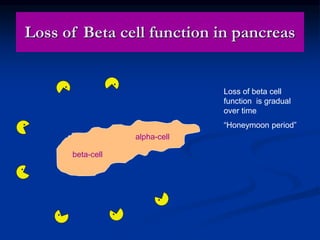
Loss of Beta cell function in pancreas
beta-cell
alpha-cell
Loss of beta cell
function is gradual
over time
“Honeymoon period”
Symptoms and signs
 Nausea
 Vomiting
 Abdominal pain
 Often preceding polyuria, polydipsia, weight loss
 Drowsiness/confusion/coma (severe)
 Kussmaul respiration - hyperventilation
 ‘Pear drops’ breath
 Sign of associated systemic illness (MI, infection,
etc)
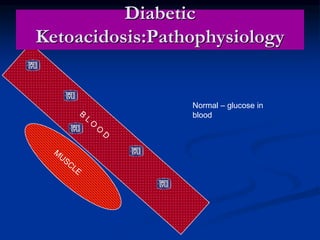
Diabetic
Ketoacidosis:Pathophysiology
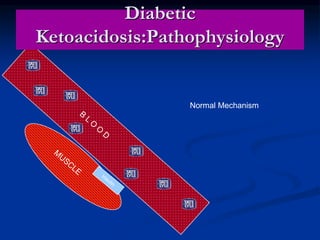
Normal – glucose in
blood
Diabetic
Ketoacidosis:Pathophysiology
Normal Mechanism
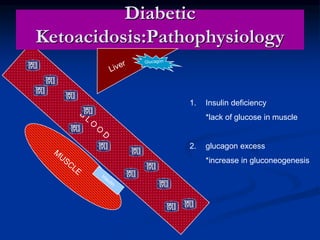
1. Insulin deficiency
*lack of glucose in muscle
2. glucagon excess
*increase in gluconeogenesis
Diabetic
Ketoacidosis:Pathophysiology
Diabetic
Ketoacidosis:Pathophysiology
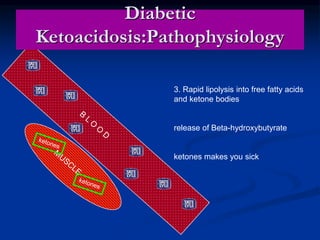
3. Rapid lipolysis into free fatty acids
and ketone bodies
release of Beta-hydroxybutyrate
ketones makes you sick
Diabetic
Ketoacidosis:Pathophysiology
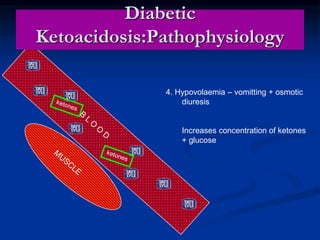
4. Hypovolaemia – vomitting + osmotic
diuresis
Increases concentration of ketones
+ glucose
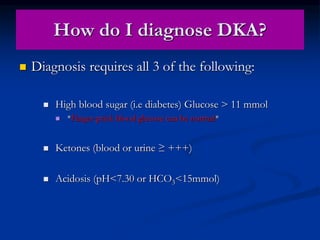
How do I diagnose DKA?
 Diagnosis requires all 3 of the following:
 High blood sugar (i.e diabetes) Glucose > 11 mmol
 *Finger-prick blood glucose can be normal*
 Ketones (blood or urine ≥ +++)
 Acidosis (pH<7.30 or HCO3<15mmol)
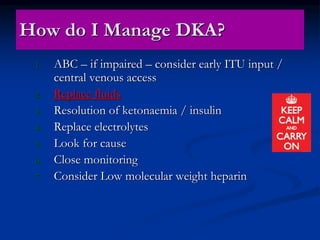
How do I Manage DKA?
1. ABC – if impaired – consider early ITU input /
central venous access
2. Replace fluids
3. Resolution of ketonaemia / insulin
4. Replace electrolytes
5. Look for cause
6. Close monitoring
7. Consider Low molecular weight heparin
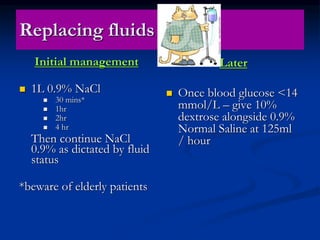
Replacing fluids
Initial management
 1L 0.9% NaCl
 30 mins*
 1hr
 2hr
 4 hr
Then continue NaCl
0.9% as dictated by fluid
status
*beware of elderly patients
Later
 Once blood glucose <14
mmol/L – give 10%
dextrose alongside 0.9%
Normal Saline at 125ml
/ hour
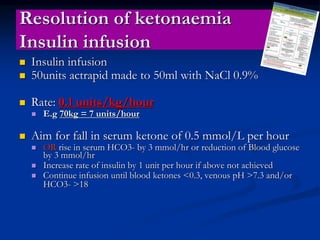
Resolution of ketonaemia
Insulin infusion
 Insulin infusion
 50units actrapid made to 50ml with NaCl 0.9%
 Rate: 0.1 units/kg/hour
 E.g 70kg = 7 units/hour
 Aim for fall in serum ketone of 0.5 mmol/L per hour
 OR rise in serum HCO3- by 3 mmol/hr or reduction of Blood glucose
by 3 mmol/hr
 Increase rate of insulin by 1 unit per hour if above not achieved
 Continue infusion until blood ketones <0.3, venous pH >7.3 and/or
HCO3- >18
Replace electrolytes
 K+ is most important
 Insulin shifts K+ into cells therefore K+ will fall as rehydrate
 Serum K+ ≥ 5.5
 No potassium supplement
 Serum K+ 3.5 - 5.4
 Add 20mmol per litre
 Serum K+ <3.5
 Add 40mmol per litre
 Hyponatraemia may occur due to osmotic effect of glucose - it will
correct with treatment of DKA
Monitoring
 Monitor urine output and vital signs closely
 catheterize
 Repeat U&E, glucose, VENOUS bicarbonate – ABG
PAINFUL
 2 – 4 hours, 6 - 8 hours, 12 hours, 24 hours
 Repeat ABG at 2 hours if not improving
 ? Alternative cause for acidosis e.g. lactate
Case
Nicholas Brown
Hyperosmolar
Hyperglycaemic State
(HHS)
(the artist formerly known as
Hyperosmolar Non Ketotic – HONK)
Features of HHS
 Possibly osmotic symptoms
 Dehydration around 10L deficit
 Decreased level of conciousness
 Signs of underlying infection in up to 50%
 +/- thrombo-embolism in up to 30%
 2/3 cases previously undiagnosed
 As high as 50% mortality – higher than DKA
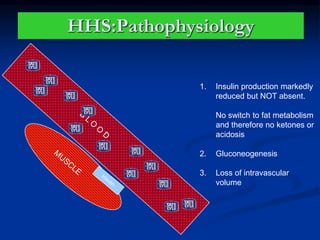
HHS:Pathophysiology
1. Insulin production markedly
reduced but NOT absent.
No switch to fat metabolism
and therefore no ketones or
acidosis
2. Gluconeogenesis
3. Loss of intravascular
volume
Diagnosis
 Diagnosis requires ALL of the following:
 Raised blood glucose (usually >30mmol)
 Absence of ketones (or + or ++ only)
 Serum osmolality >350mmol
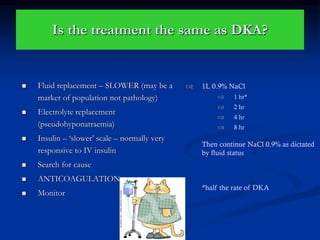
Is the treatment the same as DKA?
 Fluid replacement – SLOWER (may be a
marker of population not pathology)
 Electrolyte replacement
(pseudohyponatraemia)
 Insulin – ‘slower’ scale – normally very
responsive to IV insulin
 Search for cause
 ANTICOAGULATION
 Monitor
 1L 0.9% NaCl
 1 hr*
 2 hr
 4 hr
 8 hr
Then continue NaCl 0.9% as dictated
by fluid status
*half the rate of DKA
Insulin
 50units actrapid made to 50ml with NaCl 0.9%
 Rate: 0.1 units/kg/hour
 70kg = 7 units/hour
 More insulin sensitive
 Reduce rate if Blood glucose falls >10 mmol / hour
 Consider halving the rate within the first 1-2 hours
 Stop when patient is recovered
Case
Daniel Walters
Hypoglycaemia
Causes
 Insulin / medications
 Liver disease
 Insulinoma
Features of Hypoglycaemia
 Autonomic:
 sweating, palpitations, tremor, hunger
 Neuroglycopenic
 confusion, clumsiness, behavioural changes, seizures
 Non-specific
 nausea, headache, tiredness
 Symptoms may not present at the same level of blood
glucose
 Diagnosis with serum/capillary glucose (<3.0)
 *beware may not be accurate*
Treatment of hypoglycaemia
 If able to eat
 glucose: e.g 3 dextrosol tabs / 200mls of orange juice/ sugar
drinks
 followed by long acting carbohydrate eg toast/ sandwich
 In the community: 1mg glucagon im and long acting
carbohydrate on recovery
 Hospital options-
 I.M. glucagon 1mg
 I.V. 20ml of 50% dextrose*
 Other: hypostop
Other Metabolic Disorders
 Thyrotoxicosis
 Addisonian Crisis
 Initiate investigation of hypo and hyper natraemia and hypo and
hyperkalaemia initiate management of these conditions
 Recognise the circumstances when hypercalcaemia may occur
and initiate the management of hypercalcaemia
Case
Joanna Webbley
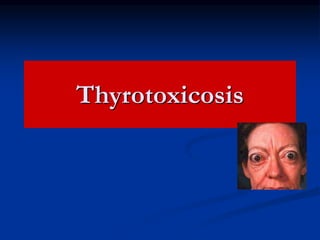
Thyrotoxicosis
Thyrotoxicosis
 Sweating
 Tachycardia with or without AF
 Nausea, vomiting and diarrhea
 Tremulousness and delirium, occasionally
apathetic
 Diarrhoea
 Exopthalmos (only in graves disease)
 Hyperpyrexia ( >40 0C )
Causes
 Graves Disease
 Thyroiditis (Hashimoto’s, de Quervain’s, etc)
 Primary hyperthyroid (multinodular goitre,
single nodule, etc)
 Exogenous thyroid
Diagnosis
 Free T4, Free T3 elevated
 TSH suppressed
 Thyroid antibodies (if autoimmune) present
Treatment
 Anti-thyroid medication
 Carbimazole (CMZ), Propylthiouracil (PTU)
 Beware of CMZ in pregnancy
 Beware of aggranulocytosis
 Beta blocker
 CMZ / PTU takes 2 weeks
 Beta blockade patient if symptomatic for 2-3 weeks
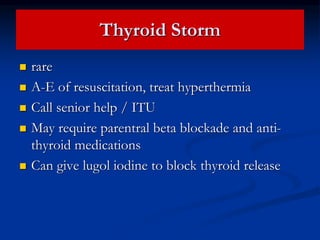
Thyroid Storm
 rare
 A-E of resuscitation, treat hyperthermia
 Call senior help / ITU
 May require parentral beta blockade and anti-
thyroid medications
 Can give lugol iodine to block thyroid release
Case
Brian Walker
Addison’s Disease
& Crisis
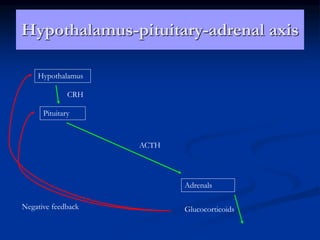
Hypothalamus-pituitary-adrenal axis
Hypothalamus
Pituitary
Adrenals
CRH
ACTH
GlucocorticoidsNegative feedback
Features
 rare
 Lack of cortisol
 Orthostatic hypotension, lethargy, faintings
 If autoimmune – dark/pigmented skin
 Causes:
 Iatrogenic : Adrenelectomy, sudden stop of long term
glucocorticoids
 Autoimmune
 Hypothalamic disease, pituitary disease, adrenal disease
Diagnosis
 Low random cortisol (not accurate)
 Short Synachten test
 Cortisol time 0
 Synacthen (artificial ACTH) Intramuscular
 Cortisol time 30 mins
 Interpretation
 Normal: increment of >200 nmol/L and 30min test
>600 nmol/L
Treatment
 Give Cortisol
 Intravenous 200 mg Hydrocotisone
 Oral Hydrocortisone
 10mg – 10/5mg – 5mg routine
 Normal adult required 20-30mg HC daily
 Remember:
 Sick patients require more cortisol
 5mg Prednisolone = 20mg Hydrocortisone
 STEROID CARD
Hyperkalaemia
 Normal range 3.5 – 4.5
 Danger of atrial / ventricular fibrillation
 Assess patient (A-E of resus)
 Re-check the Potassium levels (lab + blood gas)
 Stop offending drugs (spironolactone, amiloride)
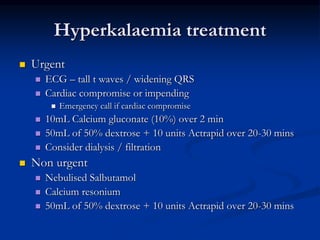
Hyperkalaemia treatment
 Urgent
 ECG – tall t waves / widening QRS
 Cardiac compromise or impending
 Emergency call if cardiac compromise
 10mL Calcium gluconate (10%) over 2 min
 50mL of 50% dextrose + 10 units Actrapid over 20-30 mins
 Consider dialysis / filtration
 Non urgent
 Nebulised Salbutamol
 Calcium resonium
 50mL of 50% dextrose + 10 units Actrapid over 20-30 mins
Hyper + Hypo natraemia
 Assess patient’s fluid status
 Hypovolaemia, euvolaemia, hypervolaemia
 Hypernatraemia
 Hyponatraemia
 Beware of acute vs chronic
hyper/hyponatraemia
Hyponatraemia
 Common in elderly
 If asymptomatic + chronic – may not need treatment
 Investigate cause: Addisons, SIADH
 Consider stopping the offending drug
 ACE-i, diuretics, omeprazole
 Main treatment:
 Fluid restrict if euvolaemia / hypervolaemia
 If unable to tolerate – consider V2 receptor antagonist
 If hypovolaemia– slow fluid resuscitation
 BEWARE – too quick replacement can cause Central
Pontine Myelinolysis
Hypernatraemia
 Assess fluid status
 Commonest cause is pure water loss
 Chronic vs acute
 Investigate cause: Conn’s, Diabetes insipidus
 Fluid replacement – slowly if chronic
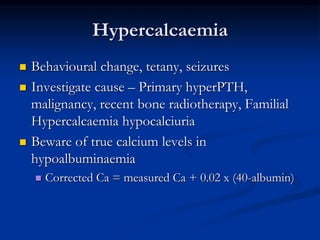
Hypercalcaemia
 Behavioural change, tetany, seizures
 Investigate cause – Primary hyperPTH,
malignancy, recent bone radiotherapy, Familial
Hypercalcaemia hypocalciuria
 Beware of true calcium levels in
hypoalbuminaemia
 Corrected Ca = measured Ca + 0.02 x (40-albumin)
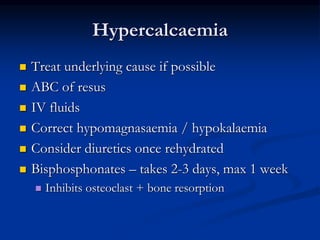
Hypercalcaemia
 Treat underlying cause if possible
 ABC of resus
 IV fluids
 Correct hypomagnasaemia / hypokalaemia
 Consider diuretics once rehydrated
 Bisphosphonates – takes 2-3 days, max 1 week
 Inhibits osteoclast + bone resorption
Thank you
Christian.Hariman@uhcw.nhs.uk

Endocrineرائع emergencies

  • 1.
  • 2.
    Objectives  Diabetic Emergencies •Recognise and participate in the management of diabetic ketoacidosis • Recognise and participate in the initial management of honk • Recognise and manage hypoglycaemia  Other Metabolic Disorders • Recognise the symptoms and signs of thyrotoxicosis • Manage thyrotoxicosis using medical therapy • Recognise and initiate the immediate management of Addisonian crisis • Initiate investigation of hypo and hyper natraemia and hypo and hyperkalaemia initiate management of these conditions • Recognise the circumstances when hypercalcaemia may occur and initiate the management of hypercalcaemia
  • 3.
    Diabetes Emergencies  DiabetesKetoacidosis  Hyperosmolar Non Ketosis (Hyperosmolar Hyperglycaemic state)  Hypoglycaemia
  • 4.
  • 5.
  • 6.
    Loss of Betacell function in pancreas beta-cell alpha-cell Loss of beta cell function is gradual over time “Honeymoon period”
  • 7.
    Symptoms and signs Nausea  Vomiting  Abdominal pain  Often preceding polyuria, polydipsia, weight loss  Drowsiness/confusion/coma (severe)  Kussmaul respiration - hyperventilation  ‘Pear drops’ breath  Sign of associated systemic illness (MI, infection, etc)
  • 8.
  • 9.
  • 10.
    1. Insulin deficiency *lackof glucose in muscle 2. glucagon excess *increase in gluconeogenesis Diabetic Ketoacidosis:Pathophysiology
  • 11.
    Diabetic Ketoacidosis:Pathophysiology 3. Rapid lipolysisinto free fatty acids and ketone bodies release of Beta-hydroxybutyrate ketones makes you sick
  • 12.
    Diabetic Ketoacidosis:Pathophysiology 4. Hypovolaemia –vomitting + osmotic diuresis Increases concentration of ketones + glucose
  • 13.
    How do Idiagnose DKA?  Diagnosis requires all 3 of the following:  High blood sugar (i.e diabetes) Glucose > 11 mmol  *Finger-prick blood glucose can be normal*  Ketones (blood or urine ≥ +++)  Acidosis (pH<7.30 or HCO3<15mmol)
  • 14.
    How do IManage DKA? 1. ABC – if impaired – consider early ITU input / central venous access 2. Replace fluids 3. Resolution of ketonaemia / insulin 4. Replace electrolytes 5. Look for cause 6. Close monitoring 7. Consider Low molecular weight heparin
  • 15.
    Replacing fluids Initial management 1L 0.9% NaCl  30 mins*  1hr  2hr  4 hr Then continue NaCl 0.9% as dictated by fluid status *beware of elderly patients Later  Once blood glucose <14 mmol/L – give 10% dextrose alongside 0.9% Normal Saline at 125ml / hour
  • 16.
    Resolution of ketonaemia Insulininfusion  Insulin infusion  50units actrapid made to 50ml with NaCl 0.9%  Rate: 0.1 units/kg/hour  E.g 70kg = 7 units/hour  Aim for fall in serum ketone of 0.5 mmol/L per hour  OR rise in serum HCO3- by 3 mmol/hr or reduction of Blood glucose by 3 mmol/hr  Increase rate of insulin by 1 unit per hour if above not achieved  Continue infusion until blood ketones <0.3, venous pH >7.3 and/or HCO3- >18
  • 17.
    Replace electrolytes  K+is most important  Insulin shifts K+ into cells therefore K+ will fall as rehydrate  Serum K+ ≥ 5.5  No potassium supplement  Serum K+ 3.5 - 5.4  Add 20mmol per litre  Serum K+ <3.5  Add 40mmol per litre  Hyponatraemia may occur due to osmotic effect of glucose - it will correct with treatment of DKA
  • 18.
    Monitoring  Monitor urineoutput and vital signs closely  catheterize  Repeat U&E, glucose, VENOUS bicarbonate – ABG PAINFUL  2 – 4 hours, 6 - 8 hours, 12 hours, 24 hours  Repeat ABG at 2 hours if not improving  ? Alternative cause for acidosis e.g. lactate
  • 19.
  • 20.
    Hyperosmolar Hyperglycaemic State (HHS) (the artistformerly known as Hyperosmolar Non Ketotic – HONK)
  • 21.
    Features of HHS Possibly osmotic symptoms  Dehydration around 10L deficit  Decreased level of conciousness  Signs of underlying infection in up to 50%  +/- thrombo-embolism in up to 30%  2/3 cases previously undiagnosed  As high as 50% mortality – higher than DKA
  • 22.
    HHS:Pathophysiology 1. Insulin productionmarkedly reduced but NOT absent. No switch to fat metabolism and therefore no ketones or acidosis 2. Gluconeogenesis 3. Loss of intravascular volume
  • 23.
    Diagnosis  Diagnosis requiresALL of the following:  Raised blood glucose (usually >30mmol)  Absence of ketones (or + or ++ only)  Serum osmolality >350mmol
  • 24.
    Is the treatmentthe same as DKA?  Fluid replacement – SLOWER (may be a marker of population not pathology)  Electrolyte replacement (pseudohyponatraemia)  Insulin – ‘slower’ scale – normally very responsive to IV insulin  Search for cause  ANTICOAGULATION  Monitor  1L 0.9% NaCl  1 hr*  2 hr  4 hr  8 hr Then continue NaCl 0.9% as dictated by fluid status *half the rate of DKA
  • 25.
    Insulin  50units actrapidmade to 50ml with NaCl 0.9%  Rate: 0.1 units/kg/hour  70kg = 7 units/hour  More insulin sensitive  Reduce rate if Blood glucose falls >10 mmol / hour  Consider halving the rate within the first 1-2 hours  Stop when patient is recovered
  • 26.
  • 27.
  • 28.
    Causes  Insulin /medications  Liver disease  Insulinoma
  • 29.
    Features of Hypoglycaemia Autonomic:  sweating, palpitations, tremor, hunger  Neuroglycopenic  confusion, clumsiness, behavioural changes, seizures  Non-specific  nausea, headache, tiredness  Symptoms may not present at the same level of blood glucose  Diagnosis with serum/capillary glucose (<3.0)  *beware may not be accurate*
  • 30.
    Treatment of hypoglycaemia If able to eat  glucose: e.g 3 dextrosol tabs / 200mls of orange juice/ sugar drinks  followed by long acting carbohydrate eg toast/ sandwich  In the community: 1mg glucagon im and long acting carbohydrate on recovery  Hospital options-  I.M. glucagon 1mg  I.V. 20ml of 50% dextrose*  Other: hypostop
  • 31.
    Other Metabolic Disorders Thyrotoxicosis  Addisonian Crisis  Initiate investigation of hypo and hyper natraemia and hypo and hyperkalaemia initiate management of these conditions  Recognise the circumstances when hypercalcaemia may occur and initiate the management of hypercalcaemia
  • 32.
  • 33.
  • 34.
    Thyrotoxicosis  Sweating  Tachycardiawith or without AF  Nausea, vomiting and diarrhea  Tremulousness and delirium, occasionally apathetic  Diarrhoea  Exopthalmos (only in graves disease)  Hyperpyrexia ( >40 0C )
  • 35.
    Causes  Graves Disease Thyroiditis (Hashimoto’s, de Quervain’s, etc)  Primary hyperthyroid (multinodular goitre, single nodule, etc)  Exogenous thyroid
  • 36.
    Diagnosis  Free T4,Free T3 elevated  TSH suppressed  Thyroid antibodies (if autoimmune) present
  • 37.
    Treatment  Anti-thyroid medication Carbimazole (CMZ), Propylthiouracil (PTU)  Beware of CMZ in pregnancy  Beware of aggranulocytosis  Beta blocker  CMZ / PTU takes 2 weeks  Beta blockade patient if symptomatic for 2-3 weeks
  • 38.
    Thyroid Storm  rare A-E of resuscitation, treat hyperthermia  Call senior help / ITU  May require parentral beta blockade and anti- thyroid medications  Can give lugol iodine to block thyroid release
  • 39.
  • 40.
  • 41.
  • 42.
    Features  rare  Lackof cortisol  Orthostatic hypotension, lethargy, faintings  If autoimmune – dark/pigmented skin  Causes:  Iatrogenic : Adrenelectomy, sudden stop of long term glucocorticoids  Autoimmune  Hypothalamic disease, pituitary disease, adrenal disease
  • 43.
    Diagnosis  Low randomcortisol (not accurate)  Short Synachten test  Cortisol time 0  Synacthen (artificial ACTH) Intramuscular  Cortisol time 30 mins  Interpretation  Normal: increment of >200 nmol/L and 30min test >600 nmol/L
  • 44.
    Treatment  Give Cortisol Intravenous 200 mg Hydrocotisone  Oral Hydrocortisone  10mg – 10/5mg – 5mg routine  Normal adult required 20-30mg HC daily  Remember:  Sick patients require more cortisol  5mg Prednisolone = 20mg Hydrocortisone  STEROID CARD
  • 45.
    Hyperkalaemia  Normal range3.5 – 4.5  Danger of atrial / ventricular fibrillation  Assess patient (A-E of resus)  Re-check the Potassium levels (lab + blood gas)  Stop offending drugs (spironolactone, amiloride)
  • 46.
    Hyperkalaemia treatment  Urgent ECG – tall t waves / widening QRS  Cardiac compromise or impending  Emergency call if cardiac compromise  10mL Calcium gluconate (10%) over 2 min  50mL of 50% dextrose + 10 units Actrapid over 20-30 mins  Consider dialysis / filtration  Non urgent  Nebulised Salbutamol  Calcium resonium  50mL of 50% dextrose + 10 units Actrapid over 20-30 mins
  • 47.
    Hyper + Hyponatraemia  Assess patient’s fluid status  Hypovolaemia, euvolaemia, hypervolaemia  Hypernatraemia  Hyponatraemia  Beware of acute vs chronic hyper/hyponatraemia
  • 48.
    Hyponatraemia  Common inelderly  If asymptomatic + chronic – may not need treatment  Investigate cause: Addisons, SIADH  Consider stopping the offending drug  ACE-i, diuretics, omeprazole  Main treatment:  Fluid restrict if euvolaemia / hypervolaemia  If unable to tolerate – consider V2 receptor antagonist  If hypovolaemia– slow fluid resuscitation  BEWARE – too quick replacement can cause Central Pontine Myelinolysis
  • 49.
    Hypernatraemia  Assess fluidstatus  Commonest cause is pure water loss  Chronic vs acute  Investigate cause: Conn’s, Diabetes insipidus  Fluid replacement – slowly if chronic
  • 50.
    Hypercalcaemia  Behavioural change,tetany, seizures  Investigate cause – Primary hyperPTH, malignancy, recent bone radiotherapy, Familial Hypercalcaemia hypocalciuria  Beware of true calcium levels in hypoalbuminaemia  Corrected Ca = measured Ca + 0.02 x (40-albumin)
  • 51.
    Hypercalcaemia  Treat underlyingcause if possible  ABC of resus  IV fluids  Correct hypomagnasaemia / hypokalaemia  Consider diuretics once rehydrated  Bisphosphonates – takes 2-3 days, max 1 week  Inhibits osteoclast + bone resorption
  • 52.