FLUID THERAPY BLOOD PRODUCTS
DURING PERIOPERATIVE PERIOD
Dr. Surekha Shaboo
Assistant Professor
Department of Anesthesiology &ICU
NIIMS
Total Body Water (TBW)
• Varies with age, gender
• 55% body weight in males
• 45% body weight in females
• 80% body weight in infants
• Less in obese: fat contains little water
Body Water Compartments
• Intracellular water: 2/3 of TBW
• Extracellular water: 1/3 TBW
- Extravascular water: 3/4 of extracellular
water
- Intravascular water: 1/4 of extracellular
water
Final Goals of Fluid
resuscitation
- Achievement of normovolemia& hemodynamic
stability
- Correction of major acid-base disturbances
- Compensation of internal fluid fluxes
- Maintain an adequate gradient between COP&PCWP
- Improvement of microvascular blood flow
- Prevention of cascade system activation
- Normalization of O2 delivery
- Prevention of reperfusion cellular injury
- Achievement of adequate urine output
Desirable outcome of fluid
resuscitation
- No peripheral edema
- No ARDS
Fluid and Electrolyte Regulation
• Volume Regulation
- Antidiuretic Hormone
- Renin/angiotensin/aldosterone system
- Baroreceptors in carotid arteries and aorta
- Stretch receptors in atrium and juxtaglomerular aparatus
- Cortisol
Fluid and Electrolyte Regulation
• Plasma Osmolality Regulation
- Arginine-Vasopressin (ADH)
- Central and Peripheral osmoreceptors
• Sodium Concentration Regulation
- Renin/angiotensin/aldosterone system
- Macula Densa of JG apparatus
Preoperative Evaluation
of Fluid Status
• Factors to Assess:
- h/o intake and output
- blood pressure: supine and standing
- heart rate
- skin turgor
- urinary output
- serum electrolytes/osmolarity
- mental status
Orthostatic Hypotension
• Systolic blood pressure decrease of greater than
20mmHg from supine to standing
• Indicates fluid deficit of 6-8% body weight
- Heart rate should increase as a compensatory measure
- If no increase in heart rate, may indicate autonomic
dysfunction or antihypertensive drug therapy
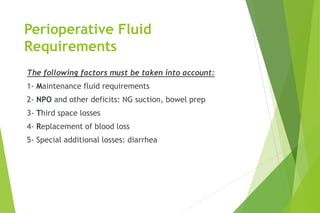
Perioperative Fluid
Requirements
The following factors must be taken into account:
1- Maintenance fluid requirements
2- NPO and other deficits: NG suction, bowel prep
3- Third space losses
4- Replacement of blood loss
5- Special additional losses: diarrhea
1- Maintenance Fluid Requirements
• Insensible losses such as evaporation of water from respiratory
tract, sweat, feces, urinary excretion. Occurs continually.
• Adults: approximately 1.5 ml/kg/hr
• “4-2-1 Rule”
- 4 ml/kg/hr for the first 10 kg of body weight
- 2 ml/kg/hr for the second 10 kg body weight
- 1 ml/kg/hr subsequent kg body weight
- Extra fluid for fever, tracheotomy, denuded surfaces
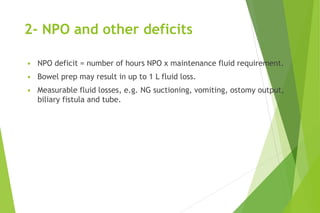
2- NPO and other deficits
• NPO deficit = number of hours NPO x maintenance fluid requirement.
• Bowel prep may result in up to 1 L fluid loss.
• Measurable fluid losses, e.g. NG suctioning, vomiting, ostomy output,
biliary fistula and tube.
3- Third Space Losses
• Isotonic transfer of ECF from functional body fluid compartments to
non-functional compartments.
• Depends on location and duration of surgical procedure, amount of
tissue trauma, ambient temperature, room ventilation.
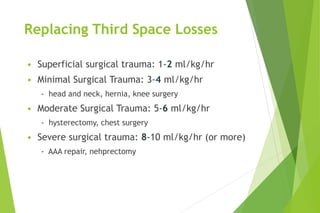
Replacing Third Space Losses
• Superficial surgical trauma: 1-2 ml/kg/hr
• Minimal Surgical Trauma: 3-4 ml/kg/hr
- head and neck, hernia, knee surgery
• Moderate Surgical Trauma: 5-6 ml/kg/hr
- hysterectomy, chest surgery
• Severe surgical trauma: 8-10 ml/kg/hr (or more)
- AAA repair, nehprectomy
4- Blood Loss
• Replace 3 cc of crystalloid solution per cc of blood loss (crystalloid
solutions leave the intravascular space)
• When using blood products or colloids replace blood loss volume per
volume
5- Other additional losses
• Ongoing fluid losses from other sites:
- gastric drainage
- ostomy output
- diarrhea
• Replace volume per volume with crystalloid solutions
Example
• 62 y/o male, 80 kg, for hemicolectomy
• NPO after 2200, surgery at 0800, received bowel prep
• 3 hr. procedure, 500 cc blood loss
• What are his estimated intraoperative fluid requirements?
Example (cont.)
• Fluid deficit (NPO): 1.5 ml/kg/hr x 10 hrs = 1200 ml + 1000 ml for
bowel prep = 2200 ml total deficit: (Replace 1/2 first hr, 1/4 2nd hr,
1/4 3rd hour).
• Maintenance: 1.5 ml/kg/hr x 3hrs = 360mls
• Third Space Losses: 6 ml/kg/hr x 3 hrs =1440 mls
• Blood Loss: 500ml x 3 = 1500ml
• Total = 2200+360+1440+1500=5500mls
Intravenous Fluids:
• Conventional Crystalloids
• Colloids
• Hypertonic Solutions
• Blood/blood products and blood substitutes
Crystalloids
• Combination of water and electrolytes
- Balanced salt solution: electrolyte composition and osmolality like
plasma; example: lactated Ringer’s, Plasmlyte, Normosol.
- Hypotonic salt solution: electrolyte composition lower than that of
plasma; example: D5W.
- Hypertonic salt solution: 2.7% NaCl.
Crystalloids in trauma
Advantages:
-Balanced electrolyte solutions
-Buffering capacity (Lactate)
-Easy to administer
-No risk of adverse reactions
-No disturbance of hemostasis
-Promote diuresis
-Inexpensive
Crystalloids contin…
Disadvantages:
-Poor plasma volume support
-Large quantities needed
-Risk of Hypothermia
-Reduced plasma COP
-Risk of edema
Crystalloid solutions
NaCl
Isotonic 0.9%: 9g/l , Na 154, Cl 154,
Osmolarity: 304mosmol/l
Disadvantages: Hyper-chloremic acidosis
Hypertonic Solutions
• Fluids containing sodium concentrations greater than normal saline.
• Available in 1.8%, 2.7%, 3%, 5%, 7.5%, 10% solutions.
• Hyperosmolarity creates a gradient that draws water out of cells;
therefore, cellular dehydration is a potential problem.
Hypertonic saline
Advantages:
-Small volume for resuscitation.
-Osmotic effect
-Inotropic effect ( increase calcium influx in sarculima )
-Direct vasodilator effect
-Increase MAP, CO
-Increase renal, mesenteric,splanchnic, coronary blood flow.
Hypertonic saline
Disadvantages:
• increase hemorrhage from open vessels.
• Hypernatremia
• Hyperchloremia.
• Metabolic acidosis.
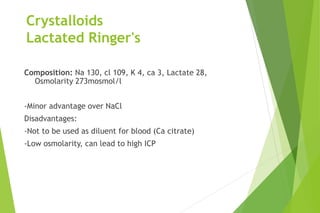
Crystalloids
Lactated Ringer's
Composition: Na 130, cl 109, K 4, ca 3, Lactate 28,
Osmolarity 273mosmol/l
-Minor advantage over NaCl
Disadvantages:
-Not to be used as diluent for blood (Ca citrate)
-Low osmolarity, can lead to high ICP
Crystalloids
Dextrose 5%
Composition: 50g/l, provides 170kcal/l
Disadvantages:
-enhance CO2 production
-enhance lactate production
-aggravate ischemic brain injury
Composition
Fluid Osmo-
lality
Na Cl K
D5W 253 0 0 0
0.9NS 308 154 154 0
LR 273 130 109 4.0
Plasma-lyte 294 140 98 5.0
Hespan 310 154 154 0
5% Albumin 308 145 145 0
3%Saline 1027 513 513 0
Colloids
• Fluids containing molecules sufficiently large enough to prevent transfer across
capillary membranes.
• Solutions stay in the space into which they are infused.
• Examples: hetastarch (Hespan), albumin, dextran.
Colloids
Advantages:
-Prolonged plasma volume support
-Moderate volume needed
-minimal risk of tissue edema
-enhances microvascular flow
Colloids
Disadvantages:
Risk of volume overload
Adverse effect on hemostasis
Adverse effect on renal function
Anaphylactic reaction
Expensive
Dextran
Composition: 40/70
Inhibit platelet aggregation
bleeding
Gelatins
 Derived from hydrolyzed bovine collagen
 Metabolized by serum collagenase
 0.5-5hr
 Histamine release (H1 blockers recommended)
 Decreases Von W factor (VWF)
Albumins
 Heat treated preparation of human serum
5% (50g/l), 25% (250g/l)
 Half of infused volume will stay intravascular
 COP=20mmHg=plasma
 25%, COP=70mmHg, it will expand the vascular space
by 4-5 times the volume infused
 25% used only in case of hypoalbuminemia
Hetastarch 6%
Composition: synthetic colloid, 6% preparation in isotonic
saline MW 240,000 D- DS 0.7
Advantages: low cost, more potent than 5% albumin (COP
30)
Disadvantages: Hyperamylesemia, allergy, coagulopathy
Dose: 15-30ml/kg/day
Pentastarch 10%
-MW: 200,000 D- DS 0.5
-Low cost
-Extensive clinical use in sepsis, burns..
-Low permeability index
-Good clinical safety
-Decreases PMN-EC activation
-Potential to diminish vascular permeability and
reduces
tissue edema
Tetrastarch (Voluven)
MW 130,000 D- DS 0.4
Used for volume therapy
Dose: 50ml/kg/day
Crystalloids Colloids
IVVP Poor Good
Hemod Stability Transient Prolong
Infusate volume Large Moderate
Plasma COP Reduced Maintain
Tissue edema Obvious Insignific
Anaphylaxis Non-exist low-mod
Cost Inexpensive Expensive
Crystalloids OR Colloids
ACS protocol for ATLS: replace each ml of blood loss
with 3 ml of crystalloid fluid. 3 for 1 rule.
Patient response:
 Rapid
 Transient
 Non-responsive
Clinical Evaluation of Fluid
Replacement
 Urine Output: at least 1.0 ml/kg/hr
 Vital Signs: BP and HR normal (How is the patient doing?)
 Physical Assessment: Skin and mucous membranes no dry; no thirst in
an awake patient
 Invasive monitoring; CVP or PCWP may be used as a guide
 Laboratory tests: periodic monitoring of hemoglobin and hematocrit
Summary
• Fluid therapy is critically important during the perioperative period.
• The most important goal is to maintain hemodynamic stability and
protect vital organs from hypoperfusion (heart, liver, brain, kidneys).
• All sources of fluid losses must be accounted for.
• Good fluid management goes a long way toward preventing problems.
Transfusion Therapy
- 60% of transfusions occur perioperatively.
- responsibility of transfusing perioperatively is with the
anesthesiologist.
Blood Transfusion
(up to 30% of blood volume can be treated with crystalloids)
Why?
-Improvement of oxygen transport
-Restoration of red cell mass
-Correction of bleeding caused by platelet dysfunction
-Correction of bleeding caused by factor deficiencies
When is Transfusion Necessary?
• “Transfusion Trigger”: Hgb level at which transfusion
should be given.
- Varies with patients and procedures
• Tolerance of acute anemia depends on:
- Maintenance of intravascular volume
- Ability to increase cardiac output
- Increases in 2,3-DPG to deliver more of the carried oxygen to tissues
Oxygen Delivery
• Oxygen Delivery (DO2) is the oxygen that is delivered to the tissues
DO2= COP x CaO2
• Cardiac Output (CO) = HR x SV
• Oxygen Content (CaO2):
- (Hgb x 1.39)O2 saturation + PaO2(0.003)
- Hgb is the main determinant of oxygen content in the blood
Oxygen Delivery (cont.)
• Therefore: DO2 = HR x SV x CaO2
• If HR or SV are unable to compensate, Hgb is the major deterimant factor in O2
delivery
• Healthy patients have excellent compensatory mechanisms and can tolerate
Hgb levels of 7 gm/dL.
• Compromised patients may require Hgb levels above 10 gm/dL.
Blood Groups
Antigen on Plasma Incidence
Blood Group erythrocyteAntibodies White African-
Americans
A A Anti-B 40% 27%
B B Anti-A 11 20
AB AB None 4 4
O None Anti-A 45 49
Anti-B
Rh Rh 42 17
Cross Match
• Major:
- Donor’s erythrocytes incubated with recipients' plasma
• Minor:
- Donor’s plasma incubated with recipients' erythrocytes
• Agglutination:
- Occurs if either is incompatible
• Type Specific:
- Only ABO-Rh determined; chance of hemolytic reaction is 1:1000
with TS blood
Type and Screen
• Donated blood that has been tested for ABO/Rh antigens and screened
for common antibodies (not mixed with recipient blood).
- Used when usage of blood is unlikely but needs to be available
(hysterectomy).
- Allows blood to available for other patients.
- Chance of hemolytic reaction: 1:10,000.
Differential Centrifugation
First Centrifugation
Whole Blood
Main Bag
Satellite Bag
1
Satellite Bag
2
RBC’s
Platelet-rich
Plasma
First
Closed System
Differential Centrifugation
Second Centrifugation
Platelet-rich
Plasma
RBC’s
Platelet
Concentrate
RBC’s
Plasma
Second
Blood Components
 Prepared from Whole blood collection
 Whole blood is separated by differential centrifugation
 Red Blood Cells (RBC’s)
 Platelets
 Plasma
 Cryoprecipitate
 Others
 Others include Plasma proteins—IVIg, Coagulation
Factors, albumin, Anti-D, Growth Factors, Colloid volume
expanders
Whole Blood
 Storage
 4° for up to 35 days
 Indications
 Massive Blood Loss/Trauma/Exchange Transfusion
 Considerations
 Use filter as platelets and coagulation factors will not
be active after 3-5 days
 Donor and recipient must be ABO identical
Component Therapy
• A unit of whole blood is divided into components; Allows prolonged
storage and specific treatment of underlying problem with increased
efficiency:
- packed red blood cells (pRBC’s)
- platelet concentrate
- fresh frozen plasma (contains all clotting factors)
- cryoprecipitate (contains factors VIII and fibrinogen; used in Von
Willebrand’s disease)
- albumin
- plasma protein fraction
- leukocyte poor blood
- factor VIII
- antibody concentrates
Packed Red Blood Cells
• 1 unit = 250 ml. Hct. = 70-80%.
• 1 unit pRBC’s raises Hgb 1 gm/dL.
• Mixed with saline: LR has Calcium which may cause clotting if mixed
with pRBC’s.
RBC Transfusions
Administration
 Dose
 Usual dose of 10 cc/kg infused over 2-4 hours
 Maximum dose 15-20 cc/kg can be given to hemodynamically
stable patient
 Procedure
 May need Premedication (Tylenol and/or Benadryl)
 Filter use—routinely leukodepleted
 Monitoring—VS q 15 minutes, clinical status
 Do NOT mix with medications
 Complications
 Rapid infusion may result in Pulmonary edema
 Transfusion Reaction
Platelet Concentrate
 Storage
 Up to 5 days at 20-24°
 Indications
 Thrombocytopenia, Plt <15,000
 Bleeding and Plt <50,000
 Invasive procedure and Plt <50,000
 Considerations
 Contain Leukocytes and cytokines
 1 unit/10 kg of body weight increases Plt count by
50,000
 Donor and Recipient must be ABO identical
Plasma and FFP
 Contents—Coagulation Factors (1 unit/ml)
 Storage
 FFP--12 months at –18 degrees or colder
 Indications
 Coagulation Factor deficiency, fibrinogen replacement,
DIC, liver disease, exchange transfusion, massive
transfusion
 Considerations
 Plasma should be recipient RBC ABO compatible
 In children, should also be Rh compatible
 Usual dose is 20 cc/kg to raise coagulation factors
approx 20%
Transfusion Complications
Acute Transfusion Reactions
(ATR’s)
Chronic Transfusion Reactions
Transfusion related infections
Acute Transfusion Reactions
 Hemolytic Reactions (AHTR)
 Febrile Reactions (FNHTR)
 Allergic Reactions
 TRALI
 Coagulopathy with Massive transfusions
 Bacteremia
Complications of Blood Therapy
• Transfusion Reactions:
- Febrile; most common, usually controlled by slowing infusion and
giving antipyretics
- Allergic; increased body temp., pruritis, urticaria. Rx:
antihistamine,discontinuation. Examination of plasma and urine for
free hemoglobin helps rule out hemolytic reactions.
Complications of Blood Therapy (cont.)
• Hemolytic:
- Wrong blood type administered (oops).
- Activation of complement system leads to intravascular hemolysis,
spontaneous hemorrhage.
Signs:
hypotension,
fever, chills
dyspnea, skin flushing,
substernal pain , Back/abdominal pain
Oliguria Dark urine Pallor
Complications of Blood Therapy
(cont.)
Signs are easily masked by general anesthesia.
- Free Hgb in plasma or urine
- Acute renal failure
- Disseminated Intravascular Coagulation (DIC)
Complications (cont.)
• Transmission of Viral Diseases:
- Hepatitis C; 1:30,000 per unit
- Hepatitis B; 1:200,000 per unit
- HIV; 1:450,000-1:600,000 per unit
- 22 day window for HIV infection and test detection
- CMV may be the most common agent transmitted, but only effects
immuno-compromised patients
- Parasitic and bacterial transmission very low
Other Complications
- Decreased 2,3-DPG with storage: ? Significance
- Citrate: metabolism to bicarbonate; Calcium binding
- Microaggregates (platelets, leukocytes): micropore
filters controversial
- Hypothermia: warmers used to prevent
- Coagulation disorders: massive transfusion (>10 units)
may lead to dilution of platelets and factor V and VIII.
- DIC: uncontrolled activation of coagulation system
Treatment of Acute Hemolytic
Reactions
• Immediate discontinuation of blood products and send blood bags to
lab.
• Maintenance of urine output with crystalloid infusions
• Administration of mannitol or Furosemide for diuretic effect
Massive Blood Transfusion
 Massive transfusion is generally defined as the need to
transfuse one to two times the patient's blood volume. For most
adult patients, that is the equivalent of 10–20 units
Massive Blood Transfusion
 Coagulopathy due to dilutional thrombocytopenia. And
dilution of the coagulation factors
 Citrate Toxicity does not occur in most normal patients
unless the transfusion rate exceeds 1 U every 5 min
 Hypothermia
 Acid–Base Balance The most consistent acid–base
abnormality after massive blood transfusion is
postoperative metabolic alkalosis
Massive Blood Transfusion
 Serum Potassium Concentration
The extracellular concentration of potassium in stored
blood steadily increases with time.
The amount of eacellular potassium transfused with each
unit less than 4 mEq per unit. Hyperkalemia can develop
regardless of the age of the blood when transfusion rates
exceed 100 mL/min.
Hypokalemia is commonly encountered postoperatively,
particularly in association with metabolic alkalosis
DIC
Type Definition Diagnosis Lab
Biological Hemostatic defect high D-Dimers and
DD≥500ug/l
without clinical SS major or minor
criteria Plat 50-100,000
of platelet
consumption
Clinical Hemostatic defect+He same above+microvasc INR 1.2-
1.5
bleeding
Complicated +ischemia +organ failure
Autologous Blood
• Pre-donation of patient’s own blood prior to elective surgery
• 1 unit donated every 4 days (up to 3 units)
• Last unit donated at least 72 hrs prior to surgery
• Reduces chance of hemolytic reactions and transmission of blood-bourne
diseases
• Not desirable for compromised patients
Administering Blood Products
- Consent necessary for elective transfusion
- Unit is checked by 2 people for Unit #, patient ID, expiration date, physical
appearance.
- pRBC’s are mixed with saline solution (not LR)
- Products are warmed mechanically and given slowly if condition permits
- Close observation of patient for signs of complications
- If complications suspected, infusion discontinued, blood bank notified, proper steps
taken.
Alternatives to Blood Products
• Autotransfusion
• Blood substitutes
Autotransfusion
• Commonly known as “Cell-saver”
• Allows collection of blood during surgery for re-administration
• RBC’s centrifuged from plasma
• Effective when > 1000ml are collected
Blood Substitutes
• Experimental oxygen-carrying solutions: developed to decrease
dependence on human blood products
• Military battlefield usage initial goal
• Multiple approaches:
- Outdated human Hgb reconstituted in solution
- Genetically engineered/bovine Hgb in solution
- Liposome-encapsulated Hgb
- Perflurocarbons
Blood Substitutes (cont.)
• Potential Advantages:
- No cross-match requirements
- Long-term shelf storage
- No blood-bourne transmission
- Rapid restoration of oxygen delivery in traumatized patients
- Easy access to product (available on ambulances, field hospitals, hospital ships)
Blood Substitutes (cont.)
• Potential Disadvantages:
- Undesirable hemodynamic effects:
• Mean arterial pressure and pulmonary artery pressure increases
- Short half-life in bloodstream (24 hrs)
- Still in clinical trials, unproven efficacy
- High cost
Transfusion Therapy Summary
• Decision to transfuse involves many factors
• Availability of component factors allows treatment of specific
deficiency
• Risks of transfusion must be understood and explained to patients and
patient should be consented
• Vigilance necessary when transfusing any blood product
What to do?
If an AHTR occurs
 STOP TRANSFUSION
 ABC’s
 Maintain IV access and run IVF (NS or LR)
 Monitor and maintain BP/pulse
 Give diuretic
 Obtain blood and urine for transfusion reaction workup
 Send remaining blood back to Blood Bank
Blood Bank Work-up of AHTR
 Check paperwork to assure no errors
 Check plasma for hemoglobin
 Repeat crossmatch
 Repeat Blood group typing
 Blood culture
Monitoring in AHTR
 Monitor patient clinical status and vital signs
 Monitor renal status (BUN, creatinine)
 Monitor coagulation status (DIC panel– PT/PTT,
fibrinogen, D-dimer/FDP, Plt, Antithrombin-III)
 Monitor for signs of hemolysis (LDH, bili, haptoglobin)
THANK YOU

fluids therapy perioperative presentation

  • 1.
    FLUID THERAPY BLOODPRODUCTS DURING PERIOPERATIVE PERIOD Dr. Surekha Shaboo Assistant Professor Department of Anesthesiology &ICU NIIMS
  • 2.
    Total Body Water(TBW) • Varies with age, gender • 55% body weight in males • 45% body weight in females • 80% body weight in infants • Less in obese: fat contains little water
  • 3.
    Body Water Compartments •Intracellular water: 2/3 of TBW • Extracellular water: 1/3 TBW - Extravascular water: 3/4 of extracellular water - Intravascular water: 1/4 of extracellular water
  • 5.
    Final Goals ofFluid resuscitation - Achievement of normovolemia& hemodynamic stability - Correction of major acid-base disturbances - Compensation of internal fluid fluxes - Maintain an adequate gradient between COP&PCWP - Improvement of microvascular blood flow - Prevention of cascade system activation - Normalization of O2 delivery - Prevention of reperfusion cellular injury - Achievement of adequate urine output
  • 6.
    Desirable outcome offluid resuscitation - No peripheral edema - No ARDS
  • 7.
    Fluid and ElectrolyteRegulation • Volume Regulation - Antidiuretic Hormone - Renin/angiotensin/aldosterone system - Baroreceptors in carotid arteries and aorta - Stretch receptors in atrium and juxtaglomerular aparatus - Cortisol
  • 8.
    Fluid and ElectrolyteRegulation • Plasma Osmolality Regulation - Arginine-Vasopressin (ADH) - Central and Peripheral osmoreceptors • Sodium Concentration Regulation - Renin/angiotensin/aldosterone system - Macula Densa of JG apparatus
  • 9.
    Preoperative Evaluation of FluidStatus • Factors to Assess: - h/o intake and output - blood pressure: supine and standing - heart rate - skin turgor - urinary output - serum electrolytes/osmolarity - mental status
  • 10.
    Orthostatic Hypotension • Systolicblood pressure decrease of greater than 20mmHg from supine to standing • Indicates fluid deficit of 6-8% body weight - Heart rate should increase as a compensatory measure - If no increase in heart rate, may indicate autonomic dysfunction or antihypertensive drug therapy
  • 11.
    Perioperative Fluid Requirements The followingfactors must be taken into account: 1- Maintenance fluid requirements 2- NPO and other deficits: NG suction, bowel prep 3- Third space losses 4- Replacement of blood loss 5- Special additional losses: diarrhea
  • 12.
    1- Maintenance FluidRequirements • Insensible losses such as evaporation of water from respiratory tract, sweat, feces, urinary excretion. Occurs continually. • Adults: approximately 1.5 ml/kg/hr • “4-2-1 Rule” - 4 ml/kg/hr for the first 10 kg of body weight - 2 ml/kg/hr for the second 10 kg body weight - 1 ml/kg/hr subsequent kg body weight - Extra fluid for fever, tracheotomy, denuded surfaces
  • 13.
    2- NPO andother deficits • NPO deficit = number of hours NPO x maintenance fluid requirement. • Bowel prep may result in up to 1 L fluid loss. • Measurable fluid losses, e.g. NG suctioning, vomiting, ostomy output, biliary fistula and tube.
  • 14.
    3- Third SpaceLosses • Isotonic transfer of ECF from functional body fluid compartments to non-functional compartments. • Depends on location and duration of surgical procedure, amount of tissue trauma, ambient temperature, room ventilation.
  • 15.
    Replacing Third SpaceLosses • Superficial surgical trauma: 1-2 ml/kg/hr • Minimal Surgical Trauma: 3-4 ml/kg/hr - head and neck, hernia, knee surgery • Moderate Surgical Trauma: 5-6 ml/kg/hr - hysterectomy, chest surgery • Severe surgical trauma: 8-10 ml/kg/hr (or more) - AAA repair, nehprectomy
  • 16.
    4- Blood Loss •Replace 3 cc of crystalloid solution per cc of blood loss (crystalloid solutions leave the intravascular space) • When using blood products or colloids replace blood loss volume per volume
  • 17.
    5- Other additionallosses • Ongoing fluid losses from other sites: - gastric drainage - ostomy output - diarrhea • Replace volume per volume with crystalloid solutions
  • 18.
    Example • 62 y/omale, 80 kg, for hemicolectomy • NPO after 2200, surgery at 0800, received bowel prep • 3 hr. procedure, 500 cc blood loss • What are his estimated intraoperative fluid requirements?
  • 19.
    Example (cont.) • Fluiddeficit (NPO): 1.5 ml/kg/hr x 10 hrs = 1200 ml + 1000 ml for bowel prep = 2200 ml total deficit: (Replace 1/2 first hr, 1/4 2nd hr, 1/4 3rd hour). • Maintenance: 1.5 ml/kg/hr x 3hrs = 360mls • Third Space Losses: 6 ml/kg/hr x 3 hrs =1440 mls • Blood Loss: 500ml x 3 = 1500ml • Total = 2200+360+1440+1500=5500mls
  • 20.
    Intravenous Fluids: • ConventionalCrystalloids • Colloids • Hypertonic Solutions • Blood/blood products and blood substitutes
  • 21.
    Crystalloids • Combination ofwater and electrolytes - Balanced salt solution: electrolyte composition and osmolality like plasma; example: lactated Ringer’s, Plasmlyte, Normosol. - Hypotonic salt solution: electrolyte composition lower than that of plasma; example: D5W. - Hypertonic salt solution: 2.7% NaCl.
  • 22.
    Crystalloids in trauma Advantages: -Balancedelectrolyte solutions -Buffering capacity (Lactate) -Easy to administer -No risk of adverse reactions -No disturbance of hemostasis -Promote diuresis -Inexpensive
  • 23.
    Crystalloids contin… Disadvantages: -Poor plasmavolume support -Large quantities needed -Risk of Hypothermia -Reduced plasma COP -Risk of edema
  • 24.
    Crystalloid solutions NaCl Isotonic 0.9%:9g/l , Na 154, Cl 154, Osmolarity: 304mosmol/l Disadvantages: Hyper-chloremic acidosis
  • 25.
    Hypertonic Solutions • Fluidscontaining sodium concentrations greater than normal saline. • Available in 1.8%, 2.7%, 3%, 5%, 7.5%, 10% solutions. • Hyperosmolarity creates a gradient that draws water out of cells; therefore, cellular dehydration is a potential problem.
  • 26.
    Hypertonic saline Advantages: -Small volumefor resuscitation. -Osmotic effect -Inotropic effect ( increase calcium influx in sarculima ) -Direct vasodilator effect -Increase MAP, CO -Increase renal, mesenteric,splanchnic, coronary blood flow.
  • 27.
    Hypertonic saline Disadvantages: • increasehemorrhage from open vessels. • Hypernatremia • Hyperchloremia. • Metabolic acidosis.
  • 28.
    Crystalloids Lactated Ringer's Composition: Na130, cl 109, K 4, ca 3, Lactate 28, Osmolarity 273mosmol/l -Minor advantage over NaCl Disadvantages: -Not to be used as diluent for blood (Ca citrate) -Low osmolarity, can lead to high ICP
  • 29.
    Crystalloids Dextrose 5% Composition: 50g/l,provides 170kcal/l Disadvantages: -enhance CO2 production -enhance lactate production -aggravate ischemic brain injury
  • 30.
    Composition Fluid Osmo- lality Na ClK D5W 253 0 0 0 0.9NS 308 154 154 0 LR 273 130 109 4.0 Plasma-lyte 294 140 98 5.0 Hespan 310 154 154 0 5% Albumin 308 145 145 0 3%Saline 1027 513 513 0
  • 31.
    Colloids • Fluids containingmolecules sufficiently large enough to prevent transfer across capillary membranes. • Solutions stay in the space into which they are infused. • Examples: hetastarch (Hespan), albumin, dextran.
  • 32.
    Colloids Advantages: -Prolonged plasma volumesupport -Moderate volume needed -minimal risk of tissue edema -enhances microvascular flow
  • 33.
    Colloids Disadvantages: Risk of volumeoverload Adverse effect on hemostasis Adverse effect on renal function Anaphylactic reaction Expensive
  • 34.
  • 35.
    Gelatins  Derived fromhydrolyzed bovine collagen  Metabolized by serum collagenase  0.5-5hr  Histamine release (H1 blockers recommended)  Decreases Von W factor (VWF)
  • 36.
    Albumins  Heat treatedpreparation of human serum 5% (50g/l), 25% (250g/l)  Half of infused volume will stay intravascular  COP=20mmHg=plasma  25%, COP=70mmHg, it will expand the vascular space by 4-5 times the volume infused  25% used only in case of hypoalbuminemia
  • 37.
    Hetastarch 6% Composition: syntheticcolloid, 6% preparation in isotonic saline MW 240,000 D- DS 0.7 Advantages: low cost, more potent than 5% albumin (COP 30) Disadvantages: Hyperamylesemia, allergy, coagulopathy Dose: 15-30ml/kg/day
  • 38.
    Pentastarch 10% -MW: 200,000D- DS 0.5 -Low cost -Extensive clinical use in sepsis, burns.. -Low permeability index -Good clinical safety -Decreases PMN-EC activation -Potential to diminish vascular permeability and reduces tissue edema
  • 39.
    Tetrastarch (Voluven) MW 130,000D- DS 0.4 Used for volume therapy Dose: 50ml/kg/day
  • 40.
    Crystalloids Colloids IVVP PoorGood Hemod Stability Transient Prolong Infusate volume Large Moderate Plasma COP Reduced Maintain Tissue edema Obvious Insignific Anaphylaxis Non-exist low-mod Cost Inexpensive Expensive
  • 42.
    Crystalloids OR Colloids ACSprotocol for ATLS: replace each ml of blood loss with 3 ml of crystalloid fluid. 3 for 1 rule. Patient response:  Rapid  Transient  Non-responsive
  • 43.
    Clinical Evaluation ofFluid Replacement  Urine Output: at least 1.0 ml/kg/hr  Vital Signs: BP and HR normal (How is the patient doing?)  Physical Assessment: Skin and mucous membranes no dry; no thirst in an awake patient  Invasive monitoring; CVP or PCWP may be used as a guide  Laboratory tests: periodic monitoring of hemoglobin and hematocrit
  • 44.
    Summary • Fluid therapyis critically important during the perioperative period. • The most important goal is to maintain hemodynamic stability and protect vital organs from hypoperfusion (heart, liver, brain, kidneys). • All sources of fluid losses must be accounted for. • Good fluid management goes a long way toward preventing problems.
  • 45.
    Transfusion Therapy - 60%of transfusions occur perioperatively. - responsibility of transfusing perioperatively is with the anesthesiologist.
  • 46.
    Blood Transfusion (up to30% of blood volume can be treated with crystalloids) Why? -Improvement of oxygen transport -Restoration of red cell mass -Correction of bleeding caused by platelet dysfunction -Correction of bleeding caused by factor deficiencies
  • 47.
    When is TransfusionNecessary? • “Transfusion Trigger”: Hgb level at which transfusion should be given. - Varies with patients and procedures • Tolerance of acute anemia depends on: - Maintenance of intravascular volume - Ability to increase cardiac output - Increases in 2,3-DPG to deliver more of the carried oxygen to tissues
  • 48.
    Oxygen Delivery • OxygenDelivery (DO2) is the oxygen that is delivered to the tissues DO2= COP x CaO2 • Cardiac Output (CO) = HR x SV • Oxygen Content (CaO2): - (Hgb x 1.39)O2 saturation + PaO2(0.003) - Hgb is the main determinant of oxygen content in the blood
  • 49.
    Oxygen Delivery (cont.) •Therefore: DO2 = HR x SV x CaO2 • If HR or SV are unable to compensate, Hgb is the major deterimant factor in O2 delivery • Healthy patients have excellent compensatory mechanisms and can tolerate Hgb levels of 7 gm/dL. • Compromised patients may require Hgb levels above 10 gm/dL.
  • 50.
    Blood Groups Antigen onPlasma Incidence Blood Group erythrocyteAntibodies White African- Americans A A Anti-B 40% 27% B B Anti-A 11 20 AB AB None 4 4 O None Anti-A 45 49 Anti-B Rh Rh 42 17
  • 51.
    Cross Match • Major: -Donor’s erythrocytes incubated with recipients' plasma • Minor: - Donor’s plasma incubated with recipients' erythrocytes • Agglutination: - Occurs if either is incompatible • Type Specific: - Only ABO-Rh determined; chance of hemolytic reaction is 1:1000 with TS blood
  • 52.
    Type and Screen •Donated blood that has been tested for ABO/Rh antigens and screened for common antibodies (not mixed with recipient blood). - Used when usage of blood is unlikely but needs to be available (hysterectomy). - Allows blood to available for other patients. - Chance of hemolytic reaction: 1:10,000.
  • 53.
    Differential Centrifugation First Centrifugation WholeBlood Main Bag Satellite Bag 1 Satellite Bag 2 RBC’s Platelet-rich Plasma First Closed System
  • 54.
  • 55.
    Blood Components  Preparedfrom Whole blood collection  Whole blood is separated by differential centrifugation  Red Blood Cells (RBC’s)  Platelets  Plasma  Cryoprecipitate  Others  Others include Plasma proteins—IVIg, Coagulation Factors, albumin, Anti-D, Growth Factors, Colloid volume expanders
  • 56.
    Whole Blood  Storage 4° for up to 35 days  Indications  Massive Blood Loss/Trauma/Exchange Transfusion  Considerations  Use filter as platelets and coagulation factors will not be active after 3-5 days  Donor and recipient must be ABO identical
  • 57.
    Component Therapy • Aunit of whole blood is divided into components; Allows prolonged storage and specific treatment of underlying problem with increased efficiency: - packed red blood cells (pRBC’s) - platelet concentrate - fresh frozen plasma (contains all clotting factors) - cryoprecipitate (contains factors VIII and fibrinogen; used in Von Willebrand’s disease) - albumin - plasma protein fraction - leukocyte poor blood - factor VIII - antibody concentrates
  • 58.
    Packed Red BloodCells • 1 unit = 250 ml. Hct. = 70-80%. • 1 unit pRBC’s raises Hgb 1 gm/dL. • Mixed with saline: LR has Calcium which may cause clotting if mixed with pRBC’s.
  • 59.
    RBC Transfusions Administration  Dose Usual dose of 10 cc/kg infused over 2-4 hours  Maximum dose 15-20 cc/kg can be given to hemodynamically stable patient  Procedure  May need Premedication (Tylenol and/or Benadryl)  Filter use—routinely leukodepleted  Monitoring—VS q 15 minutes, clinical status  Do NOT mix with medications  Complications  Rapid infusion may result in Pulmonary edema  Transfusion Reaction
  • 60.
    Platelet Concentrate  Storage Up to 5 days at 20-24°  Indications  Thrombocytopenia, Plt <15,000  Bleeding and Plt <50,000  Invasive procedure and Plt <50,000  Considerations  Contain Leukocytes and cytokines  1 unit/10 kg of body weight increases Plt count by 50,000  Donor and Recipient must be ABO identical
  • 61.
    Plasma and FFP Contents—Coagulation Factors (1 unit/ml)  Storage  FFP--12 months at –18 degrees or colder  Indications  Coagulation Factor deficiency, fibrinogen replacement, DIC, liver disease, exchange transfusion, massive transfusion  Considerations  Plasma should be recipient RBC ABO compatible  In children, should also be Rh compatible  Usual dose is 20 cc/kg to raise coagulation factors approx 20%
  • 62.
    Transfusion Complications Acute TransfusionReactions (ATR’s) Chronic Transfusion Reactions Transfusion related infections
  • 63.
    Acute Transfusion Reactions Hemolytic Reactions (AHTR)  Febrile Reactions (FNHTR)  Allergic Reactions  TRALI  Coagulopathy with Massive transfusions  Bacteremia
  • 64.
    Complications of BloodTherapy • Transfusion Reactions: - Febrile; most common, usually controlled by slowing infusion and giving antipyretics - Allergic; increased body temp., pruritis, urticaria. Rx: antihistamine,discontinuation. Examination of plasma and urine for free hemoglobin helps rule out hemolytic reactions.
  • 65.
    Complications of BloodTherapy (cont.) • Hemolytic: - Wrong blood type administered (oops). - Activation of complement system leads to intravascular hemolysis, spontaneous hemorrhage. Signs: hypotension, fever, chills dyspnea, skin flushing, substernal pain , Back/abdominal pain Oliguria Dark urine Pallor
  • 66.
    Complications of BloodTherapy (cont.) Signs are easily masked by general anesthesia. - Free Hgb in plasma or urine - Acute renal failure - Disseminated Intravascular Coagulation (DIC)
  • 67.
    Complications (cont.) • Transmissionof Viral Diseases: - Hepatitis C; 1:30,000 per unit - Hepatitis B; 1:200,000 per unit - HIV; 1:450,000-1:600,000 per unit - 22 day window for HIV infection and test detection - CMV may be the most common agent transmitted, but only effects immuno-compromised patients - Parasitic and bacterial transmission very low
  • 68.
    Other Complications - Decreased2,3-DPG with storage: ? Significance - Citrate: metabolism to bicarbonate; Calcium binding - Microaggregates (platelets, leukocytes): micropore filters controversial - Hypothermia: warmers used to prevent - Coagulation disorders: massive transfusion (>10 units) may lead to dilution of platelets and factor V and VIII. - DIC: uncontrolled activation of coagulation system
  • 69.
    Treatment of AcuteHemolytic Reactions • Immediate discontinuation of blood products and send blood bags to lab. • Maintenance of urine output with crystalloid infusions • Administration of mannitol or Furosemide for diuretic effect
  • 70.
    Massive Blood Transfusion Massive transfusion is generally defined as the need to transfuse one to two times the patient's blood volume. For most adult patients, that is the equivalent of 10–20 units
  • 71.
    Massive Blood Transfusion Coagulopathy due to dilutional thrombocytopenia. And dilution of the coagulation factors  Citrate Toxicity does not occur in most normal patients unless the transfusion rate exceeds 1 U every 5 min  Hypothermia  Acid–Base Balance The most consistent acid–base abnormality after massive blood transfusion is postoperative metabolic alkalosis
  • 72.
    Massive Blood Transfusion Serum Potassium Concentration The extracellular concentration of potassium in stored blood steadily increases with time. The amount of eacellular potassium transfused with each unit less than 4 mEq per unit. Hyperkalemia can develop regardless of the age of the blood when transfusion rates exceed 100 mL/min. Hypokalemia is commonly encountered postoperatively, particularly in association with metabolic alkalosis
  • 73.
    DIC Type Definition DiagnosisLab Biological Hemostatic defect high D-Dimers and DD≥500ug/l without clinical SS major or minor criteria Plat 50-100,000 of platelet consumption Clinical Hemostatic defect+He same above+microvasc INR 1.2- 1.5 bleeding Complicated +ischemia +organ failure
  • 74.
    Autologous Blood • Pre-donationof patient’s own blood prior to elective surgery • 1 unit donated every 4 days (up to 3 units) • Last unit donated at least 72 hrs prior to surgery • Reduces chance of hemolytic reactions and transmission of blood-bourne diseases • Not desirable for compromised patients
  • 75.
    Administering Blood Products -Consent necessary for elective transfusion - Unit is checked by 2 people for Unit #, patient ID, expiration date, physical appearance. - pRBC’s are mixed with saline solution (not LR) - Products are warmed mechanically and given slowly if condition permits - Close observation of patient for signs of complications - If complications suspected, infusion discontinued, blood bank notified, proper steps taken.
  • 76.
    Alternatives to BloodProducts • Autotransfusion • Blood substitutes
  • 77.
    Autotransfusion • Commonly knownas “Cell-saver” • Allows collection of blood during surgery for re-administration • RBC’s centrifuged from plasma • Effective when > 1000ml are collected
  • 78.
    Blood Substitutes • Experimentaloxygen-carrying solutions: developed to decrease dependence on human blood products • Military battlefield usage initial goal • Multiple approaches: - Outdated human Hgb reconstituted in solution - Genetically engineered/bovine Hgb in solution - Liposome-encapsulated Hgb - Perflurocarbons
  • 79.
    Blood Substitutes (cont.) •Potential Advantages: - No cross-match requirements - Long-term shelf storage - No blood-bourne transmission - Rapid restoration of oxygen delivery in traumatized patients - Easy access to product (available on ambulances, field hospitals, hospital ships)
  • 80.
    Blood Substitutes (cont.) •Potential Disadvantages: - Undesirable hemodynamic effects: • Mean arterial pressure and pulmonary artery pressure increases - Short half-life in bloodstream (24 hrs) - Still in clinical trials, unproven efficacy - High cost
  • 81.
    Transfusion Therapy Summary •Decision to transfuse involves many factors • Availability of component factors allows treatment of specific deficiency • Risks of transfusion must be understood and explained to patients and patient should be consented • Vigilance necessary when transfusing any blood product
  • 82.
    What to do? Ifan AHTR occurs  STOP TRANSFUSION  ABC’s  Maintain IV access and run IVF (NS or LR)  Monitor and maintain BP/pulse  Give diuretic  Obtain blood and urine for transfusion reaction workup  Send remaining blood back to Blood Bank
  • 83.
    Blood Bank Work-upof AHTR  Check paperwork to assure no errors  Check plasma for hemoglobin  Repeat crossmatch  Repeat Blood group typing  Blood culture
  • 84.
    Monitoring in AHTR Monitor patient clinical status and vital signs  Monitor renal status (BUN, creatinine)  Monitor coagulation status (DIC panel– PT/PTT, fibrinogen, D-dimer/FDP, Plt, Antithrombin-III)  Monitor for signs of hemolysis (LDH, bili, haptoglobin)
  • 85.