INTRAVENOUS
FLUIDS
Usheem Syed
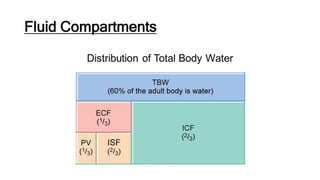
Fluid Compartments
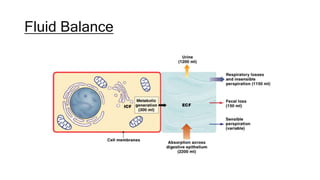
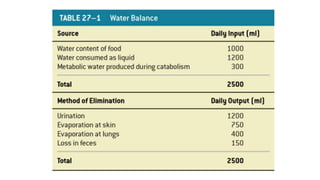
Fluid Balance
Physical exam for assessing volume
• Physical exam in general is not sensitive or specific
• Acute weight loss; however, obtaining an accurate weight over time may be difficult
• Decreased skin turgor - if you pinch it stays put
• Dry skin, particularly axilla
• Dry mucus membranes
• Low arterial blood pressure (or relative to patient's usual BP)
• Orthostatic hypotension can occur with significant hypovolemia; but it is also common in
euvolemic elderly subjects.
• Decreased intensity of both the Korotkoff sounds (when the blood pressure is being
measured with a sphygmomanometer) and the radial pulse ("thready") due to peripheral
vasoconstriction.
• Decreased Jugular Venous Pressure
• The normal venous pressure is 1 to 8 cmH2O, thus, a low value alone may be normal and does
not establish the diagnosis of hypovolemia.
SIGNS & SYMPTOMS OF Fluid Volume
Excess
• SOB & orthopnea
• Edema & weight gain
• Distended neck veins & tachycardia
• Increased blood pressure
• Crackles & wheezes
• Pleural effusion
Fluid Therapy
• Indications:
• Coma, anesthesia, severe vomiting and diarrhoea
• Dehydration
• Shock
• Hypoglycemia (where orals are not possible)
• Vehicle for: antibiotics, chemotherapy agents
• TPN
• Critical problems: anaphylaxis, pancreatitis, forced diuresis in drug overdose,
poisoning.
Disadvantages
• More expensive
• Needs asepsis, under skilled supervision
• Improper selection of type, volume, rate and technique can lead to
serious problems.
Contraindications:
• Avoided in patients who can take oral fluids
• CHF, Pulmonary edema
Types of I.V Fluids
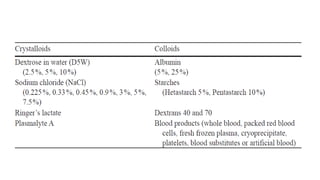
• Crystalloids
• Colloids
• Blood and Blood Products
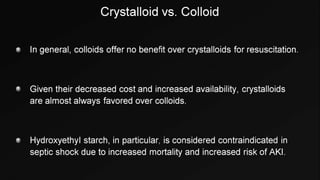
Crystalloid vs Colloid
Type of particles (large or small)
• Fluids with small “crystallizable” particles like NaCl are called
crystalloids
• Fluids with large particles like albumin are called colloids, these
don’t (quickly) fit through vascular pores, so they stay in the
circulation and much smaller amounts can be used for same
volume expansion. (250ml Albumin = 4 L NS)
• Edema resulting from these also tends to stick around longer for same
reason.
• Albumin can also trigger anaphylaxis.
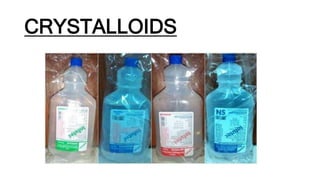
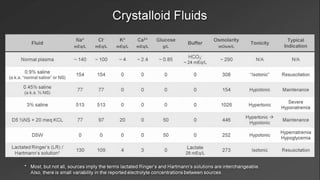
CRYSTALLOIDS
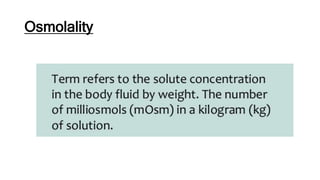
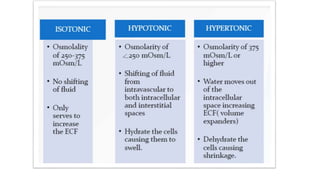
Osmolality
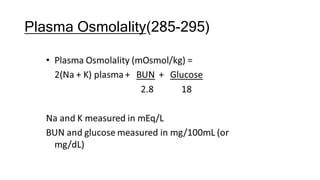
Plasma Osmolality(285-295)
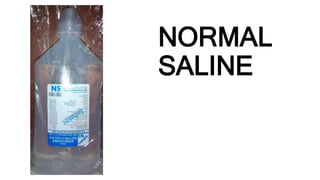
NORMAL
SALINE
NORMAL SALINE
• Composition: Na: 154 mEq , Cl: 154 mEq
• Pharmacological Basis:
• Provides major extracellular electrolytes
• Corrects both water and electrolyte deficit
• Increases the intravascular volume substantially
• Contraindications:
• Avoid in pre eclamptic patients, CHF, renal disease and cirrhosis
• Dehydration with severe hypokalemia: Deficit of intracellular potassium
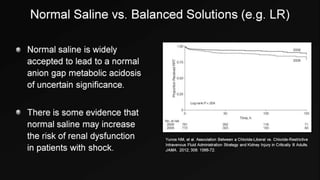
• Large volume may lead to hyperchloremic acidosis
INDICATIONS
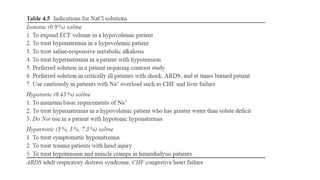
• Water and salt depletion: Diarrhea, vomiting, excessive diuresis
• Hypovolemic shock
• Alkalosis with dehydration
• Severe salt depletion and hyponatremia
• Initial fluid therapy in DKA
• Hypercalcemia
• Fluid challenge in prerenal AKI
• Irrigation of body fluids
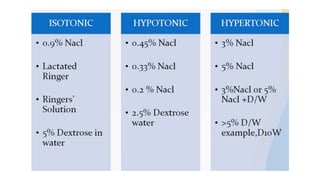
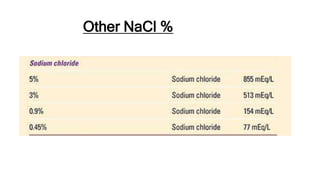
Other NaCl %
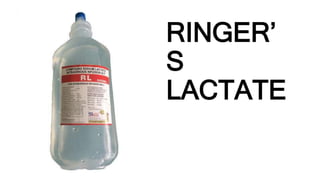
RINGER’
S
LACTATE
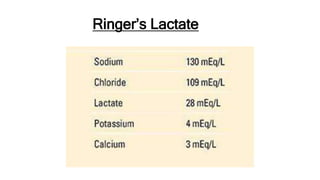
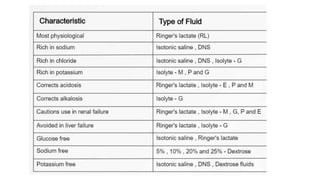
Ringer’s Lactate
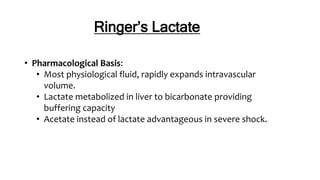
Ringer’s Lactate
• Pharmacological Basis:
• Most physiological fluid, rapidly expands intravascular
volume.
• Lactate metabolized in liver to bicarbonate providing
buffering capacity
• Acetate instead of lactate advantageous in severe shock.
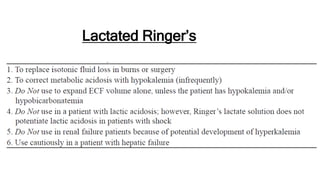
Lactated Ringer’s
Indications
• Correction in severe hypovolemia
• Replacing fluid in post op patients, burns
• Diarrhea induced hypokalemic metabolic acidosis
• Fluid of choice in diarrhea induced dehydration
• DKA, provides water, corrects metabolic acidosis and supplies
potassium
• Maintaining normal ECF fluid and electrolyte balance
Contraindications
• Liver disease, severe hypoxia and shock
• Severe CHF : may lead to lactic acidosis
• Addison disease
• Vomiting pr NGT induced alkalosis
• Simultaneous infusion of RL and blood
• Certain drugs: Amphotericin, Thiopental, Ampicillin, Doxycycline
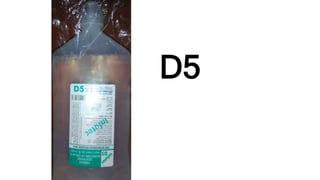
D5
5% Dextrose
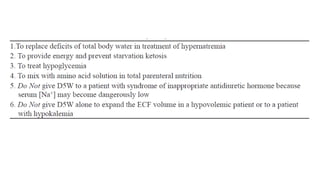
• Composition: Glucose 50 g
• Pharmacological basis: Corrects dehydration and supplies energy
(170 kCal/L)
• Indications:
• Pre and post of fluid replacement
• I.V administration of various drugs
• Prevention of ketosis in starvation
• Adequate glucose infusion protects liver against toxic
substances
• Correction of hypernatremia
• Avoid fast infusions as this may lead to swelling of hypotonic
brain cells.
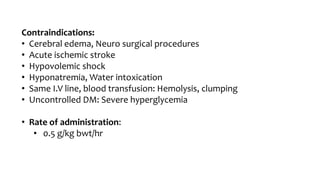
Contraindications:
• Cerebral edema, Neuro surgical procedures
• Acute ischemic stroke
• Hypovolemic shock
• Hyponatremia, Water intoxication
• Same I.V line, blood transfusion: Hemolysis, clumping
• Uncontrolled DM: Severe hyperglycemia
• Rate of administration:
• 0.5 g/kg bwt/hr
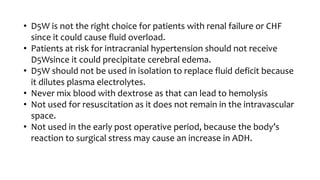
• D5W is not the right choice for patients with renal failure or CHF
since it could cause fluid overload.
• Patients at risk for intracranial hypertension should not receive
D5Wsince it could precipitate cerebral edema.
• D5W should not be used in isolation to replace fluid deficit because
it dilutes plasma electrolytes.
• Never mix blood with dextrose as that can lead to hemolysis
• Not used for resuscitation as it does not remain in the intravascular
space.
• Not used in the early post operative period, because the body’s
reaction to surgical stress may cause an increase in ADH.
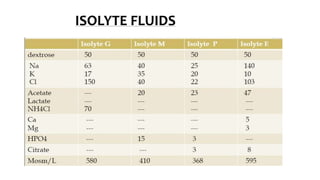
ISOLYTE FLUIDS
• ISOLYTE G
• Vomiting or NGT induced hypochloremic, hypokalemic metabolic
alkalosis
• NH4+ gets converted to H+ and urea in the liver
• Treatment of metabolic alkalosis
• Contraindications: Hepatic/Renal Failure, metabolic acidosis
• ISOLYTE M
• Richest source of potassium (35 mEq)
• Ideal fluid for maintenance
• Correction of hypokalemia
• Contraindications: Renal failure, Burns, Adrenocortical
insufficiency
COLLOIDS
Colloids: Large molecular weight substances that largely
remain in the intravascular compartment thereby generating
oncotic pressure
3 times more potent
1 mL blood loss = 1 mL colloid = 3 mL crystalloids
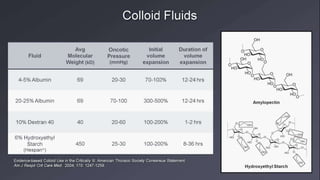
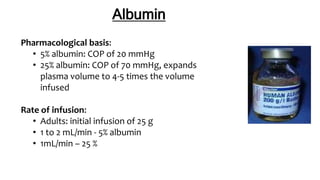
Albumin
Pharmacological basis:
• 5% albumin: COP of 20 mmHg
• 25% albumin: COP of 70 mmHg, expands
plasma volume to 4-5 times the volume
infused
Rate of infusion:
• Adults: initial infusion of 25 g
• 1 to 2 mL/min - 5% albumin
• 1mL/min – 25 %
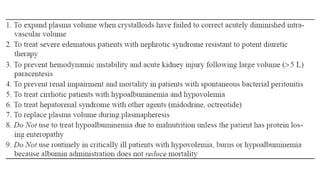
Indications:
• Plasma volume expansion in acute hypovolemic shock, burns,
severe hypoalbuminemia
• Hypoproteinemia: Liver disease, diuretic resistant nephrotic
syndrome
• In therapeutic plasmapheresis as an exchange fluid
• Contraindications:
• Severe anemia, Cardiac failure
• Hypersensitivity reaction
Dextran
• Dextrans are glucose polymers produced by bacteria (Leuconostoc)
• 2 forms:
• Dextran 70 (Mol wt: 70,000)
• Dextran 40 (Mol wt: 40,000)
• Pharmacological basis:
• Effectively expands intravascular volume
• Dextran 40 as 10% solution: Greater expansion, Short duration (6 hr)
– Rapid renal excretion
• Anti thrombotic: Inhibits platelet aggregation
• Improves micro circulatory flow
Indications:
• Hypovolemia correction
• Prophylaxis of DVT and post operative thromboembolism
• Improves blood flow and micro circulation in threatedned
vascular gangrene
• Myocardial ischemia, Cerebral ischemia, PVD and
maintaining vascular graft patency
• Priming in ECC
Adverse Effects
• Acute Kidney injury
• Interferes with blood grouping and cross matching
• Hypersensitivity reaction
Precautions:
• Severe oligo/anuria
• CHF, Circulatory overload
• Bleeding disorders
• Severe dehydration
• Anticoagulant effect of heparin increased
• Hypersensitivity to Dextran
Administration
• Adult atient in shock: Rapid 500 ml infusion
• First 24h: Dose should not exceed 20 mL/kg
• Next 5 days: 10 mL/kg/day
Gelatin polymers (Haemaccel)
• Sterile, pyrogen free, 3.5 % solution
• Polymer of degraded gelatin with electrolytes
• 2 types
• Succinylated gelatin (Modified fluid gelatin)
• Urea cross linked gelatin (Polygeline)
• Composition:
NaCl: 145 mEq
Ca: 12.5 mEq
K: 5.1 mEq
• Indications
• Rapid plasma volume expansion in hypovolemia
• Volume pre loading in regional anesthesia
• Priming of heart lung machines.
• Advantages:
• Does not interfere with coagulation, blood grouping.
• Remains in the blood for 4 to 5 hours
• Infusion of 1000 mL expands plasma volume by 300 to 350 mL
• Side Effects:
• Hypersensitivity reaction
• Should not be mixed with citrated blood
Hydroxyethyl Starch
It is composed of more than 90% esterified
amylopectin.
Esterification retards degradation leading to longer
plasma expansion.
6% Hetastarch: Mol wt: 4,50,000
Pharmacological basis:
Osmolality: 310 mOsm/L
Higher colloidal osmotic pressure
• Advantages:
• Non antigenic
• Does not interfere with blood grouping
• Greater plasma volume expansion
• Preserves intestinal micro vascular perfusion in endotoxemia
• Duration: 24 hours
• Disadvantages:
• Increase in serum amylase concentration up to 5 days after
discontinuation
• Affects coagulation by prolongation of PT, PTT and bleeding
time by lowering fibrinogen
• Decreases platelet aggregation, vWF, Factor VIII
Fluid Therapy
There are two components to fluid therapy:
• Maintenance therapy replaces normal ongoing losses, and
• Replacement therapy corrects any existing water and electrolyte
deficits.
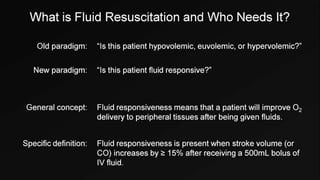
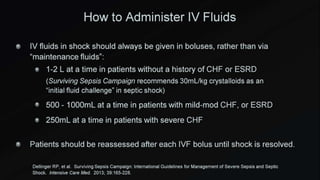
Fluids for Resuscitation
• Intravenous fluids are an essential component of resuscitation in a
patient with shock.
• In these case, I.V fluids are given as boluses, and crystalloids are
always preferred over colloids.
• The rate of correction depends on the type of shock and on the
response of the patient to fluid replacement.
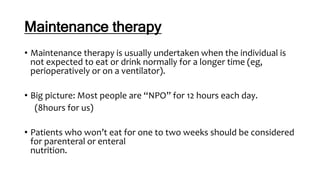
Maintenance therapy
• Maintenance therapy is usually undertaken when the individual is
not expected to eat or drink normally for a longer time (eg,
perioperatively or on a ventilator).
• Big picture: Most people are “NPO” for 12 hours each day.
(8hours for us)
• Patients who won’t eat for one to two weeks should be considered
for parenteral or enteral
nutrition.
• Water requirements increase with:
Fever, sweating, burns, tachypnea, surgical drains, polyuria, or
ongoing significant gastrointestinal losses.
• For example, water requirements increase by 100 to 150 mL/day for
each C degree of body temperature elevation.
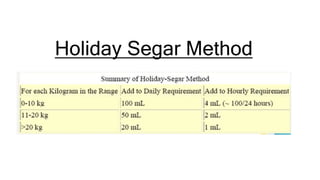
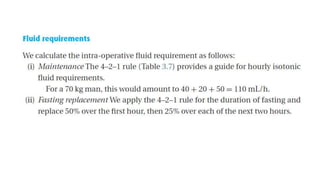
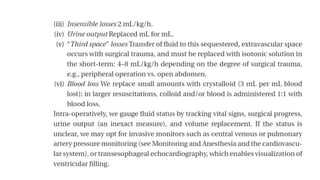
Holiday Segar Method
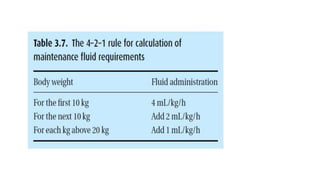
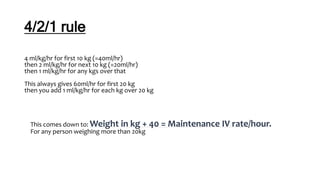
4/2/1 rule
4 ml/kg/hr for first 10 kg (=40ml/hr)
then 2 ml/kg/hr for next 10 kg (=20ml/hr)
then 1 ml/kg/hr for any kgs over that
This always gives 60ml/hr for first 20 kg
then you add 1 ml/kg/hr for each kg over 20 kg
This comes down to: Weight in kg + 40 = Maintenance IV rate/hour.
For any person weighing more than 20kg
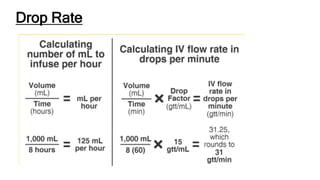
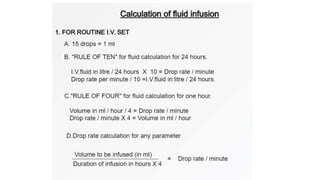
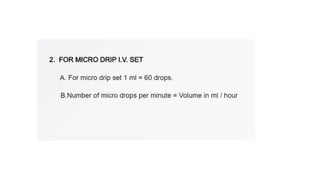
Drop Rate
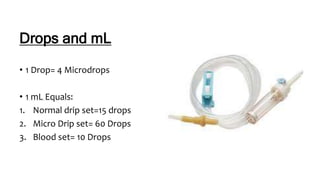
Drops and mL
• 1 Drop= 4 Microdrops
• 1 mL Equals:
1. Normal drip set=15 drops
2. Micro Drip set= 60 Drops
3. Blood set= 10 Drops
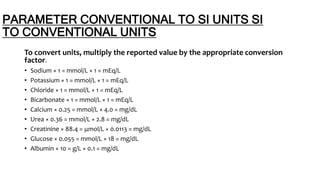
PARAMETER CONVENTIONAL TO SI UNITS SI
TO CONVENTIONAL UNITS
To convert units, multiply the reported value by the appropriate conversion
factor.
• Sodium × 1 = mmol/L × 1 = mEq/L
• Potassium × 1 = mmol/L × 1 = mEq/L
• Chloride × 1 = mmol/L × 1 = mEq/L
• Bicarbonate × 1 = mmol/L × 1 = mEq/L
• Calcium × 0.25 = mmol/L × 4.0 = mg/dL
• Urea × 0.36 = mmol/L × 2.8 = mg/dL
• Creatinine × 88.4 = μmol/L × 0.0113 = mg/dL
• Glucose × 0.055 = mmol/L × 18 = mg/dL
• Albumin × 10 = g/L × 0.1 = mg/dL

Intravenous fluids

  • 1.
  • 2.
  • 3.
  • 5.
    Physical exam forassessing volume • Physical exam in general is not sensitive or specific • Acute weight loss; however, obtaining an accurate weight over time may be difficult • Decreased skin turgor - if you pinch it stays put • Dry skin, particularly axilla • Dry mucus membranes • Low arterial blood pressure (or relative to patient's usual BP) • Orthostatic hypotension can occur with significant hypovolemia; but it is also common in euvolemic elderly subjects. • Decreased intensity of both the Korotkoff sounds (when the blood pressure is being measured with a sphygmomanometer) and the radial pulse ("thready") due to peripheral vasoconstriction. • Decreased Jugular Venous Pressure • The normal venous pressure is 1 to 8 cmH2O, thus, a low value alone may be normal and does not establish the diagnosis of hypovolemia.
  • 6.
    SIGNS & SYMPTOMSOF Fluid Volume Excess • SOB & orthopnea • Edema & weight gain • Distended neck veins & tachycardia • Increased blood pressure • Crackles & wheezes • Pleural effusion
  • 8.
    Fluid Therapy • Indications: •Coma, anesthesia, severe vomiting and diarrhoea • Dehydration • Shock • Hypoglycemia (where orals are not possible) • Vehicle for: antibiotics, chemotherapy agents • TPN • Critical problems: anaphylaxis, pancreatitis, forced diuresis in drug overdose, poisoning.
  • 9.
    Disadvantages • More expensive •Needs asepsis, under skilled supervision • Improper selection of type, volume, rate and technique can lead to serious problems. Contraindications: • Avoided in patients who can take oral fluids • CHF, Pulmonary edema
  • 10.
    Types of I.VFluids • Crystalloids • Colloids • Blood and Blood Products
  • 11.
    Crystalloid vs Colloid Typeof particles (large or small) • Fluids with small “crystallizable” particles like NaCl are called crystalloids • Fluids with large particles like albumin are called colloids, these don’t (quickly) fit through vascular pores, so they stay in the circulation and much smaller amounts can be used for same volume expansion. (250ml Albumin = 4 L NS) • Edema resulting from these also tends to stick around longer for same reason. • Albumin can also trigger anaphylaxis.
  • 13.
  • 14.
  • 15.
  • 20.
  • 21.
    NORMAL SALINE • Composition:Na: 154 mEq , Cl: 154 mEq • Pharmacological Basis: • Provides major extracellular electrolytes • Corrects both water and electrolyte deficit • Increases the intravascular volume substantially • Contraindications: • Avoid in pre eclamptic patients, CHF, renal disease and cirrhosis • Dehydration with severe hypokalemia: Deficit of intracellular potassium • Large volume may lead to hyperchloremic acidosis
  • 22.
    INDICATIONS • Water andsalt depletion: Diarrhea, vomiting, excessive diuresis • Hypovolemic shock • Alkalosis with dehydration • Severe salt depletion and hyponatremia • Initial fluid therapy in DKA • Hypercalcemia • Fluid challenge in prerenal AKI • Irrigation of body fluids
  • 23.
  • 25.
  • 26.
  • 27.
    Ringer’s Lactate • PharmacologicalBasis: • Most physiological fluid, rapidly expands intravascular volume. • Lactate metabolized in liver to bicarbonate providing buffering capacity • Acetate instead of lactate advantageous in severe shock.
  • 28.
  • 29.
    Indications • Correction insevere hypovolemia • Replacing fluid in post op patients, burns • Diarrhea induced hypokalemic metabolic acidosis • Fluid of choice in diarrhea induced dehydration • DKA, provides water, corrects metabolic acidosis and supplies potassium • Maintaining normal ECF fluid and electrolyte balance
  • 30.
    Contraindications • Liver disease,severe hypoxia and shock • Severe CHF : may lead to lactic acidosis • Addison disease • Vomiting pr NGT induced alkalosis • Simultaneous infusion of RL and blood • Certain drugs: Amphotericin, Thiopental, Ampicillin, Doxycycline
  • 31.
  • 32.
    5% Dextrose • Composition:Glucose 50 g • Pharmacological basis: Corrects dehydration and supplies energy (170 kCal/L) • Indications: • Pre and post of fluid replacement • I.V administration of various drugs • Prevention of ketosis in starvation • Adequate glucose infusion protects liver against toxic substances • Correction of hypernatremia • Avoid fast infusions as this may lead to swelling of hypotonic brain cells.
  • 34.
    Contraindications: • Cerebral edema,Neuro surgical procedures • Acute ischemic stroke • Hypovolemic shock • Hyponatremia, Water intoxication • Same I.V line, blood transfusion: Hemolysis, clumping • Uncontrolled DM: Severe hyperglycemia • Rate of administration: • 0.5 g/kg bwt/hr
  • 35.
    • D5W isnot the right choice for patients with renal failure or CHF since it could cause fluid overload. • Patients at risk for intracranial hypertension should not receive D5Wsince it could precipitate cerebral edema. • D5W should not be used in isolation to replace fluid deficit because it dilutes plasma electrolytes. • Never mix blood with dextrose as that can lead to hemolysis • Not used for resuscitation as it does not remain in the intravascular space. • Not used in the early post operative period, because the body’s reaction to surgical stress may cause an increase in ADH.
  • 36.
  • 37.
    • ISOLYTE G •Vomiting or NGT induced hypochloremic, hypokalemic metabolic alkalosis • NH4+ gets converted to H+ and urea in the liver • Treatment of metabolic alkalosis • Contraindications: Hepatic/Renal Failure, metabolic acidosis • ISOLYTE M • Richest source of potassium (35 mEq) • Ideal fluid for maintenance • Correction of hypokalemia • Contraindications: Renal failure, Burns, Adrenocortical insufficiency
  • 38.
    COLLOIDS Colloids: Large molecularweight substances that largely remain in the intravascular compartment thereby generating oncotic pressure 3 times more potent 1 mL blood loss = 1 mL colloid = 3 mL crystalloids
  • 41.
    Albumin Pharmacological basis: • 5%albumin: COP of 20 mmHg • 25% albumin: COP of 70 mmHg, expands plasma volume to 4-5 times the volume infused Rate of infusion: • Adults: initial infusion of 25 g • 1 to 2 mL/min - 5% albumin • 1mL/min – 25 %
  • 43.
    Indications: • Plasma volumeexpansion in acute hypovolemic shock, burns, severe hypoalbuminemia • Hypoproteinemia: Liver disease, diuretic resistant nephrotic syndrome • In therapeutic plasmapheresis as an exchange fluid • Contraindications: • Severe anemia, Cardiac failure • Hypersensitivity reaction
  • 44.
    Dextran • Dextrans areglucose polymers produced by bacteria (Leuconostoc) • 2 forms: • Dextran 70 (Mol wt: 70,000) • Dextran 40 (Mol wt: 40,000) • Pharmacological basis: • Effectively expands intravascular volume • Dextran 40 as 10% solution: Greater expansion, Short duration (6 hr) – Rapid renal excretion • Anti thrombotic: Inhibits platelet aggregation • Improves micro circulatory flow
  • 45.
    Indications: • Hypovolemia correction •Prophylaxis of DVT and post operative thromboembolism • Improves blood flow and micro circulation in threatedned vascular gangrene • Myocardial ischemia, Cerebral ischemia, PVD and maintaining vascular graft patency • Priming in ECC Adverse Effects • Acute Kidney injury • Interferes with blood grouping and cross matching • Hypersensitivity reaction
  • 46.
    Precautions: • Severe oligo/anuria •CHF, Circulatory overload • Bleeding disorders • Severe dehydration • Anticoagulant effect of heparin increased • Hypersensitivity to Dextran Administration • Adult atient in shock: Rapid 500 ml infusion • First 24h: Dose should not exceed 20 mL/kg • Next 5 days: 10 mL/kg/day
  • 47.
    Gelatin polymers (Haemaccel) •Sterile, pyrogen free, 3.5 % solution • Polymer of degraded gelatin with electrolytes • 2 types • Succinylated gelatin (Modified fluid gelatin) • Urea cross linked gelatin (Polygeline) • Composition: NaCl: 145 mEq Ca: 12.5 mEq K: 5.1 mEq • Indications • Rapid plasma volume expansion in hypovolemia • Volume pre loading in regional anesthesia • Priming of heart lung machines.
  • 48.
    • Advantages: • Doesnot interfere with coagulation, blood grouping. • Remains in the blood for 4 to 5 hours • Infusion of 1000 mL expands plasma volume by 300 to 350 mL • Side Effects: • Hypersensitivity reaction • Should not be mixed with citrated blood
  • 49.
    Hydroxyethyl Starch It iscomposed of more than 90% esterified amylopectin. Esterification retards degradation leading to longer plasma expansion. 6% Hetastarch: Mol wt: 4,50,000 Pharmacological basis: Osmolality: 310 mOsm/L Higher colloidal osmotic pressure
  • 50.
    • Advantages: • Nonantigenic • Does not interfere with blood grouping • Greater plasma volume expansion • Preserves intestinal micro vascular perfusion in endotoxemia • Duration: 24 hours • Disadvantages: • Increase in serum amylase concentration up to 5 days after discontinuation • Affects coagulation by prolongation of PT, PTT and bleeding time by lowering fibrinogen • Decreases platelet aggregation, vWF, Factor VIII
  • 52.
    Fluid Therapy There aretwo components to fluid therapy: • Maintenance therapy replaces normal ongoing losses, and • Replacement therapy corrects any existing water and electrolyte deficits.
  • 53.
    Fluids for Resuscitation •Intravenous fluids are an essential component of resuscitation in a patient with shock. • In these case, I.V fluids are given as boluses, and crystalloids are always preferred over colloids. • The rate of correction depends on the type of shock and on the response of the patient to fluid replacement.
  • 60.
    Maintenance therapy • Maintenancetherapy is usually undertaken when the individual is not expected to eat or drink normally for a longer time (eg, perioperatively or on a ventilator). • Big picture: Most people are “NPO” for 12 hours each day. (8hours for us) • Patients who won’t eat for one to two weeks should be considered for parenteral or enteral nutrition.
  • 61.
    • Water requirementsincrease with: Fever, sweating, burns, tachypnea, surgical drains, polyuria, or ongoing significant gastrointestinal losses. • For example, water requirements increase by 100 to 150 mL/day for each C degree of body temperature elevation.
  • 62.
  • 64.
    4/2/1 rule 4 ml/kg/hrfor first 10 kg (=40ml/hr) then 2 ml/kg/hr for next 10 kg (=20ml/hr) then 1 ml/kg/hr for any kgs over that This always gives 60ml/hr for first 20 kg then you add 1 ml/kg/hr for each kg over 20 kg This comes down to: Weight in kg + 40 = Maintenance IV rate/hour. For any person weighing more than 20kg
  • 67.
  • 68.
    Drops and mL •1 Drop= 4 Microdrops • 1 mL Equals: 1. Normal drip set=15 drops 2. Micro Drip set= 60 Drops 3. Blood set= 10 Drops
  • 73.
    PARAMETER CONVENTIONAL TOSI UNITS SI TO CONVENTIONAL UNITS To convert units, multiply the reported value by the appropriate conversion factor. • Sodium × 1 = mmol/L × 1 = mEq/L • Potassium × 1 = mmol/L × 1 = mEq/L • Chloride × 1 = mmol/L × 1 = mEq/L • Bicarbonate × 1 = mmol/L × 1 = mEq/L • Calcium × 0.25 = mmol/L × 4.0 = mg/dL • Urea × 0.36 = mmol/L × 2.8 = mg/dL • Creatinine × 88.4 = μmol/L × 0.0113 = mg/dL • Glucose × 0.055 = mmol/L × 18 = mg/dL • Albumin × 10 = g/L × 0.1 = mg/dL