AMENORRHOEA
Presentedby:-
CHAITANYA SHEORAN
University college of medical science
Delhi, INDIA
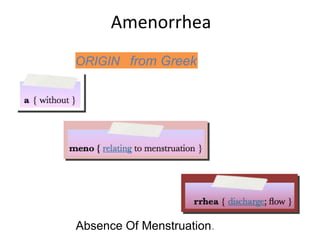
Amenorrhea
Absence Of Menstruation.
ORIGIN from Greek
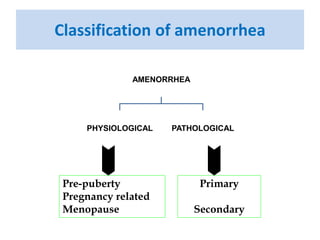
Classification of amenorrhea
AMENORRHEA
PHYSIOLOGICAL PATHOLOGICAL
Pre-puberty
Pregnancy related
Menopause
Primary
Secondary
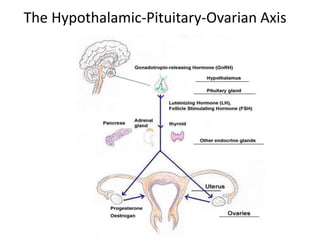
The Hypothalamic-Pituitary-Ovarian Axis
http://www.shen-nong.com/eng/images/exam/missedperiods/img_mp1a.gif
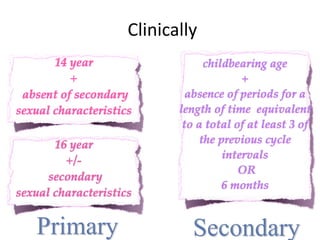
Clinically
Primary Secondary
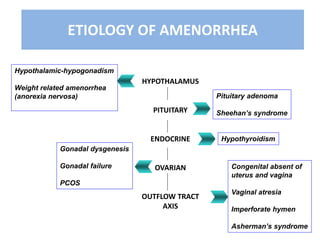
ETIOLOGY OF AMENORRHEA
HYPOTHALAMUS
PITUITARY
ENDOCRINE
OVARIAN
OUTFLOW TRACT
AXIS
Congenital absent of
uterus and vagina
Vaginal atresia
Imperforate hymen
Asherman’s syndrome
Pituitary adenoma
Sheehan’s syndrome
Hypothalamic-hypogonadism
Weight related amenorrhea
(anorexia nervosa)
Hypothyroidism
Gonadal dysgenesis
Gonadal failure
PCOS
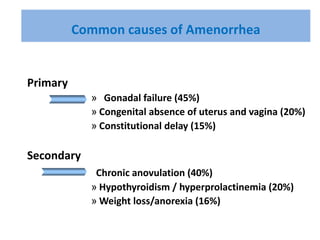
Common causes of Amenorrhea
Primary
» Gonadal failure (45%)
» Congenital absence of uterus and vagina (20%)
» Constitutional delay (15%)
Secondary
Chronic anovulation (40%)
» Hypothyroidism / hyperprolactinemia (20%)
» Weight loss/anorexia (16%)
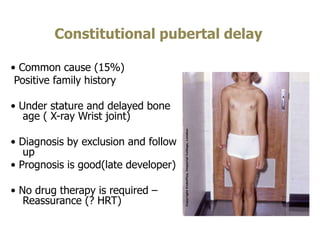
Constitutional pubertal delay
• Common cause (15%)
Positive family history
• Under stature and delayed bone
age ( X-ray Wrist joint)
• Diagnosis by exclusion and follow
up
• Prognosis is good(late developer)
• No drug therapy is required –
Reassurance (? HRT)
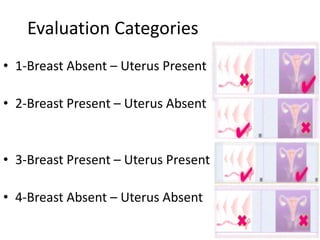
Evaluation Categories
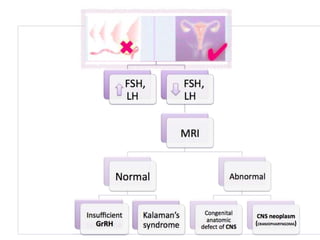
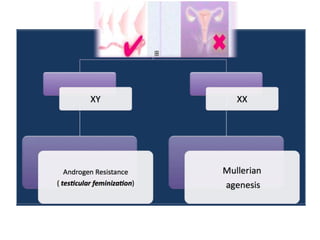
• 1-Breast Absent – Uterus Present
• 2-Breast Present – Uterus Absent
• 3-Breast Present – Uterus Present
• 4-Breast Absent – Uterus Absent
46 XX
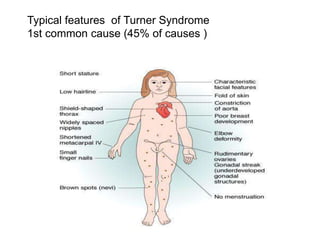
Typical features of Turner Syndrome
1st common cause (45% of causes )
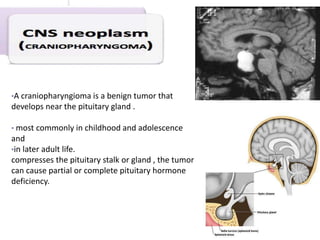
•A craniopharyngioma is a benign tumor that
develops near the pituitary gland .
• most commonly in childhood and adolescence
and
•in later adult life.
compresses the pituitary stalk or gland , the tumor
can cause partial or complete pituitary hormone
deficiency.
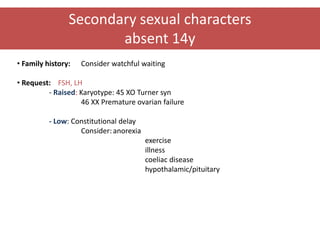
• Family history: Consider watchful waiting
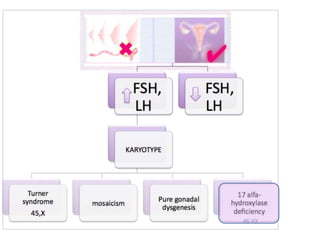
• Request: FSH, LH
- Raised: Karyotype: 45 XO Turner syn
46 XX Premature ovarian failure
- Low: Constitutional delay
Consider: anorexia
exercise
illness
coeliac disease
hypothalamic/pituitary
Secondary sexual characters
absent 14y
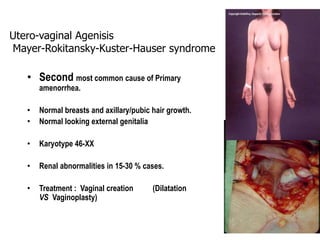
Utero-vaginal Agenisis
Mayer-Rokitansky-Kuster-Hauser syndrome
• Second most common cause of Primary
amenorrhea.
• Normal breasts and axillary/pubic hair growth.
• Normal looking external genitalia
• Karyotype 46-XX
• Renal abnormalities in 15-30 % cases.
• Treatment : Vaginal creation (Dilatation
VS Vaginoplasty)
• Normal breasts but no sexual hair
• Normal looking female external genitalia
• Absent uterus and upper vagina
• Karyotype 46, XY
• Male like testosterone level
• Treatment : gonadectomy after puberty + HRT
Androgen insensitivity
Testicular feminization syndrome
• Absent/abnormal then karyotype:
- 46 XX Mullerian agenesis
- 46 XY Androgen insensitivity
• Present
•+ no outflow obstruction
- As for 2o amenorrhoea
Secondary sexual characteristics
Present by 16 years
Ultrasound uterus
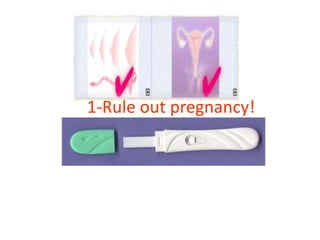
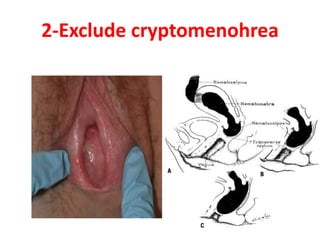
1-Rule out pregnancy!
2-Exclude cryptomenohrea
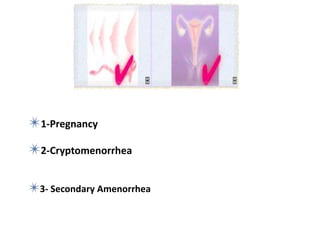
✴1-Pregnancy
✴2-Cryptomenorrhea :
imperforated hymen, vaginal septum,
✴3- Secondary Amenorrhea :
hypothalamic, pituitary ,other endocrionpathy
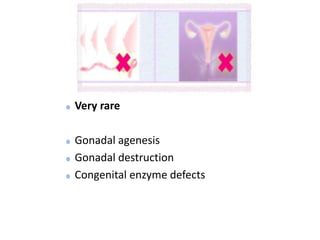
Very rare
Gonadal agenesis
Gonadal destruction
Congenital enzyme defects
classification
Classify according to level of serum FSH
• Hypergonadotropic primary amenorrhea
• Eugonadrotropic primary amenorrhea
• Hypogonadotropic primary amenorrhea
Hypergonadotropic primary
amenorrhoea
Abnormal sex chromosome :-
Turner syndrome
Normal sex chromosome:-
gonadal dysgenesis
Eugonadotropic primary amenorrhoea
• Androgen insensitivity syndrome(testicular
feminisation)
• Rokitansky-kuster-hauser syndrome
• PCOS
• Cryptomenorrhoea
Hypogonadotropic primary
amenorrhoea
Hypothalamic causes
• Hypothalamic hypogonadsim (kallman’s
syndrome)
• Psychogenic causes, weight loss, stress,
anorexia nervosa, malnutrition
Pituitary causes
• Short stature, obesity, mental retardation
• Craniopharyngiomas
Hypothalamic (Kallmann’s syndrome)
• Hypogonadotropic hypogonadism
• Congenital disorder characterized by:
• 1) Anosmia or hyposmia
• 2) Primary amenorrhea
• Caused by defect in synthesis and/or release of gonadorelin (LH
releasing hormone)
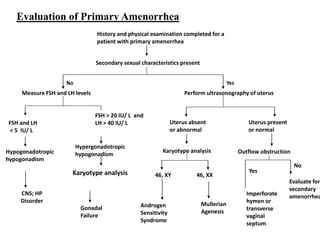
CNS; HP
Disorder
Gonadal
Failure
History and physical examination completed for a
patient with primary amenorrhea
Secondary sexual characteristics present
No Yes
Measure FSH and LH levels
Uterus absent
or abnormal
Uterus present
or normal
Karyotype analysis Outflow obstruction
FSH and LH
< 5 IU/ L
Hypogonadotropic
hypogonadism
Hypergonadotropic
hypogonadism
Karyotype analysis 46, XY 46, XX
Mullerian
Agenesis
Androgen
Sensitivity
Syndrome
No
Yes
Evaluate for
secondary
amenorrheaImperforate
hymen or
transverse
vaginal
septum
Perform ultrasonography of uterus
Evaluation of Primary Amenorrhea
FSH > 20 IU/ L and
LH > 40 IU/ L
Secondary amenorrhoea
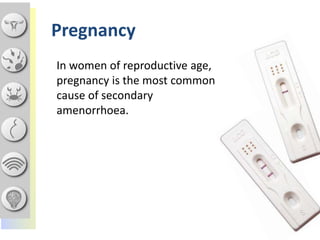
In women of reproductive age,
pregnancy is the most common
cause of secondary
amenorrhoea.
Pregnancy
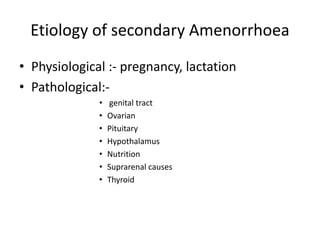
Etiology of secondary Amenorrhoea
• Physiological :- pregnancy, lactation
• Pathological:-
• genital tract
• Ovarian
• Pituitary
• Hypothalamus
• Nutrition
• Suprarenal causes
• Thyroid
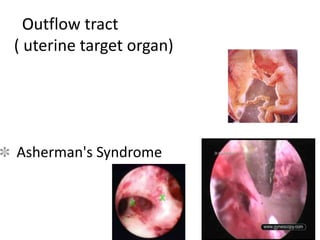
Outflow tract
( uterine target organ)
Asherman's Syndrome
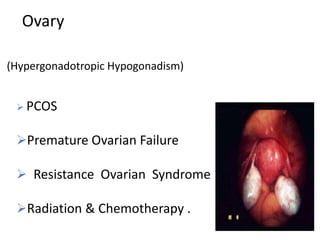
Ovary
 PCOS
Premature Ovarian Failure
 Resistance Ovarian Syndrome
Radiation & Chemotherapy .
(Hypergonadotropic Hypogonadism)
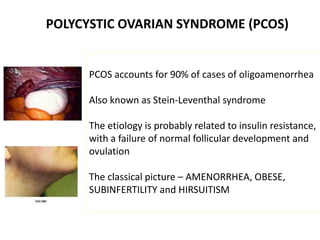
POLYCYSTIC OVARIAN SYNDROME (PCOS)
PCOS accounts for 90% of cases of oligoamenorrhea
Also known as Stein-Leventhal syndrome
The etiology is probably related to insulin resistance,
with a failure of normal follicular development and
ovulation
The classical picture – AMENORRHEA, OBESE,
SUBINFERTILITY and HIRSUITISM
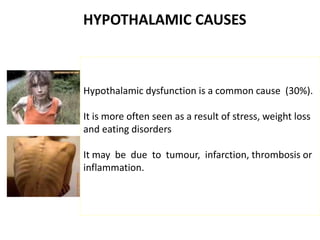
HYPOTHALAMIC CAUSES
Hypothalamic dysfunction is a common cause (30%).
It is more often seen as a result of stress, weight loss
and eating disorders
It may be due to tumour, infarction, thrombosis or
inflammation.
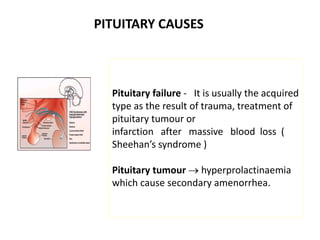
Pituitary failure - It is usually the acquired
type as the result of trauma, treatment of
pituitary tumour or
infarction after massive blood loss (
Sheehan’s syndrome )
Pituitary tumour  hyperprolactinaemia
which cause secondary amenorrhea.
PITUITARY CAUSES
ENDOCRINE CAUSES
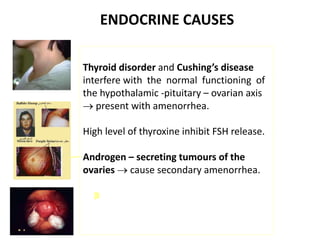
Thyroid disorder and Cushing’s disease
interfere with the normal functioning of
the hypothalamic -pituitary – ovarian axis
 present with amenorrhea.
High level of thyroxine inhibit FSH release.
Androgen – secreting tumours of the
ovaries  cause secondary amenorrhea.
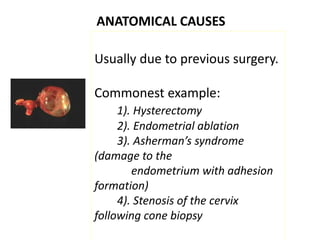
ANATOMICAL CAUSES
Usually due to previous surgery.
Commonest example:
1). Hysterectomy
2). Endometrial ablation
3). Asherman’s syndrome
(damage to the
endometrium with adhesion
formation)
4). Stenosis of the cervix
following cone biopsy
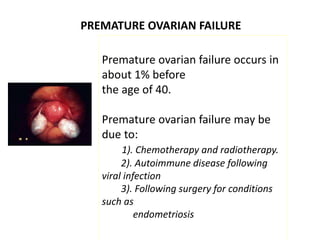
PREMATURE OVARIAN FAILURE
Premature ovarian failure occurs in
about 1% before
the age of 40.
Premature ovarian failure may be
due to:
1). Chemotherapy and radiotherapy.
2). Autoimmune disease following
viral infection
3). Following surgery for conditions
such as
endometriosis
DRUGS CAUSING HYPERPROLACTINAEMIA
Hyperprolactinaemia accounts for 20% of
cases of amenorrhea.
Prolactin inhibits GnRH release from the
hypothalamus
Drugs that may cause hyperprolactinaemia:
1). Phenothiazines
2). Methyldopa
3). Cimetidine
4). Butyrophenones
5). Antihistamines
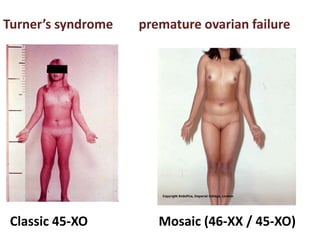
Classic 45-XO Mosaic (46-XX / 45-XO)
Turner’s syndrome premature ovarian failure
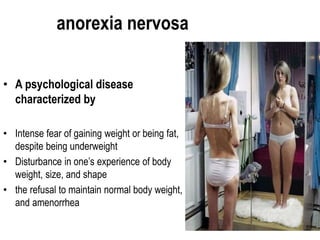
anorexia nervosaa nervosa
• A psychological disease
characterized by
• Intense fear of gaining weight or being fat,
despite being underweight
• Disturbance in one’s experience of body
weight, size, and shape
• the refusal to maintain normal body weight,
and amenorrhea
THE ASSESSMENT
HISTORY
EXAMINATION
INVESTIGATIONS
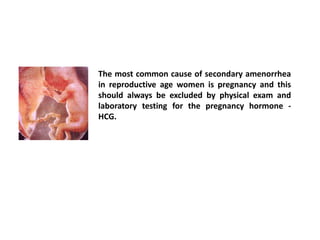
The most common cause of secondary amenorrhea
in reproductive age women is pregnancy and this
should always be excluded by physical exam and
laboratory testing for the pregnancy hormone -
HCG.
History
A good history can reveal the etiologic
diagnosis in up to 85% of cases of
amenorrhea.
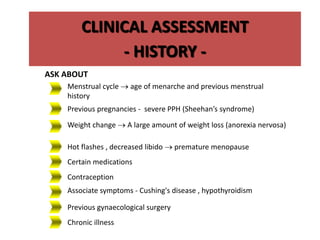
Hot flashes , decreased libido  premature menopause
Certain medications
Weight change  A large amount of weight loss (anorexia nervosa)
Associate symptoms - Cushing's disease , hypothyroidism
Contraception
Previous gynaecological surgery
CLINICAL ASSESSMENT
- HISTORY -
ASK ABOUT
Menstrual cycle  age of menarche and previous menstrual
history
Previous pregnancies - severe PPH (Sheehan’s syndrome)
Chronic illness
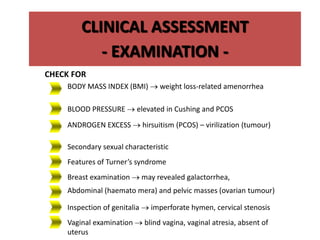
Secondary sexual characteristic
Features of Turner’s syndrome
ANDROGEN EXCESS  hirsuitism (PCOS) – virilization (tumour)
Abdominal (haemato mera) and pelvic masses (ovarian tumour)
Breast examination  may revealed galactorrhea,
Inspection of genitalia  imperforate hymen, cervical stenosis
CLINICAL ASSESSMENT
- EXAMINATION -
CHECK FOR
BODY MASS INDEX (BMI)  weight loss-related amenorrhea
BLOOD PRESSURE  elevated in Cushing and PCOS
Vaginal examination  blind vagina, vaginal atresia, absent of
uterus
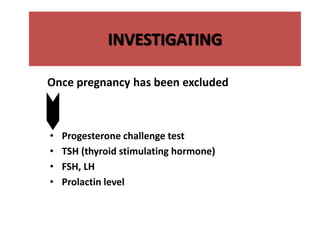
• Progesterone challenge test
• TSH (thyroid stimulating hormone)
• FSH, LH
• Prolactin level
INVESTIGATING
Once pregnancy has been excluded
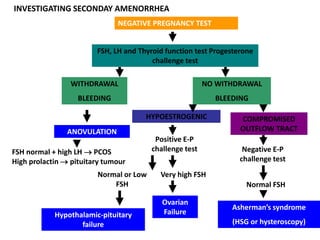
FSH, LH and Thyroid function test Progesterone
challenge test
WITHDRAWAL
BLEEDING
NO WITHDRAWAL
BLEEDING
HYPOESTROGENIC COMPROMISED
OUTFLOW TRACT
Negative E-P
challenge test
Normal FSH
Asherman’s syndrome
(HSG or hysteroscopy)
Normal or Low
FSH
Ovarian
FailureHypothalamic-pituitary
failure
ANOVULATION
Positive E-P
challenge test
Very high FSH
FSH normal + high LH  PCOS
High prolactin  pituitary tumour
NEGATIVE PREGNANCY TEST
INVESTIGATING SECONDAY AMENORRHEA
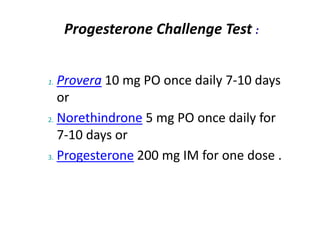
1. Provera 10 mg PO once daily 7-10 days
or
2. Norethindrone 5 mg PO once daily for
7-10 days or
3. Progesterone 200 mg IM for one dose .
Progesterone Challenge Test :
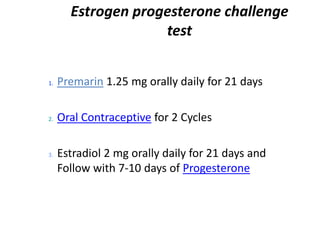
1. Premarin 1.25 mg orally daily for 21 days
2. Oral Contraceptive for 2 Cycles
3. Estradiol 2 mg orally daily for 21 days and
Follow with 7-10 days of Progesterone
Estrogen progesterone challenge
test
Asherman syndrome(intrauterine synechea)
Excessive curretage
Uterine infection
Endometrial TB
Dysfunctional uterine bleeding
Uterine packing in PPH
TREATMENT OF AMENORRHEA
The need for treatment depends on
Underlying causes
Need for regular periods
Trying to conceive (fertility)
Need for contraception)
TREATMENT OF AMENORRHEA
Underlying causes
PITUITARY TUMOUR  Bromocryptine / Surgery
ANDROGEN producing tumour of ovary  Surgery
TESTICULAR FEMINIZATION  removed gonad + HRT
TURNER’S syndrome  HRT
IMPERFORATE HYMEN  surgical incision
THYROID disease – appropriate medical treatment
EATING DISORDERS  referred to psychiatrist
PCOS  HRT/ surgery
ASHERMAN’s syndrome  breaking down adhesion + insert IUCD
TREATMENT OF AMENORRHEA
TRYING TO CONCEIVE
The prognosis for women with confirmed ovarian failure is poor.
ANOVULATION  response well with ovulation induction treatment
PCOS  ovulation may resume with weight reduction – fertility drugs
- use of gonadotrophins or ovarian drilling.
HYPERPROLACTINAEMIA  respond to treatment with dopamine
agonist.
HYPOTHALAMIC DYSFUNCTION  maintenance of normal weight
and change of lifestyle
ASHERMAN’S syndrome  breaking down adhesion + insert IUCD
TREATMENT OF AMENORRHOEA
WANT REGULAR PERIOD
The use of
1): COMBINED ORAL CONTRACEPTIVE
2): HRT
NEED CONTRACEPTION
Confirmed ovarian failure will not required contraception
Women requiring contraception  oral contraceptives are
method of choice
Amenorrhoea for undergraduates

Amenorrhoea for undergraduates

  • 1.
  • 2.
  • 3.
    Classification of amenorrhea AMENORRHEA PHYSIOLOGICALPATHOLOGICAL Pre-puberty Pregnancy related Menopause Primary Secondary
  • 4.
  • 5.
  • 6.
    ETIOLOGY OF AMENORRHEA HYPOTHALAMUS PITUITARY ENDOCRINE OVARIAN OUTFLOWTRACT AXIS Congenital absent of uterus and vagina Vaginal atresia Imperforate hymen Asherman’s syndrome Pituitary adenoma Sheehan’s syndrome Hypothalamic-hypogonadism Weight related amenorrhea (anorexia nervosa) Hypothyroidism Gonadal dysgenesis Gonadal failure PCOS
  • 7.
    Common causes ofAmenorrhea Primary » Gonadal failure (45%) » Congenital absence of uterus and vagina (20%) » Constitutional delay (15%) Secondary Chronic anovulation (40%) » Hypothyroidism / hyperprolactinemia (20%) » Weight loss/anorexia (16%)
  • 8.
    Constitutional pubertal delay •Common cause (15%) Positive family history • Under stature and delayed bone age ( X-ray Wrist joint) • Diagnosis by exclusion and follow up • Prognosis is good(late developer) • No drug therapy is required – Reassurance (? HRT)
  • 9.
    Evaluation Categories • 1-BreastAbsent – Uterus Present • 2-Breast Present – Uterus Absent • 3-Breast Present – Uterus Present • 4-Breast Absent – Uterus Absent
  • 10.
  • 11.
    Typical features ofTurner Syndrome 1st common cause (45% of causes )
  • 13.
    •A craniopharyngioma isa benign tumor that develops near the pituitary gland . • most commonly in childhood and adolescence and •in later adult life. compresses the pituitary stalk or gland , the tumor can cause partial or complete pituitary hormone deficiency.
  • 14.
    • Family history:Consider watchful waiting • Request: FSH, LH - Raised: Karyotype: 45 XO Turner syn 46 XX Premature ovarian failure - Low: Constitutional delay Consider: anorexia exercise illness coeliac disease hypothalamic/pituitary Secondary sexual characters absent 14y
  • 16.
    Utero-vaginal Agenisis Mayer-Rokitansky-Kuster-Hauser syndrome •Second most common cause of Primary amenorrhea. • Normal breasts and axillary/pubic hair growth. • Normal looking external genitalia • Karyotype 46-XX • Renal abnormalities in 15-30 % cases. • Treatment : Vaginal creation (Dilatation VS Vaginoplasty)
  • 17.
    • Normal breastsbut no sexual hair • Normal looking female external genitalia • Absent uterus and upper vagina • Karyotype 46, XY • Male like testosterone level • Treatment : gonadectomy after puberty + HRT Androgen insensitivity Testicular feminization syndrome
  • 18.
    • Absent/abnormal thenkaryotype: - 46 XX Mullerian agenesis - 46 XY Androgen insensitivity • Present •+ no outflow obstruction - As for 2o amenorrhoea Secondary sexual characteristics Present by 16 years Ultrasound uterus
  • 19.
  • 20.
  • 21.
    ✴1-Pregnancy ✴2-Cryptomenorrhea : imperforated hymen,vaginal septum, ✴3- Secondary Amenorrhea : hypothalamic, pituitary ,other endocrionpathy
  • 22.
    Very rare Gonadal agenesis Gonadaldestruction Congenital enzyme defects
  • 23.
    classification Classify according tolevel of serum FSH • Hypergonadotropic primary amenorrhea • Eugonadrotropic primary amenorrhea • Hypogonadotropic primary amenorrhea
  • 24.
    Hypergonadotropic primary amenorrhoea Abnormal sexchromosome :- Turner syndrome Normal sex chromosome:- gonadal dysgenesis
  • 25.
    Eugonadotropic primary amenorrhoea •Androgen insensitivity syndrome(testicular feminisation) • Rokitansky-kuster-hauser syndrome • PCOS • Cryptomenorrhoea
  • 26.
    Hypogonadotropic primary amenorrhoea Hypothalamic causes •Hypothalamic hypogonadsim (kallman’s syndrome) • Psychogenic causes, weight loss, stress, anorexia nervosa, malnutrition Pituitary causes • Short stature, obesity, mental retardation • Craniopharyngiomas
  • 27.
    Hypothalamic (Kallmann’s syndrome) •Hypogonadotropic hypogonadism • Congenital disorder characterized by: • 1) Anosmia or hyposmia • 2) Primary amenorrhea • Caused by defect in synthesis and/or release of gonadorelin (LH releasing hormone)
  • 28.
    CNS; HP Disorder Gonadal Failure History andphysical examination completed for a patient with primary amenorrhea Secondary sexual characteristics present No Yes Measure FSH and LH levels Uterus absent or abnormal Uterus present or normal Karyotype analysis Outflow obstruction FSH and LH < 5 IU/ L Hypogonadotropic hypogonadism Hypergonadotropic hypogonadism Karyotype analysis 46, XY 46, XX Mullerian Agenesis Androgen Sensitivity Syndrome No Yes Evaluate for secondary amenorrheaImperforate hymen or transverse vaginal septum Perform ultrasonography of uterus Evaluation of Primary Amenorrhea FSH > 20 IU/ L and LH > 40 IU/ L
  • 29.
  • 30.
    In women ofreproductive age, pregnancy is the most common cause of secondary amenorrhoea. Pregnancy
  • 31.
    Etiology of secondaryAmenorrhoea • Physiological :- pregnancy, lactation • Pathological:- • genital tract • Ovarian • Pituitary • Hypothalamus • Nutrition • Suprarenal causes • Thyroid
  • 32.
    Outflow tract ( uterinetarget organ) Asherman's Syndrome
  • 33.
    Ovary  PCOS Premature OvarianFailure  Resistance Ovarian Syndrome Radiation & Chemotherapy . (Hypergonadotropic Hypogonadism)
  • 34.
    POLYCYSTIC OVARIAN SYNDROME(PCOS) PCOS accounts for 90% of cases of oligoamenorrhea Also known as Stein-Leventhal syndrome The etiology is probably related to insulin resistance, with a failure of normal follicular development and ovulation The classical picture – AMENORRHEA, OBESE, SUBINFERTILITY and HIRSUITISM
  • 35.
    HYPOTHALAMIC CAUSES Hypothalamic dysfunctionis a common cause (30%). It is more often seen as a result of stress, weight loss and eating disorders It may be due to tumour, infarction, thrombosis or inflammation.
  • 36.
    Pituitary failure -It is usually the acquired type as the result of trauma, treatment of pituitary tumour or infarction after massive blood loss ( Sheehan’s syndrome ) Pituitary tumour  hyperprolactinaemia which cause secondary amenorrhea. PITUITARY CAUSES
  • 37.
    ENDOCRINE CAUSES Thyroid disorderand Cushing’s disease interfere with the normal functioning of the hypothalamic -pituitary – ovarian axis  present with amenorrhea. High level of thyroxine inhibit FSH release. Androgen – secreting tumours of the ovaries  cause secondary amenorrhea.
  • 38.
    ANATOMICAL CAUSES Usually dueto previous surgery. Commonest example: 1). Hysterectomy 2). Endometrial ablation 3). Asherman’s syndrome (damage to the endometrium with adhesion formation) 4). Stenosis of the cervix following cone biopsy
  • 39.
    PREMATURE OVARIAN FAILURE Prematureovarian failure occurs in about 1% before the age of 40. Premature ovarian failure may be due to: 1). Chemotherapy and radiotherapy. 2). Autoimmune disease following viral infection 3). Following surgery for conditions such as endometriosis
  • 40.
    DRUGS CAUSING HYPERPROLACTINAEMIA Hyperprolactinaemiaaccounts for 20% of cases of amenorrhea. Prolactin inhibits GnRH release from the hypothalamus Drugs that may cause hyperprolactinaemia: 1). Phenothiazines 2). Methyldopa 3). Cimetidine 4). Butyrophenones 5). Antihistamines
  • 41.
    Classic 45-XO Mosaic(46-XX / 45-XO) Turner’s syndrome premature ovarian failure
  • 42.
    anorexia nervosaa nervosa •A psychological disease characterized by • Intense fear of gaining weight or being fat, despite being underweight • Disturbance in one’s experience of body weight, size, and shape • the refusal to maintain normal body weight, and amenorrhea
  • 43.
  • 44.
    The most commoncause of secondary amenorrhea in reproductive age women is pregnancy and this should always be excluded by physical exam and laboratory testing for the pregnancy hormone - HCG.
  • 45.
    History A good historycan reveal the etiologic diagnosis in up to 85% of cases of amenorrhea.
  • 46.
    Hot flashes ,decreased libido  premature menopause Certain medications Weight change  A large amount of weight loss (anorexia nervosa) Associate symptoms - Cushing's disease , hypothyroidism Contraception Previous gynaecological surgery CLINICAL ASSESSMENT - HISTORY - ASK ABOUT Menstrual cycle  age of menarche and previous menstrual history Previous pregnancies - severe PPH (Sheehan’s syndrome) Chronic illness
  • 47.
    Secondary sexual characteristic Featuresof Turner’s syndrome ANDROGEN EXCESS  hirsuitism (PCOS) – virilization (tumour) Abdominal (haemato mera) and pelvic masses (ovarian tumour) Breast examination  may revealed galactorrhea, Inspection of genitalia  imperforate hymen, cervical stenosis CLINICAL ASSESSMENT - EXAMINATION - CHECK FOR BODY MASS INDEX (BMI)  weight loss-related amenorrhea BLOOD PRESSURE  elevated in Cushing and PCOS Vaginal examination  blind vagina, vaginal atresia, absent of uterus
  • 48.
    • Progesterone challengetest • TSH (thyroid stimulating hormone) • FSH, LH • Prolactin level INVESTIGATING Once pregnancy has been excluded
  • 49.
    FSH, LH andThyroid function test Progesterone challenge test WITHDRAWAL BLEEDING NO WITHDRAWAL BLEEDING HYPOESTROGENIC COMPROMISED OUTFLOW TRACT Negative E-P challenge test Normal FSH Asherman’s syndrome (HSG or hysteroscopy) Normal or Low FSH Ovarian FailureHypothalamic-pituitary failure ANOVULATION Positive E-P challenge test Very high FSH FSH normal + high LH  PCOS High prolactin  pituitary tumour NEGATIVE PREGNANCY TEST INVESTIGATING SECONDAY AMENORRHEA
  • 50.
    1. Provera 10mg PO once daily 7-10 days or 2. Norethindrone 5 mg PO once daily for 7-10 days or 3. Progesterone 200 mg IM for one dose . Progesterone Challenge Test :
  • 51.
    1. Premarin 1.25mg orally daily for 21 days 2. Oral Contraceptive for 2 Cycles 3. Estradiol 2 mg orally daily for 21 days and Follow with 7-10 days of Progesterone Estrogen progesterone challenge test
  • 52.
    Asherman syndrome(intrauterine synechea) Excessivecurretage Uterine infection Endometrial TB Dysfunctional uterine bleeding Uterine packing in PPH
  • 53.
    TREATMENT OF AMENORRHEA Theneed for treatment depends on Underlying causes Need for regular periods Trying to conceive (fertility) Need for contraception)
  • 54.
    TREATMENT OF AMENORRHEA Underlyingcauses PITUITARY TUMOUR  Bromocryptine / Surgery ANDROGEN producing tumour of ovary  Surgery TESTICULAR FEMINIZATION  removed gonad + HRT TURNER’S syndrome  HRT IMPERFORATE HYMEN  surgical incision THYROID disease – appropriate medical treatment EATING DISORDERS  referred to psychiatrist PCOS  HRT/ surgery ASHERMAN’s syndrome  breaking down adhesion + insert IUCD
  • 55.
    TREATMENT OF AMENORRHEA TRYINGTO CONCEIVE The prognosis for women with confirmed ovarian failure is poor. ANOVULATION  response well with ovulation induction treatment PCOS  ovulation may resume with weight reduction – fertility drugs - use of gonadotrophins or ovarian drilling. HYPERPROLACTINAEMIA  respond to treatment with dopamine agonist. HYPOTHALAMIC DYSFUNCTION  maintenance of normal weight and change of lifestyle ASHERMAN’S syndrome  breaking down adhesion + insert IUCD
  • 56.
    TREATMENT OF AMENORRHOEA WANTREGULAR PERIOD The use of 1): COMBINED ORAL CONTRACEPTIVE 2): HRT NEED CONTRACEPTION Confirmed ovarian failure will not required contraception Women requiring contraception  oral contraceptives are method of choice