Dr
Ayman Shehata
MD Ob/Gyn
Tanta University
 Blood loss < 80 ml (average 30-35 ml)
 Duration of flow 2-7 days (average 4 days)
 Cycle length 21 - 35 days (average 28 days)
 Follicular
◦ Begins with Menses ends with luteinizing (LH)
hormone surge
 Ovulation (30-36 hours)
◦ Begins with LH surge and ends with ovulation
 Luteal (14 days)
◦ Begins with the end of the LH surge and ends with
onset of menses
M. Manting; DUB LECTURE 2008
 Two main mechanisms:
◦ Formation of the platelet plug
 important in the functional endometrium
◦ Prostaglandin dependent vasoconstriction
 important in the basalis layer
 Definition:
◦ Any change in menstrual period as regard:
 Flow
 Duration
 Frequency
 Menorrhagia
 Metrorrhagia
 Polymenorrhea
 Dysmenorrhea
 Amenorrhea
 Oligomenorrhea
 Hypomenorrhea
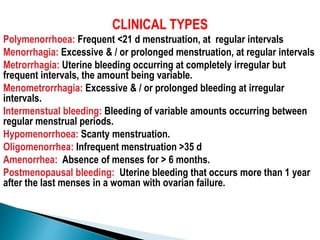
CLINICAL TYPES
Polymenorrhoea: Frequent <21 d menstruation, at regular intervals
Menorrhagia: Excessive & / or prolonged menstruation, at regular intervals
Metrorrhagia: Uterine bleeding occurring at completely irregular but
frequent intervals, the amount being variable.
Menometrorrhagia: Excessive & / or prolonged bleeding at irregular
intervals.
Intermenstual bleeding: Bleeding of variable amounts occurring between
regular menstrual periods.
Hypomenorrhoea: Scanty menstruation.
Oligomenorrhea: Infrequent menstruation >35 d
Amenorrhea: Absence of menses for > 6 months.
Postmenopausal bleeding: Uterine bleeding that occurs more than 1 year
after the last menses in a woman with ovarian failure.
Dysfunctional uterine bleeding
Abnormal uterine bleeding in absence of pelvic
organ disease or a systemic disorder.
 Heavy Menstrual Bleeding
◦ Acute
◦ Chronic
 Intermenstrual Bleeding
www.themegallery.com
 Heavy menstrual bleeding (HMB) is
defined as excessive menstrual
blood loss which interferes with a
women’s physical , emotional and
quality of life
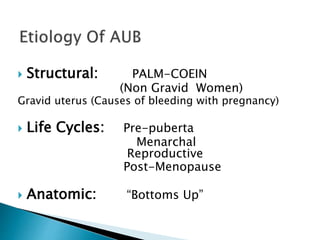
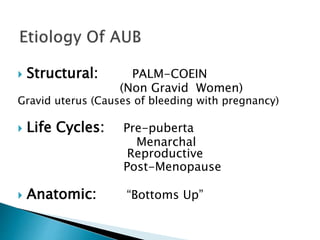
 Structural: PALM-COEIN
(Non Gravid Women)
Gravid uterus (Causes of bleeding with pregnancy)
 Life Cycles: Pre-puberta
Menarchal
Reproductive
Post-Menopause
 Anatomic: “Bottoms Up”
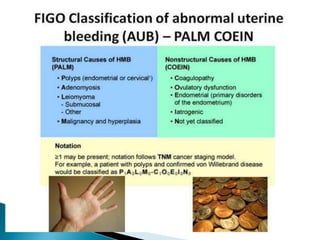
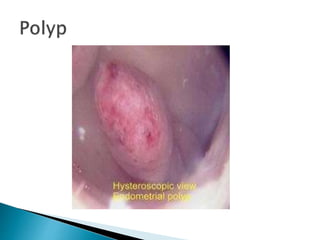
P- Polyp (AUB-P)
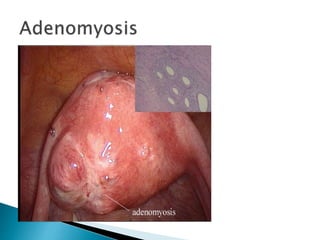
A- Adenomyosis (AUB-A)
L- Leiomyoma (AUB-L)
Submucosal myoma (AUB-LSM)
Other myoma (AUB-LO)
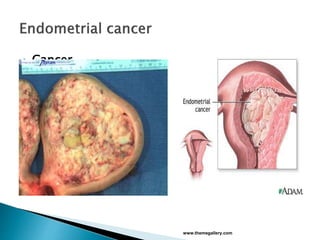
M- Malignancy & hyperplasia (AUB-M)
www.themegallery.com
 Cancer.
C- Coagulopathy (AUB-C)
O-Ovulatory dysfunction (AUB-O)
E- Endometrial (AUB-E)
I- Iatrogenic (AUB-I)
N- Not yet classified (AUB-N)
Inherited
von Willibrand's
hemophilia
Acquired
ITP
leukemia
Drug Induced
coumadin/heparin
aspirin
Coagulation Disorders
Rule out
von Willebrand's
in any girl who
requires
transfusion for excessive
bleeding
when first
starting periods
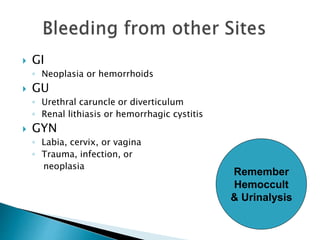
 GI
◦ Neoplasia or hemorrhoids
 GU
◦ Urethral caruncle or diverticulum
◦ Renal lithiasis or hemorrhagic cystitis
 GYN
◦ Labia, cervix, or vagina
◦ Trauma, infection, or
neoplasia
Remember
Hemoccult
& Urinalysis
Physiologic
 Pre -Adolescence
 Menopause
 Lactation
 Pregnancy
 Hyperandrogenic
anovulation (e.g.,
PCOS, CAH, or
androgen-
producing tumors)
 Hypothalamic
dysfunction
 Hyperprolactinemia
 Thyroid disease
 Pituitary disease
 Premature ovarian
failure
 Iatrogenic (Chemo)
 Medications
 Disorders of mechanisms regulating local
endometrial hemostasis.
 Endometrial inflammation
 Endometrial infection
 Abnormalities in the local endometrial
vasculogenesis
 Structural: PALM-COEIN
(Non Gravid Women)
Gravid uterus (Causes of bleeding with pregnancy)
 Life Cycles: Pre-puberta
Menarchal
Reproductive
Post-Menopause
 Anatomic: “Bottoms Up”
 Pre-pubertal
 Menarchal
 Reproductive
 Postmenopausal
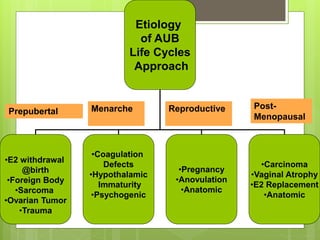
Etiology
of AUB
Life Cycles
Approach
•E2 withdrawal
@birth
•Foreign Body
•Sarcoma
•Ovarian Tumor
•Trauma
•Coagulation
Defects
•Hypothalamic
Immaturity
•Psychogenic
•Pregnancy
•Anovulation
•Anatomic
•Carcinoma
•Vaginal Atrophy
•E2 Replacement
•Anatomic
Prepubertal Menarche Reproductive Post-
Menopausal
 Structural: PALM-COEIN
(Non Gravid Women)
 Life Cycles: Pre-pubertal
Reproductive
Post-Menopause
 Anatomic: “Bottoms Up”
 “Bottoms Up”
◦ Vulva
◦ Vagina
◦ Cervix
◦ Uterus
◦ Ovary
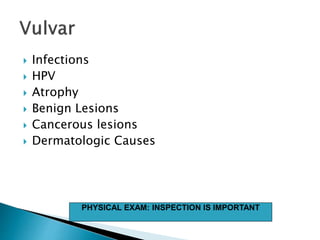
 Infections
 HPV
 Atrophy
 Benign Lesions
 Cancerous lesions
 Dermatologic Causes
PHYSICAL EXAM: INSPECTION IS IMPORTANT
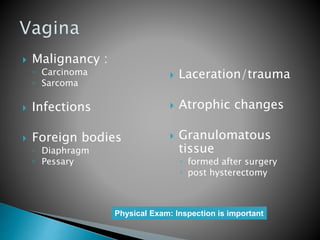
 Malignancy :
◦ Carcinoma
◦ Sarcoma
 Infections
 Foreign bodies
◦ Diaphragm
◦ Pessary
 Laceration/trauma
 Atrophic changes
 Granulomatous
tissue
◦ formed after surgery
◦ post hysterectomy
Physical Exam: Inspection is important
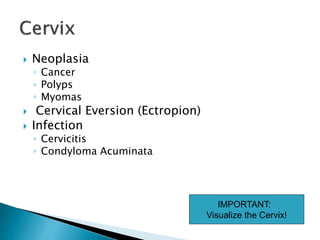
 Neoplasia
◦ Cancer
◦ Polyps
◦ Myomas
 Cervical Eversion (Ectropion)
 Infection
◦ Cervicitis
◦ Condyloma Acuminata
IMPORTANT:
Visualize the Cervix!
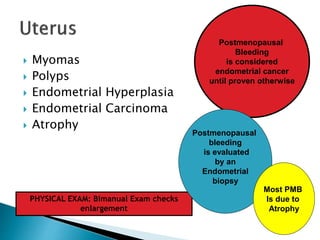
 Myomas
 Polyps
 Endometrial Hyperplasia
 Endometrial Carcinoma
 Atrophy
PHYSICAL EXAM: Bimanual Exam checks
enlargement
Postmenopausal
Bleeding
is considered
endometrial cancer
until proven otherwise
Postmenopausal
bleeding
is evaluated
by an
Endometrial
biopsy
Most PMB
Is due to
Atrophy
 Anovulation
 PCOS
 Menopause Transition
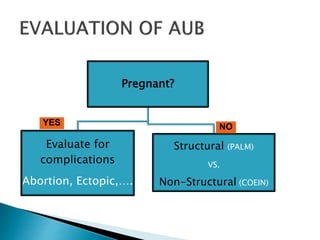
Pregnant?
Evaluate for
complications
Abortion, Ectopic,….
Structural (PALM)
VS.
Non-Structural (COEIN)
YES NO
 Onset, frequency, duration, cyclic vs. acyclic
Severity
 Pain, change from menstrual pattern
(calendar)
 Age, parity, marital status, sexual hx,
contraception
 medications, dates of pregnancies
symptoms of pregnancy and reproductive
tract disease
 Family history
II. Examination:
1. General:
pallor, endocrinopathy, coagulopathy, pregnancy
2. Abdominal:
liver, spleen, pelvi abdominal mass
3. Pelvic:
origin of the bleeding, cause
 CBC
 Urine or serum pregnancy test
 Coagulation profile
◦ PT, PTT, and bleeding time.
 Hormonal assay
◦ LH, FSH, TSH , testosterone, androstenedione,
basal 17-hydroxyprogesterone (17-HP)
 Evaluation of the Endometrium
◦ Endometrial Biopsy
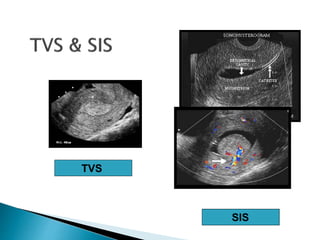
◦ Transvaginal &/or abdominal Ultrasound (TVS/AUS)
◦ Saline Sono-hysterocopy (SIS)
◦ Hysteroscopy
◦ MRI
Sonohysterography
polyps
Sonohysterography
 To assess for thickened endometrium
 In 92% of abnormal endometrial biopsies,
ultrasound showed >5mm endometrium
 In 96% of endometrial cancer by biopsy result,
ultrasound showed >5mm endometrium
 Therefore, ultrasound measured endometrium
<5mm is likely benign uterine condition
TVS
SIS
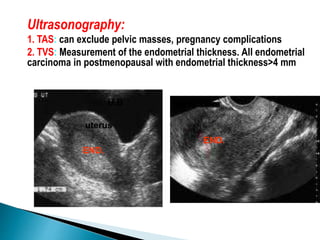
Ultrasonography:
1. TAS: can exclude pelvic masses, pregnancy complications
2. TVS: Measurement of the endometrial thickness. All endometrial
carcinoma in postmenopausal with endometrial thickness>4 mm
uterus
END.
U.B
END.
Hysteroscopy
polyp
Uterine synechia
 Precisely localizes sub-mucosal fibroids
 Detect Adenomyosis
 MRI is not superior to TVS & SIS in overall
diagnostic potential
Dueholm M, et al. Fertil Steril. 2001;76(2):350357
 General measures
 Medical
 Minimally invasive surgery
 Major surgery
Treatment
A. General
1-Bed rest till arrest of bleeding
2-Tonics and vitamins to correct anemia
3- Blood transfusion.
4- Treatment of the cause eg: Hypertension , Thyroid dis.
 Non-Hormonal
◦ Anti-fibrinolytics
◦ Coagulants
◦ Venotonics
◦ NSAIDS
 Hormonal
◦ Progestins
◦ Estrogen
◦ Estrogen + progestins (OCP)
◦ Androgens
◦ GnRH agonists
◦ Anti-progestational agents
I. Hormonal:
1.Progestagen eg:Norethisterone (Primulot-N)or norethisterone acetate (Primulot-Nor)
2.Oestrogen in threshold bleeding
3.COCs 1- 4 pills/d..bleeding stopped ...1pill for 21 days
4.Danazol 400 mg/d.
5.GnRH agonist 200 - 400 microgram nasal spray / d.
6.Levo-nova (Merina)
II. Non –hormonal
1.Prostaglandin synthetase inhibitors (NSAIDs)eg: mefenamic acid ,naproxen, Ibupufen
2.Antifibrinolytics eg: Tranexamic acid (Cyclokapron)
3.Coagulants( Dicynone)
4-Venotonics (Daflon)
 Intrauterine Device (IUD) with progesterone
 Dilation & Curettage
 Endometrial Ablation
MIRENA SYSTEM
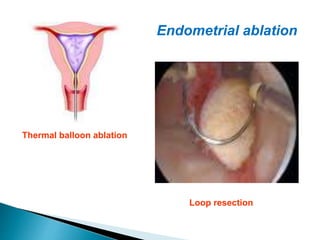
Endometrial ablation
Methods:
I.Hysteroscopic:
1. Laser
2. Electrosurgical: a. Roller ball
b. Loop resection
II.Non-hysteroscopic:
1. Thermal Balloon
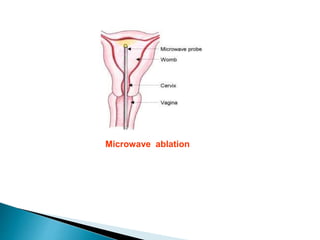
2. Microwave.
Thermal balloon ablation
Loop resection
Endometrial ablation
Microwave ablation
 Myomectomy
 Hysterectomy
Hysterectomy
Indications:
1. Failure of medical treatment
2. Family is completed
Routes:
1. Abdominal
2. Vaginal
3. Laparoscopic
 Can be a life-threatening emergency
◦ Monitor Vital signs, Start oxygen
◦ IV fluids (wide bore IV catheter)
◦ Type and Cross 2-4 units of blood
 IV Estrogen
 IM Progesterone
 NSAIDS (Anti-prostaglandins vs. Anti-
fibrinolytics)
 Emergency Dilatation and Curettage (D&C)

Abnormal uterine bleeding

  • 1.
  • 2.
     Blood loss< 80 ml (average 30-35 ml)  Duration of flow 2-7 days (average 4 days)  Cycle length 21 - 35 days (average 28 days)
  • 3.
     Follicular ◦ Beginswith Menses ends with luteinizing (LH) hormone surge  Ovulation (30-36 hours) ◦ Begins with LH surge and ends with ovulation  Luteal (14 days) ◦ Begins with the end of the LH surge and ends with onset of menses
  • 4.
    M. Manting; DUBLECTURE 2008
  • 5.
     Two mainmechanisms: ◦ Formation of the platelet plug  important in the functional endometrium ◦ Prostaglandin dependent vasoconstriction  important in the basalis layer
  • 6.
     Definition: ◦ Anychange in menstrual period as regard:  Flow  Duration  Frequency
  • 7.
     Menorrhagia  Metrorrhagia Polymenorrhea  Dysmenorrhea  Amenorrhea  Oligomenorrhea  Hypomenorrhea
  • 8.
    CLINICAL TYPES Polymenorrhoea: Frequent<21 d menstruation, at regular intervals Menorrhagia: Excessive & / or prolonged menstruation, at regular intervals Metrorrhagia: Uterine bleeding occurring at completely irregular but frequent intervals, the amount being variable. Menometrorrhagia: Excessive & / or prolonged bleeding at irregular intervals. Intermenstual bleeding: Bleeding of variable amounts occurring between regular menstrual periods. Hypomenorrhoea: Scanty menstruation. Oligomenorrhea: Infrequent menstruation >35 d Amenorrhea: Absence of menses for > 6 months. Postmenopausal bleeding: Uterine bleeding that occurs more than 1 year after the last menses in a woman with ovarian failure.
  • 9.
    Dysfunctional uterine bleeding Abnormaluterine bleeding in absence of pelvic organ disease or a systemic disorder.
  • 10.
     Heavy MenstrualBleeding ◦ Acute ◦ Chronic  Intermenstrual Bleeding
  • 11.
    www.themegallery.com  Heavy menstrualbleeding (HMB) is defined as excessive menstrual blood loss which interferes with a women’s physical , emotional and quality of life
  • 12.
     Structural: PALM-COEIN (NonGravid Women) Gravid uterus (Causes of bleeding with pregnancy)  Life Cycles: Pre-puberta Menarchal Reproductive Post-Menopause  Anatomic: “Bottoms Up”
  • 14.
    P- Polyp (AUB-P) A-Adenomyosis (AUB-A) L- Leiomyoma (AUB-L) Submucosal myoma (AUB-LSM) Other myoma (AUB-LO) M- Malignancy & hyperplasia (AUB-M)
  • 18.
  • 19.
    C- Coagulopathy (AUB-C) O-Ovulatorydysfunction (AUB-O) E- Endometrial (AUB-E) I- Iatrogenic (AUB-I) N- Not yet classified (AUB-N)
  • 20.
    Inherited von Willibrand's hemophilia Acquired ITP leukemia Drug Induced coumadin/heparin aspirin CoagulationDisorders Rule out von Willebrand's in any girl who requires transfusion for excessive bleeding when first starting periods
  • 21.
     GI ◦ Neoplasiaor hemorrhoids  GU ◦ Urethral caruncle or diverticulum ◦ Renal lithiasis or hemorrhagic cystitis  GYN ◦ Labia, cervix, or vagina ◦ Trauma, infection, or neoplasia Remember Hemoccult & Urinalysis
  • 22.
    Physiologic  Pre -Adolescence Menopause  Lactation  Pregnancy
  • 23.
     Hyperandrogenic anovulation (e.g., PCOS,CAH, or androgen- producing tumors)  Hypothalamic dysfunction  Hyperprolactinemia  Thyroid disease  Pituitary disease  Premature ovarian failure  Iatrogenic (Chemo)  Medications
  • 24.
     Disorders ofmechanisms regulating local endometrial hemostasis.  Endometrial inflammation  Endometrial infection  Abnormalities in the local endometrial vasculogenesis
  • 25.
     Structural: PALM-COEIN (NonGravid Women) Gravid uterus (Causes of bleeding with pregnancy)  Life Cycles: Pre-puberta Menarchal Reproductive Post-Menopause  Anatomic: “Bottoms Up”
  • 26.
     Pre-pubertal  Menarchal Reproductive  Postmenopausal
  • 27.
    Etiology of AUB Life Cycles Approach •E2withdrawal @birth •Foreign Body •Sarcoma •Ovarian Tumor •Trauma •Coagulation Defects •Hypothalamic Immaturity •Psychogenic •Pregnancy •Anovulation •Anatomic •Carcinoma •Vaginal Atrophy •E2 Replacement •Anatomic Prepubertal Menarche Reproductive Post- Menopausal
  • 28.
     Structural: PALM-COEIN (NonGravid Women)  Life Cycles: Pre-pubertal Reproductive Post-Menopause  Anatomic: “Bottoms Up”
  • 29.
     “Bottoms Up” ◦Vulva ◦ Vagina ◦ Cervix ◦ Uterus ◦ Ovary
  • 30.
     Infections  HPV Atrophy  Benign Lesions  Cancerous lesions  Dermatologic Causes PHYSICAL EXAM: INSPECTION IS IMPORTANT
  • 31.
     Malignancy : ◦Carcinoma ◦ Sarcoma  Infections  Foreign bodies ◦ Diaphragm ◦ Pessary  Laceration/trauma  Atrophic changes  Granulomatous tissue ◦ formed after surgery ◦ post hysterectomy Physical Exam: Inspection is important
  • 32.
     Neoplasia ◦ Cancer ◦Polyps ◦ Myomas  Cervical Eversion (Ectropion)  Infection ◦ Cervicitis ◦ Condyloma Acuminata IMPORTANT: Visualize the Cervix!
  • 33.
     Myomas  Polyps Endometrial Hyperplasia  Endometrial Carcinoma  Atrophy PHYSICAL EXAM: Bimanual Exam checks enlargement Postmenopausal Bleeding is considered endometrial cancer until proven otherwise Postmenopausal bleeding is evaluated by an Endometrial biopsy Most PMB Is due to Atrophy
  • 34.
     Anovulation  PCOS Menopause Transition
  • 35.
  • 36.
     Onset, frequency,duration, cyclic vs. acyclic Severity  Pain, change from menstrual pattern (calendar)  Age, parity, marital status, sexual hx, contraception  medications, dates of pregnancies symptoms of pregnancy and reproductive tract disease  Family history
  • 37.
    II. Examination: 1. General: pallor,endocrinopathy, coagulopathy, pregnancy 2. Abdominal: liver, spleen, pelvi abdominal mass 3. Pelvic: origin of the bleeding, cause
  • 38.
     CBC  Urineor serum pregnancy test  Coagulation profile ◦ PT, PTT, and bleeding time.  Hormonal assay ◦ LH, FSH, TSH , testosterone, androstenedione, basal 17-hydroxyprogesterone (17-HP)
  • 39.
     Evaluation ofthe Endometrium ◦ Endometrial Biopsy ◦ Transvaginal &/or abdominal Ultrasound (TVS/AUS) ◦ Saline Sono-hysterocopy (SIS) ◦ Hysteroscopy ◦ MRI
  • 40.
  • 41.
     To assessfor thickened endometrium  In 92% of abnormal endometrial biopsies, ultrasound showed >5mm endometrium  In 96% of endometrial cancer by biopsy result, ultrasound showed >5mm endometrium  Therefore, ultrasound measured endometrium <5mm is likely benign uterine condition
  • 42.
  • 43.
    Ultrasonography: 1. TAS: canexclude pelvic masses, pregnancy complications 2. TVS: Measurement of the endometrial thickness. All endometrial carcinoma in postmenopausal with endometrial thickness>4 mm uterus END. U.B END.
  • 45.
  • 46.
     Precisely localizessub-mucosal fibroids  Detect Adenomyosis  MRI is not superior to TVS & SIS in overall diagnostic potential Dueholm M, et al. Fertil Steril. 2001;76(2):350357
  • 47.
     General measures Medical  Minimally invasive surgery  Major surgery
  • 48.
    Treatment A. General 1-Bed resttill arrest of bleeding 2-Tonics and vitamins to correct anemia 3- Blood transfusion. 4- Treatment of the cause eg: Hypertension , Thyroid dis.
  • 49.
     Non-Hormonal ◦ Anti-fibrinolytics ◦Coagulants ◦ Venotonics ◦ NSAIDS  Hormonal ◦ Progestins ◦ Estrogen ◦ Estrogen + progestins (OCP) ◦ Androgens ◦ GnRH agonists ◦ Anti-progestational agents
  • 50.
    I. Hormonal: 1.Progestagen eg:Norethisterone(Primulot-N)or norethisterone acetate (Primulot-Nor) 2.Oestrogen in threshold bleeding 3.COCs 1- 4 pills/d..bleeding stopped ...1pill for 21 days 4.Danazol 400 mg/d. 5.GnRH agonist 200 - 400 microgram nasal spray / d. 6.Levo-nova (Merina) II. Non –hormonal 1.Prostaglandin synthetase inhibitors (NSAIDs)eg: mefenamic acid ,naproxen, Ibupufen 2.Antifibrinolytics eg: Tranexamic acid (Cyclokapron) 3.Coagulants( Dicynone) 4-Venotonics (Daflon)
  • 51.
     Intrauterine Device(IUD) with progesterone  Dilation & Curettage  Endometrial Ablation
  • 52.
  • 53.
    Endometrial ablation Methods: I.Hysteroscopic: 1. Laser 2.Electrosurgical: a. Roller ball b. Loop resection II.Non-hysteroscopic: 1. Thermal Balloon 2. Microwave.
  • 54.
    Thermal balloon ablation Loopresection Endometrial ablation
  • 55.
  • 56.
  • 57.
    Hysterectomy Indications: 1. Failure ofmedical treatment 2. Family is completed Routes: 1. Abdominal 2. Vaginal 3. Laparoscopic
  • 58.
     Can bea life-threatening emergency ◦ Monitor Vital signs, Start oxygen ◦ IV fluids (wide bore IV catheter) ◦ Type and Cross 2-4 units of blood  IV Estrogen  IM Progesterone  NSAIDS (Anti-prostaglandins vs. Anti- fibrinolytics)  Emergency Dilatation and Curettage (D&C)