26. Posterior Palatal Seal Michael Hamada, DDS Lecturer Division of Advanced Prosthodontics, Biomaterials and Hospital Dentistry UCLA  School of Dentistry This program of instruction is protected by copyright ©.  No portion of this program of instruction may be reproduced, recorded or transferred by any means electronic, digital, photographic, mechanical etc., or by any information storage or retrieval system, without prior permission.
Posterior Palatal Seal Introduction Purpose Palatal and Velar Anatomy House Classification Clinical Determination
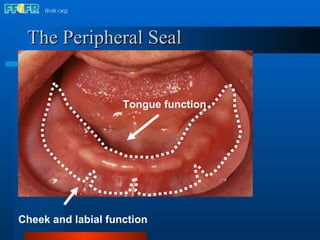
The Peripheral Seal Tongue function Cheek and labial function
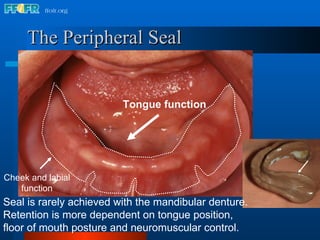
The Peripheral Seal Tongue function Cheek and labial function Seal is rarely achieved with the mandibular denture.  Retention is more dependent on tongue position, floor of mouth posture and neuromuscular control.
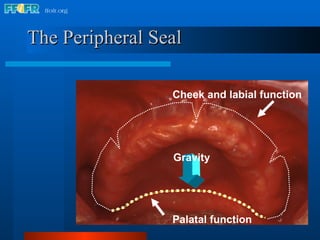
The Peripheral Seal Cheek and labial function Palatal function Gravity
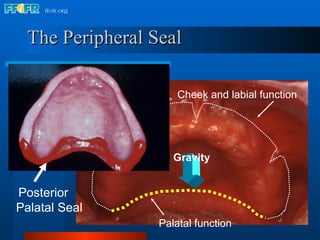
The Peripheral Seal Cheek and labial function Palatal function Gravity Posterior Palatal Seal
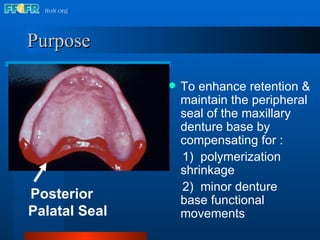
Purpose To enhance retention & maintain the peripheral seal of the maxillary denture base by compensating for : 1)  polymerization  shrinkage 2)  minor denture  base functional  movements Posterior Palatal Seal
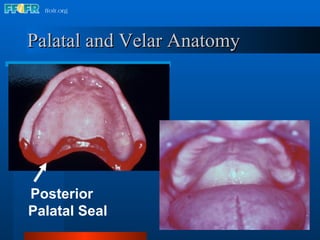
Palatal and Velar Anatomy Posterior Palatal Seal
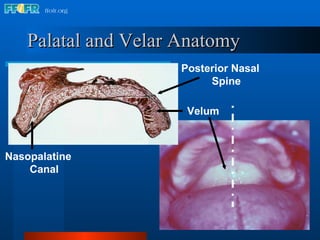
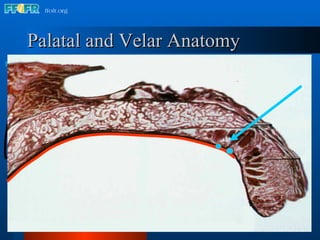
Palatal and Velar Anatomy Posterior Nasal Spine Nasopalatine Canal Velum
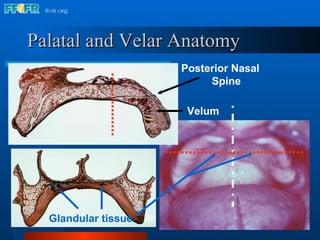
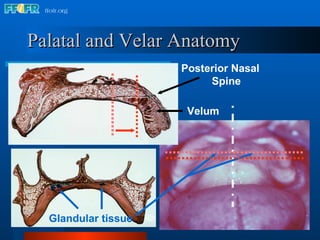
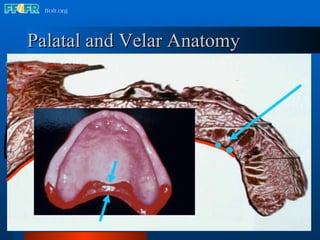
Palatal and Velar Anatomy Posterior Nasal Spine Velum Glandular tissue
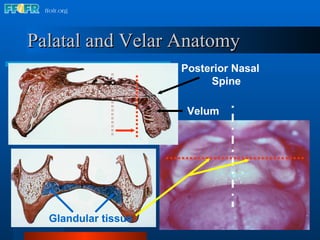
Palatal and Velar Anatomy Posterior Nasal Spine Glandular tissue Velum
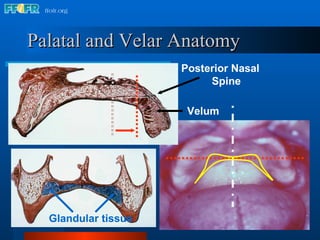
Palatal and Velar Anatomy Posterior Nasal Spine Velum Glandular tissue
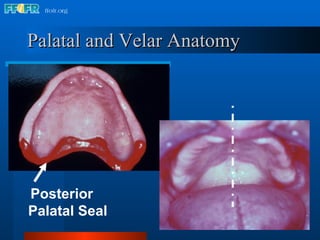
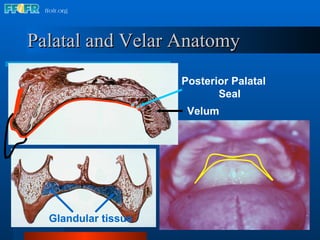
Palatal and Velar Anatomy Posterior Palatal Seal Velum Glandular tissue
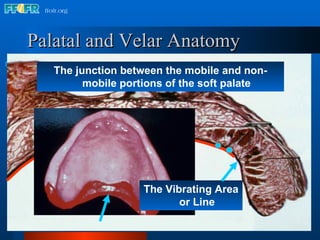
Palatal and Velar Anatomy The Vibrating Area or Line The junction between the mobile and non-mobile portions of the soft palate
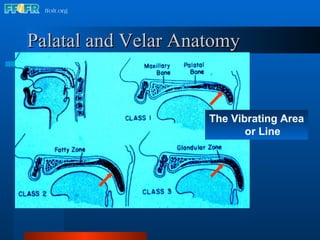
Palatal and Velar Anatomy The Vibrating Area or Line
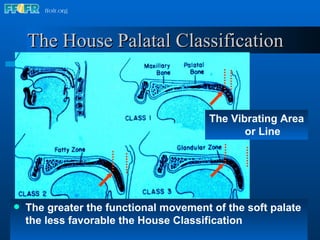
The House Palatal Classification The greater the functional movement of the soft palate the less favorable the House Classification The Vibrating Area or Line
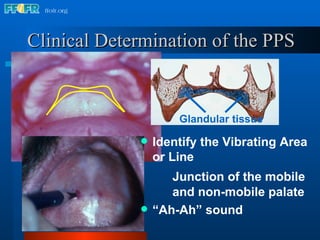
Clinical Determination of the PPS Identify the Vibrating Area or Line Junction of the mobile  and non-mobile palate “ Ah-Ah” sound Glandular tissue
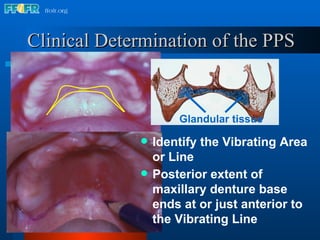
Clinical Determination of the PPS Identify the Vibrating Area or Line Glandular tissue Posterior extent of maxillary denture base ends at or just anterior to the Vibrating Line
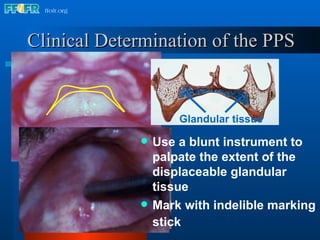
Clinical Determination of the PPS Use a blunt instrument to palpate the extent of the displaceable glandular tissue Mark with indelible marking stick Glandular tissue
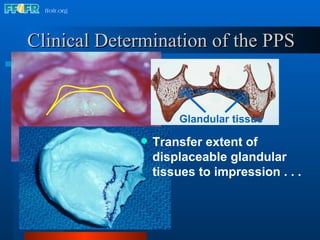
Clinical Determination of the PPS Transfer extent of displaceable glandular tissues to impression . . . Glandular tissue
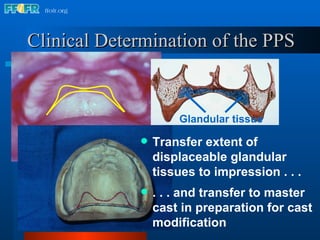
Clinical Determination of the PPS Transfer extent of displaceable glandular tissues to impression . . . Glandular tissue . . . and transfer to master cast in preparation for cast modification
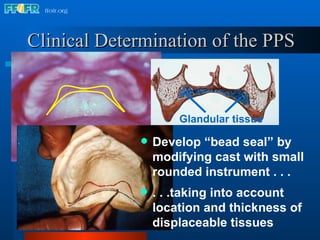
Clinical Determination of the PPS Develop “bead seal” by modifying cast with small rounded instrument . . . Glandular tissue . . .taking into account location and thickness of displaceable tissues
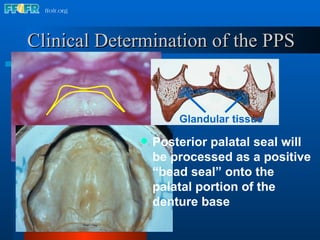
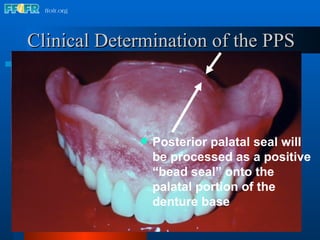
Clinical Determination of the PPS Posterior palatal seal will be processed as a positive “bead seal” onto the palatal portion of the denture base Glandular tissue
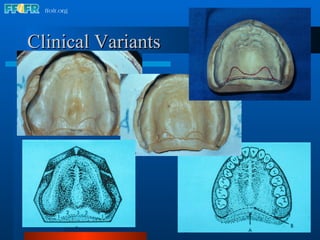
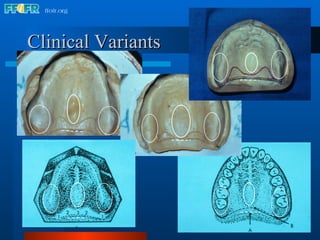
Clinical Variants
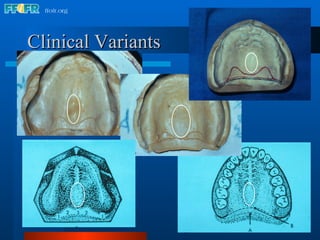
Clinical Variants
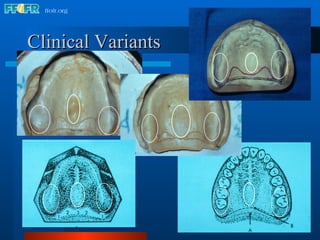
Clinical Variants
Clinical Variants

26.posterior palatal seal

  • 1.
    26. Posterior PalatalSeal Michael Hamada, DDS Lecturer Division of Advanced Prosthodontics, Biomaterials and Hospital Dentistry UCLA School of Dentistry This program of instruction is protected by copyright ©. No portion of this program of instruction may be reproduced, recorded or transferred by any means electronic, digital, photographic, mechanical etc., or by any information storage or retrieval system, without prior permission.
  • 2.
    Posterior Palatal SealIntroduction Purpose Palatal and Velar Anatomy House Classification Clinical Determination
  • 3.
    The Peripheral SealTongue function Cheek and labial function
  • 4.
    The Peripheral SealTongue function Cheek and labial function Seal is rarely achieved with the mandibular denture. Retention is more dependent on tongue position, floor of mouth posture and neuromuscular control.
  • 5.
    The Peripheral SealCheek and labial function Palatal function Gravity
  • 6.
    The Peripheral SealCheek and labial function Palatal function Gravity Posterior Palatal Seal
  • 7.
    Purpose To enhanceretention & maintain the peripheral seal of the maxillary denture base by compensating for : 1) polymerization shrinkage 2) minor denture base functional movements Posterior Palatal Seal
  • 8.
    Palatal and VelarAnatomy Posterior Palatal Seal
  • 9.
    Palatal and VelarAnatomy Posterior Palatal Seal
  • 10.
    Palatal and VelarAnatomy Posterior Nasal Spine Nasopalatine Canal Velum
  • 11.
    Palatal and VelarAnatomy Posterior Nasal Spine Velum Glandular tissue
  • 12.
    Palatal and VelarAnatomy Posterior Nasal Spine Glandular tissue Velum
  • 13.
    Palatal and VelarAnatomy Posterior Nasal Spine Velum Glandular tissue
  • 14.
    Palatal and VelarAnatomy Posterior Nasal Spine Velum Glandular tissue
  • 15.
    Palatal and VelarAnatomy Posterior Palatal Seal Velum Glandular tissue
  • 16.
    Palatal and VelarAnatomy Posterior Palatal Seal Velum Glandular tissue
  • 17.
    Palatal and VelarAnatomy Posterior Palatal Seal Velum Glandular tissue
  • 18.
    Palatal and VelarAnatomy The Vibrating Area or Line The junction between the mobile and non-mobile portions of the soft palate
  • 19.
    Palatal and VelarAnatomy The Vibrating Area or Line
  • 20.
    The House PalatalClassification The greater the functional movement of the soft palate the less favorable the House Classification The Vibrating Area or Line
  • 21.
    Clinical Determination ofthe PPS Identify the Vibrating Area or Line Junction of the mobile and non-mobile palate “ Ah-Ah” sound Glandular tissue
  • 22.
    Clinical Determination ofthe PPS Identify the Vibrating Area or Line Glandular tissue Posterior extent of maxillary denture base ends at or just anterior to the Vibrating Line
  • 23.
    Clinical Determination ofthe PPS Use a blunt instrument to palpate the extent of the displaceable glandular tissue Mark with indelible marking stick Glandular tissue
  • 24.
    Clinical Determination ofthe PPS Transfer extent of displaceable glandular tissues to impression . . . Glandular tissue
  • 25.
    Clinical Determination ofthe PPS Transfer extent of displaceable glandular tissues to impression . . . Glandular tissue . . . and transfer to master cast in preparation for cast modification
  • 26.
    Clinical Determination ofthe PPS Develop “bead seal” by modifying cast with small rounded instrument . . . Glandular tissue . . .taking into account location and thickness of displaceable tissues
  • 27.
    Clinical Determination ofthe PPS Posterior palatal seal will be processed as a positive “bead seal” onto the palatal portion of the denture base Glandular tissue
  • 28.
    Clinical Determination ofthe PPS Posterior palatal seal will be processed as a positive “bead seal” onto the palatal portion of the denture base Glandular tissue
  • 29.
  • 30.
  • 31.
  • 32.