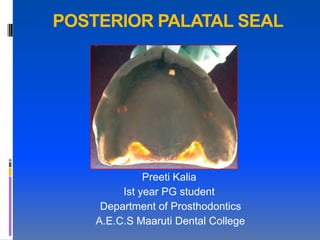
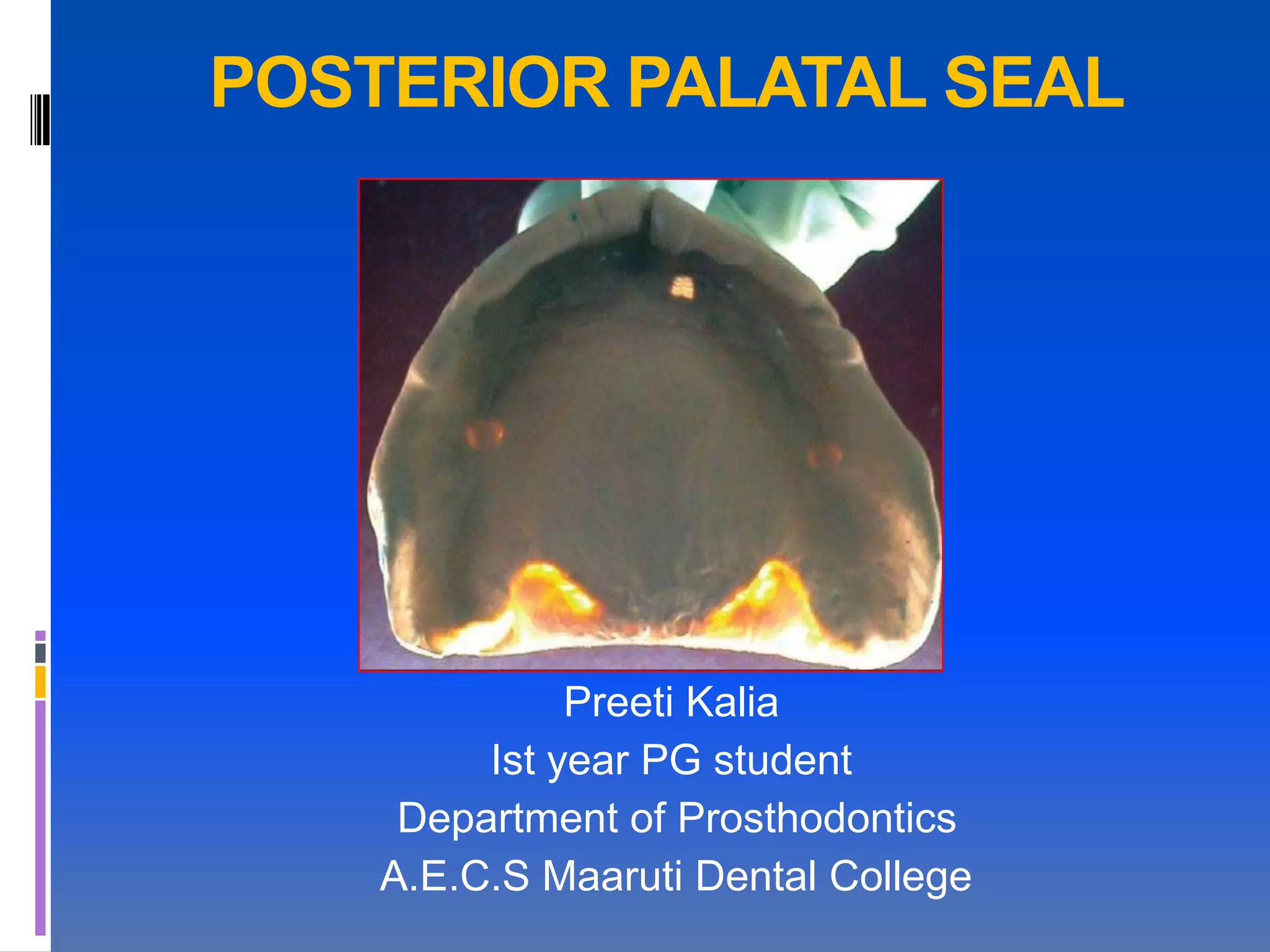
POSTERIOR PALATAL SEAL


              Preeti Kalia
         Ist year PG student
     Department of Prosthodontics
    A.E.C.S Maaruti Dental College
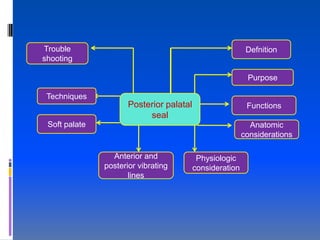
Trouble                                                    Defnition
shooting

                                                           Purpose

 Techniques
                      Posterior palatal                    Functions
                           seal
 Soft palate                                                Anatomic
                                                          considerations

                 Anterior and              Physiologic
               posterior vibrating        consideration
                      lines
Definition

According to GPT “It is defined as a soft tissue
  along the junction of the hard and soft
  palates on which pressure within the
  physiologic limits of the tissues can be
  applied by a denture to aid in the retention of
  the denture."
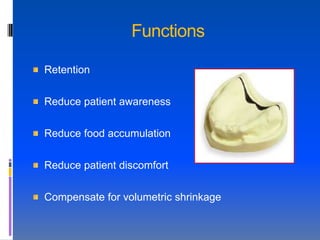
Functions

Retention

Reduce patient awareness

Reduce food accumulation

Reduce patient discomfort

Compensate for volumetric shrinkage
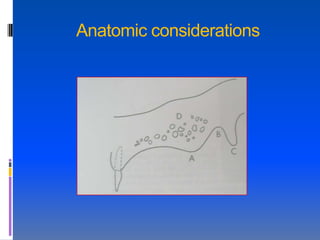
Anatomic considerations
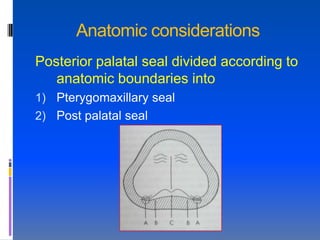
Posterior palatal seal divided according to
   anatomic boundaries into
1) Pterygomaxillary seal
2) Post palatal seal
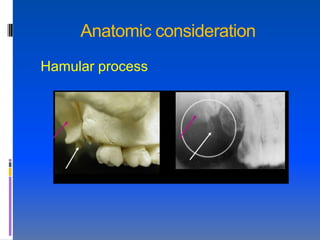
Anatomic consideration
Hamular process
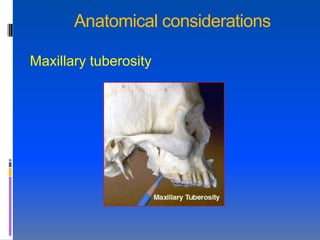
Anatomical considerations

Maxillary tuberosity
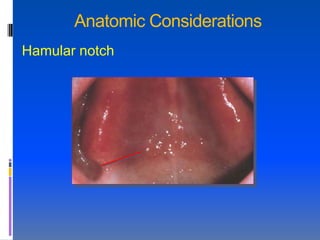
Anatomic Considerations
Hamular notch
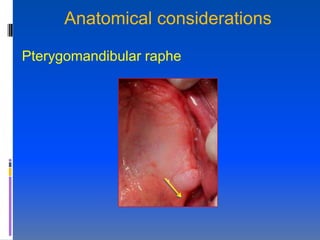
Anatomical considerations

Pterygomandibular raphe
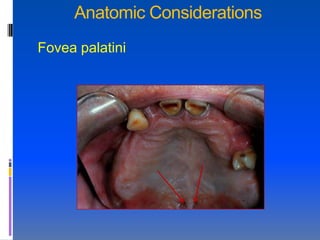
Anatomic Considerations
Fovea palatini
Anatomic Considerations
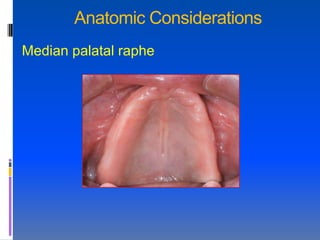
Median palatal raphe
Anatomic considerations
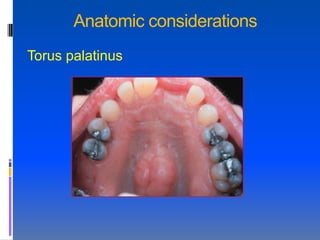
Torus palatinus
Physiologic consideration
Saliva
 Presence of thick ropy saliva can create
 hydrostatic pressure in the area anterior to
 the posterior palatal seal , resulting in a
 downward dislodging forces
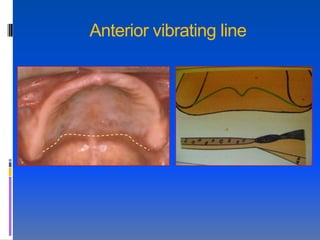
Anterior vibrating line
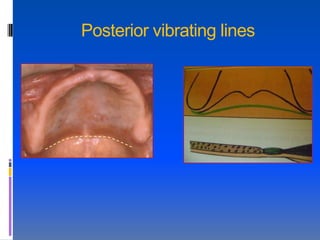
Posterior vibrating lines
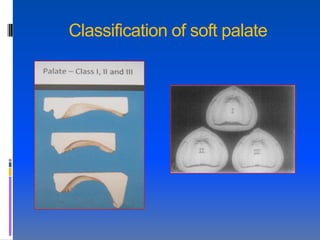
Classification of soft palate
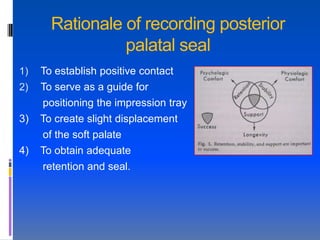
Rationale of recording posterior
                 palatal seal
1)   To establish positive contact
2)   To serve as a guide for
     positioning the impression tray
3)   To create slight displacement
     of the soft palate
4)   To obtain adequate
     retention and seal.
Techniques

Functional

Semi functional

Empirical
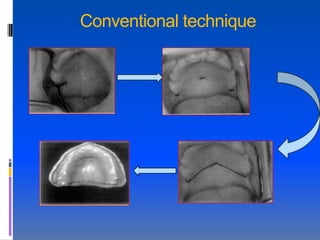
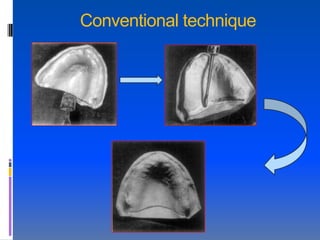
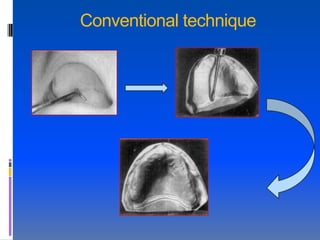
Conventional technique


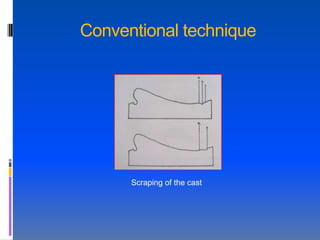
      Scraping of the cast
V id4.mov
Conventional technique
Advantages

 Trial base is more retentive

 Psychologic security to the patient

 Practitioner can determine the retentive
 qualities in the finished denture

 Patient realizes the posterior extent which may
 ease the adjustment period
Conventional technique
Disadvantages

 Not a physiologic technique

 Potential for overcompression of tissues
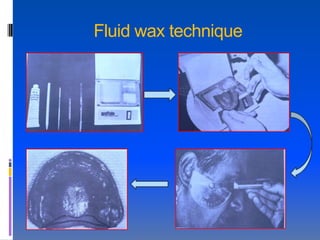
Fluid wax technique
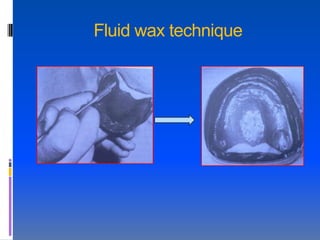
Fluid wax technique
Fluid wax technique
Advantages

 Physiologic technique

 Over compression of tissues is avoided

 Posterior palatal seal is incorporated into the
  trial denture base for added retention

 Mechanical scraping of the cast is avoided
Fluid wax technique

Disadvantages

 More time is necessary during the
 impression appointment

 Difficulty in handling materials
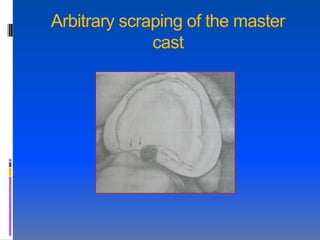
Arbitrary scraping of the master
              cast
Extended palatal technique

Proposed by Silvermann

Posterior border of the denture can be
extended by 8mm for patients with Class I
soft palate

Not accepted now
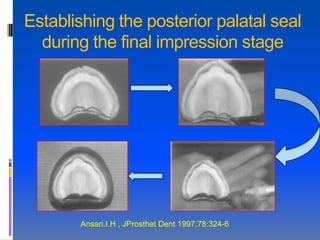
Establishing the posterior palatal seal
  during the final impression stage


       Ansari.I.H , JProsthet Dent 1997;78:324-6.
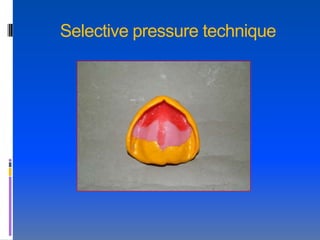
Selective pressure technique
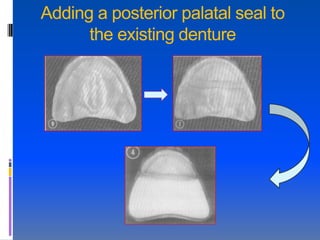
Adding a posterior palatal seal to
      the existing denture
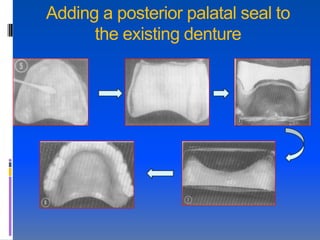
Adding a posterior palatal seal to
      the existing denture
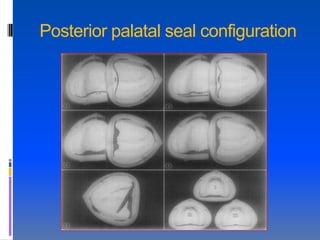
Posterior palatal seal configuration
Troubleshooting
1) Underextension

2) Underpostdamming

3) Overpostdamming

4) Overextension
Review of literature


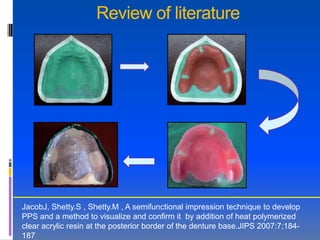
JacobJ, Shetty.S , Shetty.M , A semifunctional impression technique to develop
PPS and a method to visualize and confirm it by addition of heat polymerized
clear acrylic resin at the posterior border of the denture base.JIPS 2007:7;184-
187
Review of literature


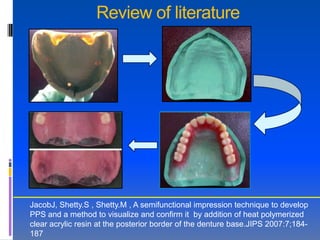
JacobJ, Shetty.S , Shetty.M , A semifunctional impression technique to develop
PPS and a method to visualize and confirm it by addition of heat polymerized
clear acrylic resin at the posterior border of the denture base.JIPS 2007:7;184-
187
Review of literature


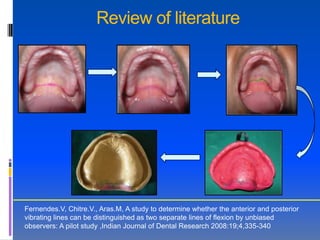
Fernendes.V, Chitre.V., Aras.M, A study to determine whether the anterior and posterior
vibrating lines can be distinguished as two separate lines of flexion by unbiased
observers: A pilot study ,Indian Journal of Dental Research 2008:19;4,335-340
References
Sheldon Winkler,Essentials of Complete
Denture Prosthodontics,2nd
edition,2009,A.I.B.T.S publishers and
distributors, India, pp-107-122
Charles.L.Bolender,Prosthodontic treatment
for edentulous patients,12th
edition,2003,Mosby publications,St.Louis,pp-
331-3
Deepak Nallaswamy,Textbook of
Prosthodontics, Ist edition,2003,Jaypee
publishers,New Delhi,pp-51-53,84-88
References
Irving R Hardy, Krishan K Kapur,Posterior
border seal-Its Rationale and Importance. J
Prosthet Dent 1958:8;3,386-397
Winland, RD and Young JM.Maxillary
complete denture posterior palatal seal:
variation in size shape and form. J Prosthet
Dent 29:256-261, 1973.
Ettinger:, R.l., Scandrett, F.R.The posterior
palatal seal. A review. Aust Dent J 25: 197-
200, 1980.
References
 Jacobson, T. E. and Krol, A. J, A
  contemporary review of the factors involved
  in complete retention , stability, and
  support.Part I.J Prosthet Dent1983 49:5-15,
 Jacobson, T. E. and. A contemporary review
  of the factors involved in complete retention ,
  stability, and support Part II J Prosthet Dent
  1983 ;49, 165-172, .
 Jacobson, T. E. and. A contemporary review
  of the factors involved in complete retention ,
  stability, and support PartI III J Prosthet Dent
  1983;49:306-313, .
References
Ansari.I.H, Establishing the posterior
palatal seal during the final impression
stage, JProsthet Dent 1997;78:324-6
Jacob.J, Shetty.S , Shetty.M ,A
semifunctional impression technique to
develop PPS and a method to visualize
and confirm it by addition of heat
polymerized clear acrylic resin at the
posterior border of the denture base ,JIPS
2007:7;184-187
References
Fernendes.V, Chitre.V, Aras.M, A study to
determine whether the anterior and
posterior vibrating lines can be
distinguished as two separate lines of
flexion by unbiased observers: A pilot
study ,Indian J Dent Res 2008:19;4,335-
340
dentyoutube.com/dentalvideo-
php?vid=b4ab82d4

posterior palatal seal ppt