THE SUN AS A STAR
ENGAGE
1. What do we see in the night sky?
2. What are the two major nuclear reactions that releases abundant
energy?
EXPLORE
EXPLAIN
• The sun is a yellow dwarf star.
• It is a star because it produces light and energy by means of nuclear
fusion converting hydrogen to helium.
• It is the heat and light generated from the sun that makes life on Earth
possible.
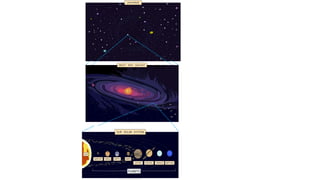
• Our Sun is one among the billions of stars present in the Milky Way
galaxy which contains about 200 billion stars
ELABORATE
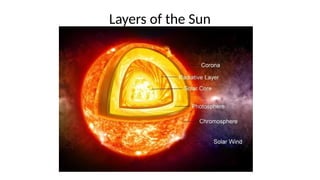
Layers of the Sun
● The gravity of the Sun, which is almost 28 times that of Earth, ''traps'' hydrogen from
its atmosphere and this hydrogen fuels the Sun’s fusion reaction.
● At temperatures of 15 million degree Celcius in the Sun's core, hydrogen gas
becomes plasma, the fourth state of matter. In a plasma, the negatively charged
electrons in atoms are completely separated from the positively charged atomic
nuclei (or ions).
● The Sun's gravitational force confines the positively-charged hydrogen nuclei and
work with the high temperatures that cause the nuclei to move around furiously,
collide at high speeds overcoming the natural electrostatic repulsion that exists
between the positive charges and fuse to form the heavier helium.
EVALUATE
1.Sun and all stars generate heat and light by..
A. nuclear fusion
B. nuclear fission
C. combustion of fuels
D. thermal ignition
STARS
ENGAGE
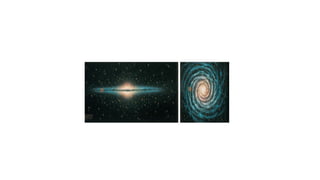
1. Name the galaxy in which our solar system is present?
2. Which is the star which brings the major source of light and heat to
our Earth without which life in Earth is not possible?
3. What is the shape of our galaxy?
EXPLORE
EXPLAIN
LIGHT YEAR
• Although the stars appear very close when we look at the night sky,
the distances involved are enormous when compared with the
distances across our solar system.
• The distance is so great that we cannot measure it with the general
unit of length. Hence we introduce a new unit called a light year. This
is the distance travelled by light in the space for one year.
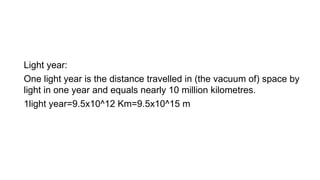
Light year:
One light year is the distance travelled in (the vacuum of) space by
light in one year and equals nearly 10 million kilometres.
1light year=9.5x10^12 Km=9.5x10^15 m
ELABORATE
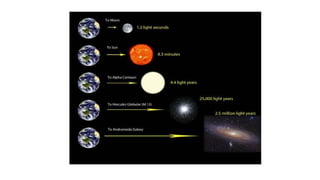
• When you gaze at the stars at night, you are actually seeing light
that might have emitted long back. It implies that you are actually
looking back in time. You are seeing a younger star than it actually
is!!
• It takes 8 minutes and 20 seconds for the sunlight to reach us. That
means the light hitting your eye from sun has been traveling for
more than 8 minutes.
• And this time lag implies that what we observe now is actually
something in past. Likewise we see the Moon as it was 1.3 seconds
ago.
CLASSIFICATION OF STAR
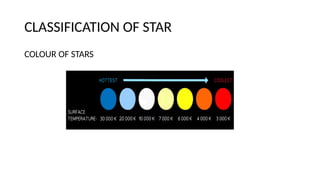
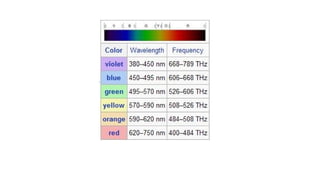
COLOUR OF STARS
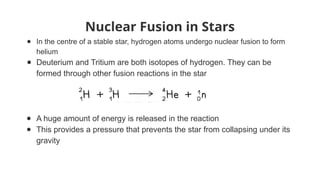
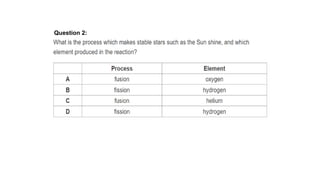
Nuclear Fusion in Stars
● In the centre of a stable star, hydrogen atoms undergo nuclear fusion to form
helium
● Deuterium and Tritium are both isotopes of hydrogen. They can be
formed through other fusion reactions in the star
● A huge amount of energy is released in the reaction
● This provides a pressure that prevents the star from collapsing under its
gravity
EVALUATE
Question 1:
Very large main sequence stars are typically much hotter than the Sun,
as indicated by their colour. Which of the star colours below has the
highest temperature?
• A. A red star
• B. A blue star
• C. An orange star
• D. A yellow star
Question 2:
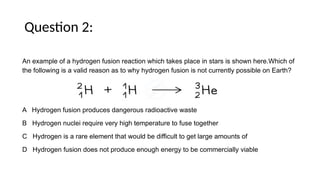
An example of a hydrogen fusion reaction which takes place in stars is shown here.Which of
the following is a valid reason as to why hydrogen fusion is not currently possible on Earth?
A Hydrogen fusion produces dangerous radioactive waste
B Hydrogen nuclei require very high temperature to fuse together
C Hydrogen is a rare element that would be difficult to get large amounts of
D Hydrogen fusion does not produce enough energy to be commercially viable
LIFE CYCLE OF STARS
Objective
• To know about the life cycle of stars
ENGAGE - 5’
1. What is a star?
2. How it is formed?
3. Is there anything like birth and death of a star?
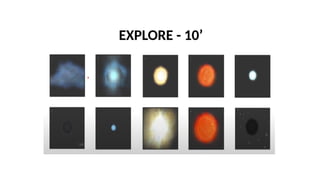
EXPLORE - 10’
EXPLAIN - 10’
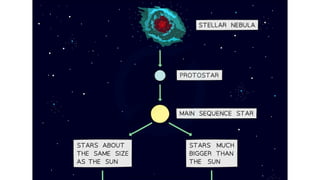
1. Nebula
•All stars form from a giant interstellar cloud of hydrogen
gas and dust called a nebula
2. Protostar
•The force of gravity within a nebula pulls the
particles closer together until it forms a hot ball of gas,
known as a protostar
•As the particles are pulled closer together the density of
the protostar will increase.
•This will result in more frequent collisions between the
particles which causes the temperature to increase
3. Main Sequence Star:
•Once the protostar becomes hot enough, nuclear fusion
reactions occur within its core.
•The hydrogen nuclei will fuse to form helium nuclei.
•Every fusion reaction releases heat (and light) energy which
keeps the core hot.
•Once a protostar is formed, its life cycle will depend on
its mass.
•Once a star is born it is known as a main-sequence star
•During the main sequence, the star is in equilibrium and said
to be stable.
•The inward force due to gravity is equal to the outward
pressure force from the fusion reactions.
ELABORATE - 15’
4. Red Giant or Red Super Giant:
• After several billion years the hydrogen causing the fusion
reactions in the star will begin to run out.
• Once this happens, the fusion reactions in the core will start to die
down.
• This causes the core to shrink and heat up.
• The core will shrink because the inward force due to gravity will
become greater than the outward force due to the pressure of the
expanding gases as the fusion dies down.
• A new series of reactions will then occur around the core, for
example, helium nuclei will undergo fusion to form beryllium.
• These reactions will cause the outer part of the star to expand.
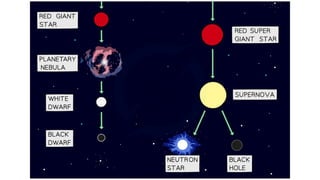
• A star the same size as the Sun or smaller will become a red
giant
• A star much larger than the Sun will become a red supergiant.
• It is red because the outer surface starts to cool.
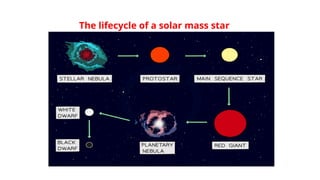
5. For Red Giant Stars:
Planetary Nebula:
• Once this second stage of fusion reactions have finished, the star will
become unstable and eject the outer layer of dust and gas.
• The layer of dust and gas which is ejected is called a planetary nebula
White Dwarf:
• The core which is left behind will collapse completely, due to the pull
of gravity, and the star will become a white dwarf.
• The white dwarf will be cooling down and as a result, the amount of energy it
emits will decrease.
Black Dwarf:
• Once the star has lost a significant amount of energy it becomes a black dwarf
• It will continue to cool until it eventually disappears from sight
The lifecycle of a solar mass star
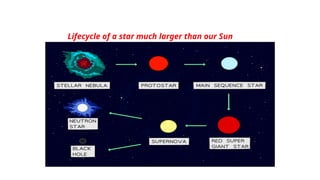
6. For Red Super Giants:
Supernova:
•Once the fusion reactions inside the red supergiant finally finish, the
core of the star will collapse suddenly causing a gigantic explosion.
This is called a supernova
•At the centre of this explosion a dense body, called a neutron star will
form
•The outer remnants of the star will be ejected into space during the
supernova explosion, forming a planetary nebula.
•The nebula from a supernova may form new stars with orbiting
planets
Neutron Star (or Black Hole):
•In the case of the biggest stars, the neutron star that forms at the
center will continue to collapse under the force of gravity until it forms
a black hole.
•A black hole is an extremely dense point in space that not
even light can escape from.
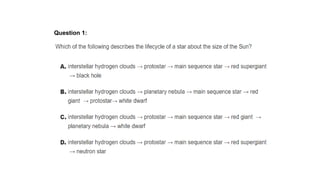
Lifecycle of a star much larger than our Sun
EVALUATE - 10’
Question 1:
Question 2:
THE EXPANDING UNIVERSE
Objective
• To describe about galaxies and redshift
ENGAGE - 5’
1. What is our galaxy name?
2. How do we measure its distance and velocity?
EXPLORE - 10’
EXPLAIN - 10’
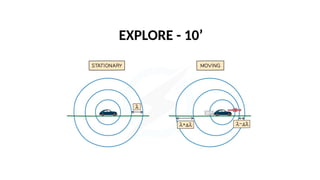
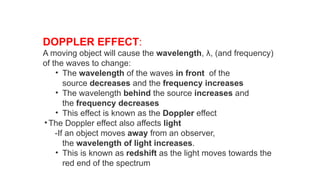
DOPPLER EFFECT:
A moving object will cause the wavelength, λ, (and frequency)
of the waves to change:
• The wavelength of the waves in front of the
source decreases and the frequency increases
• The wavelength behind the source increases and
the frequency decreases
• This effect is known as the Doppler effect
•The Doppler effect also affects light
-If an object moves away from an observer,
the wavelength of light increases.
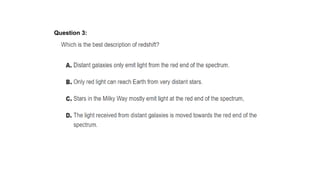
• This is known as redshift as the light moves towards the
red end of the spectrum
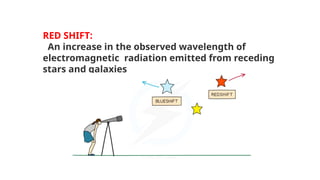
RED SHIFT:
An increase in the observed wavelength of
electromagnetic radiation emitted from receding
stars and galaxies
ELABORATE - 15’
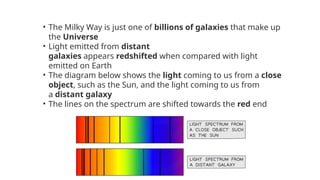
• The Milky Way is just one of billions of galaxies that make up
the Universe
• Light emitted from distant
galaxies appears redshifted when compared with light
emitted on Earth
• The diagram below shows the light coming to us from a close
object, such as the Sun, and the light coming to us from
a distant galaxy
• The lines on the spectrum are shifted towards the red end
• This indicates that the galaxies are moving away from us
• If the galaxies are moving away from us, it means that the universe
is expanding
• The observation of redshift from distant galaxies supports the Big
Bang theory
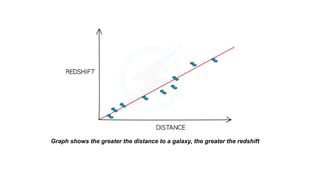
• Another observation from looking at the light spectrums produced
from distant galaxies is that the greater the distance to the galaxy,
the greater the redshift
• This means that the further away a galaxy, the faster it is moving
away from us
Graph shows the greater the distance to a galaxy, the greater the redshift
EVALUATE - 10’
Question 1:
Question 2:
Question 3:
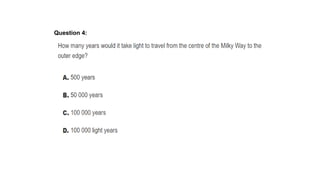
Question 4:
THE BIG BANG THEORY
Objective
• To describe about big bang theory
ENGAGE - 5’
1. Is our universe expanding? If yes, how?
2. What is redshift?
3. What do you observe?
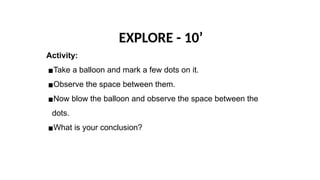
EXPLORE - 10’
Activity:
▪Take a balloon and mark a few dots on it.
▪Observe the space between them.
▪Now blow the balloon and observe the space between the
dots.
▪What is your conclusion?
EXPLAIN - 10’
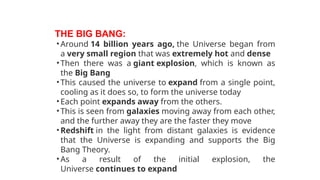
THE BIG BANG:
•Around 14 billion years ago, the Universe began from
a very small region that was extremely hot and dense
•Then there was a giant explosion, which is known as
the Big Bang
•This caused the universe to expand from a single point,
cooling as it does so, to form the universe today
•Each point expands away from the others.
•This is seen from galaxies moving away from each other,
and the further away they are the faster they move
•Redshift in the light from distant galaxies is evidence
that the Universe is expanding and supports the Big
Bang Theory.
•As a result of the initial explosion, the
Universe continues to expand
EVIDENCE FOR THE BIG BANG:
• The Big Bang theory is very well supported by
evidence from a range of sources
• The main pieces of evidence are
• Galactic red-shift
• Cosmic Microwave Background
Radiation (CMBR)
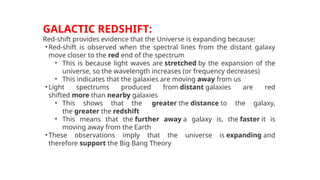
GALACTIC REDSHIFT:
Red-shift provides evidence that the Universe is expanding because:
•Red-shift is observed when the spectral lines from the distant galaxy
move closer to the red end of the spectrum
• This is because light waves are stretched by the expansion of the
universe, so the wavelength increases (or frequency decreases)
• This indicates that the galaxies are moving away from us
•Light spectrums produced from distant galaxies are red
shifted more than nearby galaxies
• This shows that the greater the distance to the galaxy,
the greater the redshift
• This means that the further away a galaxy is, the faster it is
moving away from the Earth
•These observations imply that the universe is expanding and
therefore support the Big Bang Theory
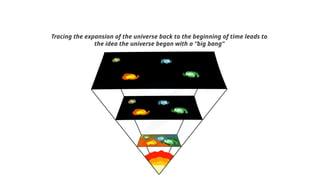
Tracing the expansion of the universe back to the beginning of time leads to
the idea the universe began with a “big bang”
EVIDENCE FROM CMB RADIATION:
CMB (Cosmic Microwave Background) radiation – currently
accepted model
• The CMB is a type of electromagnetic radiation which is a
remnant from the early stages of the Universe
• It has a wavelength of around 1 mm making it a microwave,
hence the name Cosmic Microwave Background radiation
• In 1964, Astronomers discovered radiation in the microwave
region of the electromagnetic spectrum coming from all
directions and at a generally uniform temperature of 2.73 K
• They were unable to do this any earlier since microwaves
are absorbed by the atmosphere
• Around this time, space flight was developed which enabled
astronomers to send telescopes into orbit above the
atmosphere
ELABORATE - 15’
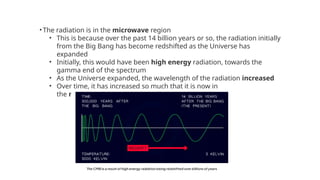
•The radiation is in the microwave region
• This is because over the past 14 billion years or so, the radiation initially
from the Big Bang has become redshifted as the Universe has
expanded
• Initially, this would have been high energy radiation, towards the
gamma end of the spectrum
• As the Universe expanded, the wavelength of the radiation increased
• Over time, it has increased so much that it is now in
the microwave region of the spectrum
EVALUATE - 10’
Question 1:
What are evidences that support Big Bang theory?
Question 2:
The CMB radiation is very uniform and has the exact profile
expected to be emitted from a hot body that has cooled
down over a very long time.
True or False
Question 3:
What is CMBR?
MEASURING GALACTIC SPEED &
DISTANCE
Objective
• To know that the speed v at which a galaxy is moving away
from the Earth can be found from the change in wavelength
of the galaxy’s starlight due to redshift
• To know that the distance of a far galaxy d can be
determined using the brightness of a supernova in that
galaxy
ENGAGE - 5’
1. What is the relation between speed , wavelength
and frequency?
2. How is the galactic speed calculated?
EXPLORE - 10’
Activity:
▪Take a slinky.
▪Let one student hold it at one end (say A) and let the other
student hold the other end (Say B).
▪Let the student holding the end B move away from the student
holding the end A.
▪Observe what happens.
▪Then let the student holding the end B move towards the
student holding the end A.
▪Observe what happens.
▪Discuss the observations.
EXPLAIN - 10’
1. Using Redshift Observations to Measure
the Universe:
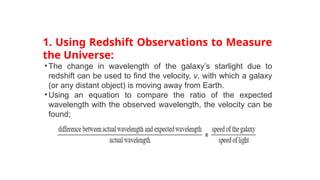
•The change in wavelength of the galaxy’s starlight due to
redshift can be used to find the velocity, v, with which a galaxy
(or any distant object) is moving away from Earth.
•Using an equation to compare the ratio of the expected
wavelength with the observed wavelength, the velocity can be
found;
Activity:
▪Take a torch and a plane mirror.
▪Switch on the torch and keep it close to plane mirror.
▪Observe its brightness.
▪Now move away from the plane mirror and observe the
brightness reflected on the mirror as you increase the distance
further.
▪Discuss the observations.
2. Measuring Distance Using Supernovae:
• A key method is the use of standard candles,
including supernovae.
• Supernovae are exploding stars
• Certain types have the same peak level of brightness
(absolute magnitude), making them extremely useful in
measuring the distance to remote stars and galaxies
• Type 1a supernovae are so bright that they can be seen
clearly even though they may be deep inside their parent
galaxy
• This allows the distance to the galaxy to be calculated
EVALUATE - 10’
Question 1:
How can we measure the galactic speed and
distance?
Question 2:
How does the brightness of the star help in measuring
the distance?
HUBBLE & THE AGE OF THE UNIVERSE
Objective
• To define Hubble’s constant.
• To know to determine the age of the universe.
ENGAGE - 5’
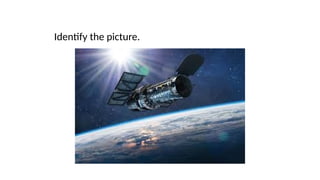
Identify the picture.
EXPLORE - 10’
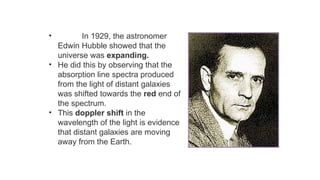
• In 1929, the astronomer
Edwin Hubble showed that the
universe was expanding.
• He did this by observing that the
absorption line spectra produced
from the light of distant galaxies
was shifted towards the red end of
the spectrum.
• This doppler shift in the
wavelength of the light is evidence
that distant galaxies are moving
away from the Earth.
EXPLAIN - 10’
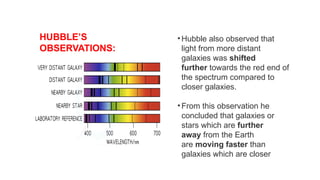
•Hubble also observed that
light from more distant
galaxies was shifted
further towards the red end of
the spectrum compared to
closer galaxies.
•From this observation he
concluded that galaxies or
stars which are further
away from the Earth
are moving faster than
galaxies which are closer
HUBBLE’S
OBSERVATIONS:
Hubble’s law:
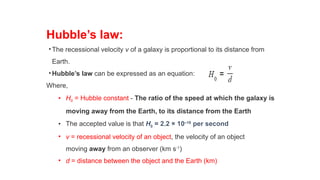
•The recessional velocity v of a galaxy is proportional to its distance from
Earth.
•Hubble’s law can be expressed as an equation:
Where,
• H0 = Hubble constant - The ratio of the speed at which the galaxy is
moving away from the Earth, to its distance from the Earth
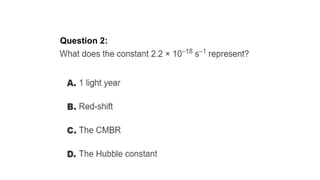
• The accepted value is that H0 = 2.2 × 10⁻¹⁸
per second
• v = recessional velocity of an object, the velocity of an object
moving away from an observer (km s-1
)
• d = distance between the object and the Earth (km)
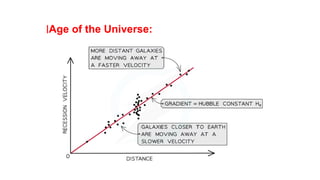
lAge of the Universe:
• The gradient of the graph can be used to find the age of
the Universe.
• When the distance equals zero, this represents all the
matter in the Universe being at a single point.
• This is the singularity that occurred at the moment of the Big
Bang.
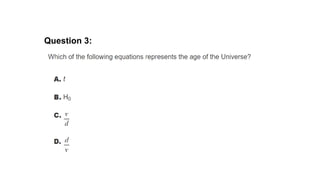
• The reciprocal of the gradient represents time and
gives the amount of time which the Universe has been
expanding for.
• Astronomers have used this formula to estimate the age
of the Universe at about 13.7 billion years.
EVALUATE - 10’
Question 1:
A distant galaxy is 20 light-years away from Earth.
Use Hubble’s Law to determine the velocity of the
galaxy as it moves away from Earth.
The Hubble constant is currently agreed to be 2.2 x
10-18
s-1
.
1 light year 9.5 x 10
≈ 15
m
Ans:0.42 m s-1
Question 2:
Question 3:

UNIT 6 SPACE PHYSICS-0625-IGCSE 0LEVEL.pptx

  • 1.
    THE SUN ASA STAR
  • 2.
  • 3.
    1. What dowe see in the night sky? 2. What are the two major nuclear reactions that releases abundant energy?
  • 4.
  • 6.
  • 7.
    • The sunis a yellow dwarf star. • It is a star because it produces light and energy by means of nuclear fusion converting hydrogen to helium. • It is the heat and light generated from the sun that makes life on Earth possible. • Our Sun is one among the billions of stars present in the Milky Way galaxy which contains about 200 billion stars
  • 8.
  • 9.
  • 10.
    ● The gravityof the Sun, which is almost 28 times that of Earth, ''traps'' hydrogen from its atmosphere and this hydrogen fuels the Sun’s fusion reaction. ● At temperatures of 15 million degree Celcius in the Sun's core, hydrogen gas becomes plasma, the fourth state of matter. In a plasma, the negatively charged electrons in atoms are completely separated from the positively charged atomic nuclei (or ions). ● The Sun's gravitational force confines the positively-charged hydrogen nuclei and work with the high temperatures that cause the nuclei to move around furiously, collide at high speeds overcoming the natural electrostatic repulsion that exists between the positive charges and fuse to form the heavier helium.
  • 12.
  • 13.
    1.Sun and allstars generate heat and light by.. A. nuclear fusion B. nuclear fission C. combustion of fuels D. thermal ignition
  • 14.
  • 15.
  • 16.
    1. Name thegalaxy in which our solar system is present? 2. Which is the star which brings the major source of light and heat to our Earth without which life in Earth is not possible? 3. What is the shape of our galaxy?
  • 17.
  • 19.
  • 20.
    LIGHT YEAR • Althoughthe stars appear very close when we look at the night sky, the distances involved are enormous when compared with the distances across our solar system. • The distance is so great that we cannot measure it with the general unit of length. Hence we introduce a new unit called a light year. This is the distance travelled by light in the space for one year.
  • 21.
    Light year: One lightyear is the distance travelled in (the vacuum of) space by light in one year and equals nearly 10 million kilometres. 1light year=9.5x10^12 Km=9.5x10^15 m
  • 22.
  • 24.
    • When yougaze at the stars at night, you are actually seeing light that might have emitted long back. It implies that you are actually looking back in time. You are seeing a younger star than it actually is!! • It takes 8 minutes and 20 seconds for the sunlight to reach us. That means the light hitting your eye from sun has been traveling for more than 8 minutes. • And this time lag implies that what we observe now is actually something in past. Likewise we see the Moon as it was 1.3 seconds ago.
  • 25.
  • 27.
    Nuclear Fusion inStars ● In the centre of a stable star, hydrogen atoms undergo nuclear fusion to form helium ● Deuterium and Tritium are both isotopes of hydrogen. They can be formed through other fusion reactions in the star ● A huge amount of energy is released in the reaction ● This provides a pressure that prevents the star from collapsing under its gravity
  • 29.
  • 30.
    Question 1: Very largemain sequence stars are typically much hotter than the Sun, as indicated by their colour. Which of the star colours below has the highest temperature? • A. A red star • B. A blue star • C. An orange star • D. A yellow star
  • 31.
    Question 2: An exampleof a hydrogen fusion reaction which takes place in stars is shown here.Which of the following is a valid reason as to why hydrogen fusion is not currently possible on Earth? A Hydrogen fusion produces dangerous radioactive waste B Hydrogen nuclei require very high temperature to fuse together C Hydrogen is a rare element that would be difficult to get large amounts of D Hydrogen fusion does not produce enough energy to be commercially viable
  • 32.
  • 33.
    Objective • To knowabout the life cycle of stars
  • 34.
  • 35.
    1. What isa star? 2. How it is formed? 3. Is there anything like birth and death of a star?
  • 36.
  • 37.
  • 38.
    1. Nebula •All starsform from a giant interstellar cloud of hydrogen gas and dust called a nebula 2. Protostar •The force of gravity within a nebula pulls the particles closer together until it forms a hot ball of gas, known as a protostar •As the particles are pulled closer together the density of the protostar will increase. •This will result in more frequent collisions between the particles which causes the temperature to increase
  • 39.
    3. Main SequenceStar: •Once the protostar becomes hot enough, nuclear fusion reactions occur within its core. •The hydrogen nuclei will fuse to form helium nuclei. •Every fusion reaction releases heat (and light) energy which keeps the core hot. •Once a protostar is formed, its life cycle will depend on its mass. •Once a star is born it is known as a main-sequence star •During the main sequence, the star is in equilibrium and said to be stable. •The inward force due to gravity is equal to the outward pressure force from the fusion reactions.
  • 40.
  • 43.
    4. Red Giantor Red Super Giant: • After several billion years the hydrogen causing the fusion reactions in the star will begin to run out. • Once this happens, the fusion reactions in the core will start to die down. • This causes the core to shrink and heat up. • The core will shrink because the inward force due to gravity will become greater than the outward force due to the pressure of the expanding gases as the fusion dies down. • A new series of reactions will then occur around the core, for example, helium nuclei will undergo fusion to form beryllium. • These reactions will cause the outer part of the star to expand. • A star the same size as the Sun or smaller will become a red giant • A star much larger than the Sun will become a red supergiant. • It is red because the outer surface starts to cool.
  • 44.
    5. For RedGiant Stars: Planetary Nebula: • Once this second stage of fusion reactions have finished, the star will become unstable and eject the outer layer of dust and gas. • The layer of dust and gas which is ejected is called a planetary nebula White Dwarf: • The core which is left behind will collapse completely, due to the pull of gravity, and the star will become a white dwarf. • The white dwarf will be cooling down and as a result, the amount of energy it emits will decrease. Black Dwarf: • Once the star has lost a significant amount of energy it becomes a black dwarf • It will continue to cool until it eventually disappears from sight
  • 45.
    The lifecycle ofa solar mass star
  • 46.
    6. For RedSuper Giants: Supernova: •Once the fusion reactions inside the red supergiant finally finish, the core of the star will collapse suddenly causing a gigantic explosion. This is called a supernova •At the centre of this explosion a dense body, called a neutron star will form •The outer remnants of the star will be ejected into space during the supernova explosion, forming a planetary nebula. •The nebula from a supernova may form new stars with orbiting planets Neutron Star (or Black Hole): •In the case of the biggest stars, the neutron star that forms at the center will continue to collapse under the force of gravity until it forms a black hole. •A black hole is an extremely dense point in space that not even light can escape from.
  • 47.
    Lifecycle of astar much larger than our Sun
  • 48.
  • 49.
  • 50.
  • 51.
  • 52.
    Objective • To describeabout galaxies and redshift
  • 53.
  • 54.
    1. What isour galaxy name? 2. How do we measure its distance and velocity?
  • 55.
  • 56.
  • 57.
    DOPPLER EFFECT: A movingobject will cause the wavelength, λ, (and frequency) of the waves to change: • The wavelength of the waves in front of the source decreases and the frequency increases • The wavelength behind the source increases and the frequency decreases • This effect is known as the Doppler effect •The Doppler effect also affects light -If an object moves away from an observer, the wavelength of light increases. • This is known as redshift as the light moves towards the red end of the spectrum
  • 58.
    RED SHIFT: An increasein the observed wavelength of electromagnetic radiation emitted from receding stars and galaxies
  • 59.
  • 60.
    • The MilkyWay is just one of billions of galaxies that make up the Universe • Light emitted from distant galaxies appears redshifted when compared with light emitted on Earth • The diagram below shows the light coming to us from a close object, such as the Sun, and the light coming to us from a distant galaxy • The lines on the spectrum are shifted towards the red end
  • 61.
    • This indicatesthat the galaxies are moving away from us • If the galaxies are moving away from us, it means that the universe is expanding • The observation of redshift from distant galaxies supports the Big Bang theory • Another observation from looking at the light spectrums produced from distant galaxies is that the greater the distance to the galaxy, the greater the redshift • This means that the further away a galaxy, the faster it is moving away from us
  • 62.
    Graph shows thegreater the distance to a galaxy, the greater the redshift
  • 63.
  • 64.
  • 65.
  • 66.
  • 67.
  • 68.
  • 69.
    Objective • To describeabout big bang theory
  • 70.
  • 71.
    1. Is ouruniverse expanding? If yes, how? 2. What is redshift? 3. What do you observe?
  • 72.
    EXPLORE - 10’ Activity: ▪Takea balloon and mark a few dots on it. ▪Observe the space between them. ▪Now blow the balloon and observe the space between the dots. ▪What is your conclusion?
  • 73.
  • 74.
    THE BIG BANG: •Around14 billion years ago, the Universe began from a very small region that was extremely hot and dense •Then there was a giant explosion, which is known as the Big Bang •This caused the universe to expand from a single point, cooling as it does so, to form the universe today •Each point expands away from the others. •This is seen from galaxies moving away from each other, and the further away they are the faster they move •Redshift in the light from distant galaxies is evidence that the Universe is expanding and supports the Big Bang Theory. •As a result of the initial explosion, the Universe continues to expand
  • 75.
    EVIDENCE FOR THEBIG BANG: • The Big Bang theory is very well supported by evidence from a range of sources • The main pieces of evidence are • Galactic red-shift • Cosmic Microwave Background Radiation (CMBR)
  • 76.
    GALACTIC REDSHIFT: Red-shift providesevidence that the Universe is expanding because: •Red-shift is observed when the spectral lines from the distant galaxy move closer to the red end of the spectrum • This is because light waves are stretched by the expansion of the universe, so the wavelength increases (or frequency decreases) • This indicates that the galaxies are moving away from us •Light spectrums produced from distant galaxies are red shifted more than nearby galaxies • This shows that the greater the distance to the galaxy, the greater the redshift • This means that the further away a galaxy is, the faster it is moving away from the Earth •These observations imply that the universe is expanding and therefore support the Big Bang Theory
  • 77.
    Tracing the expansionof the universe back to the beginning of time leads to the idea the universe began with a “big bang”
  • 78.
    EVIDENCE FROM CMBRADIATION: CMB (Cosmic Microwave Background) radiation – currently accepted model • The CMB is a type of electromagnetic radiation which is a remnant from the early stages of the Universe • It has a wavelength of around 1 mm making it a microwave, hence the name Cosmic Microwave Background radiation • In 1964, Astronomers discovered radiation in the microwave region of the electromagnetic spectrum coming from all directions and at a generally uniform temperature of 2.73 K • They were unable to do this any earlier since microwaves are absorbed by the atmosphere • Around this time, space flight was developed which enabled astronomers to send telescopes into orbit above the atmosphere
  • 79.
  • 80.
    •The radiation isin the microwave region • This is because over the past 14 billion years or so, the radiation initially from the Big Bang has become redshifted as the Universe has expanded • Initially, this would have been high energy radiation, towards the gamma end of the spectrum • As the Universe expanded, the wavelength of the radiation increased • Over time, it has increased so much that it is now in the microwave region of the spectrum
  • 81.
  • 82.
    Question 1: What areevidences that support Big Bang theory? Question 2: The CMB radiation is very uniform and has the exact profile expected to be emitted from a hot body that has cooled down over a very long time. True or False Question 3: What is CMBR?
  • 83.
  • 84.
    Objective • To knowthat the speed v at which a galaxy is moving away from the Earth can be found from the change in wavelength of the galaxy’s starlight due to redshift • To know that the distance of a far galaxy d can be determined using the brightness of a supernova in that galaxy
  • 85.
  • 86.
    1. What isthe relation between speed , wavelength and frequency? 2. How is the galactic speed calculated?
  • 87.
  • 88.
    Activity: ▪Take a slinky. ▪Letone student hold it at one end (say A) and let the other student hold the other end (Say B). ▪Let the student holding the end B move away from the student holding the end A. ▪Observe what happens. ▪Then let the student holding the end B move towards the student holding the end A. ▪Observe what happens. ▪Discuss the observations.
  • 89.
  • 90.
    1. Using RedshiftObservations to Measure the Universe: •The change in wavelength of the galaxy’s starlight due to redshift can be used to find the velocity, v, with which a galaxy (or any distant object) is moving away from Earth. •Using an equation to compare the ratio of the expected wavelength with the observed wavelength, the velocity can be found;
  • 91.
    Activity: ▪Take a torchand a plane mirror. ▪Switch on the torch and keep it close to plane mirror. ▪Observe its brightness. ▪Now move away from the plane mirror and observe the brightness reflected on the mirror as you increase the distance further. ▪Discuss the observations.
  • 92.
    2. Measuring DistanceUsing Supernovae: • A key method is the use of standard candles, including supernovae. • Supernovae are exploding stars • Certain types have the same peak level of brightness (absolute magnitude), making them extremely useful in measuring the distance to remote stars and galaxies • Type 1a supernovae are so bright that they can be seen clearly even though they may be deep inside their parent galaxy • This allows the distance to the galaxy to be calculated
  • 93.
  • 94.
    Question 1: How canwe measure the galactic speed and distance? Question 2: How does the brightness of the star help in measuring the distance?
  • 95.
    HUBBLE & THEAGE OF THE UNIVERSE
  • 96.
    Objective • To defineHubble’s constant. • To know to determine the age of the universe.
  • 97.
  • 98.
  • 99.
  • 100.
    • In 1929,the astronomer Edwin Hubble showed that the universe was expanding. • He did this by observing that the absorption line spectra produced from the light of distant galaxies was shifted towards the red end of the spectrum. • This doppler shift in the wavelength of the light is evidence that distant galaxies are moving away from the Earth.
  • 101.
  • 102.
    •Hubble also observedthat light from more distant galaxies was shifted further towards the red end of the spectrum compared to closer galaxies. •From this observation he concluded that galaxies or stars which are further away from the Earth are moving faster than galaxies which are closer HUBBLE’S OBSERVATIONS:
  • 103.
    Hubble’s law: •The recessionalvelocity v of a galaxy is proportional to its distance from Earth. •Hubble’s law can be expressed as an equation: Where, • H0 = Hubble constant - The ratio of the speed at which the galaxy is moving away from the Earth, to its distance from the Earth • The accepted value is that H0 = 2.2 × 10⁻¹⁸ per second • v = recessional velocity of an object, the velocity of an object moving away from an observer (km s-1 ) • d = distance between the object and the Earth (km)
  • 104.
    lAge of theUniverse:
  • 105.
    • The gradientof the graph can be used to find the age of the Universe. • When the distance equals zero, this represents all the matter in the Universe being at a single point. • This is the singularity that occurred at the moment of the Big Bang. • The reciprocal of the gradient represents time and gives the amount of time which the Universe has been expanding for. • Astronomers have used this formula to estimate the age of the Universe at about 13.7 billion years.
  • 106.
  • 107.
    Question 1: A distantgalaxy is 20 light-years away from Earth. Use Hubble’s Law to determine the velocity of the galaxy as it moves away from Earth. The Hubble constant is currently agreed to be 2.2 x 10⁻¹⁸ s-1 . 1 light year 9.5 x 10 ≈ 15 m Ans:0.42 m s-1
  • 108.
  • 109.

Editor's Notes

  • #31 ANSWER: B Hydrogen nuclei have positive charges So two hydrogen nuclei would have a repulsive force between them High temperatures are required to give the nuclei enough energy to overcome the repulsive force
  • #36 Students are asked why an unstabe atom undergo emission.
  • #42 Students can work in groups and refer internet to complete this activity.
  • #49 ANS: C
  • #50 ANS: C
  • #55 Usually, when an object emits waves, the wavefronts spread out symmetrically If the wave source moves, the waves can become squashed together or stretched out
  • #58 Light from a star that is moving towards an observer will be blueshifted and light from a star moving away from an observer will be redshifted
  • #64 ANS: B
  • #65 ANS: C
  • #66 ANS: D
  • #67 ANS: D
  • #71 3. All galaxies are moving away from each other, indicating that the universe is expanding
  • #86 Speed = Wavelength x Frequency
  • #88 Light from a star that is moving towards an observer will be blueshifted and light from a star moving away from an observer will be redshifted
  • #91 Light from a star that is moving towards an observer will be blueshifted and light from a star moving away from an observer will be redshifted
  • #92 A standard candle is an object whose luminosity L is known. The known luminosity, combined with the measured apparent brightness b for the object, gives us the distance.
  • #98 Speed = Wavelength x Frequency
  • #107 Step 1: List the known quantities: d = 20 light years Ho = 2.2 x 10⁻¹⁸ s-1 Step 2: Convert 20 light-years to m: 1 ly ≈ 9.5 x 10¹⁵ m So, 20 ly = 20 x (9.5 x 1015) = 1.9 x 10¹⁷ m Step 3: Substitute values into Hubble's Law:  From the data booklet: v ≈ H0d  So, v ≈ (2.2 x 10⁻¹⁸ ) x (1.9 x 10¹⁷) = 0.418 m s-1 Step 4: Confirm your answer: The velocity of the galaxy as it moves away from Earth 0.42 m s-1

  • #108 Ans: D
  • #109 Ans: D - the reciprocal of the gradient gives the time for which the universe is expanding for.