First Degree Equations
Graphs of 1st
equations Ax + By = C are straight lines.
First Degree Equations
Graphs of 1st
equations Ax + By = C are straight lines.
There are two cases.
First Degree Equations
Graphs of 1st
equations Ax + By = C are straight lines.
There are two cases.
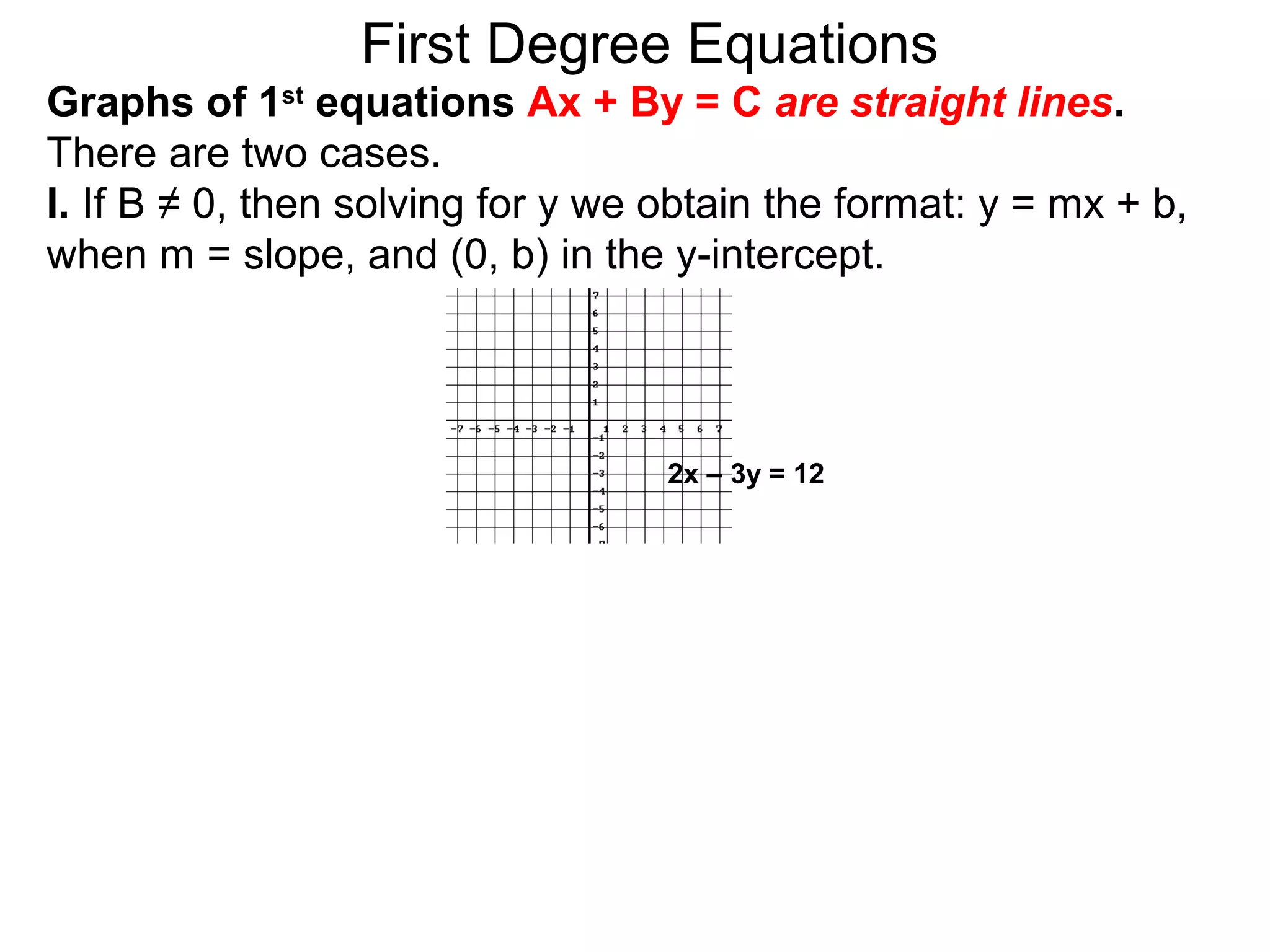
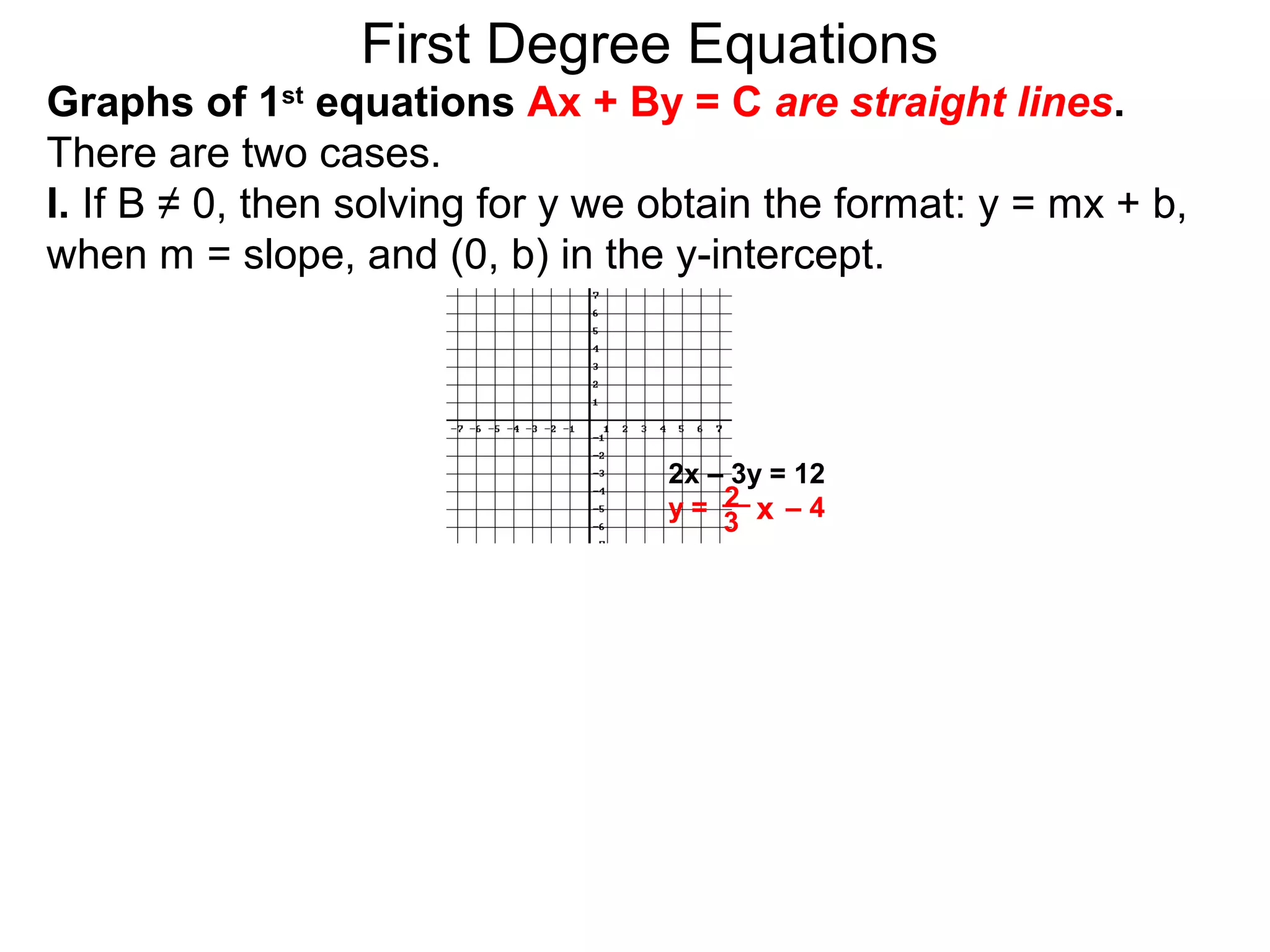
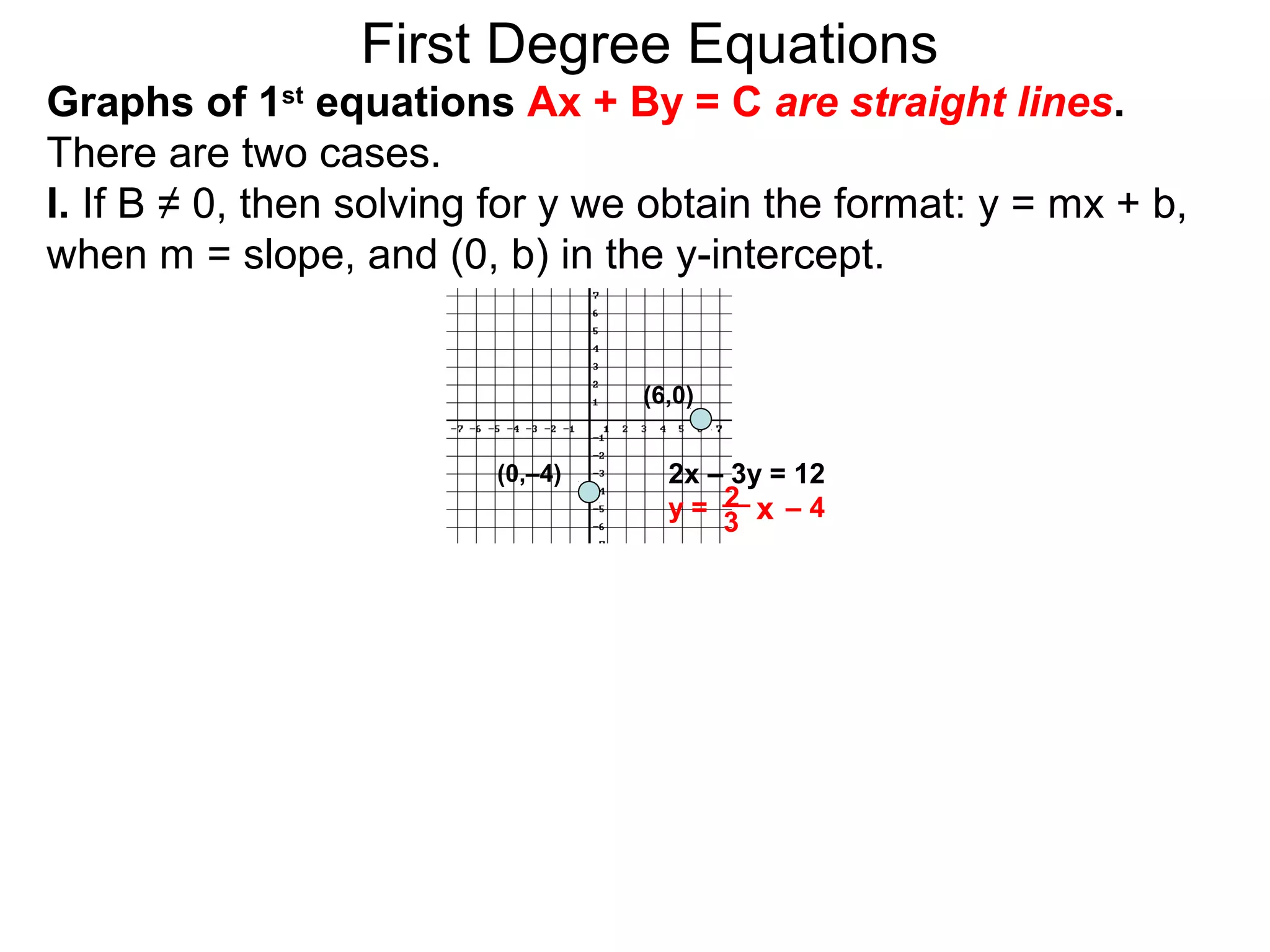
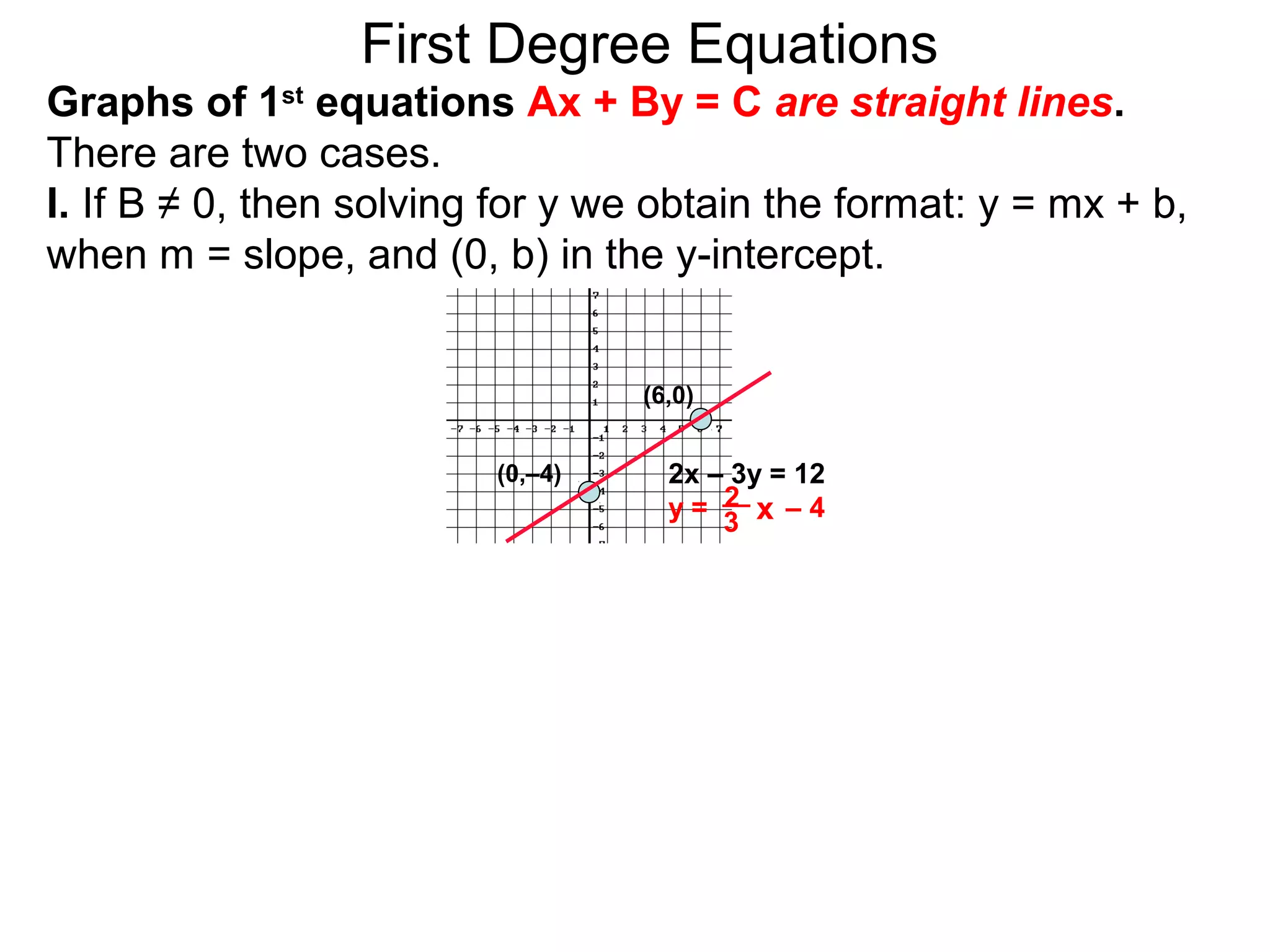
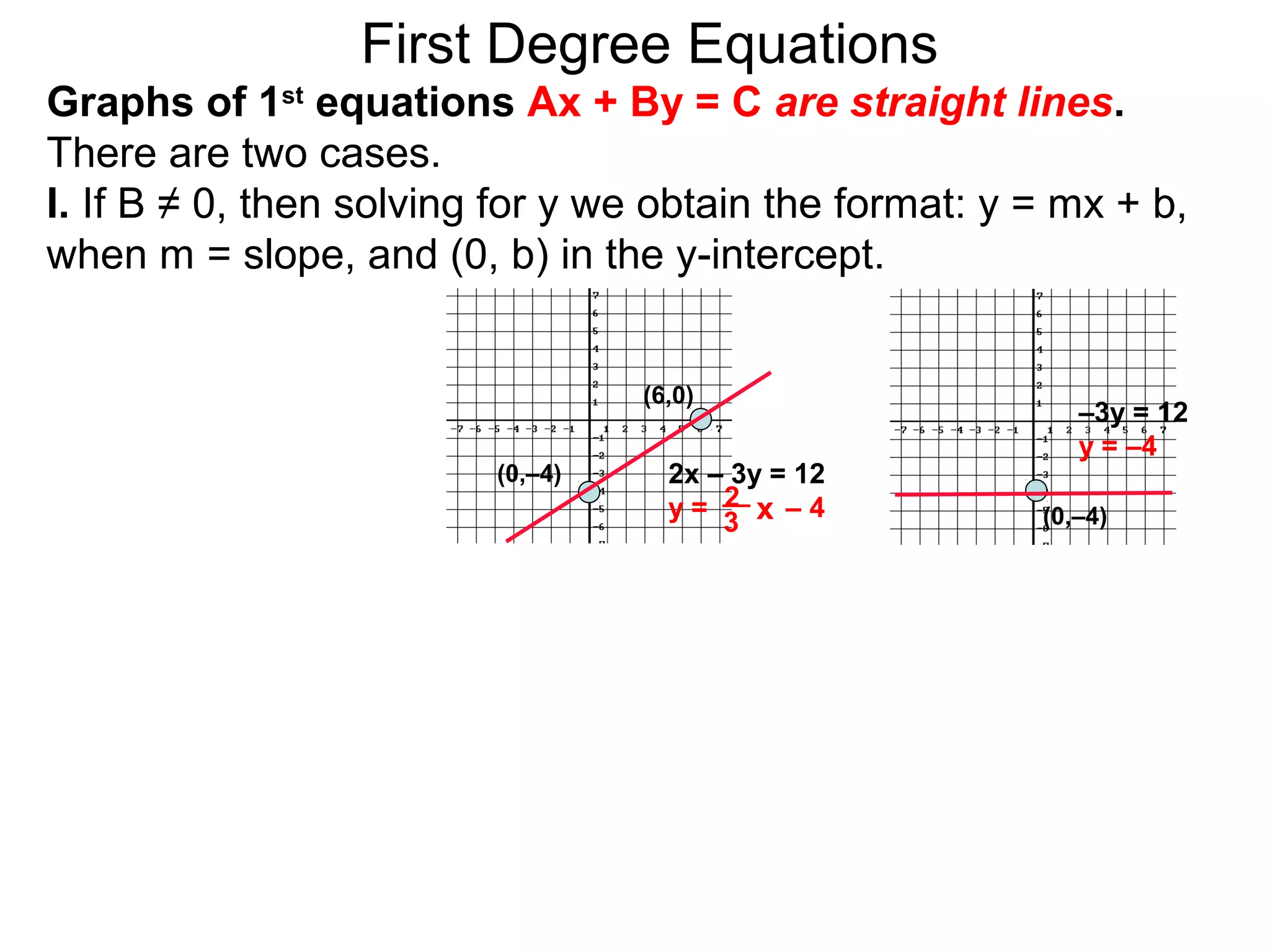
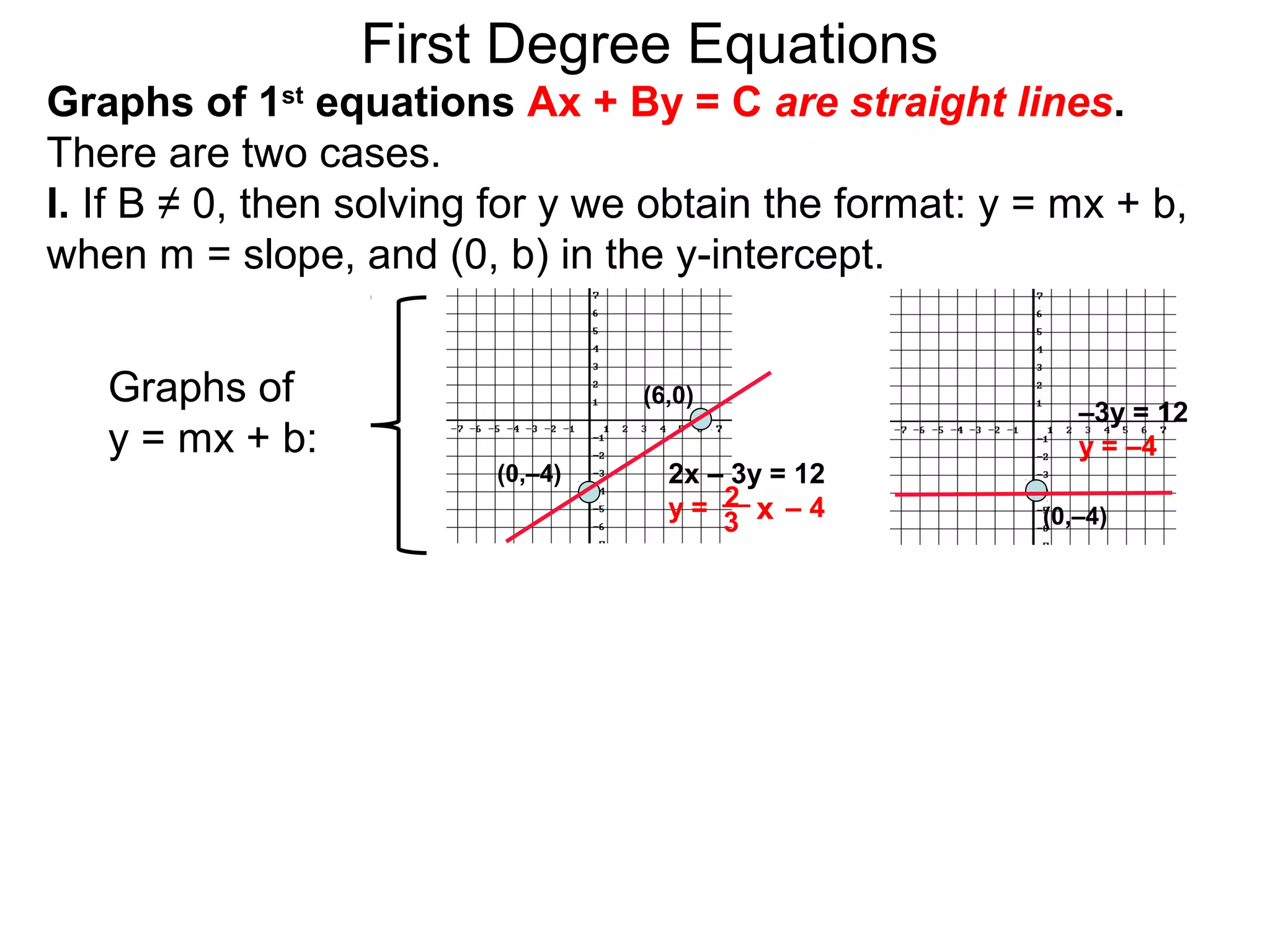
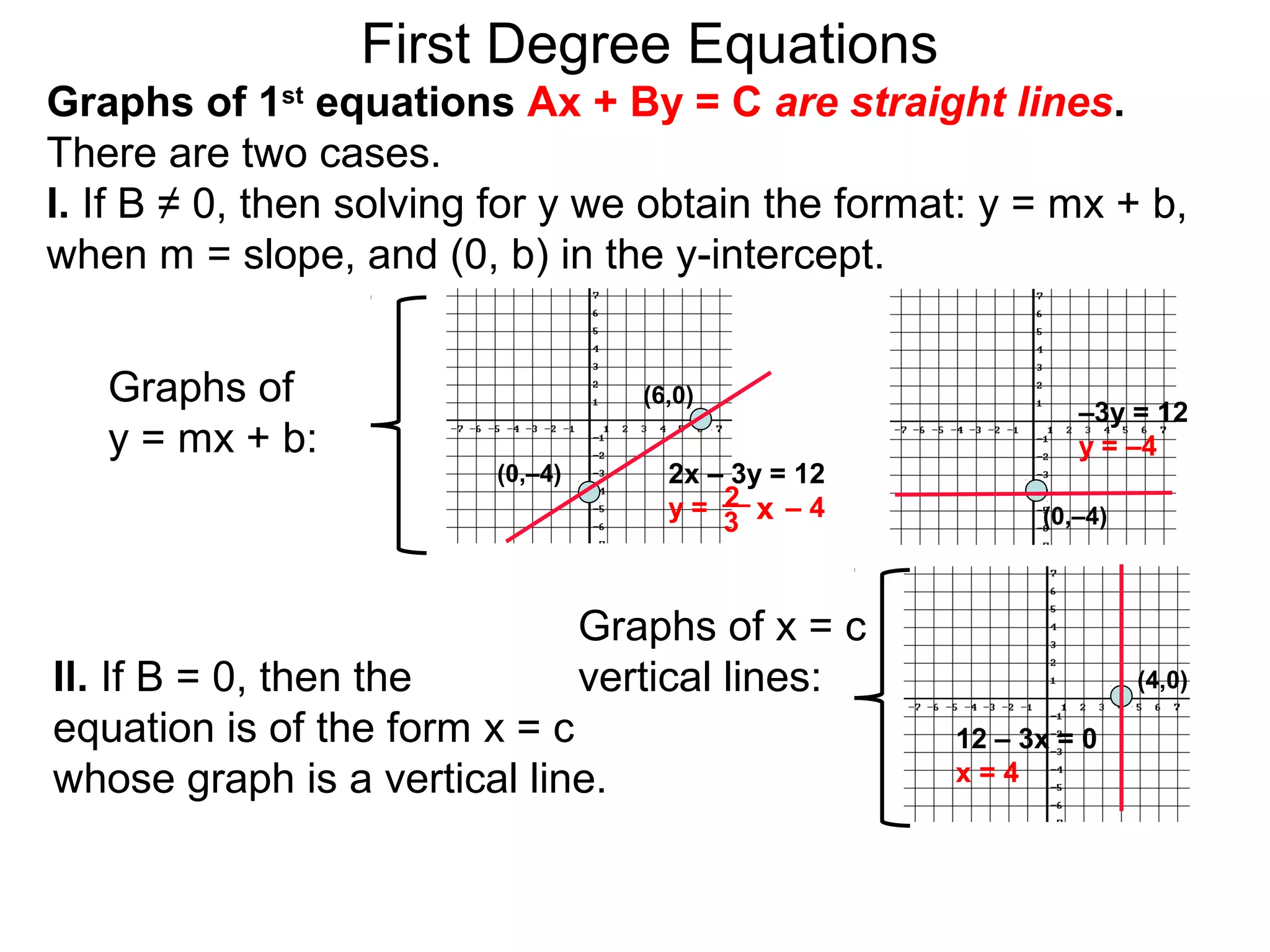
I. If B ≠ 0, then solving for y we obtain the format: y = mx + b,
when m = slope, and (0, b) in the y-intercept.
First Degree Equations
Graphs of 1st
equations Ax + By = C are straight lines.
There are two cases.
I. If B ≠ 0, then solving for y we obtain the format: y = mx + b,
when m = slope, and (0, b) in the y-intercept.
2x – 3y = 12
First Degree Equations
Graphs of 1st
equations Ax + By = C are straight lines.
There are two cases.
I. If B ≠ 0, then solving for y we obtain the format: y = mx + b,
when m = slope, and (0, b) in the y-intercept.
2x – 3y = 12
y = – 42 x3
First Degree Equations
Graphs of 1st
equations Ax + By = C are straight lines.
There are two cases.
I. If B ≠ 0, then solving for y we obtain the format: y = mx + b,
when m = slope, and (0, b) in the y-intercept.
(6,0)
(0,–4) 2x – 3y = 12
y = – 42 x3
First Degree Equations
Graphs of 1st
equations Ax + By = C are straight lines.
There are two cases.
I. If B ≠ 0, then solving for y we obtain the format: y = mx + b,
when m = slope, and (0, b) in the y-intercept.
(6,0)
(0,–4) 2x – 3y = 12
y = – 42 x3
First Degree Equations
Graphs of 1st
equations Ax + By = C are straight lines.
There are two cases.
I. If B ≠ 0, then solving for y we obtain the format: y = mx + b,
when m = slope, and (0, b) in the y-intercept.
(6,0)
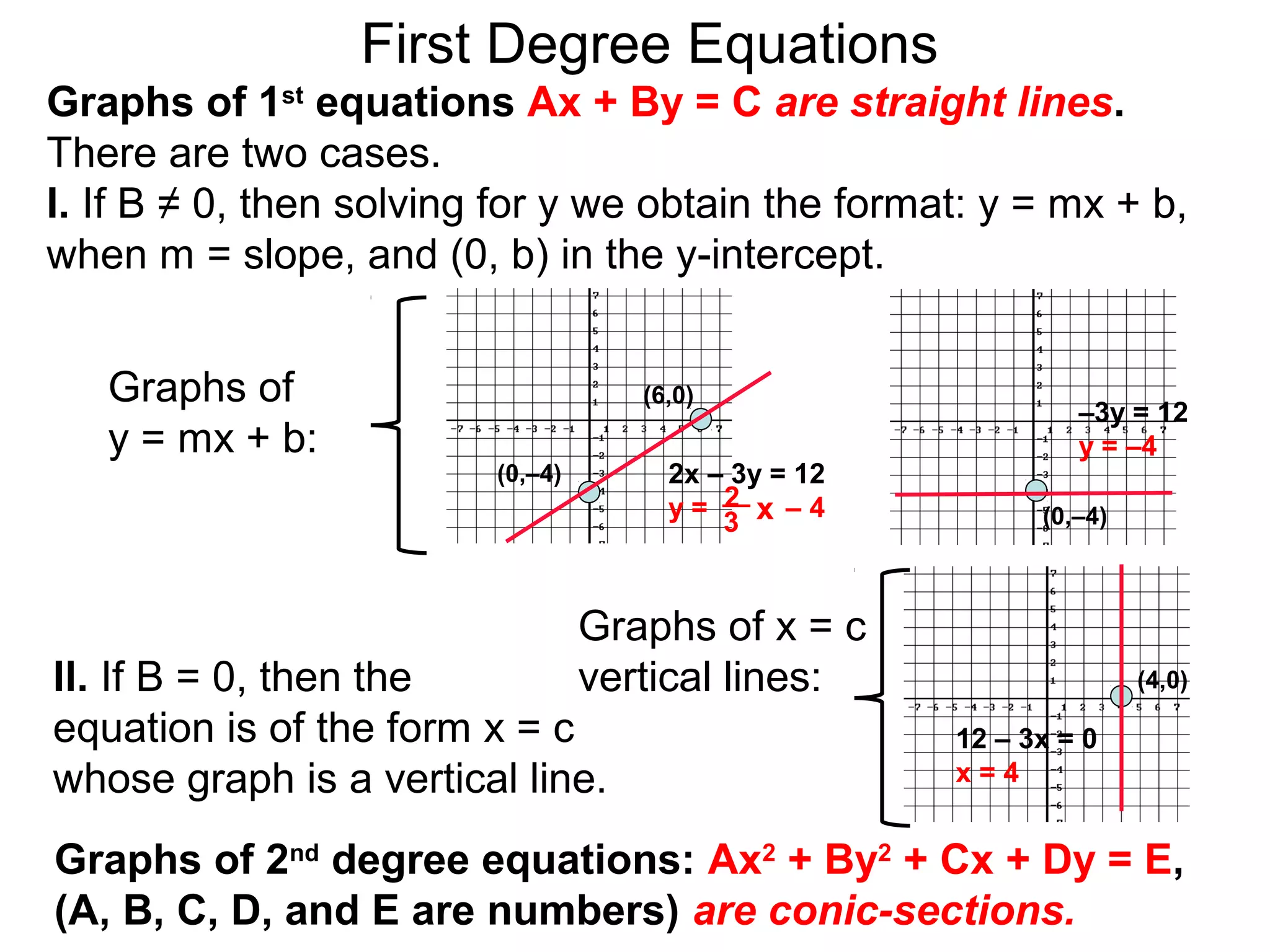
(0,–4)
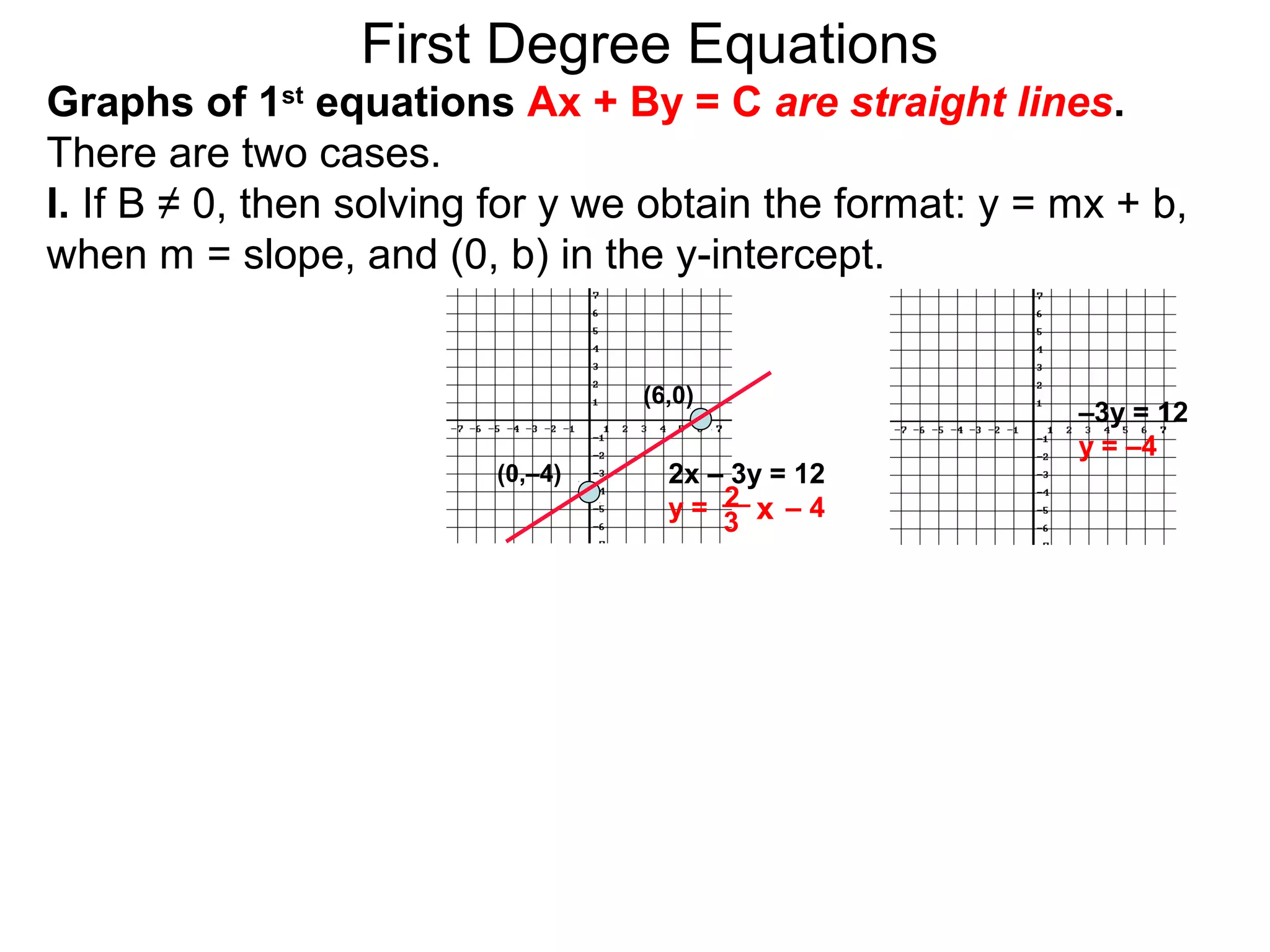
–3y = 12
y = –4
2x – 3y = 12
y = – 42 x3
First Degree Equations
Graphs of 1st
equations Ax + By = C are straight lines.
There are two cases.
I. If B ≠ 0, then solving for y we obtain the format: y = mx + b,
when m = slope, and (0, b) in the y-intercept.
(6,0)
(0,–4)
–3y = 12
y = –4
2x – 3y = 12
y = – 42 x3 (0,–4)
Graphs of
y = mx + b:
First Degree Equations
Graphs of 1st
equations Ax + By = C are straight lines.
There are two cases.
I. If B ≠ 0, then solving for y we obtain the format: y = mx + b,
when m = slope, and (0, b) in the y-intercept.
(6,0)
(0,–4)
–3y = 12
y = –4
2x – 3y = 12
y = – 42 x3 (0,–4)
Graphs of
y = mx + b:
First Degree Equations
Graphs of 1st
equations Ax + By = C are straight lines.
There are two cases.
I. If B ≠ 0, then solving for y we obtain the format: y = mx + b,
when m = slope, and (0, b) in the y-intercept.
(6,0)
(0,–4)
–3y = 12
y = –4
2x – 3y = 12
y = – 42 x3
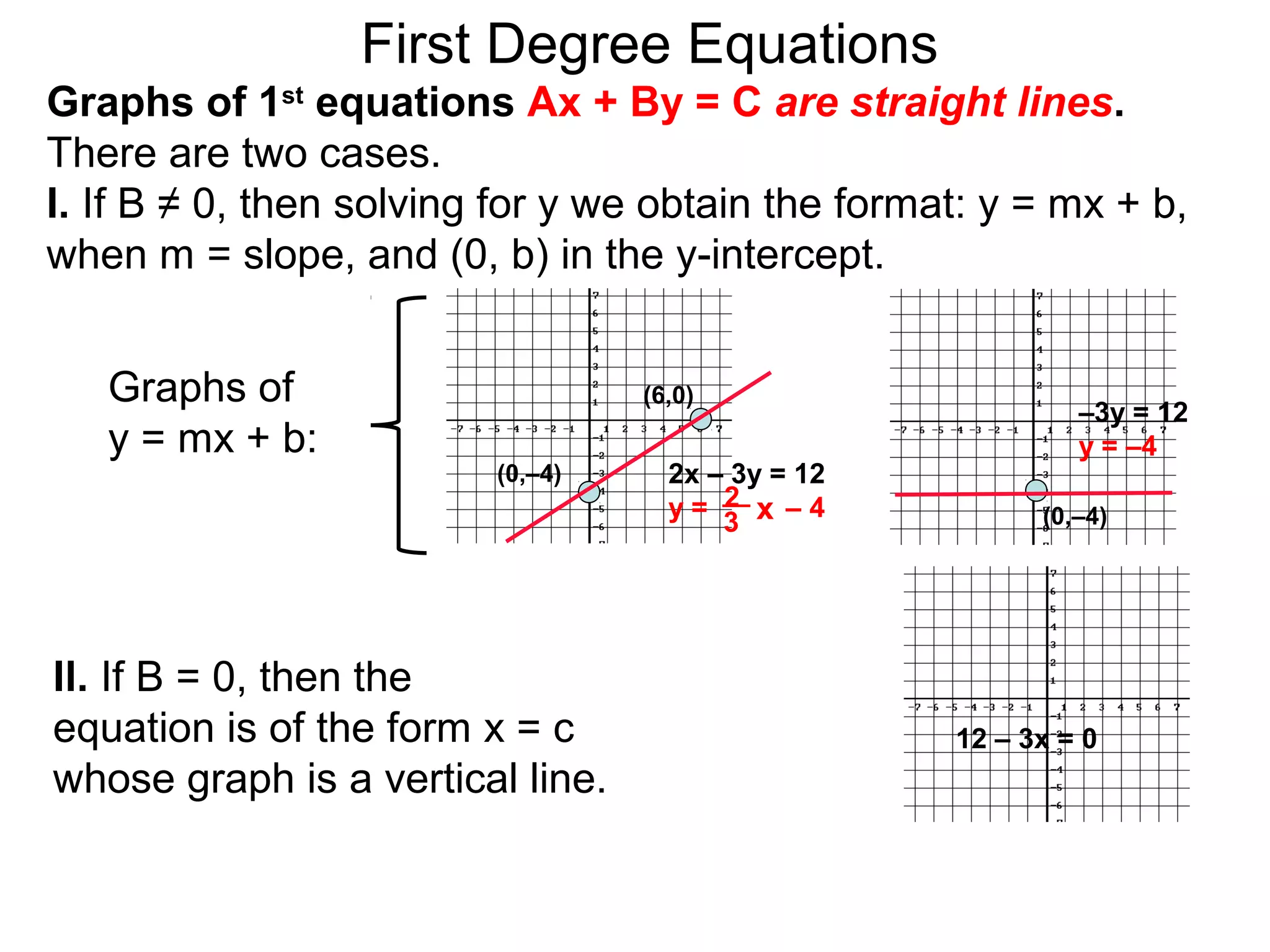
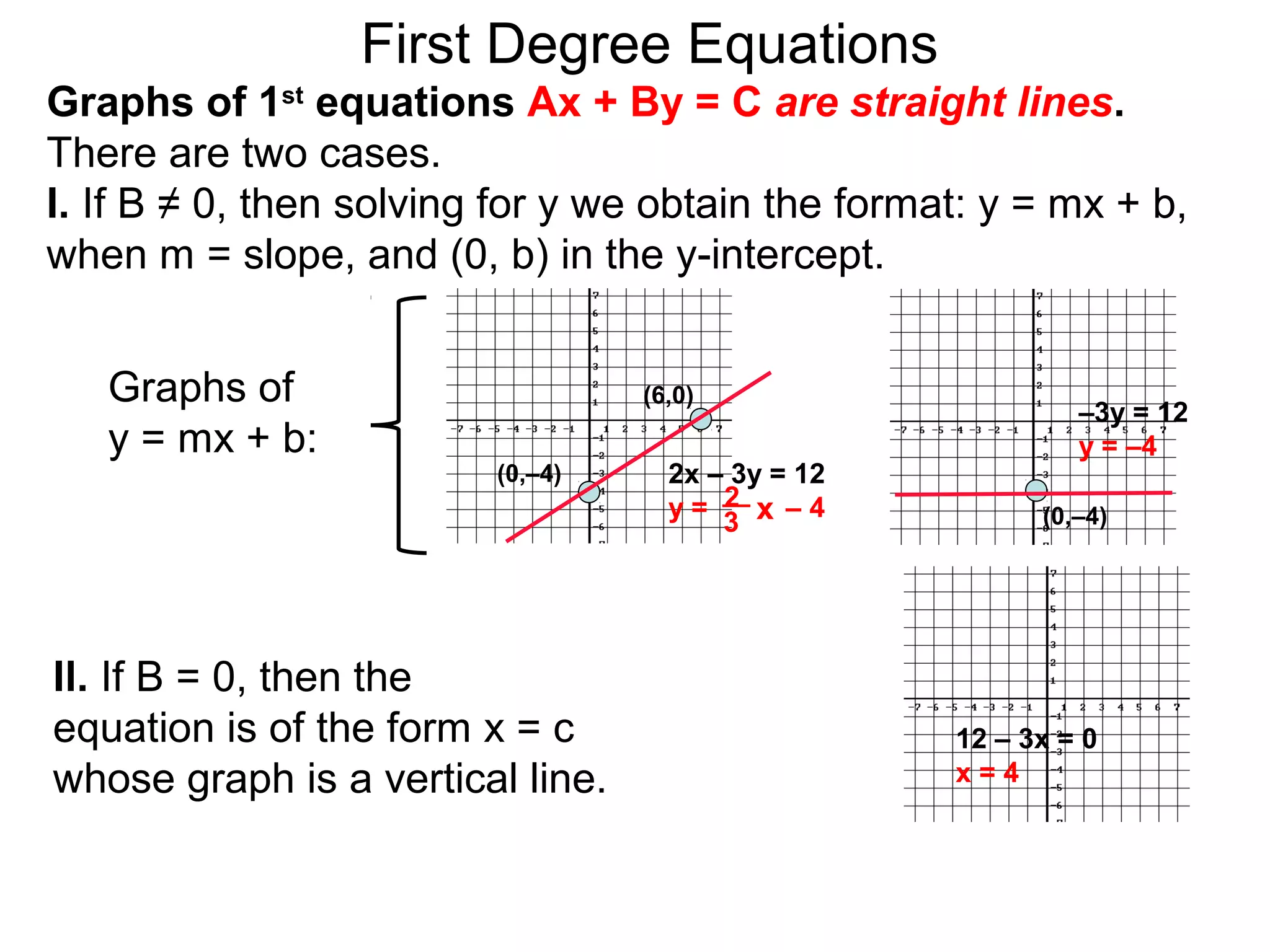
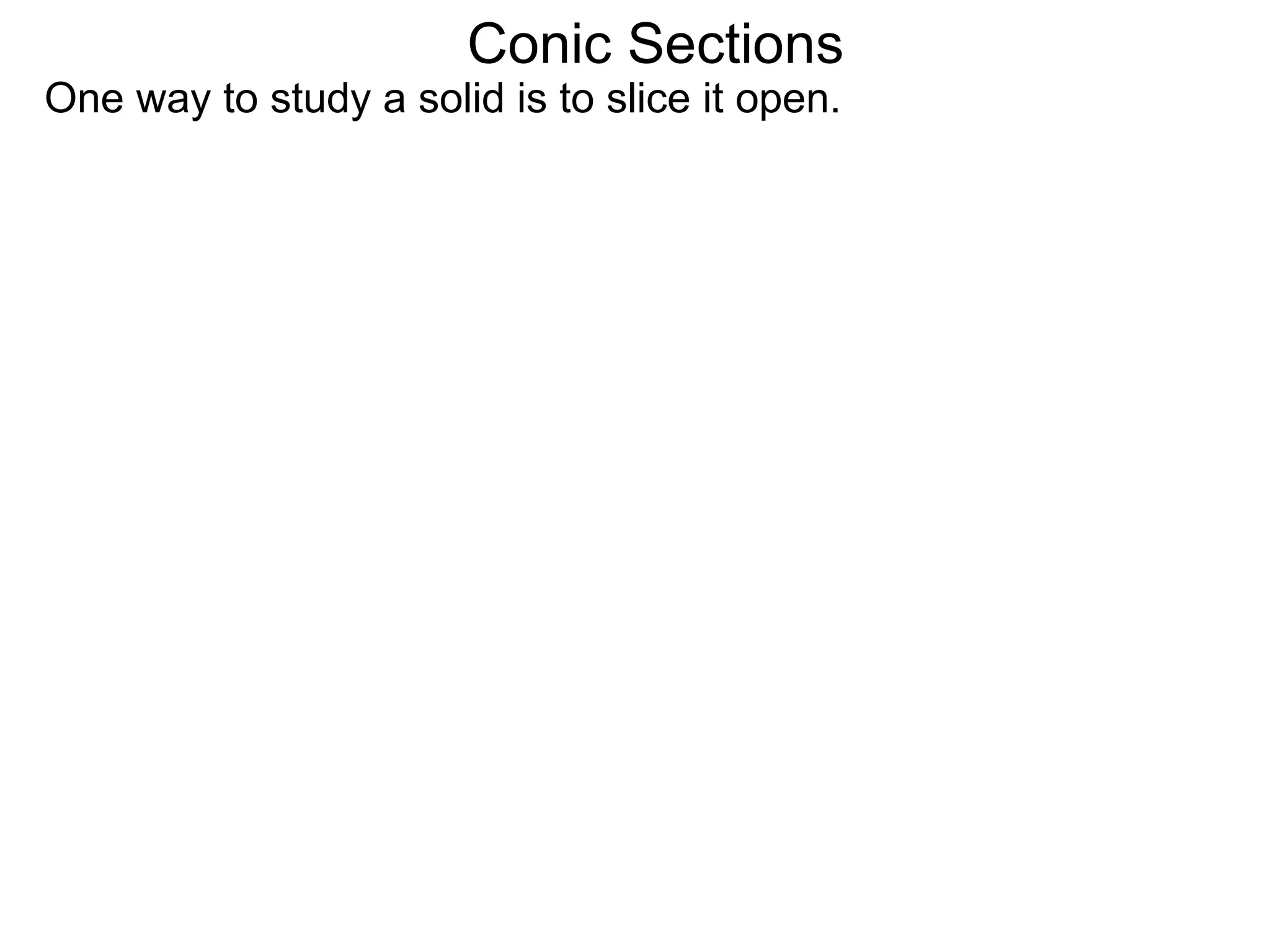
Il. If B = 0, then the
equation is of the form x = c
whose graph is a vertical line.
12 – 3x = 0
(0,–4)
Graphs of
y = mx + b:
First Degree Equations
Graphs of 1st
equations Ax + By = C are straight lines.
There are two cases.
I. If B ≠ 0, then solving for y we obtain the format: y = mx + b,
when m = slope, and (0, b) in the y-intercept.
(6,0)
(0,–4)
–3y = 12
y = –4
2x – 3y = 12
y = – 42 x3
Il. If B = 0, then the
equation is of the form x = c
whose graph is a vertical line.
12 – 3x = 0
x = 4
(0,–4)
Graphs of
y = mx + b:
First Degree Equations
Graphs of 1st
equations Ax + By = C are straight lines.
There are two cases.
I. If B ≠ 0, then solving for y we obtain the format: y = mx + b,
when m = slope, and (0, b) in the y-intercept.
(6,0)
(0,–4)
–3y = 12
y = –4
2x – 3y = 12
y = – 42 x3
Il. If B = 0, then the
equation is of the form x = c
whose graph is a vertical line.
12 – 3x = 0
x = 4
Graphs of x = c
vertical lines:
(0,–4)
(4,0)
Graphs of
y = mx + b:
First Degree Equations
Graphs of 1st
equations Ax + By = C are straight lines.
There are two cases.
I. If B ≠ 0, then solving for y we obtain the format: y = mx + b,
when m = slope, and (0, b) in the y-intercept.
(6,0)
(0,–4)
–3y = 12
y = –4
2x – 3y = 12
y = – 42 x3
Il. If B = 0, then the
equation is of the form x = c
whose graph is a vertical line.
12 – 3x = 0
x = 4
Graphs of x = c
vertical lines:
Graphs of 2nd
degree equations: Ax2
+ By2
+ Cx + Dy = E,
(A, B, C, D, and E are numbers) are conic-sections.
(0,–4)
(4,0)
Conic Sections
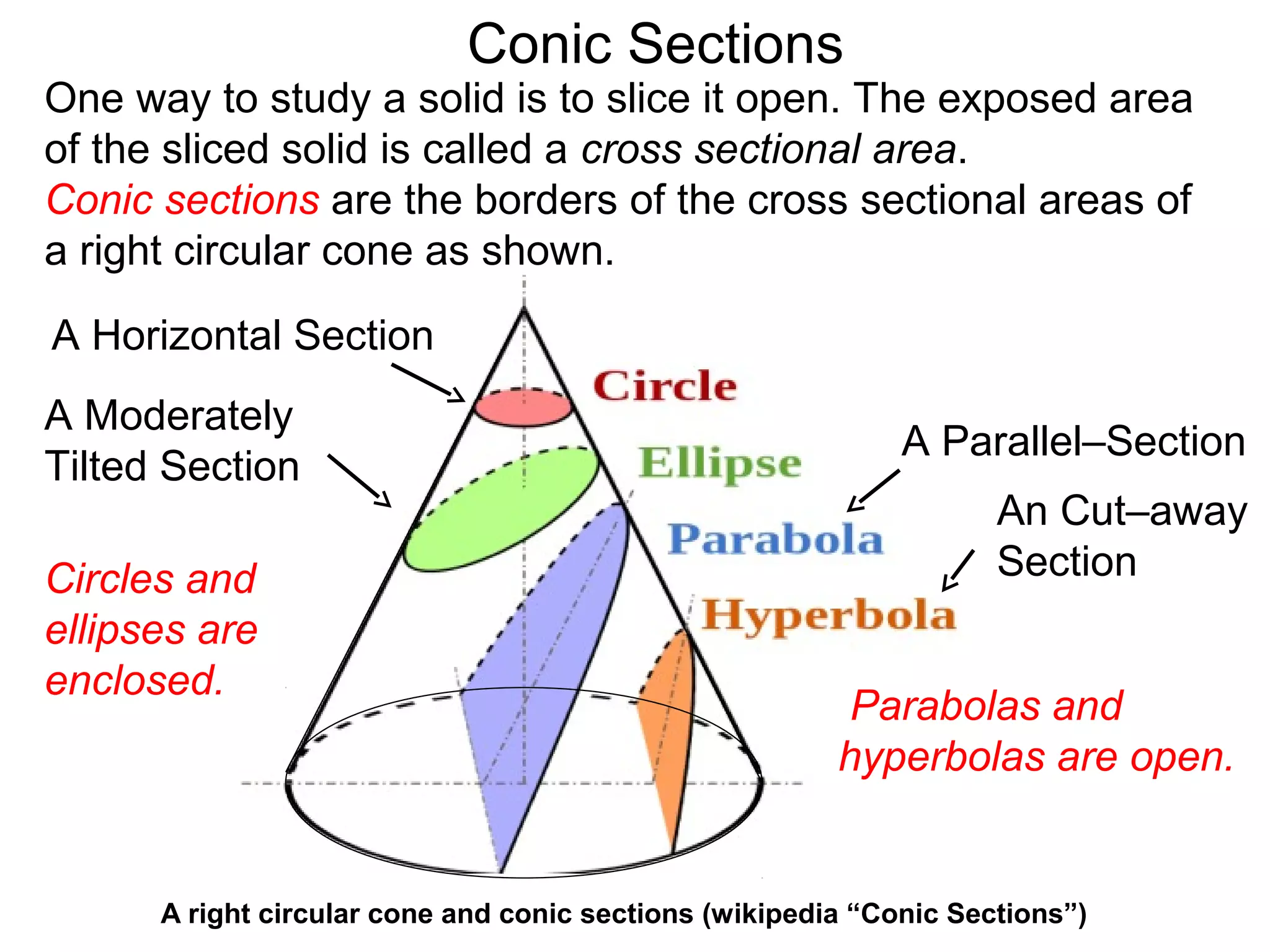
One way to study a solid is to slice it open.
Conic Sections
One way to study a solid is to slice it open.
Conic Sections
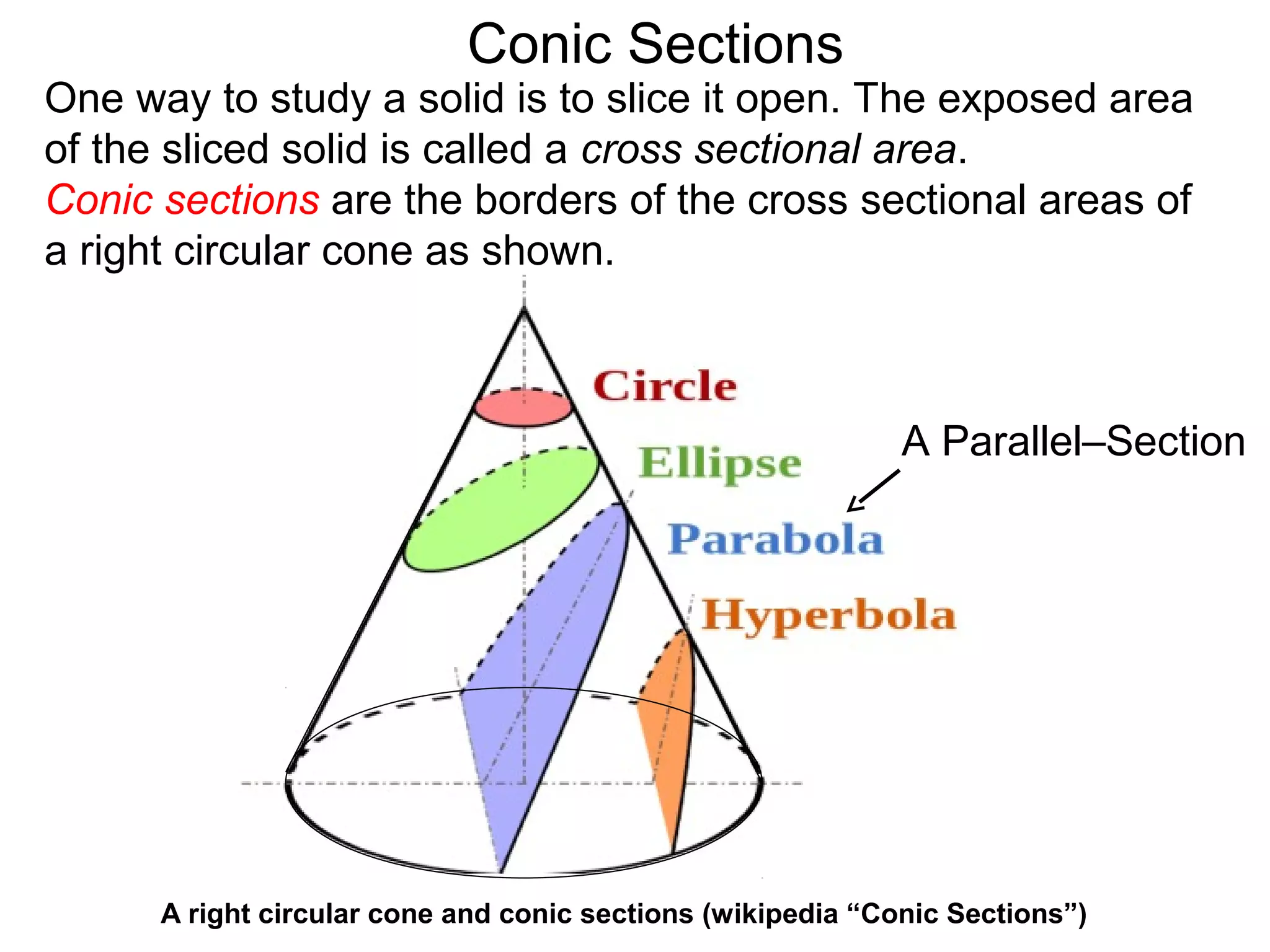
One way to study a solid is to slice it open. The exposed area
of the sliced solid is called a cross sectional area.
Conic Sections
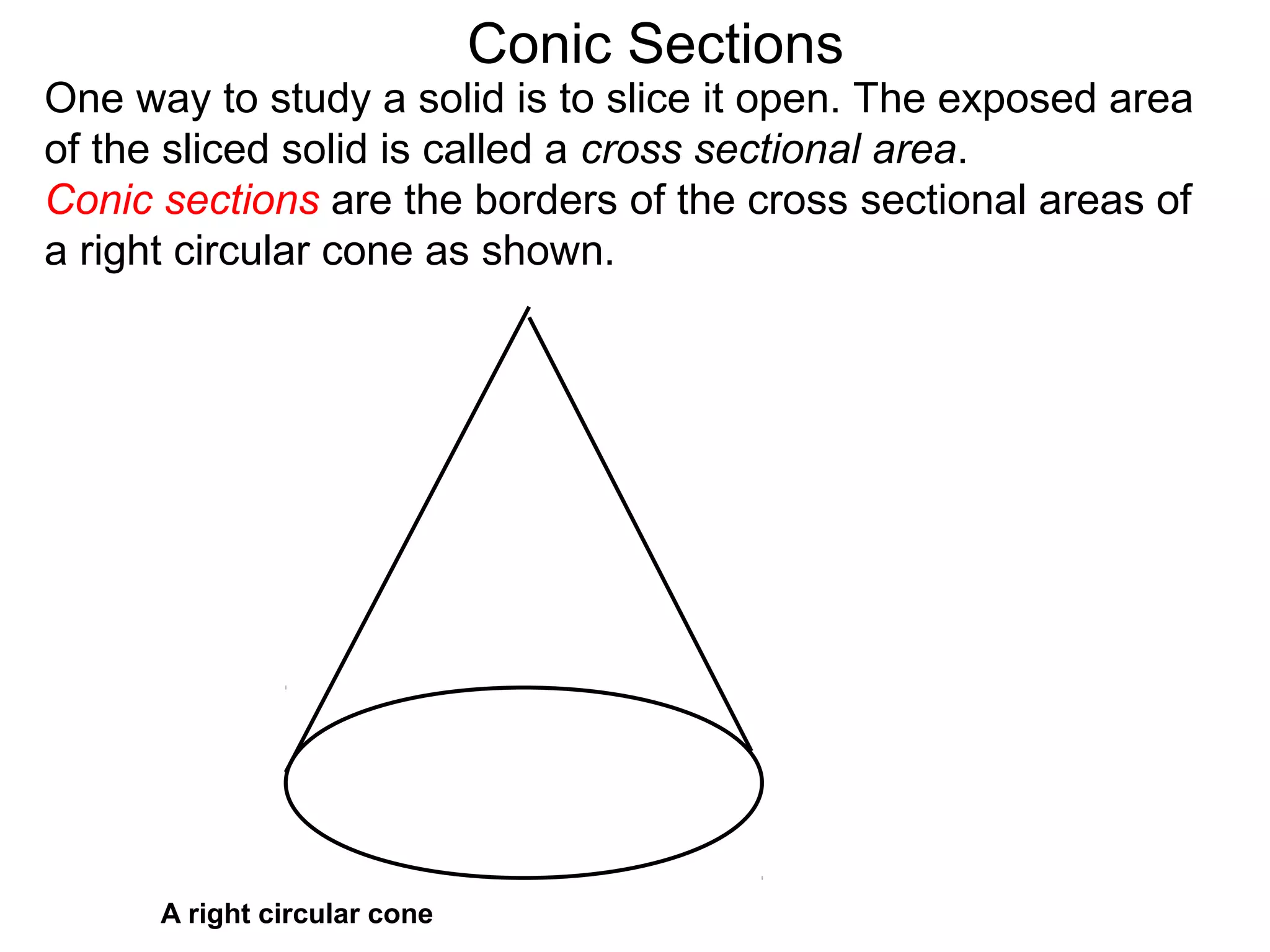
A right circular cone
One way to study a solid is to slice it open. The exposed area
of the sliced solid is called a cross sectional area.
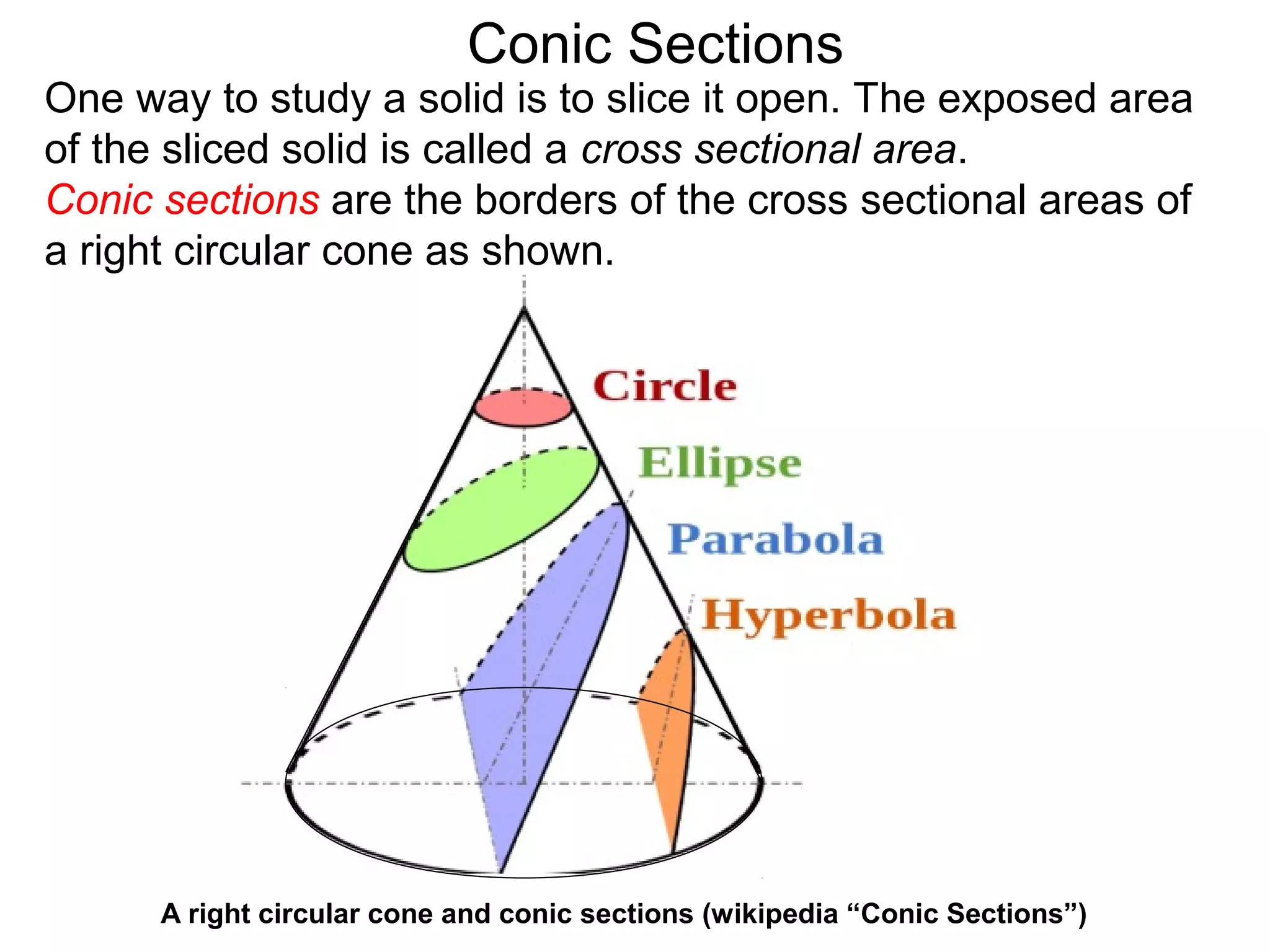
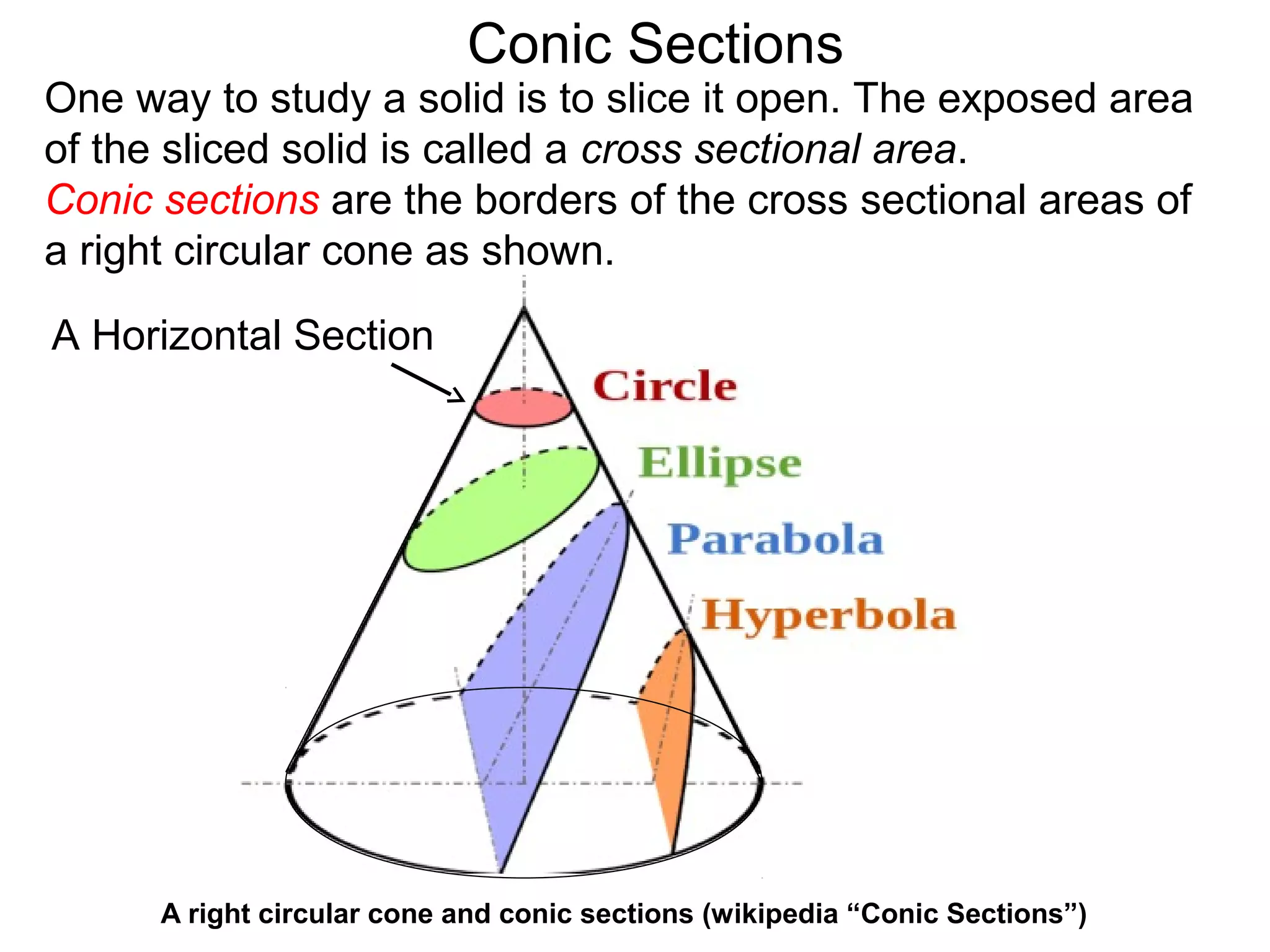
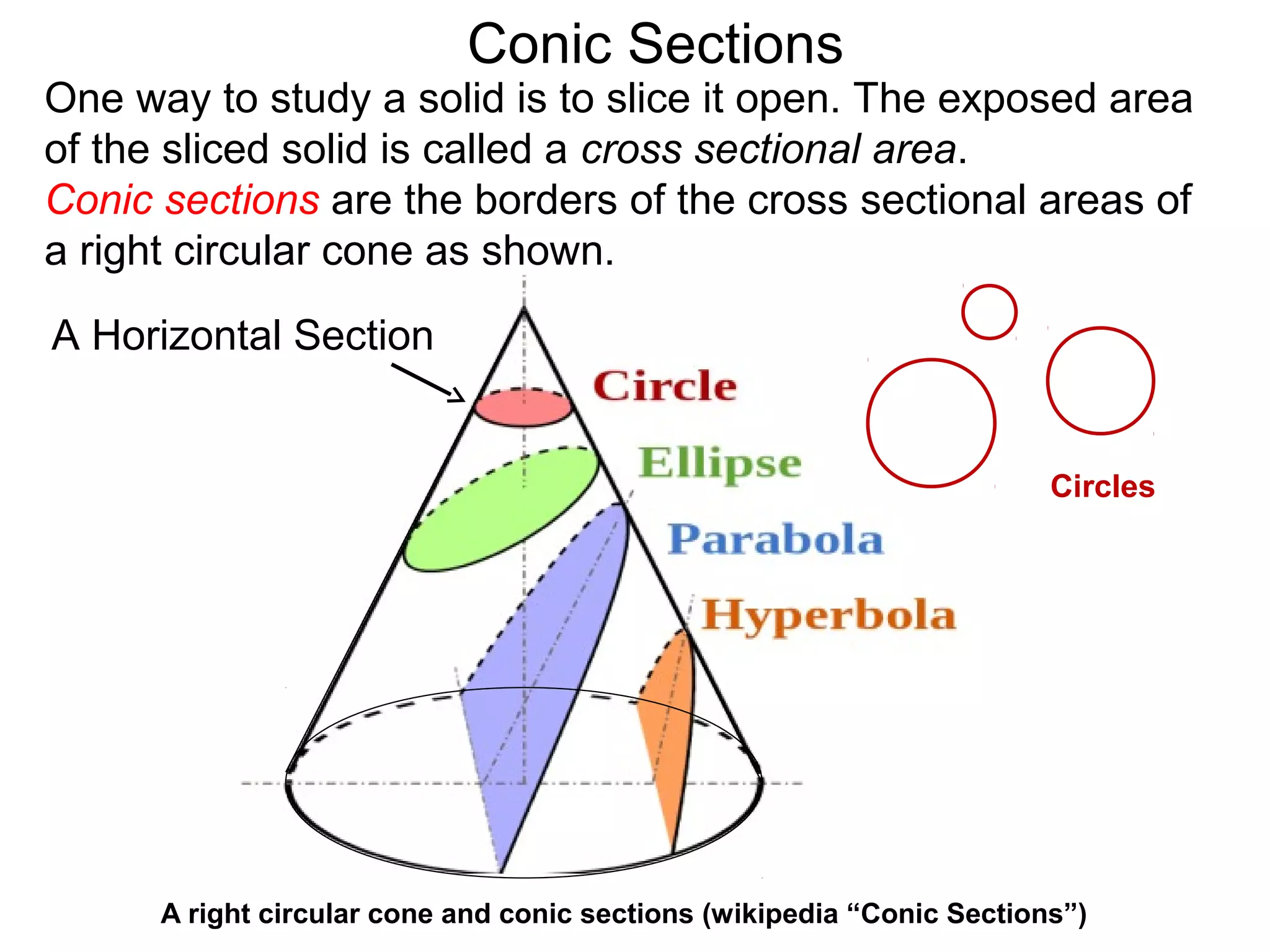
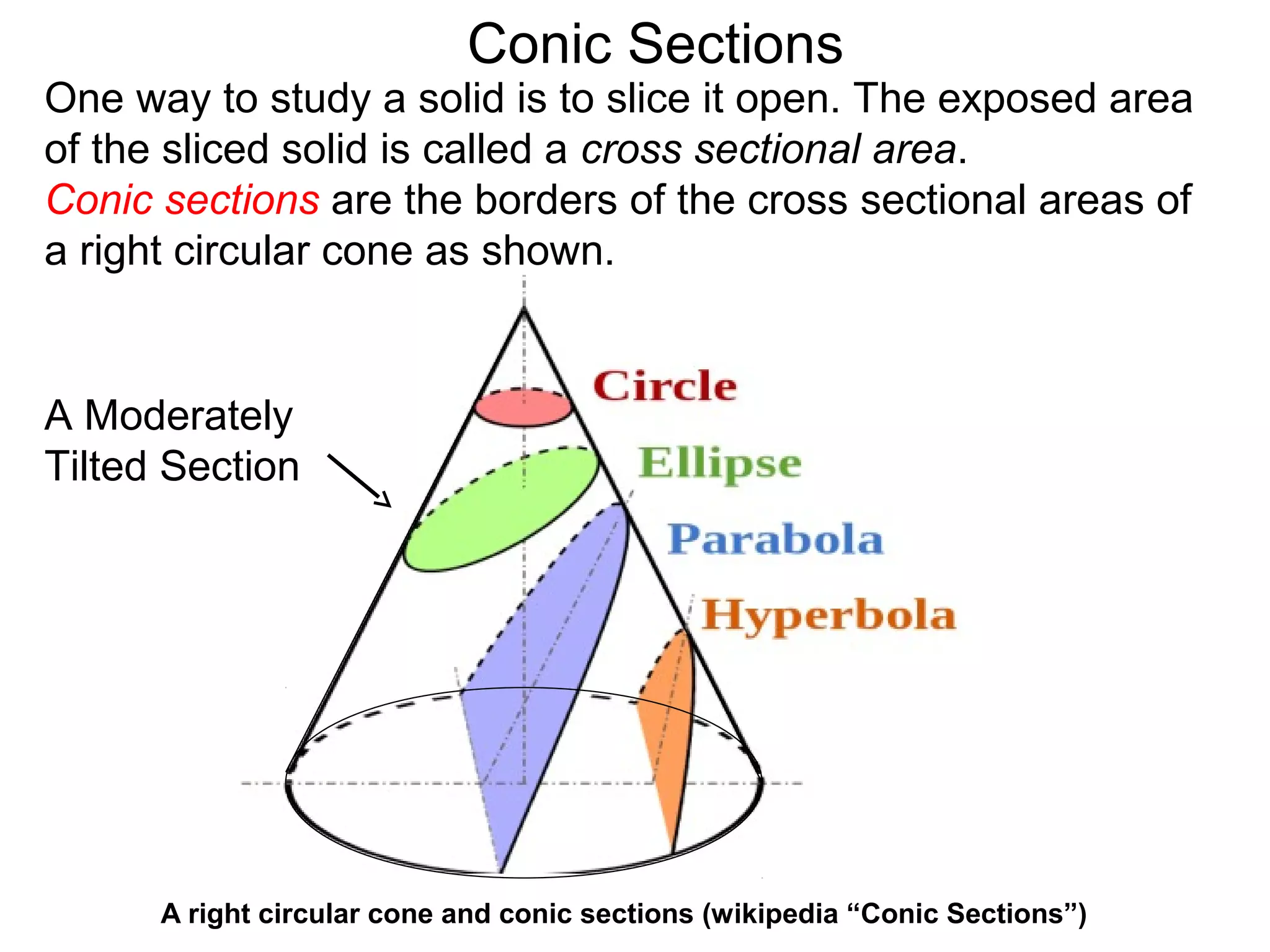
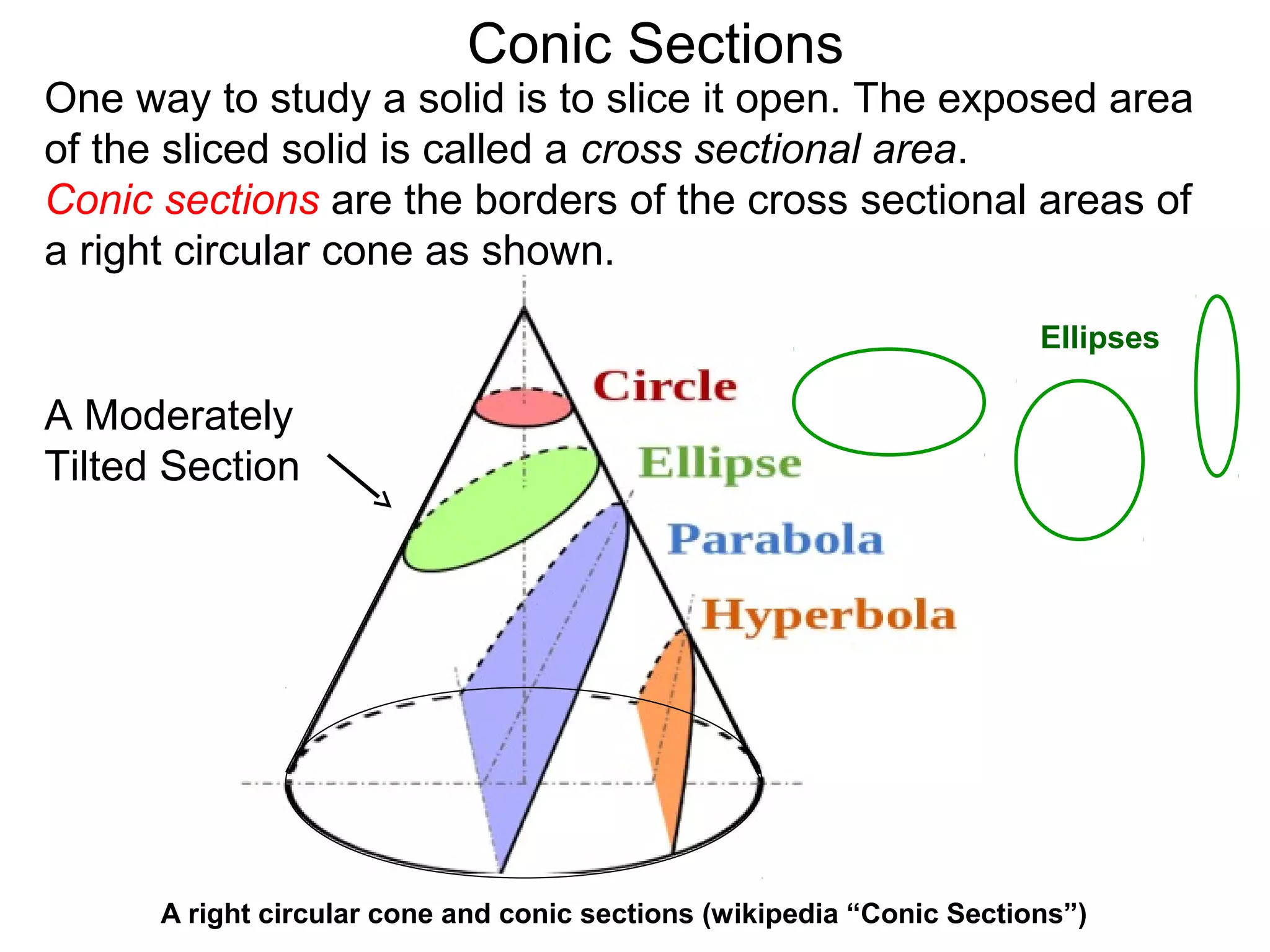
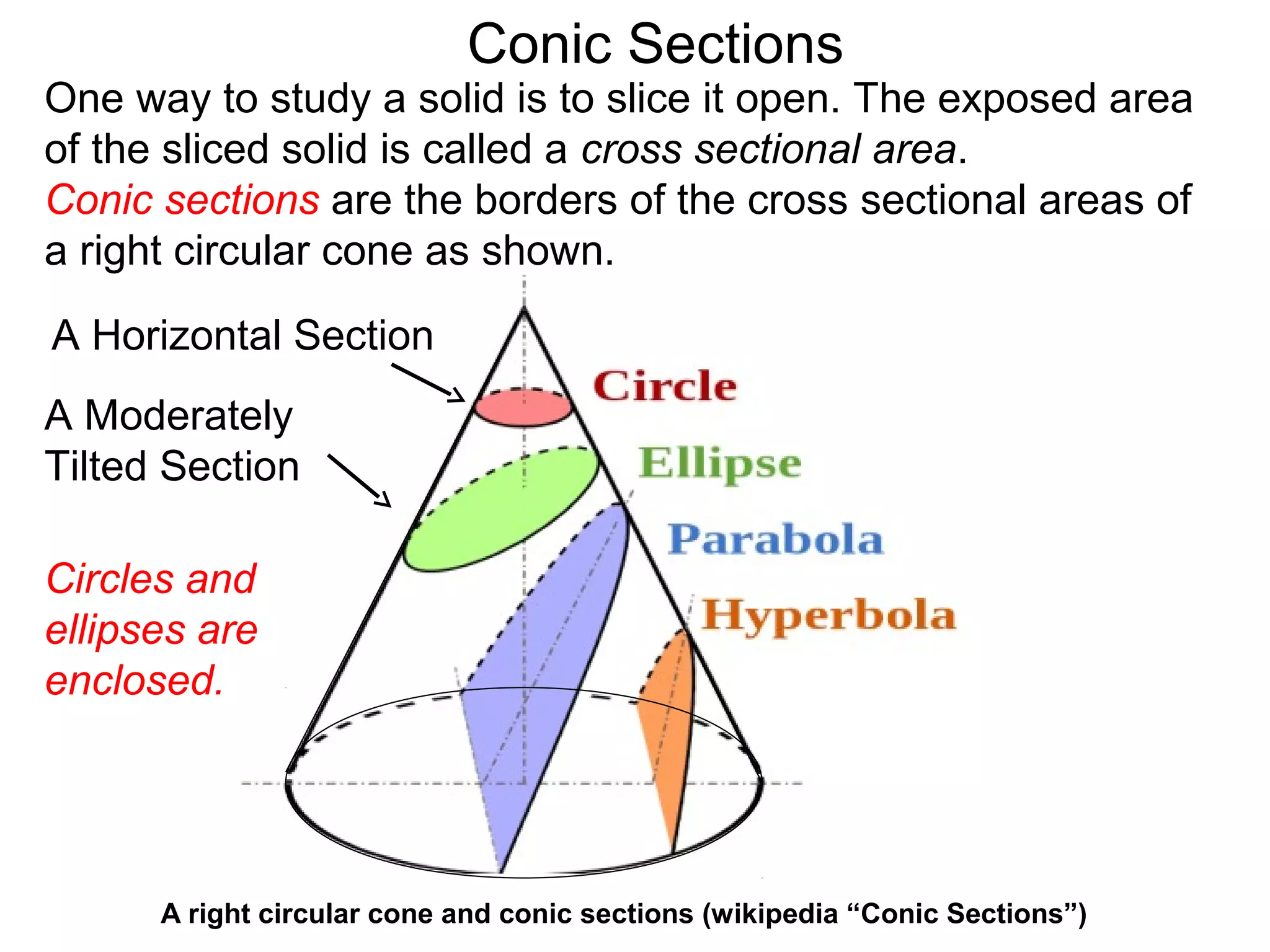
Conic sections are the borders of the cross sectional areas of
a right circular cone as shown.
Conic Sections
A right circular cone and conic sections (wikipedia “Conic Sections”)
One way to study a solid is to slice it open. The exposed area
of the sliced solid is called a cross sectional area.
Conic sections are the borders of the cross sectional areas of
a right circular cone as shown.
Conic Sections
A Horizontal Section
A right circular cone and conic sections (wikipedia “Conic Sections”)
One way to study a solid is to slice it open. The exposed area
of the sliced solid is called a cross sectional area.
Conic sections are the borders of the cross sectional areas of
a right circular cone as shown.
Conic Sections
A Horizontal Section
A right circular cone and conic sections (wikipedia “Conic Sections”)
One way to study a solid is to slice it open. The exposed area
of the sliced solid is called a cross sectional area.
Conic sections are the borders of the cross sectional areas of
a right circular cone as shown.
Circles
Conic Sections
A Moderately
Tilted Section
A right circular cone and conic sections (wikipedia “Conic Sections”)
One way to study a solid is to slice it open. The exposed area
of the sliced solid is called a cross sectional area.
Conic sections are the borders of the cross sectional areas of
a right circular cone as shown.
Conic Sections
A Moderately
Tilted Section
A right circular cone and conic sections (wikipedia “Conic Sections”)
One way to study a solid is to slice it open. The exposed area
of the sliced solid is called a cross sectional area.
Conic sections are the borders of the cross sectional areas of
a right circular cone as shown.
Ellipses
Conic Sections
A Horizontal Section
A Moderately
Tilted Section
A right circular cone and conic sections (wikipedia “Conic Sections”)
One way to study a solid is to slice it open. The exposed area
of the sliced solid is called a cross sectional area.
Conic sections are the borders of the cross sectional areas of
a right circular cone as shown.
Circles and
ellipses are
enclosed.
Conic Sections
A right circular cone and conic sections (wikipedia “Conic Sections”)
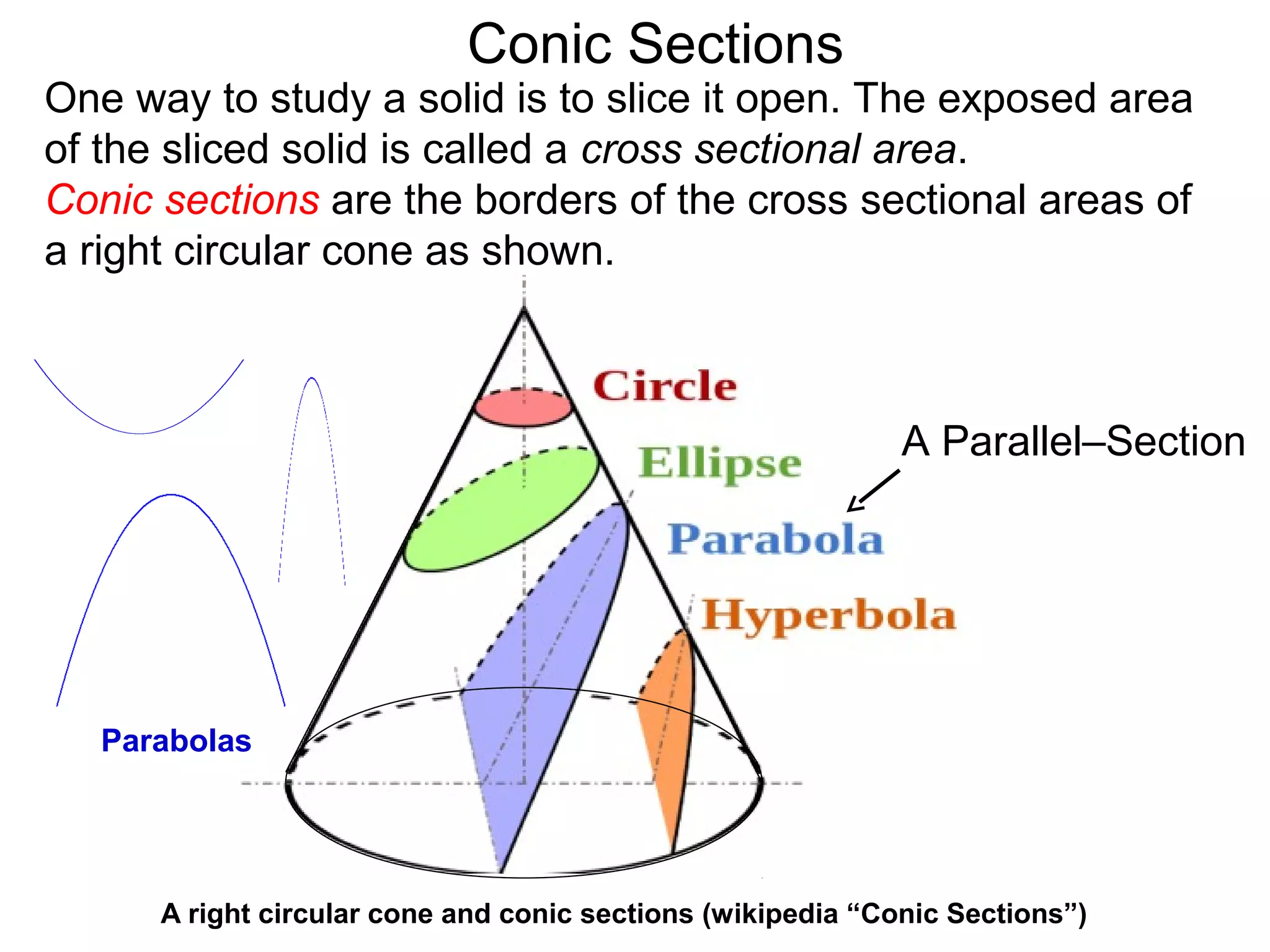
A Parallel–Section
One way to study a solid is to slice it open. The exposed area
of the sliced solid is called a cross sectional area.
Conic sections are the borders of the cross sectional areas of
a right circular cone as shown.
Conic Sections
A right circular cone and conic sections (wikipedia “Conic Sections”)
A Parallel–Section
One way to study a solid is to slice it open. The exposed area
of the sliced solid is called a cross sectional area.
Conic sections are the borders of the cross sectional areas of
a right circular cone as shown.
Parabolas
Conic Sections
A right circular cone and conic sections (wikipedia “Conic Sections”)
One way to study a solid is to slice it open. The exposed area
of the sliced solid is called a cross sectional area.
Conic sections are the borders of the cross sectional areas of
a right circular cone as shown.
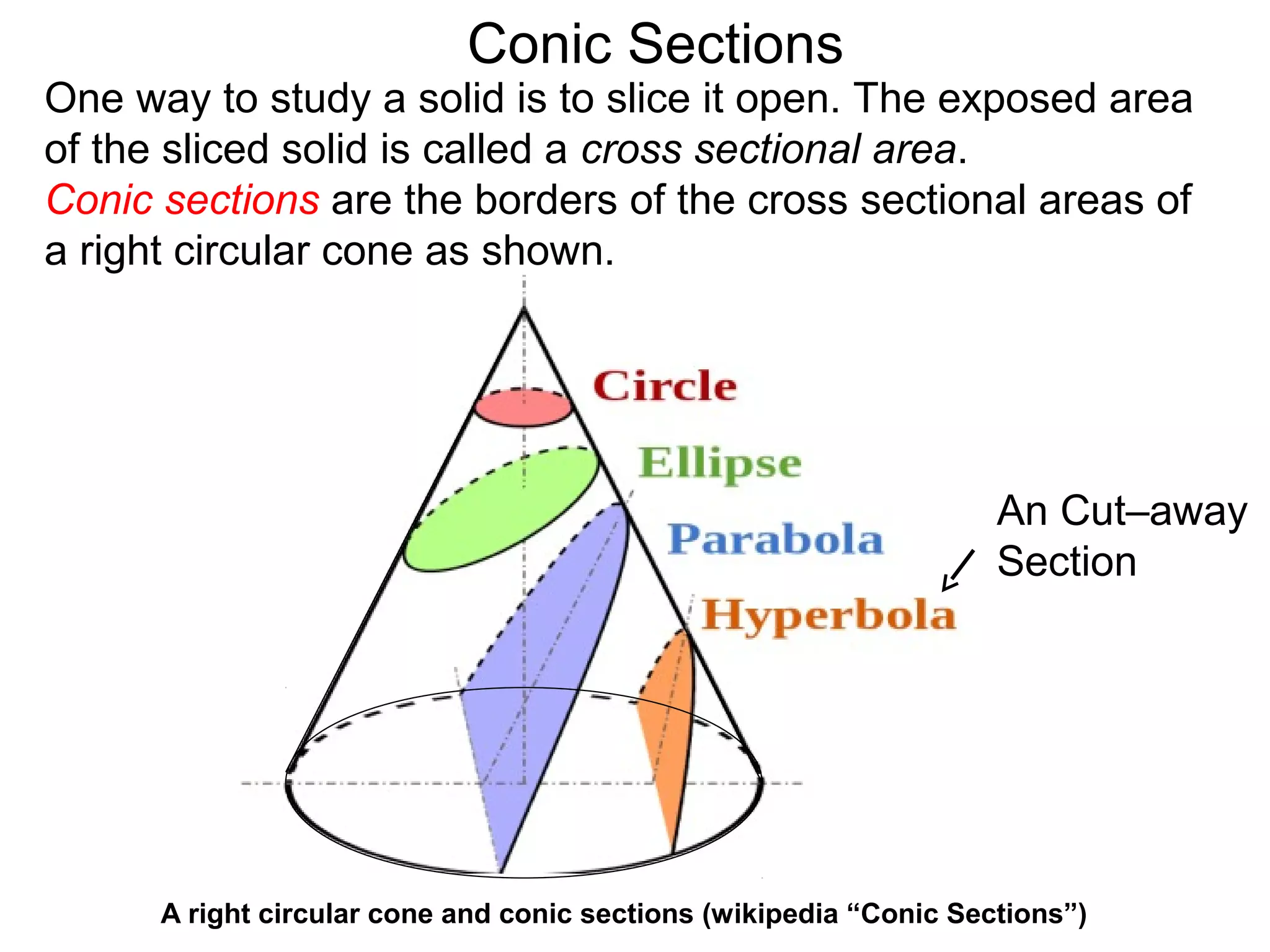
An Cut–away
Section
Conic Sections
A right circular cone and conic sections (wikipedia “Conic Sections”)
One way to study a solid is to slice it open. The exposed area
of the sliced solid is called a cross sectional area.
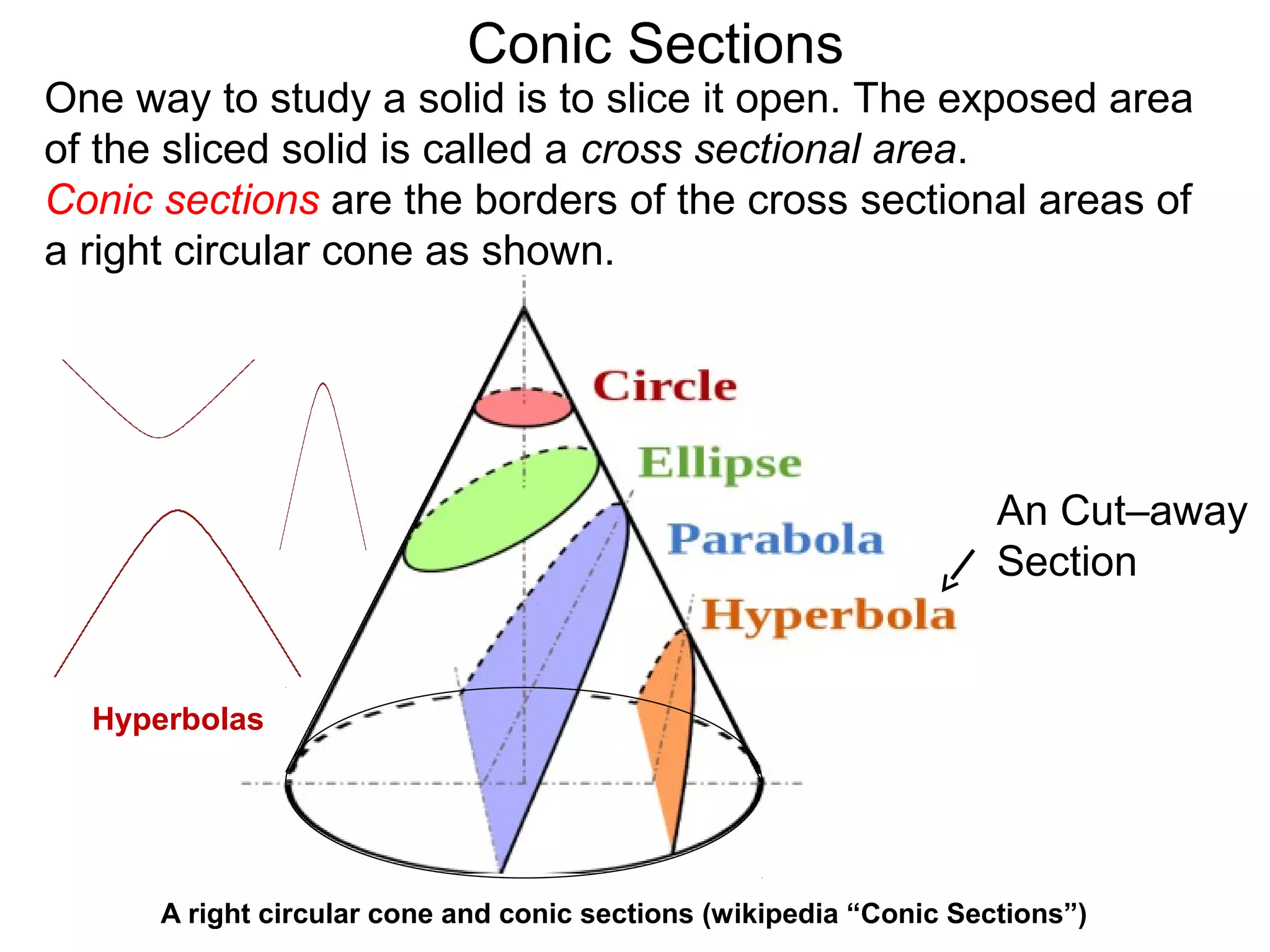
Conic sections are the borders of the cross sectional areas of
a right circular cone as shown.
An Cut–away
Section
Hyperbolas
Conic Sections
A right circular cone and conic sections (wikipedia “Conic Sections”)
An Cut–away
Section
One way to study a solid is to slice it open. The exposed area
of the sliced solid is called a cross sectional area.
Conic sections are the borders of the cross sectional areas of
a right circular cone as shown.
Parabolas and
hyperbolas are open.
A Horizontal Section
A Moderately
Tilted Section
Circles and
ellipses are
enclosed.
A Parallel–Section
Conic Sections
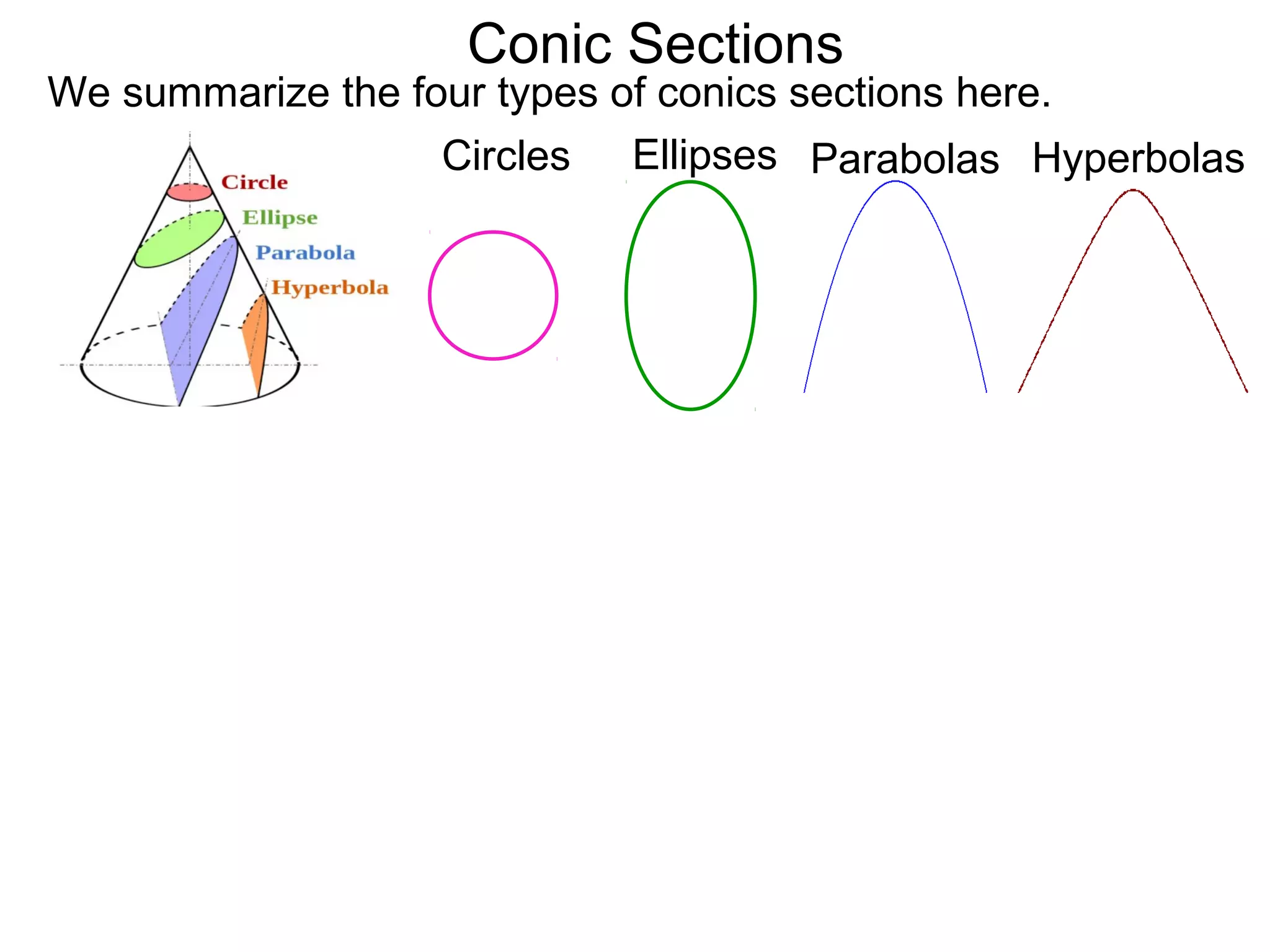
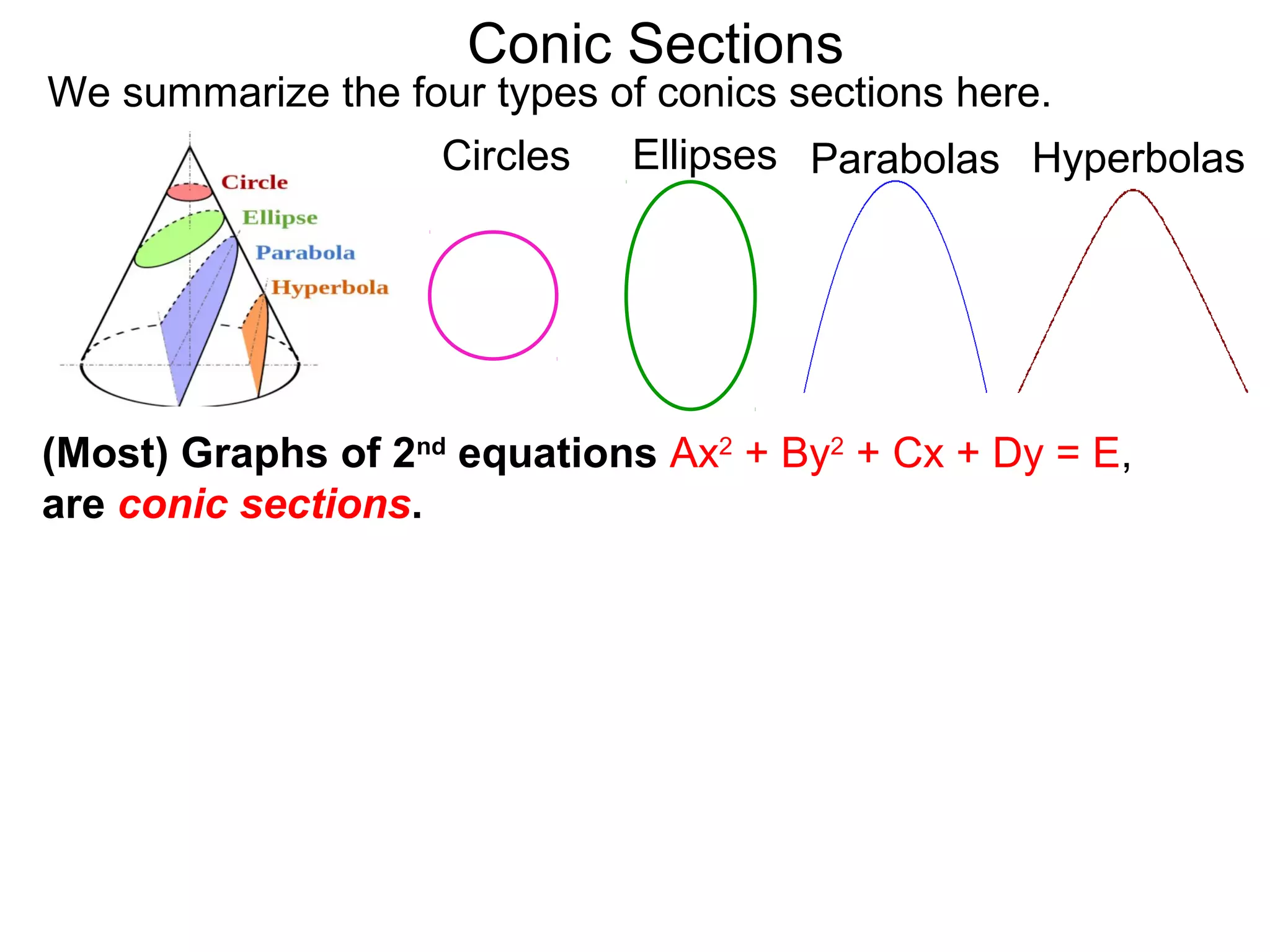
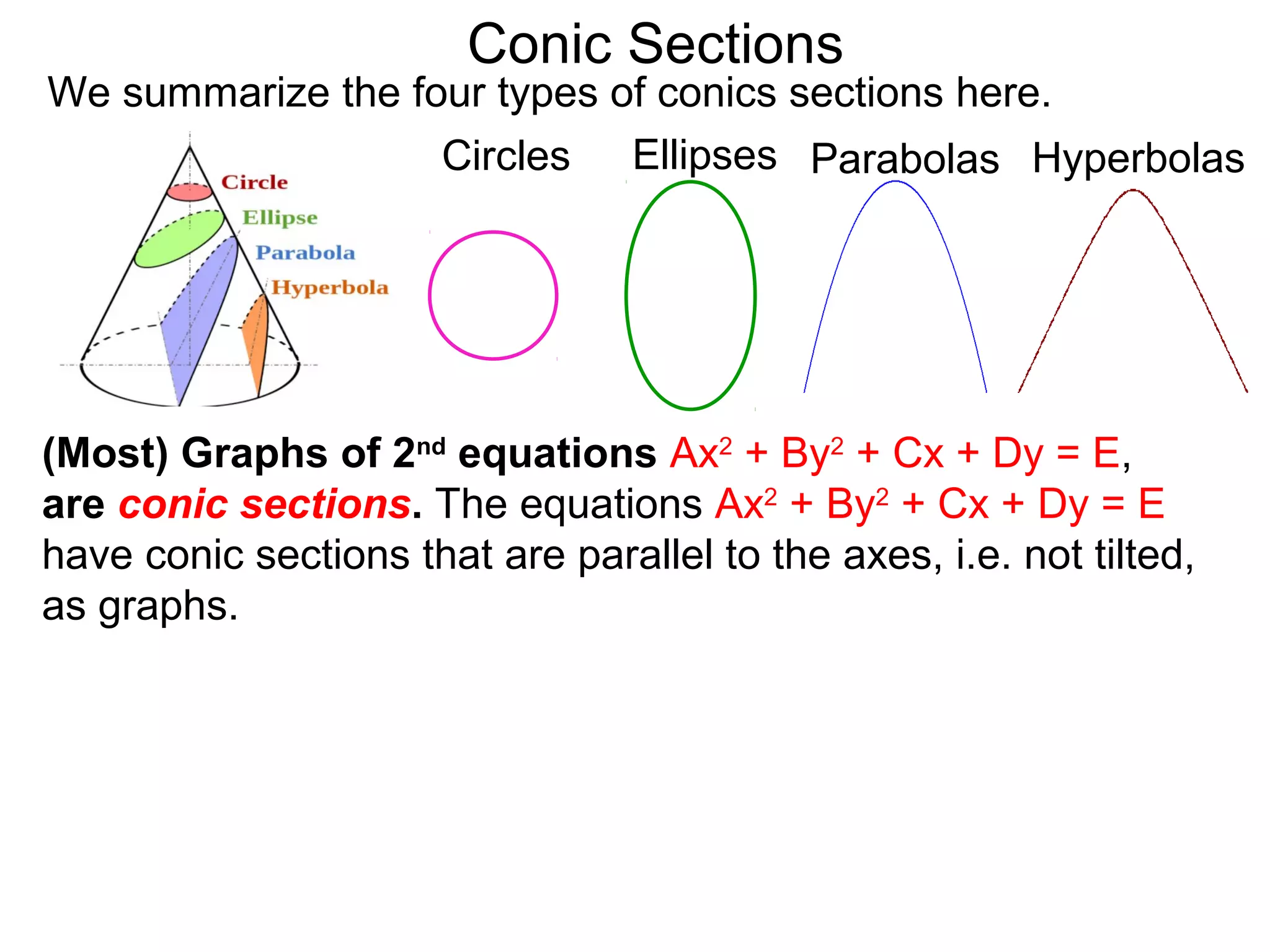
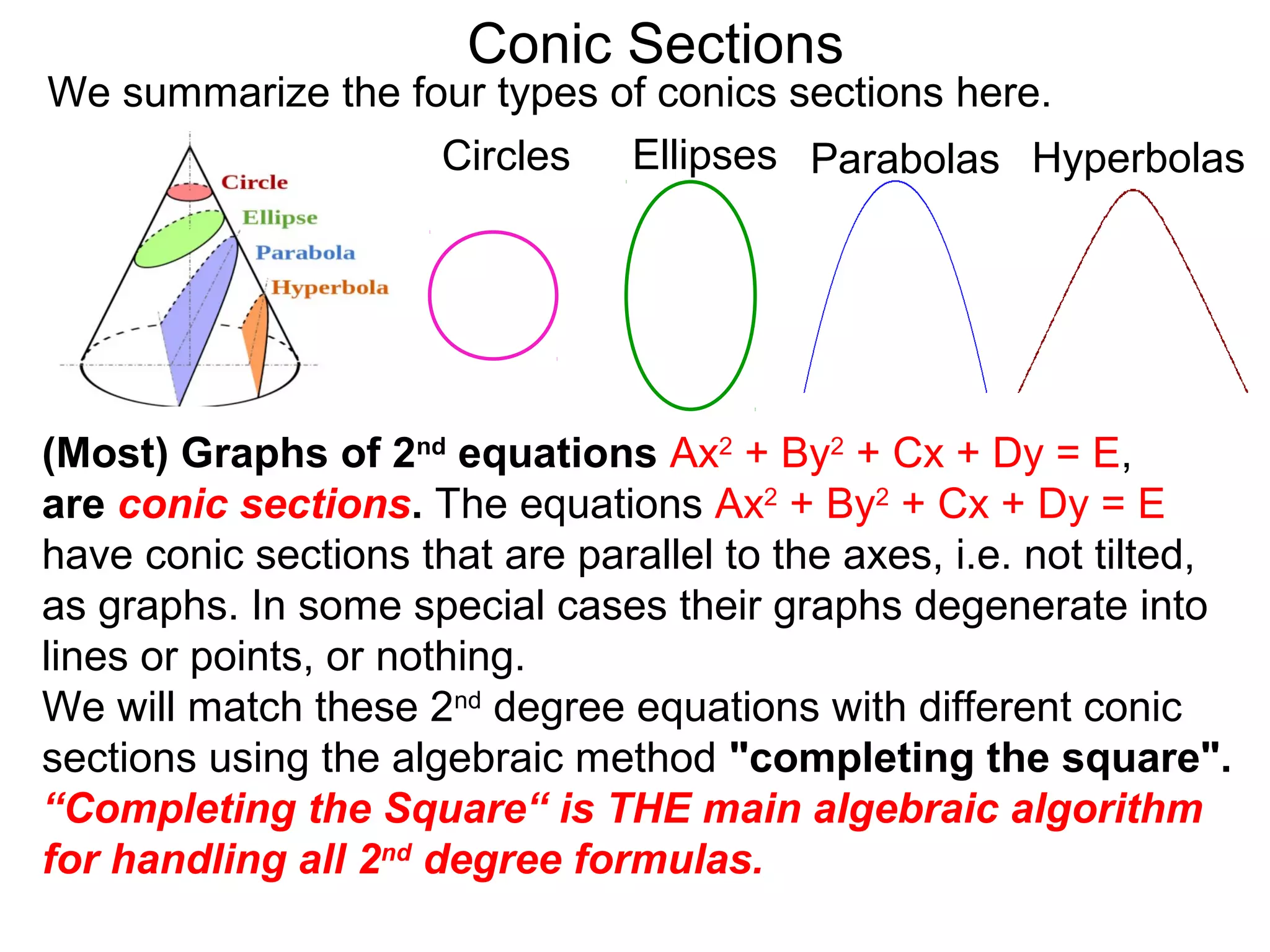
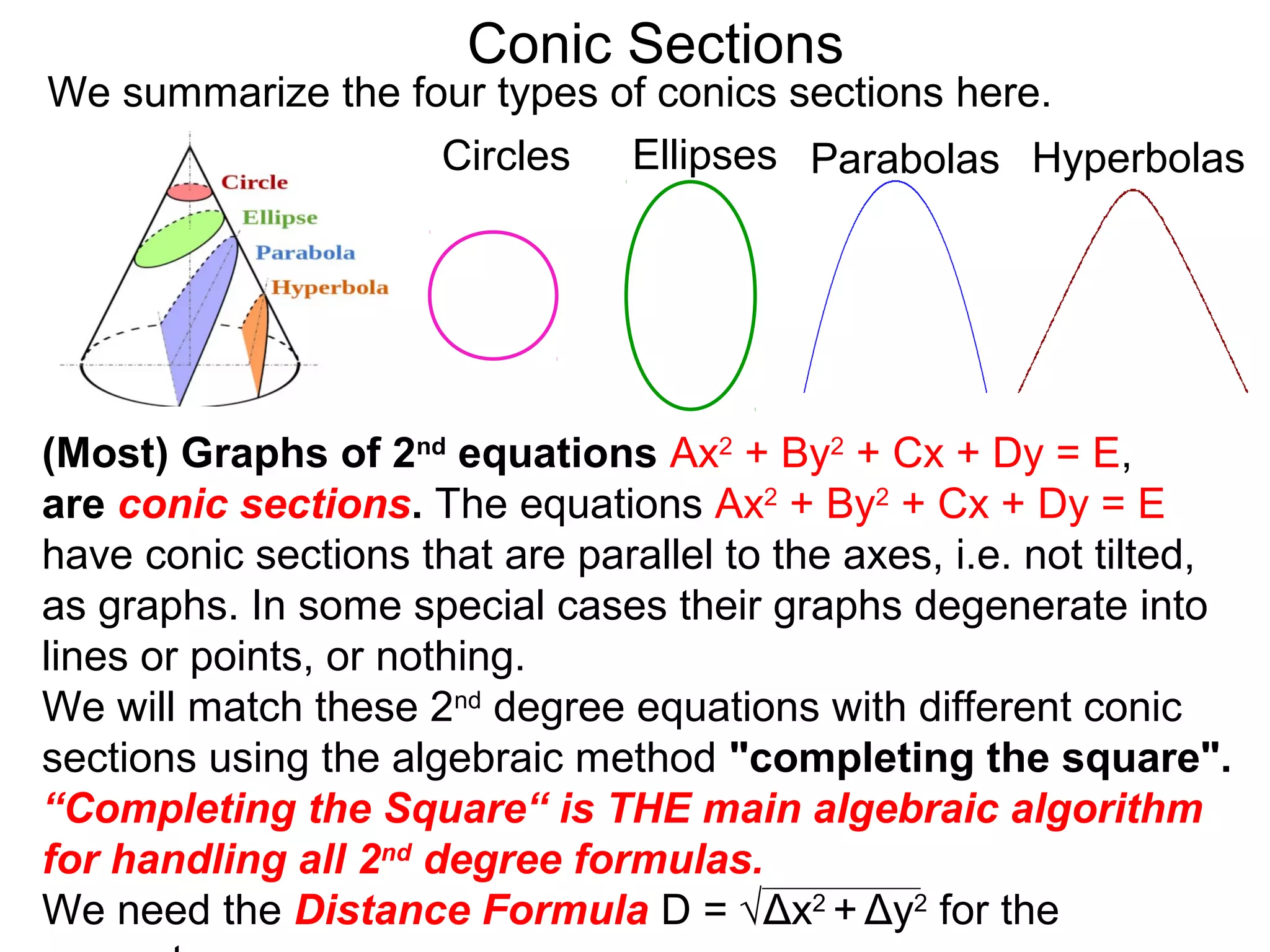
Circles Ellipses Parabolas Hyperbolas
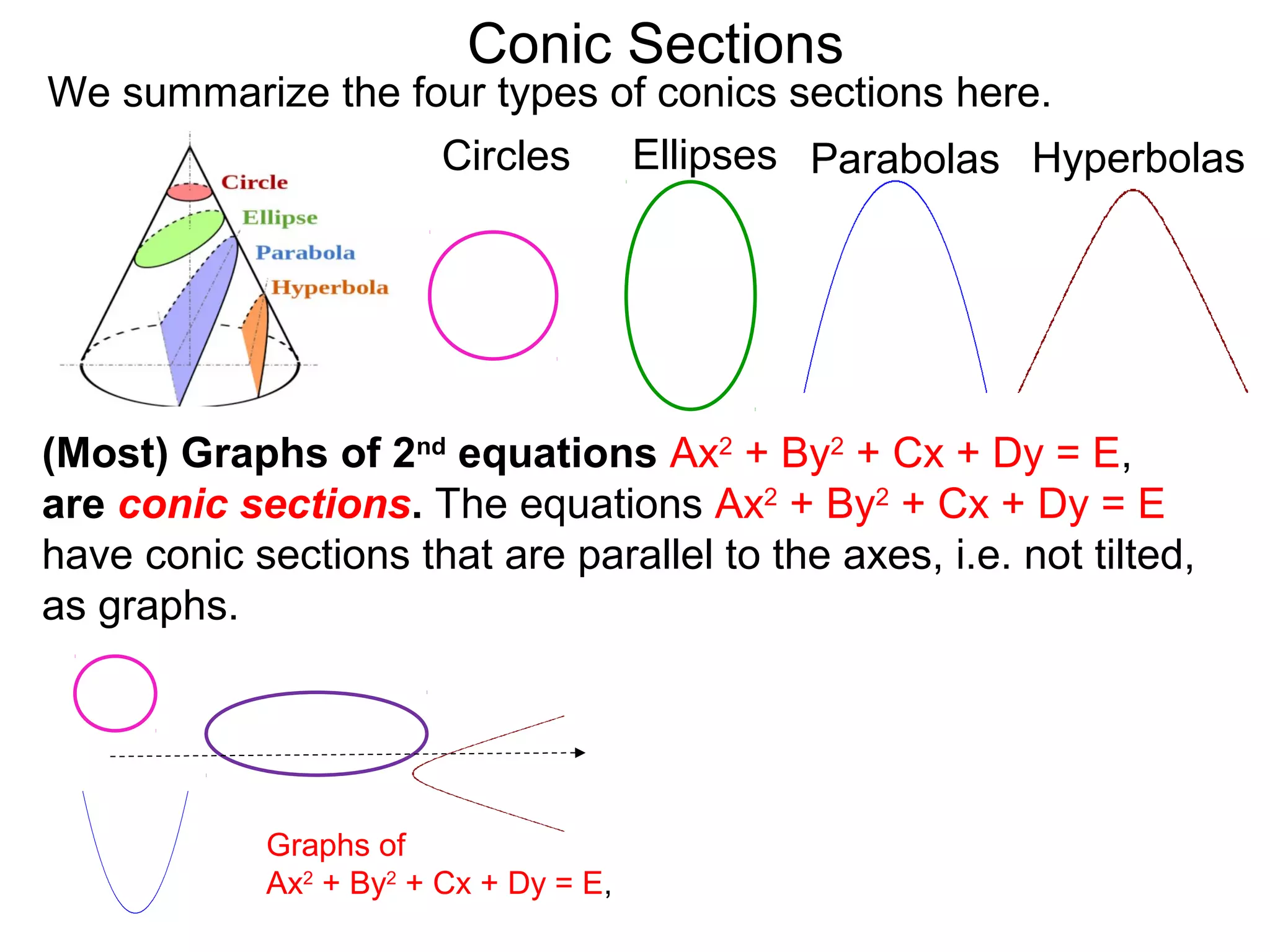
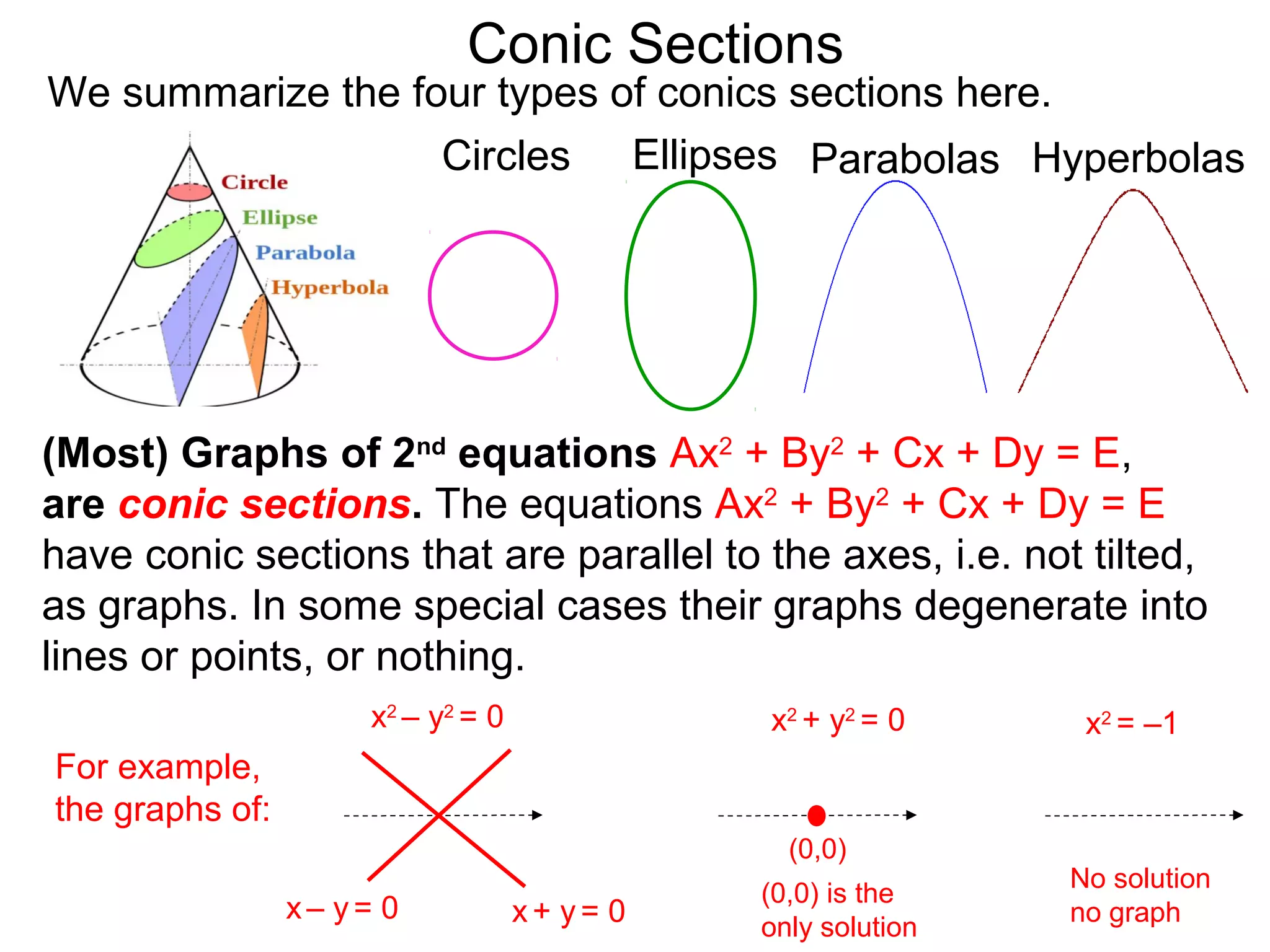
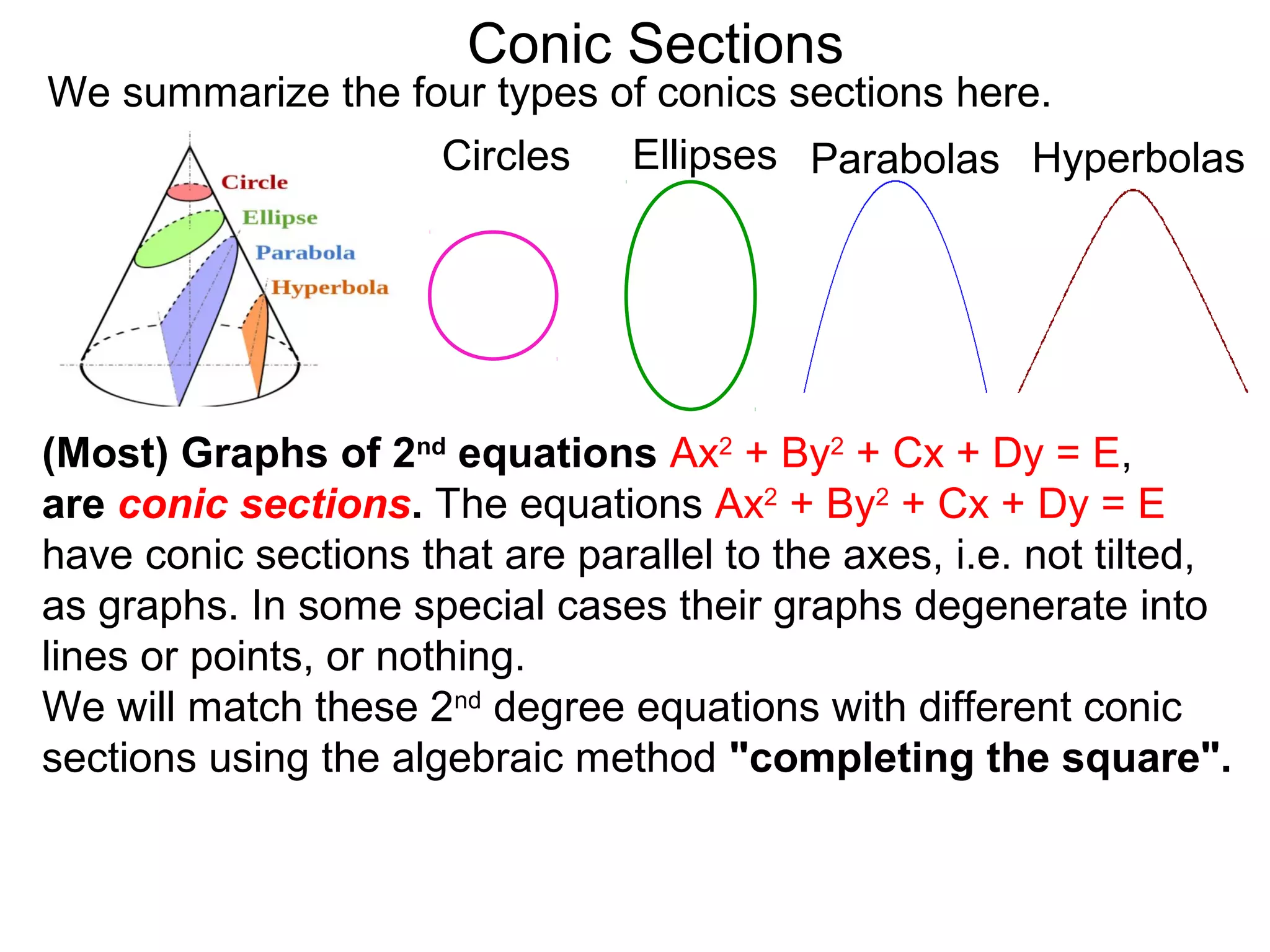
We summarize the four types of conics sections here.
Conic Sections
Circles Ellipses Parabolas Hyperbolas
We summarize the four types of conics sections here.
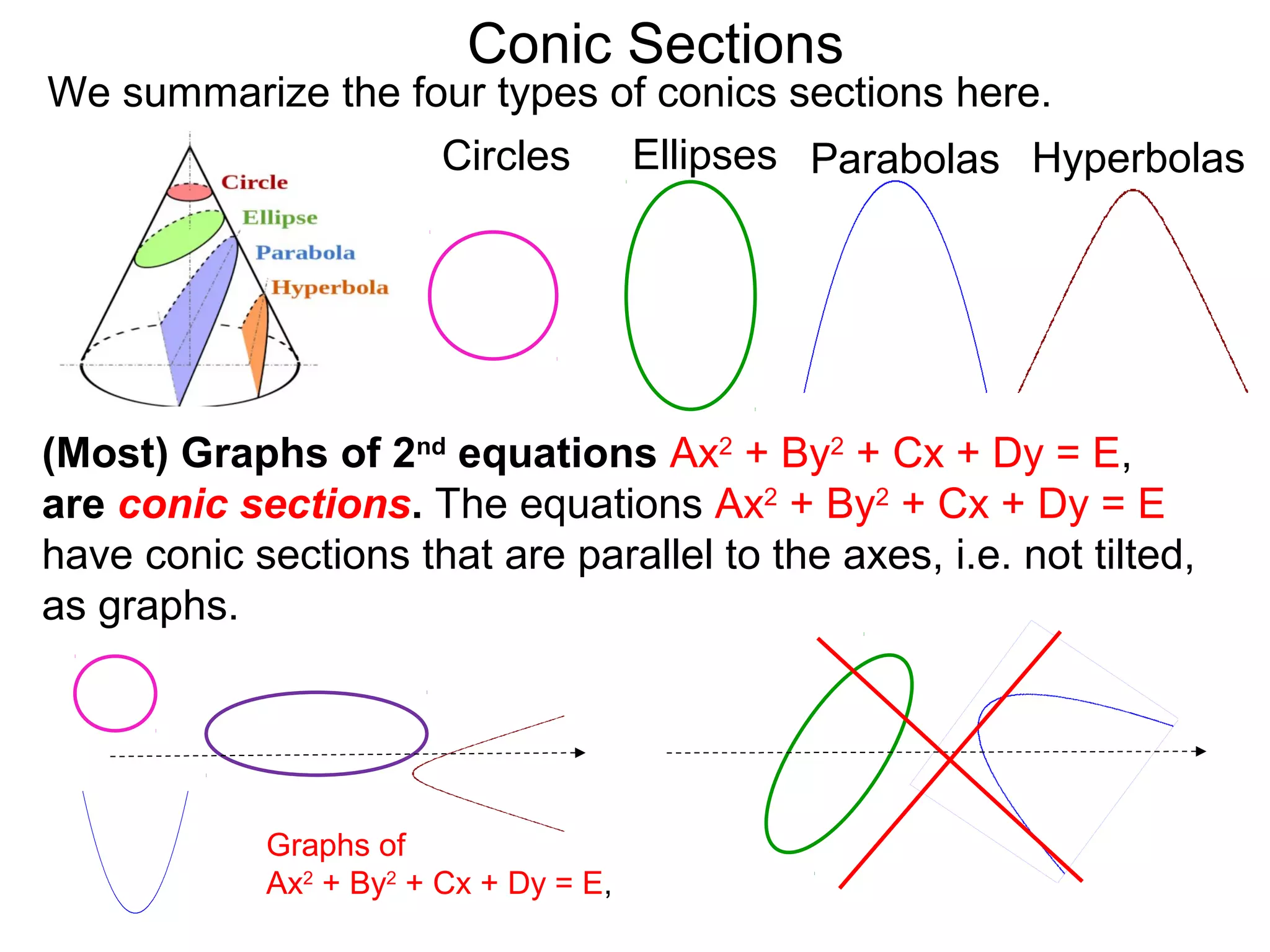
(Most) Graphs of 2nd
equations Ax2
+ By2
+ Cx + Dy = E,
are conic sections.
Conic Sections
(Most) Graphs of 2nd
equations Ax2
+ By2
+ Cx + Dy = E,
are conic sections. The equations Ax2
+ By2
+ Cx + Dy = E
have conic sections that are parallel to the axes, i.e. not tilted,
as graphs.
Circles Ellipses Parabolas Hyperbolas
We summarize the four types of conics sections here.
Conic Sections
(Most) Graphs of 2nd
equations Ax2
+ By2
+ Cx + Dy = E,
are conic sections. The equations Ax2
+ By2
+ Cx + Dy = E
have conic sections that are parallel to the axes, i.e. not tilted,
as graphs.
Circles Ellipses Parabolas Hyperbolas
We summarize the four types of conics sections here.
Graphs of
Ax2
+ By2
+ Cx + Dy = E,
Conic Sections
(Most) Graphs of 2nd
equations Ax2
+ By2
+ Cx + Dy = E,
are conic sections. The equations Ax2
+ By2
+ Cx + Dy = E
have conic sections that are parallel to the axes, i.e. not tilted,
as graphs.
Circles Ellipses Parabolas Hyperbolas
We summarize the four types of conics sections here.
Graphs of
Ax2
+ By2
+ Cx + Dy = E,
Conic Sections
(Most) Graphs of 2nd
equations Ax2
+ By2
+ Cx + Dy = E,
are conic sections. The equations Ax2
+ By2
+ Cx + Dy = E
have conic sections that are parallel to the axes, i.e. not tilted,
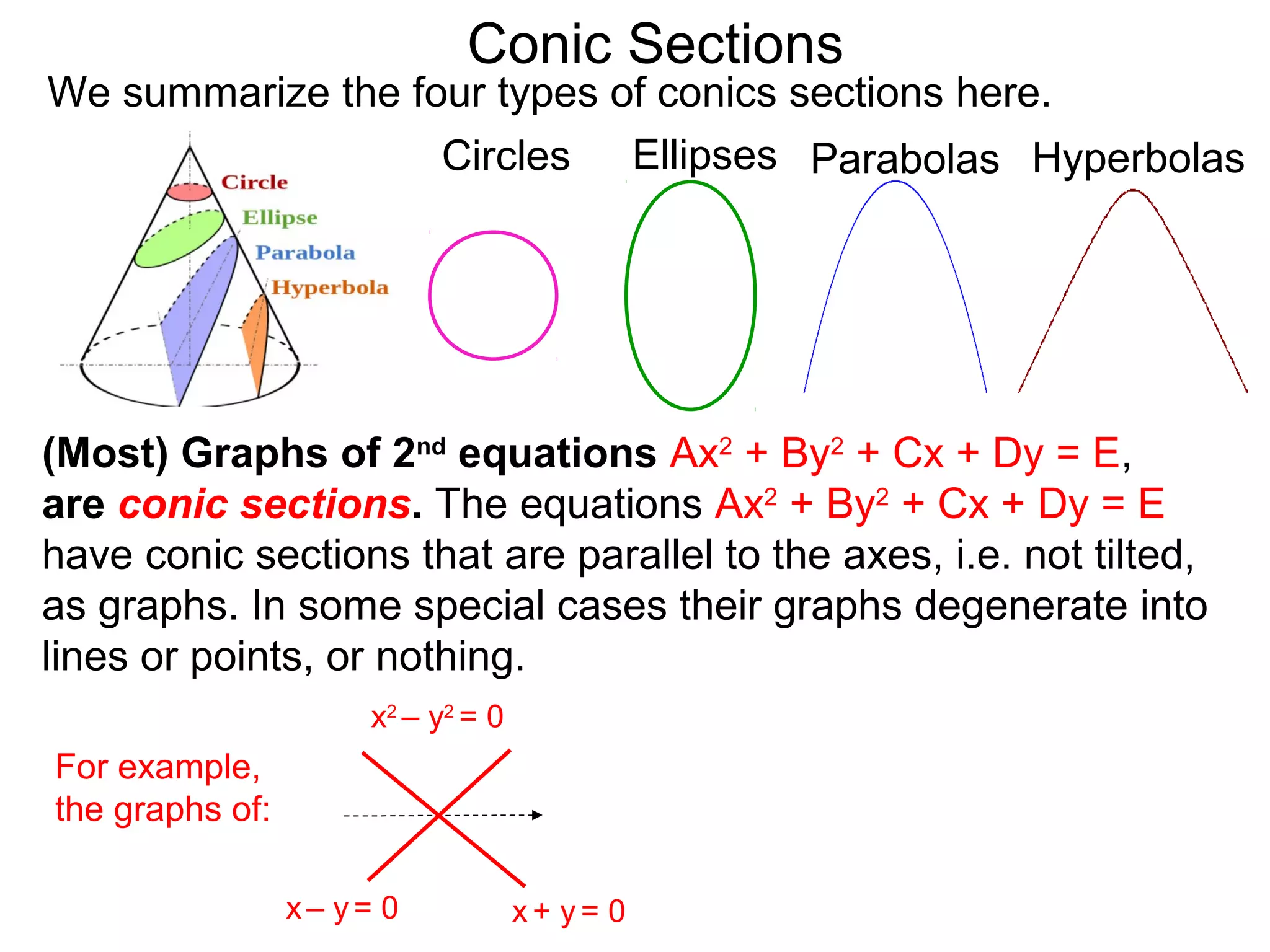
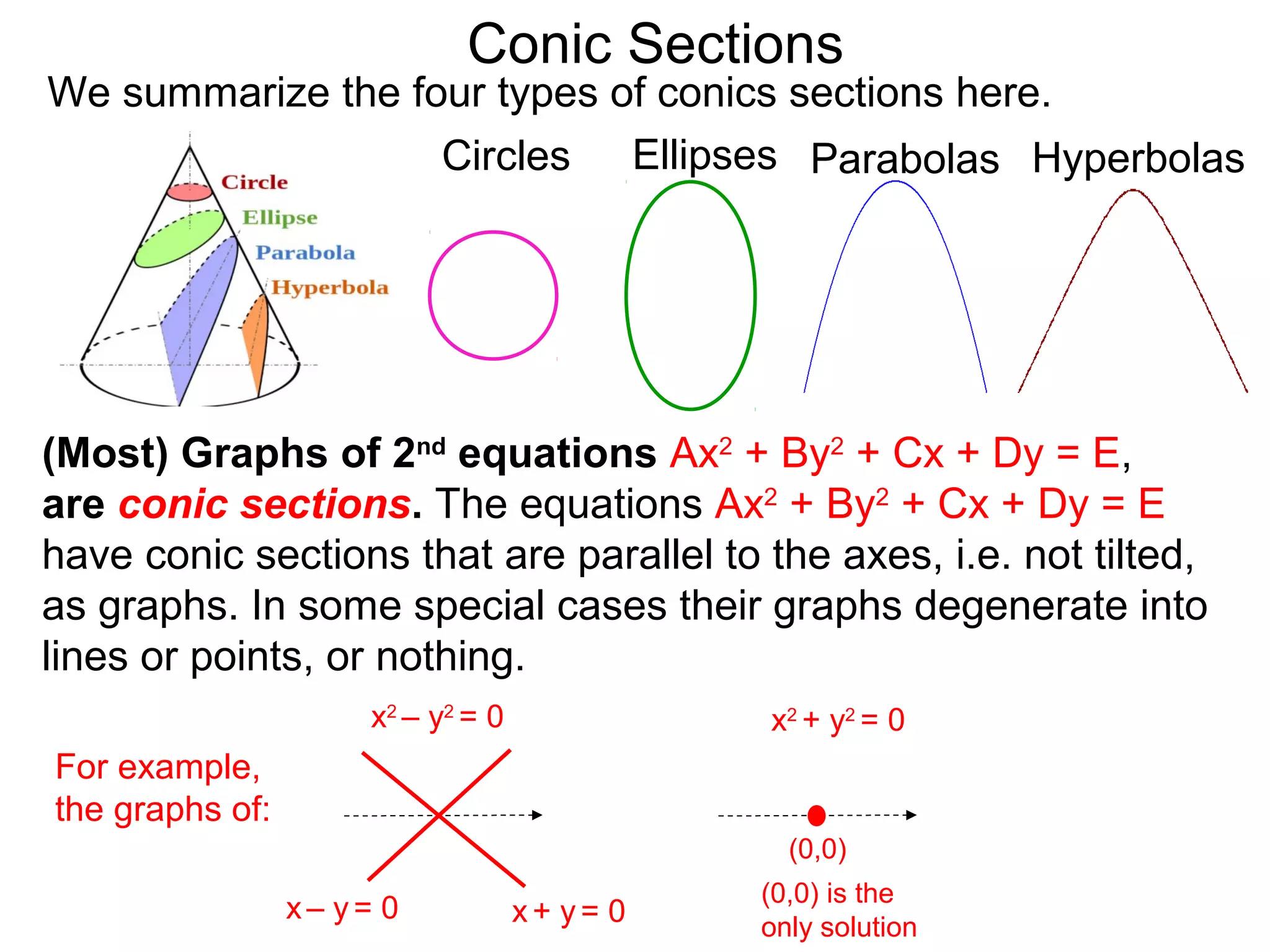
as graphs. In some special cases their graphs degenerate into
lines or points, or nothing.
Circles Ellipses Parabolas Hyperbolas
We summarize the four types of conics sections here.
Conic Sections
(Most) Graphs of 2nd
equations Ax2
+ By2
+ Cx + Dy = E,
are conic sections. The equations Ax2
+ By2
+ Cx + Dy = E
have conic sections that are parallel to the axes, i.e. not tilted,
as graphs. In some special cases their graphs degenerate into
lines or points, or nothing.
Circles Ellipses Parabolas Hyperbolas
We summarize the four types of conics sections here.
x2
– y2
= 0
For example,
the graphs of:
x+ y = 0x – y = 0
Conic Sections
(Most) Graphs of 2nd
equations Ax2
+ By2
+ Cx + Dy = E,
are conic sections. The equations Ax2
+ By2
+ Cx + Dy = E
have conic sections that are parallel to the axes, i.e. not tilted,
as graphs. In some special cases their graphs degenerate into
lines or points, or nothing.
Circles Ellipses Parabolas Hyperbolas
We summarize the four types of conics sections here.
x2
– y2
= 0
For example,
the graphs of:
x+ y = 0x – y = 0
x2
+ y2
= 0
(0,0)
(0,0) is the
only solution
Conic Sections
(Most) Graphs of 2nd
equations Ax2
+ By2
+ Cx + Dy = E,
are conic sections. The equations Ax2
+ By2
+ Cx + Dy = E
have conic sections that are parallel to the axes, i.e. not tilted,
as graphs. In some special cases their graphs degenerate into
lines or points, or nothing.
Circles Ellipses Parabolas Hyperbolas
We summarize the four types of conics sections here.
x2
– y2
= 0
For example,
the graphs of:
x+ y = 0x – y = 0
x2
= –1x2
+ y2
= 0
(0,0)
(0,0) is the
only solution
No solution
no graph
Conic Sections
(Most) Graphs of 2nd
equations Ax2
+ By2
+ Cx + Dy = E,
are conic sections. The equations Ax2
+ By2
+ Cx + Dy = E
have conic sections that are parallel to the axes, i.e. not tilted,
as graphs. In some special cases their graphs degenerate into
lines or points, or nothing.
We will match these 2nd
degree equations with different conic
sections using the algebraic method "completing the square".
Circles Ellipses Parabolas Hyperbolas
We summarize the four types of conics sections here.
Conic Sections
(Most) Graphs of 2nd
equations Ax2
+ By2
+ Cx + Dy = E,
are conic sections. The equations Ax2
+ By2
+ Cx + Dy = E
have conic sections that are parallel to the axes, i.e. not tilted,
as graphs. In some special cases their graphs degenerate into
lines or points, or nothing.
We will match these 2nd
degree equations with different conic
sections using the algebraic method "completing the square".
“Completing the Square“ is THE main algebraic algorithm
for handling all 2nd
degree formulas.
Circles Ellipses Parabolas Hyperbolas
We summarize the four types of conics sections here.
Conic Sections
(Most) Graphs of 2nd
equations Ax2
+ By2
+ Cx + Dy = E,
are conic sections. The equations Ax2
+ By2
+ Cx + Dy = E
have conic sections that are parallel to the axes, i.e. not tilted,
as graphs. In some special cases their graphs degenerate into
lines or points, or nothing.
We will match these 2nd
degree equations with different conic
sections using the algebraic method "completing the square".
“Completing the Square“ is THE main algebraic algorithm
for handling all 2nd
degree formulas.
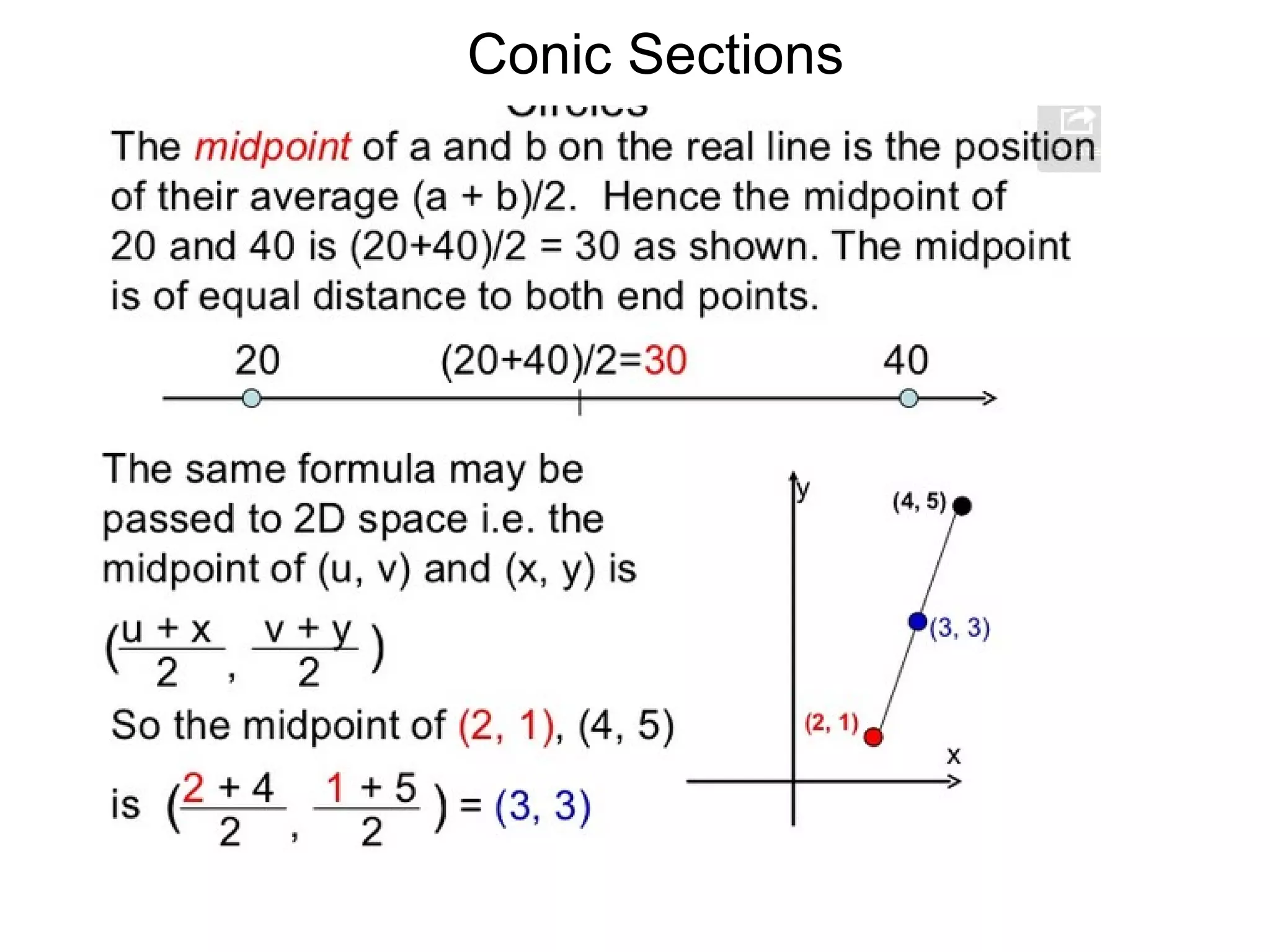
We need the Distance Formula D = √Δx2
+ Δy2
for the
Circles Ellipses Parabolas Hyperbolas
We summarize the four types of conics sections here.
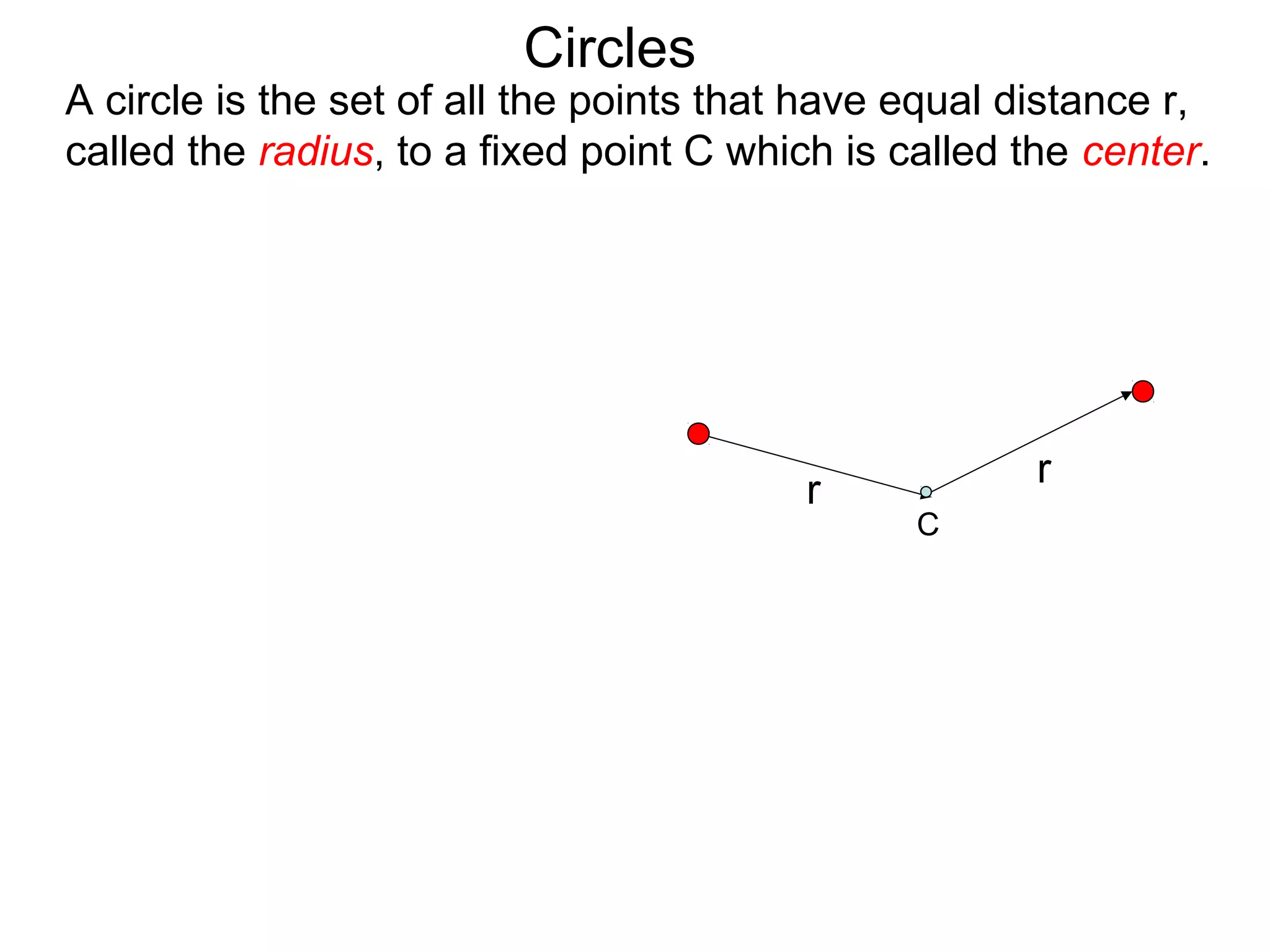
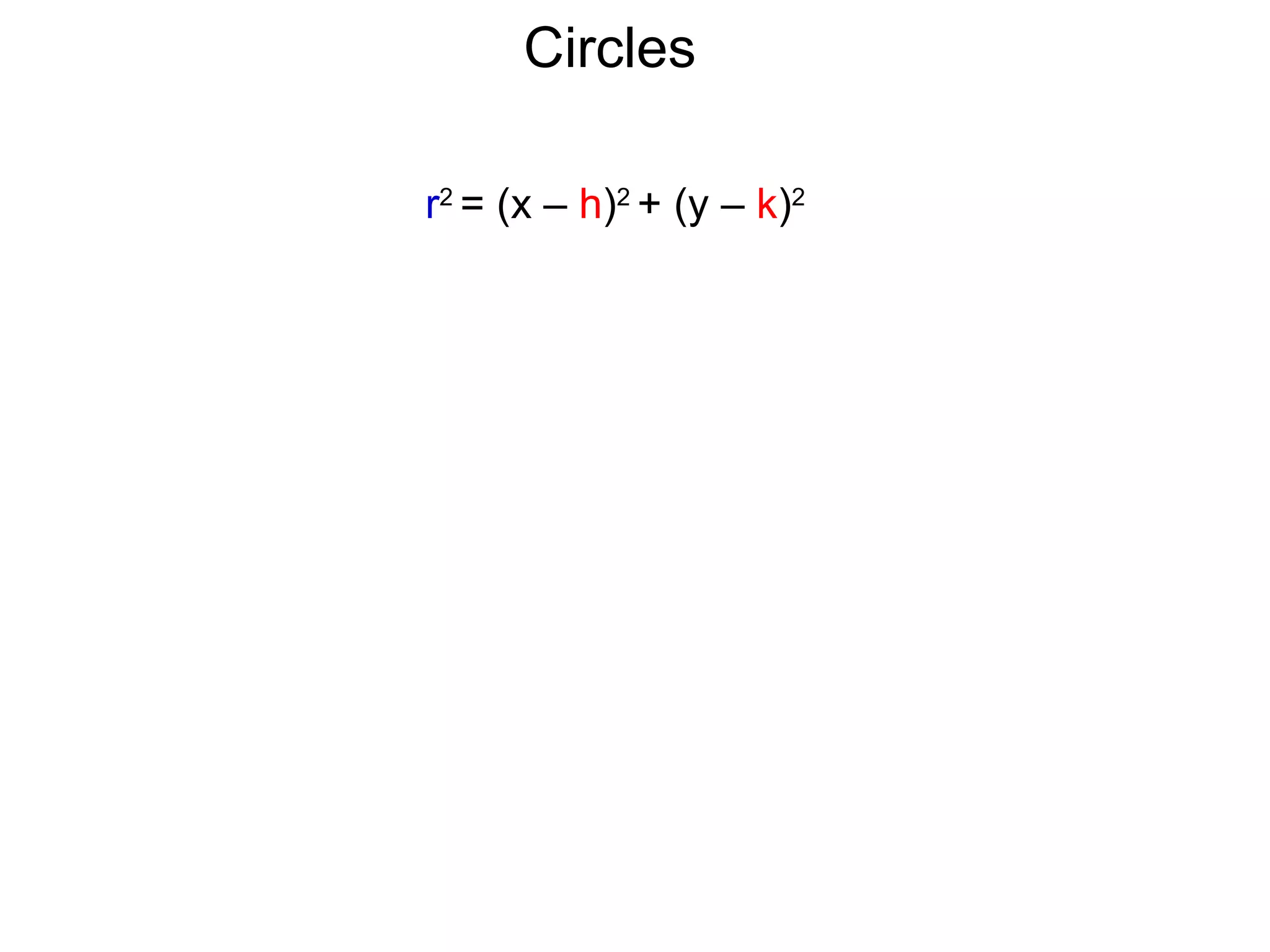
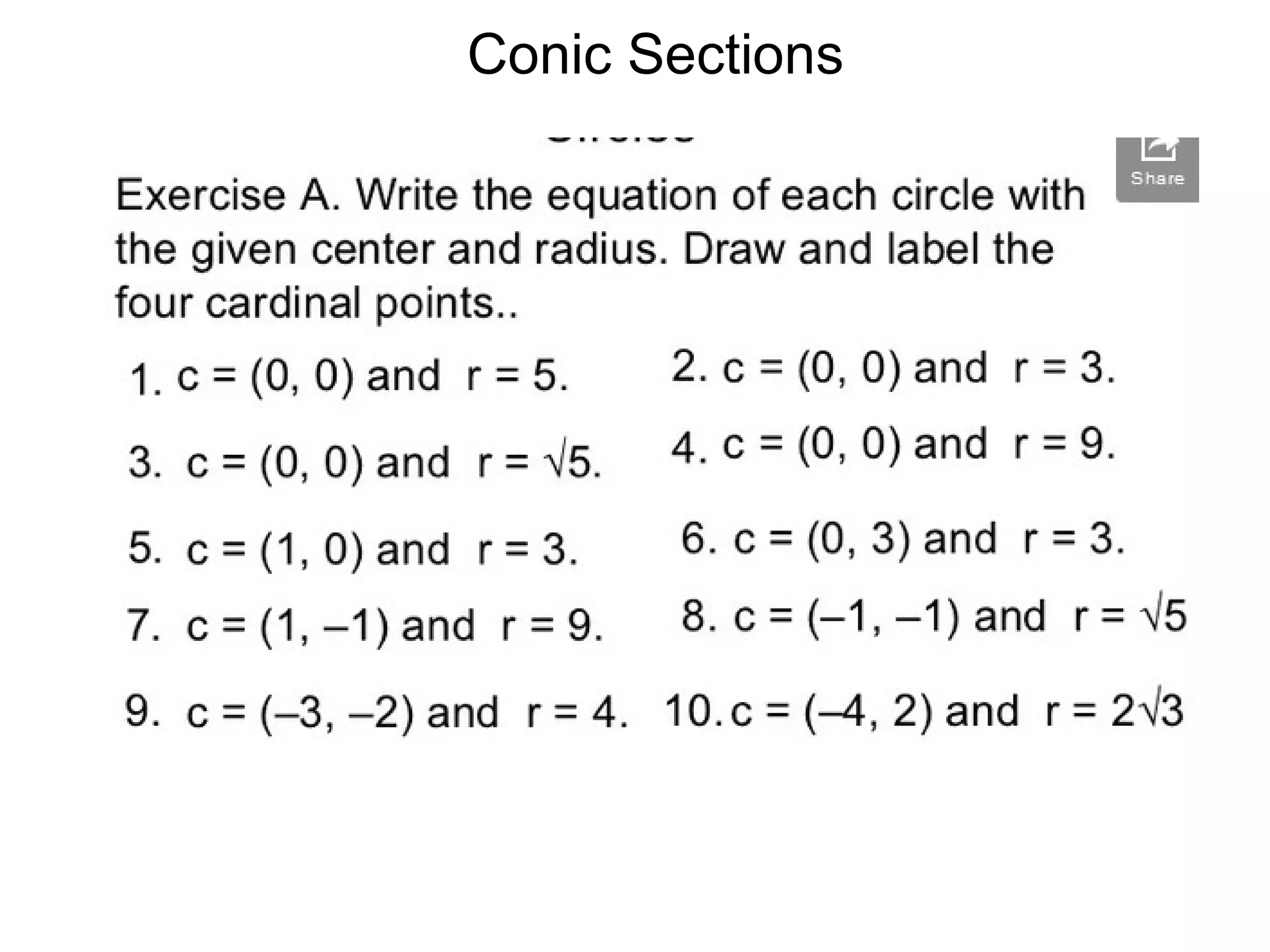
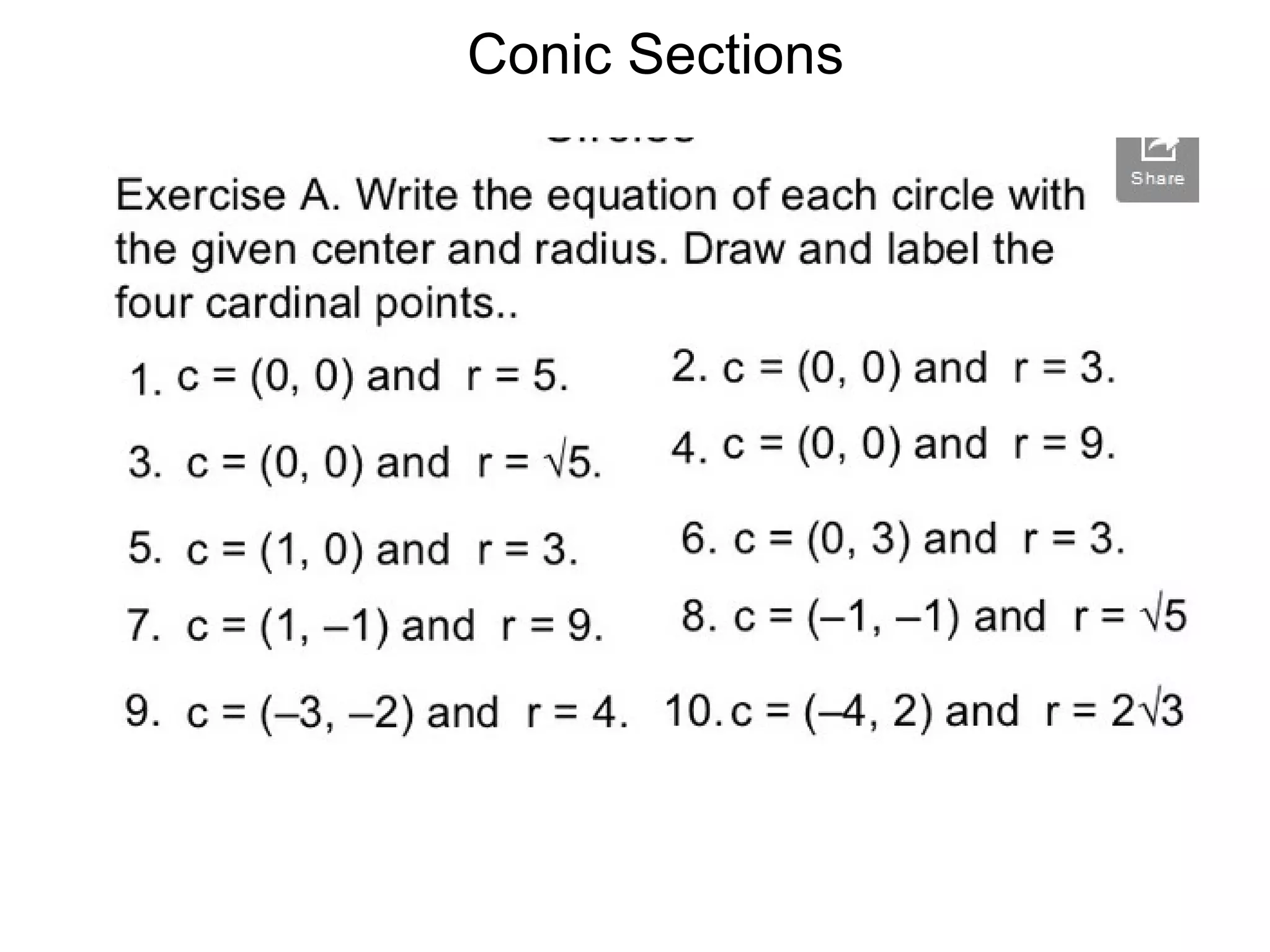
Circles
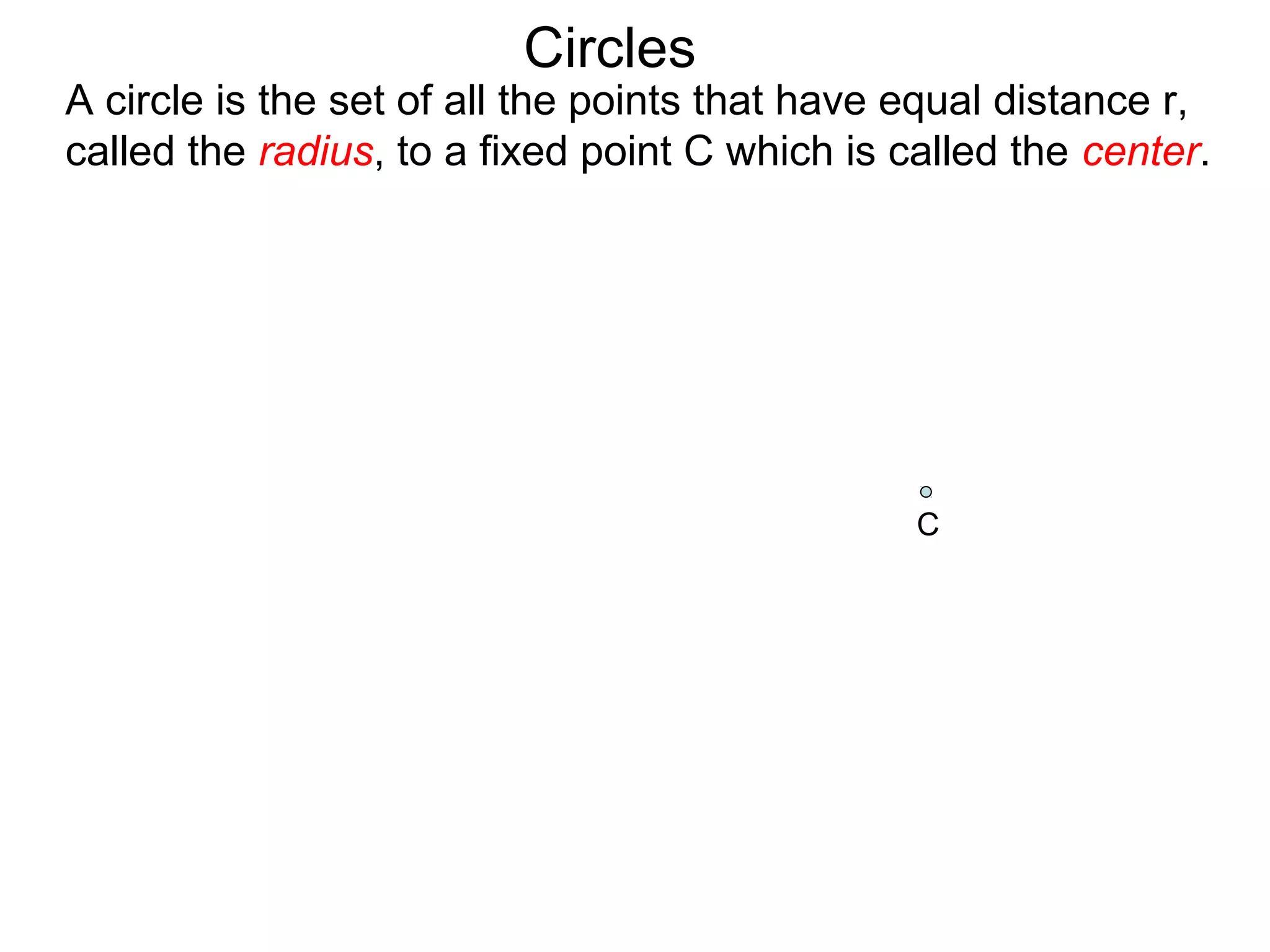
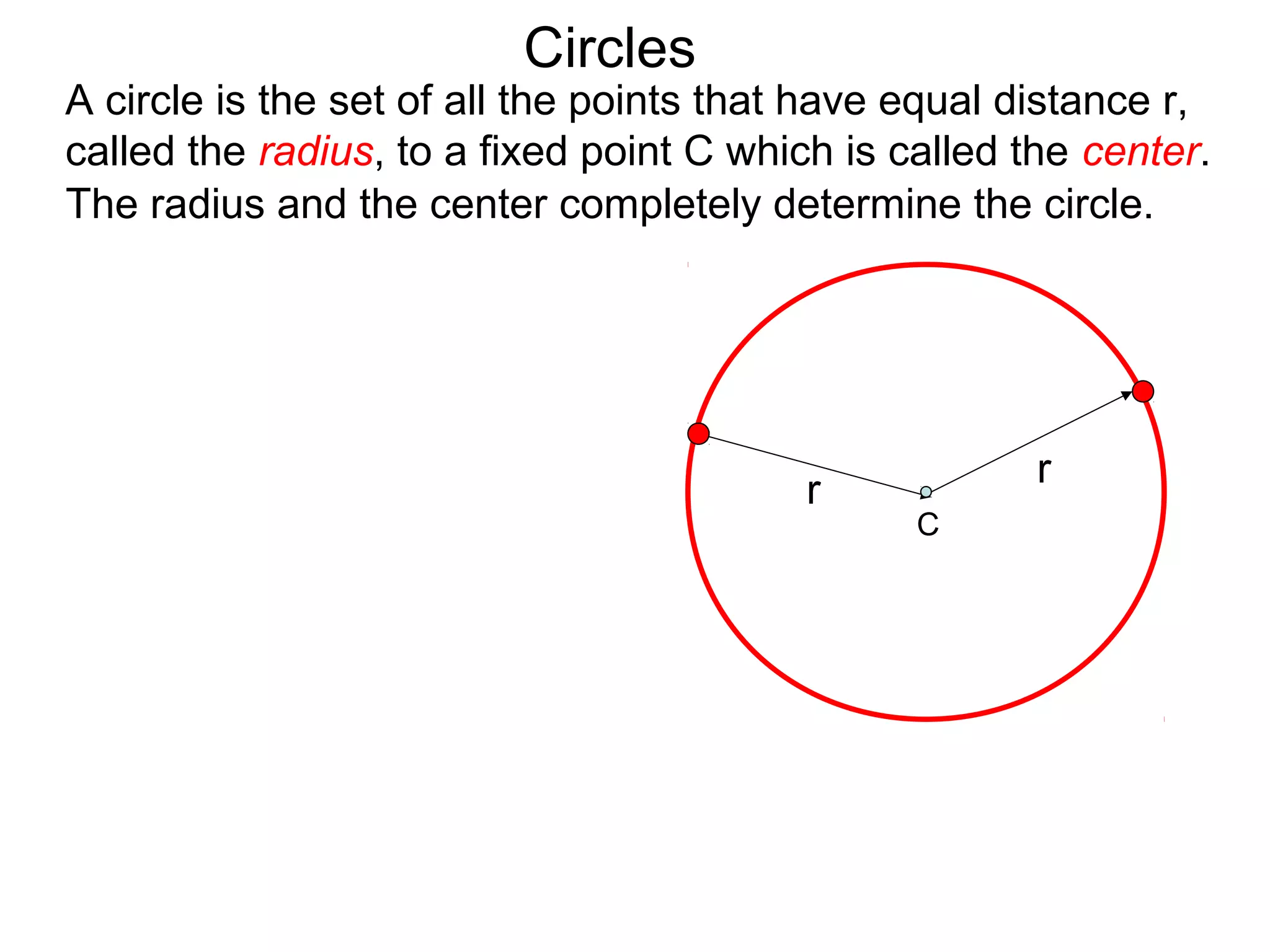
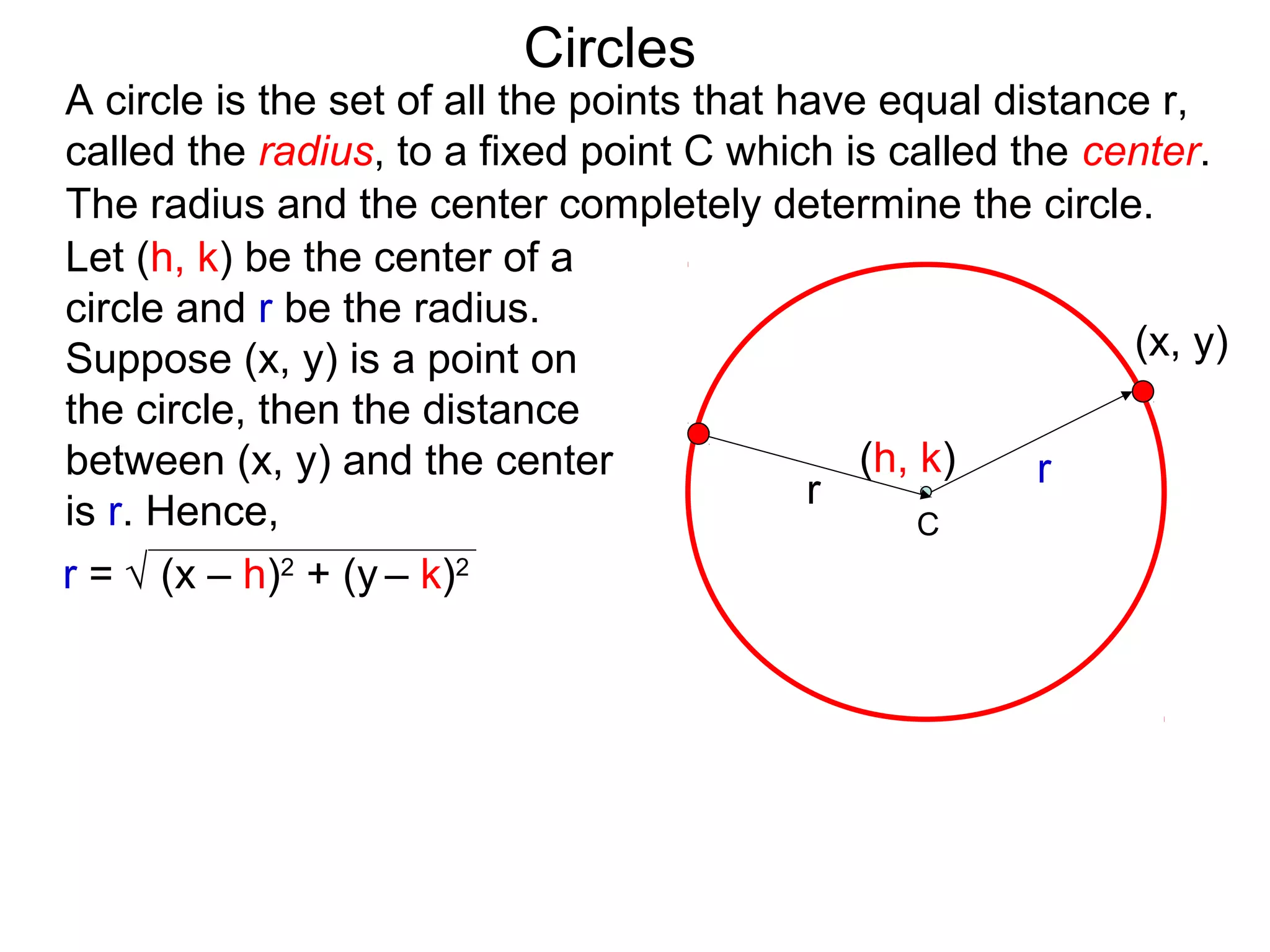
A circle is the set of all the points that have equal distance r,
called the radius, to a fixed point C which is called the center.
Circles
A circle is the set of all the points that have equal distance r,
called the radius, to a fixed point C which is called the center.
C
r
r
Circles
A circle is the set of all the points that have equal distance r,
called the radius, to a fixed point C which is called the center.
C
r
r
Circles
A circle is the set of all the points that have equal distance r,
called the radius, to a fixed point C which is called the center.
C
r
r
The radius and the center completely determine the circle.
Circles
A circle is the set of all the points that have equal distance r,
called the radius, to a fixed point C which is called the center.
C
r
The radius and the center completely determine the circle.
Circles
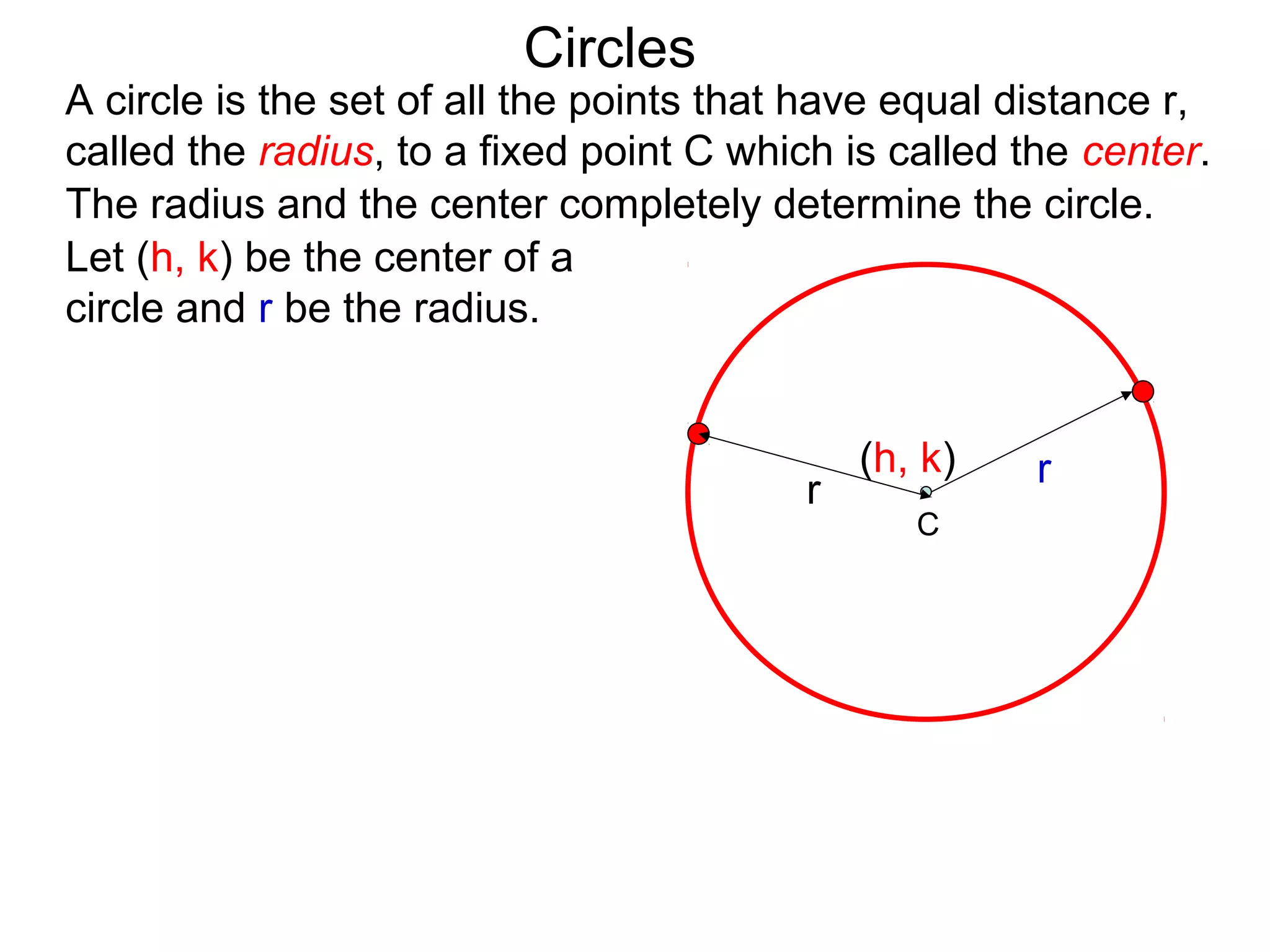
Let (h, k) be the center of a
circle and r be the radius.
(h, k)
A circle is the set of all the points that have equal distance r,
called the radius, to a fixed point C which is called the center.
r
C
r
The radius and the center completely determine the circle.
Circles
(x, y)
Let (h, k) be the center of a
circle and r be the radius.
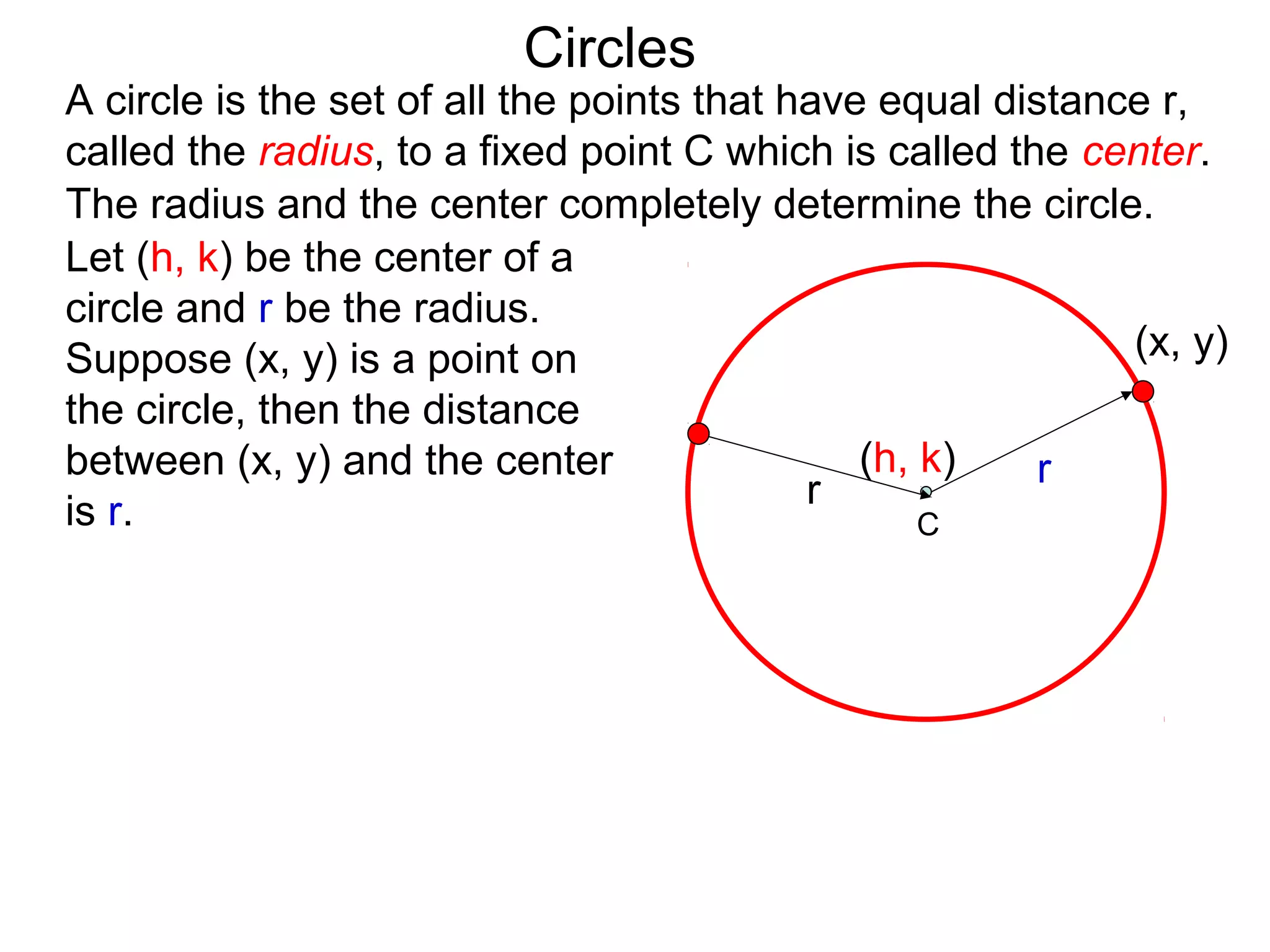
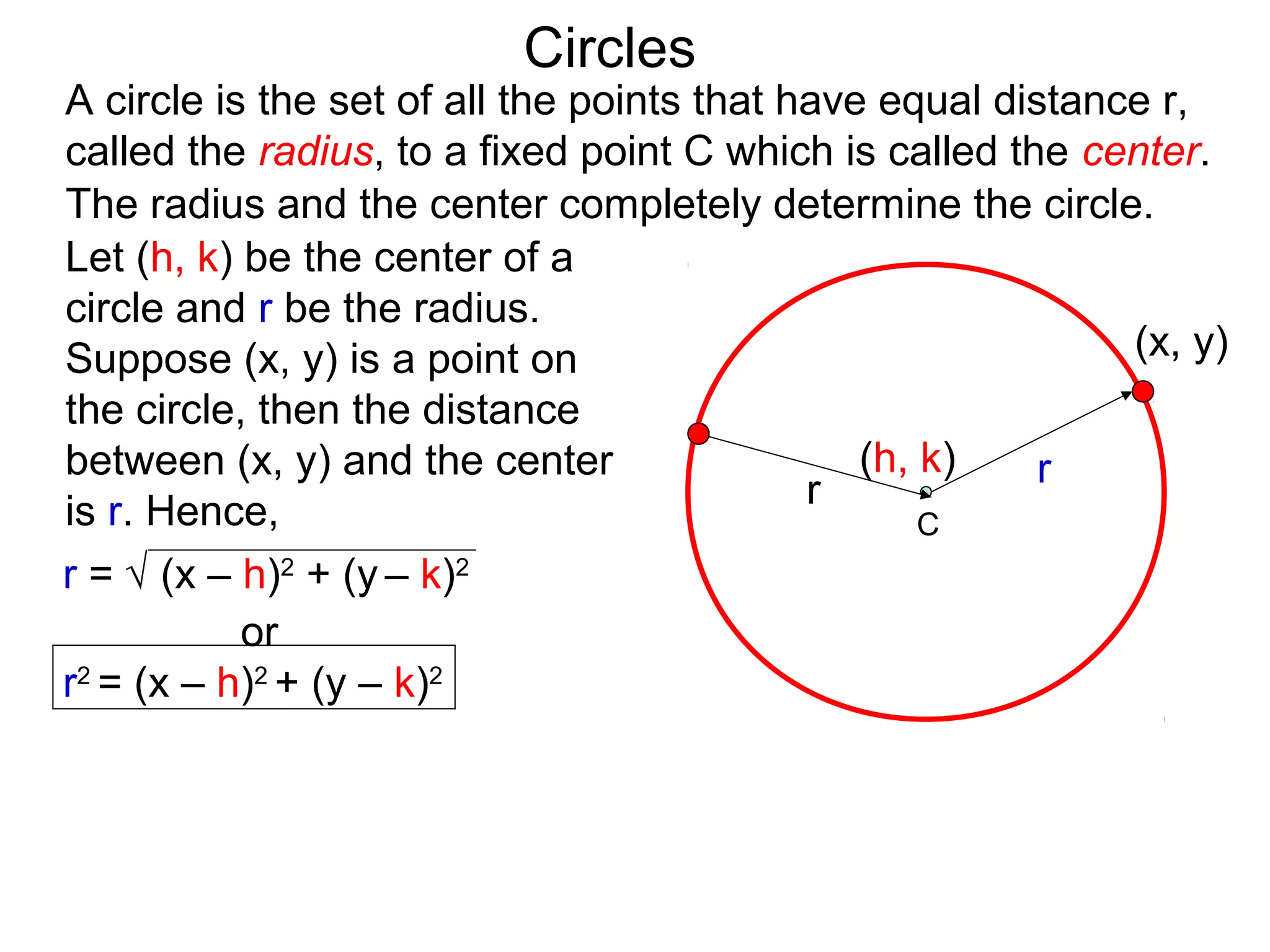
Suppose (x, y) is a point on
the circle, then the distance
between (x, y) and the center
is r.
(h, k)
A circle is the set of all the points that have equal distance r,
called the radius, to a fixed point C which is called the center.
r
C
r
The radius and the center completely determine the circle.
Circles
(x, y)
Let (h, k) be the center of a
circle and r be the radius.
Suppose (x, y) is a point on
the circle, then the distance
between (x, y) and the center
is r. Hence,
(h, k)
r = √ (x – h)2
+ (y – k)2
A circle is the set of all the points that have equal distance r,
called the radius, to a fixed point C which is called the center.
r
C
r
The radius and the center completely determine the circle.
Circles
(x, y)
Let (h, k) be the center of a
circle and r be the radius.
Suppose (x, y) is a point on
the circle, then the distance
between (x, y) and the center
is r. Hence,
(h, k)
r = √ (x – h)2
+ (y – k)2
or
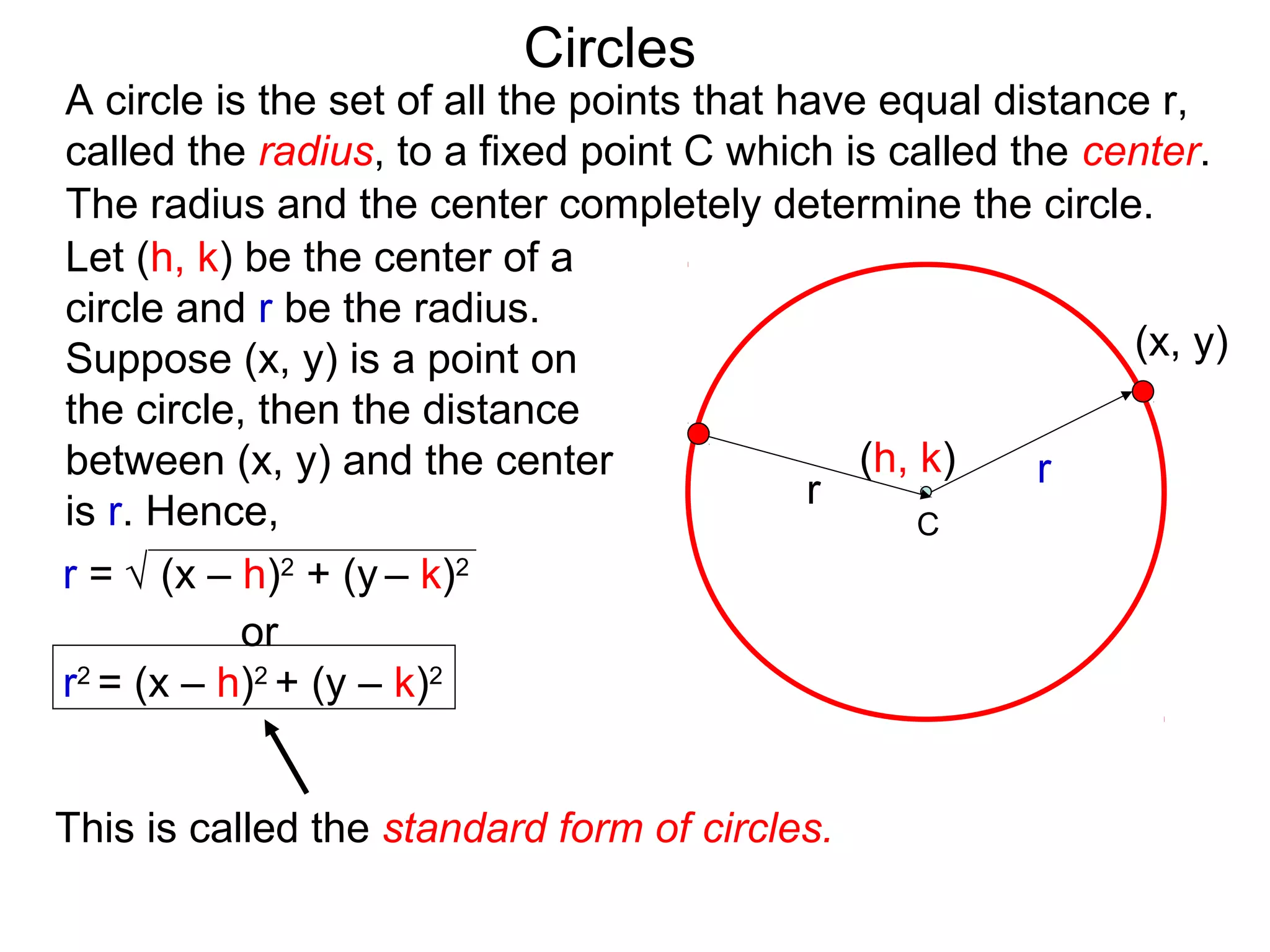
r2
= (x – h)2
+ (y – k)2
A circle is the set of all the points that have equal distance r,
called the radius, to a fixed point C which is called the center.
r
C
r
The radius and the center completely determine the circle.
Circles
(x, y)
Let (h, k) be the center of a
circle and r be the radius.
Suppose (x, y) is a point on
the circle, then the distance
between (x, y) and the center
is r. Hence,
(h, k)
r = √ (x – h)2
+ (y – k)2
or
r2
= (x – h)2
+ (y – k)2
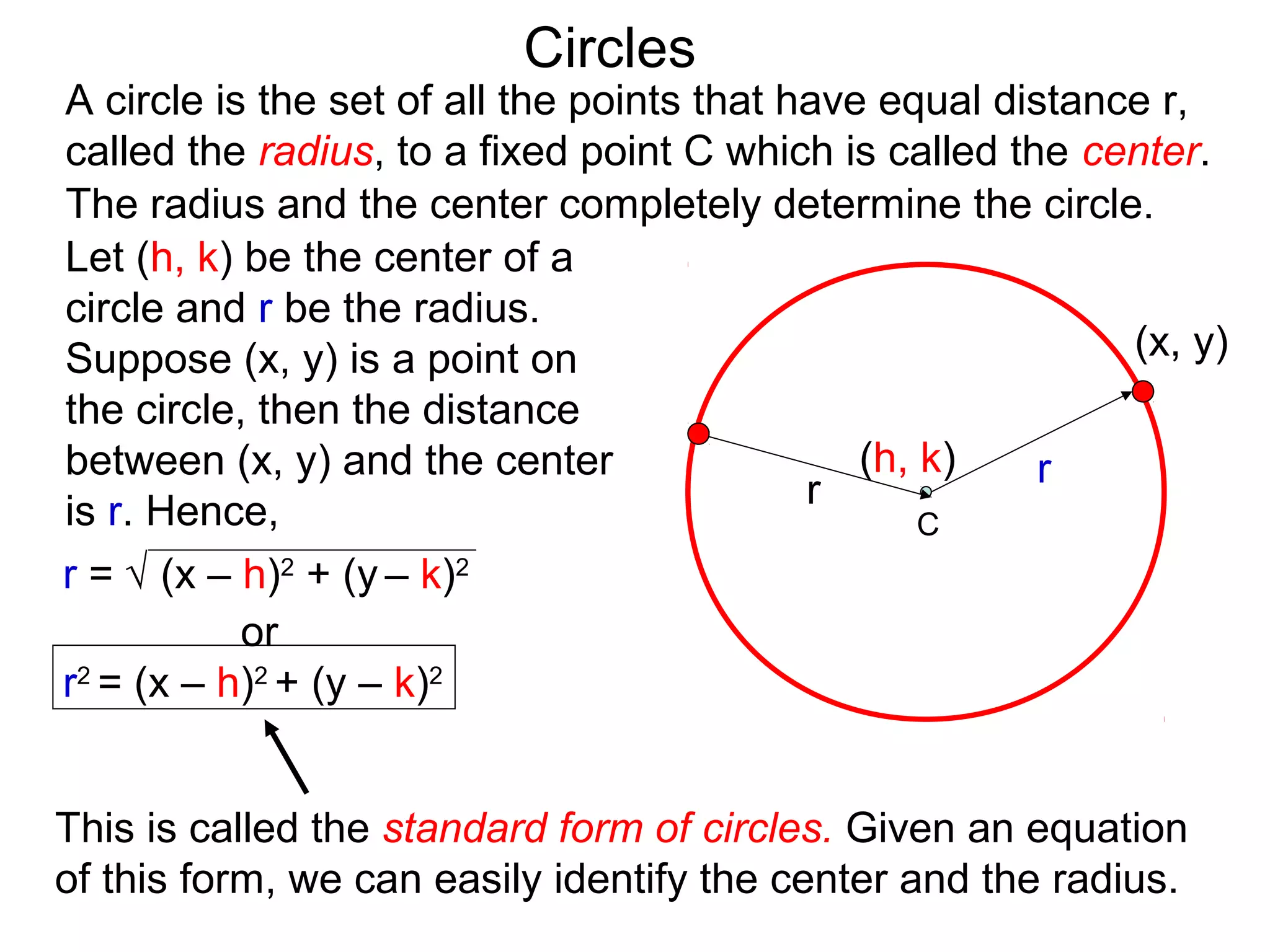
This is called the standard form of circles.
A circle is the set of all the points that have equal distance r,
called the radius, to a fixed point C which is called the center.
r
C
r
The radius and the center completely determine the circle.
Circles
(x, y)
Let (h, k) be the center of a
circle and r be the radius.
Suppose (x, y) is a point on
the circle, then the distance
between (x, y) and the center
is r. Hence,
(h, k)
r = √ (x – h)2
+ (y – k)2
or
r2
= (x – h)2
+ (y – k)2
This is called the standard form of circles. Given an equation
of this form, we can easily identify the center and the radius.
A circle is the set of all the points that have equal distance r,
called the radius, to a fixed point C which is called the center.
r
C
r2
= (x – h)2
+ (y – k)2
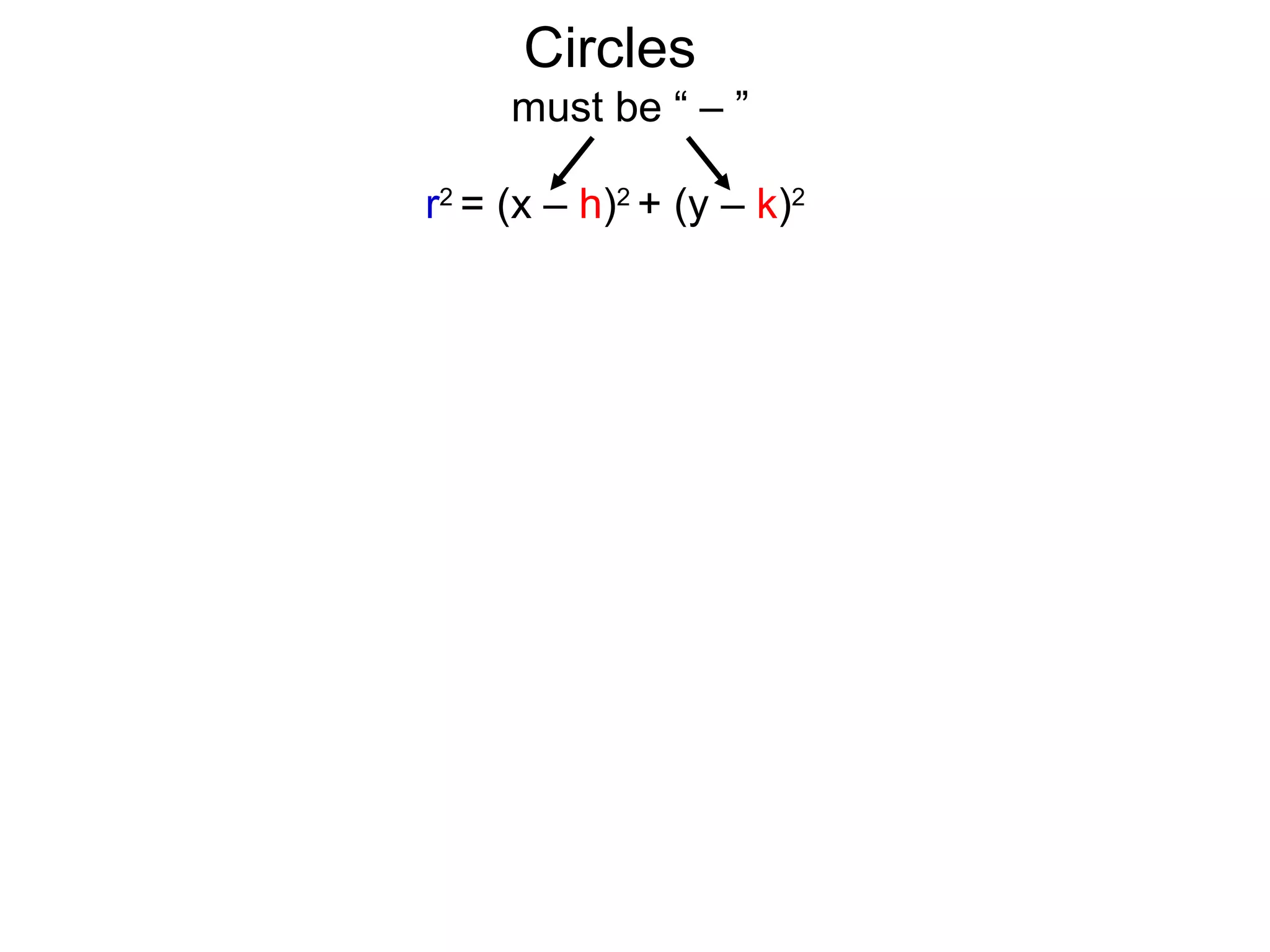
Circles
r2
= (x – h)2
+ (y – k)2
must be “ – ”
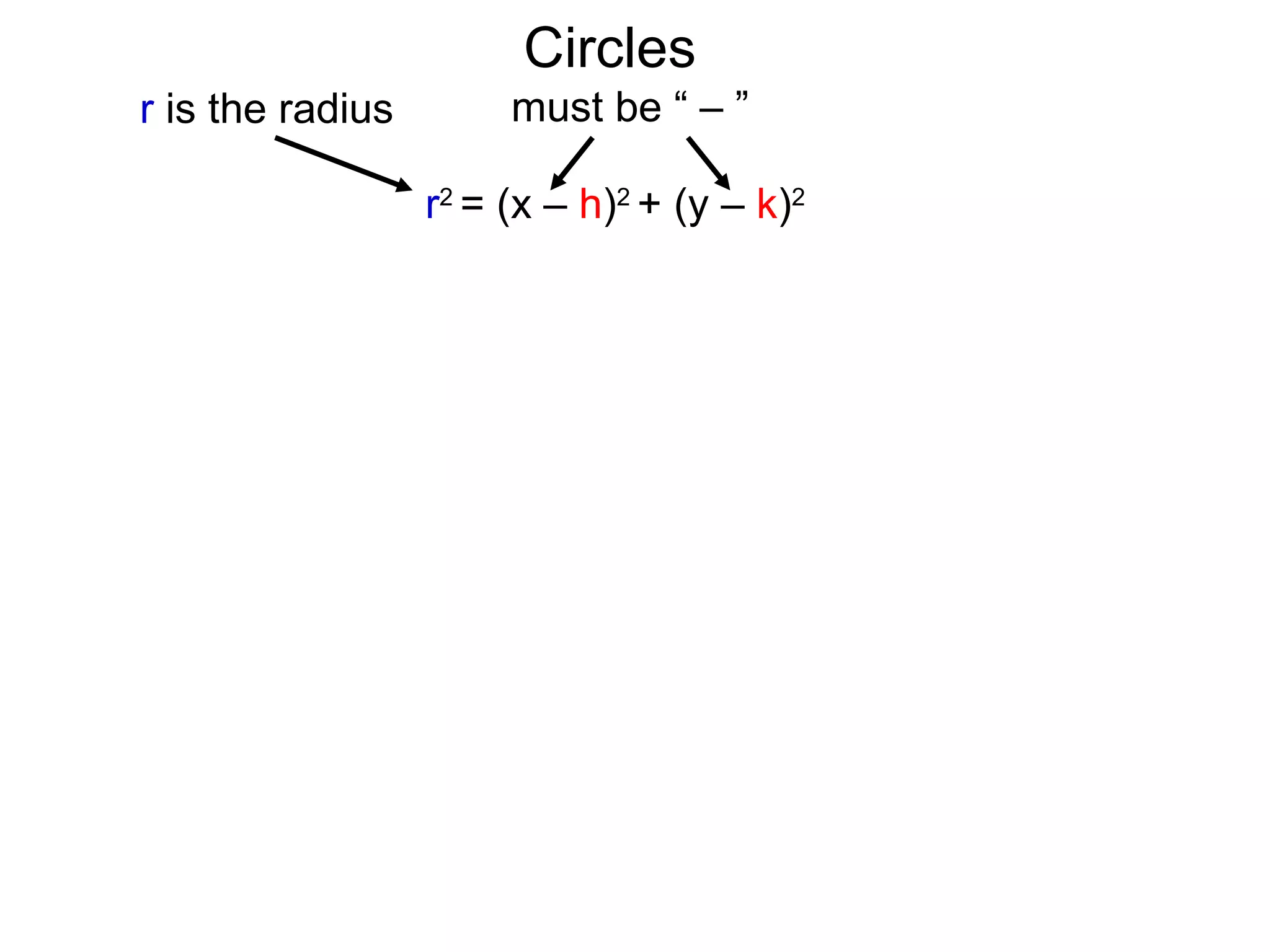
Circles
r2
= (x – h)2
+ (y – k)2
r is the radius must be “ – ”
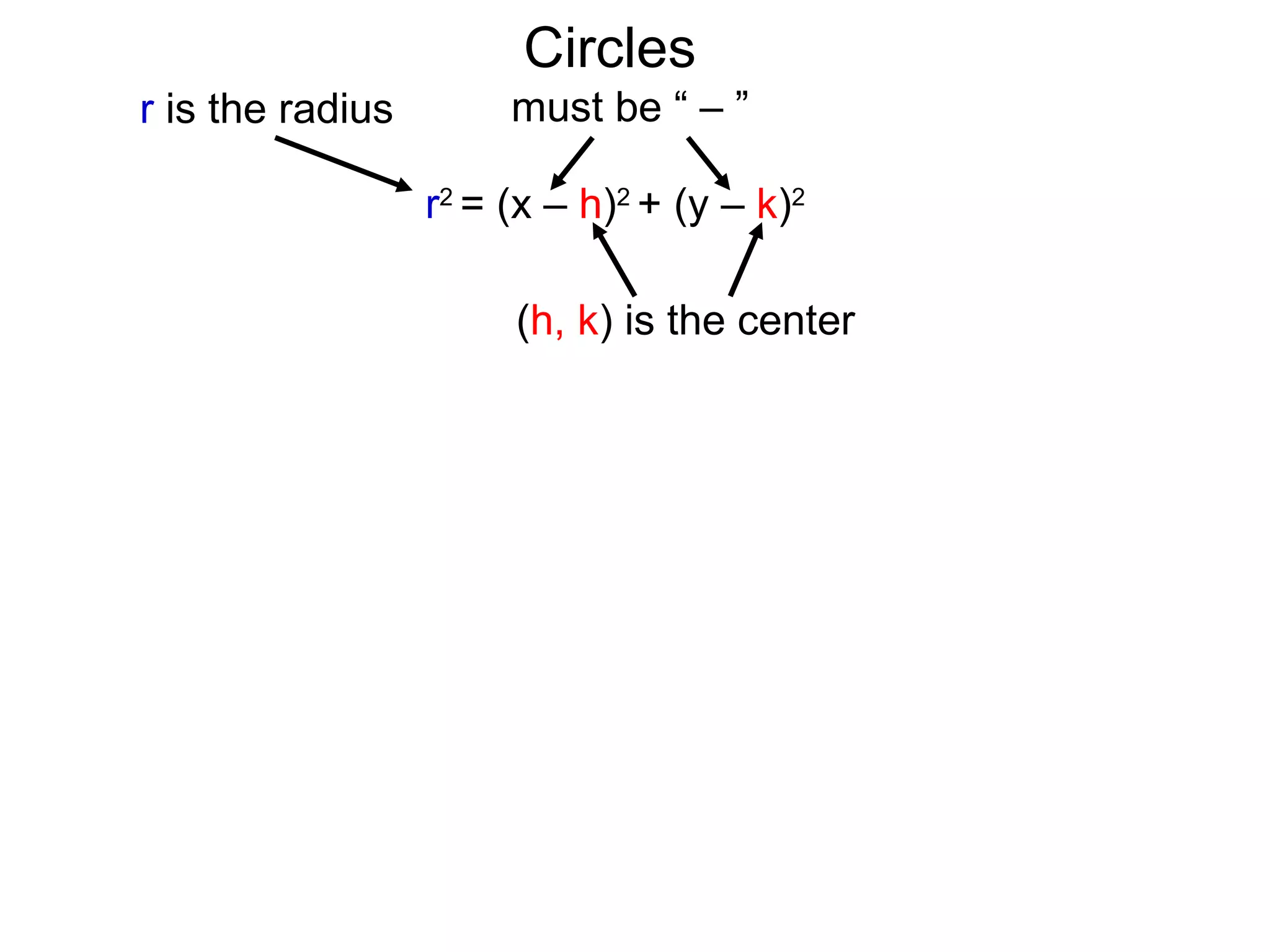
Circles
r2
= (x – h)2
+ (y – k)2
r is the radius must be “ – ”
(h, k) is the center
Circles
r2
= (x – h)2
+ (y – k)2
r is the radius must be “ – ”
(h, k) is the center
Circles
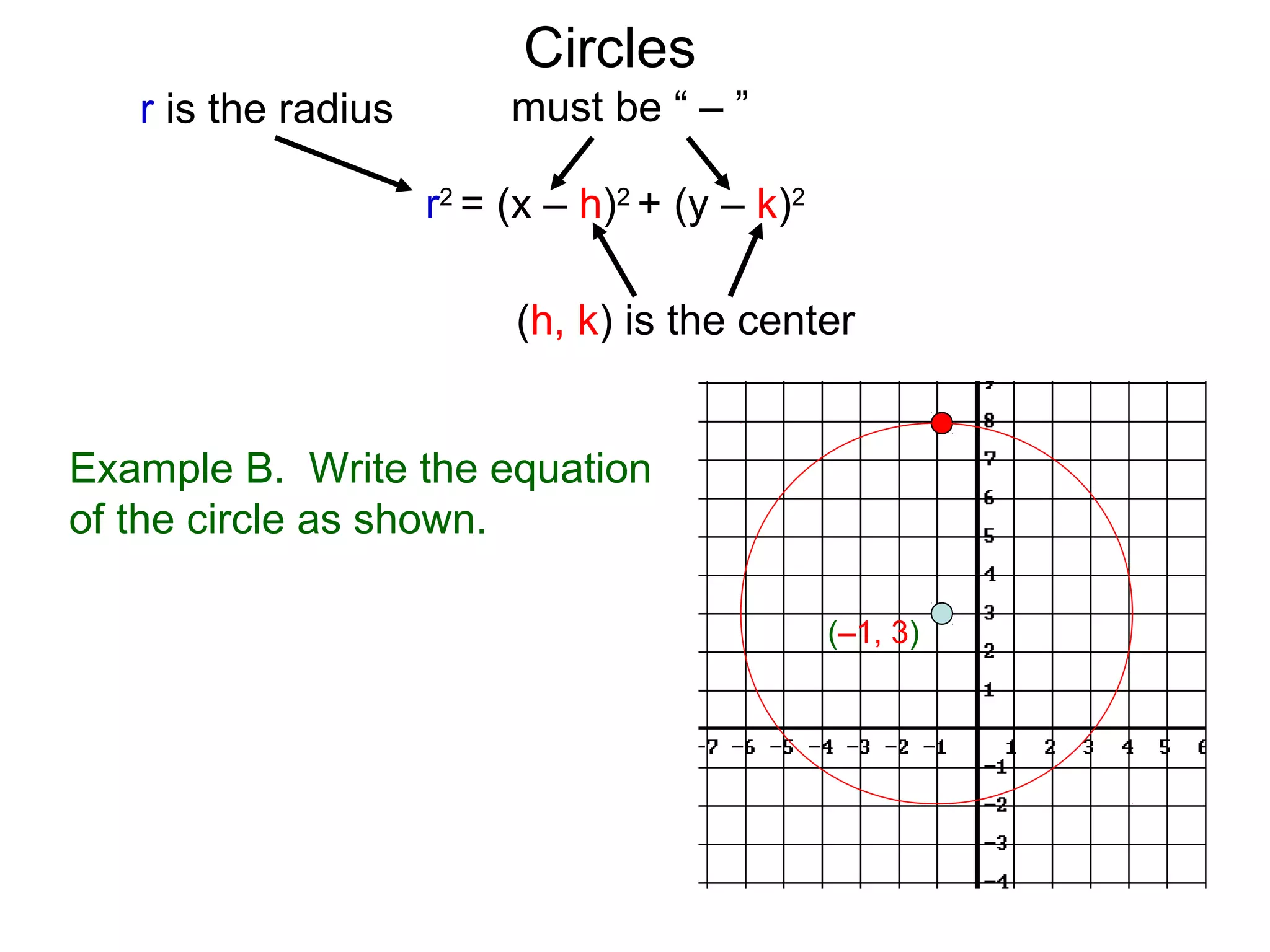
Example B. Write the equation
of the circle as shown.
(–1, 3)
r2
= (x – h)2
+ (y – k)2
r is the radius must be “ – ”
(h, k) is the center
Circles
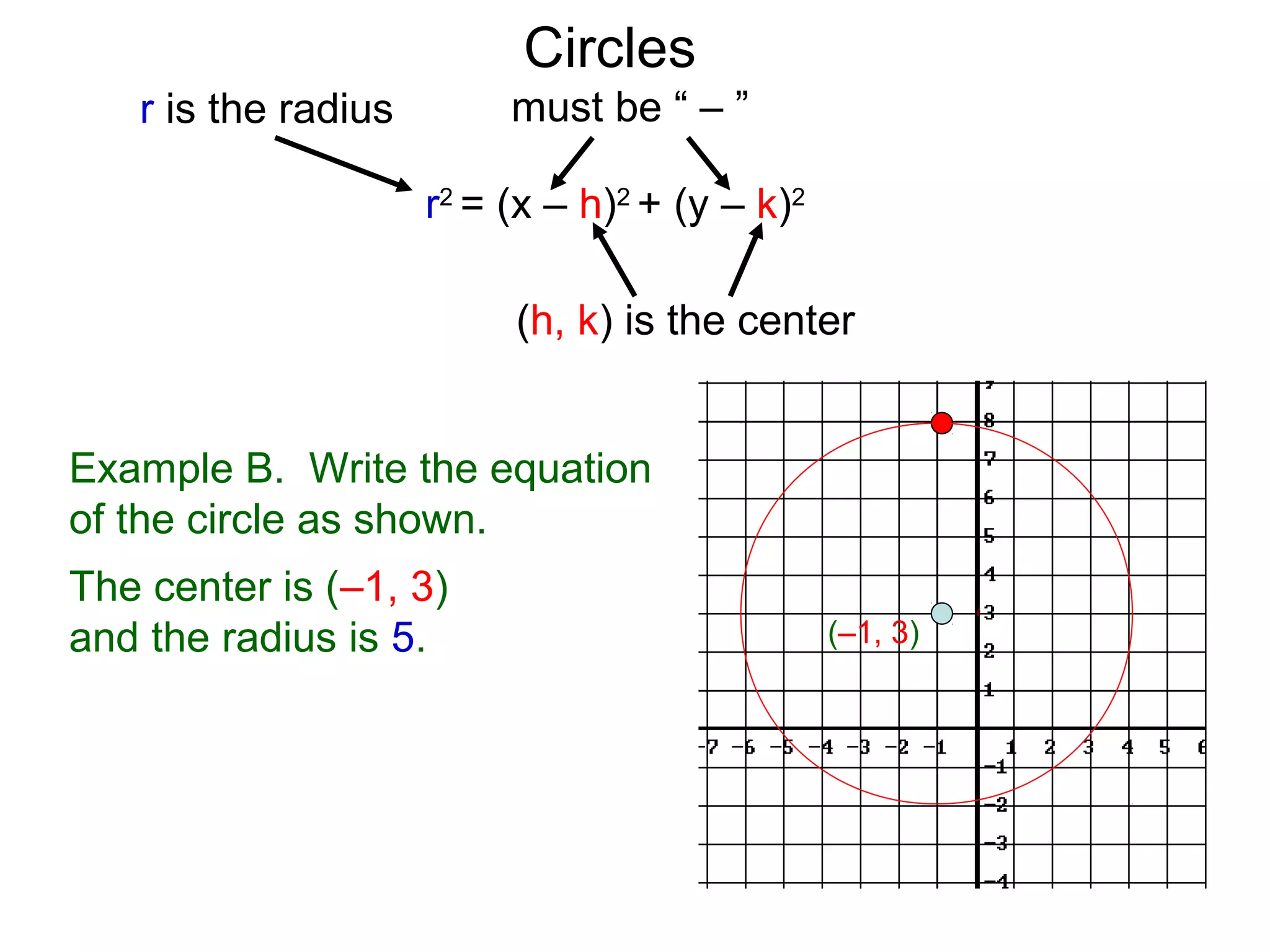
Example B. Write the equation
of the circle as shown.
The center is (–1, 3)
and the radius is 5. (–1, 3)
r2
= (x – h)2
+ (y – k)2
r is the radius must be “ – ”
(h, k) is the center
Circles
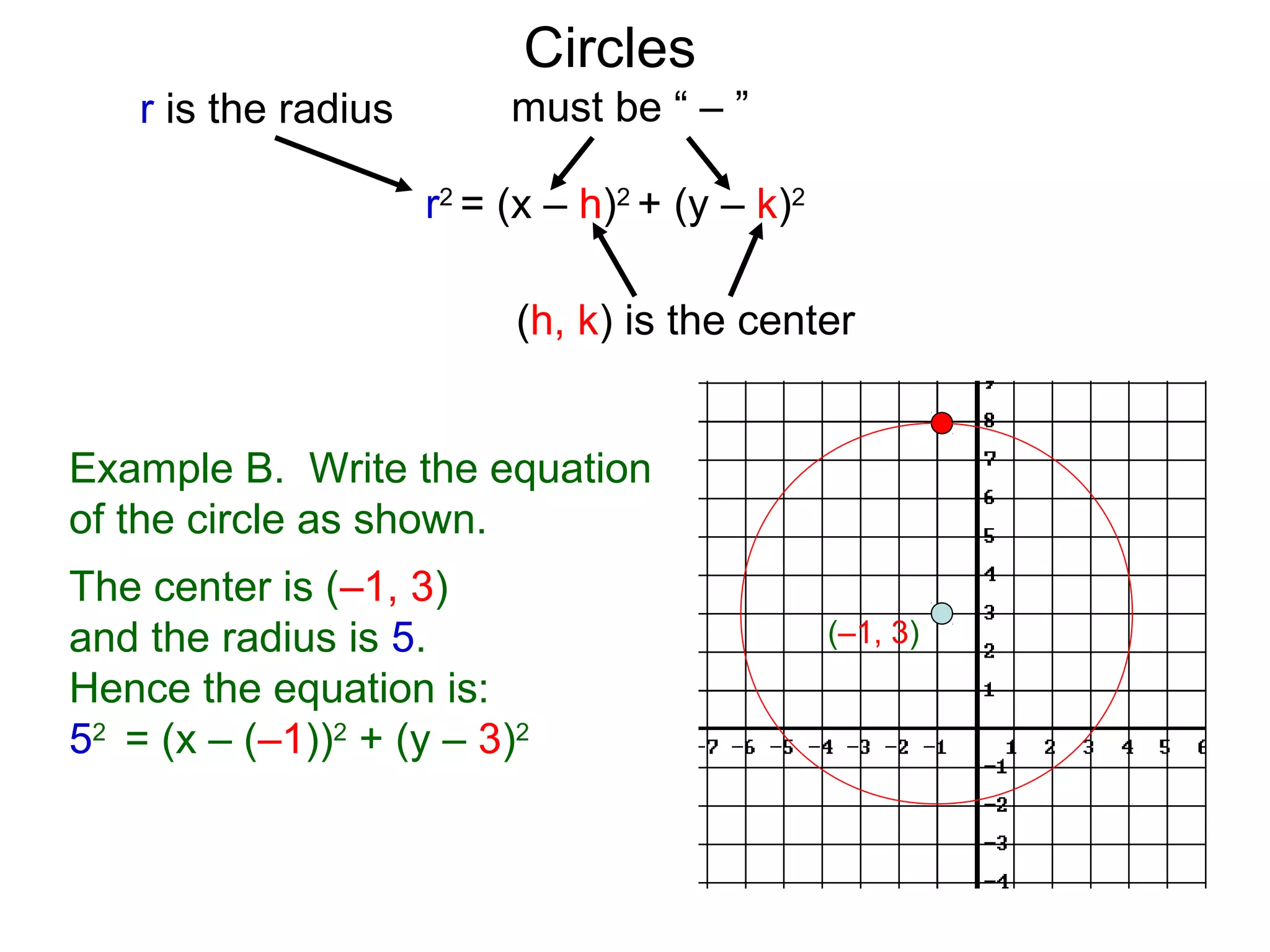
Example B. Write the equation
of the circle as shown.
The center is (–1, 3)
and the radius is 5.
Hence the equation is:
52
= (x – (–1))2
+ (y – 3)2
(–1, 3)
r2
= (x – h)2
+ (y – k)2
r is the radius must be “ – ”
(h, k) is the center
Circles
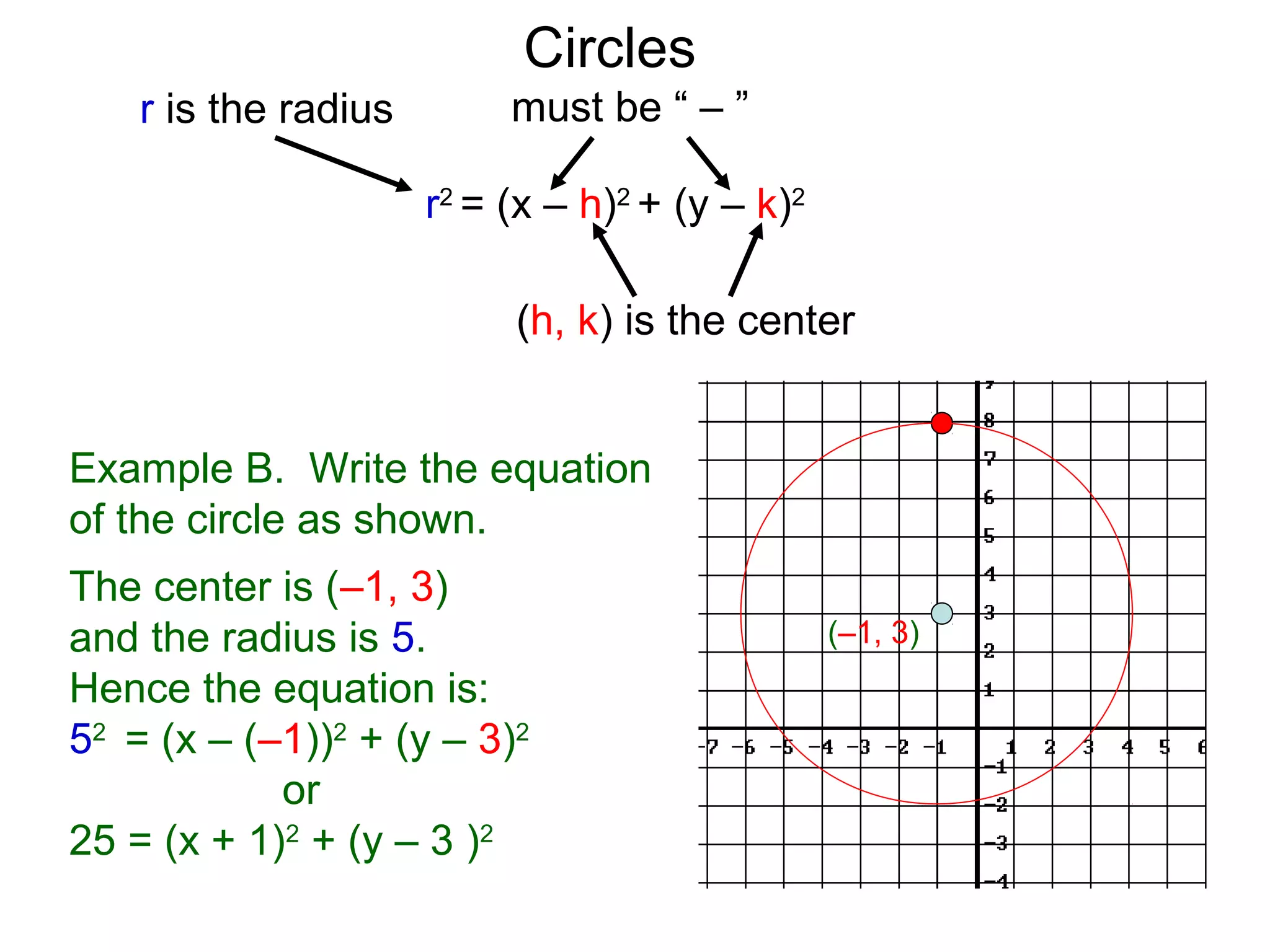
Example B. Write the equation
of the circle as shown.
The center is (–1, 3)
and the radius is 5.
Hence the equation is:
52
= (x – (–1))2
+ (y – 3)2
or
25 = (x + 1)2
+ (y – 3 )2
(–1, 3)
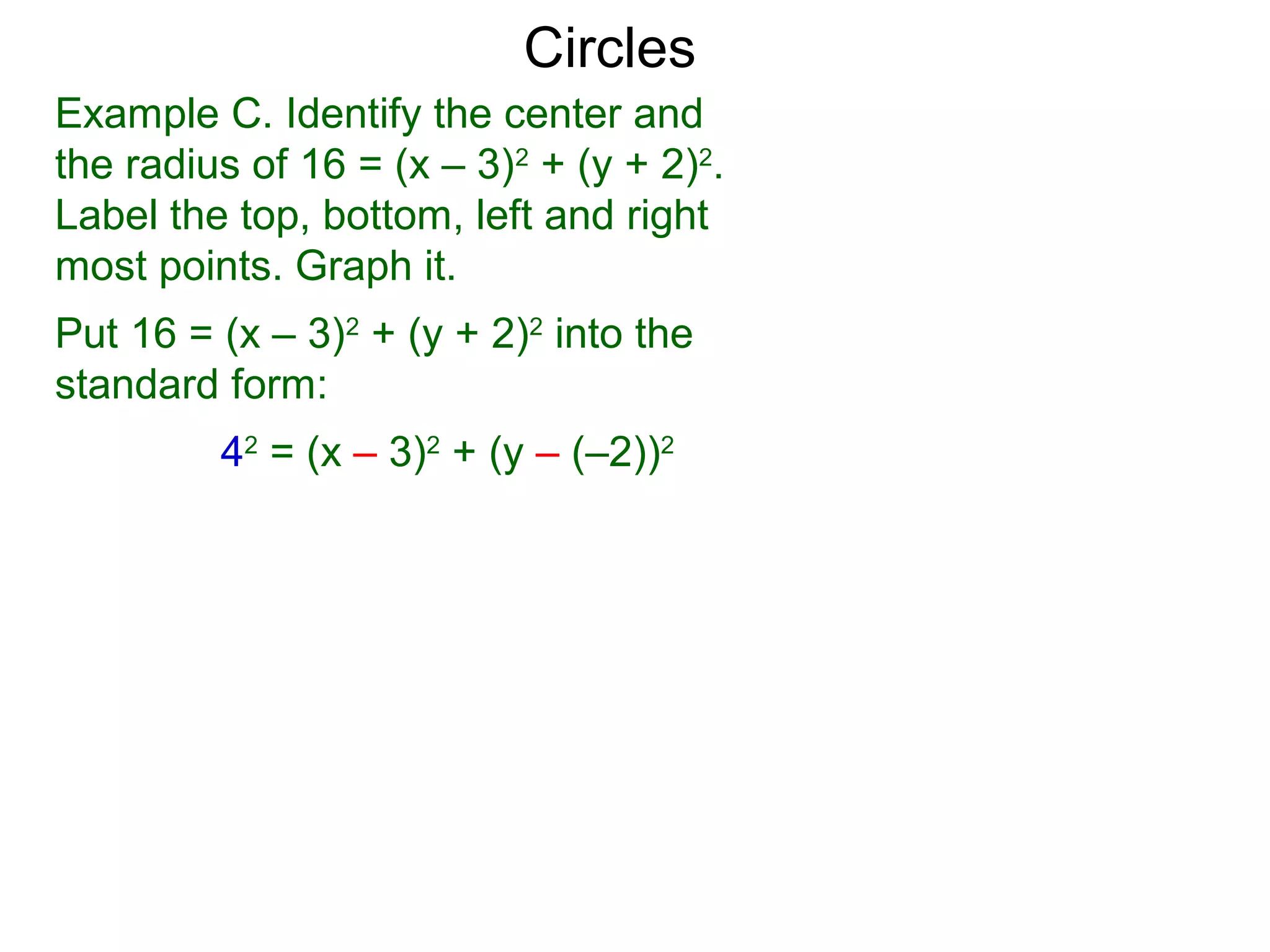
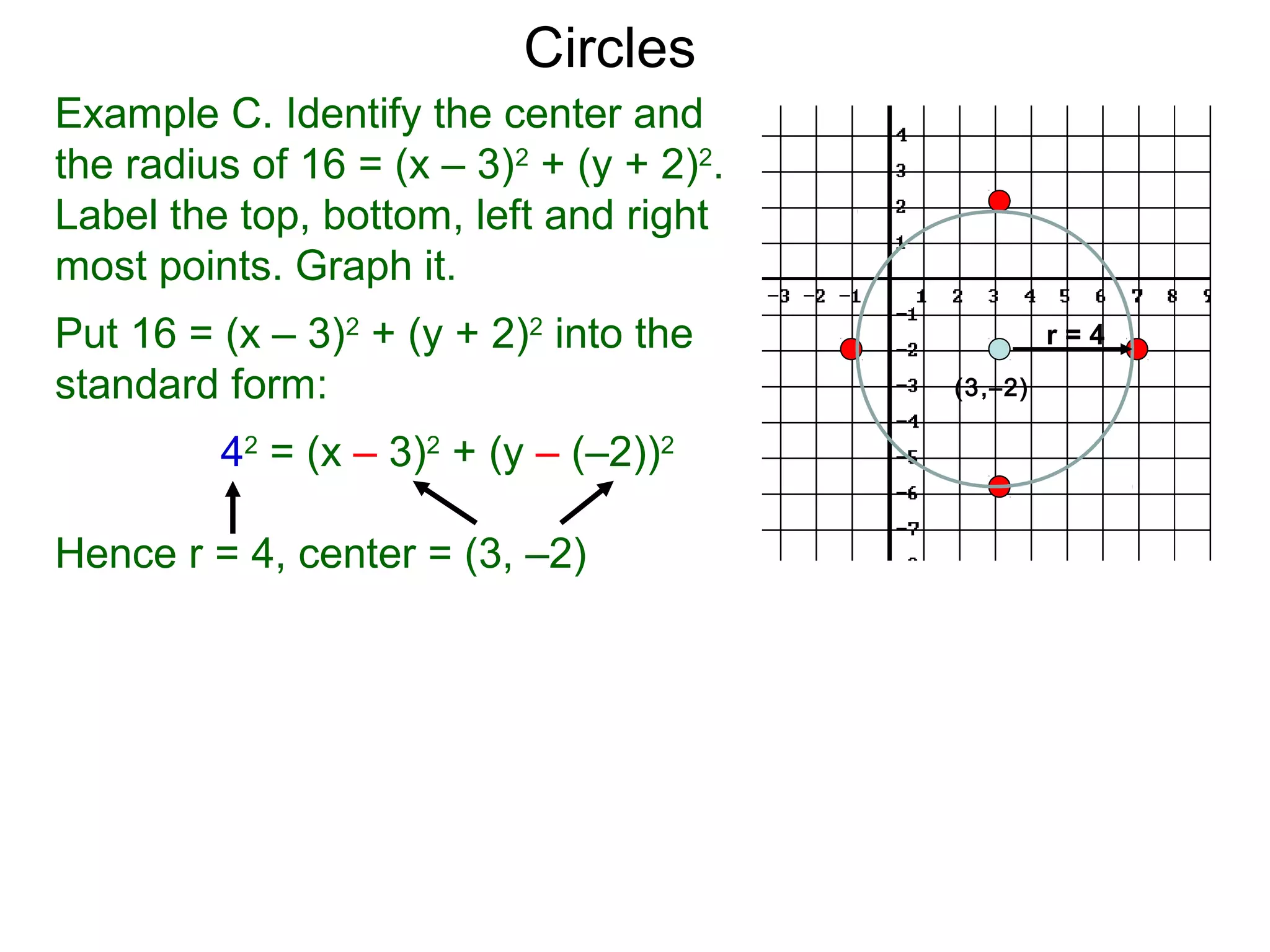
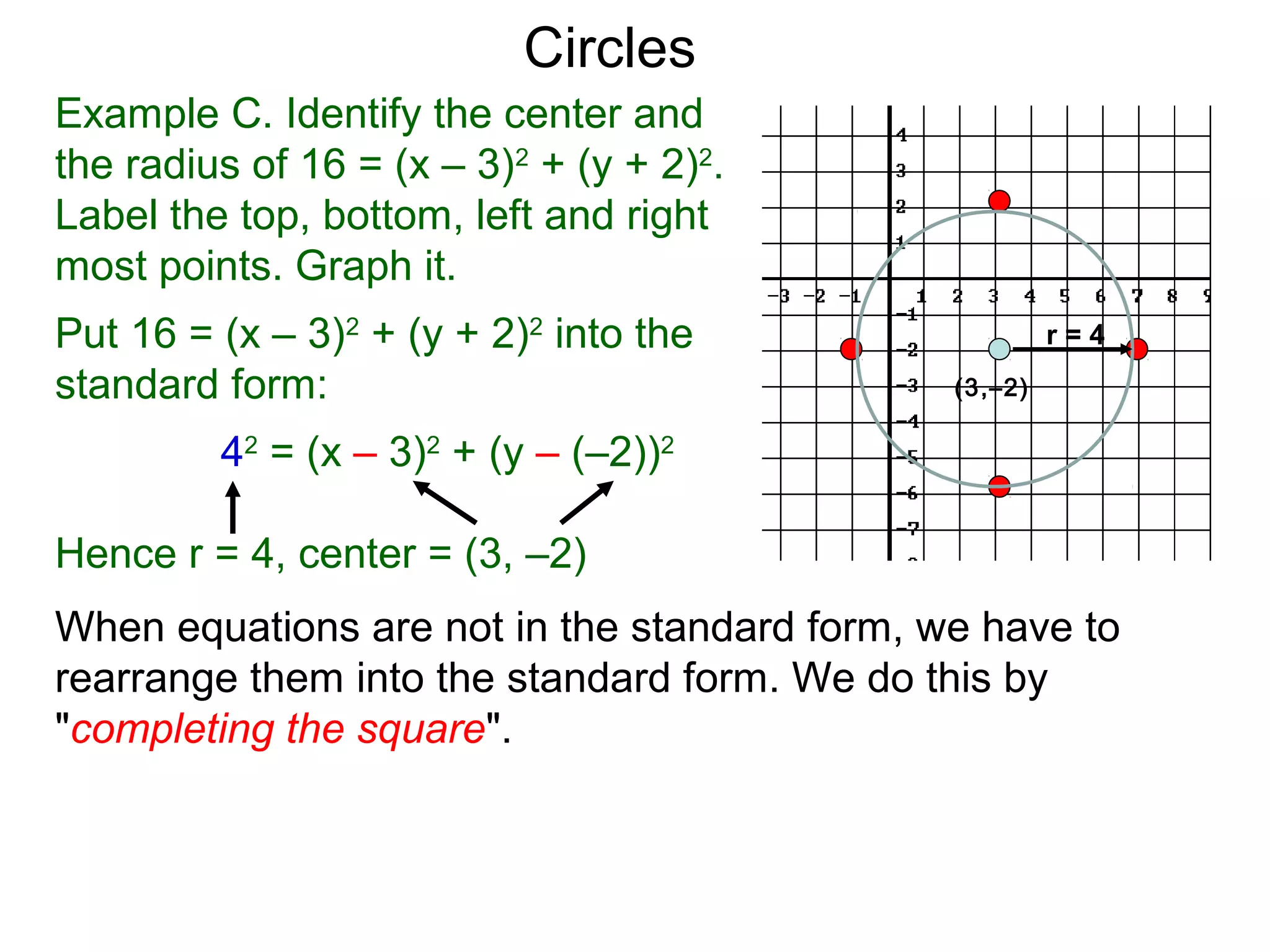
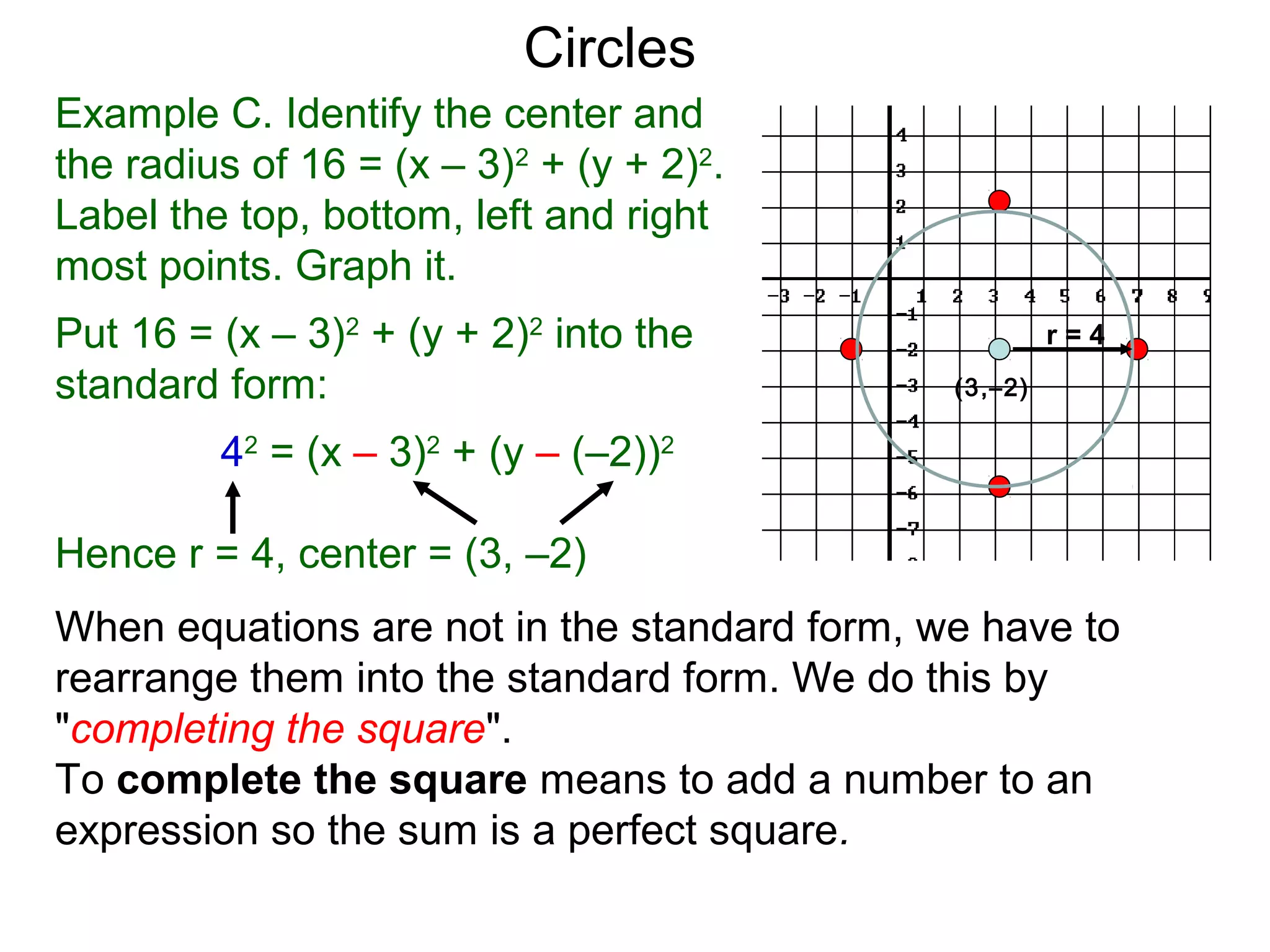
Example C. Identify the center and
the radius of 16 = (x – 3)2
+ (y + 2)2
.
Label the top, bottom, left and right
most points. Graph it.
Circles
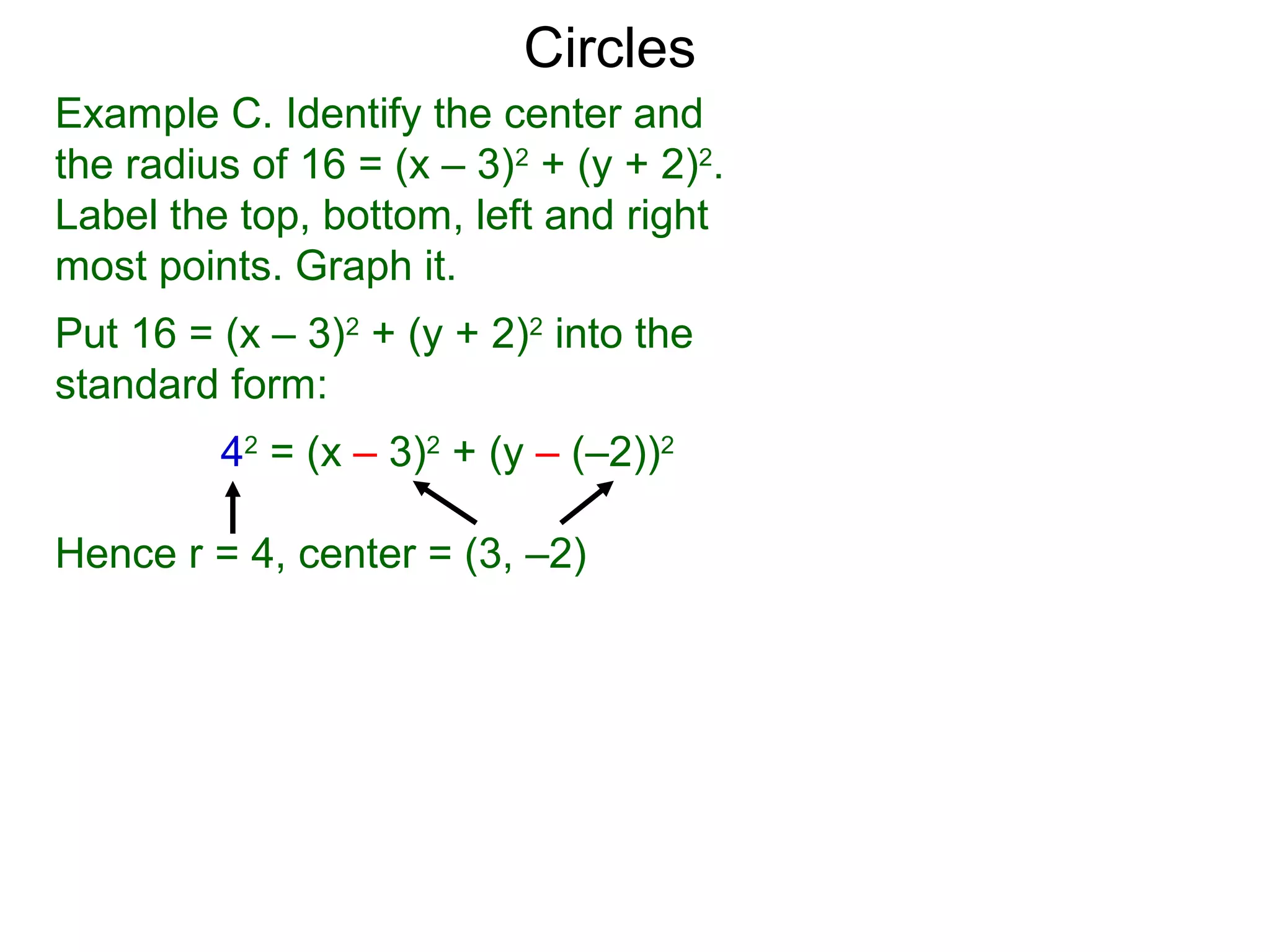
Example C. Identify the center and
the radius of 16 = (x – 3)2
+ (y + 2)2
.
Label the top, bottom, left and right
most points. Graph it.
Put 16 = (x – 3)2
+ (y + 2)2
into the
standard form:
42
= (x – 3)2
+ (y – (–2))2
Circles
Example C. Identify the center and
the radius of 16 = (x – 3)2
+ (y + 2)2
.
Label the top, bottom, left and right
most points. Graph it.
Put 16 = (x – 3)2
+ (y + 2)2
into the
standard form:
42
= (x – 3)2
+ (y – (–2))2
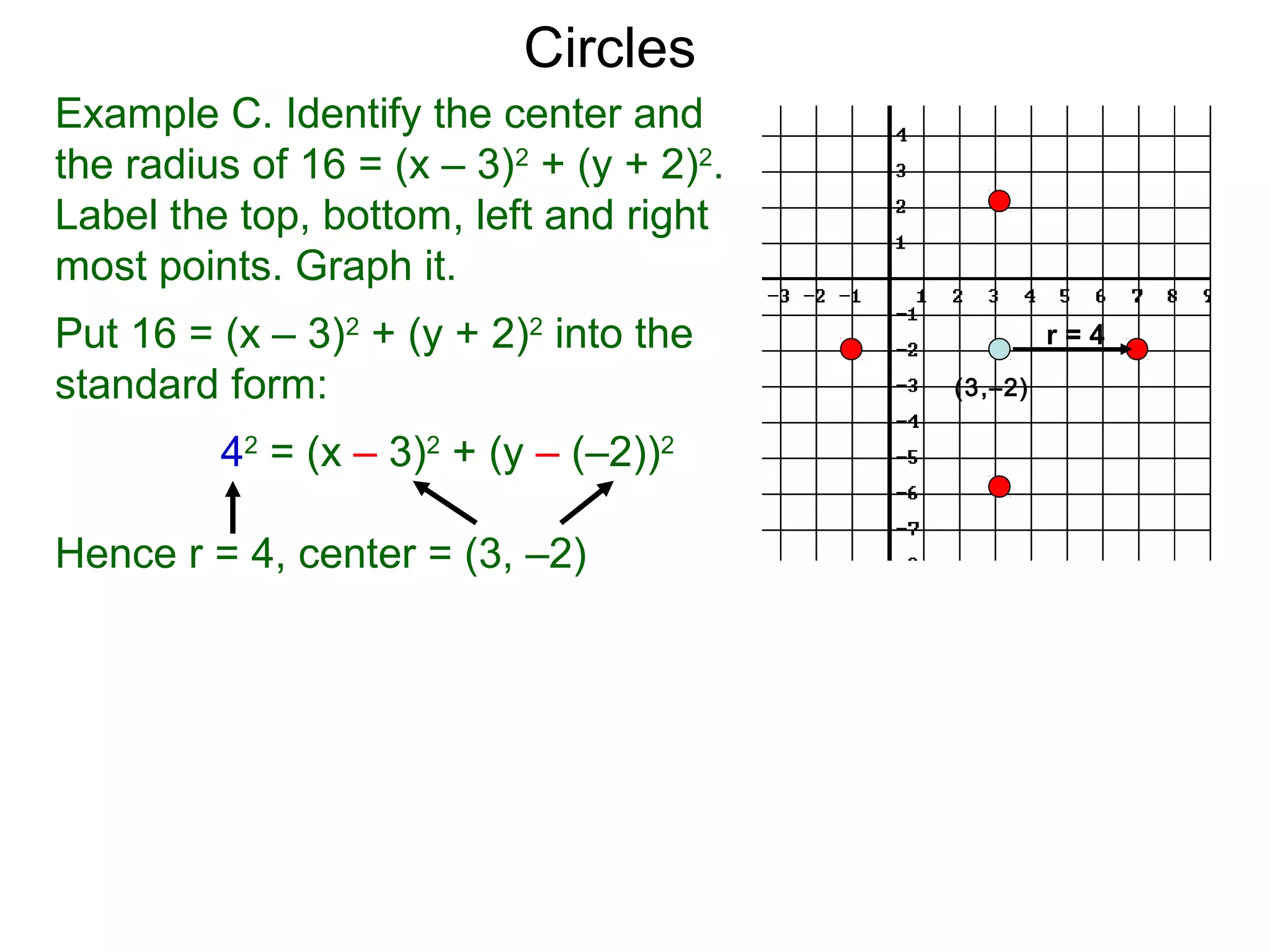
Hence r = 4, center = (3, –2)
Circles
Example C. Identify the center and
the radius of 16 = (x – 3)2
+ (y + 2)2
.
Label the top, bottom, left and right
most points. Graph it.
Put 16 = (x – 3)2
+ (y + 2)2
into the
standard form:
42
= (x – 3)2
+ (y – (–2))2
Hence r = 4, center = (3, –2)
(3,–2)
Circles
r = 4
Example C. Identify the center and
the radius of 16 = (x – 3)2
+ (y + 2)2
.
Label the top, bottom, left and right
most points. Graph it.
Put 16 = (x – 3)2
+ (y + 2)2
into the
standard form:
42
= (x – 3)2
+ (y – (–2))2
Hence r = 4, center = (3, –2)
(3,–2)
Circles
r = 4
Example C. Identify the center and
the radius of 16 = (x – 3)2
+ (y + 2)2
.
Label the top, bottom, left and right
most points. Graph it.
Put 16 = (x – 3)2
+ (y + 2)2
into the
standard form:
42
= (x – 3)2
+ (y – (–2))2
Hence r = 4, center = (3, –2)
(3,–2)
Circles
When equations are not in the standard form, we have to
rearrange them into the standard form. We do this by
"completing the square".
r = 4
Example C. Identify the center and
the radius of 16 = (x – 3)2
+ (y + 2)2
.
Label the top, bottom, left and right
most points. Graph it.
Put 16 = (x – 3)2
+ (y + 2)2
into the
standard form:
42
= (x – 3)2
+ (y – (–2))2
Hence r = 4, center = (3, –2)
(3,–2)
Circles
When equations are not in the standard form, we have to
rearrange them into the standard form. We do this by
"completing the square".
To complete the square means to add a number to an
expression so the sum is a perfect square.
r = 4
Example C. Identify the center and
the radius of 16 = (x – 3)2
+ (y + 2)2
.
Label the top, bottom, left and right
most points. Graph it.
Put 16 = (x – 3)2
+ (y + 2)2
into the
standard form:
42
= (x – 3)2
+ (y – (–2))2
Hence r = 4, center = (3, –2)
(3,–2)
Circles
When equations are not in the standard form, we have to
rearrange them into the standard form. We do this by
"completing the square".
To complete the square means to add a number to an
expression so the sum is a perfect square. This procedure is
the main technique in dealing with 2nd degree equations.
r = 4
(Completing the Square)
Circles
(Completing the Square)
Circles
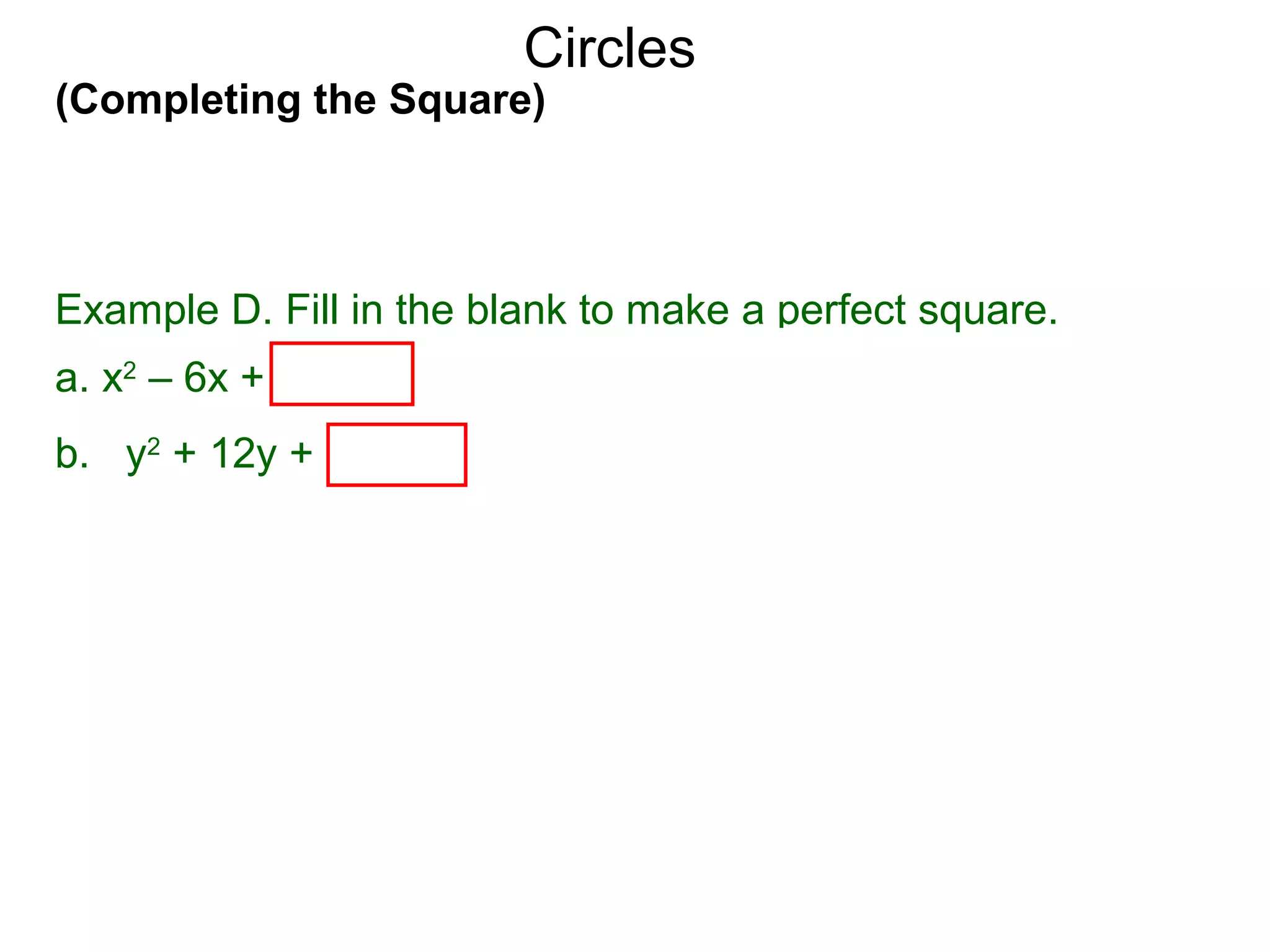
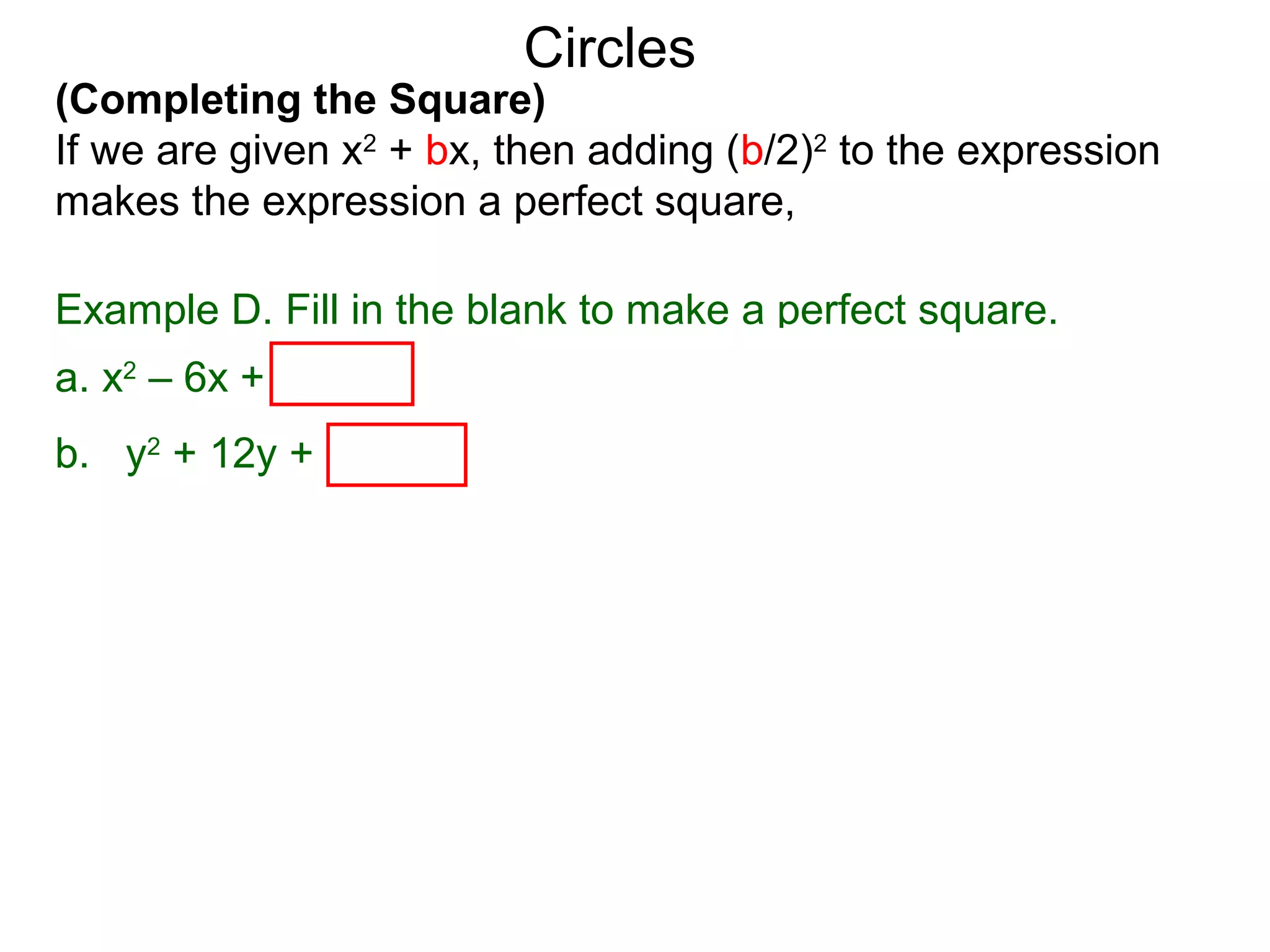
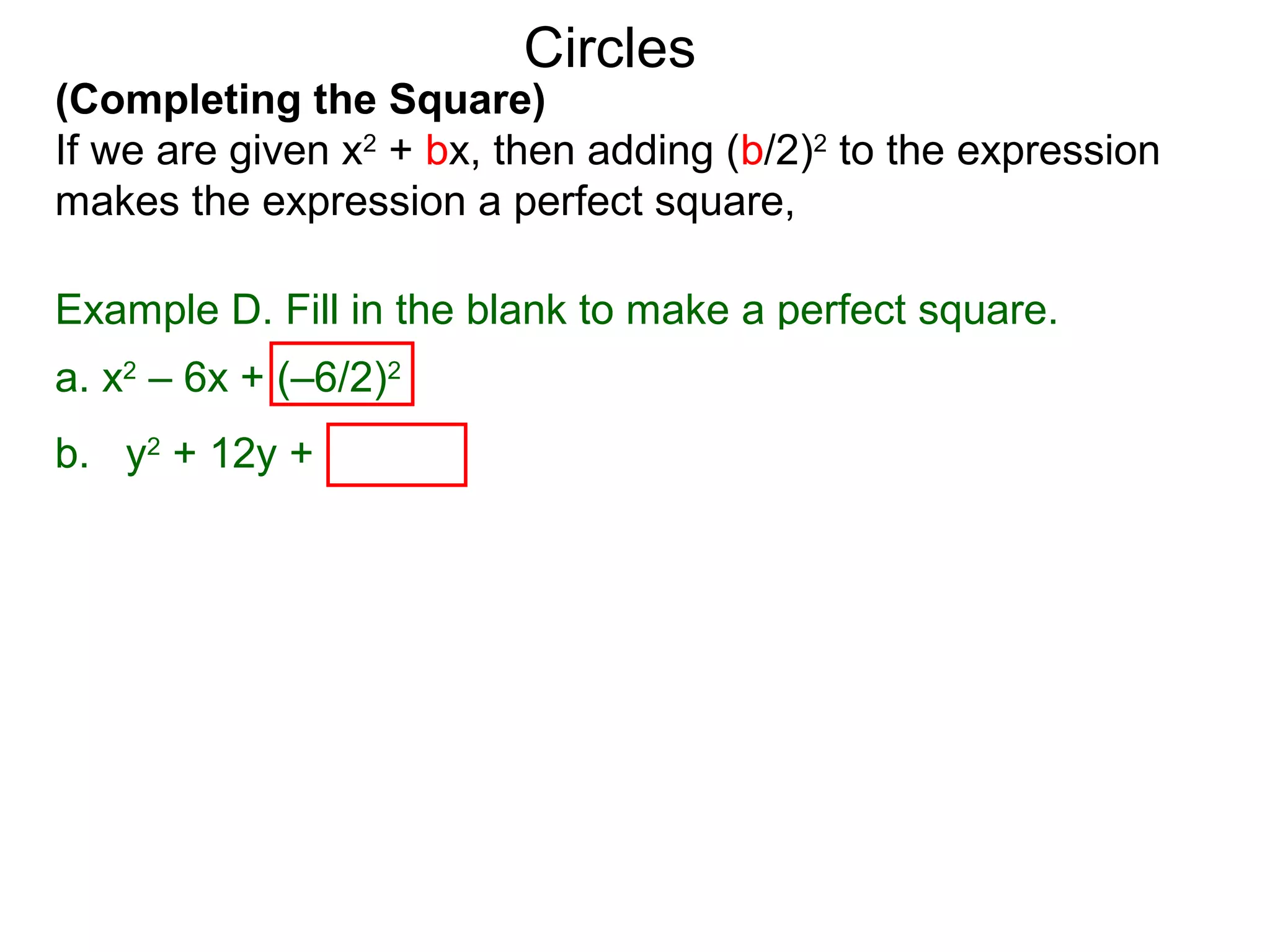
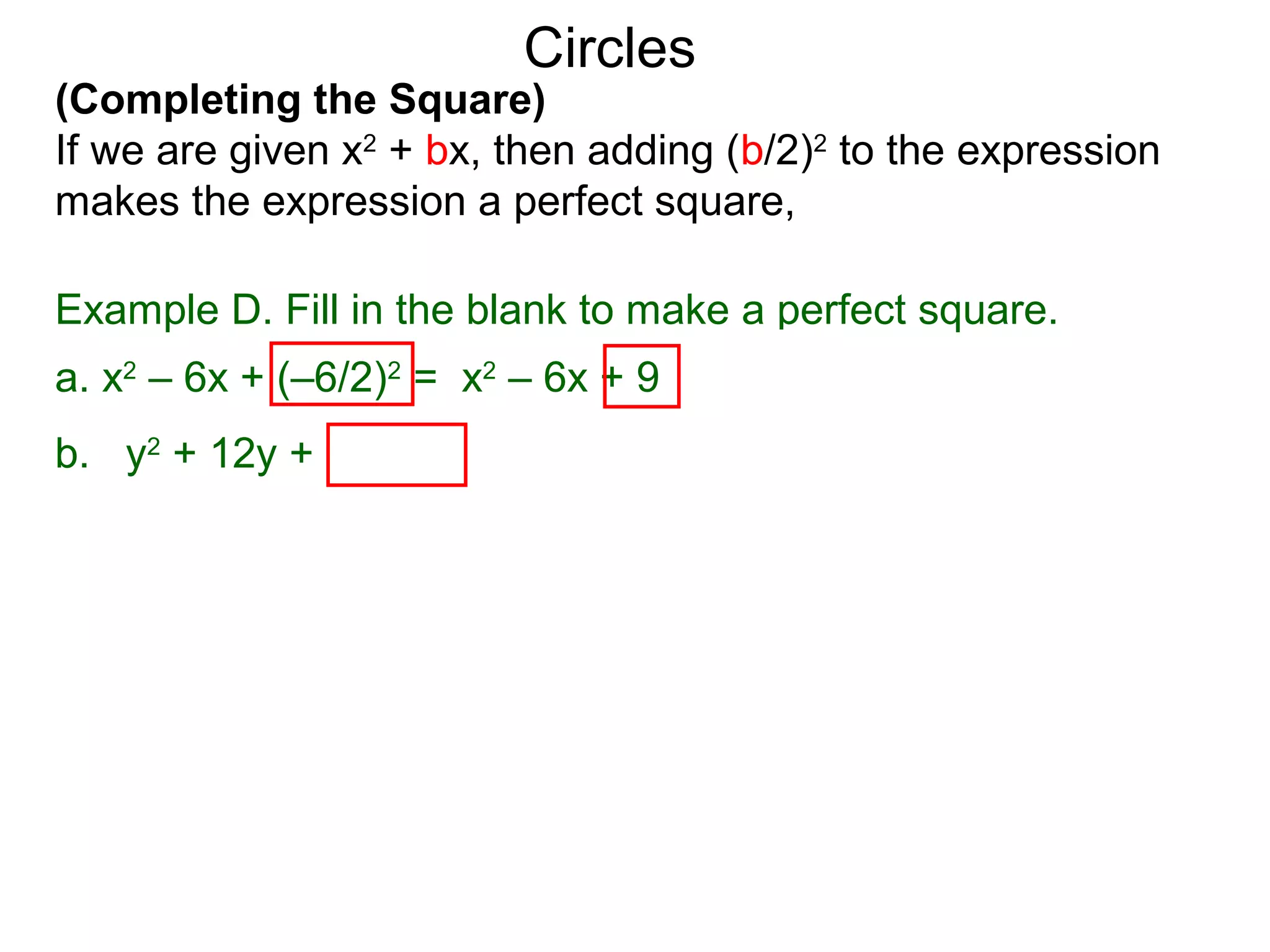
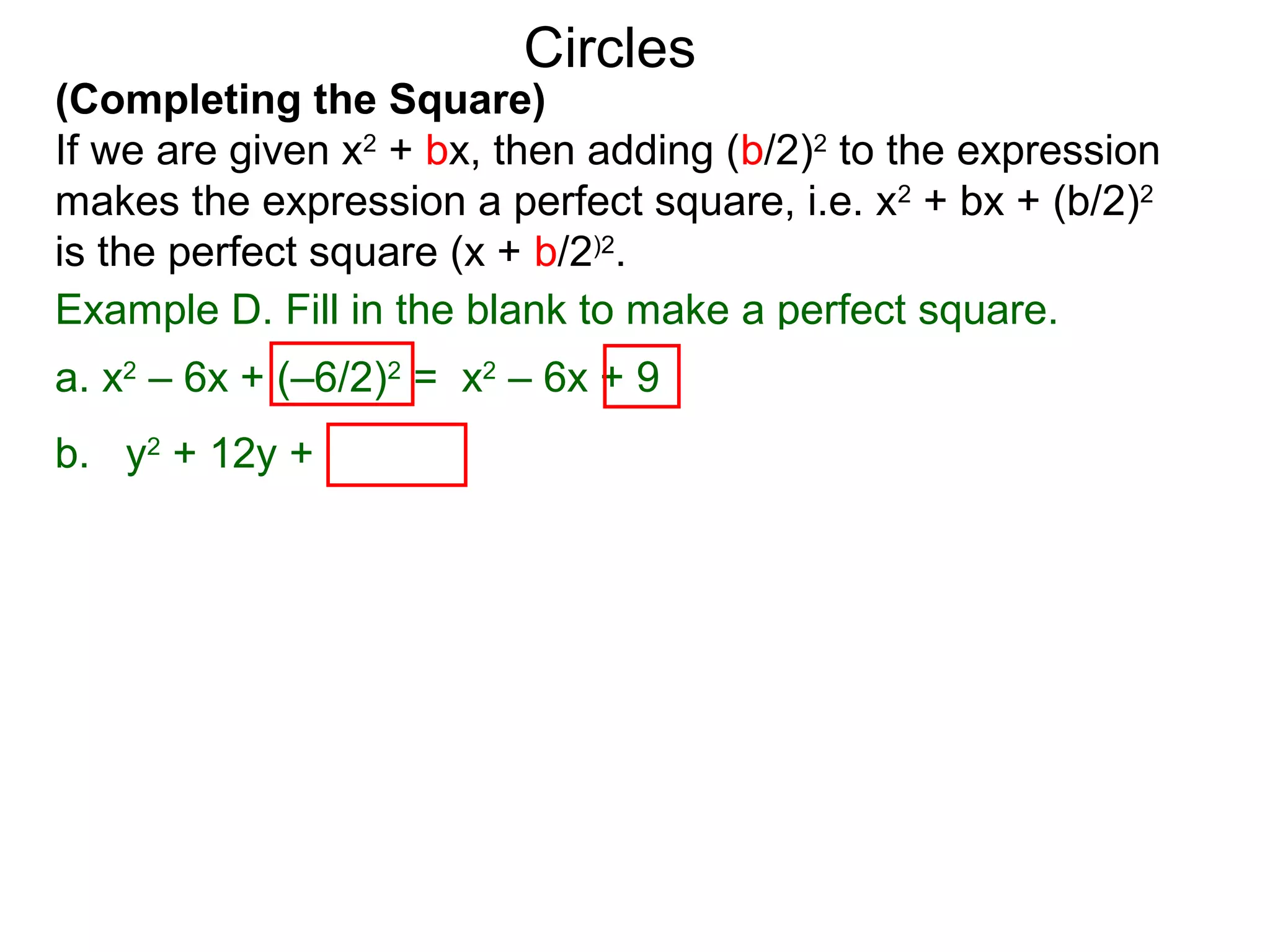
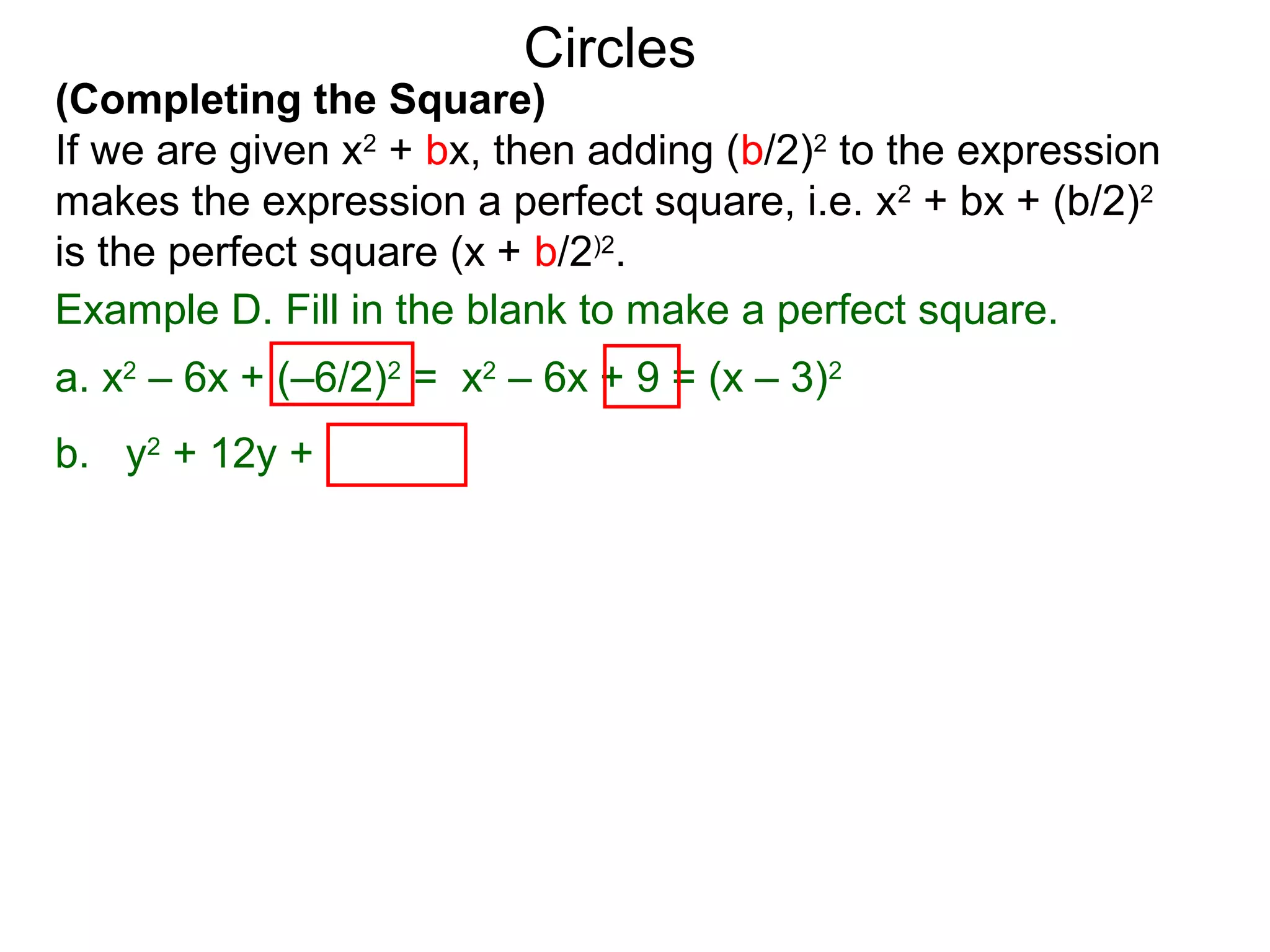
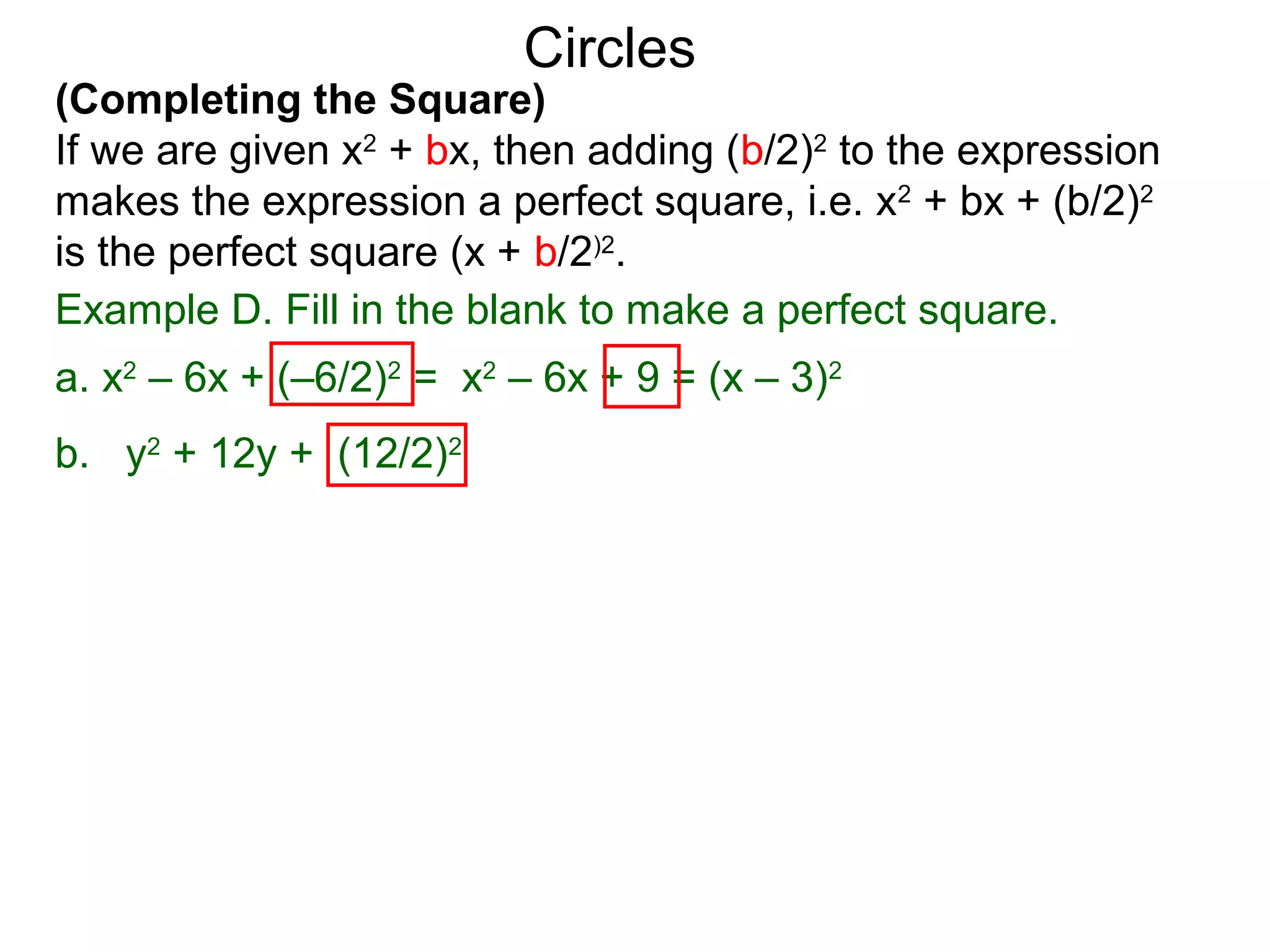
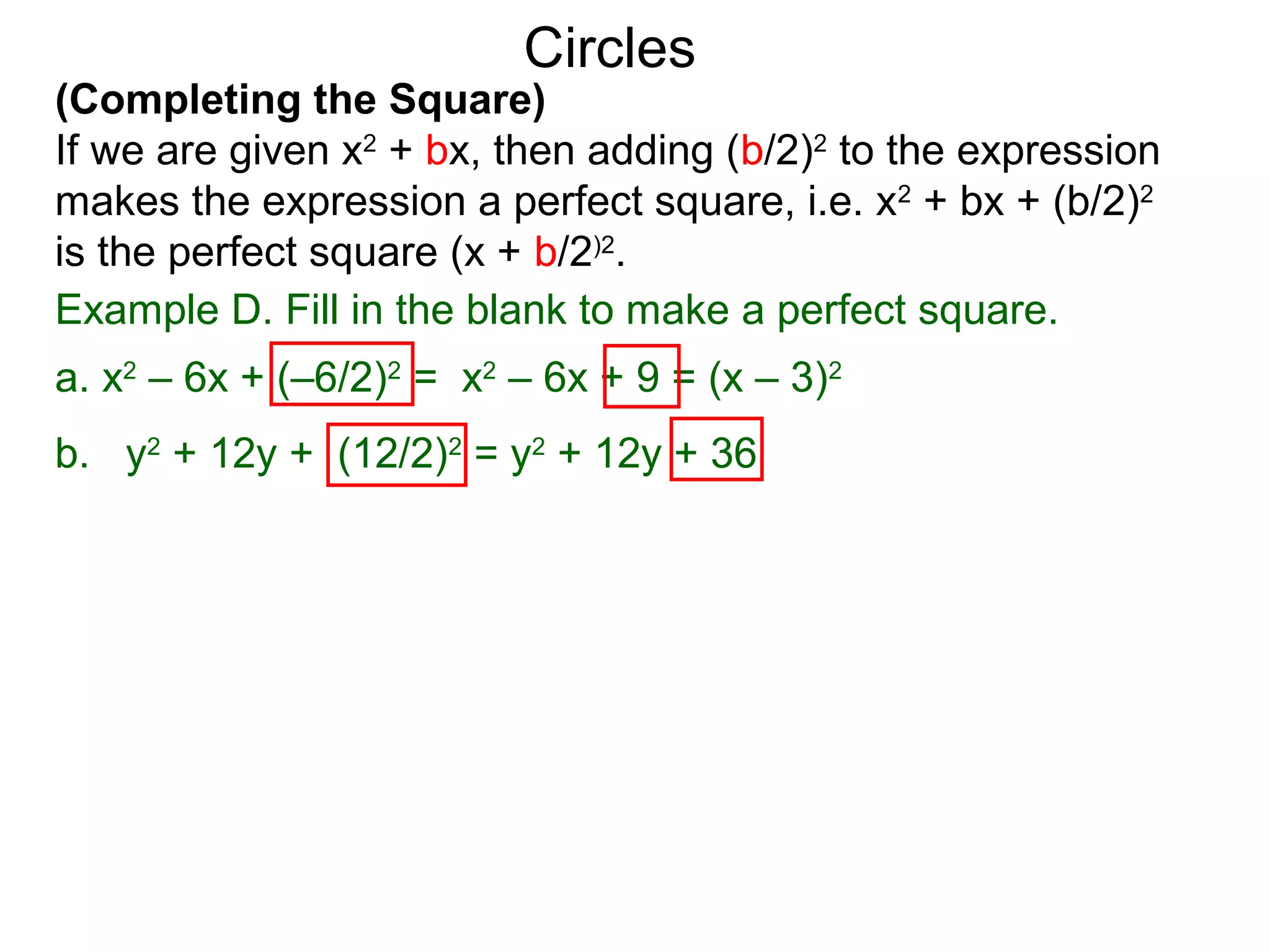
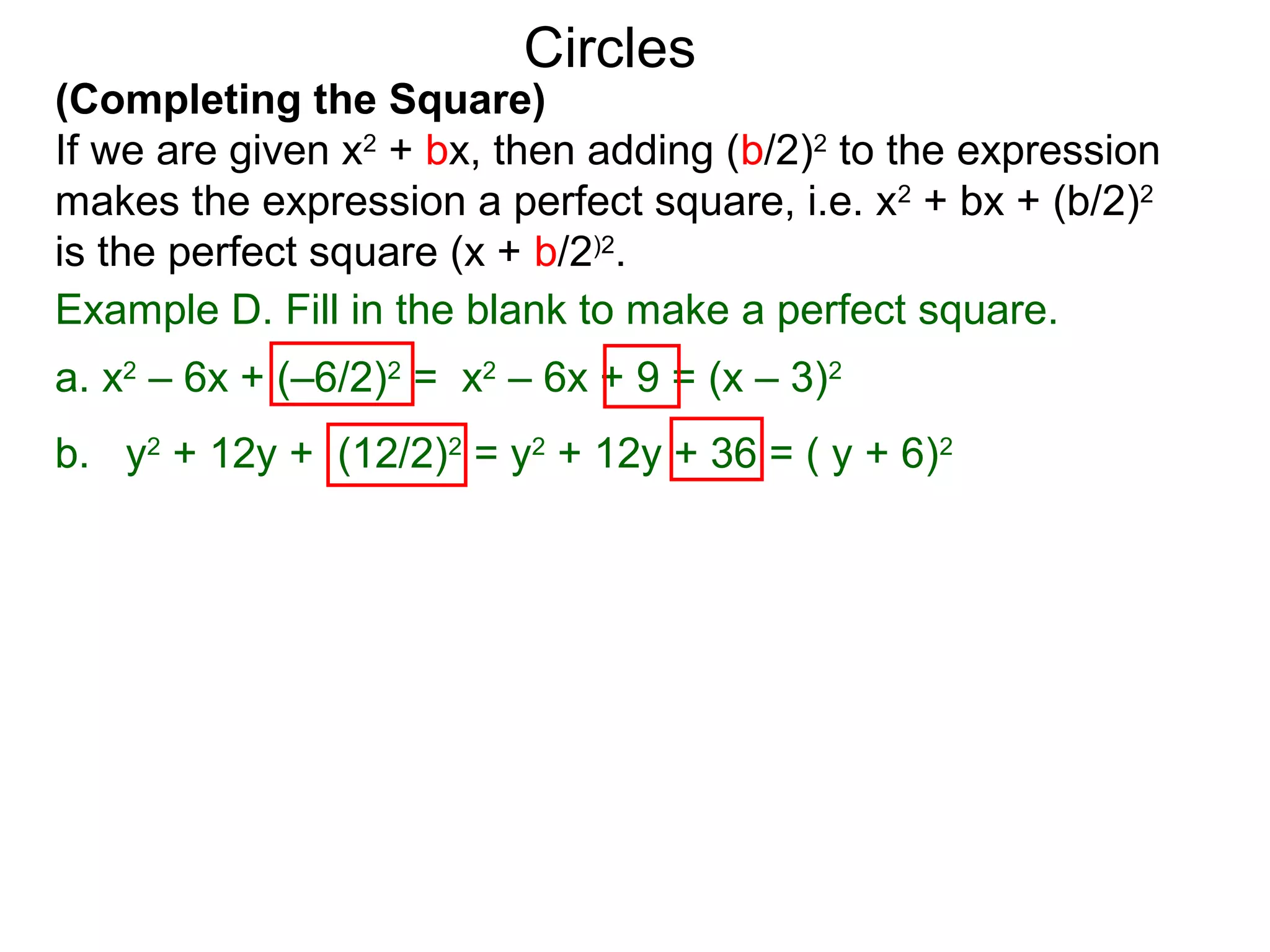
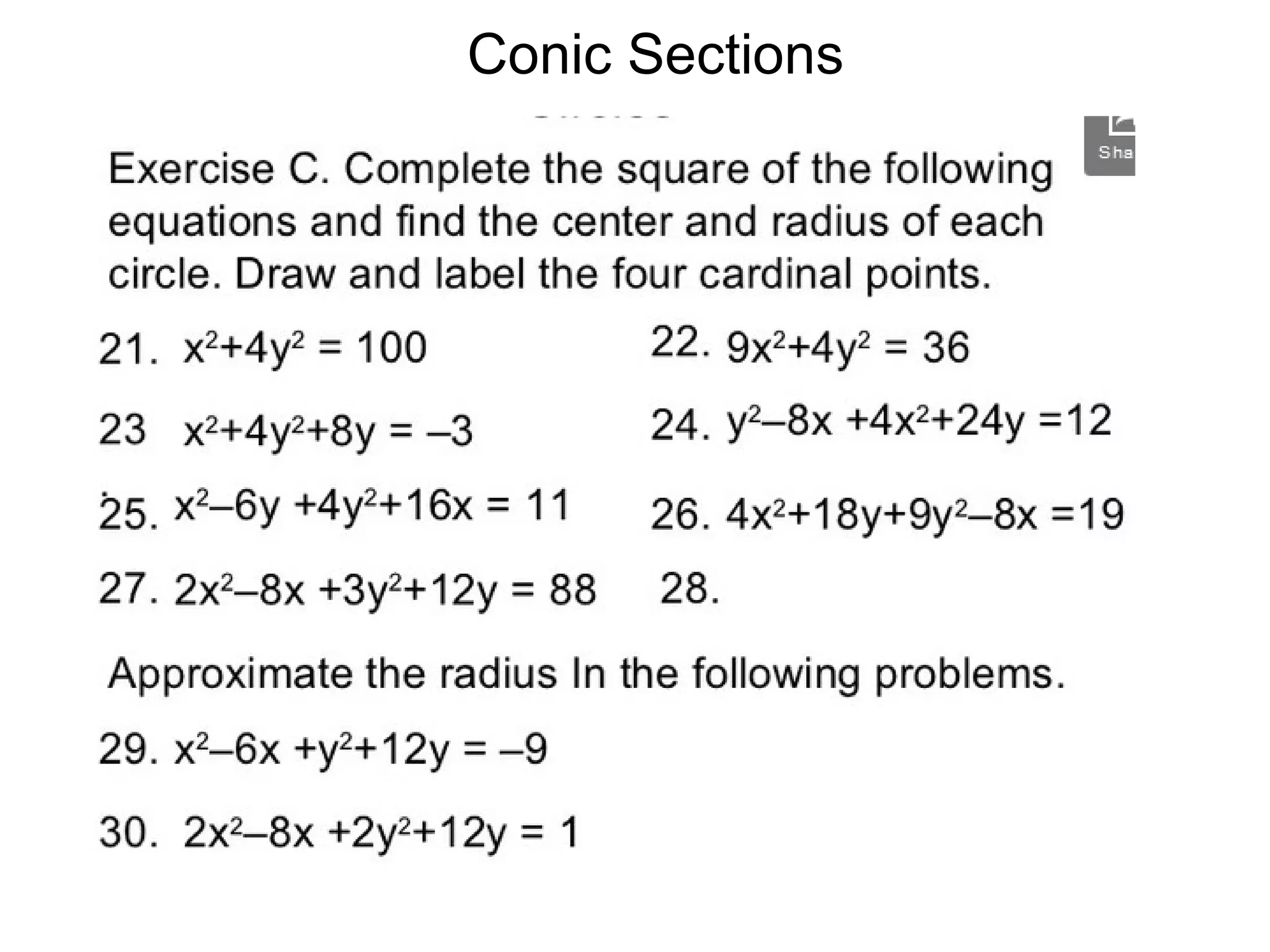
Example D. Fill in the blank to make a perfect square.
a. x2
– 6x + (–6/2)2
= x2
– 6x + 9 = (x – 3)2
b. y2
+ 12y + (12/2)2
= y2
+ 12y + 36 = ( y + 6)2
(Completing the Square)
If we are given x2
+ bx, then adding (b/2)2
to the expression
makes the expression a perfect square,
Circles
Example D. Fill in the blank to make a perfect square.
a. x2
– 6x + (–6/2)2
= x2
– 6x + 9 = (x – 3)2
b. y2
+ 12y + (12/2)2
= y2
+ 12y + 36 = ( y + 6)2
(Completing the Square)
If we are given x2
+ bx, then adding (b/2)2
to the expression
makes the expression a perfect square,
Circles
Example D. Fill in the blank to make a perfect square.
a. x2
– 6x + (–6/2)2
b. y2
+ 12y + (12/2)2
= y2
+ 12y + 36 = ( y + 6)2
(Completing the Square)
If we are given x2
+ bx, then adding (b/2)2
to the expression
makes the expression a perfect square,
Circles
Example D. Fill in the blank to make a perfect square.
a. x2
– 6x + (–6/2)2
= x2
– 6x + 9 = (x – 3)2
b. y2
+ 12y + (12/2)2
= y2
+ 12y + 36 = ( y + 6)2
(Completing the Square)
If we are given x2
+ bx, then adding (b/2)2
to the expression
makes the expression a perfect square, i.e. x2
+ bx + (b/2)2
is the perfect square (x + b/2)2
.
Circles
Example D. Fill in the blank to make a perfect square.
a. x2
– 6x + (–6/2)2
= x2
– 6x + 9 = (x – 3)2
b. y2
+ 12y + (12/2)2
= y2
+ 12y + 36 = ( y + 6)2
(Completing the Square)
If we are given x2
+ bx, then adding (b/2)2
to the expression
makes the expression a perfect square, i.e. x2
+ bx + (b/2)2
is the perfect square (x + b/2)2
.
Circles
Example D. Fill in the blank to make a perfect square.
a. x2
– 6x + (–6/2)2
= x2
– 6x + 9 = (x – 3)2
b. y2
+ 12y + (12/2)2
(Completing the Square)
If we are given x2
+ bx, then adding (b/2)2
to the expression
makes the expression a perfect square, i.e. x2
+ bx + (b/2)2
is the perfect square (x + b/2)2
.
Circles
Example D. Fill in the blank to make a perfect square.
a. x2
– 6x + (–6/2)2
= x2
– 6x + 9 = (x – 3)2
b. y2
+ 12y + (12/2)2
(Completing the Square)
If we are given x2
+ bx, then adding (b/2)2
to the expression
makes the expression a perfect square, i.e. x2
+ bx + (b/2)2
is the perfect square (x + b/2)2
.
Circles
Example D. Fill in the blank to make a perfect square.
a. x2
– 6x + (–6/2)2
= x2
– 6x + 9 = (x – 3)2
b. y2
+ 12y + (12/2)2
= y2
+ 12y + 36
(Completing the Square)
If we are given x2
+ bx, then adding (b/2)2
to the expression
makes the expression a perfect square, i.e. x2
+ bx + (b/2)2
is the perfect square (x + b/2)2
.
Circles
Example D. Fill in the blank to make a perfect square.
a. x2
– 6x + (–6/2)2
= x2
– 6x + 9 = (x – 3)2
b. y2
+ 12y + (12/2)2
= y2
+ 12y + 36 = ( y + 6)2
(Completing the Square)
If we are given x2
+ bx, then adding (b/2)2
to the expression
makes the expression a perfect square, i.e. x2
+ bx + (b/2)2
is the perfect square (x + b/2)2
.
Circles
Example D. Fill in the blank to make a perfect square.
a. x2
– 6x + (–6/2)2
= x2
– 6x + 9 = (x – 3)2
b. y2
+ 12y + (12/2)2
= y2
+ 12y + 36 = ( y + 6)2
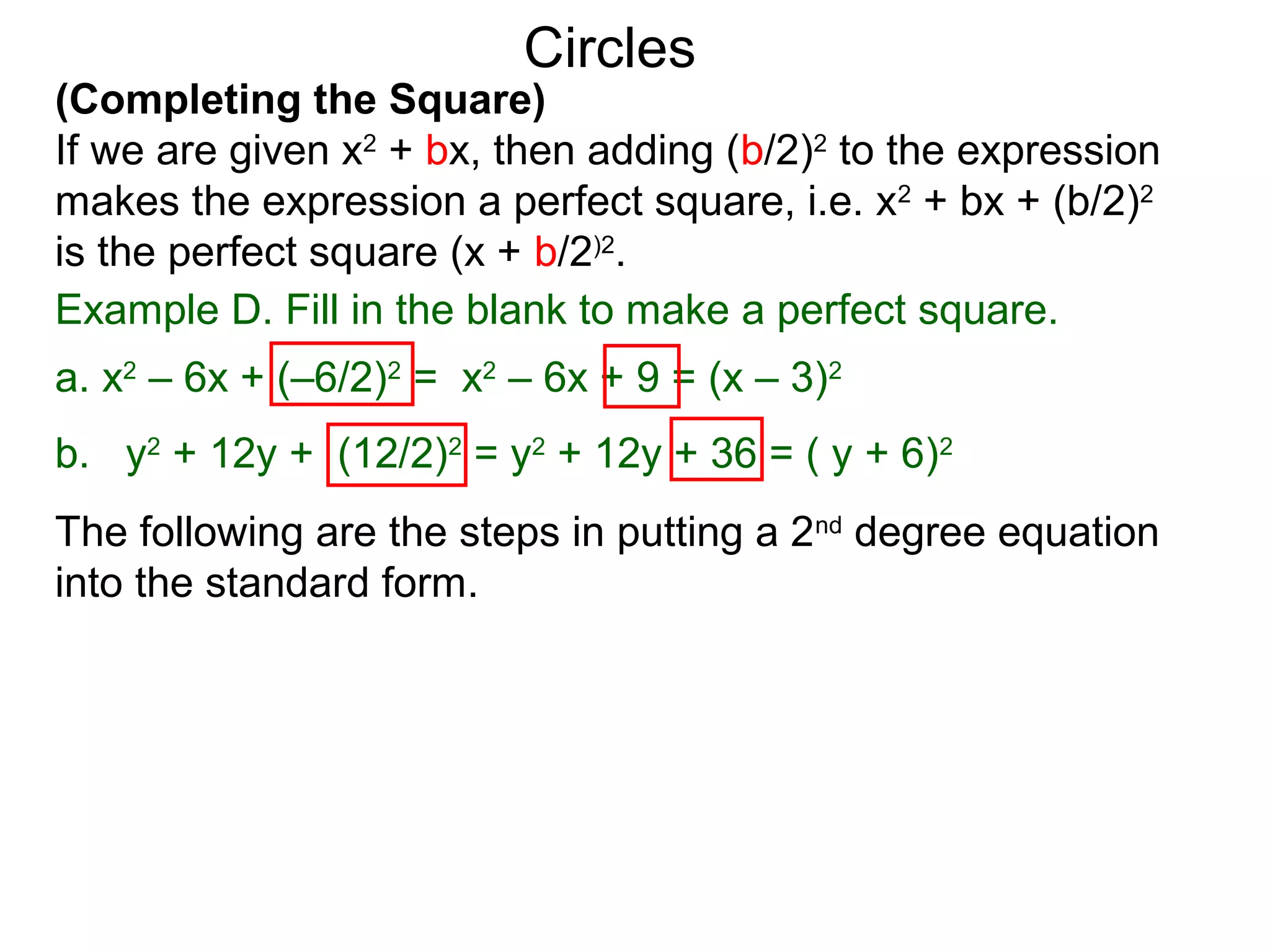
The following are the steps in putting a 2nd
degree equation
into the standard form.
(Completing the Square)
If we are given x2
+ bx, then adding (b/2)2
to the expression
makes the expression a perfect square, i.e. x2
+ bx + (b/2)2
is the perfect square (x + b/2)2
.
Circles
Example D. Fill in the blank to make a perfect square.
a. x2
– 6x + (–6/2)2
= x2
– 6x + 9 = (x – 3)2
b. y2
+ 12y + (12/2)2
= y2
+ 12y + 36 = ( y + 6)2
The following are the steps in putting a 2nd
degree equation
into the standard form.
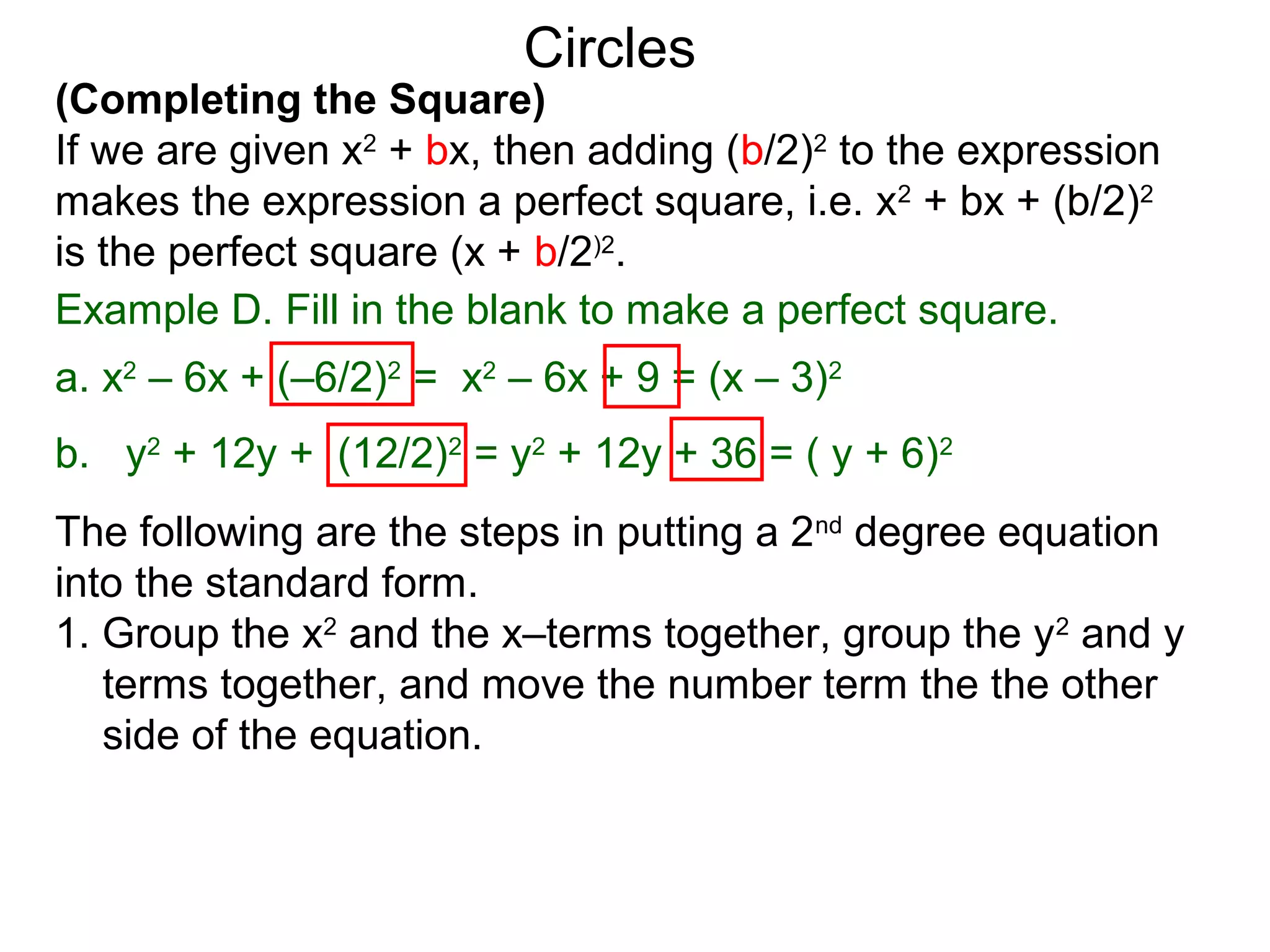
1. Group the x2
and the x–terms together, group the y2
and y
terms together, and move the number term the the other
side of the equation.
(Completing the Square)
If we are given x2
+ bx, then adding (b/2)2
to the expression
makes the expression a perfect square, i.e. x2
+ bx + (b/2)2
is the perfect square (x + b/2)2
.
Circles
Example D. Fill in the blank to make a perfect square.
a. x2
– 6x + (–6/2)2
= x2
– 6x + 9 = (x – 3)2
b. y2
+ 12y + (12/2)2
= y2
+ 12y + 36 = ( y + 6)2
The following are the steps in putting a 2nd
degree equation
into the standard form.
1. Group the x2
and the x–terms together, group the y2
and y
terms together, and move the number term the the other
side of the equation.
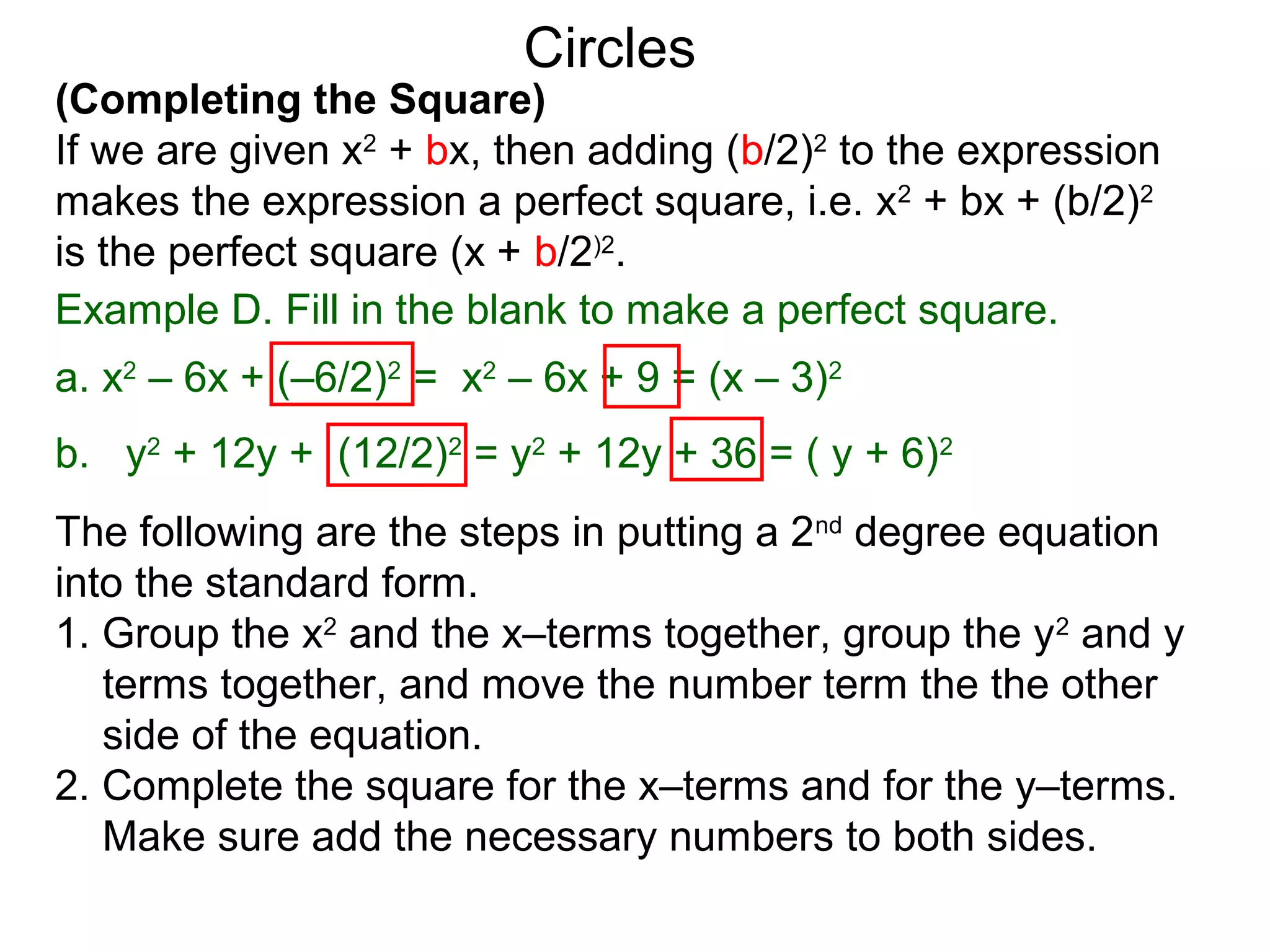
2. Complete the square for the x–terms and for the y–terms.
Make sure add the necessary numbers to both sides.
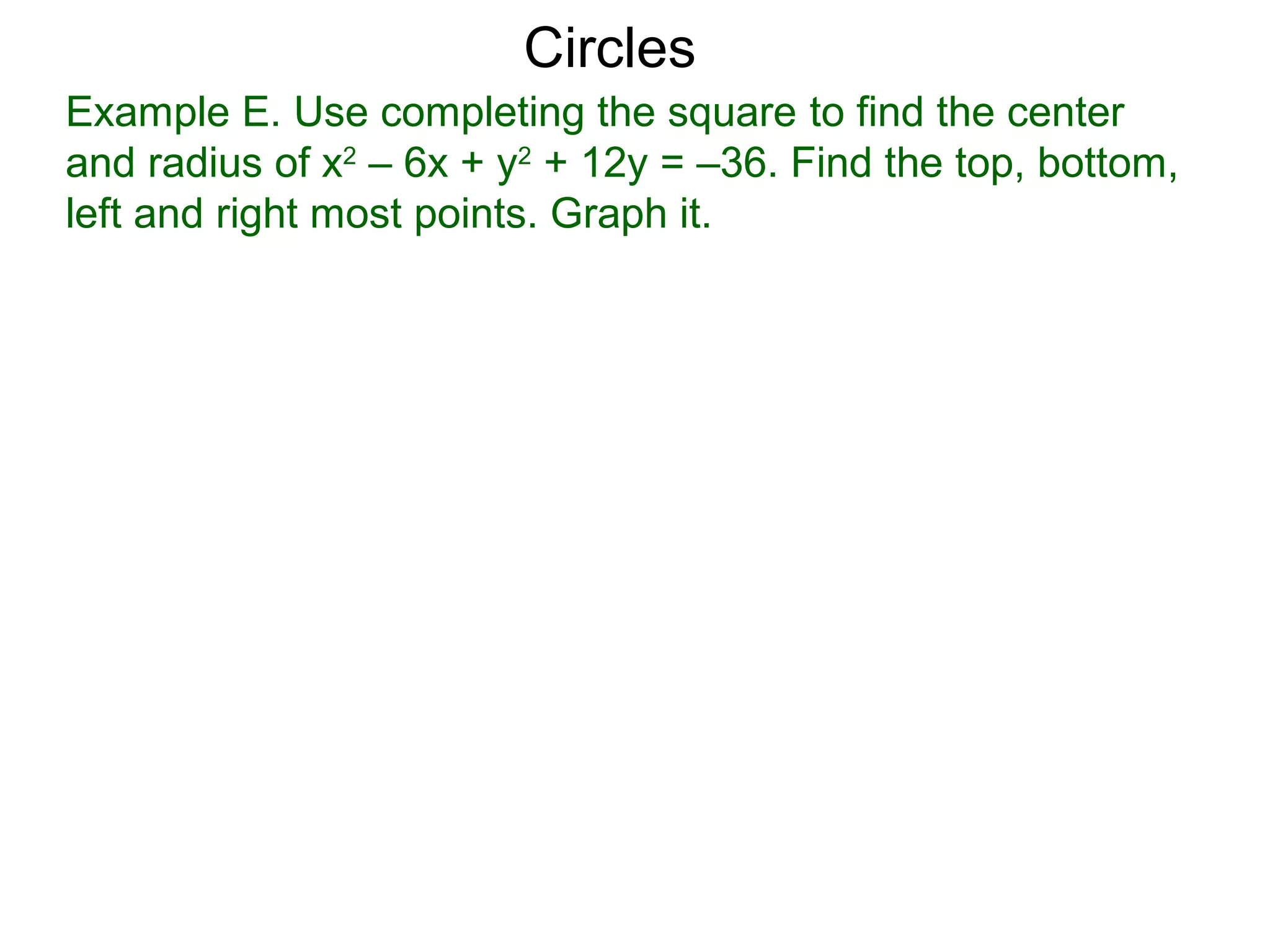
Example E. Use completing the square to find the center
and radius of x2
– 6x + y2
+ 12y = –36. Find the top, bottom,
left and right most points. Graph it.
Circles
Example E. Use completing the square to find the center
and radius of x2
– 6x + y2
+ 12y = –36. Find the top, bottom,
left and right most points. Graph it.
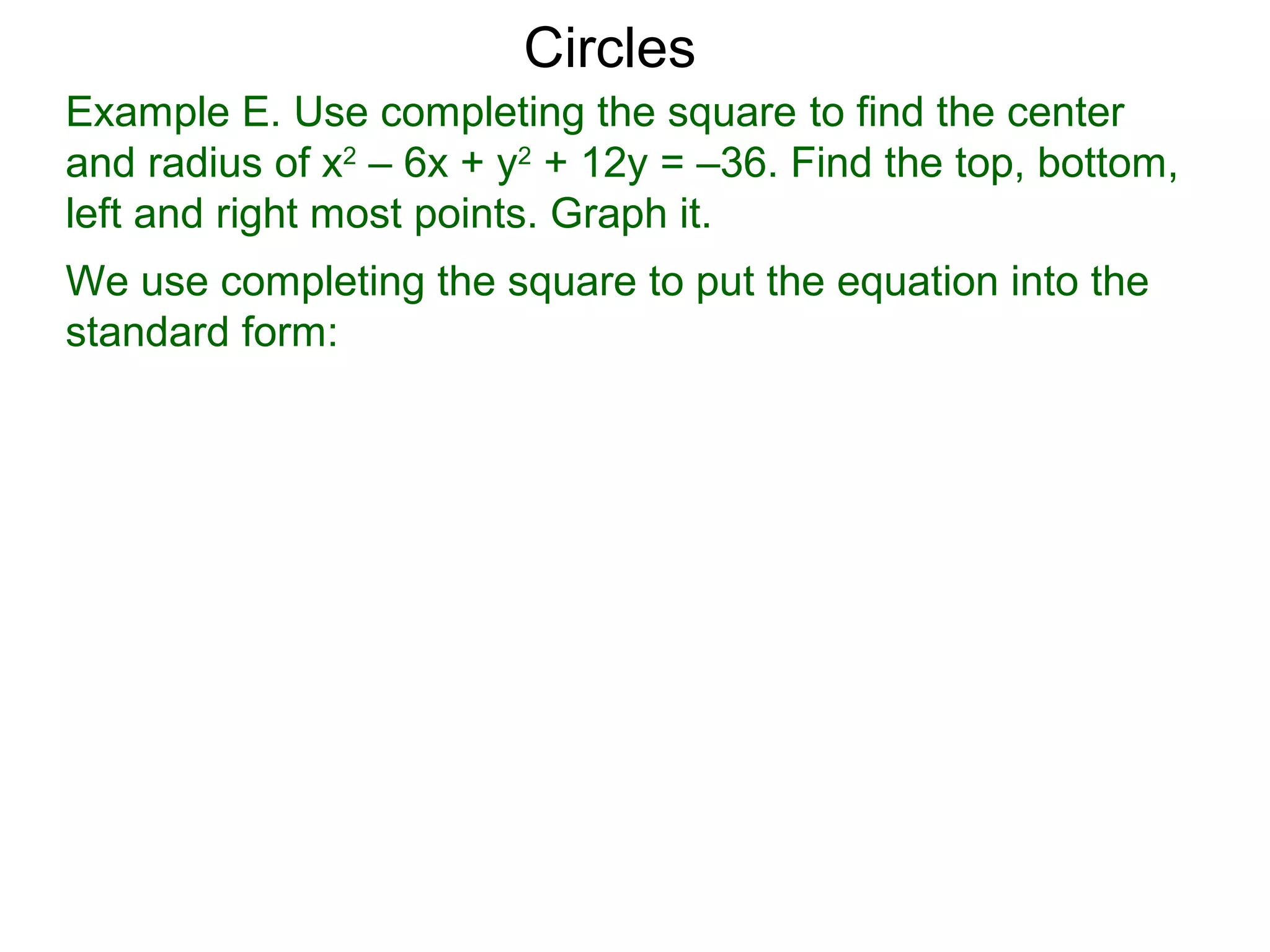
We use completing the square to put the equation into the
standard form:
Circles
Example E. Use completing the square to find the center
and radius of x2
– 6x + y2
+ 12y = –36. Find the top, bottom,
left and right most points. Graph it.
We use completing the square to put the equation into the
standard form:
x2
– 6x + + y2
+ 12y + = –36
Circles
Example E. Use completing the square to find the center
and radius of x2
– 6x + y2
+ 12y = –36. Find the top, bottom,
left and right most points. Graph it.
We use completing the square to put the equation into the
standard form:
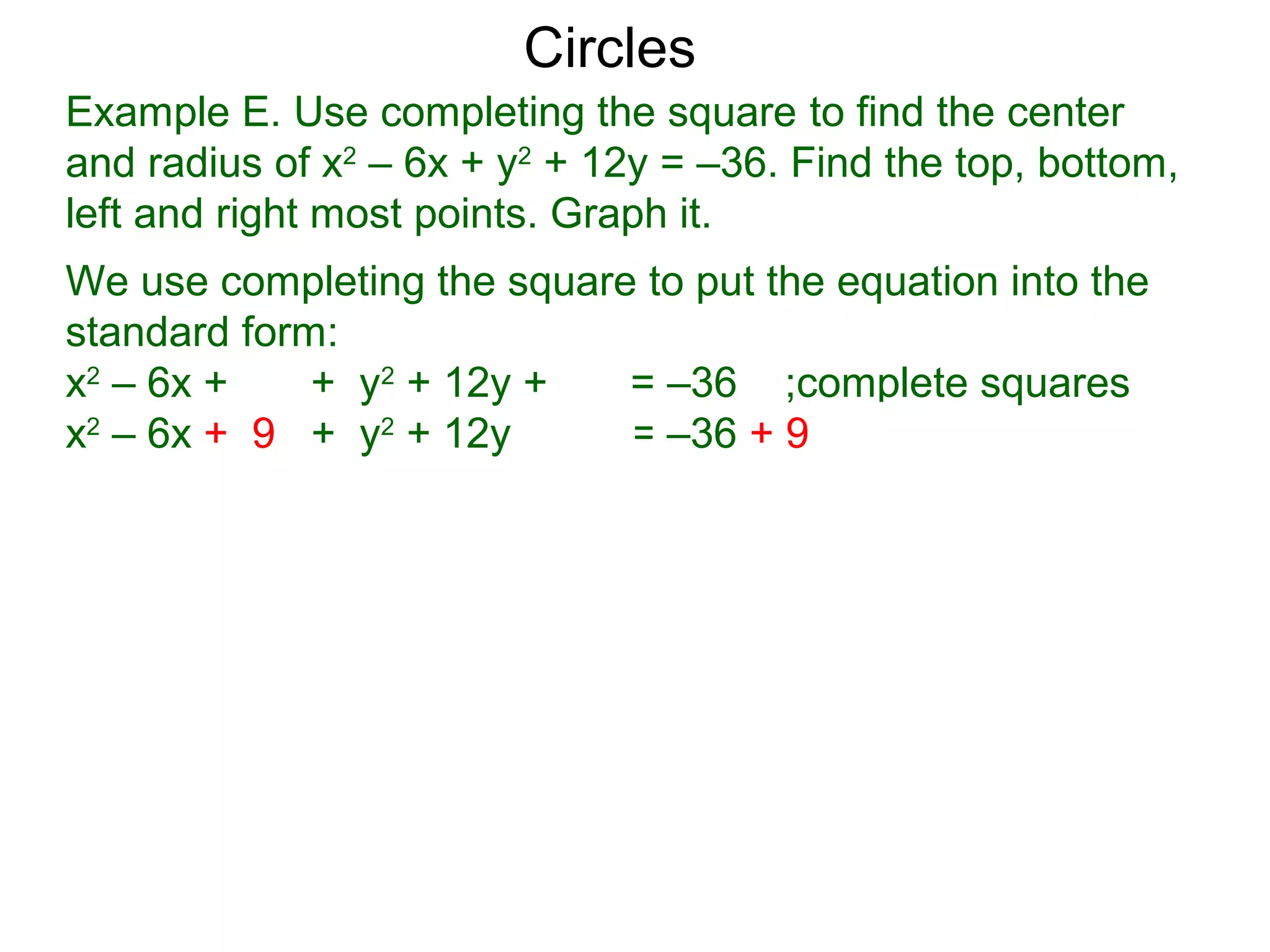
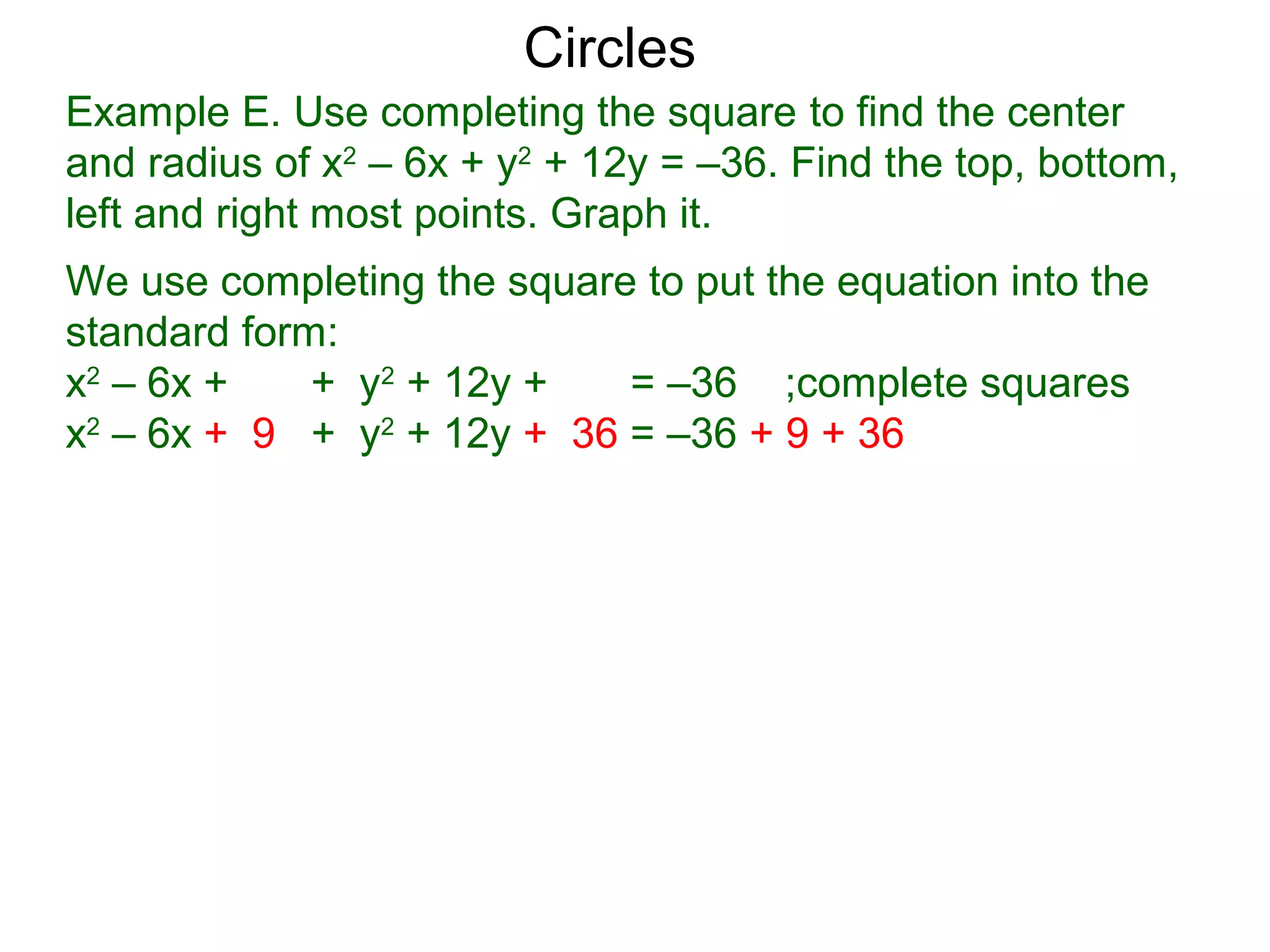
x2
– 6x + + y2
+ 12y + = –36 ;complete squares
x2
– 6x + 9 + y2
+ 12y + 36 = –36 + 9 + 36
Circles
Example E. Use completing the square to find the center
and radius of x2
– 6x + y2
+ 12y = –36. Find the top, bottom,
left and right most points. Graph it.
We use completing the square to put the equation into the
standard form:
x2
– 6x + + y2
+ 12y + = –36 ;complete squares
x2
– 6x + 9 + y2
+ 12y + 36 = –36 + 9 + 36
Circles
Example E. Use completing the square to find the center
and radius of x2
– 6x + y2
+ 12y = –36. Find the top, bottom,
left and right most points. Graph it.
We use completing the square to put the equation into the
standard form:
x2
– 6x + + y2
+ 12y + = –36 ;complete squares
x2
– 6x + 9 + y2
+ 12y + 36 = –36 + 9 + 36
( x – 3 )2
+ (y + 6)2
= 9
Circles
Example E. Use completing the square to find the center
and radius of x2
– 6x + y2
+ 12y = –36. Find the top, bottom,
left and right most points. Graph it.
We use completing the square to put the equation into the
standard form:
x2
– 6x + + y2
+ 12y + = –36 ;complete squares
x2
– 6x + 9 + y2
+ 12y + 36 = –36 + 9 + 36
( x – 3 )2
+ (y + 6)2
= 9
( x – 3 )2
+ (y + 6)2
= 32
Circles
Example E. Use completing the square to find the center
and radius of x2
– 6x + y2
+ 12y = –36. Find the top, bottom,
left and right most points. Graph it.
We use completing the square to put the equation into the
standard form:
x2
– 6x + + y2
+ 12y + = –36 ;complete squares
x2
– 6x + 9 + y2
+ 12y + 36 = –36 + 9 + 36
( x – 3 )2
+ (y + 6)2
= 9
( x – 3 )2
+ (y + 6)2
= 32
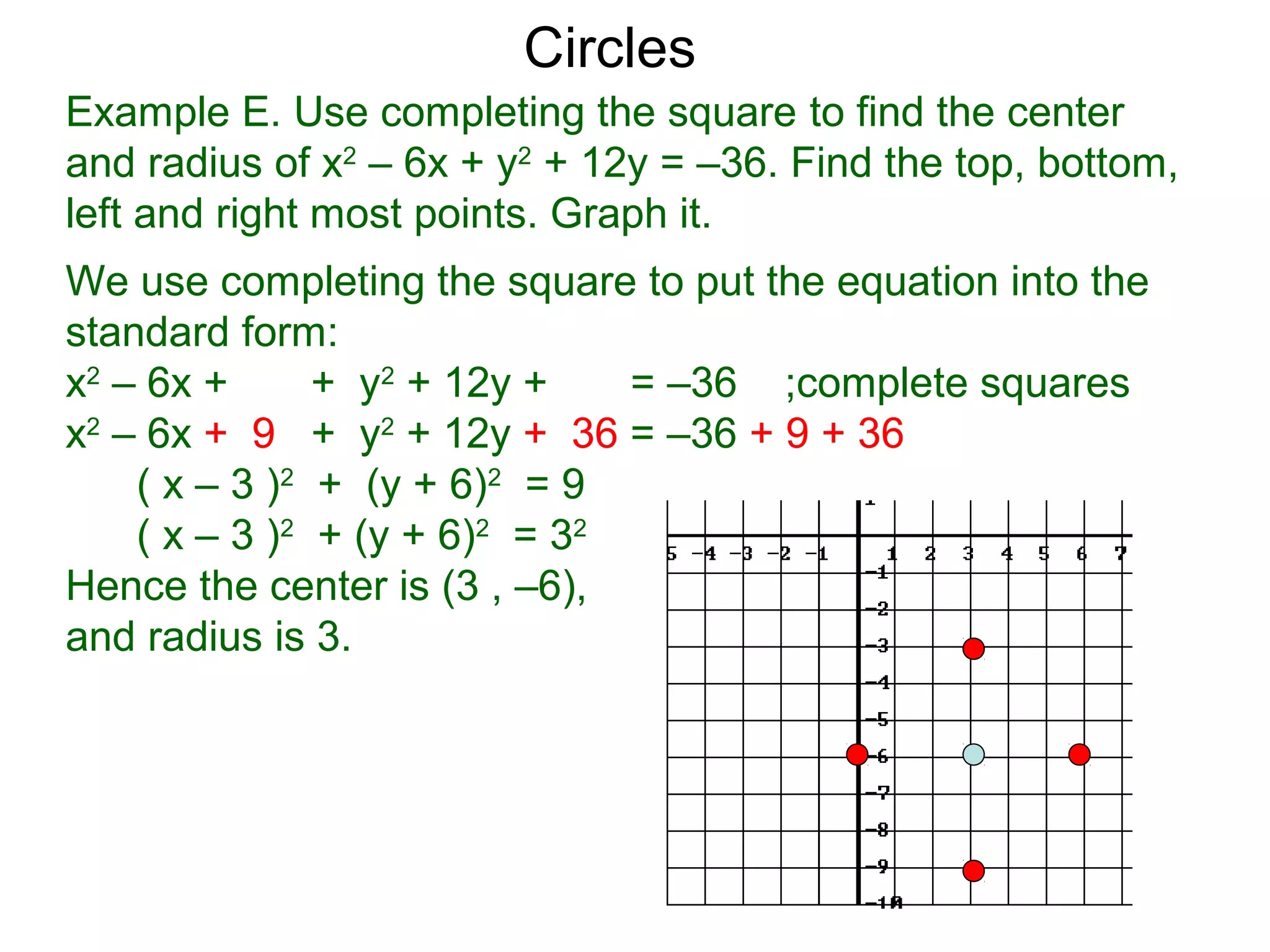
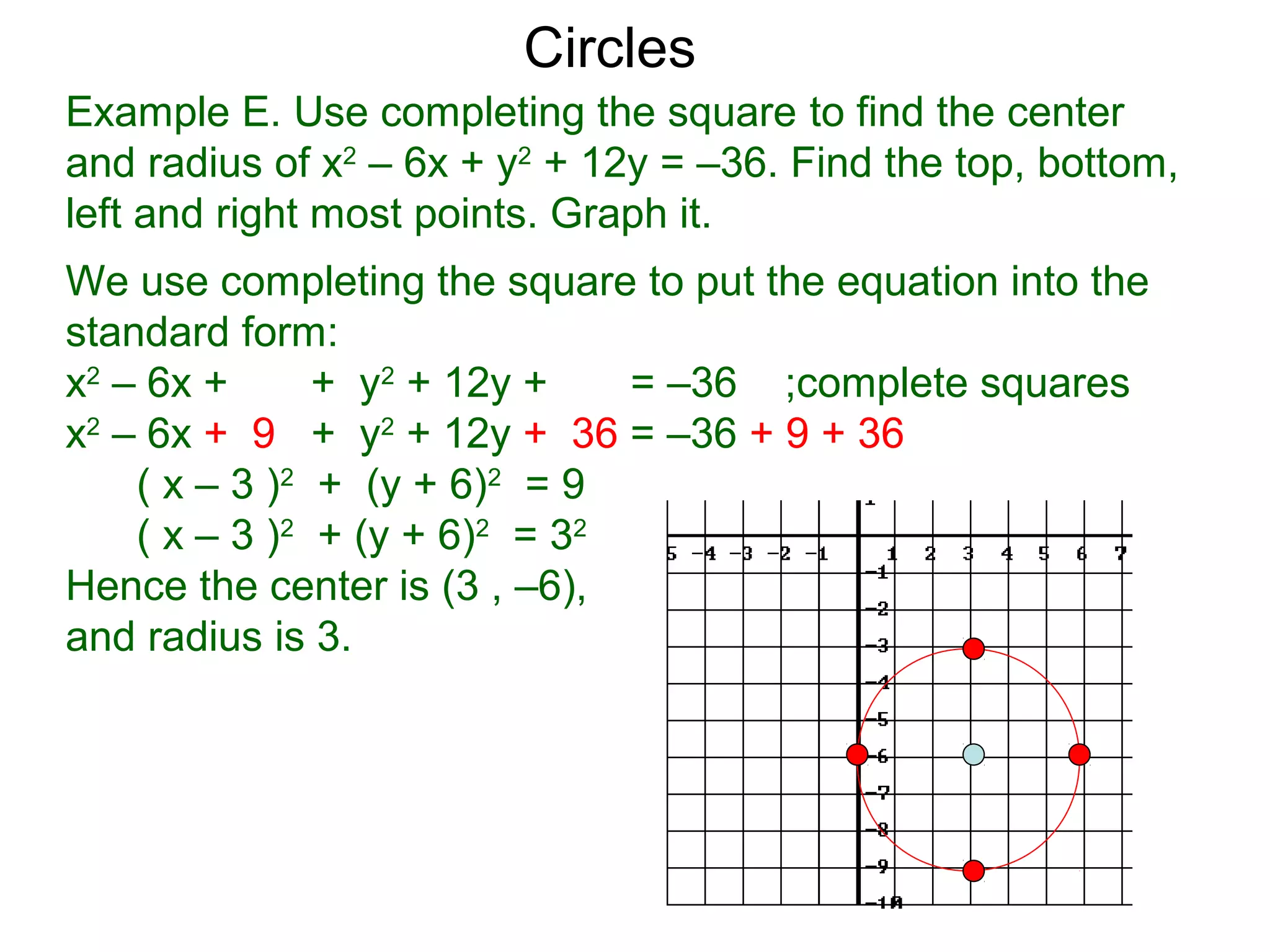
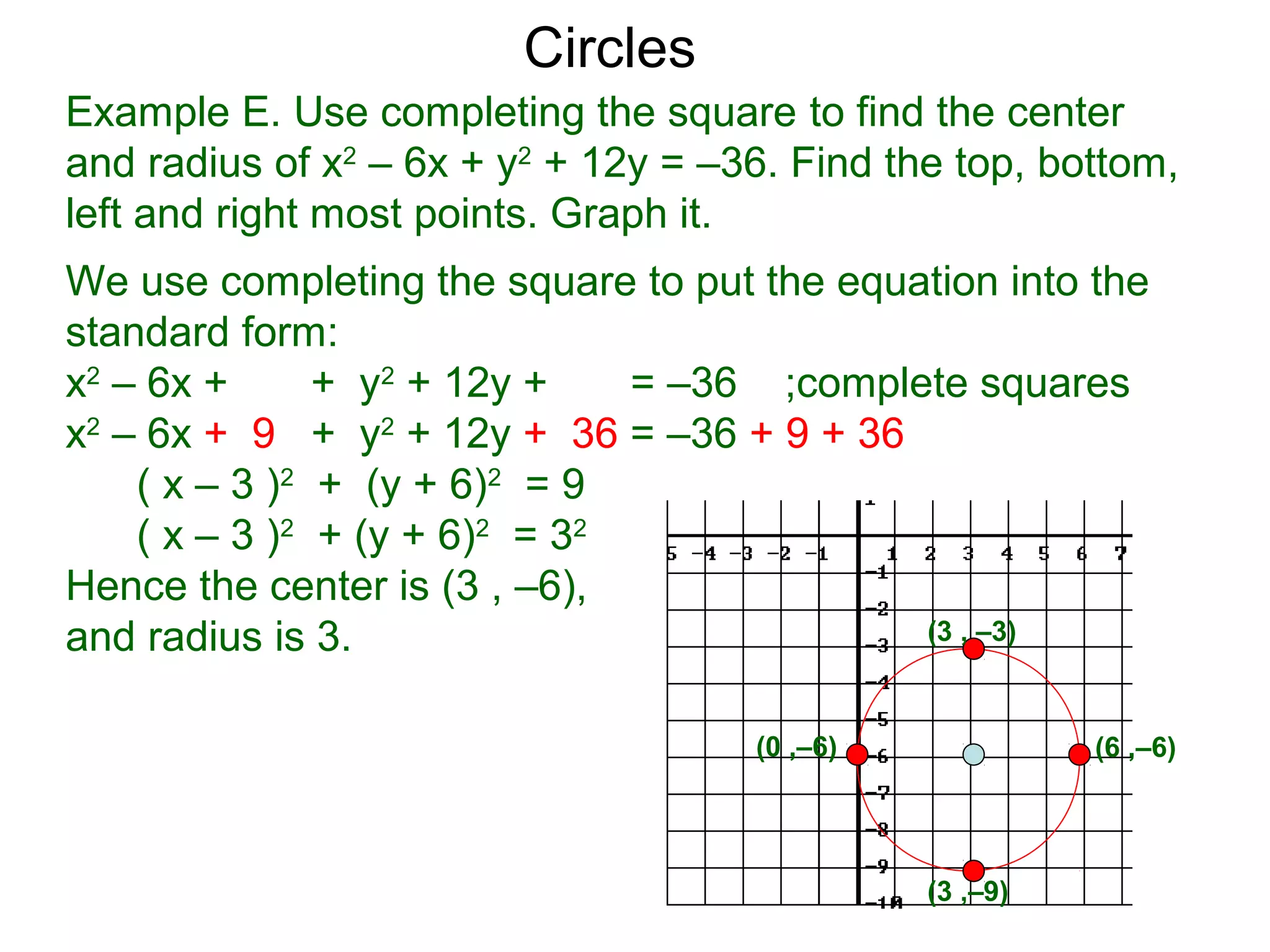
Hence the center is (3 , –6),
and radius is 3.
Circles
Example E. Use completing the square to find the center
and radius of x2
– 6x + y2
+ 12y = –36. Find the top, bottom,
left and right most points. Graph it.
We use completing the square to put the equation into the
standard form:
x2
– 6x + + y2
+ 12y + = –36 ;complete squares
x2
– 6x + 9 + y2
+ 12y + 36 = –36 + 9 + 36
( x – 3 )2
+ (y + 6)2
= 9
( x – 3 )2
+ (y + 6)2
= 32
Hence the center is (3 , –6),
and radius is 3.
Circles
Example E. Use completing the square to find the center
and radius of x2
– 6x + y2
+ 12y = –36. Find the top, bottom,
left and right most points. Graph it.
We use completing the square to put the equation into the
standard form:
x2
– 6x + + y2
+ 12y + = –36 ;complete squares
x2
– 6x + 9 + y2
+ 12y + 36 = –36 + 9 + 36
( x – 3 )2
+ (y + 6)2
= 9
( x – 3 )2
+ (y + 6)2
= 32
Hence the center is (3 , –6),
and radius is 3.
Circles
Example E. Use completing the square to find the center
and radius of x2
– 6x + y2
+ 12y = –36. Find the top, bottom,
left and right most points. Graph it.
We use completing the square to put the equation into the
standard form:
x2
– 6x + + y2
+ 12y + = –36 ;complete squares
x2
– 6x + 9 + y2
+ 12y + 36 = –36 + 9 + 36
( x – 3 )2
+ (y + 6)2
= 9
( x – 3 )2
+ (y + 6)2
= 32
Hence the center is (3 , –6),
and radius is 3.
Circles
(3 ,–9)
(3 , –3)
(0 ,–6) (6 ,–6)
Conic Sections
Conic Sections
Conic Sections
Conic Sections
Conic Sections
Conic Sections

2.5 conic sections circles-x

  • 1.
    First Degree Equations Graphsof 1st equations Ax + By = C are straight lines.
  • 2.
    First Degree Equations Graphsof 1st equations Ax + By = C are straight lines. There are two cases.
  • 3.
    First Degree Equations Graphsof 1st equations Ax + By = C are straight lines. There are two cases. I. If B ≠ 0, then solving for y we obtain the format: y = mx + b, when m = slope, and (0, b) in the y-intercept.
  • 4.
    First Degree Equations Graphsof 1st equations Ax + By = C are straight lines. There are two cases. I. If B ≠ 0, then solving for y we obtain the format: y = mx + b, when m = slope, and (0, b) in the y-intercept. 2x – 3y = 12
  • 5.
    First Degree Equations Graphsof 1st equations Ax + By = C are straight lines. There are two cases. I. If B ≠ 0, then solving for y we obtain the format: y = mx + b, when m = slope, and (0, b) in the y-intercept. 2x – 3y = 12 y = – 42 x3
  • 6.
    First Degree Equations Graphsof 1st equations Ax + By = C are straight lines. There are two cases. I. If B ≠ 0, then solving for y we obtain the format: y = mx + b, when m = slope, and (0, b) in the y-intercept. (6,0) (0,–4) 2x – 3y = 12 y = – 42 x3
  • 7.
    First Degree Equations Graphsof 1st equations Ax + By = C are straight lines. There are two cases. I. If B ≠ 0, then solving for y we obtain the format: y = mx + b, when m = slope, and (0, b) in the y-intercept. (6,0) (0,–4) 2x – 3y = 12 y = – 42 x3
  • 8.
    First Degree Equations Graphsof 1st equations Ax + By = C are straight lines. There are two cases. I. If B ≠ 0, then solving for y we obtain the format: y = mx + b, when m = slope, and (0, b) in the y-intercept. (6,0) (0,–4) –3y = 12 y = –4 2x – 3y = 12 y = – 42 x3
  • 9.
    First Degree Equations Graphsof 1st equations Ax + By = C are straight lines. There are two cases. I. If B ≠ 0, then solving for y we obtain the format: y = mx + b, when m = slope, and (0, b) in the y-intercept. (6,0) (0,–4) –3y = 12 y = –4 2x – 3y = 12 y = – 42 x3 (0,–4)
  • 10.
    Graphs of y =mx + b: First Degree Equations Graphs of 1st equations Ax + By = C are straight lines. There are two cases. I. If B ≠ 0, then solving for y we obtain the format: y = mx + b, when m = slope, and (0, b) in the y-intercept. (6,0) (0,–4) –3y = 12 y = –4 2x – 3y = 12 y = – 42 x3 (0,–4)
  • 11.
    Graphs of y =mx + b: First Degree Equations Graphs of 1st equations Ax + By = C are straight lines. There are two cases. I. If B ≠ 0, then solving for y we obtain the format: y = mx + b, when m = slope, and (0, b) in the y-intercept. (6,0) (0,–4) –3y = 12 y = –4 2x – 3y = 12 y = – 42 x3 Il. If B = 0, then the equation is of the form x = c whose graph is a vertical line. 12 – 3x = 0 (0,–4)
  • 12.
    Graphs of y =mx + b: First Degree Equations Graphs of 1st equations Ax + By = C are straight lines. There are two cases. I. If B ≠ 0, then solving for y we obtain the format: y = mx + b, when m = slope, and (0, b) in the y-intercept. (6,0) (0,–4) –3y = 12 y = –4 2x – 3y = 12 y = – 42 x3 Il. If B = 0, then the equation is of the form x = c whose graph is a vertical line. 12 – 3x = 0 x = 4 (0,–4)
  • 13.
    Graphs of y =mx + b: First Degree Equations Graphs of 1st equations Ax + By = C are straight lines. There are two cases. I. If B ≠ 0, then solving for y we obtain the format: y = mx + b, when m = slope, and (0, b) in the y-intercept. (6,0) (0,–4) –3y = 12 y = –4 2x – 3y = 12 y = – 42 x3 Il. If B = 0, then the equation is of the form x = c whose graph is a vertical line. 12 – 3x = 0 x = 4 Graphs of x = c vertical lines: (0,–4) (4,0)
  • 14.
    Graphs of y =mx + b: First Degree Equations Graphs of 1st equations Ax + By = C are straight lines. There are two cases. I. If B ≠ 0, then solving for y we obtain the format: y = mx + b, when m = slope, and (0, b) in the y-intercept. (6,0) (0,–4) –3y = 12 y = –4 2x – 3y = 12 y = – 42 x3 Il. If B = 0, then the equation is of the form x = c whose graph is a vertical line. 12 – 3x = 0 x = 4 Graphs of x = c vertical lines: Graphs of 2nd degree equations: Ax2 + By2 + Cx + Dy = E, (A, B, C, D, and E are numbers) are conic-sections. (0,–4) (4,0)
  • 15.
    Conic Sections One wayto study a solid is to slice it open.
  • 16.
    Conic Sections One wayto study a solid is to slice it open.
  • 17.
    Conic Sections One wayto study a solid is to slice it open. The exposed area of the sliced solid is called a cross sectional area.
  • 18.
    Conic Sections A rightcircular cone One way to study a solid is to slice it open. The exposed area of the sliced solid is called a cross sectional area. Conic sections are the borders of the cross sectional areas of a right circular cone as shown.
  • 19.
    Conic Sections A rightcircular cone and conic sections (wikipedia “Conic Sections”) One way to study a solid is to slice it open. The exposed area of the sliced solid is called a cross sectional area. Conic sections are the borders of the cross sectional areas of a right circular cone as shown.
  • 20.
    Conic Sections A HorizontalSection A right circular cone and conic sections (wikipedia “Conic Sections”) One way to study a solid is to slice it open. The exposed area of the sliced solid is called a cross sectional area. Conic sections are the borders of the cross sectional areas of a right circular cone as shown.
  • 21.
    Conic Sections A HorizontalSection A right circular cone and conic sections (wikipedia “Conic Sections”) One way to study a solid is to slice it open. The exposed area of the sliced solid is called a cross sectional area. Conic sections are the borders of the cross sectional areas of a right circular cone as shown. Circles
  • 22.
    Conic Sections A Moderately TiltedSection A right circular cone and conic sections (wikipedia “Conic Sections”) One way to study a solid is to slice it open. The exposed area of the sliced solid is called a cross sectional area. Conic sections are the borders of the cross sectional areas of a right circular cone as shown.
  • 23.
    Conic Sections A Moderately TiltedSection A right circular cone and conic sections (wikipedia “Conic Sections”) One way to study a solid is to slice it open. The exposed area of the sliced solid is called a cross sectional area. Conic sections are the borders of the cross sectional areas of a right circular cone as shown. Ellipses
  • 24.
    Conic Sections A HorizontalSection A Moderately Tilted Section A right circular cone and conic sections (wikipedia “Conic Sections”) One way to study a solid is to slice it open. The exposed area of the sliced solid is called a cross sectional area. Conic sections are the borders of the cross sectional areas of a right circular cone as shown. Circles and ellipses are enclosed.
  • 25.
    Conic Sections A rightcircular cone and conic sections (wikipedia “Conic Sections”) A Parallel–Section One way to study a solid is to slice it open. The exposed area of the sliced solid is called a cross sectional area. Conic sections are the borders of the cross sectional areas of a right circular cone as shown.
  • 26.
    Conic Sections A rightcircular cone and conic sections (wikipedia “Conic Sections”) A Parallel–Section One way to study a solid is to slice it open. The exposed area of the sliced solid is called a cross sectional area. Conic sections are the borders of the cross sectional areas of a right circular cone as shown. Parabolas
  • 27.
    Conic Sections A rightcircular cone and conic sections (wikipedia “Conic Sections”) One way to study a solid is to slice it open. The exposed area of the sliced solid is called a cross sectional area. Conic sections are the borders of the cross sectional areas of a right circular cone as shown. An Cut–away Section
  • 28.
    Conic Sections A rightcircular cone and conic sections (wikipedia “Conic Sections”) One way to study a solid is to slice it open. The exposed area of the sliced solid is called a cross sectional area. Conic sections are the borders of the cross sectional areas of a right circular cone as shown. An Cut–away Section Hyperbolas
  • 29.
    Conic Sections A rightcircular cone and conic sections (wikipedia “Conic Sections”) An Cut–away Section One way to study a solid is to slice it open. The exposed area of the sliced solid is called a cross sectional area. Conic sections are the borders of the cross sectional areas of a right circular cone as shown. Parabolas and hyperbolas are open. A Horizontal Section A Moderately Tilted Section Circles and ellipses are enclosed. A Parallel–Section
  • 30.
    Conic Sections Circles EllipsesParabolas Hyperbolas We summarize the four types of conics sections here.
  • 31.
    Conic Sections Circles EllipsesParabolas Hyperbolas We summarize the four types of conics sections here. (Most) Graphs of 2nd equations Ax2 + By2 + Cx + Dy = E, are conic sections.
  • 32.
    Conic Sections (Most) Graphsof 2nd equations Ax2 + By2 + Cx + Dy = E, are conic sections. The equations Ax2 + By2 + Cx + Dy = E have conic sections that are parallel to the axes, i.e. not tilted, as graphs. Circles Ellipses Parabolas Hyperbolas We summarize the four types of conics sections here.
  • 33.
    Conic Sections (Most) Graphsof 2nd equations Ax2 + By2 + Cx + Dy = E, are conic sections. The equations Ax2 + By2 + Cx + Dy = E have conic sections that are parallel to the axes, i.e. not tilted, as graphs. Circles Ellipses Parabolas Hyperbolas We summarize the four types of conics sections here. Graphs of Ax2 + By2 + Cx + Dy = E,
  • 34.
    Conic Sections (Most) Graphsof 2nd equations Ax2 + By2 + Cx + Dy = E, are conic sections. The equations Ax2 + By2 + Cx + Dy = E have conic sections that are parallel to the axes, i.e. not tilted, as graphs. Circles Ellipses Parabolas Hyperbolas We summarize the four types of conics sections here. Graphs of Ax2 + By2 + Cx + Dy = E,
  • 35.
    Conic Sections (Most) Graphsof 2nd equations Ax2 + By2 + Cx + Dy = E, are conic sections. The equations Ax2 + By2 + Cx + Dy = E have conic sections that are parallel to the axes, i.e. not tilted, as graphs. In some special cases their graphs degenerate into lines or points, or nothing. Circles Ellipses Parabolas Hyperbolas We summarize the four types of conics sections here.
  • 36.
    Conic Sections (Most) Graphsof 2nd equations Ax2 + By2 + Cx + Dy = E, are conic sections. The equations Ax2 + By2 + Cx + Dy = E have conic sections that are parallel to the axes, i.e. not tilted, as graphs. In some special cases their graphs degenerate into lines or points, or nothing. Circles Ellipses Parabolas Hyperbolas We summarize the four types of conics sections here. x2 – y2 = 0 For example, the graphs of: x+ y = 0x – y = 0
  • 37.
    Conic Sections (Most) Graphsof 2nd equations Ax2 + By2 + Cx + Dy = E, are conic sections. The equations Ax2 + By2 + Cx + Dy = E have conic sections that are parallel to the axes, i.e. not tilted, as graphs. In some special cases their graphs degenerate into lines or points, or nothing. Circles Ellipses Parabolas Hyperbolas We summarize the four types of conics sections here. x2 – y2 = 0 For example, the graphs of: x+ y = 0x – y = 0 x2 + y2 = 0 (0,0) (0,0) is the only solution
  • 38.
    Conic Sections (Most) Graphsof 2nd equations Ax2 + By2 + Cx + Dy = E, are conic sections. The equations Ax2 + By2 + Cx + Dy = E have conic sections that are parallel to the axes, i.e. not tilted, as graphs. In some special cases their graphs degenerate into lines or points, or nothing. Circles Ellipses Parabolas Hyperbolas We summarize the four types of conics sections here. x2 – y2 = 0 For example, the graphs of: x+ y = 0x – y = 0 x2 = –1x2 + y2 = 0 (0,0) (0,0) is the only solution No solution no graph
  • 39.
    Conic Sections (Most) Graphsof 2nd equations Ax2 + By2 + Cx + Dy = E, are conic sections. The equations Ax2 + By2 + Cx + Dy = E have conic sections that are parallel to the axes, i.e. not tilted, as graphs. In some special cases their graphs degenerate into lines or points, or nothing. We will match these 2nd degree equations with different conic sections using the algebraic method "completing the square". Circles Ellipses Parabolas Hyperbolas We summarize the four types of conics sections here.
  • 40.
    Conic Sections (Most) Graphsof 2nd equations Ax2 + By2 + Cx + Dy = E, are conic sections. The equations Ax2 + By2 + Cx + Dy = E have conic sections that are parallel to the axes, i.e. not tilted, as graphs. In some special cases their graphs degenerate into lines or points, or nothing. We will match these 2nd degree equations with different conic sections using the algebraic method "completing the square". “Completing the Square“ is THE main algebraic algorithm for handling all 2nd degree formulas. Circles Ellipses Parabolas Hyperbolas We summarize the four types of conics sections here.
  • 41.
    Conic Sections (Most) Graphsof 2nd equations Ax2 + By2 + Cx + Dy = E, are conic sections. The equations Ax2 + By2 + Cx + Dy = E have conic sections that are parallel to the axes, i.e. not tilted, as graphs. In some special cases their graphs degenerate into lines or points, or nothing. We will match these 2nd degree equations with different conic sections using the algebraic method "completing the square". “Completing the Square“ is THE main algebraic algorithm for handling all 2nd degree formulas. We need the Distance Formula D = √Δx2 + Δy2 for the Circles Ellipses Parabolas Hyperbolas We summarize the four types of conics sections here.
  • 42.
    Circles A circle isthe set of all the points that have equal distance r, called the radius, to a fixed point C which is called the center.
  • 43.
    Circles A circle isthe set of all the points that have equal distance r, called the radius, to a fixed point C which is called the center. C
  • 44.
    r r Circles A circle isthe set of all the points that have equal distance r, called the radius, to a fixed point C which is called the center. C
  • 45.
    r r Circles A circle isthe set of all the points that have equal distance r, called the radius, to a fixed point C which is called the center. C
  • 46.
    r r The radius andthe center completely determine the circle. Circles A circle is the set of all the points that have equal distance r, called the radius, to a fixed point C which is called the center. C
  • 47.
    r The radius andthe center completely determine the circle. Circles Let (h, k) be the center of a circle and r be the radius. (h, k) A circle is the set of all the points that have equal distance r, called the radius, to a fixed point C which is called the center. r C
  • 48.
    r The radius andthe center completely determine the circle. Circles (x, y) Let (h, k) be the center of a circle and r be the radius. Suppose (x, y) is a point on the circle, then the distance between (x, y) and the center is r. (h, k) A circle is the set of all the points that have equal distance r, called the radius, to a fixed point C which is called the center. r C
  • 49.
    r The radius andthe center completely determine the circle. Circles (x, y) Let (h, k) be the center of a circle and r be the radius. Suppose (x, y) is a point on the circle, then the distance between (x, y) and the center is r. Hence, (h, k) r = √ (x – h)2 + (y – k)2 A circle is the set of all the points that have equal distance r, called the radius, to a fixed point C which is called the center. r C
  • 50.
    r The radius andthe center completely determine the circle. Circles (x, y) Let (h, k) be the center of a circle and r be the radius. Suppose (x, y) is a point on the circle, then the distance between (x, y) and the center is r. Hence, (h, k) r = √ (x – h)2 + (y – k)2 or r2 = (x – h)2 + (y – k)2 A circle is the set of all the points that have equal distance r, called the radius, to a fixed point C which is called the center. r C
  • 51.
    r The radius andthe center completely determine the circle. Circles (x, y) Let (h, k) be the center of a circle and r be the radius. Suppose (x, y) is a point on the circle, then the distance between (x, y) and the center is r. Hence, (h, k) r = √ (x – h)2 + (y – k)2 or r2 = (x – h)2 + (y – k)2 This is called the standard form of circles. A circle is the set of all the points that have equal distance r, called the radius, to a fixed point C which is called the center. r C
  • 52.
    r The radius andthe center completely determine the circle. Circles (x, y) Let (h, k) be the center of a circle and r be the radius. Suppose (x, y) is a point on the circle, then the distance between (x, y) and the center is r. Hence, (h, k) r = √ (x – h)2 + (y – k)2 or r2 = (x – h)2 + (y – k)2 This is called the standard form of circles. Given an equation of this form, we can easily identify the center and the radius. A circle is the set of all the points that have equal distance r, called the radius, to a fixed point C which is called the center. r C
  • 53.
    r2 = (x –h)2 + (y – k)2 Circles
  • 54.
    r2 = (x –h)2 + (y – k)2 must be “ – ” Circles
  • 55.
    r2 = (x –h)2 + (y – k)2 r is the radius must be “ – ” Circles
  • 56.
    r2 = (x –h)2 + (y – k)2 r is the radius must be “ – ” (h, k) is the center Circles
  • 57.
    r2 = (x –h)2 + (y – k)2 r is the radius must be “ – ” (h, k) is the center Circles Example B. Write the equation of the circle as shown. (–1, 3)
  • 58.
    r2 = (x –h)2 + (y – k)2 r is the radius must be “ – ” (h, k) is the center Circles Example B. Write the equation of the circle as shown. The center is (–1, 3) and the radius is 5. (–1, 3)
  • 59.
    r2 = (x –h)2 + (y – k)2 r is the radius must be “ – ” (h, k) is the center Circles Example B. Write the equation of the circle as shown. The center is (–1, 3) and the radius is 5. Hence the equation is: 52 = (x – (–1))2 + (y – 3)2 (–1, 3)
  • 60.
    r2 = (x –h)2 + (y – k)2 r is the radius must be “ – ” (h, k) is the center Circles Example B. Write the equation of the circle as shown. The center is (–1, 3) and the radius is 5. Hence the equation is: 52 = (x – (–1))2 + (y – 3)2 or 25 = (x + 1)2 + (y – 3 )2 (–1, 3)
  • 61.
    Example C. Identifythe center and the radius of 16 = (x – 3)2 + (y + 2)2 . Label the top, bottom, left and right most points. Graph it. Circles
  • 62.
    Example C. Identifythe center and the radius of 16 = (x – 3)2 + (y + 2)2 . Label the top, bottom, left and right most points. Graph it. Put 16 = (x – 3)2 + (y + 2)2 into the standard form: 42 = (x – 3)2 + (y – (–2))2 Circles
  • 63.
    Example C. Identifythe center and the radius of 16 = (x – 3)2 + (y + 2)2 . Label the top, bottom, left and right most points. Graph it. Put 16 = (x – 3)2 + (y + 2)2 into the standard form: 42 = (x – 3)2 + (y – (–2))2 Hence r = 4, center = (3, –2) Circles
  • 64.
    Example C. Identifythe center and the radius of 16 = (x – 3)2 + (y + 2)2 . Label the top, bottom, left and right most points. Graph it. Put 16 = (x – 3)2 + (y + 2)2 into the standard form: 42 = (x – 3)2 + (y – (–2))2 Hence r = 4, center = (3, –2) (3,–2) Circles r = 4
  • 65.
    Example C. Identifythe center and the radius of 16 = (x – 3)2 + (y + 2)2 . Label the top, bottom, left and right most points. Graph it. Put 16 = (x – 3)2 + (y + 2)2 into the standard form: 42 = (x – 3)2 + (y – (–2))2 Hence r = 4, center = (3, –2) (3,–2) Circles r = 4
  • 66.
    Example C. Identifythe center and the radius of 16 = (x – 3)2 + (y + 2)2 . Label the top, bottom, left and right most points. Graph it. Put 16 = (x – 3)2 + (y + 2)2 into the standard form: 42 = (x – 3)2 + (y – (–2))2 Hence r = 4, center = (3, –2) (3,–2) Circles When equations are not in the standard form, we have to rearrange them into the standard form. We do this by "completing the square". r = 4
  • 67.
    Example C. Identifythe center and the radius of 16 = (x – 3)2 + (y + 2)2 . Label the top, bottom, left and right most points. Graph it. Put 16 = (x – 3)2 + (y + 2)2 into the standard form: 42 = (x – 3)2 + (y – (–2))2 Hence r = 4, center = (3, –2) (3,–2) Circles When equations are not in the standard form, we have to rearrange them into the standard form. We do this by "completing the square". To complete the square means to add a number to an expression so the sum is a perfect square. r = 4
  • 68.
    Example C. Identifythe center and the radius of 16 = (x – 3)2 + (y + 2)2 . Label the top, bottom, left and right most points. Graph it. Put 16 = (x – 3)2 + (y + 2)2 into the standard form: 42 = (x – 3)2 + (y – (–2))2 Hence r = 4, center = (3, –2) (3,–2) Circles When equations are not in the standard form, we have to rearrange them into the standard form. We do this by "completing the square". To complete the square means to add a number to an expression so the sum is a perfect square. This procedure is the main technique in dealing with 2nd degree equations. r = 4
  • 69.
  • 70.
    (Completing the Square) Circles ExampleD. Fill in the blank to make a perfect square. a. x2 – 6x + (–6/2)2 = x2 – 6x + 9 = (x – 3)2 b. y2 + 12y + (12/2)2 = y2 + 12y + 36 = ( y + 6)2
  • 71.
    (Completing the Square) Ifwe are given x2 + bx, then adding (b/2)2 to the expression makes the expression a perfect square, Circles Example D. Fill in the blank to make a perfect square. a. x2 – 6x + (–6/2)2 = x2 – 6x + 9 = (x – 3)2 b. y2 + 12y + (12/2)2 = y2 + 12y + 36 = ( y + 6)2
  • 72.
    (Completing the Square) Ifwe are given x2 + bx, then adding (b/2)2 to the expression makes the expression a perfect square, Circles Example D. Fill in the blank to make a perfect square. a. x2 – 6x + (–6/2)2 b. y2 + 12y + (12/2)2 = y2 + 12y + 36 = ( y + 6)2
  • 73.
    (Completing the Square) Ifwe are given x2 + bx, then adding (b/2)2 to the expression makes the expression a perfect square, Circles Example D. Fill in the blank to make a perfect square. a. x2 – 6x + (–6/2)2 = x2 – 6x + 9 = (x – 3)2 b. y2 + 12y + (12/2)2 = y2 + 12y + 36 = ( y + 6)2
  • 74.
    (Completing the Square) Ifwe are given x2 + bx, then adding (b/2)2 to the expression makes the expression a perfect square, i.e. x2 + bx + (b/2)2 is the perfect square (x + b/2)2 . Circles Example D. Fill in the blank to make a perfect square. a. x2 – 6x + (–6/2)2 = x2 – 6x + 9 = (x – 3)2 b. y2 + 12y + (12/2)2 = y2 + 12y + 36 = ( y + 6)2
  • 75.
    (Completing the Square) Ifwe are given x2 + bx, then adding (b/2)2 to the expression makes the expression a perfect square, i.e. x2 + bx + (b/2)2 is the perfect square (x + b/2)2 . Circles Example D. Fill in the blank to make a perfect square. a. x2 – 6x + (–6/2)2 = x2 – 6x + 9 = (x – 3)2 b. y2 + 12y + (12/2)2
  • 76.
    (Completing the Square) Ifwe are given x2 + bx, then adding (b/2)2 to the expression makes the expression a perfect square, i.e. x2 + bx + (b/2)2 is the perfect square (x + b/2)2 . Circles Example D. Fill in the blank to make a perfect square. a. x2 – 6x + (–6/2)2 = x2 – 6x + 9 = (x – 3)2 b. y2 + 12y + (12/2)2
  • 77.
    (Completing the Square) Ifwe are given x2 + bx, then adding (b/2)2 to the expression makes the expression a perfect square, i.e. x2 + bx + (b/2)2 is the perfect square (x + b/2)2 . Circles Example D. Fill in the blank to make a perfect square. a. x2 – 6x + (–6/2)2 = x2 – 6x + 9 = (x – 3)2 b. y2 + 12y + (12/2)2 = y2 + 12y + 36
  • 78.
    (Completing the Square) Ifwe are given x2 + bx, then adding (b/2)2 to the expression makes the expression a perfect square, i.e. x2 + bx + (b/2)2 is the perfect square (x + b/2)2 . Circles Example D. Fill in the blank to make a perfect square. a. x2 – 6x + (–6/2)2 = x2 – 6x + 9 = (x – 3)2 b. y2 + 12y + (12/2)2 = y2 + 12y + 36 = ( y + 6)2
  • 79.
    (Completing the Square) Ifwe are given x2 + bx, then adding (b/2)2 to the expression makes the expression a perfect square, i.e. x2 + bx + (b/2)2 is the perfect square (x + b/2)2 . Circles Example D. Fill in the blank to make a perfect square. a. x2 – 6x + (–6/2)2 = x2 – 6x + 9 = (x – 3)2 b. y2 + 12y + (12/2)2 = y2 + 12y + 36 = ( y + 6)2 The following are the steps in putting a 2nd degree equation into the standard form.
  • 80.
    (Completing the Square) Ifwe are given x2 + bx, then adding (b/2)2 to the expression makes the expression a perfect square, i.e. x2 + bx + (b/2)2 is the perfect square (x + b/2)2 . Circles Example D. Fill in the blank to make a perfect square. a. x2 – 6x + (–6/2)2 = x2 – 6x + 9 = (x – 3)2 b. y2 + 12y + (12/2)2 = y2 + 12y + 36 = ( y + 6)2 The following are the steps in putting a 2nd degree equation into the standard form. 1. Group the x2 and the x–terms together, group the y2 and y terms together, and move the number term the the other side of the equation.
  • 81.
    (Completing the Square) Ifwe are given x2 + bx, then adding (b/2)2 to the expression makes the expression a perfect square, i.e. x2 + bx + (b/2)2 is the perfect square (x + b/2)2 . Circles Example D. Fill in the blank to make a perfect square. a. x2 – 6x + (–6/2)2 = x2 – 6x + 9 = (x – 3)2 b. y2 + 12y + (12/2)2 = y2 + 12y + 36 = ( y + 6)2 The following are the steps in putting a 2nd degree equation into the standard form. 1. Group the x2 and the x–terms together, group the y2 and y terms together, and move the number term the the other side of the equation. 2. Complete the square for the x–terms and for the y–terms. Make sure add the necessary numbers to both sides.
  • 82.
    Example E. Usecompleting the square to find the center and radius of x2 – 6x + y2 + 12y = –36. Find the top, bottom, left and right most points. Graph it. Circles
  • 83.
    Example E. Usecompleting the square to find the center and radius of x2 – 6x + y2 + 12y = –36. Find the top, bottom, left and right most points. Graph it. We use completing the square to put the equation into the standard form: Circles
  • 84.
    Example E. Usecompleting the square to find the center and radius of x2 – 6x + y2 + 12y = –36. Find the top, bottom, left and right most points. Graph it. We use completing the square to put the equation into the standard form: x2 – 6x + + y2 + 12y + = –36 Circles
  • 85.
    Example E. Usecompleting the square to find the center and radius of x2 – 6x + y2 + 12y = –36. Find the top, bottom, left and right most points. Graph it. We use completing the square to put the equation into the standard form: x2 – 6x + + y2 + 12y + = –36 ;complete squares x2 – 6x + 9 + y2 + 12y + 36 = –36 + 9 + 36 Circles
  • 86.
    Example E. Usecompleting the square to find the center and radius of x2 – 6x + y2 + 12y = –36. Find the top, bottom, left and right most points. Graph it. We use completing the square to put the equation into the standard form: x2 – 6x + + y2 + 12y + = –36 ;complete squares x2 – 6x + 9 + y2 + 12y + 36 = –36 + 9 + 36 Circles
  • 87.
    Example E. Usecompleting the square to find the center and radius of x2 – 6x + y2 + 12y = –36. Find the top, bottom, left and right most points. Graph it. We use completing the square to put the equation into the standard form: x2 – 6x + + y2 + 12y + = –36 ;complete squares x2 – 6x + 9 + y2 + 12y + 36 = –36 + 9 + 36 ( x – 3 )2 + (y + 6)2 = 9 Circles
  • 88.
    Example E. Usecompleting the square to find the center and radius of x2 – 6x + y2 + 12y = –36. Find the top, bottom, left and right most points. Graph it. We use completing the square to put the equation into the standard form: x2 – 6x + + y2 + 12y + = –36 ;complete squares x2 – 6x + 9 + y2 + 12y + 36 = –36 + 9 + 36 ( x – 3 )2 + (y + 6)2 = 9 ( x – 3 )2 + (y + 6)2 = 32 Circles
  • 89.
    Example E. Usecompleting the square to find the center and radius of x2 – 6x + y2 + 12y = –36. Find the top, bottom, left and right most points. Graph it. We use completing the square to put the equation into the standard form: x2 – 6x + + y2 + 12y + = –36 ;complete squares x2 – 6x + 9 + y2 + 12y + 36 = –36 + 9 + 36 ( x – 3 )2 + (y + 6)2 = 9 ( x – 3 )2 + (y + 6)2 = 32 Hence the center is (3 , –6), and radius is 3. Circles
  • 90.
    Example E. Usecompleting the square to find the center and radius of x2 – 6x + y2 + 12y = –36. Find the top, bottom, left and right most points. Graph it. We use completing the square to put the equation into the standard form: x2 – 6x + + y2 + 12y + = –36 ;complete squares x2 – 6x + 9 + y2 + 12y + 36 = –36 + 9 + 36 ( x – 3 )2 + (y + 6)2 = 9 ( x – 3 )2 + (y + 6)2 = 32 Hence the center is (3 , –6), and radius is 3. Circles
  • 91.
    Example E. Usecompleting the square to find the center and radius of x2 – 6x + y2 + 12y = –36. Find the top, bottom, left and right most points. Graph it. We use completing the square to put the equation into the standard form: x2 – 6x + + y2 + 12y + = –36 ;complete squares x2 – 6x + 9 + y2 + 12y + 36 = –36 + 9 + 36 ( x – 3 )2 + (y + 6)2 = 9 ( x – 3 )2 + (y + 6)2 = 32 Hence the center is (3 , –6), and radius is 3. Circles
  • 92.
    Example E. Usecompleting the square to find the center and radius of x2 – 6x + y2 + 12y = –36. Find the top, bottom, left and right most points. Graph it. We use completing the square to put the equation into the standard form: x2 – 6x + + y2 + 12y + = –36 ;complete squares x2 – 6x + 9 + y2 + 12y + 36 = –36 + 9 + 36 ( x – 3 )2 + (y + 6)2 = 9 ( x – 3 )2 + (y + 6)2 = 32 Hence the center is (3 , –6), and radius is 3. Circles (3 ,–9) (3 , –3) (0 ,–6) (6 ,–6)
  • 93.
  • 94.
  • 95.
  • 96.
  • 97.
  • 98.