The Rectangular Coordinate System
4.1
4.1
1. Determine the coordinates of a given point.
2. Plot points in the coordinate plane.
3. Determine the quadrant for a given coordinate.
4. Determine whether the graph of a set of data points is
linear.
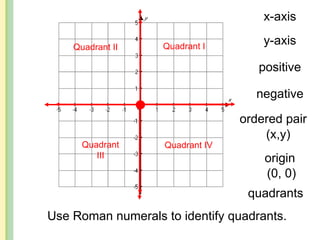
x-axis
y-axis
positive
negative
origin
quadrants
ordered pair
(x,y)
(0, 0)
Quadrant I
Quadrant II
Quadrant
III
Quadrant IV
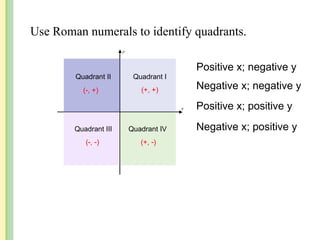
Use Roman numerals to identify quadrants.
Quadrant I
Quadrant II
Quadrant III Quadrant IV
(+, +)
(, +)
(, ) (+, )
Positive x; negative y
Negative x; negative y
Positive x; positive y
Negative x; positive y
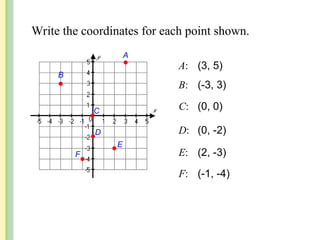
Write the coordinates for each point shown.
A
B
D
F
E
C
A:
B:
C:
D:
E:
F:
(3, 5)
(-3, 3)
(0, 0)
(0, -2)
(2, -3)
(-1, -4)
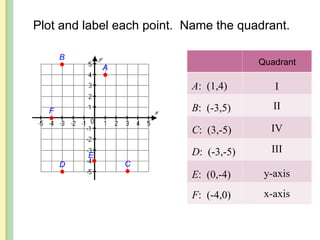
Plot and label each point. Name the quadrant.
Quadrant
A: (1,4)
B: (-3,5)
C: (3,-5)
D: (-3,-5)
E: (0,-4)
F: (-4,0)
A
B
C
D
E
F
I
II
IV
III
y-axis
x-axis
 In many problems data are listed as ordered pairs.
 If we plot each pair of data as an ordered pair, we
can see whether the points form a straight line.
 If they form a straight line they are linear.
 Points that do not form a straight line are nonlinear.
Linear versus Non-linear
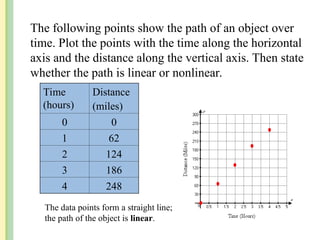
The following points show the path of an object over
time. Plot the points with the time along the horizontal
axis and the distance along the vertical axis. Then state
whether the path is linear or nonlinear.
Time
(hours)
Distance
(miles)
0 0
1 62
2 124
3 186
4 248
The data points form a straight line;
the path of the object is linear.
Slide 4- 8
Copyright © 2007 Pearson Education, Inc. Publishing as Pearson Addison-Wesley
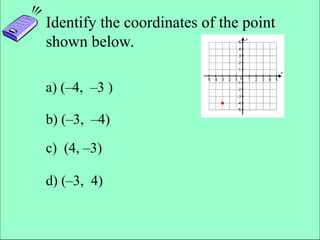
Identify the coordinates of the point
shown below.
a) (–4, –3 )
b) (–3, –4)
c) (4, –3)
d) (–3, 4)
Slide 4- 9
Copyright © 2007 Pearson Education, Inc. Publishing as Pearson Addison-Wesley
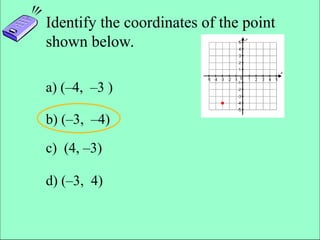
Identify the coordinates of the point
shown below.
a) (–4, –3 )
b) (–3, –4)
c) (4, –3)
d) (–3, 4)
Slide 4- 10
Copyright © 2007 Pearson Education, Inc. Publishing as Pearson Addison-Wesley
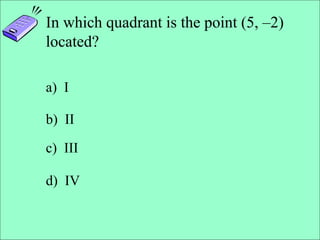
In which quadrant is the point (5, –2)
located?
a) I
b) II
c) III
d) IV
Slide 4- 11
Copyright © 2007 Pearson Education, Inc. Publishing as Pearson Addison-Wesley
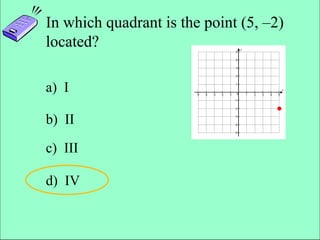
In which quadrant is the point (5, –2)
located?
a) I
b) II
c) III
d) IV
Graphing Linear Equations
4.2
4.2
1. Determine whether a given pair of coordinates is a
solution to a given equation with two unknowns.
2. Find solutions for an equation with two unknowns.
3. Graph linear equations.
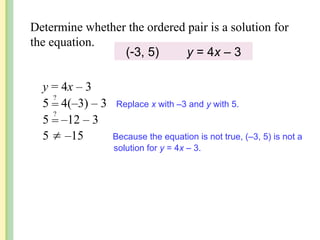
Determine whether the ordered pair is a solution for
the equation.
y = 4x – 3
5 4(–3) – 3 Replace x with –3 and y with 5.
5 –12 – 3
5  –15 Because the equation is not true, (–3, 5) is not a
solution for y = 4x – 3.
(3, 5) y = 4x – 3
?
=
?
=
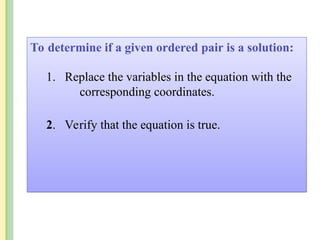
To determine if a given ordered pair is a solution:
1. Replace the variables in the equation with the
corresponding coordinates.
2. Verify that the equation is true.
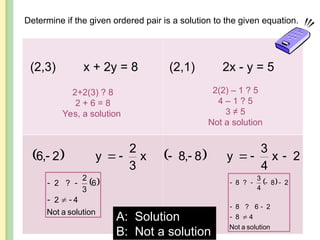
Determine if the given ordered pair is a solution to the given equation.
(2,3) x + 2y = 8 (2,1) 2x - y = 5
  x
3
2
y
2
,
6 

   2
x
4
3
y
8
,
8 




A: Solution
B: Not a solution
2+2(3) ? 8
2 + 6 = 8
Yes, a solution
2(2) – 1 ? 5
4 – 1 ? 5
3 ≠ 5
Not a solution
 
solution
a
Not
4
2
6
3
2
?
2




  
solution
a
Not
4
8
2
6
?
8
2
8
4
3
?
8








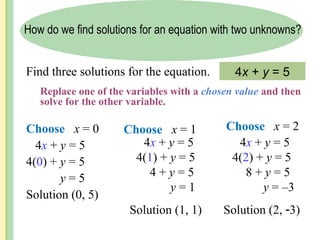
Find three solutions for the equation.
Replace one of the variables with a chosen value and then
solve for the other variable.
Choose x = 0
4x + y = 5
4(0) + y = 5
y = 5
Solution (0, 5)
4x + y = 5
4(1) + y = 5
4 + y = 5
y = 1
Solution (1, 1)
4x + y = 5
4(2) + y = 5
8 + y = 5
y = –3
Solution (2, 3)
How do we find solutions for an equation with two unknowns?
4x + y = 5
Choose x = 2
Choose x = 1
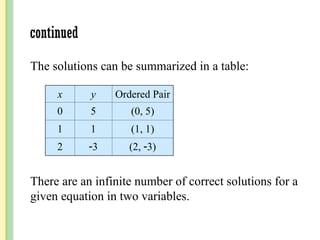
continued
The solutions can be summarized in a table:
There are an infinite number of correct solutions for a
given equation in two variables.
x y Ordered Pair
0 5 (0, 5)
1 1 (1, 1)
2 3 (2, 3)
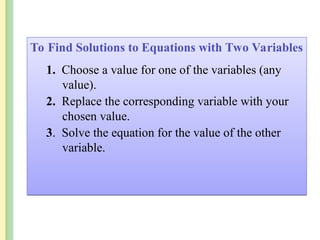
To Find Solutions to Equations with Two Variables
1. Choose a value for one of the variables (any
value).
2. Replace the corresponding variable with your
chosen value.
3. Solve the equation for the value of the other
variable.
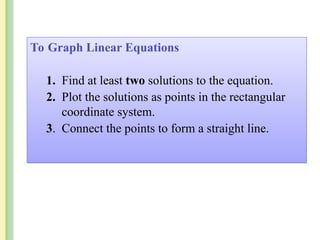
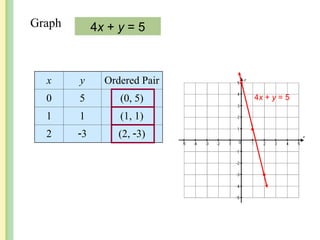
To Graph Linear Equations
1. Find at least two solutions to the equation.
2. Plot the solutions as points in the rectangular
coordinate system.
3. Connect the points to form a straight line.
Graph
x y Ordered Pair
0 5 (0, 5)
1 1 (1, 1)
2 3 (2, 3)
4x + y = 5
4x + y = 5
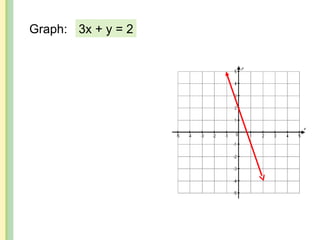
Graph: 3x + y = 2
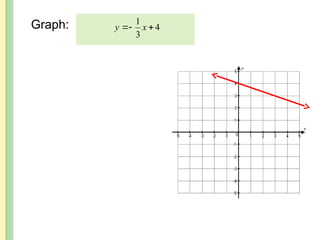
Graph: 4
3
1


 x
y
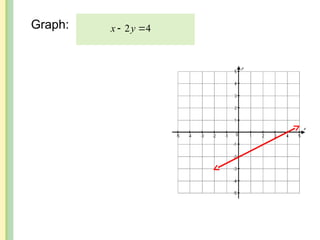
Graph: 4
2 
 y
x
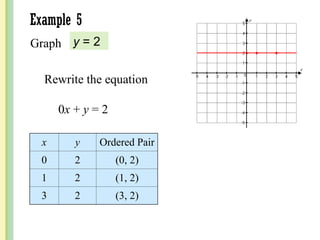
Example 5
Graph
Rewrite the equation
0x + y = 2
x y Ordered Pair
0 2 (0, 2)
1 2 (1, 2)
3 2 (3, 2)
y = 2
y = 2
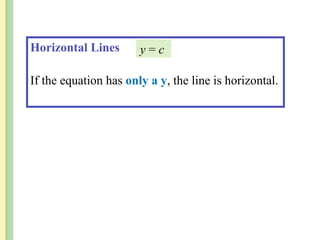
Horizontal Lines
If the equation has only a y, the line is horizontal.
y = c
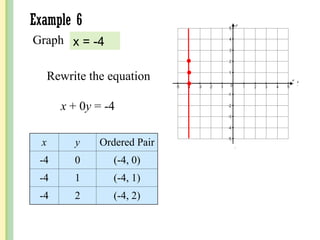
Example 6
Graph
Rewrite the equation
x + 0y = -4
x y Ordered Pair
-4 0 (-4, 0)
-4 1 (-4, 1)
-4 2 (-4, 2)
x = -4
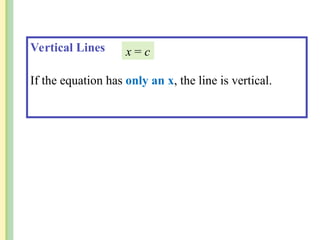
Vertical Lines
If the equation has only an x, the line is vertical.
x = c
Slide 4- 28
Copyright © 2007 Pearson Education, Inc. Publishing as Pearson Addison-Wesley
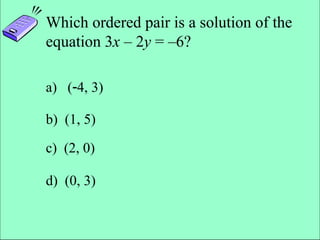
Which ordered pair is a solution of the
equation 3x – 2y = –6?
a) (4, 3)
b) (1, 5)
c) (2, 0)
d) (0, 3)
Slide 4- 29
Copyright © 2007 Pearson Education, Inc. Publishing as Pearson Addison-Wesley
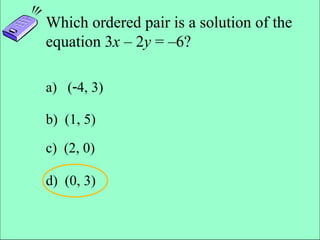
Which ordered pair is a solution of the
equation 3x – 2y = –6?
a) (4, 3)
b) (1, 5)
c) (2, 0)
d) (0, 3)
Slide 4- 30
Copyright © 2007 Pearson Education, Inc. Publishing as Pearson Addison-Wesley
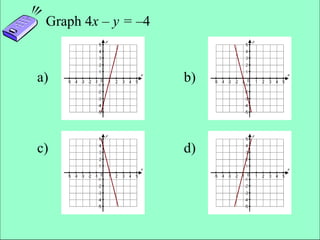
Graph 4x – y = –4
a) b)
c) d)
Slide 4- 31
Copyright © 2007 Pearson Education, Inc. Publishing as Pearson Addison-Wesley
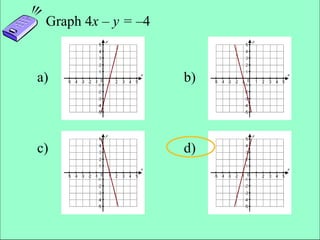
Graph 4x – y = –4
a) b)
c) d)

Rectangular Coordinate System MAthematics 8

  • 1.
    The Rectangular CoordinateSystem 4.1 4.1 1. Determine the coordinates of a given point. 2. Plot points in the coordinate plane. 3. Determine the quadrant for a given coordinate. 4. Determine whether the graph of a set of data points is linear.
  • 2.
    x-axis y-axis positive negative origin quadrants ordered pair (x,y) (0, 0) QuadrantI Quadrant II Quadrant III Quadrant IV Use Roman numerals to identify quadrants.
  • 3.
    Use Roman numeralsto identify quadrants. Quadrant I Quadrant II Quadrant III Quadrant IV (+, +) (, +) (, ) (+, ) Positive x; negative y Negative x; negative y Positive x; positive y Negative x; positive y
  • 4.
    Write the coordinatesfor each point shown. A B D F E C A: B: C: D: E: F: (3, 5) (-3, 3) (0, 0) (0, -2) (2, -3) (-1, -4)
  • 5.
    Plot and labeleach point. Name the quadrant. Quadrant A: (1,4) B: (-3,5) C: (3,-5) D: (-3,-5) E: (0,-4) F: (-4,0) A B C D E F I II IV III y-axis x-axis
  • 6.
     In manyproblems data are listed as ordered pairs.  If we plot each pair of data as an ordered pair, we can see whether the points form a straight line.  If they form a straight line they are linear.  Points that do not form a straight line are nonlinear. Linear versus Non-linear
  • 7.
    The following pointsshow the path of an object over time. Plot the points with the time along the horizontal axis and the distance along the vertical axis. Then state whether the path is linear or nonlinear. Time (hours) Distance (miles) 0 0 1 62 2 124 3 186 4 248 The data points form a straight line; the path of the object is linear.
  • 8.
    Slide 4- 8 Copyright© 2007 Pearson Education, Inc. Publishing as Pearson Addison-Wesley Identify the coordinates of the point shown below. a) (–4, –3 ) b) (–3, –4) c) (4, –3) d) (–3, 4)
  • 9.
    Slide 4- 9 Copyright© 2007 Pearson Education, Inc. Publishing as Pearson Addison-Wesley Identify the coordinates of the point shown below. a) (–4, –3 ) b) (–3, –4) c) (4, –3) d) (–3, 4)
  • 10.
    Slide 4- 10 Copyright© 2007 Pearson Education, Inc. Publishing as Pearson Addison-Wesley In which quadrant is the point (5, –2) located? a) I b) II c) III d) IV
  • 11.
    Slide 4- 11 Copyright© 2007 Pearson Education, Inc. Publishing as Pearson Addison-Wesley In which quadrant is the point (5, –2) located? a) I b) II c) III d) IV
  • 12.
    Graphing Linear Equations 4.2 4.2 1.Determine whether a given pair of coordinates is a solution to a given equation with two unknowns. 2. Find solutions for an equation with two unknowns. 3. Graph linear equations.
  • 13.
    Determine whether theordered pair is a solution for the equation. y = 4x – 3 5 4(–3) – 3 Replace x with –3 and y with 5. 5 –12 – 3 5  –15 Because the equation is not true, (–3, 5) is not a solution for y = 4x – 3. (3, 5) y = 4x – 3 ? = ? =
  • 14.
    To determine ifa given ordered pair is a solution: 1. Replace the variables in the equation with the corresponding coordinates. 2. Verify that the equation is true.
  • 15.
    Determine if thegiven ordered pair is a solution to the given equation. (2,3) x + 2y = 8 (2,1) 2x - y = 5   x 3 2 y 2 , 6      2 x 4 3 y 8 , 8      A: Solution B: Not a solution 2+2(3) ? 8 2 + 6 = 8 Yes, a solution 2(2) – 1 ? 5 4 – 1 ? 5 3 ≠ 5 Not a solution   solution a Not 4 2 6 3 2 ? 2        solution a Not 4 8 2 6 ? 8 2 8 4 3 ? 8        
  • 16.
    Find three solutionsfor the equation. Replace one of the variables with a chosen value and then solve for the other variable. Choose x = 0 4x + y = 5 4(0) + y = 5 y = 5 Solution (0, 5) 4x + y = 5 4(1) + y = 5 4 + y = 5 y = 1 Solution (1, 1) 4x + y = 5 4(2) + y = 5 8 + y = 5 y = –3 Solution (2, 3) How do we find solutions for an equation with two unknowns? 4x + y = 5 Choose x = 2 Choose x = 1
  • 17.
    continued The solutions canbe summarized in a table: There are an infinite number of correct solutions for a given equation in two variables. x y Ordered Pair 0 5 (0, 5) 1 1 (1, 1) 2 3 (2, 3)
  • 18.
    To Find Solutionsto Equations with Two Variables 1. Choose a value for one of the variables (any value). 2. Replace the corresponding variable with your chosen value. 3. Solve the equation for the value of the other variable.
  • 19.
    To Graph LinearEquations 1. Find at least two solutions to the equation. 2. Plot the solutions as points in the rectangular coordinate system. 3. Connect the points to form a straight line.
  • 20.
    Graph x y OrderedPair 0 5 (0, 5) 1 1 (1, 1) 2 3 (2, 3) 4x + y = 5 4x + y = 5
  • 21.
  • 22.
  • 23.
  • 24.
    Example 5 Graph Rewrite theequation 0x + y = 2 x y Ordered Pair 0 2 (0, 2) 1 2 (1, 2) 3 2 (3, 2) y = 2 y = 2
  • 25.
    Horizontal Lines If theequation has only a y, the line is horizontal. y = c
  • 26.
    Example 6 Graph Rewrite theequation x + 0y = -4 x y Ordered Pair -4 0 (-4, 0) -4 1 (-4, 1) -4 2 (-4, 2) x = -4
  • 27.
    Vertical Lines If theequation has only an x, the line is vertical. x = c
  • 28.
    Slide 4- 28 Copyright© 2007 Pearson Education, Inc. Publishing as Pearson Addison-Wesley Which ordered pair is a solution of the equation 3x – 2y = –6? a) (4, 3) b) (1, 5) c) (2, 0) d) (0, 3)
  • 29.
    Slide 4- 29 Copyright© 2007 Pearson Education, Inc. Publishing as Pearson Addison-Wesley Which ordered pair is a solution of the equation 3x – 2y = –6? a) (4, 3) b) (1, 5) c) (2, 0) d) (0, 3)
  • 30.
    Slide 4- 30 Copyright© 2007 Pearson Education, Inc. Publishing as Pearson Addison-Wesley Graph 4x – y = –4 a) b) c) d)
  • 31.
    Slide 4- 31 Copyright© 2007 Pearson Education, Inc. Publishing as Pearson Addison-Wesley Graph 4x – y = –4 a) b) c) d)