Derivations
and Languages
-Sampath Kumar S,
AP/CSE, SECE
Derivations and Languages
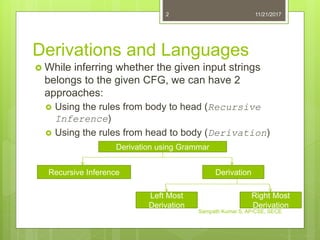
 While inferring whether the given input strings
belongs to the given CFG, we can have 2
approaches:
 Using the rules from body to head (Recursive
Inference)
 Using the rules from head to body (Derivation)
11/21/2017
Sampath Kumar S, AP/CSE, SECE
2
Derivation using Grammar
Recursive Inference Derivation
Left Most
Derivation
Right Most
Derivation
Recursive Inference:
 Here we take string from each variables,
concatenate them in proper order and infer that the
resulting string is in the language of the variable in
the head
11/21/20173
Sampath Kumar S, AP/CSE, SECE
Derivation:
 Here we use the production from head to body i.e.,
from start symbol expanding till reaches the given
string. This use of grammar is called derivation.
11/21/20174
Sampath Kumar S, AP/CSE, SECE
Problems to discuss:
61. For the language L = {wcwR | w (0+1)*} check
whether the string 01c10 belongs to the language
L or not.
Solution:
Step 1: For the language L, the productions are
S → 0S0 | 1S1 | C
Step 2: Derivation
S → 0S0 [∵ S → 0S0]
→ 01E10 [∵ S → 1S1]
→ 01c10 [∵ S → c]
11/21/2017
Sampath Kumar S, AP/CSE, SECE
5
Understanding the Language
defined by CFG:
 The only way to recognize the language, is to try
out various strings from the given production rules.
 Then by observing the derived strings, one can
find out the language generated from the given
CFG.
11/21/2017
Sampath Kumar S, AP/CSE, SECE
6
Problems to discuss:
62. Derive ‘a4’ from the grammar G=({S}, {a},P,S)
where P: S → aS|ε.
63. Find L(G) and derive the string ‘abbab’ for the
grammar G=({S}, {a},P,S) where
P: S → aS|bS|a|b.
64. Find L(G) and derive the string ‘abbaaba’ for the
grammar G=({S,X}, {a},P,S) where
P: S → XaaX, X → aX|bX|ε.
65. Find L(G) for the grammar G=({S,C}, {a,b},P,S)
where P is given by S → aCa, C → aCa|b.
11/21/2017
Sampath Kumar S, AP/CSE, SECE
7
Leftmost and Rightmost Derivation:
 If a word w is generated by a CFG by a certain
derivation and at each step in the derivation, a rule
of production is applied to the leftmost non
terminal in the working string, then this derivation
is called leftmost derivation (LMD).
 If a word w is generated by a CFG by a certain
derivation and at each step in the derivation, a rule
of production is applied to the rightmost non
terminal in the working string, then this derivation
is called rightmost derivation (RMD).
11/21/2017
Sampath Kumar S, AP/CSE, SECE
9
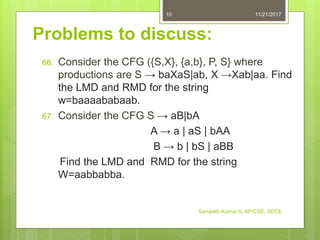
Problems to discuss:
66. Consider the CFG ({S,X}, {a,b}, P, S} where
productions are S → baXaS|ab, X →Xab|aa. Find
the LMD and RMD for the string
w=baaaababaab.
67. Consider the CFG S → aB|bA
A → a | aS | bAA
B → b | bS | aBB
Find the LMD and RMD for the string
W=aabbabba.
11/21/2017
Sampath Kumar S, AP/CSE, SECE
10
Derivation Tree:
 A derivation tree or parse tree is an ordered
rooted tree that graphically represents the
semantic information a string derived from a
Context - Free Grammar.
11/21/2017
Sampath Kumar S, AP/CSE, SECE
11
Representation Technique
 Root vertex − Must be labeled by the start
symbol.
 Vertex − Labeled by a non-terminal symbol.
 Leaves − Labeled by a terminal symbol or ε.
If S → x1x2 …… xn is a production rule in a
CFG, then the parse tree / derivation tree will be
as follows −
11/21/2017
Sampath Kumar S, AP/CSE, SECE
12
Approaches for constructing
Derivation Tree:
There are two different approaches to draw a
derivation tree −
 Top-down Approach −
 Starts with the starting symbol S
 Goes down to tree leaves using productions
 Bottom-up Approach −
 Starts from tree leaves
 Proceeds upward to the root which is the starting
symbol S
11/21/2017
Sampath Kumar S, AP/CSE, SECE
13
Derivation or Yield of a Tree:
 The derivation or the yield of a parse tree is the
final string obtained by concatenating the labels of
the leaves of the tree from left to right, ignoring the
Nulls.
 However, if all the leaves are Null, derivation is
Null.
11/21/2017
Sampath Kumar S, AP/CSE, SECE
14
Sentential Form and Partial
Derivation Tree:
 A partial derivation tree is a sub-tree of a
derivation tree/parse tree such that either all of its
children are in the sub-tree or none of them are in
the sub-tree.
11/21/2017
Sampath Kumar S, AP/CSE, SECE
15
Leftmost and Rightmost
Derivation of a String
 Leftmost derivation − A leftmost derivation is
obtained by applying production to the leftmost
variable in each step.
 Rightmost derivation − A rightmost derivation is
obtained by applying production to the rightmost
variable in each step.
11/21/2017
Sampath Kumar S, AP/CSE, SECE
16
Left and Right Recursive Grammars
 In a context-free grammar G, if there is a
production in the form X → Xa, where X is a non-
terminal and ‘a’ is a string of terminals, it is called
a left recursive production. The grammar having
a left recursive production is called a left
recursive grammar.
 If in a context-free grammar G, if there is a
production is in the form X → aX where X is a non-
terminal and ‘a’ is a string of terminals, it is called
a right recursive production. The grammar
having a right recursive production is called a right
recursive grammar.
11/21/2017
Sampath Kumar S, AP/CSE, SECE
17
Problems to discuss:
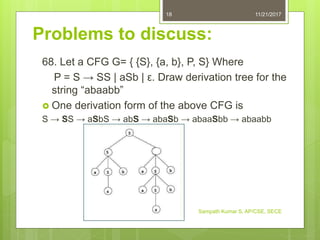
68. Let a CFG G= { {S}, {a, b}, P, S} Where
P = S → SS | aSb | ε. Draw derivation tree for the
string “abaabb”
 One derivation form of the above CFG is
S → SS → aSbS → abS → abaSb → abaaSbb → abaabb
11/21/2017
Sampath Kumar S, AP/CSE, SECE
18
Problems to discuss:
69. Let any set of production rules in a CFG be X →
X+X | X*X |X| a over an alphabet {a}. Find LMD and
RMD for string "a+a*a“.
70. Construct Parse tree for the string a*(a+b00) for the
following CFG using left and right most derivation.
E → A | E + E | E * E | (E)
A → a | b |Aa | Ab | A0 | A1
71. Construct Parse tree for the string a*(a+a) for the
following CFG using left and right most derivation.
E → E + E | E * E | (E) | a
11/21/2017
Sampath Kumar S, AP/CSE, SECE
19
Problems to discuss:
72. Generate parse tree for the string 00101 using
left and right most derivation for following CFG
S → A1B, A → 0A|ε | B → 0B | 1B | ε
73. Generate parse tree for the string babbab using
left and right most derivation for following CFG
S → aSa | bSb | a |b | ε
11/21/2017
Sampath Kumar S, AP/CSE, SECE
20
11/21/2017
Sampath Kumar S, AP/CSE, SECE
21
நன்றி
11/21/2017
Sampath Kumar S, AP/CSE, SECE
22

2.4 derivations and languages

  • 1.
  • 2.
    Derivations and Languages While inferring whether the given input strings belongs to the given CFG, we can have 2 approaches:  Using the rules from body to head (Recursive Inference)  Using the rules from head to body (Derivation) 11/21/2017 Sampath Kumar S, AP/CSE, SECE 2 Derivation using Grammar Recursive Inference Derivation Left Most Derivation Right Most Derivation
  • 3.
    Recursive Inference:  Herewe take string from each variables, concatenate them in proper order and infer that the resulting string is in the language of the variable in the head 11/21/20173 Sampath Kumar S, AP/CSE, SECE
  • 4.
    Derivation:  Here weuse the production from head to body i.e., from start symbol expanding till reaches the given string. This use of grammar is called derivation. 11/21/20174 Sampath Kumar S, AP/CSE, SECE
  • 5.
    Problems to discuss: 61.For the language L = {wcwR | w (0+1)*} check whether the string 01c10 belongs to the language L or not. Solution: Step 1: For the language L, the productions are S → 0S0 | 1S1 | C Step 2: Derivation S → 0S0 [∵ S → 0S0] → 01E10 [∵ S → 1S1] → 01c10 [∵ S → c] 11/21/2017 Sampath Kumar S, AP/CSE, SECE 5
  • 6.
    Understanding the Language definedby CFG:  The only way to recognize the language, is to try out various strings from the given production rules.  Then by observing the derived strings, one can find out the language generated from the given CFG. 11/21/2017 Sampath Kumar S, AP/CSE, SECE 6
  • 7.
    Problems to discuss: 62.Derive ‘a4’ from the grammar G=({S}, {a},P,S) where P: S → aS|ε. 63. Find L(G) and derive the string ‘abbab’ for the grammar G=({S}, {a},P,S) where P: S → aS|bS|a|b. 64. Find L(G) and derive the string ‘abbaaba’ for the grammar G=({S,X}, {a},P,S) where P: S → XaaX, X → aX|bX|ε. 65. Find L(G) for the grammar G=({S,C}, {a,b},P,S) where P is given by S → aCa, C → aCa|b. 11/21/2017 Sampath Kumar S, AP/CSE, SECE 7
  • 8.
    Leftmost and RightmostDerivation:  If a word w is generated by a CFG by a certain derivation and at each step in the derivation, a rule of production is applied to the leftmost non terminal in the working string, then this derivation is called leftmost derivation (LMD).  If a word w is generated by a CFG by a certain derivation and at each step in the derivation, a rule of production is applied to the rightmost non terminal in the working string, then this derivation is called rightmost derivation (RMD). 11/21/2017 Sampath Kumar S, AP/CSE, SECE 9
  • 9.
    Problems to discuss: 66.Consider the CFG ({S,X}, {a,b}, P, S} where productions are S → baXaS|ab, X →Xab|aa. Find the LMD and RMD for the string w=baaaababaab. 67. Consider the CFG S → aB|bA A → a | aS | bAA B → b | bS | aBB Find the LMD and RMD for the string W=aabbabba. 11/21/2017 Sampath Kumar S, AP/CSE, SECE 10
  • 10.
    Derivation Tree:  Aderivation tree or parse tree is an ordered rooted tree that graphically represents the semantic information a string derived from a Context - Free Grammar. 11/21/2017 Sampath Kumar S, AP/CSE, SECE 11
  • 11.
    Representation Technique  Rootvertex − Must be labeled by the start symbol.  Vertex − Labeled by a non-terminal symbol.  Leaves − Labeled by a terminal symbol or ε. If S → x1x2 …… xn is a production rule in a CFG, then the parse tree / derivation tree will be as follows − 11/21/2017 Sampath Kumar S, AP/CSE, SECE 12
  • 12.
    Approaches for constructing DerivationTree: There are two different approaches to draw a derivation tree −  Top-down Approach −  Starts with the starting symbol S  Goes down to tree leaves using productions  Bottom-up Approach −  Starts from tree leaves  Proceeds upward to the root which is the starting symbol S 11/21/2017 Sampath Kumar S, AP/CSE, SECE 13
  • 13.
    Derivation or Yieldof a Tree:  The derivation or the yield of a parse tree is the final string obtained by concatenating the labels of the leaves of the tree from left to right, ignoring the Nulls.  However, if all the leaves are Null, derivation is Null. 11/21/2017 Sampath Kumar S, AP/CSE, SECE 14
  • 14.
    Sentential Form andPartial Derivation Tree:  A partial derivation tree is a sub-tree of a derivation tree/parse tree such that either all of its children are in the sub-tree or none of them are in the sub-tree. 11/21/2017 Sampath Kumar S, AP/CSE, SECE 15
  • 15.
    Leftmost and Rightmost Derivationof a String  Leftmost derivation − A leftmost derivation is obtained by applying production to the leftmost variable in each step.  Rightmost derivation − A rightmost derivation is obtained by applying production to the rightmost variable in each step. 11/21/2017 Sampath Kumar S, AP/CSE, SECE 16
  • 16.
    Left and RightRecursive Grammars  In a context-free grammar G, if there is a production in the form X → Xa, where X is a non- terminal and ‘a’ is a string of terminals, it is called a left recursive production. The grammar having a left recursive production is called a left recursive grammar.  If in a context-free grammar G, if there is a production is in the form X → aX where X is a non- terminal and ‘a’ is a string of terminals, it is called a right recursive production. The grammar having a right recursive production is called a right recursive grammar. 11/21/2017 Sampath Kumar S, AP/CSE, SECE 17
  • 17.
    Problems to discuss: 68.Let a CFG G= { {S}, {a, b}, P, S} Where P = S → SS | aSb | ε. Draw derivation tree for the string “abaabb”  One derivation form of the above CFG is S → SS → aSbS → abS → abaSb → abaaSbb → abaabb 11/21/2017 Sampath Kumar S, AP/CSE, SECE 18
  • 18.
    Problems to discuss: 69.Let any set of production rules in a CFG be X → X+X | X*X |X| a over an alphabet {a}. Find LMD and RMD for string "a+a*a“. 70. Construct Parse tree for the string a*(a+b00) for the following CFG using left and right most derivation. E → A | E + E | E * E | (E) A → a | b |Aa | Ab | A0 | A1 71. Construct Parse tree for the string a*(a+a) for the following CFG using left and right most derivation. E → E + E | E * E | (E) | a 11/21/2017 Sampath Kumar S, AP/CSE, SECE 19
  • 19.
    Problems to discuss: 72.Generate parse tree for the string 00101 using left and right most derivation for following CFG S → A1B, A → 0A|ε | B → 0B | 1B | ε 73. Generate parse tree for the string babbab using left and right most derivation for following CFG S → aSa | bSb | a |b | ε 11/21/2017 Sampath Kumar S, AP/CSE, SECE 20
  • 20.
  • 21.

Editor's Notes

  • #2 School of EECS, WSU