1
Parse Trees
Definitions
Relationship to lm and rm Derivations
Ambiguity in Grammars
2
Parse Trees: graphical representations of
derivations
Parse trees have nodes labeled by symbols of
a CFG.
Leaves: labeled by a terminal or ε.
Interior nodes: labeled by variables.
Children are labeled by the right side of a
production for the parent.
Root: labeled by the start symbol.
Yield: string produced by concatenation of
leaves left-to-right
3
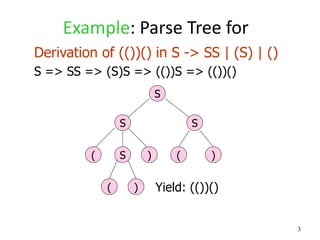
Example: Parse Tree for
Derivation of (())() in S -> SS | (S) | ()
S => SS => (S)S => (())S => (())()
S
S
S
S )
(
( )
( )
Yield: (())()
4
For CFG with start symbol S and productions
S->A1B
A->0A|e
B->0B|1B|e
Show that the parse trees of lm and rm derivations of string
00101 are identical
Work on board
5
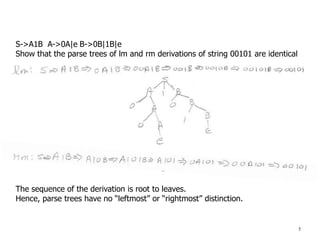
S->A1B A->0A|e B->0B|1B|e
Show that the parse trees of lm and rm derivations of string 00101 are identical
The sequence of the derivation is root to leaves.
Hence, parse trees have no “leftmost” or “rightmost” distinction.
6
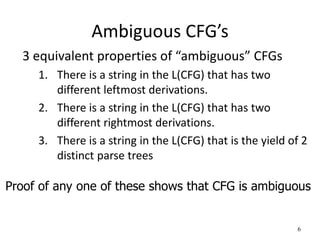
Ambiguous CFG’s
3 equivalent properties of “ambiguous” CFGs
1. There is a string in the L(CFG) that has two
different leftmost derivations.
2. There is a string in the L(CFG) that has two
different rightmost derivations.
3. There is a string in the L(CFG) that is the yield of 2
distinct parse trees
Proof of any one of these shows that CFG is ambiguous
7
Prove S -> SS | (S) | () is ambiguous
by 2 left-most derivations of ()()()
Work on board
8
S -> SS | (S) | () is ambiguous
Prove by 2 lm derivations of ()()()
S=>SS=>SSS=>()SS=>()()S=>()()()
S=>SS=>()S=>()SS=>()()S=>()()()
9
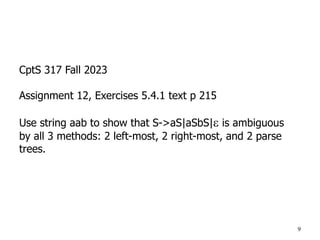
CptS 317 Fall 2023
Assignment 12, Exercises 5.4.1 text p 215
Use string aab to show that S->aS|aSbS|e is ambiguous
by all 3 methods: 2 left-most, 2 right-most, and 2 parse
trees.
10
Exercise 5.4.3 p216
Remove the ambiguity in S->aS|aSbS|e
As you will demonstrate in HW12, derivations of aab can
start with either S=>aS or S=>aSbS.
To remove ambiguity in derivation of aab we change the
production S=>aSbS to one that forces only one way to
start.
Example: add variable T with productions such that starting
with S=>aTbS cannot produce aab by lm steps.
11
Show on board that in CFG
S->aS
S->aTbS
S->e
T->aTbT
T->e
the left-most derivation of aab is unique
13
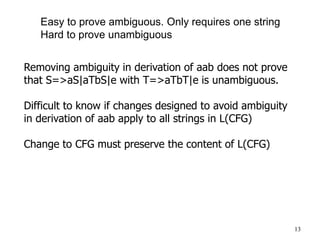
Removing ambiguity in derivation of aab does not prove
that S=>aS|aTbS|e with T=>aTbT|e is unambiguous.
Difficult to know if changes designed to avoid ambiguity
in derivation of aab apply to all strings in L(CFG)
Change to CFG must preserve the content of L(CFG)
Easy to prove ambiguous. Only requires one string
Hard to prove unambiguous
14
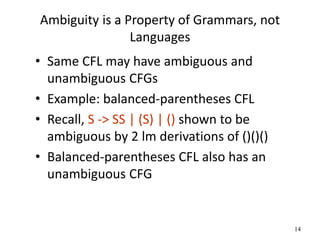
Ambiguity is a Property of Grammars, not
Languages
• Same CFL may have ambiguous and
unambiguous CFGs
• Example: balanced-parentheses CFL
• Recall, S -> SS | (S) | () shown to be
ambiguous by 2 lm derivations of ()()()
• Balanced-parentheses CFL also has an
unambiguous CFG
15
Unambiguous balanced-parenthesis CFG
B -> (RB | ε R -> ) | (RR
B is the start symbol
Derivations must start with B ->(RB
To expand with “(“, use R->(RR
To expand with “)”, use R ->)
End with B->e
Example of LL(1) CFG: “Leftmost derivation, left-to-right
scan, one symbol of look-a-head.”
16
Unambiguous balanced-parenthesis CFG
B -> (RB | ε R -> ) | (RR
Example derivation of (())() by LL(1)
Work on board
17
Unambiguous balanced-parenthesis CFG
B -> (RB | ε R -> ) | (RR
Example derivation of (())()
B =>lm (RB =>lm ((RRB =>lm (()RB =>lm (())B
(())B =>lm (())(RB =>lm (())()B =>lm (())()
At each lm step, the production needed is uniquely
defined.
18
LL(1) Grammars
• By construction obviously unambiguous
• You can always figure out the production to
use in a leftmost derivation by scanning the
given string left-to-right and looking at the
next symbol only
• Most programming languages have LL(1)
grammars.
19
Inherent Ambiguity
• Not every ambiguous grammar can be
“fixed” as was the case with the balanced-
parentheses grammar.
• Some CFL’s are inherently ambiguous; every
grammar for the language is ambiguous.
20
Example: Inherent Ambiguity
• The language {0i1j2k | i = j or j = k} is inherently
ambiguous.
• At least some of the strings of the form 0n1n2n
can be generated by two left-most derivations
depending on which you check first: equal
number of 0’s and 1’s or equal number of 1’s
and 2’s.
21
Example of ambiguous grammar for
{0i1j2k | i = j or j = k}
S -> AB | CD
A -> 0A1 | 01
B -> 2B | 2
C -> 0C | 0
D -> 1D2 | 12
A generates equal 0’s and 1’s
B generates any number of 2’s
C generates any number of 0’s
D generates equal 1’s and 2’s
There are two leftmost derivations of every string with
equal numbers of 0’s, 1’s, and 2’s.
Show true for n=2, w=001122, with 2 lm derivations
Show on board
22
Example of ambiguous grammar for
{0i1j2k | i = j or j = k}
S -> AB | CD
A -> 0A1 | 01
B -> 2B | 2
C -> 0C | 0
D -> 1D2 | 12
A generates equal 0’s and 1’s
B generates any number of 2’s
C generates any number of 0’s
D generates equal 1’s and 2’s
lm: S => AB => 0A1B =>0011B => 0112B => 001122
lm: S => CD => 0CD=>00D => 001D2 => 001122

L11 context-free grammers 2.pptx parse tree

  • 1.
    1 Parse Trees Definitions Relationship tolm and rm Derivations Ambiguity in Grammars
  • 2.
    2 Parse Trees: graphicalrepresentations of derivations Parse trees have nodes labeled by symbols of a CFG. Leaves: labeled by a terminal or ε. Interior nodes: labeled by variables. Children are labeled by the right side of a production for the parent. Root: labeled by the start symbol. Yield: string produced by concatenation of leaves left-to-right
  • 3.
    3 Example: Parse Treefor Derivation of (())() in S -> SS | (S) | () S => SS => (S)S => (())S => (())() S S S S ) ( ( ) ( ) Yield: (())()
  • 4.
    4 For CFG withstart symbol S and productions S->A1B A->0A|e B->0B|1B|e Show that the parse trees of lm and rm derivations of string 00101 are identical Work on board
  • 5.
    5 S->A1B A->0A|e B->0B|1B|e Showthat the parse trees of lm and rm derivations of string 00101 are identical The sequence of the derivation is root to leaves. Hence, parse trees have no “leftmost” or “rightmost” distinction.
  • 6.
    6 Ambiguous CFG’s 3 equivalentproperties of “ambiguous” CFGs 1. There is a string in the L(CFG) that has two different leftmost derivations. 2. There is a string in the L(CFG) that has two different rightmost derivations. 3. There is a string in the L(CFG) that is the yield of 2 distinct parse trees Proof of any one of these shows that CFG is ambiguous
  • 7.
    7 Prove S ->SS | (S) | () is ambiguous by 2 left-most derivations of ()()() Work on board
  • 8.
    8 S -> SS| (S) | () is ambiguous Prove by 2 lm derivations of ()()() S=>SS=>SSS=>()SS=>()()S=>()()() S=>SS=>()S=>()SS=>()()S=>()()()
  • 9.
    9 CptS 317 Fall2023 Assignment 12, Exercises 5.4.1 text p 215 Use string aab to show that S->aS|aSbS|e is ambiguous by all 3 methods: 2 left-most, 2 right-most, and 2 parse trees.
  • 10.
    10 Exercise 5.4.3 p216 Removethe ambiguity in S->aS|aSbS|e As you will demonstrate in HW12, derivations of aab can start with either S=>aS or S=>aSbS. To remove ambiguity in derivation of aab we change the production S=>aSbS to one that forces only one way to start. Example: add variable T with productions such that starting with S=>aTbS cannot produce aab by lm steps.
  • 11.
    11 Show on boardthat in CFG S->aS S->aTbS S->e T->aTbT T->e the left-most derivation of aab is unique
  • 13.
    13 Removing ambiguity inderivation of aab does not prove that S=>aS|aTbS|e with T=>aTbT|e is unambiguous. Difficult to know if changes designed to avoid ambiguity in derivation of aab apply to all strings in L(CFG) Change to CFG must preserve the content of L(CFG) Easy to prove ambiguous. Only requires one string Hard to prove unambiguous
  • 14.
    14 Ambiguity is aProperty of Grammars, not Languages • Same CFL may have ambiguous and unambiguous CFGs • Example: balanced-parentheses CFL • Recall, S -> SS | (S) | () shown to be ambiguous by 2 lm derivations of ()()() • Balanced-parentheses CFL also has an unambiguous CFG
  • 15.
    15 Unambiguous balanced-parenthesis CFG B-> (RB | ε R -> ) | (RR B is the start symbol Derivations must start with B ->(RB To expand with “(“, use R->(RR To expand with “)”, use R ->) End with B->e Example of LL(1) CFG: “Leftmost derivation, left-to-right scan, one symbol of look-a-head.”
  • 16.
    16 Unambiguous balanced-parenthesis CFG B-> (RB | ε R -> ) | (RR Example derivation of (())() by LL(1) Work on board
  • 17.
    17 Unambiguous balanced-parenthesis CFG B-> (RB | ε R -> ) | (RR Example derivation of (())() B =>lm (RB =>lm ((RRB =>lm (()RB =>lm (())B (())B =>lm (())(RB =>lm (())()B =>lm (())() At each lm step, the production needed is uniquely defined.
  • 18.
    18 LL(1) Grammars • Byconstruction obviously unambiguous • You can always figure out the production to use in a leftmost derivation by scanning the given string left-to-right and looking at the next symbol only • Most programming languages have LL(1) grammars.
  • 19.
    19 Inherent Ambiguity • Notevery ambiguous grammar can be “fixed” as was the case with the balanced- parentheses grammar. • Some CFL’s are inherently ambiguous; every grammar for the language is ambiguous.
  • 20.
    20 Example: Inherent Ambiguity •The language {0i1j2k | i = j or j = k} is inherently ambiguous. • At least some of the strings of the form 0n1n2n can be generated by two left-most derivations depending on which you check first: equal number of 0’s and 1’s or equal number of 1’s and 2’s.
  • 21.
    21 Example of ambiguousgrammar for {0i1j2k | i = j or j = k} S -> AB | CD A -> 0A1 | 01 B -> 2B | 2 C -> 0C | 0 D -> 1D2 | 12 A generates equal 0’s and 1’s B generates any number of 2’s C generates any number of 0’s D generates equal 1’s and 2’s There are two leftmost derivations of every string with equal numbers of 0’s, 1’s, and 2’s. Show true for n=2, w=001122, with 2 lm derivations Show on board
  • 22.
    22 Example of ambiguousgrammar for {0i1j2k | i = j or j = k} S -> AB | CD A -> 0A1 | 01 B -> 2B | 2 C -> 0C | 0 D -> 1D2 | 12 A generates equal 0’s and 1’s B generates any number of 2’s C generates any number of 0’s D generates equal 1’s and 2’s lm: S => AB => 0A1B =>0011B => 0112B => 001122 lm: S => CD => 0CD=>00D => 001D2 => 001122