How to convert a left linear
grammar to a right linear grammar
Roger L. Costello
May 28, 2014
Objective
This mini-tutorial will answer these questions:
1. What is a linear grammar? What is a left linear
grammar? What is a right linear grammar?
2
Objective
This mini-tutorial will answer these questions:
1. What is a linear grammar? What is a left linear
grammar? What is a right linear grammar?
2. Left linear grammars are evil – why?
3
Objective
This mini-tutorial will answer these questions:
1. What is a linear grammar? What is a left linear
grammar? What is a right linear grammar?
2. Left linear grammars are evil – why?
3. What algorithm can be used to convert a left
linear grammar to a right linear grammar?
4
Linear grammar
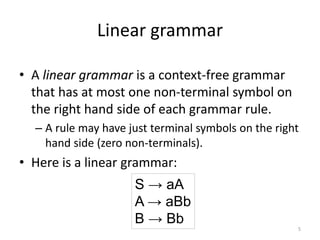
• A linear grammar is a context-free grammar
that has at most one non-terminal symbol on
the right hand side of each grammar rule.
– A rule may have just terminal symbols on the right
hand side (zero non-terminals).
• Here is a linear grammar:
5
S → aA
A → aBb
B → Bb
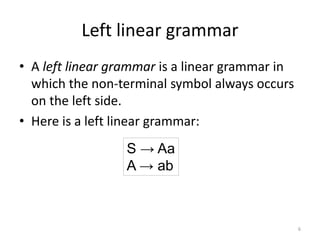
Left linear grammar
• A left linear grammar is a linear grammar in
which the non-terminal symbol always occurs
on the left side.
• Here is a left linear grammar:
S → Aa
A → ab
6
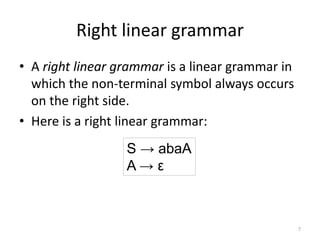
Right linear grammar
• A right linear grammar is a linear grammar in
which the non-terminal symbol always occurs
on the right side.
• Here is a right linear grammar:
S → abaA
A → ε
7
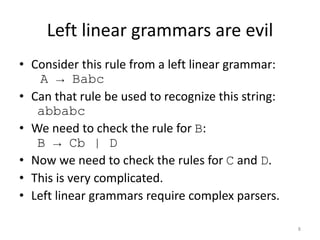
Left linear grammars are evil
• Consider this rule from a left linear grammar:
A → Babc
• Can that rule be used to recognize this string:
abbabc
• We need to check the rule for B:
B → Cb | D
• Now we need to check the rules for C and D.
• This is very complicated.
• Left linear grammars require complex parsers.
8
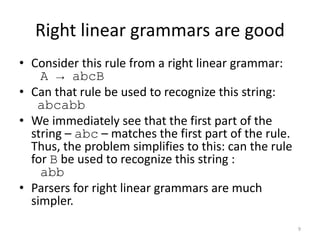
Right linear grammars are good
• Consider this rule from a right linear grammar:
A → abcB
• Can that rule be used to recognize this string:
abcabb
• We immediately see that the first part of the
string – abc – matches the first part of the rule.
Thus, the problem simplifies to this: can the rule
for B be used to recognize this string :
abb
• Parsers for right linear grammars are much
simpler.
9
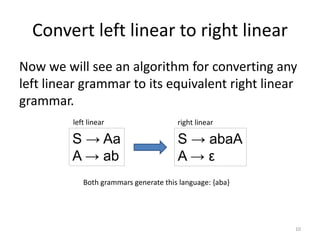
Convert left linear to right linear
Now we will see an algorithm for converting any
left linear grammar to its equivalent right linear
grammar.
S → Aa
A → ab
left linear
Both grammars generate this language: {aba}
S → abaA
A → ε
right linear
10
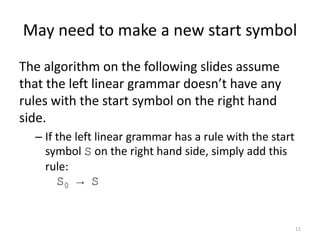
May need to make a new start symbol
The algorithm on the following slides assume
that the left linear grammar doesn’t have any
rules with the start symbol on the right hand
side.
– If the left linear grammar has a rule with the start
symbol S on the right hand side, simply add this
rule:
S0 → S
11
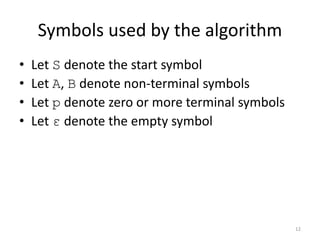
Symbols used by the algorithm
• Let S denote the start symbol
• Let A, B denote non-terminal symbols
• Let p denote zero or more terminal symbols
• Let ε denote the empty symbol
12
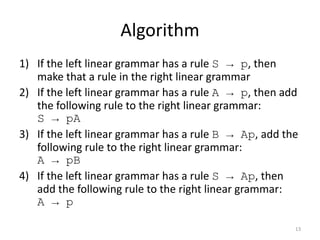
Algorithm
1) If the left linear grammar has a rule S → p, then
make that a rule in the right linear grammar
2) If the left linear grammar has a rule A → p, then add
the following rule to the right linear grammar:
S → pA
3) If the left linear grammar has a rule B → Ap, add the
following rule to the right linear grammar:
A → pB
4) If the left linear grammar has a rule S → Ap, then
add the following rule to the right linear grammar:
A → p
13
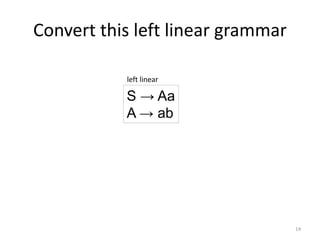
Convert this left linear grammar
14
S → Aa
A → ab
left linear
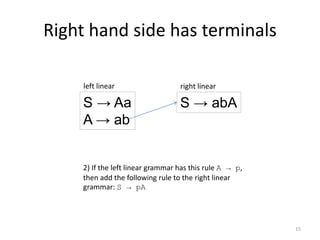
Right hand side has terminals
15
S → Aa
A → ab
left linear
2) If the left linear grammar has this rule A → p,
then add the following rule to the right linear
grammar: S → pA
S → abA
right linear
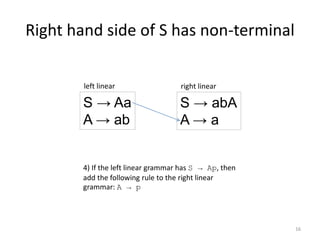
Right hand side of S has non-terminal
16
S → Aa
A → ab
left linear
4) If the left linear grammar has S → Ap, then
add the following rule to the right linear
grammar: A → p
S → abA
A → a
right linear
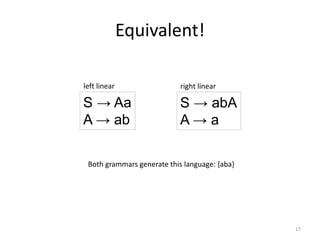
Equivalent!
17
S → Aa
A → ab
left linear
Both grammars generate this language: {aba}
S → abA
A → a
right linear
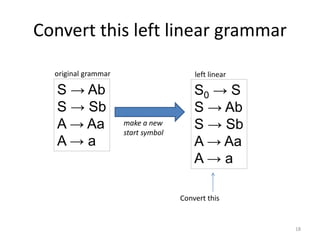
Convert this left linear grammar
18
left linear
S0 → S
S → Ab
S → Sb
A → Aa
A → a
S → Ab
S → Sb
A → Aa
A → a
original grammar
make a new
start symbol
Convert this
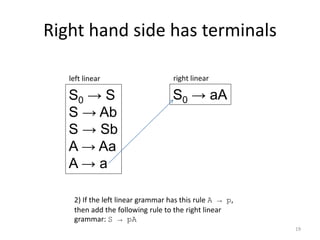
Right hand side has terminals
19
S0 → S
S → Ab
S → Sb
A → Aa
A → a
left linear
S0 → aA
right linear
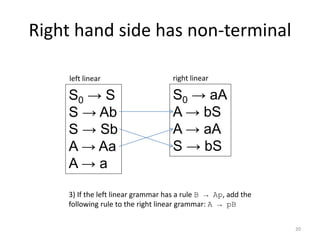
2) If the left linear grammar has this rule A → p,
then add the following rule to the right linear
grammar: S → pA
Right hand side has non-terminal
20
S0 → S
S → Ab
S → Sb
A → Aa
A → a
left linear
S0 → aA
A → bS
A → aA
S → bS
right linear
3) If the left linear grammar has a rule B → Ap, add the
following rule to the right linear grammar: A → pB
Right hand side of start symbol has
non-terminal
21
S0 → S
S → Ab
S → Sb
A → Aa
A → a
left linear
S0 → aA
A → bS
A → aA
S → bS
S → ε
right linear
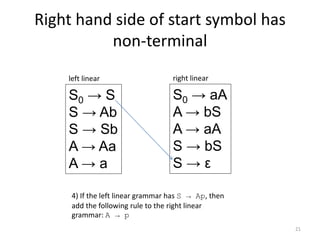
4) If the left linear grammar has S → Ap, then
add the following rule to the right linear
grammar: A → p
Equivalent!
22
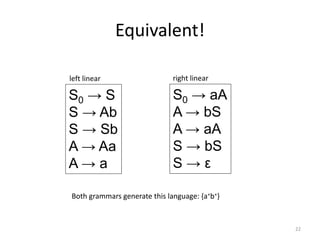
S0 → S
S → Ab
S → Sb
A → Aa
A → a
left linear
S0 → aA
A → bS
A → aA
S → bS
S → ε
right linear
Both grammars generate this language: {a+b+}
Will the algorithm always work?
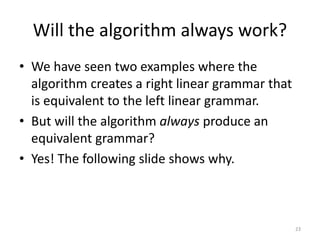
• We have seen two examples where the
algorithm creates a right linear grammar that
is equivalent to the left linear grammar.
• But will the algorithm always produce an
equivalent grammar?
• Yes! The following slide shows why.
23
Generate string p
• Let p = a string generated by the left linear
grammar.
• We will show that the grammar generated by
the algorithm also produces p.
24
Case 1: the start symbol produces p
Suppose the left linear grammar has this rule:
S → p. Then the right linear grammar will
have the same rule (see 1 below). So the right
linear grammar will also produce p.
1) If the left linear grammar contains S → p, then put that rule in the right linear grammar.
2) If the left linear grammar contains A → p, then put this rule in the right linear grammar: S → pA
3) If the left linear grammar contains B → Ap, then put this rule in the right linear grammar: A → pB
4) If the left linear grammar contains S → Ap, then put this rule in the right linear grammar: A → p
Algorithm:
25
Case 2: multiple rules needed
to produce p
Suppose p is produced by a sequence of n
production rules:
S → A1p1
→ A2p2p1
→ A3p3p2p1
→ …
→ An-1pn-1…p3p2p1
→ pnpn-1…p3p2p1 p (p is composed of n symbols)
26
Case 2 (continued)
S → A1p1
→ A2p2p1
→ A3p3p2p1
→ …
→ An-1pn-1…p3p2p1
→ pnpn-1…p3p2p1
Let’s see what right linear rules will be generated
by the algorithm for the rules implied by this
production sequence.
27
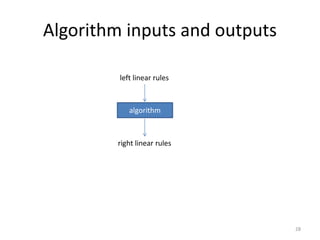
Algorithm inputs and outputs
algorithm
left linear rules
right linear rules
28
Case 2 (continued)
1) If the left linear grammar contains S → p, then put that rule in the right linear grammar.
2) If the left linear grammar contains A → p, then put this rule in the right linear grammar: S → pA
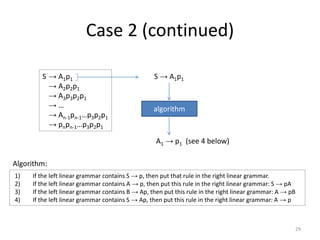
3) If the left linear grammar contains B → Ap, then put this rule in the right linear grammar: A → pB
4) If the left linear grammar contains S → Ap, then put this rule in the right linear grammar: A → p
Algorithm:
S → A1p1
→ A2p2p1
→ A3p3p2p1
→ …
→ An-1pn-1…p3p2p1
→ pnpn-1…p3p2p1
S → A1p1
algorithm
A1 → p1 (see 4 below)
29
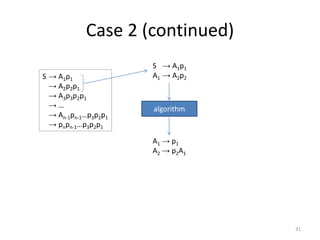
Case 2 (continued)
1) If the left linear grammar contains S → p, then put that rule in the right linear grammar.
2) If the left linear grammar contains A → p, then put this rule in the right linear grammar: S → pA
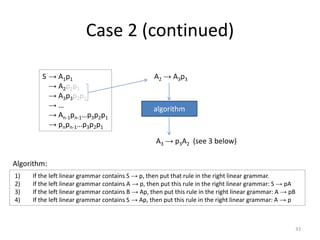
3) If the left linear grammar contains B → Ap, then put this rule in the right linear grammar: A → pB
4) If the left linear grammar contains S → Ap, then put this rule in the right linear grammar: A → p
Algorithm:
S → A1p1
→ A2p2p1
→ A3p3p2p1
→ …
→ An-1pn-1…p3p2p1
→ pnpn-1…p3p2p1
A1 → A2p2
algorithm
A2 → p2A1 (see 3 below)
30
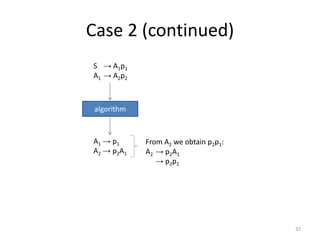
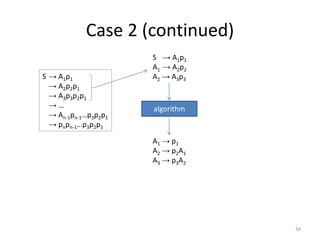
Case 2 (continued)
S → A1p1
→ A2p2p1
→ A3p3p2p1
→ …
→ An-1pn-1…p3p2p1
→ pnpn-1…p3p2p1
S → A1p1
A1 → A2p2
algorithm
A1 → p1
A2 → p2A1
31
Case 2 (continued)
S → A1p1
A1 → A2p2
algorithm
A1 → p1
A2 → p2A1
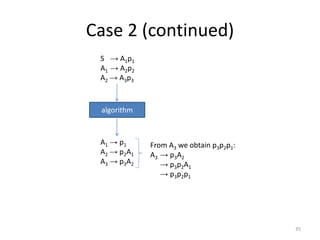
From A2 we obtain p2p1:
A2 → p2A1
→ p2p1
32
Case 2 (continued)
1) If the left linear grammar contains S → p, then put that rule in the right linear grammar.
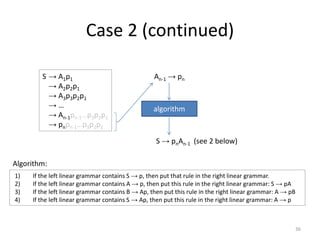
2) If the left linear grammar contains A → p, then put this rule in the right linear grammar: S → pA
3) If the left linear grammar contains B → Ap, then put this rule in the right linear grammar: A → pB
4) If the left linear grammar contains S → Ap, then put this rule in the right linear grammar: A → p
Algorithm:
S → A1p1
→ A2p2p1
→ A3p3p2p1
→ …
→ An-1pn-1…p3p2p1
→ pnpn-1…p3p2p1
A2 → A3p3
algorithm
A3 → p3A2 (see 3 below)
33
Case 2 (continued)
S → A1p1
→ A2p2p1
→ A3p3p2p1
→ …
→ An-1pn-1…p3p2p1
→ pnpn-1…p3p2p1
S → A1p1
A1 → A2p2
A2 → A3p3
algorithm
A1 → p1
A2 → p2A1
A3 → p3A2
34
Case 2 (continued)
S → A1p1
A1 → A2p2
A2 → A3p3
algorithm
A1 → p1
A2 → p2A1
A3 → p3A2
From A3 we obtain p3p2p1:
A3 → p3A2
→ p3p2A1
→ p3p2p1
35
Case 2 (continued)
1) If the left linear grammar contains S → p, then put that rule in the right linear grammar.
2) If the left linear grammar contains A → p, then put this rule in the right linear grammar: S → pA
3) If the left linear grammar contains B → Ap, then put this rule in the right linear grammar: A → pB
4) If the left linear grammar contains S → Ap, then put this rule in the right linear grammar: A → p
Algorithm:
S → A1p1
→ A2p2p1
→ A3p3p2p1
→ …
→ An-1pn-1…p3p2p1
→ pnpn-1…p3p2p1
An-1 → pn
algorithm
S → pnAn-1 (see 2 below)
36
Case 2 (concluded)
S → A1p1
A1 → A2p2
A2 → A3p3
…
An-1 → pn
algorithm
A1 → p1
A2 → p2A1
A3 → p3A2
…
An-1 → pn-1An-2
S → pnAn-1
From S we obtain pn…p2p1:
S → pnAn-1
→ pnpn-1An-2
→ …
→ pnpn-1…p3A2
→ pnpn-1…p3p2A1
→ pn…p3pn-1p2p1 (this is the desired string, p)
37
We have shown that for any string p
generated by the left linear grammar,
the right linear grammar produced by
the algorithm will also generate p.
38
How we understand the algorithm
S → A1p1
A1 → A2p2
A2 → A3p3
…
An-1 → pn
algorithm
A1 → p1
A2 → p2A1
A3 → p3A2
…
An-1 → pn-1An-2
S → pnAn-1
These rules descend through the non-terminals until
reaching a rule with terminals on the RHS, the terminals
are output, then we unwind from the descent and output
the terminals.
Make the rule with terminals on the RHS the starting rule
and output its terminals. Ascend through the other rules.
39
How we understand the algorithm
S → A1p1
A1 → A2p2
A2 → A3p3
…
An-1 → pn
algorithm
A1 → p1
A2 → p2A1
A3 → p3A2
…
An-1 → pn-1An-2
S → pnAn-1
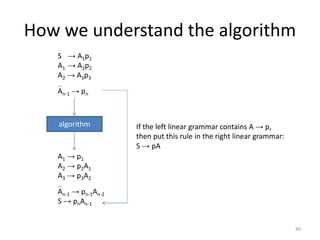
If the left linear grammar contains A → p,
then put this rule in the right linear grammar:
S → pA
40
How we understand the algorithm
S → A1p1
A1 → A2p2
A2 → A3p3
…
An-1 → pn
algorithm
A1 → p1
A2 → p2A1
A3 → p3A2
…
An-1 → pn-1An-2
S → pnAn-1
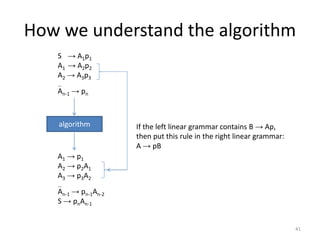
If the left linear grammar contains B → Ap,
then put this rule in the right linear grammar:
A → pB
41
How we understand the algorithm
S → A1p1
A1 → A2p2
A2 → A3p3
…
An-1 → pn
algorithm
A1 → p1
A2 → p2A1
A3 → p3A2
…
An-1 → pn-1An-2
S → pnAn-1
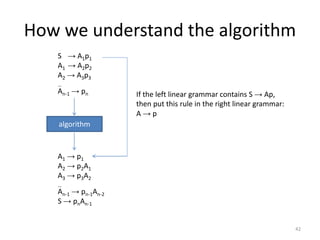
If the left linear grammar contains S → Ap,
then put this rule in the right linear grammar:
A → p
42
Left-linear grammars generate
Type 3 languages
• Every left-linear grammar can be converted to
an equivalent right-linear grammar.
– “Equivalent right-linear grammar” means the
grammar generate the same language.
• Right-linear grammars generate Type 3
languages.
• Therefore, every left-linear grammar
generates a Type 3 language.
43
Acknowledgement
The algorithm shown in these slides comes from
the wonderful book:
Introduction to Formal Languages by Gyorgy Revesz
44

How-to-convert-a-left-linear-grammar-to-a-right-linear-grammar.pptx

  • 1.
    How to converta left linear grammar to a right linear grammar Roger L. Costello May 28, 2014
  • 2.
    Objective This mini-tutorial willanswer these questions: 1. What is a linear grammar? What is a left linear grammar? What is a right linear grammar? 2
  • 3.
    Objective This mini-tutorial willanswer these questions: 1. What is a linear grammar? What is a left linear grammar? What is a right linear grammar? 2. Left linear grammars are evil – why? 3
  • 4.
    Objective This mini-tutorial willanswer these questions: 1. What is a linear grammar? What is a left linear grammar? What is a right linear grammar? 2. Left linear grammars are evil – why? 3. What algorithm can be used to convert a left linear grammar to a right linear grammar? 4
  • 5.
    Linear grammar • Alinear grammar is a context-free grammar that has at most one non-terminal symbol on the right hand side of each grammar rule. – A rule may have just terminal symbols on the right hand side (zero non-terminals). • Here is a linear grammar: 5 S → aA A → aBb B → Bb
  • 6.
    Left linear grammar •A left linear grammar is a linear grammar in which the non-terminal symbol always occurs on the left side. • Here is a left linear grammar: S → Aa A → ab 6
  • 7.
    Right linear grammar •A right linear grammar is a linear grammar in which the non-terminal symbol always occurs on the right side. • Here is a right linear grammar: S → abaA A → ε 7
  • 8.
    Left linear grammarsare evil • Consider this rule from a left linear grammar: A → Babc • Can that rule be used to recognize this string: abbabc • We need to check the rule for B: B → Cb | D • Now we need to check the rules for C and D. • This is very complicated. • Left linear grammars require complex parsers. 8
  • 9.
    Right linear grammarsare good • Consider this rule from a right linear grammar: A → abcB • Can that rule be used to recognize this string: abcabb • We immediately see that the first part of the string – abc – matches the first part of the rule. Thus, the problem simplifies to this: can the rule for B be used to recognize this string : abb • Parsers for right linear grammars are much simpler. 9
  • 10.
    Convert left linearto right linear Now we will see an algorithm for converting any left linear grammar to its equivalent right linear grammar. S → Aa A → ab left linear Both grammars generate this language: {aba} S → abaA A → ε right linear 10
  • 11.
    May need tomake a new start symbol The algorithm on the following slides assume that the left linear grammar doesn’t have any rules with the start symbol on the right hand side. – If the left linear grammar has a rule with the start symbol S on the right hand side, simply add this rule: S0 → S 11
  • 12.
    Symbols used bythe algorithm • Let S denote the start symbol • Let A, B denote non-terminal symbols • Let p denote zero or more terminal symbols • Let ε denote the empty symbol 12
  • 13.
    Algorithm 1) If theleft linear grammar has a rule S → p, then make that a rule in the right linear grammar 2) If the left linear grammar has a rule A → p, then add the following rule to the right linear grammar: S → pA 3) If the left linear grammar has a rule B → Ap, add the following rule to the right linear grammar: A → pB 4) If the left linear grammar has a rule S → Ap, then add the following rule to the right linear grammar: A → p 13
  • 14.
    Convert this leftlinear grammar 14 S → Aa A → ab left linear
  • 15.
    Right hand sidehas terminals 15 S → Aa A → ab left linear 2) If the left linear grammar has this rule A → p, then add the following rule to the right linear grammar: S → pA S → abA right linear
  • 16.
    Right hand sideof S has non-terminal 16 S → Aa A → ab left linear 4) If the left linear grammar has S → Ap, then add the following rule to the right linear grammar: A → p S → abA A → a right linear
  • 17.
    Equivalent! 17 S → Aa A→ ab left linear Both grammars generate this language: {aba} S → abA A → a right linear
  • 18.
    Convert this leftlinear grammar 18 left linear S0 → S S → Ab S → Sb A → Aa A → a S → Ab S → Sb A → Aa A → a original grammar make a new start symbol Convert this
  • 19.
    Right hand sidehas terminals 19 S0 → S S → Ab S → Sb A → Aa A → a left linear S0 → aA right linear 2) If the left linear grammar has this rule A → p, then add the following rule to the right linear grammar: S → pA
  • 20.
    Right hand sidehas non-terminal 20 S0 → S S → Ab S → Sb A → Aa A → a left linear S0 → aA A → bS A → aA S → bS right linear 3) If the left linear grammar has a rule B → Ap, add the following rule to the right linear grammar: A → pB
  • 21.
    Right hand sideof start symbol has non-terminal 21 S0 → S S → Ab S → Sb A → Aa A → a left linear S0 → aA A → bS A → aA S → bS S → ε right linear 4) If the left linear grammar has S → Ap, then add the following rule to the right linear grammar: A → p
  • 22.
    Equivalent! 22 S0 → S S→ Ab S → Sb A → Aa A → a left linear S0 → aA A → bS A → aA S → bS S → ε right linear Both grammars generate this language: {a+b+}
  • 23.
    Will the algorithmalways work? • We have seen two examples where the algorithm creates a right linear grammar that is equivalent to the left linear grammar. • But will the algorithm always produce an equivalent grammar? • Yes! The following slide shows why. 23
  • 24.
    Generate string p •Let p = a string generated by the left linear grammar. • We will show that the grammar generated by the algorithm also produces p. 24
  • 25.
    Case 1: thestart symbol produces p Suppose the left linear grammar has this rule: S → p. Then the right linear grammar will have the same rule (see 1 below). So the right linear grammar will also produce p. 1) If the left linear grammar contains S → p, then put that rule in the right linear grammar. 2) If the left linear grammar contains A → p, then put this rule in the right linear grammar: S → pA 3) If the left linear grammar contains B → Ap, then put this rule in the right linear grammar: A → pB 4) If the left linear grammar contains S → Ap, then put this rule in the right linear grammar: A → p Algorithm: 25
  • 26.
    Case 2: multiplerules needed to produce p Suppose p is produced by a sequence of n production rules: S → A1p1 → A2p2p1 → A3p3p2p1 → … → An-1pn-1…p3p2p1 → pnpn-1…p3p2p1 p (p is composed of n symbols) 26
  • 27.
    Case 2 (continued) S→ A1p1 → A2p2p1 → A3p3p2p1 → … → An-1pn-1…p3p2p1 → pnpn-1…p3p2p1 Let’s see what right linear rules will be generated by the algorithm for the rules implied by this production sequence. 27
  • 28.
    Algorithm inputs andoutputs algorithm left linear rules right linear rules 28
  • 29.
    Case 2 (continued) 1)If the left linear grammar contains S → p, then put that rule in the right linear grammar. 2) If the left linear grammar contains A → p, then put this rule in the right linear grammar: S → pA 3) If the left linear grammar contains B → Ap, then put this rule in the right linear grammar: A → pB 4) If the left linear grammar contains S → Ap, then put this rule in the right linear grammar: A → p Algorithm: S → A1p1 → A2p2p1 → A3p3p2p1 → … → An-1pn-1…p3p2p1 → pnpn-1…p3p2p1 S → A1p1 algorithm A1 → p1 (see 4 below) 29
  • 30.
    Case 2 (continued) 1)If the left linear grammar contains S → p, then put that rule in the right linear grammar. 2) If the left linear grammar contains A → p, then put this rule in the right linear grammar: S → pA 3) If the left linear grammar contains B → Ap, then put this rule in the right linear grammar: A → pB 4) If the left linear grammar contains S → Ap, then put this rule in the right linear grammar: A → p Algorithm: S → A1p1 → A2p2p1 → A3p3p2p1 → … → An-1pn-1…p3p2p1 → pnpn-1…p3p2p1 A1 → A2p2 algorithm A2 → p2A1 (see 3 below) 30
  • 31.
    Case 2 (continued) S→ A1p1 → A2p2p1 → A3p3p2p1 → … → An-1pn-1…p3p2p1 → pnpn-1…p3p2p1 S → A1p1 A1 → A2p2 algorithm A1 → p1 A2 → p2A1 31
  • 32.
    Case 2 (continued) S→ A1p1 A1 → A2p2 algorithm A1 → p1 A2 → p2A1 From A2 we obtain p2p1: A2 → p2A1 → p2p1 32
  • 33.
    Case 2 (continued) 1)If the left linear grammar contains S → p, then put that rule in the right linear grammar. 2) If the left linear grammar contains A → p, then put this rule in the right linear grammar: S → pA 3) If the left linear grammar contains B → Ap, then put this rule in the right linear grammar: A → pB 4) If the left linear grammar contains S → Ap, then put this rule in the right linear grammar: A → p Algorithm: S → A1p1 → A2p2p1 → A3p3p2p1 → … → An-1pn-1…p3p2p1 → pnpn-1…p3p2p1 A2 → A3p3 algorithm A3 → p3A2 (see 3 below) 33
  • 34.
    Case 2 (continued) S→ A1p1 → A2p2p1 → A3p3p2p1 → … → An-1pn-1…p3p2p1 → pnpn-1…p3p2p1 S → A1p1 A1 → A2p2 A2 → A3p3 algorithm A1 → p1 A2 → p2A1 A3 → p3A2 34
  • 35.
    Case 2 (continued) S→ A1p1 A1 → A2p2 A2 → A3p3 algorithm A1 → p1 A2 → p2A1 A3 → p3A2 From A3 we obtain p3p2p1: A3 → p3A2 → p3p2A1 → p3p2p1 35
  • 36.
    Case 2 (continued) 1)If the left linear grammar contains S → p, then put that rule in the right linear grammar. 2) If the left linear grammar contains A → p, then put this rule in the right linear grammar: S → pA 3) If the left linear grammar contains B → Ap, then put this rule in the right linear grammar: A → pB 4) If the left linear grammar contains S → Ap, then put this rule in the right linear grammar: A → p Algorithm: S → A1p1 → A2p2p1 → A3p3p2p1 → … → An-1pn-1…p3p2p1 → pnpn-1…p3p2p1 An-1 → pn algorithm S → pnAn-1 (see 2 below) 36
  • 37.
    Case 2 (concluded) S→ A1p1 A1 → A2p2 A2 → A3p3 … An-1 → pn algorithm A1 → p1 A2 → p2A1 A3 → p3A2 … An-1 → pn-1An-2 S → pnAn-1 From S we obtain pn…p2p1: S → pnAn-1 → pnpn-1An-2 → … → pnpn-1…p3A2 → pnpn-1…p3p2A1 → pn…p3pn-1p2p1 (this is the desired string, p) 37
  • 38.
    We have shownthat for any string p generated by the left linear grammar, the right linear grammar produced by the algorithm will also generate p. 38
  • 39.
    How we understandthe algorithm S → A1p1 A1 → A2p2 A2 → A3p3 … An-1 → pn algorithm A1 → p1 A2 → p2A1 A3 → p3A2 … An-1 → pn-1An-2 S → pnAn-1 These rules descend through the non-terminals until reaching a rule with terminals on the RHS, the terminals are output, then we unwind from the descent and output the terminals. Make the rule with terminals on the RHS the starting rule and output its terminals. Ascend through the other rules. 39
  • 40.
    How we understandthe algorithm S → A1p1 A1 → A2p2 A2 → A3p3 … An-1 → pn algorithm A1 → p1 A2 → p2A1 A3 → p3A2 … An-1 → pn-1An-2 S → pnAn-1 If the left linear grammar contains A → p, then put this rule in the right linear grammar: S → pA 40
  • 41.
    How we understandthe algorithm S → A1p1 A1 → A2p2 A2 → A3p3 … An-1 → pn algorithm A1 → p1 A2 → p2A1 A3 → p3A2 … An-1 → pn-1An-2 S → pnAn-1 If the left linear grammar contains B → Ap, then put this rule in the right linear grammar: A → pB 41
  • 42.
    How we understandthe algorithm S → A1p1 A1 → A2p2 A2 → A3p3 … An-1 → pn algorithm A1 → p1 A2 → p2A1 A3 → p3A2 … An-1 → pn-1An-2 S → pnAn-1 If the left linear grammar contains S → Ap, then put this rule in the right linear grammar: A → p 42
  • 43.
    Left-linear grammars generate Type3 languages • Every left-linear grammar can be converted to an equivalent right-linear grammar. – “Equivalent right-linear grammar” means the grammar generate the same language. • Right-linear grammars generate Type 3 languages. • Therefore, every left-linear grammar generates a Type 3 language. 43
  • 44.
    Acknowledgement The algorithm shownin these slides comes from the wonderful book: Introduction to Formal Languages by Gyorgy Revesz 44