Primitive
Recursive
Functions
-Sampath Kumar S,
AP/CSE, SECE
11/21/2017
1
Preliminaries: partial and total functions
 The domain of a partial function on set A contains the subset of A.
 The domain of a total function on set A contains the entire set A.
 A partial function f is called partially computable if there
is some program that computes it. Another term for such
functions partial recursive.
 Similarly, a function f is called computable if it is both
total and partially computable. Another term for such
function is recursive.
2 11/21/2017
Composition
 Let f : A → B and g : B → C
 Composition of f and g can then be expressed as:
g ͦ f : A → C
(g ͦ f)(x) = g(f(x))
h(x) = g(f(x))
 NB: In general composition is not commutative:
( g ͦ f )(x) ≠ ( f ͦ g )(x)
3 11/21/2017
Composition
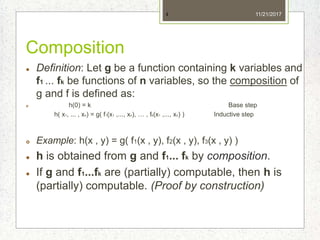
 Definition: Let g be a function containing k variables and
f1 ... fk be functions of n variables, so the composition of
g and f is defined as:
 h(0) = k Base step
h( x1, ... , xn) = g( f1(x1 ,..., xn), … , fk(x1 ,..., xn) ) Inductive step
 Example: h(x , y) = g( f1(x , y), f2(x , y), f3(x , y) )
 h is obtained from g and f1... fk by composition.
 If g and f1...fk are (partially) computable, then h is
(partially) computable. (Proof by construction)
4 11/21/2017
Recursion
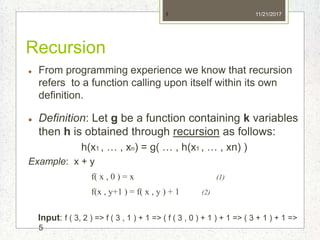
 From programming experience we know that recursion
refers to a function calling upon itself within its own
definition.
 Definition: Let g be a function containing k variables
then h is obtained through recursion as follows:
h(x1 , … , xn) = g( … , h(x1 , … , xn) )
Example: x + y
f( x , 0 ) = x (1)
f(x , y+1 ) = f( x , y ) + 1 (2)
Input: f ( 3, 2 ) => f ( 3 , 1 ) + 1 => ( f ( 3 , 0 ) + 1 ) + 1 => ( 3 + 1 ) + 1 =>
5
5 11/21/2017
PRC: Initial functions
 Primitive Recursively Closed (PRC) class of functions.
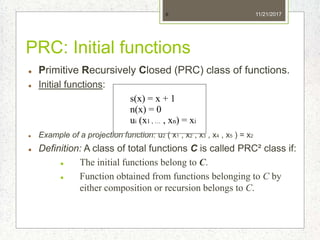
 Initial functions:
 Example of a projection function: u2 ( x1 , x2 , x3 , x4 , x5 ) = x2
 Definition: A class of total functions C is called PRC² class if:
 The initial functions belong to C.
 Function obtained from functions belonging to C by
either composition or recursion belongs to C.
6
s(x) = x + 1
n(x) = 0
ui (x1 , … , xn) = xi
11/21/2017
PRC: primitive recursive functions
 There exists a class of computable functions
that is a PRC class.
 Definition: Function is considered primitive
recursive if it can be obtained from initial functions
and through finite number of composition and
recursion steps.
 Theorem: A function is primitive recursive iff it
belongs to the PRC class. (see proof in chapter 3)
 Corollary: Every primitive recursive function is
computable.
7 11/21/2017
Primitive recursive functions: sum
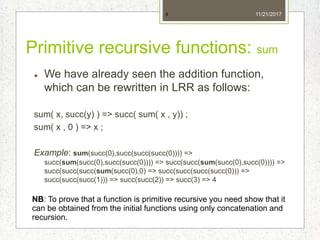
 We have already seen the addition function,
which can be rewritten in LRR as follows:
sum( x, succ(y) ) => succ( sum( x , y)) ;
sum( x , 0 ) => x ;
Example: sum(succ(0),succ(succ(succ(0)))) =>
succ(sum(succ(0),succ(succ(0)))) => succ(succ(sum(succ(0),succ(0)))) =>
succ(succ(succ(sum(succ(0),0) => succ(succ(succ(succ(0))) =>
succ(succ(succ(1))) => succ(succ(2)) => succ(3) => 4
8
NB: To prove that a function is primitive recursive you need show that it
can be obtained from the initial functions using only concatenation and
recursion.
11/21/2017
Primitive recursive functions:
multiplication
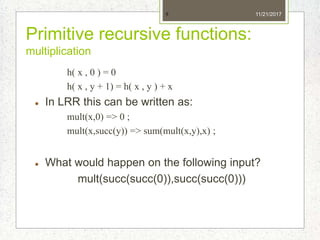
h( x , 0 ) = 0
h( x , y + 1) = h( x , y ) + x
 In LRR this can be written as:
mult(x,0) => 0 ;
mult(x,succ(y)) => sum(mult(x,y),x) ;
 What would happen on the following input?
mult(succ(succ(0)),succ(succ(0)))
9 11/21/2017
Primitive recursive functions:
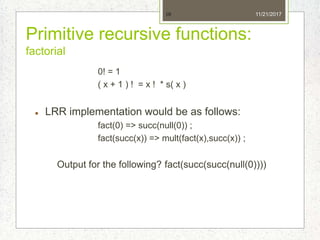
factorial
0! = 1
( x + 1 ) ! = x ! * s( x )
 LRR implementation would be as follows:
fact(0) => succ(null(0)) ;
fact(succ(x)) => mult(fact(x),succ(x)) ;
Output for the following? fact(succ(succ(null(0))))
10 11/21/2017
Primitive recursive functions:
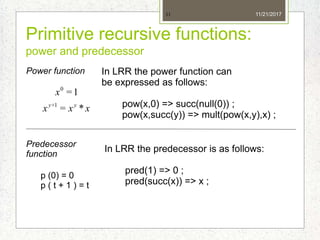
power and predecessor
11
xx=x
=x
y+y
*
1
1
0
In LRR the power function can
be expressed as follows:
pow(x,0) => succ(null(0)) ;
pow(x,succ(y)) => mult(pow(x,y),x) ;
p (0) = 0
p ( t + 1 ) = t
Power function
Predecessor
function
In LRR the predecessor is as follows:
pred(1) => 0 ;
pred(succ(x)) => x ;
11/21/2017
Primitive recursive functions:
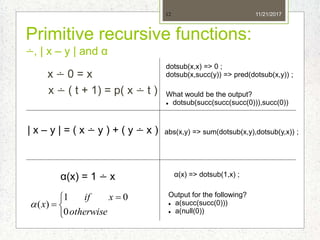
∸, | x – y | and α
x ∸ 0 = x
x ∸ ( t + 1) = p( x ∸ t )
12
| x – y | = ( x ∸ y ) + ( y ∸ x )
α(x) = 1 ∸ x
dotsub(x,x) => 0 ;
dotsub(x,succ(y)) => pred(dotsub(x,y)) ;
abs(x,y) => sum(dotsub(x,y),dotsub(y,x)) ;
α(x) => dotsub(1,x) ;
What would be the output?
 dotsub(succ(succ(succ(0))),succ(0))
Output for the following?
 a(succ(succ(0)))
 a(null(0))
0
0
1
)(





x
otherwise
if
x
11/21/2017
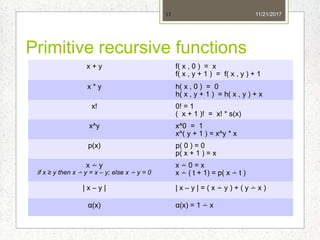
Primitive recursive functions
13
x + y f( x , 0 ) = x
f( x , y + 1 ) = f( x , y ) + 1
x * y h( x , 0 ) = 0
h( x , y + 1 ) = h( x , y ) + x
x! 0! = 1
( x + 1 )! = x! * s(x)
x^y x^0 = 1
x^( y + 1 ) = x^y * x
p(x) p( 0 ) = 0
p( x + 1 ) = x
x ∸ y
if x ≥ y then x ∸ y = x – y; else x ∸ y = 0
x ∸ 0 = x
x ∸ ( t + 1) = p( x ∸ t )
| x – y | | x – y | = ( x ∸ y ) + ( y ∸ x )
α(x) α(x) = 1 ∸ x
11/21/2017
Bounded quantifiers
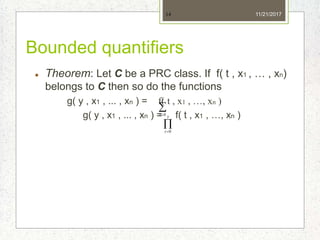
 Theorem: Let C be a PRC class. If f( t , x1 , … , xn)
belongs to C then so do the functions
g( y , x1 , ... , xn ) = f( t , x1 , …, xn )
14

y
t 0

y
t 0
11/21/2017
Bounded quantifiers
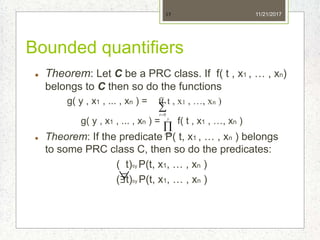
 Theorem: Let C be a PRC class. If f( t , x1 , … , xn)
belongs to C then so do the functions
g( y , x1 , ... , xn ) = f( t , x1 , …, xn )
 Theorem: If the predicate P( t, x1 , … , xn ) belongs
to some PRC class C, then so do the predicates:
( t)≤y P(t, x1, … , xn )
(∃t)≤y P(t, x1, … , xn )
15

y
t 0

y
t 0

11/21/2017
Primitive recursive predicates
16
x = y d( x , y ) = α( | x – y | )
x ≤ y α ( x ∸ y )
~P α( P )
P & Q P * Q
P v Q ~ ( ~P & ~Q )
y | x y | x = (∃t)≤x { y * t = x }
Prime(x) Prime(x) = x > 1 & ( t)≤x { t = 1 v t = x v ~( t | x ) }
Exercises for Chapter 3: page 62 Questions 3,4 and 5. Fibonacci function

11/21/2017
Bounded minimalization
17
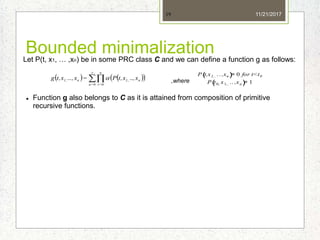
Let P(t, x1, … ,xn) be in some PRC class C and we can define a function g as follows:
    n1,.
y
u=
u
=t
n1, x,xt,P=x,xt,g .....
0 0

11/21/2017
Bounded minimalization
18
Let P(t, x1, … ,xn) be in some PRC class C and we can define a function g as follows:
    n1,.
y
u=
u
=t
n1, x,xt,P=x,xt,g .....
0 0

P(t,x1,. .. ,xn )= 0 for t<t0
P(t0, x1,. .. ,xn )= 1,where
11/21/2017
Bounded minimalization
19
Let P(t, x1, … ,xn) be in some PRC class C and we can define a function g as follows:
    n1,.
y
u=
u
=t
n1, x,xt,P=x,xt,g .....
0 0

P(t,x1,. .. ,xn )= 0 for t<t0
P(t0, x1,. .. ,xn )= 1,where
 Function g also belongs to C as it is attained from composition of primitive
recursive functions.
11/21/2017
Bounded minimalization
20
Let P(t, x1, … ,xn) be in some PRC class C and we can define a function g as follows:
    n1,.
y
u=
u
=t
n1, x,xt,P=x,xt,g .....
0 0

P(t,x1,. .. ,xn )= 0 for t<t0
P(t0, x1,. .. ,xn )= 1,where
 Function g also belongs to C as it is attained from composition of primitive
recursive functions.
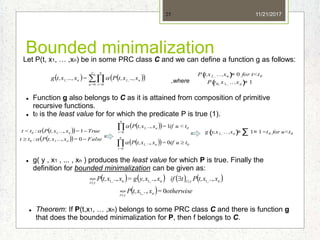
 t0 is the least value for for which the predicate P is true (1).
11/21/2017
Bounded minimalization
21
Let P(t, x1, … ,xn) be in some PRC class C and we can define a function g as follows:
    n1,.
y
u=
u
=t
n1, x,xt,P=x,xt,g .....
0 0

P(t,x1,. .. ,xn )= 0 for t<t0
P(t0, x1,. .. ,xn )= 1,where
 Function g also belongs to C as it is attained from composition of primitive
recursive functions.
 t0 is the least value for for which the predicate P is true (1).
  
   False=x,xt,Ptt
True=x,xt,Pt<t
n1,
n1,0


0...:
1...:
0 

11/21/2017
Bounded minimalization
22
Let P(t, x1, … ,xn) be in some PRC class C and we can define a function g as follows:
    n1,.
y
u=
u
=t
n1, x,xt,P=x,xt,g .....
0 0

P(t,x1,. .. ,xn )= 0 fort<t0
P (t0, x1,. .. ,xn)= 1,where
 Function g also belongs to C as it is attained from composition of primitive
recursive functions.
 t0 is the least value for for which the predicate P is true (1).
  
   False=x,xt,Ptt
True=x,xt,Pt<t
n1,
n1,0


0...:
1...:
0 

  
   0
0
0
0..
1..
tuif=x,xt,P
t<uif=x,xt,P
n1,.
u
=t
0n1,.
u
=t




11/21/2017
Bounded minimalization
23
Let P(t, x1, … ,xn) be in some PRC class C and we can define a function g as follows:
    n1,.
y
u=
u
=t
n1, x,xt,P=x,xt,g .....
0 0

P(t,x1,. .. ,xn )= 0 for t<t0
P(t0, x1,. .. ,xn )= 1,where
 Function g also belongs to C as it is attained from composition of primitive
recursive functions.
 t0 is the least value for for which the predicate P is true (1).
  
   False=x,xt,Ptt
True=x,xt,Pt<t
n1,
n1,0


0...:
1...:
0 

  
   0
0
0
0..
1..
tuif=x,xt,P
t<uif=x,xt,P
n1,.
u
=t
0n1,.
u
=t




g (y,x1,. .. ,xn)= ∑ 1= 1=t0 for u<t0
11/21/2017
Bounded minimalization
24
Let P(t, x1, … ,xn) be in some PRC class C and we can define a function g as follows:
    n1,.
y
u=
u
=t
n1, x,xt,P=x,xt,g .....
0 0

P(t,x1,. .. ,xn )= 0 for t<t0
P(t0, x1,. .. ,xn )= 1,where
 Function g also belongs to C as it is attained from composition of primitive
recursive functions.
 t0 is the least value for for which the predicate P is true (1).
  
   False=x,xt,Ptt
True=x,xt,Pt<t
n1,
n1,0


0...:
1...:
0 

  
   0
0
0
0..
1..
tuif=x,xt,P
t<uif=x,xt,P
n1,.
u
=t
0n1,.
u
=t




g (y,x1,. .. ,xn)= ∑ 1= 1=t0 for u<t0
 g( y , x1 , ... , xn ) produces the least value for which P is true. Finally the
definition for bounded minimalization can be given as:
       
  otherwise=x,xt,P
x,xt,Ptifx,xy,g=x,xt,P
n
nim
yt
nytnn
nim
yt
0..
......
1,.
1,.1,.1,.



11/21/2017
Bounded minimalization
25
Let P(t, x1, … ,xn) be in some PRC class C and we can define a function g as follows:
    n1,.
y
u=
u
=t
n1, x,xt,P=x,xt,g .....
0 0

P(t,x1,. .. ,xn )= 0 for t<t0
P(t0, x1,. .. ,xn )= 1,where
 Function g also belongs to C as it is attained from composition of primitive
recursive functions.
 t0 is the least value for for which the predicate P is true (1).
  
   False=x,xt,Ptt
True=x,xt,Pt<t
n1,
n1,0


0...:
1...:
0 

  
   0
0
0
0..
1..
tuif=x,xt,P
t<uif=x,xt,P
n1,.
u
=t
0n1,.
u
=t




g (y,x1,. .. ,xn)= ∑ 1= 1=t0 for u<t0
 g( y , x1 , ... , xn ) produces the least value for which P is true. Finally the
definition for bounded minimalization can be given as:
 Theorem: If P(t,x1, … ,xn) belongs to some PRC class C and there is function g
that does the bounded minimalization for P, then f belongs to C.
       
  otherwise=x,xt,P
x,xt,Ptifx,xy,g=x,xt,P
n
nim
yt
nytnn
nim
yt
0..
......
1,.
1,.1,.1,.



11/21/2017
Unbounded minimalization
 Definition: y is the least value for which predicate P is true if it
exists. If there is no value of y for which P is true, the
unbounded minimalization is undefined.
26
min
y
P(x1,... , xn , y)
11/21/2017
Unbounded minimalization
 Definition: y is the least value for which predicate P is true if it
exists. If there is no value of y for which P is true, the
unbounded minimalization is undefined.
 We can then define this as a non-total function in the
following way:
27
min
y
P(x1,... , xn , y)
x− y= min
z
[ y+ z= x]
11/21/2017
Unbounded minimalization
 Definition: y is the least value for which predicate P is true if it
exists. If there is no value of y for which P is true, the
unbounded minimalization is undefined.
 We can then define this as a non-total function in the
following way:
 Theorem: If P(x1, … , xn, y) is a computable predicate and if
then g is a partially computable function.
(Proof by construction)
28
min
y
P(x1,... , xn , y)
x− y= min
z
[ y+ z= x]
g(x1,. .., xn)= min
y
P(x1,. .. , xn , y)
11/21/2017
Additional primitive recursive
functions
 [ x / y ] , the whole part of the division i.e. [10/4]=2
 R(x,y) , remainder of the division of x by y.
 pn , nth prime number i.e p1=2 , p2=3 etc.
29
    yxyx=yx,R /*-
    x>y+t=yx nim
xt
*1/ 
p0= 0,
pn+ 1= min
t < pn!+ 1
[Prime(t)& t> pn]
11/21/2017
Pairing functions
30
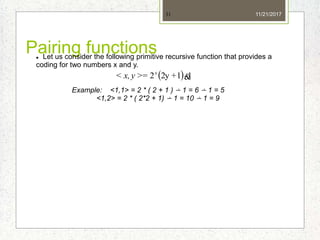
 Let us consider the following primitive recursive function that provides a
coding for two numbers x and y.
  1-12y2>< +=yx, x
11/21/2017
Pairing functions
31
 Let us consider the following primitive recursive function that provides a
coding for two numbers x and y.
Example: <1,1> = 2 * ( 2 + 1 ) ∸ 1 = 6 ∸ 1 = 5
<1,2> = 2 * ( 2*2 + 1) ∸ 1 = 10 ∸ 1 = 9
  1-12y2>< +=yx, x
11/21/2017
Pairing functions
32
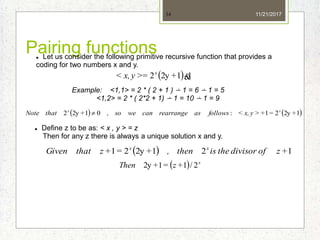
 Let us consider the following primitive recursive function that provides a
coding for two numbers x and y.
Example: <1,1> = 2 * ( 2 + 1 ) ∸ 1 = 6 ∸ 1 = 5
<1,2> = 2 * ( 2*2 + 1) ∸ 1 = 10 ∸ 1 = 9
   12y21:012y2 +=+>yx,<followsasrearrangecanweso,+thatNote xx

  1-12y2>< +=yx, x
11/21/2017
Pairing functions
33
 Let us consider the following primitive recursive function that provides a
coding for two numbers x and y.
Example: <1,1> = 2 * ( 2 + 1 ) ∸ 1 = 6 ∸ 1 = 5
<1,2> = 2 * ( 2*2 + 1) ∸ 1 = 10 ∸ 1 = 9
   12y21:012y2 +=+>yx,<followsasrearrangecanweso,+thatNote xx

 Define z to be as: < x , y > = z
Then for any z there is always a unique solution x and y.
  1-12y2>< +=yx, x
11/21/2017
Pairing functions
34
 Let us consider the following primitive recursive function that provides a
coding for two numbers x and y.
Example: <1,1> = 2 * ( 2 + 1 ) ∸ 1 = 6 ∸ 1 = 5
<1,2> = 2 * ( 2*2 + 1) ∸ 1 = 10 ∸ 1 = 9
   12y21:012y2 +=+>yx,<followsasrearrangecanweso,+thatNote xx
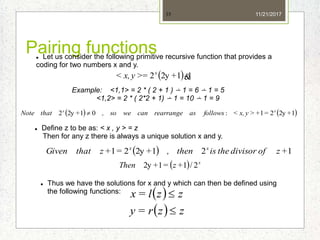

 Define z to be as: < x , y > = z
Then for any z there is always a unique solution x and y.
  1212y21 +zofdivisortheisthen,+=+zthatGiven xx
  x
+z=+Then 2/112y
  1-12y2>< +=yx, x
11/21/2017
Pairing functions
35
 Let us consider the following primitive recursive function that provides a
coding for two numbers x and y.
Example: <1,1> = 2 * ( 2 + 1 ) ∸ 1 = 6 ∸ 1 = 5
<1,2> = 2 * ( 2*2 + 1) ∸ 1 = 10 ∸ 1 = 9
   12y21:012y2 +=+>yx,<followsasrearrangecanweso,+thatNote xx

 Define z to be as: < x , y > = z
Then for any z there is always a unique solution x and y.
  1212y21 +zofdivisortheisthen,+=+zthatGiven xx
  x
+z=+Then 2/112y
 Thus we have the solutions for x and y which can then be defined using
the following functions:  
  zzr=y
zzl=x


  1-12y2>< +=yx, x
11/21/2017
Pairing functions
 More formally this can written as:
 Pairing Function Theorem: functions <x,y>, l(z), r(z) have
the following properties:
 are primitive recursive
 l(<x,y>) = x and r(<x,y>) = y
 < l(z) , r(z) > = z
 l(z) , r(z)≤ z
36
 
  zzr=y
zzl=x


     
     ]><[
]><[
yx,=zx=zr
yx,=zy=zl
z
nim
zy
z
nim
zx




11/21/2017
Gödel numbers
 Let (a1, … , an) be any sequence, then the Gödel
number is computed as follows:
37
[a1, ..., an]= ∏i= 1
n
pi
ai
11/21/2017
Gödel numbers
 Let (a1, … , an) be any sequence, then the Gödel
number is computed as follows:
 Example: Take a sequence (1,2,3,4), the Gödel
number will be computed as follows:
38
  4321
75321,2,3,4 =
[a1, ..., an]= ∏i= 1
n
pi
ai
11/21/2017
Gödel numbers
 Let (a1, … , an) be any sequence, then the Gödel
number is computed as follows:
 Example: Take a sequence (1,2,3,4), the Gödel
number will be computed as follows:
 Gödel numbering has a special uniqueness
property:
If [a1, … , an ] = [ b1, … , bn ] then
ai = bi , where i = 1, … , n
39
  4321
75321,2,3,4 =
[a1, ..., an]= ∏i= 1
n
pi
ai
11/21/2017
Gödel numbers
 Let (a1, … , an) be any sequence, then the Gödel
number is computed as follows:
 Example: Take a sequence (1,2,3,4), the Gödel
number will be computed as follows:
 Gödel numbering has a special uniqueness
property:
If [a1, … , an ] = [ b1, … , bn ] then
ai = bi , where i = 1, … , n
 Also notice: [ a1, … , an ] = [ a1, … , an, 0 ]
40
  4321
75321,2,3,4 =
[a1, ..., an]= ∏i= 1
n
pi
ai
11/21/2017
Gödel numbers
 Given that x = [a1, … , an ], we can now define two important
functions:
41
   
         00Lt
|~
1t
=xijjx=x
xp=a=x
jxi
nim
xi
i
nim
xtii
 


11/21/2017
Gödel numbers
 Given that x = [a1, … , an ], we can now define two important
functions:
 Example: Let x = [ 4 , 3 , 2 , 1 ], then (x)2 = 3 and (x)4=1 and (x)0 = 0
42
   
         00Lt
|~
1t
=xijjx=x
xp=a=x
jxi
nim
xi
i
nim
xtii
 


11/21/2017
Gödel numbers
 Given that x = [a1, … , an ], we can now define two important
functions:
 Example: Let x = [ 4 , 3 , 2 , 1 ], then (x)2 = 3 and (x)4=1 and (x)0 = 0
Lt(10) = will be the length of the sequence derived using Gödel
numbering
43
   
         00Lt
|~
1t
=xijjx=x
xp=a=x
jxi
nim
xi
i
nim
xtii
 


11/21/2017
Gödel numbers
 Given that x = [a1, … , an ], we can now define two important
functions:
 Example: Let x = [ 4 , 3 , 2 , 1 ], then (x)2 = 3 and (x)4=1 and (x)0 = 0
Lt(10) = will be the length of the sequence derived using Gödel
numbering
So: 10 = 2^1 * 3^0 * 5^1 = [ 1, 0, 1 ] => Lt(10) = 3
44
   
         00Lt
|~
1t
=xijjx=x
xp=a=x
jxi
nim
xi
i
nim
xtii
 


11/21/2017
Gödel numbers
 Given that x = [a1, … , an ], we can now define two important
functions:
 Example: Let x = [ 4 , 3 , 2 , 1 ], then (x)2 = 3 and (x)4=1 and (x)0 = 0
Lt(10) = will be the length of the sequence derived using Gödel
numbering
So: 10 = 2^1 * 3^0 * 5^1 = [ 1, 0, 1 ] => Lt(10) = 3
 Sequence Number Theorem:
45
  





 
otherwise
niifa
=a,a i
n
0
1
...1,
(1)
   
         00Lt
|~
1t
=xijjx=x
xp=a=x
jxi
nim
xi
i
nim
xtii
 


11/21/2017
Gödel numbers
 Given that x = [a1, … , an ], we can now define two important
functions:
 Example: Let x = [ 4 , 3 , 2 , 1 ], then (x)2 = 3 and (x)4=1 and (x)0 = 0
Lt(10) = will be the length of the sequence derived using Gödel
numbering
So: 10 = 2^1 * 3^0 * 5^1 = [ 1, 0, 1 ] => Lt(10) = 3
 Sequence Number Theorem:
46
  





 
otherwise
niifa
=a,a i
n
0
1
...1,
(1)
(2)       xnifx=x,x n Lt...1, 
   
         00Lt
|~
1t
=xijjx=x
xp=a=x
jxi
nim
xi
i
nim
xtii
 


11/21/2017

5.2 primitive recursive functions

  • 1.
  • 2.
    Preliminaries: partial andtotal functions  The domain of a partial function on set A contains the subset of A.  The domain of a total function on set A contains the entire set A.  A partial function f is called partially computable if there is some program that computes it. Another term for such functions partial recursive.  Similarly, a function f is called computable if it is both total and partially computable. Another term for such function is recursive. 2 11/21/2017
  • 3.
    Composition  Let f: A → B and g : B → C  Composition of f and g can then be expressed as: g ͦ f : A → C (g ͦ f)(x) = g(f(x)) h(x) = g(f(x))  NB: In general composition is not commutative: ( g ͦ f )(x) ≠ ( f ͦ g )(x) 3 11/21/2017
  • 4.
    Composition  Definition: Letg be a function containing k variables and f1 ... fk be functions of n variables, so the composition of g and f is defined as:  h(0) = k Base step h( x1, ... , xn) = g( f1(x1 ,..., xn), … , fk(x1 ,..., xn) ) Inductive step  Example: h(x , y) = g( f1(x , y), f2(x , y), f3(x , y) )  h is obtained from g and f1... fk by composition.  If g and f1...fk are (partially) computable, then h is (partially) computable. (Proof by construction) 4 11/21/2017
  • 5.
    Recursion  From programmingexperience we know that recursion refers to a function calling upon itself within its own definition.  Definition: Let g be a function containing k variables then h is obtained through recursion as follows: h(x1 , … , xn) = g( … , h(x1 , … , xn) ) Example: x + y f( x , 0 ) = x (1) f(x , y+1 ) = f( x , y ) + 1 (2) Input: f ( 3, 2 ) => f ( 3 , 1 ) + 1 => ( f ( 3 , 0 ) + 1 ) + 1 => ( 3 + 1 ) + 1 => 5 5 11/21/2017
  • 6.
    PRC: Initial functions Primitive Recursively Closed (PRC) class of functions.  Initial functions:  Example of a projection function: u2 ( x1 , x2 , x3 , x4 , x5 ) = x2  Definition: A class of total functions C is called PRC² class if:  The initial functions belong to C.  Function obtained from functions belonging to C by either composition or recursion belongs to C. 6 s(x) = x + 1 n(x) = 0 ui (x1 , … , xn) = xi 11/21/2017
  • 7.
    PRC: primitive recursivefunctions  There exists a class of computable functions that is a PRC class.  Definition: Function is considered primitive recursive if it can be obtained from initial functions and through finite number of composition and recursion steps.  Theorem: A function is primitive recursive iff it belongs to the PRC class. (see proof in chapter 3)  Corollary: Every primitive recursive function is computable. 7 11/21/2017
  • 8.
    Primitive recursive functions:sum  We have already seen the addition function, which can be rewritten in LRR as follows: sum( x, succ(y) ) => succ( sum( x , y)) ; sum( x , 0 ) => x ; Example: sum(succ(0),succ(succ(succ(0)))) => succ(sum(succ(0),succ(succ(0)))) => succ(succ(sum(succ(0),succ(0)))) => succ(succ(succ(sum(succ(0),0) => succ(succ(succ(succ(0))) => succ(succ(succ(1))) => succ(succ(2)) => succ(3) => 4 8 NB: To prove that a function is primitive recursive you need show that it can be obtained from the initial functions using only concatenation and recursion. 11/21/2017
  • 9.
    Primitive recursive functions: multiplication h(x , 0 ) = 0 h( x , y + 1) = h( x , y ) + x  In LRR this can be written as: mult(x,0) => 0 ; mult(x,succ(y)) => sum(mult(x,y),x) ;  What would happen on the following input? mult(succ(succ(0)),succ(succ(0))) 9 11/21/2017
  • 10.
    Primitive recursive functions: factorial 0!= 1 ( x + 1 ) ! = x ! * s( x )  LRR implementation would be as follows: fact(0) => succ(null(0)) ; fact(succ(x)) => mult(fact(x),succ(x)) ; Output for the following? fact(succ(succ(null(0)))) 10 11/21/2017
  • 11.
    Primitive recursive functions: powerand predecessor 11 xx=x =x y+y * 1 1 0 In LRR the power function can be expressed as follows: pow(x,0) => succ(null(0)) ; pow(x,succ(y)) => mult(pow(x,y),x) ; p (0) = 0 p ( t + 1 ) = t Power function Predecessor function In LRR the predecessor is as follows: pred(1) => 0 ; pred(succ(x)) => x ; 11/21/2017
  • 12.
    Primitive recursive functions: ∸,| x – y | and α x ∸ 0 = x x ∸ ( t + 1) = p( x ∸ t ) 12 | x – y | = ( x ∸ y ) + ( y ∸ x ) α(x) = 1 ∸ x dotsub(x,x) => 0 ; dotsub(x,succ(y)) => pred(dotsub(x,y)) ; abs(x,y) => sum(dotsub(x,y),dotsub(y,x)) ; α(x) => dotsub(1,x) ; What would be the output?  dotsub(succ(succ(succ(0))),succ(0)) Output for the following?  a(succ(succ(0)))  a(null(0)) 0 0 1 )(      x otherwise if x 11/21/2017
  • 13.
    Primitive recursive functions 13 x+ y f( x , 0 ) = x f( x , y + 1 ) = f( x , y ) + 1 x * y h( x , 0 ) = 0 h( x , y + 1 ) = h( x , y ) + x x! 0! = 1 ( x + 1 )! = x! * s(x) x^y x^0 = 1 x^( y + 1 ) = x^y * x p(x) p( 0 ) = 0 p( x + 1 ) = x x ∸ y if x ≥ y then x ∸ y = x – y; else x ∸ y = 0 x ∸ 0 = x x ∸ ( t + 1) = p( x ∸ t ) | x – y | | x – y | = ( x ∸ y ) + ( y ∸ x ) α(x) α(x) = 1 ∸ x 11/21/2017
  • 14.
    Bounded quantifiers  Theorem:Let C be a PRC class. If f( t , x1 , … , xn) belongs to C then so do the functions g( y , x1 , ... , xn ) = f( t , x1 , …, xn ) g( y , x1 , ... , xn ) = f( t , x1 , …, xn ) 14  y t 0  y t 0 11/21/2017
  • 15.
    Bounded quantifiers  Theorem:Let C be a PRC class. If f( t , x1 , … , xn) belongs to C then so do the functions g( y , x1 , ... , xn ) = f( t , x1 , …, xn ) g( y , x1 , ... , xn ) = f( t , x1 , …, xn )  Theorem: If the predicate P( t, x1 , … , xn ) belongs to some PRC class C, then so do the predicates: ( t)≤y P(t, x1, … , xn ) (∃t)≤y P(t, x1, … , xn ) 15  y t 0  y t 0  11/21/2017
  • 16.
    Primitive recursive predicates 16 x= y d( x , y ) = α( | x – y | ) x ≤ y α ( x ∸ y ) ~P α( P ) P & Q P * Q P v Q ~ ( ~P & ~Q ) y | x y | x = (∃t)≤x { y * t = x } Prime(x) Prime(x) = x > 1 & ( t)≤x { t = 1 v t = x v ~( t | x ) } Exercises for Chapter 3: page 62 Questions 3,4 and 5. Fibonacci function  11/21/2017
  • 17.
    Bounded minimalization 17 Let P(t,x1, … ,xn) be in some PRC class C and we can define a function g as follows:     n1,. y u= u =t n1, x,xt,P=x,xt,g ..... 0 0  11/21/2017
  • 18.
    Bounded minimalization 18 Let P(t,x1, … ,xn) be in some PRC class C and we can define a function g as follows:     n1,. y u= u =t n1, x,xt,P=x,xt,g ..... 0 0  P(t,x1,. .. ,xn )= 0 for t<t0 P(t0, x1,. .. ,xn )= 1,where 11/21/2017
  • 19.
    Bounded minimalization 19 Let P(t,x1, … ,xn) be in some PRC class C and we can define a function g as follows:     n1,. y u= u =t n1, x,xt,P=x,xt,g ..... 0 0  P(t,x1,. .. ,xn )= 0 for t<t0 P(t0, x1,. .. ,xn )= 1,where  Function g also belongs to C as it is attained from composition of primitive recursive functions. 11/21/2017
  • 20.
    Bounded minimalization 20 Let P(t,x1, … ,xn) be in some PRC class C and we can define a function g as follows:     n1,. y u= u =t n1, x,xt,P=x,xt,g ..... 0 0  P(t,x1,. .. ,xn )= 0 for t<t0 P(t0, x1,. .. ,xn )= 1,where  Function g also belongs to C as it is attained from composition of primitive recursive functions.  t0 is the least value for for which the predicate P is true (1). 11/21/2017
  • 21.
    Bounded minimalization 21 Let P(t,x1, … ,xn) be in some PRC class C and we can define a function g as follows:     n1,. y u= u =t n1, x,xt,P=x,xt,g ..... 0 0  P(t,x1,. .. ,xn )= 0 for t<t0 P(t0, x1,. .. ,xn )= 1,where  Function g also belongs to C as it is attained from composition of primitive recursive functions.  t0 is the least value for for which the predicate P is true (1).       False=x,xt,Ptt True=x,xt,Pt<t n1, n1,0   0...: 1...: 0   11/21/2017
  • 22.
    Bounded minimalization 22 Let P(t,x1, … ,xn) be in some PRC class C and we can define a function g as follows:     n1,. y u= u =t n1, x,xt,P=x,xt,g ..... 0 0  P(t,x1,. .. ,xn )= 0 fort<t0 P (t0, x1,. .. ,xn)= 1,where  Function g also belongs to C as it is attained from composition of primitive recursive functions.  t0 is the least value for for which the predicate P is true (1).       False=x,xt,Ptt True=x,xt,Pt<t n1, n1,0   0...: 1...: 0         0 0 0 0.. 1.. tuif=x,xt,P t<uif=x,xt,P n1,. u =t 0n1,. u =t     11/21/2017
  • 23.
    Bounded minimalization 23 Let P(t,x1, … ,xn) be in some PRC class C and we can define a function g as follows:     n1,. y u= u =t n1, x,xt,P=x,xt,g ..... 0 0  P(t,x1,. .. ,xn )= 0 for t<t0 P(t0, x1,. .. ,xn )= 1,where  Function g also belongs to C as it is attained from composition of primitive recursive functions.  t0 is the least value for for which the predicate P is true (1).       False=x,xt,Ptt True=x,xt,Pt<t n1, n1,0   0...: 1...: 0         0 0 0 0.. 1.. tuif=x,xt,P t<uif=x,xt,P n1,. u =t 0n1,. u =t     g (y,x1,. .. ,xn)= ∑ 1= 1=t0 for u<t0 11/21/2017
  • 24.
    Bounded minimalization 24 Let P(t,x1, … ,xn) be in some PRC class C and we can define a function g as follows:     n1,. y u= u =t n1, x,xt,P=x,xt,g ..... 0 0  P(t,x1,. .. ,xn )= 0 for t<t0 P(t0, x1,. .. ,xn )= 1,where  Function g also belongs to C as it is attained from composition of primitive recursive functions.  t0 is the least value for for which the predicate P is true (1).       False=x,xt,Ptt True=x,xt,Pt<t n1, n1,0   0...: 1...: 0         0 0 0 0.. 1.. tuif=x,xt,P t<uif=x,xt,P n1,. u =t 0n1,. u =t     g (y,x1,. .. ,xn)= ∑ 1= 1=t0 for u<t0  g( y , x1 , ... , xn ) produces the least value for which P is true. Finally the definition for bounded minimalization can be given as:           otherwise=x,xt,P x,xt,Ptifx,xy,g=x,xt,P n nim yt nytnn nim yt 0.. ...... 1,. 1,.1,.1,.    11/21/2017
  • 25.
    Bounded minimalization 25 Let P(t,x1, … ,xn) be in some PRC class C and we can define a function g as follows:     n1,. y u= u =t n1, x,xt,P=x,xt,g ..... 0 0  P(t,x1,. .. ,xn )= 0 for t<t0 P(t0, x1,. .. ,xn )= 1,where  Function g also belongs to C as it is attained from composition of primitive recursive functions.  t0 is the least value for for which the predicate P is true (1).       False=x,xt,Ptt True=x,xt,Pt<t n1, n1,0   0...: 1...: 0         0 0 0 0.. 1.. tuif=x,xt,P t<uif=x,xt,P n1,. u =t 0n1,. u =t     g (y,x1,. .. ,xn)= ∑ 1= 1=t0 for u<t0  g( y , x1 , ... , xn ) produces the least value for which P is true. Finally the definition for bounded minimalization can be given as:  Theorem: If P(t,x1, … ,xn) belongs to some PRC class C and there is function g that does the bounded minimalization for P, then f belongs to C.           otherwise=x,xt,P x,xt,Ptifx,xy,g=x,xt,P n nim yt nytnn nim yt 0.. ...... 1,. 1,.1,.1,.    11/21/2017
  • 26.
    Unbounded minimalization  Definition:y is the least value for which predicate P is true if it exists. If there is no value of y for which P is true, the unbounded minimalization is undefined. 26 min y P(x1,... , xn , y) 11/21/2017
  • 27.
    Unbounded minimalization  Definition:y is the least value for which predicate P is true if it exists. If there is no value of y for which P is true, the unbounded minimalization is undefined.  We can then define this as a non-total function in the following way: 27 min y P(x1,... , xn , y) x− y= min z [ y+ z= x] 11/21/2017
  • 28.
    Unbounded minimalization  Definition:y is the least value for which predicate P is true if it exists. If there is no value of y for which P is true, the unbounded minimalization is undefined.  We can then define this as a non-total function in the following way:  Theorem: If P(x1, … , xn, y) is a computable predicate and if then g is a partially computable function. (Proof by construction) 28 min y P(x1,... , xn , y) x− y= min z [ y+ z= x] g(x1,. .., xn)= min y P(x1,. .. , xn , y) 11/21/2017
  • 29.
    Additional primitive recursive functions [ x / y ] , the whole part of the division i.e. [10/4]=2  R(x,y) , remainder of the division of x by y.  pn , nth prime number i.e p1=2 , p2=3 etc. 29     yxyx=yx,R /*-     x>y+t=yx nim xt *1/  p0= 0, pn+ 1= min t < pn!+ 1 [Prime(t)& t> pn] 11/21/2017
  • 30.
    Pairing functions 30  Letus consider the following primitive recursive function that provides a coding for two numbers x and y.   1-12y2>< +=yx, x 11/21/2017
  • 31.
    Pairing functions 31  Letus consider the following primitive recursive function that provides a coding for two numbers x and y. Example: <1,1> = 2 * ( 2 + 1 ) ∸ 1 = 6 ∸ 1 = 5 <1,2> = 2 * ( 2*2 + 1) ∸ 1 = 10 ∸ 1 = 9   1-12y2>< +=yx, x 11/21/2017
  • 32.
    Pairing functions 32  Letus consider the following primitive recursive function that provides a coding for two numbers x and y. Example: <1,1> = 2 * ( 2 + 1 ) ∸ 1 = 6 ∸ 1 = 5 <1,2> = 2 * ( 2*2 + 1) ∸ 1 = 10 ∸ 1 = 9    12y21:012y2 +=+>yx,<followsasrearrangecanweso,+thatNote xx    1-12y2>< +=yx, x 11/21/2017
  • 33.
    Pairing functions 33  Letus consider the following primitive recursive function that provides a coding for two numbers x and y. Example: <1,1> = 2 * ( 2 + 1 ) ∸ 1 = 6 ∸ 1 = 5 <1,2> = 2 * ( 2*2 + 1) ∸ 1 = 10 ∸ 1 = 9    12y21:012y2 +=+>yx,<followsasrearrangecanweso,+thatNote xx   Define z to be as: < x , y > = z Then for any z there is always a unique solution x and y.   1-12y2>< +=yx, x 11/21/2017
  • 34.
    Pairing functions 34  Letus consider the following primitive recursive function that provides a coding for two numbers x and y. Example: <1,1> = 2 * ( 2 + 1 ) ∸ 1 = 6 ∸ 1 = 5 <1,2> = 2 * ( 2*2 + 1) ∸ 1 = 10 ∸ 1 = 9    12y21:012y2 +=+>yx,<followsasrearrangecanweso,+thatNote xx   Define z to be as: < x , y > = z Then for any z there is always a unique solution x and y.   1212y21 +zofdivisortheisthen,+=+zthatGiven xx   x +z=+Then 2/112y   1-12y2>< +=yx, x 11/21/2017
  • 35.
    Pairing functions 35  Letus consider the following primitive recursive function that provides a coding for two numbers x and y. Example: <1,1> = 2 * ( 2 + 1 ) ∸ 1 = 6 ∸ 1 = 5 <1,2> = 2 * ( 2*2 + 1) ∸ 1 = 10 ∸ 1 = 9    12y21:012y2 +=+>yx,<followsasrearrangecanweso,+thatNote xx   Define z to be as: < x , y > = z Then for any z there is always a unique solution x and y.   1212y21 +zofdivisortheisthen,+=+zthatGiven xx   x +z=+Then 2/112y  Thus we have the solutions for x and y which can then be defined using the following functions:     zzr=y zzl=x     1-12y2>< +=yx, x 11/21/2017
  • 36.
    Pairing functions  Moreformally this can written as:  Pairing Function Theorem: functions <x,y>, l(z), r(z) have the following properties:  are primitive recursive  l(<x,y>) = x and r(<x,y>) = y  < l(z) , r(z) > = z  l(z) , r(z)≤ z 36     zzr=y zzl=x              ]><[ ]><[ yx,=zx=zr yx,=zy=zl z nim zy z nim zx     11/21/2017
  • 37.
    Gödel numbers  Let(a1, … , an) be any sequence, then the Gödel number is computed as follows: 37 [a1, ..., an]= ∏i= 1 n pi ai 11/21/2017
  • 38.
    Gödel numbers  Let(a1, … , an) be any sequence, then the Gödel number is computed as follows:  Example: Take a sequence (1,2,3,4), the Gödel number will be computed as follows: 38   4321 75321,2,3,4 = [a1, ..., an]= ∏i= 1 n pi ai 11/21/2017
  • 39.
    Gödel numbers  Let(a1, … , an) be any sequence, then the Gödel number is computed as follows:  Example: Take a sequence (1,2,3,4), the Gödel number will be computed as follows:  Gödel numbering has a special uniqueness property: If [a1, … , an ] = [ b1, … , bn ] then ai = bi , where i = 1, … , n 39   4321 75321,2,3,4 = [a1, ..., an]= ∏i= 1 n pi ai 11/21/2017
  • 40.
    Gödel numbers  Let(a1, … , an) be any sequence, then the Gödel number is computed as follows:  Example: Take a sequence (1,2,3,4), the Gödel number will be computed as follows:  Gödel numbering has a special uniqueness property: If [a1, … , an ] = [ b1, … , bn ] then ai = bi , where i = 1, … , n  Also notice: [ a1, … , an ] = [ a1, … , an, 0 ] 40   4321 75321,2,3,4 = [a1, ..., an]= ∏i= 1 n pi ai 11/21/2017
  • 41.
    Gödel numbers  Giventhat x = [a1, … , an ], we can now define two important functions: 41              00Lt |~ 1t =xijjx=x xp=a=x jxi nim xi i nim xtii     11/21/2017
  • 42.
    Gödel numbers  Giventhat x = [a1, … , an ], we can now define two important functions:  Example: Let x = [ 4 , 3 , 2 , 1 ], then (x)2 = 3 and (x)4=1 and (x)0 = 0 42              00Lt |~ 1t =xijjx=x xp=a=x jxi nim xi i nim xtii     11/21/2017
  • 43.
    Gödel numbers  Giventhat x = [a1, … , an ], we can now define two important functions:  Example: Let x = [ 4 , 3 , 2 , 1 ], then (x)2 = 3 and (x)4=1 and (x)0 = 0 Lt(10) = will be the length of the sequence derived using Gödel numbering 43              00Lt |~ 1t =xijjx=x xp=a=x jxi nim xi i nim xtii     11/21/2017
  • 44.
    Gödel numbers  Giventhat x = [a1, … , an ], we can now define two important functions:  Example: Let x = [ 4 , 3 , 2 , 1 ], then (x)2 = 3 and (x)4=1 and (x)0 = 0 Lt(10) = will be the length of the sequence derived using Gödel numbering So: 10 = 2^1 * 3^0 * 5^1 = [ 1, 0, 1 ] => Lt(10) = 3 44              00Lt |~ 1t =xijjx=x xp=a=x jxi nim xi i nim xtii     11/21/2017
  • 45.
    Gödel numbers  Giventhat x = [a1, … , an ], we can now define two important functions:  Example: Let x = [ 4 , 3 , 2 , 1 ], then (x)2 = 3 and (x)4=1 and (x)0 = 0 Lt(10) = will be the length of the sequence derived using Gödel numbering So: 10 = 2^1 * 3^0 * 5^1 = [ 1, 0, 1 ] => Lt(10) = 3  Sequence Number Theorem: 45           otherwise niifa =a,a i n 0 1 ...1, (1)              00Lt |~ 1t =xijjx=x xp=a=x jxi nim xi i nim xtii     11/21/2017
  • 46.
    Gödel numbers  Giventhat x = [a1, … , an ], we can now define two important functions:  Example: Let x = [ 4 , 3 , 2 , 1 ], then (x)2 = 3 and (x)4=1 and (x)0 = 0 Lt(10) = will be the length of the sequence derived using Gödel numbering So: 10 = 2^1 * 3^0 * 5^1 = [ 1, 0, 1 ] => Lt(10) = 3  Sequence Number Theorem: 46           otherwise niifa =a,a i n 0 1 ...1, (1) (2)       xnifx=x,x n Lt...1,               00Lt |~ 1t =xijjx=x xp=a=x jxi nim xi i nim xtii     11/21/2017