PRESENTATION ON
PUMPING LEMMA
PRESENTED BY –
SANJEEV KUMAR
SG18342
What is pumping lemma?
There are two Pumping Lemmas, which are
defined for
1. Regular Languages, and
2. Context – Free Languages
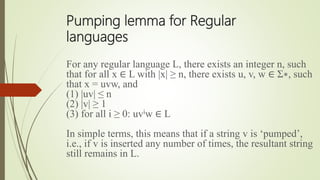
Pumping lemma for Regular
languages
For any regular language L, there exists an integer n, such
that for all x ∈ L with |x| ≥ n, there exists u, v, w ∈ Σ∗, such
that x = uvw, and
(1) |uv| ≤ n
(2) |v| ≥ 1
(3) for all i ≥ 0: uviw ∈ L
In simple terms, this means that if a string v is ‘pumped’,
i.e., if v is inserted any number of times, the resultant string
still remains in L.
Pumping Lemma is used as a proof for irregularity of a
language. Thus, if a language is regular, it always
satisfies pumping lemma. If there exists at least one
string made from pumping which is not in L, then L is
surely not regular.
The opposite of this may not always be true. That is, if
Pumping Lemma holds, it does not mean that the
language is regular.
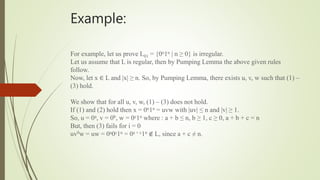
Example:
For example, let us prove L01 = {0n1n | n ≥ 0} is irregular.
Let us assume that L is regular, then by Pumping Lemma the above given rules
follow.
Now, let x ∈ L and |x| ≥ n. So, by Pumping Lemma, there exists u, v, w such that (1) –
(3) hold.
We show that for all u, v, w, (1) – (3) does not hold.
If (1) and (2) hold then x = 0n1n = uvw with |uv| ≤ n and |v| ≥ 1.
So, u = 0a, v = 0b, w = 0c1n where : a + b ≤ n, b ≥ 1, c ≥ 0, a + b + c = n
But, then (3) fails for i = 0
uv0w = uw = 0a0c1n = 0a + c1n ∉ L, since a + c ≠ n.
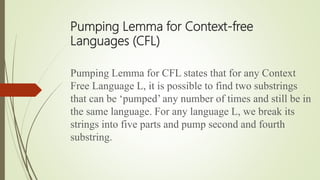
Pumping Lemma for Context-free
Languages (CFL)
Pumping Lemma for CFL states that for any Context
Free Language L, it is possible to find two substrings
that can be ‘pumped’ any number of times and still be in
the same language. For any language L, we break its
strings into five parts and pump second and fourth
substring.
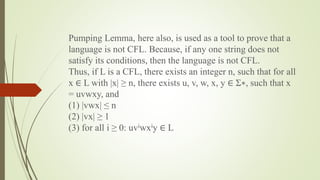
Pumping Lemma, here also, is used as a tool to prove that a
language is not CFL. Because, if any one string does not
satisfy its conditions, then the language is not CFL.
Thus, if L is a CFL, there exists an integer n, such that for all
x ∈ L with |x| ≥ n, there exists u, v, w, x, y ∈ Σ∗, such that x
= uvwxy, and
(1) |vwx| ≤ n
(2) |vx| ≥ 1
(3) for all i ≥ 0: uviwxiy ∈ L
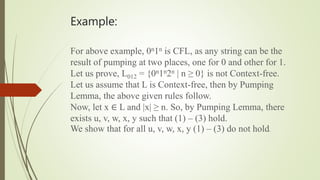
Example:
For above example, 0n1n is CFL, as any string can be the
result of pumping at two places, one for 0 and other for 1.
Let us prove, L012 = {0n1n2n | n ≥ 0} is not Context-free.
Let us assume that L is Context-free, then by Pumping
Lemma, the above given rules follow.
Now, let x ∈ L and |x| ≥ n. So, by Pumping Lemma, there
exists u, v, w, x, y such that (1) – (3) hold.
We show that for all u, v, w, x, y (1) – (3) do not hold.
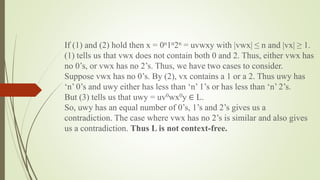
If (1) and (2) hold then x = 0n1n2n = uvwxy with |vwx| ≤ n and |vx| ≥ 1.
(1) tells us that vwx does not contain both 0 and 2. Thus, either vwx has
no 0’s, or vwx has no 2’s. Thus, we have two cases to consider.
Suppose vwx has no 0’s. By (2), vx contains a 1 or a 2. Thus uwy has
‘n’ 0’s and uwy either has less than ‘n’ 1’s or has less than ‘n’ 2’s.
But (3) tells us that uwy = uv0wx0y ∈ L.
So, uwy has an equal number of 0’s, 1’s and 2’s gives us a
contradiction. The case where vwx has no 2’s is similar and also gives
us a contradiction. Thus L is not context-free.
THANK-YOU

Pumping lemma

  • 1.
    PRESENTATION ON PUMPING LEMMA PRESENTEDBY – SANJEEV KUMAR SG18342
  • 2.
  • 3.
    There are twoPumping Lemmas, which are defined for 1. Regular Languages, and 2. Context – Free Languages
  • 4.
    Pumping lemma forRegular languages For any regular language L, there exists an integer n, such that for all x ∈ L with |x| ≥ n, there exists u, v, w ∈ Σ∗, such that x = uvw, and (1) |uv| ≤ n (2) |v| ≥ 1 (3) for all i ≥ 0: uviw ∈ L In simple terms, this means that if a string v is ‘pumped’, i.e., if v is inserted any number of times, the resultant string still remains in L.
  • 5.
    Pumping Lemma isused as a proof for irregularity of a language. Thus, if a language is regular, it always satisfies pumping lemma. If there exists at least one string made from pumping which is not in L, then L is surely not regular. The opposite of this may not always be true. That is, if Pumping Lemma holds, it does not mean that the language is regular.
  • 6.
    Example: For example, letus prove L01 = {0n1n | n ≥ 0} is irregular. Let us assume that L is regular, then by Pumping Lemma the above given rules follow. Now, let x ∈ L and |x| ≥ n. So, by Pumping Lemma, there exists u, v, w such that (1) – (3) hold. We show that for all u, v, w, (1) – (3) does not hold. If (1) and (2) hold then x = 0n1n = uvw with |uv| ≤ n and |v| ≥ 1. So, u = 0a, v = 0b, w = 0c1n where : a + b ≤ n, b ≥ 1, c ≥ 0, a + b + c = n But, then (3) fails for i = 0 uv0w = uw = 0a0c1n = 0a + c1n ∉ L, since a + c ≠ n.
  • 7.
    Pumping Lemma forContext-free Languages (CFL) Pumping Lemma for CFL states that for any Context Free Language L, it is possible to find two substrings that can be ‘pumped’ any number of times and still be in the same language. For any language L, we break its strings into five parts and pump second and fourth substring.
  • 8.
    Pumping Lemma, herealso, is used as a tool to prove that a language is not CFL. Because, if any one string does not satisfy its conditions, then the language is not CFL. Thus, if L is a CFL, there exists an integer n, such that for all x ∈ L with |x| ≥ n, there exists u, v, w, x, y ∈ Σ∗, such that x = uvwxy, and (1) |vwx| ≤ n (2) |vx| ≥ 1 (3) for all i ≥ 0: uviwxiy ∈ L
  • 9.
    Example: For above example,0n1n is CFL, as any string can be the result of pumping at two places, one for 0 and other for 1. Let us prove, L012 = {0n1n2n | n ≥ 0} is not Context-free. Let us assume that L is Context-free, then by Pumping Lemma, the above given rules follow. Now, let x ∈ L and |x| ≥ n. So, by Pumping Lemma, there exists u, v, w, x, y such that (1) – (3) hold. We show that for all u, v, w, x, y (1) – (3) do not hold.
  • 10.
    If (1) and(2) hold then x = 0n1n2n = uvwxy with |vwx| ≤ n and |vx| ≥ 1. (1) tells us that vwx does not contain both 0 and 2. Thus, either vwx has no 0’s, or vwx has no 2’s. Thus, we have two cases to consider. Suppose vwx has no 0’s. By (2), vx contains a 1 or a 2. Thus uwy has ‘n’ 0’s and uwy either has less than ‘n’ 1’s or has less than ‘n’ 2’s. But (3) tells us that uwy = uv0wx0y ∈ L. So, uwy has an equal number of 0’s, 1’s and 2’s gives us a contradiction. The case where vwx has no 2’s is similar and also gives us a contradiction. Thus L is not context-free.
  • 11.