5.4 Complex Numbers
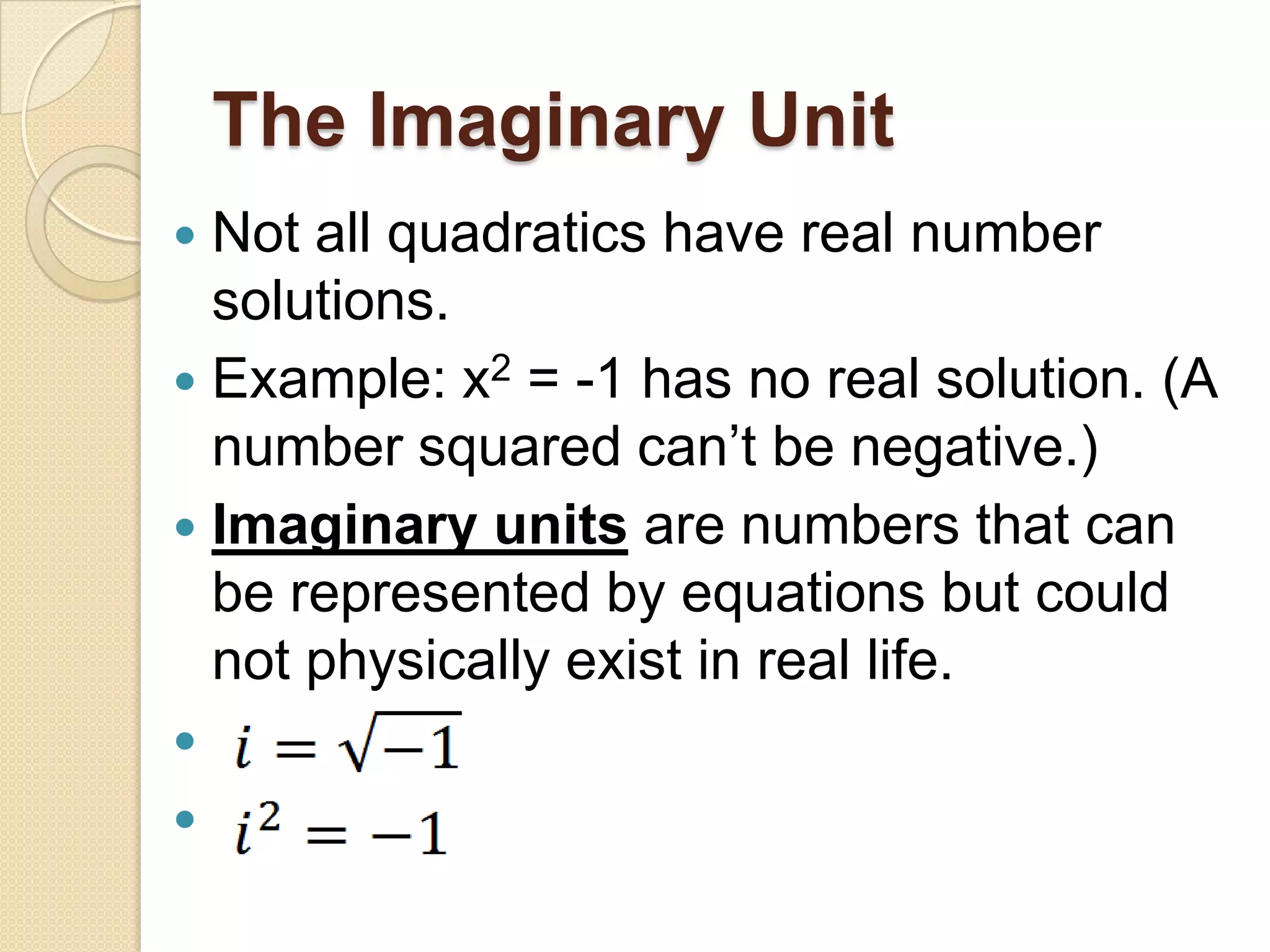
The Imaginary Unit
 Not all quadratics have real number
  solutions.
 Example: x2 = -1 has no real solution. (A
  number squared can’t be negative.)
 Imaginary units are numbers that can
  be represented by equations but could
  not physically exist in real life.


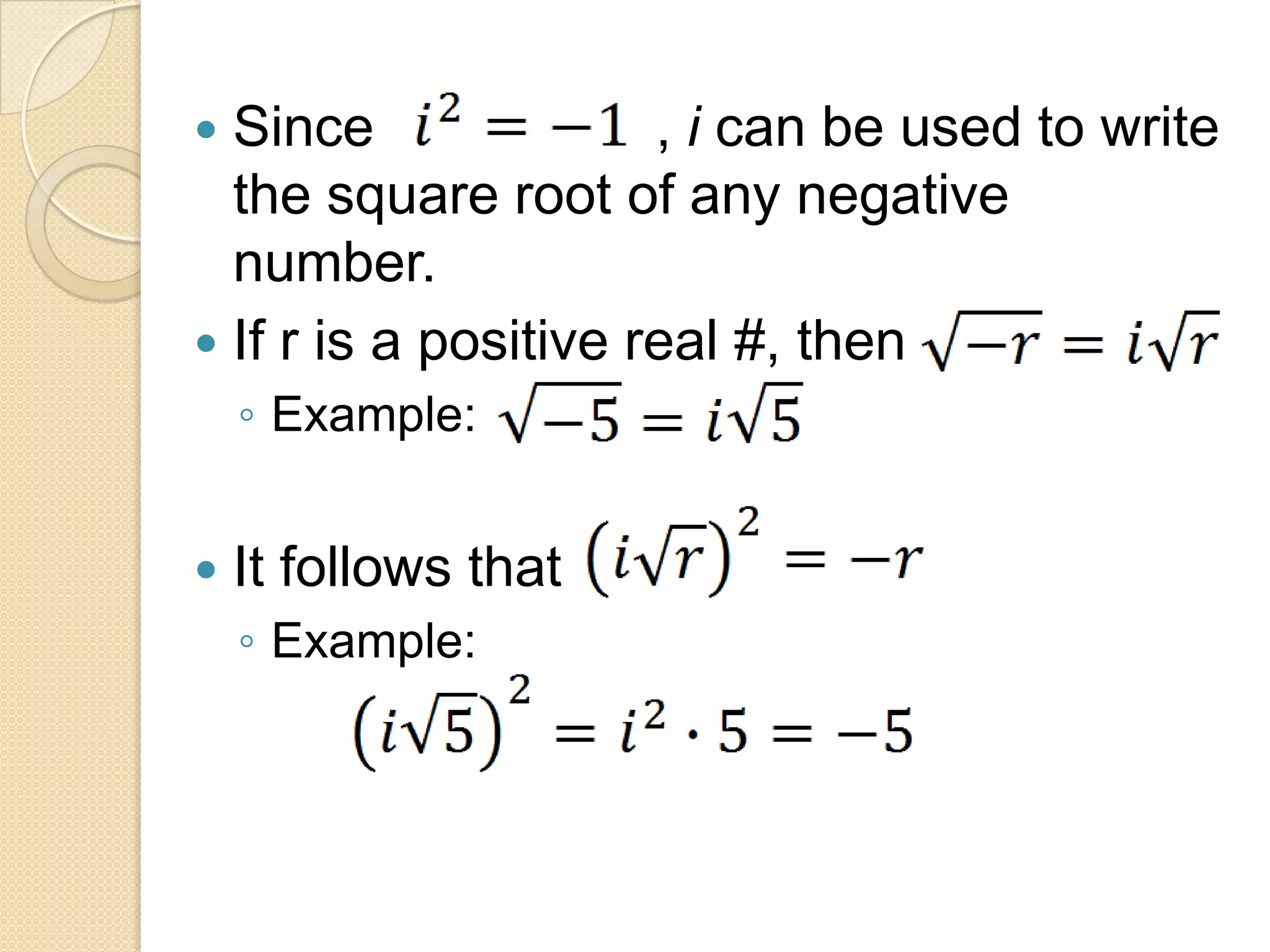
 Since               , i can be used to write
  the square root of any negative
  number.
 If r is a positive real #, then
    ◦ Example:


   It follows that
    ◦ Example:
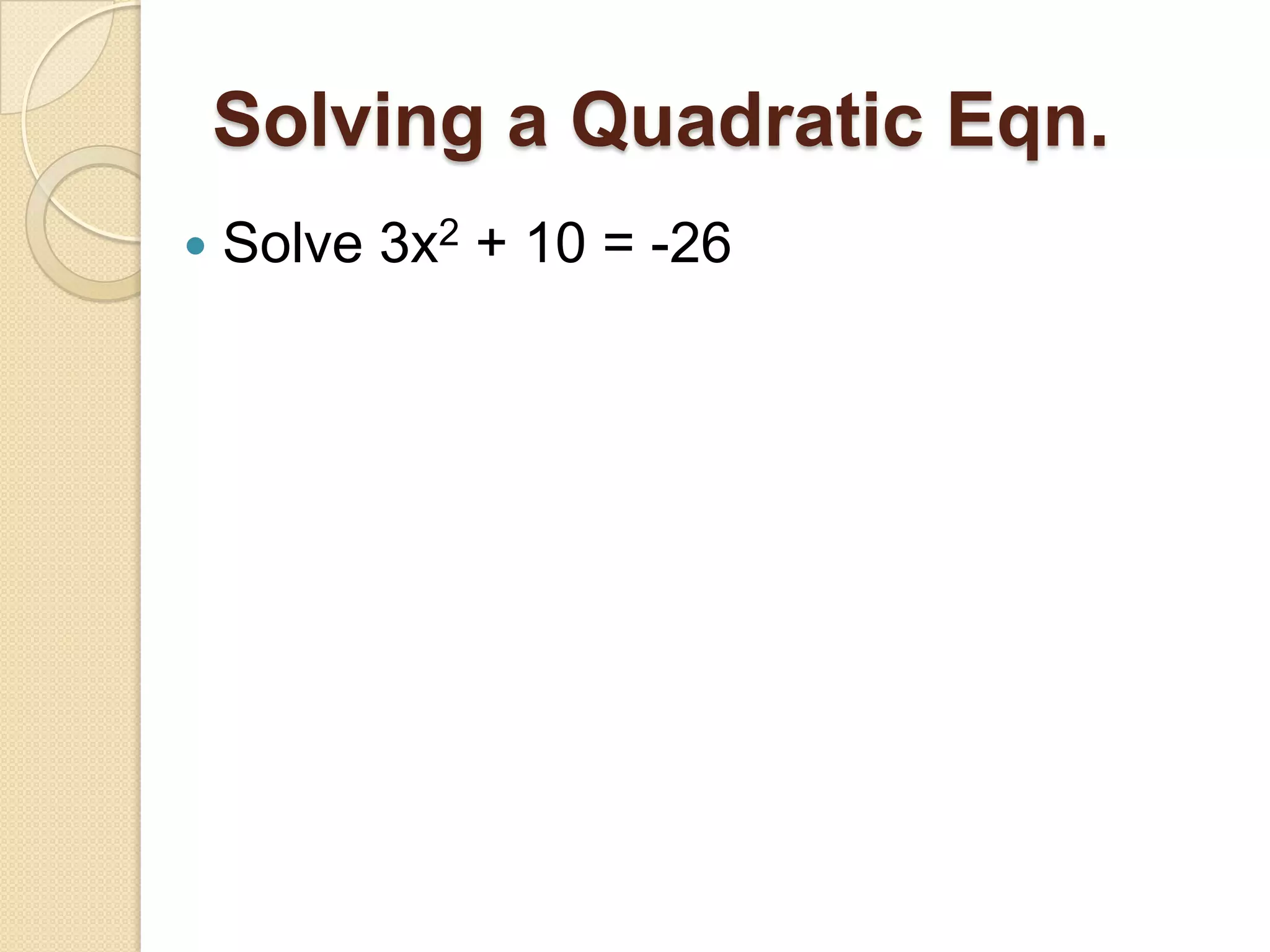
Solving a Quadratic Eqn.
   Solve 3x2 + 10 = -26
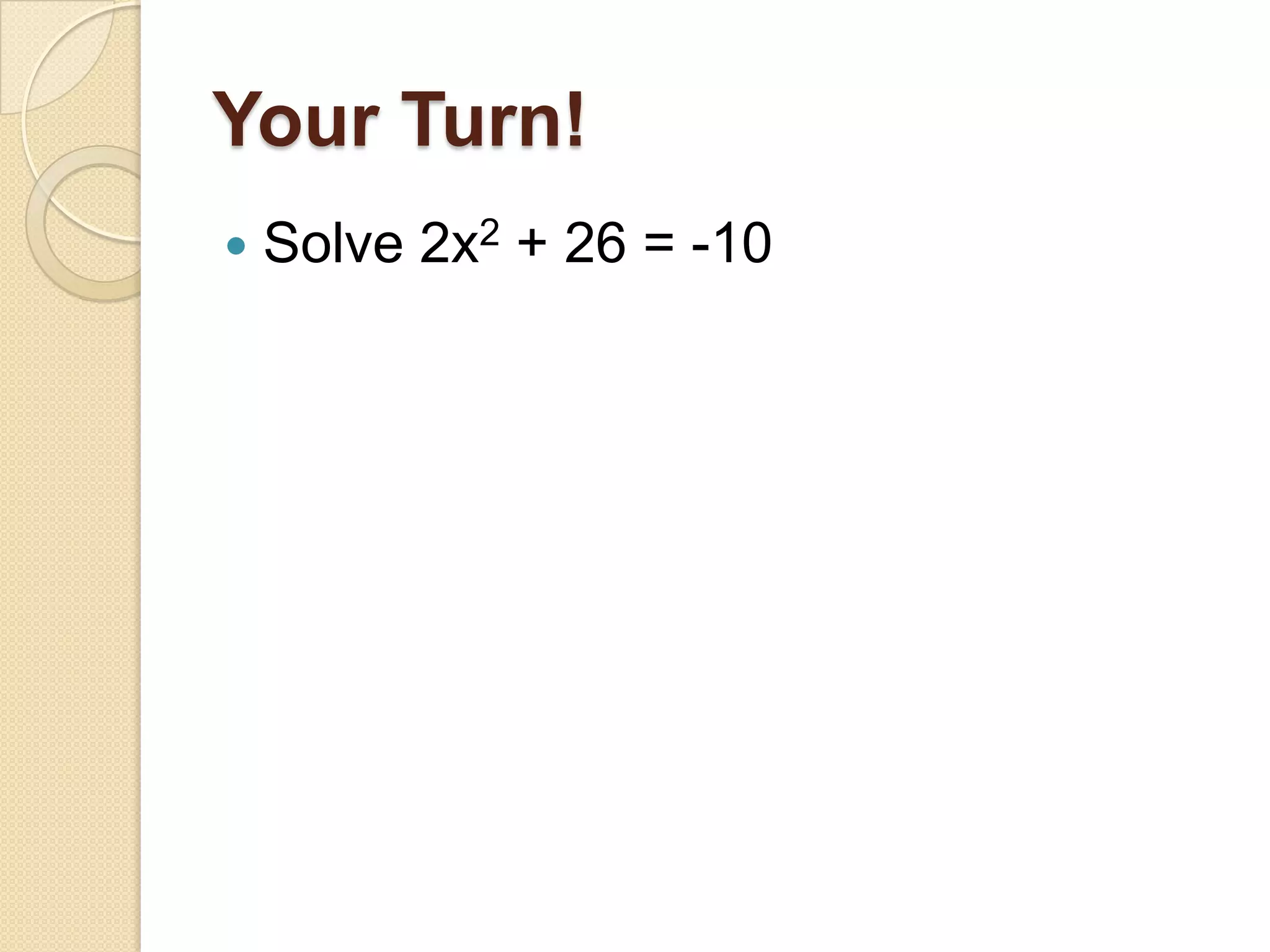
Your Turn!
   Solve 2x2 + 26 = -10
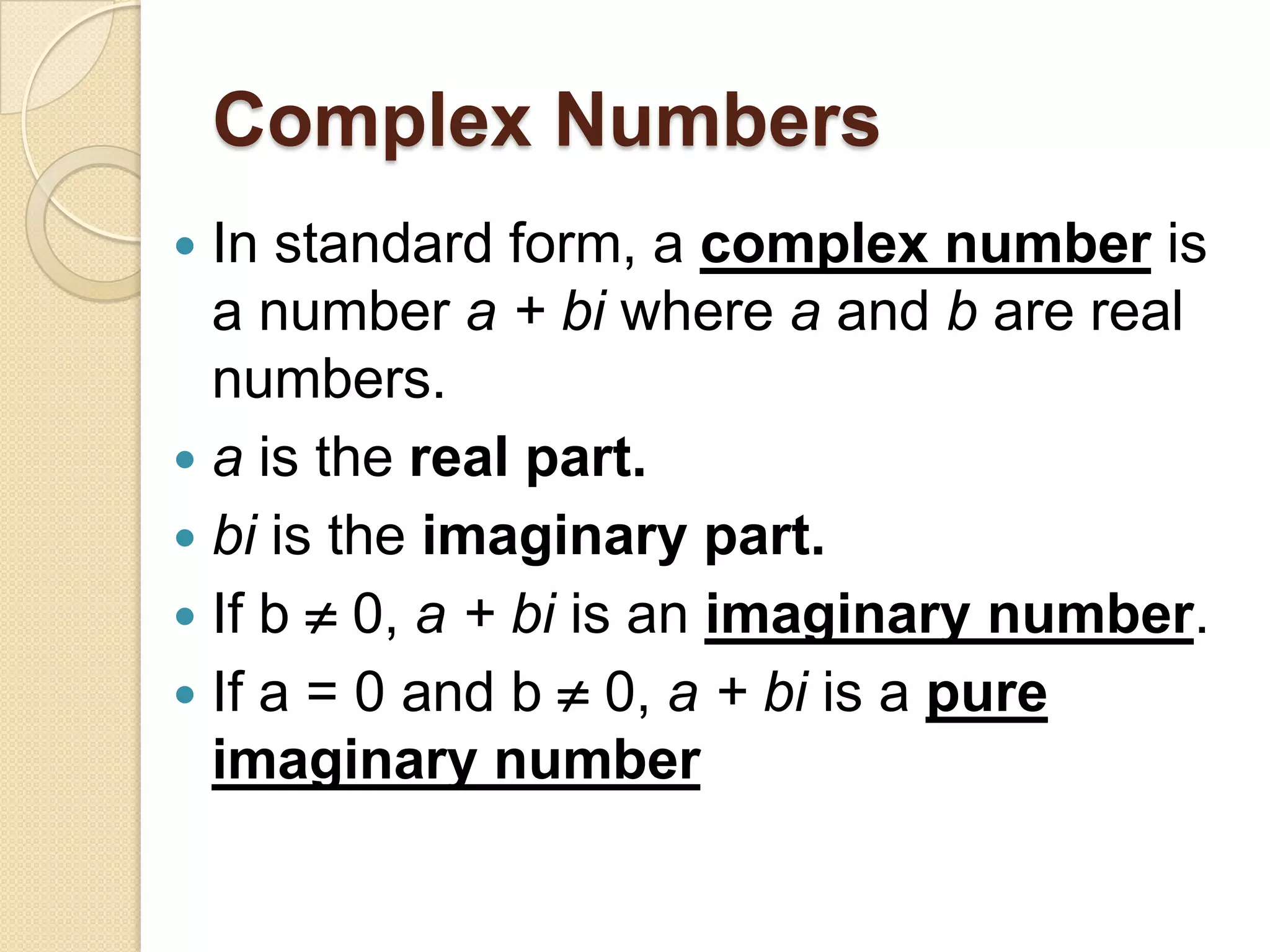
Complex Numbers
 In standard form, a complex number is
  a number a + bi where a and b are real
  numbers.
 a is the real part.
 bi is the imaginary part.
 If b  0, a + bi is an imaginary number.
 If a = 0 and b  0, a + bi is a pure
  imaginary number
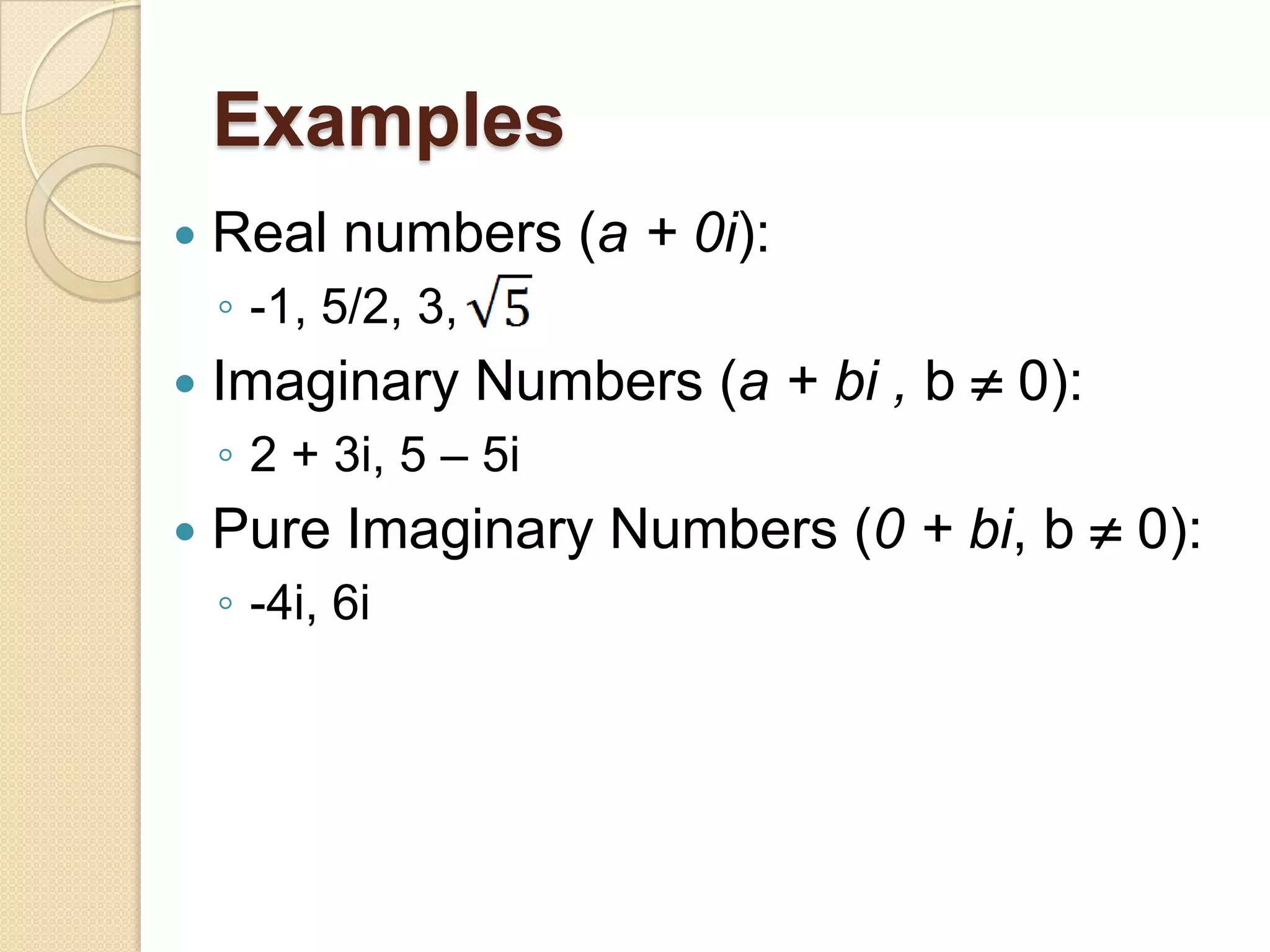
Examples
   Real numbers (a + 0i):
    ◦ -1, 5/2, 3,
   Imaginary Numbers (a + bi , b  0):
    ◦ 2 + 3i, 5 – 5i
   Pure Imaginary Numbers (0 + bi, b  0):
    ◦ -4i, 6i
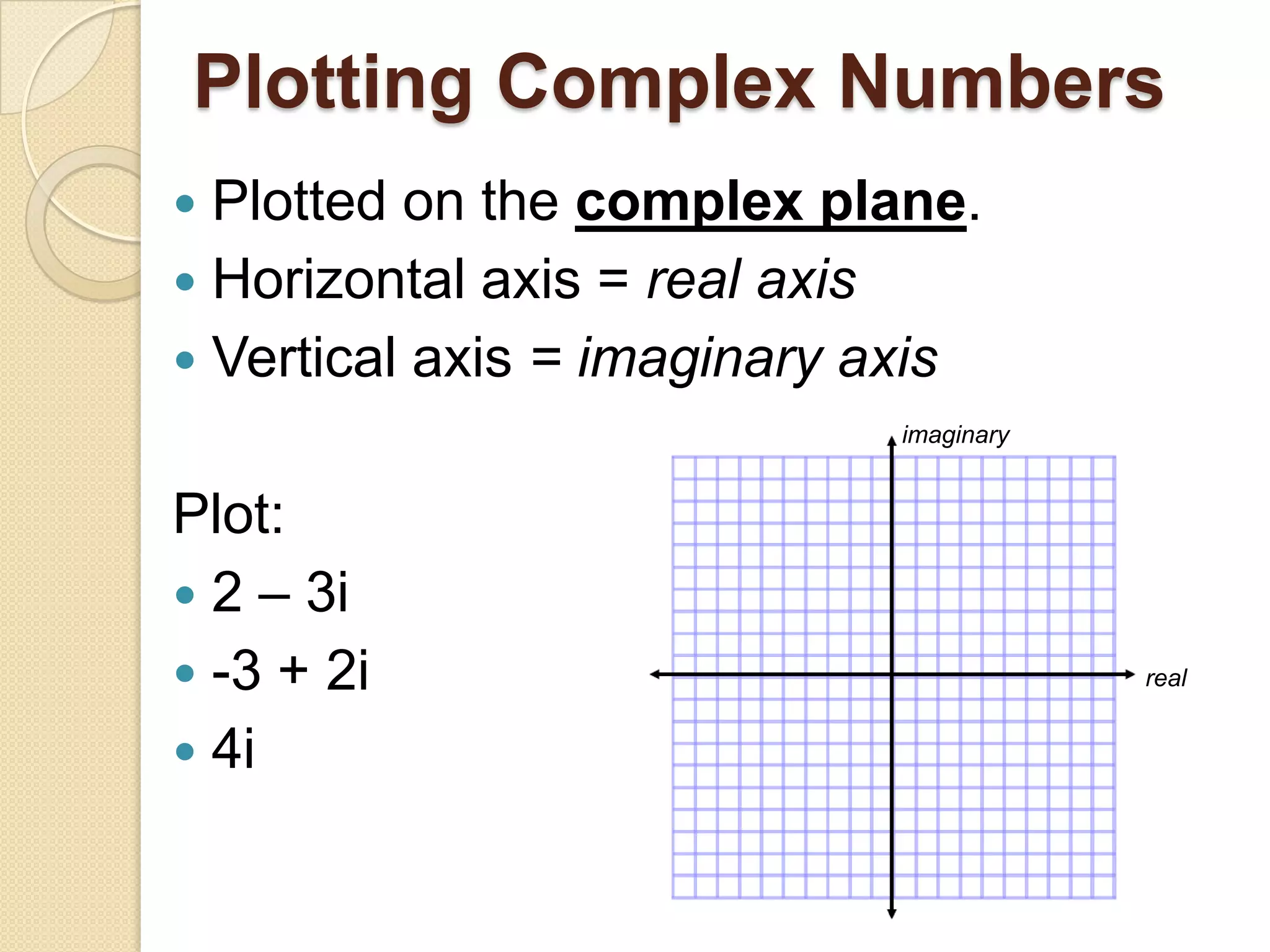
Plotting Complex Numbers
 Plotted on the complex plane.
 Horizontal axis = real axis
 Vertical axis = imaginary axis
                            imaginary


Plot:
 2 – 3i
 -3 + 2i                               real


 4i
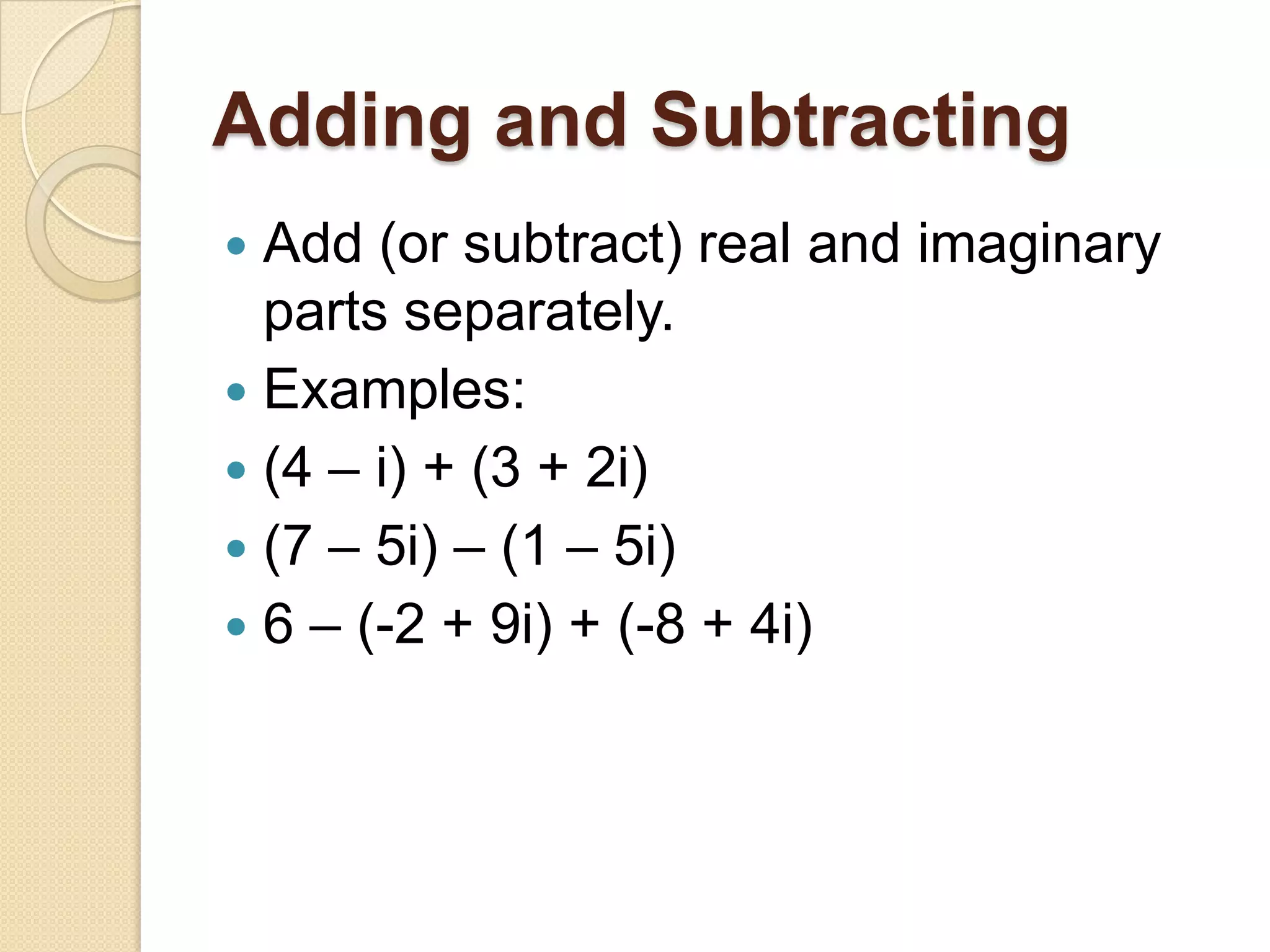
Adding and Subtracting
 Add (or subtract) real and imaginary
  parts separately.
 Examples:
 (4 – i) + (3 + 2i)
 (7 – 5i) – (1 – 5i)
 6 – (-2 + 9i) + (-8 + 4i)
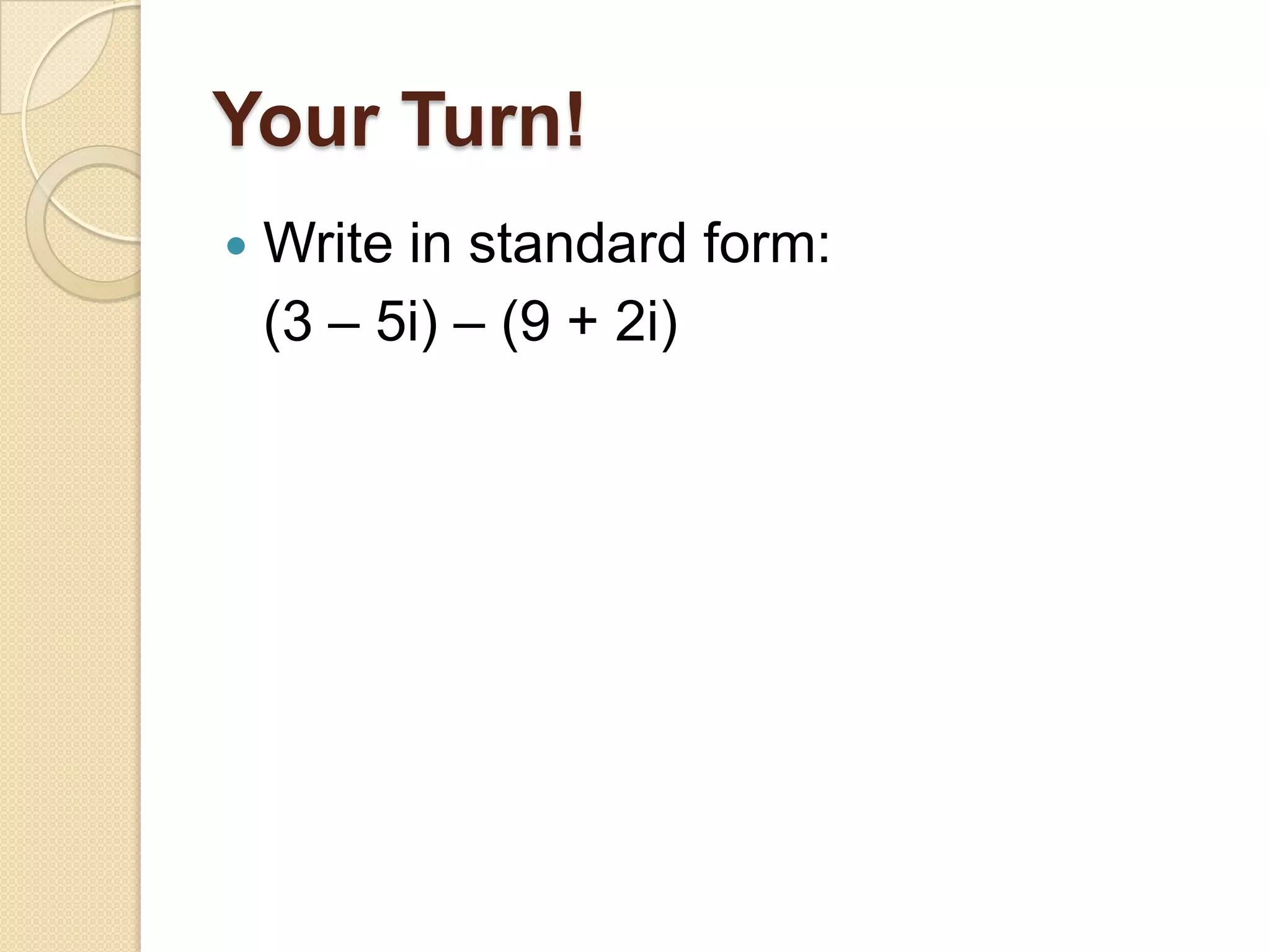
Your Turn!
   Write in standard form:
    (3 – 5i) – (9 + 2i)
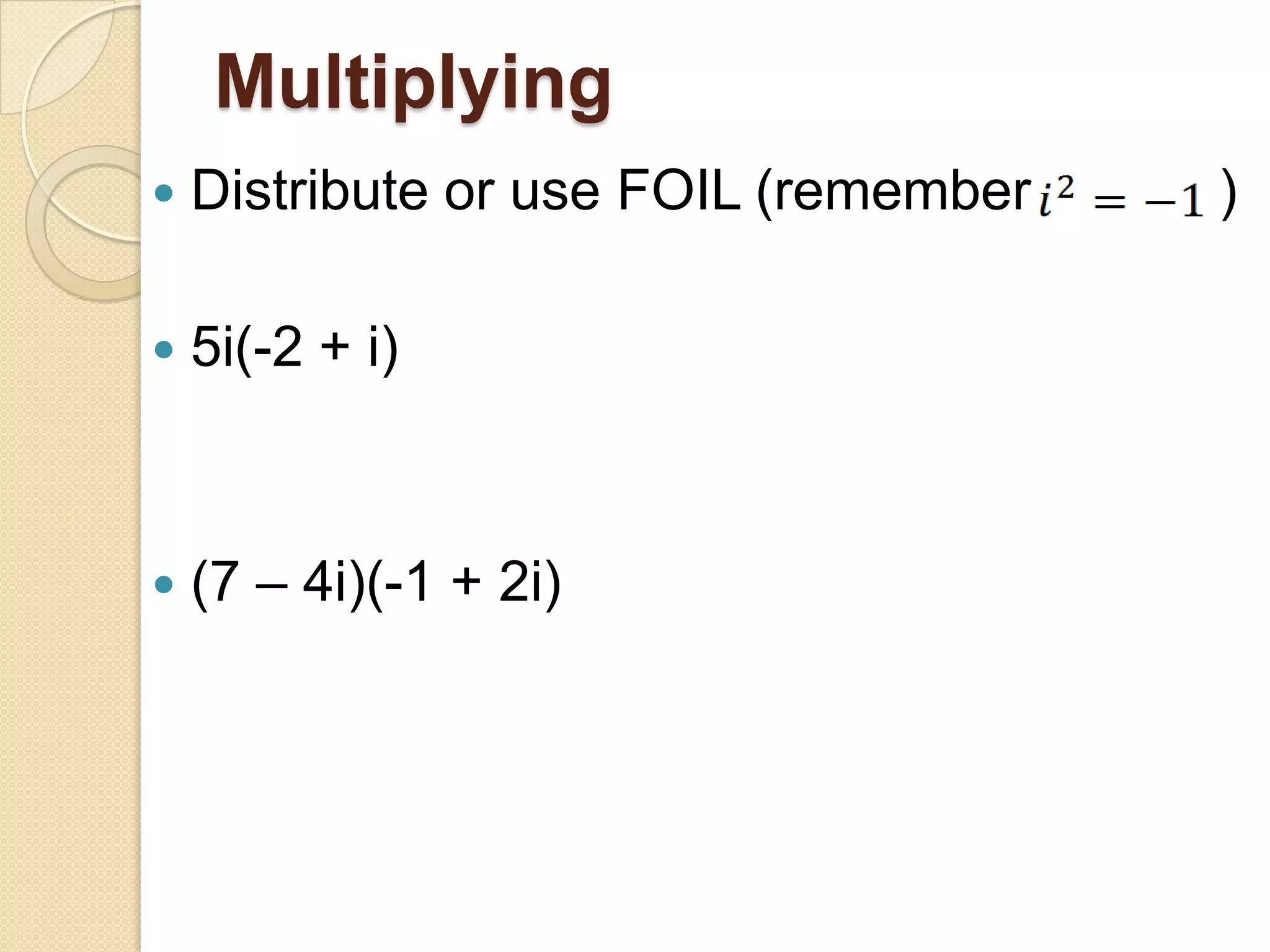
Multiplying
   Distribute or use FOIL (remember   )

   5i(-2 + i)


   (7 – 4i)(-1 + 2i)
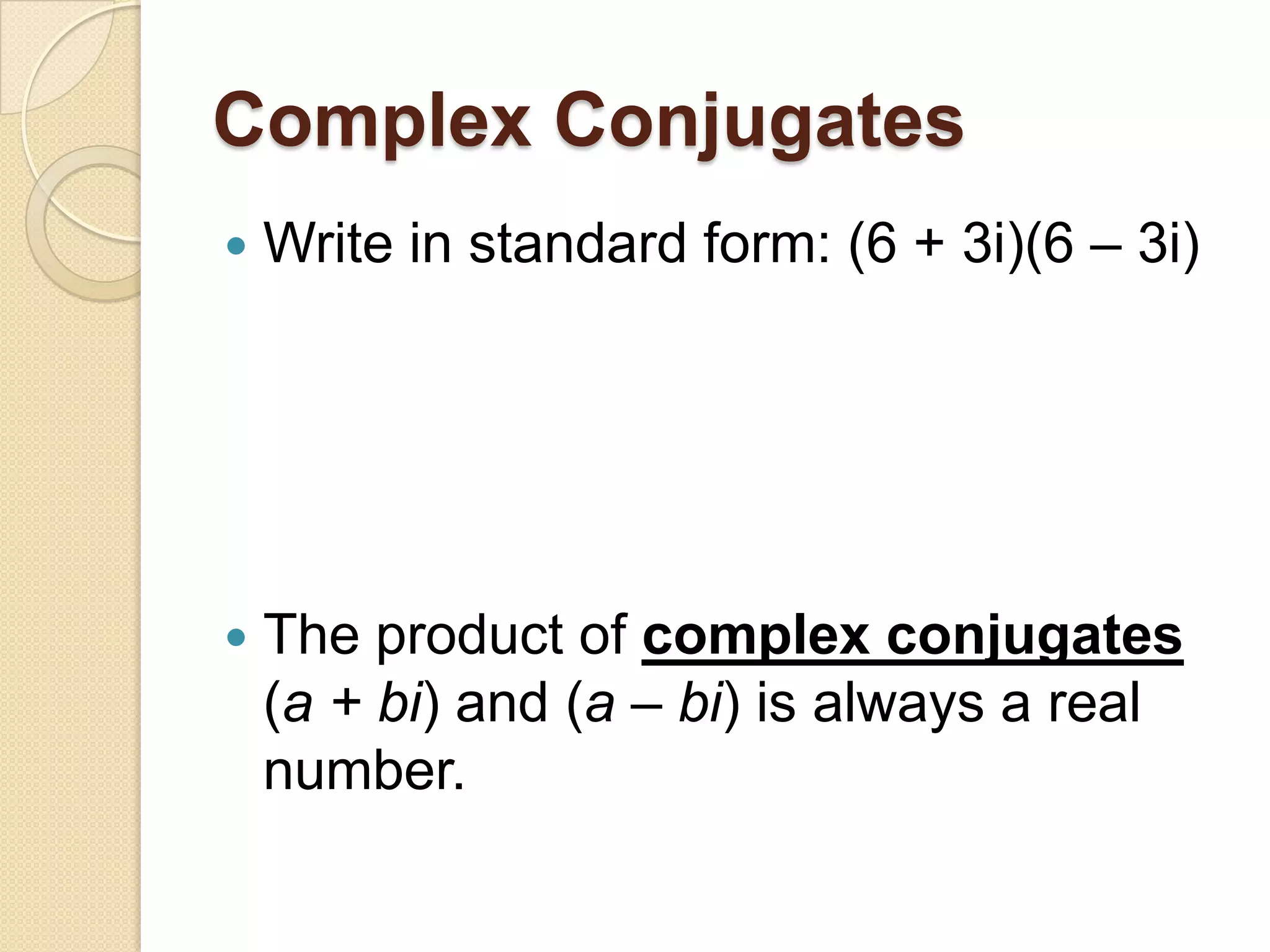
Complex Conjugates
   Write in standard form: (6 + 3i)(6 – 3i)


   The product of complex conjugates
    (a + bi) and (a – bi) is always a real
    number.
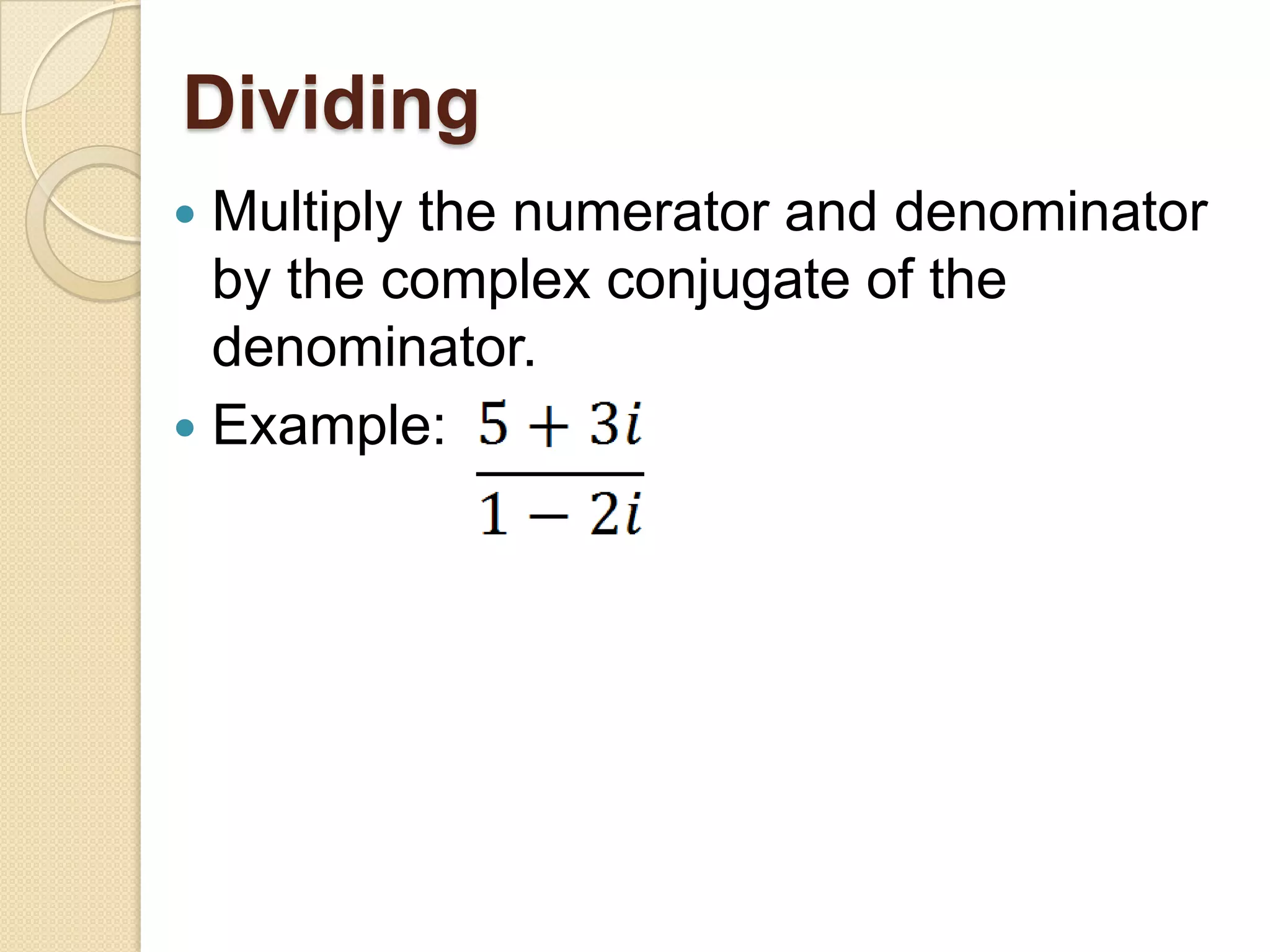
Dividing
 Multiply the numerator and denominator
  by the complex conjugate of the
  denominator.
 Example:
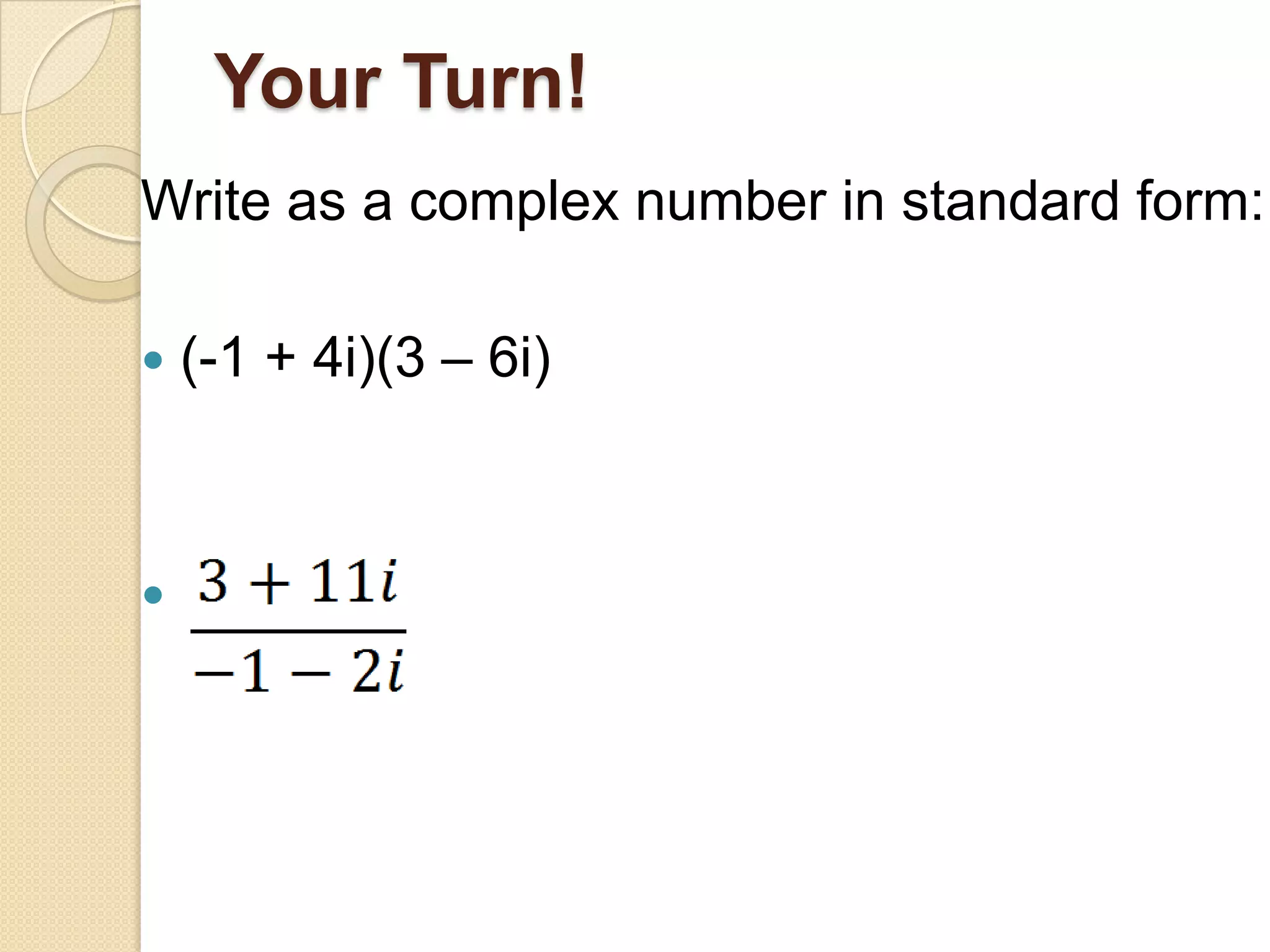
Your Turn!
Write as a complex number in standard form:

   (-1 + 4i)(3 – 6i)




5.4 Complex Numbers

  • 1.
  • 2.
    The Imaginary Unit Not all quadratics have real number solutions.  Example: x2 = -1 has no real solution. (A number squared can’t be negative.)  Imaginary units are numbers that can be represented by equations but could not physically exist in real life.  
  • 3.
     Since , i can be used to write the square root of any negative number.  If r is a positive real #, then ◦ Example:  It follows that ◦ Example:
  • 4.
    Solving a QuadraticEqn.  Solve 3x2 + 10 = -26
  • 5.
    Your Turn!  Solve 2x2 + 26 = -10
  • 6.
    Complex Numbers  Instandard form, a complex number is a number a + bi where a and b are real numbers.  a is the real part.  bi is the imaginary part.  If b  0, a + bi is an imaginary number.  If a = 0 and b  0, a + bi is a pure imaginary number
  • 7.
    Examples  Real numbers (a + 0i): ◦ -1, 5/2, 3,  Imaginary Numbers (a + bi , b  0): ◦ 2 + 3i, 5 – 5i  Pure Imaginary Numbers (0 + bi, b  0): ◦ -4i, 6i
  • 8.
    Plotting Complex Numbers Plotted on the complex plane.  Horizontal axis = real axis  Vertical axis = imaginary axis imaginary Plot:  2 – 3i  -3 + 2i real  4i
  • 9.
    Adding and Subtracting Add (or subtract) real and imaginary parts separately.  Examples:  (4 – i) + (3 + 2i)  (7 – 5i) – (1 – 5i)  6 – (-2 + 9i) + (-8 + 4i)
  • 10.
    Your Turn!  Write in standard form: (3 – 5i) – (9 + 2i)
  • 11.
    Multiplying  Distribute or use FOIL (remember )  5i(-2 + i)  (7 – 4i)(-1 + 2i)
  • 12.
    Complex Conjugates  Write in standard form: (6 + 3i)(6 – 3i)  The product of complex conjugates (a + bi) and (a – bi) is always a real number.
  • 13.
    Dividing  Multiply thenumerator and denominator by the complex conjugate of the denominator.  Example:
  • 14.
    Your Turn! Write asa complex number in standard form:  (-1 + 4i)(3 – 6i) 