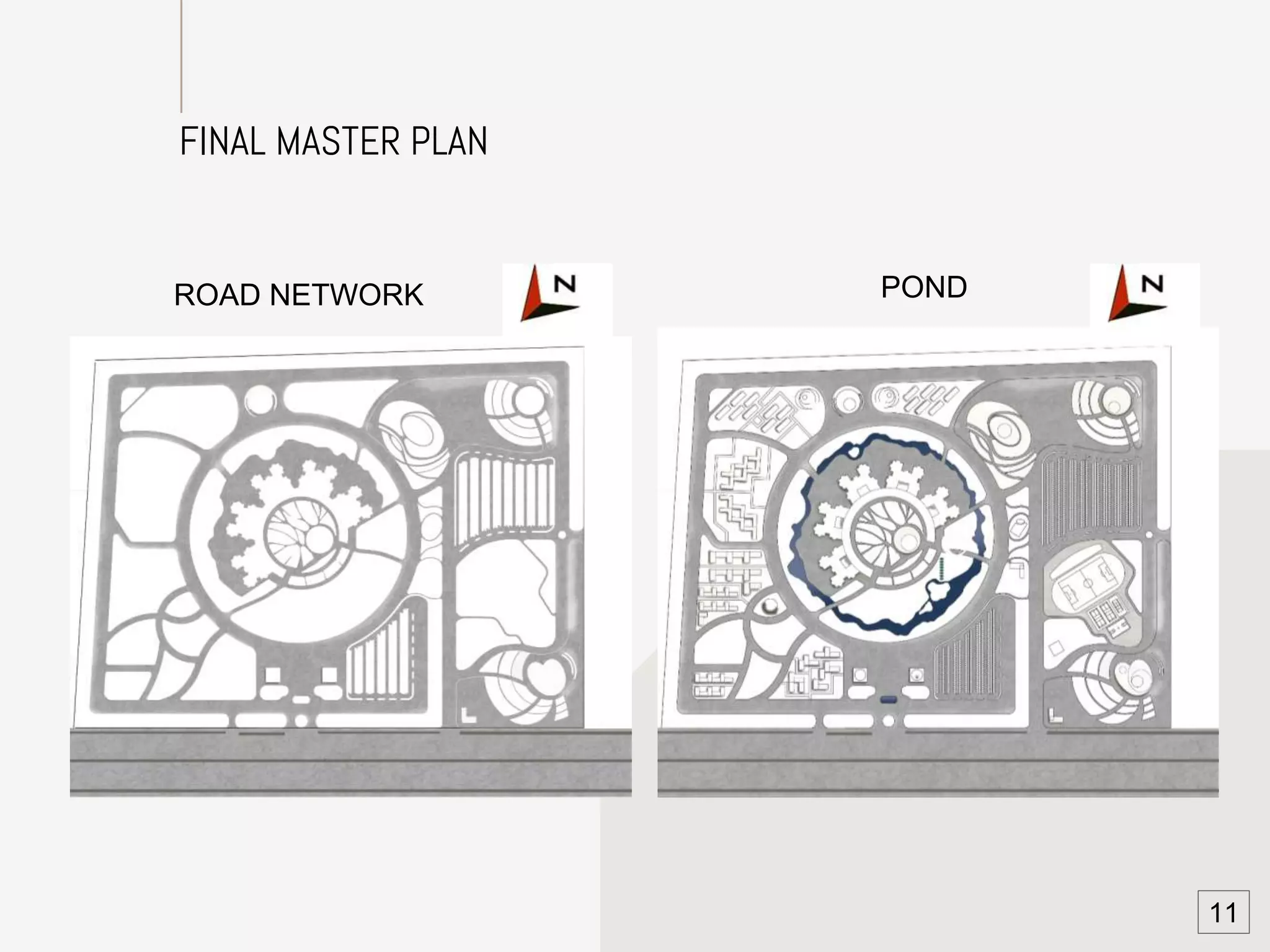
This document presents a master plan for a university complex. It discusses guiding principles for the plan such as connectivity, identity, sustainability, and community. It then presents the proposed site plan location and analyzes a case study of the Indian Institute of Management in Ahmedabad for its use of circulation, natural lighting, and critical design elements. Concepts from the Fibonacci spiral and golden ratio are discussed for the form development. The final presented master plan layout shows the road network, vegetation, buildings, and zoning for academic, residential, and religious buildings.
PRESENTED BY :
GROUP2
UNIVERSITY CITY
COMPLEX
D-17-AR-20
D-17-AR-23
D-17-AR-29
D-17-AR-30
D-17-AR-31
D-17-AR-42
D-17-AR-05
D-17-AR-08
D-17-AR-36
D-17-AR-16
2.
LITERATURE REVIEW
GUIDING PRINCIPLES
•CONNECTIVITY
The primary vision of master plan
is to create a campus that is
cohesive, walkable and pedestrian
focused.
• IDENTITY
Another element of the vision for
master plan is to create an
identity for the campus.
• SUSTAINABILITY
The physical environment of
complex should reflect
sustainable innovations.
• COMMUNITY
Complex should design as a
comprehensive community that
provide diverse housing options,
integrated academics,
community and commercial
spaces.
• POTENTIAL FACTORS :
2
CASE STUDY
INTRODUCTION
Location: Vastrapur,Ahmedabad, Gujarat, India
Chief Architect :Louis I. Khan
Project year:1974
Project type: educational institute(public)
Architectural style: modern architecture
Climate: semi-arid climate
Site Area : 66 Acre
Topography: flat land form with negligible slope.
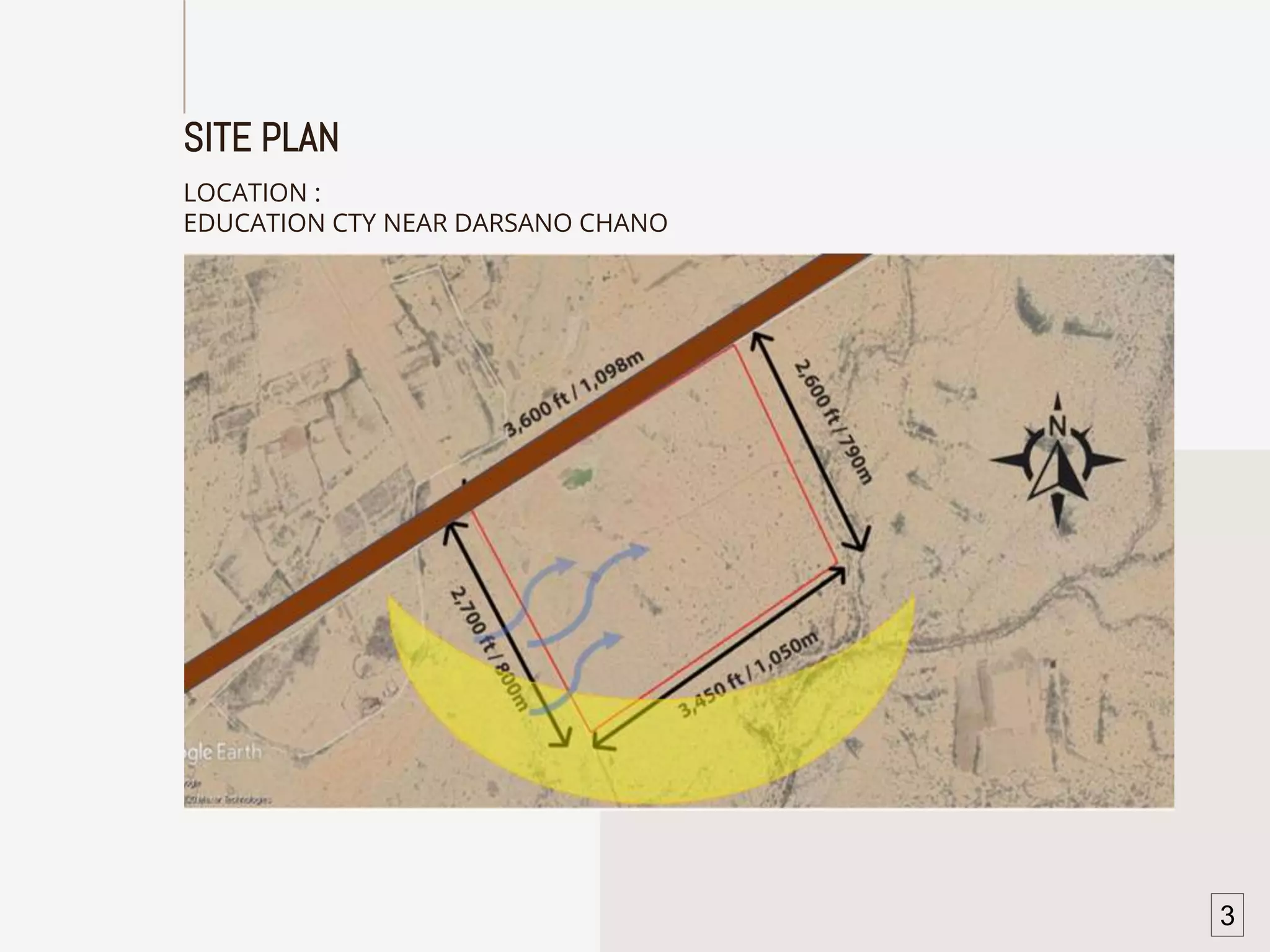
LOCATION PLAN
Vastrapur, Ahmedabad, Gujarat, India
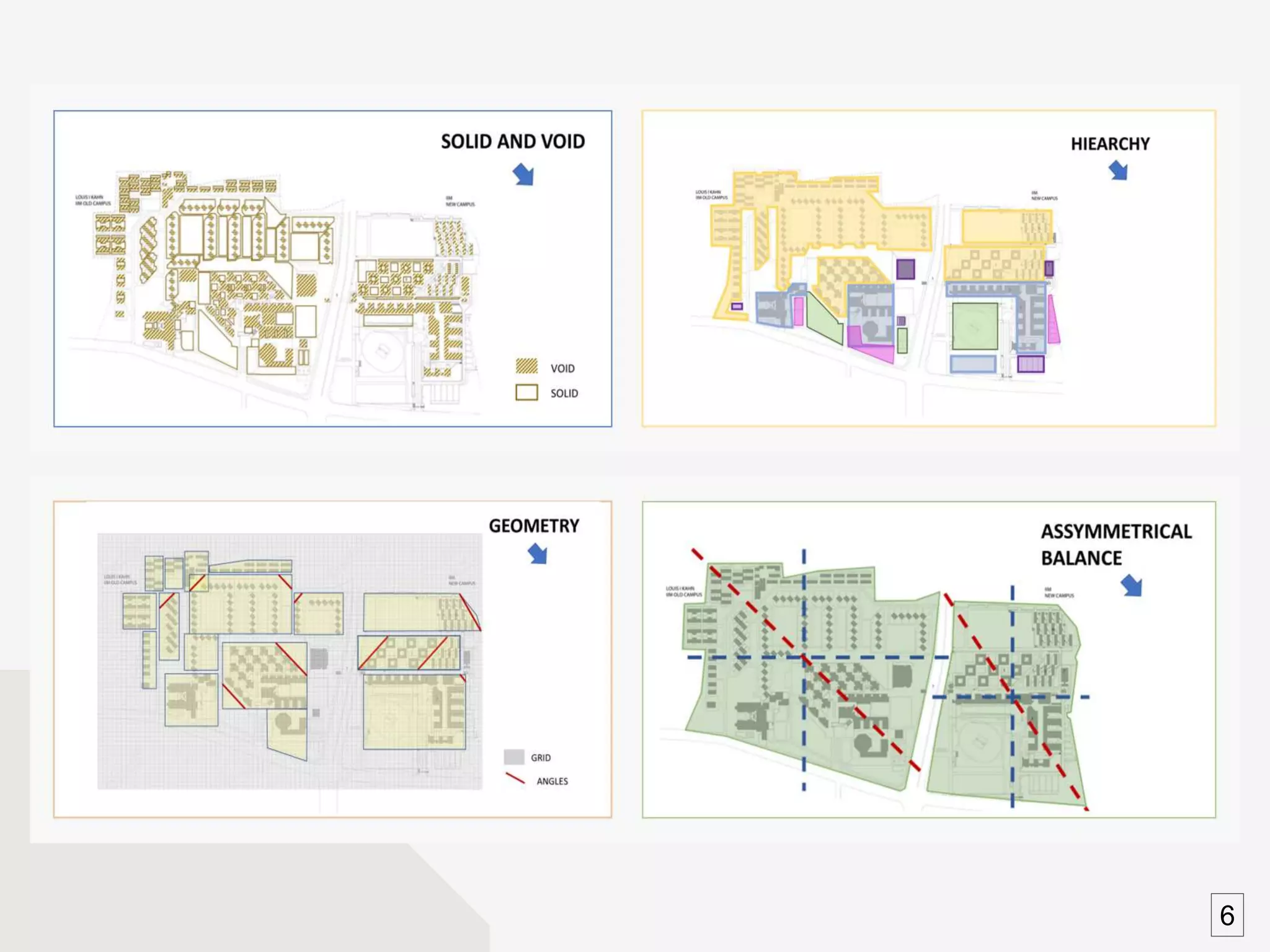
MASTER PLAN
CIRCULATION
Circulation in IIM campus is through three
major roads.
• Peripheral
• Internal
• Smaller internal roads
4
SHADING PATTERNS
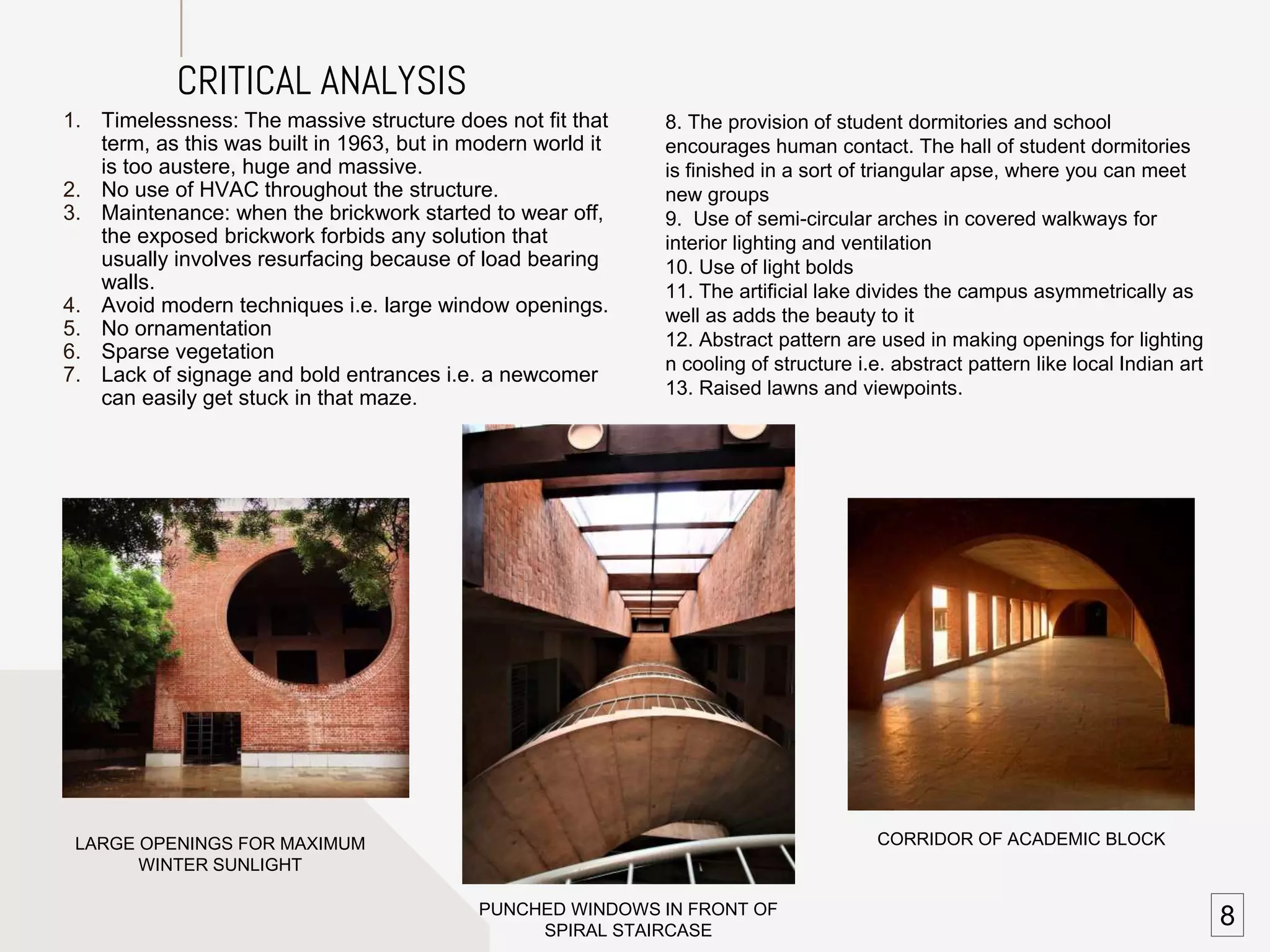
CORRIDOR OFACADEMIC BLOCK
PUNCHED WINDOWS IN FRONT OF
SPIRAL STAIRCASE
LARGE OPENINGS FOR MAXIMUM
WINTER SUNLIGHT
1. Timelessness: The massive structure does not fit that
term, as this was built in 1963, but in modern world it
is too austere, huge and massive.
2. No use of HVAC throughout the structure.
3. Maintenance: when the brickwork started to wear off,
the exposed brickwork forbids any solution that
usually involves resurfacing because of load bearing
walls.
4. Avoid modern techniques i.e. large window openings.
5. No ornamentation
6. Sparse vegetation
7. Lack of signage and bold entrances i.e. a newcomer
can easily get stuck in that maze.
CRITICAL ANALYSIS
8. The provision of student dormitories and school
encourages human contact. The hall of student dormitories
is finished in a sort of triangular apse, where you can meet
new groups
9. Use of semi-circular arches in covered walkways for
interior lighting and ventilation
10. Use of light bolds
11. The artificial lake divides the campus asymmetrically as
well as adds the beauty to it
12. Abstract pattern are used in making openings for lighting
n cooling of structure i.e. abstract pattern like local Indian art
13. Raised lawns and viewpoints.
8
9.
CONCEPT
FIBONACCI SPIRAL :
Arepeated symbol in , not only nature, but the
universe, symbolizes the changes one goes
through in life representing the varying phases.
• Using the Fibonacci sequence as a concept will allows
us to make design decisions according to the metrics of
the sequence.
• The golden ratio is said to be the secret of visual
splendor.
FORM DEVELOPMENT :
9








![Driver Easy Pro Key 7.1.0.2641 Full Mac Crack Free Activated Download [2026]....](https://cdn.slidesharecdn.com/ss_thumbnails/software-251207185324-b2fb71b4-thumbnail.jpg?width=640&height=640&fit=bounds)


![PowerISO 9.2 Mac Crack + Serial Key Free Download 2026 [Latest] Software.pptx](https://cdn.slidesharecdn.com/ss_thumbnails/software-251207185653-5d5700e6-thumbnail.jpg?width=640&height=640&fit=bounds)
![WinRAR Crack 7.13 Final Mac Keygen 2026 Download [Latest] Software.pptx](https://cdn.slidesharecdn.com/ss_thumbnails/software-251207185858-eb450678-thumbnail.jpg?width=640&height=640&fit=bounds)

![AnyTrans for iOS 8.9.14.20251127 With Crack for MacOS [Latest] pptx](https://cdn.slidesharecdn.com/ss_thumbnails/softwareoverview-251207190907-2316965f-thumbnail.jpg?width=640&height=640&fit=bounds)


