SUBMITTEDTO: Ar. Purvi Khargonkar
Ar. Gracy H. David
SUBMITTED BY: NavyaTess Sabu
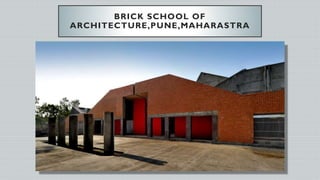
BRICK SCHOOL OF
ARCHITECTURE,PUNE,MAHARASTRA
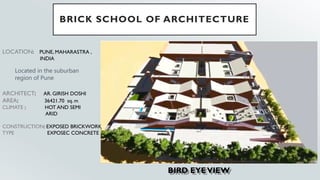
BIRD EYEVIEW
BRICK SCHOOL OF ARCHITECTURE
LOCATION: PUNE, MAHARASTRA ,
INDIA
ARCHITECT: AR. GIRISH DOSHI
AREA: 36421.70 sq. m
CLIMATE : HOT AND SEMI
ARID
CONSTRUCTION: EXPOSED BRICKWORK
TYPE EXPOSEC CONCRETE
Located in the suburban
region of Pune
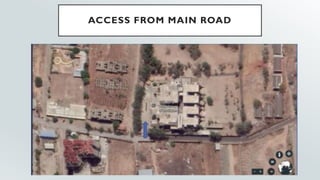
ACCESS FROM MAIN ROAD
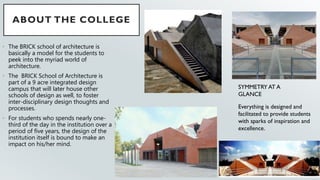
ABOUT THE COLLEGE
• The BRICK school of architecture is
basically a model for the students to
peek into the myriad world of
architecture.
• The BRICK School of Architecture is
part of a 9 acre integrated design
campus that will later house other
schools of design as well, to foster
inter-disciplinary design thoughts and
processes.
• For students who spends nearly one-
third of the day in the institution over a
period of five years, the design of the
institution itself is bound to make an
impact on his/her mind.
SYMMETRY AT A
GLANCE
Everything is designed and
facilitated to provide students
with sparks of inspiration and
excellence.
CONCEPT
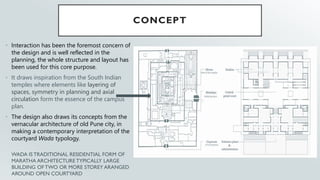
• Interaction has been the foremost concern of
the design and is well reflected in the
planning, the whole structure and layout has
been used for this core purpose.
• It draws inspiration from the South Indian
temples where elements like layering of
spaces, symmetry in planning and axial
circulation form the essence of the campus
plan.
• The design also draws its concepts from the
vernacular architecture of old Pune city, in
making a contemporary interpretation of the
courtyard Wada typology.
WADA IS TRADITIONAL RESIDENTIAL FORM OF
MARATHA ARCHITECTURE TYPICALLY LARGE
BUILDING OF TWO OR MORE STOREY ARANGED
AROUND OPEN COURTYARD
ENTRANCE
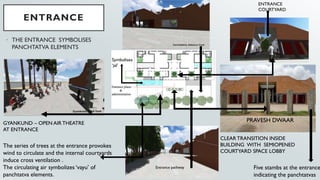
• THE ENTRANCE SYMBOLISES
PANCHTATVA ELEMENTS
PRAVESH DWAAR
ENTRANCE
COURTYARD
CLEAR TRANSITION INSIDE
BUILDING WITH SEMIOPENED
COURTYARD SPACE LOBBY
Entrance pathway
GYANKUND – OPEN AIR THEATRE
AT ENTRANCE
The series of trees at the entrance provokes
wind to circulate and the internal courtyards
induce cross ventilation .
The circulating air symbolizes ‘vayu’ of
panchtatva elements.
Symbolises
‘jal’
Five stambs at the entrance
indicating the panchtatvas
ZONING
EAST SIDE
ENTRY
WEST SIDE
ENTRY
ENTRANCE
TO THE
BUILDING
N
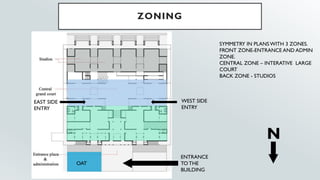
SYMMETRY IN PLANS WITH 3 ZONES.
FRONT ZONE-ENTRANCE AND ADMIN
ZONE.
CENTRAL ZONE – INTERATIVE LARGE
COURT
BACK ZONE - STUDIOS
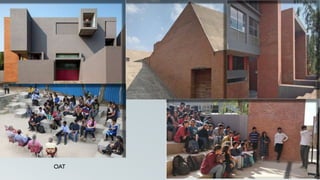
OAT
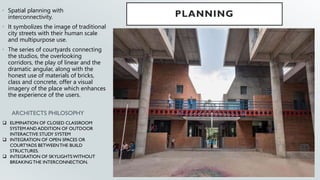
• Spatial planning with
interconnectivity.
• It symbolizes the image of traditional
city streets with their human scale
and multipurpose use.
• The series of courtyards connecting
the studios, the overlooking
corridors, the play of linear and the
dramatic angular, along with the
honest use of materials of bricks,
class and concrete, offer a visual
imagery of the place which enhances
the experience of the users.
ARCHITECTS PHILOSOPHY
❑ ELIMINATION OF CLOSED CLASSROOM
SYSTEMAND ADDITION OF OUTDOOR
INTERACTIVE STUDY SYSTEM
❑ INTEGRATION OF OPEN SPACES OR
COURTYADS BETWEENTHE BUILD
STRUCTURES.
❑ INTEGRATION OF SKYLIGHTSWITHOUT
BREAKINGTHE INTERCONNECTION.
PLANNING
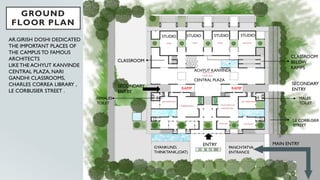
GROUND
FLOOR PLAN
SECONDARY
ENTRY
SECONDARY
ENTRYRAMP RAMP
MALES
TOILET
FEMALES
TOILET
MAIN ENTRY
CLASSROOM
CLASSROOM
BELOW
RAMPS
STUDIO STUDIO STUDIO STUDIO
ACHYUT KANVINDE
CENTRAL PLAZA
AR.GIRISH DOSHI DEDICATED
THE IMPORTANT PLACES OF
THE CAMPUS TO FAMOUS
ARCHITECTS
LIKE THE ACHYUT KANVINDE
CENTRAL PLAZA, NARI
GANDHI CLASSROOMS,
CHARLES CORREA LIBRARY ,
LE CORBUSIER STREET .
LE CORBUSIER
STREET
GYANKUND,
THINKTANK,(OAT)
PANCHTATVA
ENTRANCE
ENTRY
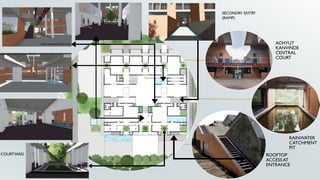
ACHYUT
KANVINDE
CENTRAL
COURT
RAINWATER
CATCHMENT
PIT
ROOFTOP
ACCESS AT
ENTRANCE
COURTYARD
SECONDRY ENTRY
(RAMP)
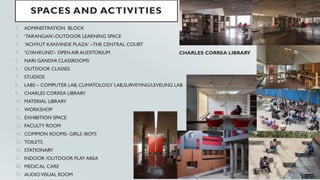
SPACES AND ACTIVITIES
1. ADMINISTRATION BLOCK
2. ‘TARANGAN’-OUTDOOR LEARNING SPACE
3. ‘ACHYUT KANVINDE PLAZA’ –THE CENTRAL COURT
4. ‘GYANKUND’- OPEN AIR AUDITORIUM
5. NARI GANDHI CLASSROOMS
6. OUTDOOR CLASSES
7. STUDIOS
8. LABS – COMPUTER LAB, CLIMATOLOGY LAB,SURVEYING/LEVELING LAB
9. CHARLES CORREA LIBRARY
10. MATERIAL LIBRARY
11. WORKSHOP
12. EXHIBITION SPACE
13. FACULTY ROOM
14. COMMON ROOMS- GIRLS /BOYS
15. TOILETS
16. STATIONARY
17. INDOOR /OUTDOOR PLAY AREA
18. MEDICAL CARE
19. AUDIOVISUAL ROOM
CHARLES CORREA LIBRARY
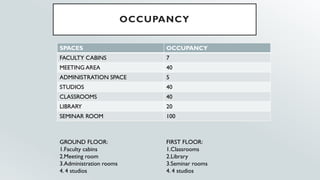
OCCUPANCY
SPACES OCCUPANCY
FACULTY CABINS 7
MEETING AREA 40
ADMINISTRATION SPACE 5
STUDIOS 40
CLASSROOMS 40
LIBRARY 20
SEMINAR ROOM 100
GROUND FLOOR:
1.Faculty cabins
2.Meeting room
3.Administration rooms
4. 4 studios
FIRST FLOOR:
1.Classrooms
2.Library
3.Seminar rooms
4. 4 studios
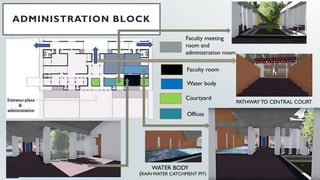
ADMINISTRATION BLOCK
Faculty meeting
room and
administration room
Faculty room
Water body
Courtyard
Offices
WATER BODY
(RAIN WATER CATCHMENT PIT)
PATHWAYTO CENTRAL COURT
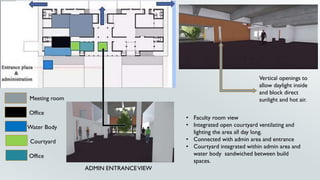
Office
Water Body
Courtyard
Office
Meeting room
• Faculty room view
• Integrated open courtyard ventilating and
lighting the area all day long.
• Connected with admin area and entrance
• Courtyard integrated within admin area and
water body sandwiched between build
spaces.
Vertical openings to
allow daylight inside
and block direct
sunlight and hot air.
ADMIN ENTRANCEVIEW
ELEVATION
FACULTY CABIN LOBBY OFFICE ADMIN
• The sloping roof design is such that it complements to the mountains behind in elevation
• The roof is designed to wash rain water off the structure.
• The structure elevation also inspired by the local Maratha wada architecture ,with series of
courtyard visible throughout the elevations and spaces planned around courtyards.
BRICK FAÇADEBRICK FAÇADE
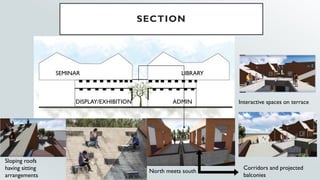
SECTION
North meets south
Interactive spaces on terraceDISPLAY/EXHIBITION ADMIN
SEMINAR LIBRARY
Corridors and projected
balconies
Sloping roofs
having sitting
arrangements
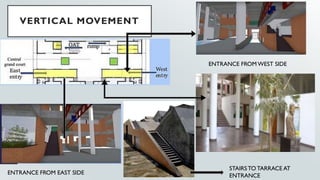
VERTICAL MOVEMENT
ENTRANCE FROM WEST SIDE
STAIRSTO TARRACE AT
ENTRANCEENTRANCE FROM EAST SIDE
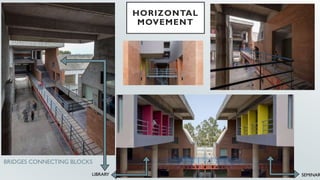
HORIZONTAL
MOVEMENT
BRIDGES CONNECTING BLOCKS
LIBRARY SEMINAR
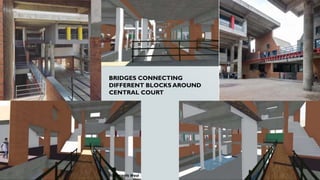
BRIDGES CONNECTING
DIFFERENT BLOCKS AROUND
CENTRAL COURT
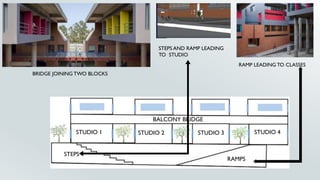
BRIDGE JOINING TWO BLOCKS
RAMP LEADING TO CLASSES
RAMPS
STEPS
BALCONY BRIDGE
STUDIO 4STUDIO 3STUDIO 2STUDIO 1
STEPS AND RAMP LEADING
TO STUDIO
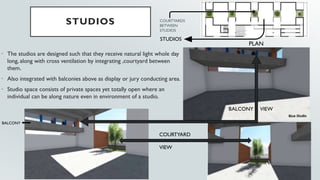
• The studios are designed such that they receive natural light whole day
long, along with cross ventilation by integrating ,courtyard between
them.
• Also integrated with balconies above as display or jury conducting area.
• Studio space consists of private spaces yet totally open where an
individual can be along nature even in environment of a studio.
BALCONY
BALCONY VIEW
COURTYARD
VIEW
STUDIOS
PLAN
COURTYARDS
BETWEEN
STUDIOS
STUDIOS
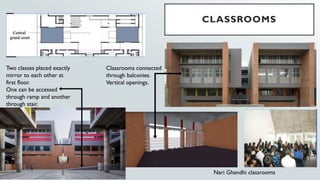
CLASSROOMS
Nari Ghandhi classrooms
Two classes placed exactly
mirror to each other at
first floor.
One can be accessed
through ramp and another
through stair.
Classrooms connected
through balconies.
Vertical openings.
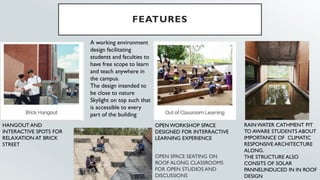
FEATURES
HANGOUT AND
INTERACTIVE SPOTS FOR
RELAXATION AT BRICK
STREET
OPEN WORKSHOP SPACE
DESIGNED FOR INTERRACTIVE
LEARNING EXPERIENCE
RAIN WATER CATHMENT PIT
TO AWARE STUDENTS ABOUT
IMPORTANCE OF CLIMATIC
RESPONSIVE ARCHITECTURE
ALONG.
THE STRUCTURE ALSO
CONSITS OF SOLAR
PANNELINDUCED IN IN ROOF
DESIGN
OPEN SPACE SEATING ON
ROOF ALONG CLASSROOMS
FOR OPEN STUDIOS AND
DISCUSSIONS
A working environment
design facilitating
students and faculties to
have free scope to learn
and teach anywhere in
the campus.
The design intended to
be close to nature
Skylight on top such that
is accessible to every
part of the building
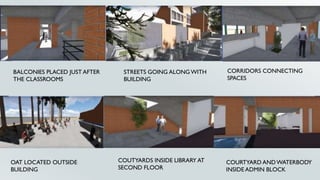
BALCONIES PLACED JUST AFTER
THE CLASSROOMS
STREETS GOING ALONG WITH
BUILDING
CORRIDORS CONNECTING
SPACES
OAT LOCATED OUTSIDE
BUILDING
COUTYARDS INSIDE LIBRARY AT
SECOND FLOOR
COURTYARD ANDWATERBODY
INSIDE ADMIN BLOCK
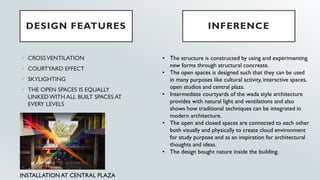
DESIGN FEATURES
• CROSSVENTILATION
• COURTYARD EFFECT
• SKYLIGHTING
• THE OPEN SPACES IS EQUALLY
LINKEDWITH ALL BUILT SPACES AT
EVERY LEVELS
INFERENCE
• The structure is constructed by using and experimenting
new forms through structural concreate.
• The open spaces is designed such that they can be used
in many purposes like cultural activity, interactive spaces,
open studios and central plaza.
• Intermediate courtyards of the wada style architecture
provides with natural light and ventilations and also
shows how traditional techniques can be integrated in
modern architecture.
• The open and closed spaces are connected to each other
both visually and physically to create cloud environment
for study purpose and as an inspiration for architectural
thoughts and ideas.
• The design bought nature inside the building.
INSTALLATION AT CENTRAL PLAZA
OAT
THANKYOU

BRICK school of architecture, case study

  • 1.
    SUBMITTEDTO: Ar. PurviKhargonkar Ar. Gracy H. David SUBMITTED BY: NavyaTess Sabu
  • 2.
  • 3.
    BIRD EYEVIEW BRICK SCHOOLOF ARCHITECTURE LOCATION: PUNE, MAHARASTRA , INDIA ARCHITECT: AR. GIRISH DOSHI AREA: 36421.70 sq. m CLIMATE : HOT AND SEMI ARID CONSTRUCTION: EXPOSED BRICKWORK TYPE EXPOSEC CONCRETE Located in the suburban region of Pune
  • 4.
  • 5.
    ABOUT THE COLLEGE •The BRICK school of architecture is basically a model for the students to peek into the myriad world of architecture. • The BRICK School of Architecture is part of a 9 acre integrated design campus that will later house other schools of design as well, to foster inter-disciplinary design thoughts and processes. • For students who spends nearly one- third of the day in the institution over a period of five years, the design of the institution itself is bound to make an impact on his/her mind. SYMMETRY AT A GLANCE Everything is designed and facilitated to provide students with sparks of inspiration and excellence.
  • 6.
    CONCEPT • Interaction hasbeen the foremost concern of the design and is well reflected in the planning, the whole structure and layout has been used for this core purpose. • It draws inspiration from the South Indian temples where elements like layering of spaces, symmetry in planning and axial circulation form the essence of the campus plan. • The design also draws its concepts from the vernacular architecture of old Pune city, in making a contemporary interpretation of the courtyard Wada typology. WADA IS TRADITIONAL RESIDENTIAL FORM OF MARATHA ARCHITECTURE TYPICALLY LARGE BUILDING OF TWO OR MORE STOREY ARANGED AROUND OPEN COURTYARD
  • 7.
    ENTRANCE • THE ENTRANCESYMBOLISES PANCHTATVA ELEMENTS PRAVESH DWAAR ENTRANCE COURTYARD CLEAR TRANSITION INSIDE BUILDING WITH SEMIOPENED COURTYARD SPACE LOBBY Entrance pathway GYANKUND – OPEN AIR THEATRE AT ENTRANCE The series of trees at the entrance provokes wind to circulate and the internal courtyards induce cross ventilation . The circulating air symbolizes ‘vayu’ of panchtatva elements. Symbolises ‘jal’ Five stambs at the entrance indicating the panchtatvas
  • 8.
    ZONING EAST SIDE ENTRY WEST SIDE ENTRY ENTRANCE TOTHE BUILDING N SYMMETRY IN PLANS WITH 3 ZONES. FRONT ZONE-ENTRANCE AND ADMIN ZONE. CENTRAL ZONE – INTERATIVE LARGE COURT BACK ZONE - STUDIOS OAT
  • 9.
    • Spatial planningwith interconnectivity. • It symbolizes the image of traditional city streets with their human scale and multipurpose use. • The series of courtyards connecting the studios, the overlooking corridors, the play of linear and the dramatic angular, along with the honest use of materials of bricks, class and concrete, offer a visual imagery of the place which enhances the experience of the users. ARCHITECTS PHILOSOPHY ❑ ELIMINATION OF CLOSED CLASSROOM SYSTEMAND ADDITION OF OUTDOOR INTERACTIVE STUDY SYSTEM ❑ INTEGRATION OF OPEN SPACES OR COURTYADS BETWEENTHE BUILD STRUCTURES. ❑ INTEGRATION OF SKYLIGHTSWITHOUT BREAKINGTHE INTERCONNECTION. PLANNING
  • 10.
    GROUND FLOOR PLAN SECONDARY ENTRY SECONDARY ENTRYRAMP RAMP MALES TOILET FEMALES TOILET MAINENTRY CLASSROOM CLASSROOM BELOW RAMPS STUDIO STUDIO STUDIO STUDIO ACHYUT KANVINDE CENTRAL PLAZA AR.GIRISH DOSHI DEDICATED THE IMPORTANT PLACES OF THE CAMPUS TO FAMOUS ARCHITECTS LIKE THE ACHYUT KANVINDE CENTRAL PLAZA, NARI GANDHI CLASSROOMS, CHARLES CORREA LIBRARY , LE CORBUSIER STREET . LE CORBUSIER STREET GYANKUND, THINKTANK,(OAT) PANCHTATVA ENTRANCE ENTRY
  • 11.
  • 12.
    SPACES AND ACTIVITIES 1.ADMINISTRATION BLOCK 2. ‘TARANGAN’-OUTDOOR LEARNING SPACE 3. ‘ACHYUT KANVINDE PLAZA’ –THE CENTRAL COURT 4. ‘GYANKUND’- OPEN AIR AUDITORIUM 5. NARI GANDHI CLASSROOMS 6. OUTDOOR CLASSES 7. STUDIOS 8. LABS – COMPUTER LAB, CLIMATOLOGY LAB,SURVEYING/LEVELING LAB 9. CHARLES CORREA LIBRARY 10. MATERIAL LIBRARY 11. WORKSHOP 12. EXHIBITION SPACE 13. FACULTY ROOM 14. COMMON ROOMS- GIRLS /BOYS 15. TOILETS 16. STATIONARY 17. INDOOR /OUTDOOR PLAY AREA 18. MEDICAL CARE 19. AUDIOVISUAL ROOM CHARLES CORREA LIBRARY
  • 13.
    OCCUPANCY SPACES OCCUPANCY FACULTY CABINS7 MEETING AREA 40 ADMINISTRATION SPACE 5 STUDIOS 40 CLASSROOMS 40 LIBRARY 20 SEMINAR ROOM 100 GROUND FLOOR: 1.Faculty cabins 2.Meeting room 3.Administration rooms 4. 4 studios FIRST FLOOR: 1.Classrooms 2.Library 3.Seminar rooms 4. 4 studios
  • 14.
    ADMINISTRATION BLOCK Faculty meeting roomand administration room Faculty room Water body Courtyard Offices WATER BODY (RAIN WATER CATCHMENT PIT) PATHWAYTO CENTRAL COURT
  • 15.
    Office Water Body Courtyard Office Meeting room •Faculty room view • Integrated open courtyard ventilating and lighting the area all day long. • Connected with admin area and entrance • Courtyard integrated within admin area and water body sandwiched between build spaces. Vertical openings to allow daylight inside and block direct sunlight and hot air. ADMIN ENTRANCEVIEW
  • 16.
    ELEVATION FACULTY CABIN LOBBYOFFICE ADMIN • The sloping roof design is such that it complements to the mountains behind in elevation • The roof is designed to wash rain water off the structure. • The structure elevation also inspired by the local Maratha wada architecture ,with series of courtyard visible throughout the elevations and spaces planned around courtyards. BRICK FAÇADEBRICK FAÇADE
  • 17.
    SECTION North meets south Interactivespaces on terraceDISPLAY/EXHIBITION ADMIN SEMINAR LIBRARY Corridors and projected balconies Sloping roofs having sitting arrangements
  • 18.
    VERTICAL MOVEMENT ENTRANCE FROMWEST SIDE STAIRSTO TARRACE AT ENTRANCEENTRANCE FROM EAST SIDE
  • 19.
  • 20.
  • 21.
    BRIDGE JOINING TWOBLOCKS RAMP LEADING TO CLASSES RAMPS STEPS BALCONY BRIDGE STUDIO 4STUDIO 3STUDIO 2STUDIO 1 STEPS AND RAMP LEADING TO STUDIO
  • 22.
    • The studiosare designed such that they receive natural light whole day long, along with cross ventilation by integrating ,courtyard between them. • Also integrated with balconies above as display or jury conducting area. • Studio space consists of private spaces yet totally open where an individual can be along nature even in environment of a studio. BALCONY BALCONY VIEW COURTYARD VIEW STUDIOS PLAN COURTYARDS BETWEEN STUDIOS STUDIOS
  • 23.
    CLASSROOMS Nari Ghandhi classrooms Twoclasses placed exactly mirror to each other at first floor. One can be accessed through ramp and another through stair. Classrooms connected through balconies. Vertical openings.
  • 24.
    FEATURES HANGOUT AND INTERACTIVE SPOTSFOR RELAXATION AT BRICK STREET OPEN WORKSHOP SPACE DESIGNED FOR INTERRACTIVE LEARNING EXPERIENCE RAIN WATER CATHMENT PIT TO AWARE STUDENTS ABOUT IMPORTANCE OF CLIMATIC RESPONSIVE ARCHITECTURE ALONG. THE STRUCTURE ALSO CONSITS OF SOLAR PANNELINDUCED IN IN ROOF DESIGN OPEN SPACE SEATING ON ROOF ALONG CLASSROOMS FOR OPEN STUDIOS AND DISCUSSIONS A working environment design facilitating students and faculties to have free scope to learn and teach anywhere in the campus. The design intended to be close to nature Skylight on top such that is accessible to every part of the building
  • 25.
    BALCONIES PLACED JUSTAFTER THE CLASSROOMS STREETS GOING ALONG WITH BUILDING CORRIDORS CONNECTING SPACES OAT LOCATED OUTSIDE BUILDING COUTYARDS INSIDE LIBRARY AT SECOND FLOOR COURTYARD ANDWATERBODY INSIDE ADMIN BLOCK
  • 26.
    DESIGN FEATURES • CROSSVENTILATION •COURTYARD EFFECT • SKYLIGHTING • THE OPEN SPACES IS EQUALLY LINKEDWITH ALL BUILT SPACES AT EVERY LEVELS INFERENCE • The structure is constructed by using and experimenting new forms through structural concreate. • The open spaces is designed such that they can be used in many purposes like cultural activity, interactive spaces, open studios and central plaza. • Intermediate courtyards of the wada style architecture provides with natural light and ventilations and also shows how traditional techniques can be integrated in modern architecture. • The open and closed spaces are connected to each other both visually and physically to create cloud environment for study purpose and as an inspiration for architectural thoughts and ideas. • The design bought nature inside the building. INSTALLATION AT CENTRAL PLAZA
  • 27.
  • 28.