Syngas Routes to Alternative Fuels from 
Renewable Sources 
John Bøgild Hansen - Haldor Topsøe 
Alkmaar, October 2, 2014
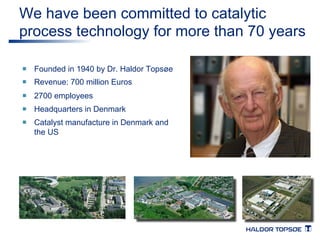
We have been committed to catalytic 
process technology for more than 70 years 
¡ Founded in 1940 by Dr. Haldor Topsøe 
¡ Revenue: 700 million Euros 
¡ 2700 employees 
¡ Headquarters in Denmark 
¡ Catalyst manufacture in Denmark and 
the US
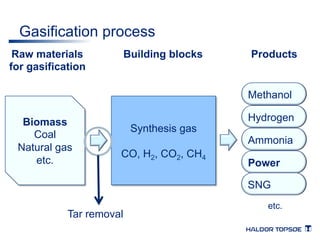
Gasification process 
Raw materials 
for gasification 
Biomass 
Coal 
Natural gas 
etc. 
Products 
Methanol 
Hydrogen 
Ammonia 
Power 
Building blocks 
Synthesis gas 
CO, H2, CO2, CH4 
SNG 
etc. 
Tar removal
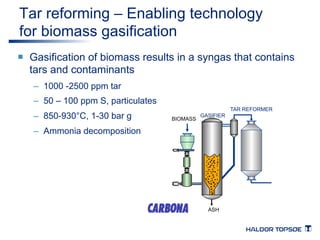
Tar reforming – Enabling technology 
for biomass gasification 
¡ Gasification of biomass results in a syngas that contains 
tars and contaminants 
– 1000 -2500 ppm tar 
– 50 – 100 ppm S, particulates 
– 850-930°C, 1-30 bar g 
– Ammonia decomposition 
BIOMASS 
GASIFIER 
ASH 
TAR REFORMER
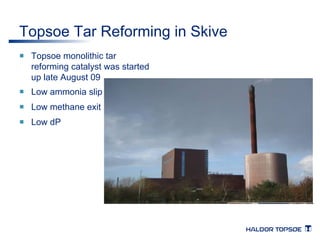
Topsoe Tar Reforming in Skive 
¡ Topsoe monolithic tar 
reforming catalyst was started 
up late August 09 
¡ Low ammonia slip 
¡ Low methane exit 
¡ Low dP
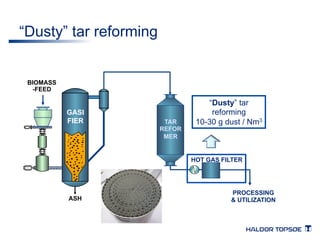
“Dusty” tar reforming 
PROCESSING 
& UTILIZATION 
TAR 
REFOR 
MER 
BIOMASS 
-FEED 
GASI 
FIER 
ASH 
“Dusty” tar 
reforming 
10-30 g dust / Nm3 
HOT GAS FILTER
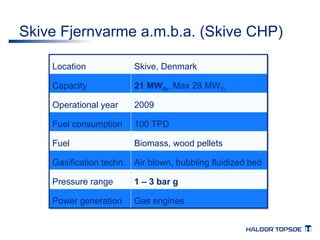
Skive Fjernvarme a.m.b.a. (Skive CHP) 
Location Skive, Denmark 
Capacity 21 MWth, Max 28 MWth 
Operational year 2009 
Fuel consumption 100 TPD 
Fuel Biomass, wood pellets 
Gasification techn. Air blown, bubbling fluidized bed 
Pressure range 1 – 3 bar g 
Power generation Gas engines
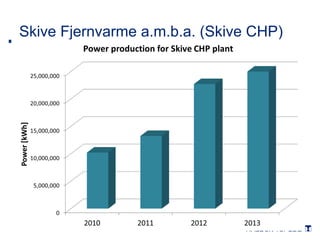
Skive Fjernvarme a.m.b.a. (Skive CHP)
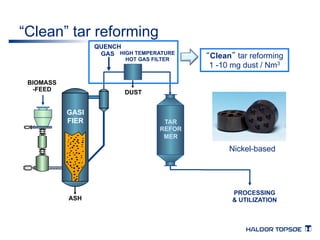
“Clean” tar reforming 
QUENCH 
GAS “Clean” tar reforming 
PROCESSING 
& UTILIZATION 
HIGH TEMPERATURE 
HOT GAS FILTER 
TAR 
REFOR 
MER 
BIOMASS 
-FEED 
ASH 
DUST 
1 -10 mg dust / Nm3 
GASI 
FIER 
Nickel-based
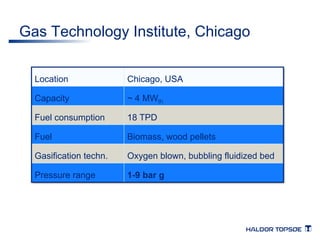
Gas Technology Institute, Chicago 
Location Chicago, USA 
Capacity ~ 4 MWth 
Fuel consumption 18 TPD 
Fuel Biomass, wood pellets 
Gasification techn. Oxygen blown, bubbling fluidized bed 
Pressure range 1-9 bar g
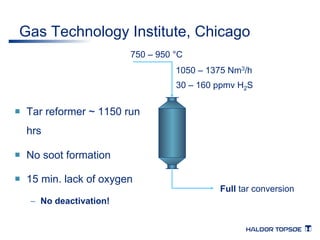
Gas Technology Institute, Chicago 
¡ Tar reformer ~ 1150 run 
hrs 
¡ No soot formation 
¡ 15 min. lack of oxygen 
– No deactivation! 
750 – 950 °C 
1050 – 1375 Nm3/h 
30 – 160 ppmv H2S 
Full tar conversion
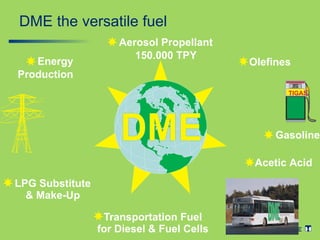
DME the versatile fuel 
TIGAS
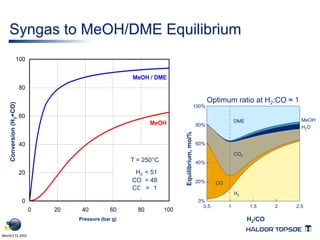
Syngas to MeOH/DME Equilibrium 
100 
Conversion (H2+CO) 
Pressure (bar g) 
80 
60 
40 
20 
0 
MeOH / DME 
MeOH 
0 20 40 60 80 100 
100% 
80% 
60% 
40% 
DME MeOH 
0.5 1 1.5 2 2.5 
H2/CO 
0% 
Equilibrium, mol% 
20% 
H2 
CO 
CO2 
H2O 
T = 250°C 
H2 = 51 
CO = 48 
CO2 = 1 
Optimum ratio at H2:CO ≈ 1
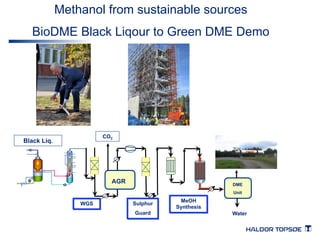
Methanol from sustainable sources 
BioDME Black Liqour to Green DME Demo 
Black Liq. CO2 
AGR DME 
Water 
WGS Sulphur 
Guard 
MeOH 
Synthesis 
Unit
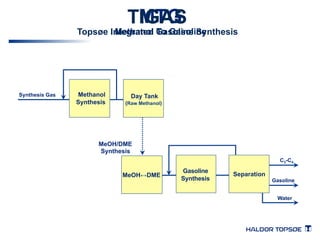
Topsøe Integrated Gasoline Synthesis 
Methanol 
Synthesis 
C3-C4 
Gasoline 
Water 
MTG 
TIGAS 
Methanol To Gasoline 
MeOH↔DME Gasoline 
Synthesis Separation 
Day Tank 
(Raw Methanol) 
Synthesis Gas 
MeOH/DME 
Synthesis
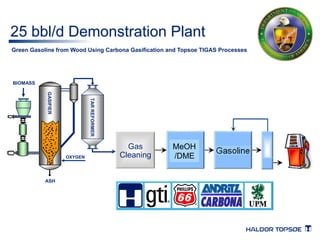
25 bbl/d Demonstration Plant 
Green Gasoline from Wood Using Carbona Gasification and Topsoe TIGAS Processes 
OXYGEN Cleaning 
OXYGEN 
BIOMASS 
GASIFIER 
ASH 
TAR REFORMER 
TAR REFORMER 
BIOMASS 
GASIFIER 
MeOH 
/DME 
MeOH/DME Gasoline 
/ N2 
Gas 
http://www.energy.gov/news2009/releases.htm
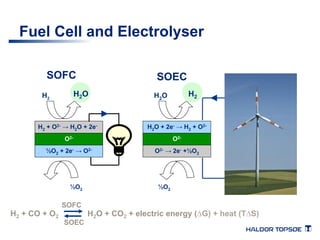
Fuel Cell and Electrolyser 
SOFC SOEC 
H2O H2 
H2 H2O 
½O2 
H2O + 2e- → H2 + O2- 
½O2 
O2- 
O2- → 2e- +½O2 
H2 + O2- → H2O + 2e- 
O2- 
½O2 + 2e- → O2- 
SOFC 
SOEC 
H2 + CO + O2 H2O + CO2 + electric energy (ΔG) + heat (TΔS)
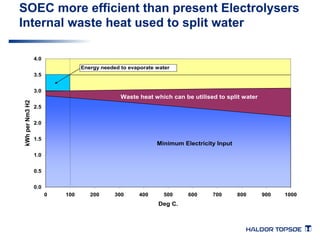
SOEC more efficient than present Electrolysers 
Internal waste heat used to split water 
4.0 
3.5 
3.0 
2.5 
2.0 
1.5 
1.0 
0.5 
0.0 
Energy needed to evaporate water 
Waste heat which can be utilised to split water 
0 100 200 300 400 500 600 700 800 900 1000 
Deg C. 
kWh per Nm3 H2 
Minimum Electricity Input
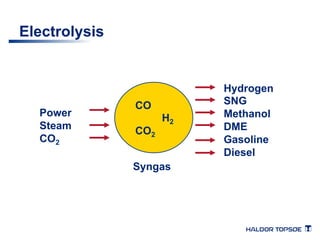
Electrolysis 
CO 
H2 
CO2 
Power 
Steam 
CO2 
Hydrogen 
SNG 
Methanol 
DME 
Gasoline 
Diesel 
Syngas
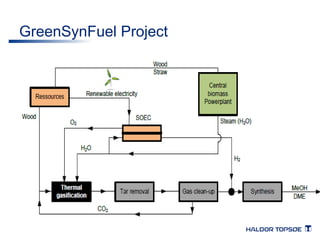
GreenSynFuel Project
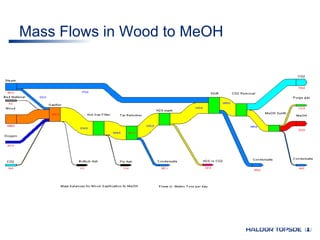
Mass Flows in Wood to MeOH
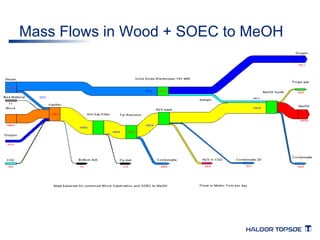
Mass Flows in Wood + SOEC to MeOH
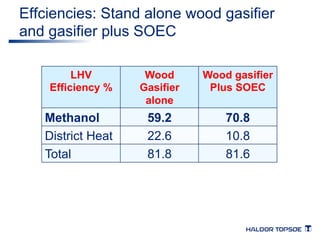
Effciencies: Stand alone wood gasifier 
and gasifier plus SOEC 
LHV 
Efficiency % 
Wood 
Gasifier 
alone 
Wood gasifier 
Plus SOEC 
Methanol 59.2 70.8 
District Heat 22.6 10.8 
Total 81.8 81.6
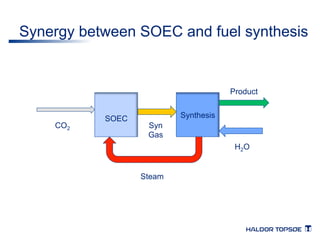
Synergy between SOEC and fuel synthesis 
SOEC Synthesis 
CO2 
H2O 
Syn 
Gas 
Product 
Steam
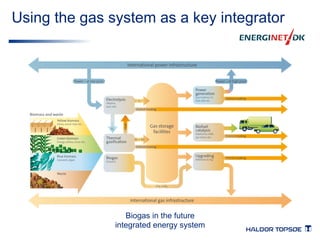
Using the gas system as a key integrator 
Biogas in the future 
integrated energy system
1400 
1200 
1000 
800 
600 
400 
200 
0 
Wind scenario 
Wind Sun Wave Heat 
(sun, geo. and 
heat pump) 
Biomass and 
waste (incl. 
slurry) 
PJ per year 
Used today (2008) 
Potential 
2050 (recommendation) 
26 
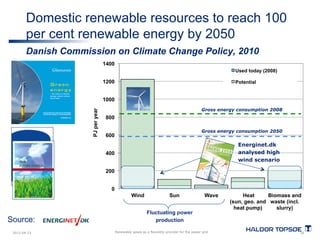
Domestic renewable resources to reach 100 
per cent renewable energy by 2050 
Danish Commission on Climate Change Policy, 2010 
Fluctuating power 
production 
Gross energy consumption 2008 
Gross energy consumption 2050 
Energinet.dk 
analysed high 
wind scenario 
Source: 
2012-04-23 Renewable gases as a flexibility provider for the power grid
Conclusions 
¡ Dusty tar reforming is now commercially proven 
¡ Clean tar reforming has been demonstrated in 
connection with succesful meOH/DME and gasoline 
synthesis at 25 bbl/day 
¡ Sustained black liquor to DME has been proven at 4 
MTPD scale and truck operation as well 
¡ Coupling SOEC with biomass gasification can double the 
biomass potential by converting excess carbon.

Syngas routes to alternative fuels - John Bogild Hansen

  • 1.
    Syngas Routes toAlternative Fuels from Renewable Sources John Bøgild Hansen - Haldor Topsøe Alkmaar, October 2, 2014
  • 2.
    We have beencommitted to catalytic process technology for more than 70 years ¡ Founded in 1940 by Dr. Haldor Topsøe ¡ Revenue: 700 million Euros ¡ 2700 employees ¡ Headquarters in Denmark ¡ Catalyst manufacture in Denmark and the US
  • 3.
    Gasification process Rawmaterials for gasification Biomass Coal Natural gas etc. Products Methanol Hydrogen Ammonia Power Building blocks Synthesis gas CO, H2, CO2, CH4 SNG etc. Tar removal
  • 4.
    Tar reforming –Enabling technology for biomass gasification ¡ Gasification of biomass results in a syngas that contains tars and contaminants – 1000 -2500 ppm tar – 50 – 100 ppm S, particulates – 850-930°C, 1-30 bar g – Ammonia decomposition BIOMASS GASIFIER ASH TAR REFORMER
  • 5.
    Topsoe Tar Reformingin Skive ¡ Topsoe monolithic tar reforming catalyst was started up late August 09 ¡ Low ammonia slip ¡ Low methane exit ¡ Low dP
  • 6.
    “Dusty” tar reforming PROCESSING & UTILIZATION TAR REFOR MER BIOMASS -FEED GASI FIER ASH “Dusty” tar reforming 10-30 g dust / Nm3 HOT GAS FILTER
  • 7.
    Skive Fjernvarme a.m.b.a.(Skive CHP) Location Skive, Denmark Capacity 21 MWth, Max 28 MWth Operational year 2009 Fuel consumption 100 TPD Fuel Biomass, wood pellets Gasification techn. Air blown, bubbling fluidized bed Pressure range 1 – 3 bar g Power generation Gas engines
  • 8.
  • 9.
    “Clean” tar reforming QUENCH GAS “Clean” tar reforming PROCESSING & UTILIZATION HIGH TEMPERATURE HOT GAS FILTER TAR REFOR MER BIOMASS -FEED ASH DUST 1 -10 mg dust / Nm3 GASI FIER Nickel-based
  • 10.
    Gas Technology Institute,Chicago Location Chicago, USA Capacity ~ 4 MWth Fuel consumption 18 TPD Fuel Biomass, wood pellets Gasification techn. Oxygen blown, bubbling fluidized bed Pressure range 1-9 bar g
  • 11.
    Gas Technology Institute,Chicago ¡ Tar reformer ~ 1150 run hrs ¡ No soot formation ¡ 15 min. lack of oxygen – No deactivation! 750 – 950 °C 1050 – 1375 Nm3/h 30 – 160 ppmv H2S Full tar conversion
  • 12.
  • 13.
    Syngas to MeOH/DMEEquilibrium 100 Conversion (H2+CO) Pressure (bar g) 80 60 40 20 0 MeOH / DME MeOH 0 20 40 60 80 100 100% 80% 60% 40% DME MeOH 0.5 1 1.5 2 2.5 H2/CO 0% Equilibrium, mol% 20% H2 CO CO2 H2O T = 250°C H2 = 51 CO = 48 CO2 = 1 Optimum ratio at H2:CO ≈ 1
  • 14.
    Methanol from sustainablesources BioDME Black Liqour to Green DME Demo Black Liq. CO2 AGR DME Water WGS Sulphur Guard MeOH Synthesis Unit
  • 15.
    Topsøe Integrated GasolineSynthesis Methanol Synthesis C3-C4 Gasoline Water MTG TIGAS Methanol To Gasoline MeOH↔DME Gasoline Synthesis Separation Day Tank (Raw Methanol) Synthesis Gas MeOH/DME Synthesis
  • 16.
    25 bbl/d DemonstrationPlant Green Gasoline from Wood Using Carbona Gasification and Topsoe TIGAS Processes OXYGEN Cleaning OXYGEN BIOMASS GASIFIER ASH TAR REFORMER TAR REFORMER BIOMASS GASIFIER MeOH /DME MeOH/DME Gasoline / N2 Gas http://www.energy.gov/news2009/releases.htm
  • 17.
    Fuel Cell andElectrolyser SOFC SOEC H2O H2 H2 H2O ½O2 H2O + 2e- → H2 + O2- ½O2 O2- O2- → 2e- +½O2 H2 + O2- → H2O + 2e- O2- ½O2 + 2e- → O2- SOFC SOEC H2 + CO + O2 H2O + CO2 + electric energy (ΔG) + heat (TΔS)
  • 18.
    SOEC more efficientthan present Electrolysers Internal waste heat used to split water 4.0 3.5 3.0 2.5 2.0 1.5 1.0 0.5 0.0 Energy needed to evaporate water Waste heat which can be utilised to split water 0 100 200 300 400 500 600 700 800 900 1000 Deg C. kWh per Nm3 H2 Minimum Electricity Input
  • 19.
    Electrolysis CO H2 CO2 Power Steam CO2 Hydrogen SNG Methanol DME Gasoline Diesel Syngas
  • 20.
  • 21.
    Mass Flows inWood to MeOH
  • 22.
    Mass Flows inWood + SOEC to MeOH
  • 23.
    Effciencies: Stand alonewood gasifier and gasifier plus SOEC LHV Efficiency % Wood Gasifier alone Wood gasifier Plus SOEC Methanol 59.2 70.8 District Heat 22.6 10.8 Total 81.8 81.6
  • 24.
    Synergy between SOECand fuel synthesis SOEC Synthesis CO2 H2O Syn Gas Product Steam
  • 25.
    Using the gassystem as a key integrator Biogas in the future integrated energy system
  • 26.
    1400 1200 1000 800 600 400 200 0 Wind scenario Wind Sun Wave Heat (sun, geo. and heat pump) Biomass and waste (incl. slurry) PJ per year Used today (2008) Potential 2050 (recommendation) 26 Domestic renewable resources to reach 100 per cent renewable energy by 2050 Danish Commission on Climate Change Policy, 2010 Fluctuating power production Gross energy consumption 2008 Gross energy consumption 2050 Energinet.dk analysed high wind scenario Source: 2012-04-23 Renewable gases as a flexibility provider for the power grid
  • 27.
    Conclusions ¡ Dustytar reforming is now commercially proven ¡ Clean tar reforming has been demonstrated in connection with succesful meOH/DME and gasoline synthesis at 25 bbl/day ¡ Sustained black liquor to DME has been proven at 4 MTPD scale and truck operation as well ¡ Coupling SOEC with biomass gasification can double the biomass potential by converting excess carbon.