Digestate 
u*liza*on 
in 
agriculture 
(a 
holis*c 
analysis) 
E. 
Hartung 
Ins*tute 
of 
Agricultural 
Engineering 
-­‐ 
Kiel 
University 
Agenda: 
• Mo+va+on 
& 
Challenges 
• Substrate 
variability 
& 
AD 
effects 
• Fer+lizer 
use 
& 
effect 
on 
Soil 
proper+es 
• GHG 
& 
… 
• “Other” 
u+liza+on 
• Conclusions
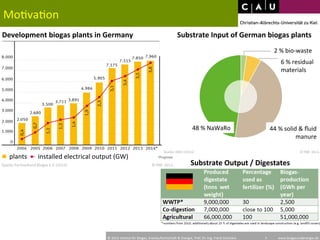
Mo*va*on 
Development 
biogas 
plants 
in 
Germany 
plants 
installed 
electrical 
output 
(GW) 
Substrate 
Input 
of 
German 
biogas 
plants 
48 
% 
NaWaRo 
2 
% 
bio-­‐waste 
6 
% 
residual 
materials 
44 
% 
solid 
& 
fluid 
manure 
Substrate 
Output 
/ 
Digestates
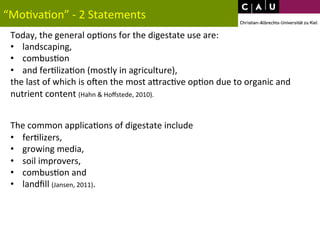
“Mo*va*on” 
-­‐ 
2 
Statements 
Today, 
the 
general 
op*ons 
for 
the 
digestate 
use 
are: 
• landscaping, 
• combus*on 
• and 
fer*liza*on 
(mostly 
in 
agriculture), 
the 
last 
of 
which 
is 
oVen 
the 
most 
aWrac*ve 
op*on 
due 
to 
organic 
and 
nutrient 
content 
(Hahn 
& 
Hoffstede, 
2010). 
The 
common 
applica*ons 
of 
digestate 
include 
• fer*lizers, 
• growing 
media, 
• soil 
improvers, 
• combus*on 
and 
• landfill 
(Jansen, 
2011).
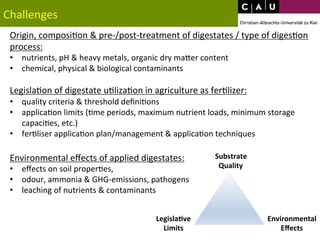
Challenges 
Origin, 
composi*on 
& 
pre-­‐/post-­‐treatment 
of 
digestates 
/ 
type 
of 
diges*on 
process: 
• nutrients, 
pH 
& 
heavy 
metals, 
organic 
dry 
maWer 
content 
• chemical, 
physical 
& 
biological 
contaminants 
Legisla*on 
of 
digestate 
u*liza*on 
in 
agriculture 
as 
fer*lizer: 
• quality 
criteria 
& 
threshold 
defini*ons 
• applica*on 
limits 
(*me 
periods, 
maximum 
nutrient 
loads, 
minimum 
storage 
capaci*es, 
etc.) 
• fer*liser 
applica*on 
plan/management 
& 
applica*on 
techniques 
Environmental 
effects 
of 
applied 
digestates: 
• effects 
on 
soil 
proper*es, 
• odour, 
ammonia 
& 
GHG-­‐emissions, 
pathogens 
• leaching 
of 
nutrients 
& 
contaminants 
Substrate 
Quality 
Legisla+ve 
Limits 
Environmental 
Effects
Challenges 
Addi*onal 
challenges: 
• area 
used 
for 
the 
cul*va*on 
of 
energy 
crops 
is 
in 
general 
not 
enough 
for 
the 
applica*on 
of 
the 
digestates 
-­‐> 
high 
demand 
for 
“addi*onal 
applica*on 
areas” 
• low 
dry 
maWer 
(poor 
transportability) 
and 
low 
& 
strongly 
varying 
nutrient 
content 
• high 
storage-­‐, 
transporta*on-­‐ 
and 
applica*on 
–costs 
• high 
pH, 
instable 
fer*lising 
effect, 
loss 
of 
nutrients 
Substrate 
Quality 
Legisla+ve 
Limits 
Environmental 
Effects 
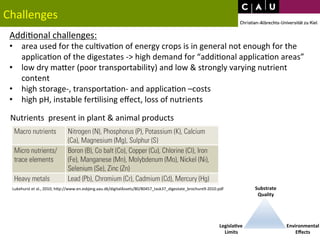
Nutrients 
present 
in 
plant 
& 
animal 
products 
Lukehurst 
et 
al., 
2010; 
hWp://www.en.esbjerg.aau.dk/digitalAssets/80/80457_task37_digestate_brochure9-­‐2010.pdf
Substrate 
variability 
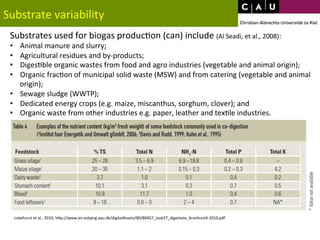
Substrates 
used 
for 
biogas 
produc*on 
(can) 
include 
(Al 
Seadi, 
et 
al., 
2008): 
• Animal 
manure 
and 
slurry; 
• Agricultural 
residues 
and 
by-­‐products; 
• Diges*ble 
organic 
wastes 
from 
food 
and 
agro 
industries 
(vegetable 
and 
animal 
origin); 
• Organic 
frac*on 
of 
municipal 
solid 
waste 
(MSW) 
and 
from 
catering 
(vegetable 
and 
animal 
origin); 
• Sewage 
sludge 
(WWTP); 
• Dedicated 
energy 
crops 
(e.g. 
maize, 
miscanthus, 
sorghum, 
clover); 
and 
• Organic 
waste 
from 
other 
industries 
e.g. 
paper, 
leather 
and 
tex*le 
industries. 
Lukehurst 
et 
al., 
2010; 
hWp://www.en.esbjerg.aau.dk/digitalAssets/80/80457_task37_digestate_brochure9-­‐2010.pdf
Substrate 
variability 
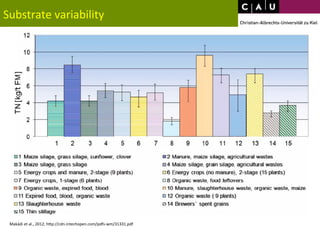
Makádi 
et 
al., 
2012; 
hWp://cdn.intechopen.com/pdfs-­‐wm/31331.pdf
Substrate 
variability 
& 
AD 
effects 
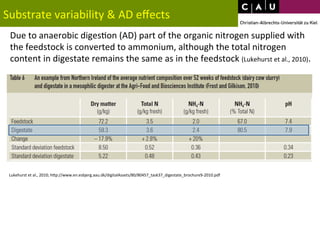
Due 
to 
anaerobic 
diges*on 
(AD) 
part 
of 
the 
organic 
nitrogen 
supplied 
with 
the 
feedstock 
is 
converted 
to 
ammonium, 
although 
the 
total 
nitrogen 
content 
in 
digestate 
remains 
the 
same 
as 
in 
the 
feedstock 
(Lukehurst 
et 
al., 
2010). 
Lukehurst 
et 
al., 
2010; 
hWp://www.en.esbjerg.aau.dk/digitalAssets/80/80457_task37_digestate_brochure9-­‐2010.pdf
Fer*lizer 
use 
& 
Effect 
on 
Soil 
proper*es 
Lukehurst 
et 
al., 
2010; 
hWp://www.en.esbjerg.aau.dk/digitalAssets/80/80457_task37_digestate_brochure9-­‐2010.pdf
Substrate 
variability 
& 
AD 
effects 
The 
amounts 
of 
organic 
dry 
maWer 
and 
the 
carbon 
content 
of 
digestate 
are 
decreased 
by 
the 
decomposi*on 
of 
easily 
degradable 
carbon 
compounds 
in 
digesters 
(S*nner 
et 
al., 
2008) 
Makádi 
et 
al., 
2012; 
hWp://cdn.intechopen.com/pdfs-­‐wm/31331.pdf
Fer*lizer 
use 
& 
Effect 
on 
Soil 
proper*es 
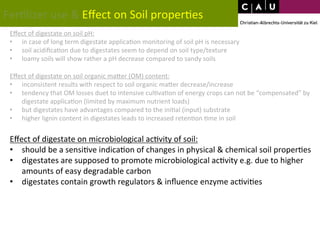
Effect 
of 
digestate 
on 
soil 
pH: 
• in 
case 
of 
long 
term 
digestate 
applica*on 
monitoring 
of 
soil 
pH 
is 
necessary 
• soil 
acidifica*on 
due 
to 
digestates 
seem 
to 
depend 
on 
soil 
type/texture 
• loamy 
soils 
will 
show 
rather 
a 
pH 
decrease 
compared 
to 
sandy 
soils 
Effect 
of 
digestate 
on 
soil 
organic 
maWer 
(OM) 
content: 
• inconsistent 
results 
with 
respect 
to 
soil 
organic 
maWer 
decrease/increase 
• tendency 
that 
OM 
losses 
duet 
to 
intensive 
cul*va*on 
of 
energy 
crops 
can 
not 
be 
“compensated” 
by 
digestate 
applica*on 
(limited 
by 
maximum 
nutrient 
loads) 
• but 
digestates 
have 
advantages 
compared 
to 
the 
ini*al 
(input) 
substrate 
• higher 
lignin 
content 
in 
digestates 
leads 
to 
increased 
reten*on 
*me 
in 
soil
Fer*lizer 
use 
& 
Effect 
on 
Soil 
proper*es 
Effect 
of 
digestate 
on 
soil 
organic 
maWer 
(OM) 
content: 
• inconsistent 
results 
with 
respect 
to 
soil 
organic 
maWer 
decrease/increase 
• tendency 
that 
OM 
losses 
duet 
to 
intensive 
cul*va*on 
of 
energy 
crops 
can 
not 
be 
“compensated” 
by 
digestate 
applica*on 
(limited 
by 
maximum 
nutrient 
loads) 
• but 
digestates 
have 
advantages 
compared 
to 
the 
ini*al 
(input) 
substrate 
• higher 
lignin 
content 
in 
digestates 
leads 
to 
increased 
reten*on 
*me 
in 
soil 
plant 
material 
slurry 
digestates 
material 
dry 
maLer 
% 
humus 
reproduc+on 
kg 
Humus-­‐C 
(t 
substrate)-­‐1 
straw 
green 
fer*lizer 
cupngs 
pig 
caWle 
fluid 
VDLUFA, 
2005 
solid
Fer*lizer 
use 
& 
Effect 
on 
Soil 
proper*es 
type 
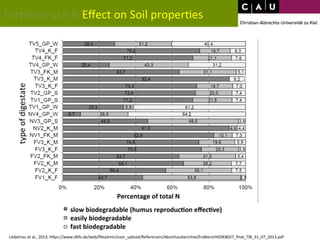
of 
digestate 
Percentage 
of 
total 
N 
slow 
biodegradable 
(humus 
reproduc+on 
effec+ve) 
easily 
biodegradable 
fast 
biodegradable 
Liebetrau 
et 
al., 
2013; 
hWps://www.dbfz.de/web/fileadmin/user_upload/Referenzen/Abschlussberichte/Endbericht03KB027_final_TIB_31_07_2013.pdf
Fer*lizer 
use 
& 
Effect 
on 
Soil 
proper*es 
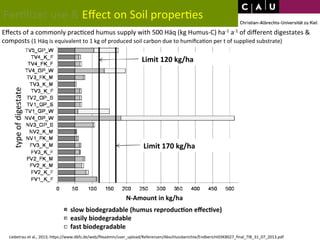
Effects 
of 
a 
commonly 
prac*ced 
humus 
supply 
with 
500 
Häq 
(kg 
Humus-­‐C) 
ha-­‐1 
a-­‐1 
of 
different 
digestates 
& 
composts 
(1 
Häq 
is 
equivalent 
to 
1 
kg 
of 
produced 
soil 
carbon 
due 
to 
humifica*on 
per 
t 
of 
supplied 
substrate) 
type 
of 
digestate 
Limit 
120 
kg/ha 
Limit 
170 
kg/ha 
N-­‐Amount 
in 
kg/ha 
slow 
biodegradable 
(humus 
reproduc+on 
effec+ve) 
easily 
biodegradable 
fast 
biodegradable 
Liebetrau 
et 
al., 
2013; 
hWps://www.dbfz.de/web/fileadmin/user_upload/Referenzen/Abschlussberichte/Endbericht03KB027_final_TIB_31_07_2013.pdf
Fer*lizer 
use 
& 
Effect 
on 
Soil 
proper*es 
Effect 
of 
digestate 
on 
soil 
pH: 
• in 
case 
of 
long 
term 
digestate 
applica*on 
monitoring 
of 
soil 
pH 
is 
necessary 
• soil 
acidifica*on 
due 
to 
digestates 
seem 
to 
depend 
on 
soil 
type/texture 
• loamy 
soils 
will 
show 
rather 
a 
pH 
decrease 
compared 
to 
sandy 
soils 
Effect 
of 
digestate 
on 
soil 
organic 
maWer 
(OM) 
content: 
• inconsistent 
results 
with 
respect 
to 
soil 
organic 
maWer 
decrease/increase 
• tendency 
that 
OM 
losses 
duet 
to 
intensive 
cul*va*on 
of 
energy 
crops 
can 
not 
be 
“compensated” 
by 
digestate 
applica*on 
(limited 
by 
maximum 
nutrient 
loads) 
• but 
digestates 
have 
advantages 
compared 
to 
the 
ini*al 
(input) 
substrate 
• higher 
lignin 
content 
in 
digestates 
leads 
to 
increased 
reten*on 
*me 
in 
soil 
Effect 
of 
digestate 
on 
microbiological 
ac*vity 
of 
soil: 
• should 
be 
a 
sensi*ve 
indica*on 
of 
changes 
in 
physical 
& 
chemical 
soil 
proper*es 
• digestates 
are 
supposed 
to 
promote 
microbiological 
ac*vity 
e.g. 
due 
to 
higher 
amounts 
of 
easy 
degradable 
carbon 
• digestates 
contain 
growth 
regulators 
& 
influence 
enzyme 
ac*vi*es
Fer*lizer 
use 
& 
Effect 
on 
Soil 
proper*es 
Effect 
of 
digestate 
on 
microbiological 
ac*vity 
of 
soil: 
• should 
be 
a 
sensi*ve 
indica*on 
of 
changes 
in 
physical 
& 
chemical 
soil 
proper*es 
• digestates 
are 
supposed 
to 
promote 
microbiological 
ac*vity 
e.g. 
due 
to 
higher 
amounts 
of 
easy 
degradable 
carbon 
• digestates 
contain 
growth 
regulators 
& 
influence 
enzyme 
ac*vi*es 
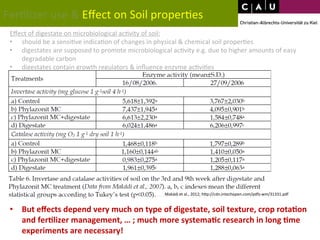
• But 
Makádi 
et 
al., 
2012; 
hWp://cdn.intechopen.com/pdfs-­‐wm/31331.pdf 
effects 
depend 
very 
much 
on 
type 
of 
digestate, 
soil 
texture, 
crop 
rota+on 
and 
fer+lizer 
management, 
… 
; 
much 
more 
systema+c 
research 
in 
long 
+me 
experiments 
are 
necessary!
GHG 
& 
Ammonia 
emissions 
& 
… 
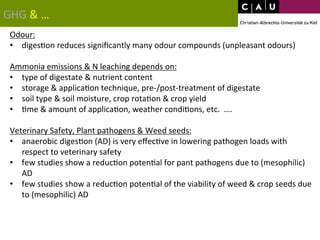
General 
Ques*ons? 
• focus 
on 
processes 
&/or 
applica*ons 
• focus 
on 
whole 
produc*on 
chain 
(e.g. 
energy 
& 
nutrient 
balances, 
LCA 
studies) 
• which 
model, 
included 
boundary/limi*ng 
condi*ons 
& 
set 
values 
are 
used 
• which 
assump*ons 
were 
made
GHG 
& 
Ammonia 
emissions 
& 
… 
Input 
substrate] 
CO2-­‐eq/Mg 
GHG 
emissions 
[kg 
different 
fermenta*on 
processes 
/ 
facili*es 
digestate 
applica+on 
digestate 
storage 
compos+ng 
/ 
post 
roo+ng 
emissions 
past 
bio-­‐ 
filter 
electricity 
demand 
BGP 
& 
CHP 
emissions 
fermenter 
emissions 
CHP 
credit 
digestate 
credit 
heat 
recovery 
credit 
electricity 
Balance 
Liebetrau 
et 
al., 
2013; 
hWps://www.dbfz.de/web/fileadmin/user_upload/Referenzen/Abschlussberichte/Endbericht03KB027_final_TIB_31_07_2013.pdf
GHG 
& 
… 
Odour: 
• diges*on 
reduces 
significantly 
many 
odour 
compounds 
(unpleasant 
odours) 
Ammonia 
emissions 
& 
N 
leaching 
depends 
on: 
• type 
of 
digestate 
& 
nutrient 
content 
• storage 
& 
applica*on 
technique, 
pre-­‐/post-­‐treatment 
of 
digestate 
• soil 
type 
& 
soil 
moisture, 
crop 
rota*on 
& 
crop 
yield 
• *me 
& 
amount 
of 
applica*on, 
weather 
condi*ons, 
etc. 
…. 
Veterinary 
Safety, 
Plant 
pathogens 
& 
Weed 
seeds: 
• anaerobic 
diges*on 
(AD) 
is 
very 
effec*ve 
in 
lowering 
pathogen 
loads 
with 
respect 
to 
veterinary 
safety 
• few 
studies 
show 
a 
reduc*on 
poten*al 
for 
pant 
pathogens 
due 
to 
(mesophilic) 
AD 
• few 
studies 
show 
a 
reduc*on 
poten*al 
of 
the 
viability 
of 
weed 
& 
crop 
seeds 
due 
to 
(mesophilic) 
AD
GHG 
& 
… 
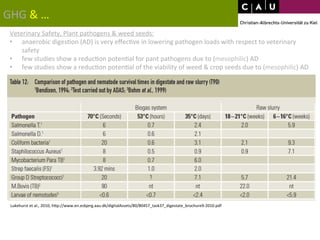
Veterinary 
Safety, 
Plant 
pathogens 
& 
weed 
seeds: 
• anaerobic 
diges*on 
(AD) 
is 
very 
effec*ve 
in 
lowering 
pathogen 
loads 
with 
respect 
to 
veterinary 
safety 
• few 
studies 
show 
a 
reduc*on 
poten*al 
for 
pant 
pathogens 
due 
to 
(mesophilic) 
AD 
• few 
studies 
show 
a 
reduc*on 
poten*al 
of 
the 
viability 
of 
weed 
& 
crop 
seeds 
due 
to 
(mesophilic) 
AD 
Lukehurst 
et 
al., 
2010; 
hWp://www.en.esbjerg.aau.dk/digitalAssets/80/80457_task37_digestate_brochure9-­‐2010.pdf
GHG 
& 
… 
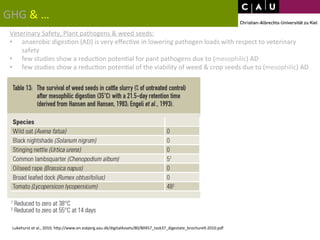
Veterinary 
Safety, 
Plant 
pathogens 
& 
weed 
seeds: 
• anaerobic 
diges*on 
(AD) 
is 
very 
effec*ve 
in 
lowering 
pathogen 
loads 
with 
respect 
to 
veterinary 
safety 
• few 
studies 
show 
a 
reduc*on 
poten*al 
for 
pant 
pathogens 
due 
to 
(mesophilic) 
AD 
• few 
studies 
show 
a 
reduc*on 
poten*al 
of 
the 
viability 
of 
weed 
& 
crop 
seeds 
due 
to 
(mesophilic) 
AD 
Lukehurst 
et 
al., 
2010; 
hWp://www.en.esbjerg.aau.dk/digitalAssets/80/80457_task37_digestate_brochure9-­‐2010.pdf
“Other” 
u*liza*on 
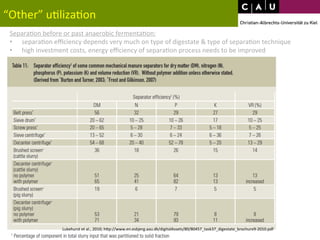
Separa*on 
before 
or 
past 
anaerobic 
fermenta*on: 
• separa*on 
efficiency 
depends 
very 
much 
on 
type 
of 
digestate 
& 
type 
of 
separa*on 
technique 
• high 
investment 
costs, 
energy 
efficiency 
of 
separa*on 
process 
needs 
to 
be 
improved
“Other” 
u*liza*on 
Separa*on 
before 
or 
past 
anaerobic 
fermenta*on: 
• separa*on 
efficiency 
depends 
very 
much 
on 
type 
of 
digestate 
& 
type 
of 
separa*on 
technique 
• high 
investment 
costs, 
energy 
efficiency 
of 
separa*on 
process 
needs 
to 
be 
improved 
Lukehurst 
et 
al., 
2010; 
hWp://www.en.esbjerg.aau.dk/digitalAssets/80/80457_task37_digestate_brochure9-­‐2010.pdf
“Other” 
u*liza*on 
Separa*on 
before 
or 
past 
anaerobic 
fermenta*on: 
• separa*on 
efficiency 
depends 
very 
much 
on 
type 
of 
digestate 
& 
type 
of 
separa*on 
technique 
• high 
investment 
costs, 
energy 
efficiency 
of 
separa*on 
process 
needs 
to 
be 
improved 
digestate 
post 
processing 
(high 
treatment 
& 
investment 
costs): 
• solid-­‐liquid 
separa*on: 
• solid 
frac*on 
compos*ng 
-­‐> 
soil 
improver-­‐growing 
material 
(SIGM) 
• liquid 
frac*on 
-­‐> 
Liquid 
fer0lizer 
• stripping 
(ammonium 
sulphate 
fer0lizer) 
• pelle*zing 
(fer0lizer 
pellet/solid 
fuel)
“Other” 
u*liza*on 
digestate 
post 
processing 
(high 
treatment 
& 
investment 
costs): 
• solid-­‐liquid 
separa*on: 
• solid 
frac*on 
compos*ng 
-­‐> 
soil 
improver-­‐growing 
material 
(SIGM) 
• liquid 
frac*on 
-­‐> 
Liquid 
fer0lizer 
• stripping 
(ammonium 
sulphate 
fer0lizer) 
• pelle*zing 
(fer0lizer 
pellet/solid 
fuel) 
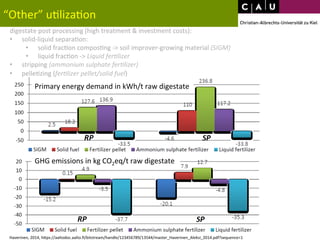
Primary 
energy 
demand 
in 
kWh/t 
raw 
digestate 
GHG 
emissions 
in 
kg 
CO2eq/t 
raw 
digestate 
Haverinen, 
2014, 
hWps://aaltodoc.aalto.fi/bitstream/handle/123456789/13544/master_Haverinen_Aleksi_2014.pdf?sequence=1
“Other” 
u*liza*on 
Separa*on 
before 
or 
past 
anaerobic 
fermenta*on: 
• separa*on 
efficiency 
depends 
very 
much 
on 
type 
of 
digestate 
& 
type 
of 
separa*on 
technique 
• high 
investment 
costs, 
energy 
efficiency 
of 
separa*on 
process 
needs 
to 
be 
improved 
digestate 
post 
processing 
(high 
treatment 
& 
investment 
costs): 
• solid-­‐liquid 
separa*on: 
• solid 
frac*on 
compos*ng 
-­‐> 
soil 
improver-­‐growing 
material 
(SIGM) 
• liquid 
frac*on 
-­‐> 
Liquid 
fer0lizer 
• stripping 
(ammonium 
sulphate 
fer0lizer) 
• pelle*zing 
(fer0lizer 
pellet/solid 
fuel) 
• ion 
exchange, 
struvite 
precipita*on 
• membrane 
filtra*on 
• drying 
• soil 
improver 
(carboniza*on, 
biochar 
produc*on)
Conclusions 
• U*liza*on 
of 
digestates 
in 
agriculture 
is 
a 
very 
broad 
field/topic 
• Up 
to 
now 
most 
digestates 
are 
used 
as 
fer*lizer 
& 
effect: 
• environment 
• soil 
proper*es 
• Alterna*ve 
digestate 
u*liza*on 
are 
mostly 
characterized 
by 
high 
treatment 
& 
investment 
costs 
• Future 
goals: 
• Achieve 
more 
knowledge 
on 
effects 
of 
digestate 
applica*on 
• Op*mize 
(automated) 
side-­‐ 
& 
plant-­‐specific 
applica*on 
• Improve 
cost-­‐effec*ve 
separa*on 
and 
carboniza*on 
techniques 
• U*lize 
fluctua*on 
of 
renewable 
energy 
produc*on 
for 
digestate 
treatment
Digestate 
u*liza*on 
in 
agriculture 
(a 
holis*c 
analysis) 
E. 
Hartung 
Ins*tute 
of 
Agricultural 
Engineering 
-­‐ 
Kiel 
University 
Agenda: 
• Mo+va+on 
& 
Challenges 
• Substrate 
variability 
& 
AD 
effects 
• Fer+lizer 
use 
& 
effect 
on 
Soil 
proper+es 
• GHG 
& 
… 
• “Other” 
u+liza+on 
• Conclusions

Digestates utlilization in agriculture - a holistic analysis - Prof. Eberhard Hartung

  • 1.
    Digestate u*liza*on in agriculture (a holis*c analysis) E. Hartung Ins*tute of Agricultural Engineering -­‐ Kiel University Agenda: • Mo+va+on & Challenges • Substrate variability & AD effects • Fer+lizer use & effect on Soil proper+es • GHG & … • “Other” u+liza+on • Conclusions
  • 2.
    Mo*va*on Development biogas plants in Germany plants installed electrical output (GW) Substrate Input of German biogas plants 48 % NaWaRo 2 % bio-­‐waste 6 % residual materials 44 % solid & fluid manure Substrate Output / Digestates
  • 3.
    “Mo*va*on” -­‐ 2 Statements Today, the general op*ons for the digestate use are: • landscaping, • combus*on • and fer*liza*on (mostly in agriculture), the last of which is oVen the most aWrac*ve op*on due to organic and nutrient content (Hahn & Hoffstede, 2010). The common applica*ons of digestate include • fer*lizers, • growing media, • soil improvers, • combus*on and • landfill (Jansen, 2011).
  • 4.
    Challenges Origin, composi*on & pre-­‐/post-­‐treatment of digestates / type of diges*on process: • nutrients, pH & heavy metals, organic dry maWer content • chemical, physical & biological contaminants Legisla*on of digestate u*liza*on in agriculture as fer*lizer: • quality criteria & threshold defini*ons • applica*on limits (*me periods, maximum nutrient loads, minimum storage capaci*es, etc.) • fer*liser applica*on plan/management & applica*on techniques Environmental effects of applied digestates: • effects on soil proper*es, • odour, ammonia & GHG-­‐emissions, pathogens • leaching of nutrients & contaminants Substrate Quality Legisla+ve Limits Environmental Effects
  • 5.
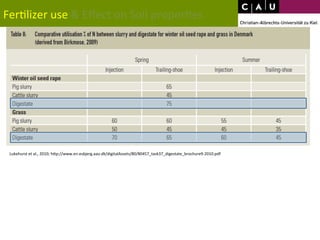
    Challenges Addi*onal challenges: • area used for the cul*va*on of energy crops is in general not enough for the applica*on of the digestates -­‐> high demand for “addi*onal applica*on areas” • low dry maWer (poor transportability) and low & strongly varying nutrient content • high storage-­‐, transporta*on-­‐ and applica*on –costs • high pH, instable fer*lising effect, loss of nutrients Substrate Quality Legisla+ve Limits Environmental Effects Nutrients present in plant & animal products Lukehurst et al., 2010; hWp://www.en.esbjerg.aau.dk/digitalAssets/80/80457_task37_digestate_brochure9-­‐2010.pdf
  • 6.
    Substrate variability Substrates used for biogas produc*on (can) include (Al Seadi, et al., 2008): • Animal manure and slurry; • Agricultural residues and by-­‐products; • Diges*ble organic wastes from food and agro industries (vegetable and animal origin); • Organic frac*on of municipal solid waste (MSW) and from catering (vegetable and animal origin); • Sewage sludge (WWTP); • Dedicated energy crops (e.g. maize, miscanthus, sorghum, clover); and • Organic waste from other industries e.g. paper, leather and tex*le industries. Lukehurst et al., 2010; hWp://www.en.esbjerg.aau.dk/digitalAssets/80/80457_task37_digestate_brochure9-­‐2010.pdf
  • 7.
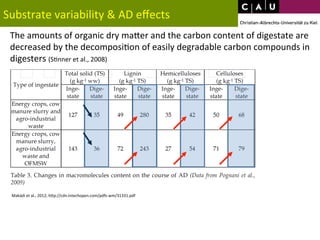
    Substrate variability Makádi et al., 2012; hWp://cdn.intechopen.com/pdfs-­‐wm/31331.pdf
  • 8.
    Substrate variability & AD effects Due to anaerobic diges*on (AD) part of the organic nitrogen supplied with the feedstock is converted to ammonium, although the total nitrogen content in digestate remains the same as in the feedstock (Lukehurst et al., 2010). Lukehurst et al., 2010; hWp://www.en.esbjerg.aau.dk/digitalAssets/80/80457_task37_digestate_brochure9-­‐2010.pdf
  • 9.
    Fer*lizer use & Effect on Soil proper*es Lukehurst et al., 2010; hWp://www.en.esbjerg.aau.dk/digitalAssets/80/80457_task37_digestate_brochure9-­‐2010.pdf
  • 10.
    Substrate variability & AD effects The amounts of organic dry maWer and the carbon content of digestate are decreased by the decomposi*on of easily degradable carbon compounds in digesters (S*nner et al., 2008) Makádi et al., 2012; hWp://cdn.intechopen.com/pdfs-­‐wm/31331.pdf
  • 11.
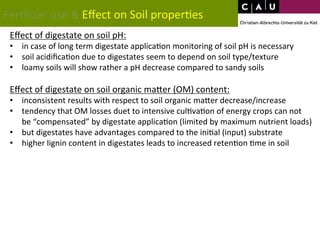
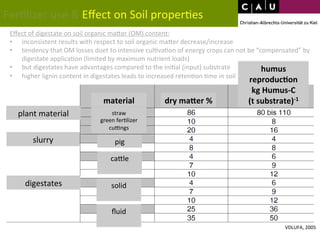
    Fer*lizer use & Effect on Soil proper*es Effect of digestate on soil pH: • in case of long term digestate applica*on monitoring of soil pH is necessary • soil acidifica*on due to digestates seem to depend on soil type/texture • loamy soils will show rather a pH decrease compared to sandy soils Effect of digestate on soil organic maWer (OM) content: • inconsistent results with respect to soil organic maWer decrease/increase • tendency that OM losses duet to intensive cul*va*on of energy crops can not be “compensated” by digestate applica*on (limited by maximum nutrient loads) • but digestates have advantages compared to the ini*al (input) substrate • higher lignin content in digestates leads to increased reten*on *me in soil
  • 12.
    Fer*lizer use & Effect on Soil proper*es Effect of digestate on soil organic maWer (OM) content: • inconsistent results with respect to soil organic maWer decrease/increase • tendency that OM losses duet to intensive cul*va*on of energy crops can not be “compensated” by digestate applica*on (limited by maximum nutrient loads) • but digestates have advantages compared to the ini*al (input) substrate • higher lignin content in digestates leads to increased reten*on *me in soil plant material slurry digestates material dry maLer % humus reproduc+on kg Humus-­‐C (t substrate)-­‐1 straw green fer*lizer cupngs pig caWle fluid VDLUFA, 2005 solid
  • 13.
    Fer*lizer use & Effect on Soil proper*es type of digestate Percentage of total N slow biodegradable (humus reproduc+on effec+ve) easily biodegradable fast biodegradable Liebetrau et al., 2013; hWps://www.dbfz.de/web/fileadmin/user_upload/Referenzen/Abschlussberichte/Endbericht03KB027_final_TIB_31_07_2013.pdf
  • 14.
    Fer*lizer use & Effect on Soil proper*es Effects of a commonly prac*ced humus supply with 500 Häq (kg Humus-­‐C) ha-­‐1 a-­‐1 of different digestates & composts (1 Häq is equivalent to 1 kg of produced soil carbon due to humifica*on per t of supplied substrate) type of digestate Limit 120 kg/ha Limit 170 kg/ha N-­‐Amount in kg/ha slow biodegradable (humus reproduc+on effec+ve) easily biodegradable fast biodegradable Liebetrau et al., 2013; hWps://www.dbfz.de/web/fileadmin/user_upload/Referenzen/Abschlussberichte/Endbericht03KB027_final_TIB_31_07_2013.pdf
  • 15.
    Fer*lizer use & Effect on Soil proper*es Effect of digestate on soil pH: • in case of long term digestate applica*on monitoring of soil pH is necessary • soil acidifica*on due to digestates seem to depend on soil type/texture • loamy soils will show rather a pH decrease compared to sandy soils Effect of digestate on soil organic maWer (OM) content: • inconsistent results with respect to soil organic maWer decrease/increase • tendency that OM losses duet to intensive cul*va*on of energy crops can not be “compensated” by digestate applica*on (limited by maximum nutrient loads) • but digestates have advantages compared to the ini*al (input) substrate • higher lignin content in digestates leads to increased reten*on *me in soil Effect of digestate on microbiological ac*vity of soil: • should be a sensi*ve indica*on of changes in physical & chemical soil proper*es • digestates are supposed to promote microbiological ac*vity e.g. due to higher amounts of easy degradable carbon • digestates contain growth regulators & influence enzyme ac*vi*es
  • 16.
    Fer*lizer use & Effect on Soil proper*es Effect of digestate on microbiological ac*vity of soil: • should be a sensi*ve indica*on of changes in physical & chemical soil proper*es • digestates are supposed to promote microbiological ac*vity e.g. due to higher amounts of easy degradable carbon • digestates contain growth regulators & influence enzyme ac*vi*es • But Makádi et al., 2012; hWp://cdn.intechopen.com/pdfs-­‐wm/31331.pdf effects depend very much on type of digestate, soil texture, crop rota+on and fer+lizer management, … ; much more systema+c research in long +me experiments are necessary!
  • 17.
    GHG & Ammonia emissions & … General Ques*ons? • focus on processes &/or applica*ons • focus on whole produc*on chain (e.g. energy & nutrient balances, LCA studies) • which model, included boundary/limi*ng condi*ons & set values are used • which assump*ons were made
  • 18.
    GHG & Ammonia emissions & … Input substrate] CO2-­‐eq/Mg GHG emissions [kg different fermenta*on processes / facili*es digestate applica+on digestate storage compos+ng / post roo+ng emissions past bio-­‐ filter electricity demand BGP & CHP emissions fermenter emissions CHP credit digestate credit heat recovery credit electricity Balance Liebetrau et al., 2013; hWps://www.dbfz.de/web/fileadmin/user_upload/Referenzen/Abschlussberichte/Endbericht03KB027_final_TIB_31_07_2013.pdf
  • 19.
    GHG & … Odour: • diges*on reduces significantly many odour compounds (unpleasant odours) Ammonia emissions & N leaching depends on: • type of digestate & nutrient content • storage & applica*on technique, pre-­‐/post-­‐treatment of digestate • soil type & soil moisture, crop rota*on & crop yield • *me & amount of applica*on, weather condi*ons, etc. …. Veterinary Safety, Plant pathogens & Weed seeds: • anaerobic diges*on (AD) is very effec*ve in lowering pathogen loads with respect to veterinary safety • few studies show a reduc*on poten*al for pant pathogens due to (mesophilic) AD • few studies show a reduc*on poten*al of the viability of weed & crop seeds due to (mesophilic) AD
  • 20.
    GHG & … Veterinary Safety, Plant pathogens & weed seeds: • anaerobic diges*on (AD) is very effec*ve in lowering pathogen loads with respect to veterinary safety • few studies show a reduc*on poten*al for pant pathogens due to (mesophilic) AD • few studies show a reduc*on poten*al of the viability of weed & crop seeds due to (mesophilic) AD Lukehurst et al., 2010; hWp://www.en.esbjerg.aau.dk/digitalAssets/80/80457_task37_digestate_brochure9-­‐2010.pdf
  • 21.
    GHG & … Veterinary Safety, Plant pathogens & weed seeds: • anaerobic diges*on (AD) is very effec*ve in lowering pathogen loads with respect to veterinary safety • few studies show a reduc*on poten*al for pant pathogens due to (mesophilic) AD • few studies show a reduc*on poten*al of the viability of weed & crop seeds due to (mesophilic) AD Lukehurst et al., 2010; hWp://www.en.esbjerg.aau.dk/digitalAssets/80/80457_task37_digestate_brochure9-­‐2010.pdf
  • 22.
    “Other” u*liza*on Separa*on before or past anaerobic fermenta*on: • separa*on efficiency depends very much on type of digestate & type of separa*on technique • high investment costs, energy efficiency of separa*on process needs to be improved
  • 23.
    “Other” u*liza*on Separa*on before or past anaerobic fermenta*on: • separa*on efficiency depends very much on type of digestate & type of separa*on technique • high investment costs, energy efficiency of separa*on process needs to be improved Lukehurst et al., 2010; hWp://www.en.esbjerg.aau.dk/digitalAssets/80/80457_task37_digestate_brochure9-­‐2010.pdf
  • 24.
    “Other” u*liza*on Separa*on before or past anaerobic fermenta*on: • separa*on efficiency depends very much on type of digestate & type of separa*on technique • high investment costs, energy efficiency of separa*on process needs to be improved digestate post processing (high treatment & investment costs): • solid-­‐liquid separa*on: • solid frac*on compos*ng -­‐> soil improver-­‐growing material (SIGM) • liquid frac*on -­‐> Liquid fer0lizer • stripping (ammonium sulphate fer0lizer) • pelle*zing (fer0lizer pellet/solid fuel)
  • 25.
    “Other” u*liza*on digestate post processing (high treatment & investment costs): • solid-­‐liquid separa*on: • solid frac*on compos*ng -­‐> soil improver-­‐growing material (SIGM) • liquid frac*on -­‐> Liquid fer0lizer • stripping (ammonium sulphate fer0lizer) • pelle*zing (fer0lizer pellet/solid fuel) Primary energy demand in kWh/t raw digestate GHG emissions in kg CO2eq/t raw digestate Haverinen, 2014, hWps://aaltodoc.aalto.fi/bitstream/handle/123456789/13544/master_Haverinen_Aleksi_2014.pdf?sequence=1
  • 26.
    “Other” u*liza*on Separa*on before or past anaerobic fermenta*on: • separa*on efficiency depends very much on type of digestate & type of separa*on technique • high investment costs, energy efficiency of separa*on process needs to be improved digestate post processing (high treatment & investment costs): • solid-­‐liquid separa*on: • solid frac*on compos*ng -­‐> soil improver-­‐growing material (SIGM) • liquid frac*on -­‐> Liquid fer0lizer • stripping (ammonium sulphate fer0lizer) • pelle*zing (fer0lizer pellet/solid fuel) • ion exchange, struvite precipita*on • membrane filtra*on • drying • soil improver (carboniza*on, biochar produc*on)
  • 27.
    Conclusions • U*liza*on of digestates in agriculture is a very broad field/topic • Up to now most digestates are used as fer*lizer & effect: • environment • soil proper*es • Alterna*ve digestate u*liza*on are mostly characterized by high treatment & investment costs • Future goals: • Achieve more knowledge on effects of digestate applica*on • Op*mize (automated) side-­‐ & plant-­‐specific applica*on • Improve cost-­‐effec*ve separa*on and carboniza*on techniques • U*lize fluctua*on of renewable energy produc*on for digestate treatment
  • 28.
    Digestate u*liza*on in agriculture (a holis*c analysis) E. Hartung Ins*tute of Agricultural Engineering -­‐ Kiel University Agenda: • Mo+va+on & Challenges • Substrate variability & AD effects • Fer+lizer use & effect on Soil proper+es • GHG & … • “Other” u+liza+on • Conclusions