Efficiency of biogas production 
Jan Liebetrau, Sören Weinrich, Jürgen Pröter 
Conference of the European Biogas Association 2014
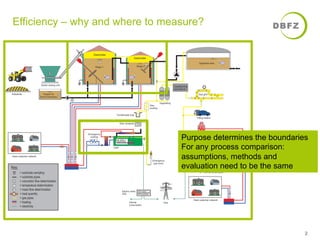
Efficiency – why and where to measure? 
Purpose determines the boundaries 
For any process comparison: 
assumptions, methods and 
evaluation need to be the same 
2
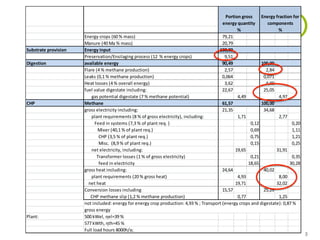
Energy 
crops 
(60 
% 
mass) 79,21 
Manure 
(40 
Ma 
% 
mass) 20,79 
Substrate 
provision Energy 
input 100,00 
Preservation/Ensilaging 
process 
(12 
% 
energy 
crops) 9,51 
Digestion available 
energy 90,49 100,00 
Flare 
(4 
% 
methane 
production) 2,57 2,84 
Leaks 
(0,1 
% 
methane 
production) 
0,064 0,071 
Heat 
losses 
(4 
% 
overall 
energy) 3,62 4,00 
fuel 
value 
digestate 
including: 22,67 25,05 
gas 
potential 
digestate 
(7 
% 
methane 
potential) 4,49 4,97 
CHP Methane 
61,57 100,00 
gross 
electricity 
including: 21,35 34,68 
plant 
requirements 
(8 
% 
of 
gross 
electricity), 
including: 1,71 2,77 
Feed 
in 
systems 
(7,3 
% 
of 
plant 
req. 
) 0,12 0,20 
Mixer 
(40,1 
% 
of 
plant 
req.) 0,69 1,11 
CHP 
(3,5 
% 
of 
plant 
req.) 0,75 1,21 
Misc. 
(8,9 
% 
of 
plant 
req.) 0,15 0,25 
net 
electricity, 
including: 19,65 31,91 
Transformer 
losses 
(1 
% 
of 
gross 
electricity) 0,21 0,35 
feed 
in 
electricity 18,65 30,28 
gross 
heat 
including: 
24,64 40,02 
plant 
requirements 
(20 
% 
gross 
heat) 4,93 8,00 
net 
heat 19,71 32,02 
Conversion 
losses 
including 15,57 25,29 
CHP 
methane 
slip 
(1,2 
% 
methane 
production) 0,77 1,25 
Plant: 
500 
kWel, 
ηel=39 
% 
577 
kWth, 
ηth=45 
% 
Full 
load 
hours 
8000h/a; 
Portion 
gross 
energy 
quantity 
% 
Energy 
fraction 
for 
components 
% 
not 
included: 
energy 
for 
energy 
crop 
production: 
4,93 
% 
; 
Transport 
(energy 
crops 
and 
digestate): 
0,87 
% 
gross 
energy 
3
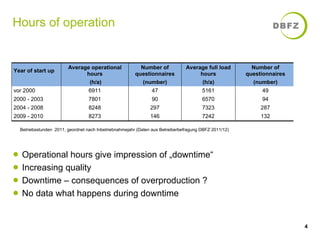
Hours of operation 
Betriebsstunden 2011, geordnet nach Inbetriebnahmejahr (Daten aus Betreiberbefragung DBFZ 2011/12) 
● Operational hours give impression of „downtime“ 
● Increasing quality 
● Downtime – consequences of overproduction ? 
● No data what happens during downtime 
4 
Year of start up Average operational 
hours 
Number of 
questionnaires 
Average full load 
hours 
Number of 
questionnaires 
(h/a) (number) (h/a) (number) 
vor 2000 6911 47 5161 49 
2000 - 2003 7801 90 6570 94 
2004 - 2008 8248 297 7323 287 
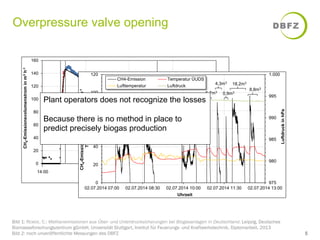
2009 - 2010 8273 146 7242 132
Overpressure valve opening 
CH4-Emission Temperatur ÜUDS 
Lufttemperatur Luftdruck 
Stromausfall 
120 
100 
Plant operators does not recognize the losses 
80 
Because there is no method in place to 
predict precisely 60 
biogas production 
Temperatur in °C 
15,9m3 
10,7m3 
y = -10927x2 + 8940,8x - 1681,2 
R² = 0,976 
y = -49,363x + 166,16 
R² = 0,99 
160 
140 
120 
100 
80 
60 
40 
20 
0 
40 
20 
CH4-Emissionsvolumenstrom in m3 h-1 
12,3m3 
4,3m3 
5,7m3 
14:00 14:45 15:30 16:15 17:00 
0 0,75 1,5 2,25 3 
CH4-Emissionsvolumenstrom in m3 h-1 
Uhrzeit 
1.000 
995 
990 
985 
980 
975 
0 
Luftdruck in hPa 
18,2m3 
0,9m3 
8,8m3 
02.07.2014 07:00 02.07.2014 08:30 02.07.2014 10:00 02.07.2014 11:30 02.07.2014 13:00 
Uhrzeit 
Bild 1: REMDE, C.: Methanemissionen aus Über- und Unterdrucksicherungen bei Biogasanlagen in Deutschland. Leipzig, Deutsches 
Biomasseforschungszentrum gGmbH, Universität Stuttgart, Institut für Feuerungs- und Kraftwerkstechnik, Diplomarbeit, 2013 
Bild 2: noch unveröffentlichte Messungen des DBFZ 5
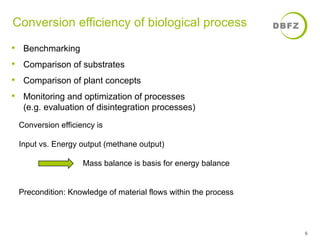
Conversion efficiency of biological process 
• Benchmarking 
• Comparison of substrates 
• Comparison of plant concepts 
• Monitoring and optimization of processes 
(e.g. evaluation of disintegration processes) 
6 
Conversion efficiency is 
Input vs. Energy output (methane output) 
Mass balance is basis for energy balance 
Precondition: Knowledge of material flows within the process
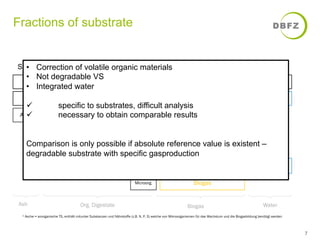
Fractions of substrate 
7 
• Correction of volatile organic materials 
• Not degradable VS 
• Integrated water 
Substrate component in the biogas process (changed according to WEIßBACH) 
wet mass 
ü specific to substrates, difficult analysis 
ü necessary to obtain comparable results 
Recalcitrant VS 
Total solids (corr.) 
VS (corr.) 
Comparison is only possible if absolute reference value is existent – 
degradable substrate with specific gasproduction 
Not 
degraded VS 
Ash1 
Integrated 
water 
conversion 
Biogas 
Degradable VS 
Converted VS 
Microorg. 
Water 
Not integrated 
water 
Ash Org. Digestate Biogas Water 
1 Asche = anorganische TS, enthält mitunter Substanzen und Nährstoffe (z.B. N, P, S) welche von Mikroorganismen für das Wachstum und die Biogasbildung benötigt werden
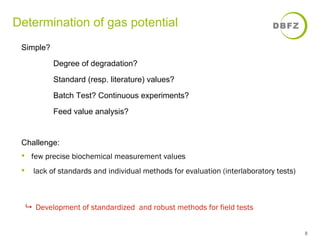
Determination of gas potential 
8 
Simple? 
Degree of degradation? 
Standard (resp. literature) values? 
Batch Test? Continuous experiments? 
Feed value analysis? 
Challenge: 
• few precise biochemical measurement values 
• lack of standards and individual methods for evaluation (interlaboratory tests) 
9 Development of standardized and robust methods for field tests
Calculation of Biogas potential 
Calculation of degradable VS according to WEIßBACH 
9 
Example corn silage (Average of samples at DBFZ) 
Ash [g/kgTS] NfE [g/kgTS] Fiber [g/kgTS] Protein [g/kgTS] Lipids [g/kgTS] 
44 621 226 79 30 
Standardized digestion tests considering metabolic excreta 
FoTS = 1000 − Ash − 16 − 0 − ( 0,47 · Fiber + 0,00104 · Fiber² ) 
Non degradable Carbohydrates (Function of fiber) 
Non degradable Lipids (constant) 
Non degradable proteiin(constant) 
FoTS = 984 − Ash − ( 0,47 · Fiber + 0,00104 · Fiber² ) = 780 [g/kgTS] 
Calculation of Biogas potential according to WEIßBACH 
Stoichiometric calculation considering 5 % MO Biomass 
Biogas = 780 ∙ 800/1000 = 624 [l/kgTS] Methan = 780 ∙ 420/1000 = 327,6 [l/ 
Gasproduction coefficient fkorg cTorSn] s ilage [l/kg FoTS]
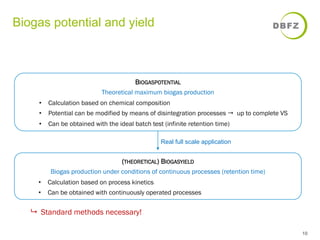
Biogas potential and yield 
10 
BIOGASPOTENTIAL 
Theoretical maximum biogas production 
• Calculation based on chemical composition 
• Potential can be modified by means of disintegration processes " up to complete VS 
• Can be obtained with the ideal batch test (infinite retention time) 
Real full scale application 
(THEORETICAL) BIOGASYIELD 
Biogas production under conditions of continuous processes (retention time) 
• Calculation based on process kinetics 
• Can be obtained with continuously operated processes 
9 Standard methods necessary!
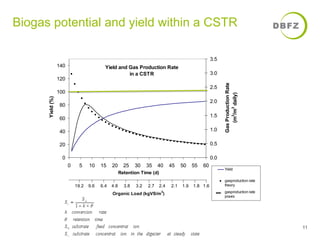
Biogas potential and yield within a CSTR 
Yield and Gas Production Rate 
in a CSTR 
140 
120 
100 
80 
60 
40 
20 
0 
0 5 10 15 20 25 30 35 40 45 50 55 60 
Retention Time (d) 
Yield (%) 
3.5 
3.0 
2.5 
2.0 
1.5 
1.0 
0.5 
0.0 
Gas Production Rate 
(m3/m3 daily) 
Yield 
gasproduction rate 
theory 
gasproduction rate 
praxis Organic Load (kgVS/m3) 
19.2 9.6 6.4 4.8 3.8 3.2 2.7 2.4 2.1 1.9 1.8 1.6 
11
Evaluation disintegration processes 
12 
§ Degradation of stillage proteins 
§ Two desintegration effects: a) rate increase; 
b) increase of biogas potential TS (Enzym B = Effekt a+10%b) 
Degree of degradation (%) 
[Mauky, 2011] 
Increase of gas production(%) 
Retention time
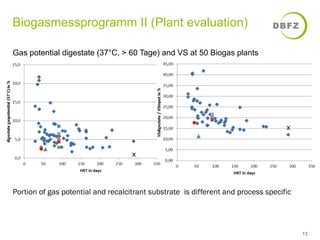
Biogasmessprogramm II (Plant evaluation) 
13 
Gas potential digestate (37°C, > 60 Tage) and VS at 50 Biogas plants 
Portion of gas potential and recalcitrant substrate is different and process specific
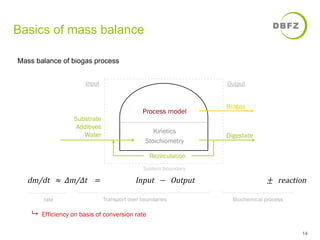
Basics of mass balance 
dm/dt  ≈ Δm/Δt  = Input − Output ± reaction 
14 
Substrate 
Additives 
Water 
Biogas 
Process model 
Kinetics 
Stoichiometry 
System boundary 
Digestate 
Mass balance of biogas process 
Input Output 
Rezirculation 
rate Transport over boundaries Biochemical process 
9 Efficiency on basis of conversion rate
Mass balance 
15 
Biogas plant (500 kWel) without recirculation 
Fermenter BHKW 
k 0.132 [1/d] ηel 38 [%] 
Maissilage HRT 75.4 [d] Biogas 
ṁS 31.5 [t/d] Uf oTS 90.9 [%] ṁB 7.99 [t/d] PFeu 1315 [kW] 
TS 33.47 [% FM]̇VB 6085 [m³ i.N./d] Pel 500 [kWel] 
oTS 95.6 [% TS] cCH4 52 [%] 
foTS 78 [% TS] Gärrest cCO2 48 [%] 
ṁW 20.96 [t/d] ṁG 23.51 [t/d] ρB 1.314 [g/l] 
ṁTS 10.54 [t/d] TSG 13.07 [% GR] H 9.97 [kWh/m³] 
ṁoTS 10.08 [t/d] foTSG 24.49 [% TSG] 
ṁf oTS 8.22 [t/d] ṁW,G 20.43 [t/d] 
YB/f oTS 740 [m³ i.N./t foTS] ṁTS,G 3.07 [t/d] 
YB/oTS 604 [m³ i.N./t oTS] ṁf oTS,G 0.75 [t/d] 
● 
Allgemeine 
Vorgaben 
Inputcharakteris ierung 
und 
Gas zusammensetzung ● 
Vorgabe 
Variante 
B 
Elektris che 
BHKW-­‐Leistung 
Berechnung unter Berücksichtigung des stöchiometrischen Wassereinbaus und unter Vernachlässigung des Biomasseaufbaus 
● 
Vorgabe 
Variante 
A 
Spezifis cher 
Biogasertrag 
des 
Subs trats 
bzw. 
der 
Anlage ● 
Vorgabe 
Variante 
C 
Reaktionskinetik 
1. 
Ordnung 
und 
HRT 
9 Variation of methods for validation dependent on available data
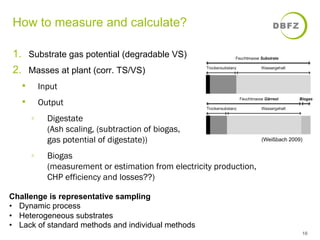
How to measure and calculate? 
1. Substrate gas potential (degradable VS) 
2. Masses at plant (corr. TS/VS) 
• Input 
• Output 
◦ Digestate 
(Ash scaling, (subtraction of biogas, 
gas potential of digestate)) 
◦ Biogas 
(measurement or estimation from electricity production, 
CHP efficiency and losses??) 
(Weißbach 2009) 
16 
Challenge is representative sampling 
• Dynamic process 
• Heterogeneous substrates 
• Lack of standard methods and individual methods
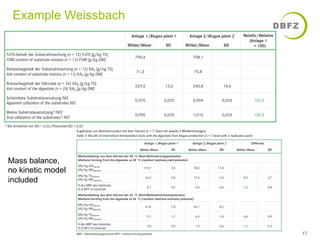
Example Weissbach 
17 
Mass balance, 
no kinetic model 
included
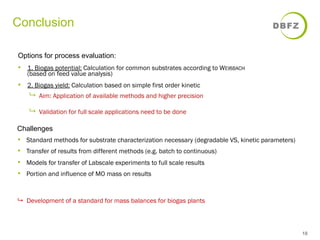
Conclusion 
18 
Options for process evaluation: 
• 1. Biogas potential: Calculation for common substrates according to WEIßBACH 
(based on feed value analysis) 
• 2. Biogas yield: Calculation based on simple first order kinetic 
9 Aim: Application of available methods and higher precision 
9 Validation for full scale applications need to be done 
Challenges 
• Standard methods for substrate characterization necessary (degradable VS, kinetic parameters) 
• Transfer of results from different methods (e.g. batch to continuous) 
• Models for transfer of Labscale experiments to full scale results 
• Portion and influence of MO mass on results 
9 Development of a standard for mass balances for biogas plants
DBFZ Deutsches 
Biomasseforschungszentrum 
gemeinnützige GmbH 
Torgauer Straße 116 
D-04347 Leipzig 
Tel.: +49 (0)341 2434 – 112 
www.dbfz.de 
Contact 
Dr.-Ing. Jan Liebetrau 
Jan.Liebetrau@dbfz.de 
+49 341 2434 716

Efficiency of biogas production - Jan Liebetrau

  • 1.
    Efficiency of biogasproduction Jan Liebetrau, Sören Weinrich, Jürgen Pröter Conference of the European Biogas Association 2014
  • 2.
    Efficiency – whyand where to measure? Purpose determines the boundaries For any process comparison: assumptions, methods and evaluation need to be the same 2
  • 3.
    Energy crops (60 % mass) 79,21 Manure (40 Ma % mass) 20,79 Substrate provision Energy input 100,00 Preservation/Ensilaging process (12 % energy crops) 9,51 Digestion available energy 90,49 100,00 Flare (4 % methane production) 2,57 2,84 Leaks (0,1 % methane production) 0,064 0,071 Heat losses (4 % overall energy) 3,62 4,00 fuel value digestate including: 22,67 25,05 gas potential digestate (7 % methane potential) 4,49 4,97 CHP Methane 61,57 100,00 gross electricity including: 21,35 34,68 plant requirements (8 % of gross electricity), including: 1,71 2,77 Feed in systems (7,3 % of plant req. ) 0,12 0,20 Mixer (40,1 % of plant req.) 0,69 1,11 CHP (3,5 % of plant req.) 0,75 1,21 Misc. (8,9 % of plant req.) 0,15 0,25 net electricity, including: 19,65 31,91 Transformer losses (1 % of gross electricity) 0,21 0,35 feed in electricity 18,65 30,28 gross heat including: 24,64 40,02 plant requirements (20 % gross heat) 4,93 8,00 net heat 19,71 32,02 Conversion losses including 15,57 25,29 CHP methane slip (1,2 % methane production) 0,77 1,25 Plant: 500 kWel, ηel=39 % 577 kWth, ηth=45 % Full load hours 8000h/a; Portion gross energy quantity % Energy fraction for components % not included: energy for energy crop production: 4,93 % ; Transport (energy crops and digestate): 0,87 % gross energy 3
  • 4.
    Hours of operation Betriebsstunden 2011, geordnet nach Inbetriebnahmejahr (Daten aus Betreiberbefragung DBFZ 2011/12) ● Operational hours give impression of „downtime“ ● Increasing quality ● Downtime – consequences of overproduction ? ● No data what happens during downtime 4 Year of start up Average operational hours Number of questionnaires Average full load hours Number of questionnaires (h/a) (number) (h/a) (number) vor 2000 6911 47 5161 49 2000 - 2003 7801 90 6570 94 2004 - 2008 8248 297 7323 287 2009 - 2010 8273 146 7242 132
  • 5.
    Overpressure valve opening CH4-Emission Temperatur ÜUDS Lufttemperatur Luftdruck Stromausfall 120 100 Plant operators does not recognize the losses 80 Because there is no method in place to predict precisely 60 biogas production Temperatur in °C 15,9m3 10,7m3 y = -10927x2 + 8940,8x - 1681,2 R² = 0,976 y = -49,363x + 166,16 R² = 0,99 160 140 120 100 80 60 40 20 0 40 20 CH4-Emissionsvolumenstrom in m3 h-1 12,3m3 4,3m3 5,7m3 14:00 14:45 15:30 16:15 17:00 0 0,75 1,5 2,25 3 CH4-Emissionsvolumenstrom in m3 h-1 Uhrzeit 1.000 995 990 985 980 975 0 Luftdruck in hPa 18,2m3 0,9m3 8,8m3 02.07.2014 07:00 02.07.2014 08:30 02.07.2014 10:00 02.07.2014 11:30 02.07.2014 13:00 Uhrzeit Bild 1: REMDE, C.: Methanemissionen aus Über- und Unterdrucksicherungen bei Biogasanlagen in Deutschland. Leipzig, Deutsches Biomasseforschungszentrum gGmbH, Universität Stuttgart, Institut für Feuerungs- und Kraftwerkstechnik, Diplomarbeit, 2013 Bild 2: noch unveröffentlichte Messungen des DBFZ 5
  • 6.
    Conversion efficiency ofbiological process • Benchmarking • Comparison of substrates • Comparison of plant concepts • Monitoring and optimization of processes (e.g. evaluation of disintegration processes) 6 Conversion efficiency is Input vs. Energy output (methane output) Mass balance is basis for energy balance Precondition: Knowledge of material flows within the process
  • 7.
    Fractions of substrate 7 • Correction of volatile organic materials • Not degradable VS • Integrated water Substrate component in the biogas process (changed according to WEIßBACH) wet mass ü specific to substrates, difficult analysis ü necessary to obtain comparable results Recalcitrant VS Total solids (corr.) VS (corr.) Comparison is only possible if absolute reference value is existent – degradable substrate with specific gasproduction Not degraded VS Ash1 Integrated water conversion Biogas Degradable VS Converted VS Microorg. Water Not integrated water Ash Org. Digestate Biogas Water 1 Asche = anorganische TS, enthält mitunter Substanzen und Nährstoffe (z.B. N, P, S) welche von Mikroorganismen für das Wachstum und die Biogasbildung benötigt werden
  • 8.
    Determination of gaspotential 8 Simple? Degree of degradation? Standard (resp. literature) values? Batch Test? Continuous experiments? Feed value analysis? Challenge: • few precise biochemical measurement values • lack of standards and individual methods for evaluation (interlaboratory tests) 9 Development of standardized and robust methods for field tests
  • 9.
    Calculation of Biogaspotential Calculation of degradable VS according to WEIßBACH 9 Example corn silage (Average of samples at DBFZ) Ash [g/kgTS] NfE [g/kgTS] Fiber [g/kgTS] Protein [g/kgTS] Lipids [g/kgTS] 44 621 226 79 30 Standardized digestion tests considering metabolic excreta FoTS = 1000 − Ash − 16 − 0 − ( 0,47 · Fiber + 0,00104 · Fiber² ) Non degradable Carbohydrates (Function of fiber) Non degradable Lipids (constant) Non degradable proteiin(constant) FoTS = 984 − Ash − ( 0,47 · Fiber + 0,00104 · Fiber² ) = 780 [g/kgTS] Calculation of Biogas potential according to WEIßBACH Stoichiometric calculation considering 5 % MO Biomass Biogas = 780 ∙ 800/1000 = 624 [l/kgTS] Methan = 780 ∙ 420/1000 = 327,6 [l/ Gasproduction coefficient fkorg cTorSn] s ilage [l/kg FoTS]
  • 10.
    Biogas potential andyield 10 BIOGASPOTENTIAL Theoretical maximum biogas production • Calculation based on chemical composition • Potential can be modified by means of disintegration processes " up to complete VS • Can be obtained with the ideal batch test (infinite retention time) Real full scale application (THEORETICAL) BIOGASYIELD Biogas production under conditions of continuous processes (retention time) • Calculation based on process kinetics • Can be obtained with continuously operated processes 9 Standard methods necessary!
  • 11.
    Biogas potential andyield within a CSTR Yield and Gas Production Rate in a CSTR 140 120 100 80 60 40 20 0 0 5 10 15 20 25 30 35 40 45 50 55 60 Retention Time (d) Yield (%) 3.5 3.0 2.5 2.0 1.5 1.0 0.5 0.0 Gas Production Rate (m3/m3 daily) Yield gasproduction rate theory gasproduction rate praxis Organic Load (kgVS/m3) 19.2 9.6 6.4 4.8 3.8 3.2 2.7 2.4 2.1 1.9 1.8 1.6 11
  • 12.
    Evaluation disintegration processes 12 § Degradation of stillage proteins § Two desintegration effects: a) rate increase; b) increase of biogas potential TS (Enzym B = Effekt a+10%b) Degree of degradation (%) [Mauky, 2011] Increase of gas production(%) Retention time
  • 13.
    Biogasmessprogramm II (Plantevaluation) 13 Gas potential digestate (37°C, > 60 Tage) and VS at 50 Biogas plants Portion of gas potential and recalcitrant substrate is different and process specific
  • 14.
    Basics of massbalance dm/dt  ≈ Δm/Δt  = Input − Output ± reaction 14 Substrate Additives Water Biogas Process model Kinetics Stoichiometry System boundary Digestate Mass balance of biogas process Input Output Rezirculation rate Transport over boundaries Biochemical process 9 Efficiency on basis of conversion rate
  • 15.
    Mass balance 15 Biogas plant (500 kWel) without recirculation Fermenter BHKW k 0.132 [1/d] ηel 38 [%] Maissilage HRT 75.4 [d] Biogas ṁS 31.5 [t/d] Uf oTS 90.9 [%] ṁB 7.99 [t/d] PFeu 1315 [kW] TS 33.47 [% FM]̇VB 6085 [m³ i.N./d] Pel 500 [kWel] oTS 95.6 [% TS] cCH4 52 [%] foTS 78 [% TS] Gärrest cCO2 48 [%] ṁW 20.96 [t/d] ṁG 23.51 [t/d] ρB 1.314 [g/l] ṁTS 10.54 [t/d] TSG 13.07 [% GR] H 9.97 [kWh/m³] ṁoTS 10.08 [t/d] foTSG 24.49 [% TSG] ṁf oTS 8.22 [t/d] ṁW,G 20.43 [t/d] YB/f oTS 740 [m³ i.N./t foTS] ṁTS,G 3.07 [t/d] YB/oTS 604 [m³ i.N./t oTS] ṁf oTS,G 0.75 [t/d] ● Allgemeine Vorgaben Inputcharakteris ierung und Gas zusammensetzung ● Vorgabe Variante B Elektris che BHKW-­‐Leistung Berechnung unter Berücksichtigung des stöchiometrischen Wassereinbaus und unter Vernachlässigung des Biomasseaufbaus ● Vorgabe Variante A Spezifis cher Biogasertrag des Subs trats bzw. der Anlage ● Vorgabe Variante C Reaktionskinetik 1. Ordnung und HRT 9 Variation of methods for validation dependent on available data
  • 16.
    How to measureand calculate? 1. Substrate gas potential (degradable VS) 2. Masses at plant (corr. TS/VS) • Input • Output ◦ Digestate (Ash scaling, (subtraction of biogas, gas potential of digestate)) ◦ Biogas (measurement or estimation from electricity production, CHP efficiency and losses??) (Weißbach 2009) 16 Challenge is representative sampling • Dynamic process • Heterogeneous substrates • Lack of standard methods and individual methods
  • 17.
    Example Weissbach 17 Mass balance, no kinetic model included
  • 18.
    Conclusion 18 Optionsfor process evaluation: • 1. Biogas potential: Calculation for common substrates according to WEIßBACH (based on feed value analysis) • 2. Biogas yield: Calculation based on simple first order kinetic 9 Aim: Application of available methods and higher precision 9 Validation for full scale applications need to be done Challenges • Standard methods for substrate characterization necessary (degradable VS, kinetic parameters) • Transfer of results from different methods (e.g. batch to continuous) • Models for transfer of Labscale experiments to full scale results • Portion and influence of MO mass on results 9 Development of a standard for mass balances for biogas plants
  • 19.
    DBFZ Deutsches Biomasseforschungszentrum gemeinnützige GmbH Torgauer Straße 116 D-04347 Leipzig Tel.: +49 (0)341 2434 – 112 www.dbfz.de Contact Dr.-Ing. Jan Liebetrau Jan.Liebetrau@dbfz.de +49 341 2434 716