A possible EU regulatory framework 
Working document - does not represent consolidated views of the Commission 
1 
for Digestates: 
Fertilisers, EoW criteria, Animal By-products, 
REACH,… 
Conference of the European Biogas 
Association, Egmont aan Zee (NL) 
1 October 2014 Eric LIEGEOIS 
Team Leader 
DG Enterprise and 
Industry – Unit F.2
Working document - does not represent consolidated views of the Commission 
2 
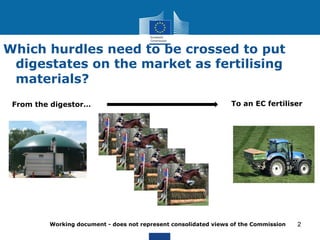
Which hurdles need to be crossed to put 
digestates on the market as fertilising 
materials? 
From the digestor… To an EC fertiliser
Working document - does not represent consolidated views of the Commission 
3 
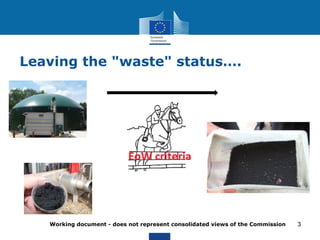
Leaving the "waste" status….
EU End-of-waste criteria for composts 
and digestates 
• DG JRC report released in February 2014 
• DG ENV to approve the EoW criteria?? 
• DG ENTR to integrate into Fertilisers 
Regulation?? 
Working document - does not represent consolidated views of the Commission 
4
Working document - does not represent consolidated views of the Commission 
5 
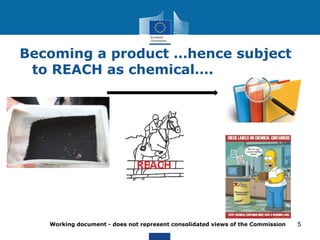
Becoming a product …hence subject 
to REACH as chemical….
Status of digestates under REACH 
Working document - does not represent consolidated views of the Commission 
6 
• A material reaching EoW status should be in 
principle subject to the REACH Regulation 
• Supplier must provide their customers with 
information allowing the material to be used safely 
• Certain materials could be subject to prior 
authorisation or restriction of use 
• Recovered materials exempted from REACH 
registration if 
• the substance(s) have already been registered 
("sameness principle") and the operator has access 
to existing data, or 
• materials are listed in Annex V (e.g. composts)
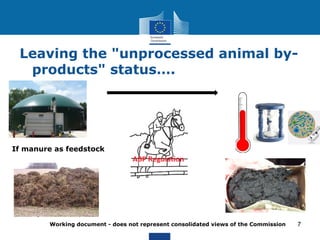
Leaving the "unprocessed animal by-products" 
Working document - does not represent consolidated views of the Commission 
7 
status…. 
If manure as feedstock
Status of digestates under ABPR 
• Animal by-products Regs. provide for processing 
conditions for materials to be considered as being 
processed (art.32) before placing on the market = 
"sanitation" (e.g. "pasteurization" or any equivalent 
recognised method). 
• Under discussion: to enforce compulsory 
measurement of the actual level of pathogens at 
the end of the digestion process in order to certify 
that a digestate has left "the unprocessed ABP 
status" and can be used as fertilising materials. 
Working document - does not represent consolidated views of the Commission 
8
Working document - does not represent consolidated views of the Commission 
9 
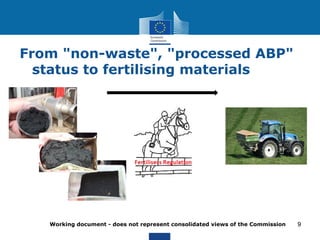
From "non-waste", "processed ABP" 
status to fertilising materials
DG ENTR approach to help digestates 
reaching the market as fertilisers 
3 main reasons: (1) P= critical, (2) N-fertilisers = societal 
challenges, (3) create business: 
• Create dynamic market place for all fertilising materials 
• Meet reasonable user expectations for fertilising materials deriving 
from waste: 
• Including legal requirements to allow use of waste materials for 
fertilising materials production 
• Requiring third party examination and frequent controls of the 
compliance of the products to the provisions of the Fertilisers 
Regulation 
• Technologically neutral 
Working document - does not represent consolidated views of the Commission 
10
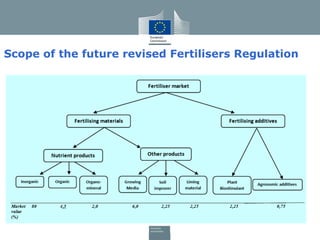
Scope of the future revised Fertilisers Regulation
DG ENTR approach to help digestates 
reaching the market as EC fertilisers 
Working document - does not represent consolidated views of the Commission 
12 
Working document - does not 
represent consolidated views of 
the Commission !!!!!
Marketing EU fertilisers deriving 
from waste: 2 steps 
• Compliance to legal requirements allowing 
use of processed waste materials as input 
materials for manufacturing fertilising 
materials (e.g. compost, digestate) set out in 
the Annexes of the Fertilisers Regulation 
• Compliance of the final fertilising material to 
the essential safety, quality and labelling 
requirements specific to its relevant category 
• Compost and digestate recognised as organic fertiliser or 
soil improver 
Working document - does not represent consolidated views of the Commission 
13
Marketing EU fertilisers deriving 
from waste (2) 
• STEP 1: Legal requirements for the waste 
material to be considered as acceptable input 
materials in the FR : 
• Make use of JRC conclusions for composts and digestates 
• List of input materials 
• General requirements on treatment processes and techniques 
• Specific list of contaminants (medicinal products,…) not 
covered by the essential safety criteria for products 
• Exclude wastes complying with these "legal requirements" 
from the scope of the WFD (="non-waste status") 
• Specify the certification procedure for waste deriving products 
Working document - does not represent consolidated views of the Commission 
14
Marketing EU fertilisers deriving 
from waste (3) 
STEP 1 : 
• We have the knowledge (through JRC report) for 
composts and digestates, so we can propose it 
• For the "others"waste-derived products: to be 
developped by JRC : 
• P recovery as a mineral form (struvite, 
ammonium sulfate from digestion process, …) 
• Biochar 
• Concentration of P from biomass and direct use 
in agriculture and P recovery after incineration 
(ashes) 
Working document - does not represent consolidated views of the Commission 
15
Marketing EU fertilisers deriving 
from waste (3) 
STEP 2 
• Verification of the compliance of the end 
products to the essential safety, quality and 
labelling criteria by the producer 
• Third party verification of the compliance of the 
products 
• Conformity assessment procedure defined in 
Decision (CE) N° 768/2008 
Working document - does not represent consolidated views of the Commission 
16
Some exceptions to the full market 
harmonisation goal : 
National measures 
Working document - does not represent consolidated views of the Commission 
17
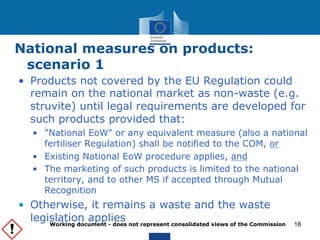
National measures on products: 
scenario 1 
• Products not covered by the EU Regulation could 
remain on the national market as non-waste (e.g. 
struvite) until legal requirements are developed for 
such products provided that: 
• "National EoW" or any equivalent measure (also a national 
fertiliser Regulation) shall be notified to the COM, or 
• Existing National EoW procedure applies, and 
• The marketing of such products is limited to the national 
territory, and to other MS if accepted through Mutual 
Recognition 
• Otherwise, it remains a waste and the waste 
legislation applies Working document - does not represent consolidated views of the Commission 
18
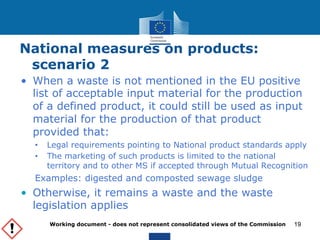
National measures on products: 
scenario 2 
• When a waste is not mentioned in the EU positive 
list of acceptable input material for the production 
of a defined product, it could still be used as input 
material for the production of that product 
provided that: 
• Legal requirements pointing to National product standards apply 
• The marketing of such products is limited to the national 
territory and to other MS if accepted through Mutual Recognition 
Examples: digested and composted sewage sludge 
• Otherwise, it remains a waste and the waste 
legislation applies 
Working document - does not represent consolidated views of the Commission 
19
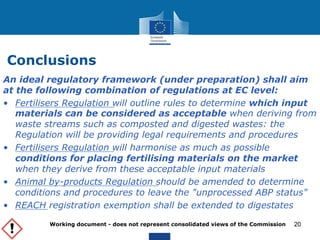
Conclusions 
An ideal regulatory framework (under preparation) shall aim 
at the following combination of regulations at EC level: 
• Fertilisers Regulation will outline rules to determine which input 
materials can be considered as acceptable when deriving from 
waste streams such as composted and digested wastes: the 
Regulation will be providing legal requirements and procedures 
• Fertilisers Regulation will harmonise as much as possible 
conditions for placing fertilising materials on the market 
when they derive from these acceptable input materials 
• Animal by-products Regulation should be amended to determine 
conditions and procedures to leave the "unprocessed ABP status" 
• REACH registration exemption shall be extended to digestates 
Working document - does not represent consolidated views of the Commission 
20
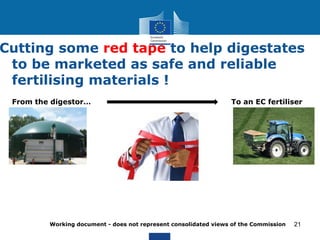
Cutting some red tape to help digestates 
to be marketed as safe and reliable 
fertilising materials ! 
From the digestor… To an EC fertiliser 
Working document - does not represent consolidated views of the Commission 
21
Thank you for 
your attention ! 
Working document - does not represent consolidated views of the Commission 
22 
European Commission 
DG Entreprise and Industry 
Unit F2 - Chemicals Industry 
Unit F.2 
eric.liegeois@ec.europa.eu

Legislative regulations of digestate use - Eric Liegeois

  • 1.
    A possible EUregulatory framework Working document - does not represent consolidated views of the Commission 1 for Digestates: Fertilisers, EoW criteria, Animal By-products, REACH,… Conference of the European Biogas Association, Egmont aan Zee (NL) 1 October 2014 Eric LIEGEOIS Team Leader DG Enterprise and Industry – Unit F.2
  • 2.
    Working document -does not represent consolidated views of the Commission 2 Which hurdles need to be crossed to put digestates on the market as fertilising materials? From the digestor… To an EC fertiliser
  • 3.
    Working document -does not represent consolidated views of the Commission 3 Leaving the "waste" status….
  • 4.
    EU End-of-waste criteriafor composts and digestates • DG JRC report released in February 2014 • DG ENV to approve the EoW criteria?? • DG ENTR to integrate into Fertilisers Regulation?? Working document - does not represent consolidated views of the Commission 4
  • 5.
    Working document -does not represent consolidated views of the Commission 5 Becoming a product …hence subject to REACH as chemical….
  • 6.
    Status of digestatesunder REACH Working document - does not represent consolidated views of the Commission 6 • A material reaching EoW status should be in principle subject to the REACH Regulation • Supplier must provide their customers with information allowing the material to be used safely • Certain materials could be subject to prior authorisation or restriction of use • Recovered materials exempted from REACH registration if • the substance(s) have already been registered ("sameness principle") and the operator has access to existing data, or • materials are listed in Annex V (e.g. composts)
  • 7.
    Leaving the "unprocessedanimal by-products" Working document - does not represent consolidated views of the Commission 7 status…. If manure as feedstock
  • 8.
    Status of digestatesunder ABPR • Animal by-products Regs. provide for processing conditions for materials to be considered as being processed (art.32) before placing on the market = "sanitation" (e.g. "pasteurization" or any equivalent recognised method). • Under discussion: to enforce compulsory measurement of the actual level of pathogens at the end of the digestion process in order to certify that a digestate has left "the unprocessed ABP status" and can be used as fertilising materials. Working document - does not represent consolidated views of the Commission 8
  • 9.
    Working document -does not represent consolidated views of the Commission 9 From "non-waste", "processed ABP" status to fertilising materials
  • 10.
    DG ENTR approachto help digestates reaching the market as fertilisers 3 main reasons: (1) P= critical, (2) N-fertilisers = societal challenges, (3) create business: • Create dynamic market place for all fertilising materials • Meet reasonable user expectations for fertilising materials deriving from waste: • Including legal requirements to allow use of waste materials for fertilising materials production • Requiring third party examination and frequent controls of the compliance of the products to the provisions of the Fertilisers Regulation • Technologically neutral Working document - does not represent consolidated views of the Commission 10
  • 11.
    Scope of thefuture revised Fertilisers Regulation
  • 12.
    DG ENTR approachto help digestates reaching the market as EC fertilisers Working document - does not represent consolidated views of the Commission 12 Working document - does not represent consolidated views of the Commission !!!!!
  • 13.
    Marketing EU fertilisersderiving from waste: 2 steps • Compliance to legal requirements allowing use of processed waste materials as input materials for manufacturing fertilising materials (e.g. compost, digestate) set out in the Annexes of the Fertilisers Regulation • Compliance of the final fertilising material to the essential safety, quality and labelling requirements specific to its relevant category • Compost and digestate recognised as organic fertiliser or soil improver Working document - does not represent consolidated views of the Commission 13
  • 14.
    Marketing EU fertilisersderiving from waste (2) • STEP 1: Legal requirements for the waste material to be considered as acceptable input materials in the FR : • Make use of JRC conclusions for composts and digestates • List of input materials • General requirements on treatment processes and techniques • Specific list of contaminants (medicinal products,…) not covered by the essential safety criteria for products • Exclude wastes complying with these "legal requirements" from the scope of the WFD (="non-waste status") • Specify the certification procedure for waste deriving products Working document - does not represent consolidated views of the Commission 14
  • 15.
    Marketing EU fertilisersderiving from waste (3) STEP 1 : • We have the knowledge (through JRC report) for composts and digestates, so we can propose it • For the "others"waste-derived products: to be developped by JRC : • P recovery as a mineral form (struvite, ammonium sulfate from digestion process, …) • Biochar • Concentration of P from biomass and direct use in agriculture and P recovery after incineration (ashes) Working document - does not represent consolidated views of the Commission 15
  • 16.
    Marketing EU fertilisersderiving from waste (3) STEP 2 • Verification of the compliance of the end products to the essential safety, quality and labelling criteria by the producer • Third party verification of the compliance of the products • Conformity assessment procedure defined in Decision (CE) N° 768/2008 Working document - does not represent consolidated views of the Commission 16
  • 17.
    Some exceptions tothe full market harmonisation goal : National measures Working document - does not represent consolidated views of the Commission 17
  • 18.
    National measures onproducts: scenario 1 • Products not covered by the EU Regulation could remain on the national market as non-waste (e.g. struvite) until legal requirements are developed for such products provided that: • "National EoW" or any equivalent measure (also a national fertiliser Regulation) shall be notified to the COM, or • Existing National EoW procedure applies, and • The marketing of such products is limited to the national territory, and to other MS if accepted through Mutual Recognition • Otherwise, it remains a waste and the waste legislation applies Working document - does not represent consolidated views of the Commission 18
  • 19.
    National measures onproducts: scenario 2 • When a waste is not mentioned in the EU positive list of acceptable input material for the production of a defined product, it could still be used as input material for the production of that product provided that: • Legal requirements pointing to National product standards apply • The marketing of such products is limited to the national territory and to other MS if accepted through Mutual Recognition Examples: digested and composted sewage sludge • Otherwise, it remains a waste and the waste legislation applies Working document - does not represent consolidated views of the Commission 19
  • 20.
    Conclusions An idealregulatory framework (under preparation) shall aim at the following combination of regulations at EC level: • Fertilisers Regulation will outline rules to determine which input materials can be considered as acceptable when deriving from waste streams such as composted and digested wastes: the Regulation will be providing legal requirements and procedures • Fertilisers Regulation will harmonise as much as possible conditions for placing fertilising materials on the market when they derive from these acceptable input materials • Animal by-products Regulation should be amended to determine conditions and procedures to leave the "unprocessed ABP status" • REACH registration exemption shall be extended to digestates Working document - does not represent consolidated views of the Commission 20
  • 21.
    Cutting some redtape to help digestates to be marketed as safe and reliable fertilising materials ! From the digestor… To an EC fertiliser Working document - does not represent consolidated views of the Commission 21
  • 22.
    Thank you for your attention ! Working document - does not represent consolidated views of the Commission 22 European Commission DG Entreprise and Industry Unit F2 - Chemicals Industry Unit F.2 eric.liegeois@ec.europa.eu