Methanol Synthesis from Industrial CO2
Sources: A Contribution to Chemical Energy
Conversion
DONE BY:
KISHAN KASUNDRA
Technical Seminar on:
CONTENTS
Introduction
Case study 1
Case study 2
Conclusion
references
6/15/2018 CHEMICAL ENGINEERING DEPARTMENT,DSCE 2
INTRODUCTION
The green-house effect is caused by the release of carbon dioxide into the atmosphere from
different power and chemical plants.
Conversion of CO2 to methanol is recognized as one of the most promising processes to reduce
the atmospheric CO2 level.
Moreover, using methanol as a fuel allows one to reduce the emissions of undesirable toxic
products such as unburned hydrocarbon, CO and NOx.
Methanol is used extensively in the plastics industry and also as solvents in the pharmaceutical
industry.
6/15/2018 CHEMICAL ENGINEERING DEPARTMENT,DSCE 3
6/15/2018 CHEMICAL ENGINEERING DEPARTMENT,DSCE 4
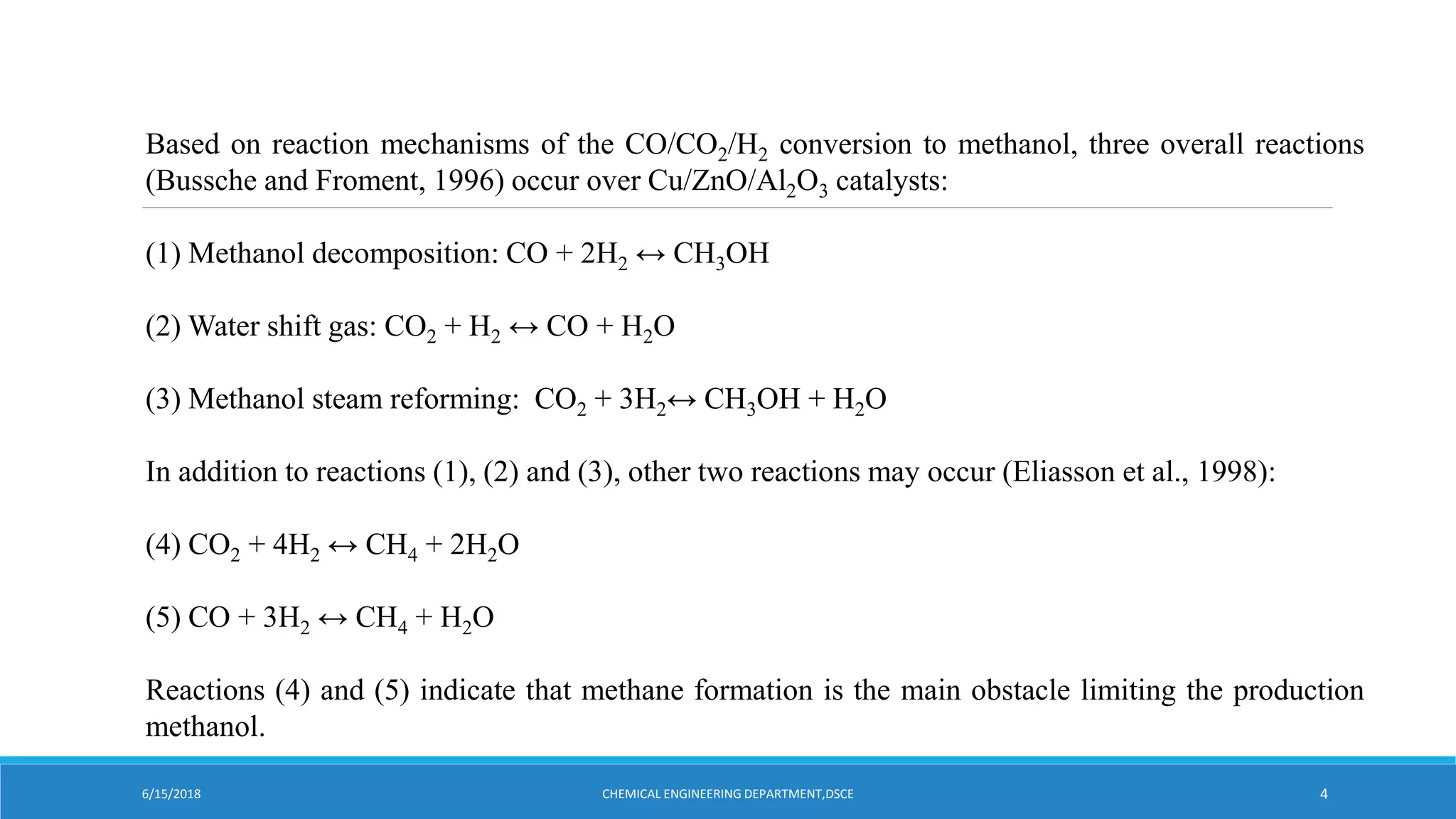
Based on reaction mechanisms of the CO/CO2/H2 conversion to methanol, three overall reactions
(Bussche and Froment, 1996) occur over Cu/ZnO/Al2O3 catalysts:
(1) Methanol decomposition: CO + 2H2 ↔ CH3OH
(2) Water shift gas: CO2 + H2 ↔ CO + H2O
(3) Methanol steam reforming: CO2 + 3H2↔ CH3OH + H2O
In addition to reactions (1), (2) and (3), other two reactions may occur (Eliasson et al., 1998):
(4) CO2 + 4H2 ↔ CH4 + 2H2O
(5) CO + 3H2 ↔ CH4 + H2O
Reactions (4) and (5) indicate that methane formation is the main obstacle limiting the production
methanol.
6/15/2018 CHEMICAL ENGINEERING DEPARTMENT,DSCE 5
CASE STUDY -1: An analysis of methanol production route via CO2
hydrogenation by Rita M. B. Alves, Camila F. R. Machado
Figure 1: CO2 hydrogenation
6/15/2018 CHEMICAL ENGINEERING DEPARTMENT,DSCE 6
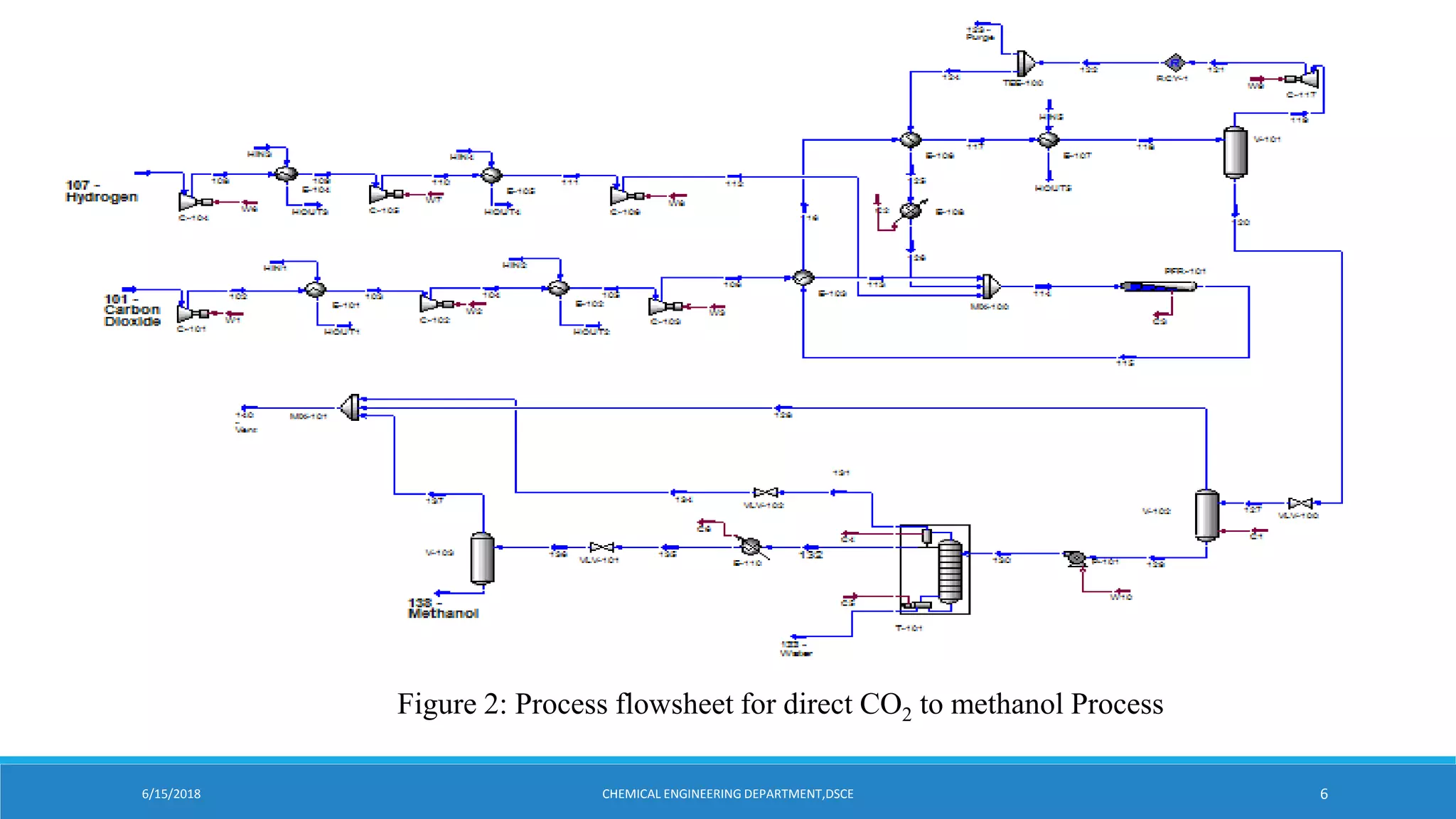
Figure 2: Process flowsheet for direct CO2 to methanol Process
RESULTS:
6/15/2018 CHEMICAL ENGINEERING DEPARTMENT,DSCE 7
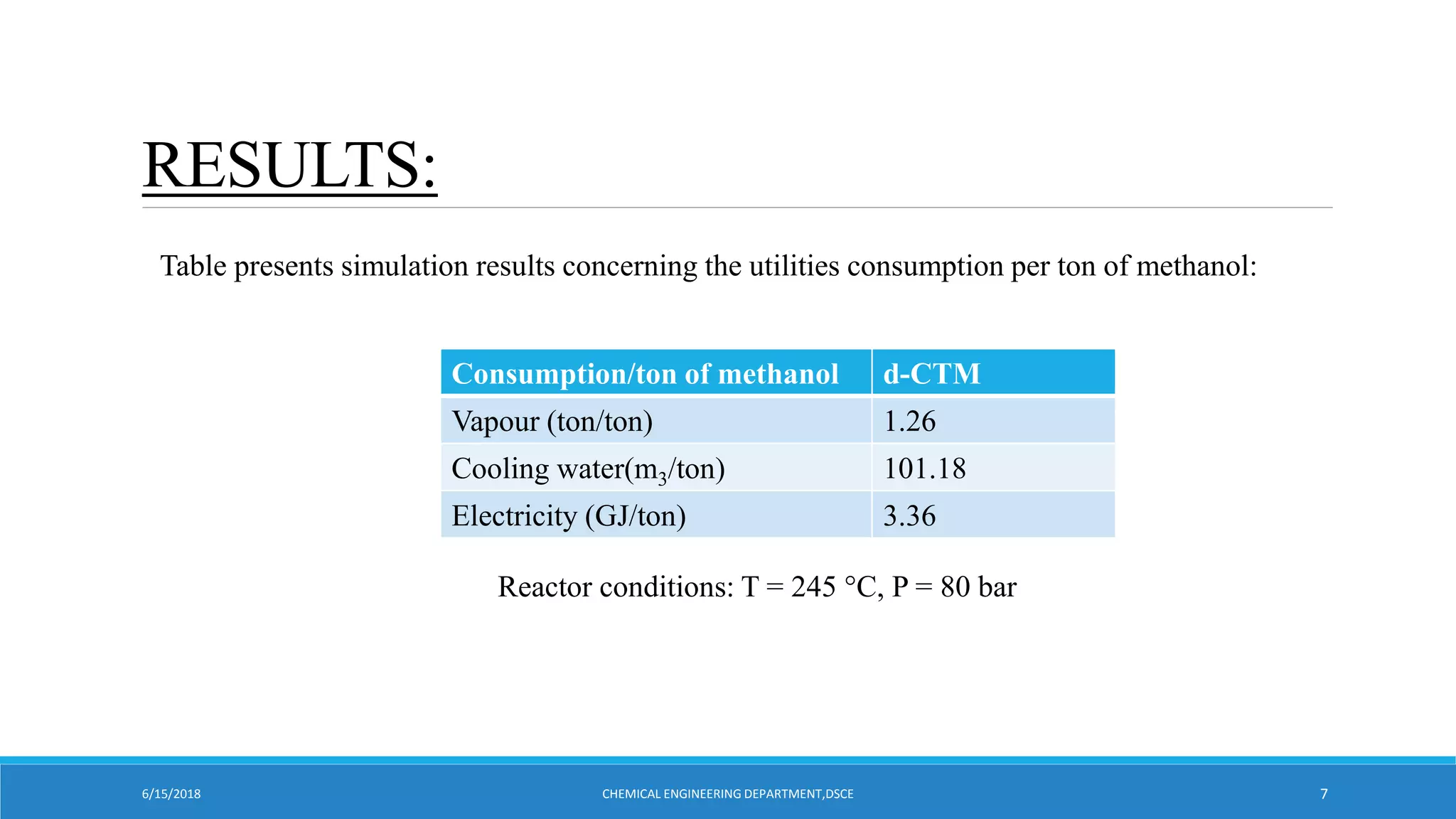
Table presents simulation results concerning the utilities consumption per ton of methanol:
Consumption/ton of methanol d-CTM
Vapour (ton/ton) 1.26
Cooling water(m3/ton) 101.18
Electricity (GJ/ton) 3.36
Reactor conditions: T = 245 °C, P = 80 bar
6/15/2018 CHEMICAL ENGINEERING DEPARTMENT,DSCE 8
Table shows the relevant factors of production for the d-CTM processes as methanol yield,
consumption of H2 and CO2, and CO2 emission
Factor d-CTM
Methanol Production 464kta
H2 consumption 99.04kta
CO2 consumption 664.8kta
Syngas consumption -
CO2 emission 19.02 ton CO2eq/h
6/15/2018 CHEMICAL ENGINEERING DEPARTMENT,DSCE 9
Case d-CTM:
In this case, the influence of pressure and H2/CO2 (N ratio) on the following parameters were
investigated:
(1) Methanol production in kg/h
(2) CO2 conversion
(3) Selectivity to MeOH
(5) Water production in kg/h
6/15/2018 CHEMICAL ENGINEERING DEPARTMENT,DSCE 10
Figure 3: different behaviours of (a)CO2 conversion, (b)selectivity to MeOH,(c) MeOH production and
(d)water production for a set of N ratios and pressures
6/15/2018 CHEMICAL ENGINEERING DEPARTMENT,DSCE 11
Table: Behaviour of MeOH production, MeOH selectivity, CO2 conversion and water production due the
variation of pressure and N parameter of the d-CTM process
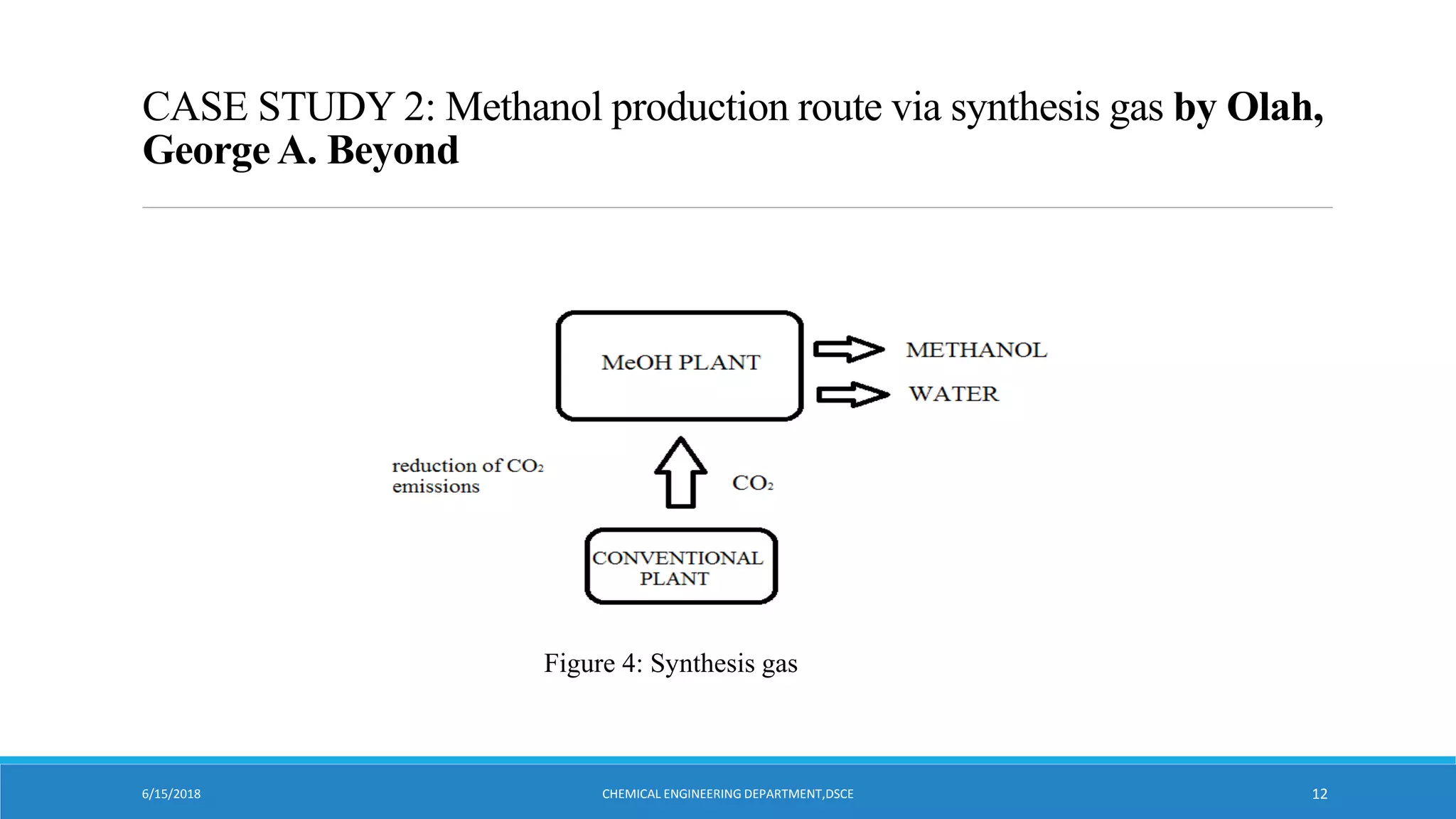
CASE STUDY 2: Methanol production route via synthesis gas by Olah,
George A. Beyond
6/15/2018 CHEMICAL ENGINEERING DEPARTMENT,DSCE 12
Figure 4: Synthesis gas
6/15/2018 CHEMICAL ENGINEERING DEPARTMENT,DSCE 13
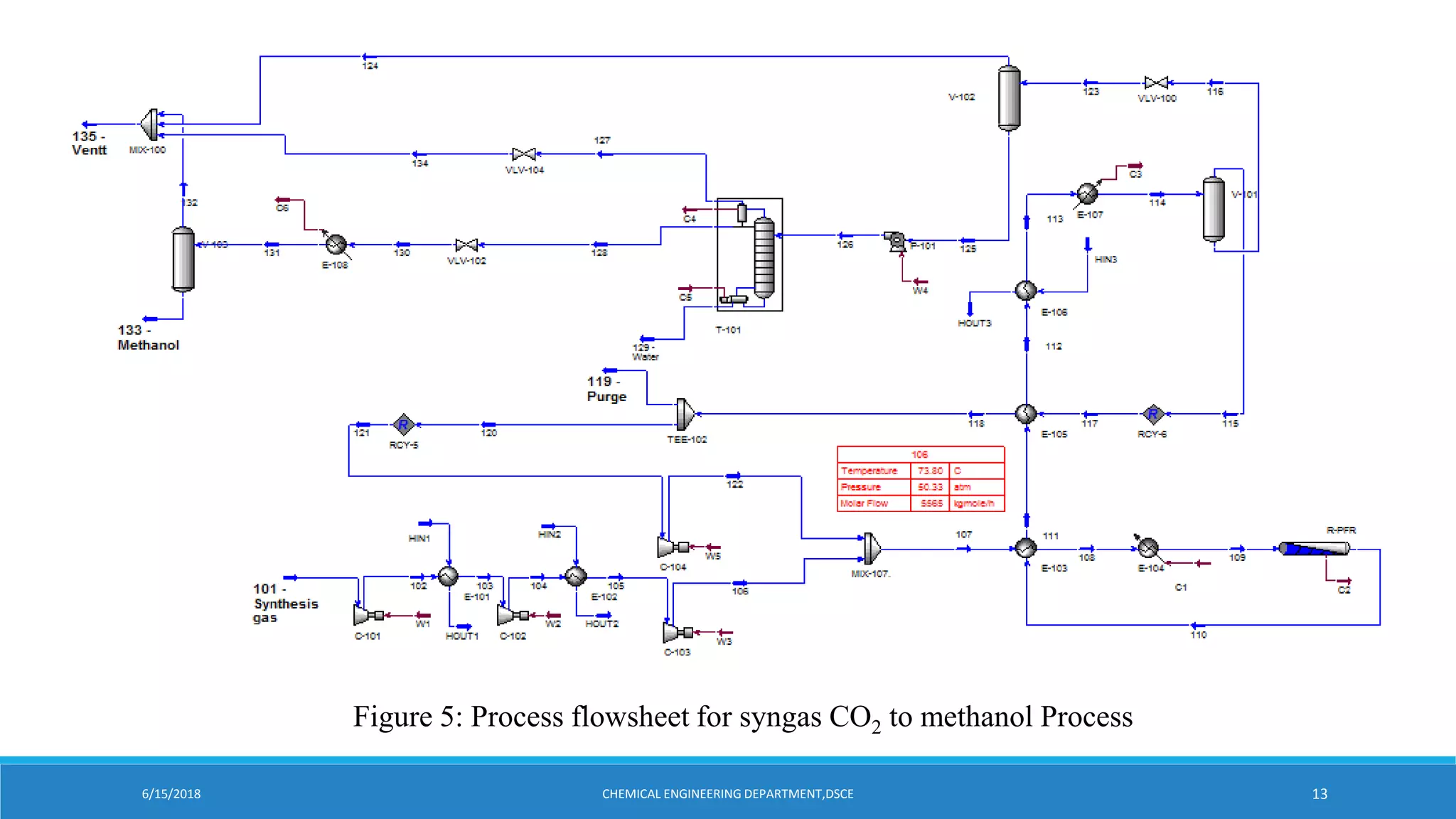
Figure 5: Process flowsheet for syngas CO2 to methanol Process
RESULTS:
6/15/2018 CHEMICAL ENGINEERING DEPARTMENT,DSCE 14
Table presents simulation results concerning the utilities consumption per ton of methanol:
Consumption/ton of methanol sg-CTM
Vapour (ton/ton) 0.30
Cooling water(m3/ton) 67.93
Electricity (GJ/ton) 1.34
Reactor conditions: T = 245 °C, P = 80 bar
6/15/2018 CHEMICAL ENGINEERING DEPARTMENT,DSCE 15
Table shows the relevant factors of production for the sg-CTM processes as methanol yield,
consumption of H2 and CO2, and CO2 emission
Factor sg-CTM
Methanol Production 464kta
H2 consumption -
CO2 consumption -
Syngas consumption 536 kta
CO2 emission 15.56 ton CO2eq/h
6/15/2018 CHEMICAL ENGINEERING DEPARTMENT,DSCE 16
Case sg-CTM
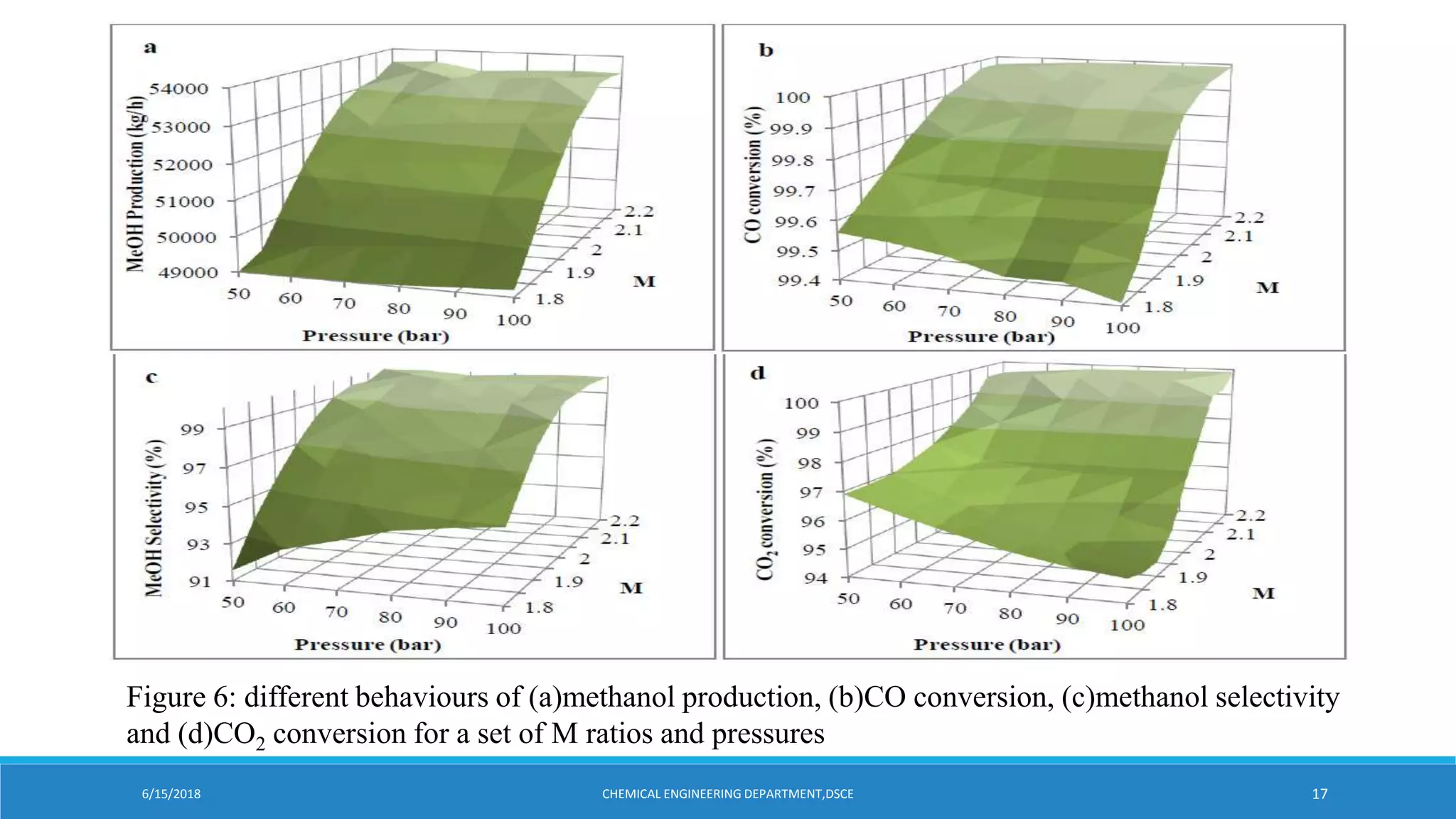
In this case, the influence of pressure and M ratio(H2-CO2/CO+CO2) on the following parameters
were investigated:
(1) Methanol production in kg/h.
(2) CO2 conversion.
(3) Selectivity to MeOH
(4) CO conversion
6/15/2018 CHEMICAL ENGINEERING DEPARTMENT,DSCE 17
Figure 6: different behaviours of (a)methanol production, (b)CO conversion, (c)methanol selectivity
and (d)CO2 conversion for a set of M ratios and pressures
6/15/2018 CHEMICAL ENGINEERING DEPARTMENT,DSCE 18
Table: Behaviour of CO conversion, CO2 conversion, MeOH selectivity and MeOH production due
the variation of pressure and M parameter of the sg-CTM process
CONCLUSION:
6/15/2018 CHEMICAL ENGINEERING DEPARTMENT,DSCE 19
There are at least two paths for methanol synthesis using syngas or a mixture of H2 and CO2 as
raw material.
d-CTM process presents more consumption of utilities as vapor, cooling water and electricity
per ton of methanol production compared to sg-CTM.
d-CTM process emits 19.02 ton CO2 equivalent per hour against an emission of 15.56 ton CO2
equivalent per hour for sg-CTM.
Regarding the consumption of raw material, d-CTM process is more demanding compared to
sg-CTM .
The production of methanol through the sg-CTM process is maximized at high M parameter
but in the studied pressure range remains unchanged.
REFERENCES:
Turton, R., Bailie, R.C., Whiting, W.B., Shaeiwitz, J.A., 2016. Analysis, Synthesis, and Design
of Chemical Processes, third ed. Prentice Hall, Upper Saddle River, New Jersey
Olah, George A. Beyond, Oil and Gas:The Methanol Economy,Angew.Chem., Int. Ed., 44, 2017
Behrens M., Felix, Kasatkin I., Kühl S., Hävecker M., Abild-Pedersen F., Zander S., Girgsdies
F., Kurr P.,Kniep B., Tovar M., Fischer R. W.,Nørskov J. K.,Schlögl R.,The Active Site of
Methanol Synthesis over Cu/ZnO/Al2O3, Industrial Catalysts, vol. 336, 18 may, 2017
6/15/2018 CHEMICAL ENGINEERING DEPARTMENT,DSCE 20
THANK YOU
6/15/2018 CHEMICAL ENGINEERING DEPARTMENT,DSCE 21

Methanol synthesis from industrial CO2 sources

  • 1.
    Methanol Synthesis fromIndustrial CO2 Sources: A Contribution to Chemical Energy Conversion DONE BY: KISHAN KASUNDRA Technical Seminar on:
  • 2.
    CONTENTS Introduction Case study 1 Casestudy 2 Conclusion references 6/15/2018 CHEMICAL ENGINEERING DEPARTMENT,DSCE 2
  • 3.
    INTRODUCTION The green-house effectis caused by the release of carbon dioxide into the atmosphere from different power and chemical plants. Conversion of CO2 to methanol is recognized as one of the most promising processes to reduce the atmospheric CO2 level. Moreover, using methanol as a fuel allows one to reduce the emissions of undesirable toxic products such as unburned hydrocarbon, CO and NOx. Methanol is used extensively in the plastics industry and also as solvents in the pharmaceutical industry. 6/15/2018 CHEMICAL ENGINEERING DEPARTMENT,DSCE 3
  • 4.
    6/15/2018 CHEMICAL ENGINEERINGDEPARTMENT,DSCE 4 Based on reaction mechanisms of the CO/CO2/H2 conversion to methanol, three overall reactions (Bussche and Froment, 1996) occur over Cu/ZnO/Al2O3 catalysts: (1) Methanol decomposition: CO + 2H2 ↔ CH3OH (2) Water shift gas: CO2 + H2 ↔ CO + H2O (3) Methanol steam reforming: CO2 + 3H2↔ CH3OH + H2O In addition to reactions (1), (2) and (3), other two reactions may occur (Eliasson et al., 1998): (4) CO2 + 4H2 ↔ CH4 + 2H2O (5) CO + 3H2 ↔ CH4 + H2O Reactions (4) and (5) indicate that methane formation is the main obstacle limiting the production methanol.
  • 5.
    6/15/2018 CHEMICAL ENGINEERINGDEPARTMENT,DSCE 5 CASE STUDY -1: An analysis of methanol production route via CO2 hydrogenation by Rita M. B. Alves, Camila F. R. Machado Figure 1: CO2 hydrogenation
  • 6.
    6/15/2018 CHEMICAL ENGINEERINGDEPARTMENT,DSCE 6 Figure 2: Process flowsheet for direct CO2 to methanol Process
  • 7.
    RESULTS: 6/15/2018 CHEMICAL ENGINEERINGDEPARTMENT,DSCE 7 Table presents simulation results concerning the utilities consumption per ton of methanol: Consumption/ton of methanol d-CTM Vapour (ton/ton) 1.26 Cooling water(m3/ton) 101.18 Electricity (GJ/ton) 3.36 Reactor conditions: T = 245 °C, P = 80 bar
  • 8.
    6/15/2018 CHEMICAL ENGINEERINGDEPARTMENT,DSCE 8 Table shows the relevant factors of production for the d-CTM processes as methanol yield, consumption of H2 and CO2, and CO2 emission Factor d-CTM Methanol Production 464kta H2 consumption 99.04kta CO2 consumption 664.8kta Syngas consumption - CO2 emission 19.02 ton CO2eq/h
  • 9.
    6/15/2018 CHEMICAL ENGINEERINGDEPARTMENT,DSCE 9 Case d-CTM: In this case, the influence of pressure and H2/CO2 (N ratio) on the following parameters were investigated: (1) Methanol production in kg/h (2) CO2 conversion (3) Selectivity to MeOH (5) Water production in kg/h
  • 10.
    6/15/2018 CHEMICAL ENGINEERINGDEPARTMENT,DSCE 10 Figure 3: different behaviours of (a)CO2 conversion, (b)selectivity to MeOH,(c) MeOH production and (d)water production for a set of N ratios and pressures
  • 11.
    6/15/2018 CHEMICAL ENGINEERINGDEPARTMENT,DSCE 11 Table: Behaviour of MeOH production, MeOH selectivity, CO2 conversion and water production due the variation of pressure and N parameter of the d-CTM process
  • 12.
    CASE STUDY 2:Methanol production route via synthesis gas by Olah, George A. Beyond 6/15/2018 CHEMICAL ENGINEERING DEPARTMENT,DSCE 12 Figure 4: Synthesis gas
  • 13.
    6/15/2018 CHEMICAL ENGINEERINGDEPARTMENT,DSCE 13 Figure 5: Process flowsheet for syngas CO2 to methanol Process
  • 14.
    RESULTS: 6/15/2018 CHEMICAL ENGINEERINGDEPARTMENT,DSCE 14 Table presents simulation results concerning the utilities consumption per ton of methanol: Consumption/ton of methanol sg-CTM Vapour (ton/ton) 0.30 Cooling water(m3/ton) 67.93 Electricity (GJ/ton) 1.34 Reactor conditions: T = 245 °C, P = 80 bar
  • 15.
    6/15/2018 CHEMICAL ENGINEERINGDEPARTMENT,DSCE 15 Table shows the relevant factors of production for the sg-CTM processes as methanol yield, consumption of H2 and CO2, and CO2 emission Factor sg-CTM Methanol Production 464kta H2 consumption - CO2 consumption - Syngas consumption 536 kta CO2 emission 15.56 ton CO2eq/h
  • 16.
    6/15/2018 CHEMICAL ENGINEERINGDEPARTMENT,DSCE 16 Case sg-CTM In this case, the influence of pressure and M ratio(H2-CO2/CO+CO2) on the following parameters were investigated: (1) Methanol production in kg/h. (2) CO2 conversion. (3) Selectivity to MeOH (4) CO conversion
  • 17.
    6/15/2018 CHEMICAL ENGINEERINGDEPARTMENT,DSCE 17 Figure 6: different behaviours of (a)methanol production, (b)CO conversion, (c)methanol selectivity and (d)CO2 conversion for a set of M ratios and pressures
  • 18.
    6/15/2018 CHEMICAL ENGINEERINGDEPARTMENT,DSCE 18 Table: Behaviour of CO conversion, CO2 conversion, MeOH selectivity and MeOH production due the variation of pressure and M parameter of the sg-CTM process
  • 19.
    CONCLUSION: 6/15/2018 CHEMICAL ENGINEERINGDEPARTMENT,DSCE 19 There are at least two paths for methanol synthesis using syngas or a mixture of H2 and CO2 as raw material. d-CTM process presents more consumption of utilities as vapor, cooling water and electricity per ton of methanol production compared to sg-CTM. d-CTM process emits 19.02 ton CO2 equivalent per hour against an emission of 15.56 ton CO2 equivalent per hour for sg-CTM. Regarding the consumption of raw material, d-CTM process is more demanding compared to sg-CTM . The production of methanol through the sg-CTM process is maximized at high M parameter but in the studied pressure range remains unchanged.
  • 20.
    REFERENCES: Turton, R., Bailie,R.C., Whiting, W.B., Shaeiwitz, J.A., 2016. Analysis, Synthesis, and Design of Chemical Processes, third ed. Prentice Hall, Upper Saddle River, New Jersey Olah, George A. Beyond, Oil and Gas:The Methanol Economy,Angew.Chem., Int. Ed., 44, 2017 Behrens M., Felix, Kasatkin I., Kühl S., Hävecker M., Abild-Pedersen F., Zander S., Girgsdies F., Kurr P.,Kniep B., Tovar M., Fischer R. W.,Nørskov J. K.,Schlögl R.,The Active Site of Methanol Synthesis over Cu/ZnO/Al2O3, Industrial Catalysts, vol. 336, 18 may, 2017 6/15/2018 CHEMICAL ENGINEERING DEPARTMENT,DSCE 20
  • 21.
    THANK YOU 6/15/2018 CHEMICALENGINEERING DEPARTMENT,DSCE 21