 Trust relationships are logical connections that
  combine two or more domains into one
  administrative unit. Trust relationships allow
  permissions to be associated and passed from
  one domain to another.
 With Active Directory Domains andTrusts, an

  administrator can establish relationships between
  domains that will allow users in one
 domain to access the resources in another


                                        07/11/2008    1
   A domain trust is a relationship established between
    domains that enables users in one domain to be
    authenticated by a domain controller in the other
    domain. The authentication requests follow a trust path.
   Trust path
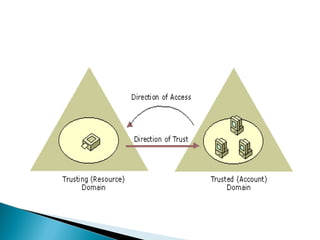
      Before a user can access a resource in another
    domain, Windows  security must determine whether the
    trusting domain (the domain containing the resource
    the user is trying to access) has a trust relationship with
    the trusted domain (the user's logon domain).
   To determine this, the Windows  security system
    computes the trust path between a domain controller in
    the trusting domain and a domain controller in the
    trusted domain.
   All domain trust relationships have only two domains in
    the relationship: the trusting domain and the trusted
    domain. A domain trust relationship is characterized by
    whether it is:
   Two-way
   One-way
   Transitive
   Nontransitive
   One-way trust
     A one-way trust is a single trust relationship, where
    Domain A trusts Domain B. All one-way relationships are
    nontransitive and all nontransitive trusts are one-way.
     Authentication requests can only be passed from the
    trusting domain to the trusted domain. This means that if
    Domain A has a one-way trust with Domain B and
    Domain B has a one-way trust with Domain C, Domain A
    does not have a trust relationship with Domain C.
   Two-way trust
     All domain trusts in a Windows  forest are two-way
    transitive trusts.
    When a new child domain is created, a two-way
    transitive trust is automatically created between the new
    child domain and the parent domain. In a two-way trust,
    Domain A trusts Domain B and Domain B trusts
    Domain A. This means that authentication requests can
    be passed between the two domains in both directions.
   To create a nontransitive two-way trust, you must create
    two one-way trusts between the domains involved.
Transitive trust
    All domain trusts in a Windows  forest are transitive.
    Transitive trusts are always two-way: Both domains in
    the relationship trust each other.
   Transitive trust relationships flow upward through the
    domain tree as it is formed
   Transitive trust relationships flow through all domains in
    the forest. Authentication requests follow these trust
    paths, so accounts from any domain in the forest can be
    authenticated at any other domain in the forest. With a
    single logon process, those accounts having the proper
    permissions can potentially access resources on any
    domain in the forest.
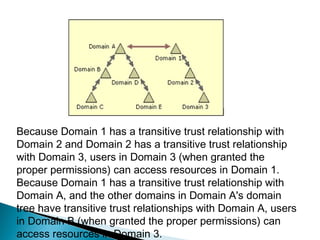
Because Domain 1 has a transitive trust relationship with
Domain 2 and Domain 2 has a transitive trust relationship
with Domain 3, users in Domain 3 (when granted the
proper permissions) can access resources in Domain 1.
Because Domain 1 has a transitive trust relationship with
Domain A, and the other domains in Domain A's domain
tree have transitive trust relationships with Domain A, users
in Domain B (when granted the proper permissions) can
access resources in Domain 3.
Nontransitive trust
      A nontransitive trust is bounded by the two domains in
    the trust relationship and does not flow to any other
    domains in the forest.
   Nontransitive trusts are one-way by default
   Shortcut Trust
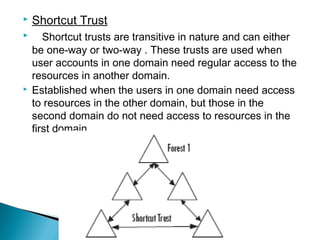
      Shortcut trusts are transitive in nature and can either
    be one-way or two-way . These trusts are used when
    user accounts in one domain need regular access to the
    resources in another domain.
   Established when the users in one domain need access
    to resources in the other domain, but those in the
    second domain do not need access to resources in the
    first domain.
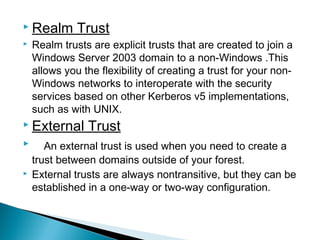
 Realm       Trust
   Realm trusts are explicit trusts that are created to join a
    Windows Server 2003 domain to a non-Windows .This
    allows you the flexibility of creating a trust for your non-
    Windows networks to interoperate with the security
    services based on other Kerberos v5 implementations,
    such as with UNIX.
 External      Trust
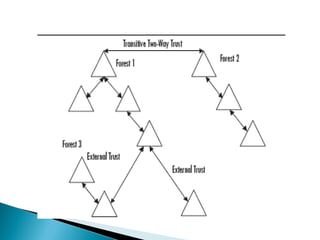
      An external trust is used when you need to create a
    trust between domains outside of your forest.
   External trusts are always nontransitive, but they can be
    established in a one-way or two-way configuration.
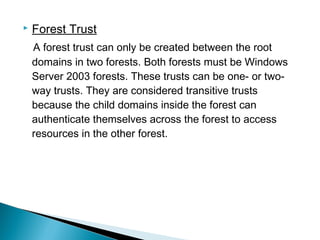
   Forest Trust
    A forest trust can only be created between the root
    domains in two forests. Both forests must be Windows
    Server 2003 forests. These trusts can be one- or two-
    way trusts. They are considered transitive trusts
    because the child domains inside the forest can
    authenticate themselves across the forest to access
    resources in the other forest.
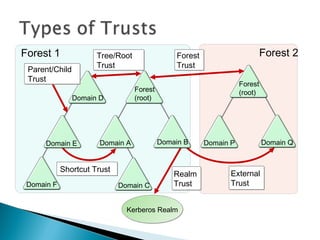
Forest 1              Tree/Root                 Forest                       Forest 2
                      Trust                     Trust
 Parent/Child
 Trust
                                                                    Forest
                                  Forest                            (root)
               Domain D           (root)


      Domain E        Domain A             Domain B      Domain P            Domain Q


            Shortcut Trust
                                               Realm           External
 Domain F                    Domain C          Trust           Trust


                               Kerberos Realm

2.2 determining trust relationships

  • 1.
     Trust relationshipsare logical connections that combine two or more domains into one administrative unit. Trust relationships allow permissions to be associated and passed from one domain to another.  With Active Directory Domains andTrusts, an administrator can establish relationships between domains that will allow users in one domain to access the resources in another 07/11/2008 1
  • 2.
    A domain trust is a relationship established between domains that enables users in one domain to be authenticated by a domain controller in the other domain. The authentication requests follow a trust path.  Trust path Before a user can access a resource in another domain, Windows  security must determine whether the trusting domain (the domain containing the resource the user is trying to access) has a trust relationship with the trusted domain (the user's logon domain).  To determine this, the Windows  security system computes the trust path between a domain controller in the trusting domain and a domain controller in the trusted domain.
  • 4.
    All domain trust relationships have only two domains in the relationship: the trusting domain and the trusted domain. A domain trust relationship is characterized by whether it is:  Two-way  One-way  Transitive  Nontransitive
  • 5.
    One-way trust A one-way trust is a single trust relationship, where Domain A trusts Domain B. All one-way relationships are nontransitive and all nontransitive trusts are one-way. Authentication requests can only be passed from the trusting domain to the trusted domain. This means that if Domain A has a one-way trust with Domain B and Domain B has a one-way trust with Domain C, Domain A does not have a trust relationship with Domain C.
  • 6.
    Two-way trust All domain trusts in a Windows  forest are two-way transitive trusts.  When a new child domain is created, a two-way transitive trust is automatically created between the new child domain and the parent domain. In a two-way trust, Domain A trusts Domain B and Domain B trusts Domain A. This means that authentication requests can be passed between the two domains in both directions.  To create a nontransitive two-way trust, you must create two one-way trusts between the domains involved.
  • 7.
    Transitive trust  All domain trusts in a Windows  forest are transitive. Transitive trusts are always two-way: Both domains in the relationship trust each other.  Transitive trust relationships flow upward through the domain tree as it is formed  Transitive trust relationships flow through all domains in the forest. Authentication requests follow these trust paths, so accounts from any domain in the forest can be authenticated at any other domain in the forest. With a single logon process, those accounts having the proper permissions can potentially access resources on any domain in the forest.
  • 8.
    Because Domain 1 hasa transitive trust relationship with Domain 2 and Domain 2 has a transitive trust relationship with Domain 3, users in Domain 3 (when granted the proper permissions) can access resources in Domain 1. Because Domain 1 has a transitive trust relationship with Domain A, and the other domains in Domain A's domain tree have transitive trust relationships with Domain A, users in Domain B (when granted the proper permissions) can access resources in Domain 3.
  • 9.
    Nontransitive trust A nontransitive trust is bounded by the two domains in the trust relationship and does not flow to any other domains in the forest.  Nontransitive trusts are one-way by default
  • 10.
    Shortcut Trust  Shortcut trusts are transitive in nature and can either be one-way or two-way . These trusts are used when user accounts in one domain need regular access to the resources in another domain.  Established when the users in one domain need access to resources in the other domain, but those in the second domain do not need access to resources in the first domain.
  • 11.
     Realm Trust  Realm trusts are explicit trusts that are created to join a Windows Server 2003 domain to a non-Windows .This allows you the flexibility of creating a trust for your non- Windows networks to interoperate with the security services based on other Kerberos v5 implementations, such as with UNIX.  External Trust  An external trust is used when you need to create a trust between domains outside of your forest.  External trusts are always nontransitive, but they can be established in a one-way or two-way configuration.
  • 13.
    Forest Trust A forest trust can only be created between the root domains in two forests. Both forests must be Windows Server 2003 forests. These trusts can be one- or two- way trusts. They are considered transitive trusts because the child domains inside the forest can authenticate themselves across the forest to access resources in the other forest.
  • 14.
    Forest 1 Tree/Root Forest Forest 2 Trust Trust Parent/Child Trust Forest Forest (root) Domain D (root) Domain E Domain A Domain B Domain P Domain Q Shortcut Trust Realm External Domain F Domain C Trust Trust Kerberos Realm