modern – postmodern
art of later 20th
century
Disruption and Upheaval: Worlds at War
Dynamics of Power
Shift to the West
Modernism, Formalism and Greenberg
THE ART WORLD'S FOCUS SHIFTS WESTThe destruction and extensive loss of life during
World War II had long-term personal, cultural, political, and economic consequences.
After the war, the United States and the Soviet Union emerged as rival superpowers.
Disruption and UpheavalAfter World War II, disruption and dislocation took place
throughout the world. Unrest continues in many countries. Hostilities and political
uncertainty still characterize the world situation. In the 1960s and 1970s there emerged
in the United States a counterculture that had considerable societal impact and
widespread influence. The civil rights movement and the women's liberation movement
rejected racism and sexism. Feminists charged that Western society's institutions
perpetuated male power and subordination of women.
The Dynamics of Power Various ethnic groups and gays and lesbians mounted
challenges to discriminatory policies and attitudes and battled discrimination with
political action. The art world also changed as the center of Western art shifted from
Paris to New York.Modernism, Formalism, and Clement GreenbergModernism
shifted course in conjunction with the changing historical conditions and demands
and became increasingly identified with a strict formalism. The influential art critic
Clement Greenberg identified Modernism as a rejection of illusionism and an
exploration of each artistic medium's properties. Meanwhile, the distance between
progressive artists and the public widened.
The emergence of Postmodernism Postmodernism may be viewed as a
rejection of the more rigid confines of modernist principles.
Postmodernism accommodates a wide range of styles, subjects, and
formats.
POSTWAR EXPRESSIONISM IN EUROPE:
World War II resulted in a pervasive sense of despair, disillusionment, and
skepticism.
Existentialism: The Absurdity of Human Existence
The philosophy of existentialism, which asserted the absurdity of human
existence and the impossibility of achieving certitude, reflected the cynicism of
the period. The spirit of pessimism and despair emerged frequently in the
European art.
Francis Bacon, Painting, 1946
An indictment of Humanity:
Painted in the aftermath of World War II, this intentionally revolting image of a
powerful figure presiding over a slaughter is Francis Bacon's indictment of
humanity and a reflection of war's butchery.
Jean Dubuffet, Vie Inquiete (Uneasy Life), 1953
Scraped and smeared canvases:
In Vie Inquiète, or Uneasy Life, Jean Dubuffet presents crudely scrawled or
scribbled images painted or incised on a surface of plaster, glue, sand, asphalt, or
other common materials; he expresses a tortured vision of the world through
thickly encrusted painted surfaces and crude images of the kind children and the
insane produce. He called it "art brut" – untaught and course art
Alberto Giacomette, Man Pointing, 1947
Lost in the world's immensity:
Alberto Giacometti's sculpture Man Pointing is a thin, severely attenuated figure with
rough, agitated surfaces. The writer Jean-Paul Sartre considered Giacometti's thin and
virtually featureless sculpted figures as the epitome of existentialist humanity –
alienated, solitary and lost in the world's immensity.
Abstract Expressionism is the first major American avant-garde movement.
Abstract Expressionist paintings are usually abstract and express the artist's
state of mind. Some Abstract Expressionists adopted Surrealist
improvisation methods and created works that had a look of rough
spontaneity and exhibited a refreshing energy. Abstract Expressionism
developed along two lines: gestural abstraction, which relied on the
expressiveness of energetically applied pigment, and chromatic abstraction,
which focused on the emotional resonance of color.
Action painting:
People also refer to gestural painting as action painting, a term that critic Harold
Rosenberg applied first to the work of the New York School.
Jackson Pollock's large-scale gestural abstract painting Lavender
Mist: Number 1, 1950 is composed of rhythmic drips, splatters, and
dribbles of paint. Emphasis is on the creation process.
Jackson Pollack, Number 1, 1950
Pollack's paintings emphasize the creative process. His mural-size canvases
consist of rhythmic drips, splatters, and dribbles of paint that envelop viewers,
drawing them into a lacy spider web.
"Gestural abstraction" nicely describes Pollack's working technique. Using
sticks or brushes, he flung, poured, and dripped paint onto a section of canvas he
simply unrolled across his studio floor.
Action Jackson
Willem De Kooning, Woman I, 1950-1952
Willem de Kooning's Woman I, although rooted in figuration,
including pictures of female models on advertising billboards,
displays the sweeping gestural brushstrokes and energetic
application of pigment typical of gestural abstraction.
Barnett Newman, Vir Heroicus Sublimis ("heroic sublime man"), 1950-1951
Vir Heroicus Sublimis by the chromatic abstractionist painter
Barnett Newman consists of a single slightly modulated color field
split by "zips" (narrow bands) running from one edge of the
canvas to the other, that serve as accents that energize the field
and give it scale.
Mark Rothko, No. 14, 1960
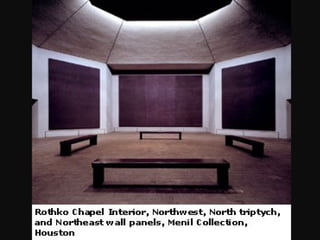
Mark Rothko's No.14, a chromatic abstactionist painting, consists of large
shimmering rectangles of intensely luminous pure color with hazy edges
that seem to float on the surface of the canvas in front of a colored
background. Rothko relies on color and shape to create emotion in the
viewer.
Da
David Smith, Cubi XIX, 1964
Although American sculptor David Smith, was not associated with the
Abstract Expressionists, his metal sculptures have affinities with the tenets of
that movement – particularly in the treatment of the surface. His abstract
metal sculptures of simple geometric forms reflect te natural light and color of
the outdoor settings for which they were intended, rahter that the sterile
illumination of a museum gallery.
Post-Painterly AbstractionPost-Painterly Abstraction, a term coined by
Clement Greenbery, developed out of Abstract Expressionism but
manifests a radically different sensiblity. Whereas Abstract
Expressionism conveys a feeling of passion and visceral intensity, a cool,
detached rationality emphasizing tighter pictorial characterizes the Post-
Painterly group. The hand of the artist is conspicuously absent in Post-
Painterly Abstraction. For Greenberg this seemed to embody his idea of
purity in art.
Ellsworth Kelly, Red Blue Green, 1963
Ellsworth Kelly's completely abstract Red Blue Green has razor-sharp edges
and clearly delineated color shapes in a simple composition, that distill
painting to its essential two dimensional elements
Frank Stella, Mas o Menos ("more or less"), 1964
"What you see is what you see": Frank Stella's Nunca Pasa Nada is a simplified
image of thin, evenly spaced pinstripes on a colored ground. Stella tried to
achieve purity in painting with this work. His canvases have no central focus,
no painterly or expressive elements, and no tactile (textural) qualities.
Helen Frankenthaler, Bay Side, 1967
Color-field painters like Frankenthaler poured paint onto unprimed canvas,
allowing the pigments to soak into the fabric. Her works underscore that a
painting is simply pigment on a flat surface.
Frankenthaler quoted:
"When you first saw a Cubist or Impressionist picture there was a whole way
of instructing the eye or the subconscious. Dabs of color had to stand for
real things; it was an abstraction of a guitar or hillside. The opposite is going on now.
If you have bands of blue, green, and pink, the mind doesn't think sky, grass and
flesh. These are colors and the question is what are they doing with themselves and
with
each other. Sentiment and nuance are being squeezed out."
Morris Louis, Saraband, 1959
Stained canvases:
In Saraband, Morris Louis impregnated the canvas with paint by
holding up the edges and pouring diluted acrylic resin to create billowy,
fluid transparent shapes that run down the length of the unprimed
canvas.
Minimal Art
Minimal art, or Minimalism, strove for purity through primary structures.
Tony Smith, Die, 1962
Emphasizing Objecthood:
Tony Smith's Die is a simple volumetric construction without an identifiable
subject, color, surface texture, or narrative element. By reducing experience to
its most fundamental level, Minimalist artists seek to inhibit any form of
interpretation and to prevent the viewer finding any meaning in the art before
them. The emphasis is on the art's "objecthood" and concrete tangibility.
Donald Judd, Untitled, 1969
Declaring sculptures Objecthood:
Donald Judd's Minimalist sculpture incorporates boxes fashioned from
undisguised industrial materials. The artist used Plexiglas because its
translucency gives the viewer access to the works interior.
Maya Ying Lin, Vietnam Veterans Memorial, Washington D.C., 1981-83
Like Minimalist sculpture, Lin's memorial to the veterans of Vietnam is a simple
geometric form. Its inscribed polished walls actively engage the viewer in a
psychological dialogue about the war.
Louise Nevelson, Tropical Garden II, 1957-1959
The monochromatic color scheme unifies the diverse sculpted
forms and found objects in Nevelson's "walls" and creates a mysterious
field of shapes and shadows that suggest magical environments.
Louise Bourgeois, Cumul 1, 1969
Louis Bourgeois's sculptures consist of sensuous organic forms that recall the Biomorpic
Surrealist forms of Miró. Although the shapes remain abstract, they refer strongly
to human figures.
Eva Hesse, Hang-Up, 1965-1966
Hesse created spare and simple sculptures with parts that extend
into the room. She wanted her works to express the strangeness
and absurdity that she considered the central conditions of modern
life.
Happenings, Events, Performance Art
George Brecht, Event Scores
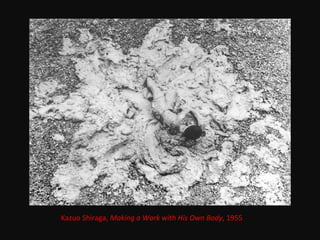
Kazuo Shiraga, Making a Work with His Own Body, 1955
The Performance artists of the Japanese Gutai Bijutsu Kyobai (Concrete Art
Association) expanded action painting into the realm of performance.
Shiraga used his body to "paint" with mud.
Joseph Beuys, How to Explain Pictures to a Dead Hare, 1965
In this one-person Beuys coated his head with honey and gold leaf. Assuming
the role of a shaman, he used stylized actions to evoke a sense of mystery and sacred
ritual.
Jean Tinguely, Homage to New York, 1960
Tinguely produced motor-driven devices programmed to make instant
abstract paintings. To explore the notion of destruction as an act of
creation, he designed this one to perform and then destroy itself.
Conceptual Art
Joseph Kosuth, One and Three Chairs, 1965
Conceptual artists regard the concept as an artwork's defining component
To portray "chairness," Kosuth juxxtaposed a chair, a photograph of the
chair, and a dictionary definition of "chair."
Bruce Nauman, The True Artist Helps the World by Revealing Mystic Truths, 1967
Nauman, like other Conceptual artists, explores his interest in language
and wordplay in his art. He described this neon sculpture's emphatic assertion
as "a totally silly idea," but one that he believed.
Pop Art
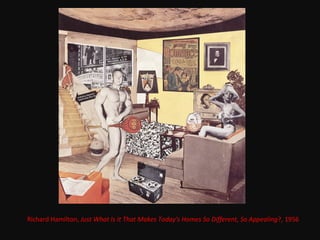
Richard Hamilton, Just What Is It That Makes Today's Homes So Different, So Appealing?, 1956
The fantasy interior in Hamilton's collage reflects the values of
modern consumer culture through figures and objects cut from
glossy magazines. Toying with mass-media imagery typifies British
Pop Art.
Jasper Johns, Flag, 1954-1955
American Pop artist Jasper Johns wanted to draw attention
to common objects that people view frequently but rarely scrutinize. He made
several series of paintings of targets, flags, numbers, an alphabets.
Robert Rauschenberg, Canyon, 1959
Rauschenberg's "combines" intersperse painted passages with sculptural elements.
Canyon incorporates pigment on canvas with pieces of printed paper, photographs,
a pillow, and a stuffed eagle.
Roy Lichtenstein, Hopeless, 1963
Comic books appealed to Lichtenstein because they were a mainstay
of American popular culture, meant to be read and discarded. The Pop
artist immortalized their images on large canvases.
Andy Warhol, Green Coca-Cola Bottles, 1962
Warhol was the quintessential American Pop artist. Here, he selected an icon of
mass-produced consumer culture and then multiplied it, reflecting Coke's
omnipresence in American society.
Andy Warhol, Marilyn Dyptych, 1962
Warhol's repetition of Monroe's face reinforced her status as a consumer
product, her glamorous visage confronting the viewer endlessly, as it did the
American public in the aftermath of her death.
Claus Oldenburg, one person show, 1962
Oldenburg's painted plaster and stuffed vinyl sculptures magnify familiar
items of American consumer culture. The title of one of his shows, The Store,
was a comment on art itself as a commodity.
Superrealism/Photography-Derived
Audrey Flack, Marilyn, 1977
Flack's pioneering Photorealist still lifes record objects with great
optical fidelity. Marilyn alludes to Dutch vanitas paintings and
incorporates multiple references to the transience of life.
Chuck Close, Big Self-Portrait, 1967-68
Closes goal was to translate photographic information into painted
information. In his portraits he deliberately avoided creative
compositions, flattering lighting effects, and revealing facial expressions.
Duane Hanson, Supermarket Shopper, 1970
Hanson used molds from live models to create his Superrealistic life-size
painted polyresin sculptures. His aim was to capture the emptiness and loneliness
of average Americans in familiar settings.
http://oleopolis.files.
wordpress.com/200
8/10/duane_hanson
_traveller2.jpg
http://oleopolis.files.
wordpress.com/200
8/10/duane_hanson
_traveller2.jpg
Environmentally Related Sculpture
Robert Smithson, Spiral Jetty, 1970
Smithson used industrial equipment to create Environmental
artworks by manipulating earth and rock. Spiral Jettty is a mammoth
coil of black basalt, limestone, and earth extending into the Great Salt Lake.
Christo and Jeanne Claude, Surrounded Islands, 1980-1983
Christo and Jeanne-Claude created this Environmental artwork by
surrounding 11 small islands with 6.5 million square feet of pink fabric.
Characteristically, the work existed for only two weeks.
Christo and Jeanne-Claude, Cologne Cathedral
Christo and Jeanne-Claude, The Gates, 2005
Richard Serra, Tilted Arc, 1981
Serra intended his Minimalist Tilted Arc to alter the character
of an existing public space. He succeeded but unleashed a
storm of protest that caused the government to remove the work.
http://upload.wikime
dia.org/wikipedia/co
mmons/d/d4/Richard
Serra_Fulcrum.jpg
Later Trends in Architecture
Frank Lloyd Wright, Solomon R. Guggenheim Museum, New York, 1943-1959
Frank Lloyd Wright, Interior Solomon R. Guggenheim
Using reinforced concrete almost as a sculptor might use resilient clay, Wright
designed a snail shell-shaped museum with a winding interior ramp for the
display of artworks along its gently inclined path.
Le Corbusier, Notre-Dame-du-Haut, Ronchamp, France, 1950-1955
The organic forms of Le Corbusier's mountaintop chapel present a fusion
of architecture and sculpture. The architect based the shapes on praying
hands, a dove's wings, and a ship's prow.
Le Corbusier, Interior of Notre-Dame-Du-Haut, Ronchamp, France, 1950-1955
Constructed of concrete sprayed on a frame of steel and metal mesh,
the heavy walls of the Ronchamp chapel enclose an intimate and mysteriously
lit interior that has the aura of a sacred cave.
Joern Utzon, Sydney Opera House, Sydney, Australia, 1959-1972
The two soaring clusters of concrete shells of Utzon's opera house
on an immense platform in Sydney's harbor suggest both the
buoyancy of seabird wings and the billowing sails of tall ships.
Eero Saarinen, Trans World Airlines Terminal, Kennedy Airport, New York, 1956-1962
Saarinen based the design for this airline terminal on the theme of
motion. The concrete and glass building's dramatic, sweeping, curilinear
rooflines appropriately suggest expansive wings and flight.
Ludwig Mies Van Der Rohe and
Philip Johnson, Seagram Building
New York, 1956-1958
Massive, sleek, and geometrically rigid, this modernist skyscraper has a bronze
and glass skin that masks its concrete and steel frame. The giant corporate
tower appears to rise from the pavement on stilts.
Skidmore, Owings and Merrell,
Sears Tower, Chicago, 1974
Consisting of nine black aluminum and smoked glass shafts soaring to 110 stories, the
Sears Tower dominates Chicago's skyline. It was the tallest building in the world at the
time of its erection.
Charles Moore, Piazza d'Italia, New Orleans, 1976-1980
Moore's circular postmodern Italian plaza incorporates elements drawn from
ancient Roman architecture with the instability of Mannerist designs
and modern stainless-steel columns with neon collars.
Phillip Johnson (1906-2005)
Philip Johnson and John Burgee, model of AT&T, New York, 1978-1984
In a startling shift of style, Modernist Johnson design this post modernist
skyscraper with more granite than glass and with a variation of a classical
pediment as the crowning motif.
Penzoil, Houston, TX – Philip Johnson
Philip Johnson – Glass House
I.M. Pei Fountain Place
Michael Graves, the Portland Building, Portland, Oregon, 1980
In this early example of postmodern architecture, Graves reasserted the horizontality
and solidity of the wall. He drew attention to the mural surfaces through polychromy and
ornamental motifs.
Robert Venture, John Rauch, Denise Scott Brown, 1978-1983
Venturi asserted that form should be separate from function and structure.
this rural home has the low profile of a farmhouse, but its façade is an
asymmetrical parody of a Neoclassical portico.
Richard Rogers and Renzo Piano, Georges Pompidou National Center of Art and Culture
(the Beaubourg), Paris France, 1977
The architects fully exposed the anatomy of this six-level building, as in the
century-earlier Crystal Palace, and color-coded the internal parts
according to function, as in a factory.
Gunter Behnisch, Hysolar Institute Building, Stuttgart, Germany, 1987
The roof, walls, and windows of this Deconstructivist structure seem to explode,
avoiding any suggestion of clear, stable masses and frustrating the observer's expectations
of what a building should look like.
Frank Gehry, Guggenheim Museo Bilbao, Bilbao Spain, 1997
Gehry's limestone and titanium Bilbao museum is an immensely
dramatic building. Its disorder and seeming randomness of design
epitomize Deconstructivist architectural principles.
Neo-Expressionism
Julian Schnabel, The Walk Home, 1984-1985
Schnabel's paintings recall the work of the gestural abstactionists, but he
employs an amalgamation of media, bringing together painting, mosaic, an
low-relief sculpture.
Susan Rothenberg, Tattoo, 1979
Rothenberg's Neo-Expressionist paintings feature loose brushwork, agitated
surfaces, and hazy, semiabstract forms. This work's title refers to the
horse's head drawn within the outline of its leg.
Anselm Kiefer, Nigredo, 1984
Keifer's paintings have thickly encrusted surfaces incorporating materials such
as straw. Here, the German artist used perspective to pull the viewer into an
incinerated landscape that alludes to the Holocaust.
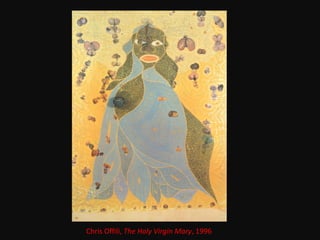
Chris Offili, The Holy Virgin Mary, 1996
Ofili, a British-born Catholic of Nigerian descent, represented the Virgin
Mary with African elephant dung on one breast and surrounded by genitalia
and buttocks. This painting produced a public outcry.
Feminist Art
Judy Chicago, The Dinner Party, 1979
Chicago's Dinner Party honors 39 women from antiquity to 20th
-century America.
The triangular form and the materials – painted china and fabric – are traditionally
associated with women.
Miriam Schapiro, Anatomy of a Kimono, 1976
Shapiro calls her huge sewn collages femmages to make the point that women
had been doing collages of fabric long before Picasso. This femmage incorporates
patterns from Japanese kimonos.
Cindy Sherman, Untitled Film Still, #35, 1979
Sherman here assumed a role for one of a series of 80 photographs resembling
film stills in which she addressed the way women have been presented in Western
art for the enjoyment of the "male gaze."
Barbara Kruger, Untitled (Your
Gaze Hits the Side of My Face), 1981
Kruger, like Sherman, has explored the male gaze in her art. Using the layout
techniques of mass media, she constructed this work-and-photograph collage
to challenge culturally constructed notions of gender.
Ana Mendieta, Flowers on Body, 1973
In this earth/body sculpture, Mendieta appears covered with flowers in
a womblike cavity to address issues of birth and death as well as the human
connection to the earth.
Hanna Wilke, S.O.S. – Starification Object Series, 1974-1982
The anonymous Guerrilla Girls wear gorilla masks in public performances and produce
posters in which they call attention to injustice in the art world, especially what they
perceive as sexist or racist treatment.
The Free-For-All
Art of the most recent past encompasses many genres. It is often self-reflective.
it is often politically, religiously , or racially charged. There are no overarching,
defining characteristics. Often it is multi-media including new technological
innovations such as computers and video. It is often in the form of installation which requires
something, even passive, of the viewer's participation.
Kiki Smith, Untitled, 1990
Asking "who controls the body?" Kiki Smith sculpted two life-size wax figures
of a nude man and woman with body fluids running from the woman's breasts
and down the man's leg.
Faith Ringgold, Who's Afraid of Aunt Jemima?, 1983
In this quilt, a medium associated with women, Ringgold presented a tribute
to her mother that also addresses African American culture and the struggles
of women to overcome oppression.
Adrian Piper, Cornered, 1988
In this installation, Piper, a light-skinned African American, appeared
on a video monitor, "cornered" behind an overturned table, and made
provocative comments about overt racism and more subtle bigotry.
Lorna Simpson, Stereo Styles, 1988
In Stereo Types, Simpson presents photographs of African American hairstyles as racial
symbols associated with personality traits. She also comments of those coiffures as fashion
commodities.
Melvin Edwards, Tambo, 1993
Edwards welded sculptures of chains, spikes, knife blades, and other
found objects allude to the lynching of African Americans and the continuing
struggle for civil rights and an end to racism.
David Hammons, Public Enemy, MOMA, 1991
Hammons intended this multimedia installation, with Theodore Roosevelt
flanked by an African American and a Native American as servants, to reveal
the racism embedded in American's cultural heritage.
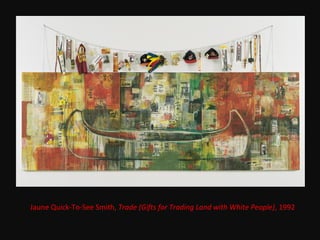
Jaune Quick-To-See Smith, Trade (Gifts for Trading Land with White People), 1992
Quick-to-See Smith's mixed media canvases are full of references to
her Native American identity. Some of the elements refer to the
controversy surrounding sports teams that have American Indian names.
Leon Golub, Mercenaries (IV), 1980
The violence of contemporary life is the subject of Golub's
huge paintings. Here, five mercenaries loom over the viewer,
instilling a feeling of peril. The rough textures reinforce the raw
imagery.
Magdalena Abakanowicz, Backs, 1982
Polish fiber artist Abakanowicz explored the stoic, everyday toughness of the
human spirit in this group of nearly identical sculptures that serve as symbols
of distinctive individuals lost in the crowd.
David Wojnarowicz, "When I put my hands on your body," 1990
In this disturbing yet eloquent print, Wojnarowicz overlaid typed commentary
on a photograph of skeletal remains. He movingly communicated his feelings
about watching a loved one die of AIDS.
Jenny Holzer, Untitled (selections from Truisms, Inflammatory Essays,
The Living Series, The Survival Series, Under a Rock, Laments, and Child Text), 1989
Holzer's 1989 installation consisted of electronic signs created using light-emitting
diode technology. The continuous display of texts spiraled around the Guggenheim
Museum's interior ramp.
Bill Viola, The Crossing, 1996
Viola's video projects use extreme slow motion, contrasts in scale,
shifts in focus, mirrored reflections, and staccato editing to create
dramatic sensory experiences rooted in tangible reality.
Tony Oursler, Mansheshe, 1997
Video artist Oursler projects his digital images onto sculptural objects, insinuating
them into the "real" world. Here he projected talking heads onto egg-shaped
forms suspended from poles.
Jeff Koons, Pink Panther, 1988
In the 1980s Koons created sculptures that highlight everything wrong with
contemporary American consumer culture. In this work, he intertwined a
centerfold nude and a cartoon character.
Mark Tansey, A Short History of Modernist Painting, 1982
Tansey's tripartite history of painting includes the Renaissance window onto the world,
the modernist insistence on a painting as flat surface, and postmodern artist's
reflections on their place in art history.
Robert Arneson, California Artist, 1982
Underscoring the importance of art critics in the contemporary art world
Arneson produces this self-portrait incorporating all the stereotypes
a New York critic attributed to California artists.
Hans Haacke, Metro Mobiltan, 1985
MetroMobiltan focuses attention on the connections between political
and economic conditions in South Africa and the conflicted politics of corporate
patronage of art exhibitions.
The anonymous Guerrilla Girls wear gorilla masks in public performances
and produce posters in which they call attention to injustice in the art
world, especially what they perceive as sexist or racist treatment.
Matthew Barney, Cremaster cycle, installation at Guggenheim Museum
Barney's vast multimedia installations of drawings, photographs, sculptures,
and videos typify the relaxation at the opening of the 21st
century of the traditional
boundaries among artistic media.

Modernism postmodernism

  • 1.
    modern – postmodern artof later 20th century
  • 2.
    Disruption and Upheaval:Worlds at War Dynamics of Power Shift to the West Modernism, Formalism and Greenberg
  • 3.
    THE ART WORLD'SFOCUS SHIFTS WESTThe destruction and extensive loss of life during World War II had long-term personal, cultural, political, and economic consequences. After the war, the United States and the Soviet Union emerged as rival superpowers. Disruption and UpheavalAfter World War II, disruption and dislocation took place throughout the world. Unrest continues in many countries. Hostilities and political uncertainty still characterize the world situation. In the 1960s and 1970s there emerged in the United States a counterculture that had considerable societal impact and widespread influence. The civil rights movement and the women's liberation movement rejected racism and sexism. Feminists charged that Western society's institutions perpetuated male power and subordination of women.
  • 4.
    The Dynamics ofPower Various ethnic groups and gays and lesbians mounted challenges to discriminatory policies and attitudes and battled discrimination with political action. The art world also changed as the center of Western art shifted from Paris to New York.Modernism, Formalism, and Clement GreenbergModernism shifted course in conjunction with the changing historical conditions and demands and became increasingly identified with a strict formalism. The influential art critic Clement Greenberg identified Modernism as a rejection of illusionism and an exploration of each artistic medium's properties. Meanwhile, the distance between progressive artists and the public widened.
  • 5.
    The emergence ofPostmodernism Postmodernism may be viewed as a rejection of the more rigid confines of modernist principles. Postmodernism accommodates a wide range of styles, subjects, and formats.
  • 6.
    POSTWAR EXPRESSIONISM INEUROPE: World War II resulted in a pervasive sense of despair, disillusionment, and skepticism. Existentialism: The Absurdity of Human Existence The philosophy of existentialism, which asserted the absurdity of human existence and the impossibility of achieving certitude, reflected the cynicism of the period. The spirit of pessimism and despair emerged frequently in the European art.
  • 7.
  • 8.
    An indictment ofHumanity: Painted in the aftermath of World War II, this intentionally revolting image of a powerful figure presiding over a slaughter is Francis Bacon's indictment of humanity and a reflection of war's butchery.
  • 14.
    Jean Dubuffet, VieInquiete (Uneasy Life), 1953
  • 15.
    Scraped and smearedcanvases: In Vie Inquiète, or Uneasy Life, Jean Dubuffet presents crudely scrawled or scribbled images painted or incised on a surface of plaster, glue, sand, asphalt, or other common materials; he expresses a tortured vision of the world through thickly encrusted painted surfaces and crude images of the kind children and the insane produce. He called it "art brut" – untaught and course art
  • 18.
  • 19.
    Lost in theworld's immensity: Alberto Giacometti's sculpture Man Pointing is a thin, severely attenuated figure with rough, agitated surfaces. The writer Jean-Paul Sartre considered Giacometti's thin and virtually featureless sculpted figures as the epitome of existentialist humanity – alienated, solitary and lost in the world's immensity.
  • 22.
    Abstract Expressionism isthe first major American avant-garde movement. Abstract Expressionist paintings are usually abstract and express the artist's state of mind. Some Abstract Expressionists adopted Surrealist improvisation methods and created works that had a look of rough spontaneity and exhibited a refreshing energy. Abstract Expressionism developed along two lines: gestural abstraction, which relied on the expressiveness of energetically applied pigment, and chromatic abstraction, which focused on the emotional resonance of color. Action painting: People also refer to gestural painting as action painting, a term that critic Harold Rosenberg applied first to the work of the New York School.
  • 23.
    Jackson Pollock's large-scalegestural abstract painting Lavender Mist: Number 1, 1950 is composed of rhythmic drips, splatters, and dribbles of paint. Emphasis is on the creation process.
  • 24.
  • 25.
    Pollack's paintings emphasizethe creative process. His mural-size canvases consist of rhythmic drips, splatters, and dribbles of paint that envelop viewers, drawing them into a lacy spider web. "Gestural abstraction" nicely describes Pollack's working technique. Using sticks or brushes, he flung, poured, and dripped paint onto a section of canvas he simply unrolled across his studio floor.
  • 27.
  • 28.
    Willem De Kooning,Woman I, 1950-1952
  • 29.
    Willem de Kooning'sWoman I, although rooted in figuration, including pictures of female models on advertising billboards, displays the sweeping gestural brushstrokes and energetic application of pigment typical of gestural abstraction.
  • 32.
    Barnett Newman, VirHeroicus Sublimis ("heroic sublime man"), 1950-1951
  • 33.
    Vir Heroicus Sublimisby the chromatic abstractionist painter Barnett Newman consists of a single slightly modulated color field split by "zips" (narrow bands) running from one edge of the canvas to the other, that serve as accents that energize the field and give it scale.
  • 37.
  • 38.
    Mark Rothko's No.14,a chromatic abstactionist painting, consists of large shimmering rectangles of intensely luminous pure color with hazy edges that seem to float on the surface of the canvas in front of a colored background. Rothko relies on color and shape to create emotion in the viewer.
  • 42.
  • 43.
    Although American sculptorDavid Smith, was not associated with the Abstract Expressionists, his metal sculptures have affinities with the tenets of that movement – particularly in the treatment of the surface. His abstract metal sculptures of simple geometric forms reflect te natural light and color of the outdoor settings for which they were intended, rahter that the sterile illumination of a museum gallery.
  • 46.
    Post-Painterly AbstractionPost-Painterly Abstraction,a term coined by Clement Greenbery, developed out of Abstract Expressionism but manifests a radically different sensiblity. Whereas Abstract Expressionism conveys a feeling of passion and visceral intensity, a cool, detached rationality emphasizing tighter pictorial characterizes the Post- Painterly group. The hand of the artist is conspicuously absent in Post- Painterly Abstraction. For Greenberg this seemed to embody his idea of purity in art.
  • 47.
    Ellsworth Kelly, RedBlue Green, 1963
  • 48.
    Ellsworth Kelly's completelyabstract Red Blue Green has razor-sharp edges and clearly delineated color shapes in a simple composition, that distill painting to its essential two dimensional elements
  • 51.
    Frank Stella, Maso Menos ("more or less"), 1964
  • 52.
    "What you seeis what you see": Frank Stella's Nunca Pasa Nada is a simplified image of thin, evenly spaced pinstripes on a colored ground. Stella tried to achieve purity in painting with this work. His canvases have no central focus, no painterly or expressive elements, and no tactile (textural) qualities.
  • 55.
  • 56.
    Color-field painters likeFrankenthaler poured paint onto unprimed canvas, allowing the pigments to soak into the fabric. Her works underscore that a painting is simply pigment on a flat surface. Frankenthaler quoted: "When you first saw a Cubist or Impressionist picture there was a whole way of instructing the eye or the subconscious. Dabs of color had to stand for real things; it was an abstraction of a guitar or hillside. The opposite is going on now. If you have bands of blue, green, and pink, the mind doesn't think sky, grass and flesh. These are colors and the question is what are they doing with themselves and with each other. Sentiment and nuance are being squeezed out."
  • 60.
  • 61.
    Stained canvases: In Saraband,Morris Louis impregnated the canvas with paint by holding up the edges and pouring diluted acrylic resin to create billowy, fluid transparent shapes that run down the length of the unprimed canvas.
  • 64.
    Minimal Art Minimal art,or Minimalism, strove for purity through primary structures.
  • 65.
  • 66.
    Emphasizing Objecthood: Tony Smith'sDie is a simple volumetric construction without an identifiable subject, color, surface texture, or narrative element. By reducing experience to its most fundamental level, Minimalist artists seek to inhibit any form of interpretation and to prevent the viewer finding any meaning in the art before them. The emphasis is on the art's "objecthood" and concrete tangibility.
  • 69.
  • 70.
    Declaring sculptures Objecthood: DonaldJudd's Minimalist sculpture incorporates boxes fashioned from undisguised industrial materials. The artist used Plexiglas because its translucency gives the viewer access to the works interior.
  • 73.
    Maya Ying Lin,Vietnam Veterans Memorial, Washington D.C., 1981-83
  • 74.
    Like Minimalist sculpture,Lin's memorial to the veterans of Vietnam is a simple geometric form. Its inscribed polished walls actively engage the viewer in a psychological dialogue about the war.
  • 78.
    Louise Nevelson, TropicalGarden II, 1957-1959
  • 79.
    The monochromatic colorscheme unifies the diverse sculpted forms and found objects in Nevelson's "walls" and creates a mysterious field of shapes and shadows that suggest magical environments.
  • 82.
  • 83.
    Louis Bourgeois's sculpturesconsist of sensuous organic forms that recall the Biomorpic Surrealist forms of Miró. Although the shapes remain abstract, they refer strongly to human figures.
  • 85.
  • 86.
    Hesse created spareand simple sculptures with parts that extend into the room. She wanted her works to express the strangeness and absurdity that she considered the central conditions of modern life.
  • 89.
  • 90.
  • 91.
    Kazuo Shiraga, Makinga Work with His Own Body, 1955
  • 92.
    The Performance artistsof the Japanese Gutai Bijutsu Kyobai (Concrete Art Association) expanded action painting into the realm of performance. Shiraga used his body to "paint" with mud.
  • 93.
    Joseph Beuys, Howto Explain Pictures to a Dead Hare, 1965
  • 94.
    In this one-personBeuys coated his head with honey and gold leaf. Assuming the role of a shaman, he used stylized actions to evoke a sense of mystery and sacred ritual.
  • 96.
    Jean Tinguely, Homageto New York, 1960
  • 97.
    Tinguely produced motor-drivendevices programmed to make instant abstract paintings. To explore the notion of destruction as an act of creation, he designed this one to perform and then destroy itself.
  • 98.
  • 99.
    Joseph Kosuth, Oneand Three Chairs, 1965
  • 100.
    Conceptual artists regardthe concept as an artwork's defining component To portray "chairness," Kosuth juxxtaposed a chair, a photograph of the chair, and a dictionary definition of "chair."
  • 101.
    Bruce Nauman, TheTrue Artist Helps the World by Revealing Mystic Truths, 1967
  • 102.
    Nauman, like otherConceptual artists, explores his interest in language and wordplay in his art. He described this neon sculpture's emphatic assertion as "a totally silly idea," but one that he believed.
  • 105.
  • 106.
    Richard Hamilton, JustWhat Is It That Makes Today's Homes So Different, So Appealing?, 1956
  • 107.
    The fantasy interiorin Hamilton's collage reflects the values of modern consumer culture through figures and objects cut from glossy magazines. Toying with mass-media imagery typifies British Pop Art.
  • 108.
  • 109.
    American Pop artistJasper Johns wanted to draw attention to common objects that people view frequently but rarely scrutinize. He made several series of paintings of targets, flags, numbers, an alphabets.
  • 115.
  • 116.
    Rauschenberg's "combines" interspersepainted passages with sculptural elements. Canyon incorporates pigment on canvas with pieces of printed paper, photographs, a pillow, and a stuffed eagle.
  • 120.
  • 121.
    Comic books appealedto Lichtenstein because they were a mainstay of American popular culture, meant to be read and discarded. The Pop artist immortalized their images on large canvases.
  • 123.
    Andy Warhol, GreenCoca-Cola Bottles, 1962
  • 124.
    Warhol was thequintessential American Pop artist. Here, he selected an icon of mass-produced consumer culture and then multiplied it, reflecting Coke's omnipresence in American society.
  • 125.
    Andy Warhol, MarilynDyptych, 1962
  • 126.
    Warhol's repetition ofMonroe's face reinforced her status as a consumer product, her glamorous visage confronting the viewer endlessly, as it did the American public in the aftermath of her death.
  • 128.
    Claus Oldenburg, oneperson show, 1962
  • 129.
    Oldenburg's painted plasterand stuffed vinyl sculptures magnify familiar items of American consumer culture. The title of one of his shows, The Store, was a comment on art itself as a commodity.
  • 133.
  • 134.
  • 135.
    Flack's pioneering Photorealiststill lifes record objects with great optical fidelity. Marilyn alludes to Dutch vanitas paintings and incorporates multiple references to the transience of life.
  • 137.
    Chuck Close, BigSelf-Portrait, 1967-68
  • 138.
    Closes goal wasto translate photographic information into painted information. In his portraits he deliberately avoided creative compositions, flattering lighting effects, and revealing facial expressions.
  • 140.
  • 141.
    Hanson used moldsfrom live models to create his Superrealistic life-size painted polyresin sculptures. His aim was to capture the emptiness and loneliness of average Americans in familiar settings.
  • 142.
  • 143.
  • 144.
  • 145.
    Smithson used industrialequipment to create Environmental artworks by manipulating earth and rock. Spiral Jettty is a mammoth coil of black basalt, limestone, and earth extending into the Great Salt Lake.
  • 146.
    Christo and JeanneClaude, Surrounded Islands, 1980-1983
  • 147.
    Christo and Jeanne-Claudecreated this Environmental artwork by surrounding 11 small islands with 6.5 million square feet of pink fabric. Characteristically, the work existed for only two weeks.
  • 148.
    Christo and Jeanne-Claude,Cologne Cathedral
  • 149.
  • 150.
  • 151.
    Serra intended hisMinimalist Tilted Arc to alter the character of an existing public space. He succeeded but unleashed a storm of protest that caused the government to remove the work.
  • 153.
  • 154.
    Later Trends inArchitecture
  • 155.
    Frank Lloyd Wright,Solomon R. Guggenheim Museum, New York, 1943-1959
  • 156.
    Frank Lloyd Wright,Interior Solomon R. Guggenheim
  • 157.
    Using reinforced concretealmost as a sculptor might use resilient clay, Wright designed a snail shell-shaped museum with a winding interior ramp for the display of artworks along its gently inclined path.
  • 158.
    Le Corbusier, Notre-Dame-du-Haut,Ronchamp, France, 1950-1955
  • 159.
    The organic formsof Le Corbusier's mountaintop chapel present a fusion of architecture and sculpture. The architect based the shapes on praying hands, a dove's wings, and a ship's prow.
  • 160.
    Le Corbusier, Interiorof Notre-Dame-Du-Haut, Ronchamp, France, 1950-1955
  • 161.
    Constructed of concretesprayed on a frame of steel and metal mesh, the heavy walls of the Ronchamp chapel enclose an intimate and mysteriously lit interior that has the aura of a sacred cave.
  • 162.
    Joern Utzon, SydneyOpera House, Sydney, Australia, 1959-1972
  • 163.
    The two soaringclusters of concrete shells of Utzon's opera house on an immense platform in Sydney's harbor suggest both the buoyancy of seabird wings and the billowing sails of tall ships.
  • 164.
    Eero Saarinen, TransWorld Airlines Terminal, Kennedy Airport, New York, 1956-1962
  • 165.
    Saarinen based thedesign for this airline terminal on the theme of motion. The concrete and glass building's dramatic, sweeping, curilinear rooflines appropriately suggest expansive wings and flight.
  • 166.
    Ludwig Mies VanDer Rohe and Philip Johnson, Seagram Building New York, 1956-1958
  • 167.
    Massive, sleek, andgeometrically rigid, this modernist skyscraper has a bronze and glass skin that masks its concrete and steel frame. The giant corporate tower appears to rise from the pavement on stilts.
  • 168.
    Skidmore, Owings andMerrell, Sears Tower, Chicago, 1974
  • 169.
    Consisting of nineblack aluminum and smoked glass shafts soaring to 110 stories, the Sears Tower dominates Chicago's skyline. It was the tallest building in the world at the time of its erection.
  • 170.
    Charles Moore, Piazzad'Italia, New Orleans, 1976-1980
  • 171.
    Moore's circular postmodernItalian plaza incorporates elements drawn from ancient Roman architecture with the instability of Mannerist designs and modern stainless-steel columns with neon collars.
  • 172.
  • 173.
    Philip Johnson andJohn Burgee, model of AT&T, New York, 1978-1984
  • 174.
    In a startlingshift of style, Modernist Johnson design this post modernist skyscraper with more granite than glass and with a variation of a classical pediment as the crowning motif.
  • 175.
    Penzoil, Houston, TX– Philip Johnson
  • 176.
    Philip Johnson –Glass House
  • 177.
  • 178.
    Michael Graves, thePortland Building, Portland, Oregon, 1980
  • 179.
    In this earlyexample of postmodern architecture, Graves reasserted the horizontality and solidity of the wall. He drew attention to the mural surfaces through polychromy and ornamental motifs.
  • 180.
    Robert Venture, JohnRauch, Denise Scott Brown, 1978-1983
  • 181.
    Venturi asserted thatform should be separate from function and structure. this rural home has the low profile of a farmhouse, but its façade is an asymmetrical parody of a Neoclassical portico.
  • 182.
    Richard Rogers andRenzo Piano, Georges Pompidou National Center of Art and Culture (the Beaubourg), Paris France, 1977
  • 183.
    The architects fullyexposed the anatomy of this six-level building, as in the century-earlier Crystal Palace, and color-coded the internal parts according to function, as in a factory.
  • 184.
    Gunter Behnisch, HysolarInstitute Building, Stuttgart, Germany, 1987
  • 185.
    The roof, walls,and windows of this Deconstructivist structure seem to explode, avoiding any suggestion of clear, stable masses and frustrating the observer's expectations of what a building should look like.
  • 186.
    Frank Gehry, GuggenheimMuseo Bilbao, Bilbao Spain, 1997
  • 187.
    Gehry's limestone andtitanium Bilbao museum is an immensely dramatic building. Its disorder and seeming randomness of design epitomize Deconstructivist architectural principles.
  • 188.
  • 189.
    Julian Schnabel, TheWalk Home, 1984-1985
  • 190.
    Schnabel's paintings recallthe work of the gestural abstactionists, but he employs an amalgamation of media, bringing together painting, mosaic, an low-relief sculpture.
  • 191.
  • 192.
    Rothenberg's Neo-Expressionist paintingsfeature loose brushwork, agitated surfaces, and hazy, semiabstract forms. This work's title refers to the horse's head drawn within the outline of its leg.
  • 193.
  • 194.
    Keifer's paintings havethickly encrusted surfaces incorporating materials such as straw. Here, the German artist used perspective to pull the viewer into an incinerated landscape that alludes to the Holocaust.
  • 195.
    Chris Offili, TheHoly Virgin Mary, 1996
  • 196.
    Ofili, a British-bornCatholic of Nigerian descent, represented the Virgin Mary with African elephant dung on one breast and surrounded by genitalia and buttocks. This painting produced a public outcry.
  • 197.
  • 198.
    Judy Chicago, TheDinner Party, 1979
  • 199.
    Chicago's Dinner Partyhonors 39 women from antiquity to 20th -century America. The triangular form and the materials – painted china and fabric – are traditionally associated with women.
  • 200.
    Miriam Schapiro, Anatomyof a Kimono, 1976
  • 201.
    Shapiro calls herhuge sewn collages femmages to make the point that women had been doing collages of fabric long before Picasso. This femmage incorporates patterns from Japanese kimonos.
  • 202.
    Cindy Sherman, UntitledFilm Still, #35, 1979
  • 203.
    Sherman here assumeda role for one of a series of 80 photographs resembling film stills in which she addressed the way women have been presented in Western art for the enjoyment of the "male gaze."
  • 204.
    Barbara Kruger, Untitled(Your Gaze Hits the Side of My Face), 1981
  • 205.
    Kruger, like Sherman,has explored the male gaze in her art. Using the layout techniques of mass media, she constructed this work-and-photograph collage to challenge culturally constructed notions of gender.
  • 206.
    Ana Mendieta, Flowerson Body, 1973
  • 207.
    In this earth/bodysculpture, Mendieta appears covered with flowers in a womblike cavity to address issues of birth and death as well as the human connection to the earth.
  • 208.
    Hanna Wilke, S.O.S.– Starification Object Series, 1974-1982
  • 209.
    The anonymous GuerrillaGirls wear gorilla masks in public performances and produce posters in which they call attention to injustice in the art world, especially what they perceive as sexist or racist treatment.
  • 210.
    The Free-For-All Art ofthe most recent past encompasses many genres. It is often self-reflective. it is often politically, religiously , or racially charged. There are no overarching, defining characteristics. Often it is multi-media including new technological innovations such as computers and video. It is often in the form of installation which requires something, even passive, of the viewer's participation.
  • 211.
  • 212.
    Asking "who controlsthe body?" Kiki Smith sculpted two life-size wax figures of a nude man and woman with body fluids running from the woman's breasts and down the man's leg.
  • 213.
    Faith Ringgold, Who'sAfraid of Aunt Jemima?, 1983
  • 214.
    In this quilt,a medium associated with women, Ringgold presented a tribute to her mother that also addresses African American culture and the struggles of women to overcome oppression.
  • 215.
  • 216.
    In this installation,Piper, a light-skinned African American, appeared on a video monitor, "cornered" behind an overturned table, and made provocative comments about overt racism and more subtle bigotry.
  • 217.
  • 218.
    In Stereo Types,Simpson presents photographs of African American hairstyles as racial symbols associated with personality traits. She also comments of those coiffures as fashion commodities.
  • 219.
  • 220.
    Edwards welded sculpturesof chains, spikes, knife blades, and other found objects allude to the lynching of African Americans and the continuing struggle for civil rights and an end to racism.
  • 221.
    David Hammons, PublicEnemy, MOMA, 1991
  • 222.
    Hammons intended thismultimedia installation, with Theodore Roosevelt flanked by an African American and a Native American as servants, to reveal the racism embedded in American's cultural heritage.
  • 223.
    Jaune Quick-To-See Smith,Trade (Gifts for Trading Land with White People), 1992
  • 224.
    Quick-to-See Smith's mixedmedia canvases are full of references to her Native American identity. Some of the elements refer to the controversy surrounding sports teams that have American Indian names.
  • 225.
  • 226.
    The violence ofcontemporary life is the subject of Golub's huge paintings. Here, five mercenaries loom over the viewer, instilling a feeling of peril. The rough textures reinforce the raw imagery.
  • 227.
  • 228.
    Polish fiber artistAbakanowicz explored the stoic, everyday toughness of the human spirit in this group of nearly identical sculptures that serve as symbols of distinctive individuals lost in the crowd.
  • 229.
    David Wojnarowicz, "WhenI put my hands on your body," 1990
  • 230.
    In this disturbingyet eloquent print, Wojnarowicz overlaid typed commentary on a photograph of skeletal remains. He movingly communicated his feelings about watching a loved one die of AIDS.
  • 231.
    Jenny Holzer, Untitled(selections from Truisms, Inflammatory Essays, The Living Series, The Survival Series, Under a Rock, Laments, and Child Text), 1989
  • 232.
    Holzer's 1989 installationconsisted of electronic signs created using light-emitting diode technology. The continuous display of texts spiraled around the Guggenheim Museum's interior ramp.
  • 233.
    Bill Viola, TheCrossing, 1996
  • 234.
    Viola's video projectsuse extreme slow motion, contrasts in scale, shifts in focus, mirrored reflections, and staccato editing to create dramatic sensory experiences rooted in tangible reality.
  • 235.
  • 236.
    Video artist Ourslerprojects his digital images onto sculptural objects, insinuating them into the "real" world. Here he projected talking heads onto egg-shaped forms suspended from poles.
  • 237.
    Jeff Koons, PinkPanther, 1988
  • 238.
    In the 1980sKoons created sculptures that highlight everything wrong with contemporary American consumer culture. In this work, he intertwined a centerfold nude and a cartoon character.
  • 239.
    Mark Tansey, AShort History of Modernist Painting, 1982
  • 240.
    Tansey's tripartite historyof painting includes the Renaissance window onto the world, the modernist insistence on a painting as flat surface, and postmodern artist's reflections on their place in art history.
  • 241.
  • 242.
    Underscoring the importanceof art critics in the contemporary art world Arneson produces this self-portrait incorporating all the stereotypes a New York critic attributed to California artists.
  • 243.
    Hans Haacke, MetroMobiltan, 1985
  • 244.
    MetroMobiltan focuses attentionon the connections between political and economic conditions in South Africa and the conflicted politics of corporate patronage of art exhibitions.
  • 246.
    The anonymous GuerrillaGirls wear gorilla masks in public performances and produce posters in which they call attention to injustice in the art world, especially what they perceive as sexist or racist treatment.
  • 247.
    Matthew Barney, Cremastercycle, installation at Guggenheim Museum
  • 248.
    Barney's vast multimediainstallations of drawings, photographs, sculptures, and videos typify the relaxation at the opening of the 21st century of the traditional boundaries among artistic media.