Pythagorean Theorem
Apply the Pythagorean Theorem to
determine unknown side lengths in right
triangles in real-world and mathematical
problems in two and three dimensions.
Today’s Objective
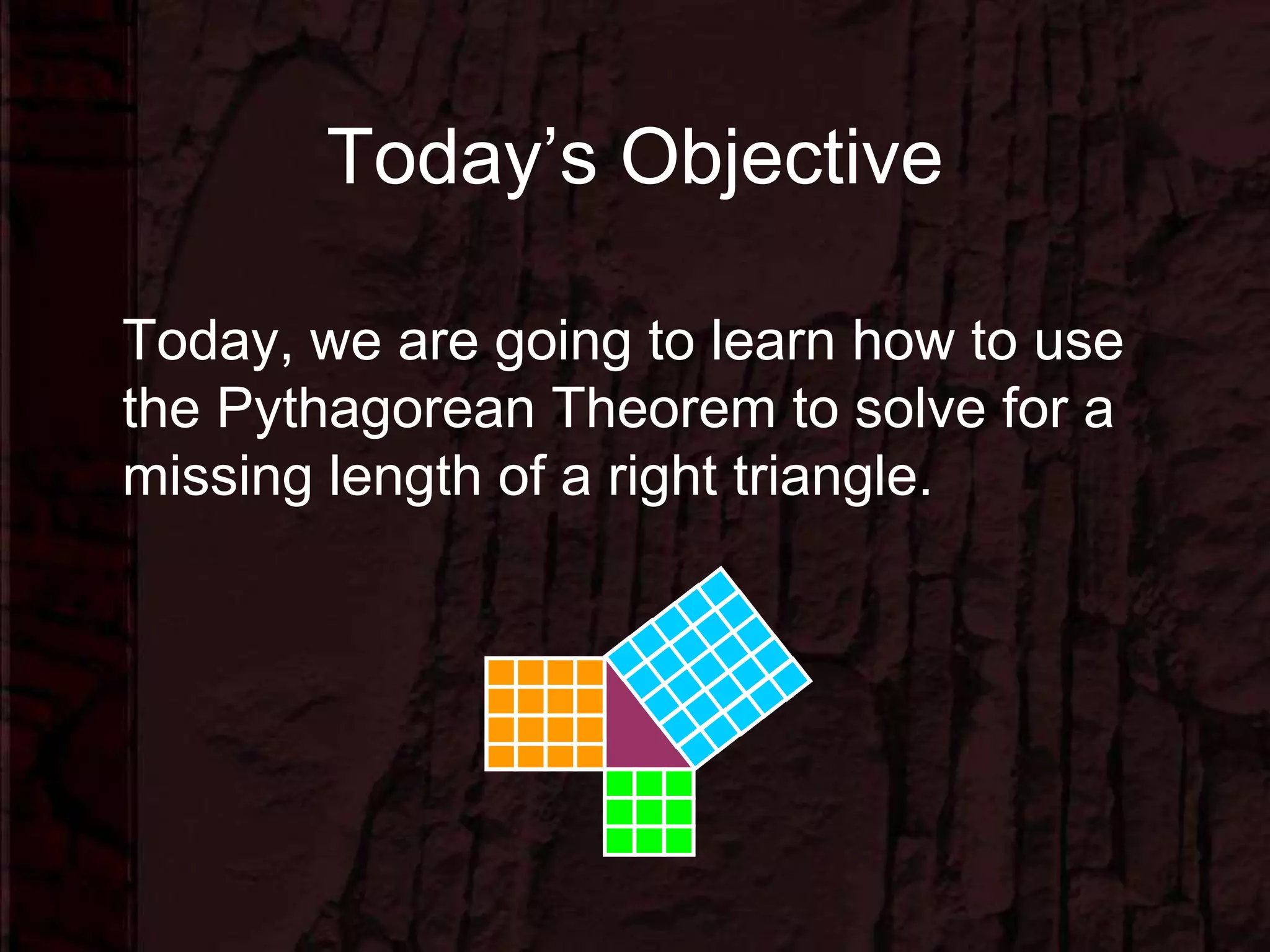
Today, we are going to learn how to use
the Pythagorean Theorem to solve for a
missing length of a right triangle.
Pythagorean Theorem
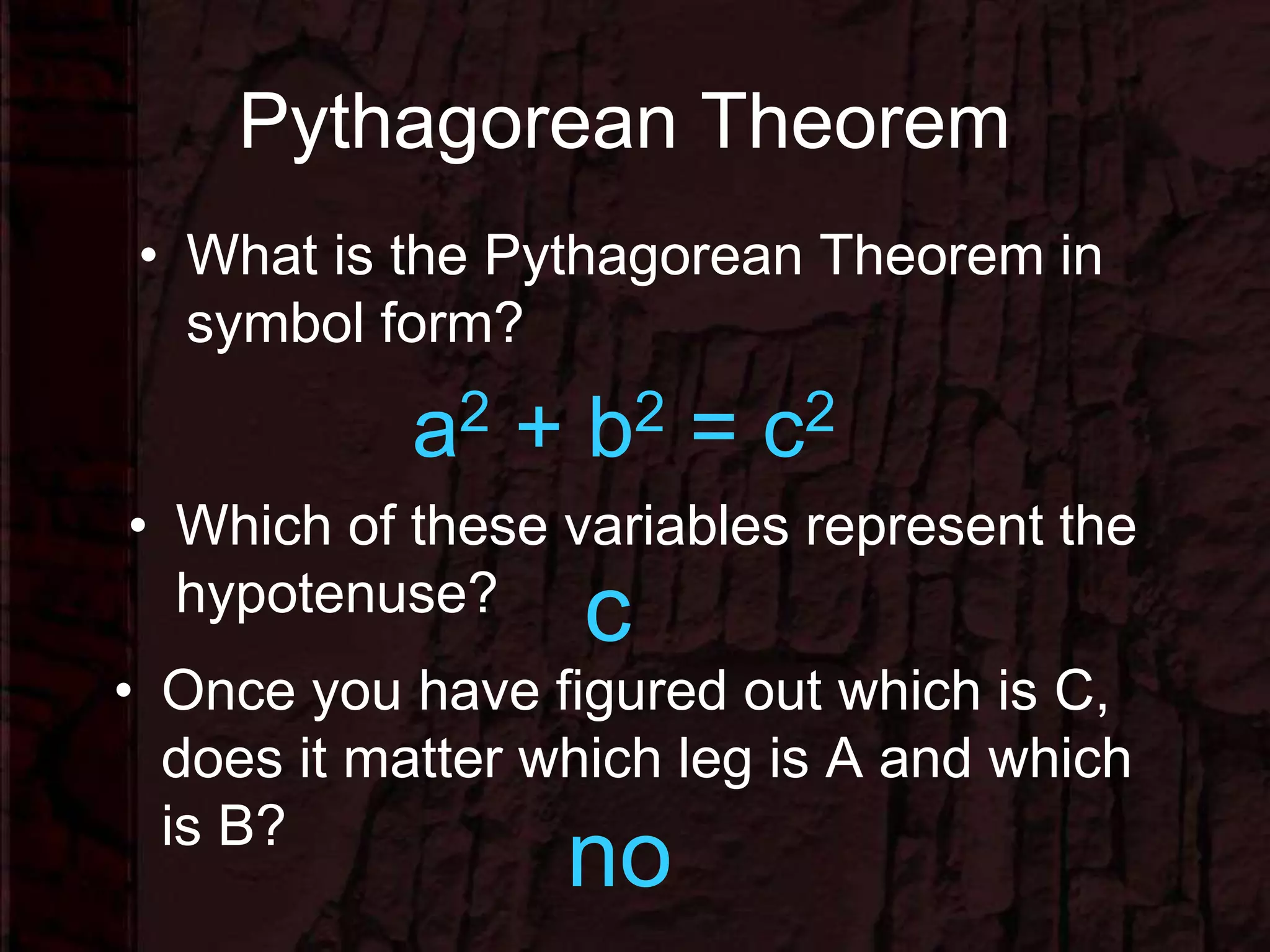
• What is the Pythagorean Theorem in
symbol form?
a2 + b2 = c2
• Which of these variables represent the
hypotenuse?
c
• Once you have figured out which is C,
does it matter which leg is A and which
is B?
no
Steps to Solve for a Missing
Side of a Triangle using the
Pythagorean Theorem
Step 1: Write the formula.
Step 2: Substitute known values for the variables.
Step 3: Solve the equation for the missing variable.
Example 1
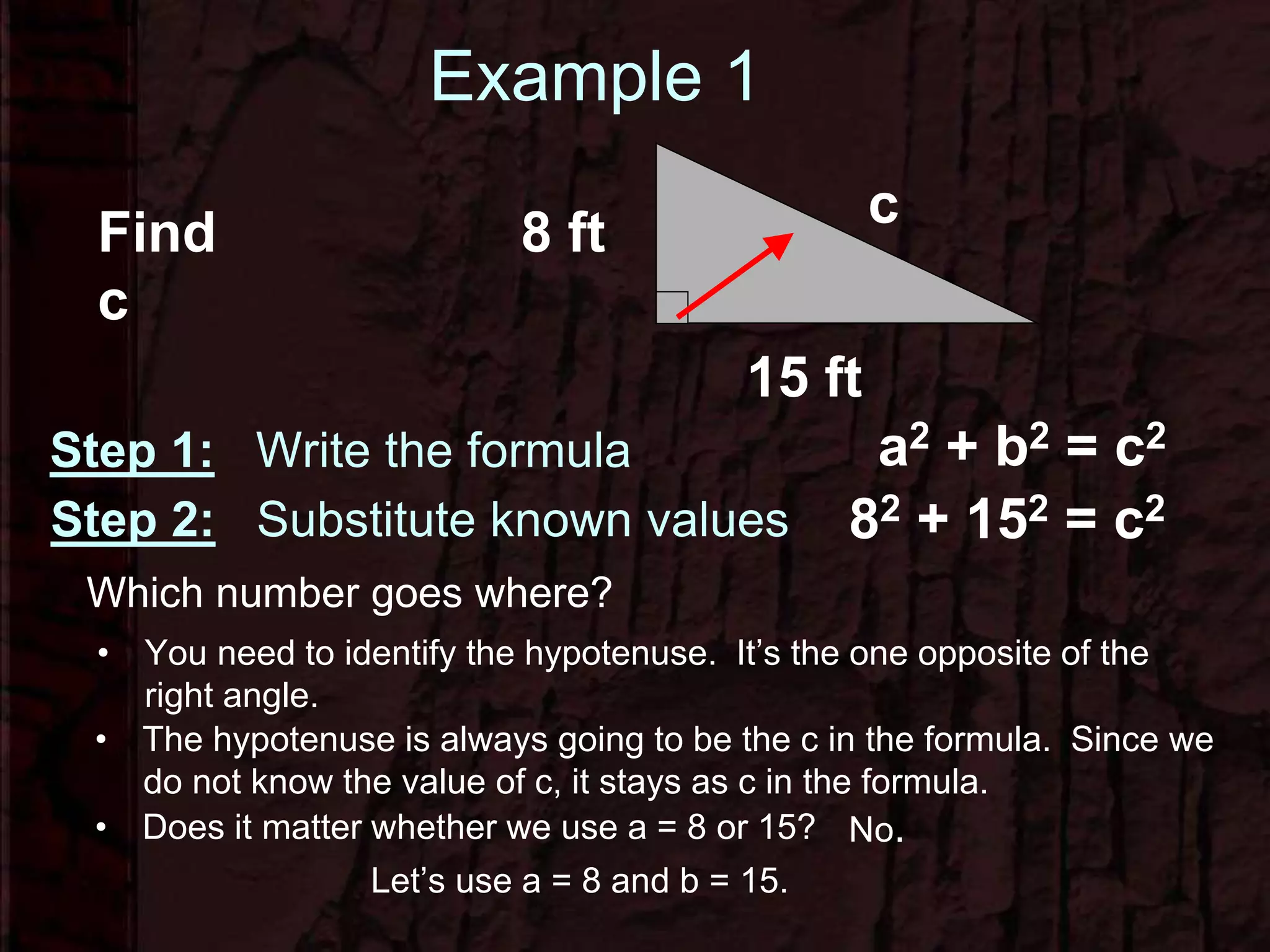
Step 1: Write the formula
c
8 ft
15 ft
Find
c
a2 + b2 = c2
82 + 152 = c2Step 2: Substitute known values
Which number goes where?
• You need to identify the hypotenuse. It’s the one opposite of the
right angle.
• Does it matter whether we use a = 8 or 15? No.
Let’s use a = 8 and b = 15.
• The hypotenuse is always going to be the c in the formula. Since we
do not know the value of c, it stays as c in the formula.
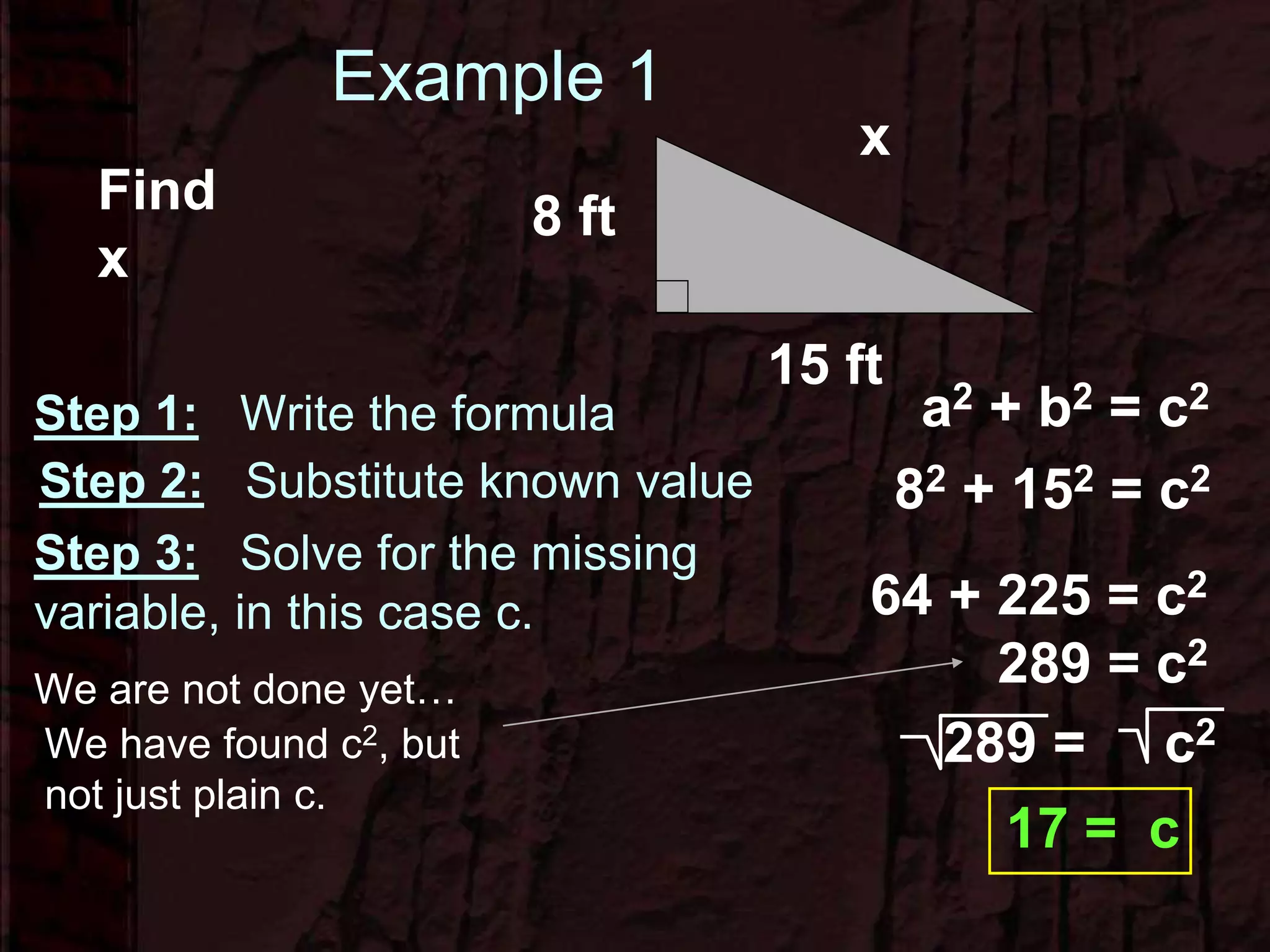
Example 1
Step 1: Write the formula
x
8 ft
15 ft
Find
x
a2 + b2 = c2
82 + 152 = c2Step 2: Substitute known value
64 + 225 = c2
289 = c2
We are not done yet…
We have found c2, but
not just plain c.
Step 3: Solve for the missing
variable, in this case c.
289 = c2
17 = c
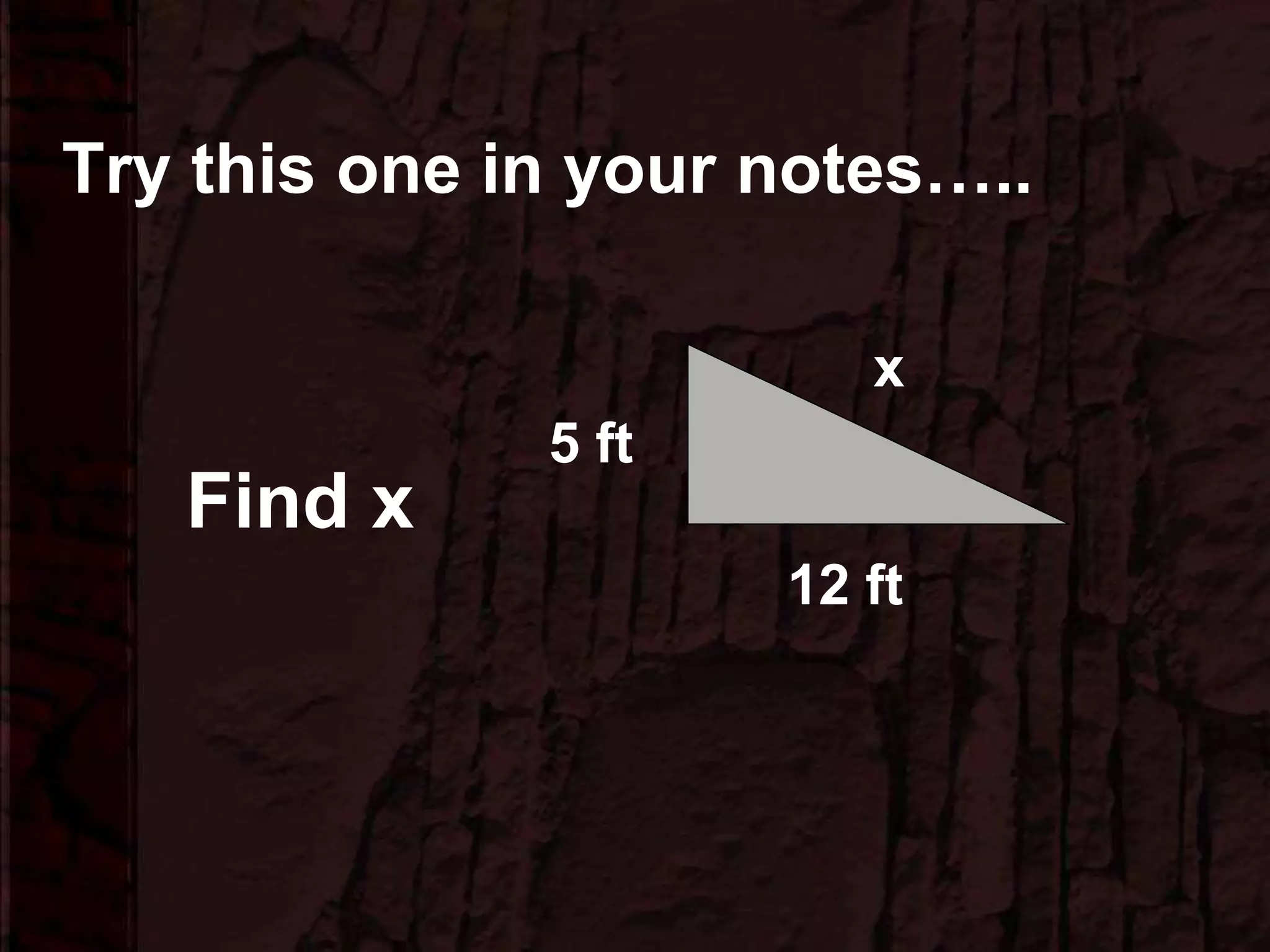
Try this one in your notes…..
x
5 ft
12 ft
Find x
Di
52 + 122 = x2
25 + 144 = x2
169 = x2
Answer x = 13
Did your work
look like this?
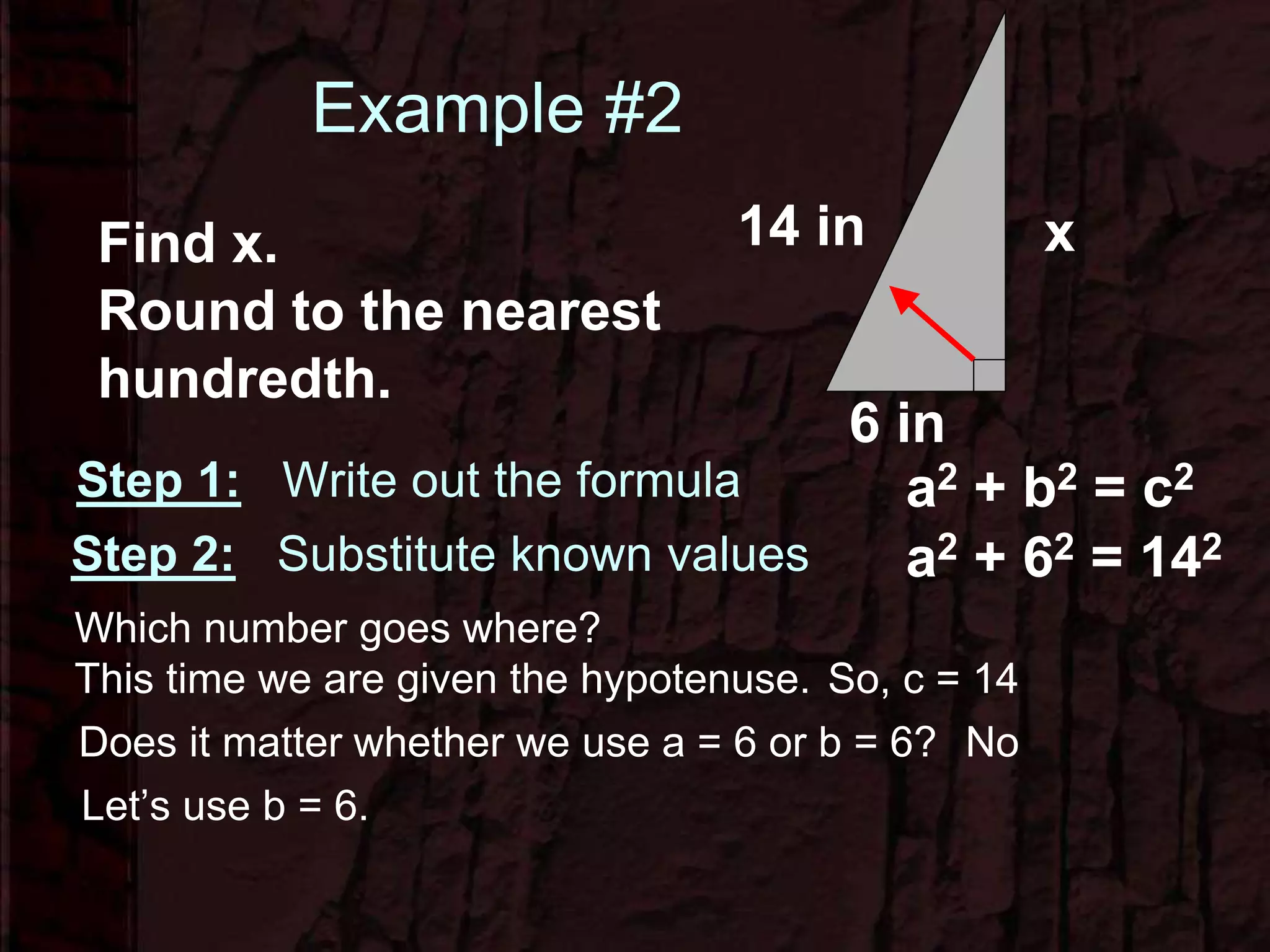
Example #2
x14 in
6 in
Find x.
Round to the nearest
hundredth.
Step 1: Write out the formula a2 + b2 = c2
a2 + 62 = 142Step 2: Substitute known values
Which number goes where?
This time we are given the hypotenuse.
Does it matter whether we use a = 6 or b = 6?
Let’s use b = 6.
So, c = 14
No
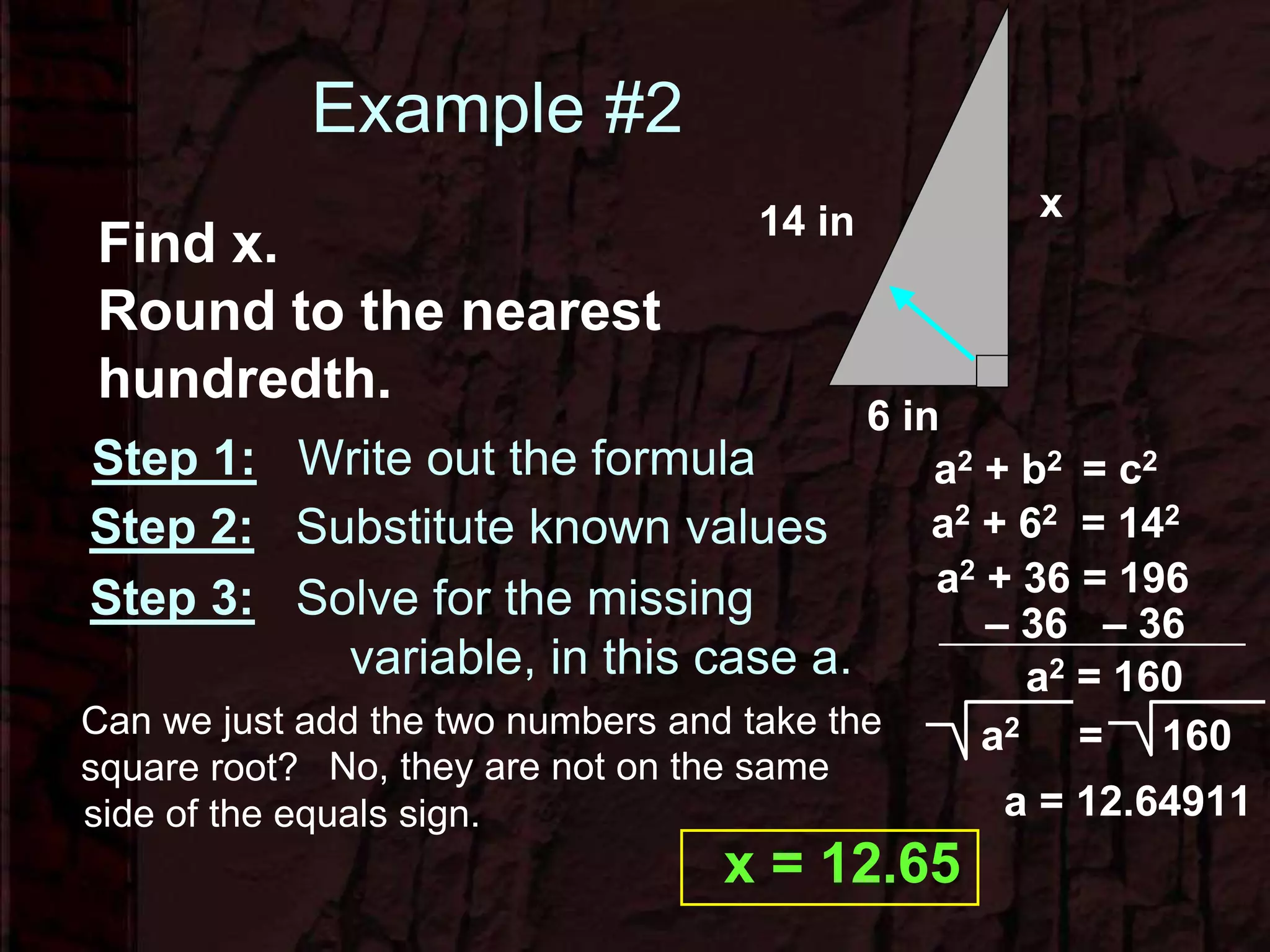
Example #2
x14 in
6 in
Find x.
Round to the nearest
hundredth.
Step 1: Write out the formula a2 + b2 = c2
a2 + 62 = 142
Step 2: Substitute known values
Step 3: Solve for the missing
variable, in this case a.
a2 + 36 = 196
Can we just add the two numbers and take the
square root? No, they are not on the same
side of the equals sign.
– 36 – 36
a2 = 160
a2 = 160
a = 12.64911
x = 12.65
What is the difference between
the 2 examples?
• Both have you squaring the given sides.
• Both have you using the square root at the
end.
• The only difference is in the middle.
– Example 1 has you adding the numbers
– Example 2 has you subtracting the smaller from
the larger.
What does this mean?
• When you have two sides of a right triangle, you
can find the third using the Pythagorean Theorem.
• Square both of the measurements you have.
• Add or subtract the two numbers depending on
whether or not you have the hypotenuse. (Subtract
if you have it, add if you don’t)
• Find the square root of the result and you have
your missing side!
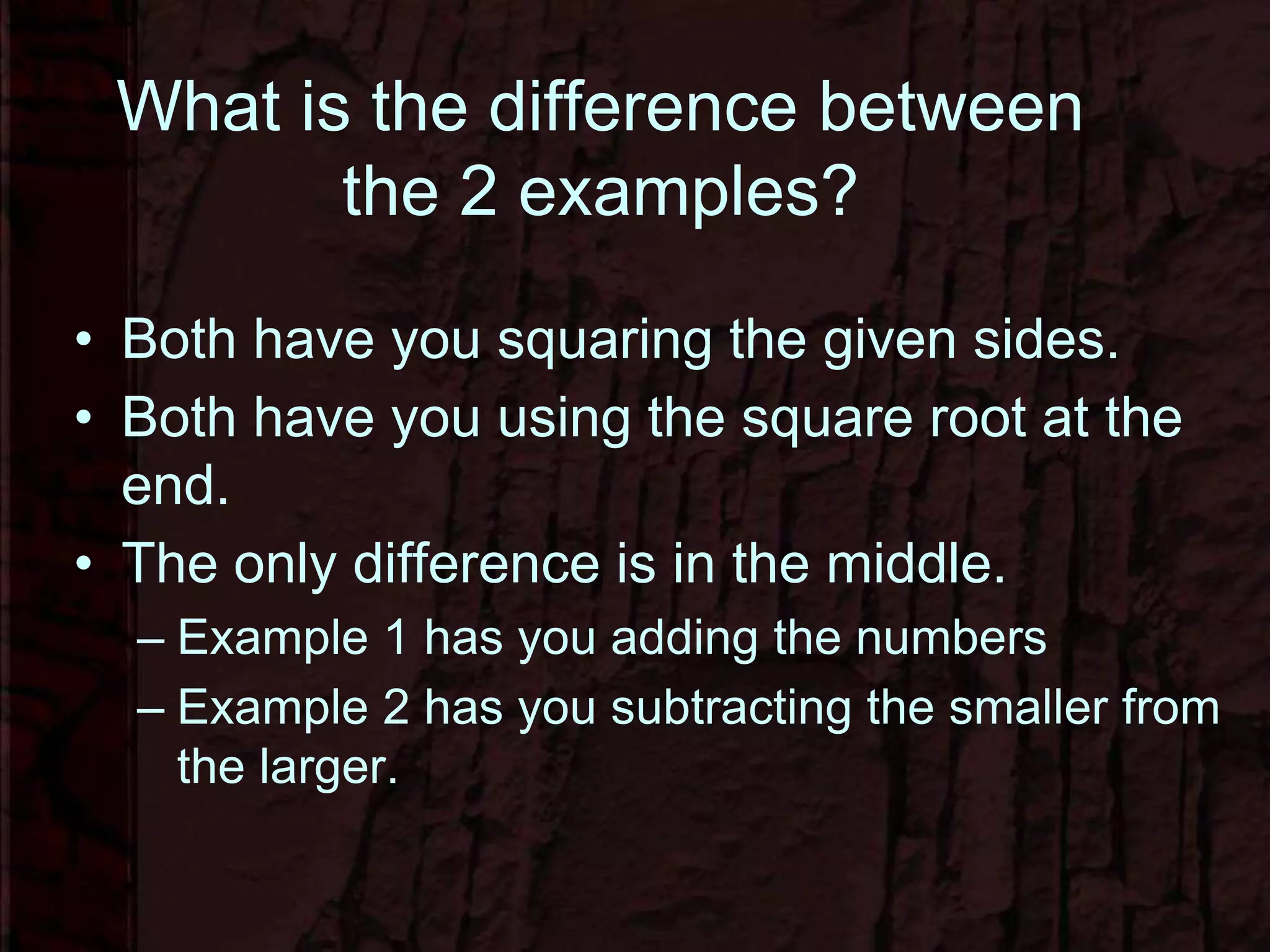
Try this one in your notes…
15
20
x
Solve for x.
Round your answer to the nearest hundredth if necessary.
Answer: 25
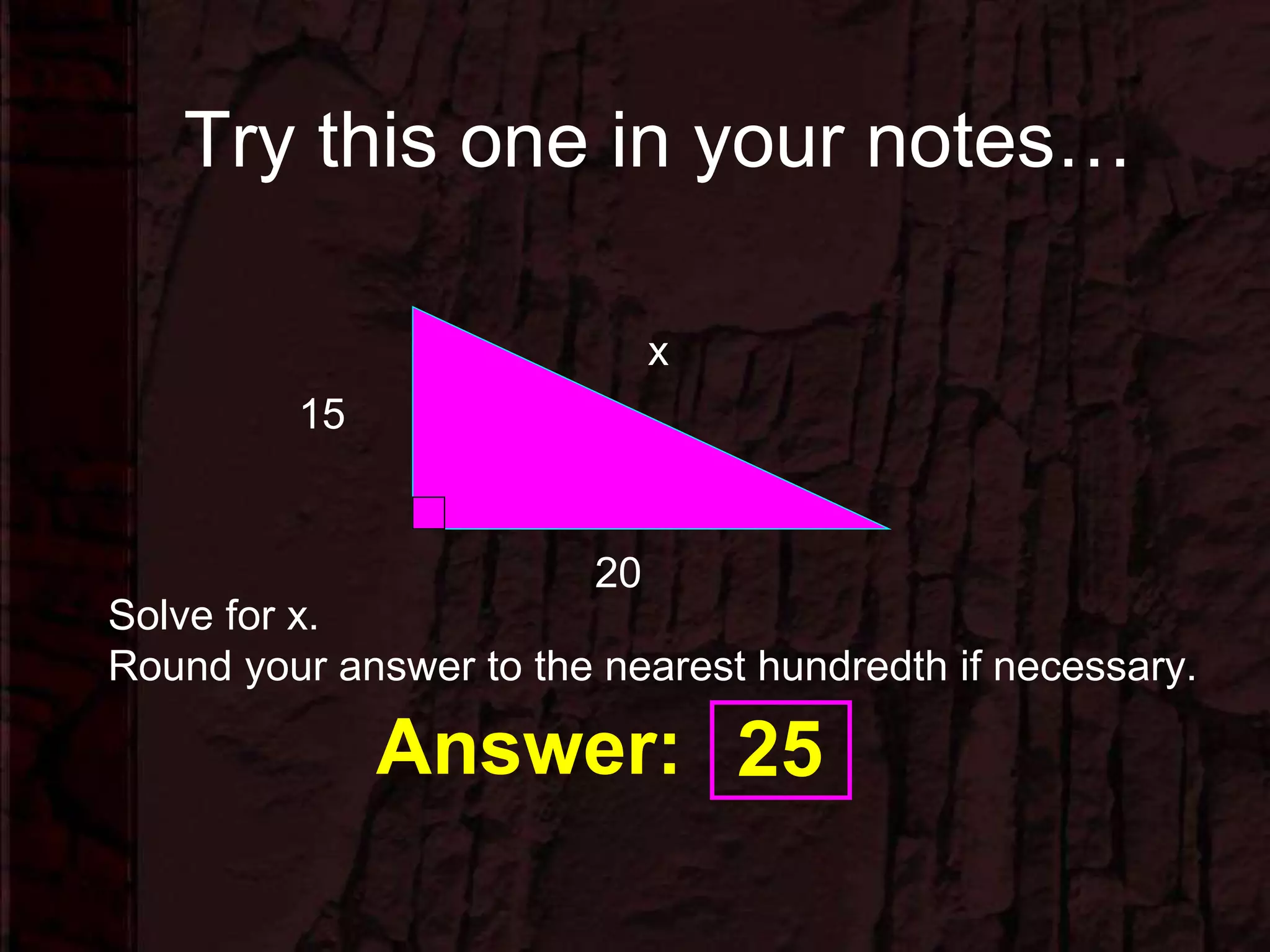
Try this one in your notes…
7
12
x
Solve for x.
Round your answer to the nearest hundredth if necessary.
Answer: 13.89
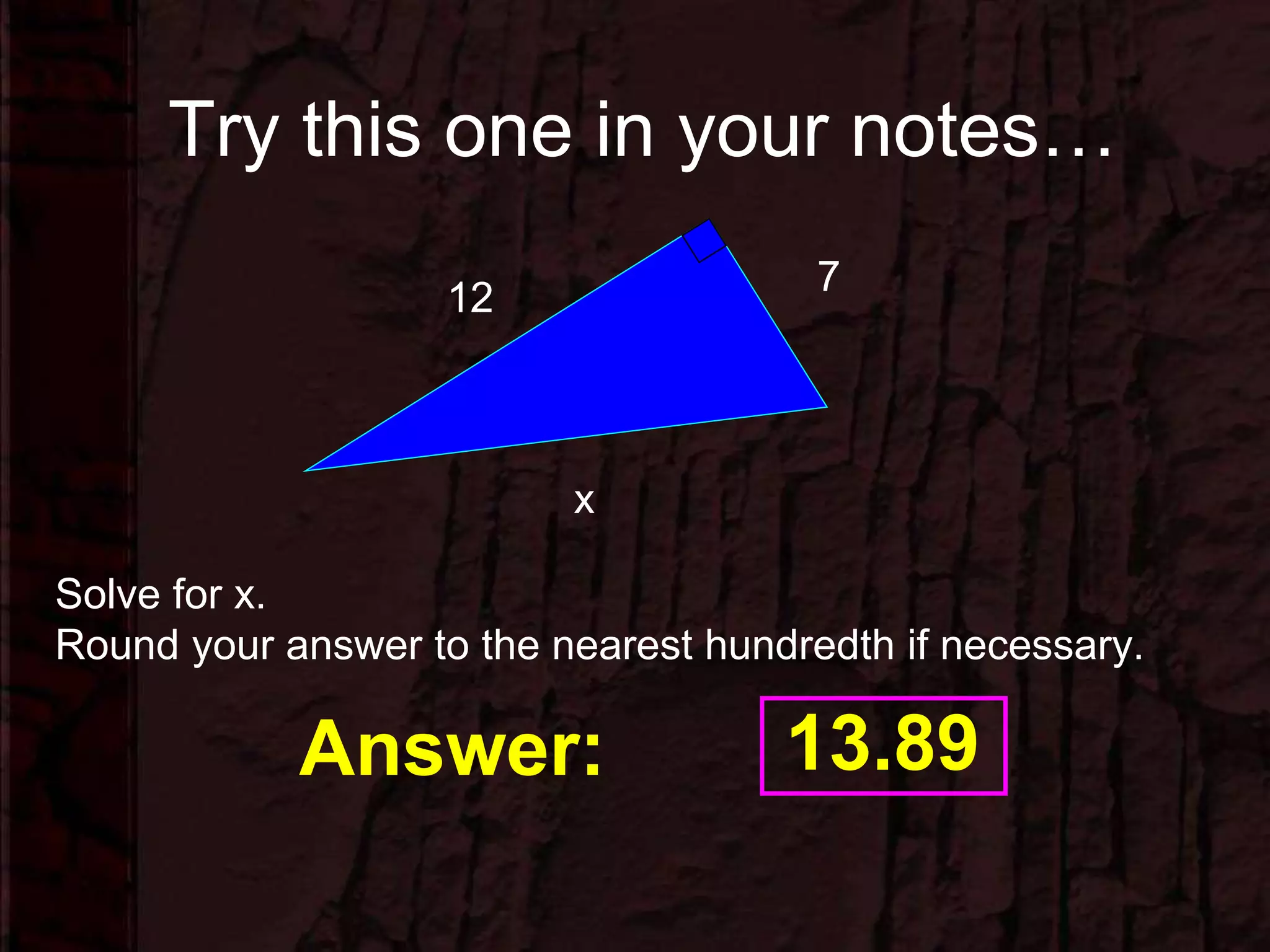
Try this one in your notes…
3
x5
Answer: 4
Solve for x.
Round your answer to the nearest hundredth if necessary.
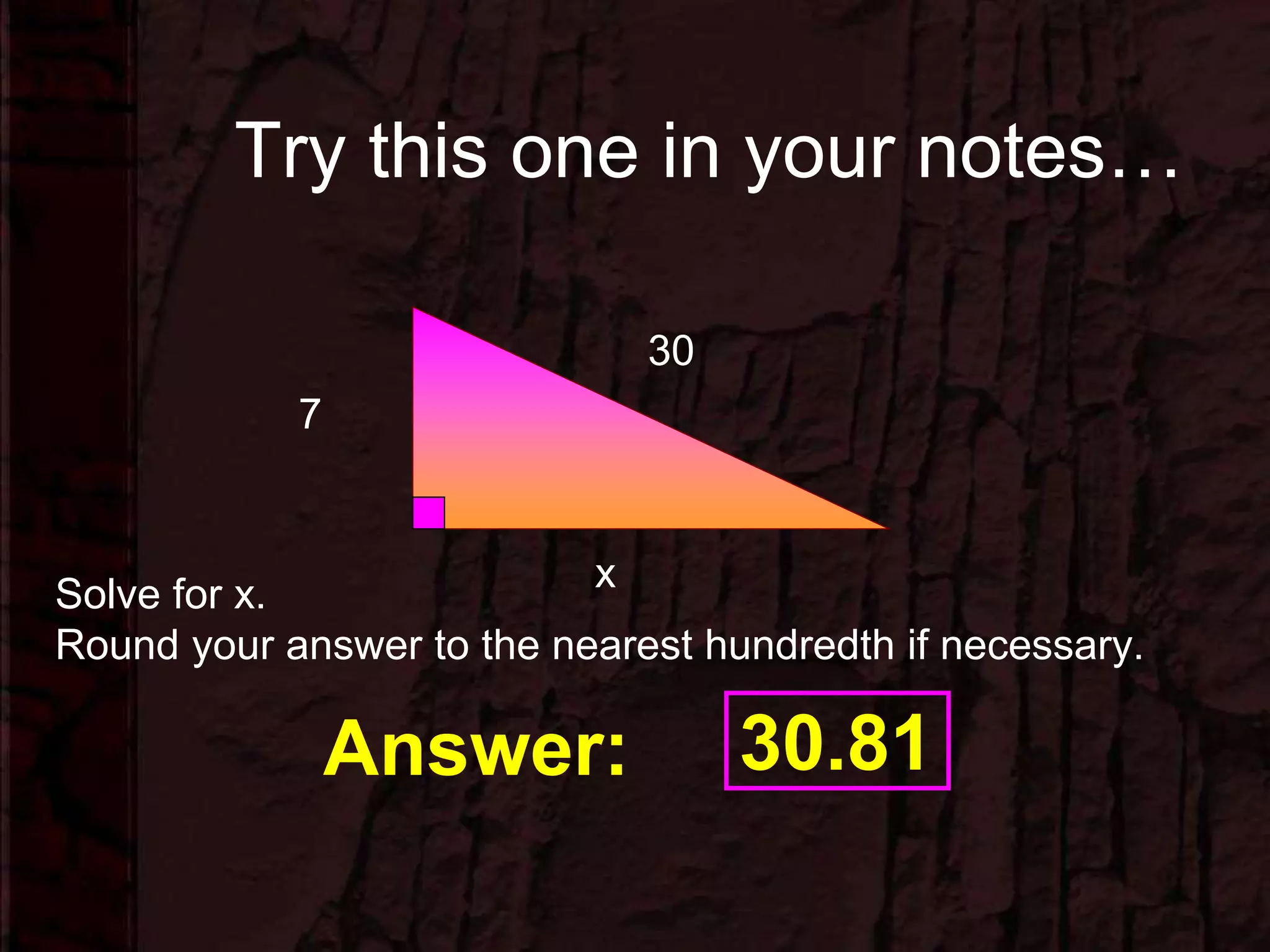
Try this one in your notes…
7
x
30
Answer: 30.81
Solve for x.
Round your answer to the nearest hundredth if necessary.
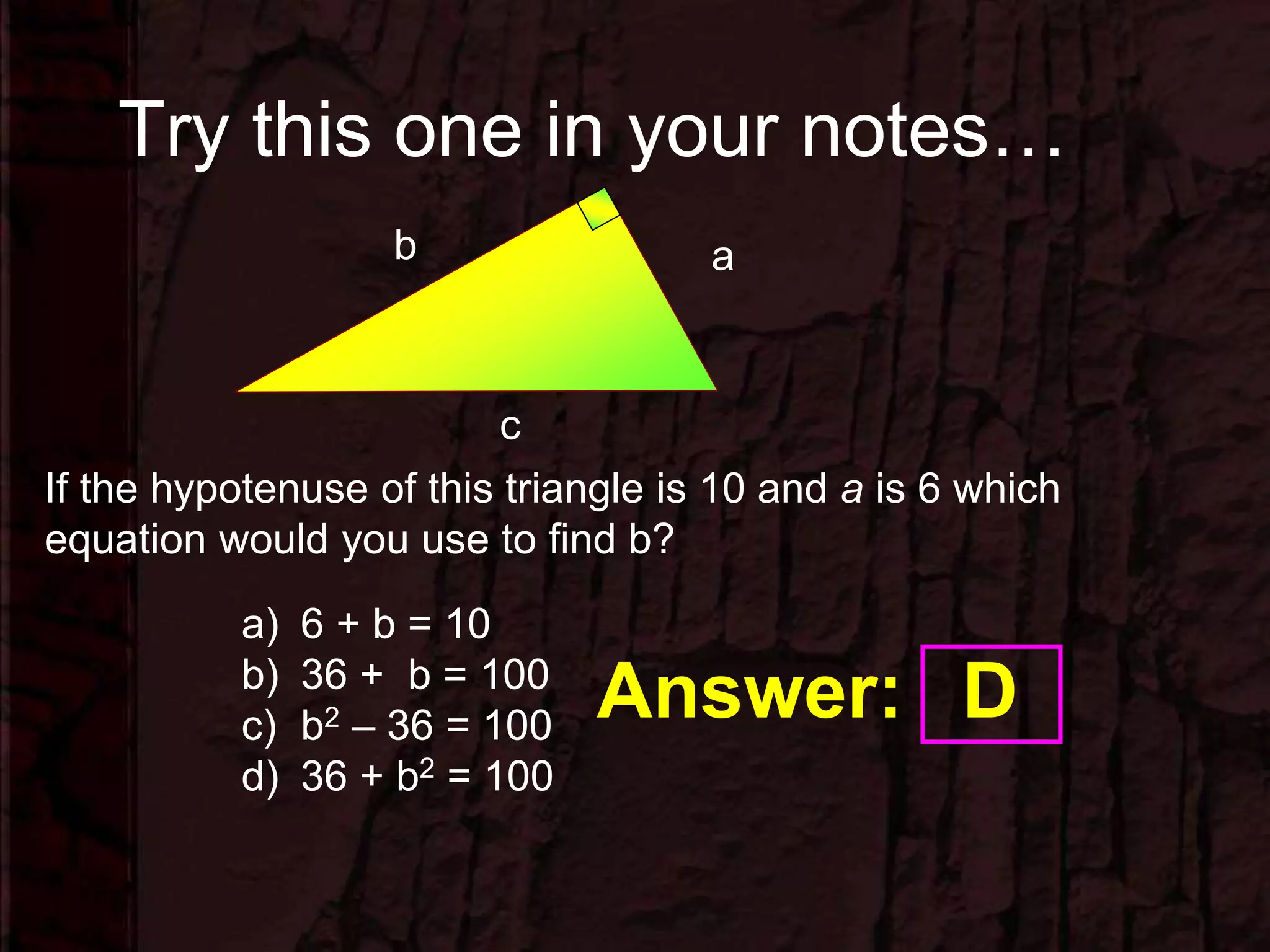
Try this one in your notes…
ab
c
Answer: D
If the hypotenuse of this triangle is 10 and a is 6 which
equation would you use to find b?
a) 6 + b = 10
b) 36 + b = 100
c) b2 – 36 = 100
d) 36 + b2 = 100
Please email me or call
me if you have any
difficulties working the
practice problems.

Power point pythagorean theorem revised

  • 1.
    Pythagorean Theorem Apply thePythagorean Theorem to determine unknown side lengths in right triangles in real-world and mathematical problems in two and three dimensions.
  • 2.
    Today’s Objective Today, weare going to learn how to use the Pythagorean Theorem to solve for a missing length of a right triangle.
  • 3.
    Pythagorean Theorem • Whatis the Pythagorean Theorem in symbol form? a2 + b2 = c2 • Which of these variables represent the hypotenuse? c • Once you have figured out which is C, does it matter which leg is A and which is B? no
  • 4.
    Steps to Solvefor a Missing Side of a Triangle using the Pythagorean Theorem Step 1: Write the formula. Step 2: Substitute known values for the variables. Step 3: Solve the equation for the missing variable.
  • 5.
    Example 1 Step 1:Write the formula c 8 ft 15 ft Find c a2 + b2 = c2 82 + 152 = c2Step 2: Substitute known values Which number goes where? • You need to identify the hypotenuse. It’s the one opposite of the right angle. • Does it matter whether we use a = 8 or 15? No. Let’s use a = 8 and b = 15. • The hypotenuse is always going to be the c in the formula. Since we do not know the value of c, it stays as c in the formula.
  • 6.
    Example 1 Step 1:Write the formula x 8 ft 15 ft Find x a2 + b2 = c2 82 + 152 = c2Step 2: Substitute known value 64 + 225 = c2 289 = c2 We are not done yet… We have found c2, but not just plain c. Step 3: Solve for the missing variable, in this case c. 289 = c2 17 = c
  • 7.
    Try this onein your notes….. x 5 ft 12 ft Find x
  • 8.
    Di 52 + 122= x2 25 + 144 = x2 169 = x2 Answer x = 13 Did your work look like this?
  • 9.
    Example #2 x14 in 6in Find x. Round to the nearest hundredth. Step 1: Write out the formula a2 + b2 = c2 a2 + 62 = 142Step 2: Substitute known values Which number goes where? This time we are given the hypotenuse. Does it matter whether we use a = 6 or b = 6? Let’s use b = 6. So, c = 14 No
  • 10.
    Example #2 x14 in 6in Find x. Round to the nearest hundredth. Step 1: Write out the formula a2 + b2 = c2 a2 + 62 = 142 Step 2: Substitute known values Step 3: Solve for the missing variable, in this case a. a2 + 36 = 196 Can we just add the two numbers and take the square root? No, they are not on the same side of the equals sign. – 36 – 36 a2 = 160 a2 = 160 a = 12.64911 x = 12.65
  • 11.
    What is thedifference between the 2 examples? • Both have you squaring the given sides. • Both have you using the square root at the end. • The only difference is in the middle. – Example 1 has you adding the numbers – Example 2 has you subtracting the smaller from the larger.
  • 12.
    What does thismean? • When you have two sides of a right triangle, you can find the third using the Pythagorean Theorem. • Square both of the measurements you have. • Add or subtract the two numbers depending on whether or not you have the hypotenuse. (Subtract if you have it, add if you don’t) • Find the square root of the result and you have your missing side!
  • 13.
    Try this onein your notes… 15 20 x Solve for x. Round your answer to the nearest hundredth if necessary. Answer: 25
  • 14.
    Try this onein your notes… 7 12 x Solve for x. Round your answer to the nearest hundredth if necessary. Answer: 13.89
  • 15.
    Try this onein your notes… 3 x5 Answer: 4 Solve for x. Round your answer to the nearest hundredth if necessary.
  • 16.
    Try this onein your notes… 7 x 30 Answer: 30.81 Solve for x. Round your answer to the nearest hundredth if necessary.
  • 17.
    Try this onein your notes… ab c Answer: D If the hypotenuse of this triangle is 10 and a is 6 which equation would you use to find b? a) 6 + b = 10 b) 36 + b = 100 c) b2 – 36 = 100 d) 36 + b2 = 100
  • 18.
    Please email meor call me if you have any difficulties working the practice problems.