4th Grade Math 
Number Sense and 
Operations 
Jessica Corriere & Robert Richards
Number Sense, 
decimals, 
fractions, and negative 
numbers, 
operations and 
factoring
This PowerPoint is a 
sample of the book, 4th 
Grade Math
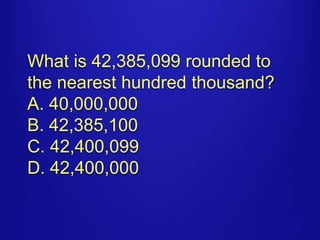
What is 42,385,099 rounded to 
the nearest hundred thousand? 
A. 40,000,000 
B. 42,385,100 
C. 42,400,099 
D. 42,400,000
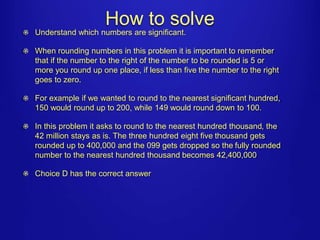
How to solve 
Understand which numbers are significant. 
When rounding numbers in this problem it is important to remember 
that if the number to the right of the number to be rounded is 5 or 
more you round up one place, if less than five the number to the right 
goes to zero. 
For example if we wanted to round to the nearest significant hundred, 
150 would round up to 200, while 149 would round down to 100. 
In this problem it asks to round to the nearest hundred thousand, the 
42 million stays as is. The three hundred eight five thousand gets 
rounded up to 400,000 and the 099 gets dropped so the fully rounded 
number to the nearest hundred thousand becomes 42,400,000 
Choice D has the correct answer
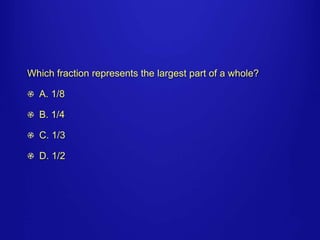
Which fraction represents the largest part of a whole? 
A. 1/8 
B. 1/4 
C. 1/3 
D. 1/2
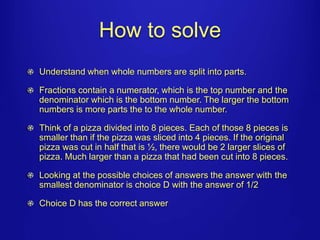
How to solve 
Understand when whole numbers are split into parts. 
Fractions contain a numerator, which is the top number and the 
denominator which is the bottom number. The larger the bottom 
numbers is more parts the to the whole number. 
Think of a pizza divided into 8 pieces. Each of those 8 pieces is 
smaller than if the pizza was sliced into 4 pieces. If the original 
pizza was cut in half that is ½, there would be 2 larger slices of 
pizza. Much larger than a pizza that had been cut into 8 pieces. 
Looking at the possible choices of answers the answer with the 
smallest denominator is choice D with the answer of 1/2 
Choice D has the correct answer
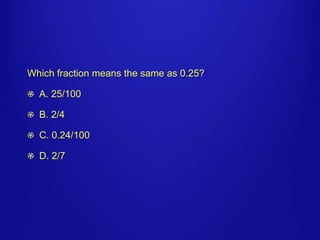
Which fraction means the same as 0.25? 
A. 25/100 
B. 2/4 
C. 0.24/100 
D. 2/7
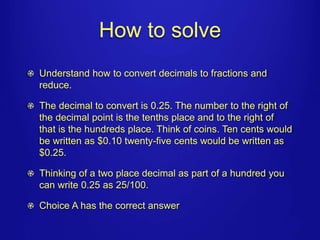
How to solve 
Understand how to convert decimals to fractions and 
reduce. 
The decimal to convert is 0.25. The number to the right of 
the decimal point is the tenths place and to the right of 
that is the hundreds place. Think of coins. Ten cents would 
be written as $0.10 twenty-five cents would be written as 
$0.25. 
Thinking of a two place decimal as part of a hundred you 
can write 0.25 as 25/100. 
Choice A has the correct answer
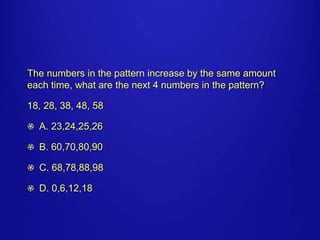
The numbers in the pattern increase by the same amount 
each time, what are the next 4 numbers in the pattern? 
18, 28, 38, 48, 58 
A. 23,24,25,26 
B. 60,70,80,90 
C. 68,78,88,98 
D. 0,6,12,18
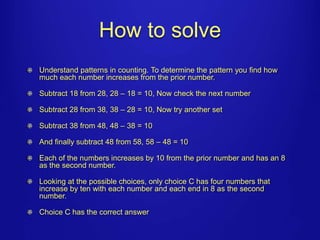
How to solve 
Understand patterns in counting. To determine the pattern you find how 
much each number increases from the prior number. 
Subtract 18 from 28, 28 – 18 = 10, Now check the next number 
Subtract 28 from 38, 38 – 28 = 10, Now try another set 
Subtract 38 from 48, 48 – 38 = 10 
And finally subtract 48 from 58, 58 – 48 = 10 
Each of the numbers increases by 10 from the prior number and has an 8 
as the second number. 
Looking at the possible choices, only choice C has four numbers that 
increase by ten with each number and each end in 8 as the second 
number. 
Choice C has the correct answer
Algebra and functions
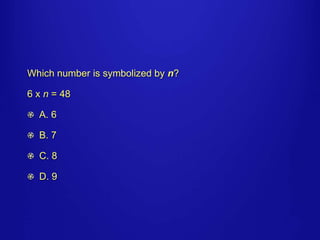
Which number is symbolized by n? 
6 x n = 48 
A. 6 
B. 7 
C. 8 
D. 9
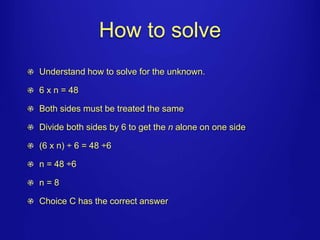
How to solve 
Understand how to solve for the unknown. 
6 x n = 48 
Both sides must be treated the same 
Divide both sides by 6 to get the n alone on one side 
(6 x n) ÷ 6 = 48 ÷6 
n = 48 ÷6 
n = 8 
Choice C has the correct answer
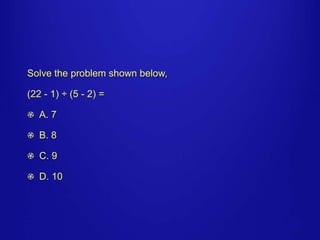
Solve the problem shown below, 
(22 - 1) ÷ (5 - 2) = 
A. 7 
B. 8 
C. 9 
D. 10
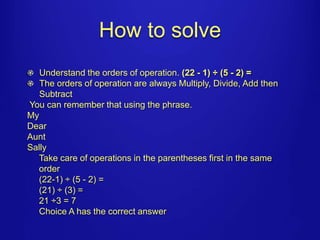
How to solve 
Understand the orders of operation. (22 - 1) ÷ (5 - 2) = 
The orders of operation are always Multiply, Divide, Add then 
Subtract 
You can remember that using the phrase. 
My 
Dear 
Aunt 
Sally 
Take care of operations in the parentheses first in the same 
order 
(22-1) ÷ (5 - 2) = 
(21) ÷ (3) = 
21 ÷3 = 7 
Choice A has the correct answer
Measurement and 
Geometry
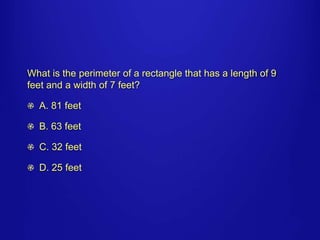
What is the perimeter of a rectangle that has a length of 9 
feet and a width of 7 feet? 
A. 81 feet 
B. 63 feet 
C. 32 feet 
D. 25 feet
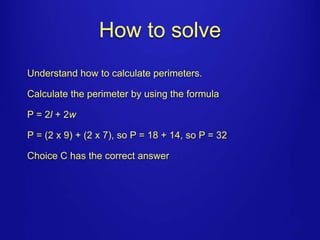
How to solve 
Understand how to calculate perimeters. 
Calculate the perimeter by using the formula 
P = 2l + 2w 
P = (2 x 9) + (2 x 7), so P = 18 + 14, so P = 32 
Choice C has the correct answer
This has been a sample of the 
book, “4th Grade Math” 
The best 4th grade study guide to prepare your student for 
mathematic exams. The book teaches children to 
understand basic math concepts, skills, and strategies of 
the California Common Core Curriculum Standards with 
detailed step by step explanations to solving typical exam 
problems. It's like studying with your own private tutor! 
This book features a user friendly format perfect for 
browsing, research, and review. Three practice test and 
answer keys included; covering review topics: Number 
Sense, Algebra, Geometry, Measurement, Probability and 
Statistics. All content aligned to state and national 
standards.
E-books only $2.99 
We have 4th and 6th grade eBooks available 
on; 
Amazon (Click Link) 
6th grade eBook on Nook (click Link) 
6th grade eBook on iBooks (click link)

4th grade math number sense and operations

  • 1.
    4th Grade Math Number Sense and Operations Jessica Corriere & Robert Richards
  • 2.
    Number Sense, decimals, fractions, and negative numbers, operations and factoring
  • 3.
    This PowerPoint isa sample of the book, 4th Grade Math
  • 4.
    What is 42,385,099rounded to the nearest hundred thousand? A. 40,000,000 B. 42,385,100 C. 42,400,099 D. 42,400,000
  • 5.
    How to solve Understand which numbers are significant. When rounding numbers in this problem it is important to remember that if the number to the right of the number to be rounded is 5 or more you round up one place, if less than five the number to the right goes to zero. For example if we wanted to round to the nearest significant hundred, 150 would round up to 200, while 149 would round down to 100. In this problem it asks to round to the nearest hundred thousand, the 42 million stays as is. The three hundred eight five thousand gets rounded up to 400,000 and the 099 gets dropped so the fully rounded number to the nearest hundred thousand becomes 42,400,000 Choice D has the correct answer
  • 6.
    Which fraction representsthe largest part of a whole? A. 1/8 B. 1/4 C. 1/3 D. 1/2
  • 7.
    How to solve Understand when whole numbers are split into parts. Fractions contain a numerator, which is the top number and the denominator which is the bottom number. The larger the bottom numbers is more parts the to the whole number. Think of a pizza divided into 8 pieces. Each of those 8 pieces is smaller than if the pizza was sliced into 4 pieces. If the original pizza was cut in half that is ½, there would be 2 larger slices of pizza. Much larger than a pizza that had been cut into 8 pieces. Looking at the possible choices of answers the answer with the smallest denominator is choice D with the answer of 1/2 Choice D has the correct answer
  • 8.
    Which fraction meansthe same as 0.25? A. 25/100 B. 2/4 C. 0.24/100 D. 2/7
  • 9.
    How to solve Understand how to convert decimals to fractions and reduce. The decimal to convert is 0.25. The number to the right of the decimal point is the tenths place and to the right of that is the hundreds place. Think of coins. Ten cents would be written as $0.10 twenty-five cents would be written as $0.25. Thinking of a two place decimal as part of a hundred you can write 0.25 as 25/100. Choice A has the correct answer
  • 10.
    The numbers inthe pattern increase by the same amount each time, what are the next 4 numbers in the pattern? 18, 28, 38, 48, 58 A. 23,24,25,26 B. 60,70,80,90 C. 68,78,88,98 D. 0,6,12,18
  • 11.
    How to solve Understand patterns in counting. To determine the pattern you find how much each number increases from the prior number. Subtract 18 from 28, 28 – 18 = 10, Now check the next number Subtract 28 from 38, 38 – 28 = 10, Now try another set Subtract 38 from 48, 48 – 38 = 10 And finally subtract 48 from 58, 58 – 48 = 10 Each of the numbers increases by 10 from the prior number and has an 8 as the second number. Looking at the possible choices, only choice C has four numbers that increase by ten with each number and each end in 8 as the second number. Choice C has the correct answer
  • 12.
  • 13.
    Which number issymbolized by n? 6 x n = 48 A. 6 B. 7 C. 8 D. 9
  • 14.
    How to solve Understand how to solve for the unknown. 6 x n = 48 Both sides must be treated the same Divide both sides by 6 to get the n alone on one side (6 x n) ÷ 6 = 48 ÷6 n = 48 ÷6 n = 8 Choice C has the correct answer
  • 15.
    Solve the problemshown below, (22 - 1) ÷ (5 - 2) = A. 7 B. 8 C. 9 D. 10
  • 16.
    How to solve Understand the orders of operation. (22 - 1) ÷ (5 - 2) = The orders of operation are always Multiply, Divide, Add then Subtract You can remember that using the phrase. My Dear Aunt Sally Take care of operations in the parentheses first in the same order (22-1) ÷ (5 - 2) = (21) ÷ (3) = 21 ÷3 = 7 Choice A has the correct answer
  • 17.
  • 18.
    What is theperimeter of a rectangle that has a length of 9 feet and a width of 7 feet? A. 81 feet B. 63 feet C. 32 feet D. 25 feet
  • 19.
    How to solve Understand how to calculate perimeters. Calculate the perimeter by using the formula P = 2l + 2w P = (2 x 9) + (2 x 7), so P = 18 + 14, so P = 32 Choice C has the correct answer
  • 20.
    This has beena sample of the book, “4th Grade Math” The best 4th grade study guide to prepare your student for mathematic exams. The book teaches children to understand basic math concepts, skills, and strategies of the California Common Core Curriculum Standards with detailed step by step explanations to solving typical exam problems. It's like studying with your own private tutor! This book features a user friendly format perfect for browsing, research, and review. Three practice test and answer keys included; covering review topics: Number Sense, Algebra, Geometry, Measurement, Probability and Statistics. All content aligned to state and national standards.
  • 21.
    E-books only $2.99 We have 4th and 6th grade eBooks available on; Amazon (Click Link) 6th grade eBook on Nook (click Link) 6th grade eBook on iBooks (click link)