1.1 Patterns and Inductive
        Reasoning
Inductive Reasoning
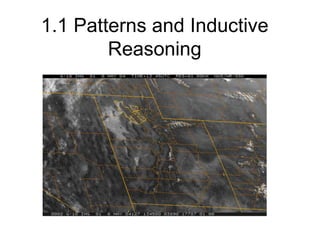
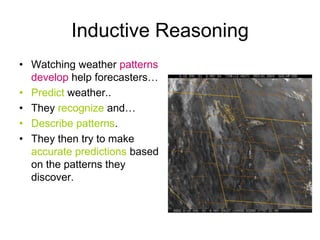
• Watching weather patterns
  develop help forecasters…
• Predict weather..
• They recognize and…
• Describe patterns.
• They then try to make
  accurate predictions based
  on the patterns they
  discover.
Patterns & Inductive Reasoning
• In Geometry, we will
• Study many
  patterns…
• Some discovered by
  others….
• Some we will
  discover…
• And use those
  patterns to make
  accurate predictions
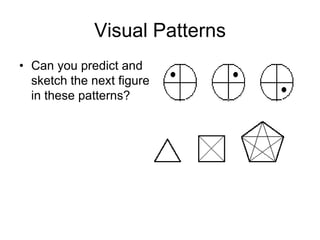
Visual Patterns
• Can you predict and
  sketch the next figure
  in these patterns?
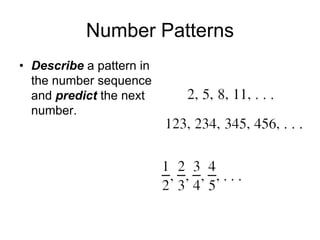
Number Patterns
• Describe a pattern in
  the number sequence
  and predict the next
  number.
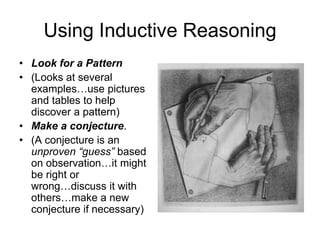
Using Inductive Reasoning
• Look for a Pattern
• (Looks at several
  examples…use pictures
  and tables to help
  discover a pattern)
• Make a conjecture.
• (A conjecture is an
  unproven “guess” based
  on observation…it might
  be right or
  wrong…discuss it with
  others…make a new
  conjecture if necessary)
How do you know your
  conjecture is True or False?
• To prove a conjecture is TRUE, you need
  to prove it is ALWAYS true (not always
  so easy!)
• To prove a conjecture is FALSE, you need
  only provide a SINGLE counterexample.
• A counterexample is an example that
  shows a conjecture is false.
Decide if this conjecture is
        TRUE or FALSE.
• All people over 6 feet tall are good basketball
  players.
• This conjecture is false (there are plenty of
  counterexamples…)
• A full moon occurs every 29 or 30 days.
• This conjecture is true. The moon revolves
  around Earth once approximately every 29.5
  days.
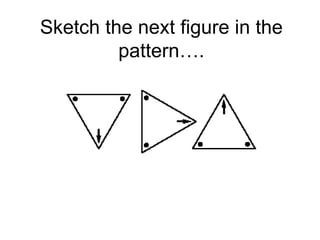
Sketch the next figure in the
         pattern….
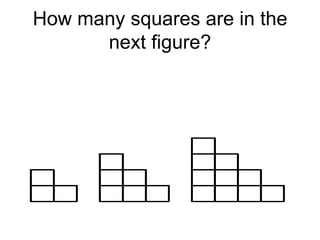
How many squares are in the
      next figure?
Patterns
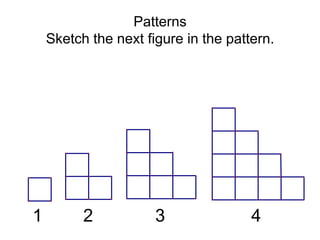
    Sketch the next figure in the pattern.


1         2           3               4
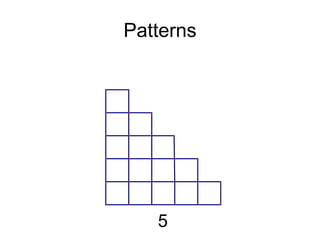
Patterns


   5
Example
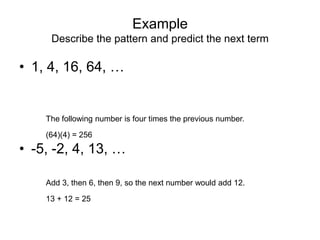
     Describe the pattern and predict the next term

• 1, 4, 16, 64, …


    The following number is four times the previous number.

    (64)(4) = 256
• -5, -2, 4, 13, …

    Add 3, then 6, then 9, so the next number would add 12.

    13 + 12 = 25
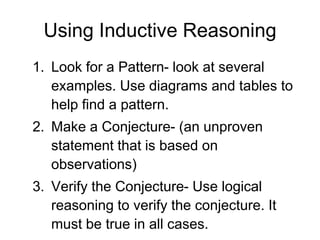
Using Inductive Reasoning
1. Look for a Pattern- look at several
   examples. Use diagrams and tables to
   help find a pattern.
2. Make a Conjecture- (an unproven
   statement that is based on
   observations)
3. Verify the Conjecture- Use logical
   reasoning to verify the conjecture. It
   must be true in all cases.
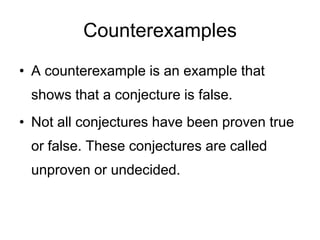
Counterexamples
• A counterexample is an example that
 shows that a conjecture is false.
• Not all conjectures have been proven true
 or false. These conjectures are called
 unproven or undecided.

Geometry 1.1 patterns and inductive reasoning

  • 1.
    1.1 Patterns andInductive Reasoning
  • 2.
    Inductive Reasoning • Watchingweather patterns develop help forecasters… • Predict weather.. • They recognize and… • Describe patterns. • They then try to make accurate predictions based on the patterns they discover.
  • 3.
    Patterns & InductiveReasoning • In Geometry, we will • Study many patterns… • Some discovered by others…. • Some we will discover… • And use those patterns to make accurate predictions
  • 4.
    Visual Patterns • Canyou predict and sketch the next figure in these patterns?
  • 5.
    Number Patterns • Describea pattern in the number sequence and predict the next number.
  • 6.
    Using Inductive Reasoning •Look for a Pattern • (Looks at several examples…use pictures and tables to help discover a pattern) • Make a conjecture. • (A conjecture is an unproven “guess” based on observation…it might be right or wrong…discuss it with others…make a new conjecture if necessary)
  • 7.
    How do youknow your conjecture is True or False? • To prove a conjecture is TRUE, you need to prove it is ALWAYS true (not always so easy!) • To prove a conjecture is FALSE, you need only provide a SINGLE counterexample. • A counterexample is an example that shows a conjecture is false.
  • 8.
    Decide if thisconjecture is TRUE or FALSE. • All people over 6 feet tall are good basketball players. • This conjecture is false (there are plenty of counterexamples…) • A full moon occurs every 29 or 30 days. • This conjecture is true. The moon revolves around Earth once approximately every 29.5 days.
  • 9.
    Sketch the nextfigure in the pattern….
  • 10.
    How many squaresare in the next figure?
  • 11.
    Patterns Sketch the next figure in the pattern. 1 2 3 4
  • 12.
  • 13.
    Example Describe the pattern and predict the next term • 1, 4, 16, 64, … The following number is four times the previous number. (64)(4) = 256 • -5, -2, 4, 13, … Add 3, then 6, then 9, so the next number would add 12. 13 + 12 = 25
  • 14.
    Using Inductive Reasoning 1.Look for a Pattern- look at several examples. Use diagrams and tables to help find a pattern. 2. Make a Conjecture- (an unproven statement that is based on observations) 3. Verify the Conjecture- Use logical reasoning to verify the conjecture. It must be true in all cases.
  • 15.
    Counterexamples • A counterexampleis an example that shows that a conjecture is false. • Not all conjectures have been proven true or false. These conjectures are called unproven or undecided.