Multiplication and
Division Using Units of 4
Module 1: Lesson 16
Use the distributive property as a strategy to
find related multiplication facts.
Fluency Practice
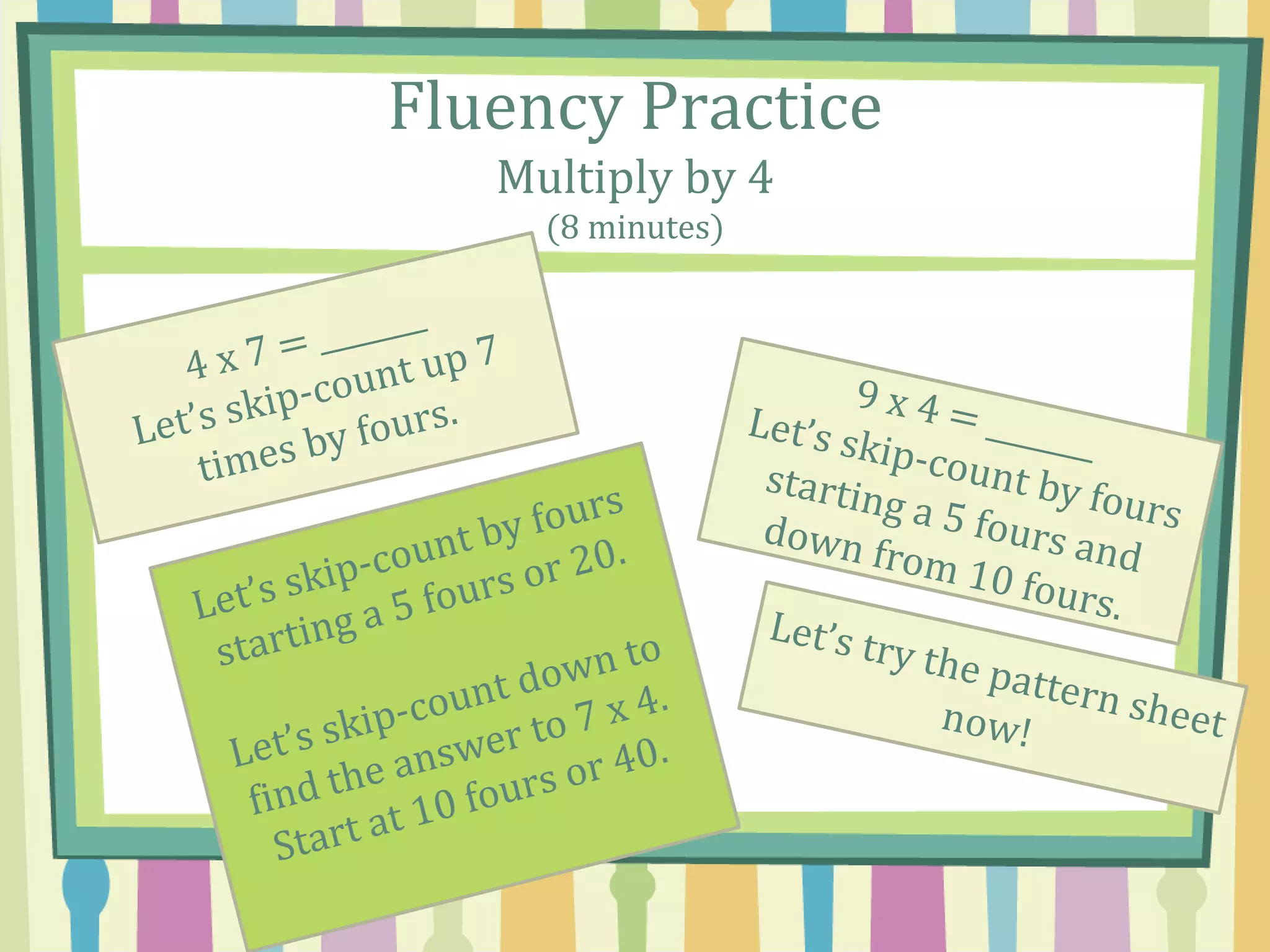
Multiply by 4
(8 minutes)
Fluency Practice
Group Counting
(5 minutes)
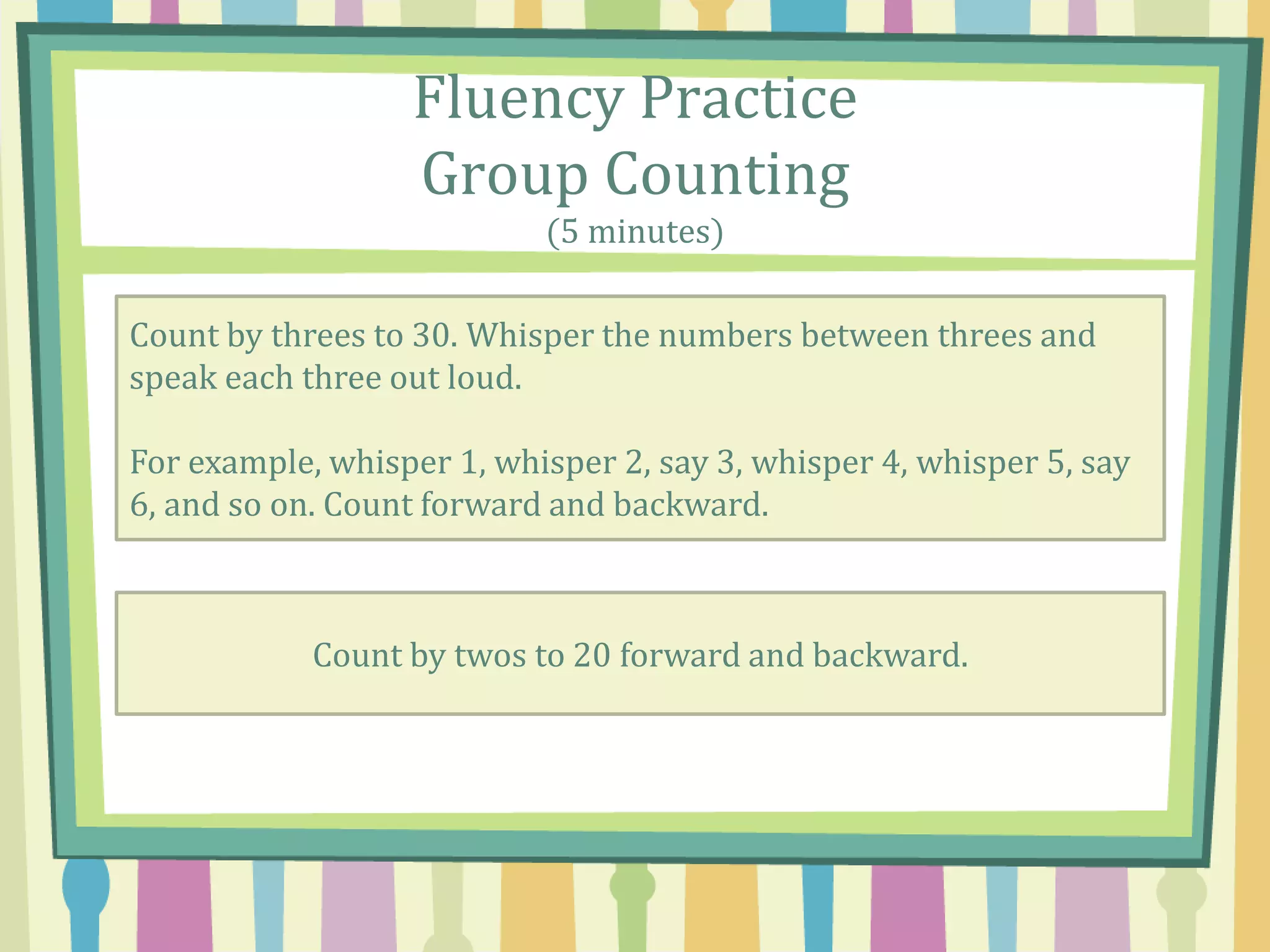
Count by threes to 30. Whisper the numbers between threes and
speak each three out loud.
For example, whisper 1, whisper 2, say 3, whisper 4, whisper 5, say
6, and so on. Count forward and backward.
Count by twos to 20 forward and backward.
Fluency Practice
Read Tape Diagrams
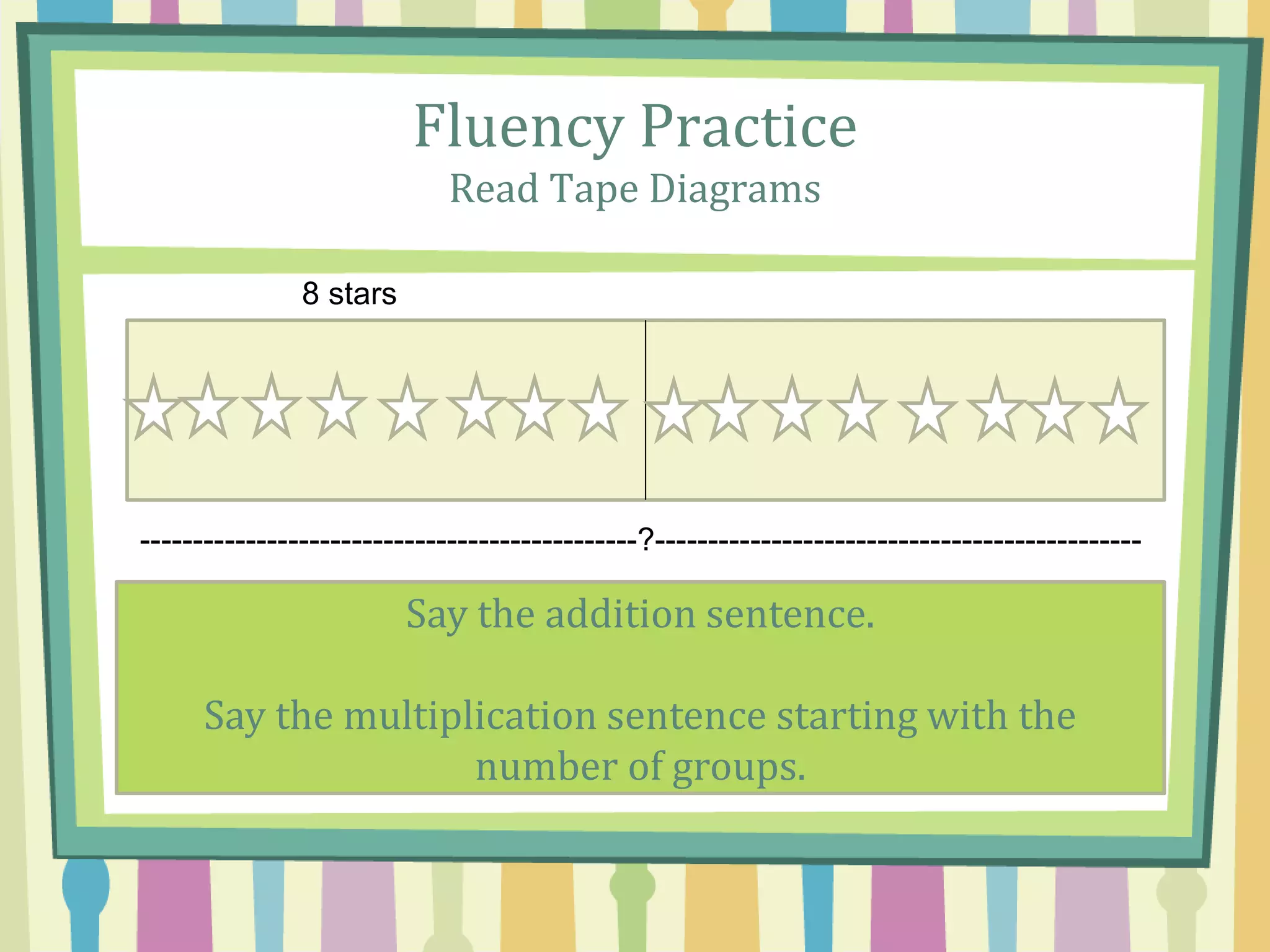
Say the addition sentence.
Say the multiplication sentence starting with the
number of groups.
8 stars
-----------------------------------------------?----------------------------------------------
Fluency Practice
Read Tape Diagrams
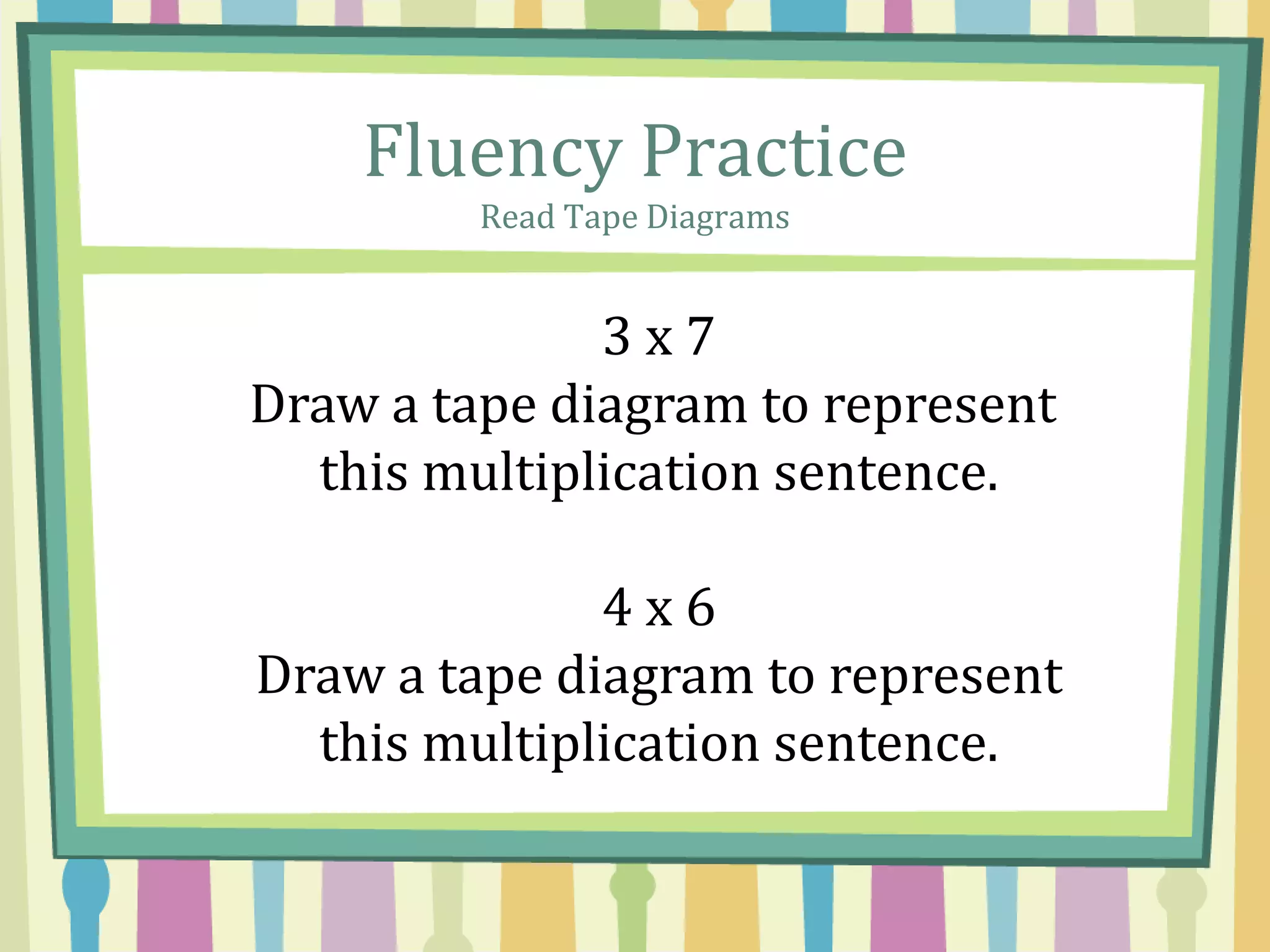
3 x 7
Draw a tape diagram to represent
this multiplication sentence.
4 x 6
Draw a tape diagram to represent
this multiplication sentence.
Application Problem
( 5 minutes)
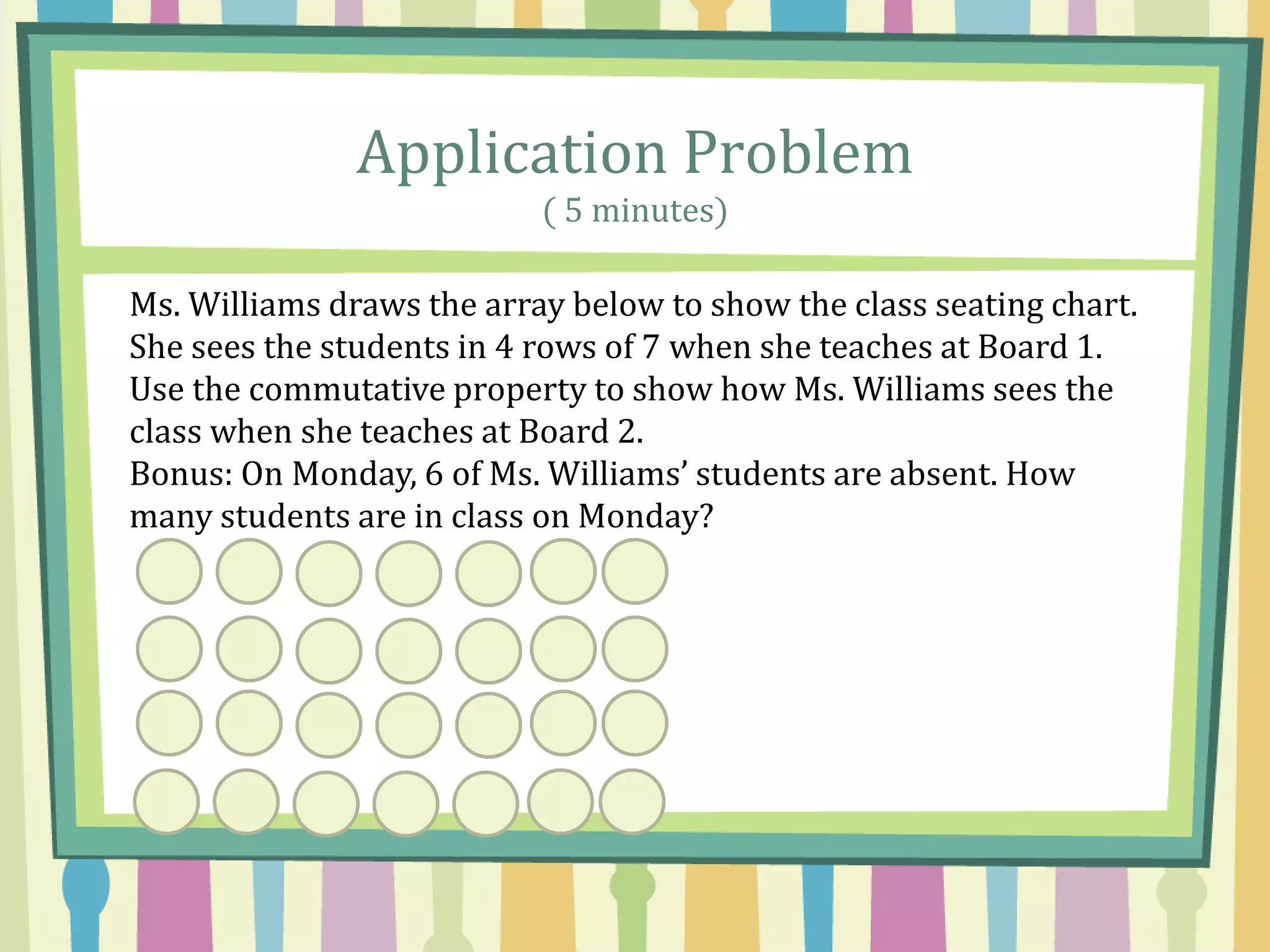
Ms. Williams draws the array below to show the class seating chart.
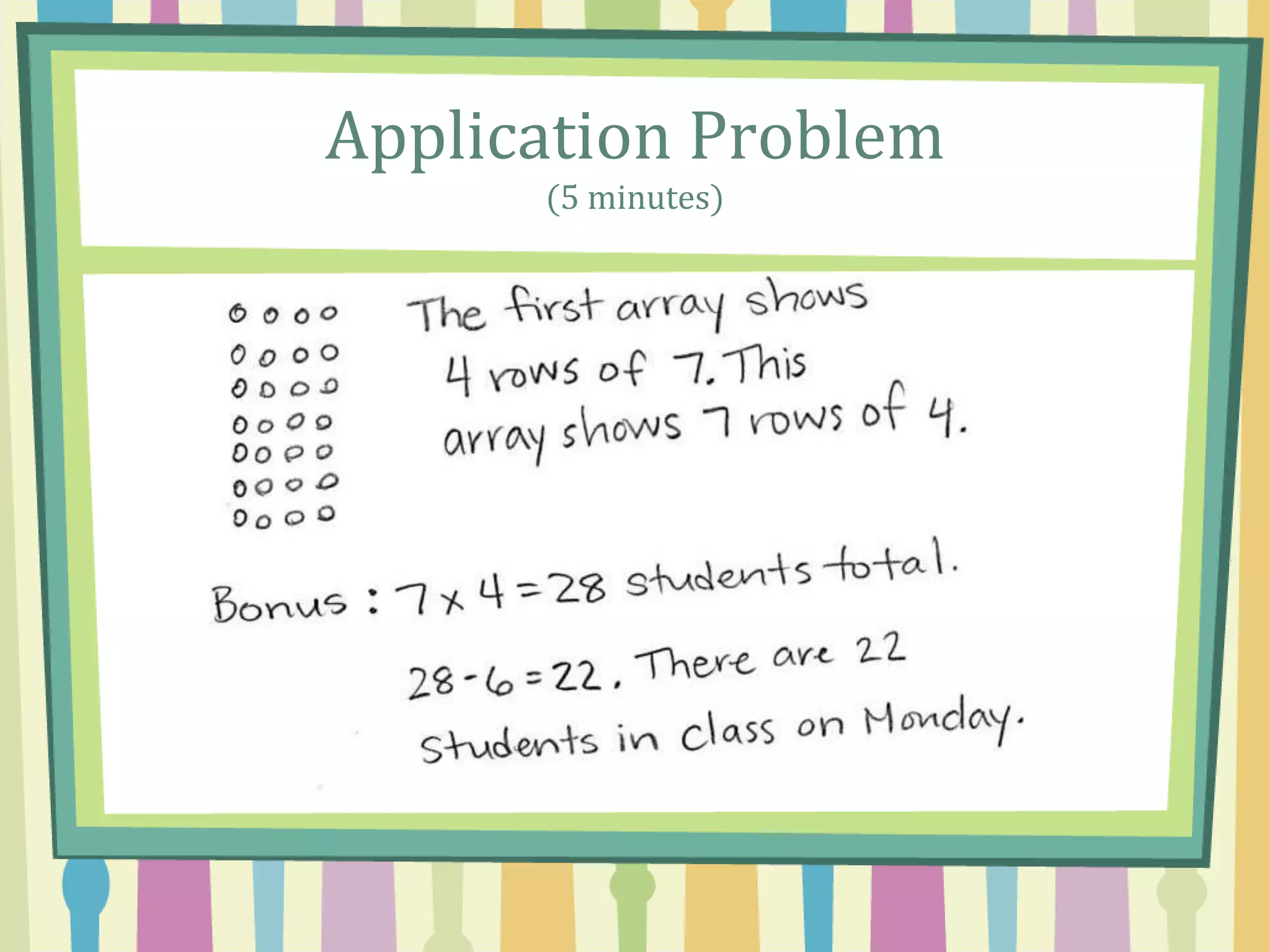
She sees the students in 4 rows of 7 when she teaches at Board 1.
Use the commutative property to show how Ms. Williams sees the
class when she teaches at Board 2.
Bonus: On Monday, 6 of Ms. Williams’ students are absent. How
many students are in class on Monday?
Application Problem
(5 minutes)
Concept Development
30 minutes
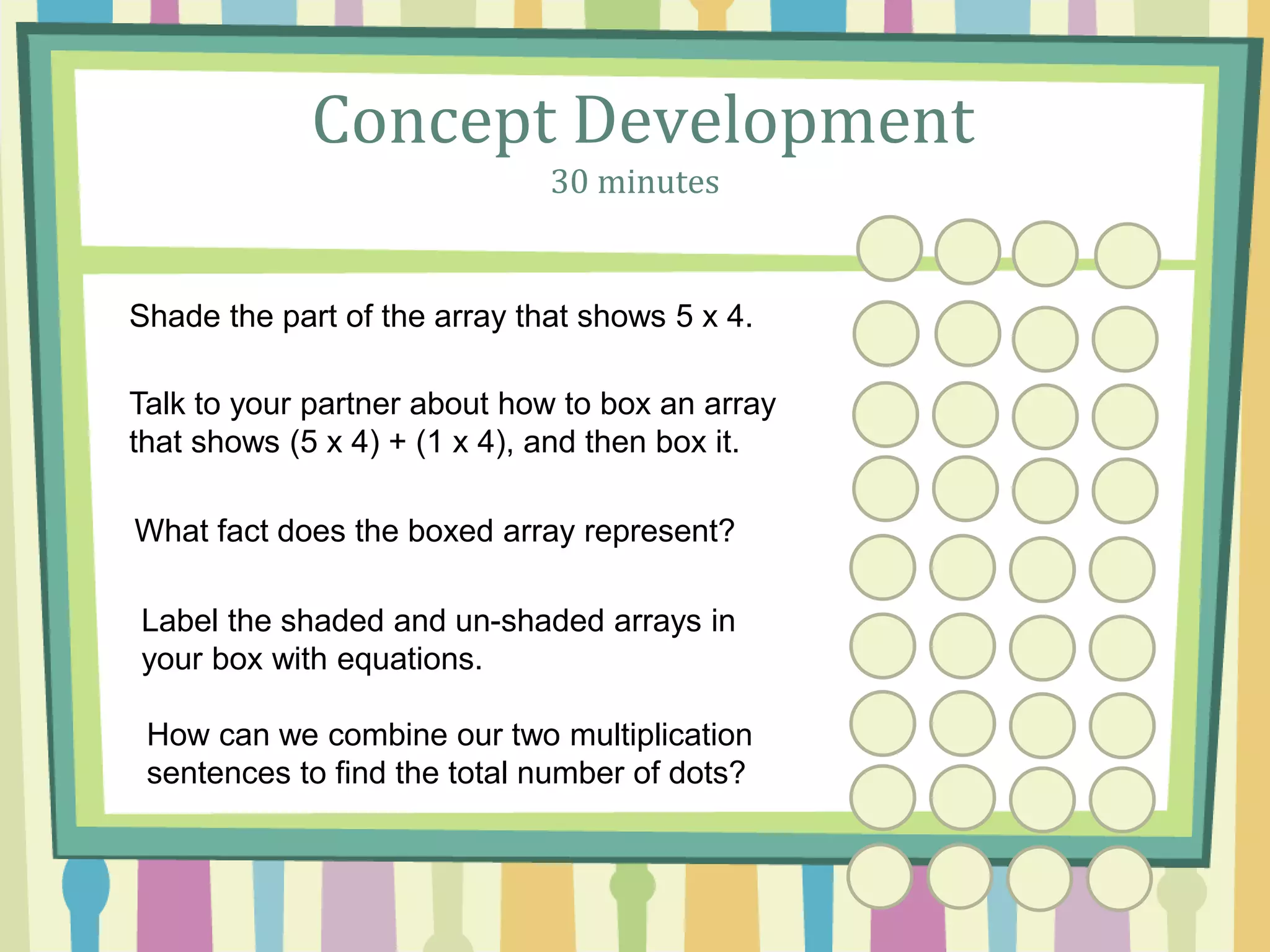
Shade the part of the array that shows 5 x 4.
Talk to your partner about how to box an array
that shows (5 x 4) + (1 x 4), and then box it.
What fact does the boxed array represent?
Label the shaded and un-shaded arrays in
your box with equations.
How can we combine our two multiplication
sentences to find the total number of dots?
Concept Development
(30 minutes)
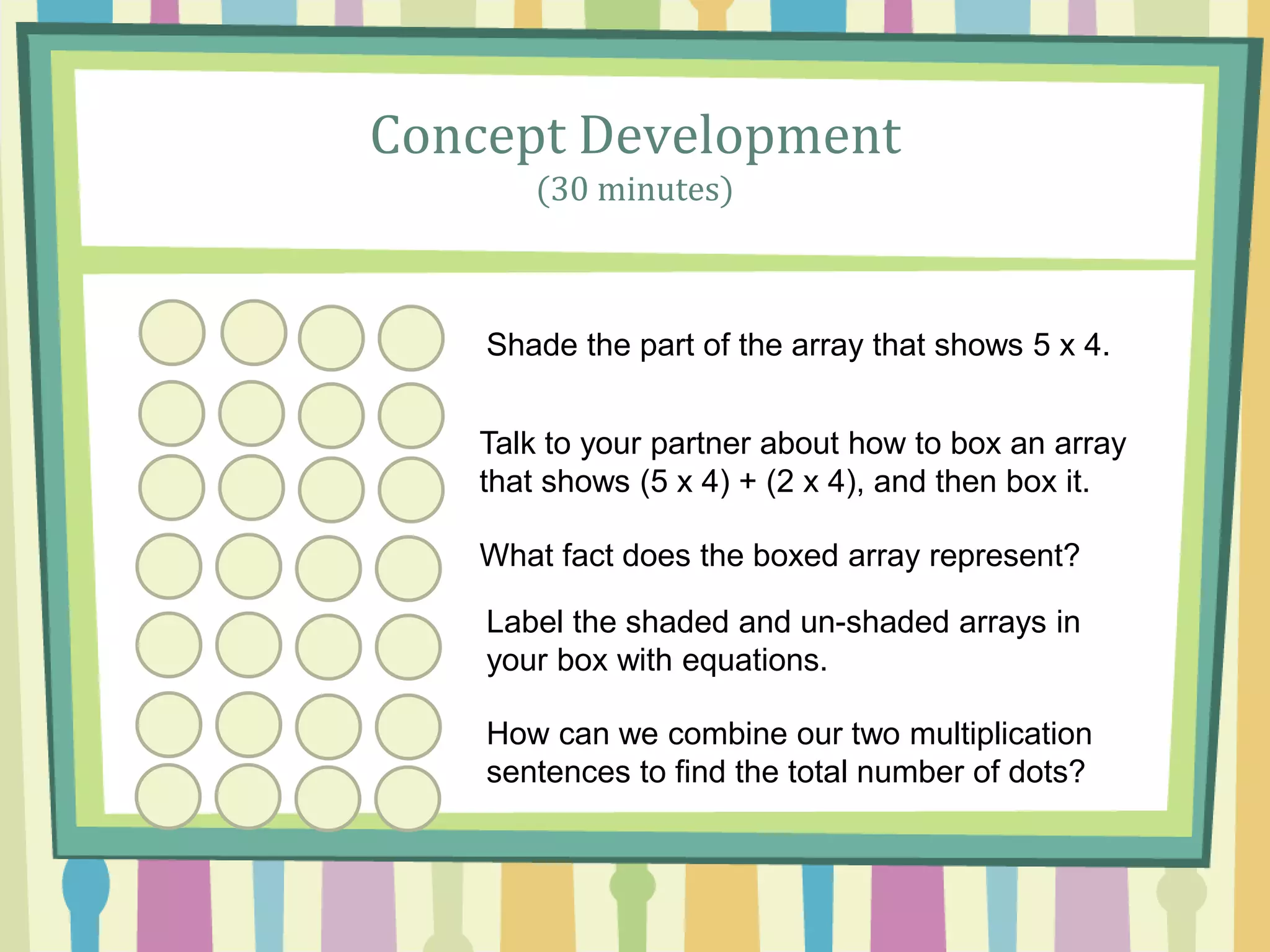
Shade the part of the array that shows 5 x 4.
Talk to your partner about how to box an array
that shows (5 x 4) + (2 x 4), and then box it.
What fact does the boxed array represent?
Label the shaded and un-shaded arrays in
your box with equations.
How can we combine our two multiplication
sentences to find the total number of dots?
Concept Development
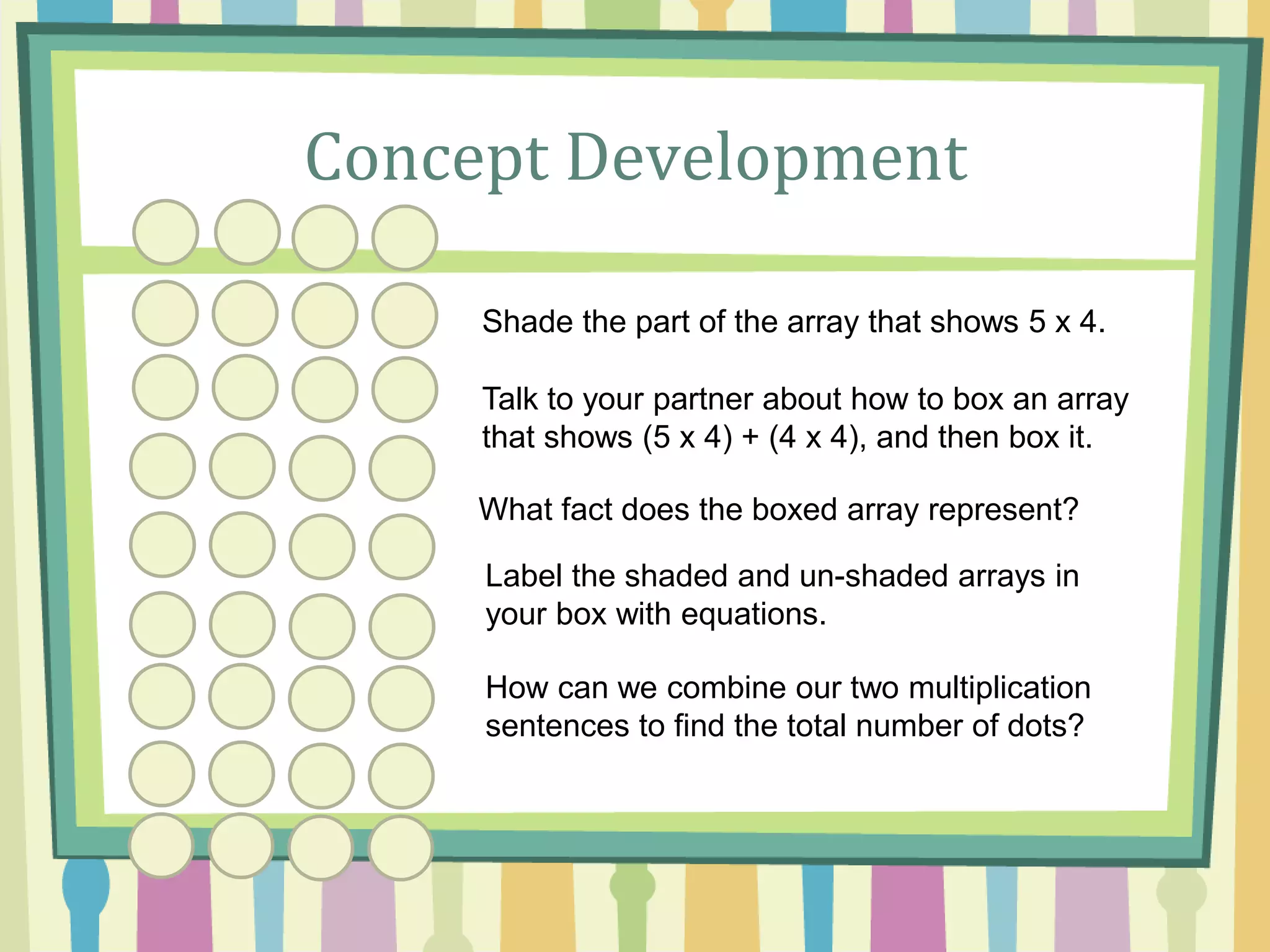
Shade the part of the array that shows 5 x 4.
Talk to your partner about how to box an array
that shows (5 x 4) + (4 x 4), and then box it.
What fact does the boxed array represent?
Label the shaded and un-shaded arrays in
your box with equations.
How can we combine our two multiplication
sentences to find the total number of dots?
Concept Development
What fact did we use to help us solve all 3 problems?
Talk to your partner. Why do you think I asked you to
solve using 5 x 4 each time?
Compare using 5 x 4 to solve your fours with 5 x 6 to solve
your sixes and 5 x 8 to solve your eights.
Now that you know how to use your fives, you have a
way to solve 7 sixes as 5 sixes and 2 sixes or 7 eights
as 5 eights and 2 eights.
Concept Development
Problem 2: Apply the 5 + n pattern to decompose and solve larger facts.
Work in pairs!
Fold the template so that only eight of the 10 rows are showing. We’ll use
the array that’s left.
What multiplication fact are we finding?
Use the strategy we practiced today to solve 8 x 4.
(Write 8 x 4 = (5 x 4) + (3 x 4).) Talk with your partner about
how you know this is true.
Concept Development
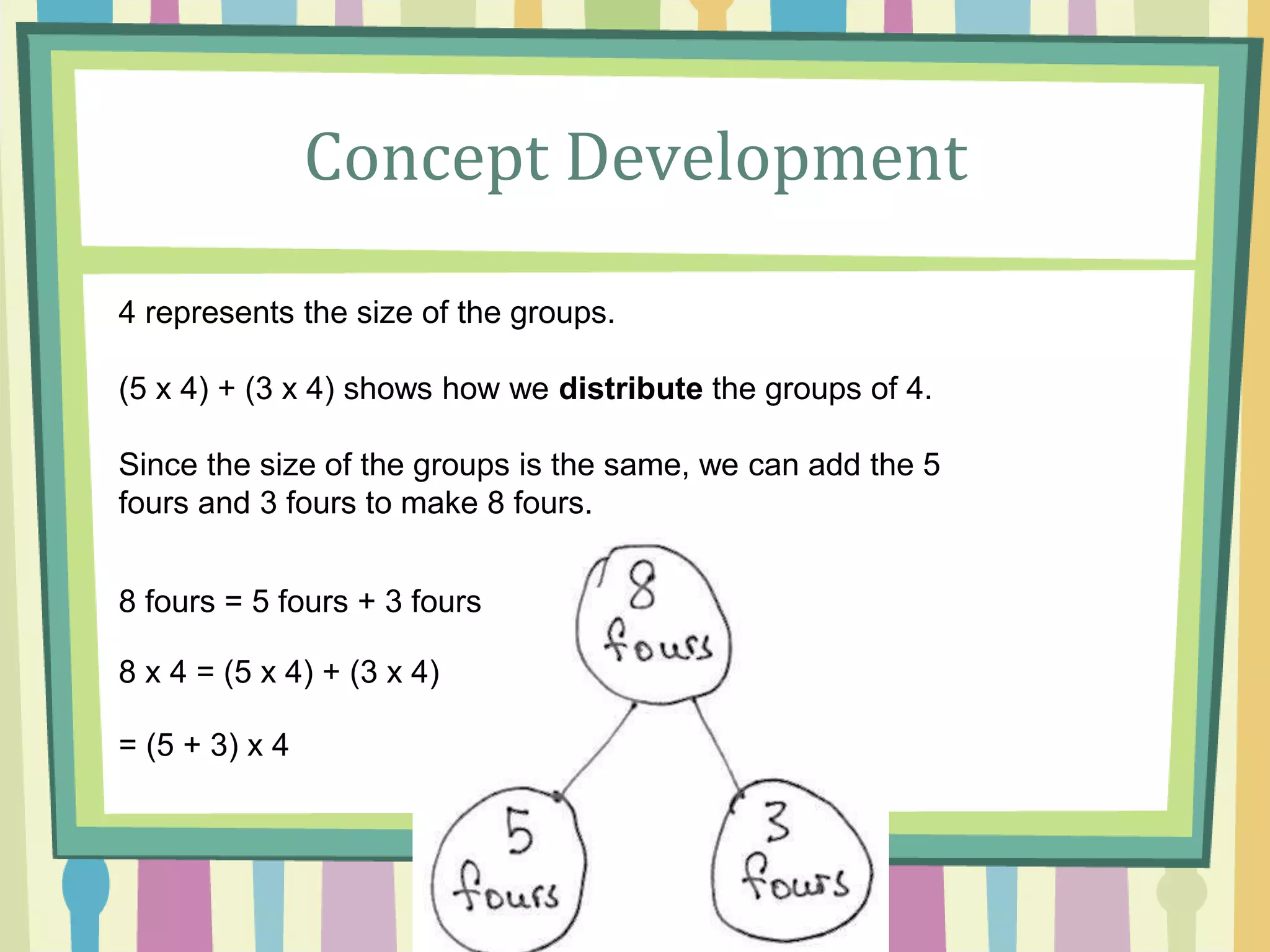
We can break a larger fact into 2 smaller facts to help us solve it.
(Draw number bond shown to the right.)
Here we broke apart 8 fours into 5 fours and 3 fours to solve.
So we can write an equation, 8 fours = 5 fours + 3 fours.
(5 + 3) x 4 is another way of writing (5 x 4) + (3 x 4). Talk with
your partner about why these expressions are the same.
True or false: In 5 x 4 and 3 x 4 the size of the groups is the same.
Concept Development
4 represents the size of the groups.
(5 x 4) + (3 x 4) shows how we distribute the groups of 4.
Since the size of the groups is the same, we can add the 5
fours and 3 fours to make 8 fours.
8 fours = 5 fours + 3 fours
8 x 4 = (5 x 4) + (3 x 4)
= (5 + 3) x 4
Problem Set (10 minutes)
Do your personal best to complete the Problem Set
in 10 minutes!
Debrief (10 minutes)
Turn to your partner and compare answers!
Let’s review your solutions for the problem set.
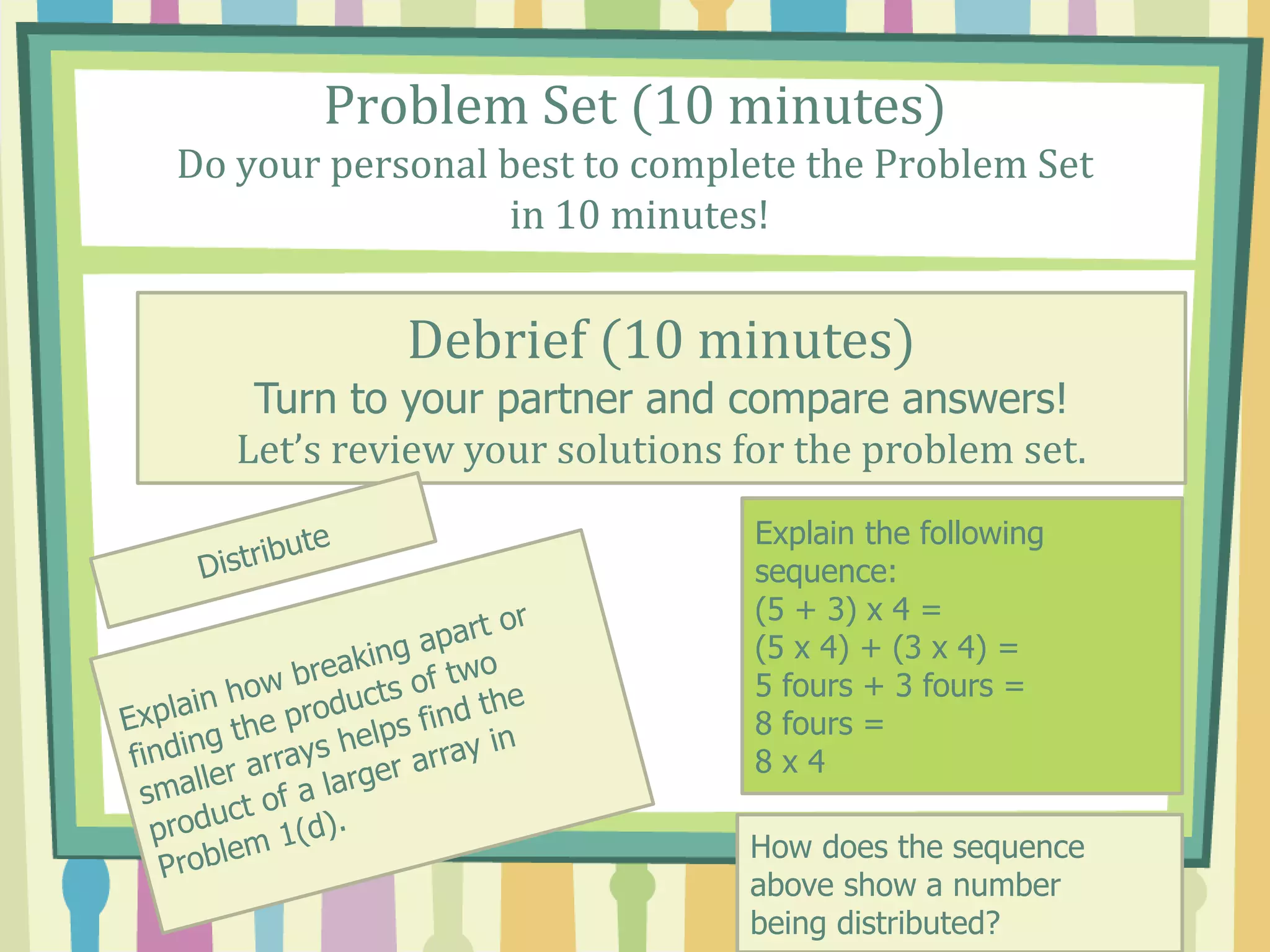
Explain the following
sequence:
(5 + 3) x 4 =
(5 x 4) + (3 x 4) =
5 fours + 3 fours =
8 fours =
8 x 4
How does the sequence
above show a number
being distributed?
Exit Ticket
(3 minutes)
This is where you are going to show
us that you understand what we learned today!
We will learn if you are ready for the next lesson!
Homework
The homework sheet for
3.1 – Lesson 16
is due tomorrow!

Lesson 16

  • 1.
    Multiplication and Division UsingUnits of 4 Module 1: Lesson 16 Use the distributive property as a strategy to find related multiplication facts.
  • 2.
  • 3.
    Fluency Practice Group Counting (5minutes) Count by threes to 30. Whisper the numbers between threes and speak each three out loud. For example, whisper 1, whisper 2, say 3, whisper 4, whisper 5, say 6, and so on. Count forward and backward. Count by twos to 20 forward and backward.
  • 4.
    Fluency Practice Read TapeDiagrams Say the addition sentence. Say the multiplication sentence starting with the number of groups. 8 stars -----------------------------------------------?----------------------------------------------
  • 5.
    Fluency Practice Read TapeDiagrams 3 x 7 Draw a tape diagram to represent this multiplication sentence. 4 x 6 Draw a tape diagram to represent this multiplication sentence.
  • 6.
    Application Problem ( 5minutes) Ms. Williams draws the array below to show the class seating chart. She sees the students in 4 rows of 7 when she teaches at Board 1. Use the commutative property to show how Ms. Williams sees the class when she teaches at Board 2. Bonus: On Monday, 6 of Ms. Williams’ students are absent. How many students are in class on Monday?
  • 7.
  • 8.
    Concept Development 30 minutes Shadethe part of the array that shows 5 x 4. Talk to your partner about how to box an array that shows (5 x 4) + (1 x 4), and then box it. What fact does the boxed array represent? Label the shaded and un-shaded arrays in your box with equations. How can we combine our two multiplication sentences to find the total number of dots?
  • 9.
    Concept Development (30 minutes) Shadethe part of the array that shows 5 x 4. Talk to your partner about how to box an array that shows (5 x 4) + (2 x 4), and then box it. What fact does the boxed array represent? Label the shaded and un-shaded arrays in your box with equations. How can we combine our two multiplication sentences to find the total number of dots?
  • 10.
    Concept Development Shade thepart of the array that shows 5 x 4. Talk to your partner about how to box an array that shows (5 x 4) + (4 x 4), and then box it. What fact does the boxed array represent? Label the shaded and un-shaded arrays in your box with equations. How can we combine our two multiplication sentences to find the total number of dots?
  • 11.
    Concept Development What factdid we use to help us solve all 3 problems? Talk to your partner. Why do you think I asked you to solve using 5 x 4 each time? Compare using 5 x 4 to solve your fours with 5 x 6 to solve your sixes and 5 x 8 to solve your eights. Now that you know how to use your fives, you have a way to solve 7 sixes as 5 sixes and 2 sixes or 7 eights as 5 eights and 2 eights.
  • 12.
    Concept Development Problem 2:Apply the 5 + n pattern to decompose and solve larger facts. Work in pairs! Fold the template so that only eight of the 10 rows are showing. We’ll use the array that’s left. What multiplication fact are we finding? Use the strategy we practiced today to solve 8 x 4. (Write 8 x 4 = (5 x 4) + (3 x 4).) Talk with your partner about how you know this is true.
  • 13.
    Concept Development We canbreak a larger fact into 2 smaller facts to help us solve it. (Draw number bond shown to the right.) Here we broke apart 8 fours into 5 fours and 3 fours to solve. So we can write an equation, 8 fours = 5 fours + 3 fours. (5 + 3) x 4 is another way of writing (5 x 4) + (3 x 4). Talk with your partner about why these expressions are the same. True or false: In 5 x 4 and 3 x 4 the size of the groups is the same.
  • 14.
    Concept Development 4 representsthe size of the groups. (5 x 4) + (3 x 4) shows how we distribute the groups of 4. Since the size of the groups is the same, we can add the 5 fours and 3 fours to make 8 fours. 8 fours = 5 fours + 3 fours 8 x 4 = (5 x 4) + (3 x 4) = (5 + 3) x 4
  • 15.
    Problem Set (10minutes) Do your personal best to complete the Problem Set in 10 minutes! Debrief (10 minutes) Turn to your partner and compare answers! Let’s review your solutions for the problem set. Explain the following sequence: (5 + 3) x 4 = (5 x 4) + (3 x 4) = 5 fours + 3 fours = 8 fours = 8 x 4 How does the sequence above show a number being distributed?
  • 16.
    Exit Ticket (3 minutes) Thisis where you are going to show us that you understand what we learned today! We will learn if you are ready for the next lesson!
  • 17.
    Homework The homework sheetfor 3.1 – Lesson 16 is due tomorrow!