Where are the Whole Numbers? Chapter 1 Lesson 2 Copyright 2010 MIND Research Institute  For use only by licensed users WN.1 Represent whole numbers as points on a number line. WO.1 Represent the addition of whole numbers on a number line. EE.4 Represent expressions and equations with number line diagrams. Translate number line representations of expressions and equations into symbolic notation. EE.5 Represent the addition of numbers, variables, and expressions symbolically and with number line diagrams. EE.6 Represent repeated addition of the same term symbolically and with number line diagrams.
Objectives Represent repeated addition on the number line. Represent whole numbers on the number line. Add whole numbers on the number line.
Remember from Before What is a whole? How is addition defined on the number line?
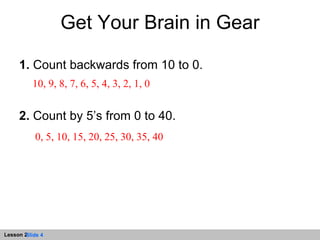
Get Your Brain in Gear 1.  Count backwards from 10 to 0. 2.  Count by 5’s from 0 to 40. 10, 9, 8, 7, 6, 5, 4, 3, 2, 1, 0 0, 5, 10, 15, 20, 25, 30, 35, 40
If we repeat this pattern 6 times, it will look like this: This means there are 6 copies of the image. The two images here represents the start and the end of the sequence.
What pattern does this diagram produce?
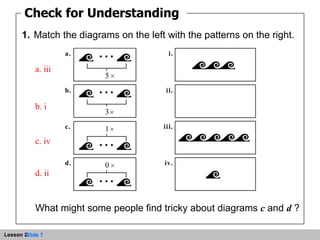
1. Match the diagrams on the left with the patterns on the right.  Check for Understanding What might some people find tricky about diagrams  c  and  d   ? a. iii  b. i  c. iv  d. ii
These diagrams can also represent repeated jumps on the number line.  We can write the expression as  repeated addition .
2. For the following diagrams, use symbols to write the corresponding repeated addition: Check for Understanding k + k + k  y + y
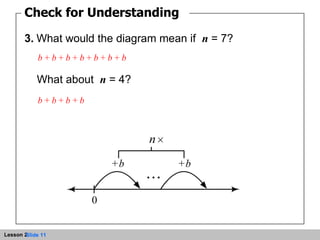
A  multiple   of  b  is a point on the number line we can get to by repeated addition of  b . This is a  variable . It expresses  all  the multiples of  b . If  n  = 5, what would the diagram mean?
3. What would the diagram mean if  n  = 7? What about  n  = 4? Check for Understanding b  +  b  +  b  +  b b  +  b  +  b  +  b  +  b  +  b  +  b
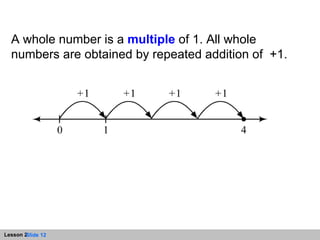
A whole number is a  multiple  of 1. All whole numbers are obtained by repeated addition of  +1.
Whole numbers in general can be illustrated by this diagram:
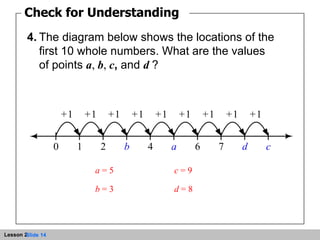
4. The diagram below shows the locations of the first 10 whole numbers. What are the values of points  a ,   b ,   c ,  and  d  ? Check for Understanding a  = 5 c  = 9 d  = 8 b  = 3
This equation shows the meaning of 5:
5. Write the equations for the following diagrams: Check for Understanding 1 + 1 + 1 = 3 1 + 1 + 1 + 1 = 4
What is the value of  y  ? What does 2 mean? What does 3 mean? y  = 1 + 1 + 1 + 1 + 1, which is the definition of 5.
6. What are the values of the variables ( t ,  z  and  h ) in the following equations? Check for Understanding t  = 4 z =  4 h =  6
Multiple Choice Practice 1.  When  w   is a whole number, the value of the expression  w  +  w  +  w  +  w   is:  a whole a positive  w a variable  w a multiple of  w
Find the Errors The numbers are not evenly spaced apart from each other.  All whole numbers are a distance of a whole  away from the next whole number.

Lesson 2

  • 1.
    Where are theWhole Numbers? Chapter 1 Lesson 2 Copyright 2010 MIND Research Institute For use only by licensed users WN.1 Represent whole numbers as points on a number line. WO.1 Represent the addition of whole numbers on a number line. EE.4 Represent expressions and equations with number line diagrams. Translate number line representations of expressions and equations into symbolic notation. EE.5 Represent the addition of numbers, variables, and expressions symbolically and with number line diagrams. EE.6 Represent repeated addition of the same term symbolically and with number line diagrams.
  • 2.
    Objectives Represent repeatedaddition on the number line. Represent whole numbers on the number line. Add whole numbers on the number line.
  • 3.
    Remember from BeforeWhat is a whole? How is addition defined on the number line?
  • 4.
    Get Your Brainin Gear 1. Count backwards from 10 to 0. 2. Count by 5’s from 0 to 40. 10, 9, 8, 7, 6, 5, 4, 3, 2, 1, 0 0, 5, 10, 15, 20, 25, 30, 35, 40
  • 5.
    If we repeatthis pattern 6 times, it will look like this: This means there are 6 copies of the image. The two images here represents the start and the end of the sequence.
  • 6.
    What pattern doesthis diagram produce?
  • 7.
    1. Match thediagrams on the left with the patterns on the right. Check for Understanding What might some people find tricky about diagrams c and d ? a. iii b. i c. iv d. ii
  • 8.
    These diagrams canalso represent repeated jumps on the number line. We can write the expression as repeated addition .
  • 9.
    2. For thefollowing diagrams, use symbols to write the corresponding repeated addition: Check for Understanding k + k + k y + y
  • 10.
    A multiple of b is a point on the number line we can get to by repeated addition of b . This is a variable . It expresses all the multiples of b . If n = 5, what would the diagram mean?
  • 11.
    3. What wouldthe diagram mean if n = 7? What about n = 4? Check for Understanding b + b + b + b b + b + b + b + b + b + b
  • 12.
    A whole numberis a multiple of 1. All whole numbers are obtained by repeated addition of +1.
  • 13.
    Whole numbers ingeneral can be illustrated by this diagram:
  • 14.
    4. The diagrambelow shows the locations of the first 10 whole numbers. What are the values of points a , b , c , and d ? Check for Understanding a = 5 c = 9 d = 8 b = 3
  • 15.
    This equation showsthe meaning of 5:
  • 16.
    5. Write theequations for the following diagrams: Check for Understanding 1 + 1 + 1 = 3 1 + 1 + 1 + 1 = 4
  • 17.
    What is thevalue of y ? What does 2 mean? What does 3 mean? y = 1 + 1 + 1 + 1 + 1, which is the definition of 5.
  • 18.
    6. What arethe values of the variables ( t , z and h ) in the following equations? Check for Understanding t = 4 z = 4 h = 6
  • 19.
    Multiple Choice Practice1. When w is a whole number, the value of the expression w + w + w + w is: a whole a positive w a variable w a multiple of w
  • 20.
    Find the ErrorsThe numbers are not evenly spaced apart from each other. All whole numbers are a distance of a whole away from the next whole number.

Editor's Notes

  • #5 Page 17
  • #6 Page 18 -The Greeks were fascinated with repeating patterns. -We can specify the repeating pattern with this notation:
  • #7 Page 18
  • #8 Page 19 c . iv. We only have one pattern. d. ii. We have no patterns
  • #9 Page 19 -What will repeat? +b -How many times will it repeat? 4 times -This shows a jump of distance + b repeated 4 times.
  • #10 Page 19
  • #11 Page 20 -b + b + b + b is a multiple of b . -What if n = 0? -What if n = 2? What if n = 1?
  • #12 Page 20
  • #13 Page 20 -4 is a whole number because it equals 1 + 1 + 1 + 1. -Why is 4 a whole number?
  • #14 Page 20 -Why is zero defined as a whole number? -What would the diagram mean if w = 0?
  • #15 Page 20
  • #16 Page 21 -What will it look like on the number line?
  • #17 Page 21
  • #18 Page 21 - 22 -Let’s use the definition of addition and whole numbers to find out. -Therefore we can draw the following equation:
  • #19 Page 22
  • #20 Page 25
  • #21 Page 25