Chapter 2
Reasoning and Proof
Lesson 2.1
Use Inductive Reasoning
What will you learn?
• To describe patters and use inductive
reasoning, so you can make predictions
• CA Standard 1
• Students demonstrate understanding by
identifying and giving examples of inductive
reasoning
• CA Standard 3
• Students give counterexamples to disprove
a statement
Describing a visual pattern
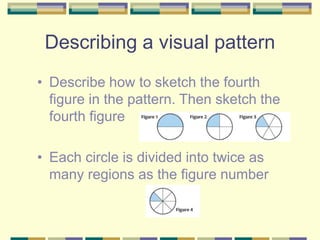
• Describe how to sketch the fourth
figure in the pattern. Then sketch the
fourth figure
• Each circle is divided into twice as
many regions as the figure number
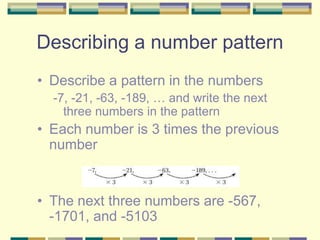
Describing a number pattern
• Describe a pattern in the numbers
-7, -21, -63, -189, … and write the next
three numbers in the pattern
• Each number is 3 times the previous
number
• The next three numbers are -567,
-1701, and -5103
Conjecture
• An unproven statement that is based
on observations
Inductive Reasoning
• When you find a pattern in specific
cases and then write a conjecture for
the general case
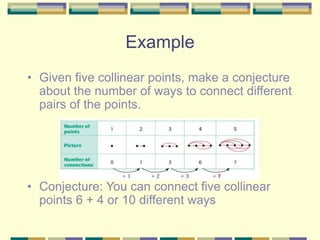
Example
• Given five collinear points, make a conjecture
about the number of ways to connect different
pairs of the points.
• Conjecture: You can connect five collinear
points 6 + 4 or 10 different ways
Example
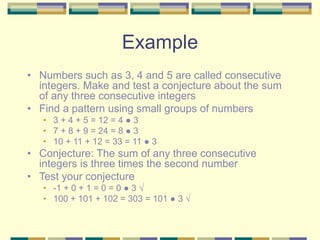
• Numbers such as 3, 4 and 5 are called consecutive
integers. Make and test a conjecture about the sum
of any three consecutive integers
• Find a pattern using small groups of numbers
• 3 + 4 + 5 = 12 = 4 ● 3
• 7 + 8 + 9 = 24 = 8 ● 3
• 10 + 11 + 12 = 33 = 11 ● 3
• Conjecture: The sum of any three consecutive
integers is three times the second number
• Test your conjecture
• -1 + 0 + 1 = 0 = 0 ● 3 √
• 100 + 101 + 102 = 303 = 101 ● 3 √
Counterexample
• A specific case for which the
conjecture is false
Disproving conjectures
• To show that a conjecture is true, you
must show that it is true for all cases
• You can show that a conjecture is false
by simply finding one counterexample
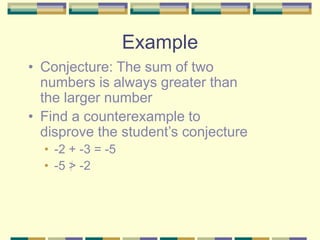
Example
• Conjecture: The sum of two
numbers is always greater than
the larger number
• Find a counterexample to
disprove the student’s conjecture
• -2 + -3 = -5
• -5 > -2
Example
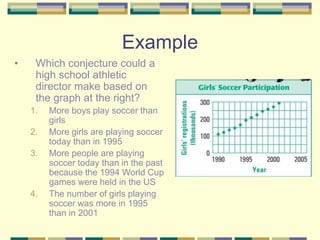
• Which conjecture could a
high school athletic
director make based on
the graph at the right?
1. More boys play soccer than
girls
2. More girls are playing soccer
today than in 1995
3. More people are playing
soccer today than in the past
because the 1994 World Cup
games were held in the US
4. The number of girls playing
soccer was more in 1995
than in 2001
You now know,
• What is a conjecture
• Unproven statement based on observations
• What is inductive reasoning
• Reasoning in which you find patterns and make
conjectures
• What is a counterexample
• A specific case that proves a conjecture false

glesson2.1.ppt

  • 1.
    Chapter 2 Reasoning andProof Lesson 2.1 Use Inductive Reasoning
  • 2.
    What will youlearn? • To describe patters and use inductive reasoning, so you can make predictions • CA Standard 1 • Students demonstrate understanding by identifying and giving examples of inductive reasoning • CA Standard 3 • Students give counterexamples to disprove a statement
  • 3.
    Describing a visualpattern • Describe how to sketch the fourth figure in the pattern. Then sketch the fourth figure • Each circle is divided into twice as many regions as the figure number
  • 4.
    Describing a numberpattern • Describe a pattern in the numbers -7, -21, -63, -189, … and write the next three numbers in the pattern • Each number is 3 times the previous number • The next three numbers are -567, -1701, and -5103
  • 5.
    Conjecture • An unprovenstatement that is based on observations
  • 6.
    Inductive Reasoning • Whenyou find a pattern in specific cases and then write a conjecture for the general case
  • 7.
    Example • Given fivecollinear points, make a conjecture about the number of ways to connect different pairs of the points. • Conjecture: You can connect five collinear points 6 + 4 or 10 different ways
  • 8.
    Example • Numbers suchas 3, 4 and 5 are called consecutive integers. Make and test a conjecture about the sum of any three consecutive integers • Find a pattern using small groups of numbers • 3 + 4 + 5 = 12 = 4 ● 3 • 7 + 8 + 9 = 24 = 8 ● 3 • 10 + 11 + 12 = 33 = 11 ● 3 • Conjecture: The sum of any three consecutive integers is three times the second number • Test your conjecture • -1 + 0 + 1 = 0 = 0 ● 3 √ • 100 + 101 + 102 = 303 = 101 ● 3 √
  • 9.
    Counterexample • A specificcase for which the conjecture is false
  • 10.
    Disproving conjectures • Toshow that a conjecture is true, you must show that it is true for all cases • You can show that a conjecture is false by simply finding one counterexample
  • 11.
    Example • Conjecture: Thesum of two numbers is always greater than the larger number • Find a counterexample to disprove the student’s conjecture • -2 + -3 = -5 • -5 > -2
  • 12.
    Example • Which conjecturecould a high school athletic director make based on the graph at the right? 1. More boys play soccer than girls 2. More girls are playing soccer today than in 1995 3. More people are playing soccer today than in the past because the 1994 World Cup games were held in the US 4. The number of girls playing soccer was more in 1995 than in 2001
  • 13.
    You now know, •What is a conjecture • Unproven statement based on observations • What is inductive reasoning • Reasoning in which you find patterns and make conjectures • What is a counterexample • A specific case that proves a conjecture false