Bernardo Ospina Patiño
Executive Director-CLAYUCA
b.ospina@cgiar.org
www.clayuca.org
RUSBI (Rural Social Bio-refineries)
An option for small-scale,
cassava-based bioenergy projects
Acknowledgements
MADR –Colombia
Tropical Fruits Program-CIAT (Fontagro Project)
IFAD-ICRISAT-CIAT Project
Financial support from:
Technical support from (Brasil):
USI – Usinas Sociais Inteligentes
UFRGS – Universidade Federal Río Grande do Sul
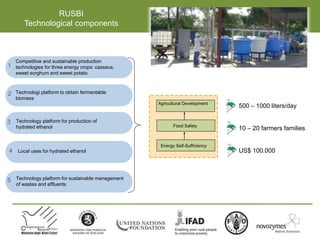
RUSBI
Technological components
1
4
5
2
3
Competitive and sustainable production
technologies for three energy crops: cassava,
sweet sorghum and sweet potato
Local uses for hydrated ethanol
Technology platform for sustainable management
of wastes and effluents
Technology platform for production of
hydrated ethanol
Technologi platform to obtain fermentable
biomass
Agricultural Development
Food Safety
Energy Self-Sufficiency
500 – 1000 liters/day
10 – 20 farmers families
US$ 100.000
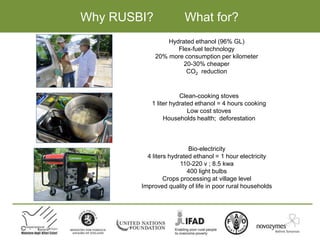
Hydrated ethanol (96% GL)
Flex-fuel technology
20% more consumption per kilometer
20-30% cheaper
CO2 reduction
Clean-cooking stoves
1 liter hydrated ethanol = 4 hours cooking
Low cost stoves
Households health; deforestation
Bio-electricity
4 liters hydrated ethanol = 1 hour electricity
110-220 v ; 8.5 kwa
400 light bulbs
Crops processing at village level
Improved quality of life in poor rural households
Why RUSBI? What for?
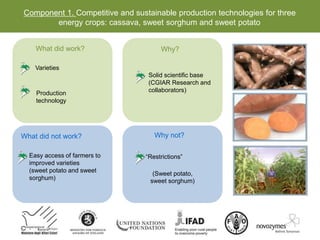
Component 1. Competitive and sustainable production technologies for three
energy crops: cassava, sweet sorghum and sweet potato
What did work?
Varieties
Production
technology
What did not work?
Easy access of farmers to
improved varieties
(sweet potato and sweet
sorghum)
(Sweet potato,
sweet sorghum)
Why not?
“Restrictions”
Why?
Solid scientific base
(CGIAR Research and
collaborators)
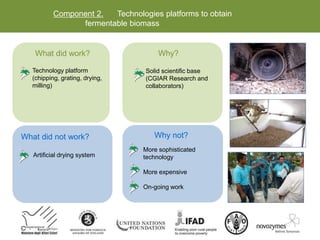
Component 2. Technologies platforms to obtain
fermentable biomass
What did not work?
Artificial drying system
What did work?
Technology platform
(chipping, grating, drying,
milling)
Why?
Solid scientific base
(CGIAR Research and
collaborators)
Why not?
More sophisticated
technology
More expensive
On-going work
Production of refined cassava flour
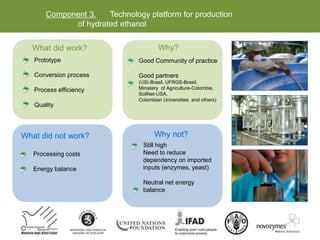
Component 3. Technology platform for production
of hydrated ethanol
What did not work?
Processing costs
Energy balance
Why not?
Still high
Need to reduce
dependency on imported
inputs (enzymes, yeast)
Neutral net energy
balance
What did work?
Prototype
Conversion process
Process efficiency
Quality
Why?
Good Community of practice
Good partners
(USI-Brasil, UFRGS-Brasil,
Ministery of Agriculture-Colombia,
SoilNet-USA,
Colombian Universities and others)
Rural Social Bio-refineries
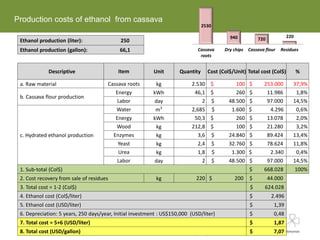
Ethanol production (liter): 250
Ethanol production (gallon): 66,1
Descriptive Item Unit Quantity Cost (Col$/Unit) Total cost (Col$) %
a. Raw material Cassava roots kg 2.530 $ 100 $ 253.000 37,9%
b. Cassava flour production
Energy kWh 46,1 $ 260 $ 11.986 1,8%
Labor day 2 $ 48.500 $ 97.000 14,5%
c. Hydrated ethanol production
Water m3
2,685 $ 1.600 $ 4.296 0,6%
Energy kWh 50,3 $ 260 $ 13.078 2,0%
Wood kg 212,8 $ 100 $ 21.280 3,2%
Enzymes kg 3,6 $ 24.840 $ 89.424 13,4%
Yeast kg 2,4 $ 32.760 $ 78.624 11,8%
Urea kg 1,8 $ 1.300 $ 2.340 0,4%
Labor day 2 $ 48.500 $ 97.000 14,5%
1. Sub-total (Col$) $ 668.028 100%
2. Cost recovery from sale of residues kg 220 $ 200 $ 44.000
3. Total cost = 1-2 (Col$) $ 624.028
4. Ethanol cost (Col$/liter) $ 2.496
5. Ethanol cost (USD/liter) $ 1,39
6. Depreciation: 5 years, 250 days/year, Initial investment : US$150,000 (USD/liter) $ 0,48
7. Total cost = 5+6 (USD/liter) $ 1,87
8. Total cost (USD/gallon) $ 7,07
Production costs of ethanol from cassava
2530
940 720
220
Cassava
roots
Dry chips Cassava flour Residues
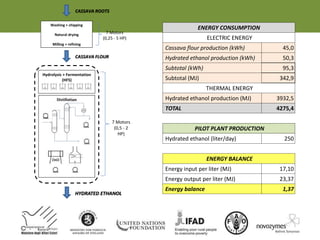
ENERGY CONSUMPTION
ELECTRIC ENERGY
Cassava flour production (kWh) 45,0
Hydrated ethanol production (kWh) 50,3
Subtotal (kWh) 95,3
Subtotal (MJ) 342,9
THERMAL ENERGY
Hydrated ethanol production (MJ) 3932,5
TOTAL 4275,4
PILOT PLANT PRODUCTION
Hydrated ethanol (liter/day) 250
ENERGY BALANCE
Energy input per liter (MJ) 17,10
Energy output per liter (MJ) 23,37
Energy balance 1,37
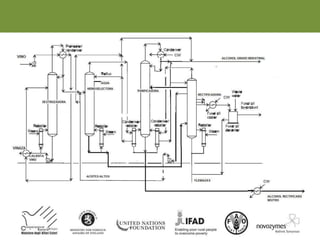
Washing + chipping
Natural drying
Milling + refining
Hydrolysis + Fermentation
(HFS)
Distillation
CASSAVA FLOUR
HYDRATED ETHANOL
7 Motors
(0,25 - 5 HP)
7 Motors
(0,5 - 2
HP)
CASSAVA ROOTS
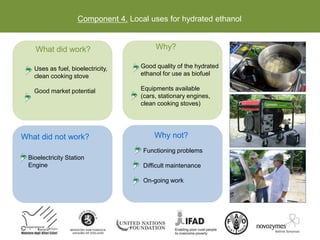
Component 4. Local uses for hydrated ethanol
What did work?
Uses as fuel, bioelectricity,
clean cooking stove
Good market potential
Why?
Good quality of the hydrated
ethanol for use as biofuel
Equipments available
(cars, stationary engines,
clean cooking stoves)
What did not work?
Bioelectricity Station
Engine
Why not?
Functioning problems
Difficult maintenance
On-going work
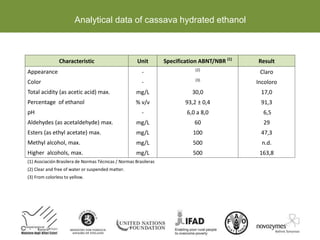
Applications of hydrated ethanol
Characteristic Unit Specification ABNT/NBR (1)
Result
Appearance - (2)
Claro
Color - (3)
Incoloro
Total acidity (as acetic acid) max. mg/L 30,0 17,0
Percentage of ethanol % v/v 93,2 ± 0,4 91,3
pH - 6,0 a 8,0 6,5
Aldehydes (as acetaldehyde) max. mg/L 60 29
Esters (as ethyl acetate) max. mg/L 100 47,3
Methyl alcohol, max. mg/L 500 n.d.
Higher alcohols, max. mg/L 500 163,8
(1) Asociación Brasilera de Normas Técnicas / Normas Brasileras
(2) Clear and free of water or suspended matter.
(3) From colorless to yellow.
Analytical data of cassava hydrated ethanol
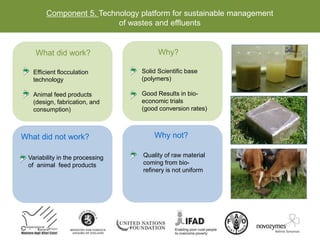
Component 5. Technology platform for sustainable management
of wastes and effluents
What did work?
Efficient flocculation
technology
Animal feed products
(design, fabrication, and
consumption)
What did not work?
Variability in the processing
of animal feed products
Why?
Solid Scientific base
(polymers)
Good Results in bio-
economic trials
(good conversion rates)
Why not?
Quality of raw material
coming from bio-
refinery is not uniform
Waste management and effluent
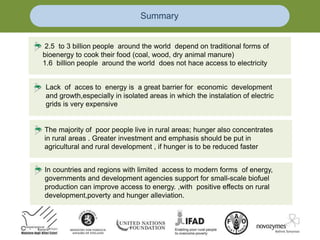
Summary
Lack of acces to energy is a great barrier for economic development
and growth,especially in isolated areas in which the instalation of electric
grids is very expensive
The majority of poor people live in rural areas; hunger also concentrates
in rural areas . Greater investment and emphasis should be put in
agricultural and rural development , if hunger is to be reduced faster
In countries and regions with limited access to modern forms of energy,
governments and development agencies support for small-scale biofuel
production can improve access to energy. ,with positive effects on rural
development,poverty and hunger alleviation.
2.5 to 3 billion people around the world depend on traditional forms of
bioenergy to cook their food (coal, wood, dry animal manure)
1.6 billion people around the world does not hace access to electricity
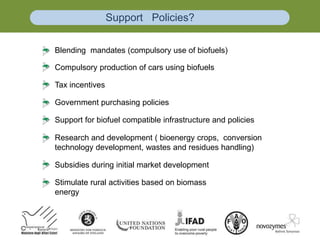
Support Policies?
Blending mandates (compulsory use of biofuels)
Compulsory production of cars using biofuels
Tax incentives
Government purchasing policies
Support for biofuel compatible infrastructure and policies
Research and development ( bioenergy crops, conversion
technology development, wastes and residues handling)
Subsidies during initial market development
Stimulate rural activities based on biomass
energy
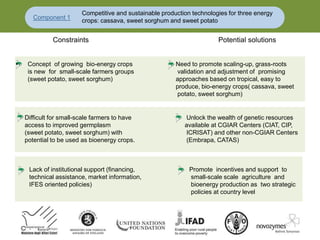
• Concept of growing bio-energy crops Need to promote scaling-up, grass-roots
is new for small-scale farmers groups validation and adjustment of promising
(sweet potato, sweet sorghum) approaches based on tropical, easy to
produce, bio-energy crops( cassava, sweet
potato, sweet sorghum)
Component 1
Competitive and sustainable production technologies for three energy
crops: cassava, sweet sorghum and sweet potato
Constraints Potential solutions
Difficult for small-scale farmers to have Unlock the wealth of genetic resources
access to improved germplasm available at CGIAR Centers (CIAT, CIP,
(sweet potato, sweet sorghum) with ICRISAT) and other non-CGIAR Centers
potential to be used as bioenergy crops. (Embrapa, CATAS)
Lack of institutional support (financing, Promote incentives and support to
technical assistance, market information, small-scale scale agriculture and
IFES oriented policies) bioenergy production as two strategic
policies at country level
High cost of equipments for conditioning Establish specific types of support for
the bioenergy crops into fermentable biomass small- scale, poor farmers-based IFES
(washing, peeling, grating, drying, refining) approaches Brazil example: credit lines
for investment in bioenergy infrastructure
(10 years, 3 years free, interest rates of
2% per year).
Lack of know-how by farmers groups Promote transfer of technologies,
and technical personnel expertise and experiences about IFES
approaches, within and between
countries
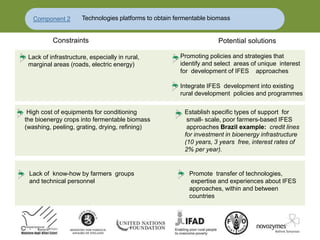
Component 2 Technologies platforms to obtain fermentable biomass
Constraints Potential solutions
Lack of infrastructure, especially in rural,
marginal areas (roads, electric energy)
Promoting policies and strategies that
identify and select areas of unique interest
for development of IFES approaches
Integrate IFES development into existing
rural development policies and programmes
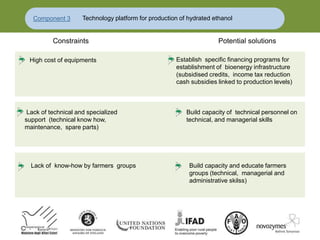
Component 3 Technology platform for production of hydrated ethanol
Constraints Potential solutions
Lack of technical and specialized Build capacity of technical personnel on
support (technical know how, technical, and managerial skills
maintenance, spare parts)
Lack of know-how by farmers groups Build capacity and educate farmers
groups (technical, managerial and
administrative skilss)
High cost of equipments Establish specific financing programs for
establishment of bioenergy infrastructure
(subsidised credits, income tax reduction
cash subsidies linked to production levels)
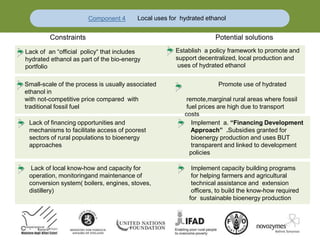
Component 4 Local uses for hydrated ethanol
Constraints Potential solutions
Small-scale of the process is usually associated Promote use of hydrated
ethanol in
with not-competitive price compared with remote,marginal rural areas where fossil
traditional fossil fuel fuel prices are high due to transport
costs
Lack of financing opportunities and Implement a. “Financing Development
mechanisms to facilitate access of poorest Approach” .Subsidies granted for
sectors of rural populations to bioenergy bioenergy production and uses BUT
approaches transparent and linked to development
policies
Lack of local know-how and capacity for Implement capacity building programs
operation, monitoringand maintenance of for helping farmers and agricultural
conversion system( boilers, engines, stoves, technical assistance and extension
distillery) officers, to build the know-how required
for sustainable bioenergy production
Lack of an “official policy“ that includes
hydrated ethanol as part of the bio-energy
portfolio
Establish a policy framework to promote and
support decentralized, local production and
uses of hydrated ethanol
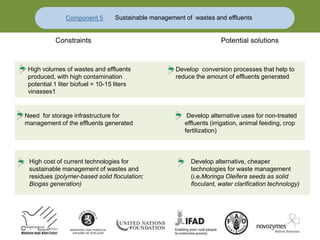
Component 5 Sustainable management of wastes and effluents
Constraints Potential solutions
Need for storage infrastructure for Develop alternative uses for non-treated
management of the effluents generated effluents (irrigation, animal feeding, crop
fertilization)
High cost of current technologies for Develop alternative, cheaper
sustainable management of wastes and technologies for waste management
residues (polymer-based solid floculation; (i.e.Moringa Oleifera seeds as solid
Biogas generation) floculant, water clarification technology)
High volumes of wastes and effluents
produced, with high contamination
potential 1 liter biofuel = 10-15 liters
vinasses1
Develop conversion processes that help to
reduce the amount of effluents generated
CRP-RTB
Thank you

2.1 session by ospina birus-ghana

  • 2.
    Bernardo Ospina Patiño ExecutiveDirector-CLAYUCA b.ospina@cgiar.org www.clayuca.org RUSBI (Rural Social Bio-refineries) An option for small-scale, cassava-based bioenergy projects
  • 3.
    Acknowledgements MADR –Colombia Tropical FruitsProgram-CIAT (Fontagro Project) IFAD-ICRISAT-CIAT Project Financial support from: Technical support from (Brasil): USI – Usinas Sociais Inteligentes UFRGS – Universidade Federal Río Grande do Sul
  • 4.
    RUSBI Technological components 1 4 5 2 3 Competitive andsustainable production technologies for three energy crops: cassava, sweet sorghum and sweet potato Local uses for hydrated ethanol Technology platform for sustainable management of wastes and effluents Technology platform for production of hydrated ethanol Technologi platform to obtain fermentable biomass Agricultural Development Food Safety Energy Self-Sufficiency 500 – 1000 liters/day 10 – 20 farmers families US$ 100.000
  • 5.
    Hydrated ethanol (96%GL) Flex-fuel technology 20% more consumption per kilometer 20-30% cheaper CO2 reduction Clean-cooking stoves 1 liter hydrated ethanol = 4 hours cooking Low cost stoves Households health; deforestation Bio-electricity 4 liters hydrated ethanol = 1 hour electricity 110-220 v ; 8.5 kwa 400 light bulbs Crops processing at village level Improved quality of life in poor rural households Why RUSBI? What for?
  • 6.
    Component 1. Competitiveand sustainable production technologies for three energy crops: cassava, sweet sorghum and sweet potato What did work? Varieties Production technology What did not work? Easy access of farmers to improved varieties (sweet potato and sweet sorghum) (Sweet potato, sweet sorghum) Why not? “Restrictions” Why? Solid scientific base (CGIAR Research and collaborators)
  • 7.
    Component 2. Technologiesplatforms to obtain fermentable biomass What did not work? Artificial drying system What did work? Technology platform (chipping, grating, drying, milling) Why? Solid scientific base (CGIAR Research and collaborators) Why not? More sophisticated technology More expensive On-going work
  • 8.
    Production of refinedcassava flour
  • 9.
    Component 3. Technologyplatform for production of hydrated ethanol What did not work? Processing costs Energy balance Why not? Still high Need to reduce dependency on imported inputs (enzymes, yeast) Neutral net energy balance What did work? Prototype Conversion process Process efficiency Quality Why? Good Community of practice Good partners (USI-Brasil, UFRGS-Brasil, Ministery of Agriculture-Colombia, SoilNet-USA, Colombian Universities and others)
  • 10.
  • 11.
    Ethanol production (liter):250 Ethanol production (gallon): 66,1 Descriptive Item Unit Quantity Cost (Col$/Unit) Total cost (Col$) % a. Raw material Cassava roots kg 2.530 $ 100 $ 253.000 37,9% b. Cassava flour production Energy kWh 46,1 $ 260 $ 11.986 1,8% Labor day 2 $ 48.500 $ 97.000 14,5% c. Hydrated ethanol production Water m3 2,685 $ 1.600 $ 4.296 0,6% Energy kWh 50,3 $ 260 $ 13.078 2,0% Wood kg 212,8 $ 100 $ 21.280 3,2% Enzymes kg 3,6 $ 24.840 $ 89.424 13,4% Yeast kg 2,4 $ 32.760 $ 78.624 11,8% Urea kg 1,8 $ 1.300 $ 2.340 0,4% Labor day 2 $ 48.500 $ 97.000 14,5% 1. Sub-total (Col$) $ 668.028 100% 2. Cost recovery from sale of residues kg 220 $ 200 $ 44.000 3. Total cost = 1-2 (Col$) $ 624.028 4. Ethanol cost (Col$/liter) $ 2.496 5. Ethanol cost (USD/liter) $ 1,39 6. Depreciation: 5 years, 250 days/year, Initial investment : US$150,000 (USD/liter) $ 0,48 7. Total cost = 5+6 (USD/liter) $ 1,87 8. Total cost (USD/gallon) $ 7,07 Production costs of ethanol from cassava 2530 940 720 220 Cassava roots Dry chips Cassava flour Residues
  • 12.
    ENERGY CONSUMPTION ELECTRIC ENERGY Cassavaflour production (kWh) 45,0 Hydrated ethanol production (kWh) 50,3 Subtotal (kWh) 95,3 Subtotal (MJ) 342,9 THERMAL ENERGY Hydrated ethanol production (MJ) 3932,5 TOTAL 4275,4 PILOT PLANT PRODUCTION Hydrated ethanol (liter/day) 250 ENERGY BALANCE Energy input per liter (MJ) 17,10 Energy output per liter (MJ) 23,37 Energy balance 1,37 Washing + chipping Natural drying Milling + refining Hydrolysis + Fermentation (HFS) Distillation CASSAVA FLOUR HYDRATED ETHANOL 7 Motors (0,25 - 5 HP) 7 Motors (0,5 - 2 HP) CASSAVA ROOTS
  • 13.
    Component 4. Localuses for hydrated ethanol What did work? Uses as fuel, bioelectricity, clean cooking stove Good market potential Why? Good quality of the hydrated ethanol for use as biofuel Equipments available (cars, stationary engines, clean cooking stoves) What did not work? Bioelectricity Station Engine Why not? Functioning problems Difficult maintenance On-going work
  • 14.
  • 15.
    Characteristic Unit SpecificationABNT/NBR (1) Result Appearance - (2) Claro Color - (3) Incoloro Total acidity (as acetic acid) max. mg/L 30,0 17,0 Percentage of ethanol % v/v 93,2 ± 0,4 91,3 pH - 6,0 a 8,0 6,5 Aldehydes (as acetaldehyde) max. mg/L 60 29 Esters (as ethyl acetate) max. mg/L 100 47,3 Methyl alcohol, max. mg/L 500 n.d. Higher alcohols, max. mg/L 500 163,8 (1) Asociación Brasilera de Normas Técnicas / Normas Brasileras (2) Clear and free of water or suspended matter. (3) From colorless to yellow. Analytical data of cassava hydrated ethanol
  • 17.
    Component 5. Technologyplatform for sustainable management of wastes and effluents What did work? Efficient flocculation technology Animal feed products (design, fabrication, and consumption) What did not work? Variability in the processing of animal feed products Why? Solid Scientific base (polymers) Good Results in bio- economic trials (good conversion rates) Why not? Quality of raw material coming from bio- refinery is not uniform
  • 18.
  • 19.
    Summary Lack of accesto energy is a great barrier for economic development and growth,especially in isolated areas in which the instalation of electric grids is very expensive The majority of poor people live in rural areas; hunger also concentrates in rural areas . Greater investment and emphasis should be put in agricultural and rural development , if hunger is to be reduced faster In countries and regions with limited access to modern forms of energy, governments and development agencies support for small-scale biofuel production can improve access to energy. ,with positive effects on rural development,poverty and hunger alleviation. 2.5 to 3 billion people around the world depend on traditional forms of bioenergy to cook their food (coal, wood, dry animal manure) 1.6 billion people around the world does not hace access to electricity
  • 20.
    Support Policies? Blending mandates(compulsory use of biofuels) Compulsory production of cars using biofuels Tax incentives Government purchasing policies Support for biofuel compatible infrastructure and policies Research and development ( bioenergy crops, conversion technology development, wastes and residues handling) Subsidies during initial market development Stimulate rural activities based on biomass energy
  • 21.
    • Concept ofgrowing bio-energy crops Need to promote scaling-up, grass-roots is new for small-scale farmers groups validation and adjustment of promising (sweet potato, sweet sorghum) approaches based on tropical, easy to produce, bio-energy crops( cassava, sweet potato, sweet sorghum) Component 1 Competitive and sustainable production technologies for three energy crops: cassava, sweet sorghum and sweet potato Constraints Potential solutions Difficult for small-scale farmers to have Unlock the wealth of genetic resources access to improved germplasm available at CGIAR Centers (CIAT, CIP, (sweet potato, sweet sorghum) with ICRISAT) and other non-CGIAR Centers potential to be used as bioenergy crops. (Embrapa, CATAS) Lack of institutional support (financing, Promote incentives and support to technical assistance, market information, small-scale scale agriculture and IFES oriented policies) bioenergy production as two strategic policies at country level
  • 22.
    High cost ofequipments for conditioning Establish specific types of support for the bioenergy crops into fermentable biomass small- scale, poor farmers-based IFES (washing, peeling, grating, drying, refining) approaches Brazil example: credit lines for investment in bioenergy infrastructure (10 years, 3 years free, interest rates of 2% per year). Lack of know-how by farmers groups Promote transfer of technologies, and technical personnel expertise and experiences about IFES approaches, within and between countries Component 2 Technologies platforms to obtain fermentable biomass Constraints Potential solutions Lack of infrastructure, especially in rural, marginal areas (roads, electric energy) Promoting policies and strategies that identify and select areas of unique interest for development of IFES approaches Integrate IFES development into existing rural development policies and programmes
  • 23.
    Component 3 Technologyplatform for production of hydrated ethanol Constraints Potential solutions Lack of technical and specialized Build capacity of technical personnel on support (technical know how, technical, and managerial skills maintenance, spare parts) Lack of know-how by farmers groups Build capacity and educate farmers groups (technical, managerial and administrative skilss) High cost of equipments Establish specific financing programs for establishment of bioenergy infrastructure (subsidised credits, income tax reduction cash subsidies linked to production levels)
  • 24.
    Component 4 Localuses for hydrated ethanol Constraints Potential solutions Small-scale of the process is usually associated Promote use of hydrated ethanol in with not-competitive price compared with remote,marginal rural areas where fossil traditional fossil fuel fuel prices are high due to transport costs Lack of financing opportunities and Implement a. “Financing Development mechanisms to facilitate access of poorest Approach” .Subsidies granted for sectors of rural populations to bioenergy bioenergy production and uses BUT approaches transparent and linked to development policies Lack of local know-how and capacity for Implement capacity building programs operation, monitoringand maintenance of for helping farmers and agricultural conversion system( boilers, engines, stoves, technical assistance and extension distillery) officers, to build the know-how required for sustainable bioenergy production Lack of an “official policy“ that includes hydrated ethanol as part of the bio-energy portfolio Establish a policy framework to promote and support decentralized, local production and uses of hydrated ethanol
  • 25.
    Component 5 Sustainablemanagement of wastes and effluents Constraints Potential solutions Need for storage infrastructure for Develop alternative uses for non-treated management of the effluents generated effluents (irrigation, animal feeding, crop fertilization) High cost of current technologies for Develop alternative, cheaper sustainable management of wastes and technologies for waste management residues (polymer-based solid floculation; (i.e.Moringa Oleifera seeds as solid Biogas generation) floculant, water clarification technology) High volumes of wastes and effluents produced, with high contamination potential 1 liter biofuel = 10-15 liters vinasses1 Develop conversion processes that help to reduce the amount of effluents generated
  • 26.
  • 27.