Sugar cane as an energy crop: current status and future trends in BrazilAndré Martins de MartiniPromon EngenhariaBrazilWednesday, 10th of March, 2010
AGENDAAgendaIntroduction
Overview of sugar cane and ethanol production in Brazil
Energy outlook and cogeneration
Case Study – the “energetic” plant
Recent developments
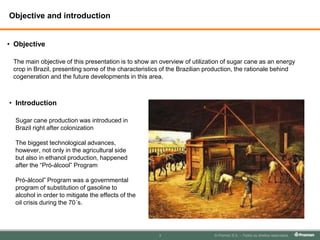
ConclusionObjective and introductionObjectiveThe main objective of this presentation is to show an overview of utilization of sugar cane as an energy crop in Brazil, presenting some of the characteristics of the Brazilian production, the rationale behind cogeneration and the future developments in this area.IntroductionSugar cane production was introduced in Brazil right after colonizationThe biggest technological advances, however, not only in the agricultural side but also in ethanol production, happened after the “Pró-álcool” ProgramPró-álcool” Program was a governmental program of substitution of gasoline to alcohol in order to mitigate the effects of the oil crisis during the 70´s.
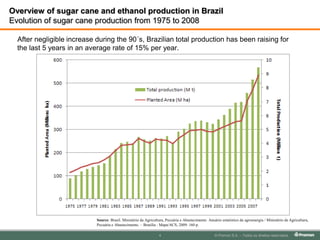
Overview of sugar cane and ethanol production in BrazilEvolution of sugar cane production from 1975 to 2008 After negligible increase during the 90´s, Brazilian total production has been raising for the last 5 years in an average rate of 15% per year.Source: Brasil. Ministério da Agricultura, Pecuária e Abastecimento. Anuário estatístico da agroenergia / Ministério da Agricultura, Pecuária e Abastecimento. – Brasília : Mapa/ACS, 2009. 160 p.
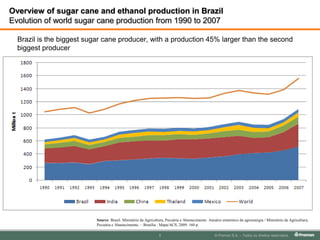
Overview of sugar cane and ethanol production in Brazil Evolution of world sugar cane production from 1990 to 2007Brazil is the biggest sugar cane producer, with a production 45% larger than the second biggest producerSource: Brasil. Ministério da Agricultura, Pecuária e Abastecimento. Anuário estatístico da agroenergia / Ministério da Agricultura, Pecuária e Abastecimento. – Brasília : Mapa/ACS, 2009. 160 p.
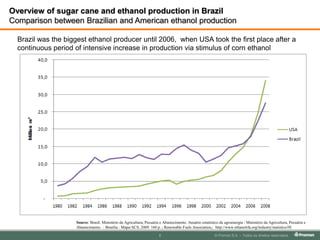
Overview of sugar cane and ethanol production in Brazil Comparison between Brazilian and American ethanol productionBrazil was the biggest ethanol producer until 2006,  when USA took the first place after a continuous period of intensive increase in production via stimulus of corn ethanolSource: Brasil. Ministério da Agricultura, Pecuária e Abastecimento. Anuário estatístico da agroenergia / Ministério da Agricultura, Pecuária e Abastecimento. – Brasília : Mapa/ACS, 2009. 160 p. ; RenewableFuelsAssociation,:  http://www.ethanolrfa.org/industry/statistics/#E
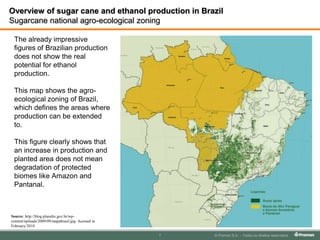
Overview of sugar cane and ethanol production in Brazil Sugarcane national agro-ecological zoning The already impressive figures of Brazilian production does not show the real potential for ethanol production.This map shows the agro-ecological zoning of Brazil, which defines the areas where production can be extended to.This figure clearly shows that an increase in production and planted area does not mean degradation of protected biomes like Amazon and Pantanal.Source: http://blog.planalto.gov.br/wp-content/uploads/2009/09/mapabrasil.jpg. Acessed in February/2010
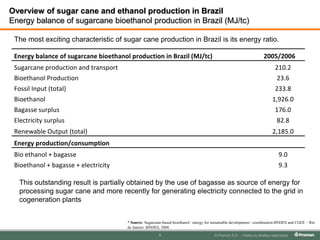
Overview of sugar cane and ethanol production in Brazil Energy balance of sugarcane bioethanol production in Brazil (MJ/tc) The most exciting characteristic of sugar cane production in Brazil is its energy ratio.This outstanding result is partially obtained by the use of bagasse as source of energy for processing sugar cane and more recently for generating electricity connected to the grid in cogeneration plants* Source: Sugarcane-based bioethanol : energy for sustainable development / coordination BNDES and CGEE – Rio de Janeiro :BNDES, 2008.
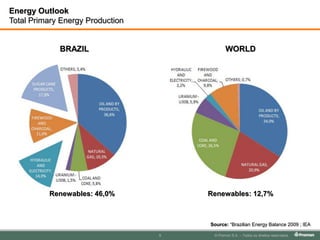
Energy OutlookTotal Primary Energy ProductionBRAZILWORLDRenewables: 12,7%Renewables: 46,0%Source: “BrazilianEnergy Balance 2009 ; IEA
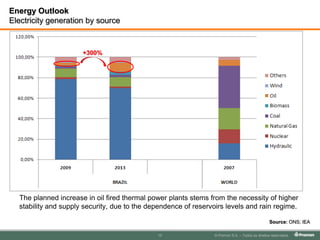
Energy OutlookElectricity generation by source+300%The planned increase in oil fired thermal power plants stems from the necessity of higher stability and supply security, due to the dependence of reservoirs levels and rain regime.Source: ONS; IEA
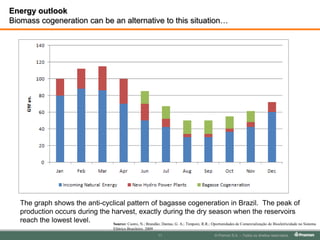
Energy outlookBiomass cogeneration can be an alternative to this situation…The graph shows the anti-cyclical pattern of bagasse cogeneration in Brazil.  The peak of production occurs during the harvest, exactly during the dry season when the reservoirs reach the lowest level.Source:Castro, N.; Brandão; Dantas, G. A.; Timponi, R.R.; Oportunidades de Comercialização de Bioeletricidade no Sistema Elétrico Brasileiro. 2009
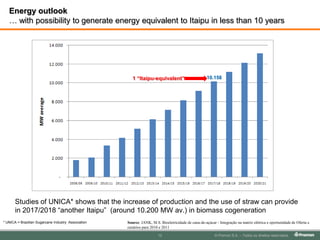
Energy outlook… with possibility to generate energy equivalent to Itaipu in less than 10 years10.1581 “Itaipu-equivalent”Studies of UNICA* shows that the increase of production and the use of straw can provide in 2017/2018 “another Itaipu”  (around 10.200 MW av.) in biomass cogenerationSource: JANK, M.S.Bioeletricidade de cana-de-açúcar - Integração na matriz elétrica e oportunidade de Oferta e cenários para 2010 e 2011* UNICA = BrazilianSugarcaneIndustryAssociation
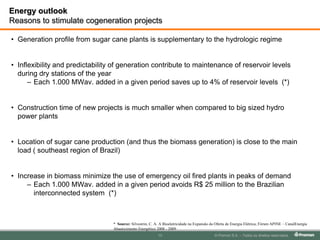
Energy outlookReasons to stimulate cogeneration projectsGeneration profile from sugar cane plants is supplementary to the hydrologic regime
Inflexibility and predictability of generation contribute to maintenance of reservoir levels during dry stations of the year
Each 1.000 MWav. added in a given period saves up to 4% of reservoir levels  (*)
Construction time of new projects is much smaller when compared to big sized hydro power plants
Location of sugar cane production (and thus the biomass generation) is close to the main load ( southeast region of Brazil)
Increase in biomass minimize the use of emergency oil fired plants in peaks of demand
Each 1.000 MWav. added in a given period avoids R$ 25 million to the Brazilian interconnected system  (*)*  Source:Silvestrin, C. A. A Bioeletricidade na Expansão da Oferta de Energia Elétrica; Fórum APINE – CanalEnergia Abastecimento Energético 2008 - 2009
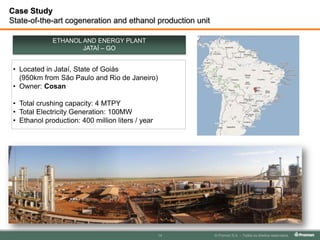
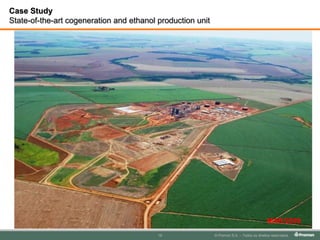
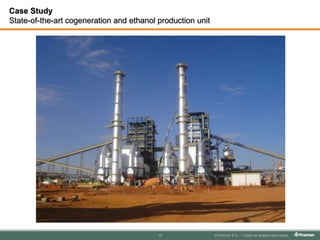
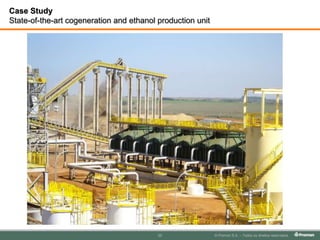
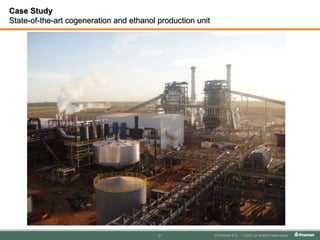
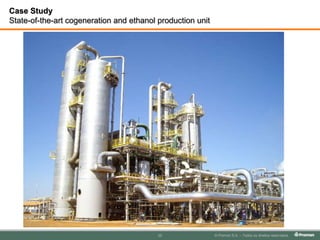
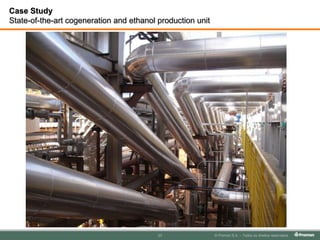
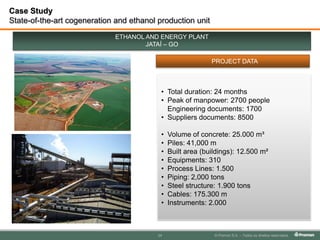
Case StudyState-of-the-art cogeneration and ethanol production unitETHANOL AND ENERGY PLANTJATAÍ – GOLocated in Jataí, State of Goiás(950km from São Paulo and Rio de Janeiro)
Owner: Cosan
Total crushing capacity: 4 MTPY
Total Electricity Generation: 100MW
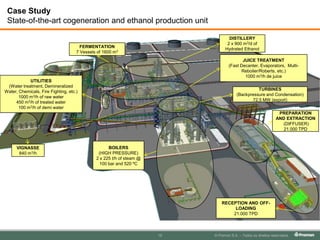
Ethanol production: 400 million liters / yearCase StudyState-of-the-art cogeneration and ethanol production unitDISTILLERY2 x 900 m3/d of  Hydrated EthanolFERMENTATION7 Vessels of 1600 m3JUICE TREATMENT(Fast Decanter, Evaporators,  Multi-Reboiler/Roberts, etc.)1000 m3/h de juiceUTILITIES(Water treatment, Demineralized Water, Chemicals, Fire Fighting, etc.)1000 m3/h of raw water450 m3/h of treated water100 m3/h of demi waterTURBINES(Backpressure and Condensation)72,5 MW (export)PREPARATION AND EXTRACTION (DIFFUSER)21.000 TPDBOILERS(HIGH PRESSURE)2 x 225 t/h of steam @ 100 bar and 520 ºCVIGNASSE840 m3/hRECEPTION AND OFF-LOADING21.000 TPD
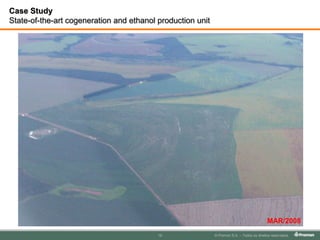
Case StudyState-of-the-art cogeneration and ethanol production unitMar/2008
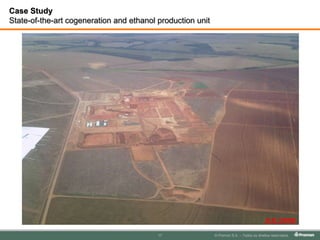
Case StudyState-of-the-art cogeneration and ethanol production unitJUL/2008

Presentation Isaf2010

  • 1.
    Sugar cane asan energy crop: current status and future trends in BrazilAndré Martins de MartiniPromon EngenhariaBrazilWednesday, 10th of March, 2010
  • 2.
  • 3.
    Overview of sugarcane and ethanol production in Brazil
  • 4.
    Energy outlook andcogeneration
  • 5.
    Case Study –the “energetic” plant
  • 6.
  • 7.
    ConclusionObjective and introductionObjectiveThemain objective of this presentation is to show an overview of utilization of sugar cane as an energy crop in Brazil, presenting some of the characteristics of the Brazilian production, the rationale behind cogeneration and the future developments in this area.IntroductionSugar cane production was introduced in Brazil right after colonizationThe biggest technological advances, however, not only in the agricultural side but also in ethanol production, happened after the “Pró-álcool” ProgramPró-álcool” Program was a governmental program of substitution of gasoline to alcohol in order to mitigate the effects of the oil crisis during the 70´s.
  • 8.
    Overview of sugarcane and ethanol production in BrazilEvolution of sugar cane production from 1975 to 2008 After negligible increase during the 90´s, Brazilian total production has been raising for the last 5 years in an average rate of 15% per year.Source: Brasil. Ministério da Agricultura, Pecuária e Abastecimento. Anuário estatístico da agroenergia / Ministério da Agricultura, Pecuária e Abastecimento. – Brasília : Mapa/ACS, 2009. 160 p.
  • 9.
    Overview of sugarcane and ethanol production in Brazil Evolution of world sugar cane production from 1990 to 2007Brazil is the biggest sugar cane producer, with a production 45% larger than the second biggest producerSource: Brasil. Ministério da Agricultura, Pecuária e Abastecimento. Anuário estatístico da agroenergia / Ministério da Agricultura, Pecuária e Abastecimento. – Brasília : Mapa/ACS, 2009. 160 p.
  • 10.
    Overview of sugarcane and ethanol production in Brazil Comparison between Brazilian and American ethanol productionBrazil was the biggest ethanol producer until 2006, when USA took the first place after a continuous period of intensive increase in production via stimulus of corn ethanolSource: Brasil. Ministério da Agricultura, Pecuária e Abastecimento. Anuário estatístico da agroenergia / Ministério da Agricultura, Pecuária e Abastecimento. – Brasília : Mapa/ACS, 2009. 160 p. ; RenewableFuelsAssociation,: http://www.ethanolrfa.org/industry/statistics/#E
  • 11.
    Overview of sugarcane and ethanol production in Brazil Sugarcane national agro-ecological zoning The already impressive figures of Brazilian production does not show the real potential for ethanol production.This map shows the agro-ecological zoning of Brazil, which defines the areas where production can be extended to.This figure clearly shows that an increase in production and planted area does not mean degradation of protected biomes like Amazon and Pantanal.Source: http://blog.planalto.gov.br/wp-content/uploads/2009/09/mapabrasil.jpg. Acessed in February/2010
  • 12.
    Overview of sugarcane and ethanol production in Brazil Energy balance of sugarcane bioethanol production in Brazil (MJ/tc) The most exciting characteristic of sugar cane production in Brazil is its energy ratio.This outstanding result is partially obtained by the use of bagasse as source of energy for processing sugar cane and more recently for generating electricity connected to the grid in cogeneration plants* Source: Sugarcane-based bioethanol : energy for sustainable development / coordination BNDES and CGEE – Rio de Janeiro :BNDES, 2008.
  • 13.
    Energy OutlookTotal PrimaryEnergy ProductionBRAZILWORLDRenewables: 12,7%Renewables: 46,0%Source: “BrazilianEnergy Balance 2009 ; IEA
  • 14.
    Energy OutlookElectricity generationby source+300%The planned increase in oil fired thermal power plants stems from the necessity of higher stability and supply security, due to the dependence of reservoirs levels and rain regime.Source: ONS; IEA
  • 15.
    Energy outlookBiomass cogenerationcan be an alternative to this situation…The graph shows the anti-cyclical pattern of bagasse cogeneration in Brazil. The peak of production occurs during the harvest, exactly during the dry season when the reservoirs reach the lowest level.Source:Castro, N.; Brandão; Dantas, G. A.; Timponi, R.R.; Oportunidades de Comercialização de Bioeletricidade no Sistema Elétrico Brasileiro. 2009
  • 16.
    Energy outlook… withpossibility to generate energy equivalent to Itaipu in less than 10 years10.1581 “Itaipu-equivalent”Studies of UNICA* shows that the increase of production and the use of straw can provide in 2017/2018 “another Itaipu” (around 10.200 MW av.) in biomass cogenerationSource: JANK, M.S.Bioeletricidade de cana-de-açúcar - Integração na matriz elétrica e oportunidade de Oferta e cenários para 2010 e 2011* UNICA = BrazilianSugarcaneIndustryAssociation
  • 17.
    Energy outlookReasons tostimulate cogeneration projectsGeneration profile from sugar cane plants is supplementary to the hydrologic regime
  • 18.
    Inflexibility and predictabilityof generation contribute to maintenance of reservoir levels during dry stations of the year
  • 19.
    Each 1.000 MWav.added in a given period saves up to 4% of reservoir levels (*)
  • 20.
    Construction time ofnew projects is much smaller when compared to big sized hydro power plants
  • 21.
    Location of sugarcane production (and thus the biomass generation) is close to the main load ( southeast region of Brazil)
  • 22.
    Increase in biomassminimize the use of emergency oil fired plants in peaks of demand
  • 23.
    Each 1.000 MWav.added in a given period avoids R$ 25 million to the Brazilian interconnected system (*)* Source:Silvestrin, C. A. A Bioeletricidade na Expansão da Oferta de Energia Elétrica; Fórum APINE – CanalEnergia Abastecimento Energético 2008 - 2009
  • 24.
    Case StudyState-of-the-art cogenerationand ethanol production unitETHANOL AND ENERGY PLANTJATAÍ – GOLocated in Jataí, State of Goiás(950km from São Paulo and Rio de Janeiro)
  • 25.
  • 26.
  • 27.
  • 28.
    Ethanol production: 400million liters / yearCase StudyState-of-the-art cogeneration and ethanol production unitDISTILLERY2 x 900 m3/d of Hydrated EthanolFERMENTATION7 Vessels of 1600 m3JUICE TREATMENT(Fast Decanter, Evaporators, Multi-Reboiler/Roberts, etc.)1000 m3/h de juiceUTILITIES(Water treatment, Demineralized Water, Chemicals, Fire Fighting, etc.)1000 m3/h of raw water450 m3/h of treated water100 m3/h of demi waterTURBINES(Backpressure and Condensation)72,5 MW (export)PREPARATION AND EXTRACTION (DIFFUSER)21.000 TPDBOILERS(HIGH PRESSURE)2 x 225 t/h of steam @ 100 bar and 520 ºCVIGNASSE840 m3/hRECEPTION AND OFF-LOADING21.000 TPD
  • 29.
    Case StudyState-of-the-art cogenerationand ethanol production unitMar/2008
  • 30.
    Case StudyState-of-the-art cogenerationand ethanol production unitJUL/2008