Mitigation potential in rice production 
Reiner Wassmann 
Bjoern Ole Sander 
International Rice Research Institute
Outline 
• Background: Rice as a source of GHGs 
• Possible Options for Mitigation in Rice 
• Feasibility assessment for 
Alternate-Wetting-and-Drying 
• Outlook and Conclusion
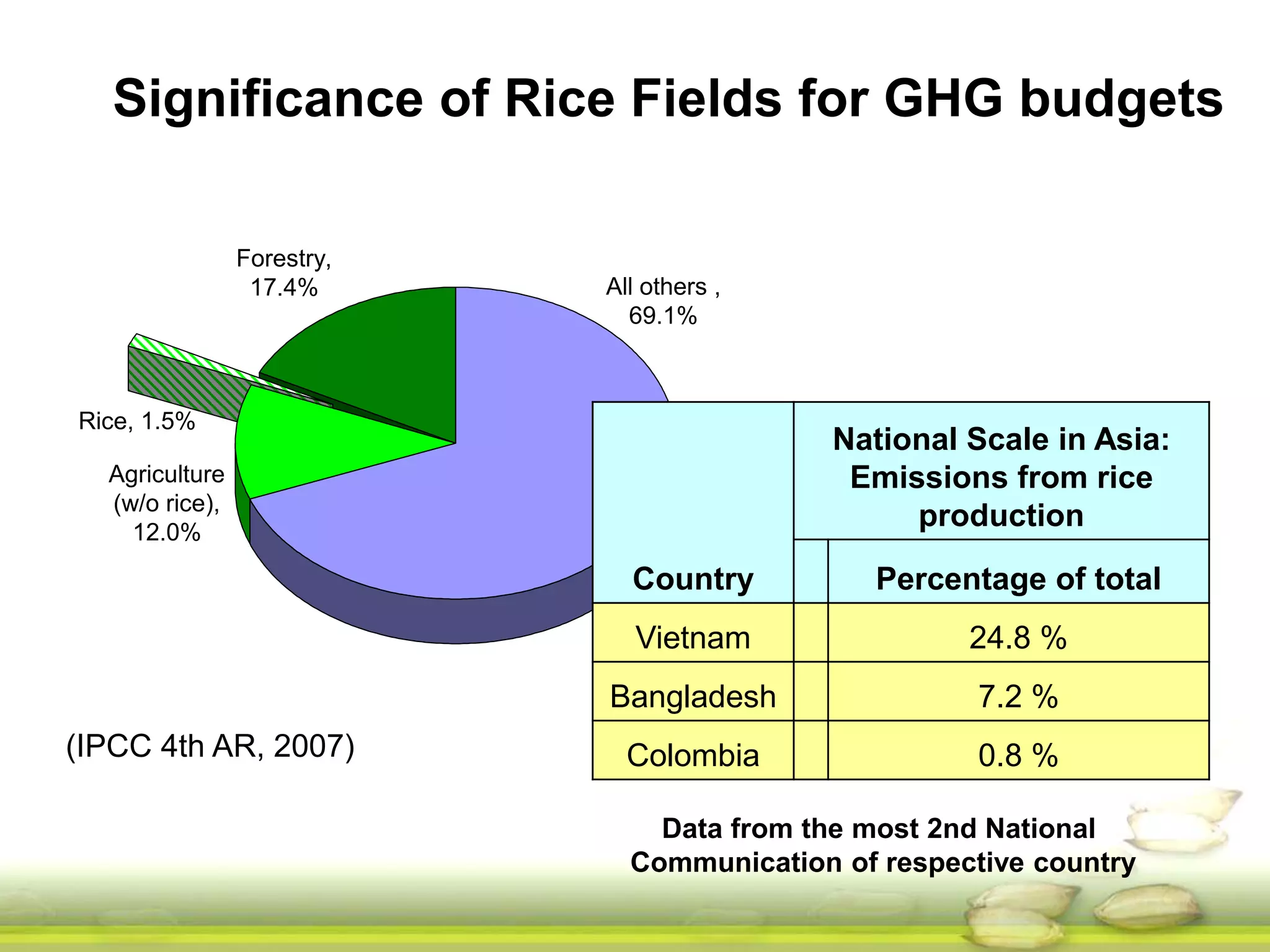
Significance of Rice Fields for GHG budgets 
Forestry, 
17.4% 
Rice, 1.5% 
Agriculture 
(w/o rice), 
12.0% 
(IPCC 4th AR, 2007) 
All others , 
69.1% 
Country 
National Scale in Asia: 
Emissions from rice 
production 
Percentage of total 
Vietnam 24.8 % 
Bangladesh 7.2 % 
Colombia 0.8 % 
Data from the most 2nd National 
Communication of respective country
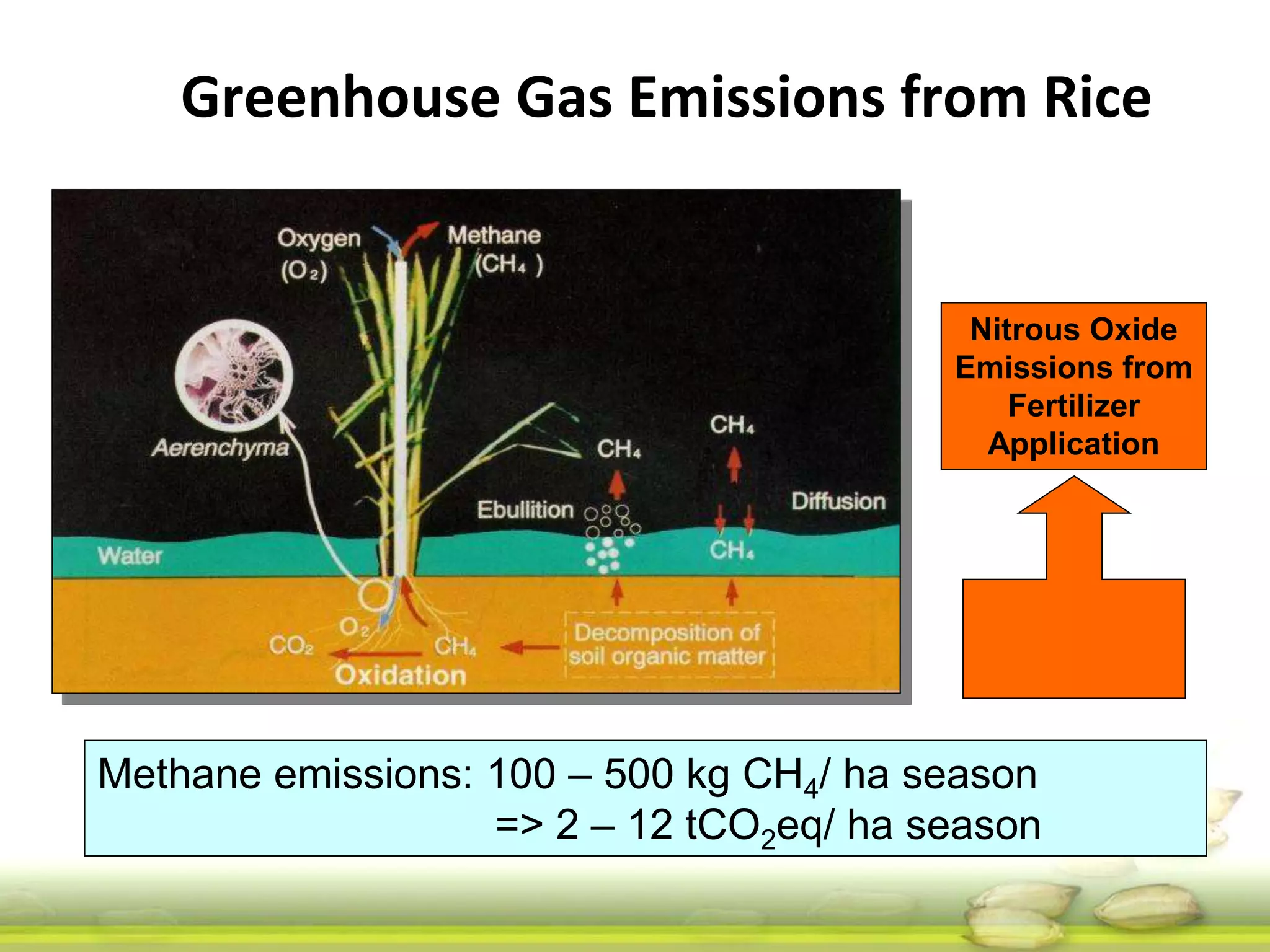
Greenhouse Gas Emissions from Rice 
Nitrous Oxide 
Emissions from 
Fertilizer 
Application 
Methane emissions: 100 – 500 kg CH4/ ha season 
=> 2 – 12 tCO2eq/ ha season
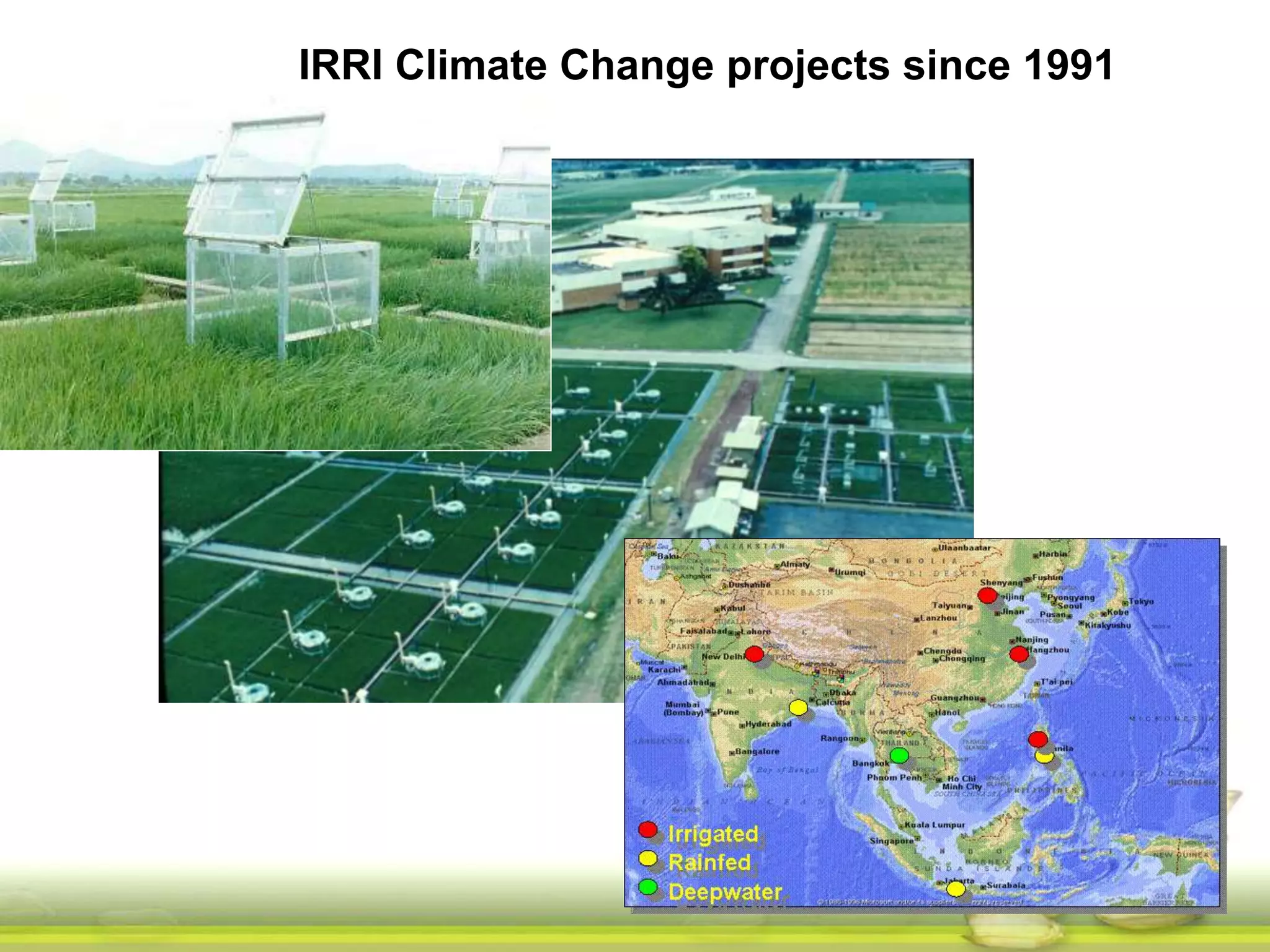
IRRI Climate Change projects since 1991
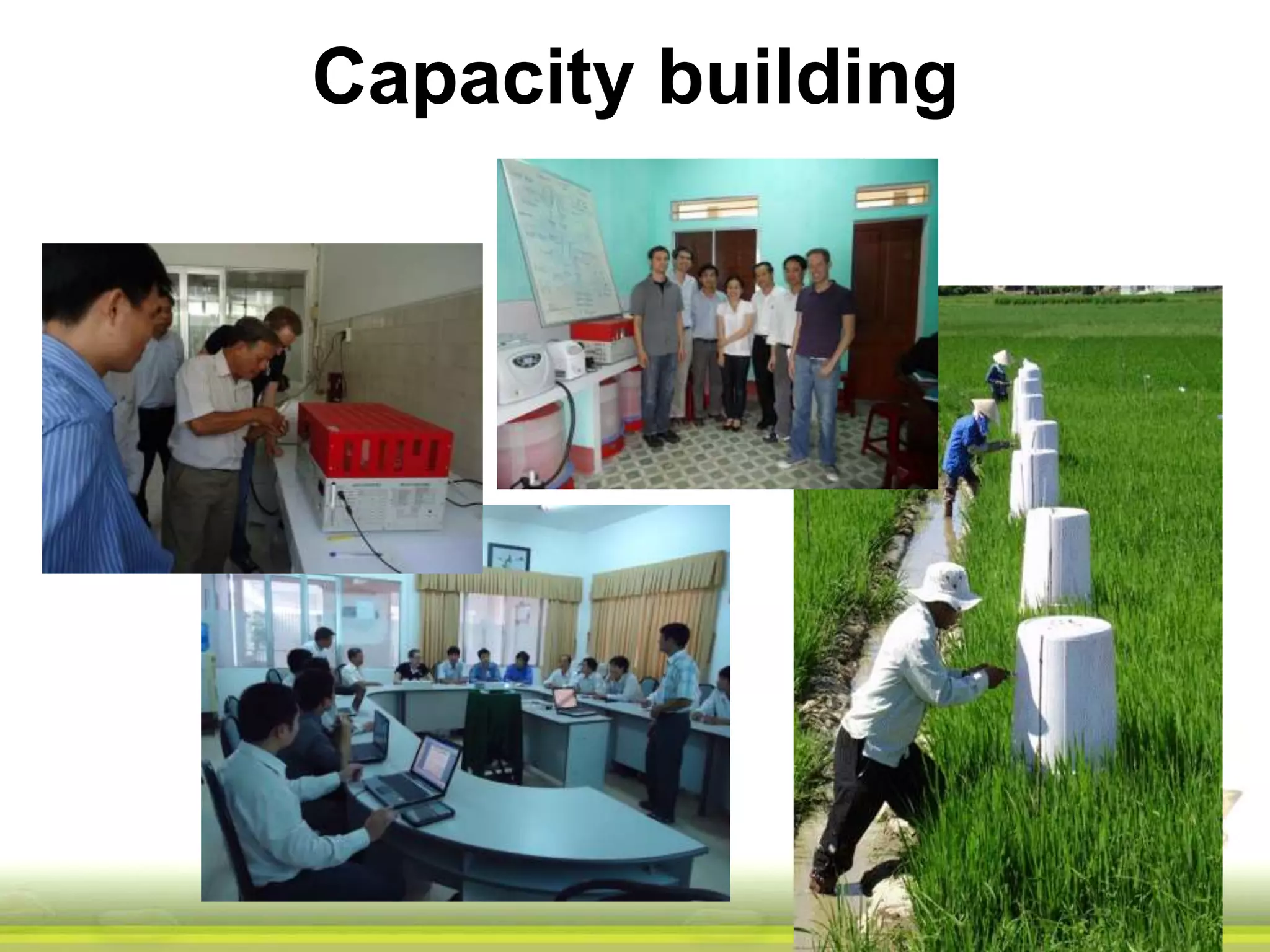
Capacity building
Outline 
• Background: Rice as a source of GHGs 
• Possible Options for Mitigation in Rice 
• Feasibility assessment for 
Alternate-Wetting-and-Drying 
• Outlook and Conclusion
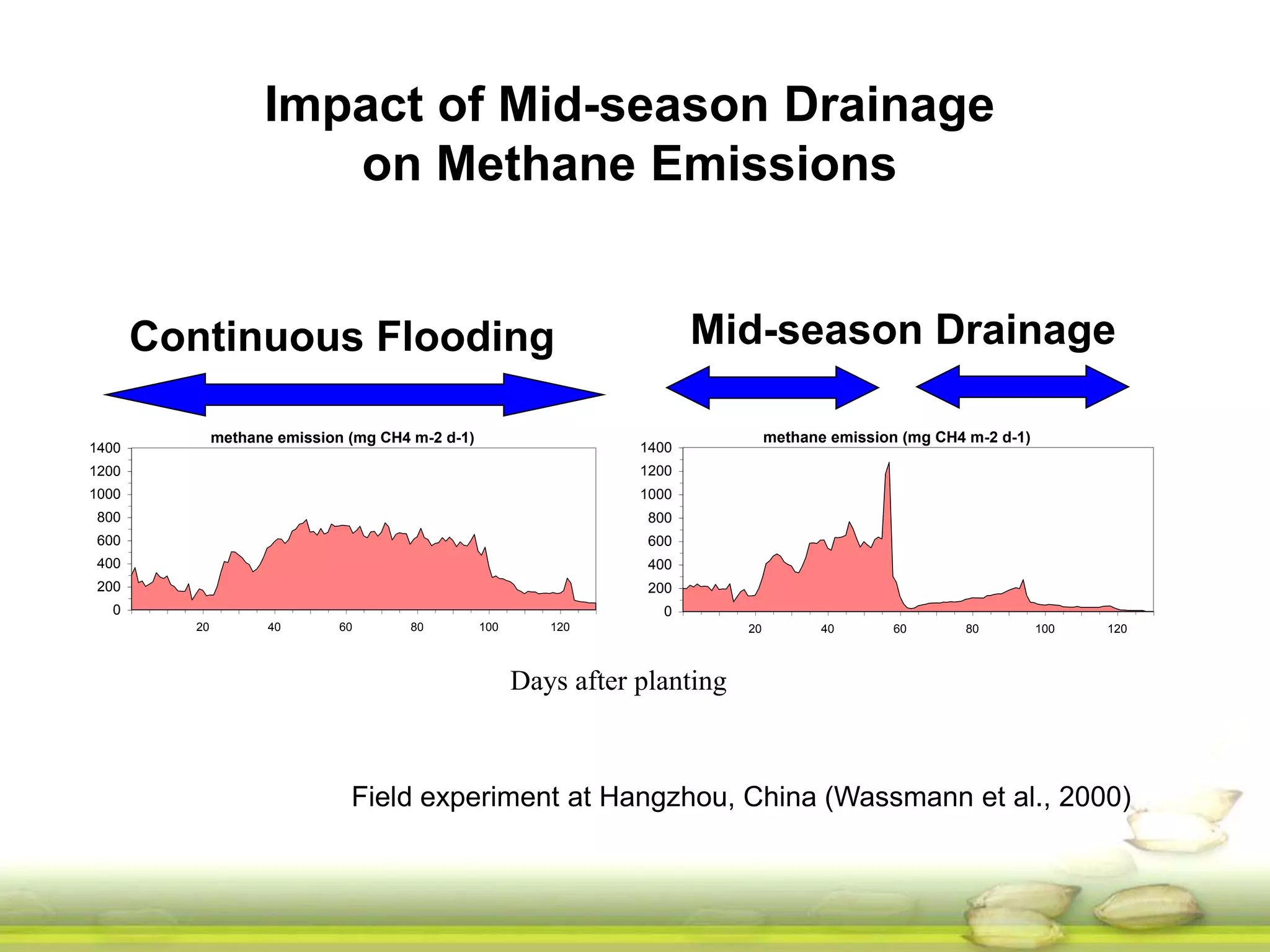
Impact of Mid-season Drainage 
on Methane Emissions 
water level (cm) / line Eh (mV) / dots 
100 
0 
Continuous Flooding -100 
Mid-season Drainage 
-200 
water level (cm) / line Eh (mV) / dots 
30 
20 
10 
1400 
1200 
1000 
800 
600 
400 
200 
Days after planting 
30 
20 
10 
0 
20 40 60 80 100 120 
-300 
1400 
1200 
1000 
800 
600 
400 
200 
0 
methane emission (mg CH4 m-2 d-1) 
20 40 60 80 100 120 
0 
20 40 60 80 100 120 
100 
0 
-100 
-200 
-300 
0 
methane emission (mg CH4 m-2 d-1) 
20 40 60 80 100 120 
Field experiment at Hangzhou, China (Wassmann et al., 2000)
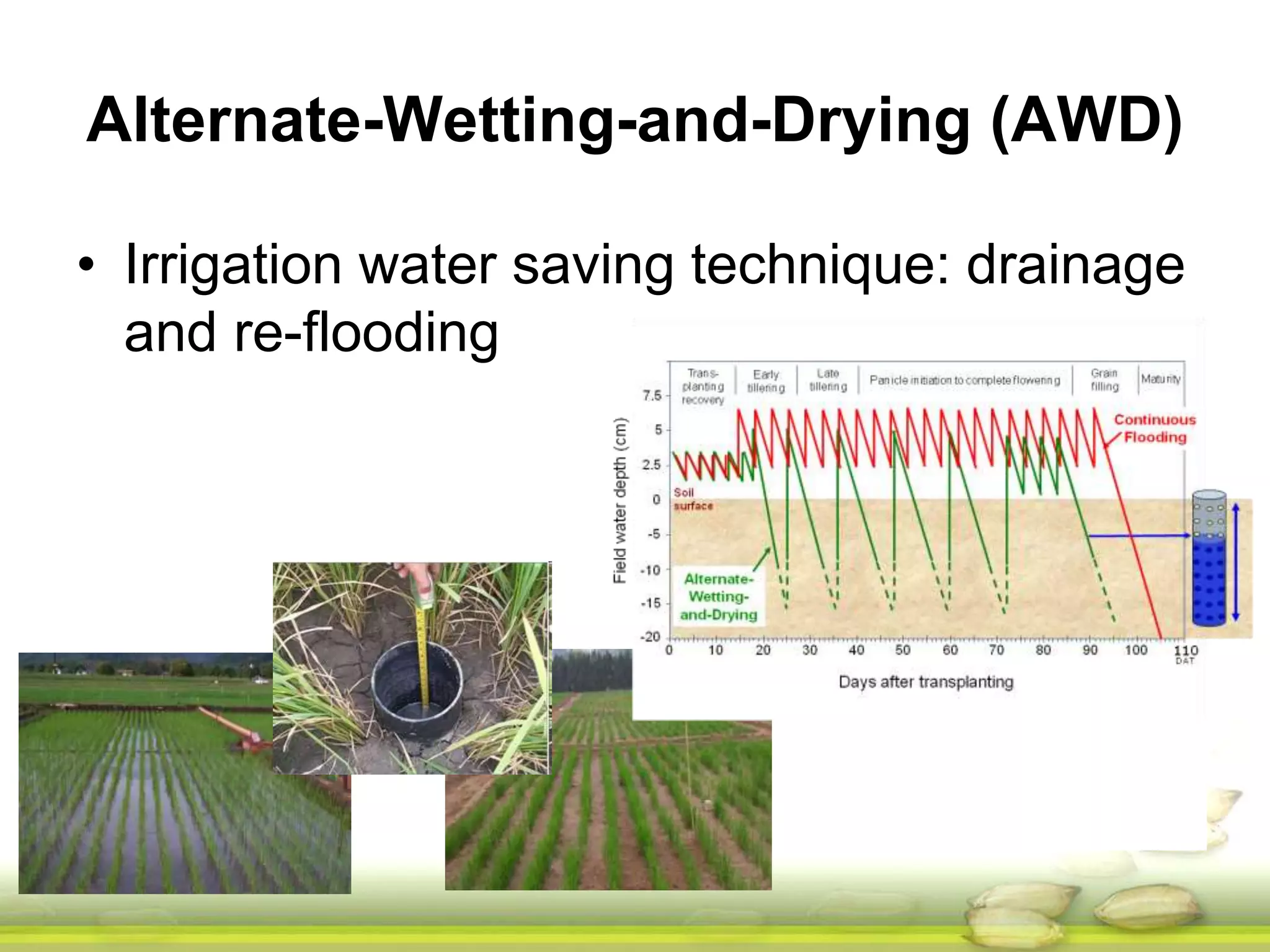
Alternate-Wetting-and-Drying (AWD) 
• Irrigation water saving technique: drainage 
and re-flooding
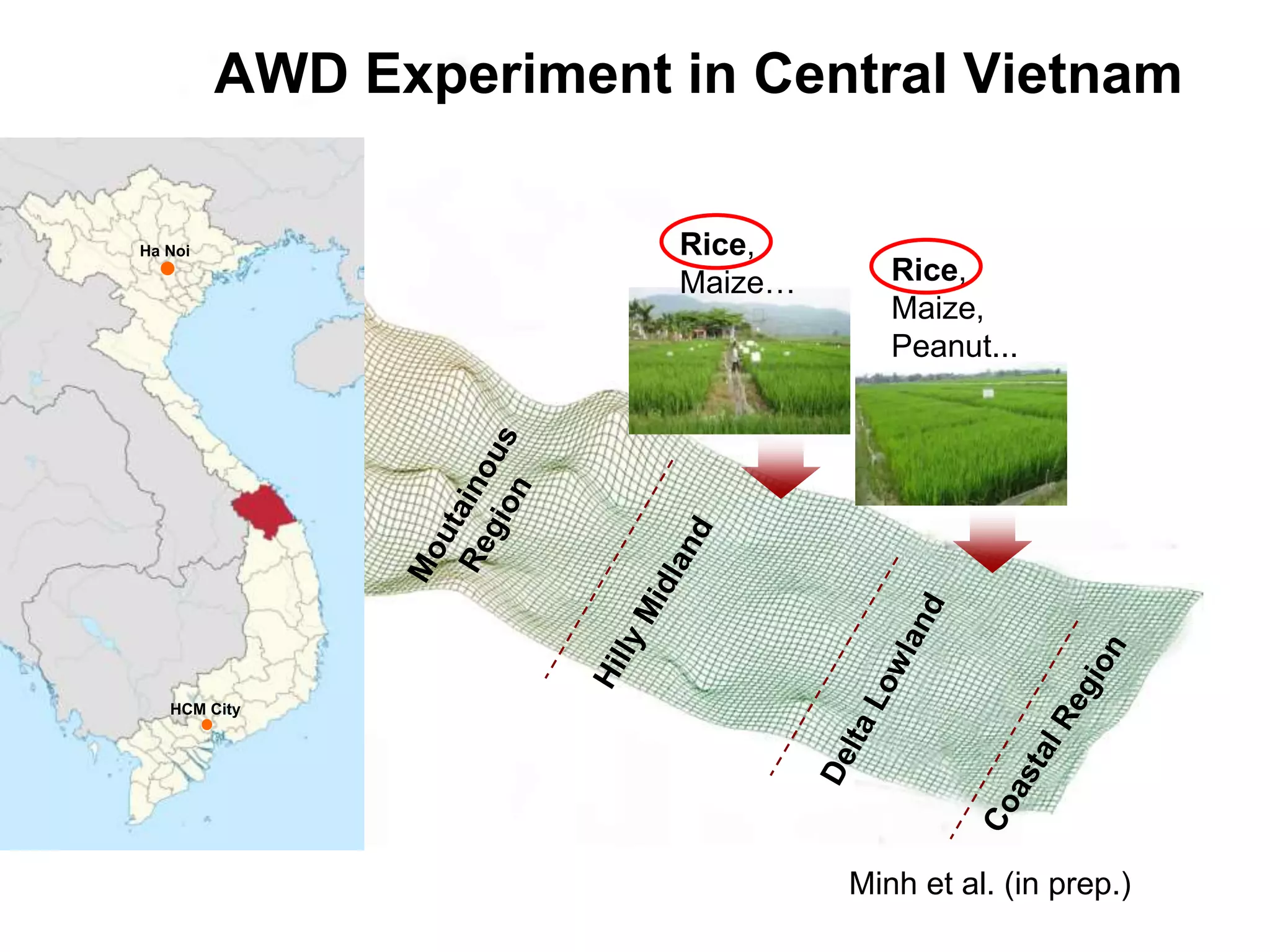
AWD Experiment in Central Vietnam 
Rice, 
Maize, 
Peanut... 
Rice, 
Maize… 
Ha Noi 
HCM City 
Minh et al. (in prep.)
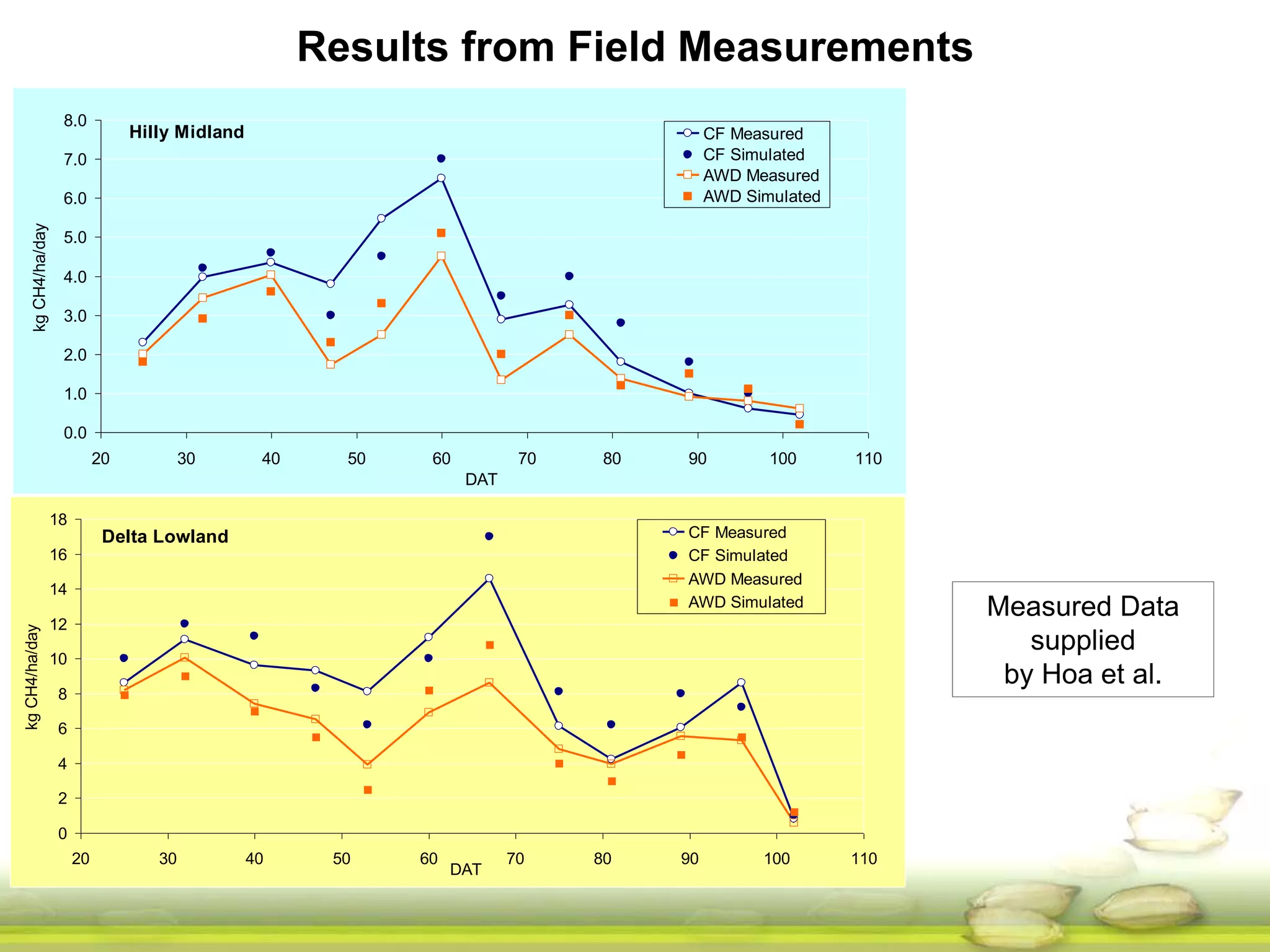
Results from Field Measurements 
Measured Data 
supplied 
by Hoa et al. 
Delta Lowland 
8.0 
7.0 
6.0 
5.0 
4.0 
3.0 
2.0 
1.0 
18 
16 
14 
12 
10 
8 
6 
4 
2 
0 
20 30 40 50 60 70 80 90 100 110 
DAT 
kg CH4/ha/day 
CF Measured 
CF Simulated 
AWD Measured 
AWD Simulated 
Hilly Midland 
0.0 
20 30 40 50 60 70 80 90 100 110 
DAT 
kg CH4/ha/day 
CF Measured 
CF Simulated 
AWD Measured 
AWD Simulated
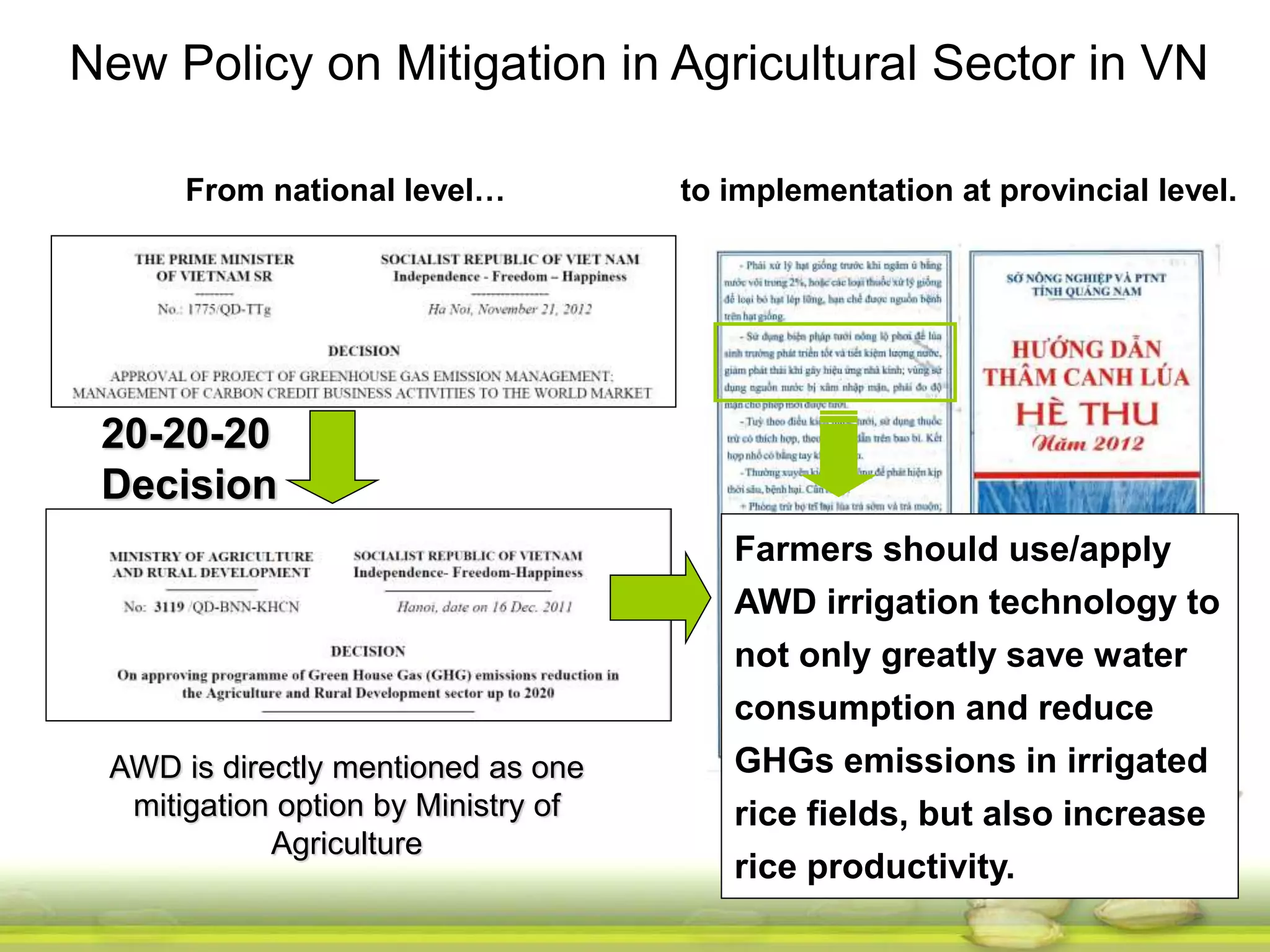
New Policy on Mitigation in Agricultural Sector in VN 
From national level… 
to implementation at provincial level. 
Farmers should use/apply 
AWD irrigation technology to 
not only greatly save water 
consumption and reduce 
GHGs emissions in irrigated 
rice fields, but also increase 
rice productivity. 
20-20-20 
Decision 
AWD is directly mentioned as one 
mitigation option by Ministry of 
Agriculture
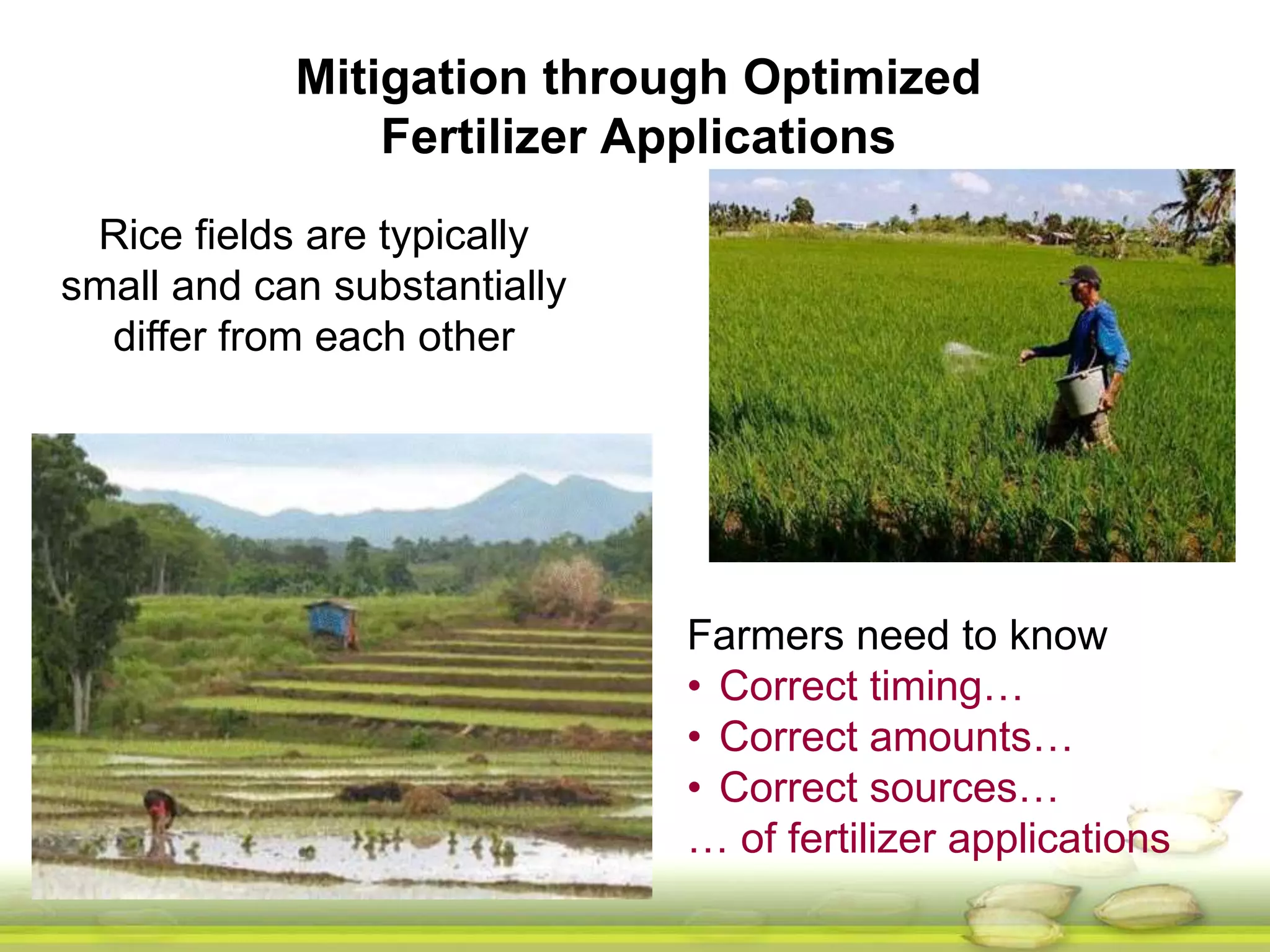
Mitigation through Optimized 
Fertilizer Applications 
Farmers need to know 
• Correct timing… 
• Correct amounts… 
• Correct sources… 
… of fertilizer applications 
Rice fields are typically 
small and can substantially 
differ from each other
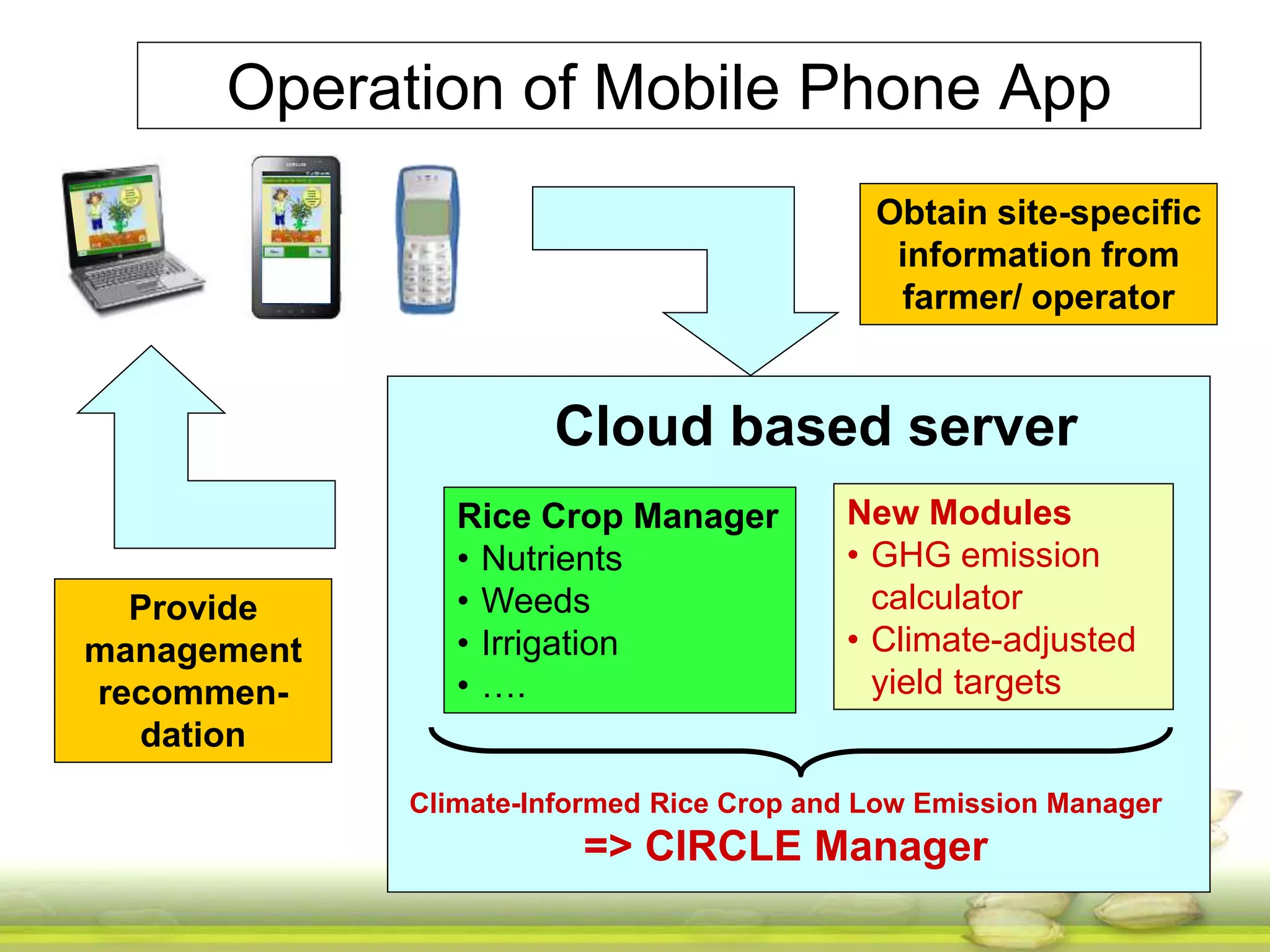
Operation of Mobile Phone App 
Provide 
management 
recommen-dation 
Cloud based server 
Rice Crop Manager 
• Nutrients 
• Weeds 
• Irrigation 
• …. 
Obtain site-specific 
information from 
farmer/ operator 
New Modules 
• GHG emission 
calculator 
• Climate-adjusted 
yield targets 
Climate-Informed Rice Crop and Low Emission Manager 
=> CIRCLE Manager
Outline 
• Background: Rice as a source of GHGs 
• Possible Options for Mitigation in Rice 
• Suitability assessment for 
Alternate-Wetting-and-Drying 
• Outlook and Conclusion
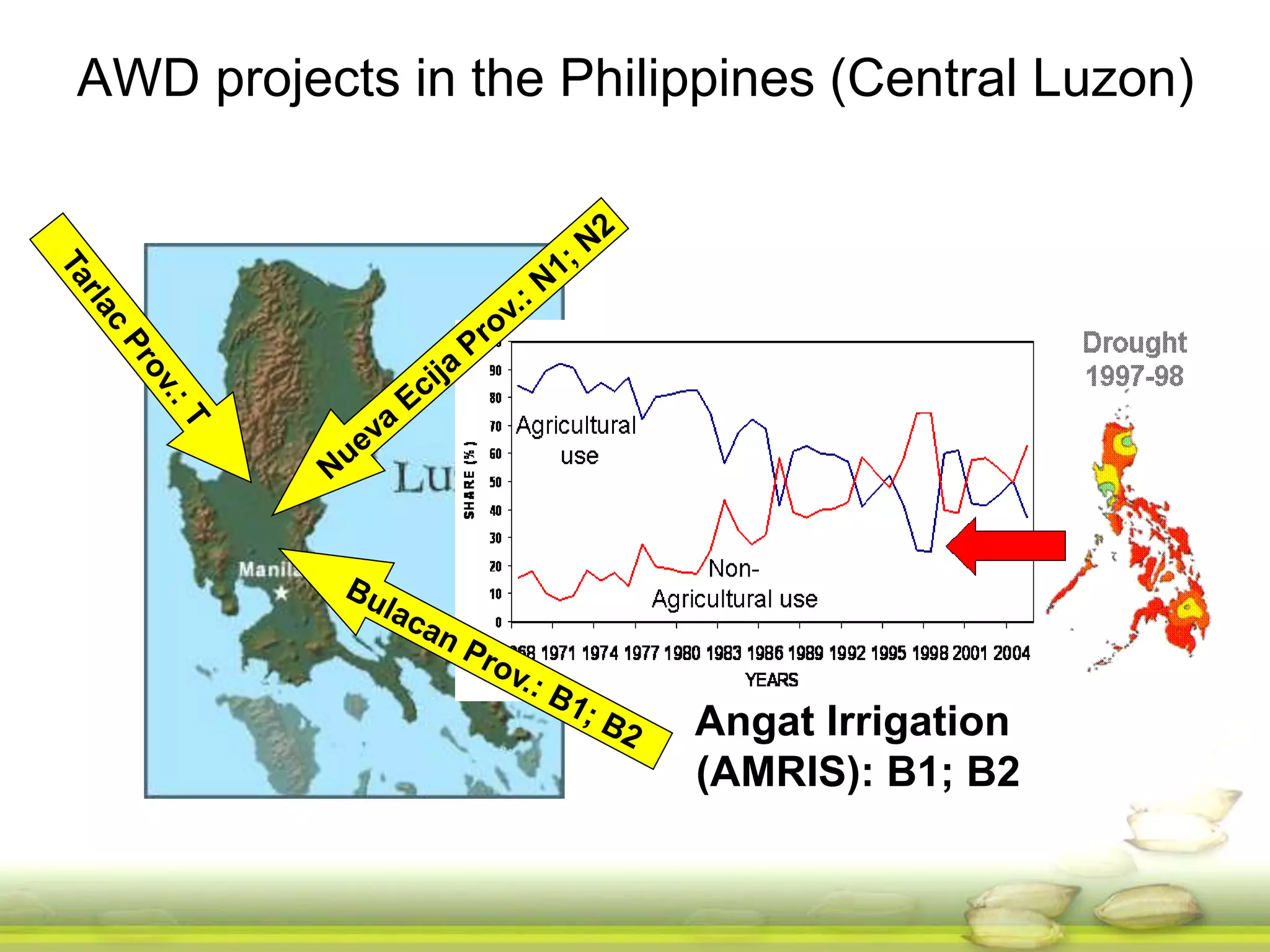
AWD projects in the Philippines (Central Luzon) 
Angat Irrigation 
(AMRIS): B1; B2
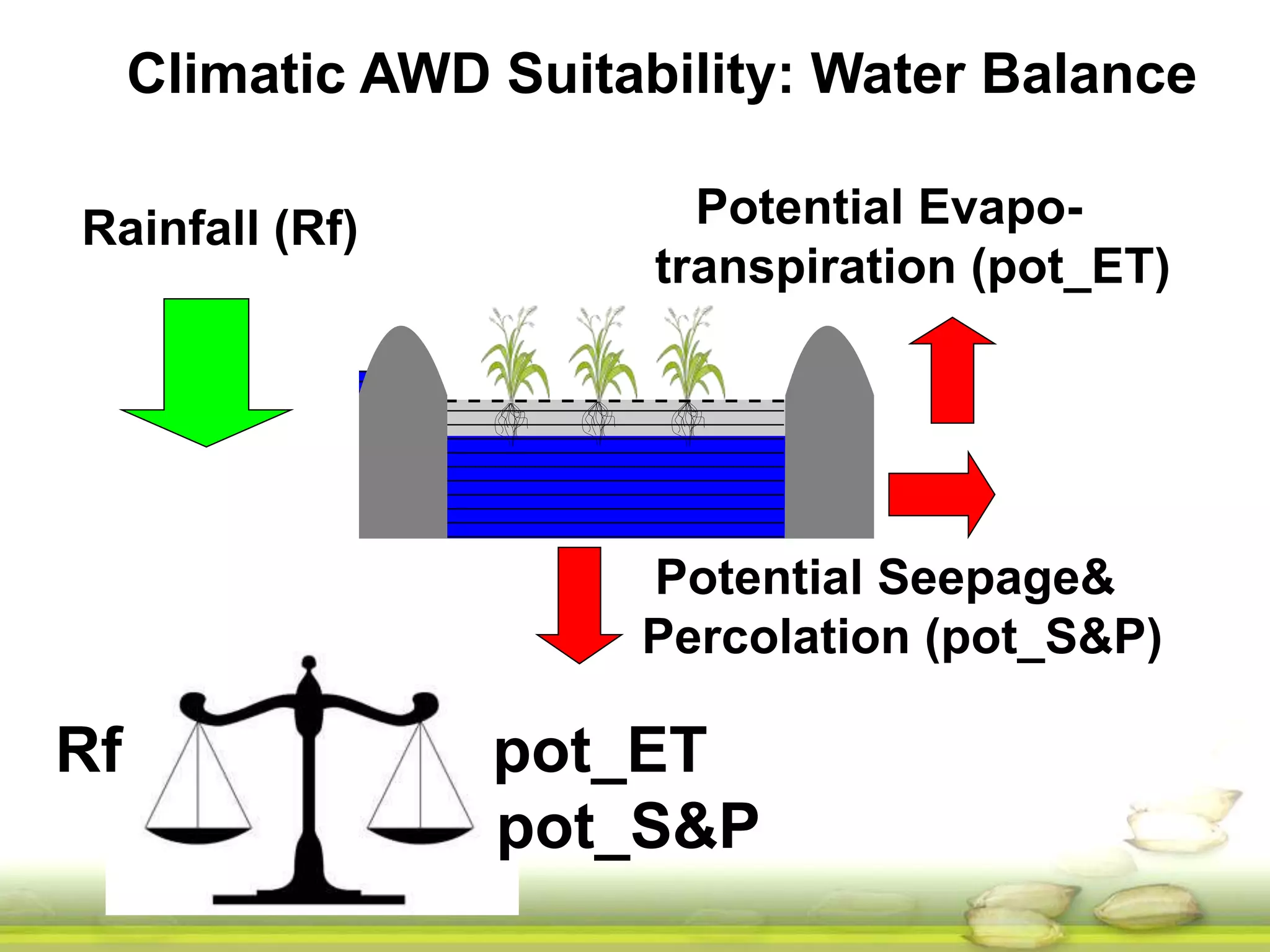
Climatic AWD Suitability: Water Balance 
Rainfall (Rf) Potential Evapo-transpiration 
(pot_ET) 
Potential Seepage& 
Percolation (pot_S&P) 
Rf pot_ET 
pot_S&P
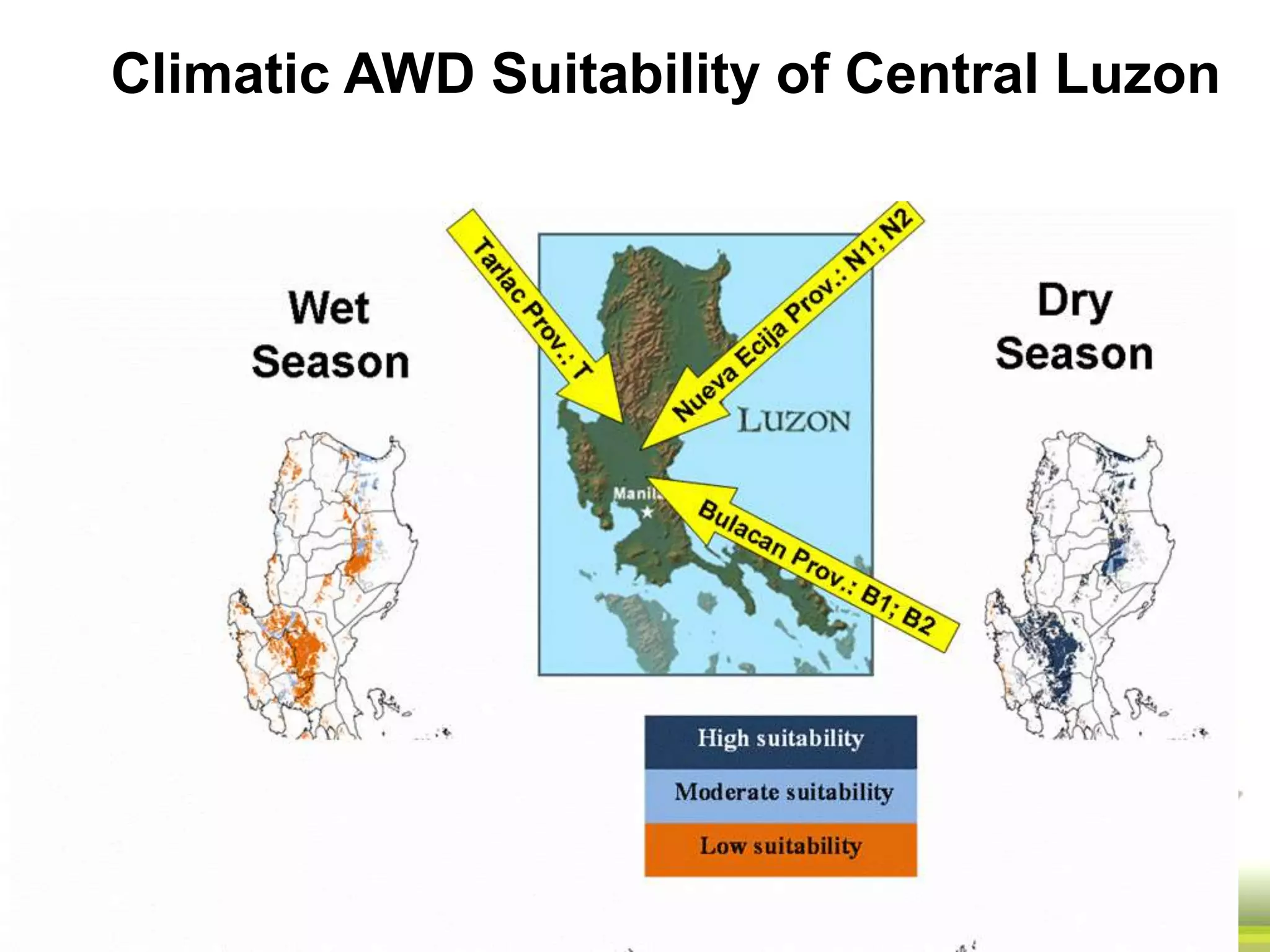
Climatic AWD Suitability of Central Luzon
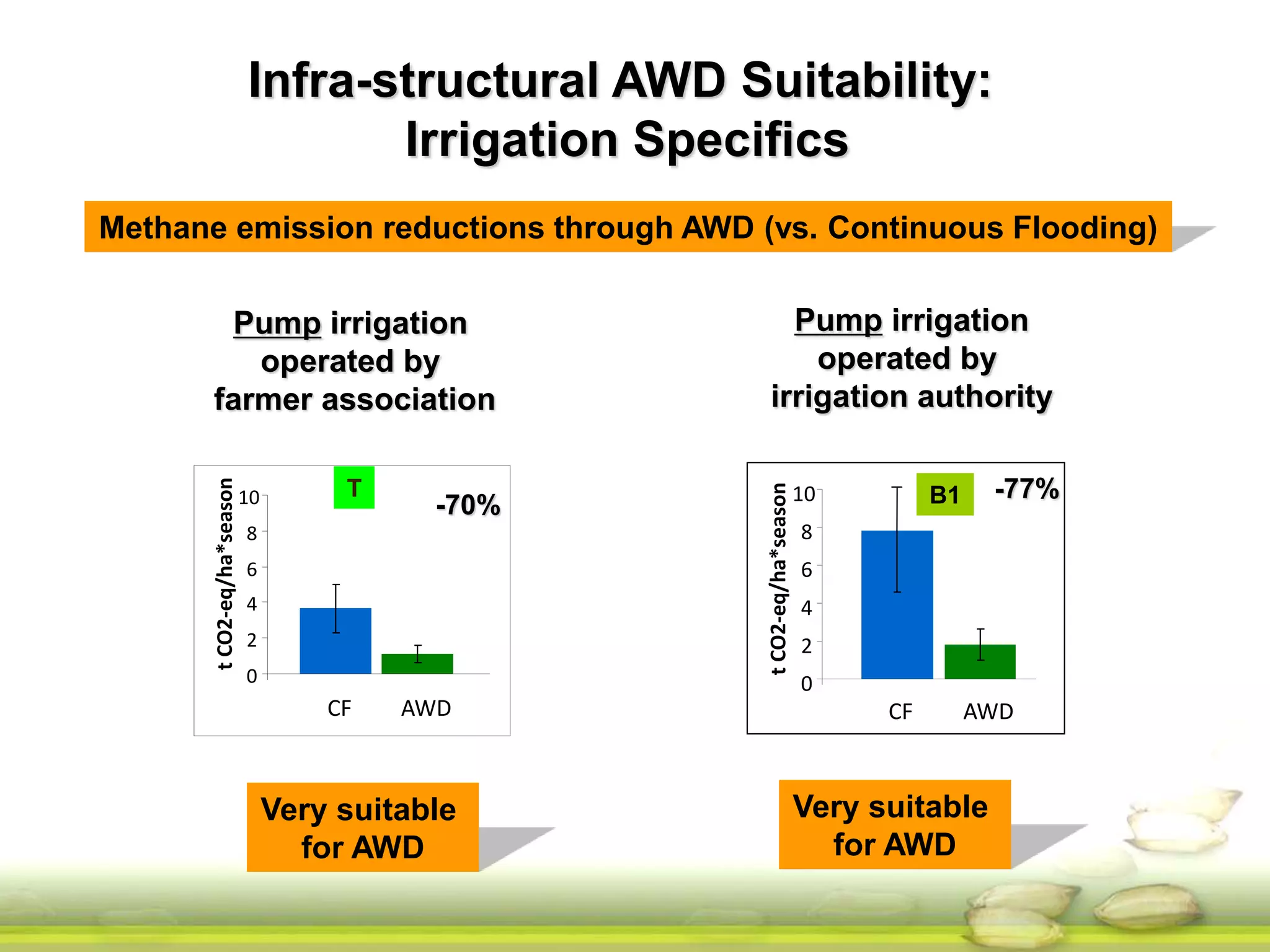
Infra-structural AWD Suitability: 
Irrigation Specifics 
Methane emission reductions through AWD (vs. Continuous Flooding) 
10 
8 
6 
4 
2 
0 
CF AWD 
t CO2-eq/ha*season 
B1 -77% 
Pump irrigation 
operated by 
farmer association 
10 
8 
6 
4 
2 
0 
CF AWD 
t CO2-eq/ha*season 
T 
-70% 
Pump irrigation 
operated by 
irrigation authority 
Very suitable 
for AWD 
Very suitable 
for AWD
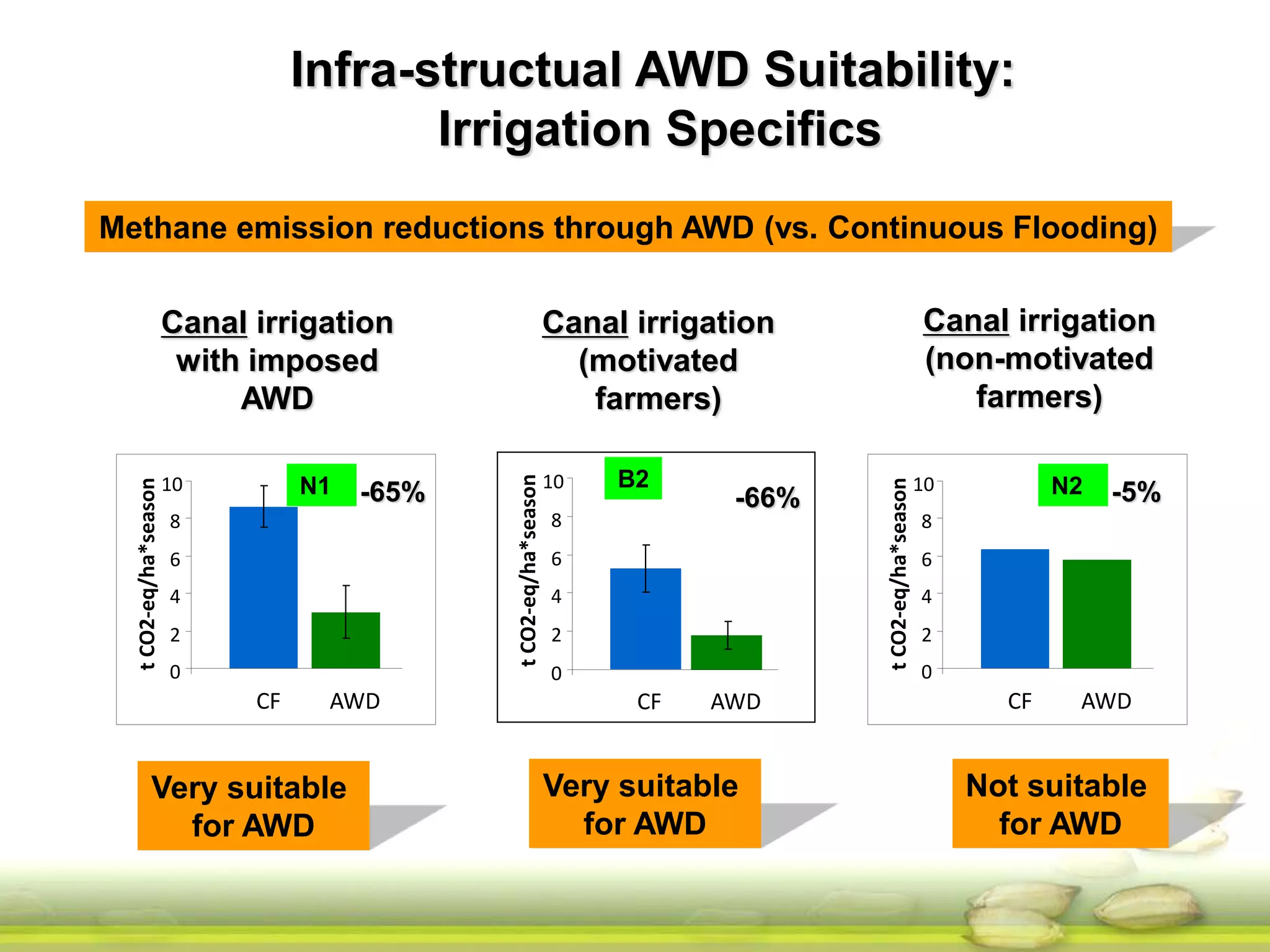
Infra-structual AWD Suitability: 
Methane emission reductions through AWD (vs. Continuous Flooding) 
10 
8 
6 
4 
2 
0 
CF AWD 
t CO2-eq/ha*season 
B2 
-66% 
10 
8 
6 
4 
2 
0 
CF AWD 
t CO2-eq/ha*season 
N1 -65% 
Irrigation Specifics 
Canal irrigation 
(motivated 
farmers) 
Canal irrigation 
with imposed 
AWD 
Canal irrigation 
(non-motivated 
farmers) 
Very suitable 
for AWD 
Very suitable 
for AWD 
Not suitable 
for AWD 
10 
8 
6 
4 
2 
0 
CF AWD 
t CO2-eq/ha*season 
N2 -5%
Introducing AWD
Lessons learned in case studies 
• Stress the co-benefits of AWD (such as stronger 
lodging resistance) to motivate farmers to adopt 
• Focus on ‘tail-end’ farmers to showcase the 
feasibility of AWD 
• Offer alternative irrigation options -- from single 
drainage to full AWD 
• Try to identify local ‘champions’ for technology 
adoption 
• Include irrigation authorities right from the onset 
of the project
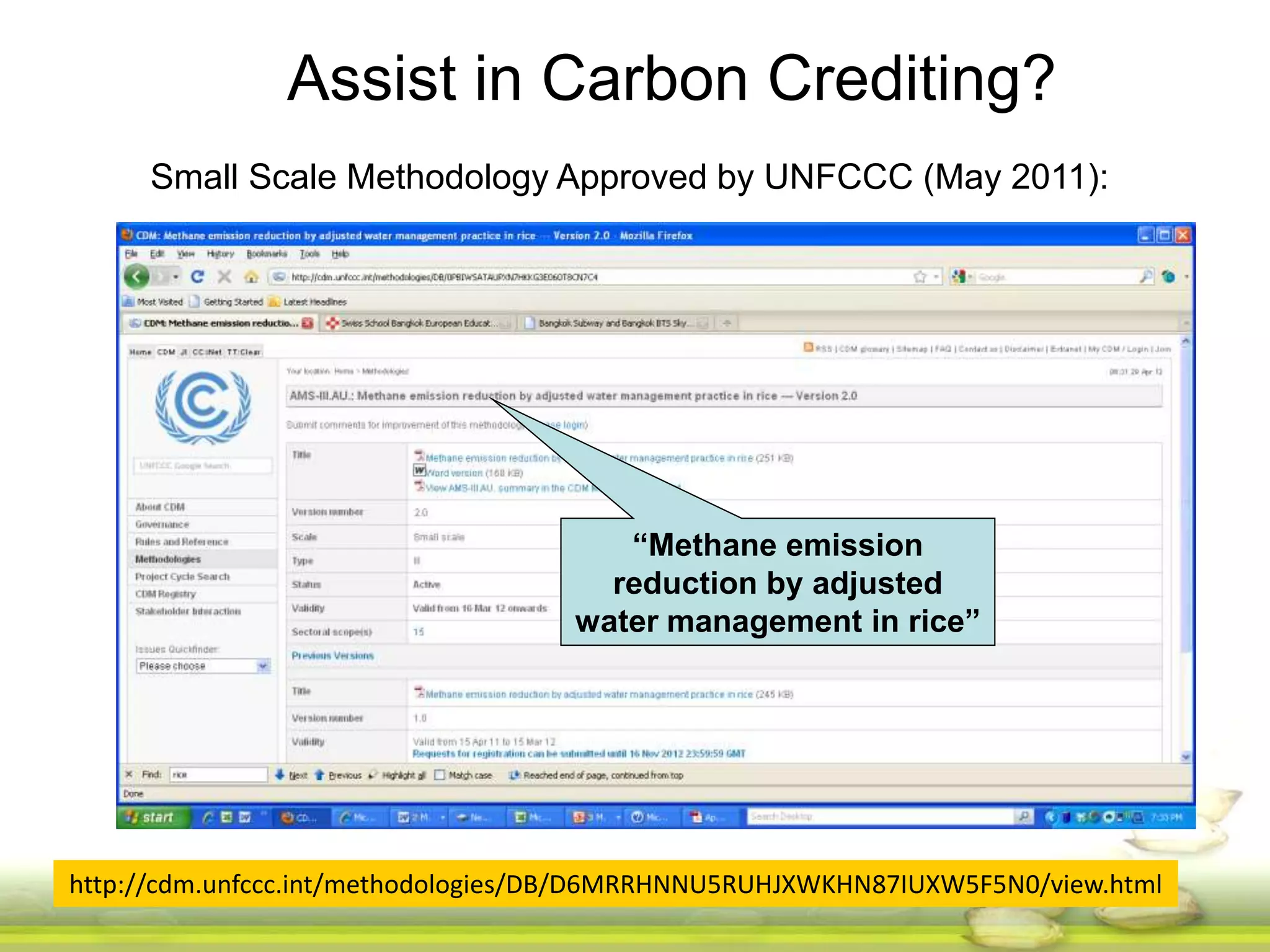
Assist in Carbon Crediting? 
Small Scale Methodology Approved by UNFCCC (May 2011): 
“Methane emission 
reduction by adjusted 
water management in rice” 
http://cdm.unfccc.int/methodologies/DB/D6MRRHNNU5RUHJXWKHN87IUXW5F5N0/view.html
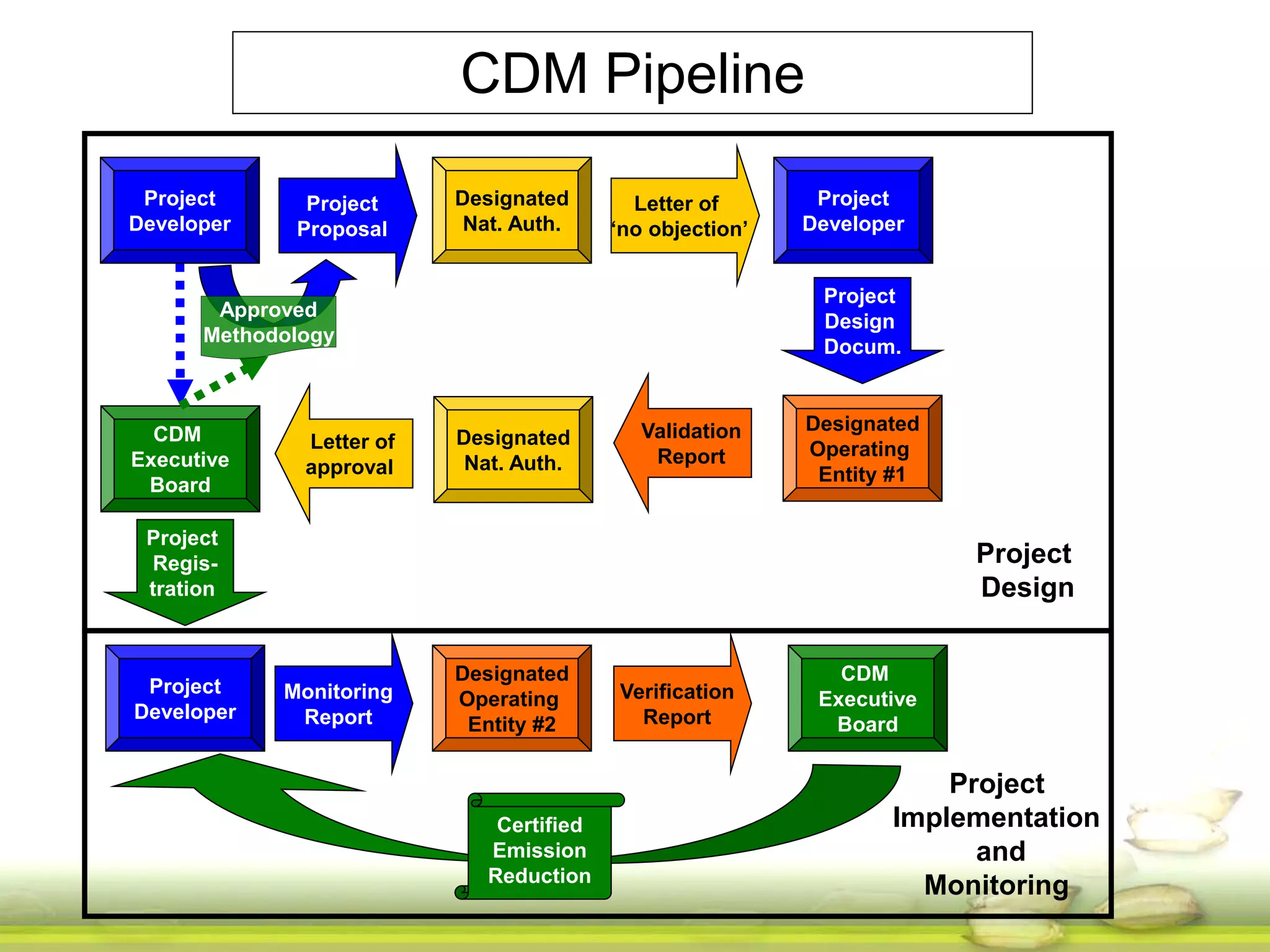
CDM Pipeline 
Project 
Developer 
Project 
Proposal 
Project 
Developer 
Designated 
Nat. Auth. 
Project 
Design 
Docum. 
Letter of 
‘no objection’ 
Designated 
Operating 
Entity #1 
Validation 
Report 
Designated 
Nat. Auth. 
Approved 
Methodology 
Letter of 
approval 
CDM 
Executive 
Board 
Project 
Regis-tration 
Certified 
Emission 
Reduction 
Project 
Developer 
Monitoring 
Report 
Designated 
Operating 
Entity #2 
Verification 
Report 
CDM 
Executive 
Board 
Project 
Design 
Project 
Implementation 
and 
Monitoring
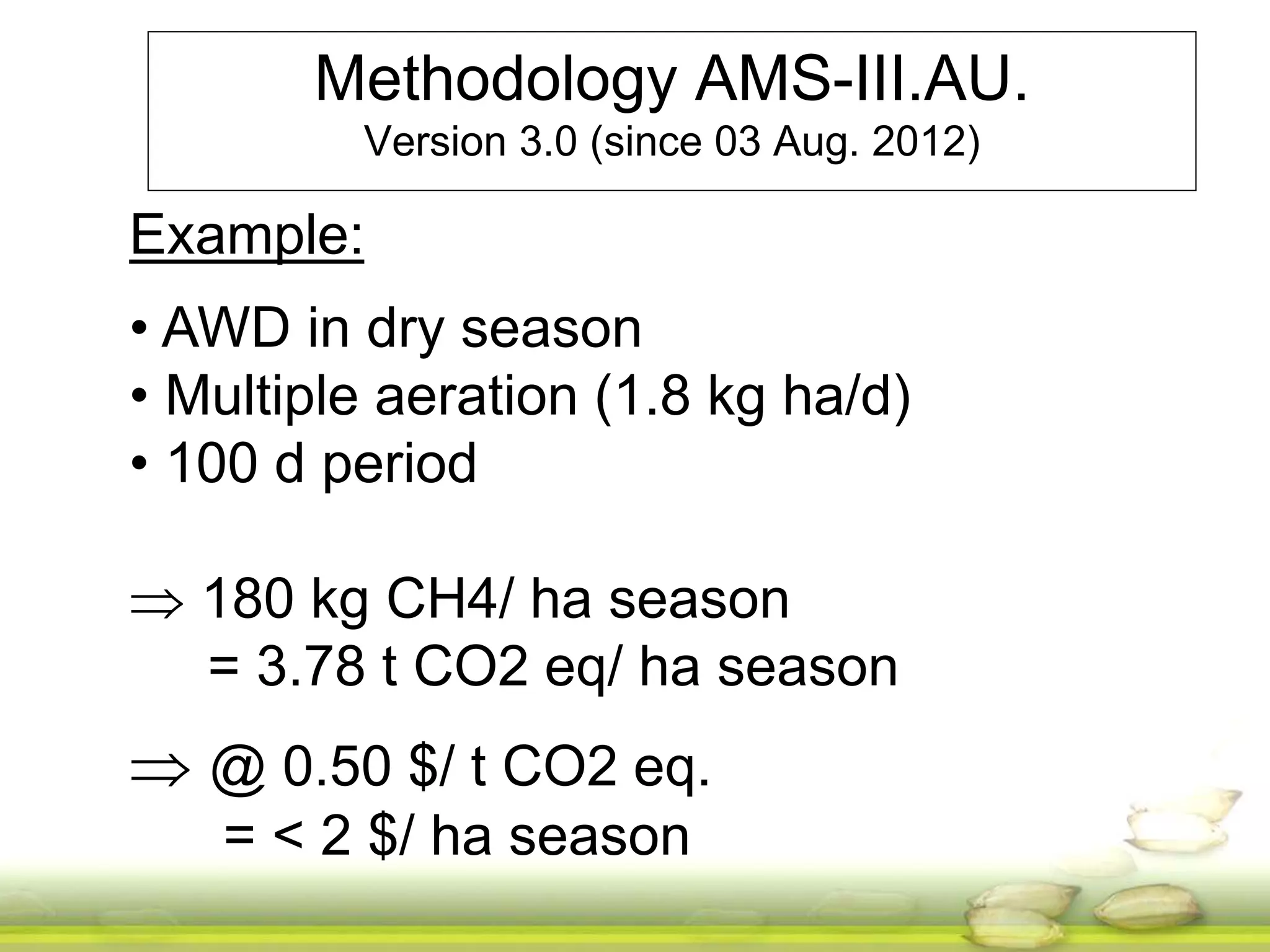
Methodology AMS-III.AU. 
Version 3.0 (since 03 Aug. 2012) 
Example: 
• AWD in dry season 
• Multiple aeration (1.8 kg ha/d) 
• 100 d period 
 180 kg CH4/ ha season 
= 3.78 t CO2 eq/ ha season 
 @ 0.50 $/ t CO2 eq. 
= < 2 $/ ha season
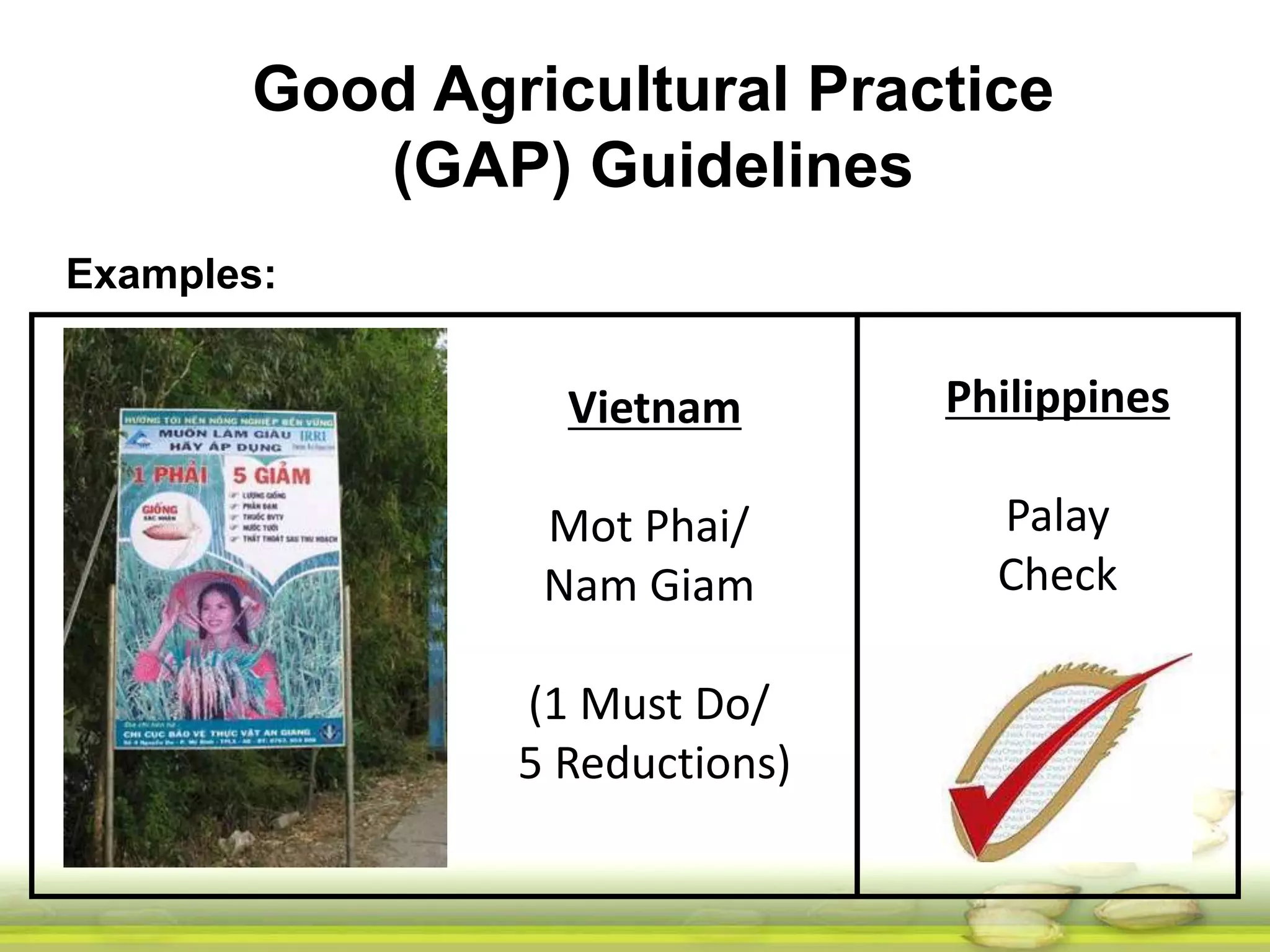
Good Agricultural Practice 
(GAP) Guidelines 
Vietnam 
Mot Phai/ 
Nam Giam 
(1 Must Do/ 
5 Reductions) 
Philippines 
Palay 
Check 
Examples:
Outline 
• Background: Rice as a source of GHGs 
• Possible Options for Mitigation in Rice 
• Feasibility assessment for 
Alternate-Wetting-and-Drying 
• Outlook and Conclusion
New Project: 
“Mitigation Options to 
Reduce Methane 
Emissions in Paddy Rice” 
CCAC: 
• Partnership of governments, inter-governmental 
organizations, private sector (40 governments, 
53 non-state entities) 
• Mission: Fight global warming and improve human 
health 
• Focus on SLCP (short-lived climate pollutants) 
• Operates under UNEP
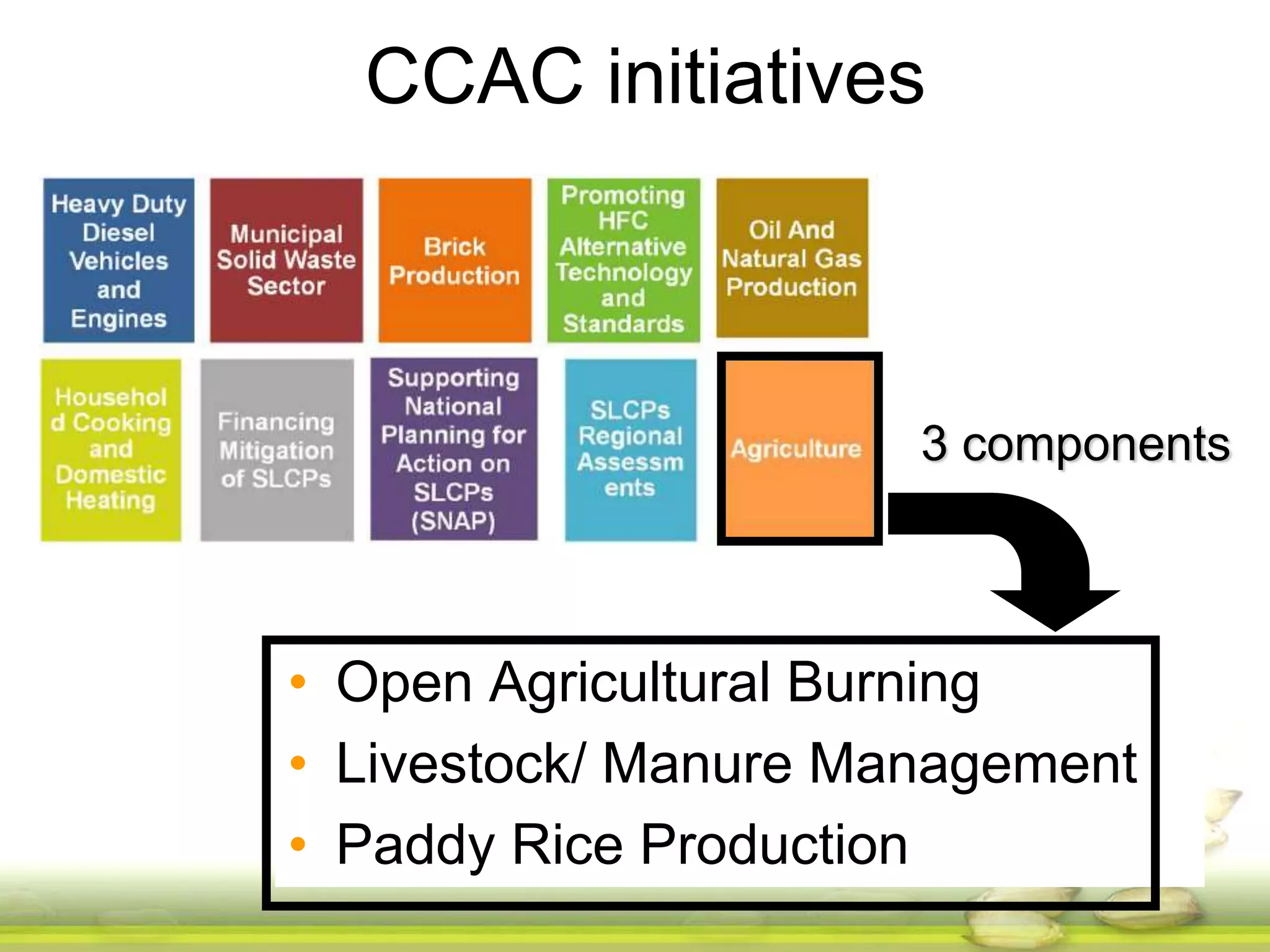
CCAC initiatives 
3 components 
• Open Agricultural Burning 
• Livestock/ Manure Management 
• Paddy Rice Production
New Project: 
“Mitigation Options to 
Reduce Methane 
Emissions in Paddy Rice” 
Overall Objective: 
Road maps for implementing replicable 
and scalable mitigation options focussing 
on AWD in 3 target countries: 
Vietnam 
Bangladesh 
Colombia
New Project: 
“Mitigation Options to 
Reduce Methane 
Emissions in Paddy Rice” 
Specific Objectives: 
1) Improved information platforms 
2) National networks, enhanced capacity 
and plans 
3) Pilot studies in areas with AWD 
experience for extracting ‘lessons learnt’
Conclusions 
Policy makers are getting increasingly 
interested to integrate mitigation into 
development targets 
… BUT … 
different stakeholders will need 
diversified information packages and 
decision support tools
Conclusions 
Scientific findings and publications will 
NOT be sufficient as such to stimulate 
mitigation 
… BUT … 
should be translated into clear spatial 
and temporal priorities at different 
scales
Thank you

GHG mitigation potential in rice production

  • 1.
    Mitigation potential inrice production Reiner Wassmann Bjoern Ole Sander International Rice Research Institute
  • 2.
    Outline • Background:Rice as a source of GHGs • Possible Options for Mitigation in Rice • Feasibility assessment for Alternate-Wetting-and-Drying • Outlook and Conclusion
  • 3.
    Significance of RiceFields for GHG budgets Forestry, 17.4% Rice, 1.5% Agriculture (w/o rice), 12.0% (IPCC 4th AR, 2007) All others , 69.1% Country National Scale in Asia: Emissions from rice production Percentage of total Vietnam 24.8 % Bangladesh 7.2 % Colombia 0.8 % Data from the most 2nd National Communication of respective country
  • 4.
    Greenhouse Gas Emissionsfrom Rice Nitrous Oxide Emissions from Fertilizer Application Methane emissions: 100 – 500 kg CH4/ ha season => 2 – 12 tCO2eq/ ha season
  • 5.
    IRRI Climate Changeprojects since 1991
  • 6.
  • 7.
    Outline • Background:Rice as a source of GHGs • Possible Options for Mitigation in Rice • Feasibility assessment for Alternate-Wetting-and-Drying • Outlook and Conclusion
  • 8.
    Impact of Mid-seasonDrainage on Methane Emissions water level (cm) / line Eh (mV) / dots 100 0 Continuous Flooding -100 Mid-season Drainage -200 water level (cm) / line Eh (mV) / dots 30 20 10 1400 1200 1000 800 600 400 200 Days after planting 30 20 10 0 20 40 60 80 100 120 -300 1400 1200 1000 800 600 400 200 0 methane emission (mg CH4 m-2 d-1) 20 40 60 80 100 120 0 20 40 60 80 100 120 100 0 -100 -200 -300 0 methane emission (mg CH4 m-2 d-1) 20 40 60 80 100 120 Field experiment at Hangzhou, China (Wassmann et al., 2000)
  • 9.
    Alternate-Wetting-and-Drying (AWD) •Irrigation water saving technique: drainage and re-flooding
  • 10.
    AWD Experiment inCentral Vietnam Rice, Maize, Peanut... Rice, Maize… Ha Noi HCM City Minh et al. (in prep.)
  • 11.
    Results from FieldMeasurements Measured Data supplied by Hoa et al. Delta Lowland 8.0 7.0 6.0 5.0 4.0 3.0 2.0 1.0 18 16 14 12 10 8 6 4 2 0 20 30 40 50 60 70 80 90 100 110 DAT kg CH4/ha/day CF Measured CF Simulated AWD Measured AWD Simulated Hilly Midland 0.0 20 30 40 50 60 70 80 90 100 110 DAT kg CH4/ha/day CF Measured CF Simulated AWD Measured AWD Simulated
  • 12.
    New Policy onMitigation in Agricultural Sector in VN From national level… to implementation at provincial level. Farmers should use/apply AWD irrigation technology to not only greatly save water consumption and reduce GHGs emissions in irrigated rice fields, but also increase rice productivity. 20-20-20 Decision AWD is directly mentioned as one mitigation option by Ministry of Agriculture
  • 13.
    Mitigation through Optimized Fertilizer Applications Farmers need to know • Correct timing… • Correct amounts… • Correct sources… … of fertilizer applications Rice fields are typically small and can substantially differ from each other
  • 14.
    Operation of MobilePhone App Provide management recommen-dation Cloud based server Rice Crop Manager • Nutrients • Weeds • Irrigation • …. Obtain site-specific information from farmer/ operator New Modules • GHG emission calculator • Climate-adjusted yield targets Climate-Informed Rice Crop and Low Emission Manager => CIRCLE Manager
  • 15.
    Outline • Background:Rice as a source of GHGs • Possible Options for Mitigation in Rice • Suitability assessment for Alternate-Wetting-and-Drying • Outlook and Conclusion
  • 16.
    AWD projects inthe Philippines (Central Luzon) Angat Irrigation (AMRIS): B1; B2
  • 17.
    Climatic AWD Suitability:Water Balance Rainfall (Rf) Potential Evapo-transpiration (pot_ET) Potential Seepage& Percolation (pot_S&P) Rf pot_ET pot_S&P
  • 18.
    Climatic AWD Suitabilityof Central Luzon
  • 19.
    Infra-structural AWD Suitability: Irrigation Specifics Methane emission reductions through AWD (vs. Continuous Flooding) 10 8 6 4 2 0 CF AWD t CO2-eq/ha*season B1 -77% Pump irrigation operated by farmer association 10 8 6 4 2 0 CF AWD t CO2-eq/ha*season T -70% Pump irrigation operated by irrigation authority Very suitable for AWD Very suitable for AWD
  • 20.
    Infra-structual AWD Suitability: Methane emission reductions through AWD (vs. Continuous Flooding) 10 8 6 4 2 0 CF AWD t CO2-eq/ha*season B2 -66% 10 8 6 4 2 0 CF AWD t CO2-eq/ha*season N1 -65% Irrigation Specifics Canal irrigation (motivated farmers) Canal irrigation with imposed AWD Canal irrigation (non-motivated farmers) Very suitable for AWD Very suitable for AWD Not suitable for AWD 10 8 6 4 2 0 CF AWD t CO2-eq/ha*season N2 -5%
  • 21.
  • 22.
    Lessons learned incase studies • Stress the co-benefits of AWD (such as stronger lodging resistance) to motivate farmers to adopt • Focus on ‘tail-end’ farmers to showcase the feasibility of AWD • Offer alternative irrigation options -- from single drainage to full AWD • Try to identify local ‘champions’ for technology adoption • Include irrigation authorities right from the onset of the project
  • 23.
    Assist in CarbonCrediting? Small Scale Methodology Approved by UNFCCC (May 2011): “Methane emission reduction by adjusted water management in rice” http://cdm.unfccc.int/methodologies/DB/D6MRRHNNU5RUHJXWKHN87IUXW5F5N0/view.html
  • 24.
    CDM Pipeline Project Developer Project Proposal Project Developer Designated Nat. Auth. Project Design Docum. Letter of ‘no objection’ Designated Operating Entity #1 Validation Report Designated Nat. Auth. Approved Methodology Letter of approval CDM Executive Board Project Regis-tration Certified Emission Reduction Project Developer Monitoring Report Designated Operating Entity #2 Verification Report CDM Executive Board Project Design Project Implementation and Monitoring
  • 25.
    Methodology AMS-III.AU. Version3.0 (since 03 Aug. 2012) Example: • AWD in dry season • Multiple aeration (1.8 kg ha/d) • 100 d period  180 kg CH4/ ha season = 3.78 t CO2 eq/ ha season  @ 0.50 $/ t CO2 eq. = < 2 $/ ha season
  • 26.
    Good Agricultural Practice (GAP) Guidelines Vietnam Mot Phai/ Nam Giam (1 Must Do/ 5 Reductions) Philippines Palay Check Examples:
  • 27.
    Outline • Background:Rice as a source of GHGs • Possible Options for Mitigation in Rice • Feasibility assessment for Alternate-Wetting-and-Drying • Outlook and Conclusion
  • 28.
    New Project: “MitigationOptions to Reduce Methane Emissions in Paddy Rice” CCAC: • Partnership of governments, inter-governmental organizations, private sector (40 governments, 53 non-state entities) • Mission: Fight global warming and improve human health • Focus on SLCP (short-lived climate pollutants) • Operates under UNEP
  • 29.
    CCAC initiatives 3components • Open Agricultural Burning • Livestock/ Manure Management • Paddy Rice Production
  • 30.
    New Project: “MitigationOptions to Reduce Methane Emissions in Paddy Rice” Overall Objective: Road maps for implementing replicable and scalable mitigation options focussing on AWD in 3 target countries: Vietnam Bangladesh Colombia
  • 31.
    New Project: “MitigationOptions to Reduce Methane Emissions in Paddy Rice” Specific Objectives: 1) Improved information platforms 2) National networks, enhanced capacity and plans 3) Pilot studies in areas with AWD experience for extracting ‘lessons learnt’
  • 32.
    Conclusions Policy makersare getting increasingly interested to integrate mitigation into development targets … BUT … different stakeholders will need diversified information packages and decision support tools
  • 33.
    Conclusions Scientific findingsand publications will NOT be sufficient as such to stimulate mitigation … BUT … should be translated into clear spatial and temporal priorities at different scales
  • 34.