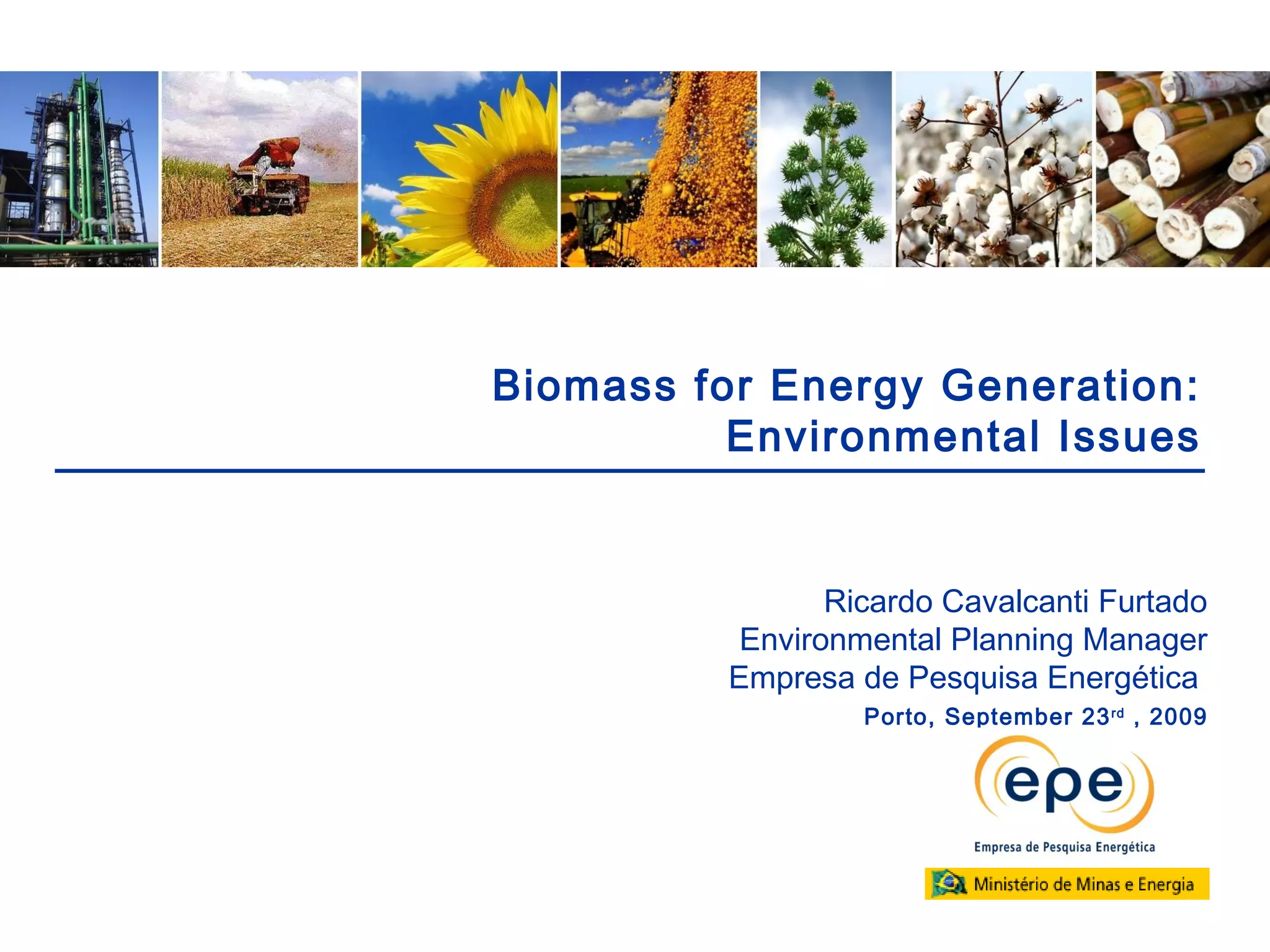
Porto, September 23rd
, 2009
Ricardo Cavalcanti Furtado
Environmental Planning Manager
Empresa de Pesquisa Energética
Biomass for Energy Generation:
Environmental Issues
Government-owned company, linked to the Ministry of Mines
and Energy, instituted by Law n° 10.847/2004
EPE has been created to develop studies and research to
support the energy sector planning in the areas of electric
energy, oil and natural gas and its derivatives, mineral coal,
renewable energy sources and energy efficiency
Empresa de Pesquisa Energética
Energy Planning in Brazil
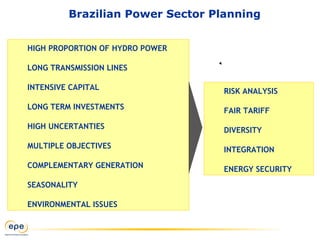
HIGH PROPORTION OF HYDRO POWER
LONG TRANSMISSION LINES
INTENSIVE CAPITAL
LONG TERM INVESTMENTS
HIGH UNCERTANTIES
MULTIPLE OBJECTIVES
COMPLEMENTARY GENERATION
SEASONALITY
ENVIRONMENTAL ISSUES
Brazilian Power Sector Planning
RISK ANALYSIS
FAIR TARIFF
DIVERSITY
INTEGRATION
ENERGY SECURITY
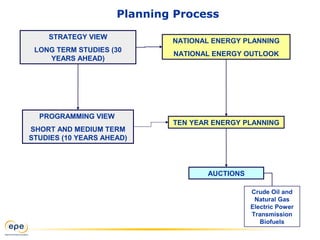
NATIONAL ENERGY PLANNING
NATIONAL ENERGY OUTLOOK
TEN YEAR ENERGY PLANNING
AUCTIONS
Crude Oil and
Natural Gas
Electric Power
Transmission
Biofuels
PROGRAMMING VIEW
SHORT AND MEDIUM TERM
STUDIES (10 YEARS AHEAD)
STRATEGY VIEW
LONG TERM STUDIES (30
YEARS AHEAD)
Planning Process
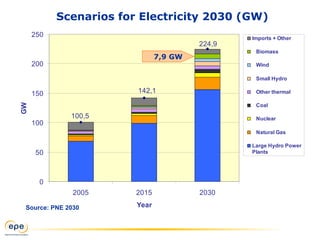
Scenarios for Electricity 2030 (GW)
Source: PNE 2030
142,1
224,9
100,5
0
50
100
150
200
250
2005 2015 2030
Year
GW
Imports + Other
Biomass
Wind
Small Hydro
Other thermal
Coal
Nuclear
Natural Gas
Large Hydro Power
Plants
7,9 GW
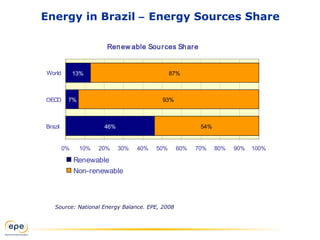
Source: National Energy Balance. EPE, 2008
Energy in Brazil – Energy Sources Share
Renew able Sources Share
54%
93%
87%13%
7%
46%
0% 10% 20% 30% 40% 50% 60% 70% 80% 90% 100%
Brazil
OECD
World
Renewable
Non-renewable
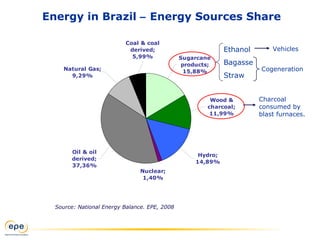
Wood &
charcoal;
11,99%
Sugarcane
products;
15,88%
Hydro;
14,89%
Nuclear;
1,40%
Coal & coal
derived;
5,99%
Natural Gas;
9,29%
Oil & oil
derived;
37,36%
Energy in Brazil – Energy Sources Share
Source: National Energy Balance. EPE, 2008
Ethanol
Bagasse
Straw
Cogeneration
Vehicles
Charcoal
consumed by
blast furnaces.
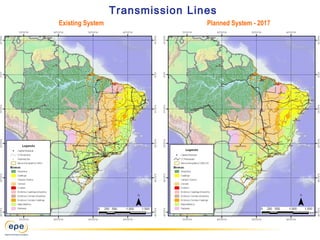
Transmission Lines
Planned System - 2017Existing System
Biomass
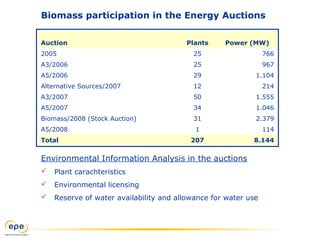
Biomass participation in the Energy Auctions
Auction Plants Power (MW)
2005 25 766
A3/2006 25 967
A5/2006 29 1.104
Alternative Sources/2007 12 214
A3/2007 50 1.555
A5/2007 34 1.046
Biomass/2008 (Stock Auction) 31 2.379
A5/2008 1 114
Total 207 8.144
Environmental Information Analysis in the auctions
 Plant carachteristics
 Environmental licensing
 Reserve of water availability and allowance for water use
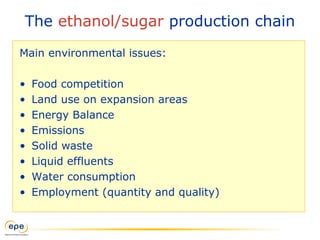
The ethanol/sugar production chain
Main environmental issues:
• Food competition
• Land use on expansion areas
• Energy Balance
• Emissions
• Solid waste
• Liquid effluents
• Water consumption
• Employment (quantity and quality)
7,9
14,6
84,8
0
2
4
6
8
10
12
14
16
10
6
ha
0
10
20
30
40
50
60
70
80
90
(%)
Crop area (M ha) Acumulated expansion (%)
Crop area (M ha) 7,9 8,7 9,6 10,3 11,2 12,1 12,8 13,5 14,1 14,6
Acumulated expansion
(%)
15,8 21,5 30,4 41,8 53,2 62,0 70,9 78,5 84,8
2008 2009 2010 2011 2012 2013 2014 2015 2016 2017
Source: EPE, 2009 based on Municipal
Agricultural Research developed by IBGE
2006
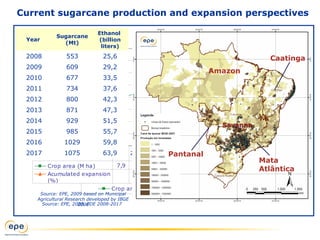
Current sugarcane production and expansion perspectives
Year
Sugarcane
(Mt)
Ethanol
(billion
liters)
2008 553 25,6
2009 609 29,2
2010 677 33,5
2011 734 37,6
2012 800 42,3
2013 871 47,3
2014 929 51,5
2015 985 55,7
2016 1029 59,8
2017 1075 63,9
Source: EPE, 2009. PDE 2008-2017
Amazon
Pantanal
SavannaSavanna
Caatinga
Mata
Atlântica
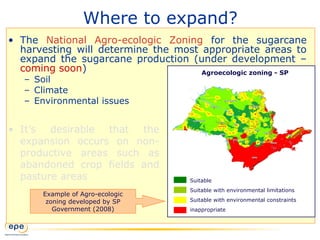
Where to expand?
• The National Agro-ecologic Zoning for the sugarcane
harvesting will determine the most appropriate areas to
expand the sugarcane production (under development –
coming soon)
– Soil
– Climate
– Environmental issues
• It’s desirable that the
expansion occurs on non-
productive areas such as
abandoned crop fields and
pasture areas Suitable
Suitable with environmental limitations
Suitable with environmental constraints
inappropriate
Agroecologic zoning - SP
Example of Agro-ecologic
zoning developed by SP
Government (2008)
Food competition
• Sugarcane can be considered as food (sugar and other
products), but the part destined to ethanol (today
~55%) doesn’t compete with this purpose
• Some studies, based on satellite images
(INPE/CANASAT), have found that the last 4-year
expansion occurred mainly over consolidated agriculture
and pasture areas
• The production of grains, rice, fruits (almost all) has
increased continuously
• Currently, in Brazil, the sugarcane production does not
influence food prices
Energy Balance
• The sugarcane provides one of the best energy balances
in bioethanol production
• The energy “Output/Input” index in the Life Cycle of
sugarcane ethanol = 8.1
• The bagasse cogeneration ensures the energy self-
consumption (power, mechanic and thermal) in the
sugar/ethanol plants
• The power excess can be sold for the Interconnected
System (Auctions)
Emissions
• In Brazil, ethanol (hydrous and anhydrous) substitutes a great
amount of gasoline consumption. As consequence, even taking
into account the life cycle emissions, it avoids significant amounts
of GHG emissions
• The use of biofuels also reduces the SOx, particulates and VOC
emissions in comparison with gasoline and diesel
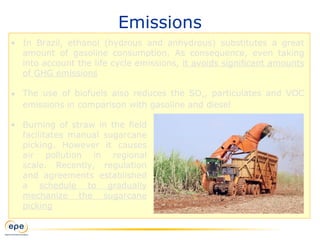
• Burning of straw in the field
facilitates manual sugarcane
picking. However it causes
air pollution in regional
scale. Recently, regulation
and agreements established
a schedule to gradually
mechanize the sugarcane
picking
Solid waste and liquid effluents
• Technically, bagasse and straw
can be considered as co-products
of sugarcane production. Both can
be used for energetic purposes.
Part of the straw is also important
for soil covering
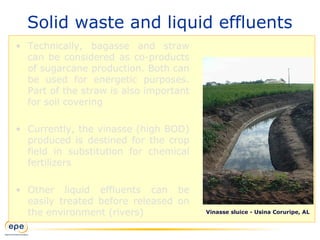
• Currently, the vinasse (high BOD)
produced is destined for the crop
field in substitution for chemical
fertilizers
• Other liquid effluents can be
easily treated before released on
the environment (rivers) Vinasse sluice - Usina Coruripe, AL
Water consumption
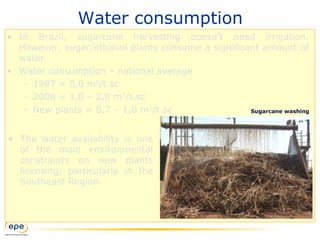
• In Brazil, sugarcane harvesting doesn’t need irrigation.
However, sugar/ethanol plants consume a significant amount of
water
• Water consumption – national average
– 1997 = 5,0 m3
/t.sc
– 2008 = 1,0 – 2,0 m3
/t.sc
– New plants = 0,7 – 1,0 m3
/t.sc
• The water availability is one
of the main environmental
constraints on new plants
licensing, particularly in the
Southeast Region
Sugarcane washing
Employment
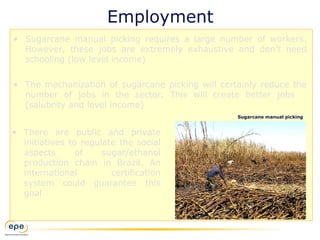
• Sugarcane manual picking requires a large number of workers.
However, these jobs are extremely exhaustive and don’t need
schooling (low level income)
• The mechanization of sugarcane picking will certainly reduce the
number of jobs in the sector. This will create better jobs
(salubrity and level income)
• There are public and private
initiatives to regulate the social
aspects of sugar/ethanol
production chain in Brazil. An
international certification
system could guarantee this
goal
Sugarcane manual picking
Other possibilites in bioenergy
• Increasing the use of sugarcane straw in cogeneration
• Ligno-celullose ethanol
• Biogas from sewage, biodigestors and landfill
• Woodchips and agriculture scraps
• Elephantgrass for power generation
• Biodiesel from vegetable oil, fried oil, tallow and other
fatty raw materials
Conclusions
• Today, biomass power generation in Brazil uses
predominantly sugarcane bagasse as fuel
• Sugarcane bagasse is a co-product of the sugar/ethanol
production chain
• Currently, the sugarcane production does not affect the
Amazon and Pantanal areas
• The expansion areas for sugarcane will be determined by
the Agro-ecologic Zoning
• The Brazilian sugar/ethanol industry manages the most of
environmental impacts in sugar/ethanol production chain
• Brazil has a great potential on bioenergy
Ricardo Cavalcanti Furtado
Superintendente de Meio Ambiente
Empresa de Pesquisa Energética
www.epe.gov.br

Biomass environmental issues 17set

  • 1.
    Porto, September 23rd ,2009 Ricardo Cavalcanti Furtado Environmental Planning Manager Empresa de Pesquisa Energética Biomass for Energy Generation: Environmental Issues
  • 2.
    Government-owned company, linkedto the Ministry of Mines and Energy, instituted by Law n° 10.847/2004 EPE has been created to develop studies and research to support the energy sector planning in the areas of electric energy, oil and natural gas and its derivatives, mineral coal, renewable energy sources and energy efficiency Empresa de Pesquisa Energética
  • 3.
  • 4.
    HIGH PROPORTION OFHYDRO POWER LONG TRANSMISSION LINES INTENSIVE CAPITAL LONG TERM INVESTMENTS HIGH UNCERTANTIES MULTIPLE OBJECTIVES COMPLEMENTARY GENERATION SEASONALITY ENVIRONMENTAL ISSUES Brazilian Power Sector Planning RISK ANALYSIS FAIR TARIFF DIVERSITY INTEGRATION ENERGY SECURITY
  • 5.
    NATIONAL ENERGY PLANNING NATIONALENERGY OUTLOOK TEN YEAR ENERGY PLANNING AUCTIONS Crude Oil and Natural Gas Electric Power Transmission Biofuels PROGRAMMING VIEW SHORT AND MEDIUM TERM STUDIES (10 YEARS AHEAD) STRATEGY VIEW LONG TERM STUDIES (30 YEARS AHEAD) Planning Process
  • 6.
    Scenarios for Electricity2030 (GW) Source: PNE 2030 142,1 224,9 100,5 0 50 100 150 200 250 2005 2015 2030 Year GW Imports + Other Biomass Wind Small Hydro Other thermal Coal Nuclear Natural Gas Large Hydro Power Plants 7,9 GW
  • 7.
    Source: National EnergyBalance. EPE, 2008 Energy in Brazil – Energy Sources Share Renew able Sources Share 54% 93% 87%13% 7% 46% 0% 10% 20% 30% 40% 50% 60% 70% 80% 90% 100% Brazil OECD World Renewable Non-renewable
  • 8.
    Wood & charcoal; 11,99% Sugarcane products; 15,88% Hydro; 14,89% Nuclear; 1,40% Coal &coal derived; 5,99% Natural Gas; 9,29% Oil & oil derived; 37,36% Energy in Brazil – Energy Sources Share Source: National Energy Balance. EPE, 2008 Ethanol Bagasse Straw Cogeneration Vehicles Charcoal consumed by blast furnaces.
  • 9.
    Transmission Lines Planned System- 2017Existing System
  • 10.
  • 11.
    Biomass participation inthe Energy Auctions Auction Plants Power (MW) 2005 25 766 A3/2006 25 967 A5/2006 29 1.104 Alternative Sources/2007 12 214 A3/2007 50 1.555 A5/2007 34 1.046 Biomass/2008 (Stock Auction) 31 2.379 A5/2008 1 114 Total 207 8.144 Environmental Information Analysis in the auctions  Plant carachteristics  Environmental licensing  Reserve of water availability and allowance for water use
  • 12.
    The ethanol/sugar productionchain Main environmental issues: • Food competition • Land use on expansion areas • Energy Balance • Emissions • Solid waste • Liquid effluents • Water consumption • Employment (quantity and quality)
  • 13.
    7,9 14,6 84,8 0 2 4 6 8 10 12 14 16 10 6 ha 0 10 20 30 40 50 60 70 80 90 (%) Crop area (Mha) Acumulated expansion (%) Crop area (M ha) 7,9 8,7 9,6 10,3 11,2 12,1 12,8 13,5 14,1 14,6 Acumulated expansion (%) 15,8 21,5 30,4 41,8 53,2 62,0 70,9 78,5 84,8 2008 2009 2010 2011 2012 2013 2014 2015 2016 2017 Source: EPE, 2009 based on Municipal Agricultural Research developed by IBGE 2006 Current sugarcane production and expansion perspectives Year Sugarcane (Mt) Ethanol (billion liters) 2008 553 25,6 2009 609 29,2 2010 677 33,5 2011 734 37,6 2012 800 42,3 2013 871 47,3 2014 929 51,5 2015 985 55,7 2016 1029 59,8 2017 1075 63,9 Source: EPE, 2009. PDE 2008-2017 Amazon Pantanal SavannaSavanna Caatinga Mata Atlântica
  • 14.
    Where to expand? •The National Agro-ecologic Zoning for the sugarcane harvesting will determine the most appropriate areas to expand the sugarcane production (under development – coming soon) – Soil – Climate – Environmental issues • It’s desirable that the expansion occurs on non- productive areas such as abandoned crop fields and pasture areas Suitable Suitable with environmental limitations Suitable with environmental constraints inappropriate Agroecologic zoning - SP Example of Agro-ecologic zoning developed by SP Government (2008)
  • 15.
    Food competition • Sugarcanecan be considered as food (sugar and other products), but the part destined to ethanol (today ~55%) doesn’t compete with this purpose • Some studies, based on satellite images (INPE/CANASAT), have found that the last 4-year expansion occurred mainly over consolidated agriculture and pasture areas • The production of grains, rice, fruits (almost all) has increased continuously • Currently, in Brazil, the sugarcane production does not influence food prices
  • 16.
    Energy Balance • Thesugarcane provides one of the best energy balances in bioethanol production • The energy “Output/Input” index in the Life Cycle of sugarcane ethanol = 8.1 • The bagasse cogeneration ensures the energy self- consumption (power, mechanic and thermal) in the sugar/ethanol plants • The power excess can be sold for the Interconnected System (Auctions)
  • 17.
    Emissions • In Brazil,ethanol (hydrous and anhydrous) substitutes a great amount of gasoline consumption. As consequence, even taking into account the life cycle emissions, it avoids significant amounts of GHG emissions • The use of biofuels also reduces the SOx, particulates and VOC emissions in comparison with gasoline and diesel • Burning of straw in the field facilitates manual sugarcane picking. However it causes air pollution in regional scale. Recently, regulation and agreements established a schedule to gradually mechanize the sugarcane picking
  • 18.
    Solid waste andliquid effluents • Technically, bagasse and straw can be considered as co-products of sugarcane production. Both can be used for energetic purposes. Part of the straw is also important for soil covering • Currently, the vinasse (high BOD) produced is destined for the crop field in substitution for chemical fertilizers • Other liquid effluents can be easily treated before released on the environment (rivers) Vinasse sluice - Usina Coruripe, AL
  • 19.
    Water consumption • InBrazil, sugarcane harvesting doesn’t need irrigation. However, sugar/ethanol plants consume a significant amount of water • Water consumption – national average – 1997 = 5,0 m3 /t.sc – 2008 = 1,0 – 2,0 m3 /t.sc – New plants = 0,7 – 1,0 m3 /t.sc • The water availability is one of the main environmental constraints on new plants licensing, particularly in the Southeast Region Sugarcane washing
  • 20.
    Employment • Sugarcane manualpicking requires a large number of workers. However, these jobs are extremely exhaustive and don’t need schooling (low level income) • The mechanization of sugarcane picking will certainly reduce the number of jobs in the sector. This will create better jobs (salubrity and level income) • There are public and private initiatives to regulate the social aspects of sugar/ethanol production chain in Brazil. An international certification system could guarantee this goal Sugarcane manual picking
  • 21.
    Other possibilites inbioenergy • Increasing the use of sugarcane straw in cogeneration • Ligno-celullose ethanol • Biogas from sewage, biodigestors and landfill • Woodchips and agriculture scraps • Elephantgrass for power generation • Biodiesel from vegetable oil, fried oil, tallow and other fatty raw materials
  • 22.
    Conclusions • Today, biomasspower generation in Brazil uses predominantly sugarcane bagasse as fuel • Sugarcane bagasse is a co-product of the sugar/ethanol production chain • Currently, the sugarcane production does not affect the Amazon and Pantanal areas • The expansion areas for sugarcane will be determined by the Agro-ecologic Zoning • The Brazilian sugar/ethanol industry manages the most of environmental impacts in sugar/ethanol production chain • Brazil has a great potential on bioenergy
  • 23.
    Ricardo Cavalcanti Furtado Superintendentede Meio Ambiente Empresa de Pesquisa Energética www.epe.gov.br