






1 Before we get started
Some thoughts to
start us off….
7 MANTRA’S OF QUALITY RESUSCITATION
#1: Measure, then
Improve, Then Measure
again…
CARES Registry should be state
wide
#2: “WHEN YOU HAVE SEEN ONE EMS SYSTEM, YOU
HAVE SEEN ONE EMS SYSTEM”
#3: It’s Not Complicated, But
It’s Not Easy
#4: Change Occurs Step by Step
#5: Performance,
Not Protocol
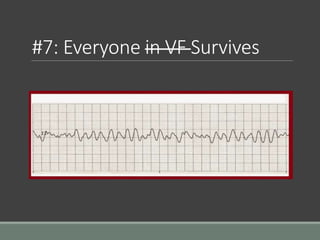
#7: Everyone in VF Survives
It Takes a System To Save a Victim
What is
Resuscitation?
What if I said
resuscitation is
Kung Fu?
Why I am doing this lecture….
A need for
change…
Approximately 350,000
persons die from out-of-
hospital cardiac arrest
each year in North
America.
CPR in Hollywood…
• ROSC: 75%
• discharged
neurologically
Intact: 67%
CPR in Real Life
ROSC between 0.1% and 49%
◦ 3-7% typical
◦ Outliers > 60% VF ROSC
Survival to Hospital Admission: 23%
Survival to Discharge : 7.6%
◦ THIS HAS NOT IMPROVED SIGNIFICANTLY IN 30YEARS!
Good Neurological Outcome: 0.1% and 30%
Predictors of Survival From Out-of-Hospital Cardiac Arrest: A Systematic Review
and Meta-Analysis
Comilla Sasson, Mary A.M. Rogers, Jason Dahl, and Arthur L. KellermannCirc
Cardiovasc Qual Outcomes. 2010;3:63-81, published online before print November 10
2009, doi:10.1161/CIRCOUTCOMES.109.8895 6
EMS Perception: Nearly everyone dies….
But there
is hope…
HOWARD SNITZER, 59,
SURVIVED 96 MINUTES OF CPR
WITH NO NEURO DEFICITS.
Where we were…
2013
Adult 203 medical cardiac arrests.
◦ 145 suspected cardiac.
39% ROSC
◦ 50% ROSC with Bystander CPR
2015
Adult 224 medical cardiac arrests.
◦ 178 suspected cardiac.
50% ROSC (+11%)
◦ 60% ROSC with Bystander CPR
(+10%)
Where we are now…
2016
Adult 253 medical cardiac arrests.
◦ 204 suspected cardiac.
36.2% ROSC
◦ 45% ROSC with Bystander CPR
2017
Adult 190 medical cardiac arrests.
◦ 190 suspected cardiac.
44% ROSC
◦ 37.5% ROSC with Bystander CPR
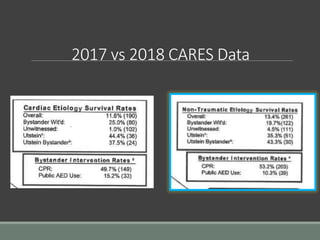
2017 vs 2018 CARES Data
National vs. ACCESS CARES data, 2018
Why does CPR
work?
SCIENCE BEHIND HIGH PERFORMANCE CPR
KEY
POINT:
CPR, NOT PARAMEDICS,
SAVE LIVES IN MOST
CARDIAC ARRESTS
Resuscitation
Arsenal
CPR
Defibrillation
Advanced Airways
IV’s and IO’s
Epinephrine
Antiarrhythmics
Sodium Bicarbonate
Other WIZ-BANG! Paramedic stuff
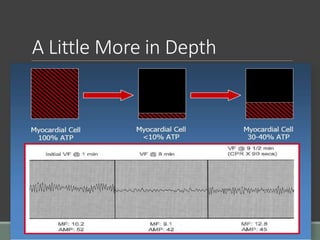
A Little More in Depth
How did we get
better?
INTRO TO HIGH PERFORMANCE CPR
What have you
heard about High
Performance or Pit
Crew CPR?
What are our metrics of performance?
RATE
◦ 100-120
◦ 110 ideal
DEPTH
◦ 2”
RELEASE/RECOIL
◦ Complete
UNINTERRUPTED
◦ 3 second goal
◦ 80% compression fraction
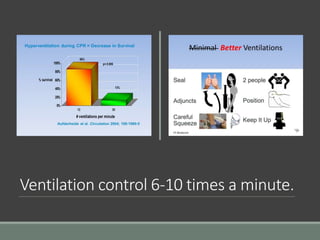
DECREASED VENTILATION
◦ 6-10/min
5 KEY
ASPECTS
OF
GOOD
CPR!
Key
ingredients to
our recipe
RATE
•Improving Perfusion through 220 continuous compressions
DEPTH
•Improving Performance with Feedback and peer
monitoring
RELEASE/RECOIL
•Improving Performance with Feedback and peer
monitoring
UNINTERRUPTED
•Reducing interruptions via assignments and positions
•Reducing interruptions via “Calling 200”
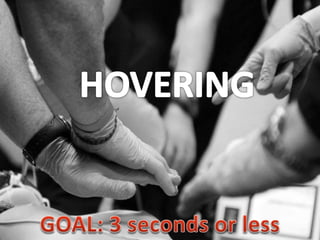
•Reducing interruptions via Hovering
•Reducing interruptions via pre-charging
DECREASED VENTILATION
•Decreasing ventilation rate/volume with Feedback and
peer monitoring
•Improving ventilations with 2 person methods
Compression…..
Increases intrathoracic pressure
Ejects Blood from the heart and lungs
“Good” compression increases cardiac
output (CO) and blood pressure
“Bad” Compressions hinders it
Tissue Perfusion
Remember, you are not just compressing the
heart, but the but the whole chest.
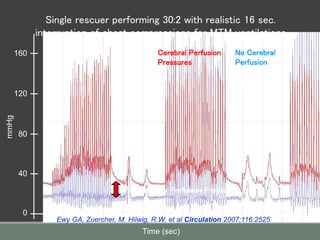
5 sec
80
160
mmHg
Time (sec)
40
120
0
Coronary Perfusion Pressures
Cerebral Perfusion
Pressures
No Cerebral
Perfusion
Single rescuer performing 30:2 with realistic 16 sec.
interruption of chest compressions for MTM ventilations
Ewy GA, Zuercher, M. Hilwig, R.W. et al Circulation 2007;116:2525
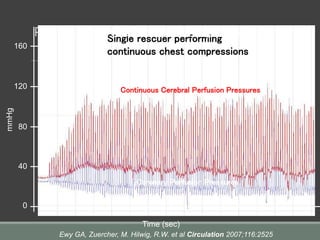
0
5 sec
80
160
mmHg
Time (sec)
40
120
Coronary Perfusion Pressures
Continuous Cerebral Perfusion Pressures
Single rescuer performing
continuous chest compressions
Ewy GA, Zuercher, M. Hilwig, R.W. et al Circulation 2007;116:2525
Perfusion with continuous compressions
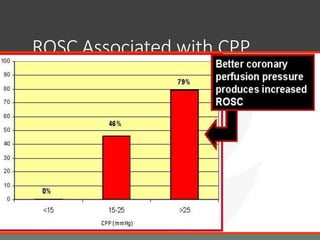
ROSC Associated with CPP
Compression Depth
2 inches
Edelson DP et al., Resuscitation 2006;71;137-145
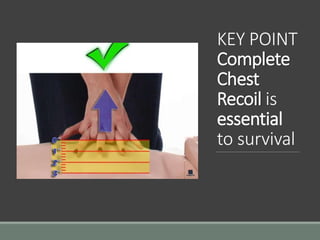
Complete Recoil
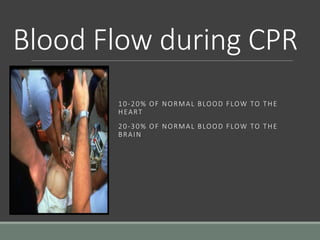
Blood Flow during CPR
10-20% OF NORMAL BLOOD FLOW TO THE
HEART
20-30% OF NORMAL BLOOD FLOW TO THE
BRAIN
Understanding Chest Compressions
Compression
Increased intrathoracic
pressure
Compression of heart and lungs
Decompression (recoil)
Decreased intrathoracic
pressure
Refilling of heart and lungs
Complete chest recoil is critical
Poor Recoil = Increased Intrathoracic
Pressure
KEY POINT
Complete
Chest
Recoil is
essential
to survival
Uninterrupted Compression's
Poor Recoil = Increased Intrathoracic
Pressure
“The physiological penalty of assisted ventilation, with
its frequently incorrect rate and duration, is a persistently
positive intrathoracic pressure throughout the
decompression phase of CPR. This decreases cardiac
preload, cardiac output, and hinders right ventricular
function.”
- Bobrow BJ, Ewy GA. Ventilation during resuscitation efforts for out-of-hospital primary
cardiac arrest. Curr Opin Crit Care. 2009;15(3):228–233.
Ventilation control 6-10 times a minute.
Focus on Compressions not
Ventilation!!!
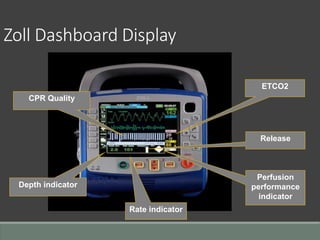
Zoll Dashboard Display
Rate indicator
Perfusion
performance
indicator
Depth indicator
Release
ETCO2
CPR Quality
Personal Feedback
Ada County’s High Performance Model of
CPR
Disclaimer!!!
There are many takes on High Performance CPR, this is just “ours” that
fits “our” system.
◦ It is not perfect
◦ It is not the only way
The science is always changing, follow the science, not the loudmouth
(me).
Positions for ACP/A.C.C.E.S.S. High
Performance CPR - BLS
COMPRESSIONS
 Position1/2 (alternating)
 Performs high-quality
compressions•:
 Hand placement on
lower half of sternum
 200 compressions @
110/minute
 Approximately 2 minutes
per cycle
 Complete recoil after each
compression
 Calls “180” and counts
down.
 Compresses at least 2
inches (5 cm)
 Complete Recoil
 “Hovers: when alternating
and during pauses
 Peri-shock pauses to
under 3 seconds.
AIRWAY
 Position 1/2
(alternating) ventilates at a
rate of 1 breath every 6-10
seconds (6-10/minute)
 Delivers breaths
asynchronously with
compressions with short
“upstroke” ventilations
 Position 3 establishes a
good 2 handed seal and:
 Maintains proper
head/airway position
including ear to sternal
notch
 Inserts adjunct as needed
based on scope of practice
without stopping
compressions.
 Visible chest rise with
each breath
TEAM LEADER/Code Commander
Every resuscitation must have a team leader
 Assigns roles PTA ,  Makes treatment decisions  Monitors performance
 Assumes responsibility for roles not assigned.  Communicates status on radio and
in person
 Should be highest certification.  Often airway position (3).
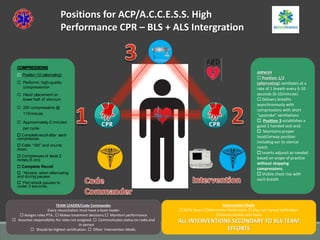
Positions for ACP/A.C.C.E.S.S. High
Performance CPR – BLS + ALS Intergration
COMPRESSIONS
 Position1/2 (alternating)
 Performs high-quality
compressions•:
 Hand placement on
lower half of sternum
 200 compressions @
110/minute
 Approximately 2 minutes
per cycle
 Complete recoil after each
compression
 Calls “180” and counts
down.
 Compresses at least 2
inches (5 cm)
 Complete Recoil
 “Hovers: when alternating
and during pauses
 Peri-shock pauses to
under 3 seconds.
AIRWAY
 Position 1/2
(alternating) ventilates at a
rate of 1 breath every 6-10
seconds (6-10/minute)
 Delivers breaths
asynchronously with
compressions with short
“upstroke” ventilations
 Position 3 establishes a
good 2 handed seal and:
 Maintains proper
head/airway position
including ear to sternal
notch
 Inserts adjunct as needed
based on scope of practice
without stopping
compressions.
 Visible chest rise with
each breath
Intervention Medic
 IO/IV Access Administer Medications  May run manual defibrilator
Communicates with team
ALL INTERVENTIONS SECONDARY TO BLS TEAM
EFFORTS
TEAM LEADER/Code Commander
Every resuscitation must have a team leader
 Assigns roles PTA ,  Makes treatment decisions  Monitors performance
 Assumes responsibility for roles not assigned.  Communicates status on radio and
in person
 Should be highest certification.  Often Intervention Medic.
What about the Airway?
Who Cares??? (I do…)
“Out-of-hospital cardiac arrest outcomes with
“pit crew” resuscitation and scripted initiation
of mechanical CPR”
444 patients in the A-TCEMS system. ½ recived manual, ½ received
LUCAS.
“Conclusions: In this EMS system with a standardized, "pit crew"
approach to OHCA that prioritized initial high-quality initial resuscitative
efforts and scripted the sequence for initiating mechanical CPR, use of
mechanical CPR was associated with decreased ROSC and decreased
survival to discharge.”
“In the propensity matched analysis (n = 176 manual CPR; 176
mechanical CPR), both ROSC (38.6% vs. 28.4%; difference: 10.2%; CI:
0.4% to 20.0%) and survival to discharge (13.6% vs. 6.8%; difference:
6.8%; CI: 0.5% to 13.3%) remained significantly higher for patients
receiving manual CPR.”
Future of the Lucas?
After 10 minutes?
Transport Only?
Limited Resources?
2020 high performance cpr v0.1

2020 high performance cpr v0.1

  • 2.
    1 Before weget started
  • 3.
    Some thoughts to startus off…. 7 MANTRA’S OF QUALITY RESUSCITATION
  • 4.
    #1: Measure, then Improve,Then Measure again…
  • 5.
    CARES Registry shouldbe state wide
  • 6.
    #2: “WHEN YOUHAVE SEEN ONE EMS SYSTEM, YOU HAVE SEEN ONE EMS SYSTEM”
  • 7.
    #3: It’s NotComplicated, But It’s Not Easy
  • 8.
    #4: Change OccursStep by Step
  • 9.
  • 10.
    #7: Everyone inVF Survives
  • 11.
    It Takes aSystem To Save a Victim
  • 12.
  • 13.
    What if Isaid resuscitation is Kung Fu?
  • 14.
    Why I amdoing this lecture….
  • 15.
    A need for change… Approximately350,000 persons die from out-of- hospital cardiac arrest each year in North America.
  • 16.
    CPR in Hollywood… •ROSC: 75% • discharged neurologically Intact: 67%
  • 17.
    CPR in RealLife ROSC between 0.1% and 49% ◦ 3-7% typical ◦ Outliers > 60% VF ROSC Survival to Hospital Admission: 23% Survival to Discharge : 7.6% ◦ THIS HAS NOT IMPROVED SIGNIFICANTLY IN 30YEARS! Good Neurological Outcome: 0.1% and 30% Predictors of Survival From Out-of-Hospital Cardiac Arrest: A Systematic Review and Meta-Analysis Comilla Sasson, Mary A.M. Rogers, Jason Dahl, and Arthur L. KellermannCirc Cardiovasc Qual Outcomes. 2010;3:63-81, published online before print November 10 2009, doi:10.1161/CIRCOUTCOMES.109.8895 6
  • 18.
    EMS Perception: Nearlyeveryone dies….
  • 19.
    But there is hope… HOWARDSNITZER, 59, SURVIVED 96 MINUTES OF CPR WITH NO NEURO DEFICITS.
  • 20.
    Where we were… 2013 Adult203 medical cardiac arrests. ◦ 145 suspected cardiac. 39% ROSC ◦ 50% ROSC with Bystander CPR 2015 Adult 224 medical cardiac arrests. ◦ 178 suspected cardiac. 50% ROSC (+11%) ◦ 60% ROSC with Bystander CPR (+10%)
  • 21.
    Where we arenow… 2016 Adult 253 medical cardiac arrests. ◦ 204 suspected cardiac. 36.2% ROSC ◦ 45% ROSC with Bystander CPR 2017 Adult 190 medical cardiac arrests. ◦ 190 suspected cardiac. 44% ROSC ◦ 37.5% ROSC with Bystander CPR
  • 22.
    2017 vs 2018CARES Data
  • 23.
    National vs. ACCESSCARES data, 2018
  • 24.
    Why does CPR work? SCIENCEBEHIND HIGH PERFORMANCE CPR
  • 26.
    KEY POINT: CPR, NOT PARAMEDICS, SAVELIVES IN MOST CARDIAC ARRESTS
  • 27.
    Resuscitation Arsenal CPR Defibrillation Advanced Airways IV’s andIO’s Epinephrine Antiarrhythmics Sodium Bicarbonate Other WIZ-BANG! Paramedic stuff
  • 28.
    A Little Morein Depth
  • 30.
    How did weget better? INTRO TO HIGH PERFORMANCE CPR
  • 31.
    What have you heardabout High Performance or Pit Crew CPR?
  • 34.
    What are ourmetrics of performance? RATE ◦ 100-120 ◦ 110 ideal DEPTH ◦ 2” RELEASE/RECOIL ◦ Complete UNINTERRUPTED ◦ 3 second goal ◦ 80% compression fraction DECREASED VENTILATION ◦ 6-10/min 5 KEY ASPECTS OF GOOD CPR!
  • 35.
    Key ingredients to our recipe RATE •ImprovingPerfusion through 220 continuous compressions DEPTH •Improving Performance with Feedback and peer monitoring RELEASE/RECOIL •Improving Performance with Feedback and peer monitoring UNINTERRUPTED •Reducing interruptions via assignments and positions •Reducing interruptions via “Calling 200” •Reducing interruptions via Hovering •Reducing interruptions via pre-charging DECREASED VENTILATION •Decreasing ventilation rate/volume with Feedback and peer monitoring •Improving ventilations with 2 person methods
  • 37.
    Compression….. Increases intrathoracic pressure EjectsBlood from the heart and lungs “Good” compression increases cardiac output (CO) and blood pressure “Bad” Compressions hinders it Tissue Perfusion Remember, you are not just compressing the heart, but the but the whole chest.
  • 38.
    5 sec 80 160 mmHg Time (sec) 40 120 0 CoronaryPerfusion Pressures Cerebral Perfusion Pressures No Cerebral Perfusion Single rescuer performing 30:2 with realistic 16 sec. interruption of chest compressions for MTM ventilations Ewy GA, Zuercher, M. Hilwig, R.W. et al Circulation 2007;116:2525
  • 39.
    0 5 sec 80 160 mmHg Time (sec) 40 120 CoronaryPerfusion Pressures Continuous Cerebral Perfusion Pressures Single rescuer performing continuous chest compressions Ewy GA, Zuercher, M. Hilwig, R.W. et al Circulation 2007;116:2525 Perfusion with continuous compressions
  • 40.
  • 41.
  • 42.
  • 43.
    Edelson DP etal., Resuscitation 2006;71;137-145
  • 44.
  • 45.
    Blood Flow duringCPR 10-20% OF NORMAL BLOOD FLOW TO THE HEART 20-30% OF NORMAL BLOOD FLOW TO THE BRAIN
  • 46.
    Understanding Chest Compressions Compression Increasedintrathoracic pressure Compression of heart and lungs Decompression (recoil) Decreased intrathoracic pressure Refilling of heart and lungs Complete chest recoil is critical
  • 47.
    Poor Recoil =Increased Intrathoracic Pressure
  • 48.
  • 49.
  • 59.
    Poor Recoil =Increased Intrathoracic Pressure “The physiological penalty of assisted ventilation, with its frequently incorrect rate and duration, is a persistently positive intrathoracic pressure throughout the decompression phase of CPR. This decreases cardiac preload, cardiac output, and hinders right ventricular function.” - Bobrow BJ, Ewy GA. Ventilation during resuscitation efforts for out-of-hospital primary cardiac arrest. Curr Opin Crit Care. 2009;15(3):228–233.
  • 61.
    Ventilation control 6-10times a minute.
  • 62.
    Focus on Compressionsnot Ventilation!!!
  • 64.
    Zoll Dashboard Display Rateindicator Perfusion performance indicator Depth indicator Release ETCO2 CPR Quality
  • 65.
  • 66.
    Ada County’s HighPerformance Model of CPR
  • 67.
    Disclaimer!!! There are manytakes on High Performance CPR, this is just “ours” that fits “our” system. ◦ It is not perfect ◦ It is not the only way The science is always changing, follow the science, not the loudmouth (me).
  • 69.
    Positions for ACP/A.C.C.E.S.S.High Performance CPR - BLS COMPRESSIONS  Position1/2 (alternating)  Performs high-quality compressions•:  Hand placement on lower half of sternum  200 compressions @ 110/minute  Approximately 2 minutes per cycle  Complete recoil after each compression  Calls “180” and counts down.  Compresses at least 2 inches (5 cm)  Complete Recoil  “Hovers: when alternating and during pauses  Peri-shock pauses to under 3 seconds. AIRWAY  Position 1/2 (alternating) ventilates at a rate of 1 breath every 6-10 seconds (6-10/minute)  Delivers breaths asynchronously with compressions with short “upstroke” ventilations  Position 3 establishes a good 2 handed seal and:  Maintains proper head/airway position including ear to sternal notch  Inserts adjunct as needed based on scope of practice without stopping compressions.  Visible chest rise with each breath TEAM LEADER/Code Commander Every resuscitation must have a team leader  Assigns roles PTA ,  Makes treatment decisions  Monitors performance  Assumes responsibility for roles not assigned.  Communicates status on radio and in person  Should be highest certification.  Often airway position (3).
  • 70.
    Positions for ACP/A.C.C.E.S.S.High Performance CPR – BLS + ALS Intergration COMPRESSIONS  Position1/2 (alternating)  Performs high-quality compressions•:  Hand placement on lower half of sternum  200 compressions @ 110/minute  Approximately 2 minutes per cycle  Complete recoil after each compression  Calls “180” and counts down.  Compresses at least 2 inches (5 cm)  Complete Recoil  “Hovers: when alternating and during pauses  Peri-shock pauses to under 3 seconds. AIRWAY  Position 1/2 (alternating) ventilates at a rate of 1 breath every 6-10 seconds (6-10/minute)  Delivers breaths asynchronously with compressions with short “upstroke” ventilations  Position 3 establishes a good 2 handed seal and:  Maintains proper head/airway position including ear to sternal notch  Inserts adjunct as needed based on scope of practice without stopping compressions.  Visible chest rise with each breath Intervention Medic  IO/IV Access Administer Medications  May run manual defibrilator Communicates with team ALL INTERVENTIONS SECONDARY TO BLS TEAM EFFORTS TEAM LEADER/Code Commander Every resuscitation must have a team leader  Assigns roles PTA ,  Makes treatment decisions  Monitors performance  Assumes responsibility for roles not assigned.  Communicates status on radio and in person  Should be highest certification.  Often Intervention Medic.
  • 72.
  • 73.
  • 75.
    “Out-of-hospital cardiac arrestoutcomes with “pit crew” resuscitation and scripted initiation of mechanical CPR” 444 patients in the A-TCEMS system. ½ recived manual, ½ received LUCAS. “Conclusions: In this EMS system with a standardized, "pit crew" approach to OHCA that prioritized initial high-quality initial resuscitative efforts and scripted the sequence for initiating mechanical CPR, use of mechanical CPR was associated with decreased ROSC and decreased survival to discharge.” “In the propensity matched analysis (n = 176 manual CPR; 176 mechanical CPR), both ROSC (38.6% vs. 28.4%; difference: 10.2%; CI: 0.4% to 20.0%) and survival to discharge (13.6% vs. 6.8%; difference: 6.8%; CI: 0.5% to 13.3%) remained significantly higher for patients receiving manual CPR.”
  • 76.
    Future of theLucas? After 10 minutes? Transport Only? Limited Resources?