AEI’S CRITICAL THREATS PROJECT
UPDATE AND ASSESSMENT
November 3, 2015
TOP THREE TAKEAWAYS
2
1
3
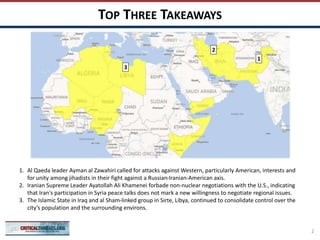
1. Al Qaeda leader Ayman al Zawahiri called for attacks against Western, particularly American, interests and
for unity among jihadists in their fight against a Russian-Iranian-American axis.
2. Iranian Supreme Leader Ayatollah Ali Khamenei forbade non-nuclear negotiations with the U.S., indicating
that Iran's participation in Syria peace talks does not mark a new willingness to negotiate regional issues.
3. The Islamic State in Iraq and al Sham-linked group in Sirte, Libya, continued to consolidate control over the
city’s population and the surrounding environs.
2
ASSESSMENT:
al Qaeda Network
Al Qaeda leader Ayman al Zawahiri called for lone-wolf attacks against the West and for jihadists to unify in their fight against
the West, Russia, and Iran. Zawahiri specifically focused attention on the liberation of Palestine, particularly following recent
violence at al Aqsa mosque. The first priority for his followers is to attack the West, especially the U.S., for its support of Israel,
and the second priority is to establish a Muslim state in Egypt and al Sham (the Levant), characterizing the areas as historically
being the two gates of Jerusalem. Zawahiri noted that the U.S., Russia, Iran, Alawites, and Hezbollah were coordinating against
Islam and that jihadists must stop infighting in order to unify the fight against them. Separately, al Qaeda in the Arabian
Peninsula and al Qaeda in the Islamic Maghreb issued a joint statement directly responding to a statement from the Islamic
State in Iraq and al Sham (ISIS) spokesman.
Outlook: Al Qaeda will continue to contest ISIS’s legitimacy based on ISIS’s actions and how it self-declared itself to be the
Islamic Caliphate.
Tehrik-e-Taliban Pakistan, al Qaeda in the Indian Subcontinent, and al Qaeda associates
Ansar al Islam Bangladesh, the al Qaeda in the Indian Subcontinent (AQIS) associate in the country, continued its attack on
secular bloggers and publishers. The group attacked two publishers and two writers, killing one and leaving the other three in
critical condition, on October 31, 2015. Ansar al Islam Bangladesh and AQIS have killed four other secular bloggers since
February 2015.
The Pakistani military continued its ground and air operations in the Shawal Valley area of North Waziristan. Operation Zarb-e-
Azb, the Pakistani military’s offensive in North Waziristan, is in its final phase.
Outlook: The Bangladeshi security forces will continue to crack down on the burgeoning Islamist militancy issues in the
country. Separately, the Pakistani military will continue Operation Zarb-e-Azb to eliminate militancy in the tribal areas of North
Waziristan.
3
AL QAEDA
ASSESSMENT:
Political
The UN special envoy to Yemen expects peace talks to take place in mid-November. The Saudi Foreign Minister signaled
openness to resolving the conflict and acknowledged the al Houthis’ right to participate in Yemen’s political process. The head
of the al Houthis’ political council questioned the talks’ fairness and accused the UN special envoy of favoring the Saudi-led
coalition, but other al Houthi leaders have not echoed his concerns.
Outlook: Combatants will continue to publicly support a politically negotiated settlement. Fighting will likely escalate in the
buildup to negotiations as combatants attempt to consolidate territorial gains.
Security
The Saudi-led coalition expanded its support for local anti-al Houthi fighters. The coalition airdropped two weapons shipments
to anti-al Houthi forces west of Taiz city and mobilized armored vehicles and a 500-man Yemeni force to the area. UAE-trained
Yemeni pilots flew bombing missions from the recently repaired al Anad airbase in southern Lahij governorate. Humanitarian
assistance has become a political tool. The al Houthis confiscated a UN aid shipment and continued the five-week siege of Taiz.
Continued fighting and airstrikes on transportation infrastructure are preventing aid deliveries throughout central Yemen.
Outlook: Fighting and restrictions on aid will continue as both sides attempt to gain leverage before negotiations. The
humanitarian situation in central Yemen will continue to deteriorate.
Al Qaeda in the Arabian Peninsula (AQAP) and ISIS in Yemen
AQAP and ISIS continue to take advantage of the ongoing conflict to expand their operational capabilities. ISIS militants
assassinated two Yemeni intelligence officers in Aden and detonated a vehicle-borne improvised explosive device near an al
Houthi gathering in the capital, Sana’a. AQAP-affiliated militants attacked al Houthi positions in Ibb and al Bayda governorates.
Outlook: AQAP and ISIS will continue to undermine the legitimacy of President Abdu Rabbu Mansour Hadi’s coalition-backed
government by threatening the Hadi government’s control in Aden and joining the anti-al Houthi fight in central Yemen.
4
YEMENGULF OF ADEN
SIGNIFICANT ACTIVITY:
5
YEMENGULF OF ADEN
1
2
3
4
5
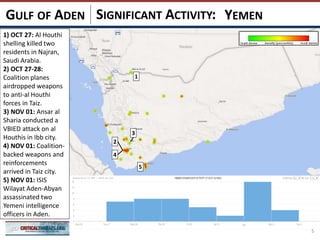
1) OCT 27: Al Houthi
shelling killed two
residents in Najran,
Saudi Arabia.
2) OCT 27-28:
Coalition planes
airdropped weapons
to anti-al Houthi
forces in Taiz.
3) NOV 01: Ansar al
Sharia conducted a
VBIED attack on al
Houthis in Ibb city.
4) NOV 01: Coalition-
backed weapons and
reinforcements
arrived in Taiz city.
5) NOV 01: ISIS
Wilayat Aden-Abyan
assassinated two
Yemeni intelligence
officers in Aden.
ASSESSMENT:
Political
Somalia’s president separately met with both India’s prime minister as well as Saudi Arabia’s king to discuss counter-terror
operations. Both heads of state offered to help Somalia to expand upon its security capabilities. Additionally, the United
Kingdom’s ambassador to Somalia pledged that the UK will pay the salaries of the Somalia National Army’s 60th battalion.
Outlook: Somalia’s government will likely continue strengthen ties with ally states to gain support in its goal of regaining control
over its territory.
Security
Somali National Army (SNA) and African Union Mission in Somalia (AMISOM) forces battle throughout southern Somalia, with
Bay region experiencing a particularly high level of clashes. Recent events such al Shabaab’s complex attack on a Mogadishu
hotel, as well as its seizure of a crashed plane not far from the capital exposes significant security weaknesses in the Lower
Shabelle and Banadir regions. Additionally, Kenyan security personnel are trying to crack down on al Shabaab recruiters and
alleged cells operating in the northwest and western regions of the country.
Outlook: Kenyan security forces will likely increase their efforts to root out possible al Shabaab members within their borders.
Al Shabaab
Al Shabaab sharply increased its number of attacks against military and government targets, and also conducted a particularly
high-profile attack in Mogadishu. Al Shabaab has also been highly vocal online, releasing multiple statements and videos
aimed at increasing recruitment, as well as issuing threats to the Somali and Kenyan governments. It is possible that the
increase in aggressive tactics, paired with greater effort put into publicizing attacks, may be indicative of the group trying to
compete with the Islamic State of Iraq and al Sham (ISIS) for recruits and to retain the loyalty of its own militants.
Outlook: Al Shabaab will likely put greater emphasis on publicizing its attacks to brand itself as an alternative to ISIS.
6
HORN OF AFRICAGULF OF ADEN
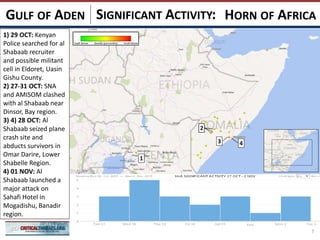
SIGNIFICANT ACTIVITY: HORN OF AFRICAGULF OF ADEN
3
1
4
2
7
1) 29 OCT: Kenyan
Police searched for al
Shabaab recruiter
and possible militant
cell in Eldoret, Uasin
Gishu County.
2) 27-31 OCT: SNA
and AMISOM clashed
with al Shabaab near
Dinsor, Bay region.
3) 4) 28 OCT: Al
Shabaab seized plane
crash site and
abducts survivors in
Omar Darire, Lower
Shabelle Region.
4) 01 NOV: Al
Shabaab launched a
major attack on
Sahafi Hotel in
Mogadishu, Banadir
region.
ASSESSMENT:
Political
Representatives from both the Tobruk-based House of Representatives (HoR) and the Tripoli-based General National Congress
(GNC) have delayed an official vote on the proposal for a Libyan national unity government. The EU is now considering
sanctions against five military commanders threatening violence against the future government. Separately, UN Secretary-
General Ban Ki-moon appointed German Martin Kobler as his special envoy to Libya, replacing Bernardino Leon.
Outlook: Libyan military commanders will continue to wield influence preventing more moderate factions within the HoR and
GNC from moving forward with a version of the proposed national unity government.
Security
A Libya Dawn helicopter crashed near Zawia, Libya, on October 27, killing several senior Libya Dawn commanders. The GNC
and its affiliated force, Libya Dawn, blamed tribesmen working with the HoR-affiliated Libyan National Army (LNA) for the
incident and nullified ceasefire agreements brokered between the LNA and Libya Dawn. Misrata’s Military Council refused to
join Libya Dawn’s new offensive against the LNA, and this decision will prevent a full resumption of hostilities.
Outlook: Misrata’s dismissal of renewed hostilities will heighten tensions between Misrata’s Military Council and GNC
hardliners, which could lead to intra-Libya Dawn clashes throughout Tripoli, Libya.
Ansar al Sharia and ISIS in Libya
ISIS Sirte’s shari’a court and its Islamic police force continue to demonstrate strength in Sirte through a number of public trials
and executions. ISIS Sirte’s renovation of the Central Bank into an Islamic police headquarters will enable the police force to
expand its operations. Warplanes targeted ISIS positions in the vicinity of Sirte on October 29.
The al Qaeda-aligned Mujahideen Shura Council of Derna announced its willingness to extend amnesty to ISIS Wilayat Barqa
militants if the group repents for its crimes.
Outlook: ISIS Sirte will continue to administer the city and surrounding region, consolidating control over the population through
its shari’a court and security forces.
8
LIBYAWEST AFRICA
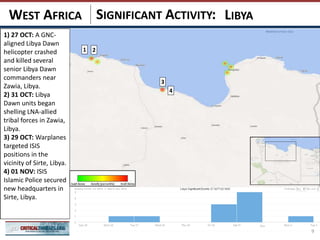
SIGNIFICANT ACTIVITY: LIBYAWEST AFRICA
1
3
2
4
9
1) 27 OCT: A GNC-
aligned Libya Dawn
helicopter crashed
and killed several
senior Libya Dawn
commanders near
Zawia, Libya.
2) 31 OCT: Libya
Dawn units began
shelling LNA-allied
tribal forces in Zawia,
Libya.
3) 29 OCT: Warplanes
targeted ISIS
positions in the
vicinity of Sirte, Libya.
4) 01 NOV: ISIS
Islamic Police secured
new headquarters in
Sirte, Libya.
ASSESSMENT:
AQIM
AQIM released three communications focusing on both the local fight and al Qaeda global issues. A eulogy for an Ansar al
Sharia militant in Libya demonstrates the continued connections between the two groups, while the first video in a series
showing footage of old operations and remarks from leaders could be used for recruitment and propaganda. AQIM also
published a joint statement with AQAP, directly refuting an ISIS statement and criticizing the group. AQIM released a joint
statement with AQAP once before after Zawahiri asked leaders to counter-message against the Islamic State.
Outlook: AQIM will likely release the second video in its series and continue to unite the radical Islamist militant groups in the
region.
Ansar al Sharia (Tunisia)
Uqba Ibn Nafa’a Brigade, an AQIM-linked group, published statements directed at the military. It claimed soldiers are “paid
slaves” to tyrants, similar to AQAP’s previous communications to the Yemeni military. Uqba Ibn Nafa’a’s statements could be an
attempt to persuade the military units currently searching for them to defect.
Outlook: The Uqba Ibn Nafa’a Brigade will continue to evade military efforts to locate it and may publish more statements
targeting the military and government.
Associated Movements in the Sahel (Ansar al Din, al Murabitoun)
Malian armed forces launched a three-month operation targeting Ansar al Din-affiliate, the Macina Liberation Front (MLF), along
the border with Burkina Faso. State forces killed seven jihadists and apprehended 12 known MLF members in the early days of
the operation. Sources cite MLF had attempted to establish a permanent base in the area as a launching pad for attacks within
Mali and into Burkina Faso. Previously, MLF attempted to establish a similar base of operations along the Ivory Coast border.
Outlook: Ansar al Din and affiliates will continue to attack MINUSMA, French security forces, and civilian convoys in an effort
to undermine the peace process and foster instability.
10
MAGHREB AND SAHELWEST AFRICA
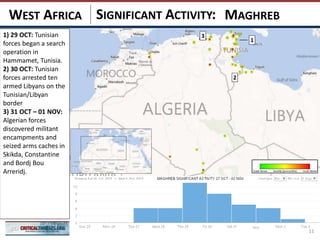
SIGNIFICANT ACTIVITY:
11
MAGHREBWEST AFRICA
3
2
1
1) 29 OCT: Tunisian
forces began a search
operation in
Hammamet, Tunisia.
2) 30 OCT: Tunisian
forces arrested ten
armed Libyans on the
Tunisian/Libyan
border
3) 31 OCT – 01 NOV:
Algerian forces
discovered militant
encampments and
seized arms caches in
Skikda, Constantine
and Bordj Bou
Arreridj.
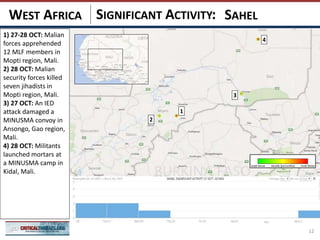
SIGNIFICANT ACTIVITY:
12
SAHELWEST AFRICA
1
2
3
4
1) 27-28 OCT: Malian
forces apprehended
12 MLF members in
Mopti region, Mali.
2) 28 OCT: Malian
security forces killed
seven jihadists in
Mopti region, Mali.
3) 27 OCT: An IED
attack damaged a
MINUSMA convoy in
Ansongo, Gao region,
Mali.
4) 28 OCT: Militants
launched mortars at
a MINUSMA camp in
Kidal, Mali.
ASSESSMENT:
Regional Developments and Diplomacy
Syria peace talks began in Vienna on October 30 with representatives from 17 countries, including the U.S., Iran, Saudi Arabia,
Russia, and China. Iranian Supreme Leader Ayatollah Ali Khamenei ruled out negotiations with the U.S. on regional issues
during a meeting with Foreign Minister Mohammad Javad Zarif and other Iranian diplomats on November 1. Khamenei called
U.S. foreign policy goals in the Middle East “180 degrees different” than Iran’s goals. Deputy Foreign Minister Hossein Amir
Abdollahian strongly criticized Saudi Arabia for its “negative role” during the Syria peace talks and warned that Iran might walk
away from the talks if they prove “unconstructive” on November 2.
Outlook: Iran’s presence at the Vienna talks does not indicate a shift in willingness to negotiate with the U.S. on regional
issues.
Deputy Foreign Minister Abdollahian reiterated support for Syrian President Bashar al Assad and stressed that Iran’s position in
Syria will not change on October 29. Abdollahian denied a Reuters report the next day claiming that Iran endorses a six-month
transition period to oust Assad. IRGC Commander Major General Mohammad Ali Jafari reaffirmed Iran’s commitment to Assad
but acknowledged that Russian goals in Syria might differ from Iran’s. Jafari stated on November 2 that Russia “is pursuing its
own national interests; it is possible… that [Russia] is not looking for Assad to remain. In any case, [Russia] has arrived… and it
is helping the resistance front.”
Outlook: Potential disagreements over Assad’s fate in Syria are unlikely to weaken Iranian and Russian cooperation in the
near future.
13
IRAN
SIGNIFICANT ACTIVITY:IRAN
14
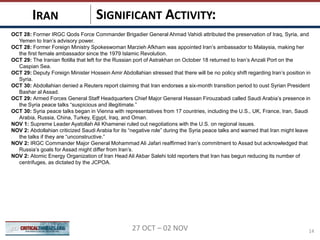
OCT 28: Former IRGC Qods Force Commander Brigadier General Ahmad Vahidi attributed the preservation of Iraq, Syria, and
Yemen to Iran’s advisory power.
OCT 28: Former Foreign Ministry Spokeswoman Marzieh Afkham was appointed Iran’s ambassador to Malaysia, making her
the first female ambassador since the 1979 Islamic Revolution.
OCT 29: The Iranian flotilla that left for the Russian port of Astrakhan on October 18 returned to Iran’s Anzali Port on the
Caspian Sea.
OCT 29: Deputy Foreign Minister Hossein Amir Abdollahian stressed that there will be no policy shift regarding Iran’s position in
Syria.
OCT 30: Abdollahian denied a Reuters report claiming that Iran endorses a six-month transition period to oust Syrian President
Bashar al Assad.
OCT 29: Armed Forces General Staff Headquarters Chief Major General Hassan Firouzabadi called Saudi Arabia’s presence in
the Syria peace talks “suspicious and illegitimate.”
OCT 30: Syria peace talks began in Vienna with representatives from 17 countries, including the U.S., UK, France, Iran, Saudi
Arabia, Russia, China, Turkey, Egypt, Iraq, and Oman.
NOV 1: Supreme Leader Ayatollah Ali Khamenei ruled out negotiations with the U.S. on regional issues.
NOV 2: Abdollahian criticized Saudi Arabia for its “negative role” during the Syria peace talks and warned that Iran might leave
the talks if they are “unconstructive.”
NOV 2: IRGC Commander Major General Mohammad Ali Jafari reaffirmed Iran’s commitment to Assad but acknowledged that
Russia’s goals for Assad might differ from Iran’s.
NOV 2: Atomic Energy Organization of Iran Head Ali Akbar Salehi told reporters that Iran has begun reducing its number of
centrifuges, as dictated by the JCPOA.
27 OCT – 02 NOV
ACRONYMS
15
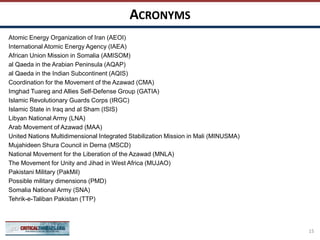
Atomic Energy Organization of Iran (AEOI)
International Atomic Energy Agency (IAEA)
African Union Mission in Somalia (AMISOM)
al Qaeda in the Arabian Peninsula (AQAP)
al Qaeda in the Indian Subcontinent (AQIS)
Coordination for the Movement of the Azawad (CMA)
Imghad Tuareg and Allies Self-Defense Group (GATIA)
Islamic Revolutionary Guards Corps (IRGC)
Islamic State in Iraq and al Sham (ISIS)
Libyan National Army (LNA)
Arab Movement of Azawad (MAA)
United Nations Multidimensional Integrated Stabilization Mission in Mali (MINUSMA)
Mujahideen Shura Council in Derna (MSCD)
National Movement for the Liberation of the Azawad (MNLA)
The Movement for Unity and Jihad in West Africa (MUJAO)
Pakistani Military (PakMil)
Possible military dimensions (PMD)
Somalia National Army (SNA)
Tehrik-e-Taliban Pakistan (TTP)
AEI’S CRITICAL THREATS PROJECT
Katherine Zimmerman
senior al Qaeda analyst
katherine.zimmerman@aei.org
(202) 888-6576
Paul Bucala
Iran analyst
paul.bucala@aei.org
(202) 888-6573
Marie Donovan
Iran analyst
marie.donovan@aei.org
(202) 888-6572
Heather Malacaria
program manager
heather.malacaria@aei.org
(202) 888-6575
Mehrdad Moarefian
Iran analyst
mehrdad.moarefian@aei.org
(202) 888-6574
For more information about AEI’s Critical Threats Project, visit www.criticalthreats.org.
Frederick W. Kagan
director
fkagan@aei.org
(202) 888-6569
16

2015-11-03 Update and Assessment

  • 1.
    AEI’S CRITICAL THREATSPROJECT UPDATE AND ASSESSMENT November 3, 2015
  • 2.
    TOP THREE TAKEAWAYS 2 1 3 1.Al Qaeda leader Ayman al Zawahiri called for attacks against Western, particularly American, interests and for unity among jihadists in their fight against a Russian-Iranian-American axis. 2. Iranian Supreme Leader Ayatollah Ali Khamenei forbade non-nuclear negotiations with the U.S., indicating that Iran's participation in Syria peace talks does not mark a new willingness to negotiate regional issues. 3. The Islamic State in Iraq and al Sham-linked group in Sirte, Libya, continued to consolidate control over the city’s population and the surrounding environs. 2
  • 3.
    ASSESSMENT: al Qaeda Network AlQaeda leader Ayman al Zawahiri called for lone-wolf attacks against the West and for jihadists to unify in their fight against the West, Russia, and Iran. Zawahiri specifically focused attention on the liberation of Palestine, particularly following recent violence at al Aqsa mosque. The first priority for his followers is to attack the West, especially the U.S., for its support of Israel, and the second priority is to establish a Muslim state in Egypt and al Sham (the Levant), characterizing the areas as historically being the two gates of Jerusalem. Zawahiri noted that the U.S., Russia, Iran, Alawites, and Hezbollah were coordinating against Islam and that jihadists must stop infighting in order to unify the fight against them. Separately, al Qaeda in the Arabian Peninsula and al Qaeda in the Islamic Maghreb issued a joint statement directly responding to a statement from the Islamic State in Iraq and al Sham (ISIS) spokesman. Outlook: Al Qaeda will continue to contest ISIS’s legitimacy based on ISIS’s actions and how it self-declared itself to be the Islamic Caliphate. Tehrik-e-Taliban Pakistan, al Qaeda in the Indian Subcontinent, and al Qaeda associates Ansar al Islam Bangladesh, the al Qaeda in the Indian Subcontinent (AQIS) associate in the country, continued its attack on secular bloggers and publishers. The group attacked two publishers and two writers, killing one and leaving the other three in critical condition, on October 31, 2015. Ansar al Islam Bangladesh and AQIS have killed four other secular bloggers since February 2015. The Pakistani military continued its ground and air operations in the Shawal Valley area of North Waziristan. Operation Zarb-e- Azb, the Pakistani military’s offensive in North Waziristan, is in its final phase. Outlook: The Bangladeshi security forces will continue to crack down on the burgeoning Islamist militancy issues in the country. Separately, the Pakistani military will continue Operation Zarb-e-Azb to eliminate militancy in the tribal areas of North Waziristan. 3 AL QAEDA
  • 4.
    ASSESSMENT: Political The UN specialenvoy to Yemen expects peace talks to take place in mid-November. The Saudi Foreign Minister signaled openness to resolving the conflict and acknowledged the al Houthis’ right to participate in Yemen’s political process. The head of the al Houthis’ political council questioned the talks’ fairness and accused the UN special envoy of favoring the Saudi-led coalition, but other al Houthi leaders have not echoed his concerns. Outlook: Combatants will continue to publicly support a politically negotiated settlement. Fighting will likely escalate in the buildup to negotiations as combatants attempt to consolidate territorial gains. Security The Saudi-led coalition expanded its support for local anti-al Houthi fighters. The coalition airdropped two weapons shipments to anti-al Houthi forces west of Taiz city and mobilized armored vehicles and a 500-man Yemeni force to the area. UAE-trained Yemeni pilots flew bombing missions from the recently repaired al Anad airbase in southern Lahij governorate. Humanitarian assistance has become a political tool. The al Houthis confiscated a UN aid shipment and continued the five-week siege of Taiz. Continued fighting and airstrikes on transportation infrastructure are preventing aid deliveries throughout central Yemen. Outlook: Fighting and restrictions on aid will continue as both sides attempt to gain leverage before negotiations. The humanitarian situation in central Yemen will continue to deteriorate. Al Qaeda in the Arabian Peninsula (AQAP) and ISIS in Yemen AQAP and ISIS continue to take advantage of the ongoing conflict to expand their operational capabilities. ISIS militants assassinated two Yemeni intelligence officers in Aden and detonated a vehicle-borne improvised explosive device near an al Houthi gathering in the capital, Sana’a. AQAP-affiliated militants attacked al Houthi positions in Ibb and al Bayda governorates. Outlook: AQAP and ISIS will continue to undermine the legitimacy of President Abdu Rabbu Mansour Hadi’s coalition-backed government by threatening the Hadi government’s control in Aden and joining the anti-al Houthi fight in central Yemen. 4 YEMENGULF OF ADEN
  • 5.
    SIGNIFICANT ACTIVITY: 5 YEMENGULF OFADEN 1 2 3 4 5 1) OCT 27: Al Houthi shelling killed two residents in Najran, Saudi Arabia. 2) OCT 27-28: Coalition planes airdropped weapons to anti-al Houthi forces in Taiz. 3) NOV 01: Ansar al Sharia conducted a VBIED attack on al Houthis in Ibb city. 4) NOV 01: Coalition- backed weapons and reinforcements arrived in Taiz city. 5) NOV 01: ISIS Wilayat Aden-Abyan assassinated two Yemeni intelligence officers in Aden.
  • 6.
    ASSESSMENT: Political Somalia’s president separatelymet with both India’s prime minister as well as Saudi Arabia’s king to discuss counter-terror operations. Both heads of state offered to help Somalia to expand upon its security capabilities. Additionally, the United Kingdom’s ambassador to Somalia pledged that the UK will pay the salaries of the Somalia National Army’s 60th battalion. Outlook: Somalia’s government will likely continue strengthen ties with ally states to gain support in its goal of regaining control over its territory. Security Somali National Army (SNA) and African Union Mission in Somalia (AMISOM) forces battle throughout southern Somalia, with Bay region experiencing a particularly high level of clashes. Recent events such al Shabaab’s complex attack on a Mogadishu hotel, as well as its seizure of a crashed plane not far from the capital exposes significant security weaknesses in the Lower Shabelle and Banadir regions. Additionally, Kenyan security personnel are trying to crack down on al Shabaab recruiters and alleged cells operating in the northwest and western regions of the country. Outlook: Kenyan security forces will likely increase their efforts to root out possible al Shabaab members within their borders. Al Shabaab Al Shabaab sharply increased its number of attacks against military and government targets, and also conducted a particularly high-profile attack in Mogadishu. Al Shabaab has also been highly vocal online, releasing multiple statements and videos aimed at increasing recruitment, as well as issuing threats to the Somali and Kenyan governments. It is possible that the increase in aggressive tactics, paired with greater effort put into publicizing attacks, may be indicative of the group trying to compete with the Islamic State of Iraq and al Sham (ISIS) for recruits and to retain the loyalty of its own militants. Outlook: Al Shabaab will likely put greater emphasis on publicizing its attacks to brand itself as an alternative to ISIS. 6 HORN OF AFRICAGULF OF ADEN
  • 7.
    SIGNIFICANT ACTIVITY: HORNOF AFRICAGULF OF ADEN 3 1 4 2 7 1) 29 OCT: Kenyan Police searched for al Shabaab recruiter and possible militant cell in Eldoret, Uasin Gishu County. 2) 27-31 OCT: SNA and AMISOM clashed with al Shabaab near Dinsor, Bay region. 3) 4) 28 OCT: Al Shabaab seized plane crash site and abducts survivors in Omar Darire, Lower Shabelle Region. 4) 01 NOV: Al Shabaab launched a major attack on Sahafi Hotel in Mogadishu, Banadir region.
  • 8.
    ASSESSMENT: Political Representatives from boththe Tobruk-based House of Representatives (HoR) and the Tripoli-based General National Congress (GNC) have delayed an official vote on the proposal for a Libyan national unity government. The EU is now considering sanctions against five military commanders threatening violence against the future government. Separately, UN Secretary- General Ban Ki-moon appointed German Martin Kobler as his special envoy to Libya, replacing Bernardino Leon. Outlook: Libyan military commanders will continue to wield influence preventing more moderate factions within the HoR and GNC from moving forward with a version of the proposed national unity government. Security A Libya Dawn helicopter crashed near Zawia, Libya, on October 27, killing several senior Libya Dawn commanders. The GNC and its affiliated force, Libya Dawn, blamed tribesmen working with the HoR-affiliated Libyan National Army (LNA) for the incident and nullified ceasefire agreements brokered between the LNA and Libya Dawn. Misrata’s Military Council refused to join Libya Dawn’s new offensive against the LNA, and this decision will prevent a full resumption of hostilities. Outlook: Misrata’s dismissal of renewed hostilities will heighten tensions between Misrata’s Military Council and GNC hardliners, which could lead to intra-Libya Dawn clashes throughout Tripoli, Libya. Ansar al Sharia and ISIS in Libya ISIS Sirte’s shari’a court and its Islamic police force continue to demonstrate strength in Sirte through a number of public trials and executions. ISIS Sirte’s renovation of the Central Bank into an Islamic police headquarters will enable the police force to expand its operations. Warplanes targeted ISIS positions in the vicinity of Sirte on October 29. The al Qaeda-aligned Mujahideen Shura Council of Derna announced its willingness to extend amnesty to ISIS Wilayat Barqa militants if the group repents for its crimes. Outlook: ISIS Sirte will continue to administer the city and surrounding region, consolidating control over the population through its shari’a court and security forces. 8 LIBYAWEST AFRICA
  • 9.
    SIGNIFICANT ACTIVITY: LIBYAWESTAFRICA 1 3 2 4 9 1) 27 OCT: A GNC- aligned Libya Dawn helicopter crashed and killed several senior Libya Dawn commanders near Zawia, Libya. 2) 31 OCT: Libya Dawn units began shelling LNA-allied tribal forces in Zawia, Libya. 3) 29 OCT: Warplanes targeted ISIS positions in the vicinity of Sirte, Libya. 4) 01 NOV: ISIS Islamic Police secured new headquarters in Sirte, Libya.
  • 10.
    ASSESSMENT: AQIM AQIM released threecommunications focusing on both the local fight and al Qaeda global issues. A eulogy for an Ansar al Sharia militant in Libya demonstrates the continued connections between the two groups, while the first video in a series showing footage of old operations and remarks from leaders could be used for recruitment and propaganda. AQIM also published a joint statement with AQAP, directly refuting an ISIS statement and criticizing the group. AQIM released a joint statement with AQAP once before after Zawahiri asked leaders to counter-message against the Islamic State. Outlook: AQIM will likely release the second video in its series and continue to unite the radical Islamist militant groups in the region. Ansar al Sharia (Tunisia) Uqba Ibn Nafa’a Brigade, an AQIM-linked group, published statements directed at the military. It claimed soldiers are “paid slaves” to tyrants, similar to AQAP’s previous communications to the Yemeni military. Uqba Ibn Nafa’a’s statements could be an attempt to persuade the military units currently searching for them to defect. Outlook: The Uqba Ibn Nafa’a Brigade will continue to evade military efforts to locate it and may publish more statements targeting the military and government. Associated Movements in the Sahel (Ansar al Din, al Murabitoun) Malian armed forces launched a three-month operation targeting Ansar al Din-affiliate, the Macina Liberation Front (MLF), along the border with Burkina Faso. State forces killed seven jihadists and apprehended 12 known MLF members in the early days of the operation. Sources cite MLF had attempted to establish a permanent base in the area as a launching pad for attacks within Mali and into Burkina Faso. Previously, MLF attempted to establish a similar base of operations along the Ivory Coast border. Outlook: Ansar al Din and affiliates will continue to attack MINUSMA, French security forces, and civilian convoys in an effort to undermine the peace process and foster instability. 10 MAGHREB AND SAHELWEST AFRICA
  • 11.
    SIGNIFICANT ACTIVITY: 11 MAGHREBWEST AFRICA 3 2 1 1)29 OCT: Tunisian forces began a search operation in Hammamet, Tunisia. 2) 30 OCT: Tunisian forces arrested ten armed Libyans on the Tunisian/Libyan border 3) 31 OCT – 01 NOV: Algerian forces discovered militant encampments and seized arms caches in Skikda, Constantine and Bordj Bou Arreridj.
  • 12.
    SIGNIFICANT ACTIVITY: 12 SAHELWEST AFRICA 1 2 3 4 1)27-28 OCT: Malian forces apprehended 12 MLF members in Mopti region, Mali. 2) 28 OCT: Malian security forces killed seven jihadists in Mopti region, Mali. 3) 27 OCT: An IED attack damaged a MINUSMA convoy in Ansongo, Gao region, Mali. 4) 28 OCT: Militants launched mortars at a MINUSMA camp in Kidal, Mali.
  • 13.
    ASSESSMENT: Regional Developments andDiplomacy Syria peace talks began in Vienna on October 30 with representatives from 17 countries, including the U.S., Iran, Saudi Arabia, Russia, and China. Iranian Supreme Leader Ayatollah Ali Khamenei ruled out negotiations with the U.S. on regional issues during a meeting with Foreign Minister Mohammad Javad Zarif and other Iranian diplomats on November 1. Khamenei called U.S. foreign policy goals in the Middle East “180 degrees different” than Iran’s goals. Deputy Foreign Minister Hossein Amir Abdollahian strongly criticized Saudi Arabia for its “negative role” during the Syria peace talks and warned that Iran might walk away from the talks if they prove “unconstructive” on November 2. Outlook: Iran’s presence at the Vienna talks does not indicate a shift in willingness to negotiate with the U.S. on regional issues. Deputy Foreign Minister Abdollahian reiterated support for Syrian President Bashar al Assad and stressed that Iran’s position in Syria will not change on October 29. Abdollahian denied a Reuters report the next day claiming that Iran endorses a six-month transition period to oust Assad. IRGC Commander Major General Mohammad Ali Jafari reaffirmed Iran’s commitment to Assad but acknowledged that Russian goals in Syria might differ from Iran’s. Jafari stated on November 2 that Russia “is pursuing its own national interests; it is possible… that [Russia] is not looking for Assad to remain. In any case, [Russia] has arrived… and it is helping the resistance front.” Outlook: Potential disagreements over Assad’s fate in Syria are unlikely to weaken Iranian and Russian cooperation in the near future. 13 IRAN
  • 14.
    SIGNIFICANT ACTIVITY:IRAN 14 OCT 28:Former IRGC Qods Force Commander Brigadier General Ahmad Vahidi attributed the preservation of Iraq, Syria, and Yemen to Iran’s advisory power. OCT 28: Former Foreign Ministry Spokeswoman Marzieh Afkham was appointed Iran’s ambassador to Malaysia, making her the first female ambassador since the 1979 Islamic Revolution. OCT 29: The Iranian flotilla that left for the Russian port of Astrakhan on October 18 returned to Iran’s Anzali Port on the Caspian Sea. OCT 29: Deputy Foreign Minister Hossein Amir Abdollahian stressed that there will be no policy shift regarding Iran’s position in Syria. OCT 30: Abdollahian denied a Reuters report claiming that Iran endorses a six-month transition period to oust Syrian President Bashar al Assad. OCT 29: Armed Forces General Staff Headquarters Chief Major General Hassan Firouzabadi called Saudi Arabia’s presence in the Syria peace talks “suspicious and illegitimate.” OCT 30: Syria peace talks began in Vienna with representatives from 17 countries, including the U.S., UK, France, Iran, Saudi Arabia, Russia, China, Turkey, Egypt, Iraq, and Oman. NOV 1: Supreme Leader Ayatollah Ali Khamenei ruled out negotiations with the U.S. on regional issues. NOV 2: Abdollahian criticized Saudi Arabia for its “negative role” during the Syria peace talks and warned that Iran might leave the talks if they are “unconstructive.” NOV 2: IRGC Commander Major General Mohammad Ali Jafari reaffirmed Iran’s commitment to Assad but acknowledged that Russia’s goals for Assad might differ from Iran’s. NOV 2: Atomic Energy Organization of Iran Head Ali Akbar Salehi told reporters that Iran has begun reducing its number of centrifuges, as dictated by the JCPOA. 27 OCT – 02 NOV
  • 15.
    ACRONYMS 15 Atomic Energy Organizationof Iran (AEOI) International Atomic Energy Agency (IAEA) African Union Mission in Somalia (AMISOM) al Qaeda in the Arabian Peninsula (AQAP) al Qaeda in the Indian Subcontinent (AQIS) Coordination for the Movement of the Azawad (CMA) Imghad Tuareg and Allies Self-Defense Group (GATIA) Islamic Revolutionary Guards Corps (IRGC) Islamic State in Iraq and al Sham (ISIS) Libyan National Army (LNA) Arab Movement of Azawad (MAA) United Nations Multidimensional Integrated Stabilization Mission in Mali (MINUSMA) Mujahideen Shura Council in Derna (MSCD) National Movement for the Liberation of the Azawad (MNLA) The Movement for Unity and Jihad in West Africa (MUJAO) Pakistani Military (PakMil) Possible military dimensions (PMD) Somalia National Army (SNA) Tehrik-e-Taliban Pakistan (TTP)
  • 16.
    AEI’S CRITICAL THREATSPROJECT Katherine Zimmerman senior al Qaeda analyst katherine.zimmerman@aei.org (202) 888-6576 Paul Bucala Iran analyst paul.bucala@aei.org (202) 888-6573 Marie Donovan Iran analyst marie.donovan@aei.org (202) 888-6572 Heather Malacaria program manager heather.malacaria@aei.org (202) 888-6575 Mehrdad Moarefian Iran analyst mehrdad.moarefian@aei.org (202) 888-6574 For more information about AEI’s Critical Threats Project, visit www.criticalthreats.org. Frederick W. Kagan director fkagan@aei.org (202) 888-6569 16